



Content Curator
The wave speed formula involves wavelength and frequency. According to the equation:
| v = f λ |
where; v is the wave speed in meters per second, m/s. f is the frequency in hertz, Hz. A Wave speed is the distance the wave travels in a given amount of time.
| Table of Contents |
Key Terms: Wave, Frequency, Time Period, Wavelength, Wave Speed, Wave Speed Formula, Oscillation, Medium
What is Wave Speed?
[Click Here for Sample Questions]
Wave speed is the total distance traveled by a given point on the wave in a given interval of time. An equation to define wave speed is
| Speed = Distance / Time |
Wave speed according to an equation; if the crest of an ocean wave moves a distance of 50 meters in 10 seconds, then the speed of the ocean wave is 5.0 m/s.
Also Check: Speed, Distance and Time Formula
Properties of a Wave
[Click Here for Previous Year Questions]
Properties of the wave is specified below:
- When a source vibrates and disrupts a particle in the medium, this wave is visible. It can also be seen in the case of tuning forks or water ripples when a body is dropped, for example.
- The number of waves traveling through a point in a unit of time (second) is called frequency, and the reciprocal of it is the time period of the wave.
- The wave's wavelength is the distance it travels in a single time period.
- If the crest of an ocean wave moves 20 meters in 10 seconds, the wave's speed is 2.0 meters per second. Also, if the crest of an ocean wave moves 25 meters in 10 seconds, the wave's speed is 2.5 meters per second.
Also Check: Frequency and Wavelength
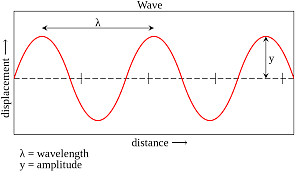
Wave Speed Formula
Also Check: Unit Of Wavelenght
The formula of Wave Speed
[Click Here for Sample Questions]
The wave speed formula involves wavelength and frequency. This is given by:
| v = f λ |
Where the symbols are abbreviated as follows:
- v represents the velocity of the wave
- f is the frequency of the wave
- λ is the wavelength
Also Check: Difference between Speed and Velocity
Examples of Wave Speed
[Click Here for Previous Year Questions]
Example 1: The wavelength with which a light wave travels is 600 nm. Determine its frequency.
Solution: Given: Wavelength λ = 600 nm,
Velocity of light v = 3 x 10⁸ m/s²
The frequency is calculated by,
f = v / λ
=3 x 10⁸/600 x 10-9
f= 5 x 10¹⁴ Hz
The frequency of the light wave is f= 5 x 10¹⁴ Hz
Also Check: Difference between Gravitation and Gravity
Example 2: The wavelength of a sound wave is 1.5 mm. Determine its frequency.
Solution: Given:
Wavelength λ = 1.5 mm,
Velocity of sound v = 343.2 m/s.
The frequency is calculated by,
f = v / λ
= 343.2 /1.5 x 10-3
f= 228 x 103 Hz
The frequency of the light wave is f= 228 x 103 Hz
Things to Remember
- A wave is a disturbance or oscillation through a moving medium.
- Frequency is the number of waves passing through a point in a unit of time (second), and the reciprocal of that is the wave's time period.
- The formula for wave speed is v = f λ.
- These relationships and the wave speed formula can be used to determine the unknown values when the remaining values are given.
Also Check: Class 11 Physics Notes
Important PYQ’s Based On Wave Speed Formula
- Interference was observed in the interference chamber where... [NEET - 1993]
- A wave traveling along a string is described by the equation... [MHT CET - 2008]
- For the constructive interference the path difference between... [KCET - 2009]
- A person with a vibrating tuning fork of frequency... [KCET - 2013]
- An air column, closed at one end and open at the other, resonates... [NEET 2016]
Sample Questions
Ques. Define a Wave. (1 Mark)
Ans: A wave, in physics, can be defined as a disturbance or oscillation that travels across space-time and is associated with an energy transfer. We can observe an ocean wave as it travels across the medium, which is the ocean water. In addition, the crest of the wave may be seen traveling from one site to another over a period.
Ques. What is the relationship between time period and frequency? (1 Mark)
Ans: The number of waves traveling through a point in a unit of time (second) is called frequency, and the reciprocal of it is the time period of the wave. The wave's wavelength is the distance it travels in a single time period.
What is the formula for wave speed? (2 Marks)
Ans: The wave speed formula is given by:
v = f λ
Where, the symbols are abbreviated as follows:
- v represents the velocity of the wave
- f is the frequency of the wave
- λ is the wavelength
Ques. A wave with a frequency of 5 Hz has a speed of 25 m/s. What is the wave’s wavelength? (2 Marks)
Ans: Wave’s wavelength is:
f = 5 Hz
v = 25 m/s
λ = ?
v = λ ⋅f ⇒ λ = v f = 25/5 = 5 m
Ques. A wave having a frequency of 50 Hz, has a wavelength of 10 m. What is the wave's speed? (2 Marks)
Ans: Wave’s speed is
f = 50 Hz
λ =10 m
v =?
v = λ ⋅f = 10⋅50= 500 m/s
Ques. What is the frequency of a wave with a wavelength of 10 m and a speed of 340 m/s? (2 Marks)
Ans:
λ =10 m
v = 340 m/s
f=? v = λ ⋅f ⇒ f = v λ = 340 /10 = 34 Hz
Ques. The speed of a wave is 900 m/s in a certain medium. In 2 minutes, 3000 waves pass over a certain point of the medium. Compute its wavelength. (3 Marks)
Ans: The speed of a wave in medium v = 900 ms-1
Freq. of wave = no. of waves passing per sec (n) = 3000 waves/2min = 3000 / 2×60 = 25s
Wavelength = λ =?
v = n λ
λ = v/n
A = 900/25 =36m
A = 36m
Answer: λ = 36 m
Ques. The bottom of a ship in the sea shoots SONAR waves straight down into the seawater. After 3.5 seconds, the signal reflects off the deep bottom bedrock and returns to the ship. When the ship has moved 100 km, it transmits another signal, which is received again after 2s. Calculate the depth of the sea in each situation, as well as the height difference between the two. (4 Marks)
Ans: The velocity of SONAR waves in water C = 1500 ms-1
Time taken by a wave after reflection from the bottom of sea
2t = 3.5s
t =1.75s
Distance covered (d)=?
C = d/t => d = c.t = 1500 × 1.75 - 2625 m
After moving 100km
The time taken by the wave = 2t = 2s
T = 2/2 = 1s
d =?
d = 1500 × l
= 1500
The different between these two heights= 2625 - 1500
= 1125m
Answer: Δd = 1149.75
Ques. Define a wave speed? (1 Mark)
Ans: A wave speed can be described as the total distance traveled by a given point on the wave in a given interval of time. The equation that define wave speed is ‘Speed = Distance / Time’
Ques. Define two features of waves. (2 Marks)
Ans: Features of waves are as follows:
- The number of waves traveling through a point in a unit of time (second) is called frequency, and the reciprocal of it is the time period of the wave.
- The wave's wavelength is the distance it travels in a single time period.
| Chapter Related Articles | ||
|---|---|---|
| Difference between Distance and Displacement | Work, Energy and Power | Motion in a Straight Line |
| Laws of Motion | Motion | System of Particles & Rotational Motion |
| Physics Study Guides | ||
|---|---|---|
| NCERT Solutions for Class 11 Physics | NCERT Solutions For Class 6 to 12 | Physics MCQs |



Comments