



Exams Prep Master
Bases are compounds that dissolve in water and produce OH- ions, as well as molecules or ions that can take a hydrogen ion from an acid. On the basis of strength, bases are divided into strong bases and weak bases. Weak bases are the bases that don’t dissolve completely on dissolution in water. Here, we will discuss the weak bases, ionization, example along with some important questions.
What are Weak Bases?
Weak bases are bases that do not dissolve into their constituent ions when dissolved in a solution. Its aqueous solution contains both a weak base and its conjugate acid. When it is dissolved in a solution, it dissociates into hydroxide anions and the relevant conjugate acid, and another part remains undissociated inside the solution.
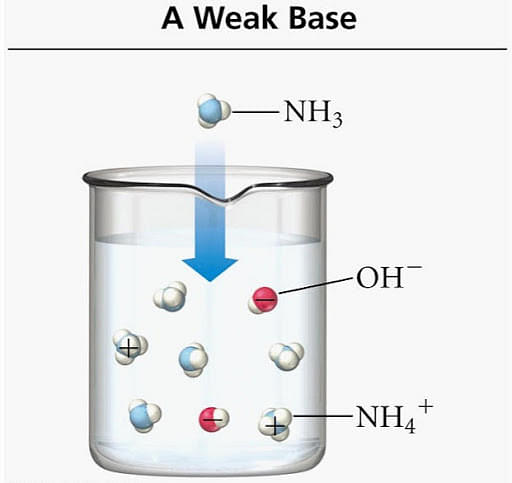
When a weak base is dissolved, it gives rise to the following equilibrium,
B + H2O ? BH+ + OH–
A lone pair of electrons, in the above reaction, which is present in the basic molecule accepts a proton from the water molecule and this results in the formation of a hydroxide ion. The base will be weaker with a greater concentration of the equilibrium towards the left.
Classification of Bases
Based on the strength, concentration, and acidity, bases can be widely classified.
Based on Concentration
- Concentrated base: A concentrated base implies an aqueous solution that has a relatively high percentage of the base in the solution. For instance, Concentrated sodium hydroxide, concentrated ammonium hydroxide, concentrated potassium hydroxide, etc.
- Diluted base: A dilute base refers to the aqueous solution which consists of a relatively low percentage of the base in the solution. For instance, dilute sodium hydroxide, dilute ammonium hydroxide, dilute potassium hydroxide, etc.
Based on Strength
- Strong base: These are the bases that dissolve completely in water. For example, KOH, NaOH, etc.
- Weak base: These are the bases that do not completely dissolve in water. For example, NH3, Zn(OH)2.
Based on Acidity of Bases
- Monoacidic base: These are one hydroxyl ions that combine with only one hydrogen ion. Eg: Sodium hydroxide, Ammonium hydroxide, etc.
- Diacidic base: These are two hydroxyl ions and combine with two hydrogen ions. Eg: Calcium hydroxide, copper (II) hydroxide, etc.
- Triacidic base: These are three hydroxyl ions that combine with three hydrogen ions. Eg: Aluminium hydroxide, ferric hydroxide, etc.
Ionization of Weak Bases
An arrow pointing from left to right represents the reaction sign for a strong base ionized in water. The reaction arrow for a weak base ionized in water, on the other hand, is a double arrow, indicating that both the forward and reverse reactions are in equilibrium. The weak base, its conjugate acid, and the hydroxide ion are all present in the aqueous solution at equilibrium circumstances.
Examples of Weak Bases
Ammonia (NH3)

Ammonia, an inorganic compound, is formed of a single nitrogen atom covalently bonded with three hydrogen atoms. It is a colourless gas and is characterised by its pungent smell. Ammonia dissociates into ammonium cation and hydroxide ions when dissolved in water.Only a part of the dissolved ammonia dissociates into these ions.
The molar mass of this base = 78 g/mol.
The boiling point of this base = -33.34oC.
The density of ammonia = 2.42 kg/m3.
The melting point of this base = 300oC
Trimethylamine (N(CH3)3)

It is a weak base. This compound can be prepared by reacting ammonia with methanol in the presence of a catalyst. This particular base can also be produced by the reaction between paraformaldehyde and ammonium chloride.
The molar mass of this base = 59.11 g/mol.
The boiling point of this base = 2.9oC.
The density of ammonia = 670 kg/m3.
Pyridine (C5H5N)

Pyridine has a chemical compound with a heterocyclic structure and is a weak base. The pyridine’s structure is equivalent to that of benzene, however, one of the methine groups is replaced with a single nitrogen atom. At STP, pyridine is known to be a colourless liquid. Moreover, pyridine behaves as a Lewis base, which also has the ability to donate electron pairs to Lewis acids.
The molar mass of this base = 79.1 g/mol.
The density of ammonia = 982 kg/m3.
The boiling point of this base = 115.4oC
Applications of Bases
Weak bases, like weak acids, possess important applications in the biochemical studies, physiological purposes, chemistry reactions. They are widely used up because of their role in buffer solutions. Weak bases can be used to catalyze certail reactions as well, such as enolate formation.

Magnesium hydroxide: It is used as an antacid to correct the excess amount of acidity in the stomach.
Calcium hydroxide: It plays a pivotal role in whitewash and mortar.
Sodium hydroxide: It is an important ingredient in manufacturing of soaps and detergents.
Ammonium hydroxide: It is used to make fertilizers, rayon, plastics, and dyes, and as a reagent in a chemical laboratory
Recommended video:
Things to Remember
- The base that is partially ionized in water and produces a very small amount of hydroxide ions is the wek base.
- When a weak base is dissolved, it gives rise to the following equilibrium,
B + H2O ? BH+ + OH–
- Based on the strength, concentration, and acidity, bases can be widely classified.
- Weak bases have less dramatic effect on pH.
- Weak bases can be used to catalyze certain reactions like enolate formation.
- Some of the examples of weak bases are ammonia, pyridine, trimethylamine, zinc hydroxide, ferric hydroxide, copper hydroxide etc.
Sample Questions
Ques. What is meant by weak bases? (2 marks)
Ans: Weak bases are bases that do not dissolve into their constituent ions when dissolved in a solution. Its aqueous solution contains both a weak base and its conjugate acid. When it is dissolved in a solution, it dissociates into hydroxide anions and the relevant conjugate acid, and another part remains undissociated inside the solution.
When a weak base is dissolved, it gives rise to the following equilibrium,
B + H2O ? BH+ + OH–
Ques. Is water a weak base? (2 marks)
Ans: Yes, pure water acts as a weak base. The pure water acts as both a weak acid and a weak base as a small amount of water dissociates into protons and hydroxide anions, binding with the remaining water molecules to form hydronium ions and hydroxide ions.
Ques. Is Sodium Hydroxide a weak base? (2 marks)
Ans: No, Sodium hydroxide is not a weak base. It is a chemical compound with the formula NaOH and is known to be a strong base. This is because sodium hydroxide undergoes almost complete ionization when it is dissolved in water.
Ques. Which one of the following is not a conjugate acid-base pair? (1 mark)
- NH3 and NH4+
- H3O+ and OH-
- H2PO4- and HPO42-
- HS- and H2S
- NH3 and NH2-
Ans: The correct option is b. H3O+ and OH-
Ques. Ammonia (NH3) acts as a weak base in an aqueous solution. What is the acid that reacts with this base when ammonia is dissolved in water? (1 mark)
- none, there are no acids in pure water
- H3O
- NH4+
- trick question, because no acids are present, ammonia cannot act as a base
- oxygen that always is dissolved in water
Ans: The correct option is b. H3O
Ques. What is the acidity of a base? Give some examples. (3 marks)
Ans: Upon dissociation in water, the number of hydroxyl ions that one molecule of a base gives is the acidity of a base.
There are three tyes:
- Monoacidic base: These are one hydroxyl ions that combine with only one hydrogen ion. Eg: Sodium hydroxide, Ammonium hydroxide, etc.
- Diacidic base: These are two hydroxyl ions and combine with two hydrogen ions. Eg: Calcium hydroxide, copper (II) hydroxide, etc.
- Triacidic base: These are three hydroxyl ions that combine with three hydrogen ions. Eg: Aluminium hydroxide, ferric hydroxide, etc.
Ques. State some of the properties of bases. (4 marks)
Ans: Some of the properties of bases are as follows:
- Bases turns red litmus into blue.
- They taste bitter.
- Bases are slippery and soapy.
- Some bases are also good conductors of electricity.
Ques. List three examples of weak bases. (3 marks)
Ans: The three examples of weak bases are:
- Ammonia: Ammonia, an inorganic compound, is formed of a single nitrogen atom covalently bonded with three hydrogen atoms. It is a colourless gas and is characterised by its pungent smell.
- Trimethylamine: It is a weak base. This compound can be prepared by reacting ammonia with methanol in the presence of a catalyst. This particular base can also be produced by the reaction between paraformaldehyde and ammonium chloride.
- Pyridine: Pyridine has a chemical compound with a heterocyclic structure and is a weak base. The pyridine’s structure is equivalent to that of benzene, however, one of the methine groups is replaced with a single nitrogen atom.
Ques. What is meant by strong bases and weak bases? Classify the following into strong and weak bases. (3 marks)
NH4OH, Ca(OH)2, NaOH, KOH, Mg (OH)2
Ans: The base which ionizes completely in water and produces a large amount of hydroxide ions is the strong base.
The base that is partially ionized in water and produces a very small amount of hydroxide ions is the wek base.
Strong bases: NaOH, KOH
Weak bases: NH4OH, Ca(OH)2, Mg (OH)2
Ques. Classify the following bases as strong and weak bases: (2 marks)
NaHCO3, NaOH, KOH, Ca(OH)2, Mg (OH)2
Ans: Strong bases: NaOH, KOH
Weak bases: NaHCO3, Ca(OH)2, Mg(OH)2
Ques. Based on concentration, write the classification of bases. (3 marks)
Ans: Based on the concentration, bases can be divided into:
- Concentrated base: A concentrated base implies an aqueous solution that has a relatively high percentage of the base in the solution. For instance, Concentrated sodium hydroxide, concentrated ammonium hydroxide, concentrated potassium hydroxide, etc.
- Diluted base: A dilute base refers to the aqueous solution which consists of a relatively low percentage of the base in the solution. For instance, dilute sodium hydroxide, dilute ammonium hydroxide, dilute potassium hydroxide, etc.



Comments