



Content Curator
Cube is a solid object bounded by 6 square faces, or sides, with 3 meetings at each vertex, 8 vertices, and 12 edges. It is a three-dimensional figure and one of the five Platonic solids. Rubik’s Cube, Dice, and ice cube are a few real-life examples of a cube. The cube has an octahedral or cubical symmetry and therefore is also known as a square parallelepiped, an equilateral cuboid, or a right rhombic hexahedron. Since all its faces are squares, it is also known as the convex polyhedron.
Also read: Difference Between Cube and Cuboid
| Table of Content |
Key Terms: Cube, Square, Face, Length, Breadth, Height, Edge, Vertices, Side, Diagonal, Surface Area
Cube Definition
[Click Here for Sample Questions]
Cube is a symmetrical three-dimensional figure and the only regular hexahedron. In a cube, each face is connected to four edges and vertices; each edge is connected to two faces and two vertices: and each vertex is connected to three faces and three edges. A cube is either solid or hollow and is contained by 6 equal squares, which is a two-dimensional shape.
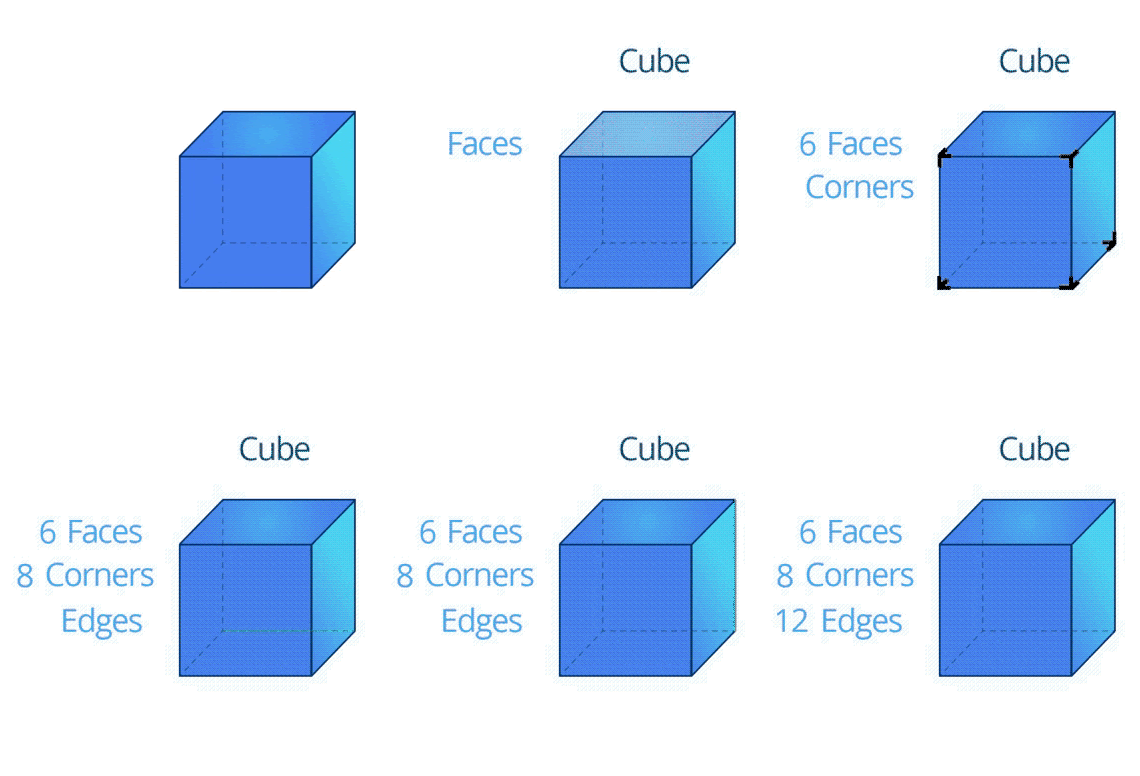
Faces, Corners, and Edges of Cube
Read Also: Area of a Triangle
Shape of Cube
[Click Here for Sample Questions]
The shape of a cube is cubic i.e. the shape of six equal squares. A cube has 6 square faces (all having the same dimensions) and all the sides of a cube are of the same length. Since, a cube is a 3-D figure of a square with all the sides of the same dimension, the length, breadth, and height of the cube have the same measurement.
In cube, the plain flat surface is known as the face of the cube. All the faces of the cube are connected by the vertices. The cube’s edges represent its length, breadth, and height and they are connected at a single point (or corner) known as the vertex.

Chamfered Cube from Cube
Properties of Cube
[Click Here for Sample Questions]
Following are the general properties of a cube:
- A cube is a special kind of square prism as all the sides of a cube are square in shape.
- The dimensions of the sides of a cube are of the same size.
- The opposite faces of the cube are parallel to each other and so are the edges.
- The angle formed between two faces is 90°.
- Each face is connected to the other four faces and the four edges.
- Each vertex is connected to the three sides and three edges.
Also Read: Operations on Rational Numbers
Formula of Cube
[Click Here for Sample Questions]
The cube has different formulas for calculating the length of a diagonal, lateral surface area, total surface area, and volume of a cube. These formulas are discussed in detail below.
Read Also: Quadrilateral Formula
Length of a Diagonal
A cube diagonal is a line segment that connects two vertices that are not the endpoints of an edge. A cube has diagonals of different lengths – one is the shorter diagonal that lies on the square faces, known as the face diagonal and the other is the longer one that passes through the centre and is known as the main diagonal.
In all, there are 12 face diagonals and 4 main diagonals that connect the non-adjacent vertices of the cube. To calculate the length of the diagonal of a cube, the following formula is used:
Let a be the length of each side of the cube. Then,
- Length of a face diagonal of a cube= √2a units
- Length of the main diagonal of a cube =√3a units

Length of a Diagonal
Lateral Surface Area
The area of all the side faces of the cube excluding the area of the top and bottom faces is known as the lateral surface area of the cube or L.S.A. In total there are 4 side faces, so the total area of these 4 faces is the L.S.A. and it is measured in square units.
Let a be the length of each side of the cube. Then,
Area of one face= Area of a square= a²
Lateral Surface Area of a Cube= 4 × ( area of one face)
= 4a² square units.

Lateral Surface Area
Total Surface Area
The total area that the surface of a cube occupies is called the total surface area of a cube or T.S.A. The total surface of a cube is calculated either by adding the area of the top and bottom surfaces to the lateral surface area of the cube or by multiplying the area of one face of the cube and 6 (as there are 6 faces of a cube). Since a cube is a three-dimensional figure, the area occupied by it will be in the 3-D plane. To calculate the total surface area of a cube, the following formula is used:
Let a be the length of each side of the cube. Then,
Area of one face= Area of a square= a²
Total Surface area of a cube= 6 × (area of one face)
= 6a² square units.
Or it can be calculated as,
T.S.A. = Area of the top and bottom faces +L.S.A.
=( a²+a² )+ 4a²
=6a² square units
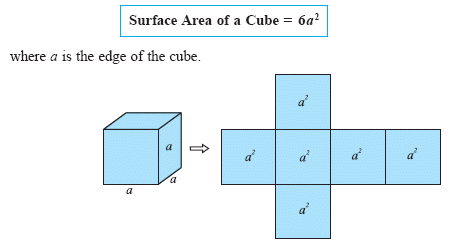
Total Surface Area
Volume
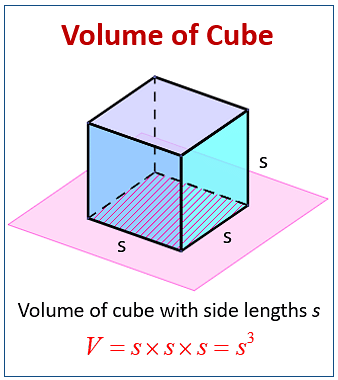
The volume of a cube is defined as the space occupied by it. To determine the volume of the cube, two formulas can be used. Following are the formulas used:
Let a be the length of each side and d be the length of the diagonal of a cube. Then,
The Volume of a Cube (based on side length) = a3
The volume of a Cube (based on diagonal) = (√3×d3)/9
Difference Between Square and Cube
[Click Here for Sample Questions]
Following are the differences between a square and a cube:
| Square | Cube |
|---|---|
| It is a two-dimensional figure with length and breadth. | It is a three-dimensional figure with length, breadth, and height. |
| It has four sides and four vertices. | It has six sides and eight vertices. |
| Clock, paper napkins, cheese are a few examples of a square. | Rubik's cube, Dice, ice cube are a few examples of a cube. |
Also Read: Algebra
Difference Between Cube and Cuboid
[Click Here for Sample Questions]
Following are some main differences between a cube and a cuboid:
| Cube | Cuboid |
|---|---|
| A 3D shape of a square | A 3D shape of a rectangle |
| The dimensions of length, breadth, and height are equal i.e. sides/edges are equal | The dimensions of length, breadth, and height are not equal i.e. sides/edges are not equal |
| In a cube, all the six faces are squares | In a cuboid, all six faces are rectangles |
| Rubik's cube, sugar cube, blocks are a few examples | Bricks, lunch box, are a few examples of a cuboid |
Things to Remember
- A cube is a three-dimensional polygon of a square that has equal dimensions of length, breadth, and height.
- A cube is known as the special case of a square prism.
- To calculate the volume, area, and length of the diagonal of a cube different formulas are used.
- The length of the edge of a cube is calculated by a= Vâ…“, where a is the length of the edge and V is the volume of the cube.
Know more: Surface Areas and Volumes Revision Notes
Sample Questions
Ques. The length of the edge of a cube is 5 cm. Find its volume and surface area. (3 marks)
Ans. Length of the edge of a cube(a) = 5cm
Volume of the cube= a³
= 5×5×5 cm³
= 125cm³
Surface area of the cube= 6a²
= 6×5×5
=150cm²
Ques. Find the diagonals of a cube when length of the edge is 10cm. (2 marks)
Ans. Length of the edge = 10cm
Length of the face diagonal of the cube =√2a
=√2×10 cm
=10√2 cm
=14.14 cm
Length of the main diagonal of the cube =√3a
=√3×10 cm
=10√3 cm
=17.32 cm
Ques. Total Surface Area of a cube is 2568 cm². Find its side. (2 marks)
Ans. Total Surface Area = 2568 cm²
6a²= 2568 cm²
a² = 2568/6 cm²
a² = 428 cm²
a= √428 cm²
a = 20.69 cm
Side of the cube= 20.69 cm
Ques. Find the lateral surface area and total surface area of a cube of side 6cm. (3 marks)
Ans. Lateral Surface area of a cube = 4a²
= 4×6×6 cm²
= 144 cm²
Total Surface Area of a cube = 6a²
= 6×6×6 cm²
= 216 cm²
Ques. Find the edge of the cube if its volume is 343cm³. Hence, find its total surface area. (3 marks)
Ans. Volume of the cube = 343 cm³
a³= 343 cm³
a = (343)â…“
a = 7cm
Therefore, Total Surface Area = 6a²
= 6×7×7
= 294 cm²
Ques. Find the length of the edge of a cube if its lateral surface area is 256cm². (2 marks)
Ans. Lateral Surface area of a cube = 256cm²
4a²= 256 cm²
a²= 256/4 cm²
a² = 64 cm²
a = 8 cm.
Ques. How will the volume of a cube be affected, if its edge is (i) halved (ii) trebled? (4 marks)
Ans. Let the edge of a cube be a cm
The volume of a cube will be a³cm
(i) When halved
Edge = a/2
Volume = (a/2)3 = a3/23 = a3/8 = 1/8times
(ii) When trebled
Edge = 3a
Volume = (3a)3 = 27a3 = 27times
Ques. A red cube has a side four times as long as that of a black cube. What is the ratio of the volume of cube red to that of cube black? (4 marks)
Ans. Given details are,
Let side of cube black be ‘x’ cm
Then, side of cube red = 4x cm
So now,
Ratio = volume of cube red / volume of cube black
= (4x)3 / (x)3
= 64x3/ x3 = 64/1 = 64:1
Also Read:



Comments