





The University of Hamburg acceptance rate is widely estimated at around 18 to 36% by education aggregators, but the university does not publish an official figure because admission in Germany works through program-level cutoffs rather than a single admit rate. The real gatekeeper is the Numerus Clausus system, not a holistic acceptance percentage.
- No official acceptance rate exists, so quoted figures are unofficial estimates that vary by source and program.
- Admission is decided by Numerus Clausus cutoffs and meeting requirements, not by a fixed admit percentage.
- Roughly three-quarters of programs carry some admission restriction, while many remain open to all qualified applicants.
- For Indian students, the real hurdles are the APS certificate, language proof and the grade cutoff, not a mysterious quota.
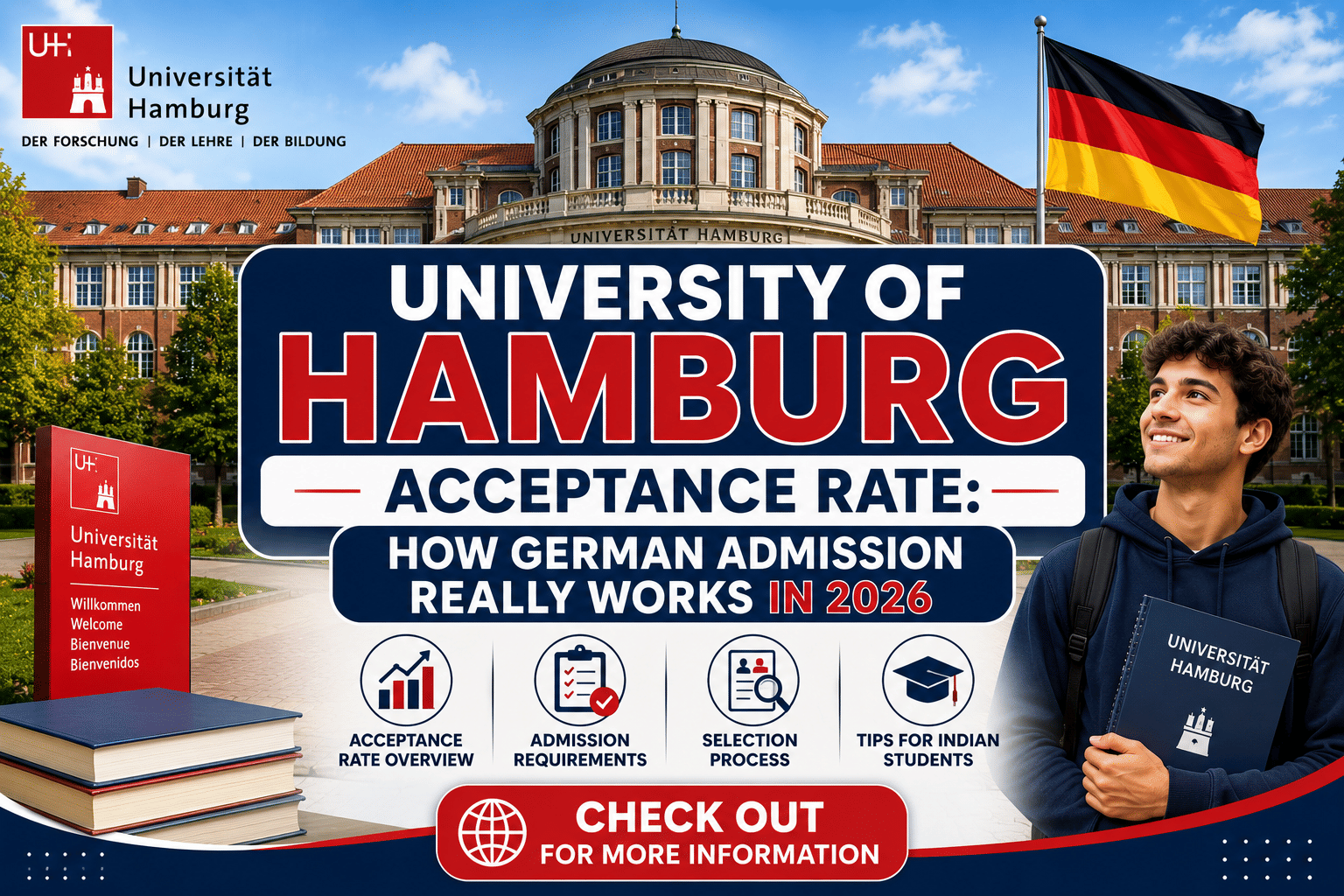
The University of Hamburg teaches more than 43,000 students, of whom about 14% are international, and charges no tuition fees. Understanding how German admission actually works tells you far more about your chances than any single acceptance-rate number can.
| Parameter | Detail |
|---|---|
| Acceptance rate (unofficial estimate) | Around 18 to 36%, varies by source |
| Admission system | Numerus Clausus cutoffs by program |
| Tuition fees | None, public university |
| Semester contribution | Around EUR 384 (around INR 41,400) |
| APS certificate | Mandatory for Indian students |
| English Master's language proof | IELTS 6.0 to 6.5 or TOEFL 80 to 90 |
| Blocked account for visa | Around EUR 11,900 (around INR 12.8 lakh) |
Conversions based on a EUR-INR rate of INR 107.80 as of June 29, 2026. Rates fluctuate so, check the current rate before financial planning.
Also Read:
- University of Hamburg admission requirements
- University of Hamburg Rankings 2026
- University of Hamburg Courses and Fees 2026
What The Acceptance Rate Means
The University of Hamburg acceptance rate is not an official statistic, so the figures you see online are estimates that differ from one source to another. Quotes range from about 18% to 36%, which alone tells you the number is not authoritative.
German public universities do not run a US-style holistic admissions process with a published admit rate. Instead, each program either accepts all applicants who meet the requirements, or, where places are limited, ranks applicants by grade and sets a cutoff. The result is that your odds depend on your program and your grades, not on a single university-wide percentage.
One aggregator estimates the overall rate near 36% while noting that around 78% of programs carry some form of admission restriction. Another places it closer to 18 to 24%. These are useful as a rough signal of selectivity, but they should not be treated as fixed odds.
Note: Chasing a single acceptance-rate number is the wrong question for a German university. The right question is whether your program is admission-free or restricted, and if restricted, what last cycle's grade cutoff was.
If your target program is admission-free, then meeting the requirements effectively secures your place. If it is restricted, then your grade ranking decides the outcome. That means the same applicant can have very different odds across two programs at the same university.
Also Read:
- Study in Germany: Find Universities, Fees and Visa Guide
- Public Universities in Germany
- Public Universities in Germany for Indian Students 2026
How German Admission Works
Admission at the University of Hamburg turns on meeting the entry requirements and, for restricted programs, clearing a grade-based cutoff, rather than on a holistic acceptance rate. The process is standardised and credential-driven.
For undergraduate study, you need a school-leaving qualification recognised as equivalent to the German Abitur. For a Master's, you need a relevant Bachelor's degree, usually with a minimum grade. The university assesses your documents, transfers your grade to the German scale and then applies it to the program's rules.
Two types of programs
- Admission-free programs: all qualified applicants are admitted, with no grade competition.
- Restricted programs: limited places are ranked by grade, and a cutoff is set each cycle.
The university reports that a large share of its programs carry some restriction, but it also lists many admission-free options. Which category your program falls into matters far more than any headline acceptance figure.
If you meet the academic and language requirements for an admission-free Master's, then your application is essentially about completing the documents correctly. That means accuracy and deadlines, not a competitive admit rate, decide most of these outcomes.
Numerus Clausus And Cutoffs
The Numerus Clausus, or NC, is the system that sets a grade cutoff for restricted programs at the University of Hamburg. It is the closest thing Germany has to a competitive acceptance threshold.
For NC programs, the university allocates part of the places by grade point average from your previous qualification. Selection depends on how many people apply for the available places, so the cutoff moves each cycle. The German grading scale runs from 1.0, the best, to 4.0 as the pass mark, so a lower number is a stronger grade.
Competitive subjects behave very differently from open ones. Programs like Medicine, Law and Psychology are highly selective, while many humanities and social science courses are more accessible or admission-free.
Note: An NC is not a fixed bar you can check years ahead. It is set by that cycle's applicant pool, so last year's cutoff is a guide, not a guarantee. A strong grade is the only reliable hedge.
If your program is NC-restricted and your grade sits above the recent cutoff, then your chance is strong. If it sits below, then the same program becomes a reach. That is why your converted German grade, not a generic acceptance rate, is the number to focus on.
Requirements For Indian Students
Indian students applying to the University of Hamburg must meet academic, language and document requirements that go beyond any acceptance-rate consideration. Missing one of these is a more common cause of rejection than the cutoff itself.
Core requirements
- Academic: a recognised Class 12 qualification for Bachelor's, or a relevant Bachelor's degree for Master's.
- Master's grade: typically a minimum around 75%, or 2.5 on the German scale, depending on the program.
- Language: German at C1 for German-taught courses, or IELTS 6.0 to 6.5 for English Master's.
- APS certificate: mandatory verification of your qualifications for Indian applicants.
The university confirms that for Bachelor's degree certificates from China, India and Vietnam, you must submit a verifying APS certificate. The evaluation of your foreign qualifications by the university itself is free, though you pay for any certified translations you need.
Many Indian applicants without German target the English-taught Master's programs in fields like computer science, data science, economics and life sciences. For these, you usually need IELTS 6.0 to 6.5 or TOEFL 80 to 90, and in some cases a medium-of-instruction letter can substitute for a test.
If your documents are complete and your grade clears the program's bar, then your application is competitive. That means the document checklist, especially the APS, deserves as much attention as your grades. You can cross-check the full picture against the University of Hamburg overview for international students before you apply.
APS And Language Proof
The APS certificate and language proof are the two documents that most often delay or block an Indian student's application to the University of Hamburg. Both take time, so they should be started early.
The APS, or Akademische Prüfstelle, verifies your academic documents before you apply to German universities. For Indian applicants it is mandatory, and processing takes time, so beginning the APS process months ahead of your deadline avoids a last-minute scramble.
Language routes
| Program type | Language proof |
|---|---|
| German-taught Bachelor's | German C1 (DSH-2 or TestDaF) |
| German-taught Master's | German C1 in most cases |
| English-taught Master's | IELTS 6.0 to 6.5 or TOEFL 80 to 90 |
| Test waiver (some courses) | Medium-of-instruction letter |
PTE is also accepted in place of IELTS for some programs. Where a program allows it, a medium-of-instruction certificate from your Indian institution can replace a TOEFL or IELTS score for certain Master's applications.
If your APS is in hand and your language proof meets the program standard, then you have cleared the two biggest document hurdles. That means front-loading these two items removes most of the avoidable risk from your application.
Also Read:
- APS Certificate Germany 2026: Full Form, Fees & Process
- Germany APS 70% Class 12 Rule: Winter 2026/27 Impacts
- Germany APS Certificate 2026 70% Rule and April Deadline
Fees And Living Costs
The University of Hamburg charges no tuition fees, so the real costs for Indian students are the semester contribution and living expenses, not a course fee. This is what makes Germany so attractive compared with the UK or Australia.
As a public university, Hamburg does not charge tuition for any degree program, for German or international students alike. The only mandatory payment is a semester contribution of around EUR 384 (around INR 41,400) for Summer 2026, which funds student services and includes a public transport pass valid across Germany.
Living costs are the larger expense. International students typically spend around EUR 9,000 to 12,000 a year on rent, food, transport and health insurance, depending on lifestyle and accommodation.
For your student visa, you must also show financial proof, usually through a blocked account holding around EUR 11,900 (around INR 12.8 lakh) for one year. There is also an international application fee of around EUR 75 where you apply through the relevant portal.
Note: The headline attraction is real: a top German research university with no tuition. But budget honestly for living costs and the blocked account, since these, not tuition, are what an Indian family actually funds.
If you plan for the semester contribution, living costs and the blocked account, then Hamburg is genuinely affordable by international standards. That means the cost barrier is far lower than at comparable English-speaking destinations.
Also Read:
- Cost of Living in Germany for Indian Students
- Cost of Studying in Germany 2026: Fees and Living Cost
- Affordable Cities in Germany for International Students
Deadlines And Intakes
The University of Hamburg runs two intakes, winter and summer, with the winter intake being the larger and more important for most programs. Deadlines vary by program and applicant type, so the program page is the source of truth.
For winter-semester entry, Bachelor's applications typically run from 1 June to 15 July, with the semester starting in October. International Master's programs often have an earlier window, around 15 February to 31 March, while some general Master's deadlines fall in spring or, for summer entry, in December and January.
| Intake or program | Typical window |
|---|---|
| Bachelor's, winter semester | 1 June to 15 July |
| International Master's, winter | 15 February to 31 March |
| General Master's, summer | 1 December to 15 January |
| Semester start | October (winter) or April (summer) |
Not all programs open for the summer intake, so winter is the safer target if your program offers both. Subjects like Medicine, Dentistry and Pharmacy can have their own separate deadlines.
If you work backwards from the program deadline and allow time for the APS and language test, then you can submit a complete application on time. That means the calendar, not the acceptance rate, is what trips up most late applicants.
The University of Hamburg acceptance rate is best understood as a rough signal of selectivity, not a fixed odds figure, because German admission runs on program-level cutoffs and clear requirements. For Indian students, the path is straightforward once you reframe it: pick a program that fits your grade, complete the APS and language proof early, and apply by the right deadline. Do those three things and the question shifts from beating a quota to simply meeting a known bar. With no tuition and strong research credentials, Hamburg rewards applicants who prepare on the details rather than worry about an acceptance percentage.
FAQs
Ques. What is the University of Hamburg acceptance rate?
Ans. There is no official figure. Education aggregators estimate it at around 18 to 36%, but the university does not publish an acceptance rate. Admission is decided by program-level Numerus Clausus cutoffs and meeting requirements, not by a single admit percentage.
Ques. Is the University of Hamburg hard to get into?
Ans. It depends on the program. Restricted programs like Medicine, Law and Psychology are highly competitive, while many humanities and social science courses are admission-free. Your converted German grade and meeting the requirements matter more than any overall rate.
Ques. Does the University of Hamburg charge tuition fees?
Ans. No. As a public university, Hamburg charges no tuition for any program, for Indian or other international students. The only mandatory payment is a semester contribution of around EUR 384, which includes a Germany-wide public transport pass.
Ques. What is the APS certificate and do I need it?
Ans. The APS verifies your academic documents and is mandatory for Indian applicants to German universities, including Hamburg. Start the process early, since it takes time and a missing APS is a common reason Indian applications stall.
Ques. What is Numerus Clausus at the University of Hamburg?
Ans. Numerus Clausus, or NC, means a program has limited places allocated by grade ranking. The cutoff is set each cycle by the applicant pool, so a stronger grade improves your chances. Admission-free programs have no NC and accept all qualified applicants.
Ques. Can Indian students study at Hamburg without German?
Ans. Yes, through the 40-plus English-taught Master's programs in fields like computer science, data science and economics. These usually require IELTS 6.0 to 6.5 or TOEFL 80 to 90. Most Bachelor's programs, however, are taught in German and need C1 German.
Ques. What grade do I need for a Master's at Hamburg?
Ans. Most Master's programs expect a relevant Bachelor's with a minimum around 75%, or 2.5 on the German scale, though the exact bar varies by program. Competitive NC programs effectively require higher grades to clear the cutoff.
Ques. How much money do I need for a German student visa?
Ans. You must show financial proof, usually a blocked account of around EUR 11,900 (around INR 12.8 lakh) for one year. This covers living costs, since there is no tuition fee, and is separate from the semester contribution.
Ques. When are the application deadlines?
Ans. Winter Bachelor's applications typically run 1 June to 15 July, and international Master's programs often close around 31 March. Some general and summer-intake Master's deadlines fall in December and January. Always check your exact program page.
Ques. Is the University of Hamburg good for Indian students?
Ans. Yes. It is a large, research-strong public university with no tuition, a major-city location and many English Master's options. For Indian students, the low cost and strong reputation make it a high-value alternative to the UK or Australia.

interested in this College ?
Follow & Share this college to get information about admission.



Comments