





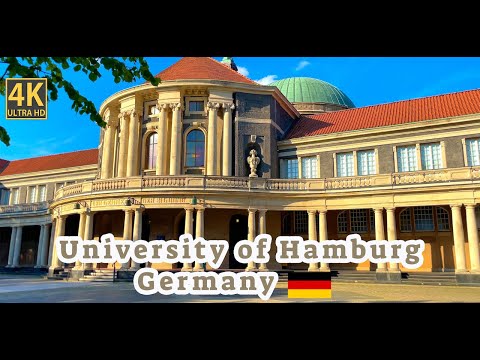
University of Hamburg, known locally as Universität Hamburg, is a public research university founded in 1919 in the port city of Hamburg, Germany. It ranks #=209 in the QS World University Rankings 2027 and is Germany’s #10 ranked institution, with eight faculties covering law, economics, life sciences, humanities, medicine, mathematics, education, and psychology.
The university enrols 42,819 students across 170 degree programmes, including 27 English-taught tracks aimed at international candidates. Indian students most often pursue Computer Science, Economics, Life Sciences, International Affairs, and Law here, drawn by German public-university MS universities in Germany and the near-zero tuition model that keeps total study cost far below UK or US peers.
- QS World Ranking 2027: #=209 (Germany #10)
- Acceptance Rate: 18-36% (estimated)
- Intakes: Winter (October) and Summer (April, select programmes)
- Semester Contribution: EUR 384/semester (INR 43,008)
- English-taught Programmes: 27 across Master’s level
- Average MS Starting Salary (Germany, market median): EUR 52,000 (INR 58.2 lakh) per annum
Also Check: MS Universities in Germany
Universität Hamburg charges no tuition for most Bachelor’s and Master’s programmes and levies only a semester contribution that covers administration and the semester public-transport ticket. Indian applicants must clear the mandatory Akademische Prüfstelle (APS) verification before applying, and post-study residence rules allow 18 months to secure skilled employment in Germany after graduation.
Exchange rate used: 1 EUR = INR 112 as of August 2026
Admission Status: Opens December 2026 (est.) for Summer 2027 intake. Applications for the Winter 2026/27 intake closed on 31 March 2026 for international Master’s applicants. Select Master’s programmes accept a Summer 2027 intake with applications expected to open December 2026 and close 15 January 2027, based on the prior cycle. The Winter 2027/28 international Master’s window is expected to run 15 February to 31 March 2027.
Table of Contents
- Popular Courses and Fees at University of Hamburg 2027
- University of Hamburg Admission 2027
- University of Hamburg Admission Requirements for Indian Applicants 2027
- University of Hamburg Acceptance Rate 2027
- Universität Hamburg Fees and Cost of Living for Indian Students 2027
- University of Hamburg Campus, Facilities and Student Life
- University of Hamburg Scholarships 2027
- University of Hamburg Rankings 2027
- University of Hamburg Placements and Career Outcomes 2027
- University of Hamburg vs Peer Universities
- University of Hamburg FAQs
Popular Courses and Universität Hamburg Fees 2027
Universität Hamburg charges no tuition on state-funded Bachelor’s and Master’s programmes. Every enrolled student instead pays a semester contribution that covers university administration, the Studierendenwerk welfare fee, and the semester public-transport ticket for Hamburg. The contribution is revised each semester and is quoted per semester, not per year.
Top 10 Postgraduate Programmes at Universität Hamburg
Most Master’s programmes at Universität Hamburg run for four semesters (two years) and carry the same semester contribution of EUR 384. Total programme contribution comes to EUR 1,536 over four semesters. Verify the exact language of instruction on each programme page before applying.
| Programme | Language of Instruction | Semester Contribution (EUR) | Semester Contribution (INR) | Entry Requirement |
|---|---|---|---|---|
| MSc Intelligent Adaptive Systems | English | EUR 384/semester (Winter 2027/28) | INR 43,008/semester (0.43 lakh) | Bachelor’s in Computer Science with 60% or CGPA 6.0/10 (recommended) |
| MSc Bioinformatics | English | EUR 384/semester (Winter 2027/28) | INR 43,008/semester (0.43 lakh) | Bachelor’s in Life Sciences with 60% or CGPA 6.0/10 (recommended) |
| MSc Molecular Life Sciences | English | EUR 384/semester (Winter 2027/28) | INR 43,008/semester (0.43 lakh) | Bachelor’s with 60% or CGPA 6.0/10 (recommended) |
| MA European Studies | English | EUR 384/semester (Winter 2027/28) | INR 43,008/semester (0.43 lakh) | Bachelor’s with 60% or CGPA 6.0/10 (recommended) |
| MA English and American Studies | English | EUR 384/semester (Winter 2027/28) | INR 43,008/semester (0.43 lakh) | Bachelor’s in English with 60% or CGPA 6.0/10 (recommended) |
| MSc Global Change Ecosystem Science | English | EUR 384/semester (Winter 2027/28) | INR 43,008/semester (0.43 lakh) | Bachelor’s in Earth/Life Sciences with 60% or CGPA 6.0/10 (recommended) |
| MSc Economics | English | EUR 384/semester (Winter 2027/28) | INR 43,008/semester (0.43 lakh) | Bachelor’s in Economics with 60% or CGPA 6.0/10 (recommended) |
| MSc Physics | English | EUR 384/semester (Winter 2027/28) | INR 43,008/semester (0.43 lakh) | Bachelor’s in Physics with 60% or CGPA 6.0/10 (recommended) |
| LLM International Law | English | EUR 384/semester (Winter 2027/28) | INR 43,008/semester (0.43 lakh) | Bachelor’s in Law with 60% or CGPA 6.0/10 (recommended) |
| MSc Ocean and Climate Physics | English | EUR 384/semester (Winter 2027/28) | INR 43,008/semester (0.43 lakh) | Bachelor’s in Physics/Earth Sciences with 60% or CGPA 6.0/10 (recommended) |
Top 5 Undergraduate Programmes at Universität Hamburg
Most Bachelor’s programmes run three years (six semesters) and are taught primarily in German. Indian applicants must show German B2 or C1 proficiency and complete the Studienkolleg or APS pathway. Total contribution across six semesters is EUR 2,304.
| Programme | Language of Instruction | Semester Contribution (EUR) | Semester Contribution (INR) | Entry Requirement |
|---|---|---|---|---|
| BSc Computer Science | German | EUR 384/semester (Winter 2027/28) | INR 43,008/semester (0.43 lakh) | Class 12 with 70% to 85% (recommended); APS certificate |
| BA Economics | German | EUR 384/semester (Winter 2027/28) | INR 43,008/semester (0.43 lakh) | Class 12 with 70% to 85% (recommended); APS certificate |
| BSc Molecular Life Sciences | German | EUR 384/semester (Winter 2027/28) | INR 43,008/semester (0.43 lakh) | Class 12 with 75% to 85% (recommended); APS certificate |
| BA English and American Studies | German and English | EUR 384/semester (Winter 2027/28) | INR 43,008/semester (0.43 lakh) | Class 12 with 70% to 85% (recommended); APS certificate |
| BSc Physics | German | EUR 384/semester (Winter 2027/28) | INR 43,008/semester (0.43 lakh) | Class 12 with 75% to 85% (recommended); APS certificate |
Insider note: Indian applicants cluster in the English-taught Master’s programmes because they bypass the German B2/C1 barrier and still deliver a state-recognised German degree, cutting the language-prep timeline by 12 to 18 months.
Universität Hamburg Admission 2027
Universität Hamburg runs two intakes per year: the main Winter semester starting October and a smaller Summer semester starting April, offered on select programmes only. Winter is the primary intake for Indian Master’s applicants because most programmes admit only in that cycle.
| Milestone | Date | Notes for Indian Applicants |
|---|---|---|
| Winter 2027/28 international Master’s application window | 15 February to 31 March 2027 | Applies to most English-taught and German-taught Master’s |
| Summer 2027 application window (select Master’s) | Expected 1 December 2026 to 15 January 2027 (based on prior cycle) | Only a subset of programmes accept Summer intake |
| APS certificate verification (India) | Start 8 to 12 weeks before the application deadline | APS certificate is mandatory before submitting |
| Winter 2027/28 programme start | October 2027 | Orientation runs in the final week of September 2027 |
Bachelor’s applications for Indian students follow a similar timeline, but restricted-admission (NC) courses close earlier and require uni-assist evaluation. Confirm programme-specific dates at the official Universität Hamburg dates and deadlines page.
Planning note: The APS interview at the German Embassy is the true bottleneck for Indian applicants and can slip beyond eight weeks in peak months. Start the APS process by October 2026 to secure a valid certificate before the March 2027 close.
Read More: Universität Hamburg Admissions Guide for Indian Students
Universität Hamburg Admission Requirements for Indian Applicants 2027
Indian applicants must clear the APS (Akademische Prüfstelle) certification and meet programme-specific academic and language thresholds before their Universität Hamburg application is processed.
Postgraduate Admission Requirements
- Academic: Four-year Indian bachelor’s degree, or a three-year bachelor’s plus one-year Indian Master’s, with 60% or CGPA 6.0/10 (recommended). Verify at the official programme page for exact minimums.
- English proficiency (English-taught programmes): IELTS or TOEFL iBT minimum set per programme. Verify at the official programme page for exact score thresholds.
- German proficiency (German-taught programmes): DSH-2 or TestDaF 4x4 (equivalent to CEFR C1) is the standard threshold. Verify at the official programme page.
- APS certificate: Mandatory for every Indian applicant, issued by the German Embassy in New Delhi.
Undergraduate Admission Requirements
- Academic: Class 12 with 70% to 85% (recommended) plus one or two semesters of successful study at an Indian university, or completion of a Studienkolleg, as India’s Class 12 alone is not accepted as direct entry.
- Language: German C1 (DSH-2 or TestDaF 4x4) for German-taught Bachelor’s; APS is mandatory alongside.
Key insight: Universität Hamburg does not usually list a numeric CGPA cutoff on English-taught Master’s programme pages. Selection is instead based on subject fit, motivation letter, and academic references, so Indian applicants with CGPA 6.0 to 7.0 and strong SOPs remain competitive.
Universität Hamburg Acceptance Rate 2027
Universität Hamburg does not publish a single institution-wide acceptance rate. Third-party estimates place the overall admit rate between 18% and 36% (estimated), with English-taught Master’s programmes trending toward the lower end because they draw a large international applicant pool for limited seats.
Restricted-admission (Numerus Clausus) subjects such as Psychology, Medicine, and Law are more selective, while open-admission Bachelor’s programmes in humanities and natural sciences admit most qualified candidates.
Reality check: Meeting the minimum CGPA does not guarantee admission for English-taught Master’s. Programme-level competition is decided on subject match and motivation, so Indian applicants should tailor SOPs to each programme rather than reuse a single template.
Read More: Universität Hamburg Acceptance Rate and Selection Guide
Universität Hamburg Fees and Cost of Living for Indian Students 2027
The total annual cost of studying at Universität Hamburg for an Indian student sits between EUR 11,568 and EUR 15,168 (INR 12.96 lakh to INR 16.99 lakh), driven almost entirely by living expenses in Hamburg rather than tuition.
Universität Hamburg Semester Contribution for Indian Students 2027
Every enrolled student pays the same contribution regardless of degree level or nationality. The figure below applies to Winter 2026/27 and is revised each semester.
| Component | Amount (EUR) | Amount (INR) |
|---|---|---|
| Bachelor’s semester contribution | EUR 384/semester | INR 43,008/semester (0.43 lakh) |
| Master’s semester contribution | EUR 384/semester | INR 43,008/semester (0.43 lakh) |
| Total Master’s contribution (4 semesters) | EUR 1,536 | INR 1.72 lakh |
Monthly Universität Hamburg Cost of Living in Hamburg for Indian Students
Hamburg is Germany’s second-largest city and sits on the higher end of German student living costs, though below Munich and Frankfurt. The city’s HVV public-transport network is covered by the semester ticket bundled in the contribution.
| Category | Monthly (EUR) | Monthly (INR) |
|---|---|---|
| Accommodation (shared or student residence) | EUR 450 to 700 | INR 50,400 to 78,400 |
| Food and groceries | EUR 200 to 260 | INR 22,400 to 29,120 |
| Transportation (covered by semester ticket) | EUR 0 | INR 0 |
| Books and study materials | EUR 30 to 50 | INR 3,360 to 5,600 |
| Personal and health insurance | EUR 120 to 150 | INR 13,440 to 16,800 |
| Total monthly cost | EUR 800 to 1,160 | INR 89,600 to 1.30 lakh |
| Total annual living cost | EUR 9,600 to 13,920 | INR 10.75 lakh to 15.59 lakh |
Indian applicants must also show a blocked account (Sperrkonto) of EUR 11,904 for the student visa, evidencing living funds for the first year.
Insider note: Student-residence spots run by Studierendenwerk Hamburg cost between EUR 280 and EUR 450 per month and are the cheapest option, but wait times stretch to six to nine months. Most Indian arrivals begin on WG (shared flat) rentals sourced through WG-Gesucht before rotating into a residence.
Read More: Cost of Study in Germany for Indian Students
Universität Hamburg Campus, Facilities and Student Life
The main Universität Hamburg campus sits in the Rotherbaum district in central Hamburg, a short S-Bahn (city-rail) ride from the main station and integrated into the city rather than walled off. Faculties are spread across the Von-Melle-Park and adjoining streets, alongside satellite locations for medicine (Eppendorf) and marine science (Bundesstraße).
- Location: Rotherbaum, central Hamburg, connected by S-Bahn (Dammtor station) and multiple bus lines; semester ticket covers all local transport.
- Housing: Studierendenwerk Hamburg runs 25 residences with about 4,300 beds; no guaranteed allocation for international students, so most rely on WG rentals in Altona, Eimsbüttel, or Hamm.
- Facilities: Staats- und Universitätsbibliothek Hamburg (state library) with over 5 million volumes is the university library and open to all students.
- Indian community: Indian Students Association at UHH hosts orientation and cultural events; the wider Hamburg metropolitan area is home to a growing Indian professional community around Airbus and shipping firms.
What Indian students say: Indian graduates highlight the strength of the marine science and physics faculties, and describe Hamburg as more affordable and less crowded than Munich, though winter daylight from November to February is short and needs adjustment.
Universität Hamburg Scholarships 2027
Universität Hamburg does not offer large tuition-waiver scholarships because tuition is already waived; funding for Indian students is instead channelled through the national Deutschlandstipendium and external DAAD awards. Verify each award value and deadline at the official page.
| Scholarship | Type | Award Value | Eligibility | Deadline |
|---|---|---|---|---|
| Deutschlandstipendium | Merit | EUR 300/month (INR 33,600) for two semesters | Enrolled students with strong academic performance | Verify at official Universität Hamburg scholarships page |
| DAAD Study Scholarship for Graduates | External (German government) | EUR 992/month (INR 1.11 lakh) plus insurance and travel | Indian applicants with a completed bachelor’s degree and admission to a German Master’s | Verify at official DAAD India page |
Planning note: DAAD Study Scholarship applications close roughly one full year before the intended start date, so Indian applicants targeting Winter 2027/28 at Universität Hamburg should file their DAAD form in the second half of 2026, not alongside the university application.
Universität Hamburg Rankings 2027
Universität Hamburg’s strongest global signal is its THE World University Rankings position at #=125 in the 2026 edition. Its QS World rank has slipped slightly from #191 in 2025 to #=209 in 2027, while THE has moved marginally up from #132 to #=125 over the same window.
| Ranking Body | Latest Edition | Previous Edition | Two Editions Back |
|---|---|---|---|
| QS World University Rankings | 2027: #=209 | 2026: #193 | 2025: #191 |
| Times Higher Education World | 2026: #=125 | 2025: #132 | 2024: #132 |
| US News Best Global Universities | 2025-2026: #146 | NA | NA |
| ARWU Shanghai | 2025: #201-300 | 2024: #201-300 | 2023: #201-300 |
| Collegedunia Study Abroad | #114 (Global) / #11 (Germany) | NA | NA |
Subject strength shows clearly in THE Subject 2026 rankings: Law #73, Arts and Humanities #77, and Education Studies #=96. Collegedunia Study Abroad ranks Universität Hamburg #49 globally for Law and #81 for Arts. [Source: QS, THE, US News, ARWU, Collegedunia Study Abroad]
Key insight: Both QS and THE list Universität Hamburg well inside the global top 250, which satisfies the Indian education-loan cutoffs of most public-sector banks and comfortably meets the ranking threshold for a German post-study Blue Card application.
Read More: Universität Hamburg Rankings Analysis
Universität Hamburg Placements and Career Outcomes 2027
Universität Hamburg does not run a centralised campus placement programme; graduates find roles through the Career Centre, faculty networks, and Hamburg’s employer base in logistics, shipping, aerospace, and media.
- Median starting salary (Germany, market median for Master’s graduates): EUR 52,000 (INR 58.2 lakh) per annum
- Top hiring sectors: Aerospace (Airbus is Hamburg’s largest private employer), shipping and logistics, media, life sciences, and public administration
- Post-study work visa: 18 months to find skilled employment; conversion to EU Blue Card once a qualifying job offer with EUR 45,300 minimum salary (2026 threshold) is signed
- Career support: Career Centre runs employer events, CV workshops, and internship listings; discipline-specific placement help comes through faculty partnerships
- Indian alumni presence: Growing footprint across Airbus, Lufthansa Technik, and Hamburg-based fintech and marine research organisations
Insider note: Indian graduates from technical Master’s (Computer Science, Bioinformatics, Physics) place fastest because English is the working language in Hamburg tech firms, while humanities graduates typically need working German B2 or higher to convert internships into full-time offers.
Universität Hamburg vs Peer Universities
The peer set below compares Universität Hamburg with three other German public universities and one European alternative that Indian students commonly weigh in the QS 150 to 250 band.
| University | QS Rank 2027 | Collegedunia Study Abroad | Avg Annual PG Contribution | Differentiator |
|---|---|---|---|---|
| Universität Hamburg | #=209 | #114 | EUR 768 (INR 0.86 lakh) | Strong law, marine, and climate science; port-city employer base |
| University of Cologne | #297 | #123 | EUR 620 (INR 0.69 lakh) | Larger economics and management footprint |
| Goethe University Frankfurt | #333 | #131 | EUR 780 (INR 0.87 lakh) | Finance capital location and stronger banking recruiter access |
| University of Bonn | #=252 | #118 | EUR 600 (INR 0.67 lakh) | Mathematics and economics research strength |
| KU Leuven (Belgium) | #=53 | NA | EUR 6,600 (INR 7.39 lakh) | Higher global rank at higher fees; English-taught depth |
Universität Hamburg stands out for the combination of a top-250 QS position, near-zero contribution costs, and specific research strength in law, oceanography, and physics. Frankfurt and Cologne carry stronger business-employer weight, while KU Leuven trades higher tuition for a materially higher global rank.
Universität Hamburg suits Indian students with CGPA 6.0 to 7.5 who want a European Master’s for under INR 20 lakh total cost and who can wait for the March 2027 Winter intake. Set against a market-median EUR 52,000 (INR 58.2 lakh) starting salary in Germany, the payback horizon on this investment is under one working year, tightened by the 18-month post-study visa and Blue Card access at INR 50 lakh gross.
It is not the best fit for candidates who need a January intake, want a US-style STEM OPT, or expect a large tuition scholarship. Applicants set on business or finance careers should also look at the MBA universities in Germany such as Mannheim or Frankfurt School as complements or alternatives.
Universität Hamburg FAQs
Ques. How long does the post-study work visa last at University of Hamburg?
Ans. Germany grants Universität Hamburg graduates an 18-month post-study residence permit to search for skilled employment matching their degree. Once a qualifying offer is signed, students can convert to an EU Blue Card if gross salary crosses EUR 45,300 (2026 threshold, INR 50.7 lakh) or the lower shortage-occupation threshold. Indian graduates in technical fields most often use this pathway.
Ques. Can Indian students work part-time while studying at Universität Hamburg?
Ans. Yes, Indian students on a German student visa may work 140 full days or 280 half days per year without additional permission. On-campus roles at Universität Hamburg pay roughly EUR 12 to 15 per hour (INR 1,344 to 1,680) and count against the same annual limit. Working more than 20 hours per week during term time requires prior approval from the Ausländerbehörde.
Ques. Is a GRE or GMAT score required for University of Hamburg Master’s admission?
Ans. No, Universität Hamburg does not require GRE or GMAT for its standard Master’s programmes. Selection weighs bachelor’s transcript, motivation letter, and subject fit instead. A few specialised research or joint international Master’s may request the GRE as recommended rather than mandatory, so verify at the official programme page before submitting.
Ques. What is the application fee to apply to University of Hamburg?
Ans. Universität Hamburg itself does not charge an application fee for direct online applications. Indian applicants routed through uni-assist for credential evaluation pay EUR 75 (INR 8,400) for the first application and EUR 30 (INR 3,360) for each additional programme in the same semester. Fees are non-refundable regardless of decision outcome.
Ques. Do Indian public-sector banks recognise University of Hamburg for education loans?
Ans. Yes, Universität Hamburg sits inside the QS top 250 and THE top 150, so it clears the ranking thresholds set by SBI Global Ed-Vantage, Bank of Baroda, and most PSBs for unsecured or collateral-backed education loans. Sanctioned amounts typically cover the blocked-account requirement plus first-year living expenses. Confirm the specific university list with your lender before applying.
Ques. Are English-medium bachelor’s transcripts accepted or is translation required?
Ans. Indian bachelor’s transcripts already in English are accepted for Universität Hamburg’s English-taught Master’s without German translation. For German-taught programmes and for uni-assist evaluation, additional certified German translations may be required for supporting documents such as consolidated mark sheets and degree certificates. Confirm document requirements on the specific programme’s application page.
Ques. Which Universität Hamburg programmes offer a Summer semester intake for Indian students?
Ans. Only a limited subset of Universität Hamburg Master’s programmes admit for the Summer semester starting April. Most English-taught Master’s admit only for the Winter intake starting October. Indian applicants targeting a Summer 2027 start should filter the official programmes page for programmes flagged Summersemester and confirm application windows before booking APS slots.
Ques. Can Indian dependents accompany a Universität Hamburg student on a family visa?
Ans. Yes, spouses and minor children of Indian students at Universität Hamburg can apply for a family reunion visa, but the primary applicant must show adequate financial means (typically an increased blocked-account balance covering dependents) and suitable accommodation. Spouses must usually demonstrate basic German (A1) before visa issuance. Processing at the German Consulate in India generally takes eight to twelve weeks.
University of Hamburg Program Fees & Deadlines
| Program | Important Dates | Fees | Eligibility |
|---|---|---|---|
LLM Insurance Law 18 months | USD 10,640 /Yr EUR 9,500 /Yr | English: B2 , German: B2 | |
Course Start Date for Winter 2026 Intake (1st Sep 2026) | USD 9,520 /Yr EUR 8,500 /Yr | TOEFL: 5.0, IELTS: 7.0 | |
| USD 6,720 /Yr EUR 6,000 /Yr | English: B2 | ||
| USD 19,040 /Yr EUR 17,000 /Yr | English: B2 , German: DSH-2 | ||
LLM Law and Economics 18 months | Priority Application Deadline for Winter 2027 Intake (15th Jan 2027) | USD 12,544 /Yr EUR 11,200 /Yr | TOEFL: 4.5, IELTS: 7.0 |
| USD 6,720 /Yr EUR 6,000 /Yr | English: B2 | ||
| USD 6,720 /Yr EUR 6,000 /Yr | English: B2 | ||
MA Law and Economics 18 months | Priority Application Deadline for Winter 2027 Intake (15th Jan 2027) | USD 12,544 /Yr EUR 11,200 /Yr | TOEFL: 4.5, IELTS: 7.0 |
Course Start Date for Winter 2027 Intake (14th Sep 2027) | USD 7,280 /Yr EUR 6,500 /Yr | TOEFL: 4.0, IELTS: 6.0 | |
Priority Application Deadline for Winter 2027 Intake (31st Jan 2027) Application Deadline for Winter 2027 Intake (30th Apr 2027) | USD 7,840 /Yr EUR 7,000 /Yr | TOEFL: 4.5, IELTS: 6.5 |
Do you think the Dates are wrong ? Report Here
Important Alerts
| Events | Dates |
|---|---|
| European and European Legal Studies Course Start Date for Winter 2026 Intake | Opened since 43 days |
Find A Program
Top streams:
Top Recommended Courses
Do you think the fees are wrong ? Report Here
Master of Science [MS] Biology
Do you think the fees are wrong ? Report Here
Course Finder - Search from 50K+ courses
Popular Streams:

Overall 209 out of 1504 in Global Ranking

Overall 129 out of 2298 in Global Ranking
Do you think the Rankings are wrong ? Report Here
University of Hamburg Reviews
7 Reviews Found
Likes
- I chose to accept the admission as this is a Public University with no tution fees and it is located in a multi-cultural city. Another important aspect for my consideration was that in my course there were 50% of seats assigned to International students ensuring a diverse learning environment.
- University of Hamburg is a Public University, which has no tuition fees. You only pay approximately 350 Eur (as of 2023) towards administrative costs and public transport ticket costs. In my specific course (which is fully in English), 50% of seats are allocated to International students, which was much higher than most other public universities I looked at.
- With the public transport cost you have unlimited access to all modes of public transport in the city including U-Bahn, S-Bahn, Bus etc. The university is located in a very nice city that is very diverse. There is always something to do in this city so that is a big plus for people coming from large metropolis cities around the world.
Dislikes
- Most courses in the University fall under a German system accreditation and few courses have EQUIS accreditation. In a lot of cases this should not be an issue, but you should look into if this is a relevant issue for you. Incase you plan to continue to a Master's or PHD at the University of Hamburg, you will probably not have any problems.
Overview
University is great, located in a very nice city and best of all doesn't charge tuition fees. The main challenge I faced is finding accommodation as the wait time for student housing is very long.
Campus Life
The University of Hamburg has a wide range of events, clubs and sporting activity opportunities. There are well required libraries and wifi all over the campus.
Likes
- Good curriculum providing in depth knowledge about the subject, almost zero tuition fees in Germany.
- The faculty is very nice, experienced and motivating. Also the university is one of the most renowned university in Germany and also worldwide. So it's good to have the name of such prestigious university as your alma mater. Also the good part about studying in Germany is that one can study with very nominal fees which is comparable or even cheaper than what one would study in india
Dislikes
- The department can get more funding and get more focus/priority from the university management. Also it can me more supportive for international students like housing, better language courses, job preparations/Training (applicable for both international and domestic students), there can be more options of English courses offered computer science department which are also more practical/handson oriented that prepares students for industry
Overview
Overall I enjoyed my studying at the university. I got lots of knowledge which boosted my confidence. Also gave me experience and perspective how things are done in Germany or at international level in general.
Campus Life
There is Bootcamp, computer science clubs. The library is very well equipped which lots of studying, co-working spaces. The research environment is quite good and motivating.
Likes
- - Very good faculty in Particle Physics - Collaboration with DESY - Great ranking of the university - Promising opportunities to involve in research
- - The University has some of the leading researchers in various fields. - Great integration of education with industry/research. - Very friendly professors. - The pattern of the course. - Lot of good opportunities for gaining experience in the field (in Physics), through many labs and research teams.
Dislikes
- Not many things to dislike, need to think hard to find any. - No/little support to find accommodation. - Accommodation is the greatest drawback - like in any German city. ---Since it is asking for 200 characters, I am not gonna lie, but just paste the same thing-- Not many things to dislike, need to think hard to find any. - No/little support to find accommodation. - Accommodation is the greatest drawback - like in any German city.
Overview
My experience in the university of Hamburg so far has been amazing. I am very glad to have chosen this university for my masters in Physics, as it provides both great academics and research opportunities. The experience that I have gained in the class room and also outside the classroom will surely be very helpful in my future endeavors.
Campus Life
- The campus life is rather not so great. Students interaction is limited because of not having many classes together. - However, the campus life is such that you can meet any researchers/scientists working in the your field of interest anytime, as the classes are held in the DESY (where all the experiments and research happen). - Campus infrastructure is antic and premium. Many buildings were build pre world war, yet have all the basic amenities with good quality. Also, it is mixed with state-of-the-art research facilities which are also open to the students (with supervision). - When it comes to extra-curriculum activities there are various clubs for variety of activities; from game nights to journal club, from foreign language club to gardening.
Likes
- Because of Particle Physics. It is a heaven for Particle Physicists in my Opinion.
- I'll start by going over the curriculum. The course material is very adaptable. In addition to the abundance of Physics courses, there are several wonderful cross-faculty courses available. Subsequently, the instructors are amiable, supportive, and knowledgeable in their disciplines.
- Both the MENSAs and the student dorms at Studienenderwerk are amazing. Since all of my classes for my M.Sc. in physics are held at DESY, I have spent all of my time there. I was exposed to several of the prospects available at DESY as a result of this. I had the opportunity to meet DESY employees as well as those from the University of Hamburg. Furthermore, Hamburg is among Germany's top cities. There are many events held in this lovely city throughout the year.
Dislikes
- I love everything about my University. I don't think so I'm able to think anything that I dislike about my University. Maybe just the fact that I miss the University Campus sometimes as I rarely go there as my classes.
Overview
Overall my experience was amazing. I loved every aspect of my Masters. Though there were moments where I felt everything might go opposite but that's just life in general.
Campus Life
Campus life is very active. There are many student Groups and they are very active. The infrastructure is amazing. Regarding libraries I always found the boom that I wanted and there a lot of places to study as well as one can book a room for group meetings or assignment groups to work on the exercise sheets. There's WiFi everywhere on the campus. For sports one can register themselves in Hochschule Sport and there they get of options, be it dancing or football or some excursion.
Likes
- Because of Particle Physics. It is a heaven for Particle Physicists in my Opinion.
- I'll start by going over the curriculum. The course material is very adaptable. In addition to the abundance of Physics courses, there are several wonderful cross-faculty courses available.
- Subsequently, the instructors are amiable, supportive, and knowledgeable in their disciplines. Both the MENSAs and the student dorms at Studenenderwerk are amazing.
Dislikes
- "I love everything about my University. I don't think so I'm able to think anything that I dislike about my University. Maybe just the fact that I miss the University Campus sometimes as I rarely go there as my classes held at DESY. "
Campus Life
Campus life is very active. There are many student Groups and they are very active. The infrastructure is amazing. Regarding libraries I always found the boom that I wanted and there a lot of places to study as well as one can book a room for group meetings or assignment groups to work on the exercise sheets. There's WiFi everywhere on the campus. For sports one can register themselves in Hochschule Sport and there they get of options, be it dancing or football or some excursion.
Fees
Tuition Fees - 0 Semester Contribution - € 330
Likes
- It is one of the best University in Germany (228 in QS World University Rankings 2023.). I was interested to work in the direction of Nanobiotechnology and my supervisor, Prof. Wolfgang J Parak, is a pioneer in this field. I was always keen to work under his supervision. So, when he had a opening for PhD position, I applied for that.
- A lot of opportunities for scientific collaboration, International exposure, Highly equipped and sophisticated labs. Independent work environment. Opportunities to interact with international students, Participation in various career development programmes.
Dislikes
- There is nothing to dislike. I believe, every hard situations are the openings to new opportunities. Initially one may have problems with language barrier in academic administrative section but taking few language courses, really helps to get integrated in the system.
Overview
I got the best exposure in my life. I was a member of peer helmoltze research group, where one can get chance to interact with many fellow researchers of different field. My perspective towards higher study was totally changed and I was able to understand how interdisciplinary are all the subjects.
Campus Life
Campus life is very good, World class facilities, library is of international standard.
Overview
because It is one of the well recognized University in Europe for research
Fees
No tution fee. But only a semester contribution of 320 Euro as a rough estimate.
University of Hamburg Scholarships
| Name | Scholarship Per Student | Level of Study | Type | |
|---|---|---|---|---|
| VueVille Future Technology Scholarship | Scholarship per student$1,000 | Level Of StudyBachelor | TypeMerit-Based | |
| MAWISTA Scholarship | Scholarship per student$6,691 | Level Of StudyBachelor | TypeEasy-to-Apply | |
| Kurt Hansen Science Scholarship | Scholarship per student$10,000 | Level Of StudyDoctorate | TypeNeed-Based | |
| Bharat Petroleum Scholarship | Scholarship per studentVariable Amount | Level Of StudyMaster | TypeMerit-Based | |
| Google's Women Techmakers Program | Scholarship per studentVariable Amount | Level Of StudyBachelor | TypeMerit-Based | |
| Axol Science Scholarship | Scholarship per student$2,000 | Level Of StudyBachelor | TypeCompany-Sponsored |
Do you think the Scholarship is wrong ? Report Here
University of Hamburg Admissions
Attendance Cost
The table shows average yearly cost of attendance for international students. Amount may vary with the course opted, nature of accommodation, and personal spending habits of a candidate.Check Program wise Fees
Faculty
| Total Faculty | Full Time | Part Time | Graduate Assistants |
|---|---|---|---|
| 513 | - | - | - |
interested in this College ?
Follow & Share this college to get information about admission.



Comments
Found 58 Comments