





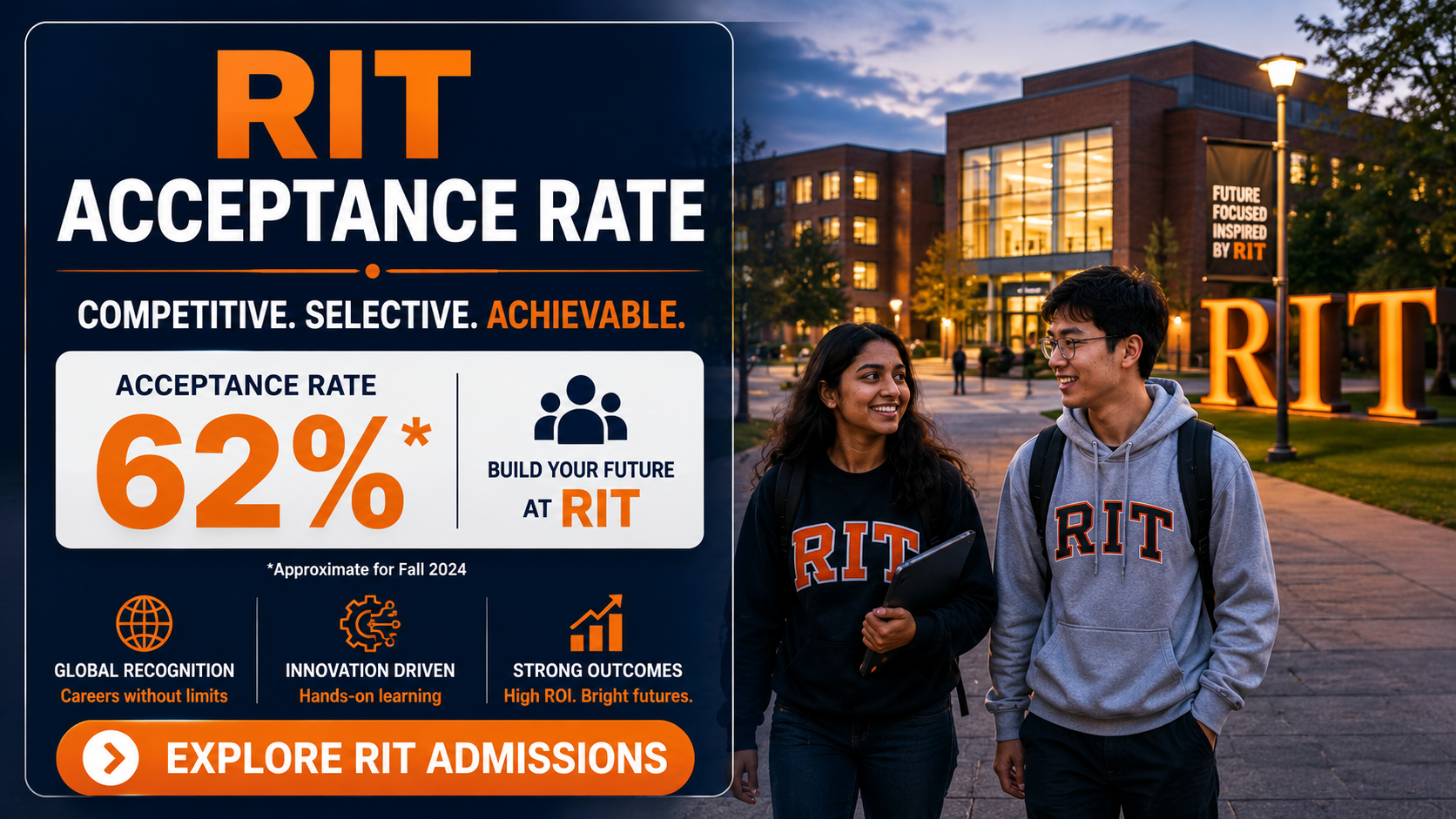
The RIT acceptance rate for Fall 2024 was 67%, which puts Rochester Institute of Technology in the moderately selective bracket. International applicants face a tougher cut, with only 37% getting an offer. Fall 2023 saw 39.4% of overseas students admitted from 2,308 applications.
- RIT is test-optional, so a strong GPA and portfolio matter more than SAT for most Indian applicants.
- The overall number hides the truth: engineering, computing and game design are far more selective than the campus average.
- Indian STEM applicants should treat RIT as a strong target school, not a safety.
- Merit aid is automatic for internationals, so scholarship application is not a separate step.
Check RIT Admissions 2026: Deadlines, Eligibility and Fees
RIT climbed into the QS World top 1,000 for the first time in five years in 2026. Its computer science program is ranked #71 globally by US News, and game design sits at #4 nationally. That is why the campus-wide 67% figure can mislead first-time applicants.
Reading the acceptance rate the right way decides whether RIT is your target, reach or safety school.
Quick Facts on RIT Admissions
| Parameter | Detail |
|---|---|
| Overall Acceptance Rate (Fall 2024) | 67% |
| International Acceptance Rate (Fall 2023) | 39.4% |
| SAT Middle 50% | 1270 to 1430 |
| ACT Middle 50% | 28 to 33 |
| Average Admitted GPA | 3.6 to 3.7 |
| Indian Students on Campus | 991 (Fall 2023) |
| Application Fee | USD 65 (around INR 6,200) |
| Regular Decision Deadline | January 15, 2027 |
Source: RIT Common Data Set 2024-25 and RIT Institutional Research.
- RIT Acceptance Rate for Fall 2024 Explained
- International vs Overall Acceptance Rate
- Program-Wise Acceptance at RIT
- Test Scores and GPA for RIT Admission
- Application Deadlines and Timeline
- Fees and Cost After Getting In
- Scholarships That Change RIT Acceptance Odds
- Jobs, Co-op and STEM OPT After RIT
- Mistakes Indian Applicants Make
RIT Acceptance Rate for Fall 2024 Explained
The RIT acceptance rate for Fall 2024 was 67%, down from 71.1% in Fall 2023. That is a real drop of four points in one cycle. RIT still admits two out of every three applicants across all majors.
Rochester Institute of Technology is a mid-sized private university in New York. It received a record number of applications in 2024, which pushed the rate down. The Fall 2023 number of 71.1% is still the more common figure quoted across the web.
Both numbers count every domestic and international applicant together. The mix hides how selective the top programs really are for Indian STEM students.
- Fall 2020 to 2023: acceptance stayed above 70%.
- Fall 2024: rate fell to 67% as applications grew.
- US News still calls RIT "more selective" than average national universities.
Key Insight: A 67% campus-wide rate does not mean 67% for your program. Computing and engineering pull the number down inside their own colleges.
The Rochester Institute of Technology profile tracks these year-on-year changes for Indian applicants. Use it to compare current-year numbers before you build your college list.
International vs Overall Acceptance Rate
RIT admits international applicants at a much lower rate than the overall pool. For Fall 2023, 2,308 international students applied and 911 got an offer. That is a 39.4% international acceptance rate.
Fall 2024 saw 1,188 international admits, up from 911. The applicant pool also grew, and RIT reports the international rate landed near 37%. Indian applicants sit inside this smaller number, not the 67% headline.
Where Indian students fit
RIT has around 2,400 international students from over 100 countries. Indians form the largest single group with 991 students on campus as of Fall 2023. Most join graduate MS programs in computing, engineering and data.
| Applicant Group | Acceptance Rate |
|---|---|
| Overall (Fall 2023) | 71.1% |
| International (Fall 2023) | 39.4% |
| Overall (Fall 2024) | 67% |
| International (Fall 2024) | ~37% |
Source: RIT Institutional Research and RIT Common Data Set 2024-25.
The gap between the two numbers is normal for US private universities. Domestic applicants often have stronger high school profiles, and RIT does not need to yield-cap its home base like it does with international admits.
Read More: Acceptance Rate of Universities in USA: Full Guide for 2027 Intake
Program-Wise Acceptance at RIT
Admission at RIT depends more on your program choice than on the university-wide rate. The Kate Gleason College of Engineering and the Golisano College of Computing are the two hardest to crack.
Game design at RIT is ranked #4 in the country. Photography sits at #6 nationally. These programs draw specialised applicants, so the internal admit bar is much higher than 67%.
Which programs are hardest
- Computer Science, Computer Engineering and Software Engineering: highest maths and coding bar.
- Game Design and Development: portfolio review plus strong GPA.
- Photography and Imaging Arts: portfolio-first, GPA second.
- MS Data Science and MS Computer Science: strong quantitative background needed.
Which programs are easier
- Business, humanities and applied liberal arts majors admit closer to the campus average.
- Some engineering technology and applied science programs are more open than pure engineering.
- Rolling admission graduate programs stay open until seats fill.
Key Insight: Applying to the same college through a less flooded program can lift your real admit chance. RIT lets you list one alternate major on the Common App.
Check the full course list on the RIT Courses and Fees resource to see which programs match your background before you apply.
Test Scores and GPA for RIT Admission
RIT is test-optional for all undergraduate programs, so SAT and ACT scores are not required. If you submit scores, the middle 50% of admitted students falls between 1270 and 1430 on the SAT.
The ACT middle 50% sits between 28 and 33. The average admitted GPA is 3.6 to 3.7 on a 4.0 scale. That maps to roughly 88% to 92% in the Indian CBSE or state board grading system.
What Indian applicants need
- Class 12 marks: aim for 85% and above in main subjects.
- TOEFL: minimum 88 to 94 based on program.
- IELTS: minimum 6.5 overall.
- PTE: 58 to 66.
- Duolingo English Test: accepted, with 105 to 120 as the common range.
- GRE: optional for MS programs, but a 315+ score helps for CS and engineering.
RIT accepts three-year bachelor’s degrees from Indian NAAC-A accredited universities. That is a big win for Indian applicants, since many US schools still ask for a four-year degree.
The Duolingo accepted universities list confirms RIT takes DET scores. That saves you the TOEFL fee and cuts test prep time by weeks.
MS applicants can compare score cutoffs on US universities accepting GRE for MS in Computer Science.
Application Deadlines and Timeline
RIT undergraduate applications for Fall 2027 close on January 15, 2027 under Regular Decision. The university uses four rounds, and Early Action is the smartest route for most Indian students.
Graduate programs mostly follow rolling admissions. That means the earlier you apply, the better your seat and scholarship odds.
| Round | Deadline | Best For |
|---|---|---|
| Early Decision I | November 1, 2026 | Certain about RIT, binding offer |
| Early Action | November 1, 2026 | Non-binding, best for Indian applicants |
| Early Decision II | January 1, 2027 | Second-thought commit |
| Regular Decision | January 15, 2027 | Standard timeline |
| MS Spring 2027 Deposit | November 15, 2026 | Spring intake applicants |
Source: RIT Admissions Office, 2026-27 cycle.
Ideal timeline for Indian applicants
- June to August: book and take TOEFL, IELTS or DET.
- September: shortlist programs and start SOP.
- October: collect recommendation letters and transcripts.
- By November 1: submit Early Action for Fall 2027 intake.
- December: receive decision and start visa prep.
- January to March: book F-1 visa slot and interview.
Key Insight: Applying in Early Action can lift your real admit chance by 5 to 10 points at RIT. The pool is smaller and the university is trying to fill early.
Fees and Cost After Getting In
RIT undergraduate tuition for 2026-27 is USD 63,508 (around INR 60.7 lakh) per year for 12-18 credits. Graduate tuition is close, at USD 64,542 (around INR 61.7 lakh) per year.
Add living expenses, insurance and travel, and the first-year budget lands between INR 65 lakh and INR 75 lakh. That is standard for private US universities.
| Cost Head | USD (Annual) | INR (Annual) |
|---|---|---|
| Undergraduate Tuition | 63,508 | 60.7 lakh |
| Graduate Tuition (12-18 credits) | 64,542 | 61.7 lakh |
| Housing and Meals | 17,370 | 16.6 lakh |
| Books, Transport and Personal | 3,016 | 2.9 lakh |
| Application Fee | 65 | 6,200 |
Conversions based on a USD-INR rate of INR 95.66 as of August 17, 2026. Rates fluctuate; check the current rate before financial planning.
How Indian students fund it
- HDFC Credila and Avanse lend up to INR 75 lakh for RIT programs.
- SBI Global Ed-Vantage covers full tuition for STEM programs.
- Prodigy Finance gives no-collateral loans for MS applicants.
- PNB Udaan works well for undergraduate applicants with a co-applicant.
The MS in USA cost guide compares RIT with 20 other private universities so you can benchmark before you sign a loan.
Scholarships That Change RIT Acceptance Odds
RIT gives over USD 110 million in scholarships every year, and international applicants are auto-considered. You do not need a separate scholarship application at the undergraduate level.
Awards start at USD 14,000 (around INR 13.4 lakh) per year and go up to USD 27,000 (around INR 25.8 lakh) for the strongest profiles. Some merit scholarships are worth USD 15,000 per year for all four years.
Key scholarships for Indian students
- Presidential Scholarship: largest merit award, based on academics and leadership.
- Dean’s Scholarship: smaller but wider award pool.
- Trustee Scholarship: mid-tier merit aid, common for engineering admits.
- Graduate assistantships: can cut MS tuition by 10 to 40%.
- Fulbright-Nehru Fellowship: external funding, based on merit.
Key Insight: Strong essays and a clear "why RIT" answer often unlock a bigger scholarship than raw scores alone. RIT wants students who will actually join.
Full lists sit on the scholarships for Indian students in USA resource, sorted by amount and eligibility.
Jobs, Co-op and STEM OPT After RIT
RIT has over 100 STEM-designated programs, which means you can work in the US for up to 3 years after graduation. That is the biggest reason Indian STEM students target RIT over similar private universities.
The mandatory co-op program is what sets RIT apart. Students complete paid full-time work terms during the degree, with over 500 companies hiring. Employers include Google, Amazon, Microsoft, IBM, JPMorgan Chase, Boeing and Tesla.
Salaries and outcomes
- Computer Science graduates: median starting salary of USD 85,300 (around INR 81.6 lakh).
- Computer Engineering graduates: median USD 73,800 (around INR 70.6 lakh).
- Information Technology graduates: median USD 83,600 (around INR 80 lakh).
- OPT participation: 889 RIT students currently on OPT in the US.
Placements cross 90% within six months of graduation for STEM majors, and starting salaries have grown 4 to 6% year on year for computing roles.
What RIT gives you
- Paid co-op experience before you graduate.
- STEM OPT for 36 months in the US.
- Access to over 500 employers through career services.
- Alumni base in every major US tech hub.
What RIT does not cover
- H-1B sponsorship is on the employer, not the university.
- Post-OPT green card processing timelines depend on your employer.
- Rochester is not a tech hub like the Bay Area, so you may relocate for co-op or full-time roles.
Mistakes Indian Applicants Make
Most Indian applicants read the 67% RIT acceptance rate and treat the school as a safety. That is the single biggest planning error. Your real chance is closer to 37% to 40%.
Common mistakes to avoid
- Applying only in Regular Decision, when Early Action gives a better shot.
- Skipping the SAT or GRE because RIT is test-optional, even with strong scores.
- Choosing the most competitive major without a backup listed on the form.
- Missing scholarship auto-consideration by submitting late in the cycle.
- Under-budgeting the year with no currency buffer.
Key Insight: A common RIT rejection pattern is a strong CS applicant with a weak "why RIT" essay. Show that you understand the co-op model, not just the ranking.
The shortlisting universities for MS in USA guide covers how to balance ambitious, moderate and safe schools around RIT.
Also Check:
| RIT Rankings 2027 | MS Acceptance Rates in USA | Top 10 MS Universities in USA |
| US Student Visa Requirements | Top STEM Scholarships in USA | Scholarships to Study in USA |
The RIT acceptance rate is one data point, not the full story. For Indian STEM applicants, the real bar is closer to 40%, and program choice moves that number up or down. Focus on Early Action, a clear program fit and a sharp co-op-aware essay. Do that, and RIT becomes a strong target rather than a coin flip.
FAQs on RIT Acceptance Rate
Ques. What is the RIT acceptance rate for Fall 2024?
Ans. The overall RIT acceptance rate for Fall 2024 was 67%. That is down from 71.1% in Fall 2023. The rate dropped because the applicant pool grew that year.
Ques. Is the RIT acceptance rate lower for international students?
Ans. Yes. International applicants had a Fall 2023 acceptance rate of 39.4%. Only 911 out of 2,308 international applicants received an offer. The Fall 2024 international rate is close to 37%.
Ques. What SAT score do you need for RIT?
Ans. RIT is test-optional, so no SAT is required. If you submit, the middle 50% of admitted students scored between 1270 and 1430. Aim for 1400 or above to lift a borderline profile.
Ques. What GPA is needed for RIT admission?
Ans. The average admitted GPA is 3.6 to 3.7 on a 4.0 scale. That maps to about 85% to 92% in Indian board exams. Applicants with lower GPAs still get in if they show strong maths and science grades.
Ques. How many Indian students study at RIT?
Ans. RIT has 991 Indian students as of Fall 2023. Indians form the largest single international student group on campus. Most join MS programs in computer science, data science and engineering.
Ques. Does RIT accept a three-year bachelor’s degree?
Ans. Yes. RIT accepts three-year bachelor’s degrees from Indian universities that hold NAAC-A accreditation. That is a major advantage for MS applicants. Some other US schools still ask for a four-year degree.
Ques. When is the RIT application deadline for Fall 2027?
Ans. The Regular Decision deadline for Fall 2027 is January 15, 2027. Early Action closes on November 1, 2026. Graduate MS programs use rolling admissions and stay open until seats fill.
Ques. How much does it cost to study at RIT for Indian students?
Ans. Undergraduate tuition for 2026-27 is USD 63,508 (around INR 60.7 lakh) per year. MS tuition sits at about USD 64,542 (around INR 61.7 lakh) per year. The full first-year budget with living costs lands between INR 65 lakh and INR 75 lakh.
Ques. Which RIT programs are the hardest to get into?
Ans. Computer Science, Computer Engineering, Software Engineering and Game Design are the most selective at RIT. Game Design is ranked #4 nationally. Photography is ranked #6. These programs draw specialised applicants with strong portfolios.
Ques. Does RIT offer scholarships to Indian students?
Ans. Yes. RIT gives out over USD 110 million in scholarships each year. International applicants are auto-considered. Merit awards range from USD 14,000 to USD 27,000 (around INR 13.4 lakh to INR 25.8 lakh) per year.
Ques. Is RIT STEM OPT eligible?
Ans. Yes. RIT offers over 100 STEM-designated programs. F-1 students in these programs can work in the US for up to 36 months after graduation. RIT currently has 889 students working on OPT.
Ques. Are RIT graduates well placed in top companies?
Ans. Yes. Over 90% of STEM graduates are placed within six months. Median starting salary for CS graduates is USD 85,300 (around INR 81.6 lakh). Employers include Google, Amazon, Microsoft, IBM, JPMorgan Chase and Tesla.





interested in this College ?
Follow & Share this college to get information about admission.



Comments