



Harvard University Public Policy Programs


Harvard University Courses are organised through separate schools rather than one single international course catalogue. Indian students applying after Class XII usually explore Harvard College concentrations such as Computer Science, Economics, Applied Mathematics, Government and Neuroscience. Graduates apply through a specific school for degrees such as the MBA, public policy, data science, law or education. Your first decision is therefore the school and degree level, not only the subject name.
For Indian students, the course choice also depends on the study level, academic background and school-specific requirements.
- UG courses: Usually 4 years, with students entering Harvard College before choosing a concentration.
- PG courses: Duration can range from 1 to 2 years, depending on the school and programme.
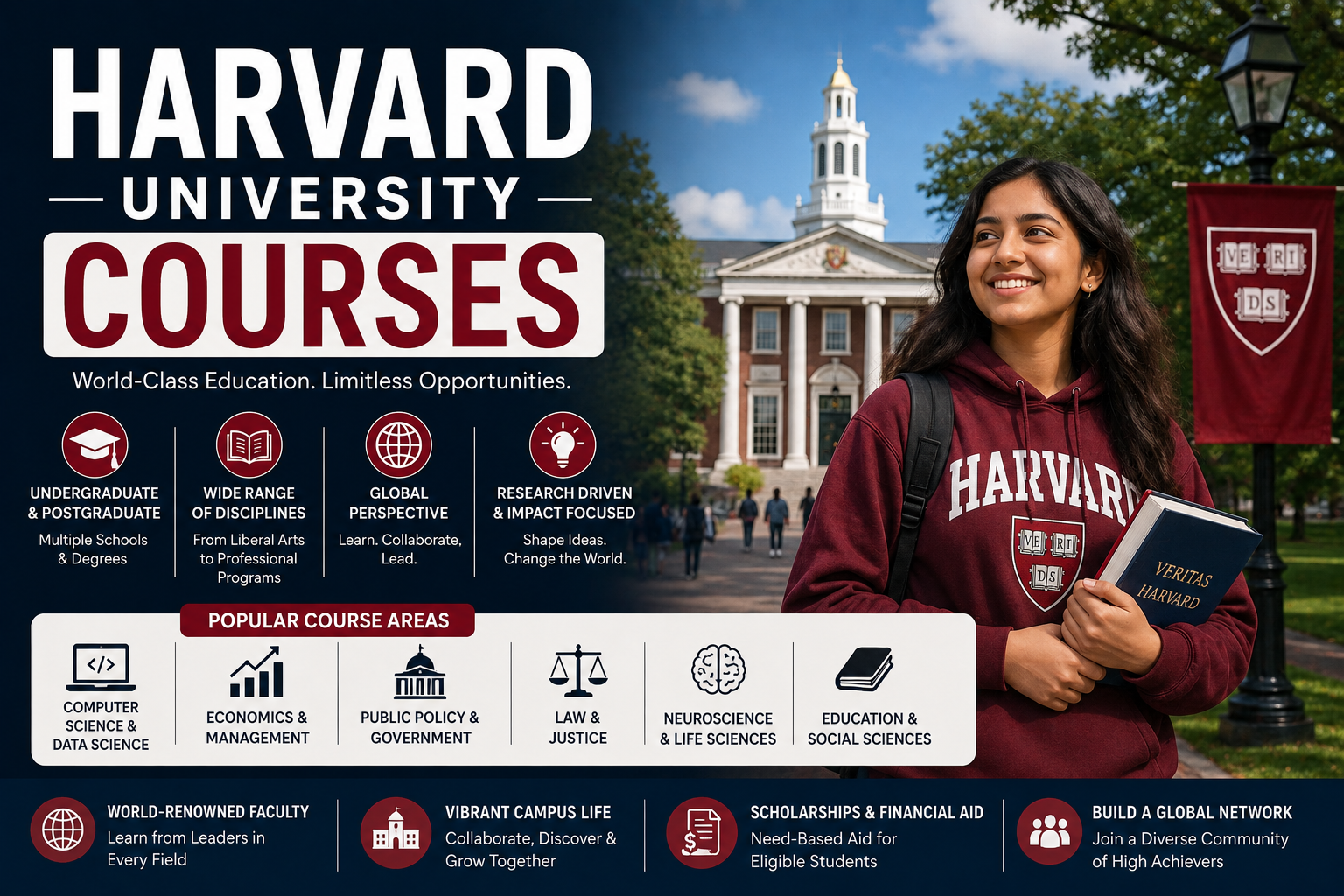
- Popular areas: Computer Science, Data Science, Economics, MBA, Public Policy and Law.
- Before applying: Check the exact eligibility, tests, fees, deadlines and application route, as these vary across Harvard schools.
Use the course level and your current qualification as the first shortlist filters. Then compare the subject prerequisites, teaching language, duration and programme-specific assessment.
Start with this decision:
- Class XII applicant: begin with Harvard College and distinguish a concentration from a professional graduate degree.
- Graduate applicant: identify the school that owns the degree before checking tests, essays and deadlines.
- Applicant comparing similarly named courses: read the curriculum and degree outcome because Harvard schools set separate rules.
Major Faculties And Course Areas
- Harvard College: Undergraduate concentrations in computing, economics, mathematics, government, psychology, life sciences and the humanities.
- Engineering and applied science: Computer science, data science, engineering, applied mathematics and technology-related study.
- Business and management: MBA and executive or doctoral business routes through Harvard Business School.
- Public policy and social science: Public policy, international development, government, education and social research.
- Law, medicine and health: JD, LLM, public health, medicine and related professional degrees through separate schools.
Also Check: Harvard University Acceptance Rate
Table of Contents
Harvard University UG Courses
Undergraduate study usually begins after Class XII. The exact entry profile depends on the degree. Check subjects, language and any professional assessment before treating a course as a realistic option.
Undergraduate Course Table
These examples show the academic direction and the first Indian preparation check. Use the linked university course details for the full programme record.
| Course | Duration | Main academic focus | Indian student check |
|---|---|---|---|
| Computer Science concentration | 4 years | Computing foundations, theory, systems and applications within a liberal-arts degree. | Strong Mathematics and computing preparation help, but Harvard College uses holistic review. |
| Economics concentration | 4 years | Economic theory, data, policy and applied analysis. | Mathematics is useful for quantitative economics pathways. |
| Applied Mathematics concentration | 4 years | Mathematical modelling across science, technology and social applications. | Advanced Mathematics preparation is important. |
| Government concentration | 4 years | Politics, institutions, public policy and political analysis. | Reading, writing and social-science preparation matter. |
| Neuroscience concentration | 4 years | Brain science across biology, psychology and related disciplines. | Biology and Chemistry preparation can support the academic fit. |
Check Out: Harvard University Rankings
Popular Harvard University Courses Among Indian Students
These are commonly compared options for Indian applicants. They are not an official popularity ranking. Compare the curriculum and eligibility instead of choosing by title alone.
The College concentration is a four-year undergraduate route after Class XII. The Data Science master’s is a graduate degree with a stronger statistics and programming expectation. They belong to different application systems and should not be compared as parallel entry options.
How These Two Routes Differ
Harvard’s undergraduate concentrations are explored within Harvard College, while the MBA is a separate professional-school application. This is a structural difference, not just a difference in subject. An Indian student comparing them must first decide whether they are applying after Class XII or after a bachelor’s degree and work experience.
| Decision point | Harvard College Computer Science | Harvard MS in Data Science |
|---|---|---|
| Study level | Postgraduate | Postgraduate |
| Typical duration | 4 years | 2 years |
| Core academic focus | Computing foundations, theory, systems and applications within a liberal-arts degree. | General management, leadership, business functions and case-based learning. |
| First preparation check | Strong Mathematics and computing preparation help, but Harvard College uses holistic review. | Harvard Business School sets its own work-experience and test rules. |
| Best first question | Does your current qualification meet the exact course profile? | Does your transcript show the required prior learning? |
| What can change the choice | Teaching language, subject depth and the selected intake. | Prerequisite credits, assessment and the selected application school or department. |
Harvard University PG Courses
Postgraduate choices are more dependent on the bachelor’s transcript. Read the course prerequisites before comparing duration, tuition or career direction. A related degree can still miss a required module.
Postgraduate Course Table
The table separates specialist and broader routes. Duration is a typical full-time structure and must be confirmed for the intake you choose.
| Course | Duration | Main academic focus | Indian bachelor’s check |
|---|---|---|---|
| MBA course details | 2 years | General management, leadership, business functions and case-based learning. | Harvard Business School sets its own work-experience and test rules. |
| Master in Public Policy | 2 years | Policy analysis, economics, statistics and public leadership. | Quantitative preparation and policy experience can be relevant. |
| MS in Data Science | 2 years | Statistics, computation, data analysis and applied research. | Mathematics, statistics and programming preparation should be clear. |
| LLM course details | 1 year | Advanced legal study for graduates with a first law degree. | A recognised law degree and school-specific conditions apply. |
| Master of Education | 1 year | Education policy, practice, leadership or learning sciences. | The relevant professional or academic background varies by pathway. |
How To Shortlist A Course
Harvard requires a school-level reading of the catalogue. The undergraduate concentration model and the separate graduate schools create two different shortlisting journeys. Use the course name as the starting point, then test the qualification, subject and delivery conditions against your own profile.
| Applicant starting point | Course families to compare | Evidence to prepare | Do not assume |
|---|---|---|---|
| After Class XII | Harvard College concentrations such as Computer Science or Economics | College application, school testing policy and subject preparation | Concentrations are chosen within Harvard College, not applied to like UK degrees. |
| With a bachelor’s | MBA, Data Science, Public Policy, Law or Education | The selected graduate school’s academic and professional rules | Harvard graduate programmes do not share one application model. |
| Comparing undergraduate and graduate study | Four-year College route versus school-specific graduate routes | Starting qualification, work experience and test context | The MBA is not a direct postgraduate version of a College concentration. |
| Planning the application | Harvard College or a named graduate school | Correct portal, essays, references and deadline | A university-wide deadline can hide school-level dates. |
Harvard requires the applicant’s starting point to be identified before the course comparison begins. Harvard College concentrations belong to an undergraduate application, while the MBA, Data Science and other graduate options belong to separate schools. The correct portal, testing policy and evidence list follow from that distinction.
Before treating a course as a final option, record its exact level, duration, language, prerequisites, test requirement and application route in one shortlist. This keeps related course names from being compared as if they had the same entry path.
For Undergraduate Applicants
Students applying after Class XII should make the subject and language checks before comparing fees or city preferences.
- Harvard College admits students to the college before they choose a concentration. Computer Science, Economics and Government are academic concentrations, not separate first-year applications.
- Mathematics through Class XII is useful for Computer Science, Economics and Applied Mathematics. Biology and Chemistry matter for Neuroscience.
- The undergraduate degree normally takes four years. Concentration choice and course planning happen after entry, not like a UK UCAS selection.
- Check the current testing policy and application route for the intake. Do not copy a graduate-school requirement into the undergraduate application.
For Postgraduate Applicants
Master’s applicants should read the prerequisite credits as carefully as the course title. A related bachelor’s degree can still miss a required foundation.
- Harvard’s postgraduate options sit in different schools. The MBA, public policy, data science, law and education routes do not share one application.
- The MBA is a professional degree with its own work-experience and test context. It is not interchangeable with a general master’s route.
- Data Science applicants need quantitative preparation. Law and Education applicants follow school-specific academic and professional requirements.
- Confirm the exact school, intake and application portal before comparing duration or funding. University-level summaries can hide important differences.
Shortlisting Mistakes To Avoid
These errors can make a course look suitable before the actual qualification or application condition is checked.
- Treating Harvard College concentrations as separate first-year applications.
- Using the MBA’s school, work-experience or test rules for another graduate programme.
- Budgeting from a university-wide figure instead of the selected school’s cost model.
Harvard University Course Structure And Study Options
Harvard does not use one course-selection model across the university. Harvard College admits undergraduates before concentration choice. Graduate applicants apply to separate schools such as HBS, Harvard Kennedy School, SEAS, Harvard Law School or the Graduate School of Education.
Duration alone does not show how a degree feels to study. Check when specialisation starts, whether a placement or research project is compulsory and whether the teaching language changes by level.
- Harvard College undergraduate study normally spans four years and includes broad liberal-arts requirements alongside a concentration.
- Graduate duration depends on the school. MBA and public policy routes commonly use two years, while some professional master’s degrees use one year.
- Course names, tests, fees and deadlines belong to the individual school.
Eligibility For Indian Students
Eligibility is course-specific. Indian students should compare the qualification route, academic subjects and English evidence together. A university-wide minimum cannot replace the selected programme’s conditions.
Undergraduate Entry Check
Indian Class XII applicants should understand that Computer Science, Economics, Government and Neuroscience are concentrations within Harvard College. They are not separate first-year applications in the same way as UK degree choices. Mathematics and subject depth still matter for preparation.
- Harvard College evaluates international applicants through its undergraduate process and does not use a simple Indian percentage cutoff.
- Graduate eligibility is school-specific. A bachelor’s degree may be required, but subject, work and test conditions vary.
Postgraduate Entry Check
The graduate course title determines the application school, test policy, work-experience context and documents. The MBA is different from a research master’s. Data Science, public policy, law and education each require their own academic fit check.
- A course title such as data science or public policy can appear in different schools with different prerequisites.
- English testing, standardised tests, essays, references and interviews depend on the school and intake.
English Language Requirements
English testing and waiver rules can differ between Harvard schools. Do not copy the MBA’s recommended scores into a data science, law or education application. Follow the selected school’s current instructions.
Course Tests And Application Timing
Harvard has no university-wide entrance test for all courses. Undergraduate applicants should check the current Harvard College testing policy. Graduate applicants may need the GRE, GMAT, LSAT, MCAT or another school-specific test. Always identify the school before planning the exam.
Timing That Matters
Harvard College uses a different application calendar from the graduate schools. MBA rounds, public-policy deadlines and other graduate dates are not interchangeable. Identify the school before making a deadline plan.
Application Route By Study Level
Harvard College and the graduate schools use separate application systems and document rules. Identify the school first, then prepare the transcript, testing, references, essays and work evidence that belong to that route.
After shortlisting, check the Harvard admission information for the route, documents and current deadlines. Do not transfer an undergraduate deadline to a postgraduate course.
Course Fees And Funding Context
Harvard fees differ sharply by school, degree and enrolment status. The cost of an MBA cannot be used for an undergraduate or public-policy estimate. Compare tuition, health insurance, living costs and school-specific aid through the dedicated fees and scholarship information.
What The Course Fee Does Not Tell You
Harvard costs vary by school and programme. Compare the course-specific tuition, health insurance, living budget and funding model. Need-based aid and school scholarships follow different rules from admission.
Funding Check For Indian Applicants
Harvard funding differs by school and may be need-based, merit-based or programme-specific. Do not assume that an undergraduate funding rule applies to the MBA or another graduate school.Once you have chosen a course, compare the Harvard scholarship information. Check eligibility, coverage, renewal and the award deadline separately from admission.
Source note: Course names, structures and policy conditions should be rechecked against the current Harvard academic programmes before submission.
Also Check:
Shortlist Harvard University courses by study level, subject preparation, teaching language and duration. Then open the exact course details, confirm the current entry conditions and compare the next application step before deciding.
FAQs
Ques. Does Harvard have one course catalogue for international students?
Ans. No. Harvard courses are organised through Harvard College and separate graduate or professional schools. Each school controls its own programme rules.
Ques. Which Harvard courses can Indian students study after Class XII?
Ans. Harvard College concentrations include computing, economics, applied mathematics, government, neuroscience and many humanities or science areas. Admission is holistic and school-specific.
Ques. How long are Harvard graduate courses?
Ans. Duration varies. The MBA and Master in Public Policy commonly use two years, while some law, education and specialised master’s routes use one year.
Ques. Which test is required for Harvard courses?
Ans. The test depends on the school and degree. Possible exams include GRE, GMAT, LSAT or MCAT, but none applies to every Harvard course.
Ques. Can Indian students choose a Harvard College concentration before admission?
Ans. Harvard College admits students to the College first. Students normally explore and choose a concentration after entering, subject to the College’s academic structure.
Ques. Do all Harvard graduate courses use the same application?
Ans. No. The MBA, data science, public policy, law and education routes belong to different schools or application systems. Identify the school before preparing documents.
Popular Programs and Important Dates
| Program | Important Dates | Fees | Application Fees | Eligibility | Financial Aid |
|---|---|---|---|---|---|
LLM 1 year | Application Deadline for Fall 2027 Intake (1st Dec 2026) | INR 78.2 L/Yr USD 80,760 /Yr | 90 | Bachelor's Degree, TOEFL: 5.0 | |
MBA 2 years | Round 2 Application Deadline for Fall 2029 Intake (1st Jan 2027) | INR 82.1 L/Yr USD 84,760 /Yr | 250 | Bachelor's Degree, TOEFL: 5.0, IELTS: 7.5, PTE: 75, Duolingo: 145 | |
Application Deadline for Fall 2027 Intake (1st Dec 2026) | INR 65.4 L/Yr USD 67,504 /Yr | 105 | Bachelor's Degree, TOEFL: 4.0, IELTS: 6.5 | - | |
MS Data Science 18 months | Application Deadline for Fall 2027 Intake (1st Dec 2026) | INR 65.4 L/Yr USD 67,504 /Yr | 105 | Bachelor's Degree, TOEFL: 4.0, IELTS: 6.5 | - |
PhD Computer Science 5 years | Application Deadline for Fall 2027 Intake (15th Dec 2026) | INR 57.2 L/Yr USD 59,048 /Yr | 105 | Bachelor's Degree, TOEFL: 4.0, IELTS: 6.5 | |
MPA 2 years | Application Deadline for Fall 2027 Intake (1st Dec 2026) | INR 62.3 L/Yr USD 64,340 /Yr | 100 | Bachelor's Degree, TOEFL: 5.0, IELTS: 7.0 | |
BA Computer Science 4 years | Early Action Application Deadline for Fall 2027 Intake (1st Nov 2026) Regular Decision Application Deadline for Fall 2027 Intake (1st Jan 2027) | INR 60.3 L/Yr USD 62,226 /Yr | 90 | Higher Secondary Degree | |
BA Physics 4 years | Early Action Application Deadline for Fall 2027 Intake (1st Nov 2026) Regular Decision Application Deadline for Fall 2027 Intake (1st Jan 2027) | INR 60.3 L/Yr USD 62,226 /Yr | 90 | Higher Secondary Degree | |
MPP 2 years | Application Deadline for Fall 2027 Intake (1st Dec 2026) | INR 62.3 L/Yr USD 64,340 /Yr | 100 | Bachelor's Degree, TOEFL: 5.0, IELTS: 7.0 | - |
MD 4 years | INR 74.4 L/Yr USD 76,828 /Yr | 100 | Bachelor's Degree |
Do you think the Dates are wrong ? Report Here

Harvard University Public Policy Programs will provide you with a conceptual toolkit rooted in the social sciences and adapted for action. A defining feature of these programs is their commitment to practice. Take what you learn here and apply it right away—through capstone exercises, case studies, experiential learning opportunities, and optional internships—to deliver lasting results.
At the heart of these programs is a cross-disciplinary core curriculum that exposes you to the analytic methods, conceptual frameworks, and habits of mind that empower you to craft solutions for real-world public problems.
STEM Course
Master of Science [MS] Bioethics
Do you think the fees are wrong ? Report Here
Course Finder - Search from 50K+ courses
Popular Streams:
SUBSCRIBE TO OUR NEWS LETTER



Comments