





Stanford University admissions run on a single Autumn (September) intake for every degree programme, with no Spring or Winter entry for international students. Undergraduate applicants need strong Class XII scores (typically 90%-plus) with SAT or ACT, while graduate applicants need a completed four-year Bachelor’s plus TOEFL 100 iBT or IELTS 7.0.
- Restrictive Early Action closes 1 November 2026 for the primary Autumn 2027 intake.
- Base UG tuition USD 67,731 (INR 64.58 Lakhs); undergraduate application fee USD 100 (INR 9,534).
- UG needs Class XII 90% plus with SAT or ACT; PG needs Bachelor’s plus IELTS 7.0 or TOEFL 100.
- Undergraduate acceptance rate near 3.6%, among the world’s most competitive.
Popular Indian-applicant tracks at Stanford University include MS Computer Science, MS Electrical Engineering, and the two-year Stanford GSB MBA, all of which see strong Indian representation each cycle.
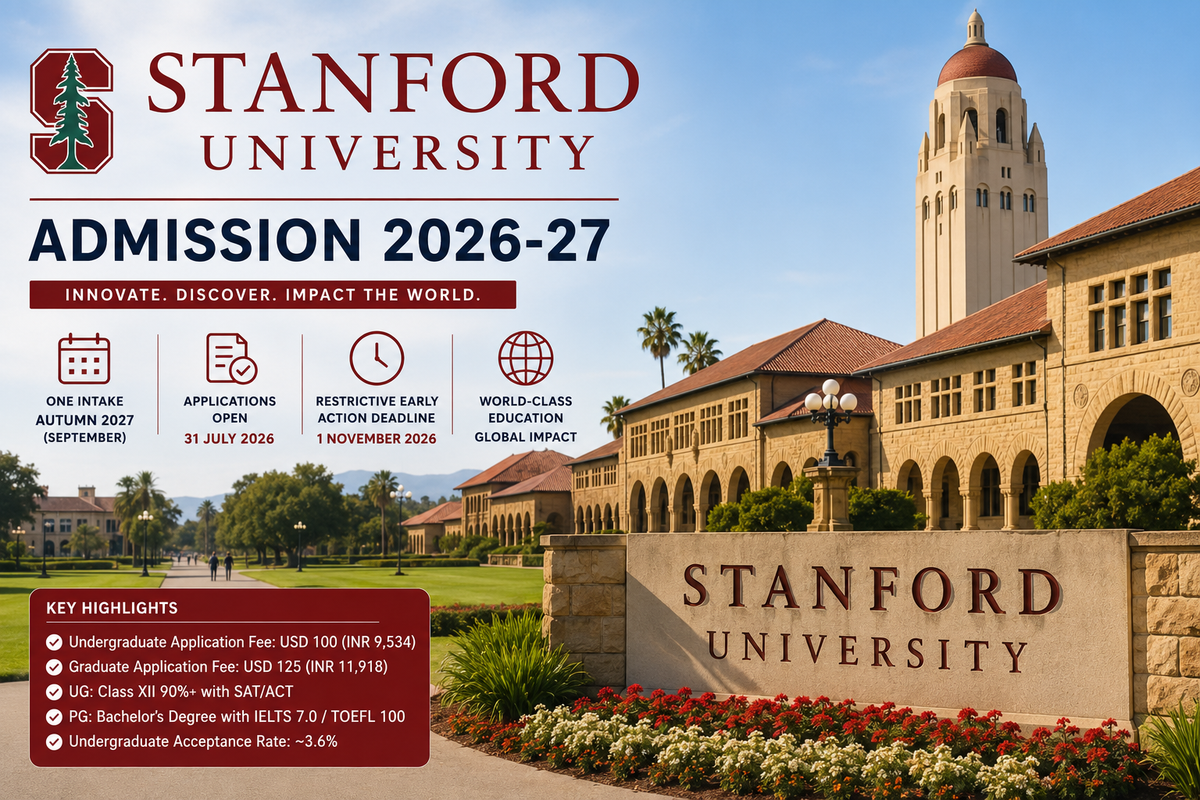
Admission status: Open. The Common Application for Fall 2027 opened on 31 July 2026, and Stanford’s Restrictive Early Action deadline is 1 November 2026 with the USD 100 (INR 9,534) application fee due at submission. Undergraduate Regular Decision closes 5 January 2027, and graduate deadlines run from 6 October 2026 (MS Computer Science and Knight-Hennessy Scholars) through 15 February 2027 (Law JD) via Stanford’s own portals with a USD 125 (INR 11,918) standard graduate application fee.
Also Check: Stanford University Courses and Fees
Table of Cable
- Stanford University Application Deadlines Autumn 2027
- Stanford Eligibility for Indian Students
- Stanford University Graduate Programs and English Scores
- Stanford Undergraduate Programs
- Stanford GSB MBA Admissions Rounds
- Stanford University PhD Admissions
- Stanford Application Process Step-by-Step
- Stanford Documents Required
- Stanford University Acceptance Rate
- USA F-1 Student Visa for Stanford
- Tips and Checklist for Stanford Admissions
- FAQs
Stanford University Application Deadlines for Autumn 2027
Stanford University runs one intake per year, and every degree programme (undergraduate, master’s, PhD, MBA, and Law JD) enters in September 2027. Undergraduate applications route through the Common Application, which opened on 31 July 2026 for the 2026-27 cycle, while graduate applicants apply through their department’s own page on Stanford Graduate Admissions. The deadlines below are drawn from the Stanford Graduate Admissions page and each school’s own portal.
Stanford’s primary intake for Indian students is Autumn 2027 (September), the only intake, and every programme below opens here.
| Intake | Level and Programme | App Opens | Deadline | App Fee | Portal |
|---|---|---|---|---|---|
| Autumn 2027 (Primary intake) | UG Restrictive Early Action | 31 Jul 2026 | 1 Nov 2026 |
USD 100 |
Common App |
| Autumn 2027 (Primary intake) | UG Regular Decision | 31 Jul 2026 | 5 Jan 2027 | USD 100 (INR 9,534) |
Common App |
| Autumn 2027 | MS Computer Science | Sep 2026 | 6 Oct 2026 | USD 125 (INR 11,918) |
Stanford grad portal |
| Autumn 2027 | Engineering MS and most PhDs | Sep 2026 | 1 Dec 2026 | USD 125 (INR 11,918) |
Stanford grad portal |
| Autumn 2027 | Graduate School of Education PhD | Sep 2026 | 16 Nov 2026 | USD 125 (INR 11,918) |
Stanford grad portal |
| Autumn 2027 | MBA (GSB) Round 1 | Jun 2026 | 9 Sep 2026 | USD 275 (INR 26,219) |
ApplyGSB |
| Autumn 2027 | MBA (GSB) Round 2 | Jun 2026 | 6 Jan 2027 | USD 275 (INR 26,219) |
ApplyGSB |
| Autumn 2027 | MBA (GSB) Round 3 | Jun 2026 | 7 Apr 2027 | USD 275 (INR 26,219) |
ApplyGSB |
| Autumn 2027 | Law School JD | Sep 2026 | 15 Feb 2027 | USD 85 (INR 8,104) |
LSAC |
Insider note: The MBA Round 1 deadline on 9 September 2026 is the strongest signal to Stanford GSB. Indian applicants who target Round 1 get their decision by early December, freeing up December-January for F-1 visa processing well before the July peak crush.
Stanford University Eligibility for Indian Students
Stanford sets institution-wide floors at the undergraduate and graduate level, and individual programmes can only push them higher, never lower. Indian applicants should clear both the academic band and the English-proficiency floor before investing time in the essay and portfolio work.
Stanford University UG Academic and Test Floors
Undergraduate applicants need Class XII (or equivalent) results in a strong upper band, plus one standardised test.
- Class XII: 90%-plus in CBSE, ISC, or state board, or a comparable IB (36+ points) or A-level (A/A* profile).
- Standardised test: SAT or ACT required, as Stanford is not test-optional for the 2026-27 cycle.
- English proficiency: TOEFL 100 iBT or IELTS 7.0 if your medium of instruction was not English.
- Recommendations: two academic teacher letters plus one counsellor letter.
Stanford University Graduate Academic and Test Floors
Graduate applicants need a completed four-year Bachelor’s from a recognised university, or a three-year degree with strong justification and additional coursework.
- Bachelor’s floor: around 3.0 US GPA (around 75% Indian equivalent) is the entry band, and competitive tracks look for 3.5+ (around 85%-plus).
- TOEFL: 100 iBT is the university-wide floor.
- IELTS: 7.0 accepted at the same floor.
- GRE: waived at most Engineering, Education, and International Policy tracks for Autumn 2027, so check the department page.
- PTE: not accepted at the graduate level except at the GSB (MBA).
Stanford University IELTS and TOEFL Waiver for Indian Students
Stanford’s Graduate Admissions publishes a medium-of-instruction (MOI) waiver. If your entire Bachelor’s or Master’s programme was delivered exclusively in English, which is the standard case at almost every Indian university offering English-medium degrees, you are not required to submit TOEFL, IELTS, or PTE scores. You will need a written confirmation from the registrar of your Indian university stating that the medium of instruction was English throughout the degree. Two or more consecutive years of English-medium professional or educational experience in the last 10 years also qualifies for the waiver.
Check Out: Stanford University Accommodation
Stanford University Graduate Programs and English Scores
Stanford’s master’s and doctoral programmes span seven schools (Engineering, Humanities and Sciences, Business, Law, Medicine, Education, and Sustainability). The list below covers the master’s tracks that draw the largest Indian cohort, and every row reflects the institution-wide graduate floor per Stanford Graduate Admissions. Individual departments may push these bands higher on their own pages. Base graduate tuition on the Engineering track is USD 69,717 (INR 66.47 Lakhs) per year, and Humanities and Sciences base tuition is USD 66,048 (INR 62.97 Lakhs).
| Programme | Duration | Minimum Eligibility | English Req. Min. |
|---|---|---|---|
| MS Computer Science | 2 years | 4-year Bachelor’s in CS or related, GPA around 3.5+ (85%+) | TOEFL 100 |
| MS Electrical Engineering | 2 years | 4-year Bachelor’s in EE, ECE, or Physics with strong Math | TOEFL 100 |
| MS Mechanical Engineering | 2 years | 4-year Bachelor’s in ME or related with core Mech coursework | TOEFL 100 |
| MS Management Science and Engineering | 1-2 years | 4-year Bachelor’s in Engineering, Math, Physics, or Economics | TOEFL 100 |
| MS Computational and Mathematical Engineering | 1-2 years | 4-year Bachelor’s with strong Math background | TOEFL 100 |
| MS Statistics | 1-2 years | 4-year Bachelor’s with linear algebra and probability coursework | TOEFL 100 |
| MS Bioengineering | 2 years | 4-year Bachelor’s in Bioengineering, BME, or related science | TOEFL 100 |
| MS Civil and Environmental Engineering | 2 years | 4-year Bachelor’s in Civil, Environmental, or related field | TOEFL 100 |
| MS Aeronautics and Astronautics | 2 years | 4-year Bachelor’s in Aero, Mech, EE, or Physics | TOEFL 100 |
| MS Materials Science and Engineering | 2 years | 4-year Bachelor’s in MSE, ChemE, Physics, or Chemistry | TOEFL 100 |
Note: Program-specific entry requirements, fees, and intake availability may differ from the institution-wide minimums shown above. Always confirm on the official Stanford Graduate Admissions page for your chosen program before applying.
Stanford University Undergraduate Programs for Indian Students
Stanford admits undergraduates to the university, not to a specific major, and every applicant follows the same Common Application route. Students formally declare a major by the end of the second year, so the list below reflects the popular declared tracks among Indian undergraduates rather than separate admission routes. All rows share the same institution-wide entry floor.
| Programme | Duration | Minimum Eligibility | English Req. Min. |
|---|---|---|---|
| BS Computer Science | 4 years | Class XII 90%-plus with Mathematics; SAT or ACT required | TOEFL 100 |
| BS Symbolic Systems | 4 years | Class XII 90%-plus in Science or Humanities stream | TOEFL 100 |
| BS Mathematics | 4 years | Class XII 90%-plus with Mathematics | TOEFL 100 |
| BA/BS Economics | 4 years | Class XII 90%-plus with Mathematics recommended | TOEFL 100 |
| BS Engineering (Bioengineering, Chemical, Civil, EE, ME) | 4 years | Class XII 90%-plus with Mathematics and Physics | TOEFL 100 |
Check Out: Staford University Scholarships
Stanford University GSB MBA Admissions Rounds
Stanford Graduate School of Business (GSB) runs the full-time MBA on a three-round calendar for the Autumn 2027 entering class. Every round accepts Indian applicants on equal terms, and each round’s decision releases before the next round’s deadline. Base MBA tuition is USD 89,187 (INR 85.03 Lakhs) per year. For scholarships and fellowships available to Indian MBA candidates, see funding options for Indian students.
Stanford University GSB MBA Rounds and Interview
Round 1 candidates get the earliest read and the widest visa runway, while Round 3 admits face the tightest window.
- Round 1: Deadline 9 September 2026 (4 pm PT), decision by 9 December 2026.
- Round 2: Deadline 6 January 2027 (4 pm PT), decision by 1 April 2027.
- Round 3: Deadline 7 April 2027 (4 pm PT), decision by 27 May 2027.
Interview stage: Stanford GSB conducts by-invitation interviews with alumni in the applicant’s home city. Indian applicants typically interview in Mumbai, Delhi, or Bangalore. Invitations are issued on a rolling basis between the round deadline and the decision date.
Stanford University GSB MBA English and Test Requirements
- GMAT Focus or GRE: required, no preference between the two.
- Work experience: no minimum stated, but the incoming class median is around 4-5 years.
- English proficiency: TOEFL, IELTS, or PTE accepted; MOI waiver applies if your prior degree was fully in English.
- Application fee: USD 275 (INR 26,219).
Planning note: Round 1 closes in under a month for anyone reading this in mid-August 2026. If your GMAT Focus or GRE is not yet booked, Round 2 (6 January 2027) is the realistic target for a strong application.
Stanford University PhD Admissions Process
Stanford PhD applications are department-driven, and each department controls its own deadline, funding letter, and admission committee. Most departments close on 1 December 2026 for Autumn 2027 entry, with a few (Graduate School of Education on 16 November 2026, MS/PhD Computer Science on 6 October 2026) closing earlier. The Stanford PhD in Computer Science page carries the most-referenced Indian-applicant profile.
Stanford University PhD Application Steps
- Identify faculty: shortlist two to four Stanford faculty whose research aligns with your interests before writing the statement.
- Statement of purpose: lead with the specific research question, cite prior papers you have engaged with, and name the faculty you want to work with.
- Recommendations: three letters, with at least two from research supervisors who can speak to your independent work.
- Departmental application: apply through the department page linked from Stanford Graduate Admissions.
Stanford University PhD Funding for Indian Students
Stanford PhD offers routinely come with a full five-year funding package covering tuition, health insurance, and a stipend. Indian doctoral admits also qualify for the Knight-Hennessy Scholars programme (up to three years of full funding on top of departmental support, deadline 6 October 2026 at 1 pm PT), the Stanford Graduate Fellowship, and departmental TA/RA appointments. Application to Knight-Hennessy is separate and concurrent with the departmental PhD application.
Insider note: Indian PhD applicants who match faculty pre-application (a short, specific email in September naming two of the faculty’s recent papers) see materially higher interview rates than those who apply cold in November.
Stanford University Application Process for Indian Students
Stanford’s application process differs by level. Undergraduate applicants apply through the Common Application, MBA applicants apply through ApplyGSB, Law applicants apply through LSAC’s Credential Assembly Service, and every other graduate applicant applies through the department’s own page on Stanford Graduate Admissions. Steps below cover the undergraduate route; graduate applicants follow steps 3 to 7.
- Create a Common Application account on the Common App portal, which opened for the 2026-27 cycle on 31 July 2026.
- Add Stanford to your college list, complete the Common App essay, and answer the Stanford supplement short-answers.
- Pay the application fee of USD 100 (INR 9,534) for UG, USD 125 (INR 11,918) for standard graduate, USD 275 (INR 26,219) for MBA (GSB), or USD 85 (INR 8,104) for Law JD (via LSAC).
- Submit official transcripts of Class XII and, for graduate applicants, your Bachelor’s mark sheets.
- Send TOEFL, IELTS, or PTE scores directly to Stanford’s institution code, or upload the registrar’s MOI waiver letter.
- Request academic recommenders to submit letters through the portal.
- For UG applicants requesting institutional aid, complete the CSS Profile and IDOC financial forms in parallel with the application.
Planning note: Every Stanford deadline is set in Pacific Time. A 1 pm PT deadline closes at 1:30 am IST the next calendar day, and an 11:59 pm PT deadline closes at 1:29 pm IST the next day. Submit at least 48 to 72 hours before to buffer against portal errors and any last-minute financial-document upload issue.
Stanford University Documents Required
Stanford’s document list stays consistent across undergraduate and graduate applications, with additions for the professional programmes. Prepare digital copies well in advance, since Indian universities often take four to six weeks to release official transcripts. This section covers paperwork only; academic and English-test floors are covered in the Eligibility section.
- Passport: valid biographical page, expiring no earlier than six months after your planned entry date.
- Transcripts: certified Class XII mark sheet and, for graduate applicants, semester-wise Bachelor’s mark sheets and provisional or final degree certificate.
- Statement of Purpose (SOP): Stanford supplement essays for UG, or a research-focused SOP for graduate and PhD applicants.
- Letters of Recommendation: two academic teachers plus one counsellor for UG, three recommenders for graduate and PhD applicants.
- CV or Resume: required for graduate, MBA, and Law applicants.
- English-test score report: official TOEFL, IELTS, or PTE report sent to Stanford, or an MOI waiver letter from your registrar.
- Standardised test: SAT or ACT report for UG, GMAT Focus or GRE for MBA, LSAT for Law JD.
- Financial documentation: CSS Profile and IDOC (UG aid), or bank statements and sponsor affidavit for the F-1 visa I-20.
- Work-experience letters: for MBA applicants, official letters from each employer stating role, dates, and reporting line.
Check Out: Stanford University Placements
Stanford University Acceptance Rate for Indian Students
Stanford is one of the most selective universities in the world, and the acceptance rate has trended lower each year since 2015. The rate below is Stanford’s most recently reported figure, and the university does not publish a separate India-specific acceptance number, so the university-wide figure is the correct reference for Indian applicants.
Stanford University Undergraduate Acceptance Rate
Stanford’s undergraduate acceptance rate sits at around 3.6% across all applicants (domestic and international). International admit rate is lower than the headline number, as Stanford maintains a need-aware policy for international undergraduates and admits fewer international students overall.
Stanford University Graduate Acceptance Rate
Graduate admit rates vary sharply by department. Stanford GSB MBA sits near 6 to 7%, and Stanford Computer Science PhD is estimated at around 5% based on public admit-versus-application counts (the university does not publish an official departmental figure). Engineering master’s tracks typically admit in the 15 to 20% band. Law JD admits at around 6%.
Reality check: A strong Class XII or Bachelor’s transcript is the entry ticket, not the differentiator. Indian applicants who convert offers at Stanford show clear evidence of research, entrepreneurship, or Olympiad-level achievement outside classroom marks.
USA F-1 Student Visa for Stanford University Applicants
Indian students admitted to Stanford apply for the F-1 non-immigrant student visa. Stanford’s Bechtel International Center issues the Form I-20 within two to four weeks of the tuition deposit, and Indian applicants should schedule the US Embassy visa slot immediately once the I-20 arrives. Peak F-1 visa demand runs from May through July, so a June-onward slot booking is realistic for Indian summer intake dates.
The F-1 process has three cost components for Indian applicants: the SEVIS I-901 fee of USD 350 (INR 33,369), the MRV visa application fee of USD 185 (INR 17,638), and DS-160 form completion (no fee). Financial proof for the I-20 must cover at least one academic year of tuition plus living expenses, evidenced through bank statements not older than three months. Post-study work is 12 months of Optional Practical Training (OPT) for all graduates, with a further 24-month STEM OPT extension (36 months total) for eligible STEM programmes, and Stanford’s MS Computer Science, MS Electrical Engineering, MS Statistics, and most PhD tracks all qualify as STEM.
2026 update: US visa interview appointment backlogs in Delhi, Mumbai, Chennai, and Kolkata have eased through 2026, but Indian applicants should still book the interview slot within a week of receiving the I-20. Slot release for Fall 2027 opens in stages from late April 2027.
Check Out: F1 Student Visa Application
Stanford University Admissions Tips and Checklist
The following tips and steps are drawn from Indian-applicant patterns at Stanford, focused on the sequencing traps that most often push a strong candidate to the following year.
- Target Restrictive Early Action: even though REA is non-binding, an early read from Stanford by mid-December frees the January window for backup applications.
- Request institutional aid in the initial UG application: Stanford permanently forfeits institutional aid for international undergraduates who do not request it in the first application, per their published financial-aid policy.
- MBA Round 1 signal: Stanford GSB reads Round 1 (9 September 2026) as the strongest signal of intent, so target this window if your GMAT Focus or GRE is ready.
- MOI waiver letter format: the confirmation must come from your Indian university’s registrar office (not the head of department), on official letterhead, stating that the entire degree’s medium of instruction was English.
- 8 weeks before the deadline: request official Class XII and Bachelor’s transcripts from your Indian board and university, since release timelines often stretch to 6 weeks.
- 6 weeks before: book your TOEFL, IELTS, or PTE test slot, or secure the MOI waiver letter from your registrar.
- 4 weeks before: approach recommenders with your CV, target Stanford programme, and a short brief on which skills to speak to.
- 48 to 72 hours before the PT deadline: submit the application to buffer against portal errors or IST time-zone confusion.
Stanford’s admissions cycle is unforgiving in one way: a single Autumn intake, high test floors, and a 3.6% undergraduate acceptance rate mean every missed year is a full year lost. Indian applicants who hit the 1 November 2026 REA window, or MBA Round 1 on 9 September 2026, get the earliest reads and the earliest F-1 visa slot.
Frequently Asked Questions
Ques. When is the Stanford Restrictive Early Action deadline for Indian students in the 2026-27 cycle?
Ans. Stanford’s Restrictive Early Action closes on 1 November 2026 at 11:59 pm PT, with decisions released in mid-December 2026. Regular Decision closes on 5 January 2027.
Ques. Does Stanford University require SAT or ACT for undergraduate admission?
Ans. Yes. Stanford is not test-optional for the 2026-27 undergraduate cycle. SAT or ACT scores are required, and both tests are accepted with no preference.
Ques. What is Stanford’s undergraduate acceptance rate for Indian applicants?
Ans. Stanford’s overall undergraduate acceptance rate sits at around 3.6%. The university does not publish an India-specific figure, and international admit rates are lower than the headline number because Stanford maintains a need-aware policy for international undergraduates.
Ques. Can I apply to Stanford without submitting TOEFL or IELTS scores?
Ans. Yes, if your Bachelor’s or Master’s programme was delivered entirely in English. You need a written medium-of-instruction (MOI) waiver letter from your Indian university’s registrar. Two or more consecutive years of English-medium professional or educational experience in the last 10 years also qualifies.
Ques. What is the application fee for a Stanford master’s programme at the Autumn 2027 intake?
Ans. The standard graduate application fee is USD 125 (INR 11,918). Stanford GSB MBA charges USD 275 (INR 26,219), Law JD (via LSAC) charges USD 85 (INR 8,104), and Medicine MD charges USD 95 (INR 9,058). Undergraduate applicants pay USD 100 (INR 9,534).
Ques. Does Stanford GSB require GMAT for the MBA, or is GRE accepted?
Ans. Stanford GSB accepts both GMAT Focus and GRE with no preference between the two. Applicants submit either score, and the admissions committee makes no distinction. The test is required; there is no waiver route for the MBA.
Ques. Is financial aid available for Indian undergraduate applicants at Stanford?
Ans. Yes, Stanford offers need-based institutional aid to international undergraduates. The admissions policy is need-aware for international applicants, which means that requesting aid can affect the admission decision. Applicants who do not request aid in the initial application permanently forfeit institutional aid for their entire undergraduate tenure.
Ques. When did the Common Application open for the Stanford 2026-27 cycle?
Ans. The Common Application opened for the 2026-27 cycle on 31 July 2026. Stanford accepts the Common Application only, with no Coalition or Universal College Application route.
Ques. Does Stanford accept the Duolingo English Test?
Ans. Stanford’s graduate admissions accepts TOEFL iBT and IELTS Academic as its two standard English tests, and PTE at the GSB (MBA). Duolingo English Test is not accepted at the graduate level. Undergraduate policy also centres on TOEFL and IELTS.
Ques. How long does a Stanford graduate application decision take?
Ans. Most Stanford graduate departments release decisions between February and March 2027 for a 1 December 2026 deadline. Stanford GSB MBA follows fixed round decision dates: Round 1 on 9 December 2026, Round 2 on 1 April 2027, Round 3 on 27 May 2027.
Ques. What is the F-1 visa fee for Indian Stanford students?
Ans. The F-1 visa carries a SEVIS I-901 fee of USD 350 (INR 33,369) and an MRV visa application fee of USD 185 (INR 17,638). The DS-160 form itself has no fee. Post-study, F-1 visa holders qualify for 12 months of OPT plus a 24-month STEM OPT extension for eligible programmes.
Ques. Does Stanford accept a three-year Indian Bachelor’s for graduate admission?
Ans. Stanford’s graduate admissions floor is a four-year Bachelor’s degree. Three-year Indian Bachelor’s applicants (typically BA or BCom) are considered on a case-by-case basis, and most competitive tracks expect either a completed Master’s or a Bachelor’s with an additional year of coursework. STEM Bachelor’s degrees (BE, BTech, BSc four-year) meet the four-year floor without additional coursework.
College Student Profiles

Stanford University Program Fees & Deadlines
| Program | Important Dates | Fees | Application Fees | Eligibility | Financial Aid |
|---|---|---|---|---|---|
BA Psychology 4 years | Fall 2027 Restrictive Early Action deadline (1st Nov 2026) Fall 2027 Regular Decision deadline (5th Jan 2027) | USD 67,731 /Yr | 100 | High School Diploma | |
Fall 2027 Restrictive Early Action deadline (1st Nov 2026) Fall 2027 Regular Decision deadline (5th Jan 2027) | USD 67,731 /Yr | 100 | High School Diploma | ||
Fall 2027 Restrictive Early Action deadline (1st Nov 2026) Fall 2027 Regular Decision deadline (5th Jan 2027) | USD 67,731 /Yr | 100 | High School Diploma | ||
MBA Finance 2 years | Round 1 Application Decision Date For 2027 Intake (10th Dec 2026) | USD 85,755 /Yr | 275 | GPA: 3.7, IELTS: 7.0, TOEFL: 5.5, PTE: 68, GMAT: 738, GRE: 327 | |
BA Economics 4 years | Fall 2027 Restrictive Early Action deadline (1st Nov 2026) Fall 2027 Regular Decision deadline (5th Jan 2027) | USD 67,731 /Yr | 100 | High School Diploma | |
BSc Mathematics 4 years | Fall 2027 Restrictive Early Action deadline (1st Nov 2026) Fall 2027 Regular Decision deadline (5th Jan 2027) | USD 67,731 /Yr | 100 | High School Diploma | |
| USD 67,686 /Yr | - | - | - | ||
BSc Biology 4 years | Fall 2027 Restrictive Early Action deadline (1st Nov 2026) Fall 2027 Regular Decision deadline (5th Jan 2027) | USD 67,731 /Yr | 100 | High School Diploma | |
MSx Round 2 application deadline (6th Jan 2027) MSx Round 3 application deadline (11th Feb 2027) | USD 154,828 /Yr | 275 | IELTS: 7, TOEFL: 5, PTE: 68, GRE: Required, GMAT: Required, Bachelor's Degree | ||
BSc Design 4 years | Fall 2027 Restrictive Early Action deadline (1st Nov 2026) Fall 2027 Regular Decision deadline (5th Jan 2027) | USD 67,731 /Yr | 100 | High School Diploma |
Do you think the Dates are wrong ? Report Here
Important Alerts
| Events | Dates |
|---|---|
| Psychology Fall 2027 Restrictive Early Action deadline | Closing in 4 days |


Course Finder - Search from 50K+ courses
Popular Streams:
Reviews
Most Popular Tags
4 Reviews Found
Overview
Stanford University School of Engineering had a very good ranking for engineering. Also, compared to other colleges, the admission process was very straightforward and hence easier to complete. My overall experience at Stanford University is best. I like the academics and facilities provided to the students and the International Student Department is very helpful and understanding.
Overview
As we all know Stanford comes in the top 10 colleges for education. I took Stanford because they were offering the program in which I want to do my career. Also, the fact that it is one of the best universities in the world was a major yes.
Scholarship
Yeah I did receive a scholarship from Stanford where I had a huge discount on my fees they asked me to introduce myself on a paper and I did.
Overview
Stanford is fantastic for aspiring entrepreneurs and allows me to explore a variety of disciplines while mingling with peers who rank among the most hard-working and creative in the world that inspires me and helps me grow.
Scholarship
100% financial aid.
Overview
It was close in proximity to my home, has great academics and faculty, chill atmosphere/vibe, beautiful campus, lots of resources and opportunities, highly ranked University, students who go here are happy
interested in this College ?
Follow & Share this college to get information about admission.



Comments
Found 2 Comments
Yes, you can apply to Stanford University after completing your class 12th (high school). Admission is highly competitive and requires a strong academic record, typically a high GPA (around 3.96 or above), and often standardized test scores (SAT/ACT), IELTS/TOEFL scores, Letters Of Recommendation, extracurriculars, etc.
Yes you can get into Stanford after class 12th.
Stanford University does not have a strict minimum GPA requirement for undergraduate admissions. However, admitted students typically have very high GPAs, ranging from 3.8 to 4.0, with an average GPA of 3.9.