

![Fortune Institute of International Business - [FIIB]](https://img.collegedunia.com/public/college_data/images/logos/1766735642Screenshot20251226132346.png?h=71.7&w=71.7&mode=stretch)

Fortune Institute of International Business (FIIB) today launched FIIBX, an educational operating system that fundamentally recognizes what a postgraduate management programme and an AACSB-accredited PGDM — is built to do. The launch was marked by a fireside conversation with Raghav Gupta, Head of Education, India and Asia Pacific. at OpenAI, who joined Saurabh Mittal, Chair of FIIB's AI Council and Executive Coach and Mentor to Startups, and Radhika Shrivastava, President & CEO of FIIB, on stage for the occasion.
In that conversation, Mr. Gupta observed that the institutions best positioned for the next decade will be those that design for AI capability development from the ground up, rather than retrofitting it onto existing structures. FIIB, he noted, had done exactly that.
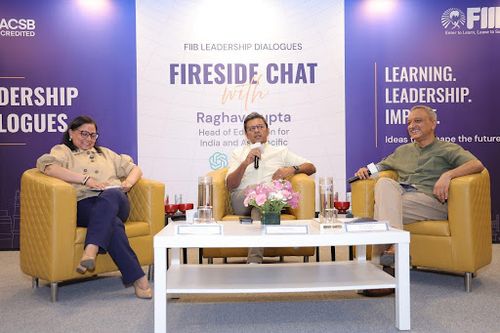
Raghav Gupta, Head of Educationfor India and APAC at OpenAI, in conversation with Radhika Shrivastava, President & CEO - FIIB (Left) and Saurabh Mittal - Chair of FIIB's AI Council (right), at the FIIBX launch.
"Most institutions are updating the applications. We rebuilt the operating system. The difference is not metaphorical. A curriculum revision changes what is taught. An operating system changes the architecture beneath: how capability is defined, how learning is structured, how achievement is validated, and how technology runs through all of it. FIIBX governs all of those simultaneously."
— Radhika Shrivastava, President & CEO, FIIB
Six career paths. Ten tracks. A different kind of precision.
FIIBX organizes students by destination, not by subject. The difference is structural. A pathway is the domain a student is entering: Consulting and Strategy, Marketing and Growth, Finance and FinTech, Operations and Analytics, People and Organization, or Founders and Venture. A track is the role architecture within that domain: the specific competency framework, the mapped course structure, and the assessment calibrated to what that work actually demands. Six pathways. Ten tracks. One system built around where a graduate is going, not what subject they studied to get there.
The distinction between pathway and track is not cosmetic. A student on the Revenue and Growth track and a student on the Digital Marketing and Brand Communication track share a pathway. They do not share a programme. One is being built for commercial ownership: pipeline, conversion, account economics, the ability to defend a revenue number. The other is being built for integrated brand and digital strategy: audience architecture, channel logic, the ability to construct a campaign that serves a business objective rather than just executes one. The competencies diverge because the work diverges. FIIBX makes that divergence explicit rather than leaving it to the placement process to resolve.
This is harder to build than a specialization. It requires committing to what each track contains, what tracks within a pathway share, and where they must separate. That commitment is what makes the architecture credible to an employer, and what gives a student something most programmes do not: preparation for something specific, with the capability foundation to move laterally if the destination shifts.
That capability foundation has a name in FIIBX: the Capability Transit System — the shared layer of core competencies and AI capability that runs beneath all six pathways and ten tracks, connecting them the way a transit network links any station to any other. It is what allows a graduate to move laterally when the destination shifts.
— Radhika Shrivastava, President & CEO, FIIB
What recruiters gain
In conversations with recruiters across industries, two themes surfaced consistently. The first was skill fracture: graduates arriving technically trained in a subject but underprepared for the specific demands of the role. The second was ramp time: the months between joining and genuine productivity, which organisations absorb as a hidden cost of every hire.
FIIBX is designed to address both. Every pathway is anchored in actual job descriptions, actual tool stacks, and actual hiring signals. Students leave with portfolios of work built under real conditions: live ad campaigns, credit committee simulations with practising bankers, consulting engagements with external clients, stock pitches judged by buy-side professionals, and semester-long micro-ventures where students acquire real customers. The assessment is designed so that the work produced is portfolio-ready from day one of the hiring conversation.
Each track also embeds AI capability at the point where it changes the work, not as a generic skill but as a trained capability within the specific role. A graduate on the Investment Intelligence track uses AI to accelerate research and stress-test models. A graduate on the Revenue and Growth track uses it to analyse pipeline and model account economics. The result is a hire who arrives oriented to the work, to the tools, and to the standard of output the role requires.
Each track carries a defined competency architecture and a mapped course structure. The evidence of that competency is what the assessment section below addresses directly.
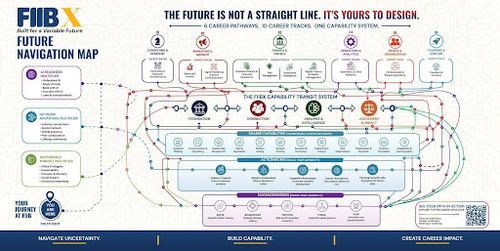
The FIIBX Future Navigation Map: six career pathways, ten tracks, and the FIIBX Capability Transit System that runs beneath all of them.
"Something irreversible has happened to the relationship between knowing and doing. AI has made knowledge retrieval instantaneous and universal. What organisations now need from graduates is not the knowledge itself, but the judgment to use it, the capability to apply it under pressure, and the ability to keep adapting as the tools and conditions shift. That is not a skills agenda. It is a redesign problem. FIIBX is our answer to it."
— Radhika Shrivastava, President & CEO, FIIB
Assessment as the core argument
The most consequential change in FIIBX is the one least visible from the outside: what counts as evidence of a graduate's capability.
"If a take-home examination can be answered by a machine in seconds, that examination is measuring the machine, not the student. We rebuilt assessment from a single question: what does a capable graduate actually do? And the answer is not write an exam. It is make a decision, solve a problem, defend a position, and produce something an employer recognises as real work."
— Radhika Shrivastava, President & CEO, FIIB
Assessment in FIIBX produces deliverables, not scores. Students work through structured challenges that simulate real professional conditions: problems with missing information, decisions that must be defended under scrutiny, projects that run against genuine ambiguity. Each track's assessment is mapped to its competency architecture, so the portfolio a student builds is not generic evidence of capability, it is specific evidence of readiness for the role they have been working toward. A student does not graduate with a transcript that implies readiness. They graduate with a body of work that proves it.
Two systems make this possible.
ActionWorks is the engine of structured challenges, decisions, simulations, and live problems students work through under real professional conditions. EvidenceWorks is what captures the output, the portfolio of deliverables that becomes specific, role-mapped proof of what a graduate can do. Together, they are why a FIIBX student leaves with demonstrated work rather than a transcript.
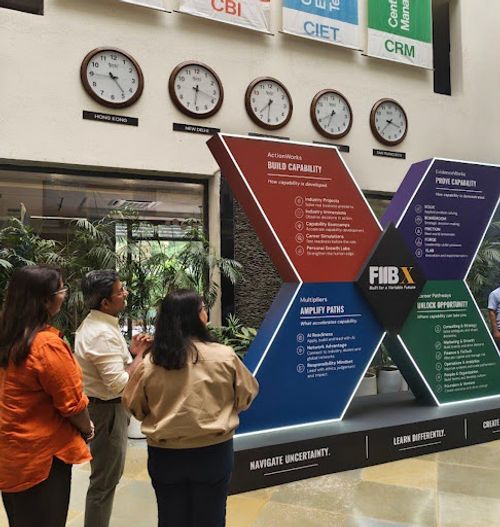
Raghav Gupta at the FIIBX installation on campus following the unveiling, with the ActionWorks and EvidenceWorks architecture visible behind him.
Designed for AI, not with AI
FIIB draws a deliberate distinction between curriculum designed with AI and curriculum designed for AI. The former adds AI tools to an existing structure. The latter starts from the assumption that graduates will operate in an AI-saturated environment and builds accordingly. FIIBX is designed for AI: every capability framework assumes AI-embedded workflows, every assessment is built around what AI cannot replicate, and AI readiness runs as a capability thread across all six specializations at five levels of depth, from working literacy to leading transformation.
"By making knowledge free, AI has stripped the value out of simply knowing things. A school that still mainly sells knowledge is selling something whose value is collapsing in real time. What rises in value at the same moment is judgement. That is where we have concentrated the entire programme."
— Radhika Shrivastava, President & CEO, FIIB
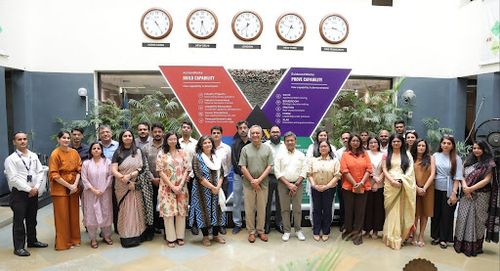
Faculty, staff, and students at the FIIBX launch at FIIB, New Delhi.
Built by the institution, owned by the institution
FIIBX is the product of the institution itself: designed, debated, and owned by the faculty, programme leads, and academic staff at FIIB who will teach it, assess it, and be accountable for what it produces. The framework was stress-tested with senior professionals from BCG, FedEx, JPMorgan, SBI Cards, Societe Generale, KPMG, and MakeMyTrip, among others, whose inputs shaped the career track architecture, the competency frameworks, and the assessment design. Their perspectives are documented at www.fiib.edu.in/fiibx.
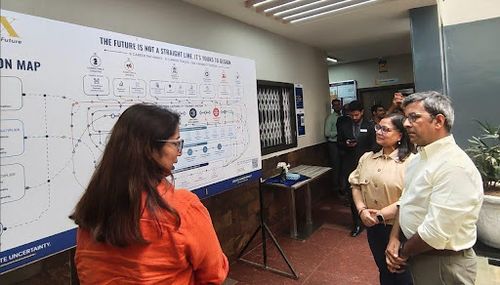
Raghav Gupta reviewing the FIIBX Future Navigation Map at the launch
The promise to a student
"You will not graduate prepared for one job. You will graduate prepared for a career you cannot yet predict. There is a difference between being trained and being prepared. Training is for a known role, and a known role can be automated out from under you. Preparation is for an unknown future. The future cannot be predicted. But it can be prepared for."
— Radhika Shrivastava, President & CEO, FIIB
Three Decades, One institutional commitment
FIIB was founded on the conviction that Indian management education could be genuinely industry-first: designed not for institutional convenience, but for graduate readiness. That conviction has shaped the institution for over three decades. FIIBX is its most complete expression.
The launch marks the beginning of implementation, not the completion of a project. Graduate outcomes, employer feedback, and placement data against prior cohorts will be tracked and published. The institution has committed publicly to that process.
About FIIB
Fortune Institute of International Business (FIIB) is a New Delhi-based, AACSB-accredited postgraduate business school and PRME Champion institution. Established in 1995, FIIB has built its identity on a single commitment: preparing graduates who are ready to work, think, and lead from day one. FIIBX is the institutional expression of that commitment, rebuilt for an AI-native world.


.png?h=132&w=263&mode=stretch)
.png?h=132&w=263&mode=stretch)
![MBA/PGDM | admission | 2024 | Narsee Monjee Institute of Management Studies - [NMIMS Deemed to be University]](https://img.collegedunia.com/public/college_data/images/logos/1506323004Logo.jpg?h=72&w=72&mode=stretch)


![MBA/PGDM | admission | 2024 | Indian Institute of Management - [IIMC]](https://img.collegedunia.com/public/college_data/images/logos/1488950580d2.png?h=72&w=72&mode=stretch)



Comments