




CUET PG M.Ed. Question Paper 2024 is available here for download. NTA conducted CUET PG M.Ed. paper 2024 on from March 17 in Shift 1. CUET PG Question Paper 2024 is based on objective-type questions (MCQs). According to latest exam pattern, candidates get 105 minutes to solve 75 MCQs in CUET PG 2024 M.Ed. question paper.
CUET PG M.Ed. Question Paper 2024 PDF Download
| CUET PG 2024 M.Ed. Question Paper with Answer Key |  Download Download |
Check Solution |

CUET PG M.ED. 2024 Questions with Solutions
Which of the following branch deals with morals, norms and values?
View Solution
Ethics is the branch of philosophy that deals with questions about morality, norms, values, and principles that guide human behavior. It focuses on what is right and wrong, and what people ought to do. Other branches like Metaphysics, Epistemology, and Aesthetics are related to different philosophical concepts such as existence, knowledge, and beauty respectively. Therefore, the correct answer is Ethics. Quick Tip: Ethics is central to understanding moral principles and guiding human actions. It is one of the core areas of philosophy.
Match List I with List II:

Choose the correct answer from the options given below:
View Solution
Shaikshik Gyan aur varchasva is authored by Krishna Kumar (II).
Shiksha me badlav ke sawal is authored by Anil Sadgopal (III).
Divaswapn is authored by Gijubhai Badheka (IV).
Shiksha aur jan andolan is authored by Sadhna Saxena (I).
Therefore, the correct matching is (A) - (II), (B) - (III), (C) - (IV), (D) - (I), which corresponds to option (4). Quick Tip: Ensure you match authors and their respective works carefully based on the content of the book or theory.
Select the right combinations:
(A). Discovery of India - . L. Nehru
(B). My Experiments with truth - M. K. Gandhi
(C). Annihilation of Caste - B. R. Ambedkar
(D). India wins freedom - Maulana Abul Kalam Azad
Choose the correct answer from the options given below:
View Solution
Discovery of India is written by Jawaharlal Nehru.
My Experiments with Truth is written by M. K. Gandhi.
Annihilation of Caste is by B. R. Ambedkar.
India Wins Freedom is by Maulana Abul Kalam Azad.
Thus, the correct combination includes all four books, so the answer is (A), (B), (C), and (D). Quick Tip: These books are important historical texts that reflect the views and philosophies of some of India's prominent freedom fighters and thinkers.
Which of the following is an astik school of Indian philosophy?
View Solution
Astik schools of Indian philosophy accept the authority of the Vedas. Samkhya is one of the six classical Astik schools of Indian philosophy, which are based on the teachings of the Vedas. Buddhism, Jainism, and Charvak are considered Nastik schools as they do not accept the authority of the Vedas.
Thus, the correct answer is Samkhya. Quick Tip: Astik schools believe in the authority of the Vedas, while Nastik schools do not.
Nai Talim can be associated with:
View Solution
Nai Talim, also known as Basic Education, was introduced by Mahatma Gandhi. It focused on learning through handicrafts and manual labor, aiming for a holistic development of students. The system emphasized the importance of practical learning in the overall education process.
Thus, the correct answer is Gandhi. Quick Tip: Nai Talim was designed by Gandhi to ensure a well-rounded education that integrates practical skills with academic learning.
Arrange the following in historical chronology:
(A) Calcutta University Commission
(B) University Education Commission
(C) Macaulay Minutes
(D) Gokhale Bill
Choose the correct answer from the options given below:
View Solution
The correct chronological order is:
(C) Macaulay Minutes (1835)
(D) Gokhale Bill (1911)
(A) Calcutta University Commission (1917-1919)
(B) University Education Commission (1948-1949)
Thus, the correct sequence is (C) - (D) - (A) - (B).
Quick Tip: For historical chronology questions, make sure to refer to the dates of significant events in education history.
Who was the first Education minister of independent India?
View Solution
Maulana Abul Kalam Azad was the first Education Minister of independent India. He played a significant role in shaping the educational policies and promoting education in India post-independence. Quick Tip: Maulana Abul Kalam Azad's contributions to Indian education include his work in establishing the IITs and promoting primary education.
Match List I with List II

Choose the correct answer from the options given below:
View Solution
The correct matching is:
(A) Idealism - (IV) Plato
(B) Naturalism - (III) Rousseau
(C) Pragmatism - (II) Dewey
(D) Realism - (I) A.N. Whitehead
To accurately match the philosophical schools of thought with their respective thinkers, it's essential to understand the core tenets of each philosophy.
Idealism: This philosophy prioritizes mind and spirit over material reality. Plato, a classical Greek philosopher, is a quintessential idealist. His theory of Forms posits that the physical world is merely a reflection of eternal, unchanging ideas or Forms. Thus, (A) matches with (IV) Plato.
Naturalism: Naturalism emphasizes the natural world as the entirety of reality, rejecting supernatural or spiritual explanations. Jean-Jacques Rousseau, an Enlightenment thinker, advocated for education aligned with nature, emphasizing the innate goodness of humanity and the importance of learning through experience in the natural environment. Therefore, (B) matches with (III) Rousseau.
Pragmatism: Pragmatism focuses on the practical consequences of ideas and actions, viewing truth as what works in practice. John Dewey, an American philosopher and educational reformer, is a key proponent of pragmatism. He believed that education should be experiential and problem-centered, fostering critical thinking and practical skills. Hence, (C) matches with (II) Dewey.
Realism: Realism asserts that reality exists independently of human perception or thought. Alfred North Whitehead, a 20th-century philosopher and mathematician, contributed to realist thought with his process philosophy, which emphasizes the dynamic and interconnected nature of reality. Thus, (D) matches with (I) A.N. Whitehead.
Quick Tip: Remember the key figures associated with each philosophical school of thought.
University Grants Commission was established in the year:
View Solution
The University Grants Commission (UGC) was established in 1956 by an Act of Parliament to coordinate, determine, and maintain the standards of university education in India. Quick Tip: UGC is crucial for maintaining educational quality and facilitating grants to Indian universities.
Which of the following are not Kosha as in Panchkosh of Aurobindo?
(A) Vijnanmay
(B) Anandmay
(C) Sukhmay
(D) Santoshmay
Choose the correct answer from the options given below:
View Solution
In the Panchkosh theory of Aurobindo, the Koshas are layers or sheaths that encase the Atman (soul).
The correct Koshas in the theory are:
(A) Vijnanmay Kosha (knowledge sheath)
(B) Anandmay Kosha (bliss sheath)
The other options, (C) Sukhmay and (D) Santoshmay, are not part of Aurobindo’s Panchkosh. Quick Tip: The concept of Koshas is rooted in the idea that the soul is veiled by layers, each representing different aspects of our being.
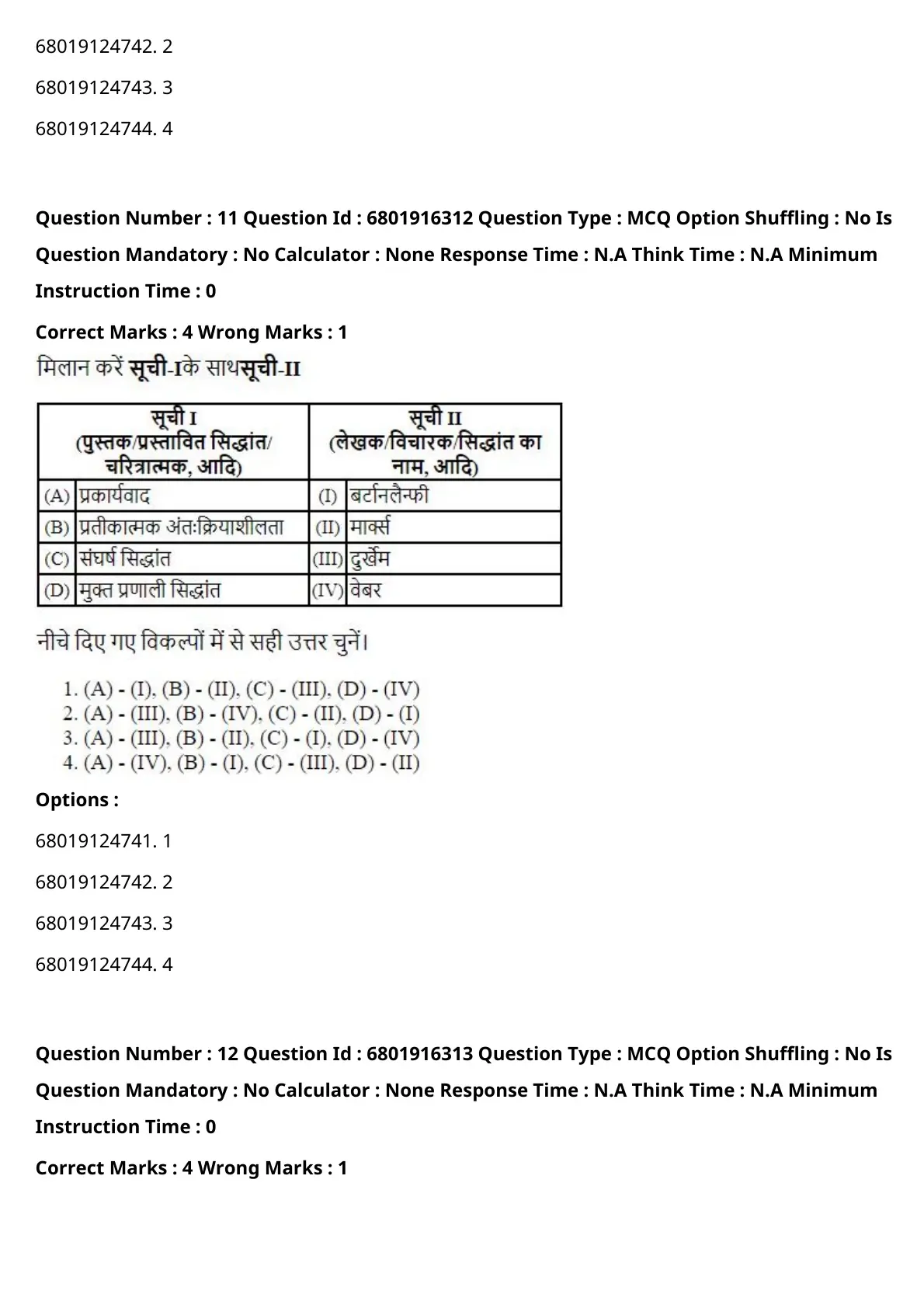
Match List I with List II

Choose the correct answer from the options given below:
View Solution
The correct matching is:
(A) Functionalism - (III) Durkheim
(B) Symbolic Interactionism - (IV) Weber
(C) Conflict theory - (II) Marx
(D) Open Systems theory - (I) Bertalanffy
To accurately match the sociological theories with their respective thinkers, it's essential to understand the core tenets of each theory.
Functionalism: This sociological perspective views society as a system of interconnected parts that work together to maintain stability and order. Emile Durkheim, a key figure in functionalism, emphasized the importance of social solidarity and the functions of social institutions. Thus, (A) matches with (III) Durkheim.
Symbolic Interactionism: This theory focuses on how individuals create and interpret meaning through social interaction and symbols. Max Weber, a foundational sociologist, explored the subjective meanings that individuals attach to their actions and interactions, laying the groundwork for symbolic interactionism. Therefore, (B) matches with (IV) Weber.
Conflict Theory: Conflict theory emphasizes social inequality and power struggles as driving forces in society. Karl Marx, a critical theorist, analyzed how class conflict and economic inequality shape social relations and institutions. Hence, (C) matches with (II) Marx.
Open Systems Theory: This theory views systems as interconnected and influenced by their environments. Ludwig von Bertalanffy, a biologist and systems theorist, developed the general systems theory, which applies to various fields, including sociology. Thus, (D) matches with (I) Bertalanffy.
Quick Tip: Remember the key figures associated with each sociological theory. Understanding their core contributions will help you accurately match them in such questions.
Select the incorrect ones:
(A). Education helps in vertical mobility.
(B). Caste facilitates social mobility.
(C). Girls' education is a loss to public exchequer.
(D). NEP 2020 promotes education by private philanthropic institutions.
Choose the correct answer from the options given below:
View Solution
Let's analyze each statement:
(A) Education helps in vertical mobility: This is a correct statement. Education is a powerful tool for upward mobility in society, allowing individuals to improve their social and economic status.
(B) Caste facilitates social mobility: This is incorrect. Caste systems generally hinder social mobility as individuals are restricted to certain roles and positions based on their caste, limiting upward movement.
(C) Girls' education is a loss to the public exchequer: This is also incorrect. Girls' education is a key factor in national development, leading to a more educated, productive workforce and improved societal welfare. Therefore, it is an investment, not a loss.
(D) NEP 2020 promotes education by private philanthropic institutions: This statement is correct. The NEP 2020 encourages private participation in education through philanthropic contributions and support to boost the education system in India.
Thus, the incorrect statements are (B) and (C), making option (3) the correct choice. Quick Tip: Education is a powerful tool for social change, and it is important to evaluate policies based on how they enhance opportunities for all, especially marginalized groups.
Every student of B.Ed must study philosophy of education because:
View Solution
The philosophy of education helps future educators understand the principles and ideas that guide teaching and learning. It is essential for teachers to reflect on their teaching practices to improve and adapt them to the needs of students. Through philosophical study, teachers can align their teaching methods with educational theories and understand their own beliefs and values about education. Therefore, the most accurate reason for B.Ed students to study the philosophy of education is to reflect on their own teaching. Quick Tip: Understanding educational philosophies helps teachers develop a reflective practice, making their teaching more meaningful and effective.
Arrange in historical chronology:
(A). Operation Blackboard
(B). National Literacy Mission
(C). Sarva Shiksha Abhiyan
(D). Right to Education
Choose the correct answer from the options given below:
View Solution
Here is the chronological order of the programs:
Operation Blackboard (1987): Aimed to improve the quality of primary education in India by providing basic infrastructure and teaching materials in schools.
National Literacy Mission (1988): Focused on eradicating illiteracy among adults, providing a basic education to the masses.
Sarva Shiksha Abhiyan (2001): Aimed at achieving universal elementary education, it brought together different education-related programs for more comprehensive education access.
Right to Education (RTE) Act (2009): Made education a fundamental right, mandating free and compulsory education for children aged 6-14.
Thus, the correct chronological order is (A), (B), (C), and (D). Quick Tip: These educational reforms were introduced over several decades to address different issues in India's education system. They laid the foundation for modern educational policies.
Arrange as in a lesson plan:
(A). Homework
(B). Specific Aims
(C). Recapitulation
(D). Content and Method
Choose the correct answer from the options given below:
View Solution
The correct sequence of a lesson plan is as follows:
(B) Specific Aims: These outline the objectives of the lesson and what the teacher intends to achieve.
(D) Content and Method: This section includes the actual material to be taught and the methods for delivering it.
(C) Recapitulation: After teaching the content, a recap or review of the material ensures that the students grasped the concepts.
(A) Homework: This allows students to further practice what they have learned in class and helps solidify the concepts.
Thus, the correct order is (B), (D), (C), (A). Quick Tip: A lesson plan is essential for ensuring a structured and effective teaching session. Always begin with clear objectives and end with a reflection or homework for reinforcement.
Project Method was propounded by:
View Solution
The Project Method was propounded by William H. Kilpatrick in 1918. He believed that students learn best when they engage in practical projects that have real-world applications. This method encourages active participation and problem-solving rather than passive learning. Although other educators like Rousseau and Froebel influenced modern educational methods, Kilpatrick is the one who specifically developed the Project Method. Quick Tip: The Project Method emphasizes learning by doing, where students take part in projects to understand concepts more practically.
Corporal punishment still exists in our schools because:
View Solution
Corporal punishment is an outdated and harmful practice that still persists in some schools due to the lack of awareness about its detrimental effects on students' mental health and overall development. Teachers who use corporal punishment may not fully realize its demerits, such as the emotional and physical harm it causes, and its ineffectiveness in creating disciplined students. More modern approaches to discipline emphasize positive reinforcement and understanding students' needs. Quick Tip: Teachers should be educated about alternative, non-violent methods of discipline, focusing on emotional and cognitive development to promote a positive learning environment.
Raag Darbari - a satirical novel on the education system is written by:
View Solution
Raag Darbari is a famous satirical novel by Shrilal Shukla that critiques the educational system, societal norms, and the hypocrisy in rural Indian life. The novel uses humor and satire to portray the flaws in the system, making it an essential read for understanding social commentary in literature. Quick Tip: Shrilal Shukla's work is known for its sharp critique of social structures and his use of satire to reflect on the moral decay in society.
According to Spearman, individual differences are based on:
View Solution
Charles Spearman proposed a theory of intelligence based on two factors: the g factor (general intelligence) and s factors (specific intelligence). According to Spearman, individual differences in intellectual ability can be attributed to the general factor (g), which influences all areas of cognitive ability. Specific factors (s) relate to particular skills or talents, but the g factor is the primary source of individual differences. Quick Tip: Spearman’s theory suggests that a person’s overall cognitive ability (g factor) is the main determinant of success across various tasks, while specific abilities (s) influence particular areas.
Match List I with List II

Choose the correct answer from the options given below:
View Solution
In Guilford's Structure of Intellect (SI) model:
Units represent single items of information, so (A) matches with (III).
Relations represent connections between items or variables, so (B) matches with (IV).
Classes are sets that share common attributes, so (C) matches with (II).
Transformations involve changes or conversions of information, so (D) matches with (I).
Thus, the correct matching is: (A) - (III), (B) - (IV), (C) - (II), (D) - (I). Quick Tip: The SI Model of Guilford emphasizes different aspects of cognitive and intellectual functioning, including the basic components (Units), relationships (Relations), categorization (Classes), and changes (Transformations).
Which of the following is NOT a group verbal Intelligence test?
View Solution
The Benet-Simon Tests are not a group verbal intelligence test. These tests were developed to measure the intelligence of children individually and are primarily used for assessing cognitive abilities on a one-on-one basis.
Army General Classification Test and Army Alpha Test are both group intelligence tests designed for military personnel to assess their verbal ability and general mental aptitude.
General Mental Ability Test also measures intelligence on a group level but is broader than just verbal intelligence.
Thus, the correct answer is (4) Benet-Simon Tests. Quick Tip: Group intelligence tests assess the cognitive abilities of a large group, while individual tests like Benet-Simon focus on one person at a time.
Which of the following are NOT among the important traits as identified by Allport?
(A). Secondary traits
(B). Source traits
(C). Super traits
(D). Surface traits
Choose the correct answer from the options given below:
View Solution
Gordon Allport's trait theory identifies three levels of traits: cardinal, central, and secondary.
Secondary traits were identified by Allport.
Source traits, super traits, and surface traits are associated with other trait theories (Cattell and Eysenck).
Therefore, source traits, super traits, and surface traits are NOT among the important traits identified by Allport.
So the correct answer is (B), (C) and (D) only.
Quick Tip: Allport’s theory of personality highlights the importance of source and surface traits in understanding individual behaviors.
How many dimensions does Structure of Intellect Model have?
View Solution
The Structure of Intellect Model developed by J.P. Guilford consists of 180 different intellectual abilities. The model is based on three dimensions: operations, contents, and products, resulting in 180 distinct abilities that contribute to human intelligence. This model was designed to explain the complexity and multidimensionality of human cognitive abilities.
Thus, the correct answer is 180. Quick Tip: Guilford's Structure of Intellect Model provides a detailed approach to understanding human intelligence, breaking it down into 180 components.
Choose the correct statements related to teaching:
(A). Teaching is expressed in the form of shaping habits.
(B). Teaching involves instruction.
(C). Training is a part of teaching.
(D). Teaching can also occur without indoctrination.
Choose the correct answer from the options given below:
View Solution
(B) Teaching involves instruction, which is a fundamental aspect of education.
(C) Training is indeed a part of teaching, as it focuses on developing specific skills.
(D) Teaching can occur without indoctrination, meaning it can be done objectively without forcing specific beliefs on students.
All three statements are correct and reflect different aspects of effective teaching, so the answer is (4) (B), (C) and (D). Quick Tip: Effective teaching encompasses both instruction and skill development while avoiding indoctrination, ensuring students develop critical thinking and independent thought.
Choose the correct statements related to temperament:
(A). Temperament is partly physical and partly mental
(B). Personality of a person depends on his/her temperament
(C). Climate doesn't affect our temperament
(D). Mood, when it becomes permanent, influences our temperament
Choose the correct answer from the options given below:
View Solution
(A) Temperament is a combination of both physical and mental traits. It influences how a person responds to various situations.
(B) Personality is indeed shaped by temperament, as temperament lays the foundation for behavioral tendencies.
(C) Climate can actually influence temperament. For example, extreme weather can affect mood and behavior, contradicting this statement.
(D) Mood, when it becomes permanent, definitely has an impact on temperament, as it shapes habitual emotional responses.
Therefore, the correct answer is (1) (A), (B) and (D) only. Quick Tip: Temperament plays a significant role in shaping an individual's personality and can be influenced by both internal and external factors, including climate and mood.
Choose the correct sequence of the first four steps involved in the microteaching cycle:
(A) Replan
(B) Plan
(C) Feedback
(D) Teach
Choose the correct answer from the options given below:
View Solution
The microteaching cycle is a structured approach to improving teaching skills. The sequence of steps in the microteaching cycle is:
(B) Plan: Teachers start by planning the lesson to be taught, focusing on specific skills.
(D) Teach: The teacher then teaches the planned lesson in a controlled setting, usually to a small group of students.
(C) Feedback: After the lesson, the teacher receives feedback on their performance to identify areas for improvement.
(A) Replan: Based on the feedback, the teacher revises and re-plans the lesson to improve the next teaching attempt.
Thus, the correct sequence is: (B) - (D) - (C) - (A). Quick Tip: Microteaching is designed to improve specific teaching skills through repetition, feedback, and re-planning.
Which one of the following is not a phase of teaching?
View Solution
The phases of teaching include:
Pre-active phase (planning)
Interactive phase (implementation)
Post-active phase (evaluation)
The term "active" is not recognized as a distinct phase of teaching. The correct term for the implementation phase is "interactive."
Correct Answer: (2) Active Quick Tip: Focus on understanding the stages of teaching to improve overall instructional quality and student engagement.
Choose the correct sequence of steps involved in simulated teaching:
(A) Conducting practice session
(B) Selection and discussion of the skills
(C) Deciding the procedure of evaluation
(D) Selection of small group of student teachers
Choose the correct answer from the options given below:
View Solution
Simulated teaching involves a structured approach to teaching practice, and the correct sequence of steps is:
(D) Selection of small group of student teachers: A small group of student teachers is chosen to simulate the teaching environment.
(B) Selection and discussion of the skills: The skills to be focused on during the practice session are selected, and the group discusses these skills.
(C) Deciding the procedure of evaluation: The method of evaluating the teaching performance is decided in this step.
(A) Conducting practice session: The student teachers then conduct their practice sessions based on the selected skills and evaluation criteria.
Thus, the correct sequence is: (D) - (B) - (C) - (A). Quick Tip: Simulated teaching helps in practicing specific teaching skills in a controlled environment, making it easier to identify areas for improvement.
The main purpose of this skill through microteaching is to increase student's participation. Identify the skill.
View Solution
Among the given skills:
Skill of Explaining focuses on clarity of concepts.
Skill of Reinforcement focuses on encouraging desired student behaviors and participation.
Skill of using audio-visual aids focuses on enhancing learning through visual and auditory materials.
Skill of Illustrating with Examples focuses on making concepts concrete.
The skill that directly aims to increase student participation is the Skill of Reinforcement.
therefore, the Correct Answer is (2) Skill of Reinforcement Quick Tip: Illustrating concepts with examples is a powerful tool in teaching, as it helps to bridge the gap between theory and practical understanding.
Which of the following is NOT a content of maxims of teaching?
View Solution
The maxims of teaching are principles that guide teaching methods. The correct ones are:
Concrete to abstract: Teaching should start with tangible, concrete concepts before moving to abstract ones.
Psychological to logical: The learning process should be based on the learner's psychology and move to logical concepts.
Particular to general: Teaching should begin with specific instances before moving to generalizations.
However, Definite to indefinite is not one of the recognized maxims of teaching. Instead, the focus is typically on moving from simple to complex or concrete to abstract. Quick Tip: Maxims of teaching serve as guiding principles that help improve teaching effectiveness by focusing on the learner's understanding and cognitive development.
Which of the following is NOT a teaching style?
View Solution
In teaching, styles like directing, delegating, and discussing are widely recognized:
Directing refers to a teacher-centered approach where the teacher provides clear instructions.
Delegating gives students more responsibility for learning, where the teacher takes on a more facilitative role.
Discussing encourages interaction between teacher and students through group discussions.
However, developing style is not commonly recognized as a formal teaching style. Thus, the correct answer is (1) The developing style. Quick Tip: Effective teaching often involves balancing multiple styles based on the learning context and student needs.
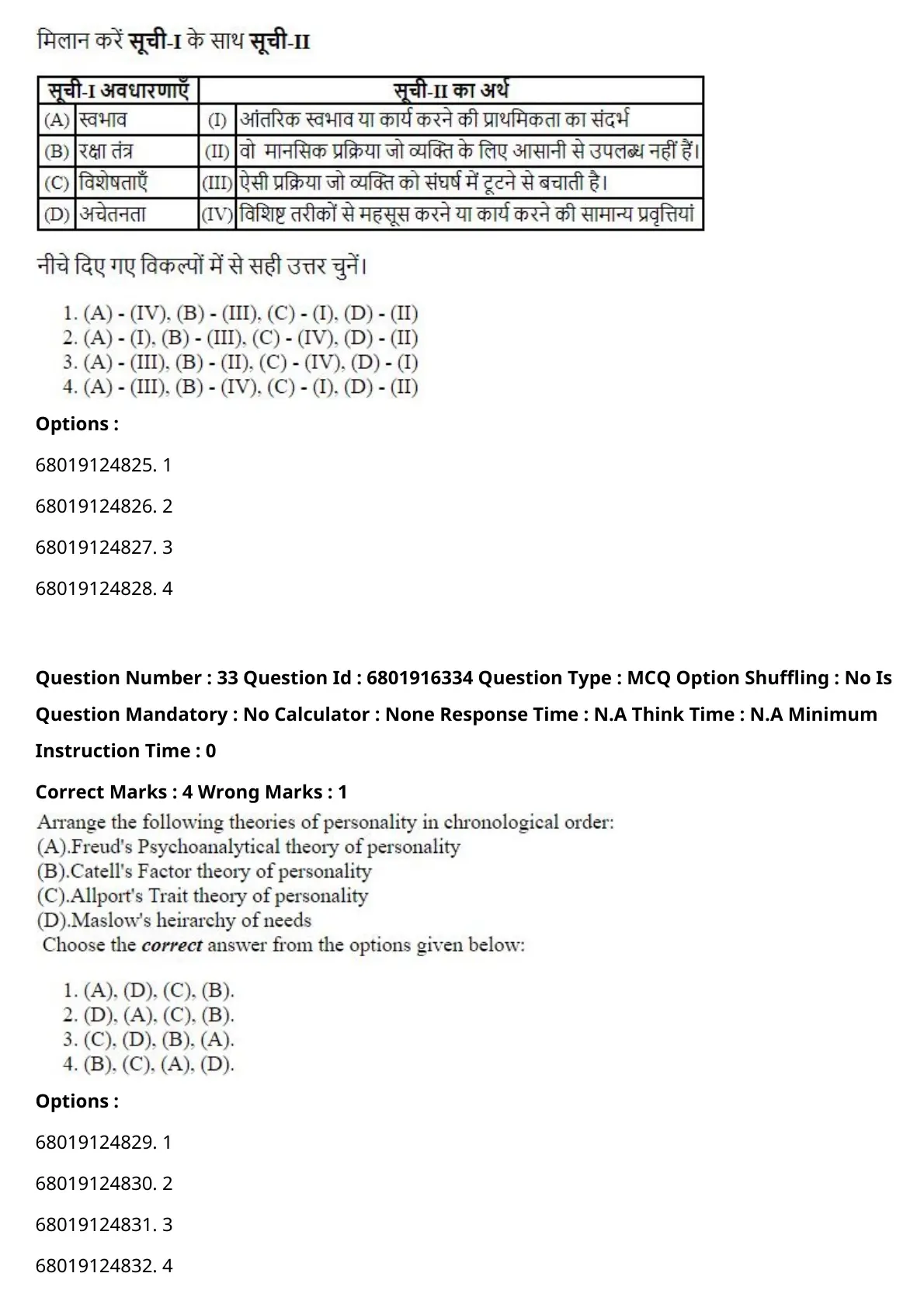
Match List I with List II:

Choose the correct answer from the options given below:
View Solution
The correct matching is as follows:
Temperament (A) refers to general tendencies to feel or act in particular ways (IV).
Defence mechanism (B) refers to a process that protects the person from breaking down in conflict (III).
Trait (C) refers to an internal disposition or preference to act (I).
Unconsciousness (D) refers to mental processes that are not easily available to the individual (II).
Thus, the correct matching is: (A) - (IV), (B) - (III), (C) - (I), (D) - (II). Quick Tip: Understanding the relationship between psychological concepts like temperament, defence mechanisms, and traits helps in recognizing individual behavior patterns.
Arrange the following theories of personality in chronological order:
(A). Freud's Psychoanalytical theory of personality
(B). Catell's Factor theory of personality
(C). Allport's Trait theory of personality
(D). Maslow’s hierarchy of needs
Choose the correct answer from the options given below:
View Solution
The correct chronological order is:
Freud's Psychoanalytical theory of personality (A) is the earliest, proposed in the late 19th to early 20th century.
Maslow’s hierarchy of needs (D) was proposed later, in the mid-20th century.
Allport's Trait theory of personality (C) came after Maslow’s work, in the 1930s and 1940s.
Catell's Factor theory of personality (B) is one of the most recent theories, developed in the 1940s and 1950s.
Thus, the correct chronological order is (A), (D), (C), (B). Quick Tip: Theories of personality evolved over time as researchers explored different aspects of human behavior, from Freud’s focus on unconscious forces to Maslow’s emphasis on self-actualization.
Which of the following is NOT among the fundamental principles of programmed instruction?
View Solution
Programmed instruction is a method of teaching that involves breaking down material into small steps and providing feedback. The fundamental principles of programmed instruction include:
Principle of active responding: Learners must actively respond to stimuli to enhance retention.
Principle of immediate confirmation: Immediate feedback helps reinforce learning.
Principle of logical sequencing: Content is presented in a logical order, progressing from simple to complex.
Principle of student testing is not a fundamental principle of programmed instruction; instead, the focus is on feedback and reinforcement.
Thus, the correct answer is (3) Principle of student testing. Quick Tip: Programmed instruction ensures a self-paced, structured learning experience, emphasizing active engagement and prompt feedback.
Suppose a man channels his aggression into excelling in gardening. Then he is using which type of defense mechanism?
View Solution
Sublimation is a defense mechanism where socially unacceptable impulses or desires are transformed into socially acceptable actions or behavior. In this case, the man's aggression is channeled into gardening, which is a productive and socially acceptable activity.
Regression involves reverting to an earlier stage of development to avoid dealing with stress.
Repression involves burying distressing thoughts or memories in the unconscious mind.
Projection involves attributing one's own undesirable feelings or thoughts to someone else.
Thus, the correct defense mechanism being used is Sublimation. Quick Tip: Sublimation is a healthy way to cope with negative emotions by redirecting energy into positive and productive outlets.
Match List I with List II

Choose the correct answer from the options given below:
View Solution
The correct matching is:
(A) Imbeciles - (III) 25-50
(B) Dull - (I) 80-90
(C) Idiots - (IV) below 25
(D) Morons - (II) 50-70
To accurately match Terman's classification of intellectual disabilities with their corresponding IQ ranges, it's essential to understand the historical context of these classifications.
Terman's Classification: Lewis Terman, a pioneer in intelligence testing, categorized individuals with intellectual disabilities based on their IQ scores. His classifications, while now considered outdated and insensitive, were historically significant.
Imbeciles: This term referred to individuals with moderate intellectual disability, typically with IQ scores ranging from 25 to 50. Therefore, (A) matches with (III) 25-50.
Dull: This category referred to individuals with borderline intellectual functioning, often with IQ scores in the range of 80 to 90. Hence, (B) matches with (I) 80-90.
Idiots: This term described individuals with profound intellectual disability, usually with IQ scores below 25. Thus, (C) matches with (IV) below 25.
Morons: This category referred to individuals with mild intellectual disability, generally with IQ scores ranging from 50 to 70. Therefore, (D) matches with (II) 50-70.
Quick Tip: While these classifications are no longer used in contemporary practice, understanding their historical context is important for studying the evolution of intelligence testing and disability classifications.
Children with Special Needs can be categorised as
(A) Physical
(B) Sensory
(C) Developmental
(D) Cognitive
Choose the correct answer from the options given below:
View Solution
Children with Special Needs can be categorized into four major categories:
Physical: This category includes children with disabilities affecting their physical mobility or coordination.
Sensory: This includes children who have hearing, visual, or other sensory impairments.
Developmental: These children have delays in physical, cognitive, or emotional development.
Cognitive: Children with cognitive impairments or intellectual disabilities are included in this category.
Thus, all the categories listed are valid, and the correct answer is (A), (B), (C), and (D). Quick Tip: Children with Special Needs encompass a broad range of disabilities, and understanding these categories helps in tailoring appropriate educational approaches.
The following are the main factors responsible for poor educational status among scheduled tribe children:
(A) Textbooks do not have local specific examples from their local environment
(B) Weak in English
(C) Formal education system being alien, is not adjusted to their socio-economic and cultural needs.
(D) Weak in reasoning
Choose the correct answer from the options given below:
View Solution
The factors that contribute to poor educational status among scheduled tribe children include:
(A) Textbooks that lack local specific examples make learning less relatable and harder for these children to connect with the content.
(C) The formal education system is often alien to the cultural, social, and economic realities of scheduled tribe children, making it difficult for them to adapt.
While (B) and (D) (Weak in English and Weak in reasoning) may also be factors, the most prominent contributors are the lack of cultural relevance in textbooks and the alien nature of the education system itself.
Thus, the correct answer is (A) and (C). Quick Tip: Educational systems need to adapt to the cultural and socio-economic backgrounds of students for better engagement and learning outcomes.
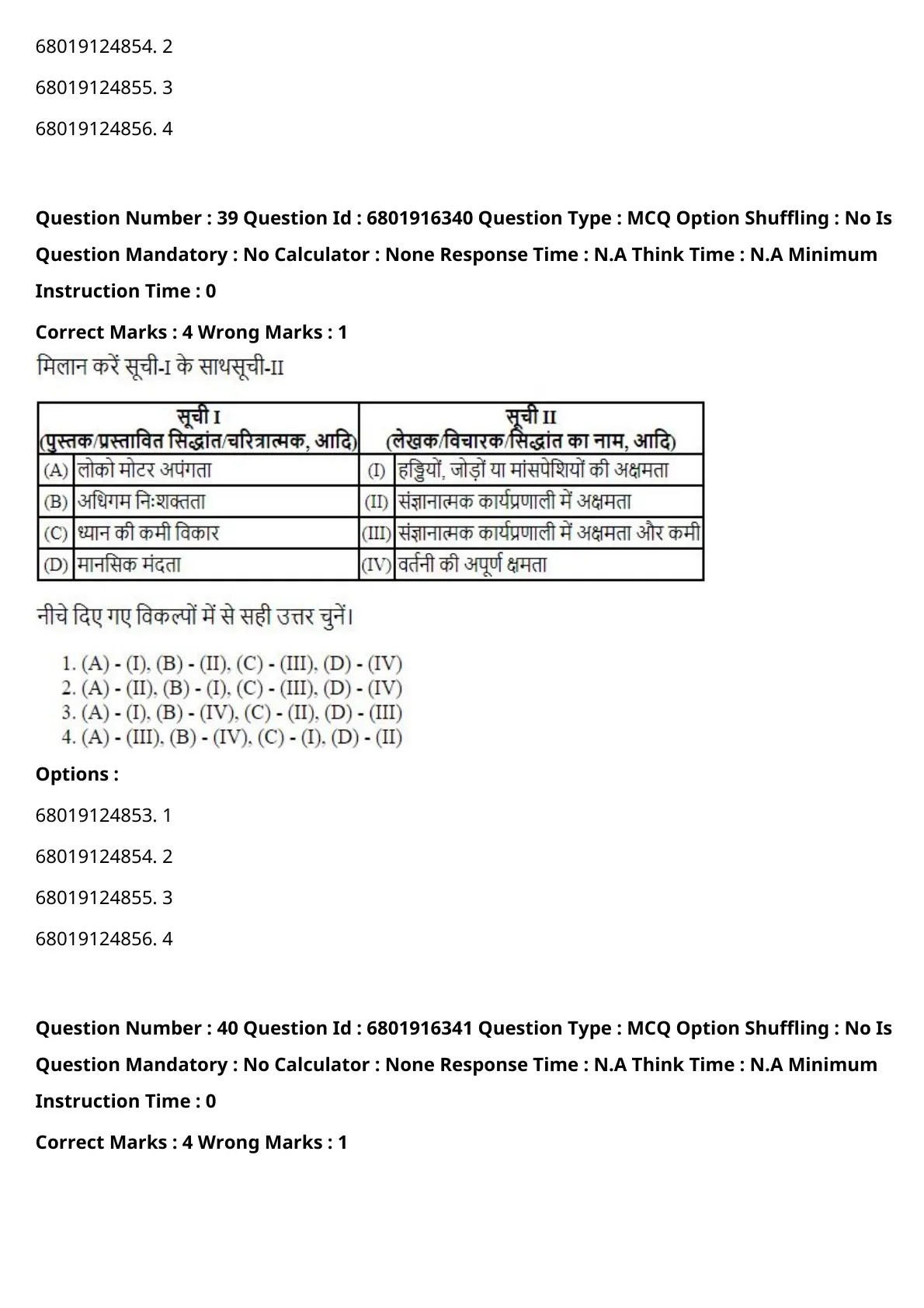
Match List I with List II

Choose the correct answer from the options given below:
View Solution
The correct matching between the categories and their corresponding definitions is as follows:
(A) Loco motor Impairment: This refers to a disability involving bones, joints, or muscles, which affects physical movement. Thus, it corresponds to (I) Disability of bones, joint, or muscles.
(B) Learning Disability: This is a condition that impacts cognitive functioning, making it harder for an individual to process information and learn. Hence, it is linked to (II) Impaired cognitive functioning.
(C) Attention Deficit Disorder: This disorder affects cognitive functioning and includes deficits in attention, focus, and impulse control. It corresponds to (III) Impaired cognitive functioning and deficit.
(D) Mental Retardation: This refers to intellectual disability, where the ability to spell and perform other cognitive tasks is impaired. Thus, it corresponds to (IV) An imperfect ability to spell.
Thus, the correct answer is (A) - (I), (B) - (II), (C) - (III), and (D) - (IV). Quick Tip: Understanding the specific definitions and characteristics of disabilities helps in correctly matching them with their appropriate terms.
Women’s Education is affected by:
(A) Prevailing biases in the content
(B) Lack of motivation for education among females
(C) Structural inadequacies in delivery systems
(D) Conflicting Familial factors
Choose the correct answer from the options given below:
View Solution
Women’s education is influenced by several key factors, including:
(A) Prevailing biases in educational content often underrepresent women’s contributions and reinforce gender stereotypes.
(C) Structural inadequacies in delivery systems, such as lack of appropriate facilities or resources for female students, hinder access to education.
(D) Conflicting familial factors, such as prioritizing domestic duties over education, also play a role in limiting educational opportunities for women.
While (B) Lack of motivation is a factor, the systemic issues (A), (C), and (D) have a more significant impact on women's education.
Thus, the correct answer is (A), (C), (D). Quick Tip: Women’s education can be significantly improved by addressing biases, improving educational infrastructure, and promoting societal changes that value education for girls and women.
Which of the following are gender stereotypes?
(A). Boys are weak in Fine art,
(B). Boys are courageous.
(C). Girls are weak in mathematics.
(D). Girls are good in household chores.
Choose the correct answer from the options given below:
View Solution
Gender stereotypes are generalized beliefs about the roles and behaviors of men and women. The statements in the options are classic examples of gender stereotypes:
(A) "Boys are weak in Fine art" is a stereotype about boys' perceived lack of artistic skills.
(B) "Boys are courageous" is a stereotype about traditional masculinity and expected behavior.
(C) "Girls are weak in mathematics" is a common stereotype about girls' perceived inability in math.
(D) "Girls are good in household chores" is a stereotype about the roles women are expected to play in domestic settings.
All four statements represent gender stereotypes, so the correct answer is (3) (A), (B), (C) and (D). Quick Tip: It is important to recognize and challenge gender stereotypes to ensure equality in education and other aspects of life.
Which of the following are District Primary Education Programme objectives?
(A). Reducing gender and social groups gap to less than 5 percent
(B). To provide access to primary education to all children
(C). To provide access to education to all children at the middle stage
(D). Reducing primary dropout to less than 10 percent
Choose the correct answer from the options given below:
View Solution
The District Primary Education Programme (DPEP) aims to improve primary education in India with the following objectives:
(A) Reducing gender and social gaps in education is a key objective of DPEP to promote inclusive education.
(B) Providing access to primary education to all children is another central objective of the program.
(D) Reducing primary school dropouts to less than 10 percent is also an important goal for improving retention and completion rates in primary education.
However, (C) providing access to education to all children at the middle stage is not specifically part of DPEP’s focus, as it primarily concentrates on primary education.
Thus, the correct answer is (2) (A), (B) and (D). Quick Tip: The focus of the District Primary Education Programme is to ensure access, retention, and quality in primary education for all children.
Match List I with List II:

Choose the correct answer from the options given below:
View Solution
To match the pedagogical and curricular structure with the correct age groups, we need to understand the structure of the National Education Policy (NEP) 2020:
Foundational Stage: Ages 3-8 (divided into 3 years of preschool/Anganwadi and 2 years of primary school). The initial 3 years are not listed, but the last 2 years of Foundational Stage are Ages 6-8.
Preparatory Stage: Ages 8-11.
Middle Stage: Ages 11-14.
Secondary Stage: Ages 14-18.
Therefore, the correct matching is:
(A) Preparatory - (III) Ages 8-11
(B) Secondary - (IV) Ages 14-18
(C) Foundational - (I) Ages 6-8
(D) Middle - (II) Ages 11-14
Therefore, the Correct Answer: 4. (A) - (III), (B) - (IV), (C) - (I), (D) - (II) Quick Tip: Understanding the different stages of education helps in designing appropriate curricula that meet the developmental needs of children at each age group.
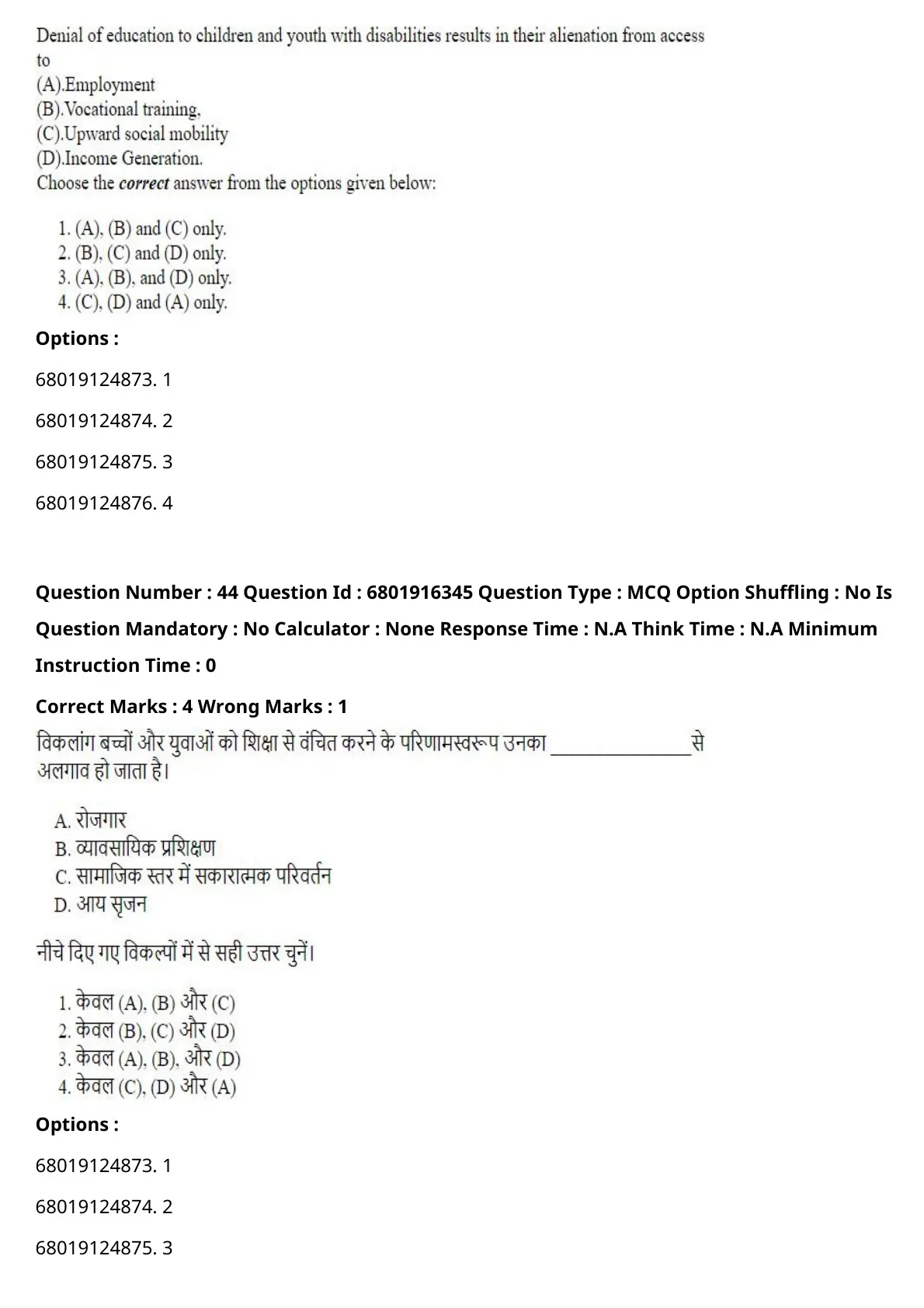
Denial of education to children and youth with disabilities results in their alienation from access to:
(A). Employment
(B). Vocational training
(C). Upward social mobility
(D). Income Generation
Choose the correct answer from the options given below:
View Solution
Denying education to children and youth with disabilities leads to exclusion from key societal benefits such as:
(A) Employment opportunities: Without proper education, individuals may lack the skills and qualifications needed for employment.
(B) Vocational training: Education and vocational training are essential for acquiring specific skills needed in various professions.
(C) Upward social mobility: Education plays a key role in improving social standing, and its absence leads to social isolation and limited opportunities for advancement.
(D) Income generation is not specifically linked to education, though it may be indirectly affected by lack of educational access.
Thus, the correct answer is (1) (A), (B) and (C) only. Quick Tip: Education is a powerful tool for empowerment, especially for individuals with disabilities, enabling them to participate fully in society.
The Universal Declaration of Human Rights envisages that primary education (classes I-V) should be:
View Solution
The Universal Declaration of Human Rights emphasizes that primary education (classes I-V) should be universal. This means that primary education should be available to all children, regardless of their social, economic, or geographic status. The goal is to ensure that every child has access to basic education, as a fundamental human right.
Thus, the correct answer is (3) Universal. Quick Tip: Universal access to primary education is essential for the development of individuals and societies, as it lays the foundation for lifelong learning.
The Operation Blackboard scheme consists of mainly three components:
(A). Providing at least one smart classroom in each primary school.
(B). Providing teaching-learning equipment to all primary schools brought under the scheme.
(C). Providing at least two classrooms in each primary school.
(D). Provision of an additional teacher to single teacher primary schools.
Choose the correct answer from the options given below:
View Solution
The Operation Blackboard scheme, launched in India, aimed to improve primary education. Its key components were:
(B) Providing teaching-learning equipment: This included essential educational materials to enhance the learning environment.
(C) Providing at least two classrooms: This ensured adequate space for students to learn effectively.
(D) Provision of an additional teacher: This addressed the issue of single-teacher schools, improving the teacher-student ratio.
(A) Providing smart classrooms was not a primary component of the original Operation Blackboard scheme.
Thus, the correct answer is (3) (B), (C) and (D) only. Quick Tip: Remember the core objectives of educational schemes like Operation Blackboard to understand their components.
Sarva Shiksha Abhiyan (SSA) programme aims to provide useful and relevant elementary education to all children in
View Solution
The Sarva Shiksha Abhiyan (SSA) is a government initiative aimed at providing universal elementary education to all children in the age group of 6 to 14 years. The program focuses on making education accessible and equitable for all children in this age group, ensuring free and compulsory education as a fundamental right. Quick Tip: SSA is pivotal in achieving universal education and ensuring that no child is left behind.
The term Compulsory Education in Right To Education act means
View Solution
Under the Right to Education (RTE) Act, compulsory education means that every child in the age group of 6 to 14 years is entitled to receive free elementary education. The RTE Act ensures that children within this age group must attend school and receive quality education, making it a fundamental right for all children in India. Quick Tip: The RTE Act empowers children by guaranteeing free and compulsory education, helping achieve universal primary education.
Match List I with List II

Choose the correct answer from the options given below:
View Solution
Let's match each item in List I with the corresponding item in List II:
(A) School management committee: These committees are primarily responsible for preparing school development plans. So, (A) matches with (III).
(B) 86th Constitutional Amendment Act: This act made free and compulsory education a fundamental right for children aged 6-14. So, (B) matches with (I).
(C) Operation Blackboard: This program aimed to improve the human and physical resources available in primary schools. So, (C) matches with (IV).
(D) 73rd Constitutional Amendment: This amendment led to the decentralization of powers to local self-governments, including in the education sector. So, (D) matches with (II).
Therefore, the correct matching is:
(A) - (III)
(B) - (I)
(C) - (IV)
(D) - (II)
Correct Answer: 3. (A) - (III), (B) - (I), (C) - (IV), (D) - (II) Quick Tip: Understanding constitutional amendments and key education reforms helps in identifying their impact on the structure and management of the education system.
Arrange in the historical chronology:
(A) Woods Dispatch
(B) Wardha Scheme
(C) Hunter commission
(D) Sadler commission
Choose the correct answer from the options given below:
View Solution
The correct historical sequence of educational reforms and commissions is:
(A) Woods Dispatch (1854): It laid down the foundation for modern education in India, advocating for a centralized education system.
(C) Hunter Commission (1882): It followed Woods Dispatch, and focused on primary education and its expansion.
(D) Sadler Commission (1917): This commission was set up to improve higher education in India, particularly focusing on university education.
(B) Wardha Scheme (1937): This scheme, proposed by Mahatma Gandhi, emphasized the need for basic education and promoted the concept of a free and compulsory education system in India.
Thus, the correct historical chronology is: (A) - (C) - (D) - (B). Quick Tip: Knowing the chronology of educational reforms helps in understanding the evolution of the education system in India.
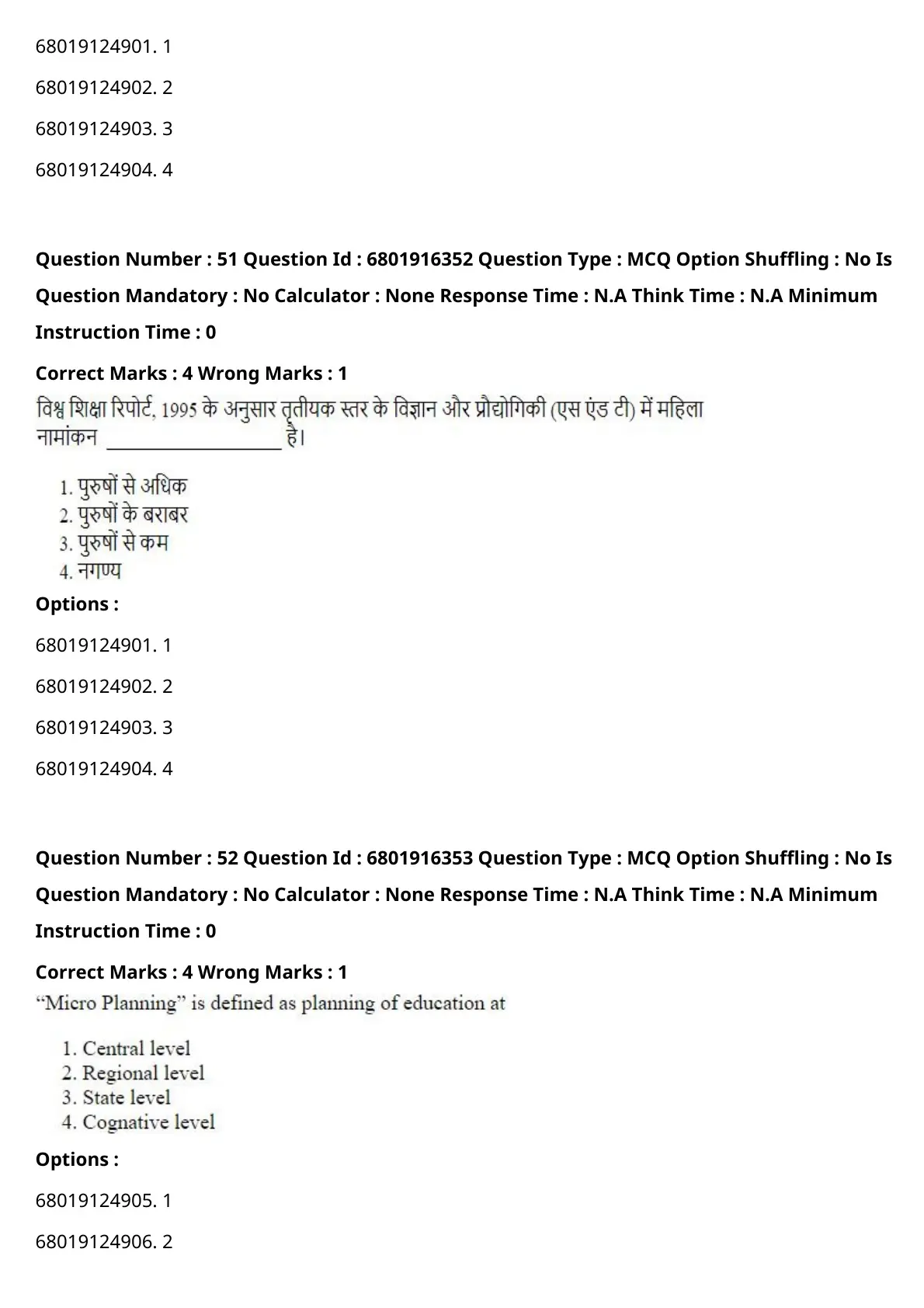
Female enrolment in tertiary level Science and technology (S\&T) is (World Education Report, 1995).
View Solution
According to the World Education Report (1995), female enrolment in Science and Technology (S\&T) at the tertiary level has historically been lower than male enrolment. This trend reflects gender disparities in fields related to science and technology, despite efforts to increase gender equality in education.
Thus, the correct answer is (3) Less than Male. Quick Tip: Efforts to increase female representation in science and technology fields continue, aiming to close the gender gap in higher education.
“Micro Planning” is defined as planning of education at
View Solution
Micro planning refers to the planning process that focuses on specific, localized needs and conditions, typically at the regional or local level. It involves detailed, community-level planning, which allows for more targeted and effective educational interventions.
Thus, the correct answer is (2) Regional level. Quick Tip: Micro planning ensures that education strategies are tailored to the unique needs of local communities, improving accessibility and effectiveness.
The principle of diversity provides the foundation
View Solution
The principle of diversity emphasizes the importance of recognizing and embracing differences among people, including those related to disabilities. It is a fundamental aspect of inclusive education and human rights, acknowledging that disability is part of human diversity rather than an abnormality.
Thus, the correct answer is (4) to accept disability as part of human variation. Quick Tip: Embracing diversity is essential for fostering inclusive environments where individuals with disabilities can thrive alongside others.
Arrange the following in historical chronology:
(A). Sarva Shiksha Abhiyan
(B). University Education Commission
(C). Rammurti committee
(D). Chattopadhyaya Commission
Choose the correct answer from the options given below:
View Solution
The correct chronological order is:
(B) University Education Commission (1948-49) was established under the leadership of Dr. S. Radhakrishnan.
(D) Chattopadhyaya Commission (1983) focused on higher education reforms.
(C) Rammurti Committee (1990) addressed reforms for improving access to education and reducing disparities.
(A) Sarva Shiksha Abhiyan (2001) is the most recent initiative aimed at universalizing elementary education.
Thus, the correct chronological order is (B), (D), (C), (A). Quick Tip: Chronological understanding of educational reforms helps trace the evolution of education policies and initiatives over time.
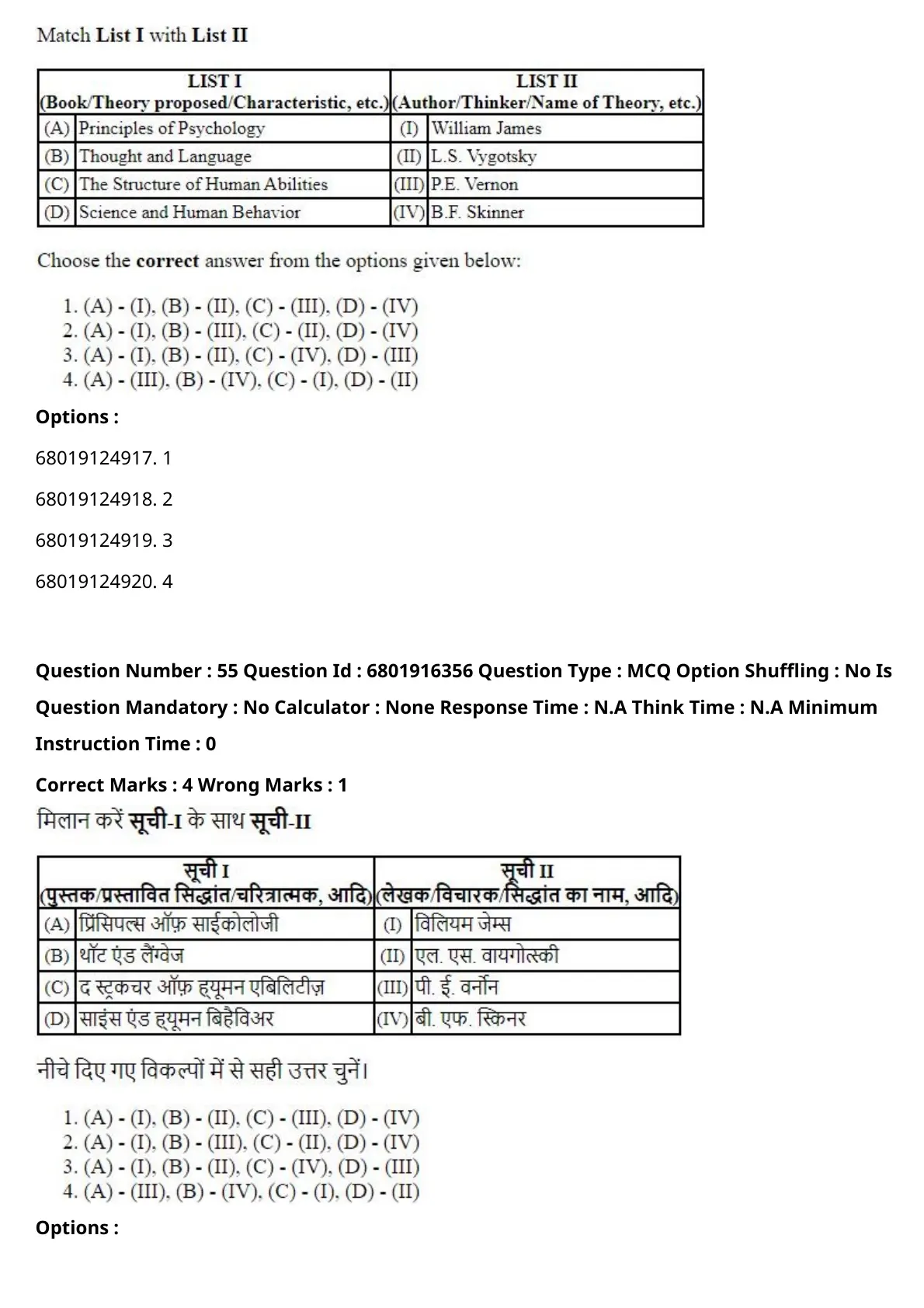
Match List I with List II:

Choose the correct answer from the options given below:
View Solution
(A) Principles of Psychology is a well-known work by William James, often regarded as one of the founders of modern psychology.
(B) Thought and Language is a significant work by L.S. Vygotsky, who is famous for his theories on cognitive development and the role of language in thought.
(C) The Structure of Human Abilities is a theory proposed by P.E. Vernon, who worked on psychometrics and human intelligence.
(D) Science and Human Behavior is written by B.F. Skinner, a leading figure in the development of behaviorist psychology.
Thus, the correct matching is: (A) - (I), (B) - (II), (C) - (III), (D) - (IV). Quick Tip: Understanding the works of foundational figures in psychology helps clarify the development of key concepts like intelligence, behaviorism, and cognitive theories.
Who among the following is considered as a Behavioral Psychologist?
View Solution
B.F. Skinner is widely recognized as a prominent figure in behavioral psychology. He is best known for his work on operant conditioning, which explores how behavior is shaped by its consequences (reinforcement and punishment).
John Dewey is known for his work in functional psychology and progressive education.
William James is considered one of the founders of American psychology and is associated with functionalism.
Jean Piaget is renowned for his work on cognitive development in children.
Thus, the correct answer is (2) B.F. Skinner. Quick Tip: Remember the key contributions of major psychologists to identify their areas of expertise.
Find the correct statements:
(A) Pedagogy is a Science of teaching
(B) Pedagogy is an Art of teaching
(C) Pedagogy is a craft of teaching
(D) Pedagogy is both Art and Science of teaching
View Solution
(A) Pedagogy is a Science of teaching: Pedagogy involves systematic knowledge and principles that guide teaching, making it a science.
(B) Pedagogy is an Art of teaching: Pedagogy also involves creativity, intuition, and practical skills, making it an art.
(C) Pedagogy is a craft of teaching: While teaching can be considered a craft, the term "craft" is less precise than "art" and does not fully encompass the systematic knowledge aspect of pedagogy.
(D) Pedagogy is both Art and Science of teaching: Pedagogy involves both structured knowledge (science) and creative application (art).
Thus, the correct statements are (A), (B), and (D). Quick Tip: Pedagogy is the study of teaching methods, combining both scientific principles and artistic creativity to enhance the learning experience.
Functions of Educational Management are
View Solution
Educational management involves the effective planning, organizing, controlling, and directing of educational resources and processes. These functions are fundamental in ensuring the smooth operation of educational institutions and the achievement of educational goals.
- Planning: Setting educational goals and determining how to achieve them.
- Organizing: Coordinating resources and activities to implement plans.
- Controlling: Monitoring and assessing performance to ensure goals are being met.
- Directing: Leading and motivating staff to carry out the planned activities.
Thus, the correct answer is (1). Quick Tip: Educational management is key to maintaining the functionality of educational systems, ensuring resources are effectively used to meet the goals of the institution.
Ms. Radhika wants to know how much time her students spend off-task each day. To determine this, she carefully watches the students in class, keeping a record of off-task behavior. By doing so, which research approach has she used?
View Solution
In naturalistic observation, researchers observe subjects in their natural environment without any manipulation or intervention. Ms. Radhika is observing her students' behavior without altering the classroom setting, making it a clear example of naturalistic observation. Quick Tip: Naturalistic observation is a valuable research method for studying behavior in real-world settings without interference.
Match List I with List II

Choose the correct answer from the options given below:
View Solution
The correct matching is:
(A) Biological Processes - (I) changes in the child's body and underlie brain development
(B) Cognitive Processes - (II) changes in the child's thinking, intelligence, and language.
(C) Socioemotional Processes - (III) changes in the child's relationships with other people
(D) Learning Processes - (IV) changes in the child's adaptation, behaviour and personality.
To accurately match the developmental processes with their descriptions, it's essential to understand the key aspects of each process.
Biological Processes: These involve physical changes in the body, including growth, brain development, and motor skills. Thus, (A) matches with (I).
Cognitive Processes: These pertain to changes in thinking, intelligence, and language abilities. This includes problem-solving, memory, and reasoning. Therefore, (B) matches with (II).
Socioemotional Processes: These involve changes in relationships with others, emotions, and personality. This includes social skills, emotional regulation, and attachment. Hence, (C) matches with (III).
Learning Processes: These involve changes in adaptation, behavior, and personality through experience and instruction. This includes acquiring new skills, knowledge, and attitudes. Thus, (D) matches with (IV).
Quick Tip: Understanding the different domains of development helps in recognizing their specific characteristics and examples.
Piaget argued that children progress through a series of cognitive development stages. In contrast, Skinner stressed that individuals simply learn more as time goes on. Which developmental issue is highlighted in their disagreement?
View Solution
The disagreement between Piaget and Skinner highlights the issue of continuity vs. discontinuity in development. Piaget viewed cognitive development as a series of distinct stages (discontinuous), while Skinner believed in continuous learning that simply becomes more complex over time. This difference reflects the debate about whether development occurs in a smooth, continuous process or in discrete, stage-like steps.
Thus, the correct answer is (1) Continuity and discontinuity. Quick Tip: The debate between continuity and discontinuity focuses on whether development is a gradual process or whether it occurs in distinct stages.
Arrange the Piagetian Stages in order:
(A). Sensorimotor Stage
(B). Preoperational Stage
(C). Concrete Operational Stage
(D). Formal Operational Stage
Choose the correct answer from the options given below:
View Solution
Piaget's stages of cognitive development occur in the following order:
1. Sensorimotor Stage (A): Infants learn through their senses and actions (birth to 2 years).
2. Preoperational Stage (B): Children begin to use language and symbols, but lack logical reasoning (2 to 7 years).
3. Concrete Operational Stage (C): Children gain the ability to think logically about concrete events (7 to 11 years).
4. Formal Operational Stage (D): Adolescents develop abstract reasoning and problem-solving skills (11 years and beyond).
Thus, the correct order is (A), (B), (C), (D). Quick Tip: Piaget's theory emphasizes how children move through different stages of cognitive development, each characterized by distinct ways of thinking.
Match List I with List II

Choose the correct answer from the options given below:
View Solution
The correct matching is:
(A) Stages of Development - (II) Jean Piaget
(B) Programmed Learning - (III) B.F. Skinner
(C) Classical Conditioning - (IV) Ivan Pavlov
(D) Zone of proximal development - (I) Lev Vygotsky
To accurately match the psychological theories with their respective thinkers, it's essential to understand the core tenets of each theory.
Stages of Development: Jean Piaget is renowned for his theory of cognitive development, which outlines distinct stages of cognitive growth in children. Thus, (A) matches with (II) Jean Piaget.
Programmed Learning: B.F. Skinner developed the concept of programmed learning, which involves breaking down learning tasks into small, sequential steps with immediate feedback. Therefore, (B) matches with (III) B.F. Skinner.
Classical Conditioning: Ivan Pavlov is famous for his work on classical conditioning, a type of learning in which a neutral stimulus becomes associated with a meaningful stimulus, eliciting a similar response. Hence, (C) matches with (IV) Ivan Pavlov.
Zone of Proximal Development: Lev Vygotsky introduced the concept of the zone of proximal development (ZPD), which refers to the gap between what a learner can do independently and what they can achieve with guidance. Thus, (D) matches with (I) Lev Vygotsky.
Quick Tip: Remember the key contributions of major psychologists to accurately match them with their respective theories.
According to Jean Piaget, at ......... thinking is more abstract, idealistic, and logical.
View Solution
According to Piaget, the Formal Operational Stage is the stage where thinking becomes more abstract, logical, and idealistic. This stage typically begins at age 11 and continues into adulthood, enabling individuals to think about hypothetical situations, use deductive reasoning, and engage in more complex problem-solving.
Thus, the correct answer is (1) Formal operational stage. Quick Tip: The Formal Operational Stage allows for abstract thinking, which is essential for higher-level reasoning, problem-solving, and planning.
Scaffolding is an important concept in .............
View Solution
Scaffolding is a concept introduced by Jerome Bruner, but it is closely associated with Lev Vygotsky's theory of cognitive development. Vygotsky emphasized the role of social interaction in learning, and scaffolding refers to the support provided by a more knowledgeable person to help a learner accomplish a task they cannot do alone. This temporary support is gradually removed as the learner gains competence.
Thus, the correct answer is (4) Vygotsky's theory. Quick Tip: Scaffolding plays a crucial role in Vygotsky’s theory, helping learners reach higher levels of understanding with guidance.
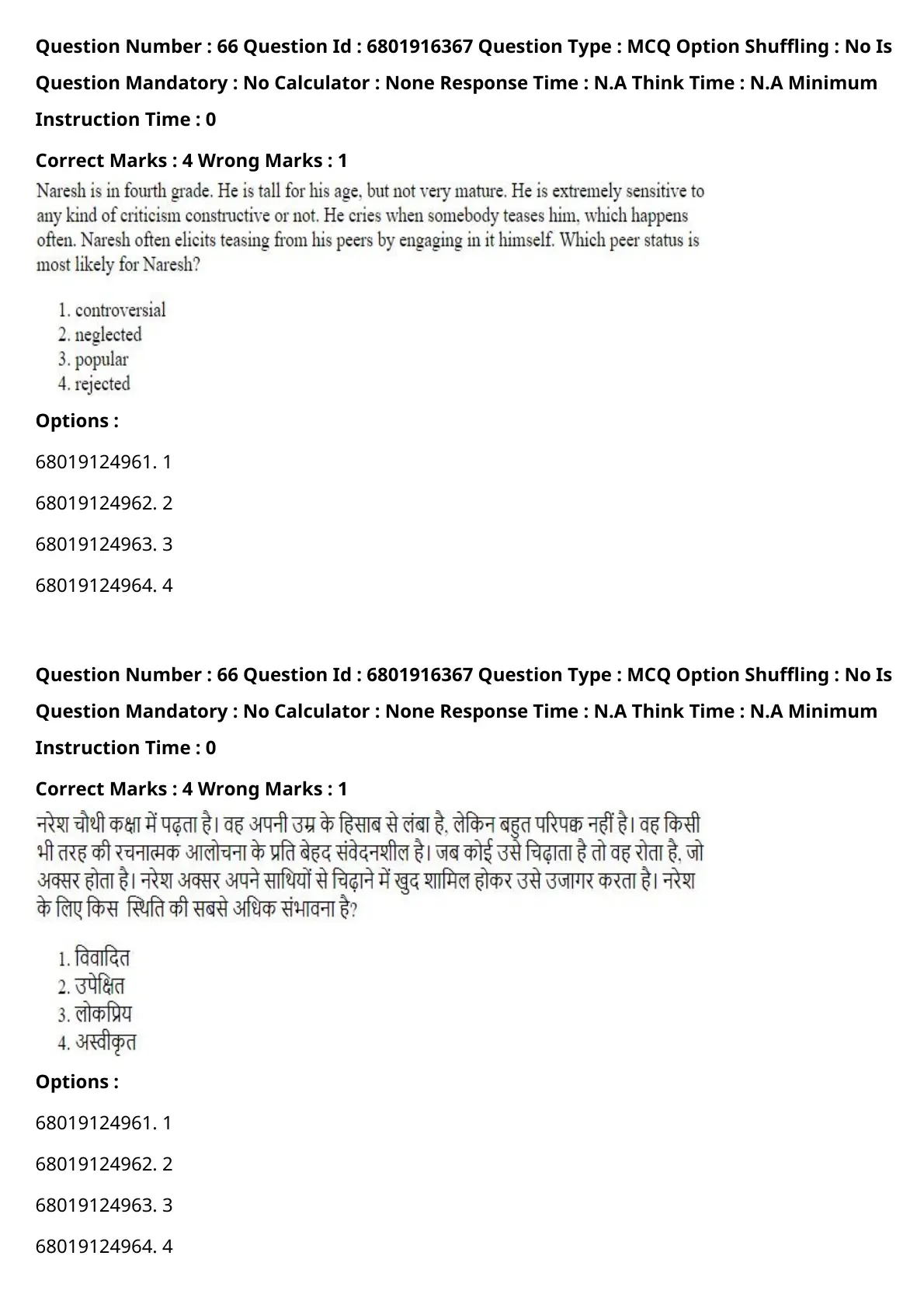
Naresh is in fourth grade. He is tall for his age, but not very mature. He is extremely sensitive to any kind of criticism constructive or not. He cries when somebody teases him, which happens often. Naresh often elicits teasing from his peers by engaging in it himself. Which peer status is most likely for Naresh?
View Solution
Naresh's behavior, characterized by sensitivity to criticism, crying when teased, and engaging in teasing himself, aligns with the characteristics of a rejected peer status. Rejected children are often actively disliked by their peers.
Controversial children are liked by some peers and disliked by others.
Neglected children are neither liked nor disliked; they are simply overlooked.
Popular children are well-liked and have many friends.
Thus, the correct answer is (4) rejected. Quick Tip: Understand the different peer statuses and their associated behaviors to accurately identify a child's peer status.
The Golden rules for guidance is/are as under:
(A) Guidance as continuous process
(B) Guidance is need-based
(C) Guidance is gender inclusive
(D) Guidance is a service
Choose the correct answer from the options given below:
View Solution
The Golden Rules for Guidance focus on key principles that ensure effective and inclusive guidance for individuals:
(A) Guidance as a continuous process: Guidance should be an ongoing process, not a one-time event, to address evolving needs.
(B) Guidance is need-based: The guidance provided should be tailored to the specific needs of the individual.
(C) Guidance is gender-inclusive: Guidance should be inclusive, addressing the needs of all genders without bias.
(D) Guidance is a service: Guidance is not just a function but a service that provides support to individuals for personal and professional growth.
Thus, all four statements are correct, and the answer is (A), (B), (C), and (D). Quick Tip: Guidance should be tailored to individual needs and delivered continuously for best outcomes.
Arrange the following steps of clinical counselling in order:
(A) Analysis
(B) Synthesis
(C) Diagnosis
(D) Prognosis
(E) Treatment
(F) Follow-up
View Solution
The clinical counselling process typically follows these steps:
1. (A) Analysis: Understanding the problem and gathering relevant information.
2. (B) Synthesis: Combining the information to gain a comprehensive understanding of the issue.
3. (C) Diagnosis: Identifying the problem and the underlying causes.
4. (D) Prognosis: Making predictions about the potential course of the issue based on the diagnosis.
5. (E) Treatment: Implementing interventions and strategies to address the issue.
6. (F) Follow-up: Checking in with the individual to monitor progress and adjust the treatment plan if needed.
Thus, the correct sequence is: (A), (B), (C), (D), (E), and (F). Quick Tip: Clinical counselling follows a systematic process that helps in assessing, diagnosing, and providing treatment for psychological or emotional issues.
Arrange the Williamson's five categories of counselling in sequence:
(A) Forcing conformity
(B) Changing the Environment
(C) Environment Selection
(D) Learning needed skills
(E) Changing Attitudes
Choose the correct answer from the options given below:
View Solution
Williamson's five categories of counselling are arranged in the following sequence:
1. (A) Forcing conformity: The first step is to encourage conformity to social norms or rules.
2. (B) Changing the Environment: Adjusting the external environment to create better conditions.
3. (C) Environment Selection: Helping individuals select environments that are conducive to growth and well-being.
4. (D) Learning needed skills: Assisting individuals in acquiring the necessary skills to adapt and thrive.
5. (E) Changing Attitudes: Finally, changing attitudes and beliefs to foster long-term success and adaptation.
Thus, the correct order is: (A), (B), (C), (D), and (E). Quick Tip: Williamson's model focuses on a holistic approach to counselling, which includes both external changes and internal growth processes.
Which is not part of vocational guidance?
View Solution
Vocational guidance aims to assist individuals in making career decisions, understanding their skills, and achieving career success. The following are key elements of vocational guidance:
Self-realisation: Helping individuals understand their strengths, interests, and goals.
Human relationship: Understanding interpersonal dynamics and their impact on career success.
Economic efficiency: Ensuring that individuals are prepared to contribute productively to the economy.
However, Power establishment is not part of vocational guidance, as it focuses more on the ability to influence or control others, which is not related to career choice or development.
Thus, the correct answer is (4). Quick Tip: Vocational guidance should focus on career development, self-awareness, and enhancing economic efficiency for personal and societal growth.
Social Development Theory is given by
View Solution
Lev Vygotsky proposed the Social Development Theory, which emphasizes the importance of social interaction and cultural context in cognitive development. According to Vygotsky, learning is deeply embedded in social interactions, and development occurs as a result of these interactions with more knowledgeable others (e.g., teachers or peers).
Thus, the correct answer is (3) Vygotsky. Quick Tip: Vygotsky’s theory underscores the role of language, culture, and social context in shaping cognitive development and learning processes.
The 74th Constitutional Amendment is related to
View Solution
The 74th Constitutional Amendment (1992) deals with decentralization, particularly with regard to local self-government. It provides for the formation of urban local bodies and the delegation of authority to these bodies, including in the field of education. This amendment emphasizes the need for decentralization in managing education at the local level, improving governance and decision-making.
Thus, the correct answer is (3) Decentralization of Education. Quick Tip: The 74th Amendment played a crucial role in empowering local governments, allowing them to manage resources and make decisions, including those related to education.
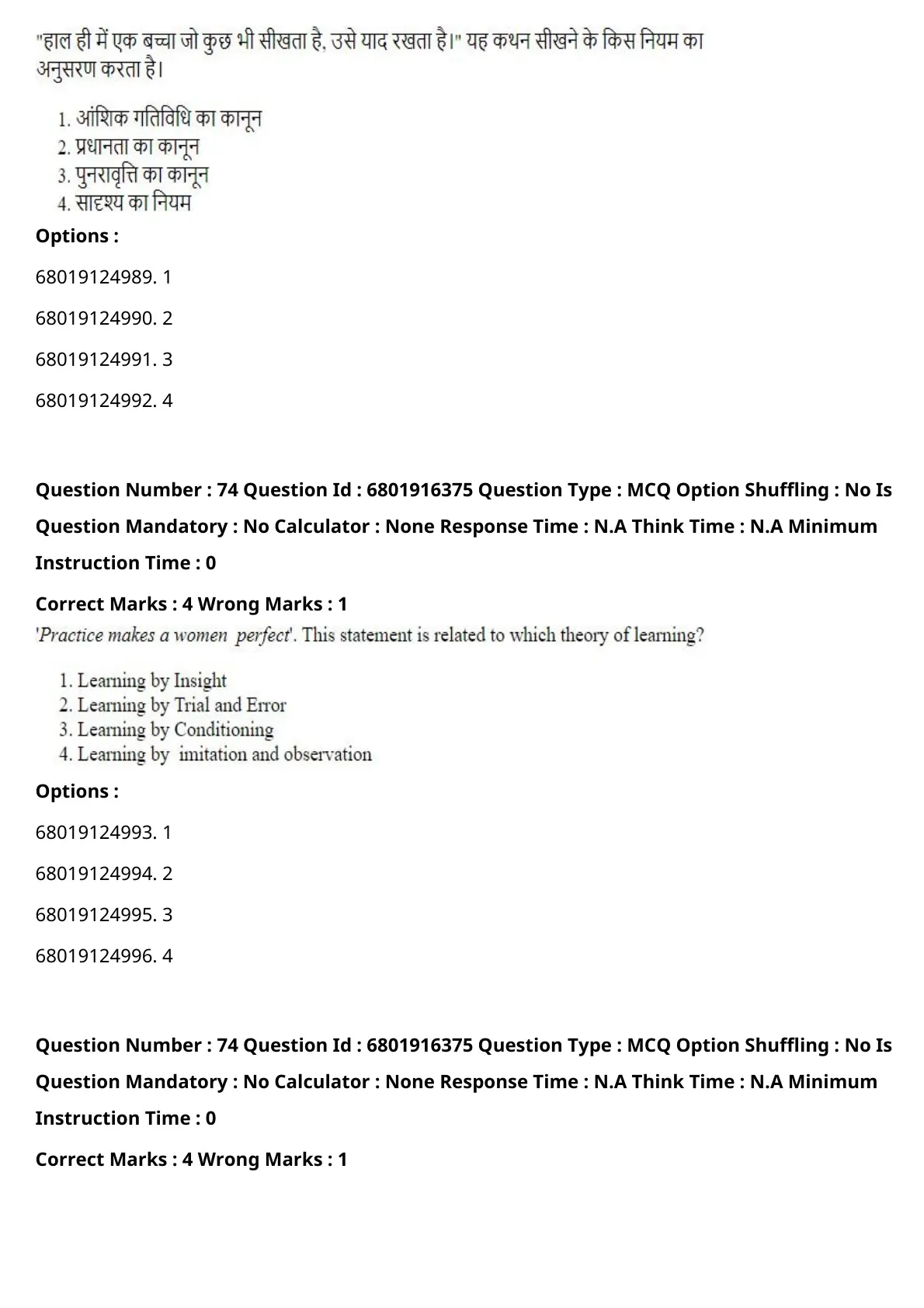
"Whatever is recently learnt by a child is retained by him." This statement follows which Law of Learning?
View Solution
The Law of Recency suggests that things most recently learned are more likely to be remembered. This law explains why learners tend to recall the most recent information or experiences they encountered, making it an important concept in the learning process.
Thus, the correct answer is (3) Law of Recency. Quick Tip: To reinforce learning, review material soon after learning it to ensure retention through the Law of Recency.
'Practice makes a woman perfect'. This statement is related to which theory of learning?
View Solution
The statement "Practice makes a woman perfect" is closely related to Learning by Trial and Error. This theory suggests that learning occurs through repeated attempts, where the learner makes mistakes and then corrects them through practice, ultimately mastering the skill.
In the case of practice making one perfect, it emphasizes the idea that repeated practice and experience lead to improvement through trial, error, and refinement of skills. Quick Tip: Learning by Trial and Error is a powerful method of learning, especially for developing practical skills where feedback from mistakes helps in improvement.
Academic Bank of Credit has been introduced by
View Solution
The Academic Bank of Credit (ABC) is a key feature introduced by the National Education Policy (NEP) 2020. It aims to provide students with flexibility in higher education by allowing them to accumulate academic credits from various institutions and transfer them as per their choice. This system supports interdisciplinary education, lifelong learning, and the flexibility to switch between institutions.
Thus, the correct answer is National Education Policy 2020. Quick Tip: The introduction of the Academic Bank of Credit in NEP 2020 is designed to make the higher education system more flexible and student-centric.
















































































Comments