




The CUET PG Data Science syllabus (Paper Code MTQP04) has 12 core units. The paper is titled Data Science, Artificial Intelligence, Cyber Security etc., so one syllabus covers the CUET PG AI syllabus and the CUET PG Cyber Security syllabus as well.
The CUET PG exam pattern for this paper is 75 compulsory MCQs, 300 marks, and 90 minutes. The 2027 bulletin is awaited. The syllabus is based on the latest NTA M.Tech curriculum.
| Direct Link: Download CUET PG Data Science Syllabus 2027 PDF (EXPECTED SOON) |
- Programming and Data Structures carry the Highest Weightage of approximately 12% of the paper, with an expected 8–10 questions covering C programming, recursion, arrays, linked lists, etc.
- Algorithms account for 11% Weightage. Expect around 7–9 questions on algorithm analysis, asymptotic notations, greedy methods, dynamic programming, sorting, searching, graph traversal, and shortest paths.
- Data Science Carries Around 11% weightage, with approximately 7–9 questions that may cover structured and unstructured data, supervised and unsupervised learning, etc.
- Artificial Intelligence Accounts for around 8%, so expect approximately 5–7 questions on intelligent agents, informed and uninformed search, etc.
- The paper follows a CBT format with a duration of 90 minutes. Each correct answer carries +4 marks, while each incorrect answer results in a deduction of 1 mark. There is no separate General Aptitude section.
Also Check:
- CUET PG Exam Pattern 2027: Questions, Marks, Duration & Marking Scheme
- CUET PG 2026 Question Paper (Available): Check Previous Year Question Paper with Solution PDF (2025-2021)
- CUET PG Preparation 2027: Subject-wise Study Plan, Timetable, Last-month Strategy, PYQs, and Mock Tests
Key Summary
- The CUET PG Data Science syllabus has 12 units, from Set Theory & Algebra to Data Science.
- Programming & Data Structures, Algorithms, and Data Science carry about 12%, 11%, and 11%.
- Microprocessors & Interfacing has the lowest weightage, at about 4%.
- The marking scheme is +4 for a correct answer and −1 for a wrong answer. The paper is a Computer-Based Test.
- One book is recommended per unit. Stallings is recommended for both Computer Organization and Cryptography.
CUET PG Data Science Syllabus 2027: Overview
The paper covers fundamental and advanced computer science and AI concepts in 12 units.
- Paper code: MTQP04.
- Subject label: Data Science, Artificial Intelligence, Cyber Security etc. (M.Tech).
- Syllabus status: The 2027 bulletin is awaited.
- Official websites: exams.nta.nic.in/cuet-pg and nta.ac.in.
| Particulars | Details |
|---|---|
| Exam Name | Common University Entrance Test – Postgraduate (CUET PG) |
| Conducting Body | National Testing Agency (NTA) |
| Subject | Data Science, Artificial Intelligence, Cyber Security etc. (M.Tech) |
| Paper Code | MTQP04 |
| Syllabus Status | Active (Based on the latest NTA M.Tech curriculum; 2027 bulletin awaited) |
| Number of Units | 12 Core Units |
| Official Websites | exams.nta.nic.in/cuet-pg and nta.ac.in |
Ques. What is the paper code for CUET PG Data Science?
Ans. MTQP04, covering Data Science, Artificial Intelligence, Cyber Security etc.
Ques. How many units are in the CUET PG Data Science syllabus?
Ans. 12 core units.
Also Check:
CUET PG Data Science Syllabus 2027: Unit-Wise Topics
The CUET PG Data Science syllabus unit-wise topics come from the official NTA MTQP04 Syllabus PDF. The table lists every unit and its prescribed subtopics.
- Units 1 to 5 cover mathematical and hardware foundations: Set Theory & Algebra, Theory of Computation, Digital Logic, Computer Organization & Architecture, and Microprocessors & Interfacing.
- Units 6 to 9 cover the software core: Programming & Data Structures, Algorithms, Operating Systems, and Computer Networks.
- Units 10 to 12 cover Artificial Intelligence, Cryptography & Network Security, and Data Science.
| Unit | Subject / Topic | Important Topics Covered |
|---|---|---|
| 1 | Set Theory & Algebra | Sets, relations, functions, composition of functions and relations, groups, partial orders, Boolean algebra |
| 2 | Theory of Computation | Finite automata, regular expressions, NFA, properties of regular sets, context-free grammar, Chomsky Normal Form (CNF), Greibach Normal Form (GNF), pushdown automata, Moore and Mealy machines, Turing machines |
| 3 | Digital Logic | Number representation, fixed and floating-point arithmetic, logic functions, minimization, combinational and sequential circuits, A/D and D/A converters |
| 4 | Computer Organization & Architecture | Machine instructions, addressing modes, ALU, data path, CPU control design, memory and I/O interfaces, interrupts, DMA, instruction pipelining, cache memory, main memory, secondary storage |
| 5 | Microprocessors & Interfacing | Microprocessor architecture, instruction sets, addressing modes, 8085 programming, memory interfacing, peripheral devices, interrupts, DMA, timers, microprocessor applications |
| 6 | Programming & Data Structures | C programming, functions, recursion, parameter passing, arrays, stacks, queues, linked lists, trees, priority queues, heaps, binary search trees |
| 7 | Algorithms | Algorithm analysis and design, asymptotic notations, worst and average-case analysis, greedy approach, dynamic programming, divide and conquer, tree and graph traversal, spanning trees, shortest paths, hashing, sorting and searching |
| 8 | Operating Systems | OS functions, processes, threads, interprocess communication, concurrency, synchronization, deadlocks, CPU and I/O scheduling, resource scheduling, Banker's algorithm, memory management, virtual memory, file systems, DOS, UNIX and Windows |
| 9 | Computer Networks | OSI and TCP/IP models, LAN technologies, transmission media, flow and error control, routing, congestion control, IPv4, application-layer protocols, sliding window protocols, switches, hubs, bridges, routers, gateways, firewalls, network security, DNS, email and WWW |
| 10 | Artificial Intelligence | Basic concepts of AI, intelligent agents, problem-solving through uninformed and informed search, logical agents, first-order logic, knowledge representation |
| 11 | Cryptography & Network Security | Computer and network security concepts, classical encryption techniques, symmetric cipher model, Caesar cipher, Playfair cipher and Hill cipher |
| 12 | Data Science | Data concepts, structured and unstructured data, data representation, supervised, unsupervised and reinforcement learning, clustering, classification, regression, data preprocessing, normalization, smoothing and visualization |
Ques. Is C programming part of the CUET PG Data Science syllabus?
Ans. Yes. Unit 6 lists C programming, along with recursion, arrays, stacks, queues, linked lists, trees, heaps, and binary search trees.
Ques. Does the CUET PG Data Science syllabus include machine learning?
Ans. Yes. Unit 12 lists supervised, unsupervised, and reinforcement learning, clustering, classification, and regression.
Also Check:
CUET PG Data Science Syllabus 2027: Unit-wise Weightage
NTA does not publish an official chapter-wise mark distribution for MTQP04. The expected weightage below comes from previous year question paper trends. The paper has 75 compulsory questions worth 300 marks.
- Units 6, 7, 8, 9, and 12 carry roughly 34 to 44 questions. That is 136 to 176 of the 300 marks.
- Data Science (Unit 12), Artificial Intelligence (Unit 10), and Cryptography (Unit 11) carry around 16 to 22 questions. They mostly test conceptual clarity and algorithmic logic.
- Digital Logic (Unit 3), COA (Unit 4), and Microprocessors (Unit 5) carry 11 to 16 questions. They often feature direct formula-based numericals and instruction-set queries.
- Unit 12 sits in both the Core Focus group and the Applied Domains group. The group percentages overlap for this reason.
| Unit No. | Unit Name | Expected Questions | Approx. Weightage (%) |
|---|---|---|---|
| Unit 1 | Set Theory & Algebra | 5–7 | ~8% |
| Unit 2 | Theory of Computation | 5–7 | ~8% |
| Unit 3 | Digital Logic | 4–6 | ~7% |
| Unit 4 | Computer Organization & Architecture | 4–6 | ~7% |
| Unit 5 | Microprocessors & Interfacing | 3–4 | ~4% |
| Unit 6 | Programming & Data Structures | 8–10 | ~12% |
| Unit 7 | Algorithms | 7–9 | ~11% |
| Unit 8 | Operating Systems | 6–8 | ~9% |
| Unit 9 | Computer Networks | 6–8 | ~9% |
| Unit 10 | Artificial Intelligence | 5–7 | ~8% |
| Unit 11 | Cryptography & Network Security | 4–6 | ~6% |
| Unit 12 | Data Science | 7–9 | ~11% |
| Total | All 12 Units | 75 Questions | 100% |
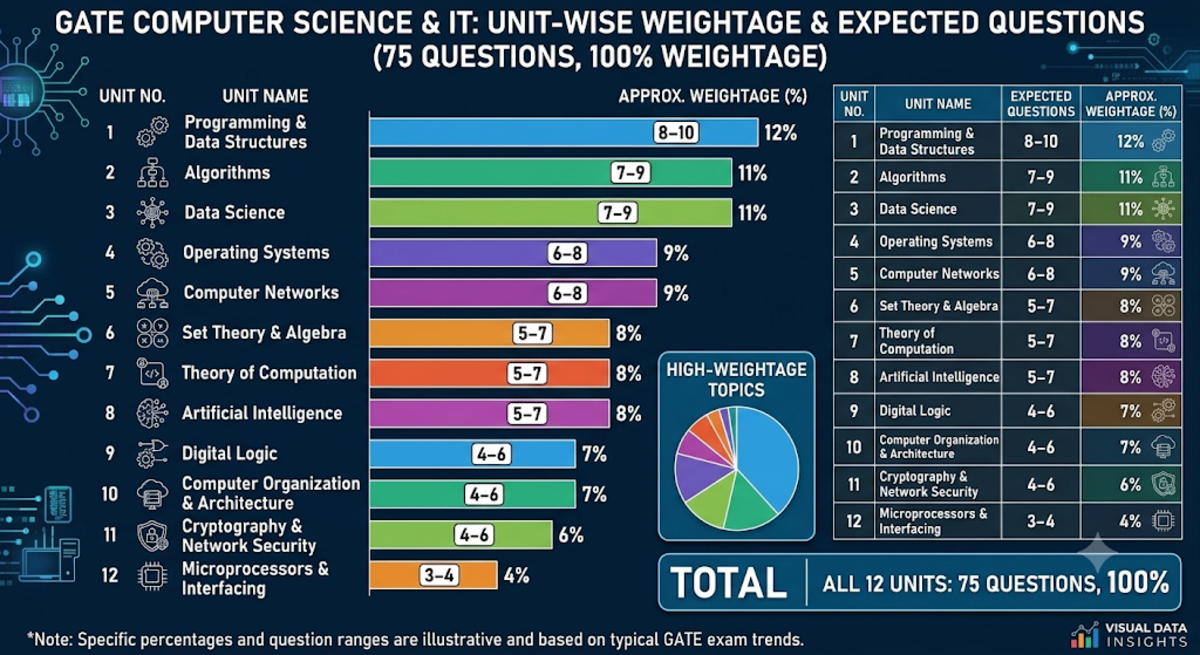
Ques. Which unit has the highest weightage in CUET PG Data Science?
Ans. Programming & Data Structures (Unit 6), at about 12% with 8 to 10 questions.
Ques. Does NTA publish the unit-wise weightage for MTQP04?
Ans. No. The weightage here is derived from previous year question paper trends.
This video by the channel “Diwakar Education Hub Publication” discusses CUET PG Data Science and Artificial Intelligence 2027 (MTQP04), covering the complete syllabus, recommended books, previous year question papers (PYQs), and expected cut-offs. It also highlights important topics across all 12 syllabus units and preparation resources to help candidates prepare for the entrance examination.
CUET PG Year-wise Question Paper Download
| CUET PG Year-wise Question Paper Download | ||
|---|---|---|
| CUET PG Question Paper 2026 | CUET PG Question Paper 2025 | CUET PG 2024 Question Paper |
| CUET PG 2023 Question Paper | CUET PG 2022 Question Paper | - |
CUET PG Data Science vs AI vs Cyber Security: Topics by Course Area
One paper serves all three areas. The table maps each area to the units that carry its topics.
- Data Science topics sit in Unit 12, at about 11%. Unit 6 and Unit 7 supply the programming and algorithm base.
- AI topics sit in Unit 10, at about 8%. The machine learning part of CUET PG artificial intelligence and machine learning sits in Unit 12.
- Cyber Security topics sit in Unit 11, at about 6%. Network security, firewalls, and routing sit in Unit 9, at about 9%.
- Computer Science and IT topics sit in Units 1 to 9, which together carry about 75%.
| Course Area | Primary Units | Combined Weightage | Key Topics |
|---|---|---|---|
| Data Science | Unit 12(with Units 6 and 7) | ~11% (~34% with Units 6 and 7) | Structured and unstructured data, supervised and unsupervised learning, clustering, classification, regression, preprocessing, normalization, visualization |
| Artificial Intelligence | Unit 10 (with Unit 12) | ~8%(~19% with Unit 12) | Intelligent agents, uninformed and informed search, logical agents, first-order logic, knowledge representation |
| Cyber Security | Unit 11 (with Unit 9) | ~6% (~15% with Unit 9) | Classical encryption, symmetric cipher model, Caesar, Playfair and Hill ciphers, network security, firewalls |
| Computer Science and IT | Units 1 to 9 | ~75% | Algebra, automata, digital logic, architecture, microprocessors, data structures, algorithms, operating systems, networks |
Ques. Is there a separate CUET PG AI or Cyber Security syllabus?
Ans. No. They share paper MTQP04. AI topics sit in Units 10 and 12. Cyber Security topics sit in Units 11 and 9.
Ques. What is the difference between the CUET PG Data Science and AI syllabus?
Ans. Data Science is Unit 12 (data handling and learning methods). AI is Unit 10 (agents, search, and logic). Both are in the same paper.
Ques. What are the CUET PG AI and Cyber Security important topics?
Ans. For AI: search strategies, logical agents, and first-order logic. For Cyber Security: classical encryption, the symmetric cipher model, and network security.
Check Out:
CUET PG Data Science Exam Pattern 2027
The CUET PG 2027 Data Science (MTQP04) paper is a Computer-Based Test (CBT) with 75 domain-specific MCQs worth 300 marks.
- Duration is 90 minutes. That gives 1.2 minutes per question.
- Each correct answer gives +4 marks. Each incorrect answer costs 1 mark.
- The paper has a single section. There is no General Aptitude section.
- The medium is English only.
- The exam window is March 2027, conducted across multiple shifts. The 2027 bulletin is awaited.
| Exam Parameter | Details |
|---|---|
| Conducting Body | National Testing Agency (NTA) |
| Paper Code | MTQP04 (Data Science, Artificial Intelligence, Cyber Security etc.) |
| Exam Mode | Computer-Based Test (Online CBT) |
| Duration | 90 Minutes (1 Hour 30 Minutes) |
| Total Questions | 75 Compulsory MCQs |
| Section Structure | Single Section (100% Domain-Specific Knowledge; no General Aptitude section) |
| Marking Scheme | +4 for each correct response; −1 for each incorrect response |
| Maximum Marks | 300 Marks |
| Medium of Paper | English Only (Standard rule for M.Tech/Higher Sciences papers) |
| Exam Window | March 2027 (Conducted across multiple shifts) |
Ques. What is the CUET PG exam pattern for Data Science?
Ans. 75 compulsory MCQs, 300 marks, 90 minutes, CBT mode, with +4 for correct and −1 for incorrect answers.
Ques. Is there a General Aptitude section in CUET PG Data Science?
Ans. No. The paper is a single section with 100% domain-specific questions.
Best Books for CUET PG Data Science 2027
Use standard undergraduate computer science and engineering textbooks, paired with GATE and CUET MCQ practice guides.
- The syllabus spans 12 core units. Combining foundation books with objective question banks gives the best results.
- One recommended book per unit. Twelve units have twelve titles.
| Subject / Syllabus Unit | Recommended Book & Author | Why It Helps |
|---|---|---|
| Discrete Mathematics (Unit 1) | Discrete Mathematics and Its Applications by Kenneth H. Rosen | Covers set theory, relations, functions, groups, and Boolean algebra with clear solved examples |
| Theory of Computation (Unit 2) | An Introduction to Formal Languages and Automata by Peter Linz | Explains finite automata, context-free grammars, push-down automata, and Turing machines simply |
| Digital Logic (Unit 3) | Digital Design by M. Morris Mano | Ideal for number systems, Boolean minimization, and combinational/sequential circuits |
| Computer Organization (Unit 4) | Computer Organization and Architecture by William Stallings | Strong coverage of pipelining, ALU, addressing modes, and memory hierarchy |
| Microprocessors (Unit 5) | Microprocessor Architecture, Programming, and Applications with the 8085 by Ramesh Gaonkar | Directly addresses instruction sets, interrupts, and peripheral interfacing concepts |
| Programming & Data Structures (Unit 6) | Data Structures and Algorithms Made Easy by Narasimha Karumanchi | Great for C concepts, recursion, trees, heaps, and graph representations with MCQ-style logic |
| Algorithms (Unit 7) | Introduction to Algorithms (CLRS) by Cormen, Leiserson, Rivest & Stein | The gold standard for asymptotic complexity, sorting, greedy algorithms, and dynamic programming |
| Operating Systems (Unit 8) | Operating System Concepts by Silberschatz, Galvin & Gagne | Thoroughly covers CPU scheduling, deadlocks (Banker's algorithm), synchronization, and virtual memory |
| Computer Networks (Unit 9) | Computer Networking: A Top-Down Approach by Kurose & Ross | Clearly breaks down OSI/TCP-IP layers, IPv4, routing algorithms, and application protocols |
| Artificial Intelligence (Unit 10) | Artificial Intelligence: A Modern Approach by Stuart Russell & Peter Norvig | Covers intelligent agents, informed/uninformed search, and first-order logic |
| Cryptography & Security (Unit 11) | Cryptography and Network Security by William Stallings | Directly aligns with symmetric ciphers, classical encryption, and public-key cryptography |
| Data Science & ML (Unit 12) | Introduction to Machine Learning by Ethem Alpaydin | Explains data preprocessing, supervised/unsupervised learning, clustering, and regression concisely |
Ques. Which are the best books for CUET PG Data Science?
Ans. Karumanchi and CLRS for programming and algorithms, Silberschatz for Operating Systems, Kurose & Ross for Networks, and Alpaydin for Data Science and ML.
Also Check:
CUET PG Data Science Preparation Tips 2027

Source: Quora
Students can employ the below tips in their CUET PG Data Science preparation:
- Prioritise the Core Five. Units 6, 7, 8, 9, and 12 comprise roughly 50% to 55% of the exam.
- Balance theory with numericals. Prepare conceptual MCQs in AI and Data Science alongside numerical problems in Digital Logic, OS, and Algorithms.
- Practise past papers. Access previous papers through the NTA Official Downloads Portal to gauge difficulty and question style.
- Lock down the Core Five first. Give the first half of the preparation to Programming & Data Structures, Algorithms, Data Science, Operating Systems, and Computer Networks. Together they cover roughly 34 to 44 questions.
Quick-revision formula and cheat sheet:
| Area | What to Keep on the Sheet |
|---|---|
| Algorithms & Data Structures | A table of worst-case and average-case time and space complexities for all sorting, searching, tree, and graph algorithms |
| Systems & Networks | Page replacement formulas, Banker's algorithm safety conditions, IPv4 subnetting rules, and OSI layer protocols on two pages for rapid morning review |
| Data Science & AI | Distance metrics (Euclidean, Manhattan), normalization methods (Min-Max, Z-score), evaluation metrics (Precision, Recall, F1), and uninformed vs. informed search properties |
CUET PG Data Science Syllabus FAQs
Ques. What is the CUET PG Data Science syllabus 2027?
Ans. 12 core units under paper code MTQP04, from Set Theory & Algebra to Data Science.
Ques. Is the CUET PG AI syllabus part of the Data Science paper?
Ans. Yes. AI topics sit in Unit 10 (agents, search, logic) and machine learning sits in Unit 12.
Ques. What does the CUET PG Cyber Security syllabus include?
Ans. Unit 11 covers security concepts, classical encryption, the symmetric cipher model, and the Caesar, Playfair, and Hill ciphers. Unit 9 covers network security and firewalls.
Ques. Which unit has the highest weightage in CUET PG Data Science?
Ans. Programming & Data Structures (Unit 6), at about 12%.
Ques. Does the cryptography unit cover public-key cryptography?
Ans. The syllabus lists classical encryption techniques, the symmetric cipher model, and the Caesar, Playfair, and Hill ciphers.



Comments