



.png?h=35&w=35&mode=stretch)
CUET PG Theatre Question Paper 2024 is available here for download. NTA conducted CUET PG Theatre paper 2024 on from March 18 in Shift 1. CUET PG Question Paper 2024 is based on objective-type questions (MCQs). According to latest exam pattern, candidates get 105 minutes to solve 75 MCQs in CUET PG 2024 Theatre question paper.
CUET PG Theatre Question Paper 2024 PDF Download
| CUET PG Theatre Question Paper 2024 with Answer Key |  Download Download |
Check Solutions |
Theatre 2024 Questions with Solutions
Question 1:In which of the following Dasarupakas, the story deals with gods and asuras; the hero is well-known and estimable; in its three acts, there are three kinds of deceit, three calamities and three types of Shringara?
View Solution
Solution:
1: Understand the question. The question describes the characteristics of a specific type of play (Dasarupaka) in Sanskrit dramaturgy. We need to identify the type based on the description: deals with gods and asuras, well-known hero, three acts, three types of deceit, calamities, and Shringara.
2: Recall the characteristics of each Dasarupaka.
Prakarana: Focuses on a fictional story with a focus on middle-class characters like merchants and courtesans.
Samavakara: Deals with gods and demons, has a well-known hero, comprises three acts, and features various types of deceit, calamities, and love (Shringara).
Nataka: The most important type, featuring kings, gods, or divine sages with well-known stories (often from epics). Usually 5-10 acts.
Anka (also called Utsrstikanka): A one-act play typically features lamentation and sorrow.
3: Match the description to the correct option. The description clearly matches 'Samavakara'. The key is the combination of gods/asuras, three acts, and the three types of deceit, calamities, and Shringara.
Quick Tip: Familiarize yourself with the ten types of (rupakas) in Natyashastra. Pay close attention to their defining characteristics (number of acts, type of hero, subject matter, dominant rasa).
Question 2:
From which of the following Vedas, Lord Brahma incorporated pathya or words in the composition of the Natyaveda?
View Solution
Solution:
1: Understand the question. The question asks which Veda contributed the 'pathya' (words/recitation) element to the Natyaveda (the fifth Veda, encompassing all aspects of drama).
2: Recall the components of the Natyaveda and their sources. According to the Natyashastra, Brahma created the Natyaveda by drawing elements from the four Vedas:
Rigveda: Contributed 'Pathya,' which refers to the spoken word, recitation, and dialogue.
Samaveda: Contributed 'Geet,' or music and song.
Yajurveda: Contributed 'Abhinaya,' or acting and gestures.
Atharvaveda: Contributed 'Rasa,' or the emotional essence and aesthetic experience.
3: Identify the correct Veda. Since the question specifically asks about pathya (words), the correct answer is the Rigveda.
Quick Tip: Memorize the four Vedas and their specific contributions to the Natyaveda: Rigveda (Pathya - words), Samaveda (Geet - music), Yajurveda (Abhinaya - acting), and Atharvaveda (Rasa - emotion).
Question 3:
According to the 'Origin of Natya', what did Lord Vishnu gift the actors on the success of the first performance at the Flag-Festival of Mahendra?
View Solution
Solution:
1: Recall the story of the origin of Natya. As described in Bharata's Natyashastra, the first dramatic performance was held during the flag festival of Indra (Mahendra). The performance depicted the conflict between the Devas (gods) and Asuras (demons).
2: Identify the gifts given by various deities. The Natyashastra mentions different gods gifting various things to actors and for theatrical productions.
Brahma: Gave protection to the performing space.
Shiva: Gave success in performance
Vishnu: Gifted a 'Kutilaka' (क्हिला) or crooked stick, which became a symbol of the stage/performance and is also used in rituals related to performances.
Indra: Gave his own banner.
Other gods gave various other boons.
3: Identify Vishnu's gift. Vishnu gifted a Kutilaka or crooked stick. This is the correct answer.
Quick Tip: The origin story of Natya in the Natyashastra is filled with symbolic details. Familiarize yourself with the major events and gifts from different deities to answer similar questions.
Question 4:
According to the 'Units of Measurement' as described in Natyashastra, One Hasta is equivalent to how many Angulas?
View Solution
Solution:
1: Recall the units of measurement from Natyashastra. Natyashastra describes various units of measurement, with Angula as a primary unit.
2: The relationship between Angula and other units.
8 Trasarenus = 1 Rajah (particle of dust)
8 Rajah = 1 Balagra (hair's breadth)
8 Balagra = 1 Liksa
8 Liksa = 1 Yuka (louse)
8 Yuka = 1 Yava (barley grain)
8 Yava = 1 Angula (finger-breadth)
24 Angulas = 1 Hasta (cubit - from elbow to tip of the middle finger)
3: Determine the Angula-Hasta relationship. The Natyashastra clearly states that one Hasta is equal to 24 Angulas.
Quick Tip: Familiarize yourself with the units of measurement in Natyashastra, particularly Angula and Hasta, as they are crucial for understanding stage dimensions and actor movements.
Question 5:
Pick the odd one out in context of Sattvika Bhava:
View Solution
Solution:
1: Understand Sattvika Bhavas. Sattvika Bhavas are involuntary physical manifestations of intense emotions, as described in the Natyashastra. They are considered crucial for conveying authentic emotions in performance. There are eight Sattvika Bhavas.
2: List the eight Sattvika Bhavas:
Stambha: Paralysis, immobility
Sveda: Sweating
Romancha: Horripilation (goosebumps)
Svarabhanga: Change/break in voice
Vepathu: Trembling
Vaivarnya: Change of color (in the face)
Ashru: Tears
Pralaya: Fainting, loss of consciousness
3: Identify the option that is not a Sattvika Bhava. Romancha (goosebumps), Vaivarnya (change in color), and Pralaya (fainting) are all listed among the eight Sattvika Bhavas. 'Supta' means asleep or dormant and isn't one of the eight Sattvika Bhavas described in Natyashastra.
Quick Tip: Memorize the eight Sattvika Bhavas. Understanding these involuntary emotional expressions is crucial for analyzing acting and character portrayal in classical Indian theatre.
Question 6:
Who among the following is NOT considered as one of the pioneers in the establishment of Moscow Art Theatre?
View Solution
Solution:
1: Understand the question: The question asks to exclude the person not associated with the foundation of the Moscow Art Theatre.
2: Identify the key founders of the Moscow Art Theatre (MAT). The Moscow Art Theatre was famously founded in 1898 by two prominent figures in Russian theatre:
Konstantin Stanislavski: A renowned actor and director, known for developing his influential system of acting.
Vladimir Nemirovich-Danchenko: A playwright, director, and theatre administrator.
3: Consider the other options:
Anton Chekhov: A celebrated playwright whose works (like The Seagull, Uncle Vanya, Three Sisters, and The Cherry Orchard) were closely associated with the MAT and formed a core part of its repertoire. However, he was a playwright, not a founder.
Mikhail Chekhov: A nephew of Anton Chekhov, and a brilliant actor and acting teacher. He developed his own acting technique, distinct from Stanislavski's, but he was not a founder of the MAT. He joined the MAT later and eventually formed his own studio.
4: The person who was NOT a founder is Mikhail Chekhov.
Quick Tip: When studying theatre history, pay attention to key figures, their roles (actor, director, playwright, etc.), and their relationships to specific institutions or movements. Don't confuse founders with later influential members.
Question 7:
Who experimented with various Conscious means to the Subconscious?
View Solution
Solution:
1: Understand the phrase Conscious means to the Subconscious. This refers to acting techniques that use deliberate, conscious actions (exercises, techniques) to tap into the actor's subconscious emotions and impulses, leading to more authentic and believable performances.
2: Consider each option:
Erwin Piscator: A German theatre director known for his pioneering work in epic and political theatre. His focus was on using theatre to engage with social and political issues, not on exploring the actor's subconscious.
Bertolt Brecht: Another major figure in epic theatre, known for his Verfremdungseffekt (alienation effect). Brecht's techniques aimed to distance the audience emotionally, encouraging critical reflection rather than emotional immersion. This is the opposite of accessing the subconscious.
Augusto Boal: A Brazilian theatre practitioner known for his Theatre of the Oppressed, which uses interactive theatre techniques to empower marginalized communities and promote social change. His focus was on using theatre as a tool for social action, not on the actor's internal psychological processes.
C S Stanislavski: Constantin Stanislavski's system of acting is fundamentally about using conscious techniques to access and control the actor's subconscious. His methods, like emotional recall, the magic if, and given circumstances, are designed to help the actor create a truthful inner life for the character.
3: Identify the correct answer. Stanislavski is the one whose work centered around accessing the subconscious through conscious means.
Quick Tip: Learn about different approaches in acting like those given by Stanislavski, Chekhov, Meisner. These are crucial to understand modern practices of acting and directing.
Question 8:
“The director must die within an actor.” Who advocated these thoughts?
View Solution
Solution:
1: Understanding the Quote: The quote suggests that the director's influence and control should be minimized during the performance, allowing the actor's interpretation and embodiment of the character to take center stage. The director's work is preparation, but the actor is the ultimate creator during the performance.
2: Considering the Options and their Approaches:
Vladimir Nemirovich-Danchenko: Danchenko, co-founder of the Moscow Art Theatre with Stanislavski, emphasized the importance of the actor's inner life and psychological realism. He believed the director's job was to help the actor find the truth of the character, not to impose a rigid external interpretation. This aligns with the quote.
Yevgeny Vakhtangov: Vakhtangov was a student of Stanislavski, but he developed his own style, known as fantastic realism. While he valued the actor's work, he also emphasized theatricality and the director's vision. He would be less likely to advocate for the director dying within the actor.
Glikeria Fedotova: Glikeria Fedotova was a famous Russian actress. While an actress would undoubtedly have strong views on the actor/director relationship, the quote implies a director/teacher's perspective.
Vsevolod Meyerhold: Meyerhold, a former member of the MAT, developed a highly stylized and physical approach to theatre called biomechanics. He emphasized the actor's physical training and control, often with a strong director's vision. He is the least likely to have said this quote.
3: Identify the correct answer. Nemirovich-Danchenko is the director and teacher whose views are best represented by this quote.
Quick Tip: Understand the different schools of thought on the relationship between actors, directors, and text. Note that some systems of acting are more collaborative, while others are hierarchical.
Question 9:
Which among the following is NOT one of the main objectives of the Epic Theatre productions as laid down by Berliner Ensemble founded in 1949 ?
View Solution
Solution:
1: Understand Epic Theatre. Epic Theatre, primarily associated with Bertolt Brecht, is a form of theatre that aims to provoke critical thinking and social awareness in the audience. It rejects the traditional Aristotelian drama's emphasis on emotional catharsis and identification with characters.
2: Recall the Key Objectives of the Berliner Ensemble. The Berliner Ensemble, founded by Brecht and Helene Weigel, was a key institution in developing and promoting Epic Theatre. Its main objectives were to:
- Present plays that dealt with social and political issues.
- Encourage audiences to think critically about the world, rather than being emotionally absorbed.
- Break the illusion of reality on stage (using techniques like the Verfremdungseffekt).
- Show that both society and human nature are changeable, not fixed.
- Make the audience aware of the constructed nature of theatre.
3: Analyze the Options.
1. To portray society as alterable: This is a core principle of Epic Theatre. It aims to show that social structures are not fixed and can be changed through human action.
2. To portray human nature as alterable: This is also a key tenet. Epic Theatre rejects the idea of a fixed human nature and suggests that people's behavior is shaped by social conditions.
3. To implicate the spectator in a stage situation: This is the opposite of what Epic Theatre aims to do. Implicate suggests drawing the spectator into the emotional world of the play, creating empathy and identification. Epic Theatre seeks to distance the spectator, encouraging critical observation.
4. To capture the achievements of classics in a dialectic sense: The Berliner Ensemble did engage with classic plays, but they reinterpreted them through a Marxist/dialectic lens, often highlighting social contradictions and challenging traditional interpretations. This option is an objective but is phrased a little vaguely (but is not the best answer of the four).
Quick Tip: The core of Epic Theatre is to alienate the audience (Verfremdungseffekt), not to immerse them. It aims for critical thought, not emotional catharsis.
Question 10:
“No one seriously concerned with the theatre can by-pass Brecht. Brecht is the key figure of our time, and all theatre work today at some point starts or returns to his statements and achievement.” Whose words are these?
View Solution
Solution:
1: Identify the figures. The options provided are major names in 20th- and 21st-century theatre. We need to identify who is best associated with acknowledging the significance of Brecht.
Stanislavski: A Russian actor and theatre director, known for his influential “system” of acting. Although his work was immensely influential, it preceded and differed greatly in focus from Brecht's Epic theatre.
Peter Brook: A highly influential English theatre and film director, known for his experimental and innovative productions, and for incorporating diverse theatrical traditions. He was deeply interested in Brecht's work.
Jerzy Grotowski: A Polish theatre director known for his poor theatre concept, which emphasized the actor's physical and vocal work. Grotowski's approach was more focused on ritual and the actor's inner experience, less directly influenced by Brecht.
Gordon Craig: An English theatre designer and theorist who championed a symbolic and visual approach to theatre. His focus was primarily on design and visual elements, rather than the political and social aspects of Brecht's work.
2: Associate the quote with the correct figure. The quote emphasizes Brecht's central importance to modern theatre. Peter Brook is the one among the four most known for his engagement with and admiration of Brecht. The quote is attributed to him.
Quick Tip: Familiarize yourself with the major theatre practitioners of the 20th and 21st centuries and their primary theoretical concerns. This helps in matching styles and concepts to specific names.
Question 11:
“When in the art of the grotesque, form triumphs over content, then the soul of the grotesque and the soul of the theatre will be one.” Who wrote these thoughts?
View Solution
Solution:
1: Understand the Quote. The quote refers to the concept of the grotesque in theatre and suggests a specific relationship between form and content.
2: Identify Key Figures
A. Lechika: There is no major theatrical figure by that name, or a similar one that's widely known.
Richard Schechner: A performance theorist and director, known for his work in environmental theatre and performance studies. While interested in ritual and cross-cultural performance, he's not particularly known for this specific quote or a focus on the grotesque in this way.
Eugenio Barba: A highly influential Italian theatre director and theorist, known for his work with Odin Teatret and his focus on intercultural theatre and actor training. His work explores the 'pre-expressive' principles underlying diverse performance traditions.
Vsevolod Meyerhold: Meyerhold was an innovative Russian director who would be most associated with biomechanics.
3: Match the quote. The correct answer is Eugenio Barba. The quote is his and is often associated with him.
Quick Tip: Familiarize yourself with various theatre practitioners and scholars and their key philosophies and works.
Question 12:
The film 'Mr. and Mrs. 55' was directed by
View Solution
Solution:
1: Identify the film. Mr. and Mrs. 55 is a classic 1955 Indian Hindi-language romantic comedy film.
2: Recall the director of the film. Guru Dutt is well-known for directing, producing, and acting in several critically acclaimed and popular Hindi films of the 1950s and 1960s. Mr. and Mrs. 55, starring Madhubala and Guru Dutt, showcases his signature style, blending humor, social commentary, and memorable music.
3: Consider the other options:
Chetan Anand: Chetan Anand was a notable Hindi film director known for films like Neecha Nagar and Haqeeqat. He has a different style compared to Guru Dutt and did not direct Mr. and Mrs. 55.
Raj Kapoor: A legendary actor, producer, and director, known for his socially conscious films and his tramp persona. He is not associated with directing Mr. and Mrs. 55.
Abrar Alvi: Abrar Alvi was a noted screenwriter, dialogue writer, and director who collaborated extensively with Guru Dutt. He wrote Mr. Mrs. 55, but he did not direct it. He directed Sahib Bibi Aur Ghulam, which is often attributed (incorrectly) to Guru Dutt.
Quick Tip: For questions related to film, focus on remembering major film personalities (directors, actors, screenwriters) and their major works.
Question 13:
Which of the following films is NOT directed by Sanjay Leela Bhansali?
View Solution
Solution:
1: Identify the director in question. Sanjay Leela Bhansali is a prominent contemporary Indian film director known for his opulent sets, elaborate costumes, and melodramatic narratives, often with a focus on historical or romantic themes.
2: Analyze each film.
Khamoshi: Khamoshi: The Musical (1996) was indeed directed by Sanjay Leela Bhansali. It marked his directorial debut.
1942: A Love Story: This film was directed by Vidhu Vinod Chopra, not Sanjay Leela Bhansali. It's a period romance set during the Indian independence movement.
Hum Dil De Chuke Sanam: This is a well-known film directed by Sanjay Leela Bhansali.
Bajirao Mastani: This historical romance film was directed by Sanjay Leela Bhansali.
3: Identify the film NOT directed by Bhansali. 1942: A Love Story is the correct answer.
Quick Tip: Familiarize yourself with the major works and distinctive styles of well-known film directors. This helps in quickly eliminating incorrect options.
Question 14:
Who among the following actors essayed the character of Michael Corleone in the 1972 film 'The Godfather'?
View Solution
Solution:
1: Identify the Film and Character. The Godfather (1972), directed by Francis Ford Coppola, is a classic American crime film. Michael Corleone is one of the central characters, the youngest son of Vito Corleone, who initially resists involvement in the family's mafia business but eventually becomes the head of the family.
2: Recall the cast members of the film.
Al Pacino: Al Pacino played the role of Michael Corleone in The Godfather. This role was a breakthrough in his career, and he is very much associated with this character.
Robert De Niro: Robert De Niro played the young Vito Corleone in The Godfather Part II (1974), a prequel/sequel to the original film, and not Michael Corleone.
Marlon Brando: Marlon Brando played Vito Corleone, the patriarch of the Corleone family, in the first Godfather film.
Robert Duvall: Robert Duvall played Tom Hagen, the Corleone family's lawyer and consigliere.
3: Identify the actor who played Michael Corleone, the correct answer is Al Pacino.
Quick Tip: For famous films, it is useful to remember the key roles and the actors who played them.
Question 15:
Who among the following directors directed the film 'North by Northwest'?
View Solution
Solution:
1: Identify the Film: North by Northwest (1959) is a classic American suspense thriller.
2: Recall the director known for this genre and style. Alfred Hitchcock, often called the Master of Suspense, is renowned for his distinctive directorial style, characterized by suspense, plot twists, and psychological tension. North by Northwest is one of his most celebrated films, known for its iconic set pieces and thrilling narrative.
3: Evaluate the other options:
David Fischer: There seems to be no director named David Fischer, but there is a well-known director named David Fincher. However, he is not associated with the film.
Stanley Kubrick: Another highly influential director, known for films like 2001: A Space Odyssey, Dr. Strangelove, and The Shining. His style differs significantly from Hitchcock's, and he didn't direct North by Northwest.
Elia Kazan: A prominent director known for his work in both theatre and film, particularly for his collaborations with playwrights like Tennessee Williams and Arthur Miller. He is not associated with North by Northwest.
Quick Tip: Knowing the directors of famous films and their styles can help in answering questions related to them.
Question 16:
Which two of the following are male clowns or zanni of low social status in Commedia dell'arte?
(A) Dottore
(B) Arlecchino
(C) Pantalone
(D) Brighella
Choose the correct answer from the options given below:
View Solution
Solution:
1: Understand Commedia dell'arte. Commedia dell'arte was a form of popular, improvisational theatre that originated in Italy in the 16th century. It featured stock characters, often masked, with distinct personalities, costumes, and social roles. Zanni were the servant characters, often clowns, and were generally of low social status.
2: Identify each character:
Dottore: Il Dottore (the Doctor) is a vecchio (old man) character, representing the learned but often foolish professional class. He's not a zanni.
Arlecchino (Harlequin): Arlecchino is a classic zanni character. He's a clever, acrobatic, and mischievous servant, known for his patched costume.
Pantalone: Pantalone is another vecchio character, a wealthy and often miserly merchant. He's not a zanni.
Brighella: Brighella is a zanni character, often a cunning and scheming servant, sometimes a shopkeeper or innkeeper. He is more cynical and less physically comedic than Arlecchino.
3: Select the correct Zanni. The two zanni (male, low-status clowns) are Arlecchino (B) and Brighella (D).
Quick Tip: Learn the key stock characters of Commedia dell'arte: the vecchi (old men, like Pantalone and Dottore), the zanni (servants, like Arlecchino and Brighella), and the innamorati (lovers).
Question 17:
Identify Vrittis from among the following:
(A) Bharati
(B) Arabhati
(C) Kaishiki
(D) Avanti
Choose the correct answer from the options given below:
View Solution
Solution:
1: Understand Vrittis. In the context of Natyashastra, 'Vrittis' refer to the styles or modes of dramatic expression. They are essential components of a performance, shaping its overall mood and impact.
2: Recall the Four Vrittis. There are four Vrittis:
Bharati Vritti: The verbal style, associated with dialogue, narration, and predominantly male characters.
Sattvati Vritti: The grand style, related to heroism, courage, and noble emotions. (This is missing from the options but is important to know).
Kaishiki Vritti: The graceful style, associated with love, beauty, and feminine charm.
Arabhati Vritti: The energetic style, linked to anger, violence, and forceful actions.
3: Identify the Vrittis from the Options.
(A) Bharati: This is a Vritti.
(B) Arabhati: This is a Vritti.
(C) Kaishiki: This is a Vritti.
(D) Avanti: This is not a Vritti. It is one of the Pravrittis.
Quick Tip: Memorize the four Vrittis (Bharati, Sattvati, Kaishiki, Arabhati) and their corresponding characteristics. Also, know the difference between Pravrittis and Vrittis.
Question 18:
Which of the following are characteristic features of Epic Theatre?
(A) Plot
(B) Narrative
(C) Feeling
(D) Reason
Choose the correct answer from the options given below:
View Solution
Solution:
1: Recall the characteristics of Epic Theatre. Epic Theatre, developed by Bertolt Brecht, aims to make the audience think critically about social and political issues rather than get emotionally involved in the story.
2: Analyze the options.
(A) Plot: While Epic Theatre has a plot, it's not a tightly structured, emotionally driven plot like in Aristotelian drama. The plot is often episodic, interrupted, and used to illustrate social contradictions, not to create suspense. Thus, the plot is not a characteristic feature, even though it exists.
(B) Narrative: Epic Theatre often uses a narrative structure, with a narrator or characters directly addressing the audience, breaking the fourth wall. This is a key characteristic.
(C) Feeling: Epic Theatre aims to minimize strong emotional identification with characters. It wants the audience to think, not just feel.
(D) Reason: Epic Theatre encourages the audience to use reason and critical thinking to analyze the social forces at play in the drama.
3: Select the correct option. The characteristic features from the given list are Narrative (B) and Reason (D).
Quick Tip: Remember the key features of Epic theatre, like episodic structure, Verfremdungseffekt, and the narrator's use, aimed to encourage critical thinking.
Question 19:
Which of the following films are directed by Stanley Kubrick?
(A) Spartacus
(B) Eyes Wide Shut
(C) Taxi Driver
(D) Paths of Glory
Choose the correct answer from the options given below:
View Solution
Solution:
1: Identify the director. Stanley Kubrick was a highly influential and acclaimed filmmaker known for his meticulous visual style, complex themes, and technical innovation.
2: Analyze each film:
(A) Spartacus: Spartacus (1960) was directed by Stanley Kubrick.
(B) Eyes Wide Shut: Eyes Wide Shut (1999) was directed by Stanley Kubrick. It was his final film.
(C) Taxi Driver: Taxi Driver (1976) was directed by Martin Scorsese, not Stanley Kubrick.
(D) Paths of Glory: Paths of Glory (1957) was directed by Stanley Kubrick.
3: Choose the correct option: The films directed by Kubrick are (A), (B), and (D).
Quick Tip: Make a list of important directors, their major films, and their key styles.
Question 20:
Match List I with List II
LIST I (Films)
A. Dilwale Dulhaniya Le Jayenge
B. Jab Tak Hai Jaan
C. Shaan
D. Chupke Chupke
LIST II (Directors)
I. Ramesh Sippy
II. Hrishikesh Mukherjee
III. Aditya Chopra
IV. Yash Chopra
Choose the correct answer from the options given below:
View Solution
Solution:
1: Analyze the lists and try to recall which film was directed by whom.
2: Match the films with their directors.
A. Dilwale Dulhania Le Jayenge (DDLJ) - III. Aditya Chopra: This iconic Bollywood film was directed by Aditya Chopra.
B. Jab Tak Hai Jaan - IV. Yash Chopra: This was directed by Yash Chopra and was his last film.
C. Shaan - I. Ramesh Sippy: Shaan (1980) was directed by Ramesh Sippy, known for his action films like Sholay.
D. Chupke Chupke - II. Hrishikesh Mukherjee: This classic comedy was directed by Hrishikesh Mukherjee, known for his heartwarming and socially relevant films.
3: Choose the correct option based on this, which is Option 4.
Quick Tip: For matching questions, start with the pairs you are most confident about. This can often help you eliminate incorrect options and narrow down the choices.
Question 21:
Match List I with List II
LIST I (Folk Theatre Form)
A. Maanch
B. Nautanki
C. Naqaal
D. Bhand Pather
LIST II (State)
I. Madhya Pradesh
II. Punjab
III. Uttar Pradesh
IV. Kashmir
Choose the correct answer from the options given below:
View Solution
Solution:
1: Recall the folk theatre forms and their related states.
2: Match the pairs.
A. Maanch - I. Madhya Pradesh: Maanch is a traditional folk theatre form of Madhya Pradesh.
B. Nautanki - III. Uttar Pradesh: Nautanki is a popular form of folk theatre and operatic drama most commonly associated with Uttar Pradesh.
C. Naqaal - II. Punjab: Naqaal (or Naqal) is a form of folk theatre from Punjab.
D. Bhand Pather - IV. Kashmir: Bhand Pather is a traditional folk theatre form of Kashmir.
3: Based on this, the correct answer is option 2.
Quick Tip: Make sure you clearly understand the traditional folk theatre forms of different states of India and other parts of the subcontinent.
Question 22:
Match List I with List II
LIST I (Theory proposed)
A. Upachitivada
B. Chitra Turaga Nyaya
C. Bhogavaad - Bhavakatva
D. Bhojya Rasa
LIST II (Thinker)
I. Bhatta Lollata
II. Sri Sankuka
III. Bhatta Nayaka
IV. Bharata
Choose the correct answer from the options given below:
View Solution
Solution:
1: Understand the theories and schools of thought. These terms are all related to theories of Rasa (aesthetic experience) in Indian aesthetics, specifically commentaries on Bharata's Natyashastra.
2: Match each theory with its proponent:
A. Upachitivada - I. Bhatta Lollata: Bhatta Lollata is known for his theory of Utpattivada or Aropavada, often also referred to as Upachitivada. It's a theory of causation or generation of Rasa.
B. Chitra Turaga Nyaya - II. Sri Sankuka: Sri Sankuka proposed the theory of Anumitivada, which uses the analogy of Chitra Turaga Nyaya (the logic of the painted horse) to explain how Rasa is inferred by the audience.
C. Bhogavaad - Bhavakatva - III. Bhatta Nayaka: Bhatta Nayaka is associated with the theory of Bhuktivada or Bhogavada, which emphasizes the process of aesthetic enjoyment (bhoga) through the functions of bhavakatva (generalization) and bhojakatva (enjoyment).
D. Bhojya Rasa: This should actually be associated with Bhatta Nayaka, but since the other three are perfect matches, this will automatically go with Bharata. In the context of the options given, there may be a slight error, but as the other options are clearly correct, it can be taken that this will match with Bharata.
3: Choose the correct option which is option 1.
Quick Tip: Familiarize yourself with the major commentators on Bharata's Natyashastra and their respective theories of Rasa (Bhatta Lollata, Sri Sankuka, Bhatta Nayaka, Abhinavagupta). Understand the key terms and concepts associated with each theory.
Question 23:
Match List I with List II
LIST I
A. Breathing in Repose
B. Intercostal Diaphragmatic Method
C. Clavicular Method
D. Vocal Register - Head
LIST II
I. Normal Breathing for Life
II. Correct method of breathing for voice sound
III. High pitched voice sound
IV. Incorrect method of breathing
Choose the correct answer from the options given below:
View Solution
Solution:
1: Understand Voice and Speech Terminology. This question deals with techniques of breathing and voice production important for actors and singers.
2: Match the terms and definitions:
A. Breathing in Repose - I. Normal Breathing for Life: Breathing in repose refers to the natural, relaxed breathing pattern used when at rest. This is the normal, everyday breathing for sustaining life.
B. Intercostal Diaphragmatic Method - II. Correct method of breathing for voice sound: This is the optimal method for voice production, involving the coordinated use of the intercostal muscles (between the ribs) and the diaphragm. It provides efficient breath support and control for sustained vocalization.
C. Clavicular Method - IV. Incorrect method of breathing: Clavicular breathing involves raising the shoulders and collarbones (clavicles) to expand the upper chest. It's a shallow, inefficient breathing pattern that restricts airflow and can lead to vocal strain. Therefore it is considered incorrect.
D. Vocal Register - Head - III. High pitched voice sound: The head register is the highest part of the vocal range, typically associated with lighter, brighter, and higher-pitched sounds.
3: Select the correct option, which is (3).
Quick Tip: Understanding basic voice and speech terminology is very important in theatre and acting.
Question 24:
Choose the correct sequence of elements of the performance theory in accordance to the shloka of Natya Sangraha, given in Natyashastra:
(A) Siddhi
(B) Atodya
(C) Swara
(D) Gana
Choose the correct answer from the options given below:
View Solution
Solution:
1: Understand Natya Sangraha. Natya Sangraha is a key concept from Bharata's Natyashastra. The shloka in question lists essential elements of a theatrical performance.
2: Recall the correct sequence. The correct order, as established by the Natyashastra's shloka, is:
1. Swara (सलार): Musical notes, melody.
2. Atodya (ताप्दह।): Musical instruments.
3. Gana (गस): Singing, vocal music.
4. Siddhi (सिदती): Success or accomplishment of a performance
3: Match the options to the sequence.
Quick Tip: Memorize the correct order of elements within the Natya Sangraha shloka from the Natyashastra: Swara, Atodya, Gana, Ranga, Pathya, Abhinaya, Dharmi, Vritti, Pravritti, and Siddhi.
Question 25:
Choose the correct chronological sequence of the 'Elements of an Action', according to Stanislavski:
(A) Communion
(B) Truth and Belief
(C) Tempo-Rhythm
(D) Adaptation
Choose the correct answer from the options given below:
View Solution
Solution:
1: Understand Stanislavski's System. Stanislavski's system is an influential approach to acting that emphasizes psychological realism and emotional truthfulness. It involves a series of techniques and concepts, often referred to as elements of an action.
2: Recall the chronological order. There is no strictly defined, universally accepted chronological sequence of all of Stanislavski's elements, as they are often interconnected and used in different combinations depending on the actor and the role. However, a logical progression, considering how these elements build upon one another, is presented below. The order presented in the question is related to how you approach a scene.
1. Truth and Belief (B): The actor must first believe in the given circumstances of the play and the character. This is fundamental to creating a truthful performance.
2. Communion (A): Once an actor believes in the circumstances, they can establish a genuine connection or communion with other actors and the environment. This is about being in the moment and reacting authentically.
3. Adaptation (D): Adaptation refers to the adjustments an actor makes in response to changing circumstances and the actions of other characters. It's about being flexible and responsive.
4. Tempo-Rhythm (C): Tempo-rhythm refers to the internal and external pace and rhythm of a character and a scene. It's influenced by the character's emotions, objectives, and the overall dynamics of the play. It is usually worked on after the actor has the core beliefs, connections, and how to adapt.
Quick Tip: Understand the interrelation between the core elements of Stanislavski's system and how they build on each other.
Question 26:
Which art form has incorporated time and space in its formation?
View Solution
Solution:
1: Understand the Question. The question is asking which art form inherently and fundamentally uses both time and space as integral elements of its creation and experience.
2: Analyze Each Art Form:
Music: Music primarily exists in time. While it can evoke spatial imagery, it doesn't occupy physical space in the same way that theatre, architecture, or sculpture do.
Theatre: Theatre is unique because it is a live art form that unfolds in both time (the performance's duration) and space (the stage, the set, the actors' movement). It requires both to exist.
Architecture: Architecture primarily deals with space. While the experience of a building unfolds over time as one moves through it, the building itself is a static spatial form.
Painting: Painting is primarily a spatial art form. It creates an illusion of space on a two-dimensional surface but doesn't inherently incorporate the element of time in its creation or experience (unless it is kinetic art).
3: Identify the Best Answer. Theatre is the art form that most directly and necessarily incorporates both time and space.
Quick Tip: Think about how each art form is experienced. Some are purely visual and spatial; others exist primarily in time, and some, like theatre and dance, combine both.
Question 27:
Realism is a concept, developed in –
View Solution
Solution:
1: Understand Realism. Realism, as a theatrical and artistic movement, is characterized by an attempt to represent subject matter truthfully, avoiding artificiality, and avoiding speculative fiction and supernatural elements.
2: Identify the Historical Context. While elements of realism can be found in earlier periods, Realism as a distinct movement in theatre and literature emerged in the 19th century in Europe (Modern Europe), particularly in France and Russia. It was a reaction against Romanticism and melodrama, seeking to depict everyday life and social issues with greater accuracy. Key figures include playwrights like Henrik Ibsen, Anton Chekhov, and August Strindberg.
3: Analyze the other options.
Ancient Greek: Greek drama had stylized forms and involved chorus, gods, and was not realistic in its presentation.
Medieval India: Sanskrit drama had elements of stylization.
Twentieth-Century America: America was greatly influenced by European realism and developed it further, but the movement originated in Europe.
Quick Tip: When studying artistic movements, knowing their timeline and place of origin, along with their key characteristics and main proponents, is useful.
Question 28:
Ancient Greek Theatre belongs to which one of the following kinds of theatre?
View Solution
Solution:
1: Understand the Different Stage Types.
Amphitheatre (Amphi Theatron): A large, open-air venue with seating that surrounds or partially surrounds the performance space. The seating is typically tiered. This is the characteristic form of ancient Greek theatres.
Traverse Stage: A stage where the audience sits on two sides, facing each other, with the acting area running between them.
Circular Stage (Theatre-in-the-Round/Arena Stage): A stage surrounded completely by the audience.
Proscenium Theatre: A stage with a proscenium arch that frames the stage, creating a picture frame effect. The audience sits directly in front.
2: Recall the Structure of Ancient Greek Theatres. Ancient Greek theatres, like the Theatre of Dionysus in Athens, were large, open-air structures built into hillsides. They had a circular or semicircular orchestra (dancing place), a skene (scene building) behind the orchestra, and tiered seating (the theatron) that wrapped around a large part of the orchestra. This description matches an amphitheatre.
Quick Tip: Visualize the different stage configurations. Understanding the physical layout is crucial for understanding how each type of stage impacts the performance and audience experience.
Question 29:
Space in Classical Indian Theatre is always defined by –
View Solution
Solution:
1: Understand the Question. The question focuses on how theatrical space is defined, meaning how it is brought into being and given meaning within Classical Indian theatre.
2: Consider Each Option:
Scenographer: While a scenographer (set designer) can contribute to shaping the visual environment of a stage, elaborate sets were not the primary means of defining space in classical Indian theatre.
Choreographer: A choreographer designs and arranges movement, particularly dance. While movement is crucial, it's the performers executing the movement who define the space.
Audience: The audience experiences the space, but they don't actively define it in the same way the performers do.
Performers: In classical Indian theatre (as described in the Natyashastra), the performers, through their movements, gestures (abhinaya), speech (vachika), and even their gaze (drishti), create and define the theatrical space. The concept of kakshya vibhaga (zonal division of the stage) is created by the actors' movements and blocking, not necessarily by physical set pieces. The actors create the location through their performance.
Quick Tip: In classical Indian theatre, the performer is central to creating the theatrical world, including the space. This contrasts with later Western traditions that rely more heavily on scenic design.
Question 30:
Who among the following is attributed for breaking the concept of 'Fourth Wall' in theatre?
View Solution
Solution:
1: Understand the Fourth Wall. The fourth wall is the imaginary barrier between the actors and the audience in a traditional proscenium theatre. It's the idea that the actors are in a self-contained world, unaware of the audience's presence.
2: Consider each option:
Stanislavsky: Stanislavski's system generally aimed to create a believable reality on stage, often reinforcing the fourth wall by having actors fully immersed in their characters' world.
Meyerhold: While Meyerhold experimented with non-realistic staging, his primary focus was on biomechanics and stylized movement, not specifically on breaking the fourth wall in the way Brecht did.
Richard Schechner: Schechner's environmental theatre often broke down the barriers between performers and audience, but this was a later development, influenced by but distinct from Brecht.
Bertolt Brecht: Brecht, through his Epic Theatre and the Verfremdungseffekt (alienation effect), actively sought to break the fourth wall. He wanted the audience to be aware that they were watching a play, to think critically, and not be emotionally swept away. Techniques like direct address to the audience, visible scene changes, and actors pinging out of character were used to disrupt the illusion.
3: Identify the key figure associated with this. Bertolt Brecht is most directly and intentionally associated with breaking the fourth wall.
Quick Tip: The 'fourth wall' is a crucial concept in understanding different theatrical styles. Breaking the fourth wall is most associated with the movement called 'Epic Theatre'.
Question 31:
During the medieval period, painted sceneries were introduced into theatre design by-
View Solution
Solution:
1: Understand the Time Period and Innovation. We're looking for who introduced painted scenery during the medieval period, although this is a bit misleading, as the major shift happened during the Renaissance, building upon medieval foundations.
2: Recall the major developments in European theatre design. The use of perspective scenery, creating the illusion of depth on a flat surface, was a significant innovation. This development is most strongly associated with the Italian Renaissance, building on medieval experiments.
3: Consider the other options:
While other countries eventually adopted and adapted these techniques, the initial and most influential developments were in Italy. Key figures include Sebastiano Serlio, who wrote extensively on perspective scenery in his architectural treatise.
4: The correct answer is: Italian stage designers.
Quick Tip: The Italian Renaissance was a key period for innovation in theatre design, particularly developing perspective scenery, which dramatically changed the performance's visual aspects.
Question 32:
In which of the following states Nagarjunakonda Amphi-theatre is situated?
View Solution
Solution:
1: Locate Nagarjunakonda. Nagarjunakonda is an important historical site in India, known for its Buddhist remains, including an amphitheatre.
2: Identify the State. Nagarjunakonda is located in the state of Andhra Pradesh, in the Guntur district.
Quick Tip: Always keep in mind the location of ancient monuments and important heritage sites.
Question 33:
Which of the following painters is known for creating Abstract Expressionism in his works?
View Solution
Solution:
1: Understand Abstract Expressionism. Abstract Expressionism was a post-World War II art movement that developed in New York in the 1940s. It's characterized by non-representational, spontaneous, and gestural painting, often involving large canvases and focusing on the physical act of painting itself.
2: Consider the artists:
Pablo Picasso: A highly influential 20th-century artist but primarily associated with Cubism, not Abstract Expressionism.
Edgar Degas: A French Impressionist artist known for his paintings and sculptures of dancers, horses, and everyday life. His style is representational, not abstract.
Vincent van Gogh: A Post-Impressionist painter known for his expressive brushwork and emotional intensity. While his work is highly expressive, it predates and differs from Abstract Expressionism.
Jackson Pollock: A major figure in the Abstract Expressionist movement, famous for his drip painting technique, where he poured and dripped paint onto canvases laid on the floor. This epitomizes the gestural and non-representational nature of Abstract Expressionism.
3: Identify the Abstract Expressionist. Jackson Pollock is the artist most closely associated with Abstract Expressionism.
Quick Tip: Familiarize yourself with major art movements and the artists associated with them. Knowing the key characteristics of each movement (like Abstract Expressionism's focus on non-representation and gestural painting) is crucial.
Question 34:
Ramnagar's Ramlila belongs to which of the following kinds of theatre?
View Solution
Solution:
1: Understand the Ramnagar Ramlila. The Ramnagar Ramlila is a traditional performance of the Ramayana epic, held annually in Ramnagar, near Varanasi, India. It's famous for its unique staging and immersive quality.
2: Define the Theatre Types:
Proscenium Theatre: A traditional theatre with a picture frame stage where the audience sits directly in front.
Environmental Theatre: A type of theatre where the traditional separation between performers and audience is blurred or eliminated. The performance space is often transformed or used in unconventional ways, incorporating the entire environment.
Theatre-in-the-Round: A stage surrounded by the audience on all sides.
Intimate Theatre: A general term for a small theatre space that creates a close relationship between performers and audience, but it doesn't define a specific staging configuration.
3: Identify the Ramlila's Staging. The Ramnagar Ramlila is a prime example of environmental theatre. It's not performed on a single stage. Instead, the entire town of Ramnagar becomes the performance space. Different locations are used to represent different places in the Ramayana story (Ayodhya, Lanka, etc.), and the audience moves with the performers from place to place. This creates a highly immersive and participatory experience.
Quick Tip: Environmental theatre breaks down the barriers between the performers and the audience and can be staged in unconventional spaces.
Question 35:
In art and design colour works as -
View Solution
Solution:
1: Understand the Basics of Design. In art and design, there's a distinction between elements and principles.
Elements of Design: These are the basic building blocks or components that make up a visual composition. They include things like line, shape, form, color, texture, space, and value (light and dark).
Principles of Design: These are the ways the elements are arranged and used to create a successful composition. They include balance, contrast, emphasis, movement, pattern, rhythm, and unity.
Objectives of design: These are what the designer hopes to accomplish, for example, clarity, visual appeal, or user engagement.
Motivation of design: This refers to the purpose behind creating a specific type of design and is not relevant in this context.
2: Classify Color. Color is one of the fundamental building blocks of a visual composition. It's a visual element, not a principle of arrangement.
Quick Tip: Clearly distinguish between the elements of design (the basic components) and the principles of design (how those components are organized).
Question 36:
Who is the author of the book What is Scenography?
View Solution
Solution:
1: Identify the Book. What is Scenography? is a well-regarded book that explores the theory and practice of scenography (stage design).
2: Identify the author: Pamela Howard is a prominent British scenographer and author, and What is Scenography? is one of her key publications.
Quick Tip: This is a question where the answer depends on your prior knowledge about important books on theatre studies.
Question 37:
The name of the theatre group, established by Habib Tanvir is -
View Solution
Solution:
1: Identify Habib Tanvir. Habib Tanvir was a highly influential Indian playwright, director, and actor known for his work with folk theatre traditions, particularly from Chhattisgarh.
2: Recall his Theatre Group. Habib Tanvir founded the theatre group Naya Theatre (New Theatre) in 1959. This group became famous for its productions that incorporated folk performers, dialects, and performance styles, particularly from the Chhattisgarh region.
Quick Tip: Remember key theatre personalities from India, and the theatre groups they formed and their main focus.
Question 38:
Which of the following directors has made a stage play of the film Mughal-e-Azam by the same name?
View Solution
Solution:
1: Identify the Film. Mughal-e-Azam is a classic 1960 Indian historical epic film directed by K. Asif. It's renowned for its lavish sets, costumes, music, and dramatic storytelling.
2: Identify the Director of the Stage Adaptation. Firoz Abbas Khan, a well-known Indian theatre and film director, adapted Mughal-e-Azam into a large-scale stage musical, which premiered in 2016. He is known for directing plays like Tumhari Amrita.
3: Verify the other options.
Sunil Shanbag: A prominent Indian theatre director known for his experimental work and engagement with social and political themes.
Vijaya Mehta: A highly respected Indian theatre director known for her work in Marathi and Hindi theatre.
Atul Kulkarni: A well-known Indian actor, but not primarily known for directing stage adaptations of films.
Quick Tip: Keep yourself updated about significant adaptations of classic works in theatre.
Question 39:
Which one of the following plays has been adapted into a Hindi movie with the name, 'Haider'?
View Solution
Solution:
1: Identify the Film. Haider (2014) is an Indian film directed by Vishal Bhardwaj. It is part of his Shakespearean trilogy.
2: Recognize the Shakespearean Adaptation. Haider is a modern-day adaptation of William Shakespeare's tragedy Hamlet, set against the backdrop of the Kashmir conflict. The other films in the trilogy by Bhardwaj are Maqbool (Macbeth) and Omkara (Othello).
Quick Tip: Be familiar with major adaptations of classic plays, especially Shakespearean works, in different cultural contexts (like Indian cinema).
Question 40:
In stage lighting intensity is controlled through-
View Solution
Solution:
1: Understand Stage Lighting Terminology.
Colours: Colors in stage lighting are achieved through the use of gels or colored filters placed in front of the light source, not through controlling intensity.
Lights: Lights are the source of illumination but not the mechanism for controlling their intensity.
Dimmer: A dimmer is an electronic device used to control the voltage supplied to a lighting instrument, thereby adjusting its brightness (intensity). This is the standard way to control stage lighting intensity.
Current: Current is a component of electrical flow, but not the direct method for managing light output on stage.
2: Identify the correct method to do this. Dimmers are specifically designed to control stage lights' intensity.
Quick Tip: Learn the basic technical terms of stage lighting like dimmer, color filters, etc.
Question 41:
Choose the correct sequential order in the context of set design:
(A) Sketching
(B) Layout drawings
(C) Executing the design
(D) Model making
Choose the correct answer from the options given below:
View Solution
Solution:
1: Understand the Set Design Process. Set design is a multi-stage process that involves conceptualization, planning, visualization, and finally, construction.
2: Determine the Logical Sequence:
(A) Sketching: The process typically begins with initial sketches, which are quick visual explorations of ideas and concepts.
(B) Layout drawings: Once the initial concept is approved, detailed layout drawings (like ground plans, elevations) are created to specify the dimensions, placement, and technical details of the set.
(D) Model making: A scale model (often a white model or a more detailed colored model) is built to visualize the set in three dimensions and to help the director and other designers understand the spatial relationships.
(C) Executing the design: Finally, the set is built (executed) based on the approved designs, drawings, and models. This is the construction phase.
Therefore, the correct sequence is A, B, D, C.
Quick Tip: Understand the various stages of set design and remember the general sequence.
Question 42:
Choose the correct sequence in the context of play direction.
(A) Blocking
(B) Performance
(C) Polishing
(D) Scripting
Choose the correct answer from the options given below:
View Solution
Solution:
1: Understanding the process of play direction. The process of play direction includes analyzing the script, blocking, final refining, and finally, the performance.
2: Determine the sequence:
(D) Scripting: Analyzing and understanding the script is the very first, which forms the basis of all the following processes.
(A) Blocking: Blocking involves working out the movement and positioning of actors on stage. This would logically come after selecting and analyzing the script.
(C) Polishing: After the actors know the script, movements, and staging, the director polishes and refines the performance and addresses any technical issues.
(B) Performance: Performance is the final stage of the process.
3: The correct order is D, A, C, B.
Quick Tip: Always remember that directing a play has a definite process.
Question 43:
Which of the following three components fall under Elements of Design?
(A) Colour
(B) Proportion
(C) Lines
(D) Texture
Choose the correct answer from the options given below:
View Solution
Solution:
1: Understand Elements of Design vs. Principles of Design.
Elements of Design: The basic building blocks of a visual composition (line, shape, form, color, texture, space, value).
Principles of Design: How the elements are arranged and used (balance, contrast, emphasis, movement, pattern, rhythm, unity, proportion).
2: Analyze the Options:
(A) Colour: Color is a fundamental element of design.
(B) Proportion: Proportion is a principle of design, referring to the relative size and scale of elements within a composition.
(C) Lines: Line is a fundamental element of design.
(D) Texture: Texture (either actual or visual) is an element of design.
3: The correct answer is (A), (C), and (D).
Quick Tip: Clearly differentiate between Elements of Design and Principles of Design.
Question 44:
Which of the following two theatre performances use mask-makeup ?
(A) Noh Theatre
(B) Beijing Opera
(C) Kathakali Dance-drama
(D) Nautanki
Choose the correct answer from the options given below:
View Solution
Solution:
1: Consider each performance form and its use of masks or makeup.
(A) Noh Theatre: Noh theatre, a classical Japanese form, uses masks for the main characters, not elaborate makeup in the same way as Kathakali or Beijing Opera. So this is incorrect.
(B) Beijing Opera: Beijing Opera (Jingju) is famous for its elaborate and highly stylized makeup, which uses specific colors and patterns to represent different character types and personalities. This is a correct statement.
(C) Kathakali Dance-drama: Kathakali, a classical Indian dance-drama from Kerala, is characterized by its incredibly detailed and colorful makeup, which can take hours to apply. The makeup, along with elaborate headdresses, creates a mask-like effect. This is also correct.
(D) Nautanki: Nautanki is a folk theatre form from North India. While it uses makeup, it's not as elaborate or stylized as Beijing Opera or Kathakali, and it doesn't create the same mask-like transformation.
2: The options that heavily emphasize elaborate mask-like makeup are (B) and (C).
Quick Tip: Different cultures employ makeup in their theatre traditions. It is important to have a basic understanding of this.
Question 45:
Which of the following two Indian directors have not directed any of the plays of Shakespeare?
(A) Robin Das
(B) K.N. Panikkar
(C) Ramgopal Bajaj
(D) B. V. Karanth
Choose the correct answer from the options given below:
View Solution
Solution:
1: Consider each director and their known works. This question requires knowledge of specific Indian theatre directors and their repertoire.
(A) Robin Das: Robin Das has designed many plays and has also been associated with a few Shakespearian adaptations; however, as a director, he has not done a Shakespeare play.
(B) K.N. Panikkar: K.N. Panikkar was a prominent Indian theatre director known for his work in Malayalam theatre and his adaptations of Sanskrit plays, often incorporating elements of traditional Kerala performance forms. He did direct Shakespeare, including a notable production of Macbeth. Therefore, this is not one of the directors who hasn't directed Shakespeare.
(C) Ramgopal Bajaj: Ram Gopal Bajaj is an eminent Indian theatre director, actor, and academic. He is very famously known for directing plays by Shakespeare.
(D) B. V. Karanth: B.V. Karanth was a major figure in Indian theatre, known for his work in Kannada and Hindi. He was particularly known for his musical adaptations of folk and classical texts. He is known to have directed a Kannada adaptation of Macbeth called Maaranayaka.
2: Based on the information, B.V. Karanth and K N Panicker are the two directors who have directed adaptations of Shakespeare. Thus options (B) and (D) are the wrong options and thus the correct options are (A) and (C).
Quick Tip: Keep in mind the key contributions of famous Indian theatre personalities.
Question 46:
Non-representational style is used in art and design to create –
(A) Literal meaning
(B) Psychological atmosphere
(C) Illusion of reality
(D) Feelings and moods
Choose the correct answer from the options given below:
View Solution
Solution:
1: Understand Non-representational Style. Non-representational art (also called non-objective or abstract art) does not attempt to depict recognizable objects or scenes from the real world. It focuses on the formal elements of art (line, shape, color, texture, etc.) to create an aesthetic experience.
2: Evaluate each option:
(A) Literal meaning: Non-representational art avoids literal meaning. It's not about depicting something specific; it's about evoking emotions, ideas, or sensations.
(B) Psychological atmosphere: Non-representational art can create a psychological atmosphere through the use of color, form, and composition. Abstract works can evoke feelings of tension, calm, joy, or anxiety.
(C) Illusion of reality: This is the opposite of what non-representational art does. It deliberately avoids creating an illusion of reality.
(D) Feelings and moods: Non-representational art can powerfully evoke feelings and moods, even without depicting recognizable objects.
3: The correct choices are (B) and (D).
Quick Tip: Non-representational art focuses on creating emotions and feelings.
Question 47:
Match List I with List II
LIST I
A. D. R Ankur
B. Robin Das
C. B.V.Karanth
D. Ratan Thiyam
LIST II
I. Theatre Design
II. Theatre of Roots
III. Kahani ka Rangmanch
IV. Theatre Music
Choose the correct answer from the options given below:
View Solution
Solution:
1: Analyze the given options:
A. D. R Ankur: D.R. Ankur is associated with the narrative style of theatre direction.
B. Robin Das: Robin Das is a well-known theatre personality and expert in theatre design.
C. B.V.Karanth: B.V. Karanth was a very well-known theatre director and music composer.
D. Ratan Thiyam: Ratan Thiyam is known for his work in the theatre of roots, often incorporating traditional performance into contemporary themes.
2:
A - III
B - I
C - IV
D - II
Quick Tip: Remember important theatre personalities from India and their field of expertise.
Question 48:
Match List I with List II
LIST I
Line structures
A. Vertical line
B. Horizontal line
C. Diagonal line
D. Zigzag line
LIST II
Symbolic representations
I. Madness and chaotic
II. Excitement and Tenseful
III. Calm and Peaceful
IV. Dignity and Power
Choose the correct answer from the options given below:
View Solution
Solution:
1: Understand the question. This question asks to match different types of lines with their symbolic representation.
2: Match the terms and definitions.
A. Vertical line - IV. Dignity and Power: Vertical lines often convey a sense of height, strength, stability, and formality. They can suggest dignity, power, and authority.
B. Horizontal line - III. Calm and Peaceful: Horizontal lines generally evoke feelings of rest, stability, tranquility, and peace.
C. Diagonal line - II. Excitement and Tenseful: Diagonal lines suggest movement, action, instability, and tension. They can create a sense of excitement or dynamism.
D. Zigzag line - I. Madness and chaotic: Zigzag lines, with their sharp, abrupt changes in direction, often convey chaos, confusion, agitation, or madness.
3: Based on the matching, choose the correct option, which is option 2.
Quick Tip: In design and art, different types of lines have different symbolic connotations.
Question 49:
Match List I with List II
LIST I
A. Kimono
B. Hashigakari
C. Pushp-path
D. Half Mask
LIST II
I. Commedia del 'arte
II. Kabuki
III. Noh
IV. Jatra
Choose the correct answer from the options given below:
View Solution
Solution:
1: Analyze the lists: List one is a set of terms related to different theatre traditions, and list two are names of different traditions.
2: Match the terms with their associated theatre forms:
A. Kimono - II. Kabuki: Kimono is a traditional Japanese garment, and while it might be worn in multiple forms of Japanese theatre, it's most strongly associated with Kabuki, known for its elaborate costumes.
B. Hashigakari - III. Noh: The Hashigakari is a specific architectural feature of the Noh stage - a narrow bridge or walkway used by actors to enter and exit.
C. Pushp-path - IV. Jatra: Pushp-path is a path made by flowers and other things for the performers to use. It is associated with Jatra.
D. Half Mask - I. Commedia dell'arte: Commedia dell'arte characters often wear half-masks that cover the upper part of the face, allowing for greater expressiveness with the mouth and jaw.
3: Based on this matching, the correct option is 2.
Quick Tip: Familiarize yourself with the key terms, costume elements, and stage features of different world theatre traditions.
Question 50:
Match List I with List II
LIST I
A. Spatial-rhythm
B. Red, Blue and Yellow
C. Irregular shape
D. Theatre Space
LIST II
I. Spatial-rhythm
II. Asymmetric
III. Principles of design
IV. Subtractive scheme
Choose the correct answer from the options given below:
View Solution
Solution:
1: Analyze the lists:
2: Match the terms.
A. Spatial-rhythm - III. Principles of design: Spatial rhythm is a visual element and principle of design.
B. Red, Blue and Yellow - IV. Subtractive scheme: The color scheme of red, blue, and yellow refers to the traditional subtractive primary colors used in pigments (like paints). When mixed, they subtract light, creating darker colors.
C. Irregular shape - II. Asymmetric: Irregular shapes are inherently asymmetrical, lacking the balanced proportions of symmetrical shapes.
D. Theatre Space - I. Spatial-rhythm: Theatre space is defined by various elements like lighting, sound, and movements.
3: Based on the matching, option (4) is the correct answer.
Quick Tip: Always consider the context of the terminology. The same term might have slightly different meanings in different artistic fields.
Question 51:
What is the meaning of the Greek word 'Melos'?
View Solution
Solution:
1: Understand the Question and Term. The question asks for the meaning of the Greek word Melos.
2: Recall the definition of Melos. In ancient Greek, melos primarily refers to a song or lyric poem meant to be sung. While it can be a component of melody, it's more encompassing than just the melodic line; it includes the sung aspect.
3: Analyze the other options.
Melody: Melody is a part of 'melos' but not the entire meaning.
Rhythm: Rhythm is related to music and song, but melos is not specifically about rhythm.
Spectacle: Spectacle refers to a visually striking performance or display. This has no direct relationship to the Greek word melos.
Quick Tip: Greek terms like melos, opsis, etc., form the basis of many concepts in theatre studies. Knowing their meaning is useful.
Question 52:
As an art form what is drama?
View Solution
Solution:
1: Define Drama. Drama, in its most fundamental sense, is a form of literature intended for performance. It's a story told through dialogue and action, designed to be enacted by actors on a stage before an audience.
2: Analyze the Options:
A literary composition meant to be staged: This is the most accurate definition of drama. It highlights both the written aspect (literary composition) and the performance aspect (meant to be staged).
A lyrical composition meant to be sung: This describes a song or an opera, not necessarily a drama. While some dramas incorporate songs (musicals), the core of drama is not solely lyrical.
A graphical composition: This would describe visual art forms like drawing, painting, or graphic design, not drama.
A pictorial composition meant to be drawn: This describes visual art, not performance art.
Quick Tip: Remember that drama is a composite art, and its key aspect is performance.
Question 53:
What is the contemporary form in which the conversation replaces action?
View Solution
Solution:
1: Understand the concept. The question describes a dramatic form where dialogue and discussion are more central than physical action or events.
2: Analyze the options:
Tragedy: Tragedy typically involves significant action, often leading to a downfall or catastrophe. While dialogue is important, it's not the sole focus.
Comedy: Comedy can involve both physical action (slapstick, farce) and verbal wit, so action is not necessarily replaced by conversation.
Thesis Play (Problem Play): A thesis play (also known as a problem play or discussion play) is a drama type that focuses on exploring a specific social or political issue. The characters often engage in lengthy debates and discussions, presenting different viewpoints on the central problem. Action is often secondary to the intellectual exchange of ideas.
Tragi-Comedy: Tragi-comedy blends elements of both tragedy and comedy, so it wouldn't necessarily prioritize conversation over action.
3: Based on the understanding that Thesis plays are primarily meant to generate discussion, this best fits the description.
Quick Tip: Thesis plays are meant for discussion and engagement with social issues.
Question 54:
What immediately follows the exposition and initiates the rising action?
View Solution
Solution:
1: Understand Dramatic Structure. Plays are typically structured with elements like exposition, rising action, climax, falling action, and resolution/denouement.
2: Define the terms:
Exposition: The beginning of the play where background information (characters, setting, situation) is introduced.
Rising Action: The series of events that build tension and lead to the climax.
Inciting Event (or Inciting Incident): The specific event that kicks off the play's main conflict and sets the rising action in motion. It disrupts the status quo established in the exposition.
Induction: An introductory scene or prologue, often separate from the play's main action. It precedes the exposition.
Inflection: In speech, inflection refers to changes in pitch or tone. It's not a structural element of the plot.
Ingenue: A type of character (typically a young, innocent woman). Not a structural element.
3: The event that follows the exposition and starts the rising action is, by definition, the inciting event.
Quick Tip: Understand Freytag's Pyramid and the different stages of a play, including exposition, rising action, climax, falling action, and resolution.
Question 55:
A speech or piece of business added to a play by an author or a director after the completion of the script is known as:
View Solution
Solution:
1: Understand the Question. The question describes something added to a play after the original script is finished.
2: Define the terms:
Intermezzo: A short, often light, musical or dramatic piece performed between the acts of a longer work (like an opera or play). While added, it's a separate, defined piece, not integrated into the existing text.
Intonation: The rise and fall of the voice in speaking.
Interval: A pause or break between parts of a performance (like the intermission between acts).
Interpolation: The insertion of something (text, music, action) into an existing work. This is the correct term for something added to a play after the script is considered complete.
Quick Tip: Make sure you know what interpolations in literature mean and how it impacts the existing text.
Question 56:
Who wrote the play 'Wedding Album'?
View Solution
Solution:
1: Identify the Play. Wedding Album is a contemporary Indian play.
2: Recall the Playwright. Girish Karnad, a renowned Indian playwright, actor, director, and scholar, wrote Wedding Album. The play, originally written in Kannada as Odakalu Bimba and later translated/adapted into English, explores themes of family, tradition, and identity in modern India.
3: Consider the other options.
Satish Alekar: A prominent Marathi playwright known for his experimental and satirical works.
G.P. Deshpande: G.P. Deshpande was a Marathi playwright, critic, and academician.
Chandrashekhara Kambara: A major Kannada playwright and poet, known for his use of folklore and mythology.
Quick Tip: Remember major playwrights, their style of writing, and their main works.
Question 57:
Who said, “In reproducing and acting out the histories of colonial exploitation and domination, modern Indian drama became an invigorating arena for the interplay of anti-colonial struggles and change”?
View Solution
Solution:
1: Understand the quote. The quote speaks about modern Indian drama's role in portraying and interacting with colonial exploitation and the struggle for change themes.
2: Identify notable scholars of Indian theatre.
Aparna Dharwadker: A prominent scholar of Indian theatre and postcolonial studies. Her work often focuses on theatre, history, and politics intersections. This quote is likely from her writings.
Nandi Bhatia: Nandi Bhatia is a scholar whose work focuses on Indian English literature.
Kirti Jain: Kirti Jain is a well-known theatre director and scholar.
Anuradha Kapur: Anuradha Kapur is a theatre director and academic associated with performance studies.
3: Identify the scholar associated with this statement: Aparna Dharwadker
Quick Tip: Familiarize yourself with major scholars, their works, and their area of expertise in theatre studies.
Question 58:
Who among the following is the theatre music expert?
View Solution
Solution:
1: Identify the field of expertise. The question asks about an expert in theatre music, meaning someone known for composing, arranging, or directing music specifically for theatrical productions.
2: Consider each person:
Tapas Sen: Tapas Sen was a legendary Indian lighting designer known for his innovative and dramatic lighting effects. He was a master of light, not music.
Prasanna: Prasanna is a major Indian theatre director, playwright, and activist. While he uses music in his productions, he's not primarily known as a music expert.
B.V. Karanth: B.V. Karanth was a multifaceted theatre personality–a director, actor, and, crucially, a highly respected music composer for theatre. He was renowned for his work in integrating music into dramatic performances, often drawing on folk and classical Indian traditions.
B.M. Shah: B.M. Shah was a prominent figure in Indian theatre, but primarily as a director and administrator (he was associated with the National School of Drama), not as a music specialist.
3: The correct answer is B.V. Karanth.
Quick Tip: Remember that artists often specialize in different areas within theatre (acting, directing, design, music, etc.). Be aware of the primary contributions of key figures.
Question 59:
Who wrote the book Indian Method in Acting?
View Solution
Solution:
1: Understand the Question. The question asks to identify the scholar's name who wrote the book Indian Method in Acting.
2: Analyze each option:
Waman Kendre is known for writing the book Indian Method in Acting.
Suresh Awasthi: He was a noted Indian scholar of drama and theatre.
Nemichandra Jain: He was a well-known poet and theatre critic.
Prasanna: Prasanna is a noted Indian theatre director.
Quick Tip: Always keep in mind different authors and their well-known books related to art, theatre, and culture.
Question 60:
Identify the Mime Expert from the following:
View Solution
Solution:
1: Understand Mime. Mime is a theatrical art form that involves conveying a story or expressing emotions through bodily movements and gestures, without speech.
2: Consider the options based on known figures in Indian performing arts.
Rajiv Naik and Devendra Pem: While associated with theatre, they are not known as experts in mime.
Niranjan Goswami: Niranjan Goswami is a renowned Indian mime artist. He is known for his contributions to the development and popularization of mime in India.
Shyamanand Jalan: He was a well-known theatre personality and director, but not known for mime.
Quick Tip: Keep in mind various Indian artists and their expertise.
Question 61:
On whom did the Duke of Buckingham and Chandos, the then Governor of Madras, bestow the title of 'an Indian Garrik' for his performance in Shakuntala?
View Solution
Solution:
1: Understand Indian Garrick. The title Indian Garrick is a comparison to David Garrick, a highly celebrated 18th-century English actor and theatre manager. It implies a performer of exceptional skill and renown.
2: Research the Award Recipient. Pammal Sambandha Mudaliar, often referred to as Sambamurthy or Sambamoorthi, was given the title of Indian Garrick. He was a playwright, director, actor, and one of the pioneers in Tamil theatre.
Quick Tip: For questions like this, you should know the important names of Indian theatre, especially those recognized and who received awards or other recognitions.
Question 62:
An exploration of a 'distinct identity' through not just a rediscovery of 'the two thousand-year-old Sanskrit drama, production methods and natyashastra but also through 'the traditional and folk theatre surviving in different forms and languages all over the country. What is being referred to here?
View Solution
Solution:
1: Understand the Question. The question describes a theatrical movement or approach that seeks to rediscover and incorporate elements of traditional Indian theatre forms (Sanskrit drama, Natyashastra, folk theatre) to create a distinct national theatrical identity.
2: Analyze the Options:
Traditional Theatre and Folk Theatre: While these are sources for the movement described, this option just names the forms, not the movement itself.
Street Theatre: Street theatre is a performance form, often with social or political messages, but it doesn't specifically focus on rediscovering classical Indian forms.
Alternative Theatre: This is a broad term for theatre that challenges mainstream conventions but does not necessarily focus on Indian traditions.
Theatre of Roots: This is the exact term for the movement described. The Theatre of Roots was a post-Independence Indian theatre movement that consciously sought to create a modern Indian theatre by drawing inspiration from classical Sanskrit drama (Natyashastra), traditional performance forms, and folk traditions. It was a reaction against both colonial influences and the perceived stagnation of existing urban theatre. Key figures associated with this movement include B.V. Karanth, Ratan Thiyam, Habib Tanvir, and K.N. Panikkar.
3: Based on the description provided, the correct option is 'Theatre of Roots.'
Quick Tip: 'Theatre of Roots' tried to rediscover and revitalize classical, traditional, and folk Indian theatre forms to establish a unique Indian theatrical identity.
Question 63:
Who initiated Third Theatre and later called it the 'Free Theatre' (economically free with no-ticket policy and rejection of sponsorship)?
View Solution
Solution:
1: Understand Third Theatre. Third Theatre is a term used in Indian theatre to describe a form that rejects both the commercial, entertainment-focused model of mainstream theatre and the Western-influenced, proscenium-based urban theatre. It aims to be accessible, politically engaged, and rooted in ordinary people's experiences. Free Theatre refers to its economic model.
2: Identify the Key Figure. Badal Sircar, a highly influential Indian playwright and director, is the key figure associated with Third Theatre and its later iteration as Free Theatre. He developed this form in the 1970s, seeking to create a theatre that was:
Economically Accessible: No tickets, relying on voluntary contributions.
Politically Engaged: Addressing social and political issues relevant to the audience.
Physically Flexible: Performed in found spaces (courtyards, parks, etc.) rather than traditional proscenium stages.
Actor-Centered: Emphasizing the actor's physical and vocal skills, with minimal reliance on sets, costumes, and props.
3: Consider the other options:
Shambhu Mitra: A major figure in Bengali theatre, associated with the group Bohurupee, known for productions of Tagore and adaptations of Western classics.
Mama Warerkar: V.V. Shirwadkar, popularly known as 'Mama', was a noted Marathi playwright.
Kanhailal: Heisnam Kanhailal was a significant Manipuri theatre director, known for his experimental and politically charged work.
Quick Tip: Badal Sircar's 'Third Theatre' aimed to create an economically and physically accessible, politically conscious form of theatre.
Question 64:
Who said 'Dramatic performance is a set of signs'?
View Solution
Solution:
1: Understand the Quote. The quote highlights theatre's semiotic nature - that a performance comprises signs (visual, auditory, verbal) that communicate meaning to the audience.
2: Consider the figures and their theoretical perspectives.
Otakar Zich: Otakar Zich was a Czech aesthetician and theorist who focused on art psychology. He had talked about theatre in semiotic terms.
Vsevolod Meyerhold: Meyerhold was a Russian director known for biomechanics, a highly physical and stylized approach to acting. While he was concerned with the expressiveness of the actor's body, the quote's emphasis on signs doesn't directly align with his primary focus.
Nikolai Okhlopkov: Okhlopkov was a Soviet director known for his innovative staging, often breaking down the barrier between actors and audience. While he was experimental, he isn't specifically associated with this semiotic view.
Jindřich Honzl: Honzl was a Czech theatre director, theorist, and a key figure in the Prague Linguistic Circle, a group of scholars who applied structuralist and semiotic ideas to study language, literature, and art. He specifically argued that all components of theatre functioned as signs within a system of meaning. This directly relates to the quote.
Quick Tip: When studying theatre theory, be aware of various schools of thought like structuralism and semiotics and their key thinkers.
Question 65:
What is the text which employs the written text only as one element in a multi-coded, multidimensional, and pluralistic new textual system?
View Solution
Solution:
1: Understand the Question. The question describes a concept where the written script is just one part of a larger, more complex system of meaning in a performance.
2: Define the Options:
Spectacle text: This term, often associated with performance studies and theatre semiotics, refers to the entire performance as a text. It includes not just the written script but also acting, movement, set design, costumes, lighting, sound - everything that contributes to the performance's meaning. This is the best fit for the description.
Intertext: Intertextuality refers to the relationship between texts, where one text references or alludes to another. While relevant to performance, it doesn't encompass all performance elements.
Subtext: Subtext is the underlying meaning or unspoken thoughts and feelings of characters implied rather than explicitly stated in the dialogue.
Pre-text: Pretext is a reason or excuse given to conceal the truth and is not relevant in this context.
Quick Tip: 'Spectacle text' views the entire theatrical performance as a complex system of signs where the written script is only one element.
Question 66:
The Plot structure graph of Gustav Freytag operates between:
(A). Space and Tension
(B). Space and Time
(C). Space and Line
(D). Tension and Time.
Choose the correct answer from the options given below:
View Solution
Solution:
1: Understand Freytag's Pyramid. Gustav Freytag's Pyramid is a model of dramatic structure that outlines the typical progression of a plot: exposition, rising action, climax, falling action, and catastrophe/resolution. It focuses on how tension builds and releases throughout the play.
2: Analyze the Relationships within Freytag's Pyramid
(A) Space and Tension: Space can play an important role in creating tension. The location and environment of a scene can contribute to the rising or falling action, but Space itself isn't the primary operational element within Freytag's model.
(B) Space and Time: All events happen with time, and shifts and changes exist, but 'time' is not a key factor according to Freytag.
(C) Space and Line: Line has no major significance in this.
(D) Tension and Time: Freytag's Pyramid fundamentally operates on rising and falling tension over time. The rising action builds tension, the climax is the peak of tension, and the falling action releases tension. The entire structure is a temporal progression (time) marked by changes in tension.
3: Thus, based on this understanding, options (A) and (D) make the most sense.
Quick Tip: Freytag's Pyramid is a model of dramatic structure, showing how tension builds and releases over a play.
Question 67:
Who among the following earlier dramatized Jean Racine's version of the myth 'Phaedra'?
(A) Moliere
(B) Euripides
(C) Jean Regnard
(D) Seneca
Choose the correct answer from the options given below:
View Solution
Solution:
1: Understand the Question and the Key Figure. The question asks about earlier dramatizations of the Phaedra myth before Jean Racine's version. Jean Racine (1639–1699) was a French classical playwright. His play Phèdre (1677) is a key work. We need to identify who wrote about Phaedra before him.
2: Analyze the playwrights:
(A) Molière: Molière (1622–1673) was a French playwright famous for his comedies. He did not write a play about Phaedra, and he was a contemporary of Racine.
(B) Euripides: Euripides (c. 480 – 406 BCE) was an ancient Greek tragedian. He wrote Hippolytus, a play about the Phaedra myth. This predates Racine.
(C) Jean Regnard: Jean-François Regnard (1655–1709) was a French comic playwright. He came after Racine.
(D) Seneca: Seneca the Younger (c. 4 BCE – 65 CE) was a Roman Stoic philosopher, statesman, and dramatist. He wrote a tragedy called Phaedra, based on the Greek myth. This predates Racine.
3: Identify the correct options. Euripides and Seneca both wrote versions of the Phaedra myth before Racine.
Quick Tip: Always pay attention to the chronological order of events, especially in historical questions.
Question 68:
Which among the following themes were explored by the play 'Zoo Story'?
(A). Isolation
(B). Loneliness
(C). Miscommunication
(D). Social disparity
Choose the correct answer from the options given below:
View Solution
Solution:
1: Identify the play. The Zoo Story (1958) is a one-act play by American playwright Edward Albee. It's a key work in the Theatre of the Absurd.
2: Analyze the themes. The play depicts a seemingly chance encounter between two men, Peter and Jerry, in Central Park. Their conversation, initially mundane, becomes increasingly strange and disturbing, revealing deep-seated anxieties and societal issues.
(A) Isolation: A central theme. Both characters, despite being in a public space, are profoundly isolated. Jerry, in particular, is desperately seeking connection.
(B) Loneliness: Closely related to isolation, loneliness is a major theme. Jerry's desperate attempts to communicate with Peter stem from his profound loneliness.
(C) Miscommunication: The play highlights the difficulty of genuine communication. Peter and Jerry struggle to understand each other, and their conversation is filled with misunderstandings and non-sequiturs.
(D) Social disparity: The play subtly explores class differences and social alienation. Peter is a middle-class, conventional man, while Jerry is an outsider, living on the margins of society. Their contrasting backgrounds contribute to their inability to connect.
3: Therefore, the correct answer includes all four options.
Quick Tip: When analyzing a play's themes, pay close attention to the characters' interactions, dialogue, and the overall context of the play.
Question 69:
Who among the following were co-founders of Living Theatre?
(A). Julian Beck
(B). Joseph Chaikin
(C). Judith Malina
(D). Richard Schechner
Choose the correct answer from the options given below:
View Solution
Solution:
1: Understand the question. It asks for identifying the founders of the theatre company, The Living Theatre.
2: Recall the founders: The Living Theatre, a highly influential and experimental American theatre company, was founded in 1947 by:
Judith Malina: An actress and director known for her radical political views and commitment to non-violent revolution.
Julian Beck: A painter, director, and actor who shared Malina's political and artistic vision.
3: Analyze the other options:
Joseph Chaikin: A significant figure in American experimental theatre, he founded The Open theatre, a separate and distinct company, though he had initial interactions with The Living Theatre.
Richard Schechner: A performance theorist and director associated with environmental theatre and performance studies. He was not a founder of The Living Theatre.
Quick Tip: Always know important theatre groups and companies and their founders or core members.
Question 70:
Match List I with List II
LIST I (Genre)
A. Well-made play
B. Realistic Expressionism
C. Social Realism
D. Poetic Realism
LIST II (Thinker)
I. Garcia Lorca
II. Tennessee Williams
III. Synge
IV. Eugine Scribe
Choose the correct answer from the options given below:
View Solution
Solution:
1: Define each theatrical genre/style:
Well-made play: A dramatic genre popular in the 19th century, characterized by a tightly structured plot, intricate cause-and-effect relationships, and a focus on suspense and dramatic irony.
Realistic Expressionism: A blend of realism (depicting everyday life) and expressionism (expressing inner emotions and psychological states).
Social Realism: A style that focuses on depicting ordinary people's lives and struggles, often with a focus on social and political issues.
Poetic Realism: A style that combines realistic elements with lyrical, symbolic, or poetic language and imagery.
2: Match the genres with their associated playwrights/theorists:
A. Well-made play - IV. Eugène Scribe: Eugène Scribe was a French playwright who perfected the well-made play formula. His works were highly popular and influential, though often criticized for their formulaic nature.
B. Realistic Expressionism - II. Tennessee Williams: Tennessee Williams, an American playwright, often blended realistic settings and characters with expressionistic techniques to explore his characters' inner lives and psychological turmoil.
C. Social Realism - I. García Lorca: Federico García Lorca, a Spanish playwright and poet, often incorporated elements of social realism in his plays, depicting marginalized communities' lives and struggles in rural Spain.
D. Poetic Realism - III. Synge: J.M. Synge, an Irish playwright, is known for his plays set in rural Ireland, which blend realistic depictions of peasant life with lyrical and poetic language.
3: Select the option which reflects the correct matching.
Quick Tip: Understand major theatrical movements and styles (Realism, Expressionism, Naturalism, etc.) and their defining characteristics.
Question 71:
Match List I with List II
LIST I (Theory/Concept)
A. Symbolism
B. Surrealism
C. Absurdism
D. Theatricalism
LIST II (Theatre Expert/Practitioner/Playwright)
I. Peter Sellers
II. Samuel Beckett
III. Pirandello
IV. Maeterlinck
Choose the correct answer from the options given below:
Solution:
2: Match the theories/concepts with their associated figures:
A. Symbolism - IV. Maeterlinck: Maurice Maeterlinck was a Belgian playwright and a key figure in the Symbolist movement in theatre. Symbolist drama used symbolic imagery, suggestion, and atmosphere to evoke emotions and ideas rather than realistic representation.
B. Surrealism - III. Pirandello: While Surrealism in theatre is more difficult to put with one person, Pirandello experimented with the notions of reality, illusion, and identity.
C. Absurdism - II. Samuel Beckett: Samuel Beckett is one of the most prominent playwrights associated with the Theatre of the Absurd. Absurdist drama explores the meaninglessness and irrationality of human existence.
D. Theatricalism - I. Peter Sellers: Theatricalism acknowledges the artificiality of theatre and that it is a medium. Peter Sellers is associated with this kind of concept.
Quick Tip: Learn different kinds of '-isms' in theatre history.
Question 72:
Match List I with List II
LIST I (Play)
A. Loose Women
B. Khidki
C. Jadu Mantar
D. Bury the Dead
LIST II (Playwright/Director/Performer)
I. Maya K. Krishna Rao
II. Vikas Bahari
III. Abhishek Garg
IV. Surya Mohan Kulashetra
Choose the correct answer from the options given below:
View Solution
Solution:
1: Understand the matches needed to be made.
A. Loose Women: I. Maya K. Krishna Rao: Maya Krishna Rao is a contemporary Indian theatre artist known for her solo performances that blend movement, text, and political commentary. Loose Women is one of her well-known solo works.
B. Khidki: II. Vikas Bahari: This seems to be a correct match based on available resources.
C. Jadu Mantar: III. Abhishek Garg: This is the correct match according to online resources.
D. Bury the Dead: IV. Surya Mohan Kulshreshtha: Bury the Dead is originally a play by Irwin Shaw, but the reference here is likely to an Indian adaptation or production. Surya Mohan Kulshreshtha, an Indian theatre director, worked with the play.
2: Therefore, the correct option is Option 1.
Quick Tip: Keep yourself updated about contemporary plays, directors, and actors.
Question 73:
Match List I with List II
LIST I (Play/Performance)
A. Impressions of Bhima
B. Chitrapata
C. Khurchya
D. Maiyyat
LIST II (Director/Performer)
I. B. Jaya Shree
II. Veenapani Chawla
III. Vijaya Mehta
IV. Usha Ganguly
Choose the correct answer from the options given below:
View Solution
Solution:
1: Analyze the options:
A. Impressions of Bhima - I. B. Jaya Shree: Impressions of Bhima is a play/performance, and B. Jayashree, a renowned theatre personality, is associated with it.
B. Chitrapata - II. Veenapani Chawla: Veenapani Chawla, a prominent theatre director and founder of Adishakti Laboratory for Theatre Arts Research, is known for her work on Chitrapata Ramayana.
C. Khurchya - III. Vijaya Mehta: Khurchya has been done by Vijaya Mehta.
D. Maiyyat - IV. Usha Ganguly: Maiyyat is associated with Usha Ganguly, a well-known theatre director and actor known for her work in Hindi theatre.
2: Therefore, option (1) is correct.
Quick Tip: Keep track of important contemporary Indian plays and performances and the artists (directors, actors) associated with them.
Question 74:
Choose the correct chronological sequence of the western playwrights from among the following:
(A) Shakespeare
(B) Racine
(C) Calderon
(D) Congreve
Choose the correct answer from the options given below:
View Solution
Solution:
1: Understand Chronological Order. The question asks to arrange the playwrights in their time periods from earliest to latest.
2: Approximate the Lifespans/Active Periods:
(A) Shakespeare: William Shakespeare (1564–1616) - English Renaissance.
(B) Racine: Jean Racine (1639–1699) - French Neoclassical period.
(C) Calderón: Pedro Calderón de la Barca (1600–1681) - Spanish Golden Age.
(D) Congreve: William Congreve (1670–1729) - English Restoration period.
3: Determine the order: 1. Shakespeare (1564–1616) 2. Calderón (1600–1681) 3. Racine (1639–1699) 4. Congreve (1670–1729) Therefore, option (2) is the correct answer.
Quick Tip: Create a timeline of major Western playwrights and their respective periods (Greek, Roman, Medieval, Renaissance, Restoration, etc.) to remember the chronological order.
Question 75:
Choose the correct sequence of the Directors of National School of Drama from the following.
(A). Kirti Jain
(B). Ratan Thiyam
(C). Mohan Maharshi
(D). B.M Shah
Choose the correct answer from the options given below:
View Solution
Solution:
1: Understand the question. This question asks for the sequence of directors of NSD.
2: Recall the sequence:
(D) B.M. Shah: He served as the director of NSD.
(C) Mohan Maharshi: Mohan Maharshi served as the director of NSD after B.M. Shah.
(B) Ratan Thiyam: Ratan Thiyam became the director of NSD after Mohan Maharshi.
(A) Kirti Jain: Kirti Jain became the director of NSD after Ratan Thiyam.
3: Therefore, option (4) is the correct sequence.
Quick Tip: Always know the sequence of directors of prominent institutions like NSD.








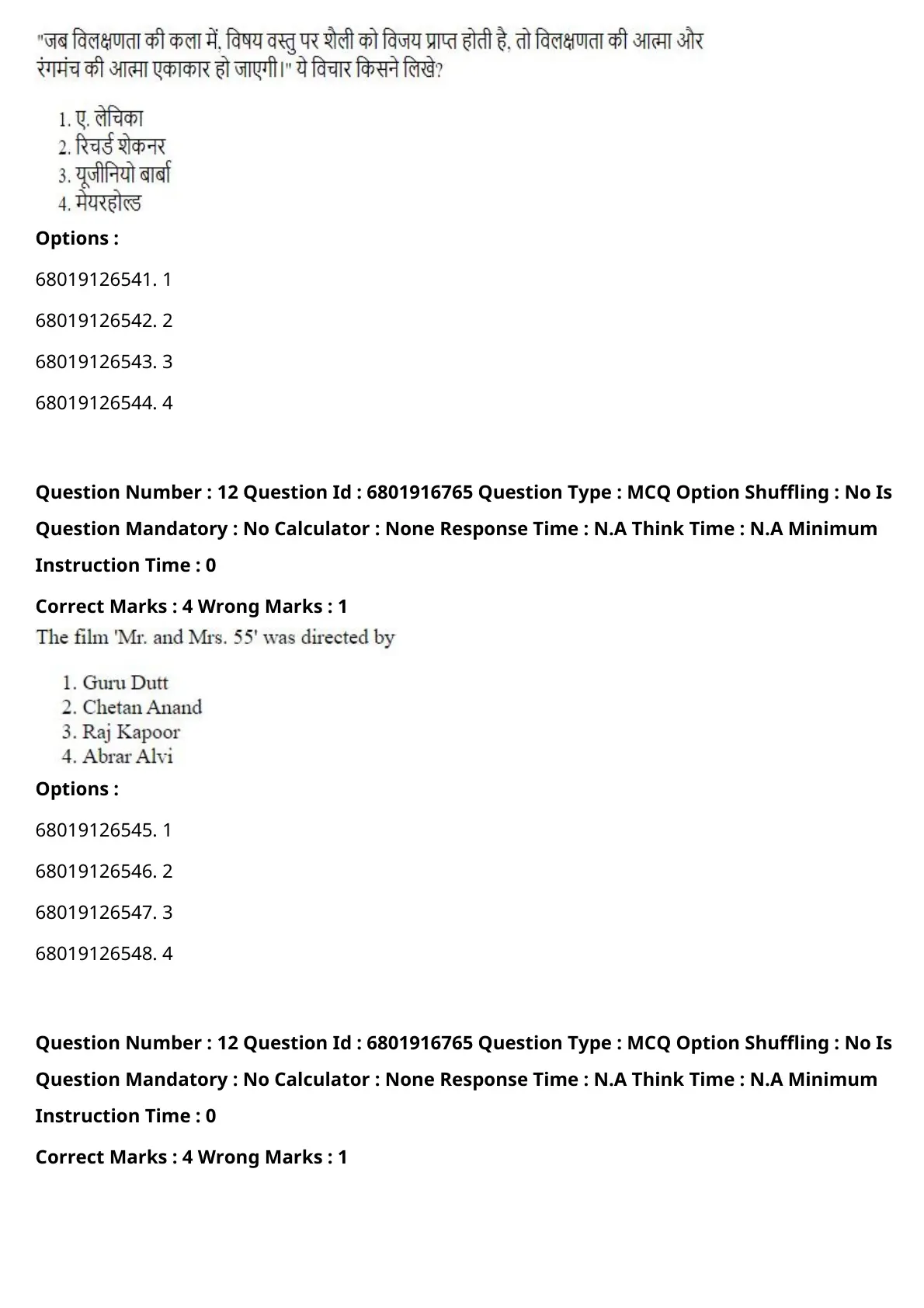

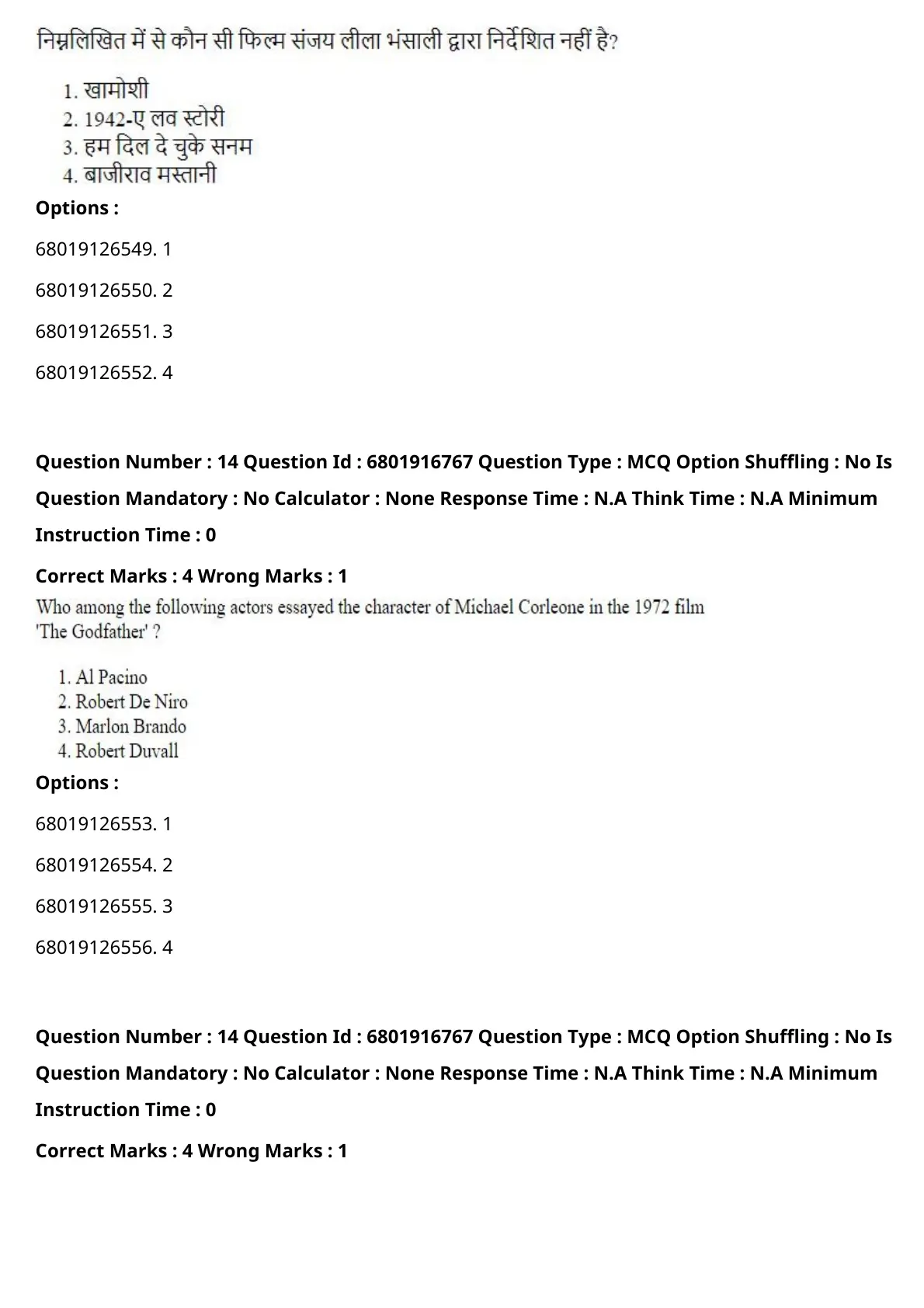

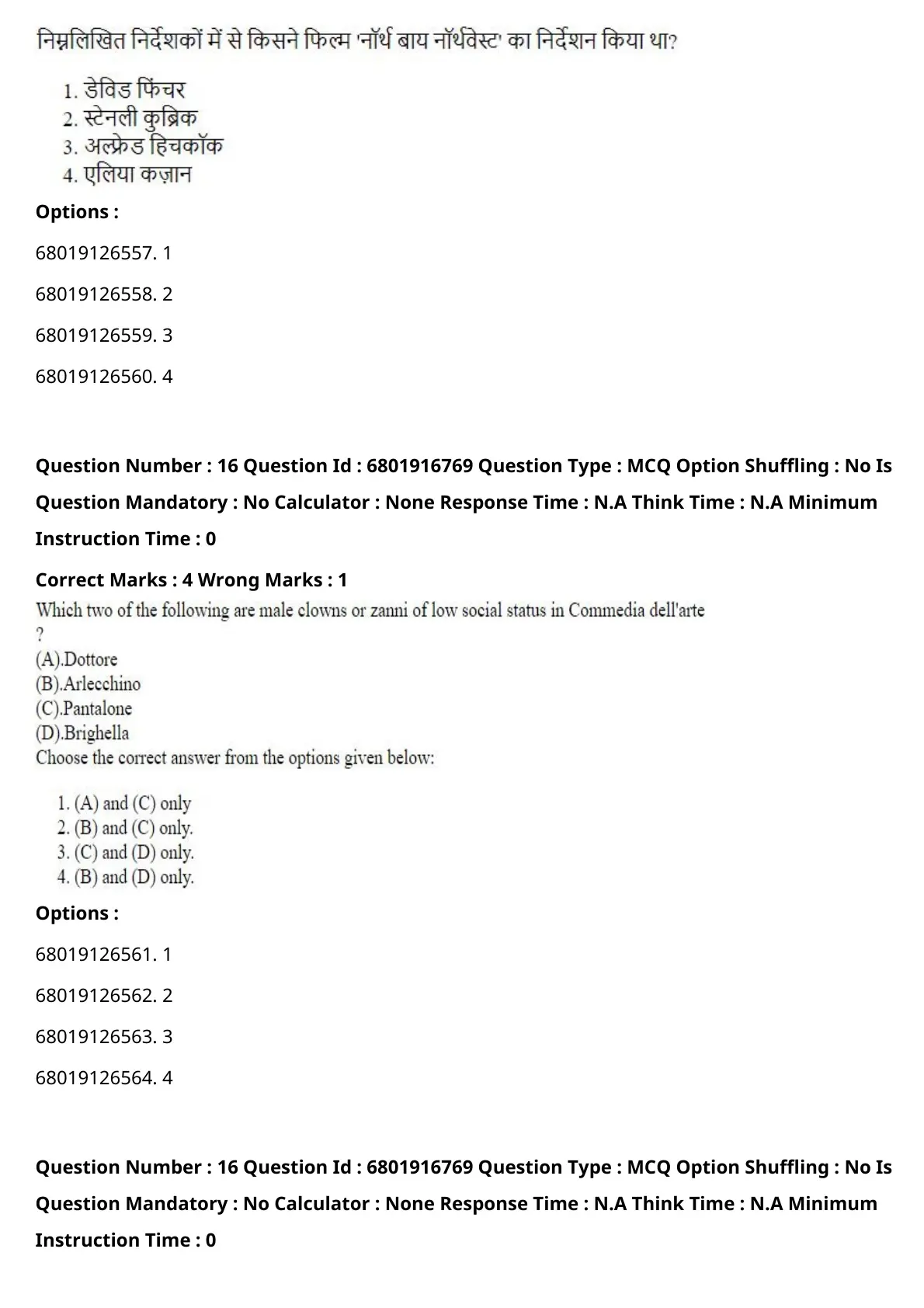

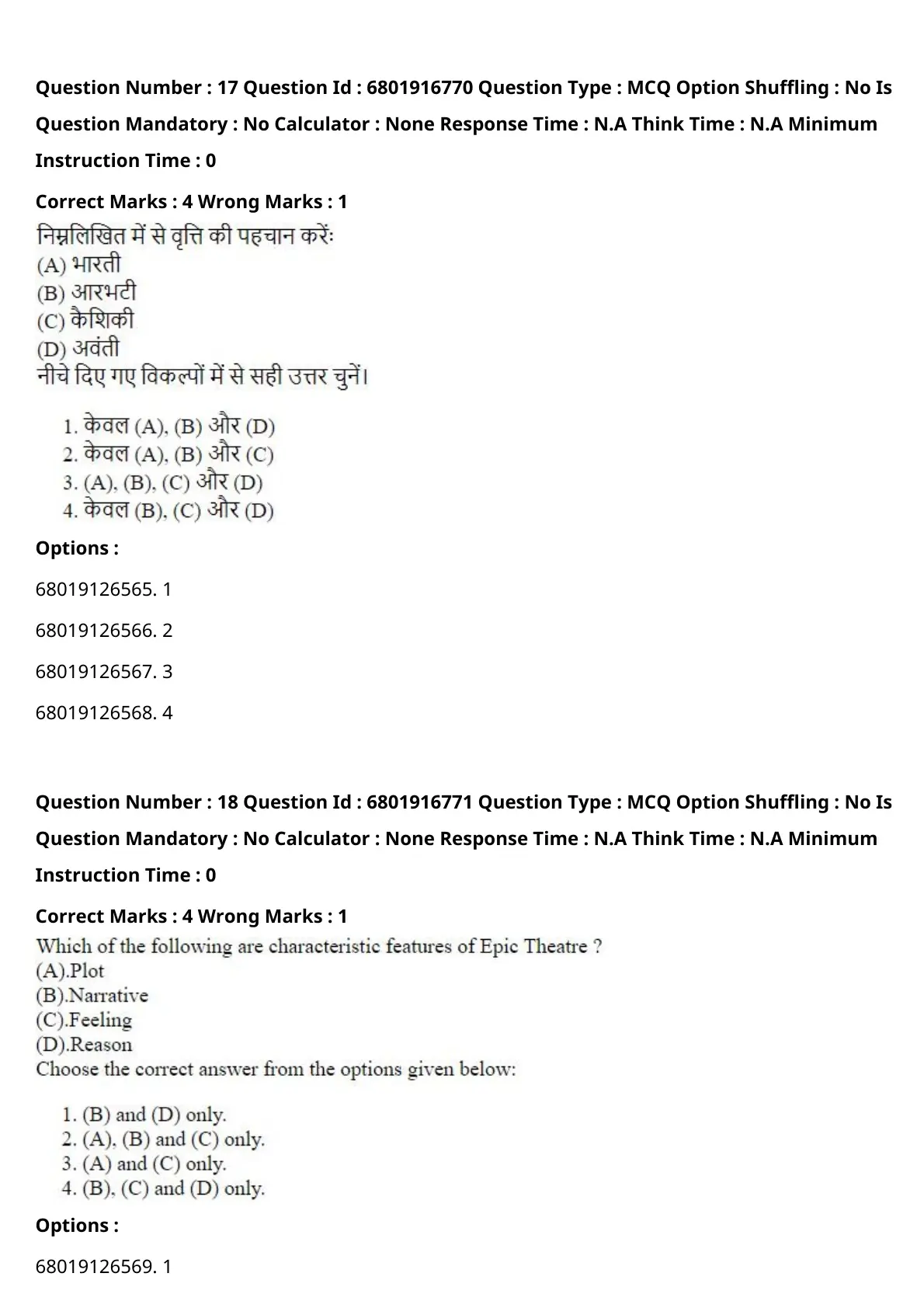
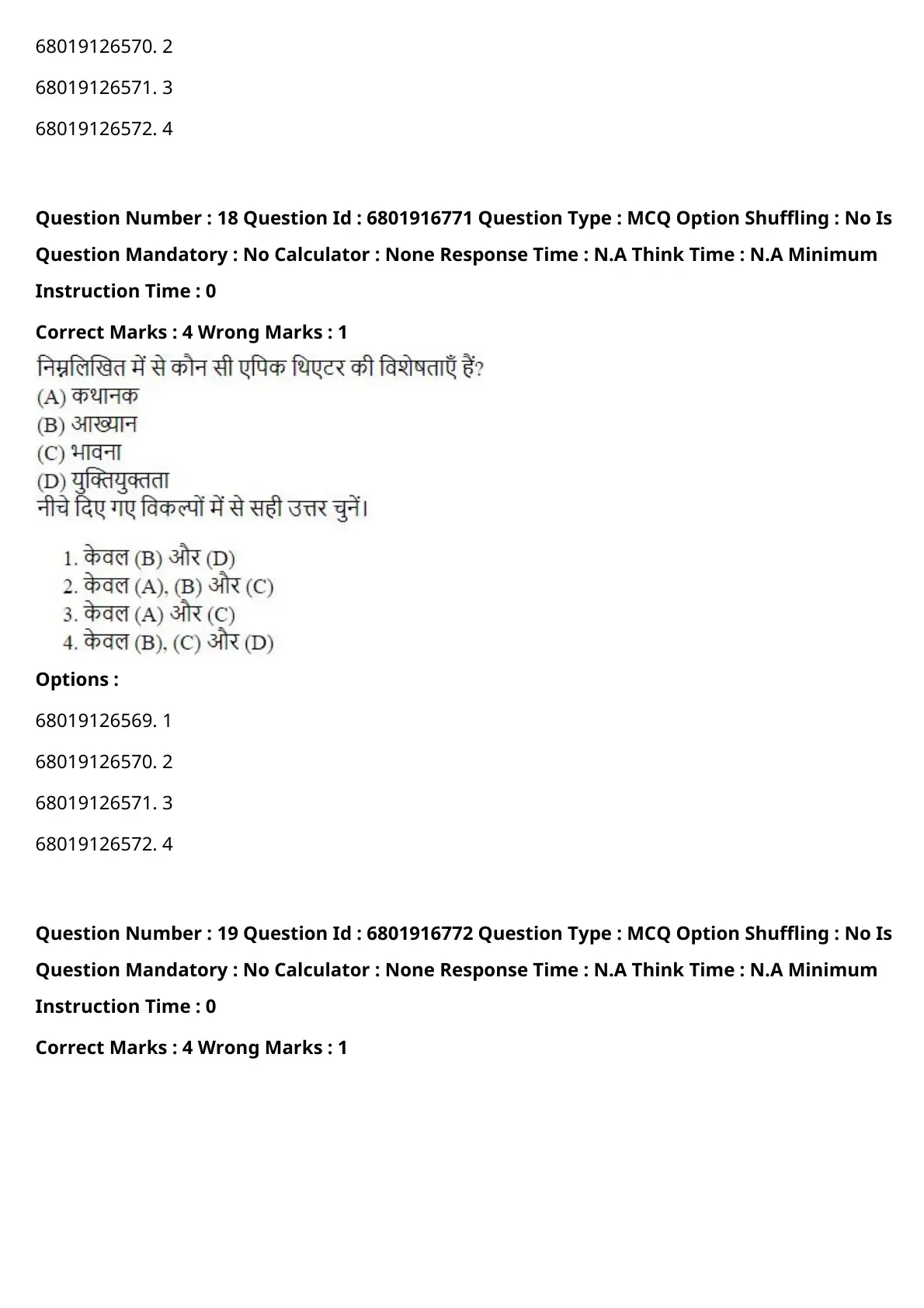
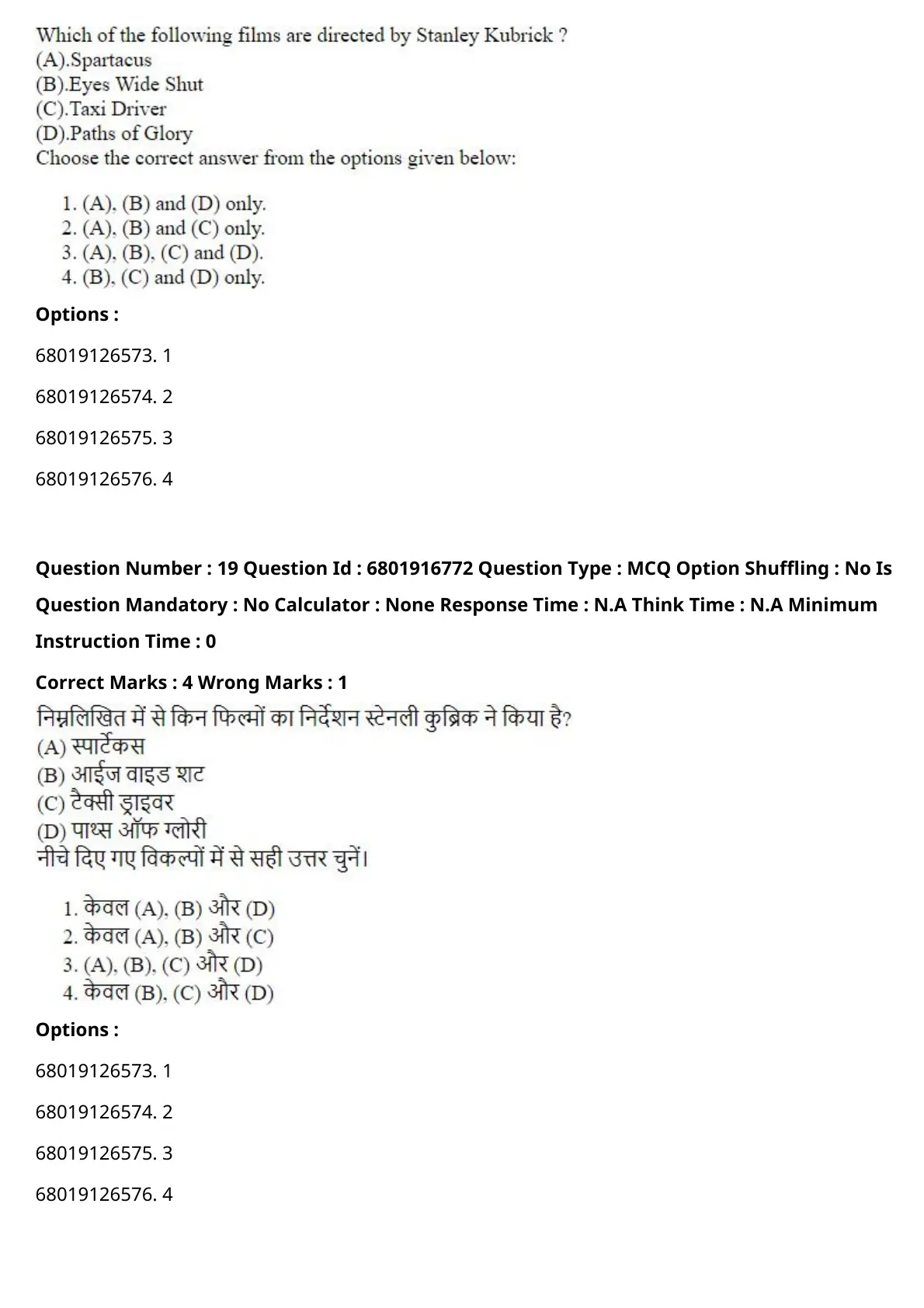

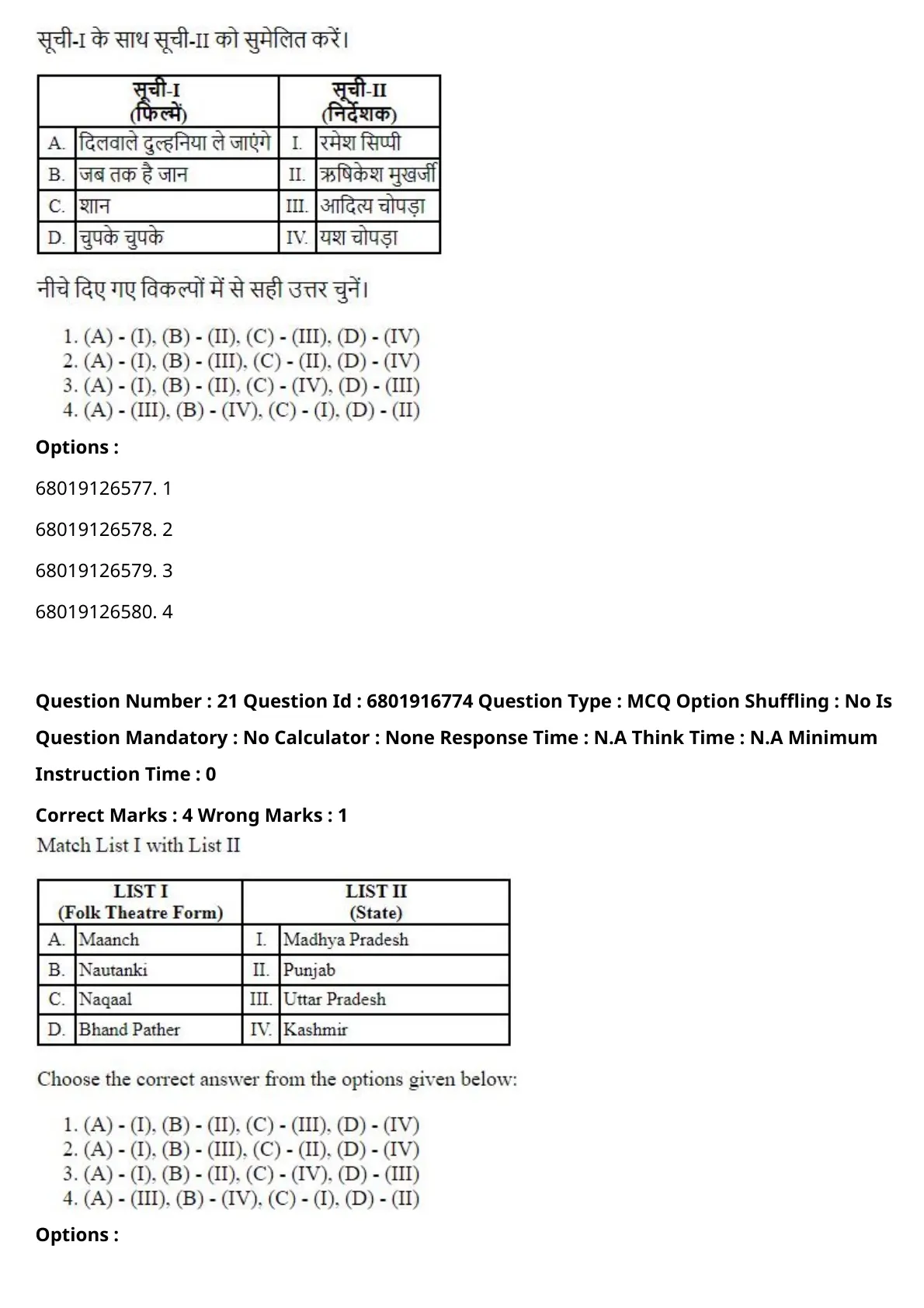
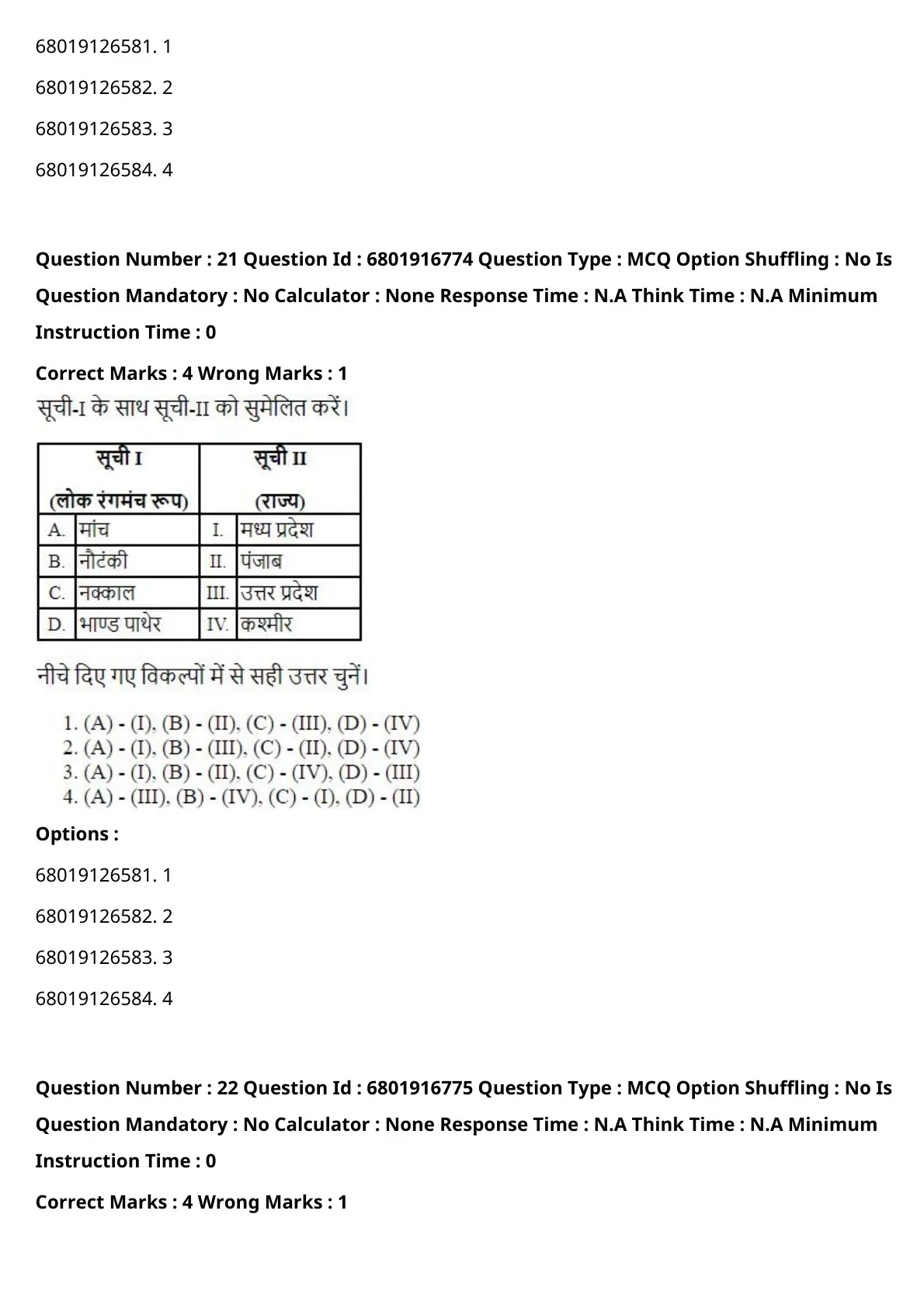
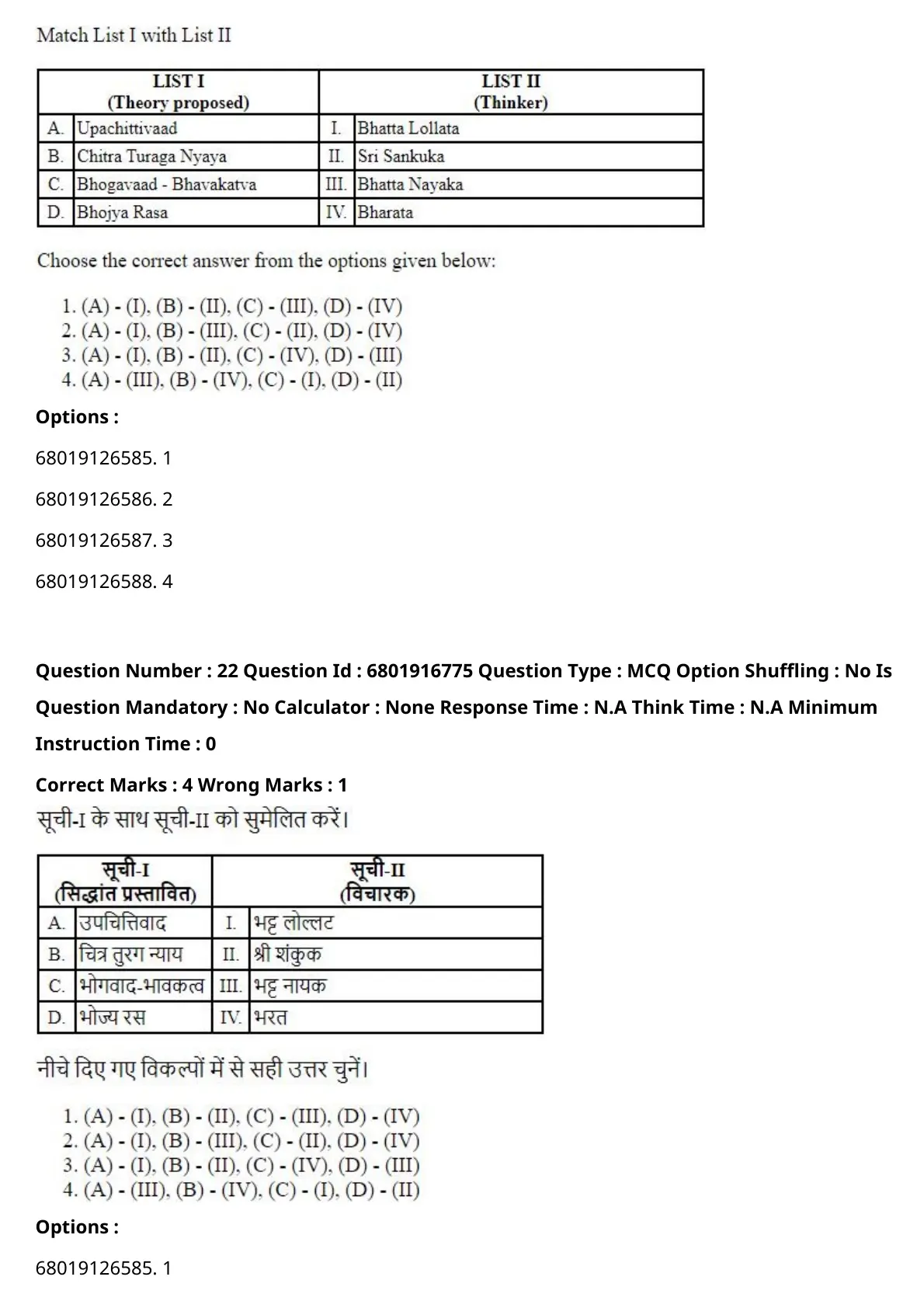
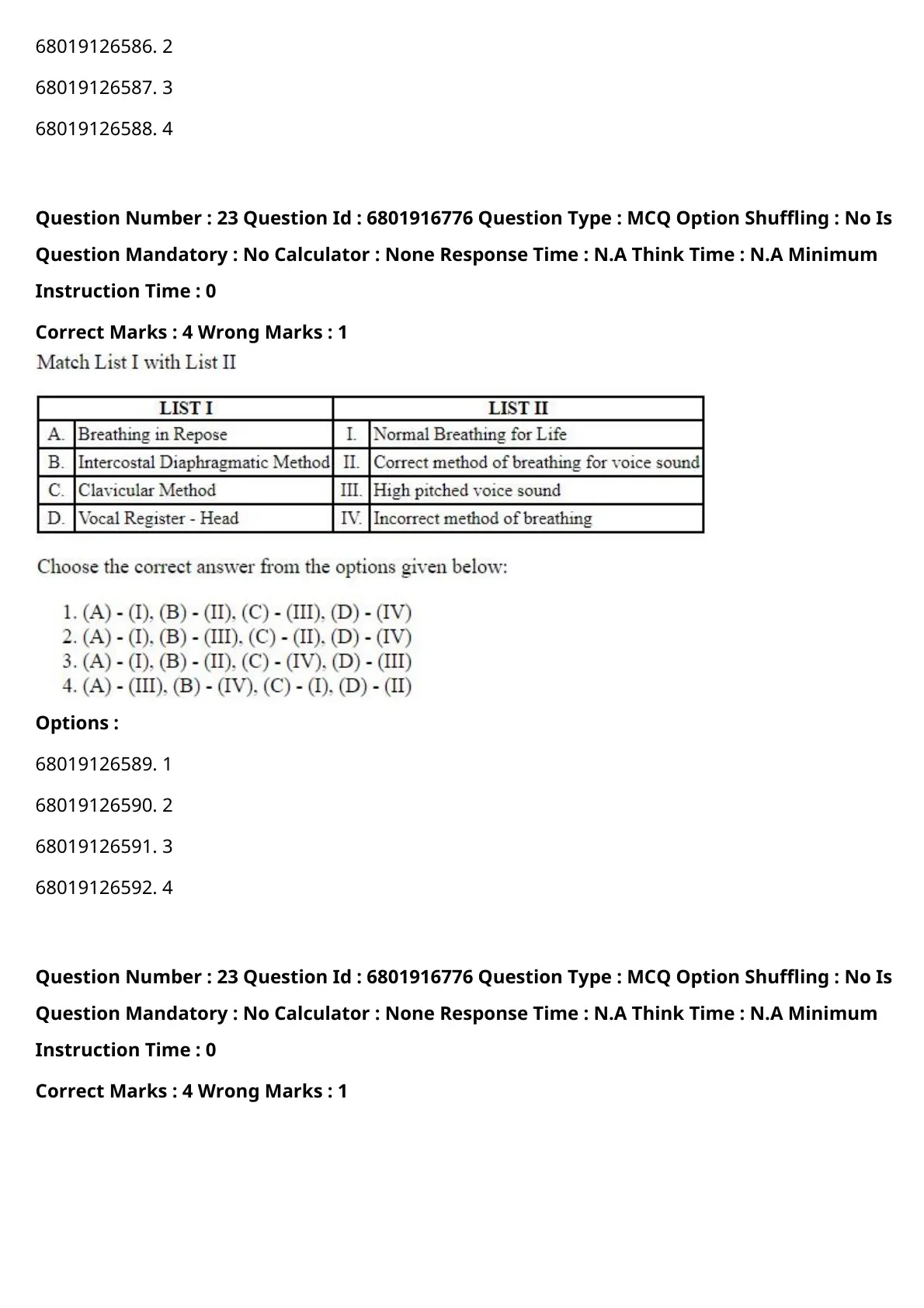
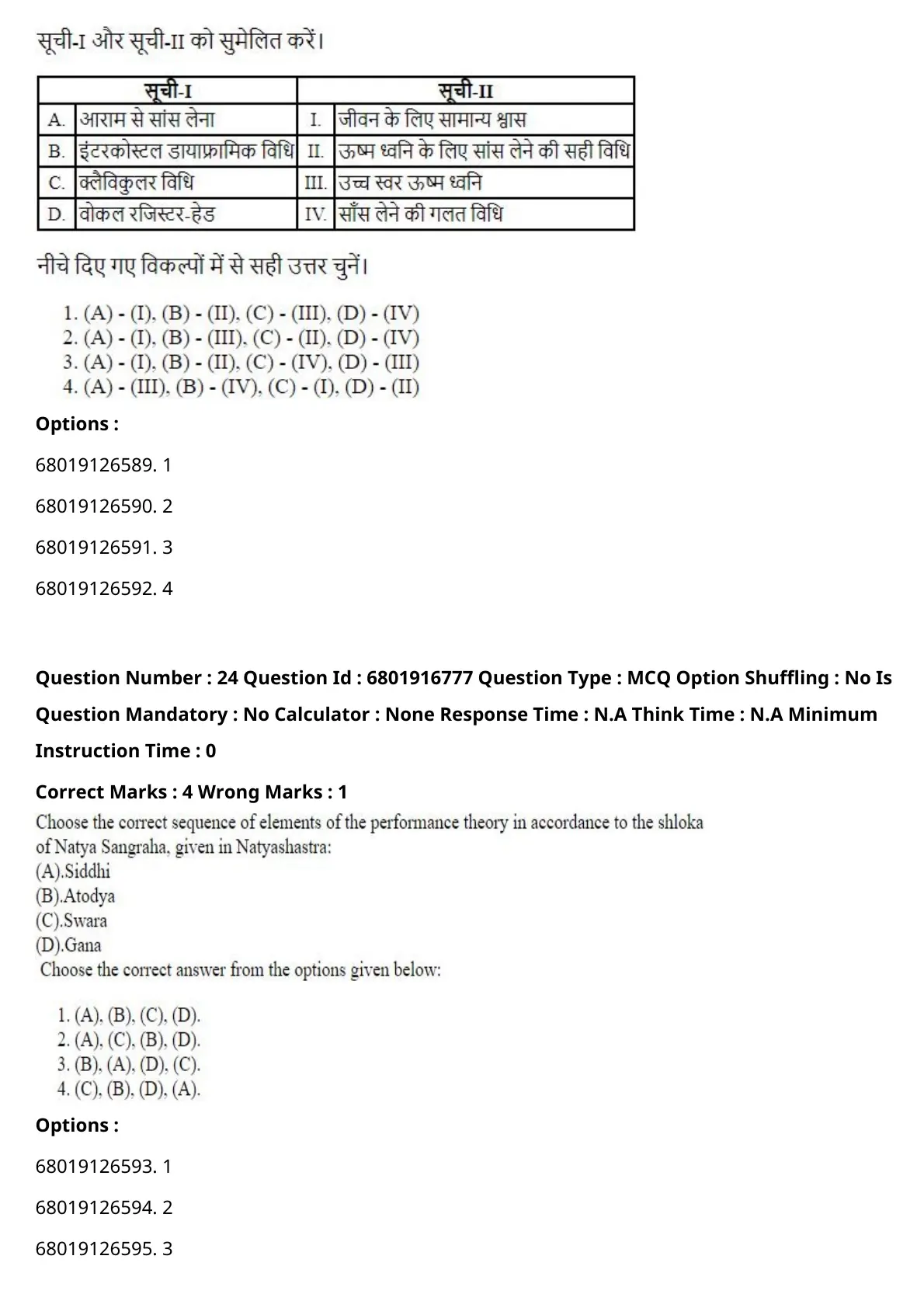
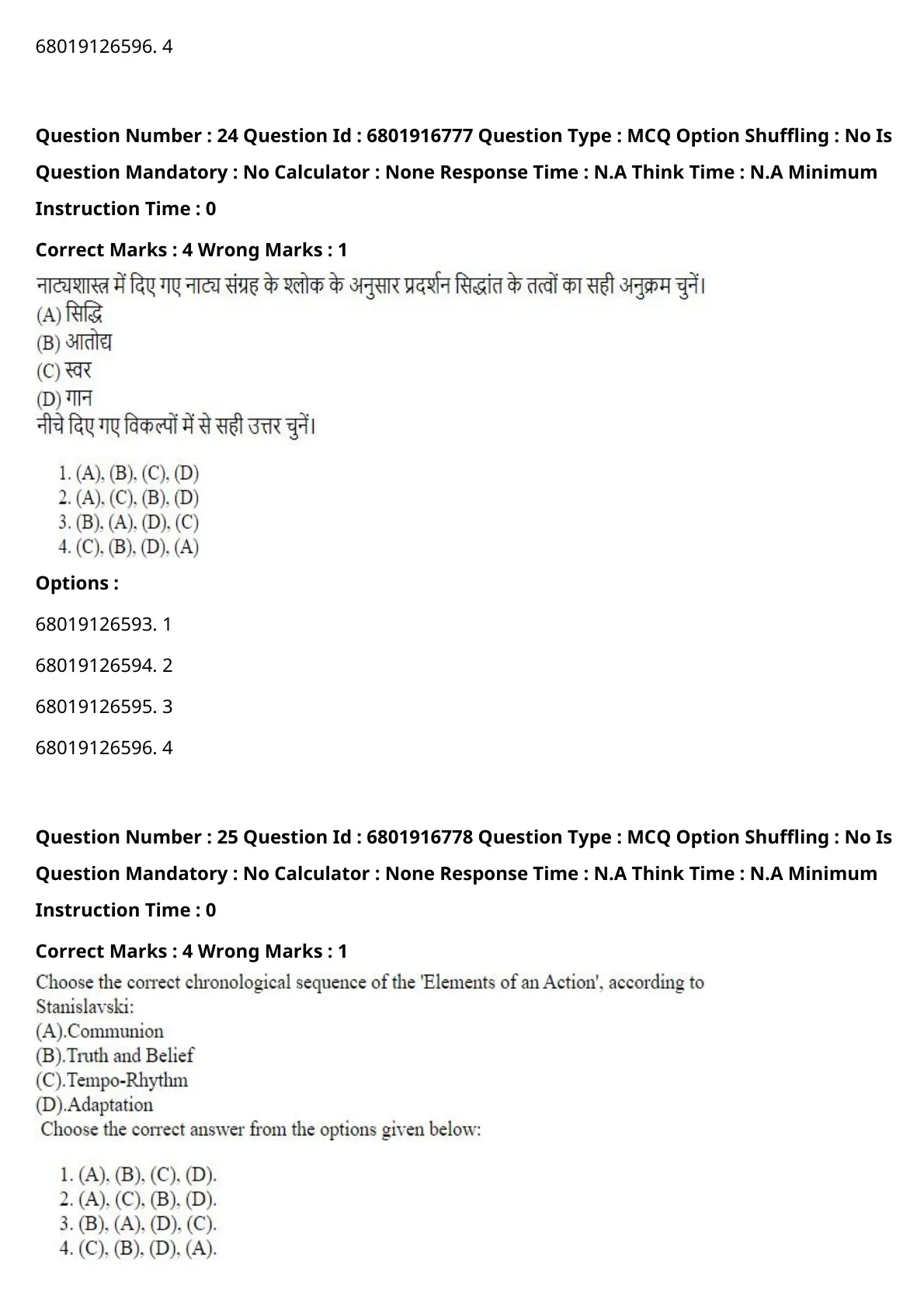
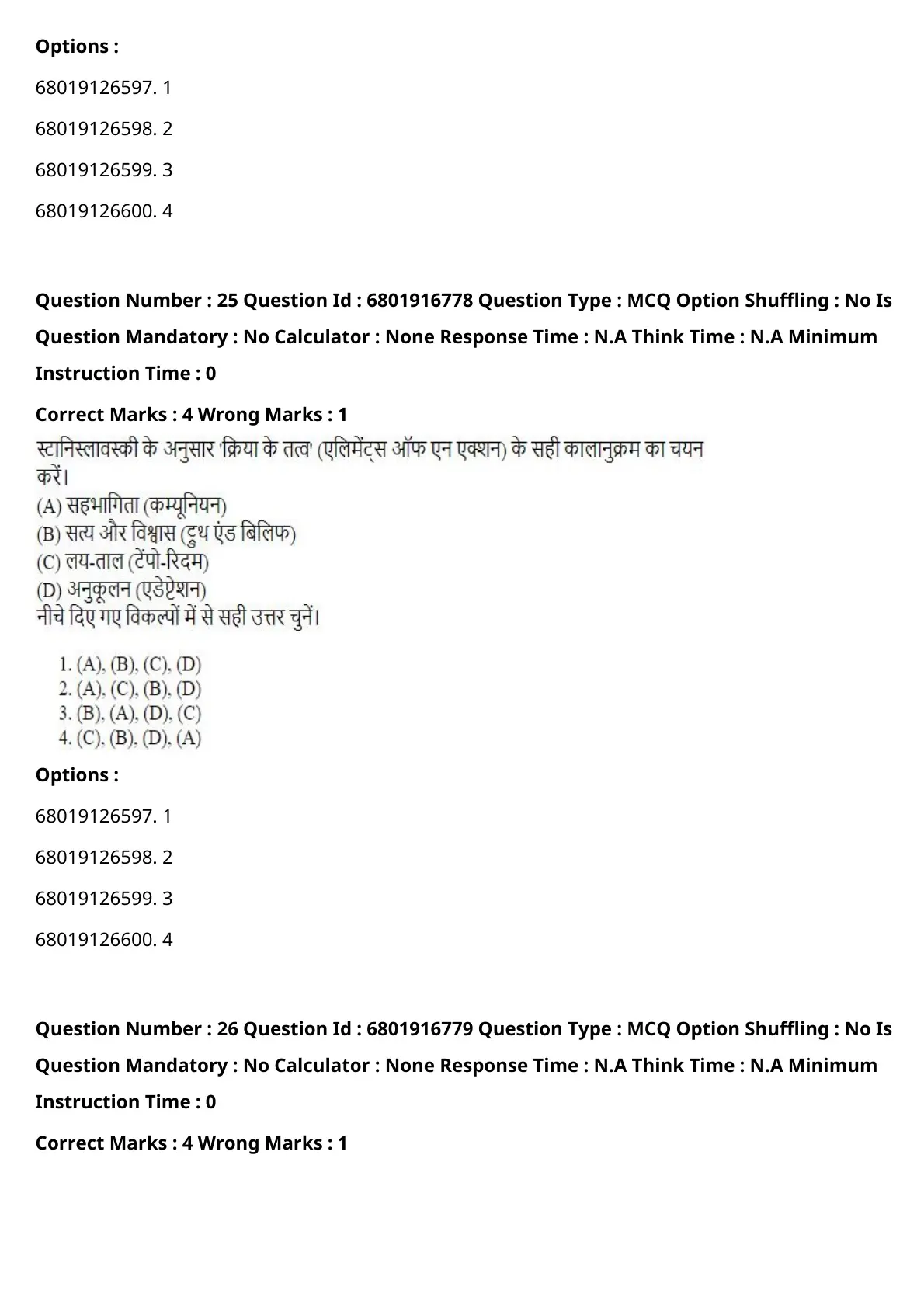
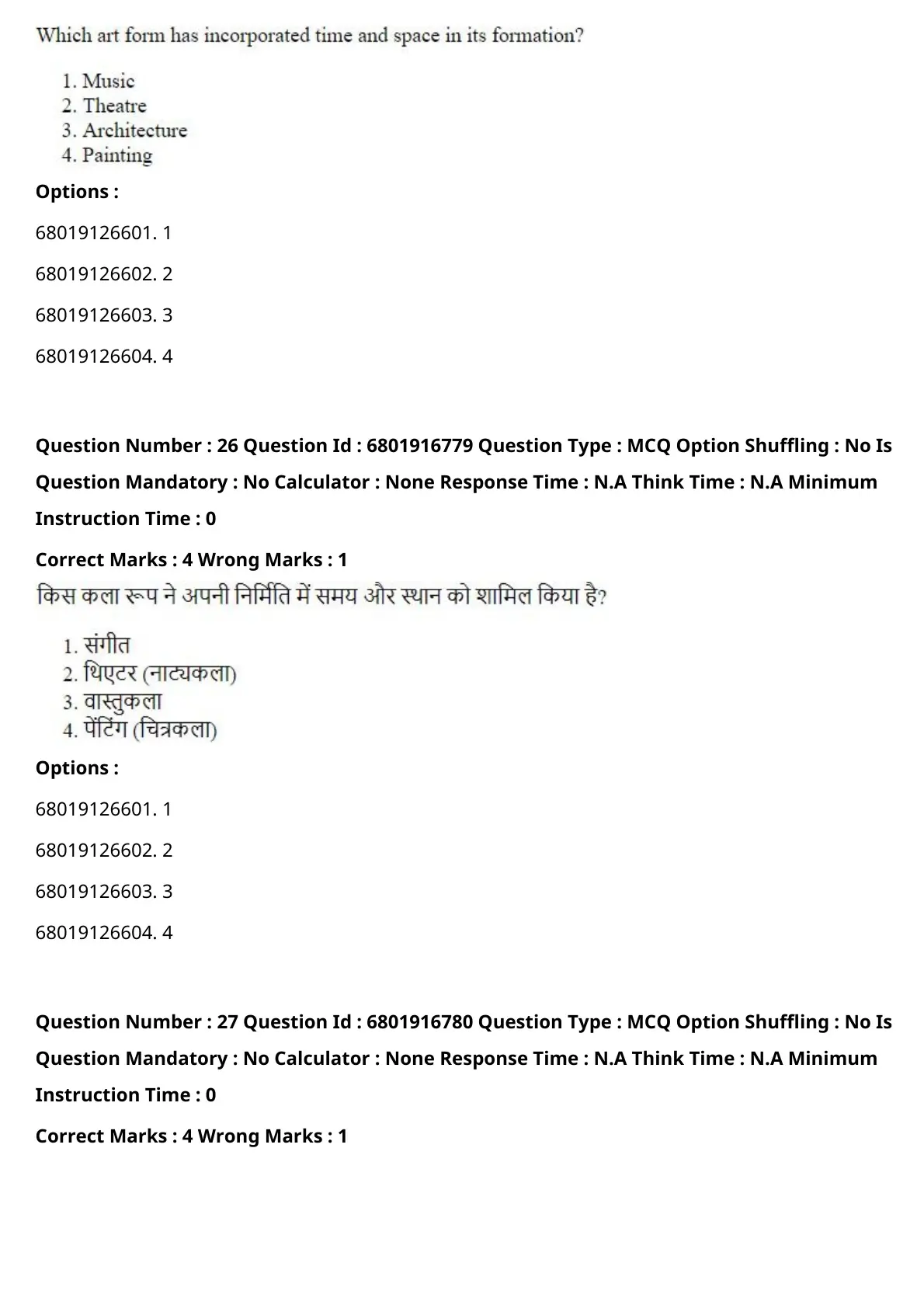
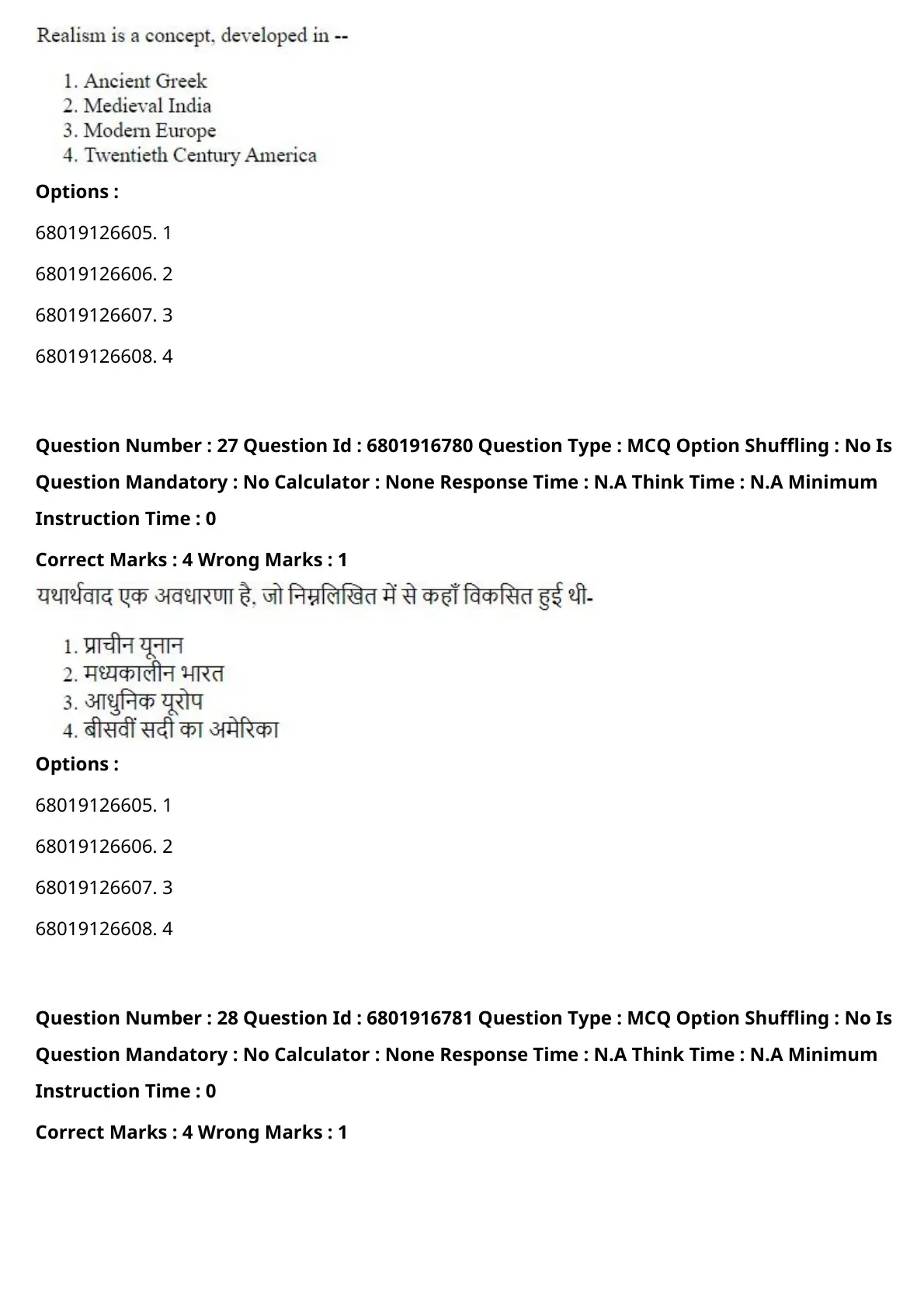
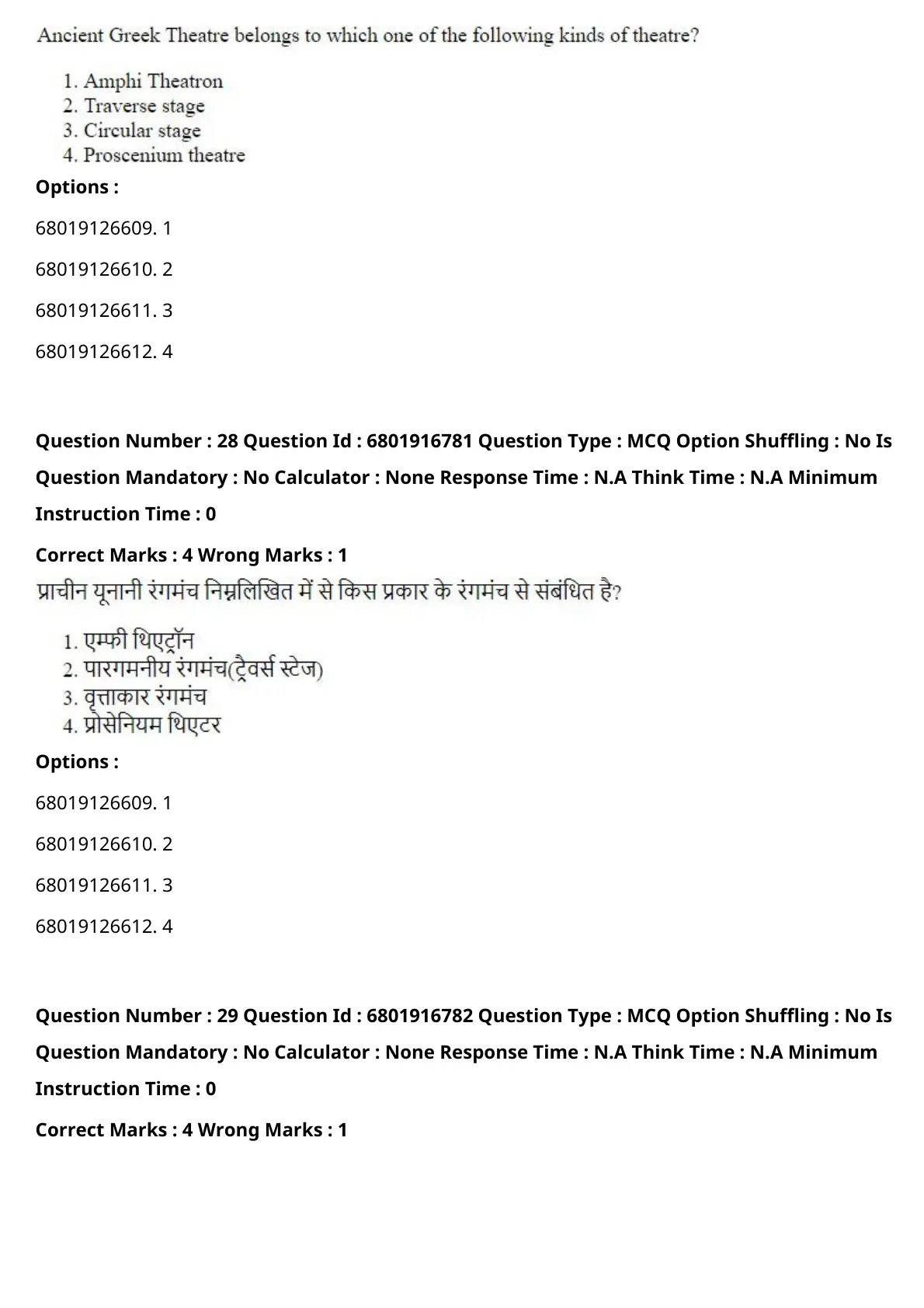
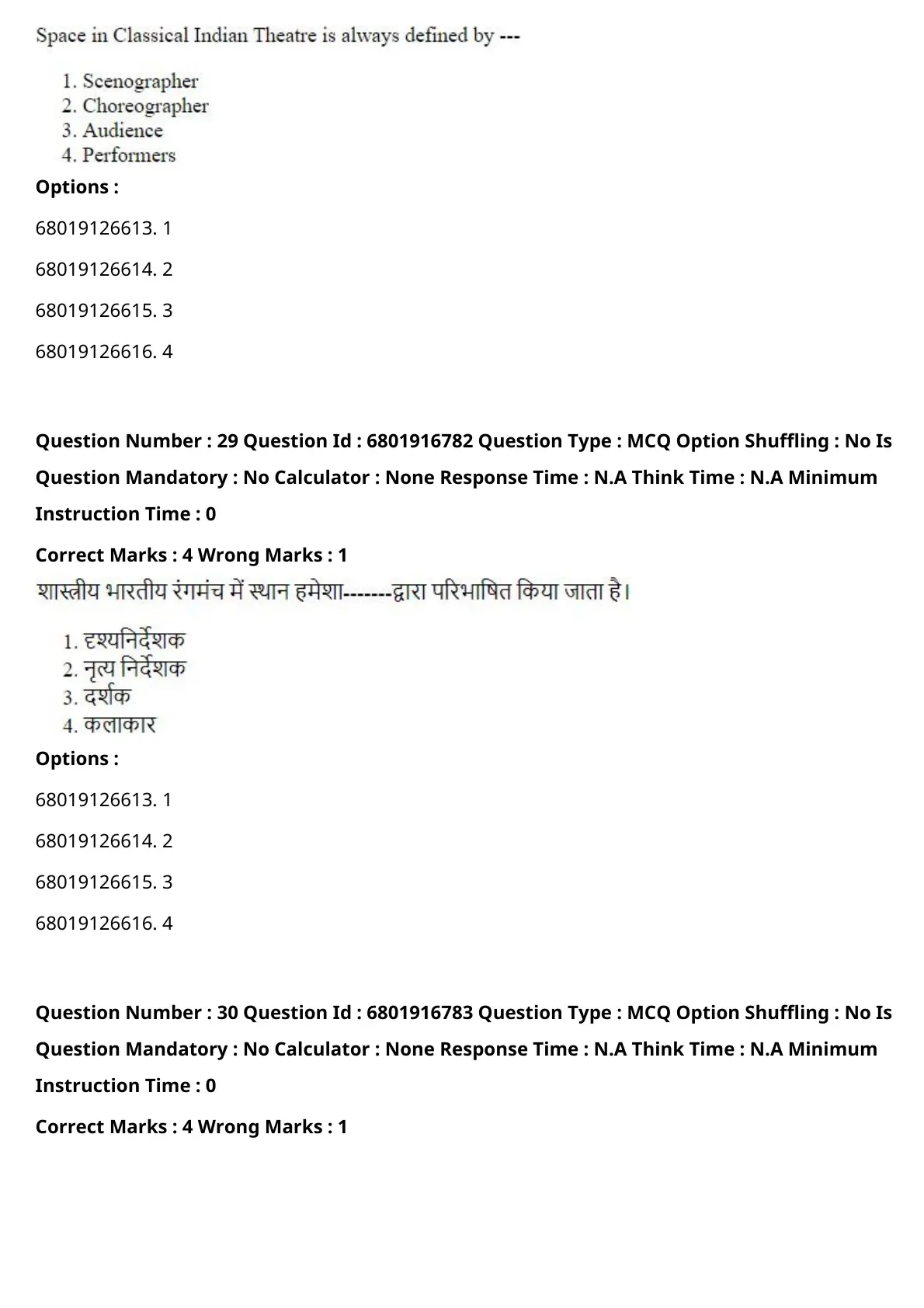

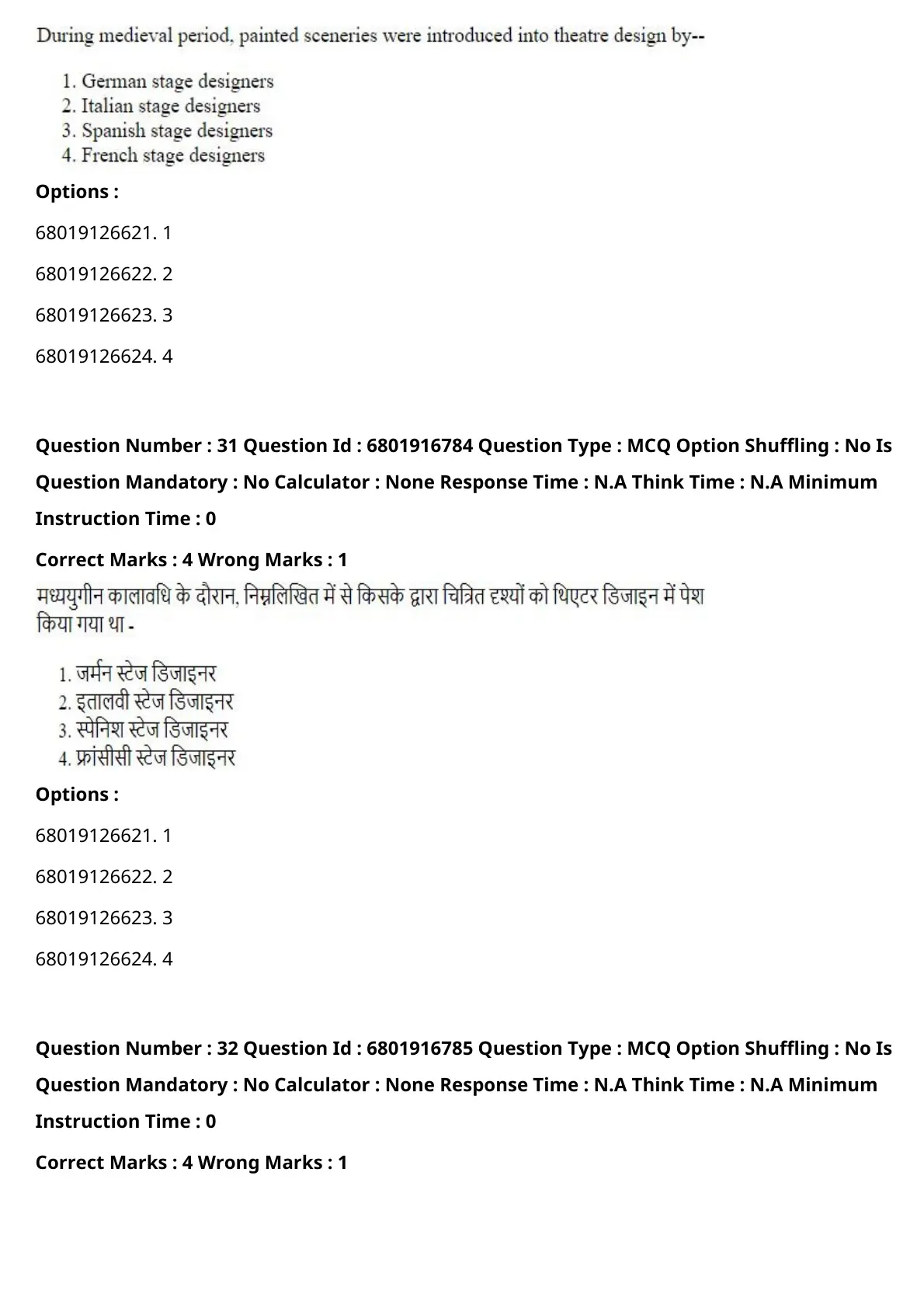
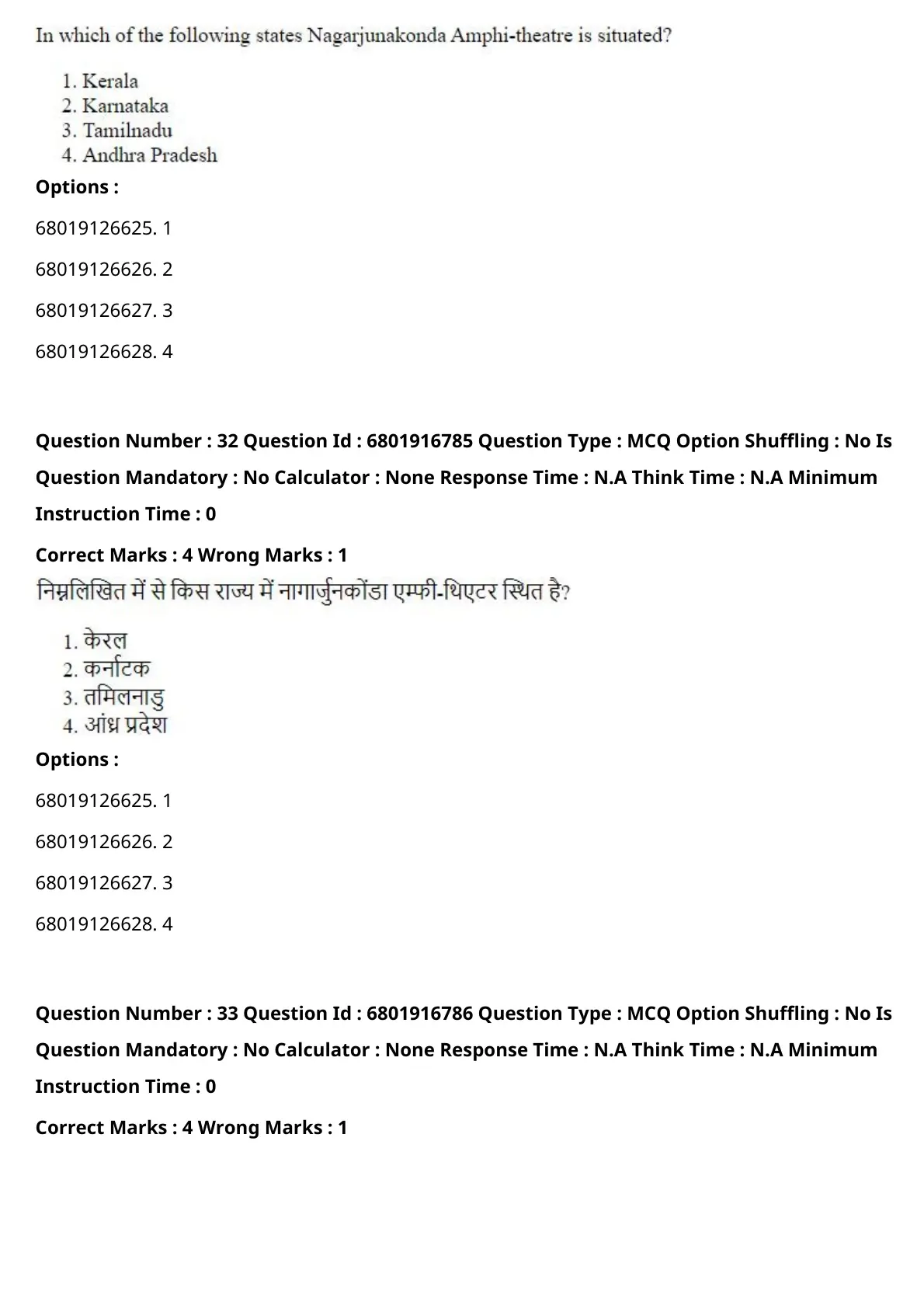

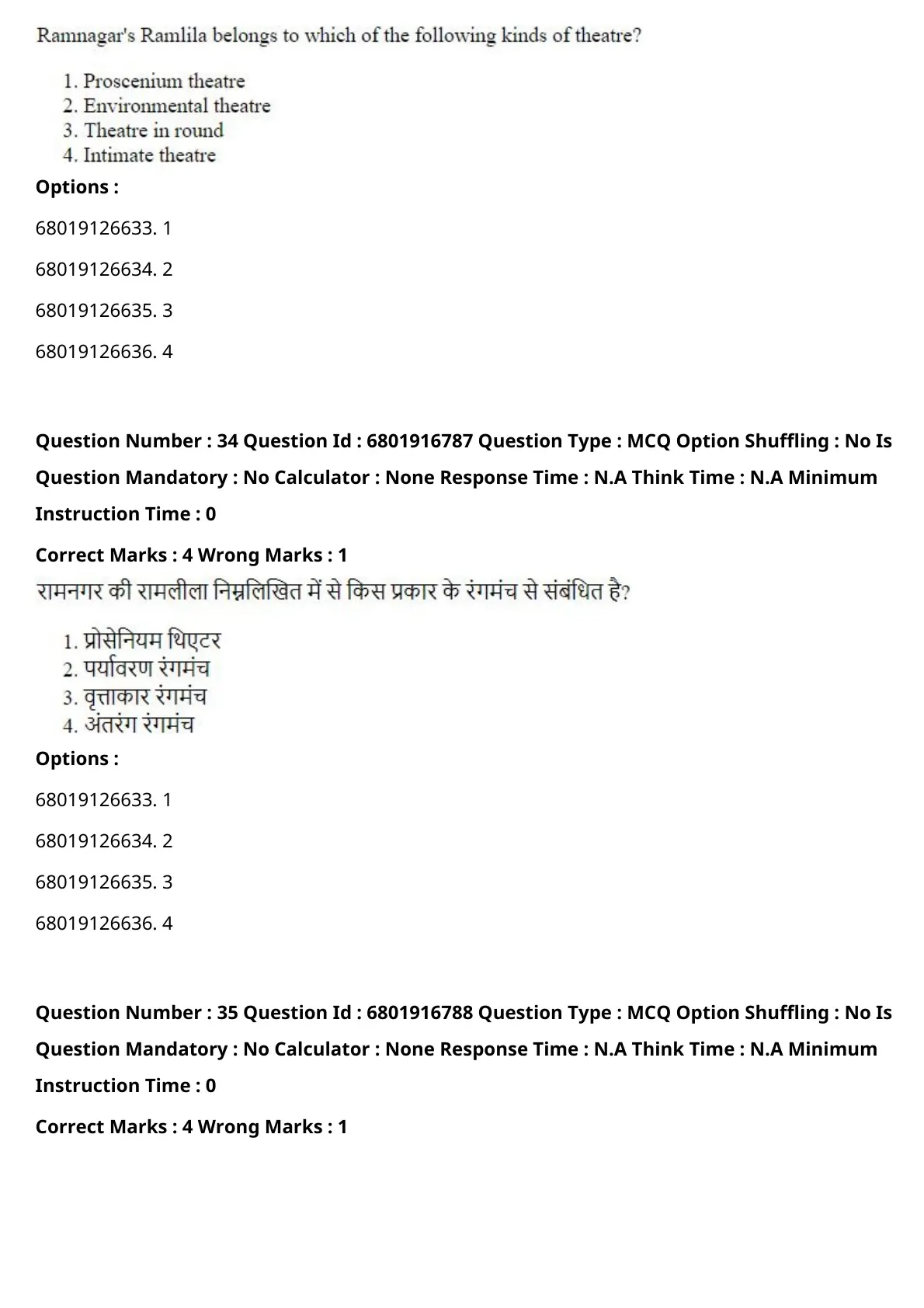
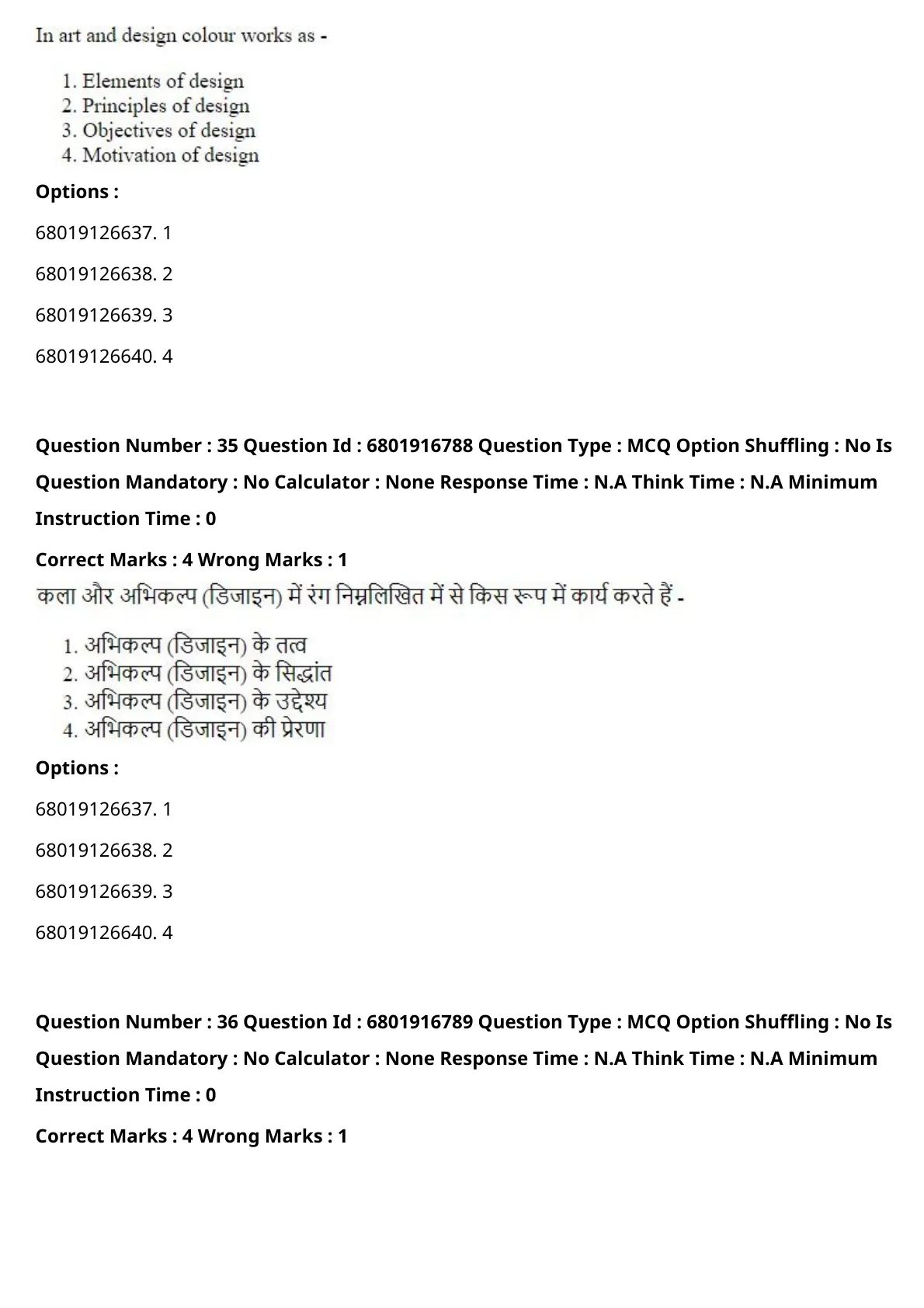
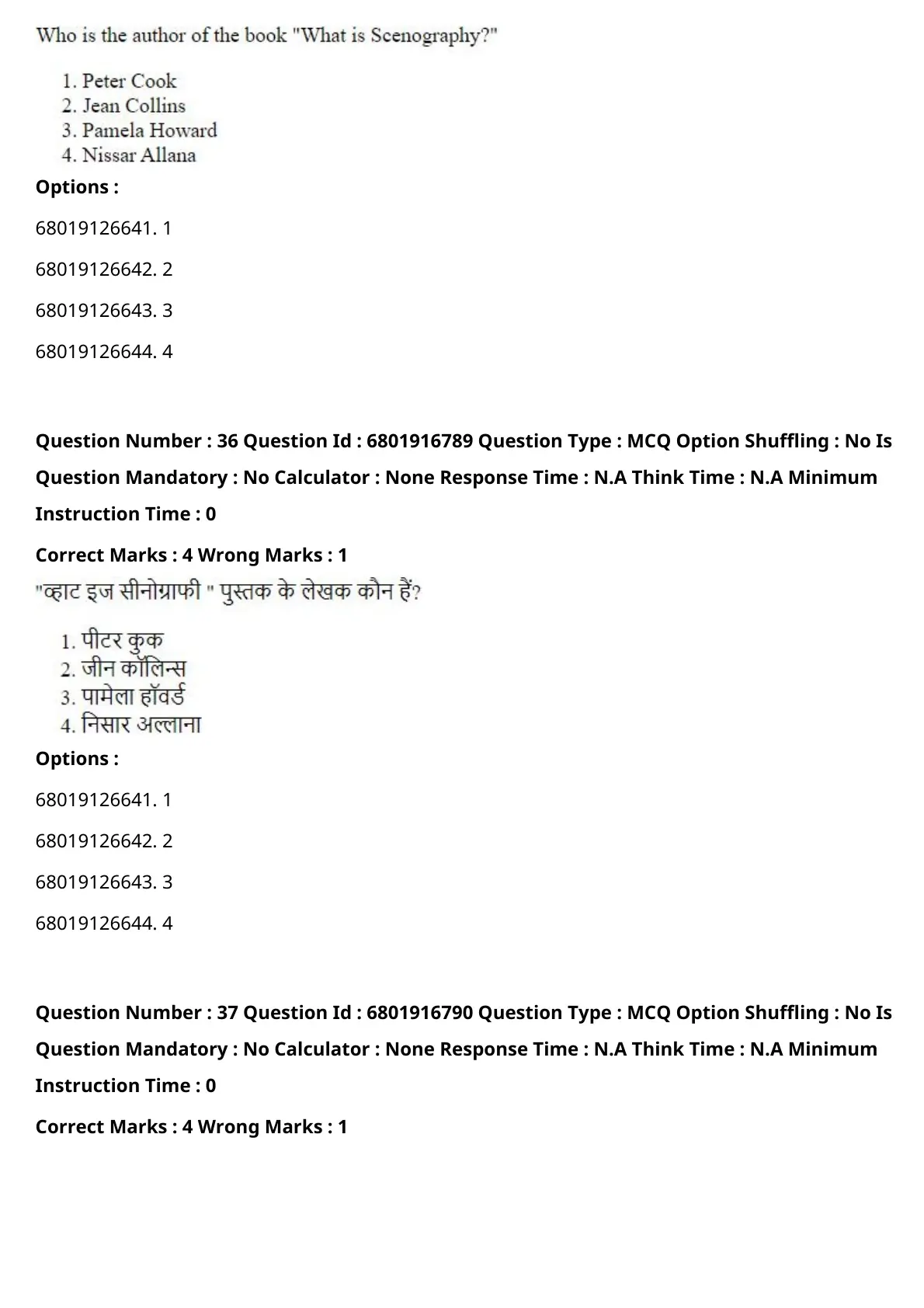
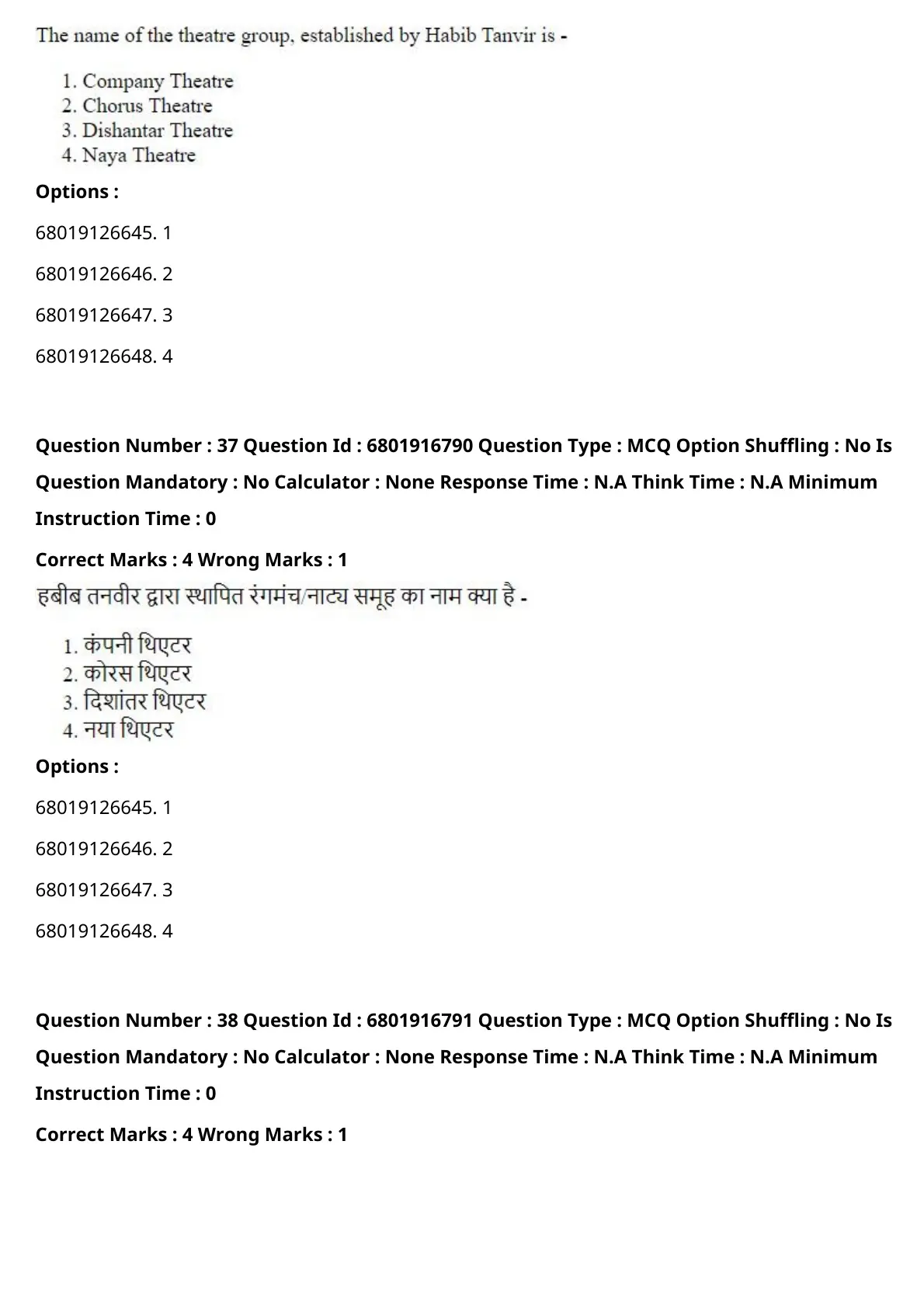
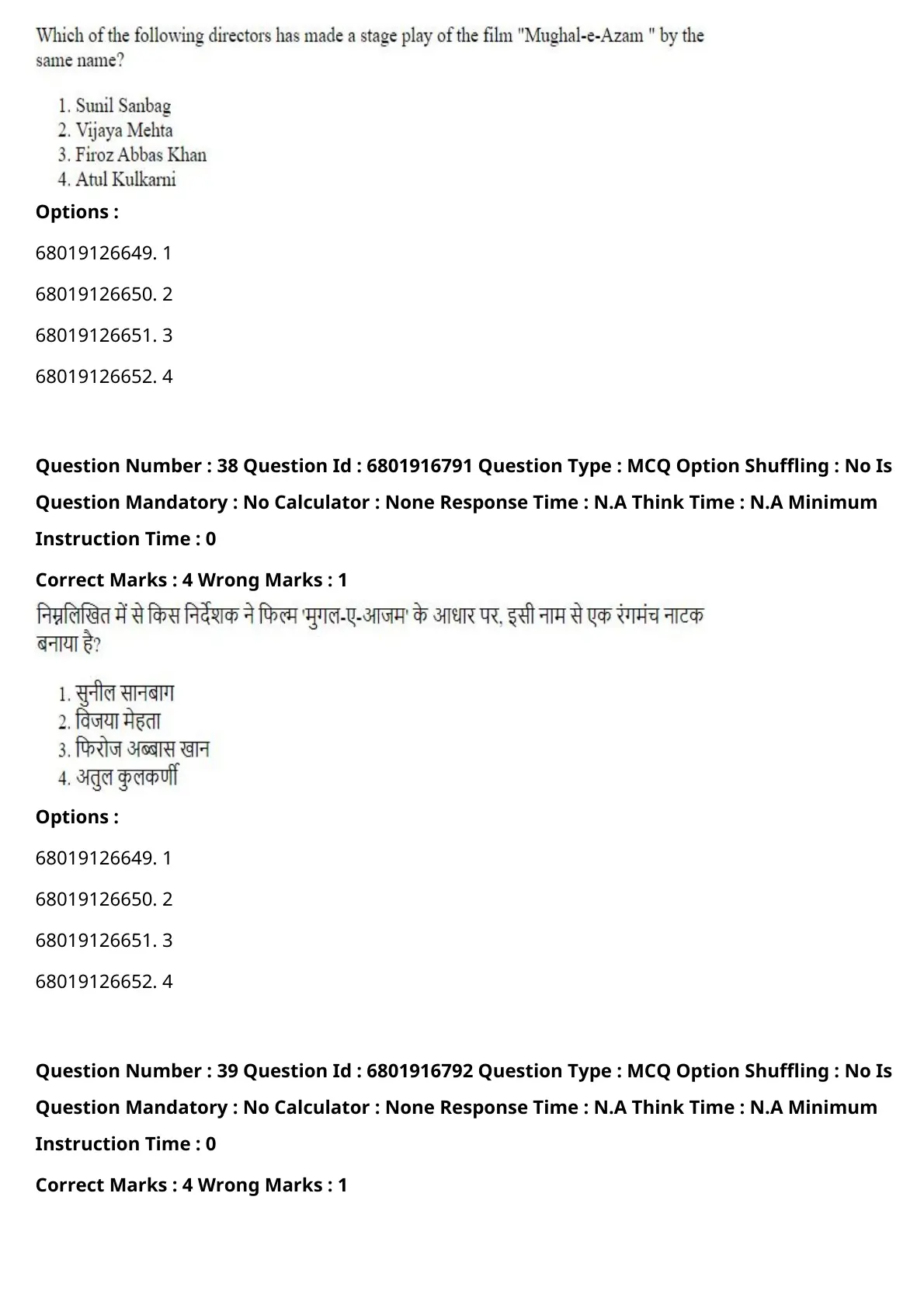


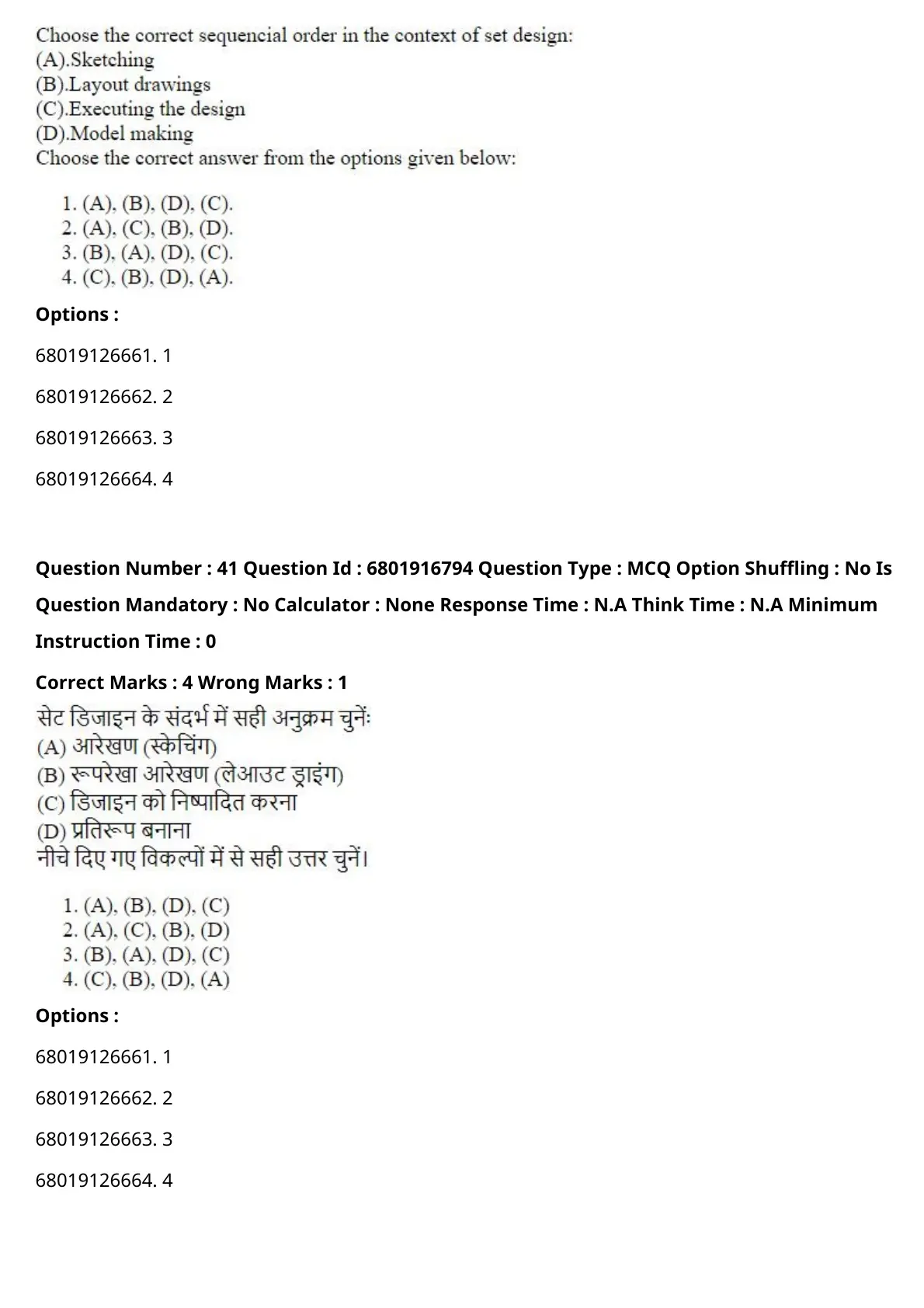
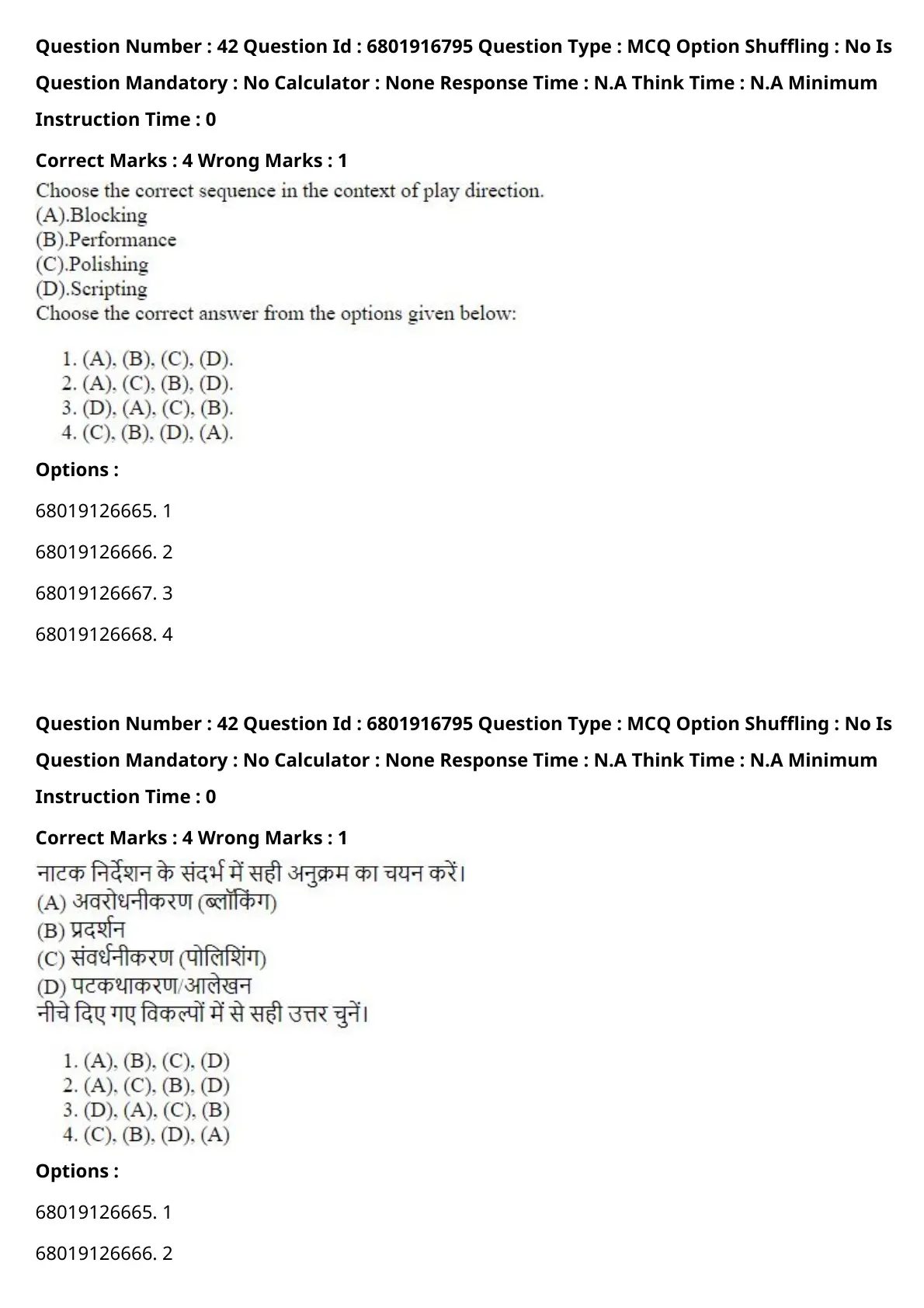

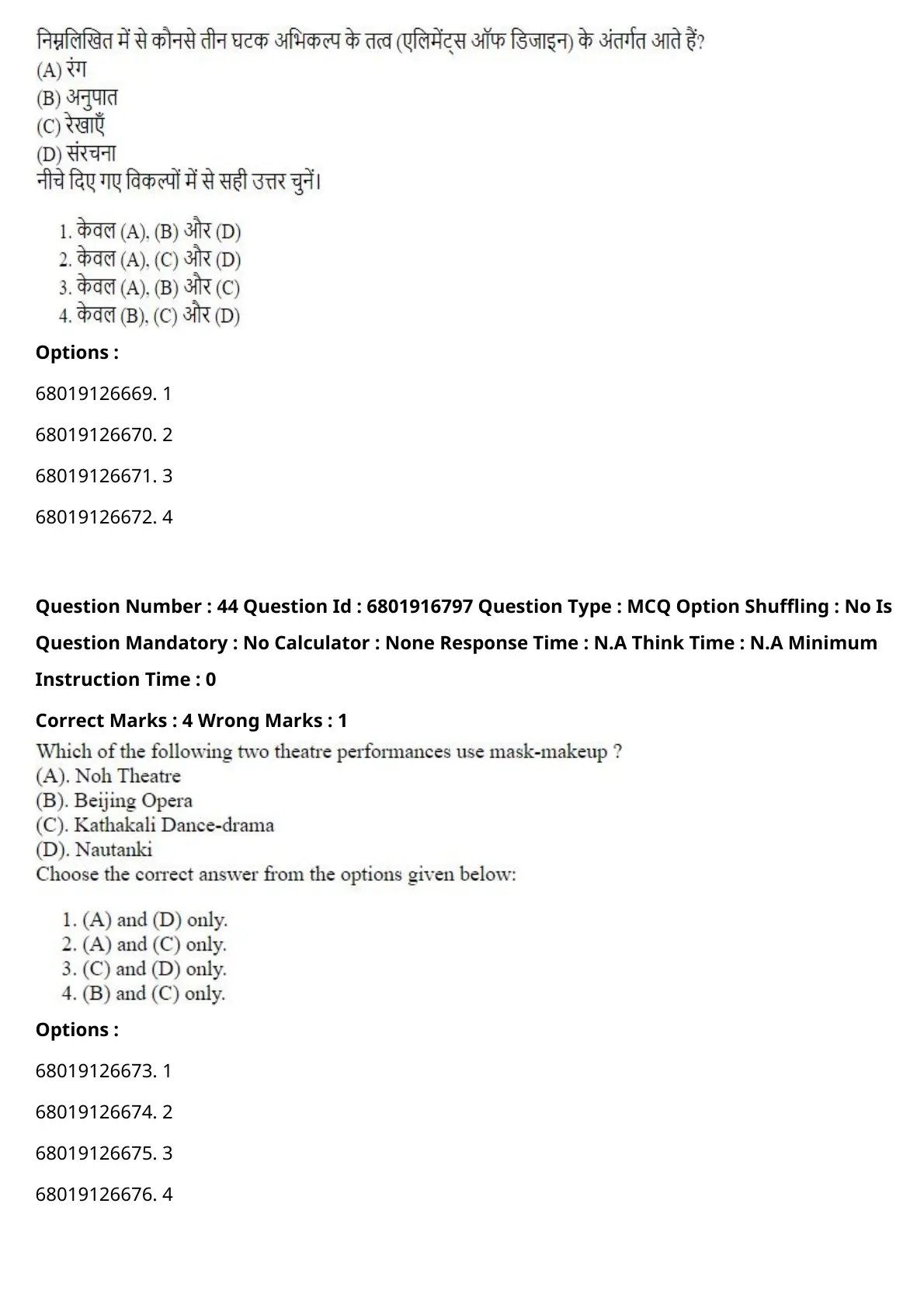
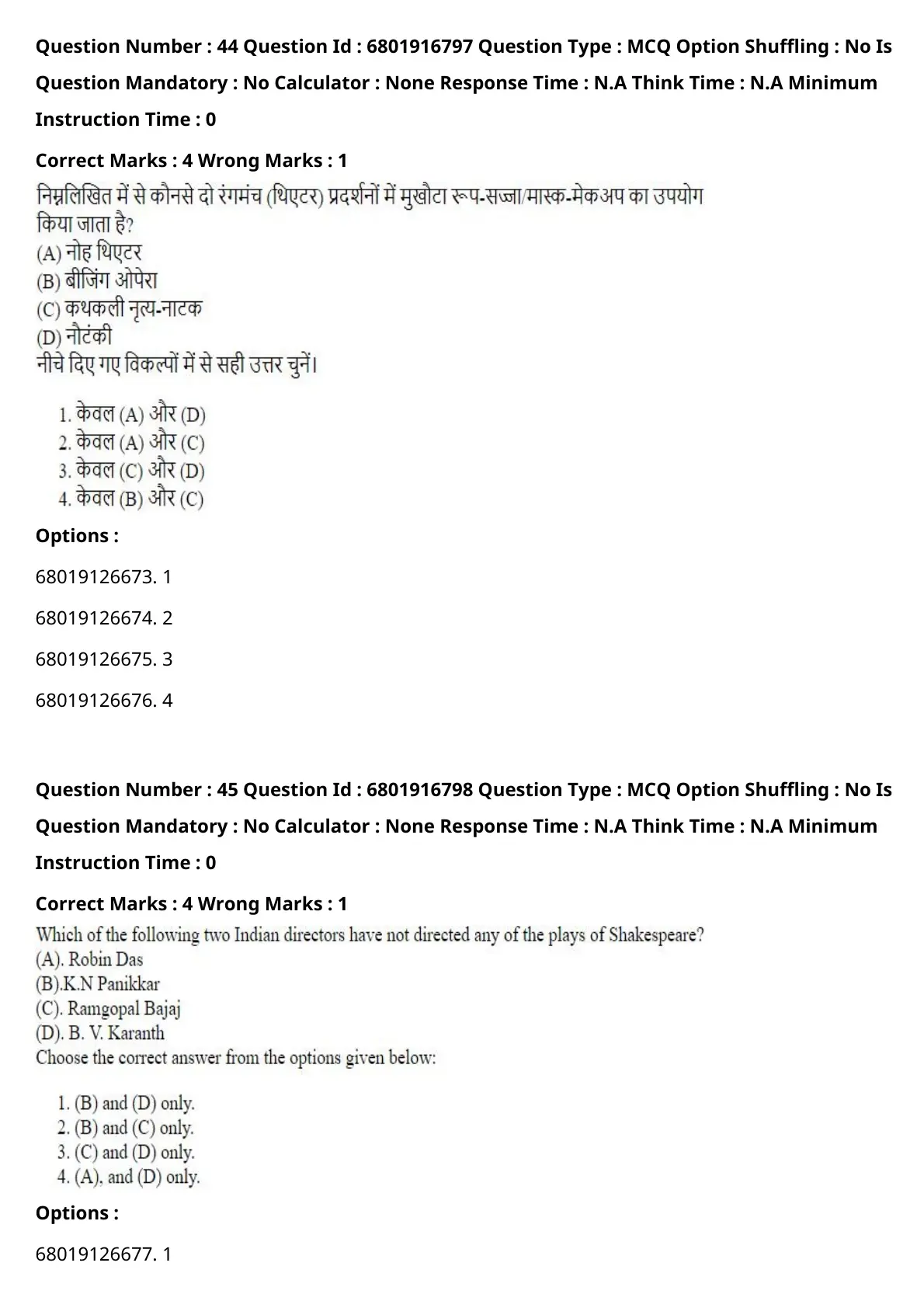
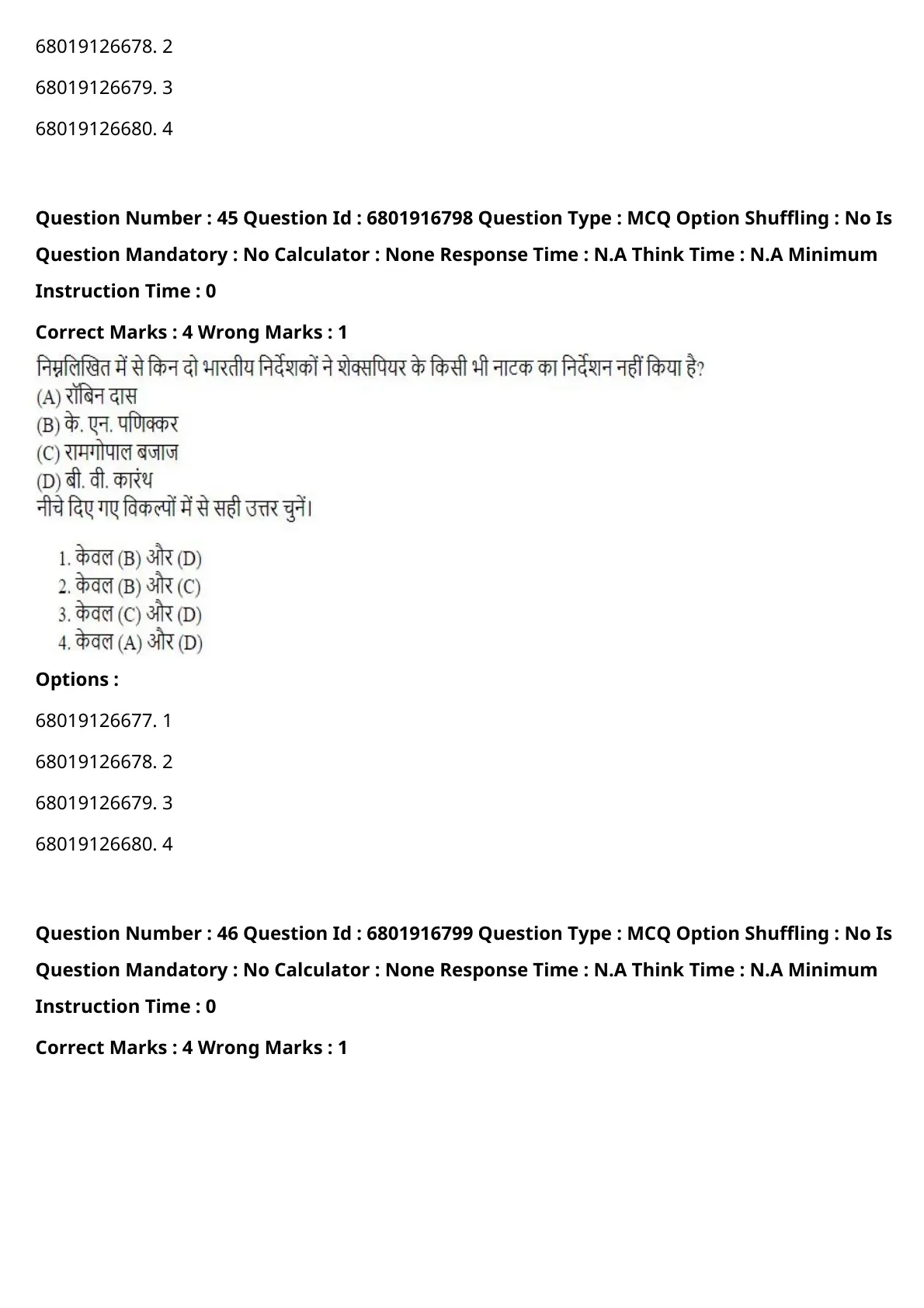
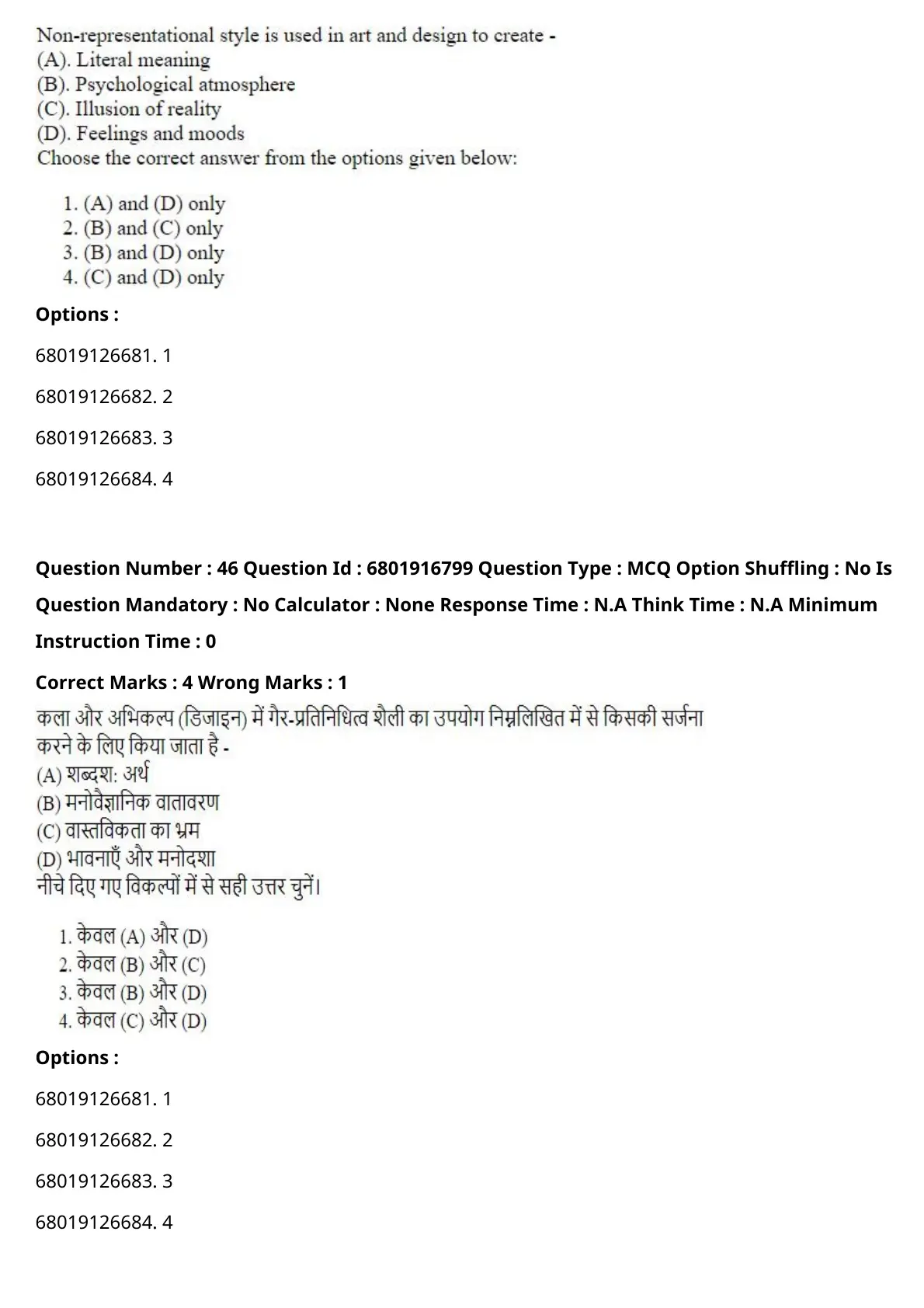

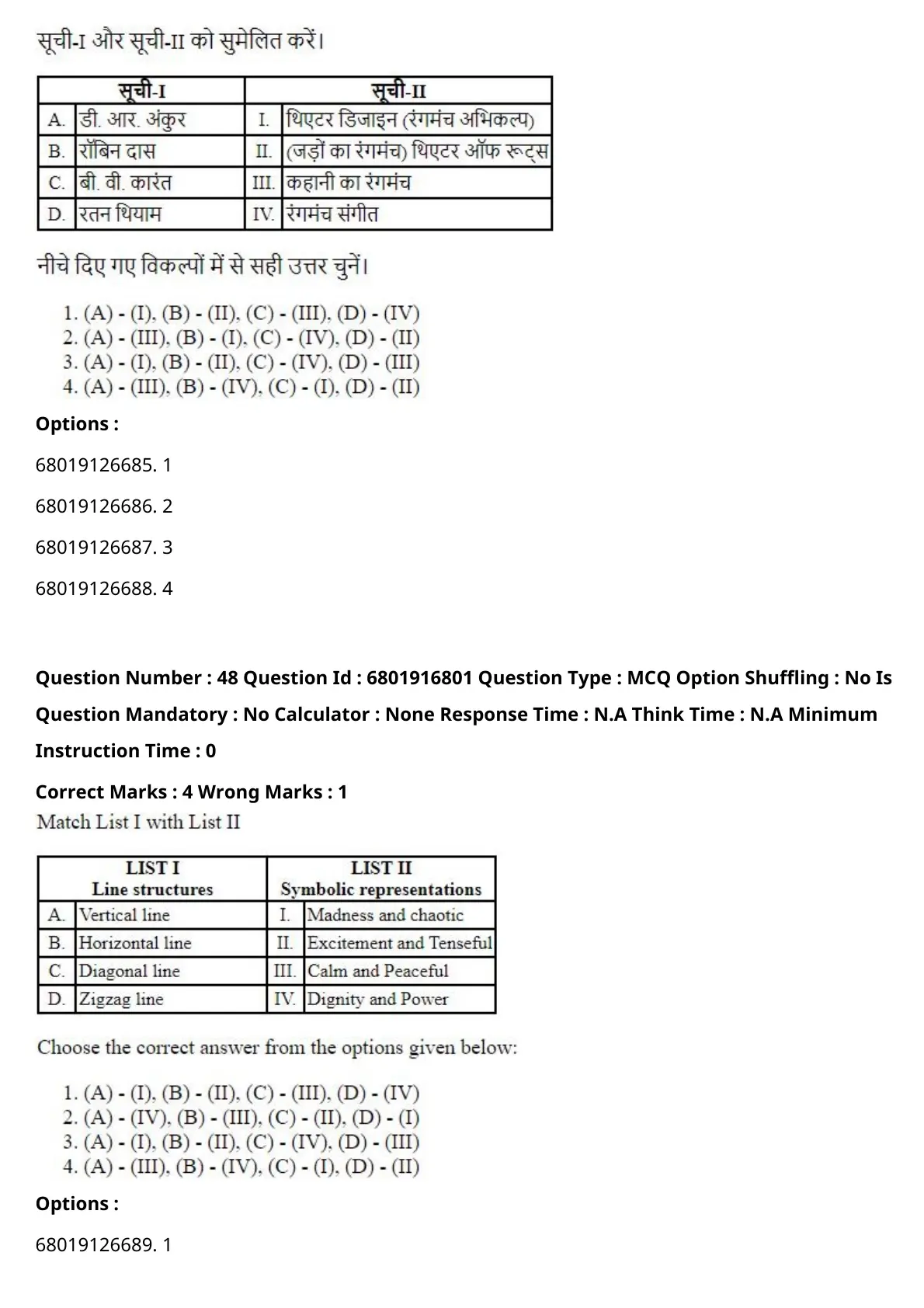
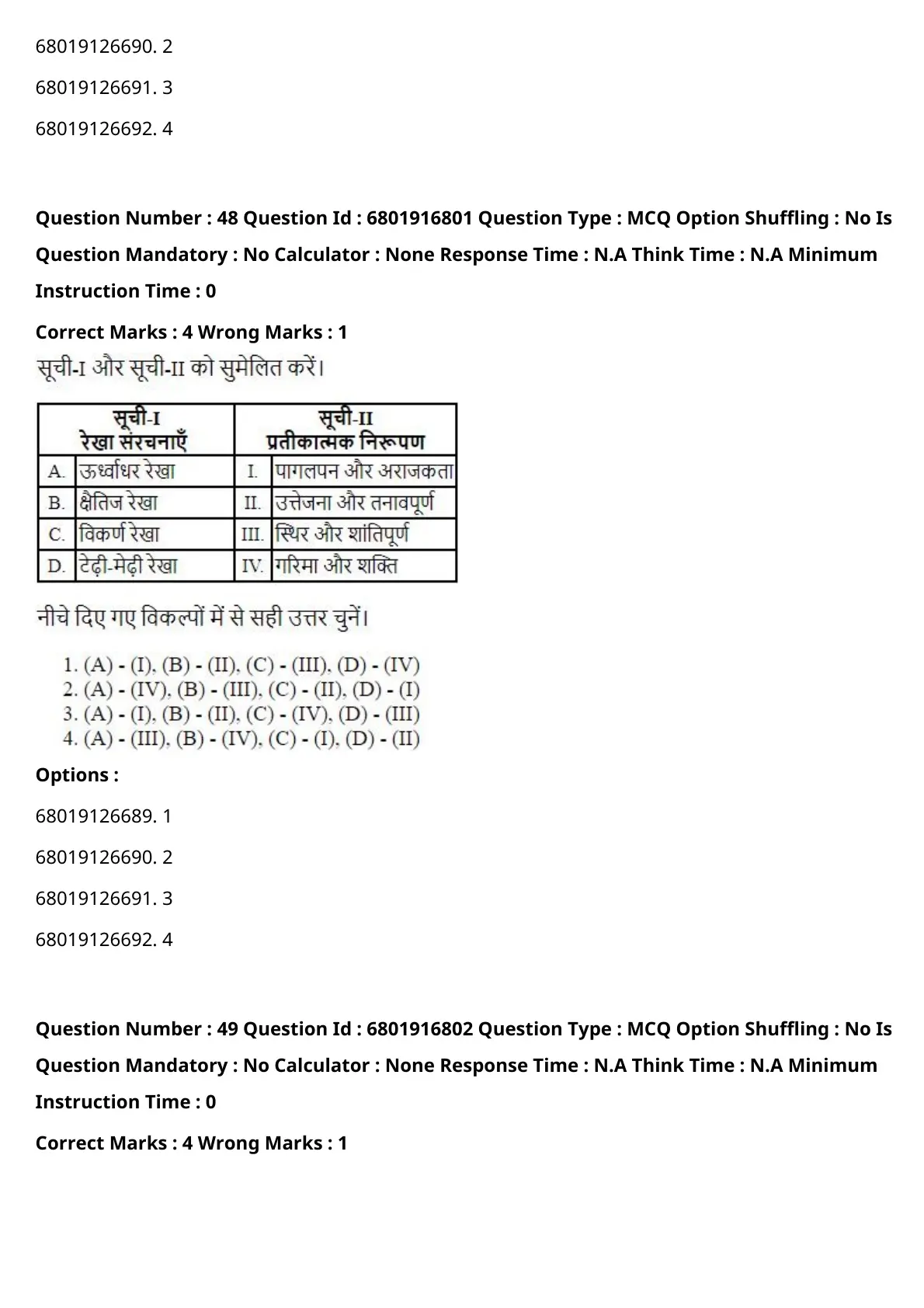
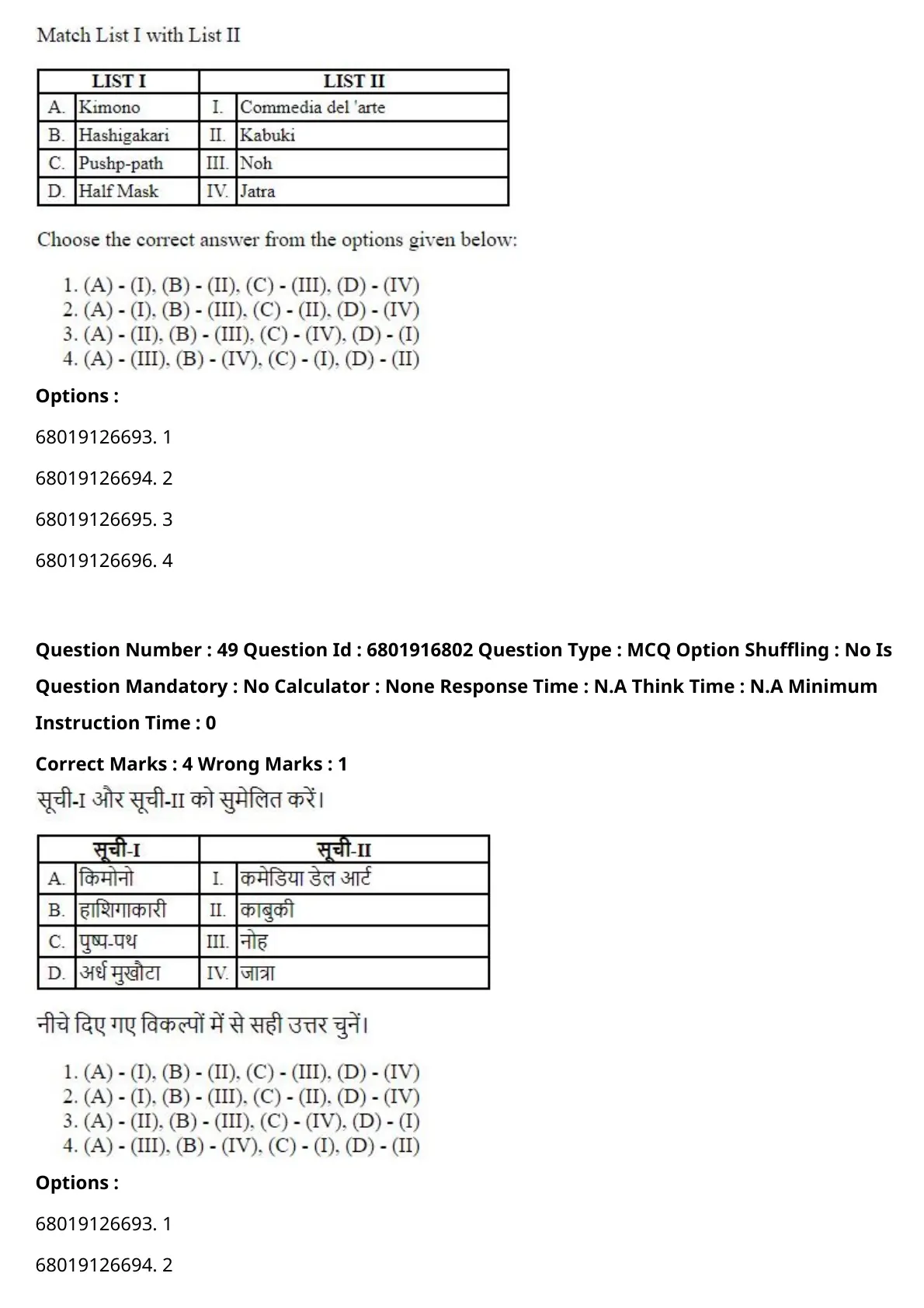

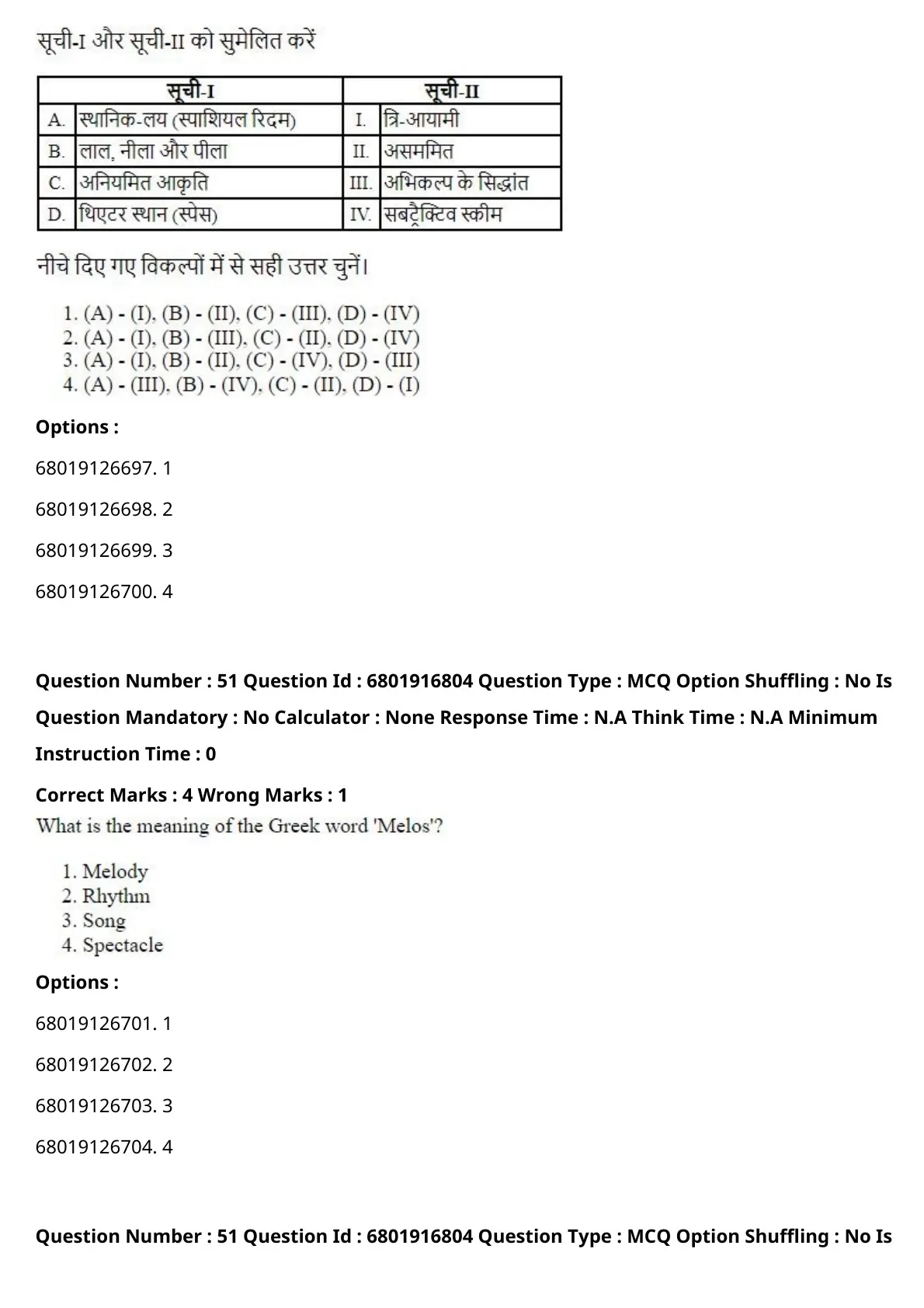
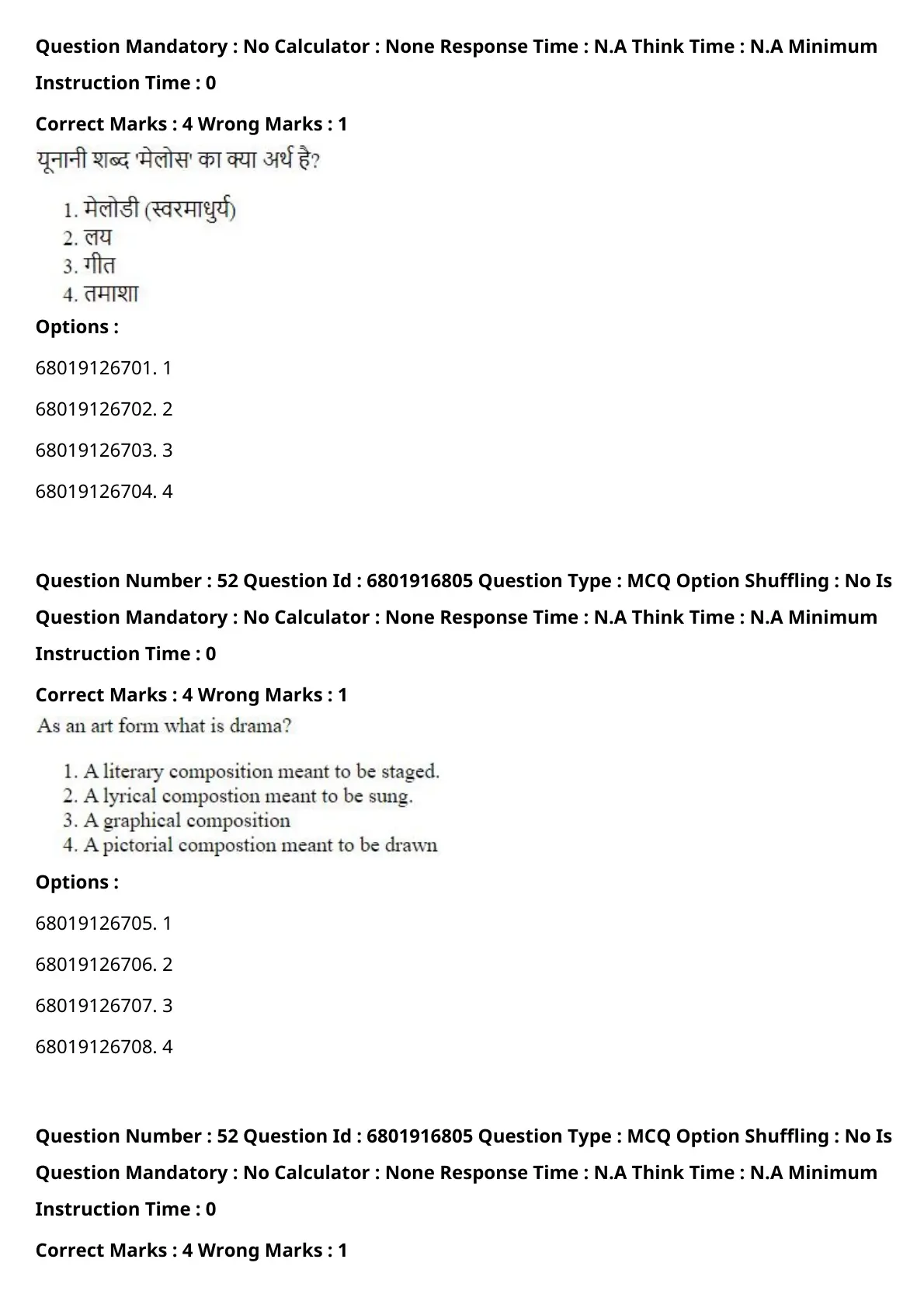
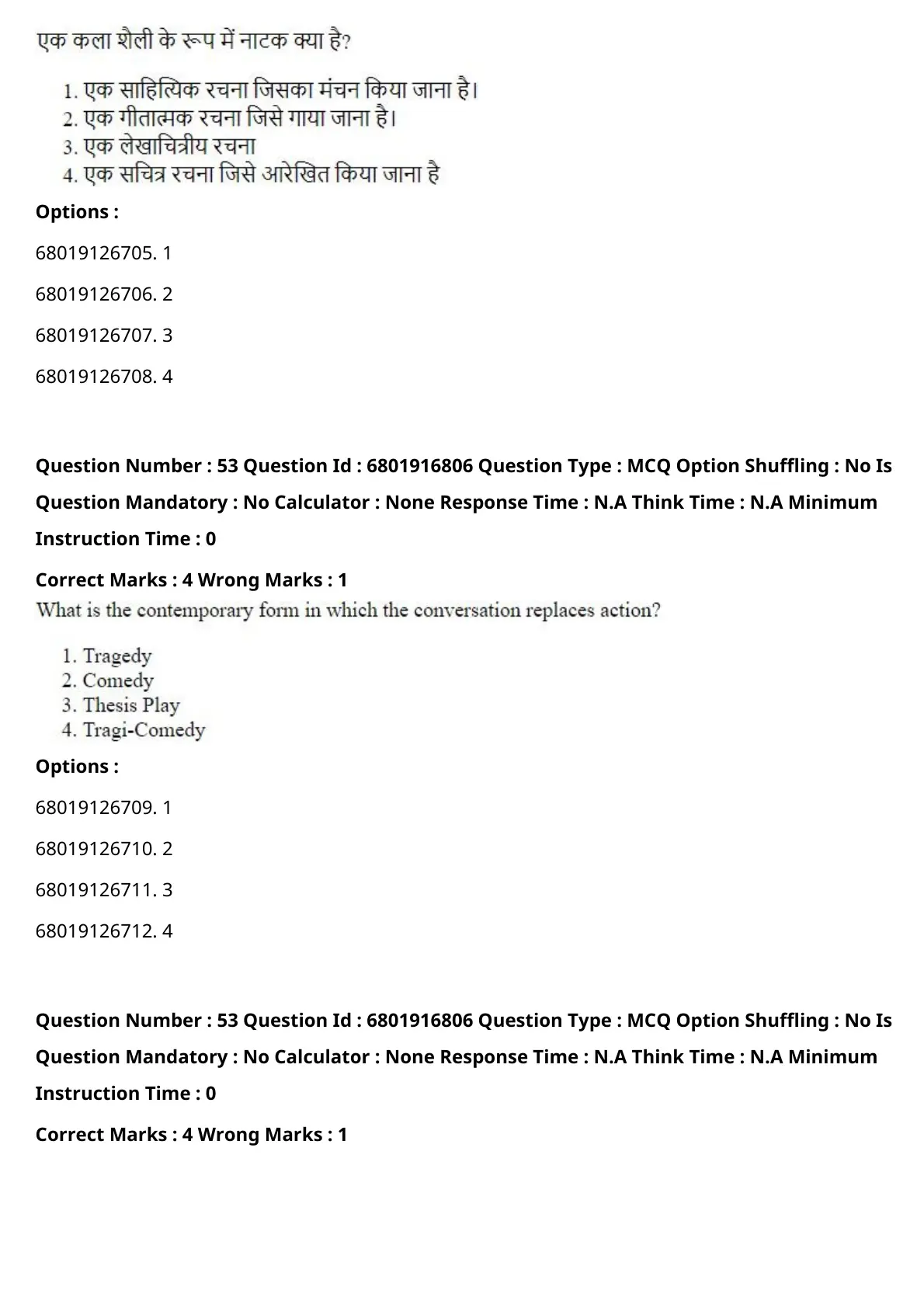
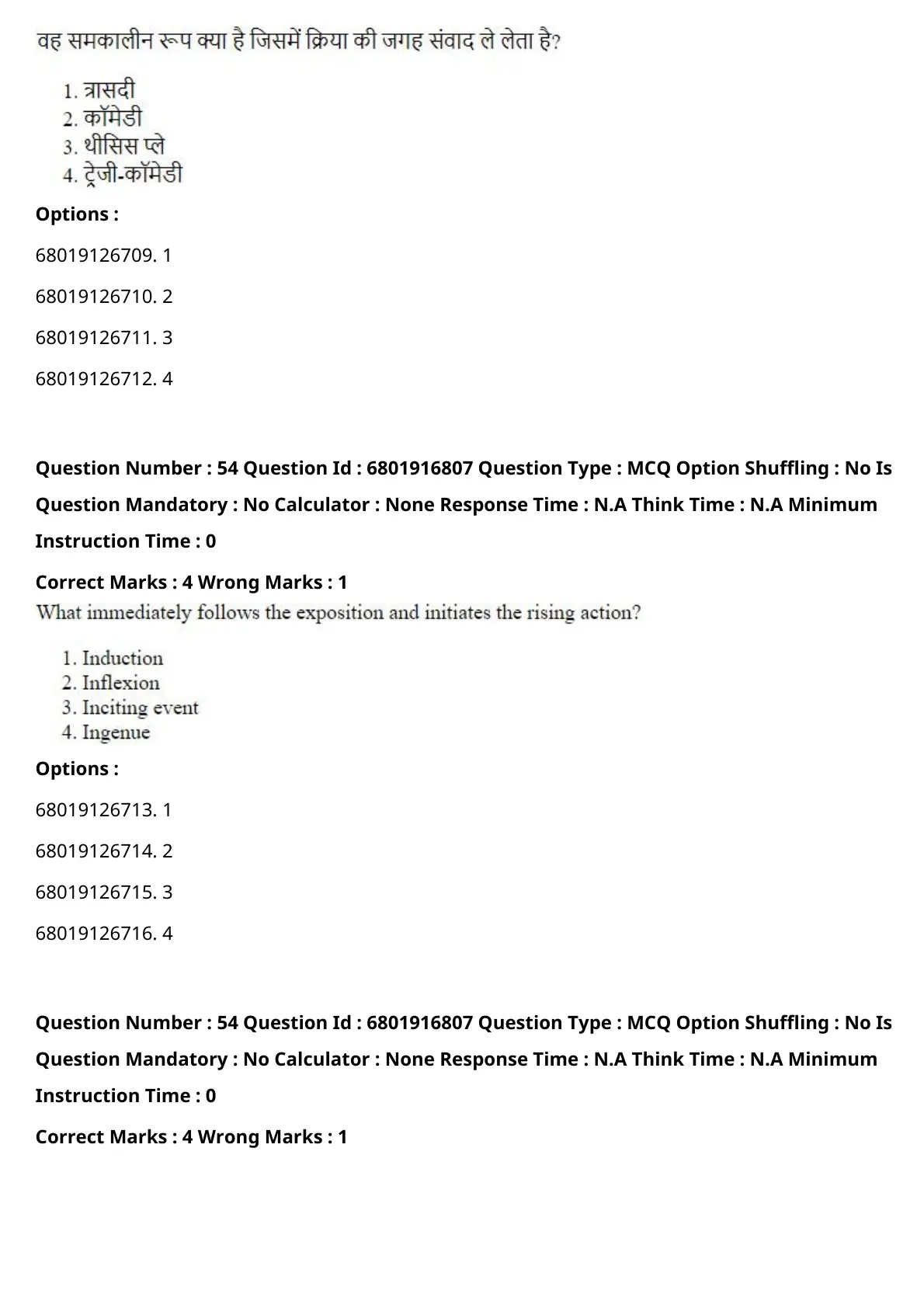
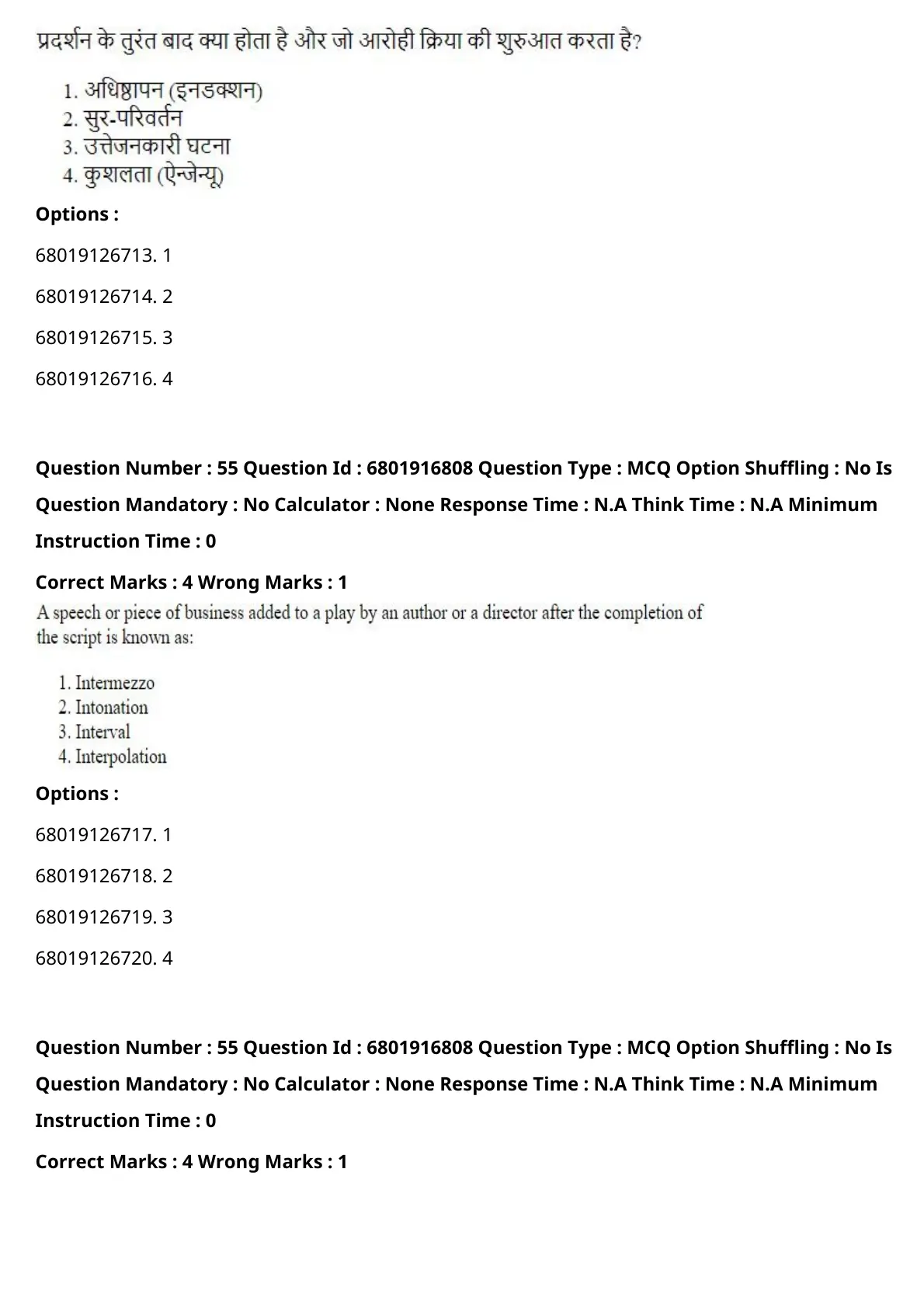
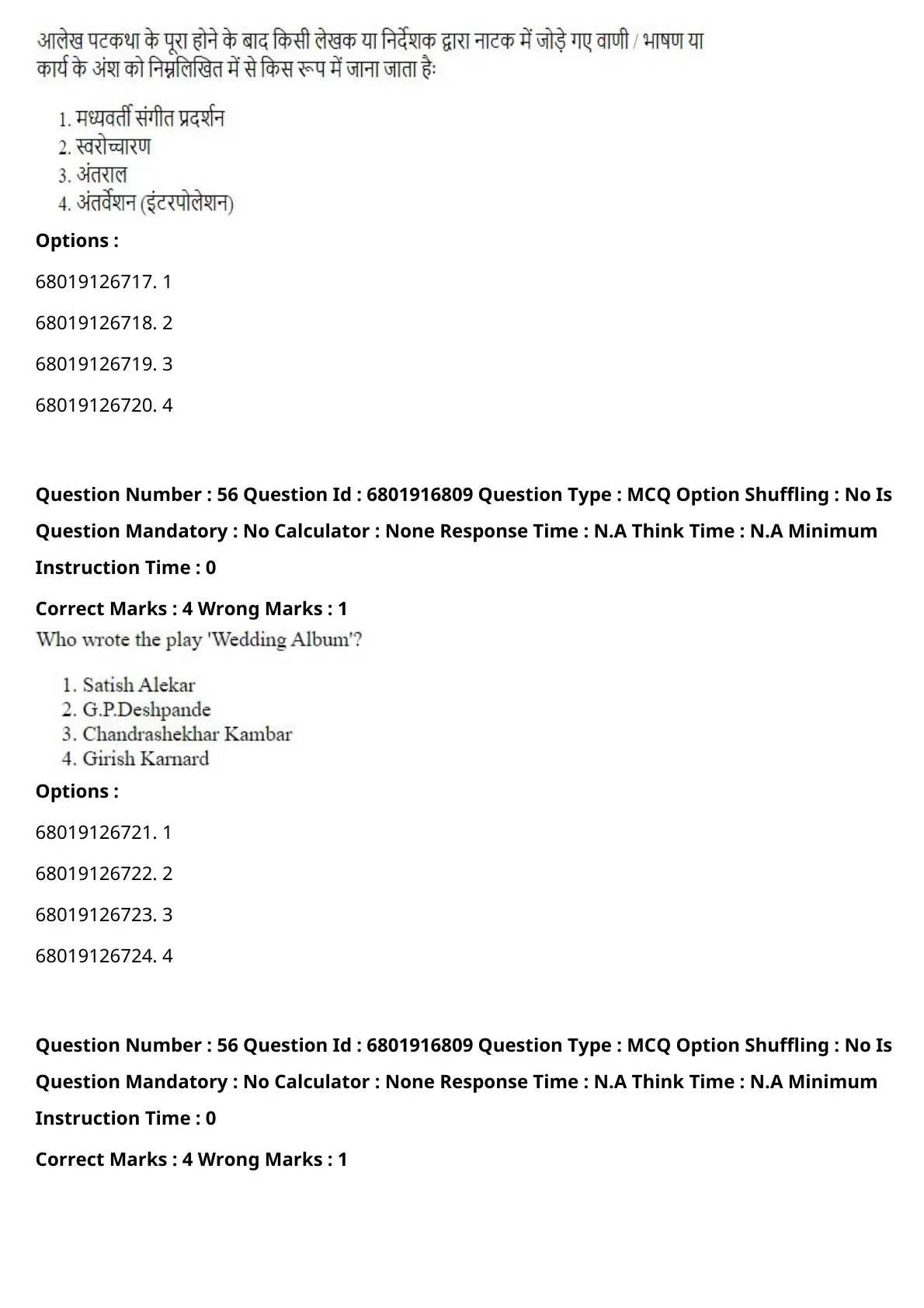
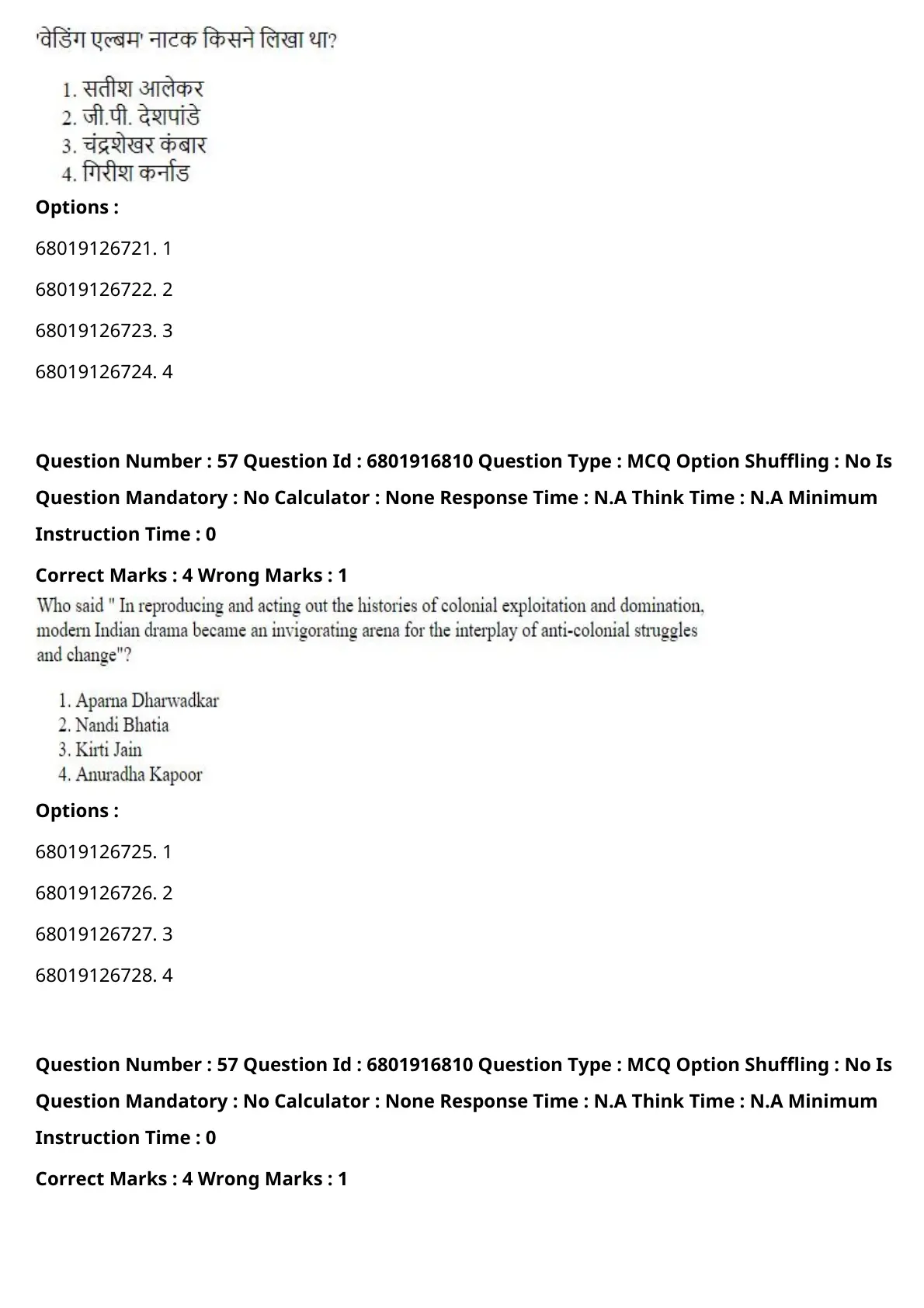
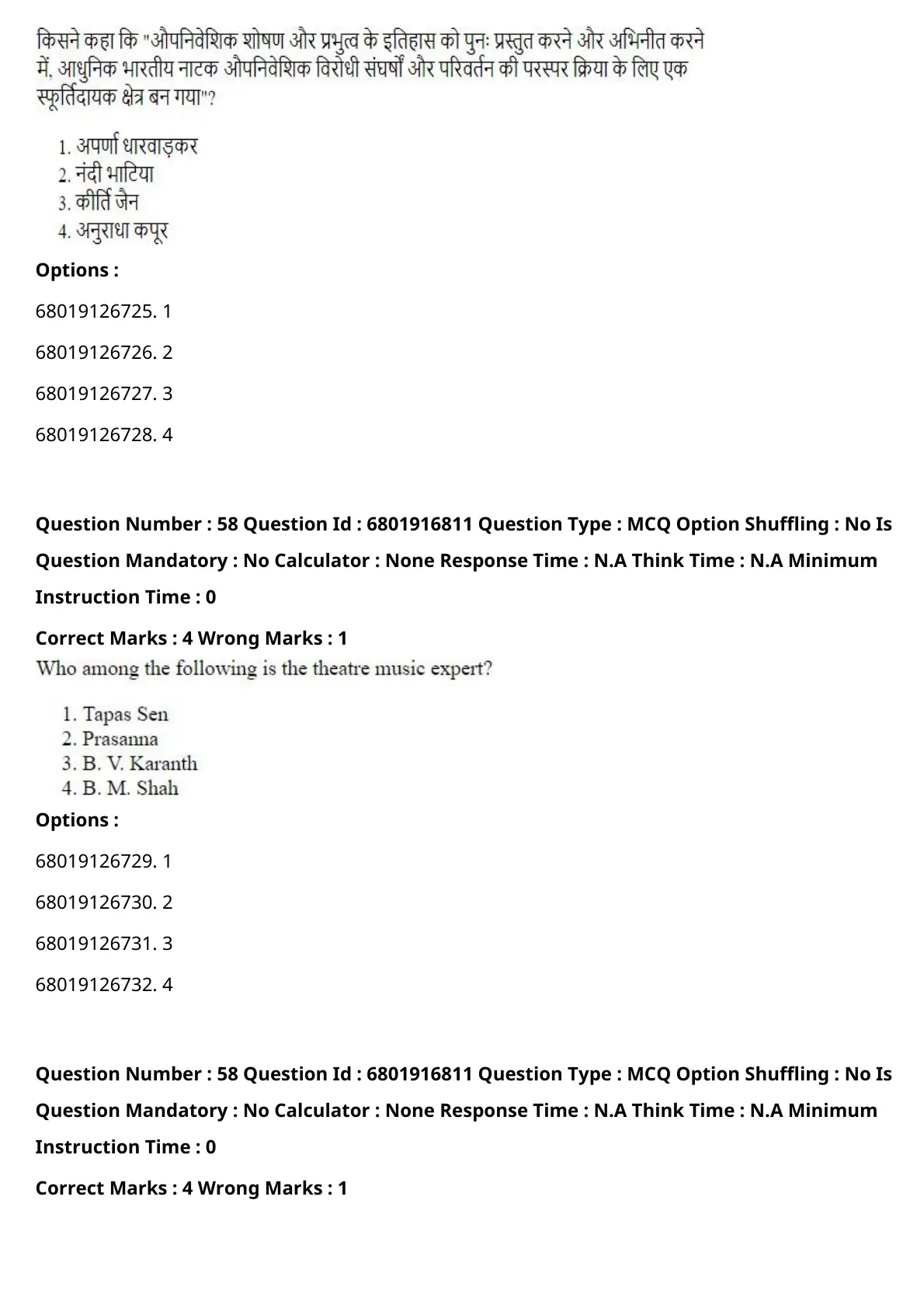
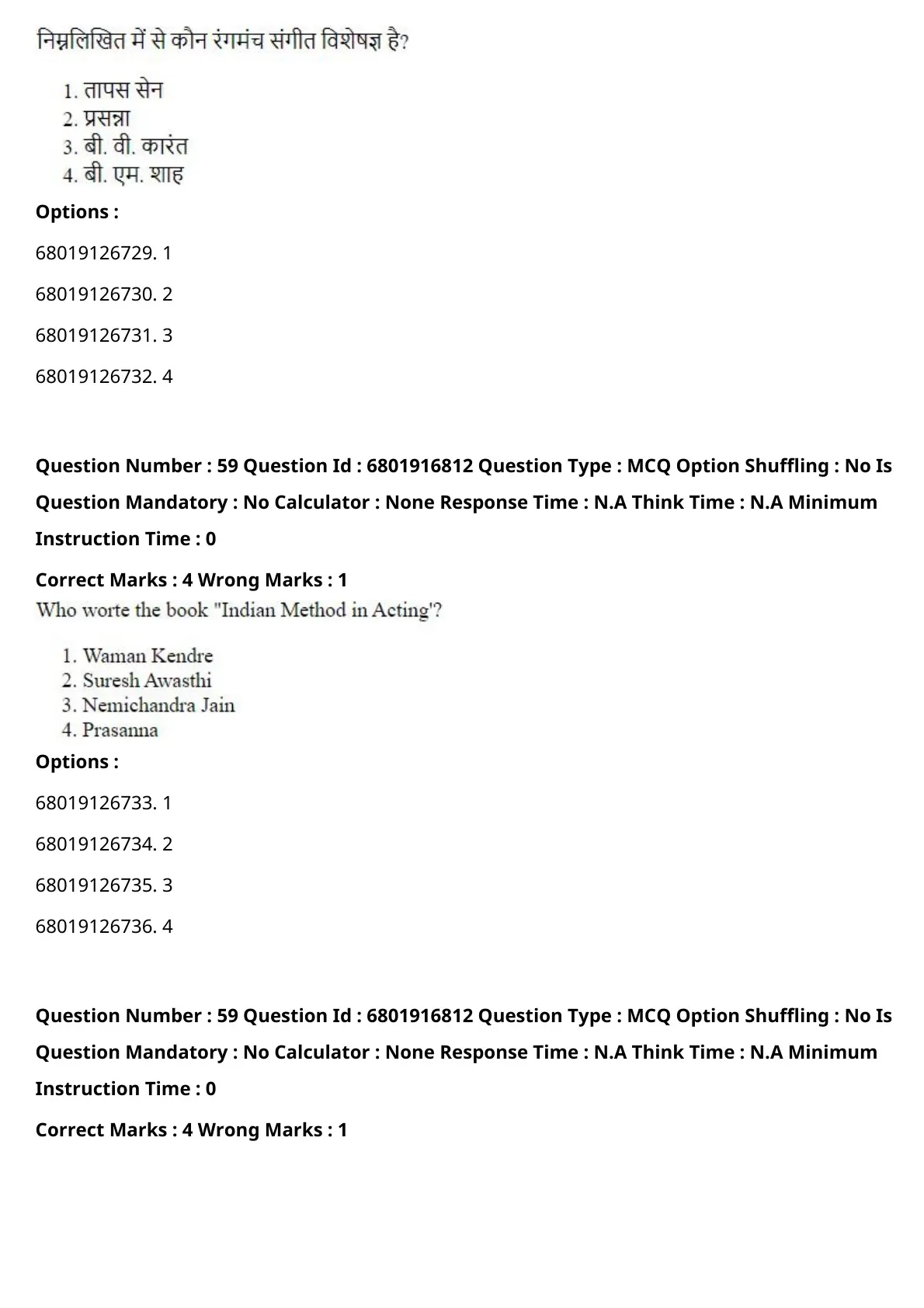

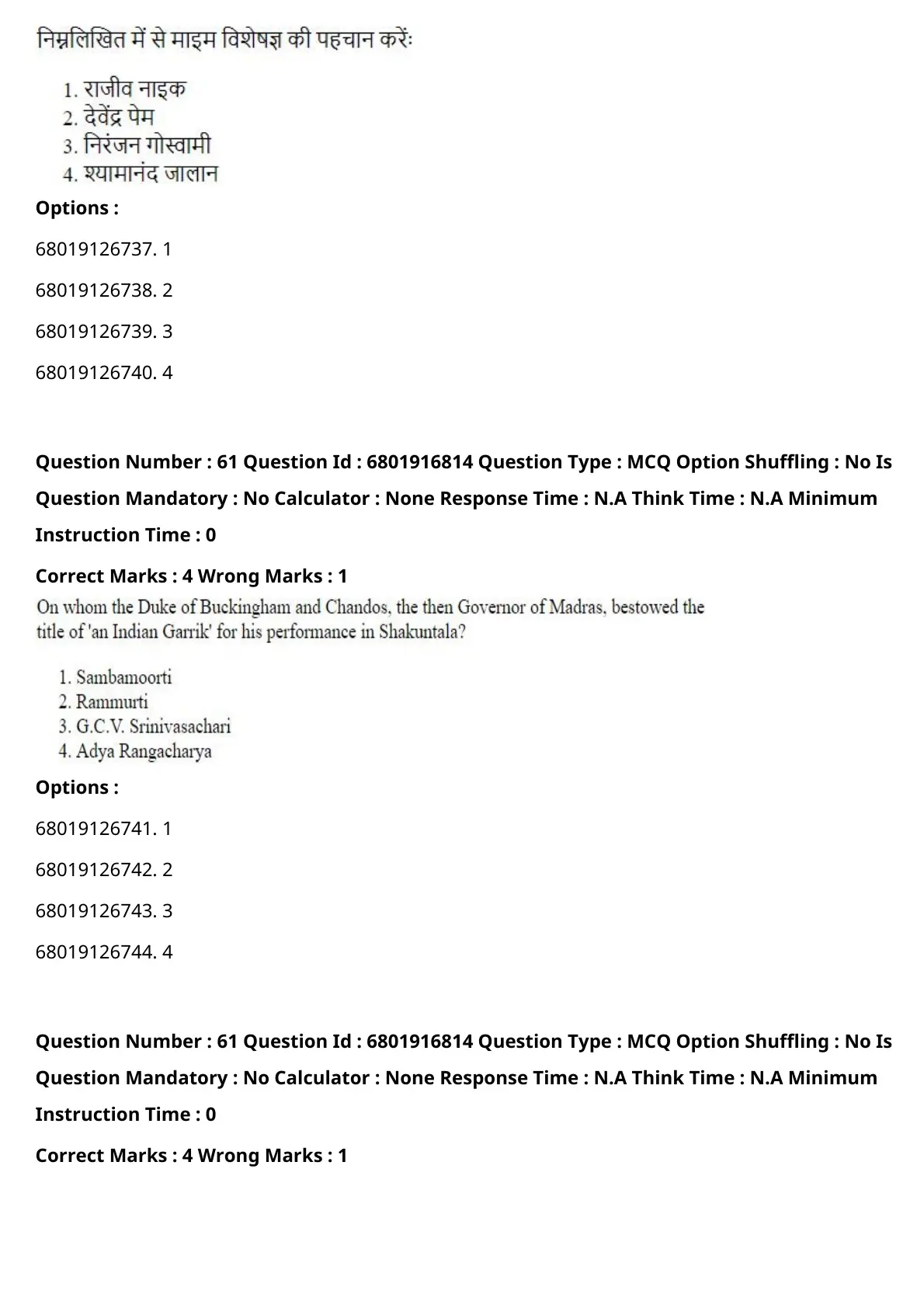
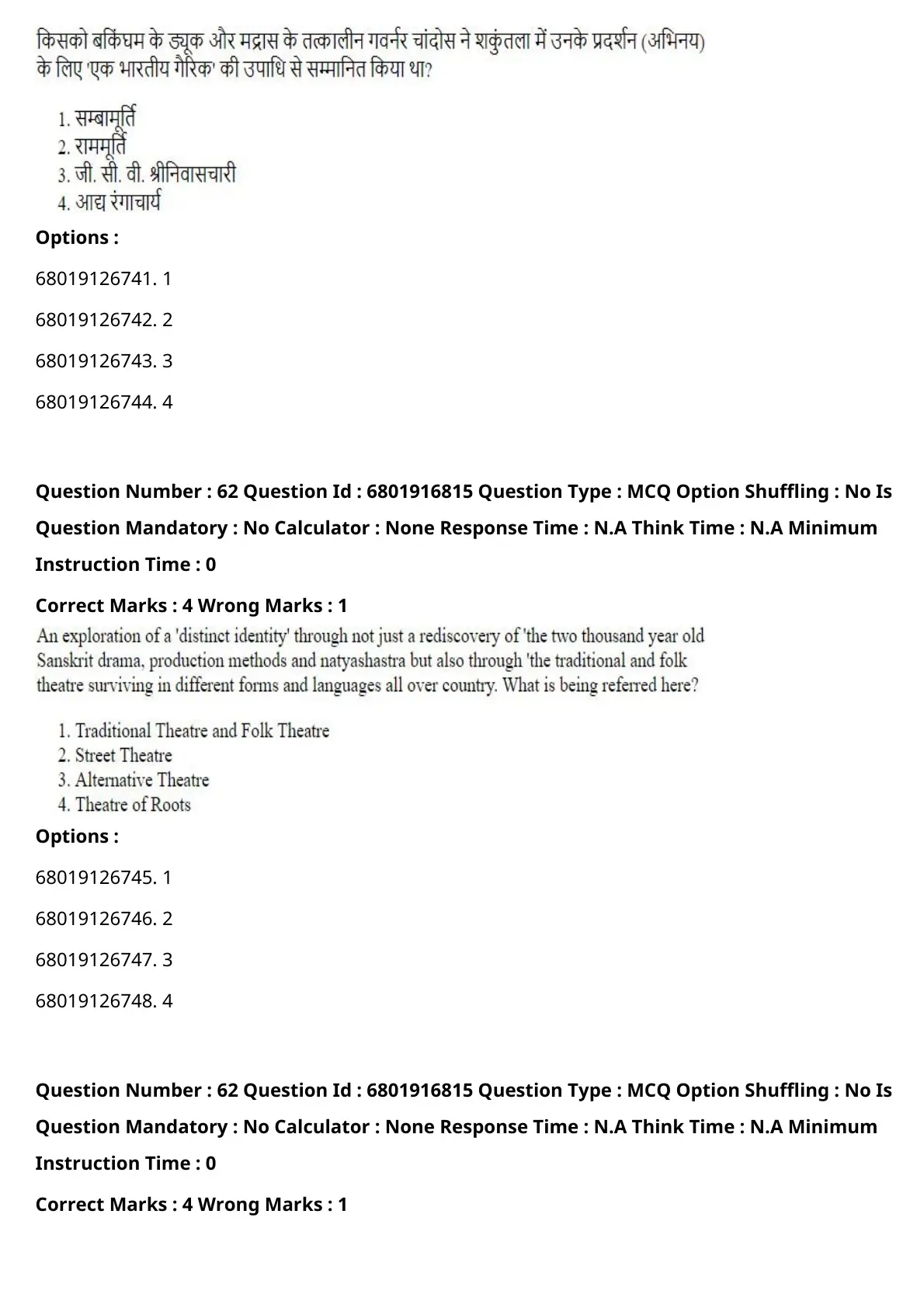
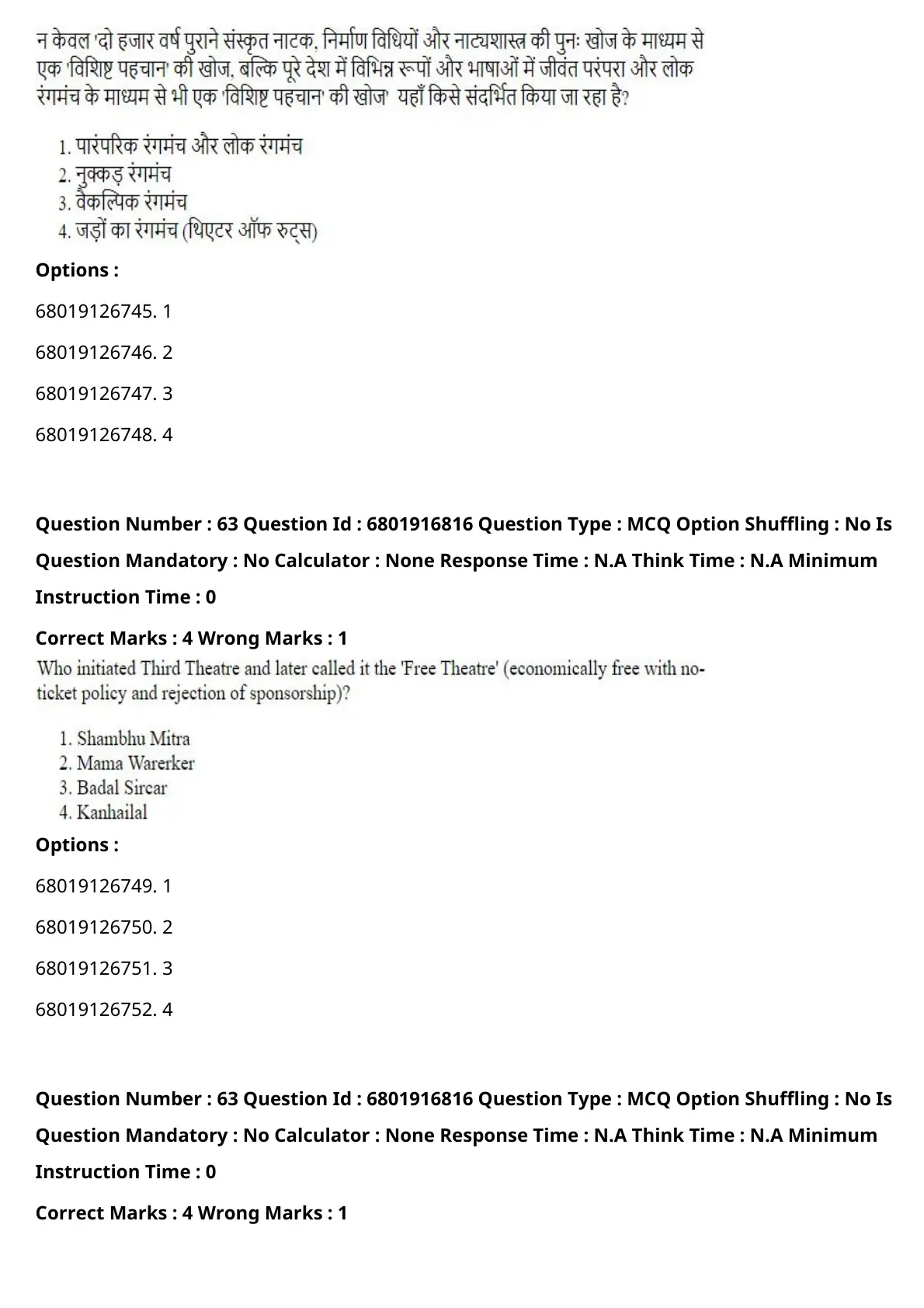
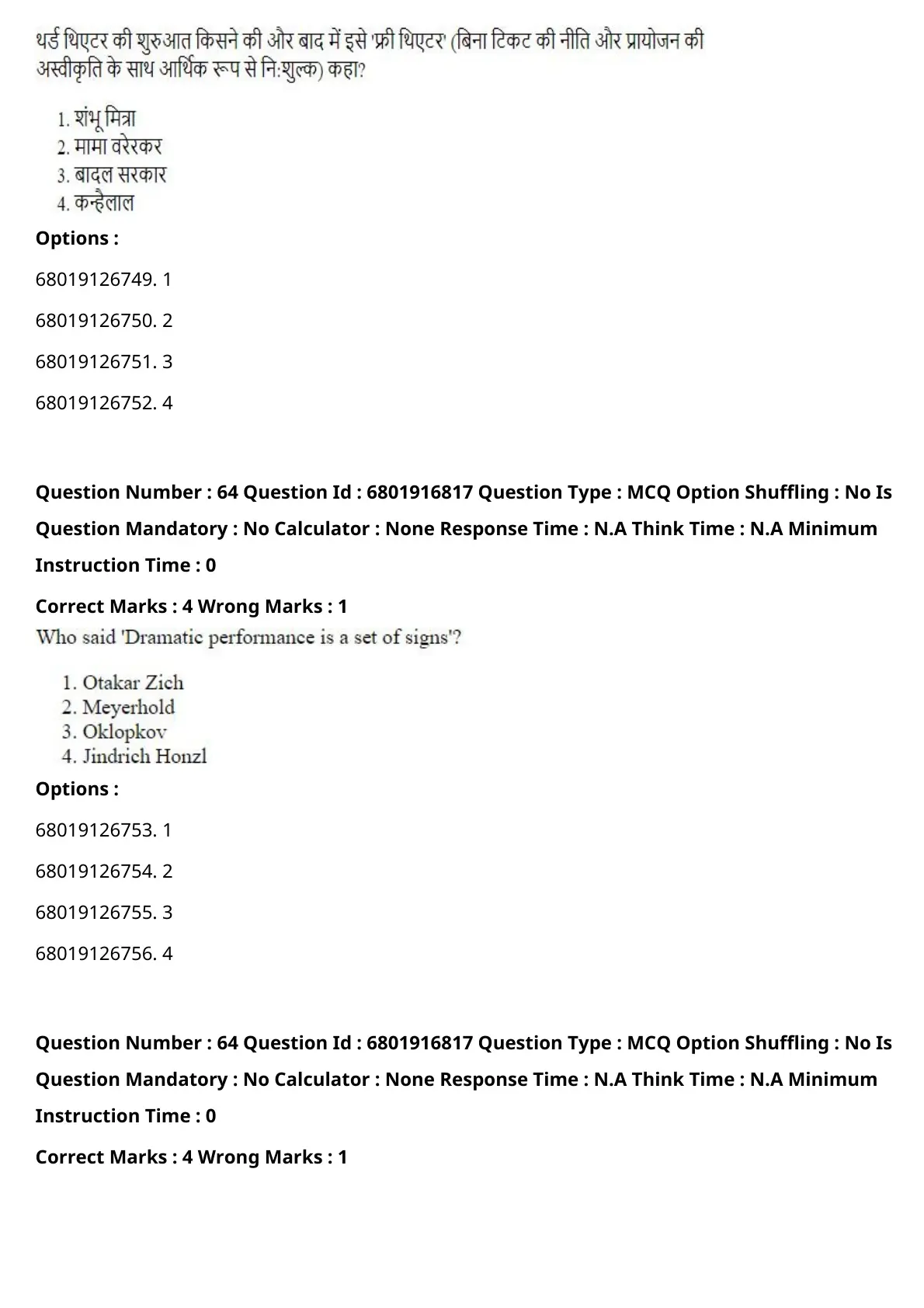


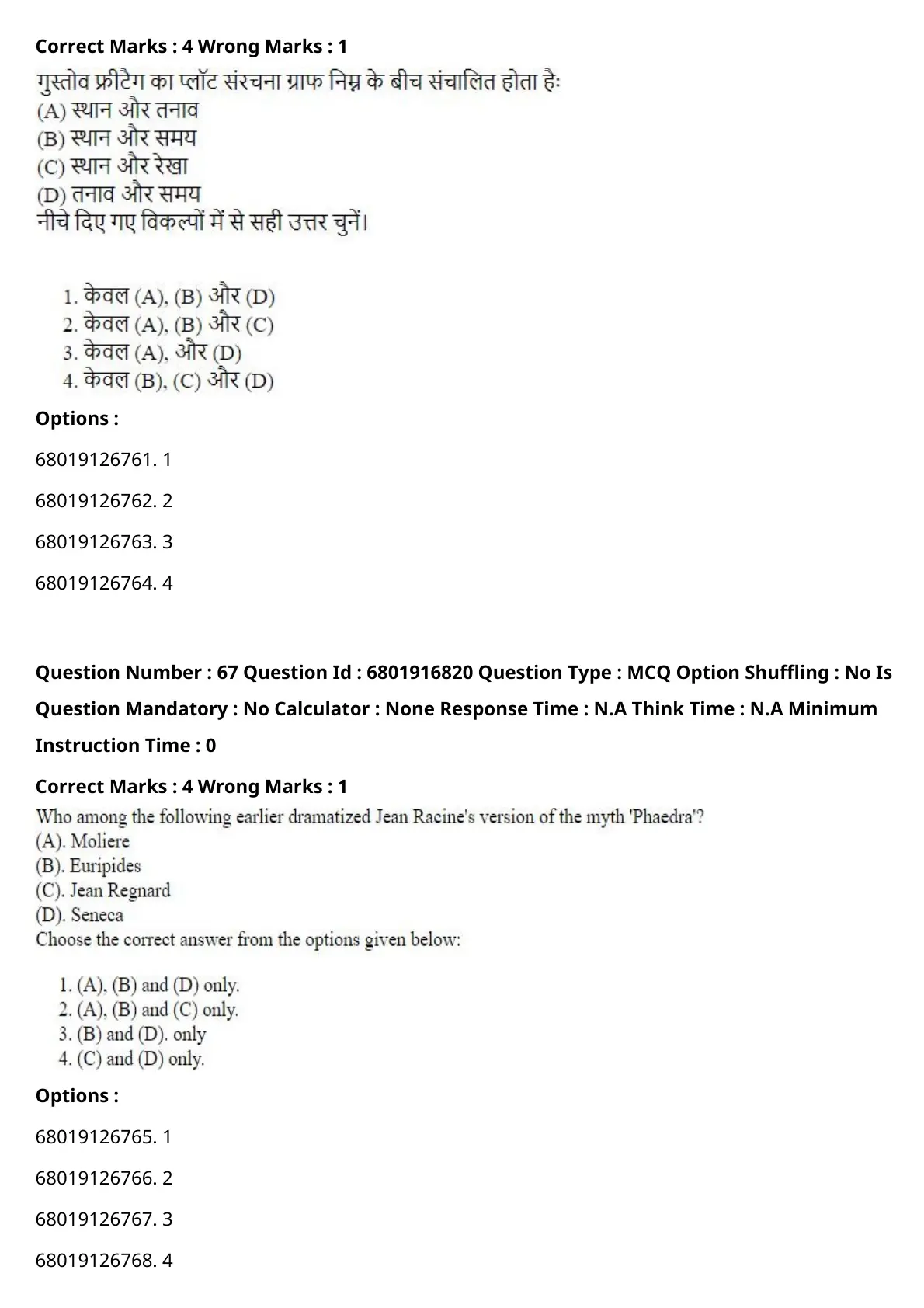
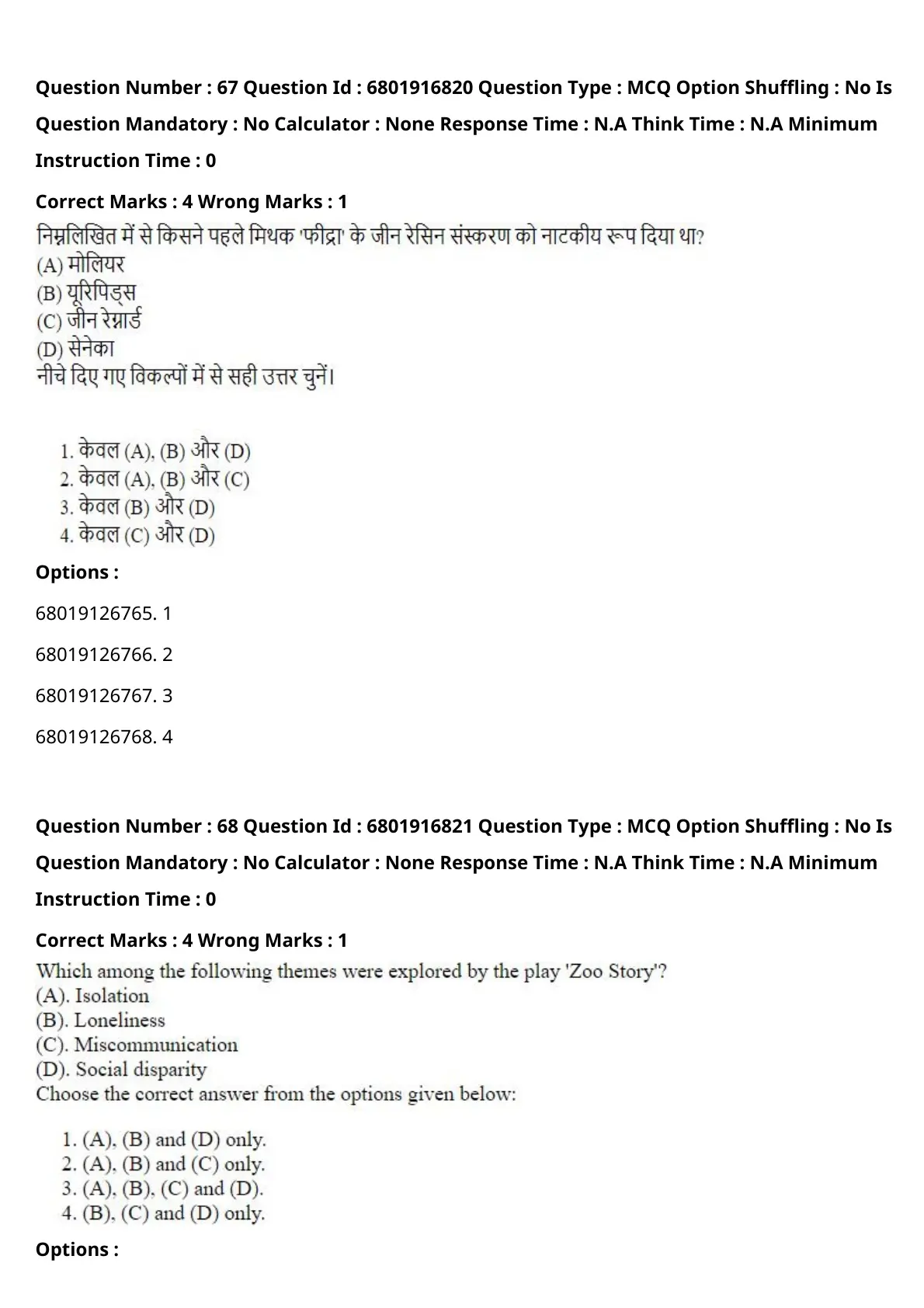
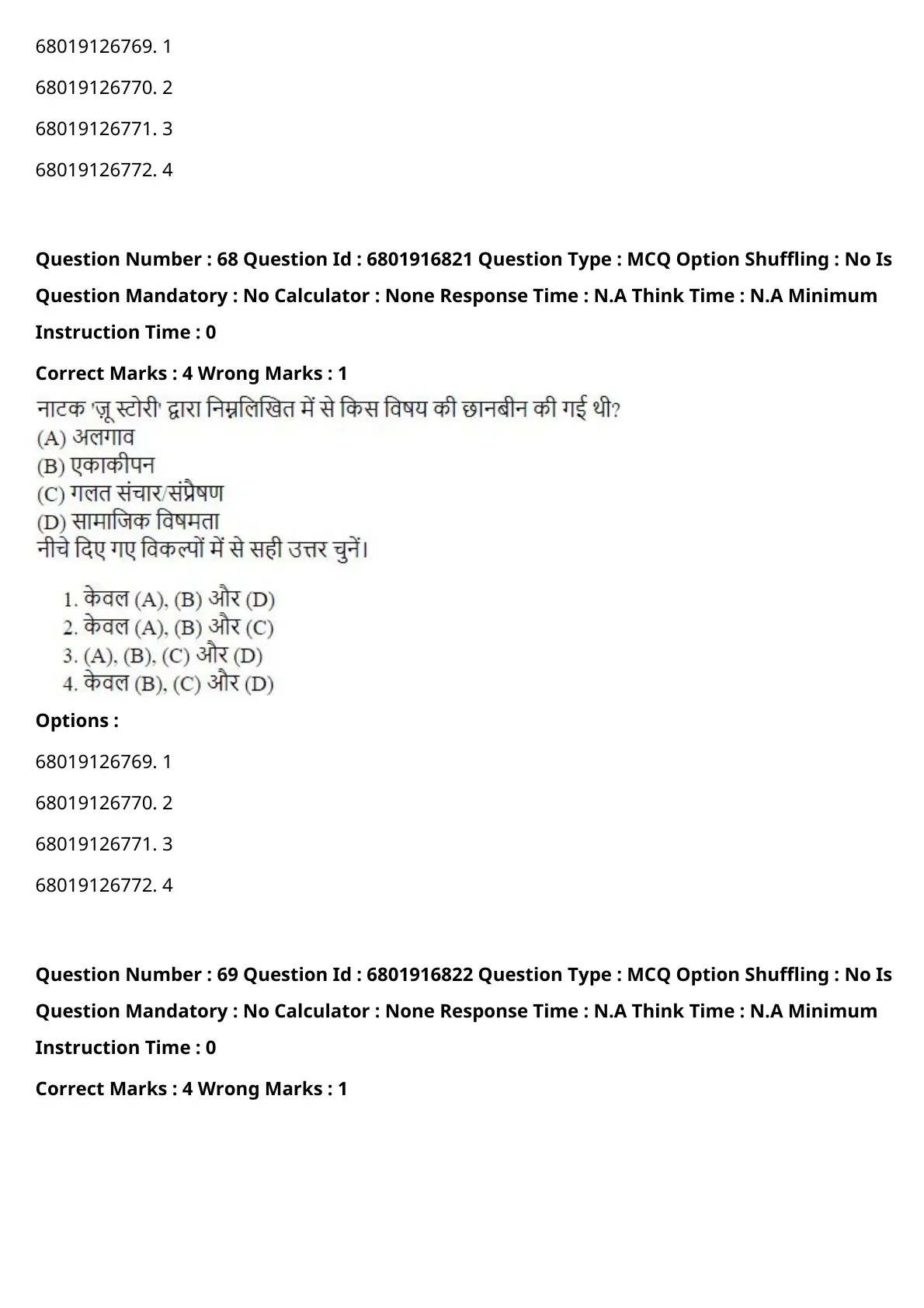
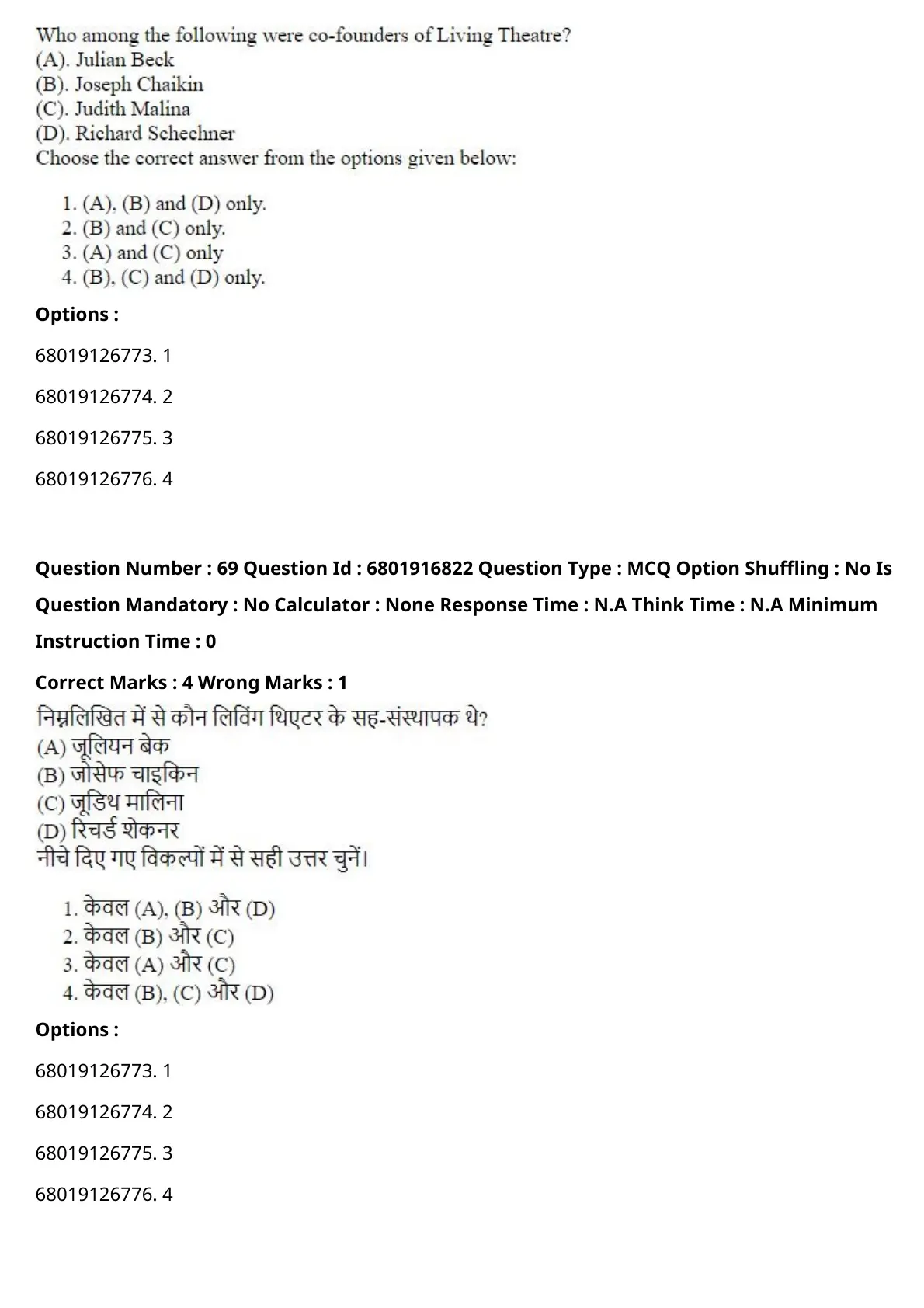

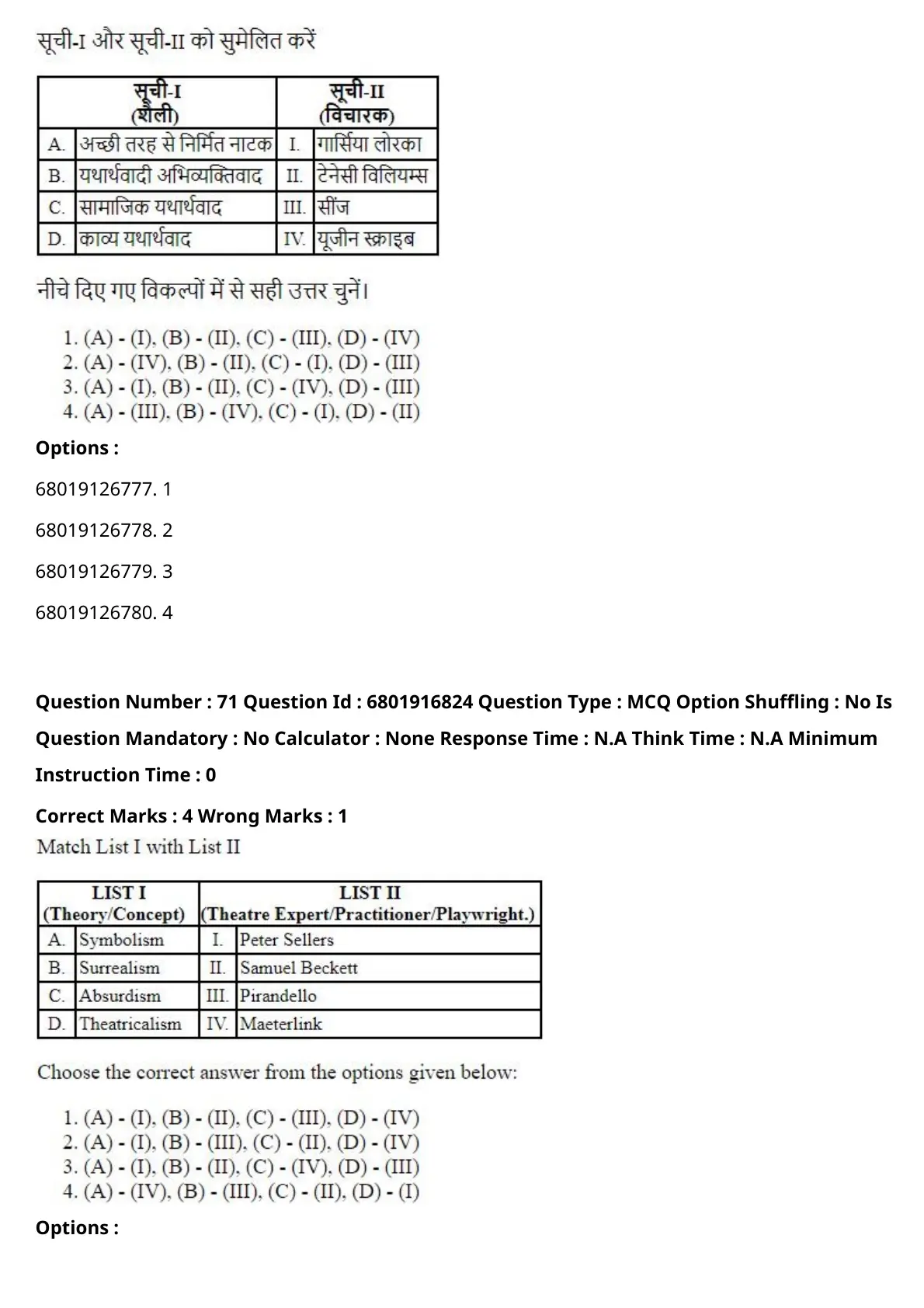
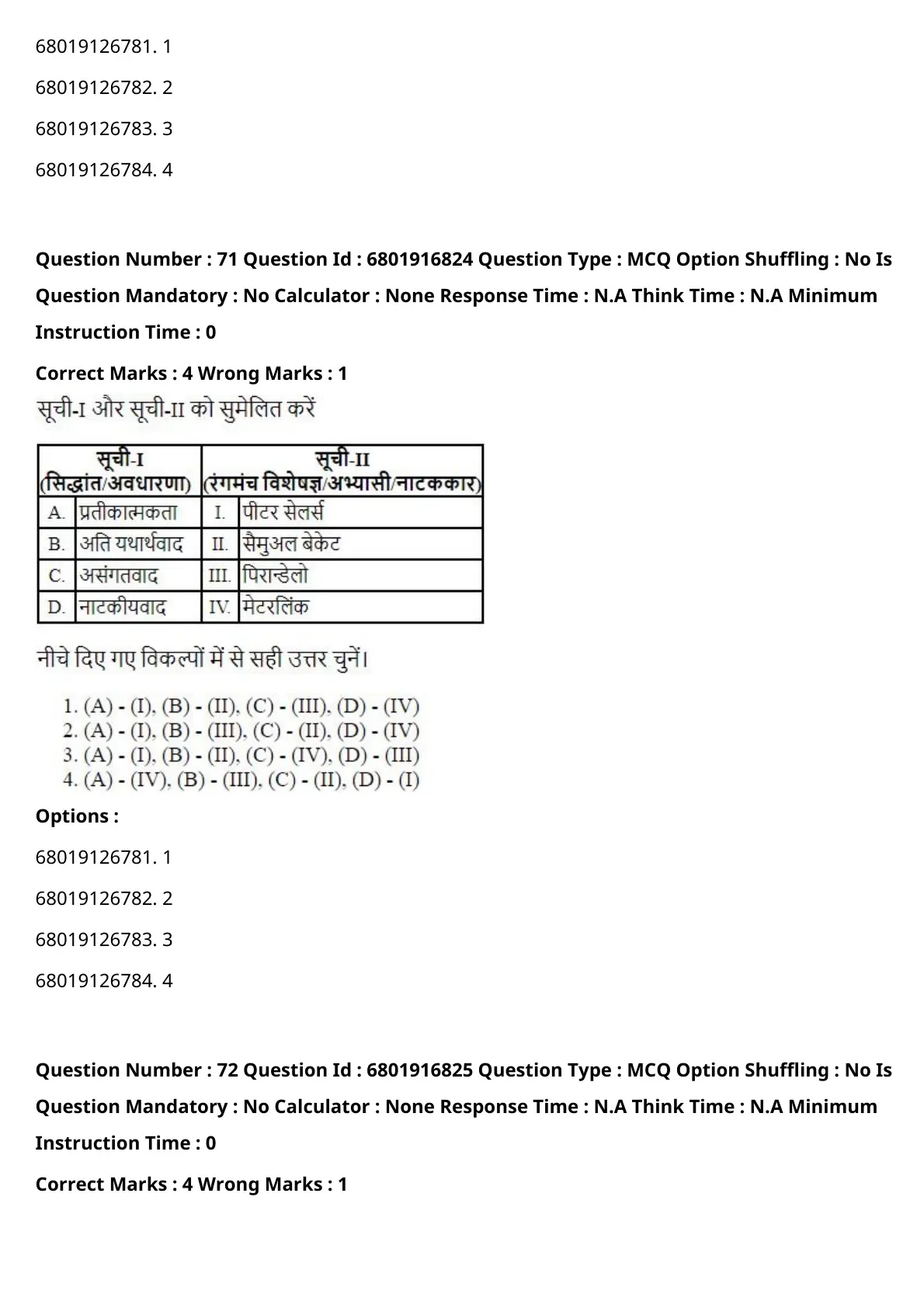
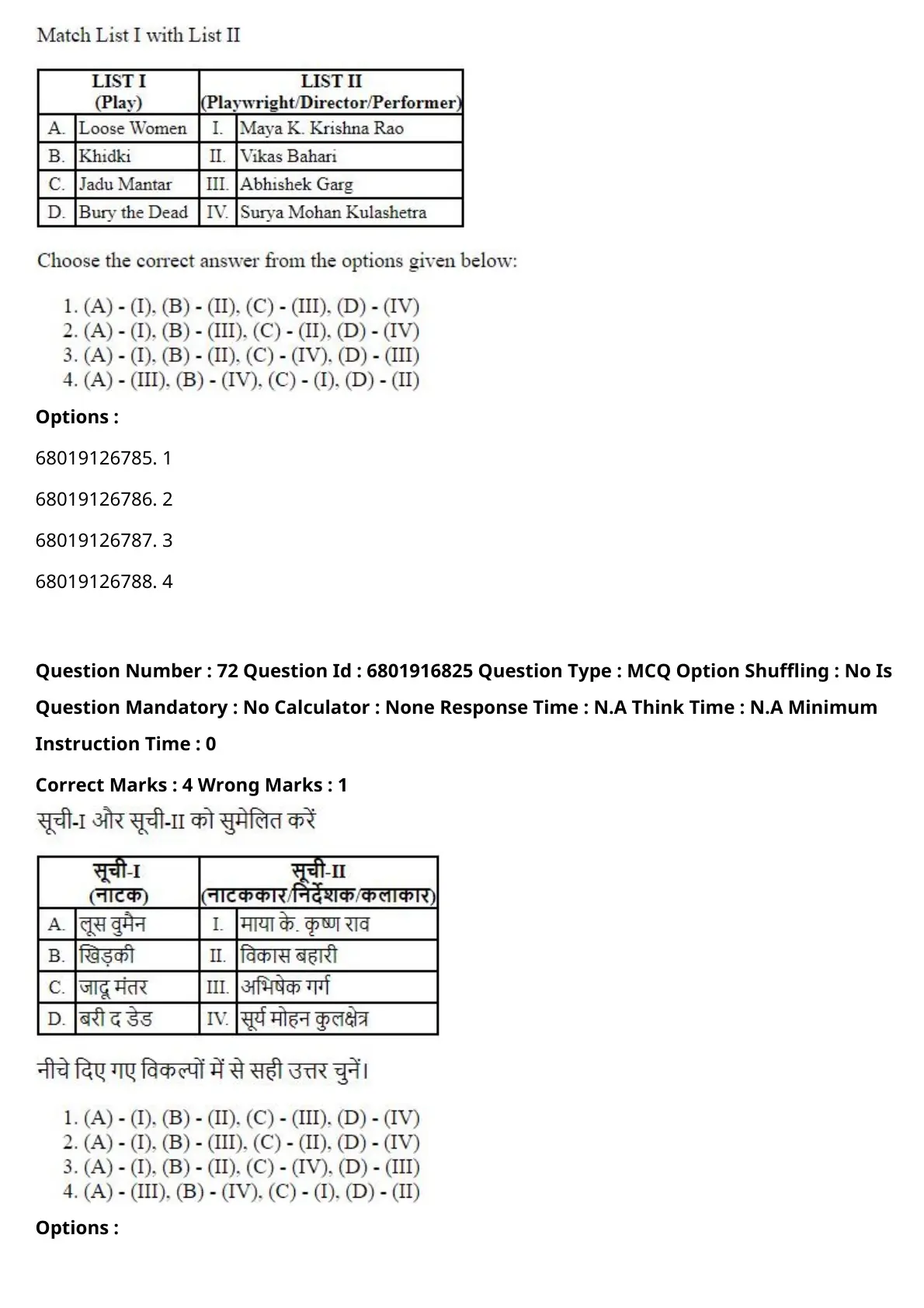
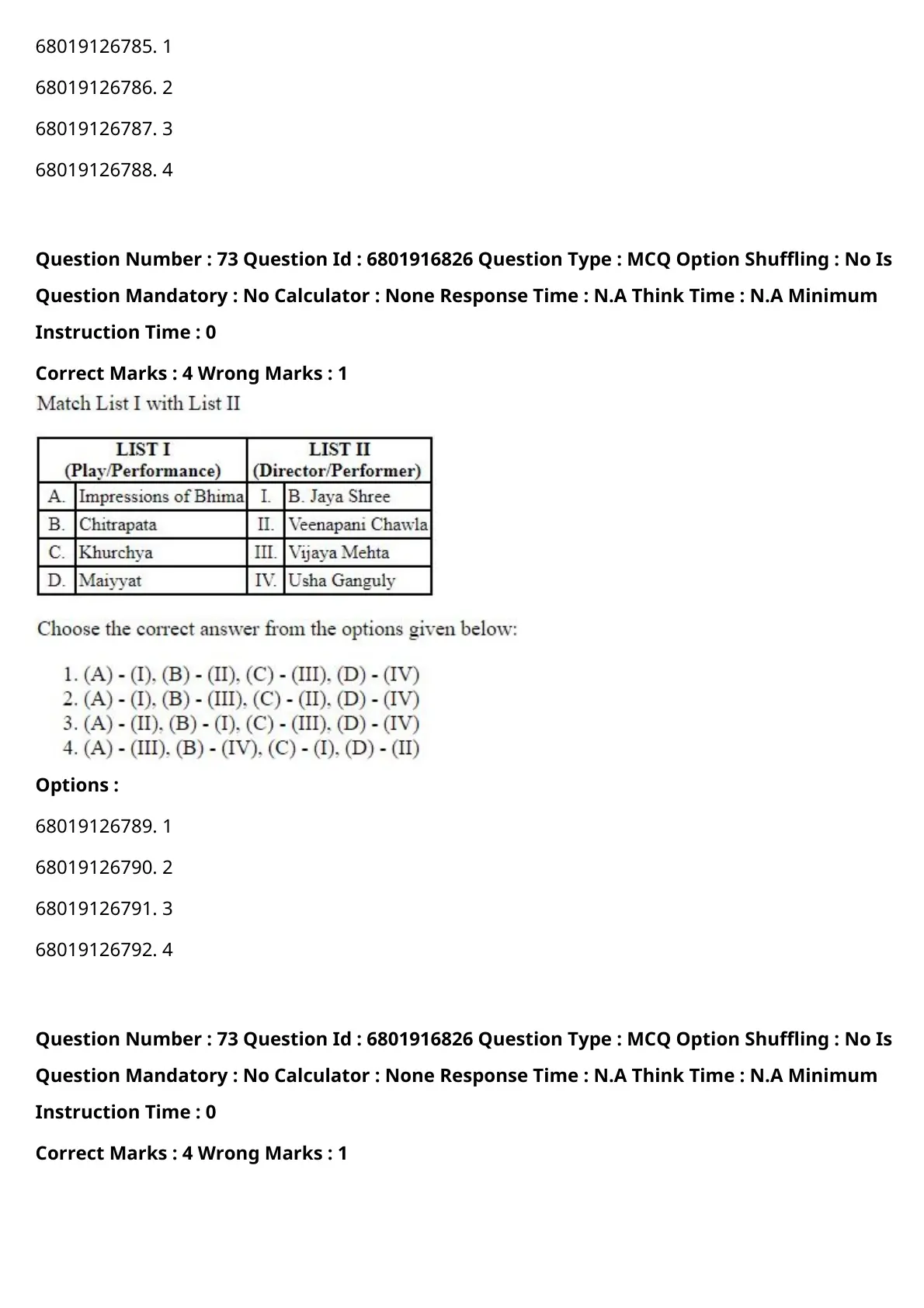
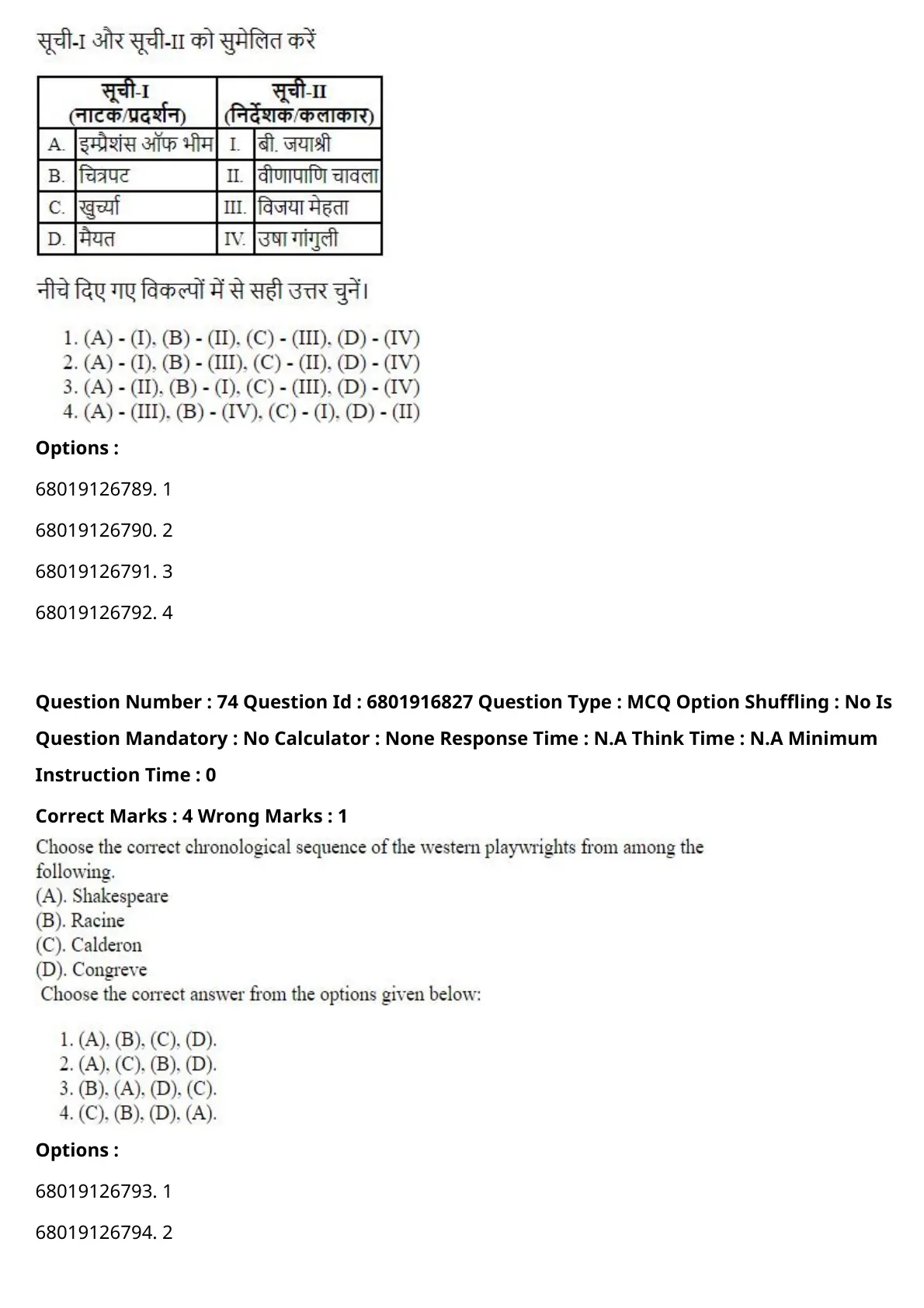
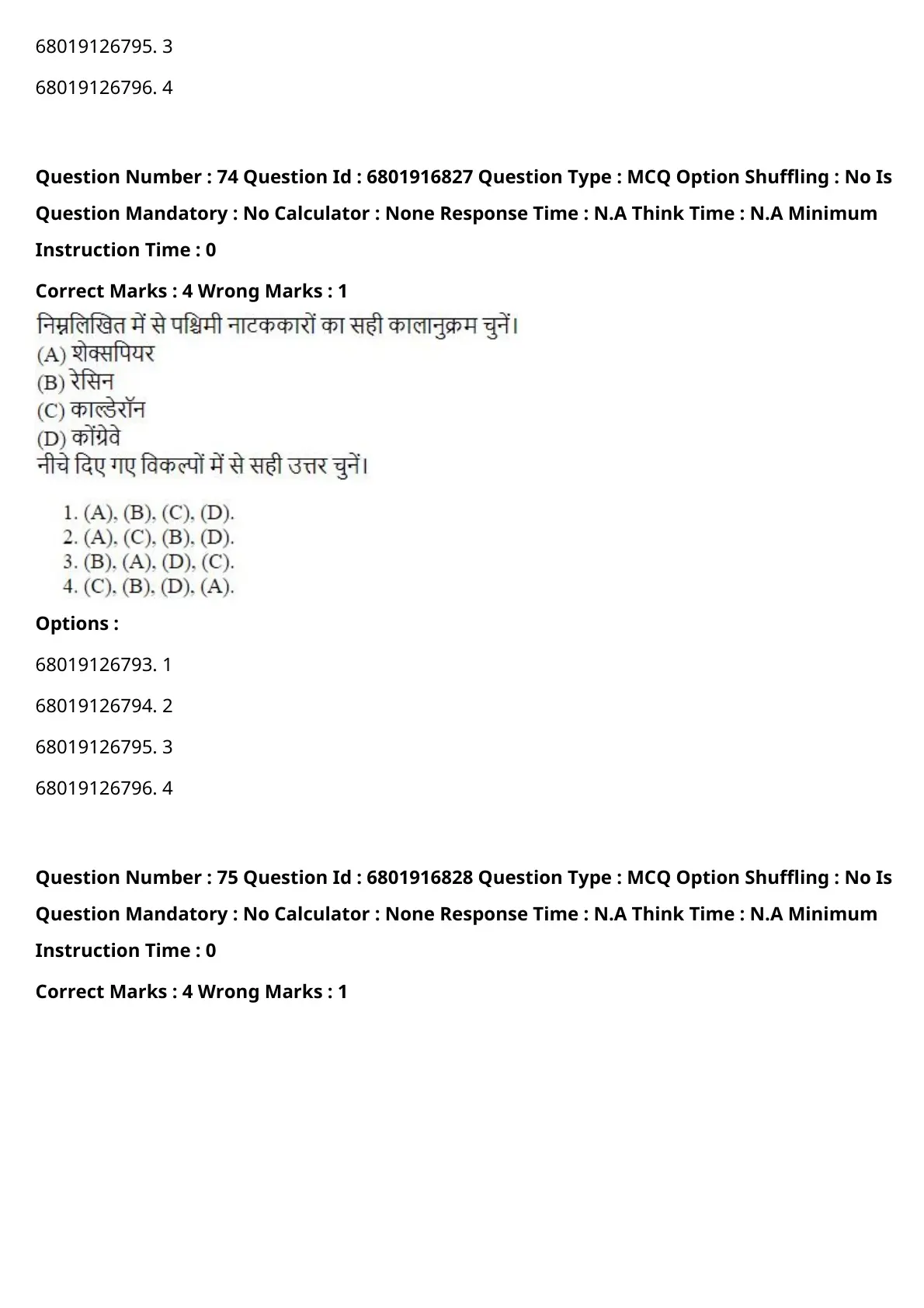
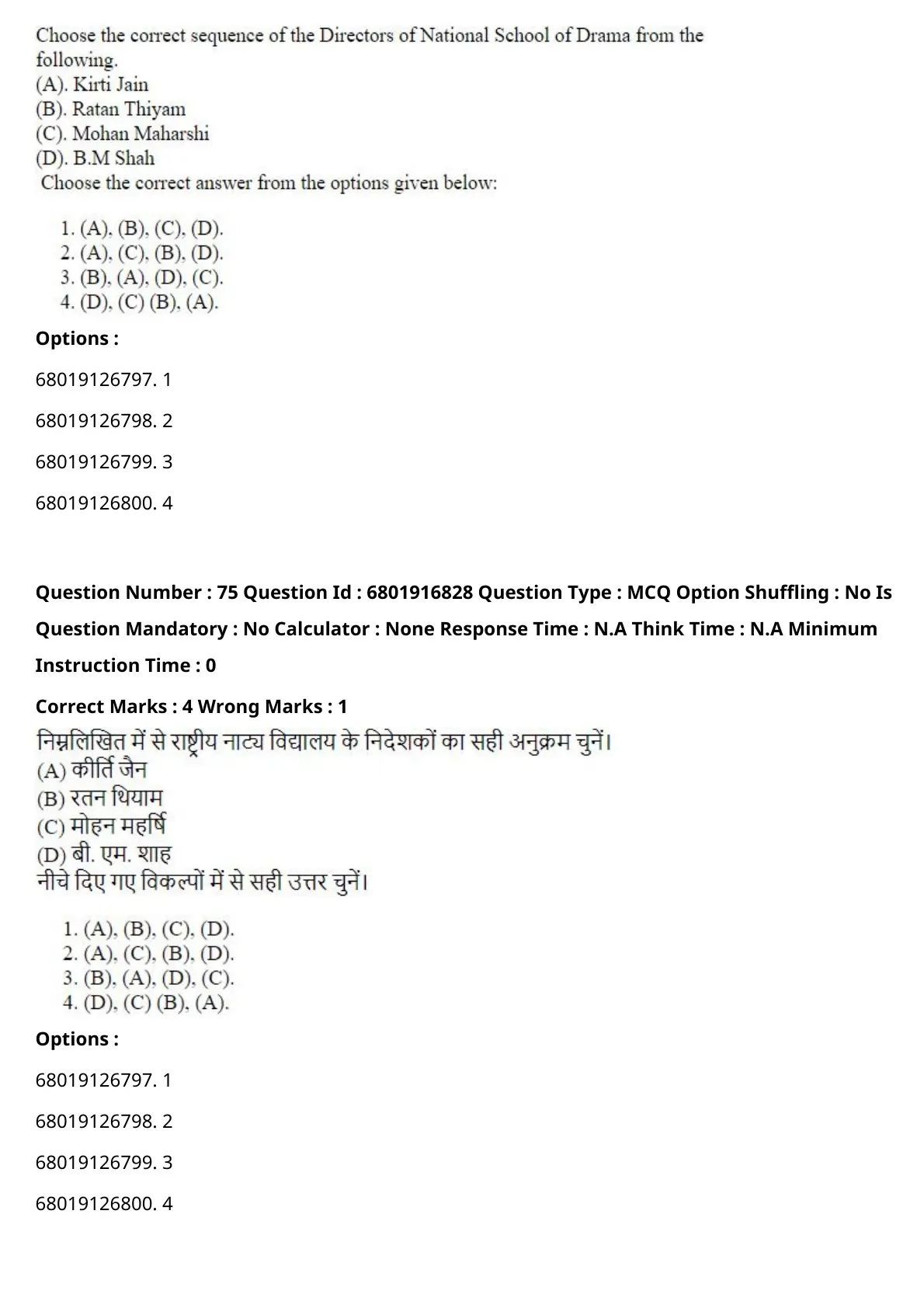



Comments