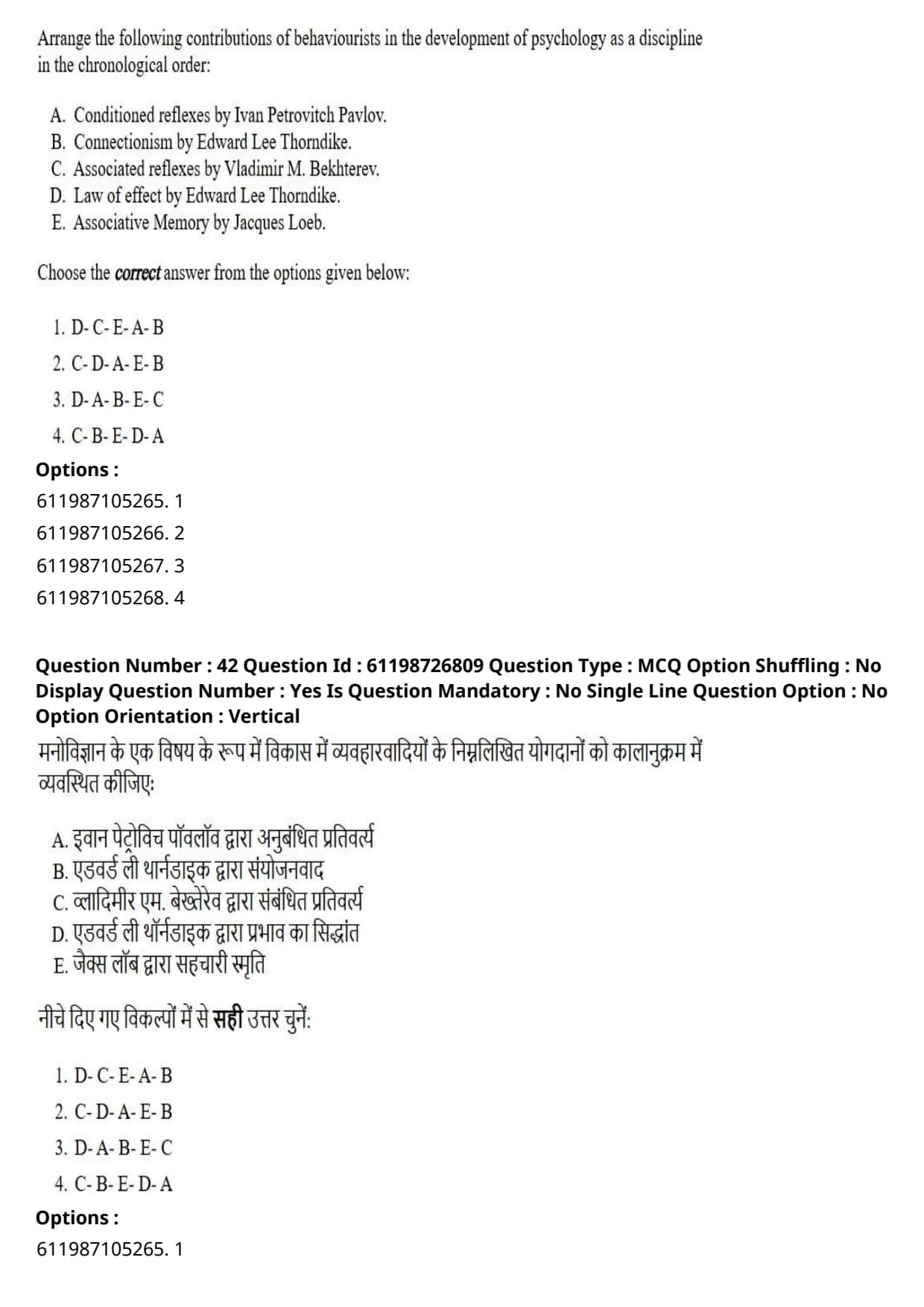
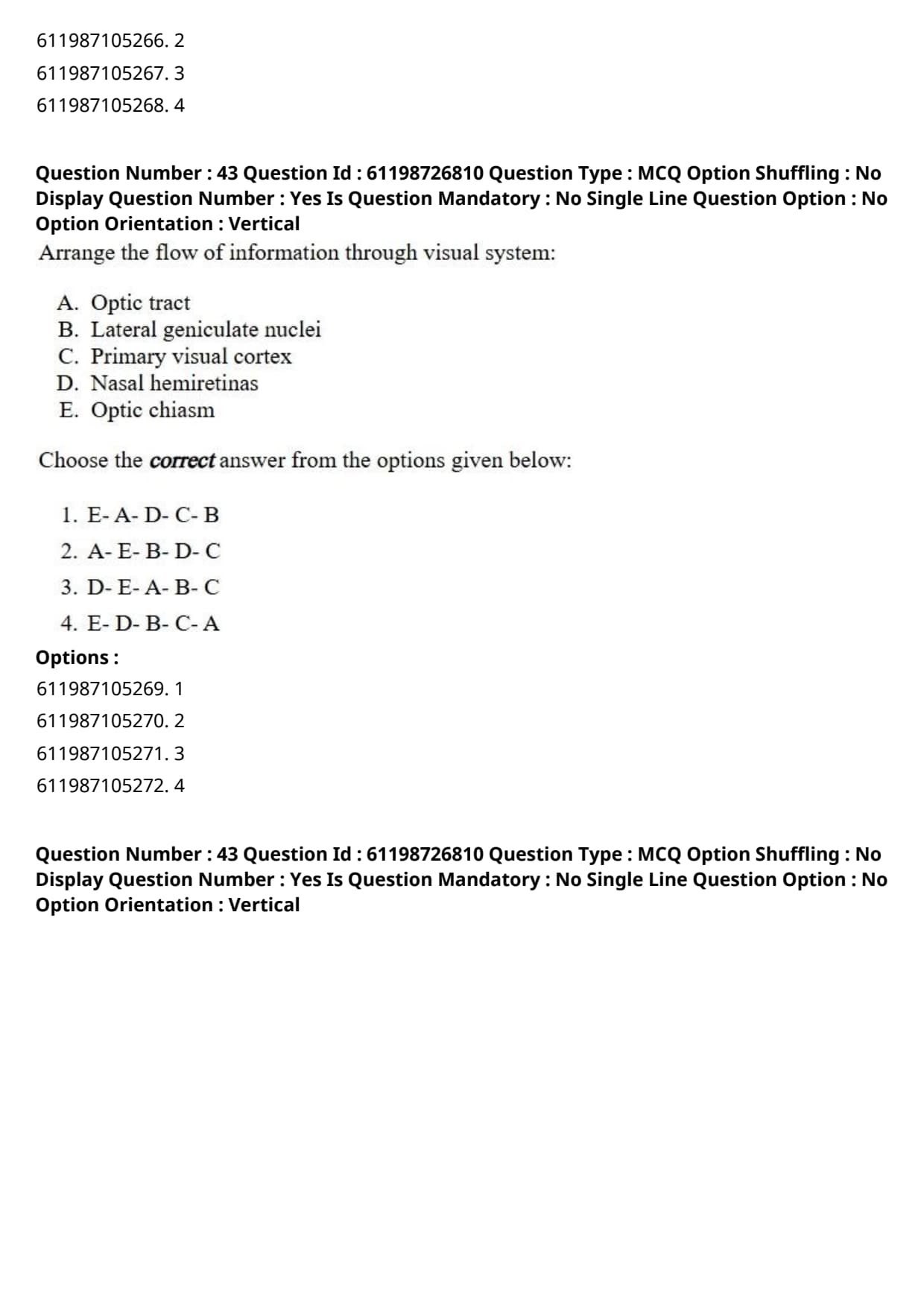
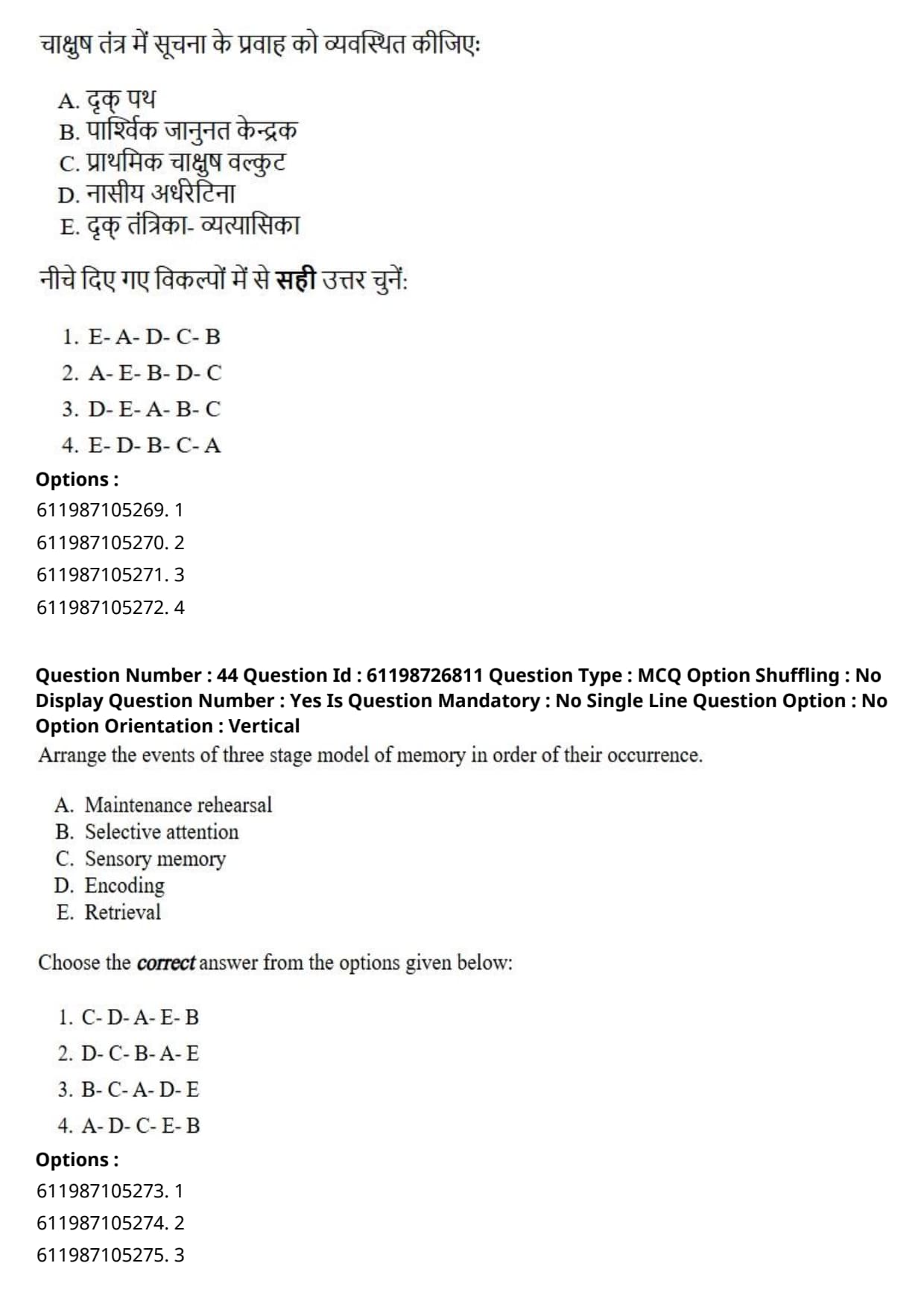
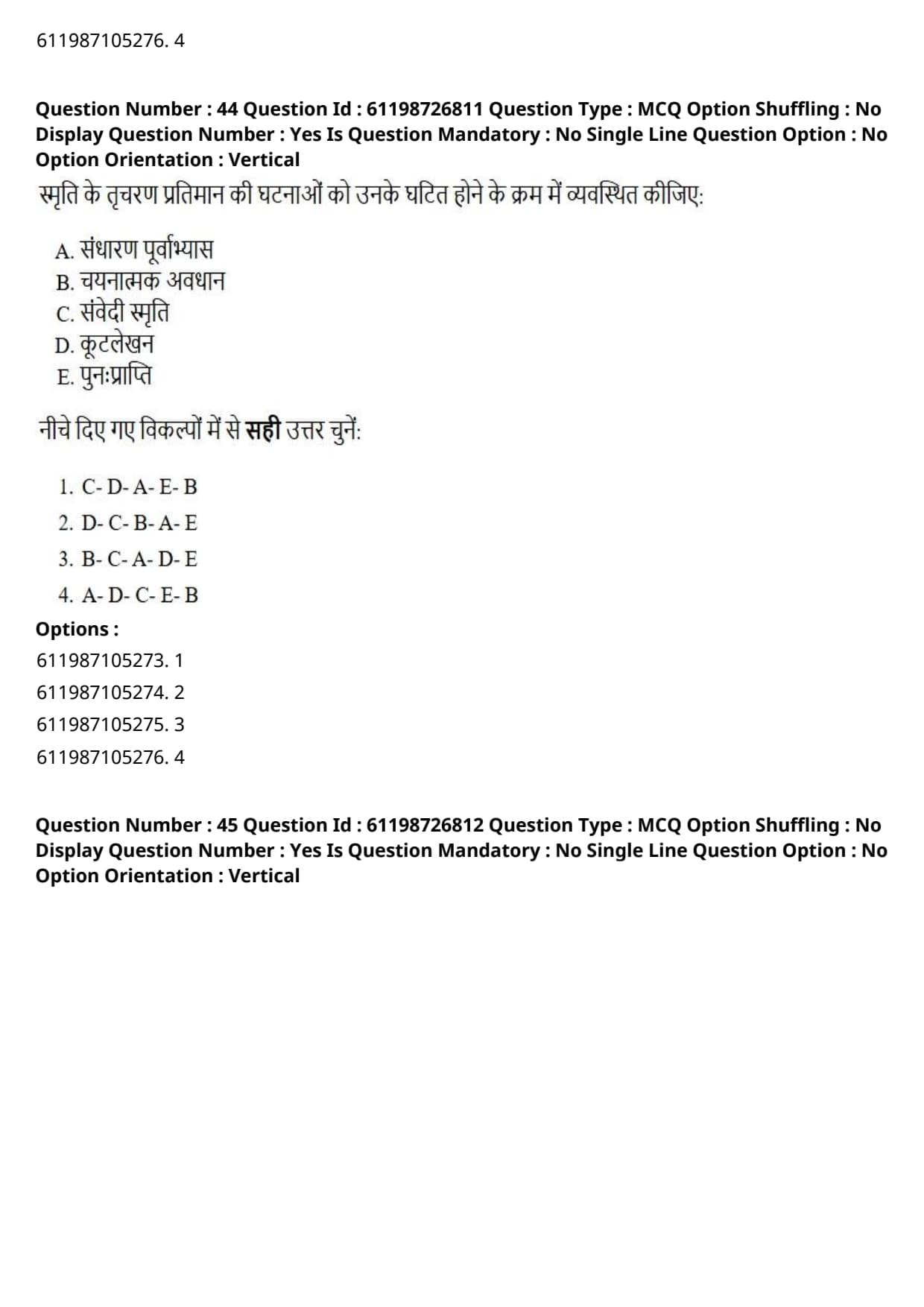
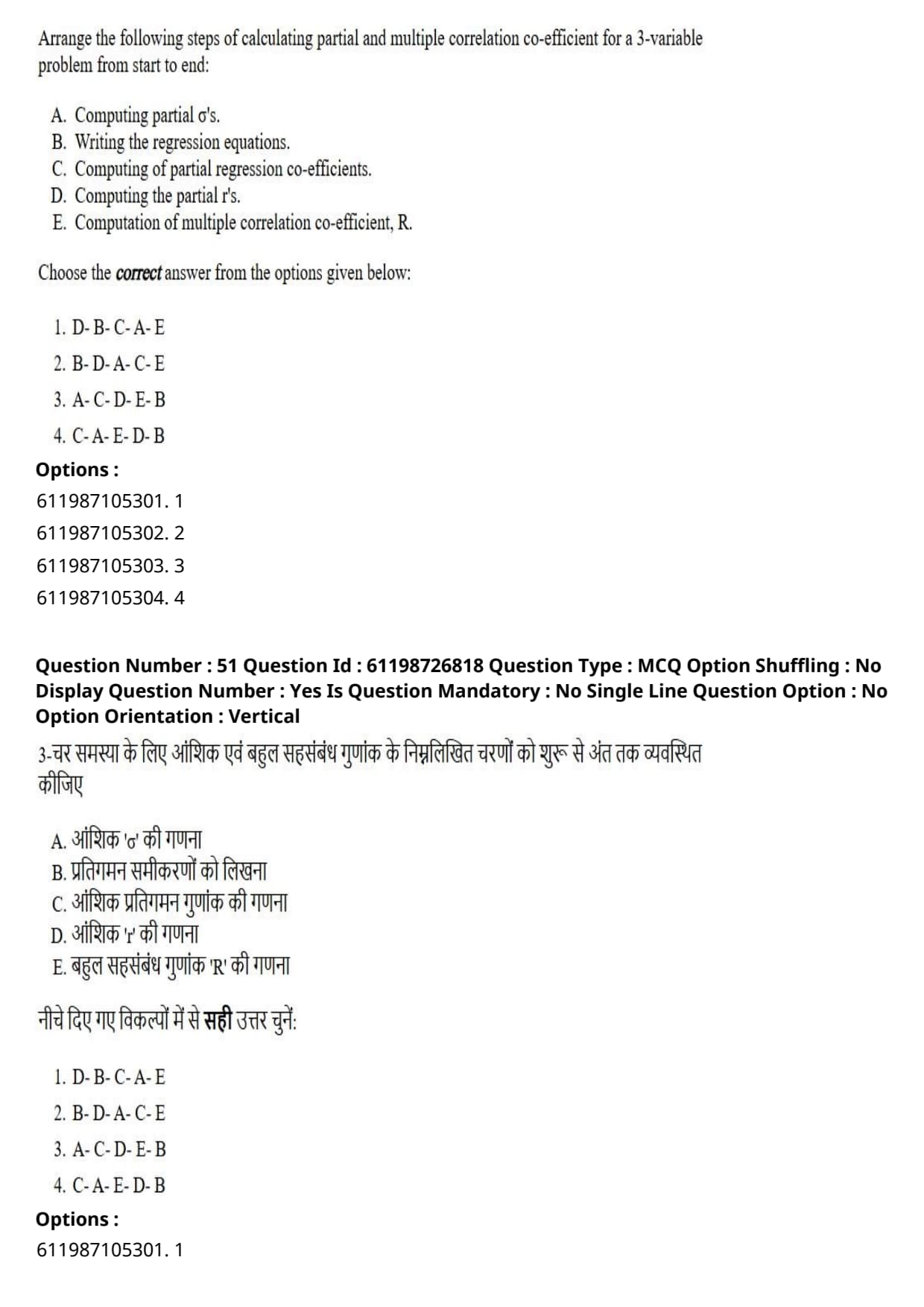
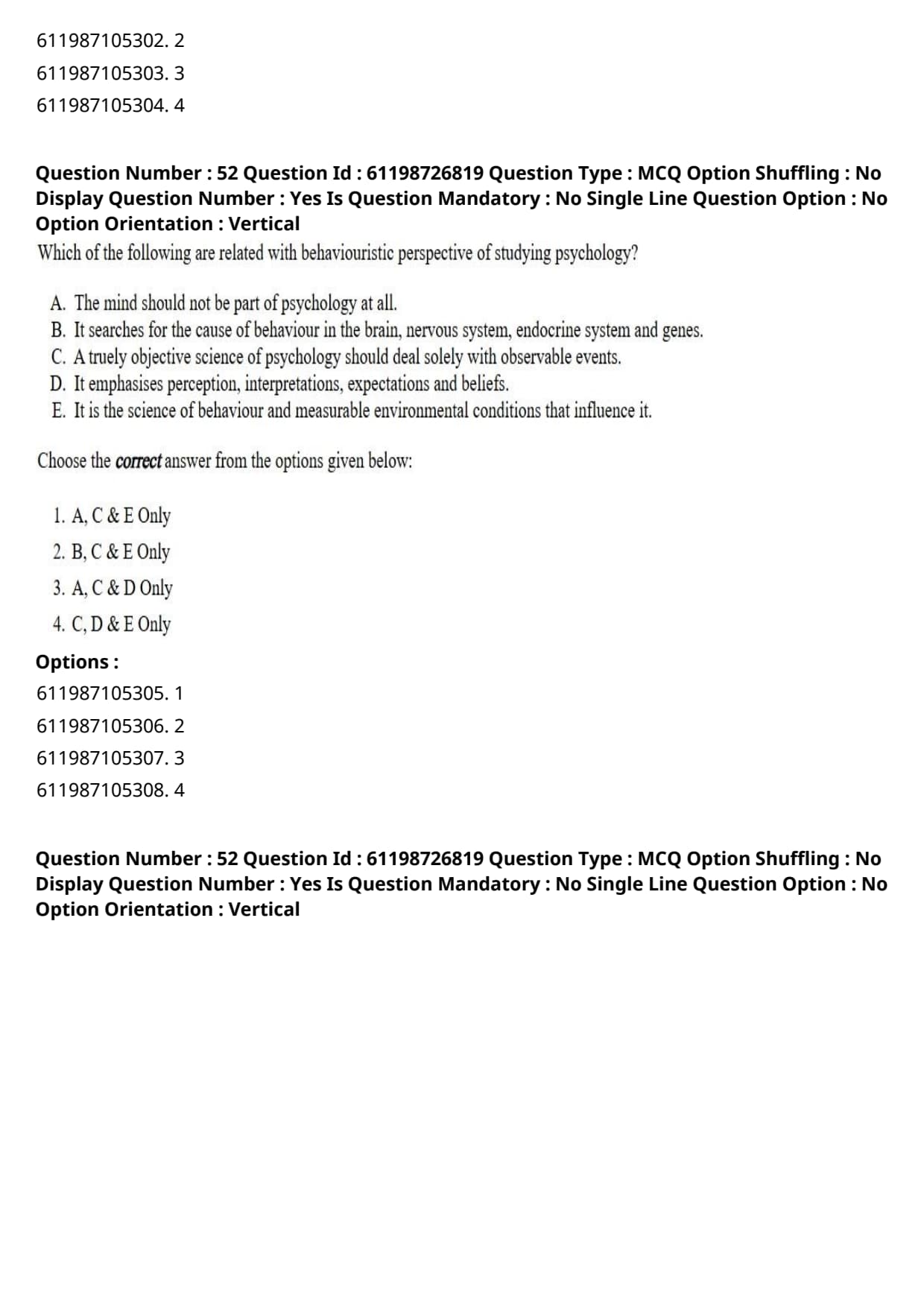
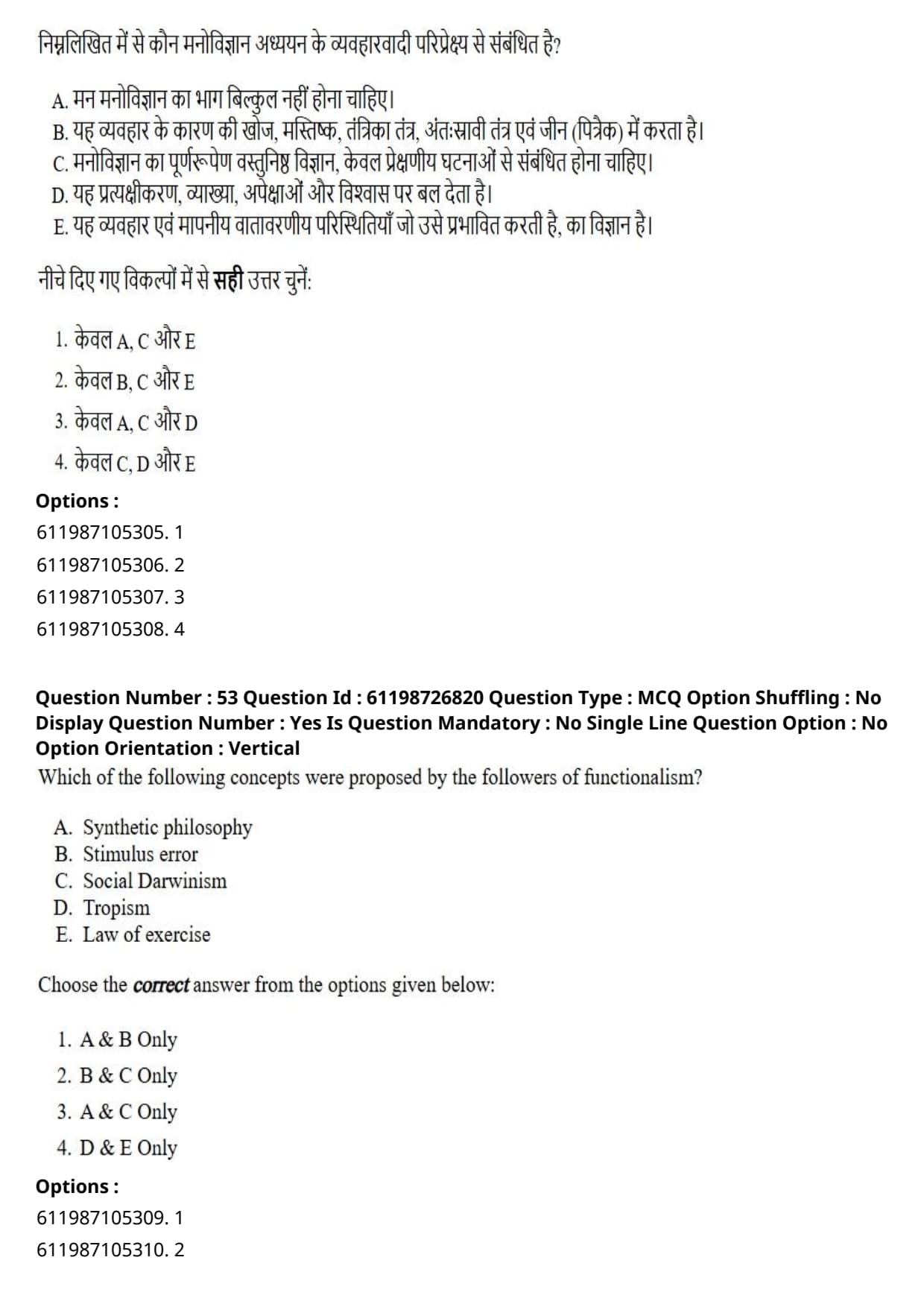
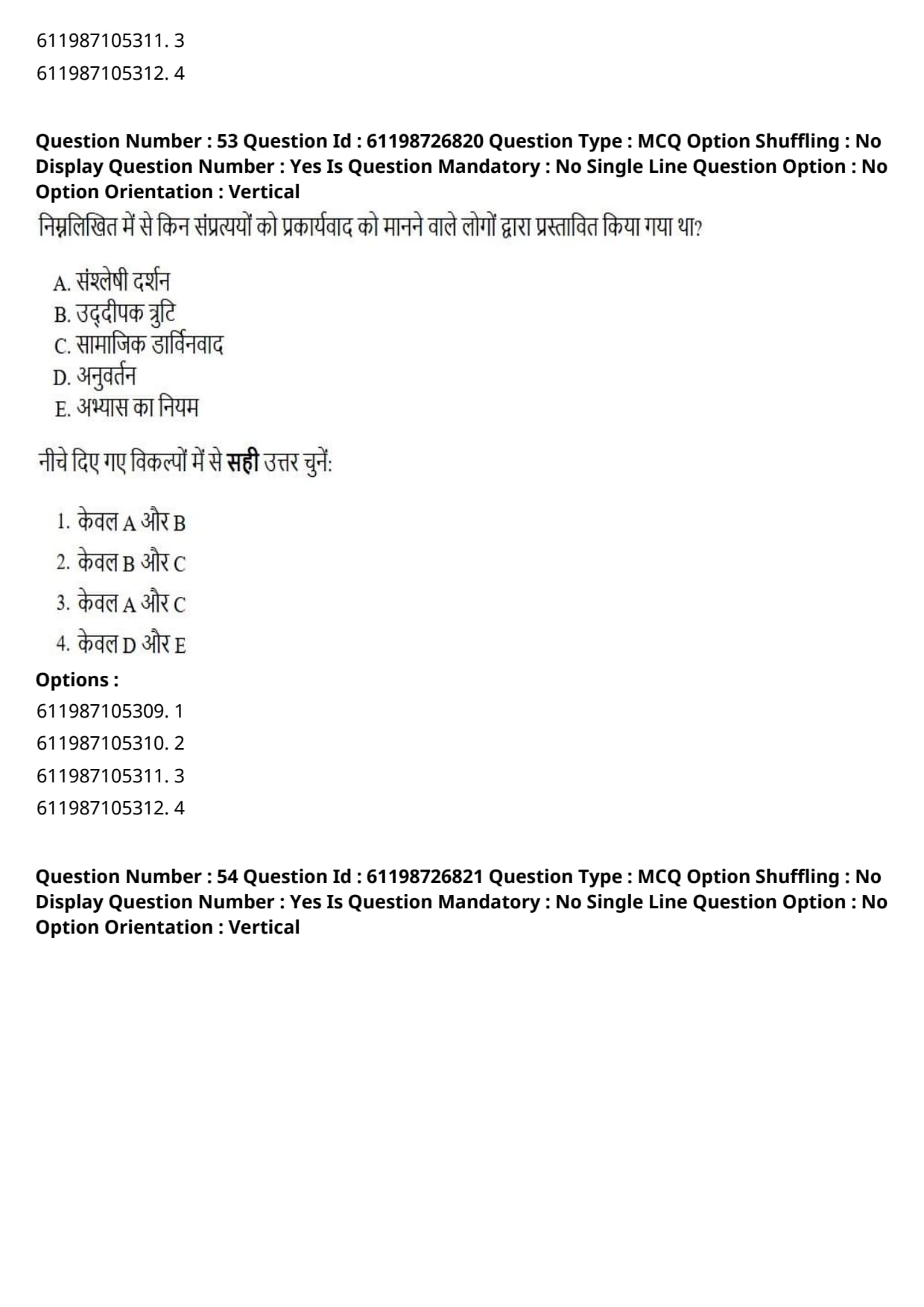
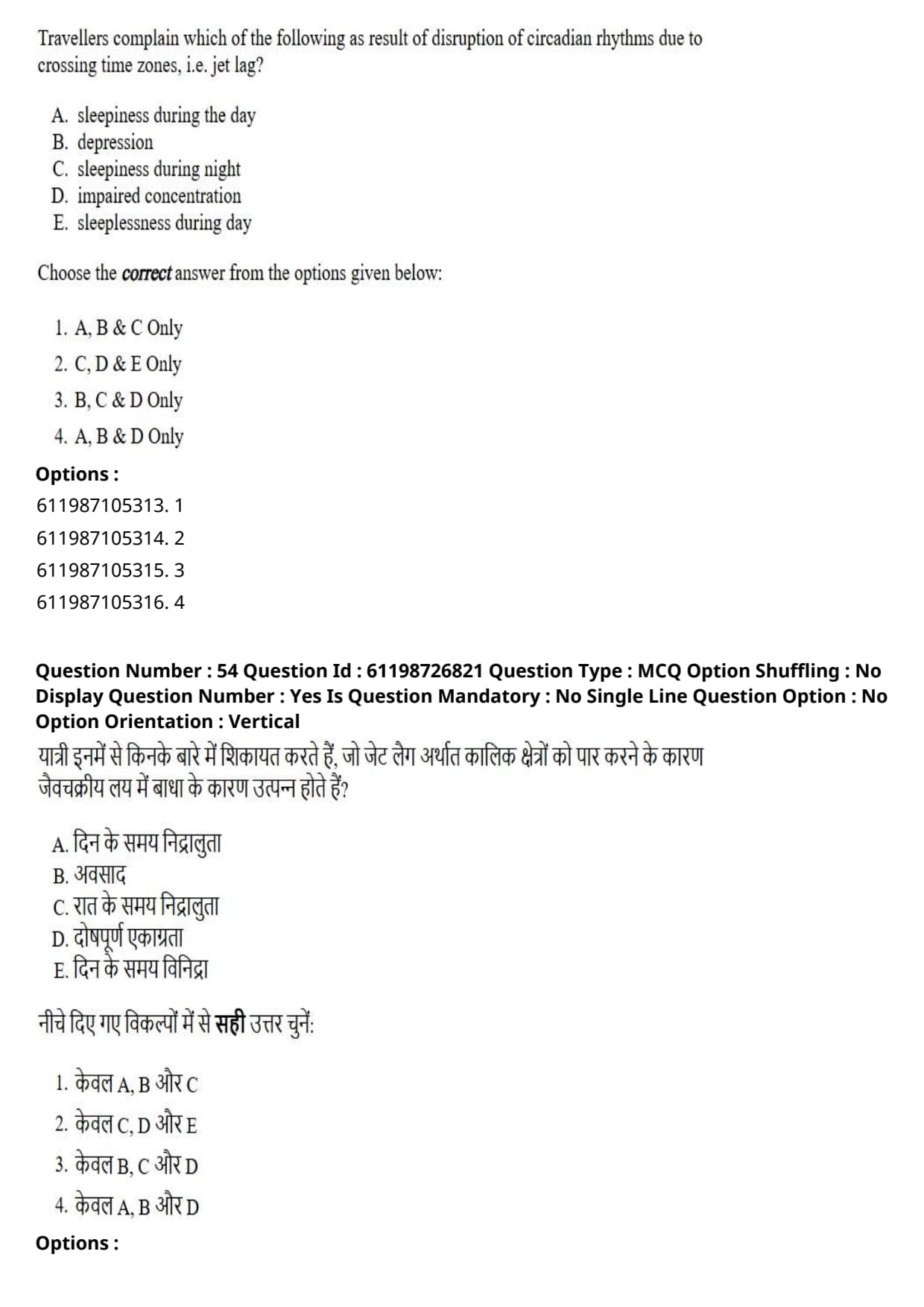
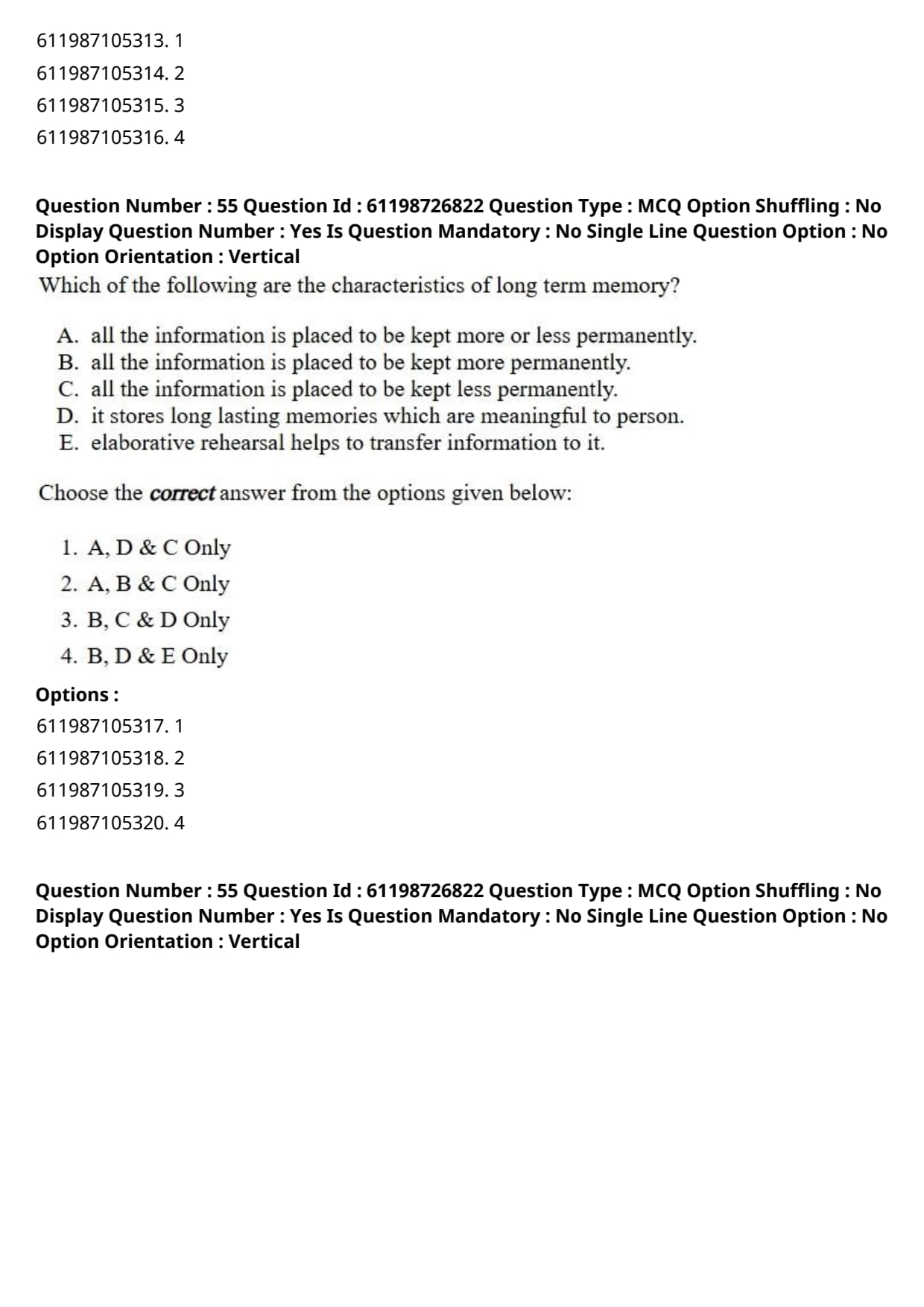
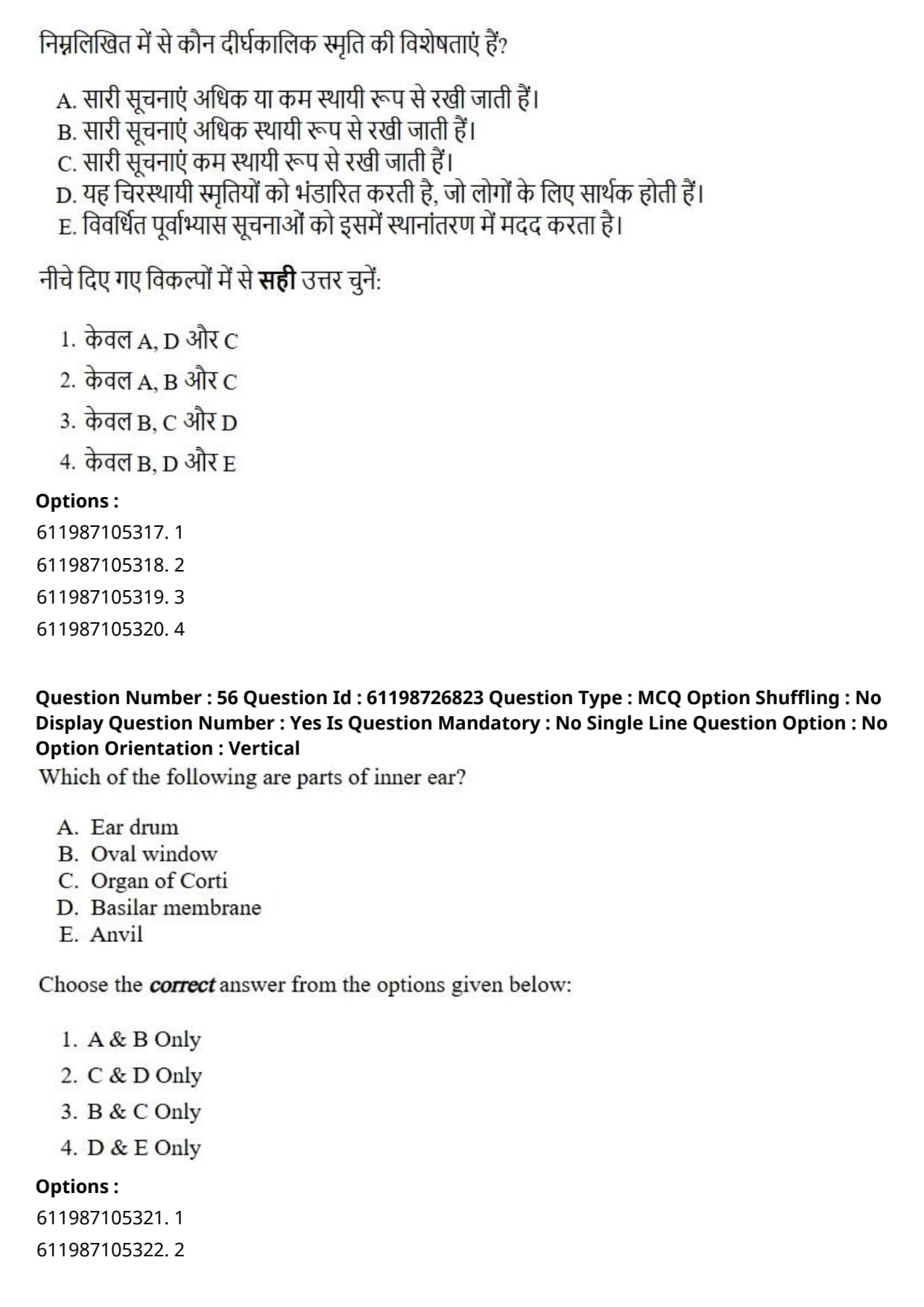
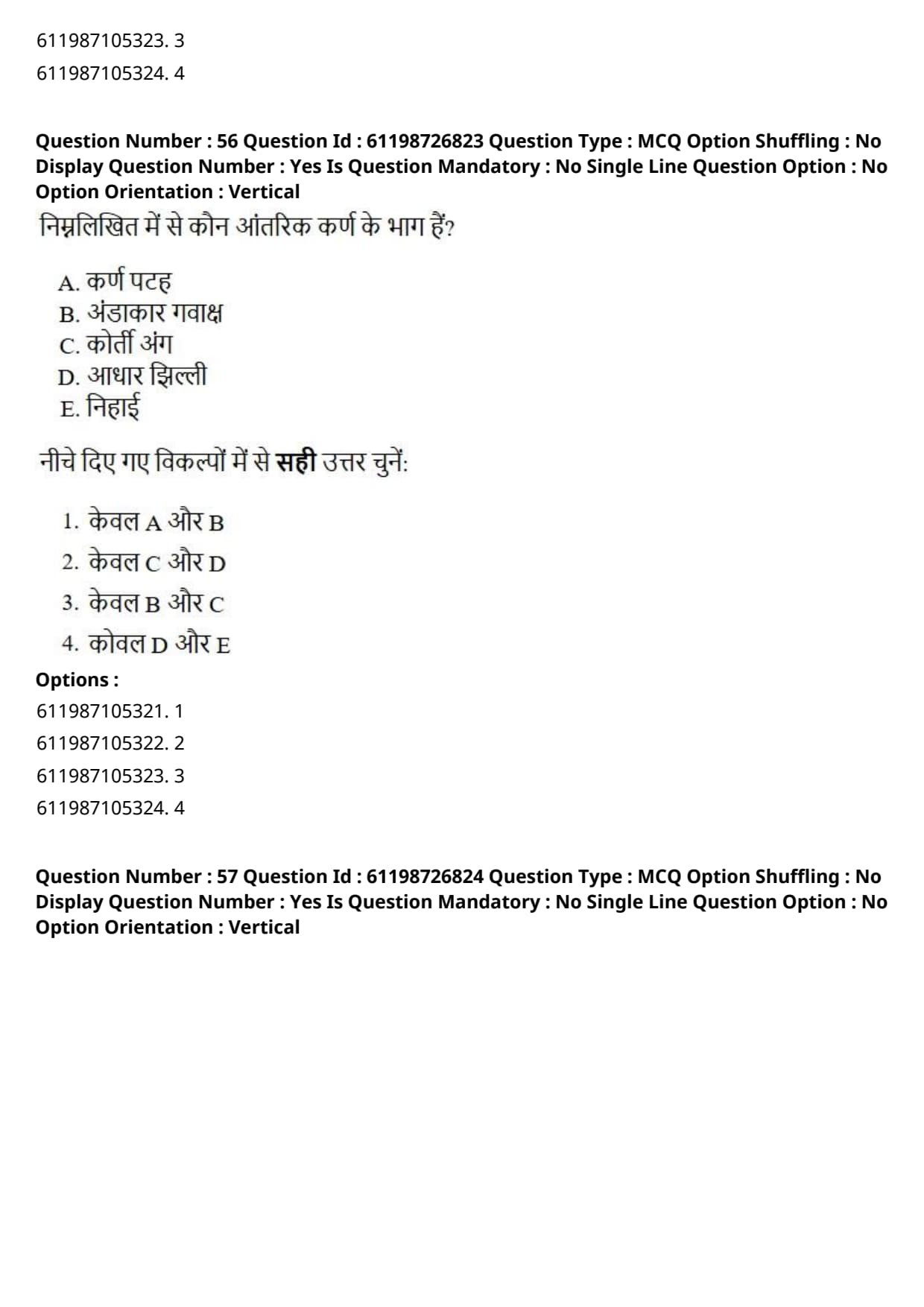
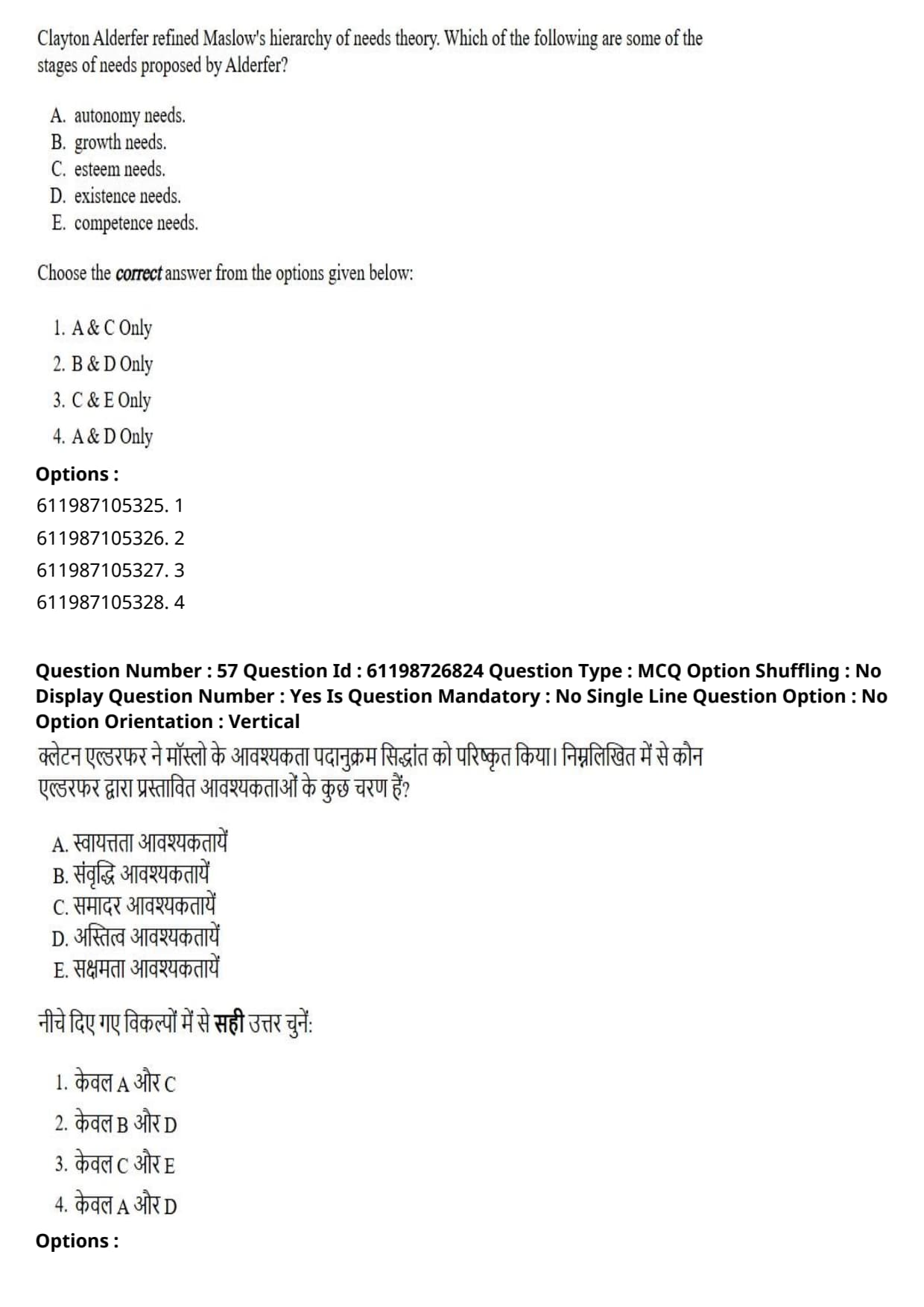
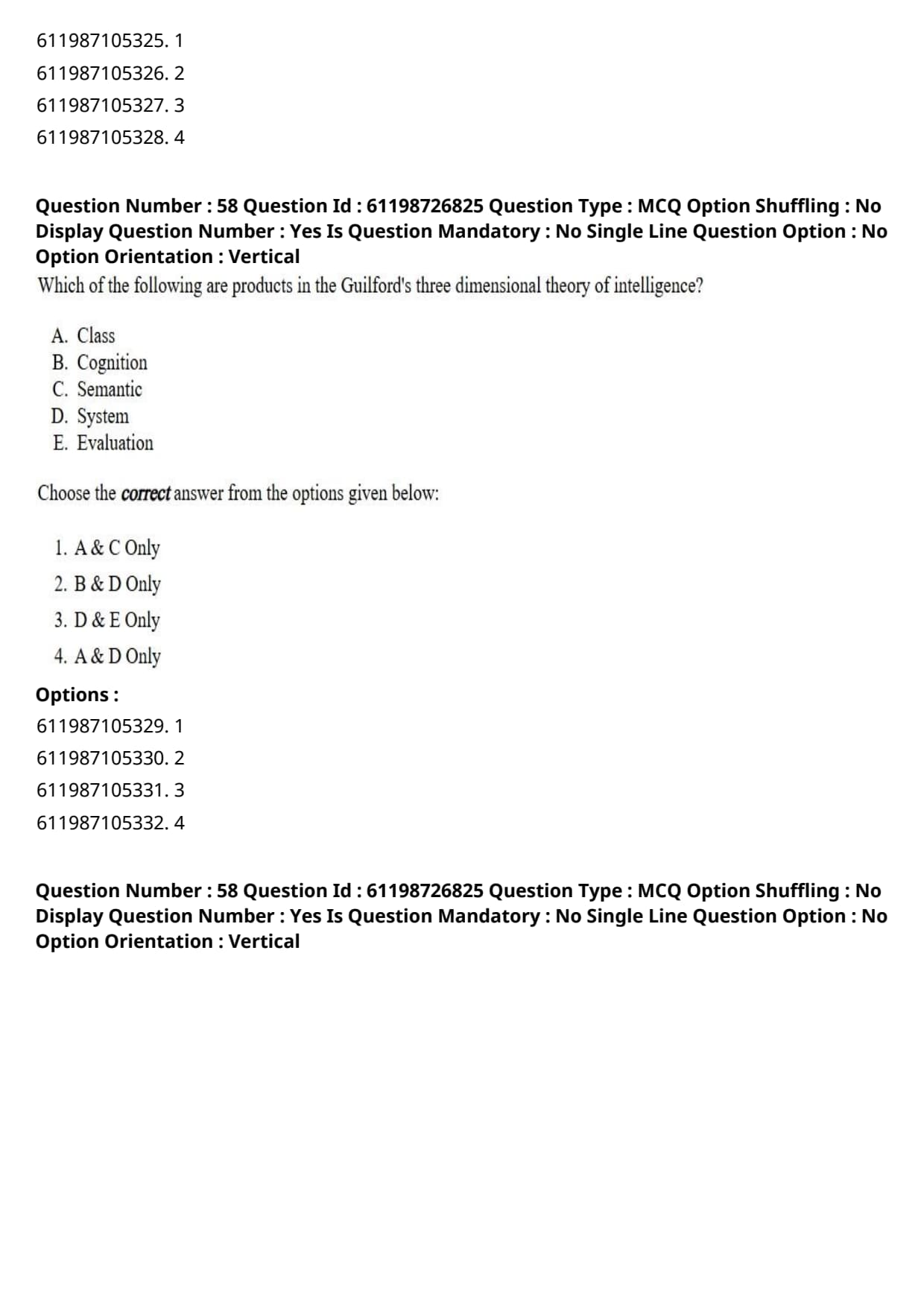
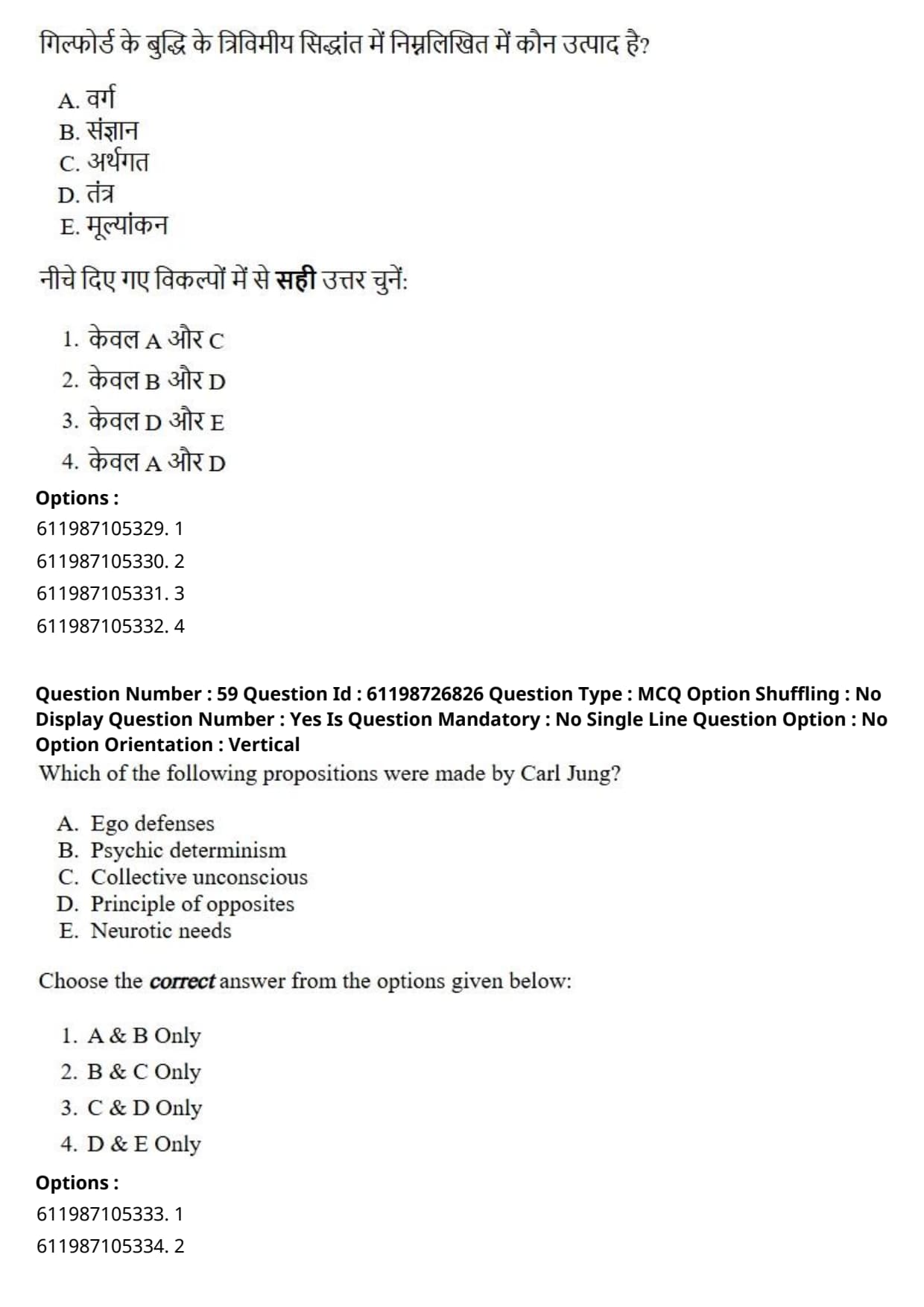
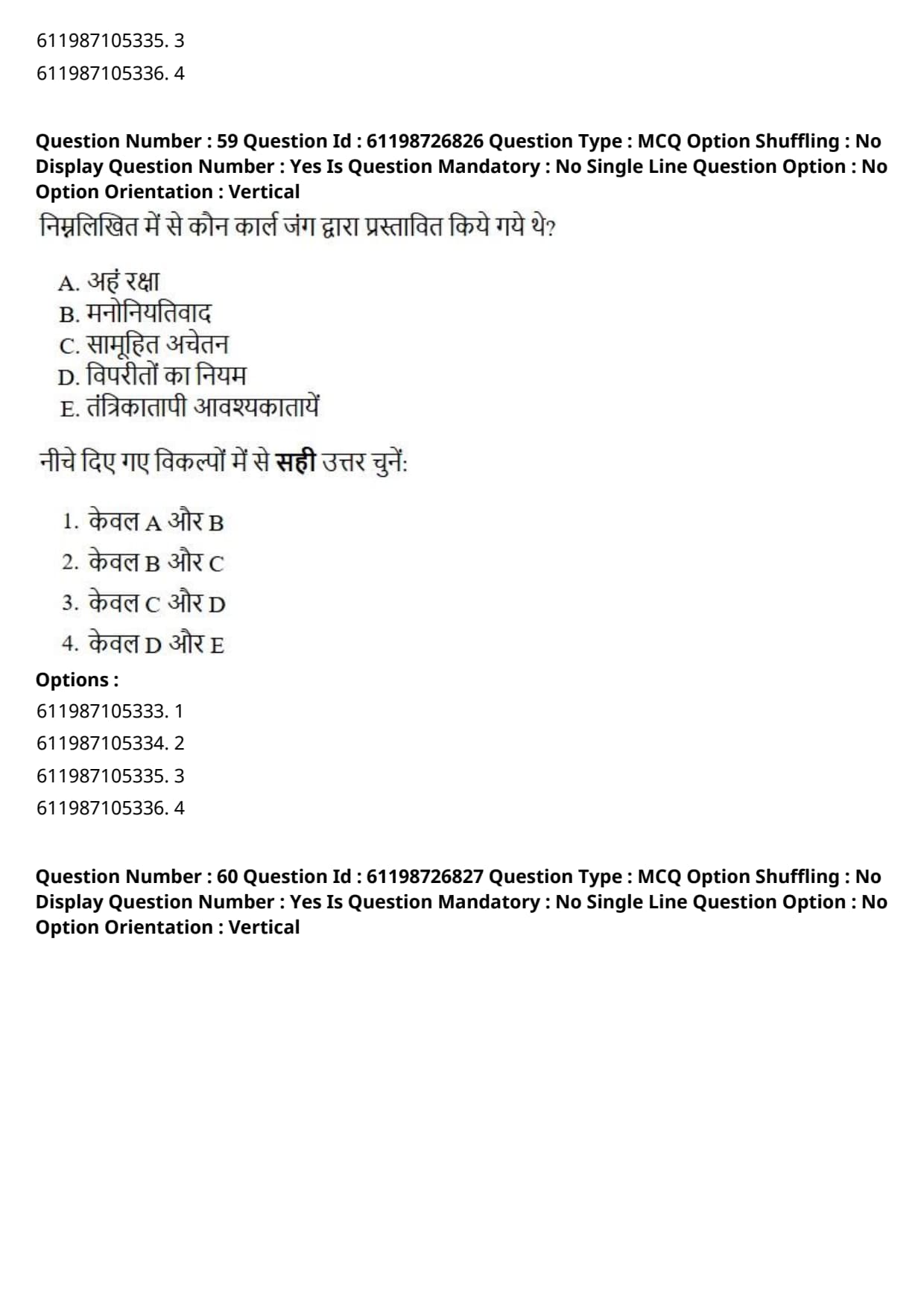
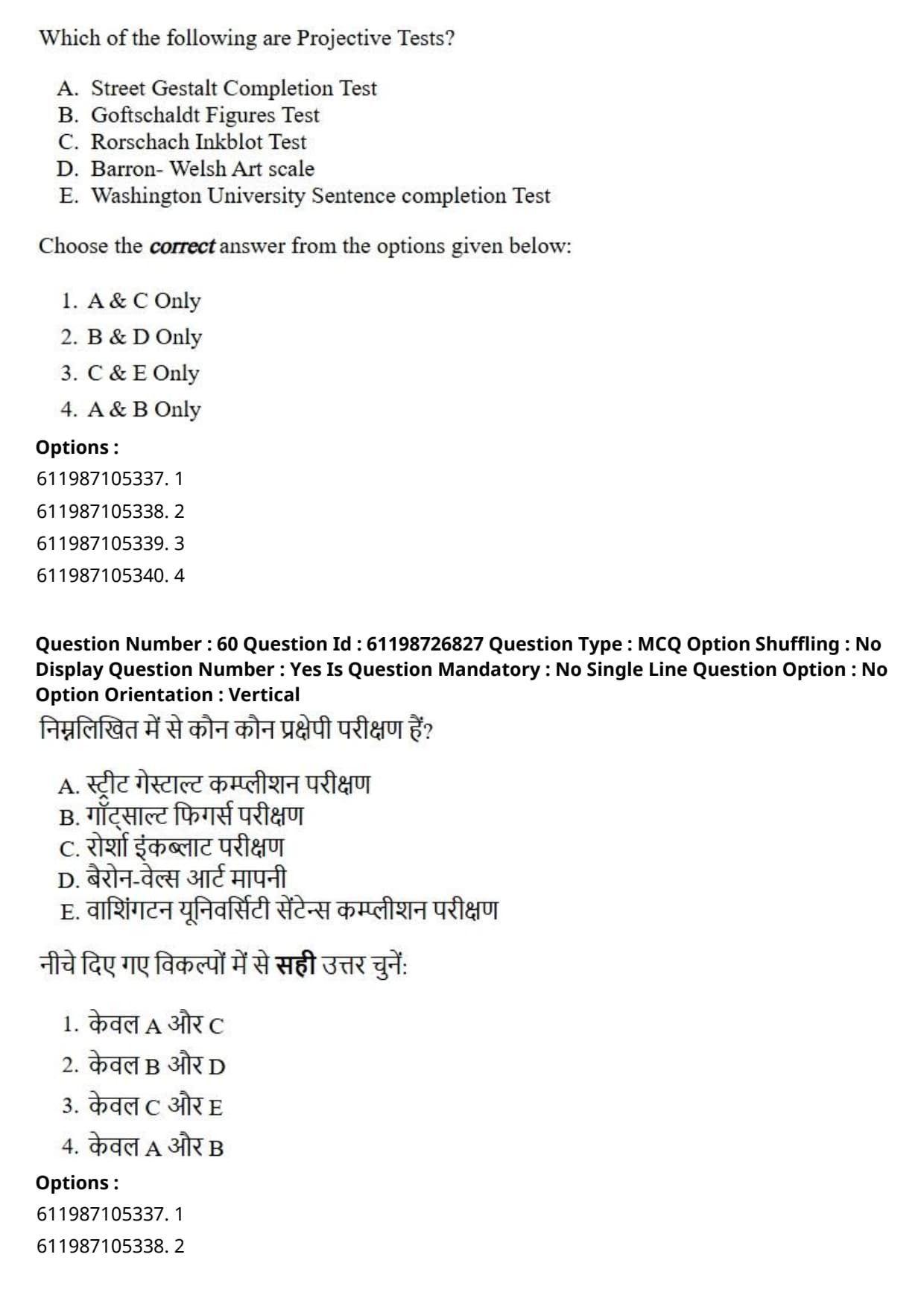
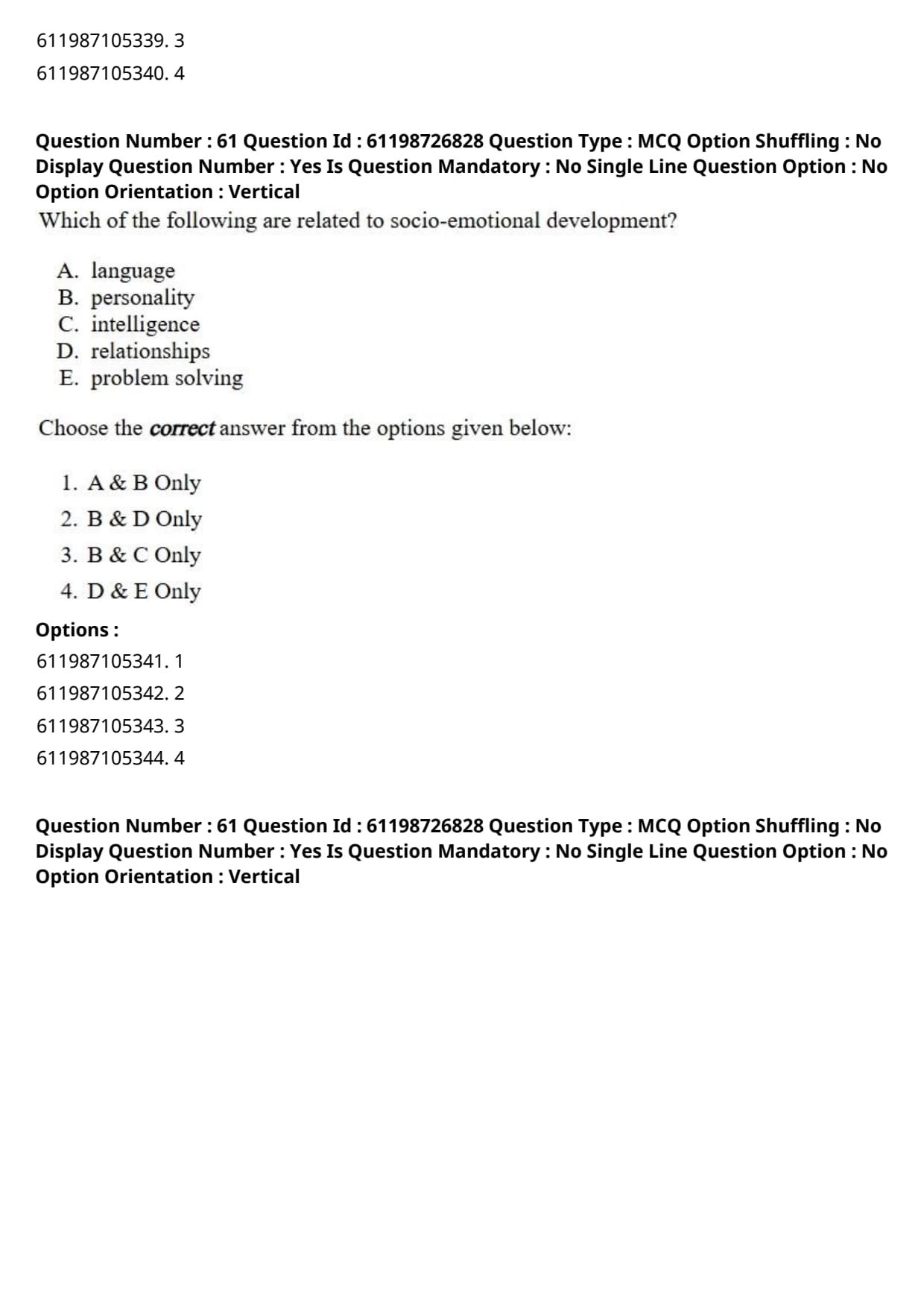
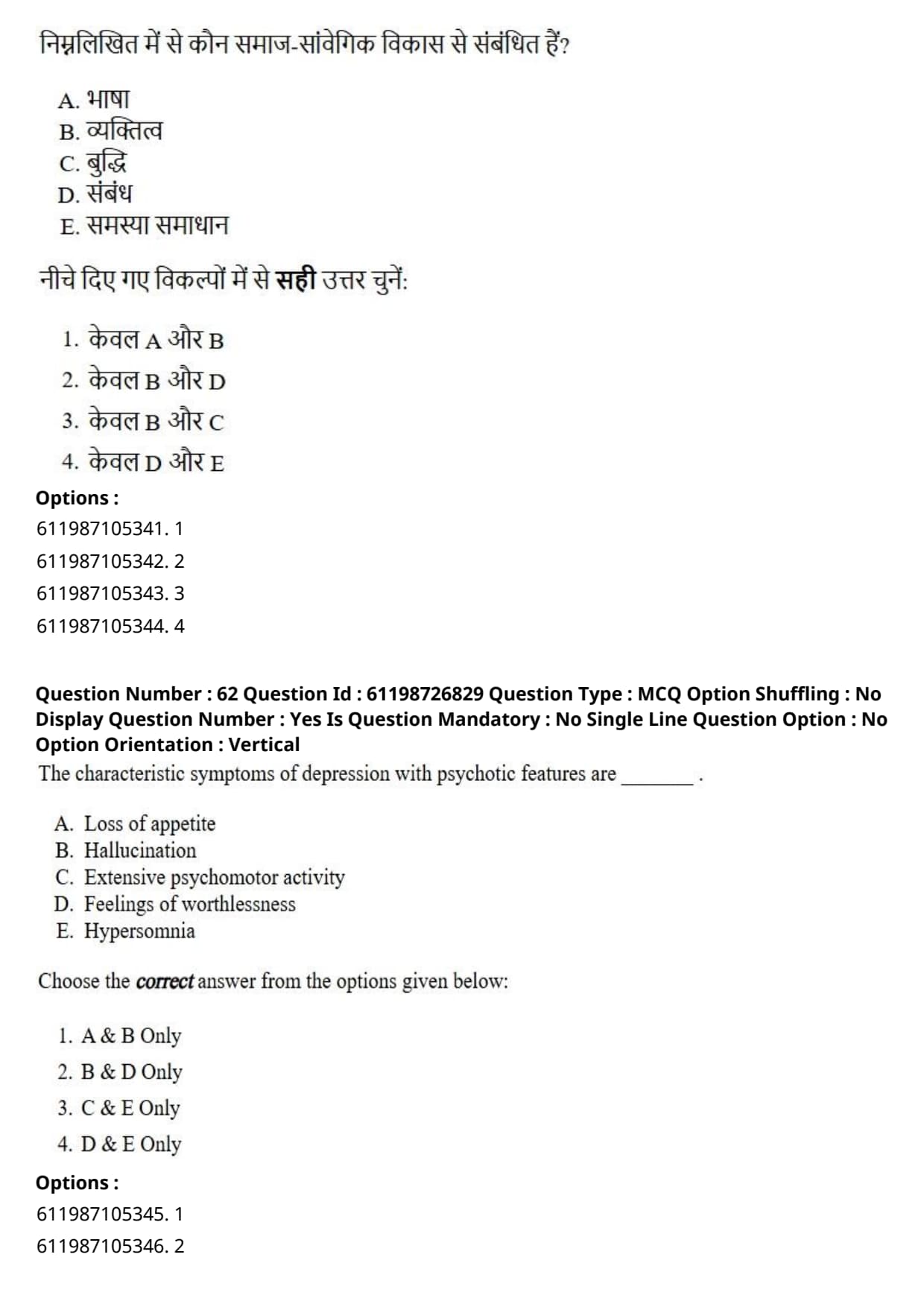
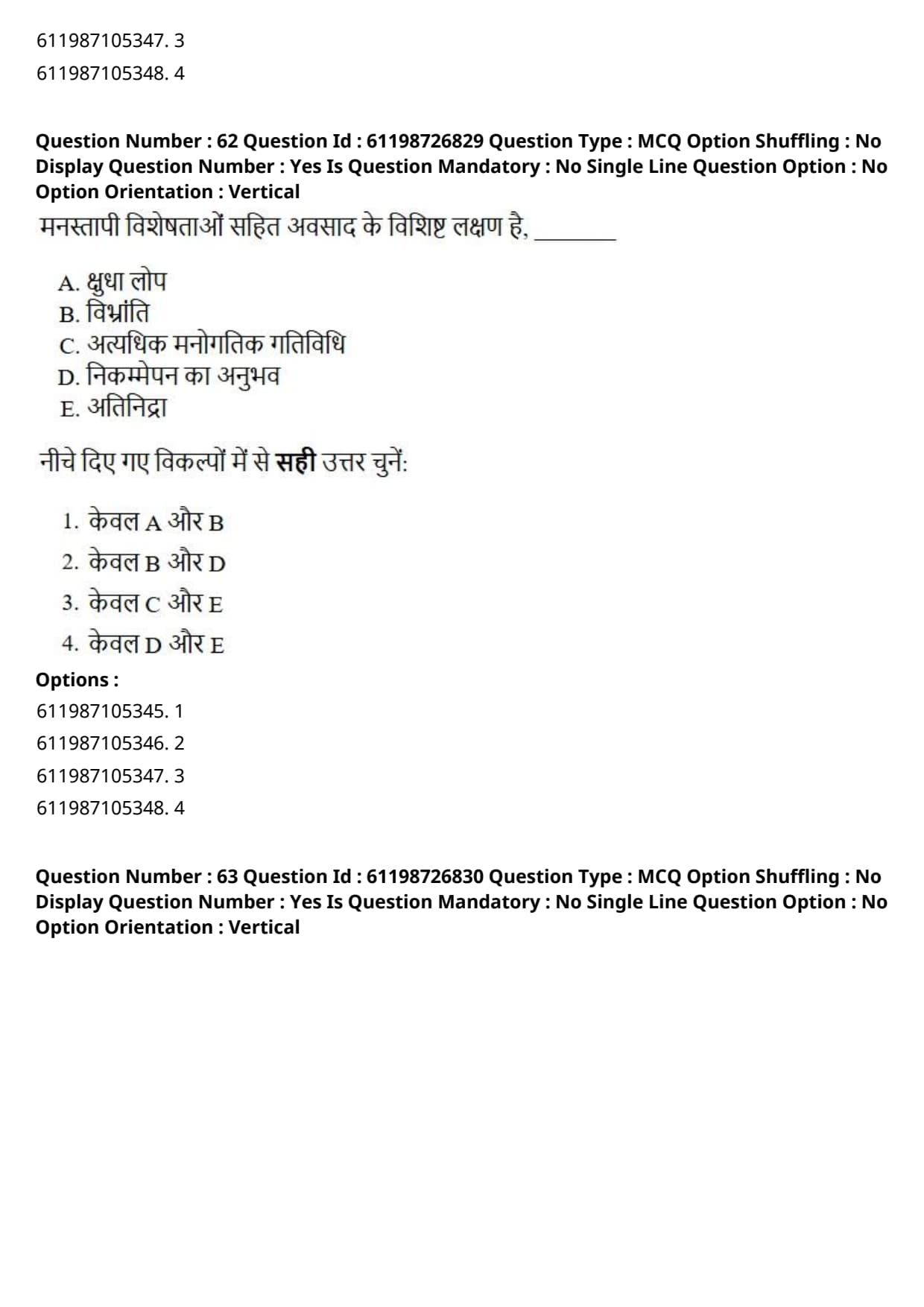
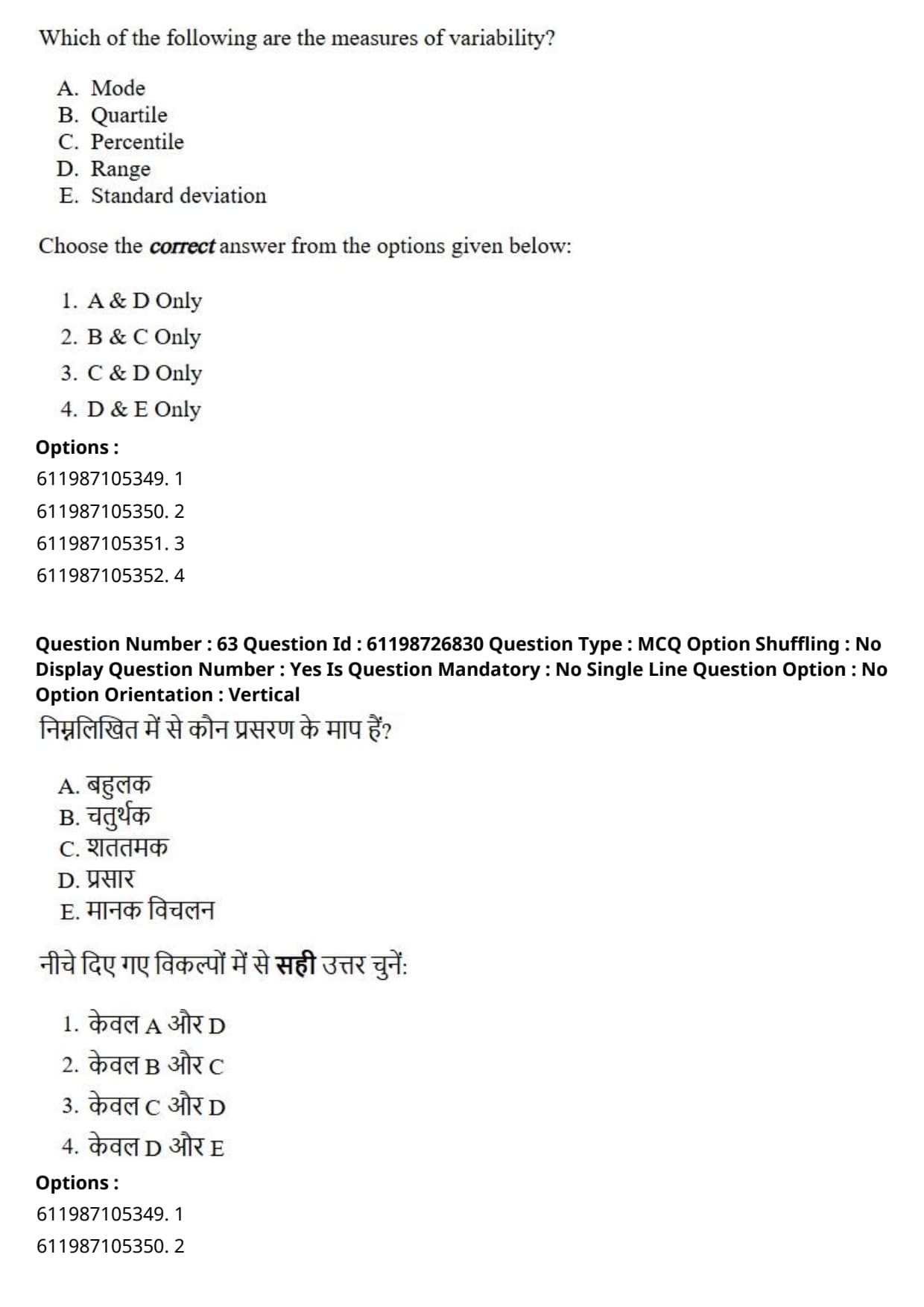
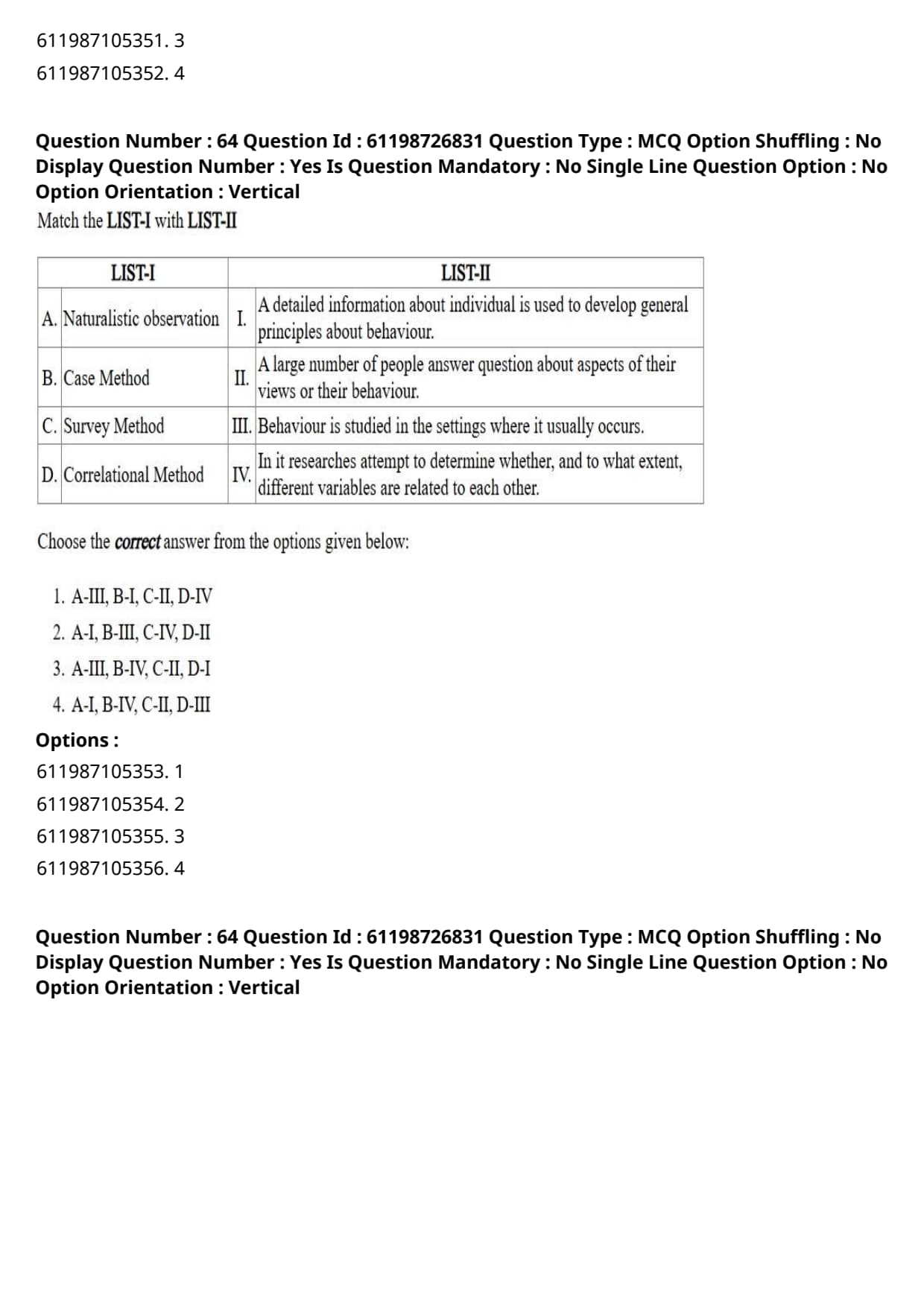
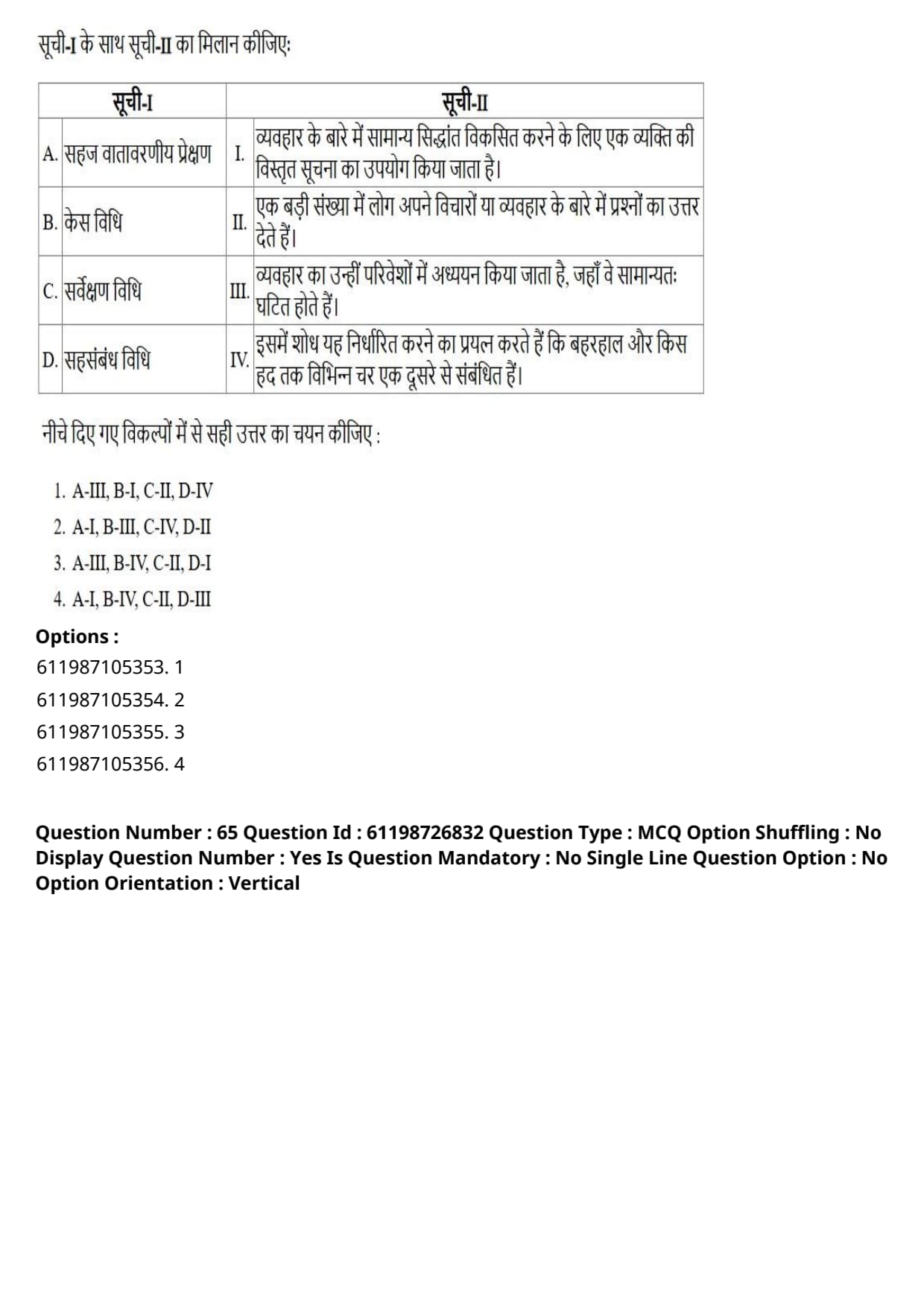
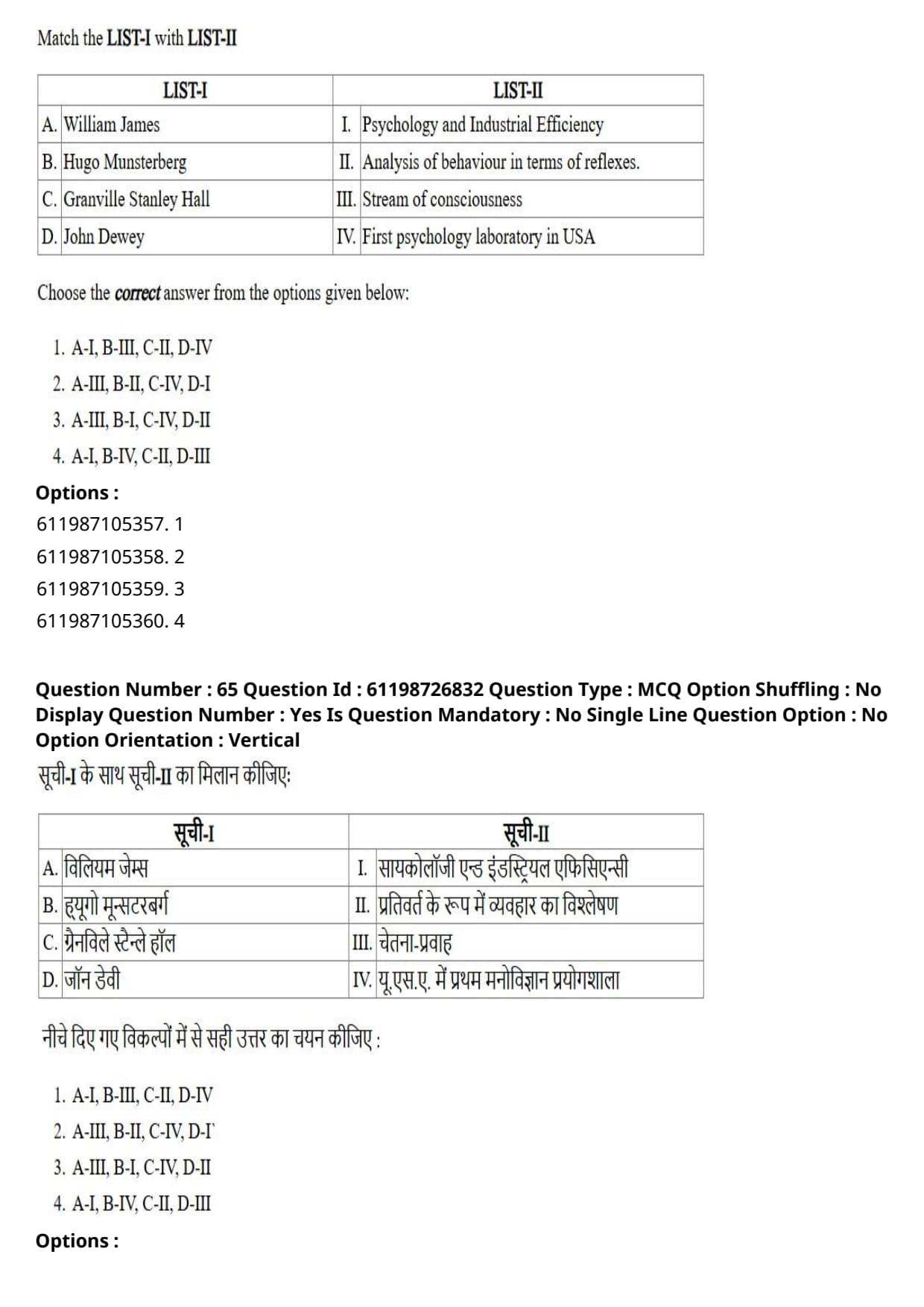
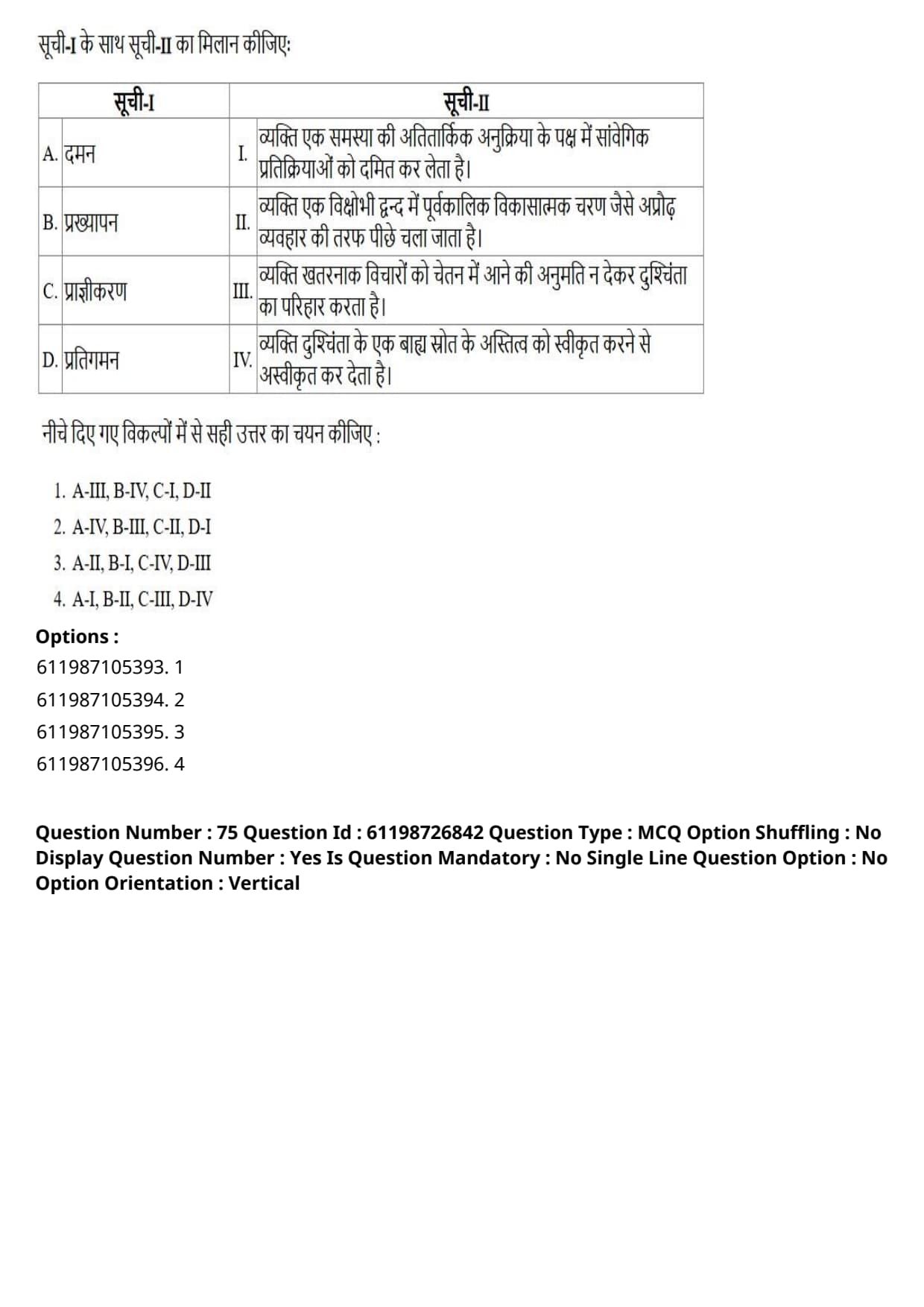
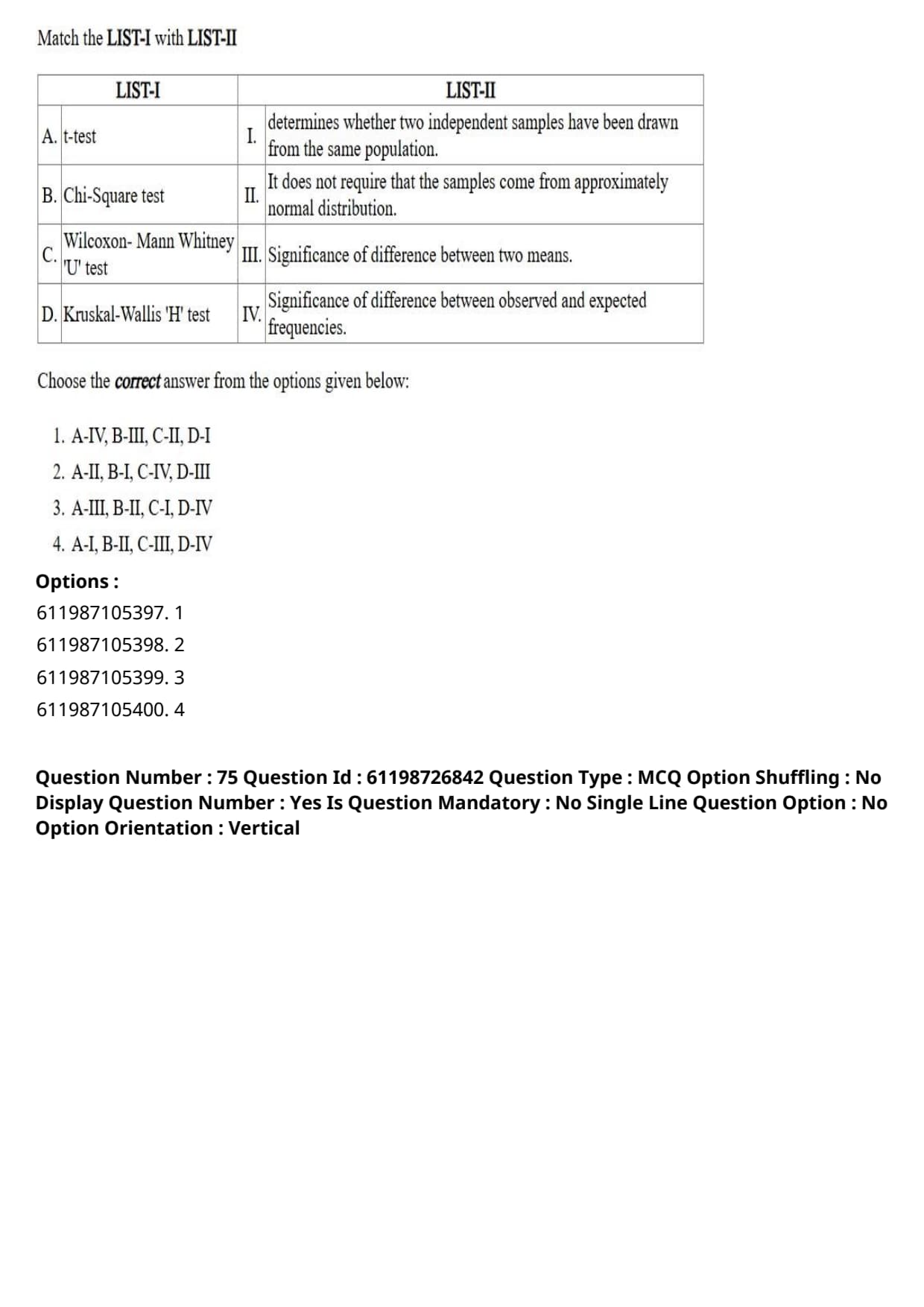
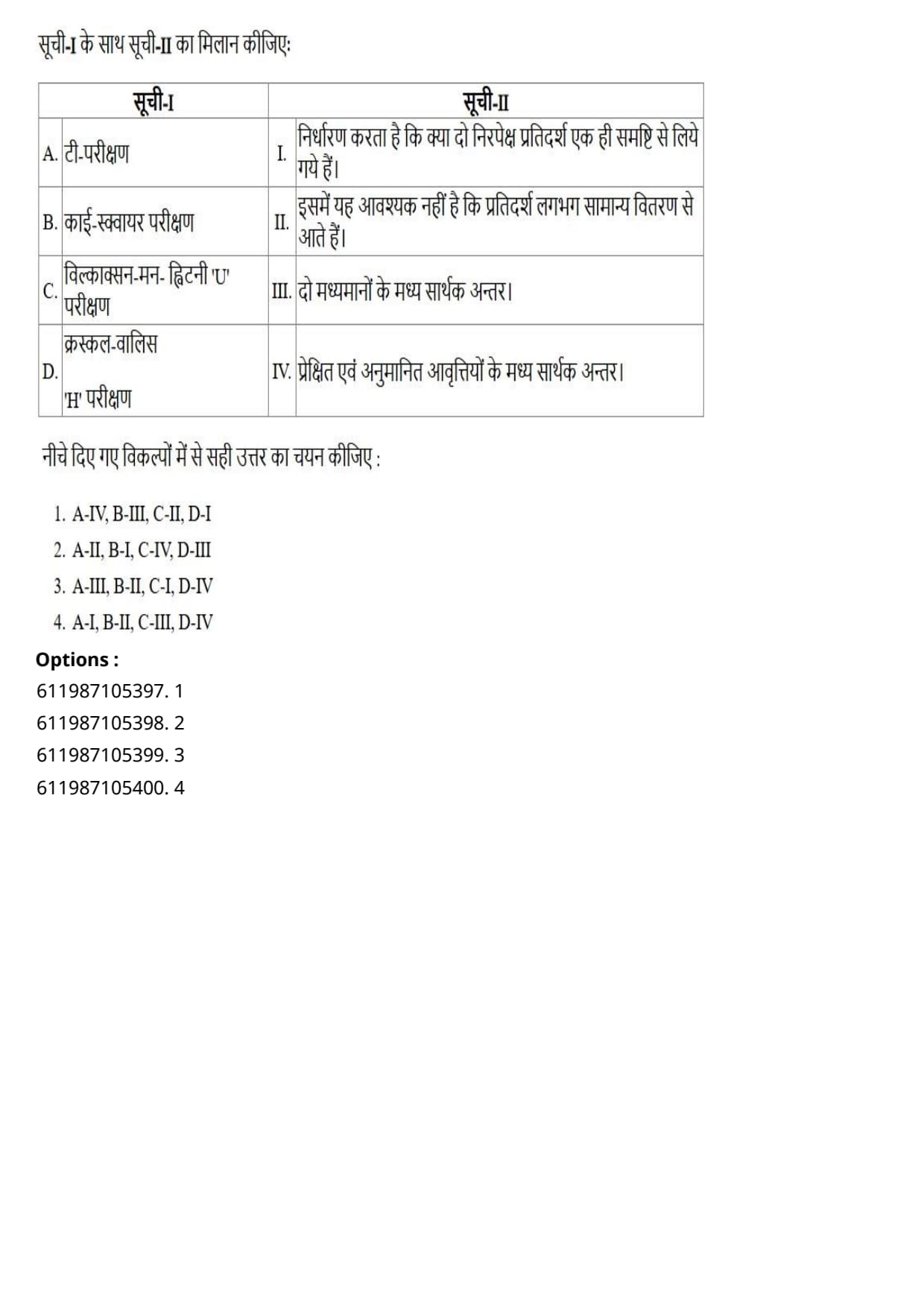
The National Testing Agency (NTA) conducted the CUET PG 2026 Psychology / Applied Psychology (HUQP20) examination on March 16, 2026, during Shift 3 from 04:00 PM to 05:30 PM.

Students who appeared for the exam reported that the overall difficulty level of the paper was moderate. CUET PG 2026 Psychology Question Paper with Solutions PDF is available here for download. The marking scheme is +4 for correct answers and -1 for wrong answers, totaling 300 marks.

CUET PG 2026 Psychology Question Paper with Solutions PDF

CUET PG 2026 Psychology Question Paper with Answer Key Download PDF Check Solutions

Question 1:

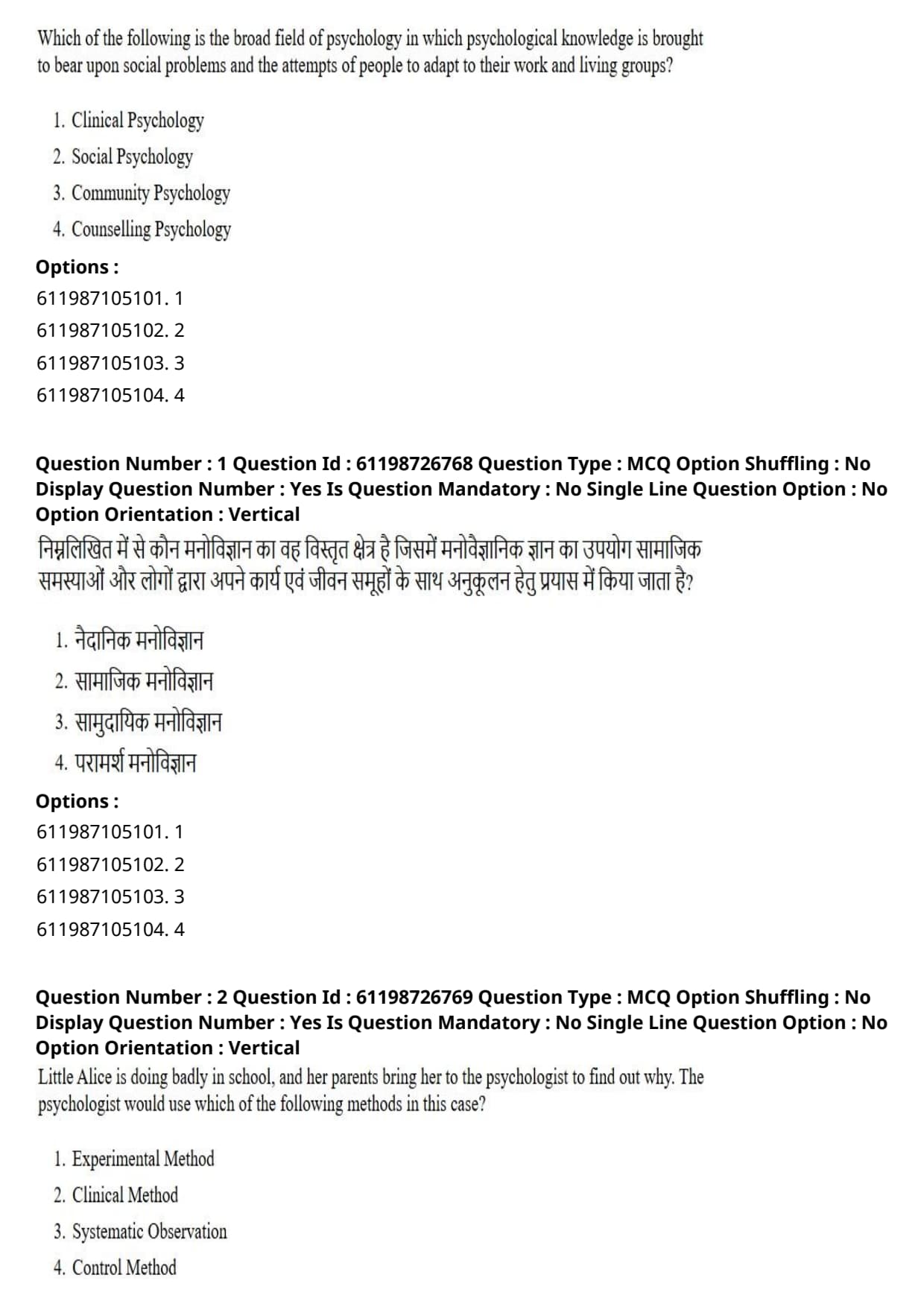
Which of the following is the broad field of psychology in which psychological knowledge is brought to bear upon social problems and the attempts of people to adapt to their work and living groups?

  • (A) Clinical Psychology
  • (B) Social Psychology
  • (C) Community Psychology
  • (D) Counselling Psychology
Correct Answer: (C) Community Psychology
View Solution


Step 1: Understanding the Question:

The question asks us to identify the sub-discipline of psychology that deals with solving social issues and helping people adjust within their work and social environments.


Step 2: Detailed Explanation:


Community psychology is specifically focused on person-environment interactions and how social institutions affect individuals and groups.

Unlike clinical psychology, which heavily focuses on diagnosing and treating individual psychopathology, community psychology works on systemic changes.

It actively applies psychological principles to resolve broad-scale social issues, enhance quality of life, and design collaborative interventions for work and living groups.

Social psychology studies how individuals are influenced by others but is largely theoretical and experimental rather than intervention-based.

Counselling psychology primarily deals with personal and interpersonal functioning across the lifespan, focusing on emotional, social, and vocational concerns.

Therefore, the integration of psychological knowledge to address social problems and systemic adaptation is the hallmark definition of community psychology.


Step 3: Final Answer:

The correct field that focuses on applying psychological knowledge to social problems and group adaptation is Community Psychology.
Quick Tip: Remember that whenever a question refers to broad social problems, systemic prevention, or adaptation to ecological and group settings, the answer is usually Community Psychology rather than individualistic Clinical or Counseling Psychology.


Question 2:

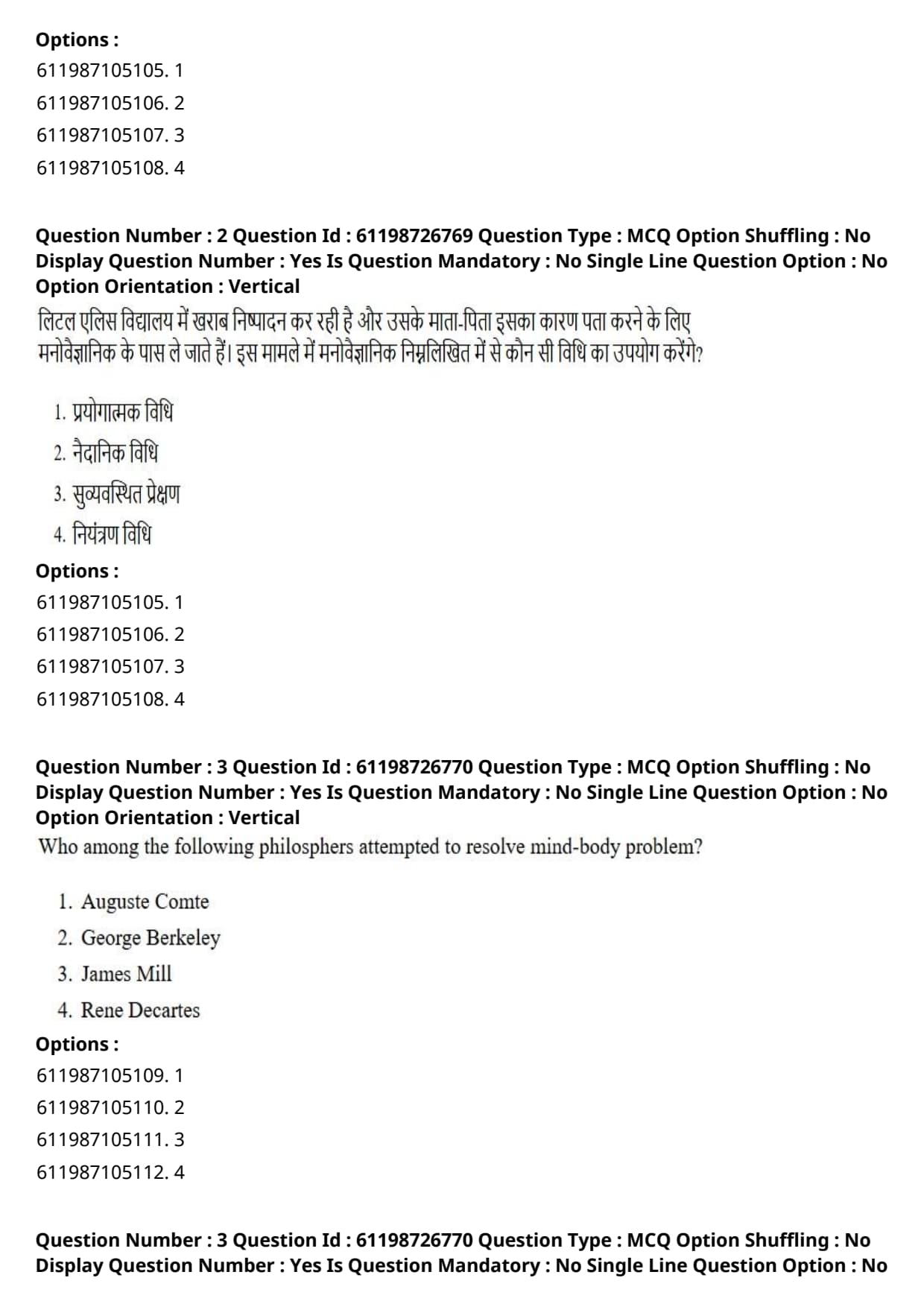
Little Alice is doing badly in school, and her parents bring her to the psychologist to find out why. The psychologist would use which of the following methods in this case?

  • (A) Experimental Method
  • (B) Clinical Method
  • (C) Systematic Observation
  • (D) Control Method
Correct Answer: (B) Clinical Method
View Solution


Step 1: Understanding the Question:

The question asks for the most appropriate psychological investigation method to diagnose and understand why an individual child is struggling academically.


Step 2: Detailed Explanation:


The clinical method, also known as the case study method, is designed to conduct an in-depth, detailed examination of a single individual.

This method involves gathering extensive biographical history, interviewing family members, administering diagnostic tests, and examining environmental influences.

Experimental methods are used to establish general cause-and-effect laws across large groups under highly controlled laboratory conditions, making them unsuitable for individual diagnoses.

Systematic observation involves recording behavior in natural settings without intervention, which would not provide the deep historical and diagnostic insights needed for Alice.

The control method is an experimental design technique to rule out confounding variables, not an independent diagnostic tool.

Therefore, analyzing a specific child's academic deficit through personalized diagnostics and history-taking aligns with the clinical method.


Step 3: Final Answer:

The psychologist would use the Clinical Method to perform a thorough individual diagnostic assessment.
Quick Tip: Whenever an individual patient or client is brought in with a unique behavioral, emotional, or cognitive problem requiring direct assessment, the Clinical (or Case Study) Method is the most logical choice.


Question 3:

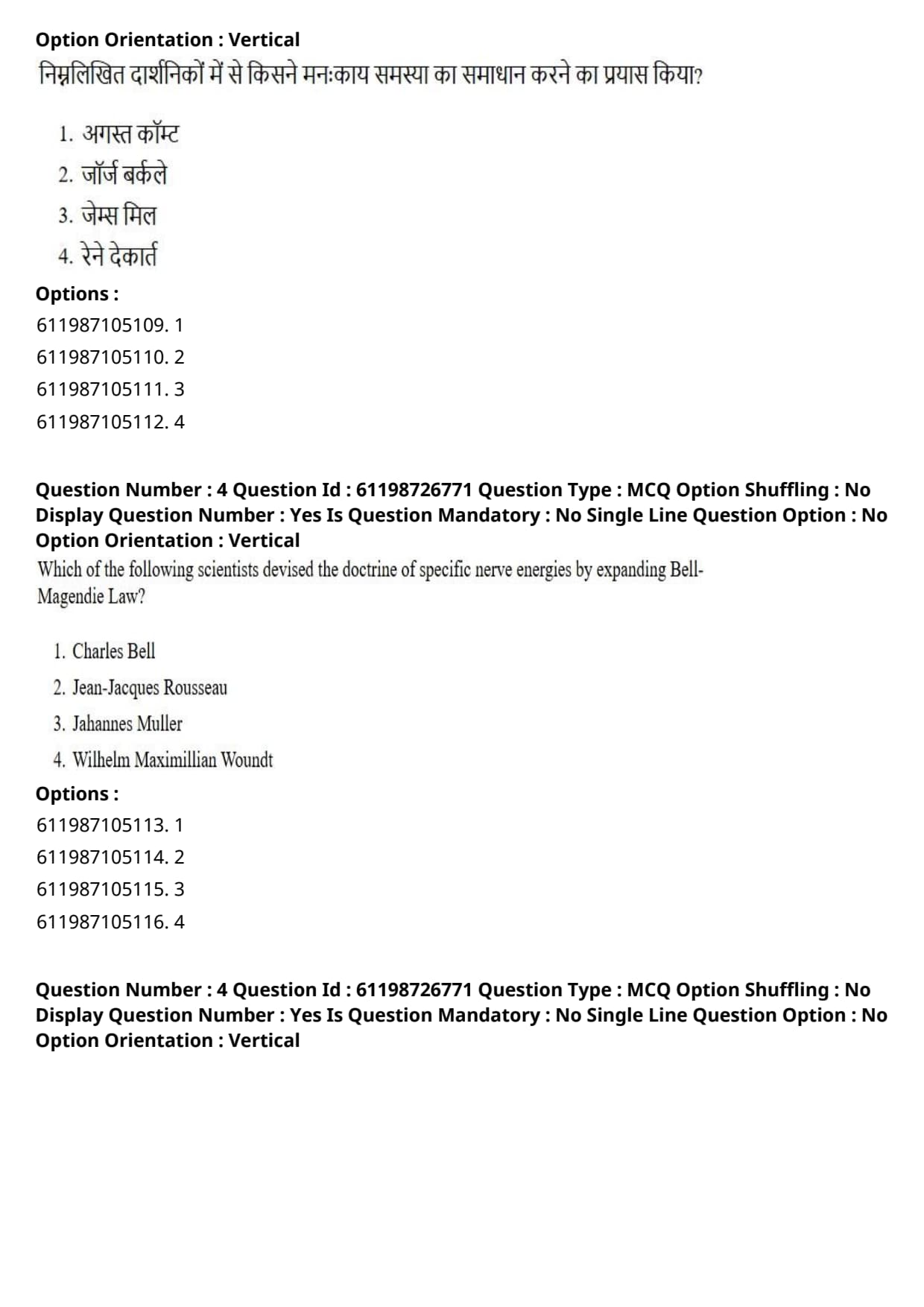
Who among the following philosophers attempted to resolve mind-body problem?

  • (A) Auguste Comte
  • (B) George Berkeley
  • (C) James Mill
  • (D) Rene Descartes
Correct Answer: (D) Rene Descartes
View Solution


Step 1: Understanding the Question:

The question asks us to identify the prominent philosopher who attempted to resolve the classic mind-body problem.


Step 2: Detailed Explanation:


René Descartes is famous for formulating Cartesian dualism, which posits that the mind and body are two distinct substances.

Descartes defined the mind as a non-extended, thinking substance (\textit{res cogitans) and the body as an extended, physical substance (\textit{res extensa).

He attempted to resolve the interaction between these two distinct realms by proposing that they communicate through the pineal gland in the brain.

Auguste Comte is known as the father of positivism and sociology, focusing on empirical scientific observation rather than metaphysical mind-body dualism.

George Berkeley proposed subjective idealism, resolving the problem by claiming that only the mind and its ideas exist (\textit{esse est percipi).

James Mill proposed a purely associationist view of the mind, analyzing mental states as mechanical combinations of sensory elements.

Descartes' systematic attempt to explain how physical actions relate to conscious mental experiences remains the cornerstone of the mind-body debate.


Step 3: Final Answer:

René Descartes is the philosopher famous for his systematic attempt to resolve the mind-body problem through interactionist dualism.
Quick Tip: Remember Descartes' pineal gland hypothesis as his biological attempt to solve the mind-body interaction problem, which remains a central theme in physiological psychology and philosophy.


Question 4:

Which of the following scientists devised the doctrine of specific nerve energies by expanding Bell-Magendie Law?

  • (A) Charles Bell
  • (B) Jean-Jacques Rousseau
  • (C) Johannes Muller
  • (D) Wilhelm Maximillian Wundt
Correct Answer: (C) Johannes Muller
View Solution


Step 1: Understanding the Question:

The question asks us to identify the scientist who formulated the doctrine of specific nerve energies by expanding upon the sensory-motor distinctions established by the Bell-Magendie Law.


Step 2: Detailed Explanation:


The Bell-Magendie Law established that the dorsal roots of the spinal cord carry sensory information while the ventral roots carry motor information.

Johannes Müller expanded this physiological concept into the sensory domain by formulating the Doctrine of Specific Nerve Energies in 1826.

Müller argued that our sensory experiences depend not on the physical stimulus itself, but on which nervous pathways are stimulated.

For example, pressure on the eyeball stimulates the optic nerve and produces a visual sensation of light, demonstrating that visual pathways always yield visual experiences.

Charles Bell was co-discoverer of the Bell-Magendie Law but did not formulate the generalized doctrine of specific nerve energies.

Jean-Jacques Rousseau was a political philosopher, and Wilhelm Wundt was the founder of experimental psychology who built upon Müller's physiological foundations.


Step 3: Final Answer:

Johannes Müller is the physiologist who formulated the doctrine of specific nerve energies.
Quick Tip: Associate "Doctrine of Specific Nerve Energies" directly with Johannes Müller. This physiological principle laid the groundwork for modern sensory neuroscience and sensory mapping.


Question 5:

What was the subject matter of psychology according to Edward Bradford Titchener?

  • (A) Conscious experience
  • (B) Sub-conscious experience
  • (C) Unconscious experience
  • (D) Meta-conscious experience
Correct Answer: (A) Conscious experience
View Solution


Step 1: Understanding the Question:

The question asks us to identify the core subject matter of psychology as defined by the structuralist Edward Bradford Titchener.


Step 2: Detailed Explanation:


Edward Bradford Titchener was a student of Wilhelm Wundt and the founder of Structuralism in the United States.

Titchener defined psychology as the science of conscious experience, specifically analyzed from the perspective of the experiencing individual.

He believed that consciousness could be broken down into basic, constituent elements: sensations (elements of perceptions), images (elements of ideas), and affections (elements of emotions).

To study these elements, structuralists utilized highly trained self-observation known as experimental introspection.

Titchener rejected the study of unconscious processes (which was later popularized by Sigmund Freud's psychoanalysis).

Sub-conscious and meta-conscious concepts were outside the structuralist definition of psychology's empirical scope.


Step 3: Final Answer:

According to Edward Bradford Titchener, the proper subject matter of psychology is Conscious experience.
Quick Tip: Structuralism always equates the mind to the sum total of conscious experience at any given moment, studied via analytic introspection.


Question 6:

Which of the following schools of psychology was strongly influenced by Darwin's theory of natural selection?

  • (A) Structuralism
  • (B) Functionalism
  • (C) Behaviourism
  • (D) Psychodynamic
Correct Answer: (B) Functionalism
View Solution


Step 1: Understanding the Question:

The question asks us to identify the school of psychology that drew substantial inspiration from Charles Darwin's evolutionary theory of natural selection.


Step 2: Detailed Explanation:


Functionalism, championed by William James, John Dewey, and James Rowland Angell, focused on how mental processes operate to help organisms adapt to their environments.

This focus on the "utility" and "adaptive value" of consciousness was a direct application of Charles Darwin's theory of natural selection.

Rather than looking at static structures of the mind (as Structuralism did), functionalists wanted to know *why* the mind functions the way it does.

Behaviorism focused on observable stimulus-response relations, and while it used animal models, its philosophical core was environmental learning rather than direct evolutionary adaptation of conscious processes.

Psychodynamic theory focused on internal unconscious conflicts, heavily drawing from biological drives but not originating as a direct functional adaptation school.

Thus, Functionalism is the school defined by its evolutionary, adaptive perspective on human mental life.


Step 3: Final Answer:

Functionalism is the psychological school of thought that was strongly influenced by Darwin's theory of natural selection.
Quick Tip: Think of "adaptation," "utility of consciousness," and "Darwin" as a single conceptual cluster that points directly to Functionalism and William James.


Question 7:

Which kind of glia cells wraps around the synaptic terminals of axons?

  • (A) Astrocytes
  • (B) Microglia
  • (C) Oligodendrocytes
  • (D) Schwann Cells
Correct Answer: (A) Astrocytes
View Solution


Step 1: Understanding the Question:

The question asks us to identify the type of glial cell that physically wraps around and supports the synaptic junctions of neurons.


Step 2: Detailed Explanation:


Astrocytes are star-shaped glial cells in the central nervous system that play a crucial role in maintaining synaptic structures.

They extend processes that wrap around the synaptic cleft and synaptic terminals of axons, forming what is known as the "tripartite synapse."

By wrapping around synapses, astrocytes isolate them chemically, uptake excess neurotransmitters (such as glutamate), and regulate ion concentrations (like potassium).

Microglia function as the primary immune defense of the central nervous system, acting as phagocytes to clear cellular debris and pathogens.

Oligodendrocytes produce the myelin sheath that insulates axons within the central nervous system.

Schwann cells provide myelin sheathing for axons in the peripheral nervous system.

Therefore, only astrocytes are physically positioned to envelop and chemically regulate synaptic terminals.


Step 3: Final Answer:

Astrocytes are the glial cells that wrap around the synaptic terminals of axons to assist in synaptic transmission and maintenance.
Quick Tip: Remember the concept of the "tripartite synapse" which consists of: 1. Presynaptic membrane, 2. Postsynaptic membrane, and 3. Astrocytic processes wrapping them.


Question 8:

What kind of receptor is rhodopsin, which does not respond to neurotransmitter molecules?

  • (A) C-protein coupled receptor
  • (B) G-protein coupled receptor
  • (C) M-protein coupled receptor
  • (D) n-protein coupled receptor
Correct Answer: (B) G-protein coupled receptor
View Solution


Step 1: Understanding the Question:

The question asks for the biological classification of the light-sensitive receptor protein rhodopsin.


Step 2: Detailed Explanation:


Rhodopsin is the photopigment located in the outer segment of rod cells in the retina, responsible for dim-light vision.

Structurally, rhodopsin belongs to the superfamily of G-protein coupled receptors (GPCRs), characterized by seven transmembrane domains.

Unlike typical GPCRs in the nervous system that are activated by chemical ligands (neurotransmitters), rhodopsin is activated by light (photons).

When light strikes the 11-cis-retinal cofactor inside rhodopsin, it isomerizes to all-trans-retinal, causing a conformational change in the opsin protein.

This conformational change activates a specialized G-protein called transducin, initiating the visual phototransduction cascade.

There are no standard categories named "C-protein," "M-protein," or "n-protein" coupled receptors in standard neurobiology.


Step 3: Final Answer:

Rhodopsin is structurally and functionally classified as a G-protein coupled receptor (GPCR).
Quick Tip: Even though GPCRs are famous for neurotransmission, some function as sensory receptors. Rhodopsin is the classic evolutionary example of a light-activated GPCR.


Question 9:

Which is the area of the sensory cortex that receives most of its inputs directly from the thalamic relay nuclei of the system?

  • (A) Lateral sensory cortex
  • (B) Secondary sensory cortex
  • (C) Sensory motor cortex
  • (D) Primary sensory cortex
Correct Answer: (D) Primary sensory cortex
View Solution


Step 1: Understanding the Question:

The question asks to identify the specific cortical region that acts as the primary receiver of sensory signals relayed from the thalamus.


Step 2: Detailed Explanation:


The thalamus acts as the "gateway" or major relay station for sensory systems (excluding olfaction) before information reaches the cerebral cortex.

Specific thalamic relay nuclei project directly to dedicated regions of the cerebral cortex known as the primary sensory cortices.

For example, the lateral geniculate nucleus (LGN) of the thalamus projects to the primary visual cortex (V1), and the medial geniculate nucleus (MGN) projects to the primary auditory cortex (A1).

The secondary sensory cortex receives highly processed inputs primarily from the primary sensory cortex rather than directly from thalamic relay nuclei.

Sensory motor cortex is a functional overlap zone involved in motor integration, not the primary destination of raw thalamic sensory relays.

Lateral sensory cortex is not a standard functional-anatomical division used to describe primary sensory processing.


Step 3: Final Answer:

The area of the sensory cortex receiving direct projections from the thalamic relay nuclei is the Primary sensory cortex.
Quick Tip: Remember the flow of sensory information: Sensory Receptors \(\rightarrow\) Thalamic Relay Nuclei \(\rightarrow\) Primary Sensory Cortex \(\rightarrow\) Secondary Sensory Cortex \(\rightarrow\) Association Cortex.


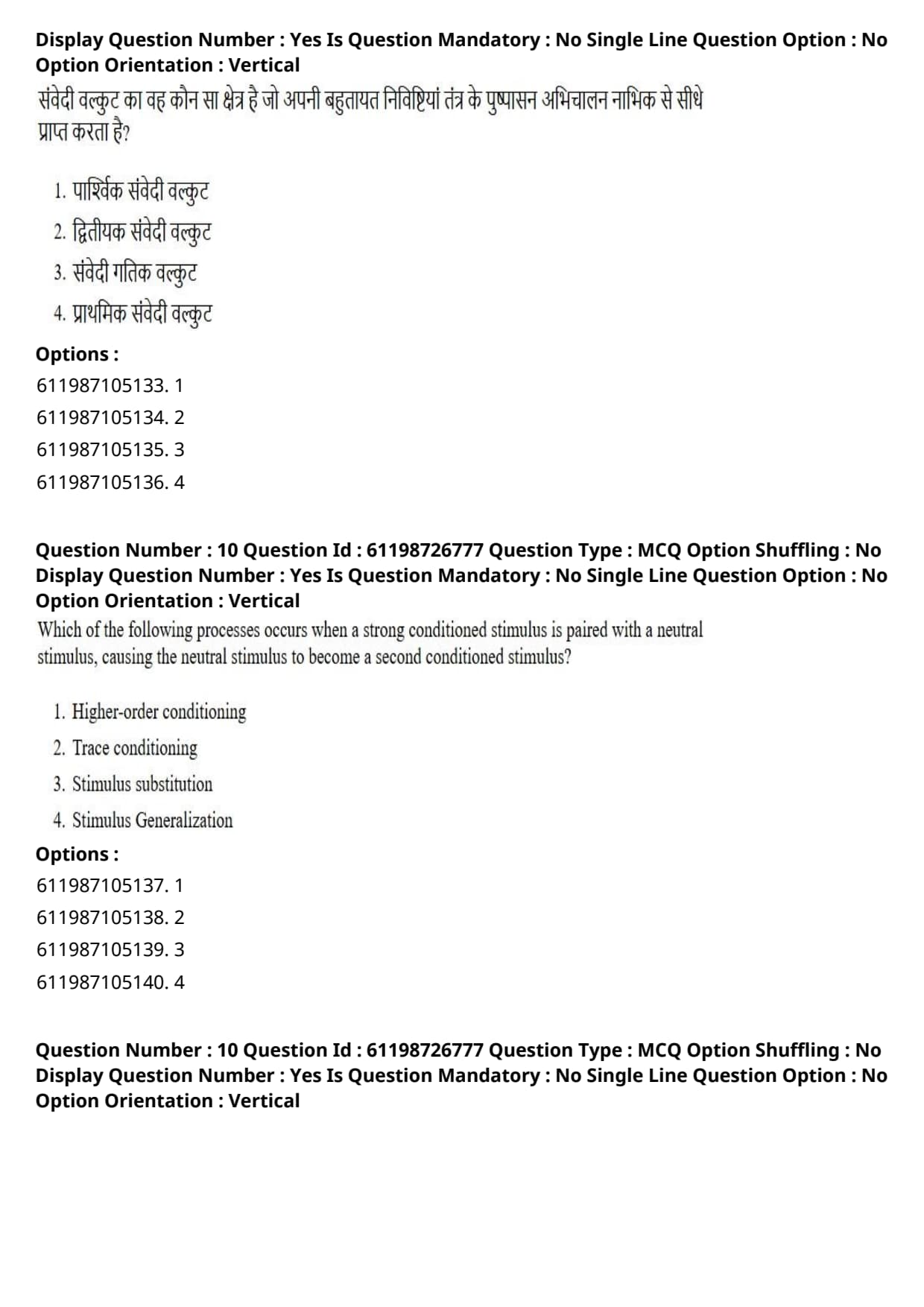
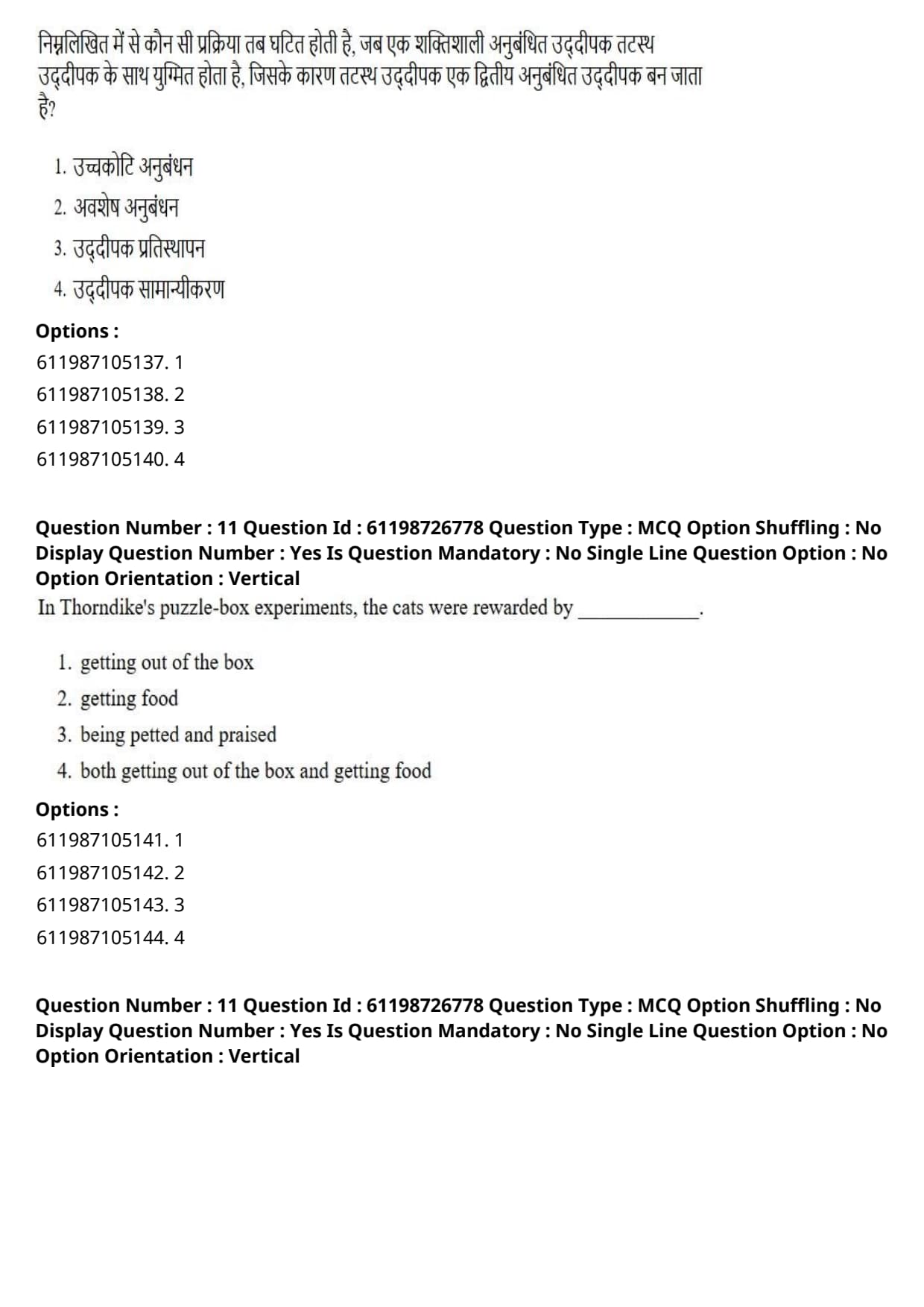
Question 10:

Which of the following processes occurs when a strong conditioned stimulus is paired with a neutral stimulus, causing the neutral stimulus to become a second conditioned stimulus?

  • (A) Higher-order conditioning
  • (B) Trace conditioning
  • (C) Stimulus substitution
  • (D) Stimulus Generalization
Correct Answer: (A) Higher-order conditioning
View Solution


Step 1: Understanding the Question:

The question asks us to identify the classical conditioning process where an established conditioned stimulus (CS) serves as the basis for conditioning a new, neutral stimulus.


Step 2: Detailed Explanation:


Higher-order conditioning (also called second-order conditioning) is a process in which a well-established conditioned stimulus (\(CS_1\)) is paired with a new neutral stimulus (\(NS\)).

Because the \(CS_1\) is already strongly associated with the unconditioned stimulus (\(UCS\)), it can act like an unconditioned stimulus itself to transfer the association to the new neutral stimulus.

After successful pairings, the neutral stimulus becomes a secondary conditioned stimulus (\(CS_2\)) and elicits the conditioned response (\(CR\)) on its own.

Trace conditioning is a specific temporal arrangement where the neutral stimulus is presented and terminated before the unconditioned stimulus begins.

Stimulus substitution is Pavlov's physiological theory of how conditioning works in the brain, suggesting the CS acts as a direct substitute for the UCS.

Stimulus generalization occurs when stimuli similar to the original conditioned stimulus evoke the conditioned response without specific pairing.


Step 3: Final Answer:

The process described, where a strong CS helps turn a neutral stimulus into a second CS, is Higher-order conditioning.
Quick Tip: In higher-order conditioning, the unconditioned stimulus (UCS) is never paired with the second-order conditioned stimulus (\(CS_2\)). The learning is built entirely upon the \(CS_1\).


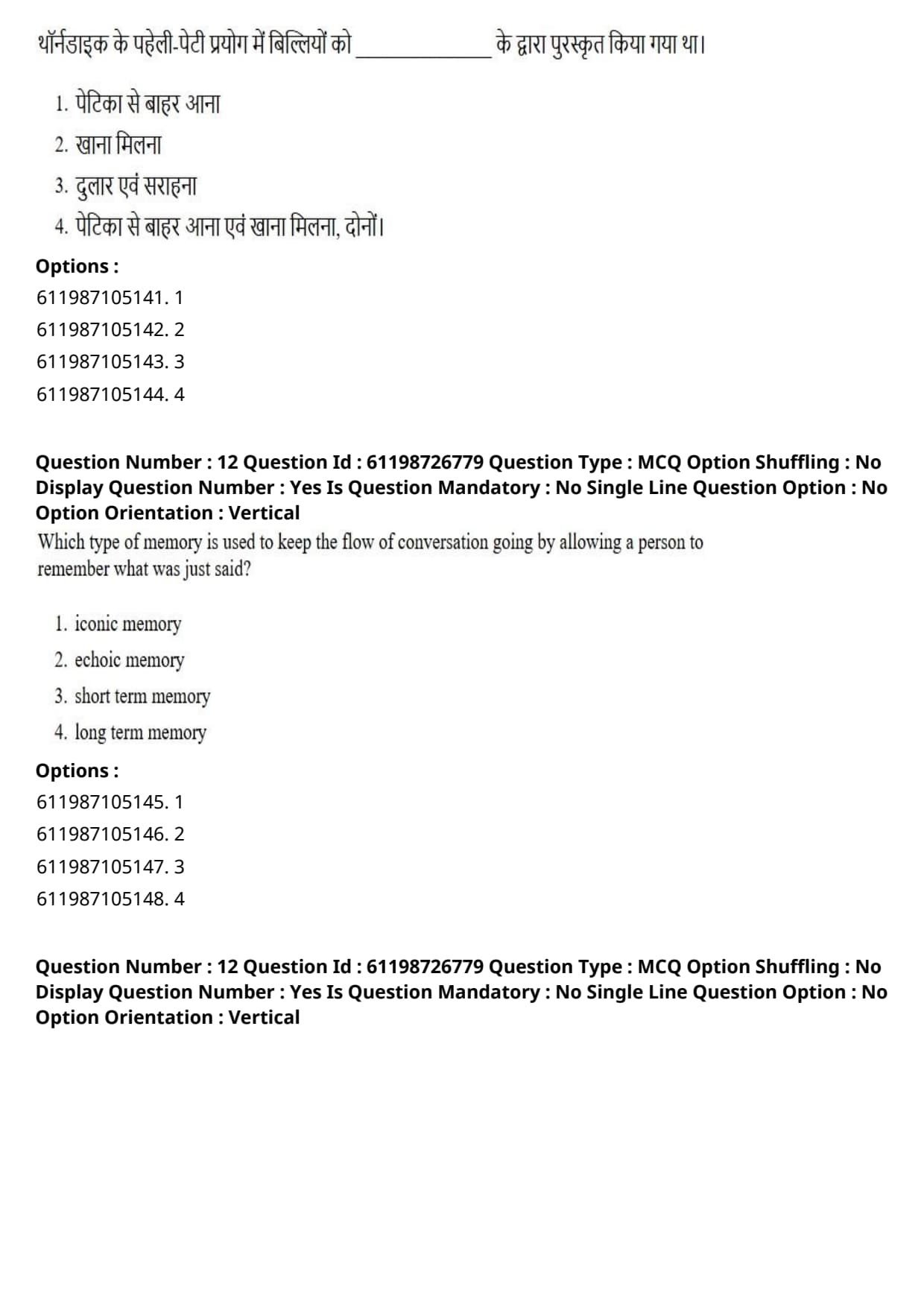
Question 11:

In Thorndike's puzzle-box experiments, the cats were rewarded by ____________.

  • (A) getting out of the box
  • (B) getting food
  • (C) being petted and praised
  • (D) both getting out of the box and getting food
Correct Answer: (D) both getting out of the box and getting food
View Solution


Step 1: Understanding the Question:

The question asks us to identify the reinforcing consequences (rewards) experienced by the cats in Edward Thorndike's classic puzzle-box learning experiments.


Step 2: Detailed Explanation:


Edward Thorndike placed hungry cats inside a wooden crate called a "puzzle box."

To escape, the cats had to perform a specific mechanical action, such as pulling a loop, stepping on a treadle, or pressing a lever.

Outside the box, a small portion of appetizing food (usually fish) was placed in plain sight of the cat.

When the cat successfully performed the correct action, the door fell open, which allowed the cat to immediately escape the confinement of the box.

Upon escaping, the cat was immediately able to consume the food placed outside.

Therefore, the behavioral response was reinforced by two simultaneous rewards: the negative reinforcement of escaping the cramped box and the positive reinforcement of eating the food.


Step 3: Final Answer:

The cats in Thorndike's puzzle-box experiments were rewarded by both getting out of the box and getting food.
Quick Tip: Thorndike's Law of Effect states that behaviors followed by satisfying states are strengthened. For a hungry, confined cat, both freedom and food comprise this satisfying state.


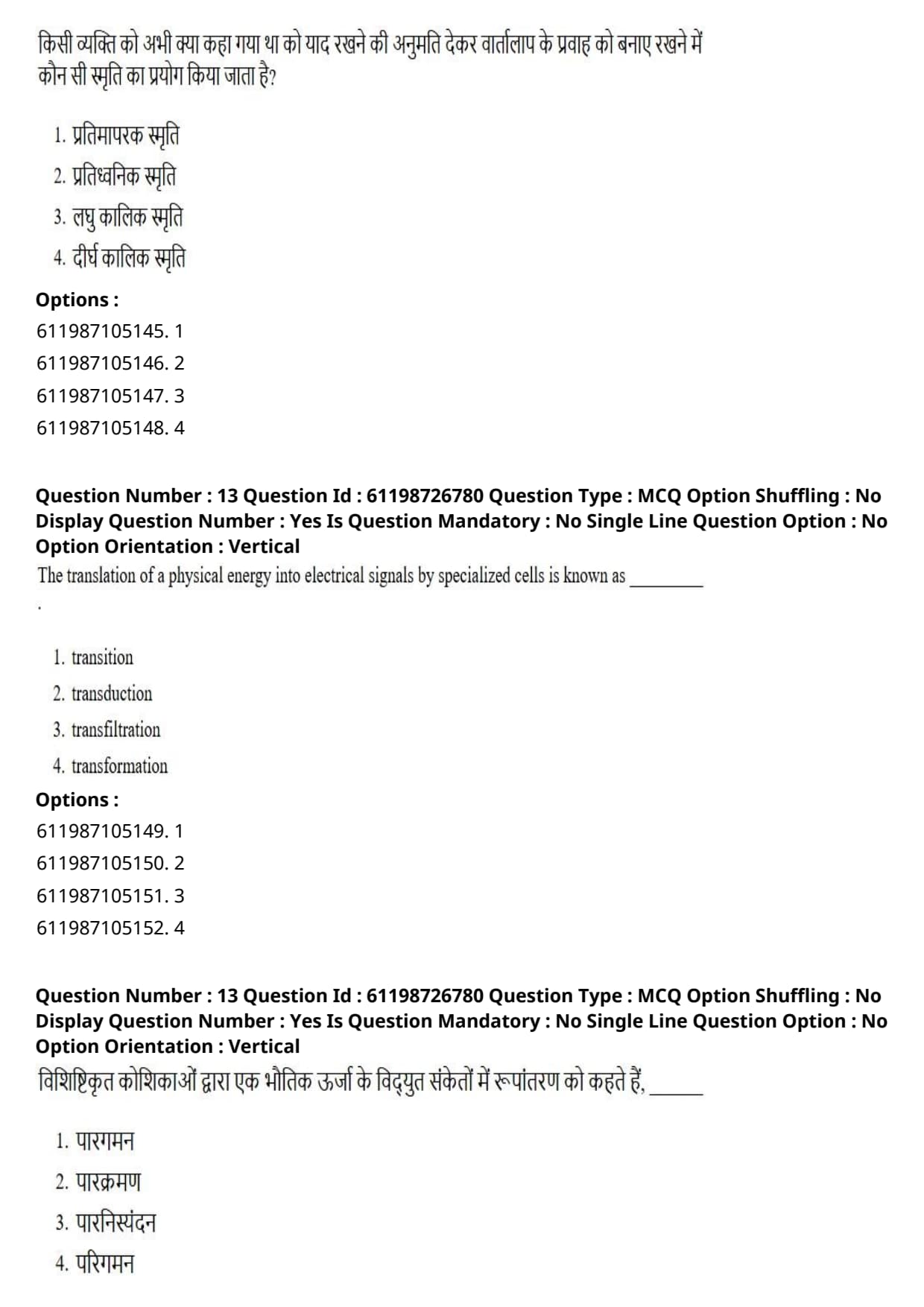
Question 12:

Which type of memory is used to keep the flow of conversation going by allowing a person to remember what was just said?

  • (A) iconic memory
  • (B) echoic memory
  • (C) short term memory
  • (D) long term memory
Correct Answer: (B) echoic memory
View Solution


Step 1: Understanding the Question:

The question asks us to identify the specific memory system that enables continuous processing of speech so we can maintain conversational flow by briefly holding onto auditory input.


Step 2: Detailed Explanation:


Echoic memory is the sensory memory register specialized for holding auditory information for a very brief duration (typically \(2\) to \(4\) seconds).

This "auditory echo" allows the brain to retain the exact acoustic details of the beginning of a sentence long enough to process the complete verbal thought once the sentence ends.

This is what lets you "hear" what someone said even if you were initially distracted when they started speaking.

Iconic memory is the visual counterpart of sensory memory, lasting only a fraction of a second, which is useless for conversational speech.

Short-term memory has a longer duration (\(15\) to \(30\) seconds) and holds cognitive concepts rather than the immediate sensory echo of spoken words.

Long-term memory stores semantic and episodic information indefinitely, rather than serving as the immediate conversational buffer.


Step 3: Final Answer:

Echoic memory is the immediate sensory memory buffer used to keep conversations flowing by preserving auditory inputs long enough to decode speech.
Quick Tip: Echoic memory acts like a "playback" button in your brain, holding speech sounds just long enough for you to recognize their linguistic meaning in real-time conversations.


Question 13:

The translation of a physical energy into electrical signals by specialized cells is known as __________.

  • (A) transition
  • (B) transduction
  • (C) transfiltration
  • (D) transformation
Correct Answer: (B) transduction
View Solution


Step 1: Understanding the Question:

The question asks for the scientific term that describes how sensory organs convert environmental physical energies into neuroelectrical signals.


Step 2: Detailed Explanation:


Sensory transduction is the process of converting an environmental physical stimulus (e.g., electromagnetic light waves, mechanical sound waves, chemical odorants) into electrochemical neural impulses.

This process is carried out by specialized sensory receptor cells (such as photoreceptors in the eye, hair cells in the cochlea, and nociceptors in the skin).

Once physical energy is transducted into action potentials, the nervous system can transmit this information to the brain for perceptual processing.

Transition refers generally to passing from one state or place to another.

Transfiltration is not a biological or psychological term.

Transformation is a general term describing structural change, but it lacks the physiological precision of transduction.


Step 3: Final Answer:

The biological conversion of physical stimuli into neural electrical signals is called transduction.
Quick Tip: Transduction is the "translator" of the brain. Without transduction, physical energy (like light or sound) remains completely invisible and uninterpretable to the nervous system.


Question 14:

Which of the following is the true sensory receptor of sound?

  • (A) Pinna
  • (B) Oval Window
  • (C) Hair Cells
  • (D) Tympanic Membrane
Correct Answer: (C) Hair Cells
View Solution


Step 1: Understanding the Question:

The question asks us to identify the specific physiological structure that acts as the primary sensory receptor cell for hearing.


Step 2: Detailed Explanation:


The auditory pathway consists of accessory structures that conduct sound vibrations, and sensory receptor cells that convert those vibrations into neural signals.

Hair cells, located on the basilar membrane within the organ of Corti inside the cochlea, are the true sensory receptors of sound.

When sound waves cause fluid movement inside the cochlea, the hair cells' stereocilia bend, opening mechanosensitive ion channels to initiate depolarization.

The pinna is the external cartilaginous ear structure that simply collects and funnels acoustic waves into the auditory canal.

The oval window is a membrane-covered opening that transmits mechanical vibrations from the ossicles (middle ear bones) into the fluid of the inner ear.

The tympanic membrane (eardrum) is a thin membrane that vibrates in response to air-conducted sound waves, initiating mechanical conduction.


Step 3: Final Answer:

The true sensory receptor cells of sound that perform auditory transduction are the Hair Cells.
Quick Tip: Accessory auditory structures (Pinna, Tympanic Membrane, Oval Window, Ossicles) only vibrate or guide sound. Actual sensory transduction is performed strictly by the Hair Cells.


Question 15:

Which of the following is NOT a monocular cue for depth?

  • (A) Convergence
  • (B) Overlap
  • (C) Linear perspective
  • (D) Texture gradient
Correct Answer: (A) Convergence
View Solution


Step 1: Understanding the Question:

The question asks us to identify which of the listed depth perception cues requires the use of both eyes (making it binocular rather than monocular).


Step 2: Detailed Explanation:


Depth cues are divided into monocular cues (perceived with one eye) and binocular cues (requiring coordinated visual input from both eyes).

Overlap (interposition) is a monocular cue where an object blocking another object is perceived as being closer.

Linear perspective is a monocular cue where parallel lines appear to converge as they recede into the distance.

Texture gradient is a monocular cue where closer surfaces show distinct details and distant surfaces appear smooth and packed.

Convergence is a binocular depth cue. It is a neuromuscular cue that relies on the brain sensing the angle of inward rotation of the eyes when focusing on nearby objects.


Step 3: Final Answer:

Convergence is a binocular depth cue and is therefore NOT a monocular cue for depth.
Quick Tip: There are only two major binocular depth cues to memorize: Retinal (Binocular) Disparity and Convergence. All other pictorial cues are monocular.


Question 16:

The theory of emotion that states that the thalamus sends sensory information to the cortex and the sympathetic organs at the same time is the _________ theory.

  • (A) James-Lange
  • (B) Cannon-Bard
  • (C) Schachter- Singer
  • (D) Facial feedback
Correct Answer: (B) Cannon-Bard
View Solution


Step 1: Understanding the Question:

The question asks to identify the classical theory of emotion asserting that emotional experience and physiological arousal occur simultaneously via thalamic pathways.


Step 2: Detailed Explanation:


The Cannon-Bard theory of emotion (proposed by Walter Cannon and Philip Bard) argues that emotional feelings and physical arousal are parallel, independent processes.

When an emotion-triggering stimulus is perceived, sensory pathways transmit this information to the thalamus.

The thalamus simultaneously relays this information to the cerebral cortex (producing the subjective experience of emotion) and the autonomic nervous system (triggering bodily arousal).

The James-Lange theory, by contrast, argues that physiological arousal occurs first, and our cognitive perception of that physical state is what we label as emotion.

The Schachter-Singer (two-factor) theory states that emotion is determined by both undifferentiated physiological arousal and a cognitive label applied to it.

The Facial Feedback hypothesis focuses on how facial muscle movements directly modulate emotional experiences.


Step 3: Final Answer:

The theory pointing to simultaneous thalamic distribution of emotional experience and arousal is the Cannon-Bard theory.
Quick Tip: Think of "Cannon-Bard" as a double-barreled shotgun firing at the exact same time: one barrel fires physiological arousal, and the other fires subjective emotional experience.


Question 17:

Those people who are high in the need for __________ want to be liked by others and are good team players.

  • (A) Power
  • (B) Emotion
  • (C) Affiliation
  • (D) Achievement
Correct Answer: (C) Affiliation
View Solution


Step 1: Understanding the Question:

The question asks to identify the specific motivational need characterized by a strong desire to build relationships, be liked, and work collaboratively.


Step 2: Detailed Explanation:


David McClelland developed the Acquired Needs Theory, which posits that human motivation is driven by three dominant needs: Achievement, Affiliation, and Power.

The Need for Affiliation (nAff) is characterized by a strong desire for friendly interpersonal relationships, social acceptance, and interpersonal harmony.

Individuals high in nAff thrive in cooperative environments, value team cohesion, and prioritize being liked by peers over personal dominance.

The Need for Power (nPow) involves a desire to control, influence, or lead others, which often conflicts with merely trying to be liked.

The Need for Achievement (nAch) focuses on personal mastery, reaching high standards, and accomplishing challenging tasks individually.

Emotion is not a motivational need category in McClelland's framework.


Step 3: Final Answer:

People who prioritize group acceptance and excel as collaborative team players are high in the need for Affiliation.
Quick Tip: Remember McClelland's triad: nAch = Tasks and mastery; nPow = Control and status; nAff = Social harmony and teamwork.


Question 18:

Which of the following needs proposed by Maslow is involved in helping others to achieve their full potential?

  • (A) Self- actualization
  • (B) Transcendence
  • (C) Cognitive
  • (D) Esteem
Correct Answer: (B) Transcendence
View Solution


Step 1: Understanding the Question:

The question asks us to identify the need in Abraham Maslow's expanded hierarchy of needs that involves looking beyond oneself to help others achieve their potential.


Step 2: Detailed Explanation:


While Abraham Maslow's initial model ended with self-actualization, he later expanded the hierarchy to include cognitive, aesthetic, and transcendence needs.

Self-actualization refers to an individual realizing their own personal potential, creativity, and self-fulfillment.

Transcendence, placed above self-actualization, represents a shift from self-oriented goals to other-oriented, altruistic, or spiritual goals.

Transcendence involves helping other people realize their potential, experiencing deep connection to nature or humanity, and pursuing selfless service.

Cognitive needs involve the desire to search, understand, and explore information.

Esteem needs concern the desire for personal respect, reputation, and social status.


Step 3: Final Answer:

The need proposed by Maslow that focuses on helping others realize their full potential is Transcendence.
Quick Tip: Self-actualization is about "becoming the best version of yourself," whereas Transcendence is about "helping others become the best version of themselves."


Question 19:

Sternberg found that _________ intelligence is a good predictor of success in life but has low relationship to _________ intelligence.

  • (A) practical; academic
  • (B) practical; creative
  • (C) academic; practical
  • (D) academic; creative
Correct Answer: (A) practical; academic
View Solution


Step 1: Understanding the Question:

The question asks us to complete a statement regarding Robert Sternberg's Triarchic Theory of Intelligence, specifically concerning real-world success and its relation to traditional academic metrics.


Step 2: Detailed Explanation:


Robert Sternberg proposed the Triarchic Theory of Intelligence, consisting of analytical (academic), creative, and practical intelligence.

Analytical intelligence involves abstract problem-solving and is typically measured by standard school grades and IQ tests.

Practical intelligence, often called "street smarts," is the ability to adapt to, shape, or select everyday environmental contexts.

Sternberg's research demonstrated that practical intelligence is an excellent predictor of occupational and life success.

However, practical intelligence has a surprisingly weak correlation with traditional academic intelligence, meaning a person can be highly practical without being highly analytical in academic settings.

This distinction separates raw book-smart academic capability from real-world, situational practical intelligence.


Step 3: Final Answer:

Sternberg found that practical intelligence is a strong predictor of success in life but has a low relationship to academic intelligence.
Quick Tip: Think of "practical intelligence" as real-world adaptation (street smarts) which operates independently of formal classroom grading or "academic intelligence" (book smarts).


Question 20:

According to Goleman which of the following intelligence types has more powerful influence in the success of person in his/ her life than other forms of intelligence?

  • (A) Practical
  • (B) Emotional
  • (C) Creative
  • (D) Analytical
Correct Answer: (B) Emotional
View Solution


Step 1: Understanding the Question:

The question asks us to identify the type of intelligence that Daniel Goleman argued is the single most powerful predictor of life success.


Step 2: Detailed Explanation:


In his landmark 1995 book, Daniel Goleman popularized the concept of Emotional Intelligence (EQ).

Goleman argued that traditional cognitive intelligence (IQ) accounts for only a small percentage of a person's vocational and personal success.

Instead, Goleman asserted that emotional intelligence—comprising self-awareness, self-regulation, empathy, motivation, and social skills—plays a far more critical role in determining positive life outcomes.

Practical, creative, and analytical intelligences are core components of Sternberg's triarchic model rather than Goleman's emotional intelligence framework.

Emotional intelligence allows individuals to build strong relationships, navigate complex workplace dynamics, manage stress, and make resilient decisions.


Step 3: Final Answer:

According to Goleman, Emotional intelligence has a more powerful influence on a person's life success than other forms of intelligence.
Quick Tip: Associate Daniel Goleman directly with the popularization of Emotional Intelligence (EQ) as the premier predictor of relational and leadership success.


Question 21:

In which psychosexual stage might fixation result in a person who is excessively neat and fussy?

  • (A) Oral
  • (B) Anal
  • (C) Phallic
  • (D) Genital
Correct Answer: (B) Anal
View Solution


Step 1: Understanding the Question:

The question asks us to identify the psychosexual developmental stage in Sigmund Freud's theory where fixation leads to an adult personality characterized by excessive orderliness, neatness, and fussiness.


Step 2: Detailed Explanation:


Sigmund Freud's psychosexual theory postulates that childhood development occurs in stages: Oral, Anal, Phallic, Latency, and Genital.

The anal stage (from roughly \(1.5\) to \(3\) years) focuses on pleasure derived from retaining and expelling feces, coinciding with toilet training.

If toilet training is conducted in an excessively harsh, punitive, or rigid manner, the child may experience fixation at this stage.

This fixation results in an "anal-retentive" adult personality, characterized by being overly neat, tidy, orderly, stubborn, stingy, and fussy.

Conversely, a lenient approach can lead to an "anal-expulsive" personality, characterized by messiness, disorganization, and carelessness.

Oral fixation typically leads to dependence, overeating, or smoking; Phallic fixation centers on Oedipal conflicts and gender identity; the Genital stage represents mature adult relationships.


Step 3: Final Answer:

Fixation during the Anal stage of psychosexual development results in an excessively neat, tidy, and fussy adult personality.
Quick Tip: Remember: Anal-retentive = Retaining feces, leading to rigid control, neatness, and frugality. Anal-expulsive = Letting go freely, leading to messiness and disorganization.


Question 22:

According to behaviourists, personality is __________.

  • (A) driven by unconscious forces
  • (B) a set of learned responses
  • (C) motivated by striving for success
  • (D) a collection of specific traits
Correct Answer: (B) a set of learned responses
View Solution


Step 1: Understanding the Question:

The question asks for the fundamental definition of personality from the perspective of behaviorist theorists.


Step 2: Detailed Explanation:


Behaviorism (championed by B.F. Skinner, John B. Watson, and Albert Bandura) rejects the idea of internal, unobservable mental traits or drives.

Behaviorists view personality not as a stable inner essence, but rather as a comprehensive set of learned responses or habits.

These behaviors are acquired through classical conditioning, operant conditioning, observational learning, and cumulative reinforcement history.

Unconscious forces are the cornerstone of the psychodynamic model (Freud).

Striving for success and self-actualization are core concepts in humanistic and Adlerian psychology.

A collection of specific traits is the core definition of personality according to trait theorists (like Allport, Cattell, and Eysenck).


Step 3: Final Answer:

According to behaviorists, personality is defined as a set of learned responses and habits acquired through environmental conditioning.
Quick Tip: For behaviorists, there is no mysterious "self" inside; what we call "personality" is simply the sum total of our learned behavioral habits.


Question 23:

If a test measures a single construct, then its component items will be internally consistent. This characteristic of test is known as _________.

  • (A) Test fallacy
  • (B) Test dominance
  • (C) Test homogeneity
  • (D) Test validity
Correct Answer: (C) Test homogeneity
View Solution


Step 1: Understanding the Question:

The question asks us to identify the psychometric property that describes a test whose items are highly internally consistent and measure a single underlying construct.


Step 2: Detailed Explanation:


When all items on a psychological test measure the same single construct, the test is said to be unidimensional or homogeneous.

Test homogeneity refers to the degree to which the individual items on a test are intercorrelated and measure a single, unified psychological trait or construct.

High internal consistency (often measured using Cronbach's alpha) is a direct statistical indicator of test homogeneity.

Test fallacy is not a recognized psychometric term.

Test dominance is not a standard property related to internal item consistency.

Test validity refers to whether a test measures what it claims to measure, which is a broader concept that includes external relationships and content coverage, rather than just internal item consistency.

Therefore, a test that is internally consistent because it measures a single construct exhibits high test homogeneity.


Step 3: Final Answer:

The characteristics of a test measuring a single construct with internally consistent items is known as Test homogeneity.
Quick Tip: Remember that test homogeneity and internal consistency are closely related psychometric concepts that indicate all items on a scale are pulling in the same direction to measure one single variable.


Question 24:

Which of the following test is Not one of the tests used in Differential Aptitude Test?

  • (A) Verbal reasoning
  • (B) Naturalistic reasoning
  • (C) Abstract reasoning
  • (D) Mechanical reasoning
Correct Answer: (B) Naturalistic reasoning
View Solution


Step 1: Understanding the Question:

The question asks us to identify which of the listed subtests is not a component of the standardized Differential Aptitude Test (DAT) battery.


Step 2: Detailed Explanation:


The Differential Aptitude Test (DAT) is a widely used multi-aptitude test battery designed to measure a student's or worker's specific cognitive abilities.

The standard DAT battery comprises several distinct subtests, including: Verbal Reasoning, Numerical Ability, Abstract Reasoning, Mechanical Reasoning, Space Relations, Clerical Speed and Accuracy, Spelling, and Language Usage.

Verbal reasoning evaluates the ability to understand and analyze complex ideas expressed in words.

Abstract reasoning assesses non-verbal problem-solving skills using geometric shapes and patterns.

Mechanical reasoning measures the understanding of physical principles, machinery, and mechanical operations.

Naturalistic reasoning is not a subtest in the DAT battery; instead, "naturalistic" is a term famously associated with Howard Gardner's theory of multiple intelligences.


Step 3: Final Answer:

Naturalistic reasoning is not one of the tests included in the Differential Aptitude Test battery.
Quick Tip: To memorize the DAT subtests, use the acronym V-N-A-M-S-C-S-L: Verbal, Numerical, Abstract, Mechanical, Space, Clerical, Spelling, and Language. Naturalistic is an intelligence type, not a DAT subtest.


Question 25:

Which of the following processes indicate that the areas of the brain not being used lose synaptic connections and those being used show an increase in synaptic connections?

  • (A) Synaptic blooming
  • (B) Synaptic pruning
  • (C) Synaptic priming
  • (D) Synaptic rhythm
Correct Answer: (B) Synaptic pruning
View Solution


Step 1: Understanding the Question:

The question asks for the developmental neurobiological process whereby unused neural connections are eliminated while active neural pathways are maintained or strengthened.


Step 2: Detailed Explanation:


During early childhood, the brain undergoes a massive expansion of neural connections, a process known as synaptic blooming or synaptogenesis.

Following this rapid growth, the brain begins a process of selective elimination known as synaptic pruning.

Synaptic pruning operates on a "use it or lose it" principle, where synapses that are actively stimulated by the environment are preserved and strengthened, whereas inactive synapses are dismantled.

This pruning is crucial for brain efficiency, as it removes redundant connections and streamlines neural processing.

Synaptic priming refers to a form of molecular prep-work that ready synapses for neurotransmitter release or plasticity, but does not refer to connection loss.

Synaptic rhythm is not a standard physiological term describing the structural modification of neural connections over development.


Step 3: Final Answer:

The developmental neurological process of eliminating unused connections and reinforcing active ones is Synaptic pruning.
Quick Tip: Think of the brain as a garden. Synaptic blooming is the rapid, wild growth of weeds and flowers, while synaptic pruning is the careful trimming of dead branches to help the healthy ones grow stronger.


Question 26:

In which of the following stages of psychosocial development proposed by Erikson, child become convinced that they are person of their own and begin to discover what kind of person they will become?

  • (A) Initiative Vs. Guilt
  • (B) Trust Vs. Mistrust
  • (C) Autonomy Vs. Shame and Doubt
  • (D) Industry Vs. Inferiority
Correct Answer: (A) Initiative Vs. Guilt
View Solution


Step 1: Understanding the Question:

The question asks to identify the specific stage in Erik Erikson's theory of psychosocial development where a child asserts their individuality, establishes initiative, and begins defining who they want to become.


Step 2: Detailed Explanation:


In Erik Erikson's eight stages of psychosocial development, the third stage is Initiative vs. Guilt, which occurs during early childhood (ages \(3\) to \(5\) years).

During this stage, children use their motor, language, and cognitive skills to actively plan and initiate activities, games, and social interactions.

Erikson noted that during this stage, children become firmly convinced that they are a person of their own, separating from their parents' immediate identity and exploring their own potential and future self.

Trust vs. Mistrust occurs in infancy and focuses on establishing basic security and trust in caregivers.

Autonomy vs. Shame and Doubt occurs in toddlerhood (ages \(1\) to \(3\)) and is centered on physical self-control and independence.

Industry vs. Inferiority occurs in middle-to-late childhood, focusing on mastering social and academic skills.

Thus, early childhood's active exploration of a personal identity through planful actions belongs to the stage of Initiative vs. Guilt.


Step 3: Final Answer:

The stage in which a child becomes convinced they are a person of their own and starts planning their future self is Initiative Vs. Guilt.
Quick Tip: Remember that "Initiative" involves active planning, projecting oneself into the future, and declaring personal agency. This is the stage where children discover "what kind of person they will become."


Question 27:

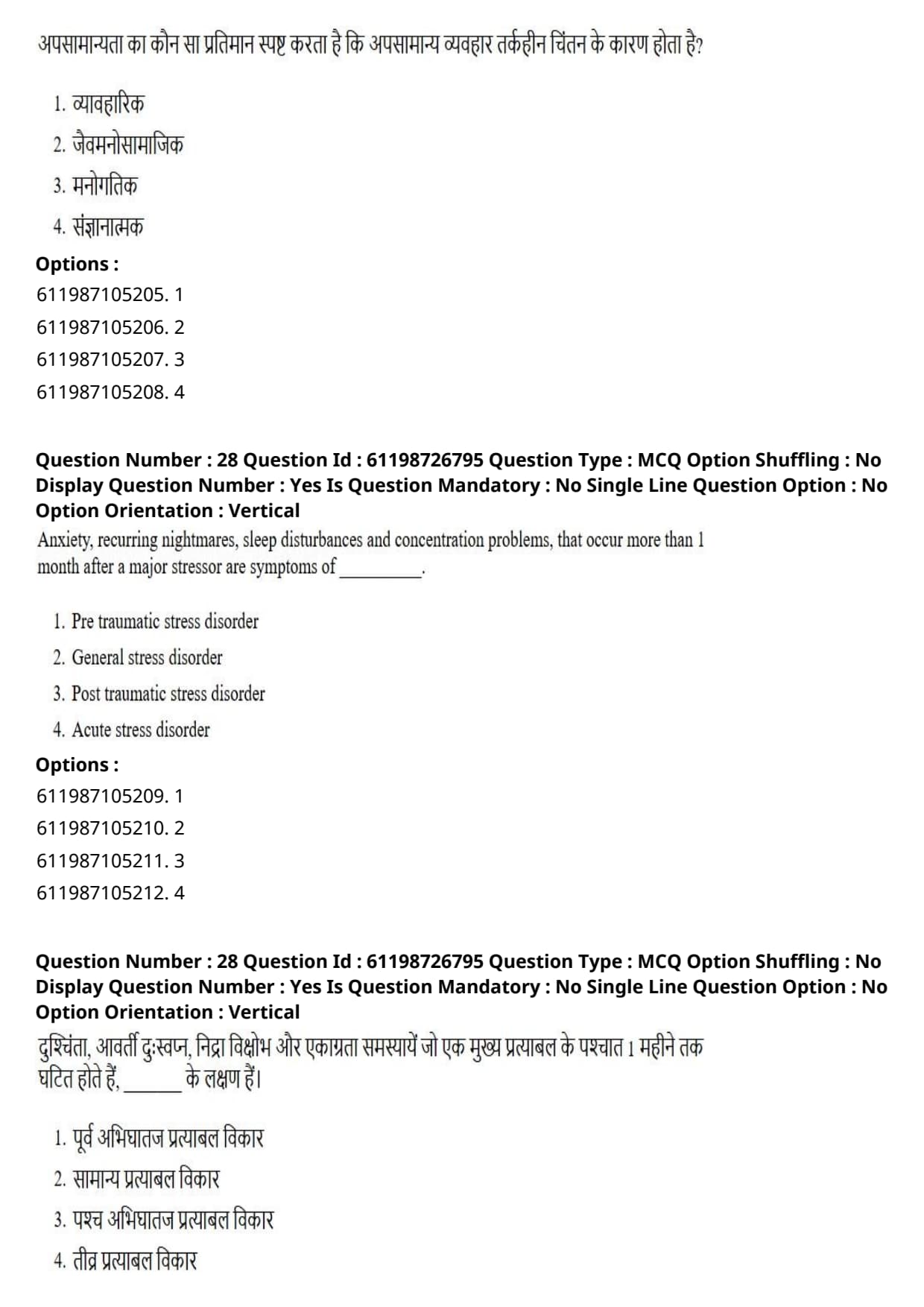
Which model of abnormality explains abnormal behaviour as caused by illogical thinking?

  • (A) Behavioural
  • (B) Biopsychosocial
  • (C) Psychodynamic
  • (D) Cognitive
Correct Answer: (D) Cognitive
View Solution


Step 1: Understanding the Question:

The question asks us to identify the theoretical model of psychopathology that attributes abnormal behavior to illogical thought patterns and cognitive distortions.


Step 2: Detailed Explanation:


The cognitive model of abnormality, pioneered by Aaron Beck and Albert Ellis, asserts that emotional distress and dysfunctional behavior are direct results of irrational beliefs and illogical thinking.

According to this model, individuals with psychological disorders process information through cognitive distortions, such as overgeneralization, catastrophizing, and black-and-white thinking.

The behavioural model views abnormal behavior as learned responses acquired through conditioning and environmental reinforcement.

The biopsychosocial model is an integrative perspective that considers biological, psychological, and social factors simultaneously, without focusing solely on thoughts.

The psychodynamic model attributes abnormality to unconscious, unresolved conflicts originating in early childhood experiences.

Therefore, only the cognitive model explicitly identifies illogical thinking as the root cause of psychological disorders.


Step 3: Final Answer:

The model that explains abnormal behavior as a product of illogical thinking is the Cognitive model.
Quick Tip: Whenever terms like "thinking," "beliefs," "attributions," "schemas," or "thought processes" are mentioned in relation to psychopathology, the correct theoretical framework is always the Cognitive model.


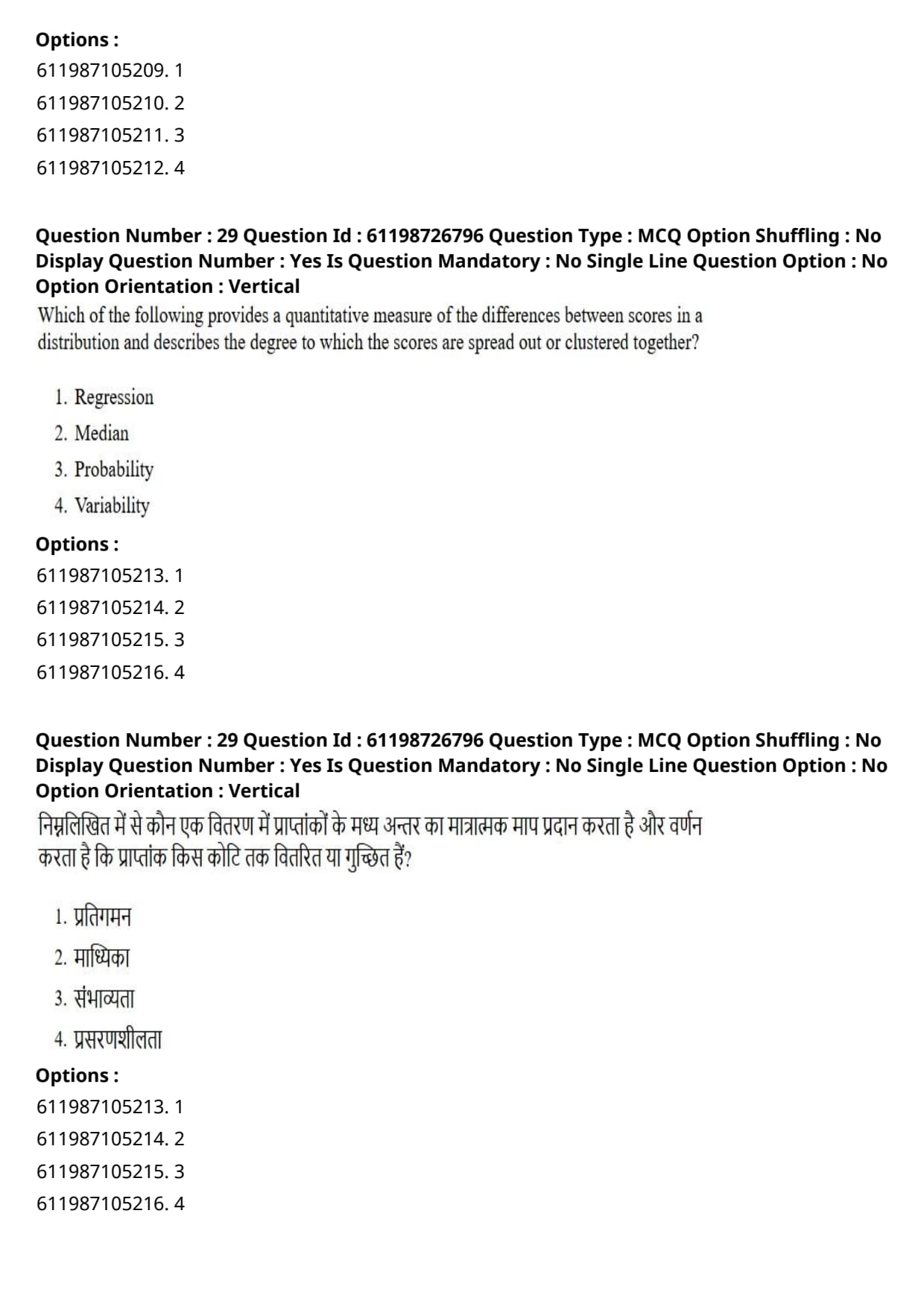
Question 28:

Anxiety, recurring nightmares, sleep disturbances and concentration problems, that occur more than 1 month after a major stressor are symptoms of _________.

  • (A) Pre traumatic stress disorder
  • (B) General stress disorder
  • (C) Post traumatic stress disorder
  • (D) Acute stress disorder
Correct Answer: (C) Post traumatic stress disorder
View Solution


Step 1: Understanding the Question:

The question asks us to identify the clinical disorder characterized by symptoms of anxiety, intrusive memories, and hyperarousal lasting more than one month following a major traumatic stressor.


Step 2: Detailed Explanation:


Post-Traumatic Stress Disorder (PTSD) is a mental health condition triggered by experiencing or witnessing a terrifying, life-threatening event.

Symptoms of PTSD include intrusive memories (recurring nightmares, flashbacks), avoidance of trauma reminders, negative alterations in mood, and marked hyperarousal (sleep disturbances, concentration problems).

Crucially, the diagnostic criteria in both the DSM-5 and ICD-11 require these symptoms to persist for more than \(1\) month following the trauma.

If the symptoms occur within the first month immediately following the trauma, the diagnosis is Acute Stress Disorder (ASD).

Pre-traumatic stress disorder is not an established clinical diagnosis in psychiatric classification.

General stress disorder is not a formal diagnostic category in standard manuals like DSM-5.


Step 3: Final Answer:

When symptoms like nightmares, hyperarousal, and concentration deficits persist for more than \(1\) month after a major stressor, the diagnosis is Post traumatic stress disorder.
Quick Tip: To distinguish between Acute Stress Disorder and PTSD, look at the timeline: under \(1\) month is Acute Stress Disorder; over \(1\) month is Post-Traumatic Stress Disorder.


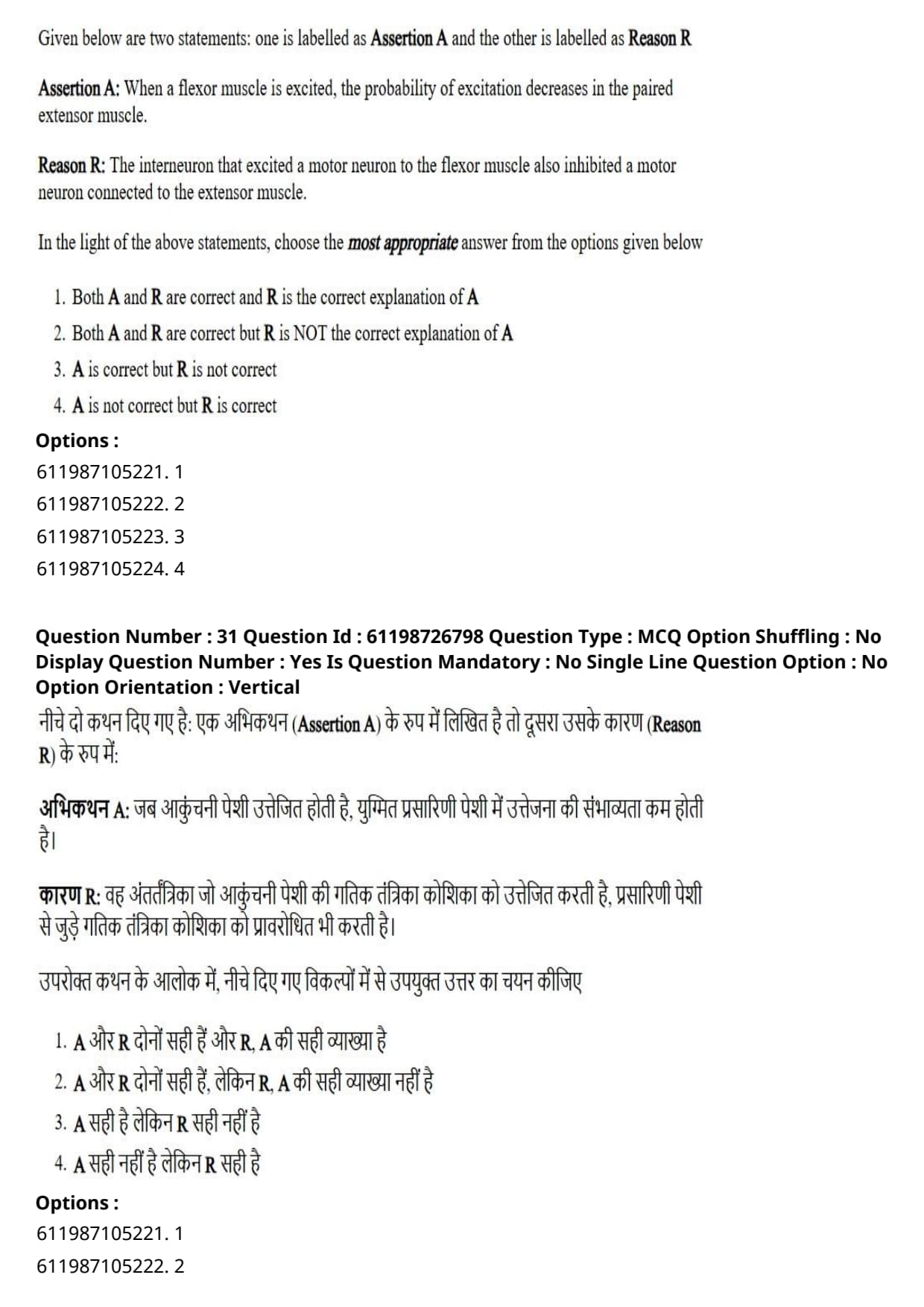
Question 29:

Which of the following provides a quantitative measure of the differences between scores in a distribution and describes the degree to which the scores are spread out or clustered together?

  • (A) Regression
  • (B) Median
  • (C) Probability
  • (D) Variability
Correct Answer: (D) Variability
View Solution


Step 1: Understanding the Question:

The question asks for the statistical concept that measures how much scores in a distribution differ from one another and indicates how spread out or clustered they are.


Step 2: Detailed Explanation:


In descriptive statistics, variability (also known as dispersion or spread) describes how spread out or clustered together the scores in a dataset are.

Measures of variability include the range, interquartile range, variance, and standard deviation.

A low variability indicates that the scores are clustered closely around a central value, while high variability indicates that the scores are highly spread out.

Regression is an inferential statistical technique used to predict the value of a dependent variable based on independent variables.

The median is a measure of central tendency that identifies the exact middle score in an ordered distribution.

Probability is a mathematical measure of the likelihood that a given event will occur.


Step 3: Final Answer:

The quantitative measure describing how scores are spread out or clustered together in a distribution is Variability.
Quick Tip: While measures of central tendency (mean, median, mode) tell you where the center of a distribution is, measures of variability (standard deviation, variance) tell you how far away the data points are from that center.


Question 30:

Which of the following refers to the peakedness or flatness of a frequency distribution as compared to the normal distribution?

  • (A) Skewness
  • (B) Kurtosis
  • (C) Variability
  • (D) Probability
Correct Answer: (B) Kurtosis
View Solution


Step 1: Understanding the Question:

The question asks to identify the statistical term that describes the peakedness or flatness of a frequency distribution curve relative to a standard normal curve.


Step 2: Detailed Explanation:


Kurtosis is a statistical measure used to describe the shape of a frequency distribution curve, specifically its peakedness or flatness.

A distribution with a high peak is called leptokurtic (positive kurtosis), indicating that scores are highly clustered around the center with heavy tails.

A distribution that is relatively flat is called platykurtic (negative kurtosis), indicating a broad, spread-out peak.

A distribution shaped similarly to the normal curve is called mesokurtic (zero excess kurtosis).

Skewness refers to the asymmetry of a distribution, indicating whether scores trail off more to the left (negative skew) or to the right (positive skew).

Variability describes the dispersion of scores but does not specifically refer to the geometric peakedness or flatness of the distribution curve.

Probability represents the likelihood of event occurrences, which is not a description of a distribution's physical shape.


Step 3: Final Answer:

The term that refers to the peakedness or flatness of a distribution curve is Kurtosis.
Quick Tip: Remember: Skewness = Lack of symmetry (left or right lean); Kurtosis = Height of peak (Lepto = tall/skinny, Platy = flat/broad like a plate).


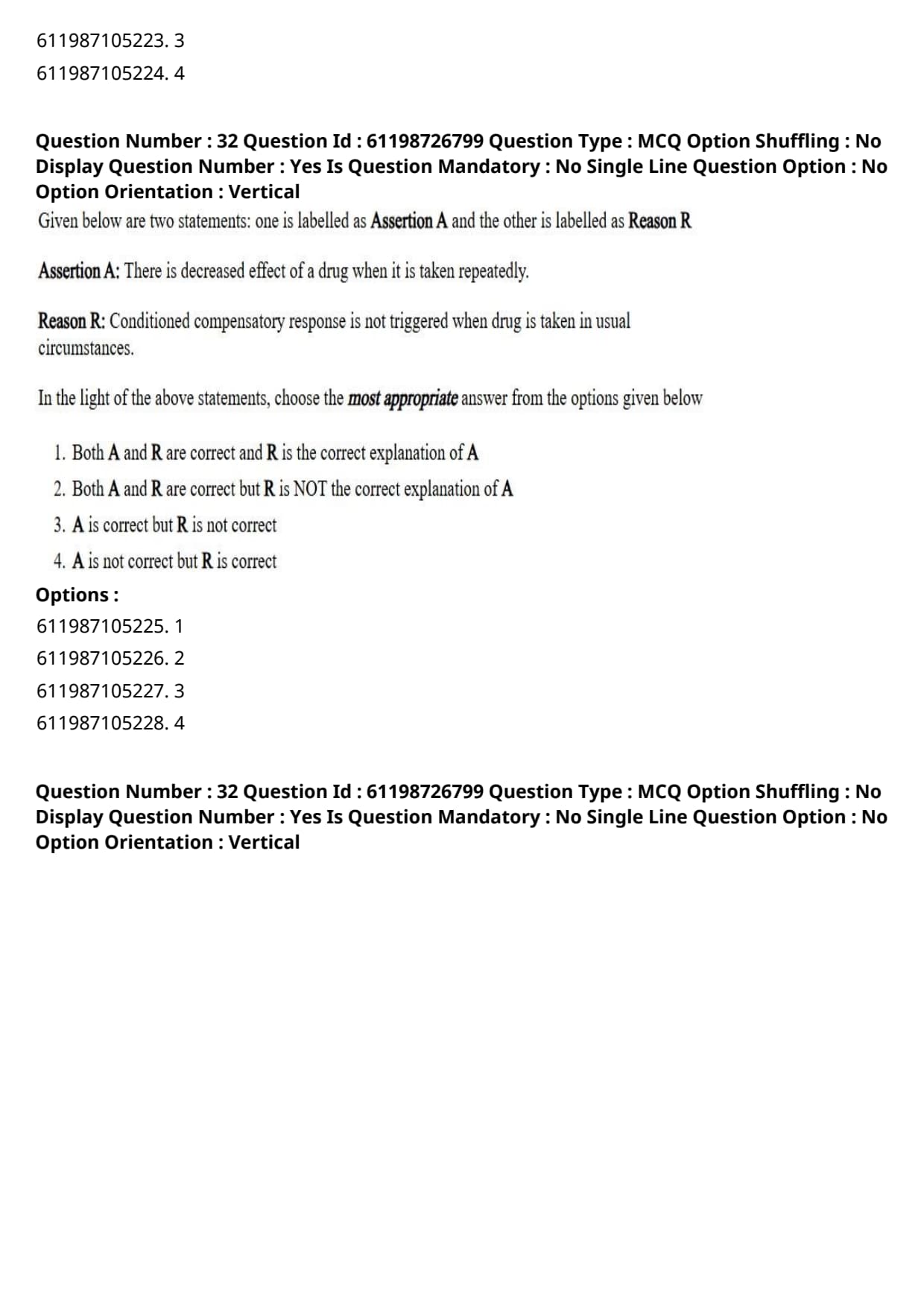
Question 31:

Given below are two statements: one is labelled as Assertion A and the other is labelled as Reason R

Assertion A: When a flexor muscle is excited, the probability of excitation decreases in the paired extensor muscle.

Reason R: The interneuron that excited a motor neuron to the flexor muscle also inhibited a motor neuron connected to the extensor muscle.

In the light of the above statements, choose the most appropriate answer from the options given below

  • (A) Both A and R are correct and R is the correct explanation of A
  • (B) Both A and R are correct but R is NOT the correct explanation of A
  • (C) A is correct but R is not correct
  • (D) A is not correct but R is correct
Correct Answer: (A) Both A and R are correct and R is the correct explanation of A
View Solution


Step 1: Understanding the Question:

The question asks us to analyze an Assertion-Reason pair explaining how antagonistic muscle groups (flexors and extensors) are coordinated during motor reflexes.


Step 2: Detailed Explanation:


Antagonistic muscle pairs, such as the biceps (flexor) and triceps (extensor), must work in a coordinated, opposite fashion to produce smooth limb movement.

Assertion A states that when a flexor muscle is excited, the probability of excitation in its paired extensor muscle decreases. This is a true statement describing the phenomenon of reciprocal inhibition.

Reason R explains the physiological mechanism behind this reflex. When sensory neurons detect a stimulus, they project into the spinal cord.

In the spinal cord, sensory neurons synapse with interneurons. One pathway of interneurons excites the motor neuron of the flexor muscle, causing it to contract.

Simultaneously, collateral branches of these interneurons activate inhibitory interneurons, which directly inhibit the motor neurons controlling the antagonistic extensor muscle, preventing it from contracting.

This reciprocal wiring ensures that muscles do not pull against one another, making the Reason a biologically accurate and direct explanation of the Assertion.


Step 3: Final Answer:

Both Assertion A and Reason R are correct, and Reason R provides the exact neurological explanation of Assertion A.
Quick Tip: Reciprocal inhibition is a fundamental spinal reflex mechanism. Inhibitory interneurons are the biological "switches" that turn off the antagonist muscle when the agonist muscle is turned on.


Question 32:

Given below are two statements: one is labelled as Assertion A and the other is labelled as Reason R

Assertion A: There is decreased effect of a drug when it is taken repeatedly.

Reason R: Conditioned compensatory response is not triggered when drug is taken in usual circumstances.

In the light of the above statements, choose the most appropriate answer from the options given below

  • (A) Both A and R are correct and R is the correct explanation of A
  • (B) Both A and R are correct but R is NOT the correct explanation of A
  • (C) A is correct but R is not correct
  • (D) A is not correct but R is correct
Correct Answer: (C) A is correct but R is not correct
View Solution


Step 1: Understanding the Question:

The question asks us to evaluate the scientific validity of an Assertion and a Reason relating drug tolerance to classical conditioning and conditioned compensatory responses.


Step 2: Detailed Explanation:


Assertion A states that there is a decreased effect of a drug when it is taken repeatedly. This is a true statement that defines the physiological and behavioral phenomenon of drug tolerance.

Reason R asserts that a conditioned compensatory response is not triggered when a drug is taken in usual circumstances. This statement is biologically and psychologically incorrect.

According to Shepard Siegel's classical conditioning model of drug tolerance, the environment in which a drug is taken repeatedly acts as a conditioned stimulus (\(CS\)).

The body learns to associate these environmental cues with the upcoming drug administration and triggers a conditioned compensatory response (\(CR\)) that opposes the drug's effects to maintain homeostasis.

Therefore, when the drug is taken in usual circumstances, this compensatory response *is* actively triggered, which directly reduces the drug's effective strength and causes tolerance.

If the drug is taken in an unusual environment, the \(CS\) is absent, the conditioned compensatory response is *not* triggered, and the drug effect remains dangerously high, which can lead to accidental overdoses.


Step 3: Final Answer:

Assertion A is correct because it accurately defines tolerance, but Reason R is incorrect because the conditioned compensatory response is actively triggered in usual drug-taking circumstances.
Quick Tip: Remember Shepard Siegel's model: Pavlovian conditioning plays a massive role in tolerance. Usual environment = CS present \(\rightarrow\) Compensatory CR triggered \(\rightarrow\) Tolerant response (lower drug effect).


Question 33:

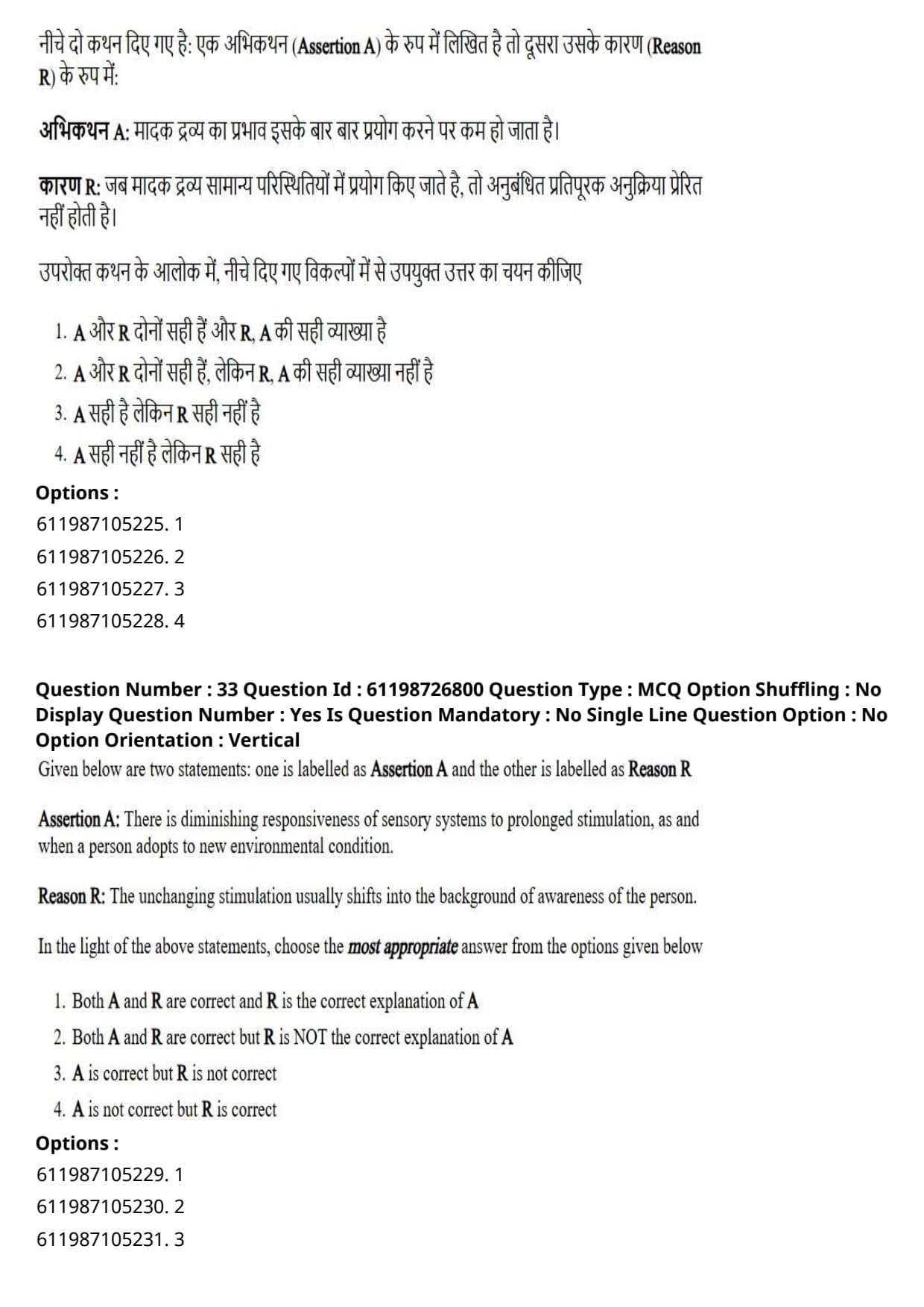
Given below are two statements: one is labelled as Assertion A and the other is labelled as Reason R

Assertion A: There is diminishing responsiveness of sensory systems to prolonged stimulation, as and when a person adopts to new environmental condition.

Reason R: The unchanging stimulation usually shifts into the background of awareness of the person.

In the light of the above statements, choose the most appropriate answer from the options given below

  • (A) Both A and R are correct and R is the correct explanation of A
  • (B) Both A and R are correct but R is NOT the correct explanation of A
  • (C) A is correct but R is not correct
  • (D) A is not correct but R is correct
Correct Answer: (A) Both A and R are correct and R is the correct explanation of A
View Solution


Step 1: Understanding the Question:

The question asks us to evaluate an Assertion-Reason pair regarding sensory adaptation and how unchanging stimuli are processed by human consciousness.


Step 2: Detailed Explanation:


Assertion A states that sensory systems show a diminishing responsiveness to prolonged, unchanging stimulation as a person adapts to environmental conditions. This is a true statement that defines sensory adaptation.

For example, when you walk into a kitchen with a strong coffee smell, you notice it immediately, but after a few minutes, you stop smelling it because your olfactory receptors adapt.

Reason R states that unchanging stimulation usually shifts into the background of a person's conscious awareness. This is also a true statement.

From an evolutionary perspective, sensory adaptation is highly adaptive because it prevents our brain from becoming overloaded with constant, irrelevant background noise.

By filtering out unchanging stimuli (shifting them to the background of awareness), our cognitive resources are freed up to detect novel changes in the environment, which could indicate threats or rewards.

Therefore, Reason R is a correct explanation for why and how the sensory systems diminish their responsiveness to prolonged stimulation.


Step 3: Final Answer:

Both Assertion A and Reason R are correct, and Reason R is the correct explanation of Assertion A.
Quick Tip: Sensory adaptation is a biological mechanism of efficiency. If a stimulus does not change, it carries no new information, so our nervous system filters it out and shifts it to the background of awareness.


Question 34:

Given below are two statements: one is labelled as Assertion A and the other is labelled as Reason R

Assertion A: Happy mood can increase creativity.

Reason R: Nigotiators who are in a good mood adopt more cooperative strategies and expect better outcomes.

In the light of the above statements, choose the most appropriate answer from the options given below

  • (A) Both A and R are correct and R is the correct explanation of A
  • (B) Both A and R are correct but R is NOT the correct explanation of A
  • (C) A is correct but R is not correct
  • (D) A is not correct but R is correct
Correct Answer: (B) Both A and R are correct but R is NOT the correct explanation of A
View Solution


Step 1: Understanding the Question:

The question asks us to determine the relationship between an Assertion about mood and creativity, and a Reason about mood and negotiation strategies.


Step 2: Detailed Explanation:


Assertion A states that a happy mood can increase creativity. This is a true statement supported by extensive research in cognitive psychology (e.g., Alice Isen's work).

A positive emotional state broadens cognitive flexibility, promotes divergent thinking, and allows people to see unusual connections between ideas, thereby boosting creative problem-solving.

Reason R states that negotiators who are in a good mood adopt more cooperative strategies and expect better outcomes. This is also a true statement, well-established in social and organizational psychology.

Positive affect increases empathy, collaboration, and a preference for win-win outcomes during interpersonal conflicts and negotiation tasks.

However, while both statements are true, Reason R does not explain Assertion A.

The cooperative behavior of negotiators does not provide a cognitive or physiological explanation for why a happy mood enhances creative thinking.

The cognitive broadening theory (e.g., Barbara Fredrickson's Broaden-and-Build theory) is what links mood to creativity, not negotiation cooperation.


Step 3: Final Answer:

Both Assertion A and Reason R are correct, but Reason R is a separate, unrelated application of positive mood and does not explain why positive mood increases creativity.
Quick Tip: When checking Assertion-Reason questions, always read both separately first. If both are true, ask: "Does Statement R tell me *why* Statement A happens?" If the answer is no, select option B.


Question 35:

Given below are two statements: one is labelled as Assertion A and the other is labelled as Reason R

Assertion A: Older, more experienced individuals can sometimes outperform younger ones on cognitive tasks ranging from scientific research to chess.

Reason R: Fluid intelligence seems to increase slowly with age but crystallized intelligence decreases.

In the light of the above statements, choose the most appropriate answer from the options given below

  • (A) Both A and R are correct and R is the correct explanation of A
  • (B) Both A and R are correct but R is NOT the correct explanation of A
  • (C) A is correct but R is not correct
  • (D) A is not correct but R is correct
Correct Answer: (C) A is correct but R is not correct
View Solution


Step 1: Understanding the Question:

The question asks us to evaluate statements regarding age-related changes in fluid and crystallized intelligence and how they influence cognitive performance in older individuals.


Step 2: Detailed Explanation:


Assertion A states that older, more experienced individuals can sometimes outperform younger ones on complex cognitive tasks like scientific research and chess. This is a true statement.

This performance advantage occurs because tasks like chess and research heavily rely on domain-specific knowledge, schemas, and life experience, which accumulate over decades.

Reason R states that fluid intelligence increases slowly with age but crystallized intelligence decreases. This is biologically and psychologically incorrect.

According to Raymond Cattell's theory of intelligence, fluid intelligence (the capacity to think logically and solve problems in novel situations, independent of acquired knowledge) peaks in early adulthood and steadily declines with age.

Conversely, crystallized intelligence (the ability to use skills, knowledge, and experience) remains stable or increases slowly throughout middle and late adulthood.

Therefore, the correct explanation for Assertion A is that older adults' high crystallized intelligence and specialized expertise compensate for declines in fluid intelligence.


Step 3: Final Answer:

Assertion A is correct, but Reason R is incorrect because it reverses the developmental trajectories of fluid and crystallized intelligence.
Quick Tip: Remember: Fluid = Flowing/Flexible (declines with age, starting in your \(20\)s); Crystallized = Solid/Hardened knowledge (grows stronger and accumulates with age).


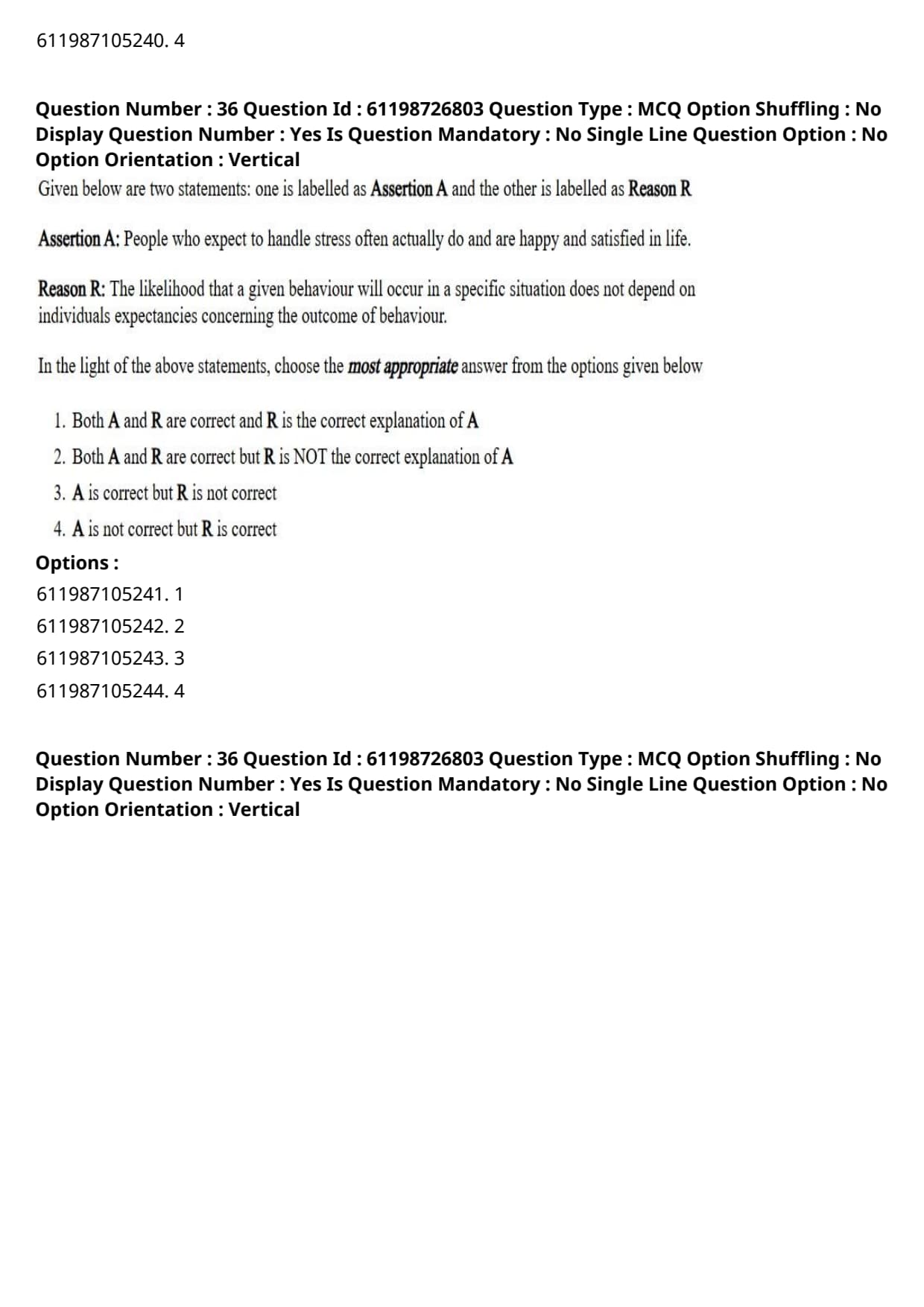
Question 36:

Given below are two statements: one is labelled as Assertion A and the other is labelled as Reason R

Assertion A: People who expect to handle stress often actually do and are happy and satisfied in life.

Reason R: The likelihood that a given behaviour will occur in a specific situation does not depend on individuals' expectancies concerning the outcome of behaviour.

In the light of the above statements, choose the most appropriate answer from the options given below

  • (A) Both A and R are correct and R is the correct explanation of A
  • (B) Both A and R are correct but R is NOT the correct explanation of A
  • (C) A is correct but R is not correct
  • (D) A is not correct but R is correct
Correct Answer: (C) A is correct but R is not correct
View Solution


Step 1: Understanding the Question:

The question asks us to analyze the validity of statements concerning stress coping, self-expectancies, and their influence on human behavior as proposed by social-cognitive theories.


Step 2: Detailed Explanation:


Assertion A states that people who expect to handle stress effectively often do so and report higher life satisfaction. This is a true statement.

This aligns with Albert Bandura's theory of self-efficacy, which states that an individual's belief in their ability to perform a task directly determines their stress levels, motivation, and coping success.

Reason R states that the likelihood of a behavior occurring in a specific situation does not depend on an individual's expectancies regarding the outcome of that behavior. This is false.

According to Julian Rotter's social learning theory, Behavior Potential (\(BP\)) is a direct function of Expectancy (\(E\)) and Reinforcement Value (\(RV\)), expressed as \(BP = f(E \& RV)\).

This means people are highly likely to perform a behavior if they expect that behavior will lead to a positive, successful outcome.

Therefore, individual expectancies are major determinants of actual behavioral outcomes, rendering Reason R incorrect.


Step 3: Final Answer:

Assertion A is correct because high coping expectancies promote successful coping, but Reason R is incorrect because behavior is heavily dependent on expectancies.
Quick Tip: Self-efficacy and outcome expectancies act as self-fulfilling prophecies. If you expect you can cope, you are more likely to apply active coping strategies and successfully reduce stress.


Question 37:

Given below are two statements: one is labelled as Assertion A and the other is labelled as Reason R

Assertion A: The IQ scores of the children of mothers who are exposed to teratogens are found to be low.

Reason R: The use of drugs, alcohol consumption and smoking by mothers lead to central nervous system dysfunction in children.

In the light of the above statements, choose the most appropriate answer from the options given below

  • (A) Both A and R are correct and R is the correct explanation of A
  • (B) Both A and R are correct but R is NOT the correct explanation of A
  • (C) A is correct but R is not correct
  • (D) A is not correct but R is correct
Correct Answer: (A) Both A and R are correct and R is the correct explanation of A
View Solution


Step 1: Understanding the Question:

The question asks us to evaluate how prenatal exposure to teratogens (such as drugs, alcohol, and nicotine) affects the cognitive development and neurophysiology of children.


Step 2: Detailed Explanation:


Assertion A states that children born to mothers who were exposed to teratogens during pregnancy often have lower IQ scores. This is a true statement.

Teratogens are external agents, such as chemicals, viruses, or drugs, that can cross the placental barrier and cause physical or cognitive abnormalities during prenatal development.

Reason R states that maternal use of drugs, alcohol, and tobacco leads to central nervous system (CNS) dysfunction in developing children. This is also a true statement.

During pregnancy, the developing brain is highly sensitive to toxins. Alcohol and drugs disrupt neuronal migration, synapse formation, and myelination in the fetal brain.

This disruption results in structural and functional central nervous system damage (e.g., Fetal Alcohol Spectrum Disorders).

Because the central nervous system is the biological foundation for all cognitive processes, CNS dysfunction directly leads to lower cognitive capabilities and reduced IQ scores.

Therefore, Reason R is a direct physiological explanation for the lower IQ scores described in Assertion A.


Step 3: Final Answer:

Both Assertion A and Reason R are correct, and Reason R explains the biological mechanism that causes the outcome described in Assertion A.
Quick Tip: Teratogens target developing organ systems. Because the brain develops throughout the entire pregnancy, it is highly susceptible to teratogens, which often manifests as lower IQ and cognitive impairment.


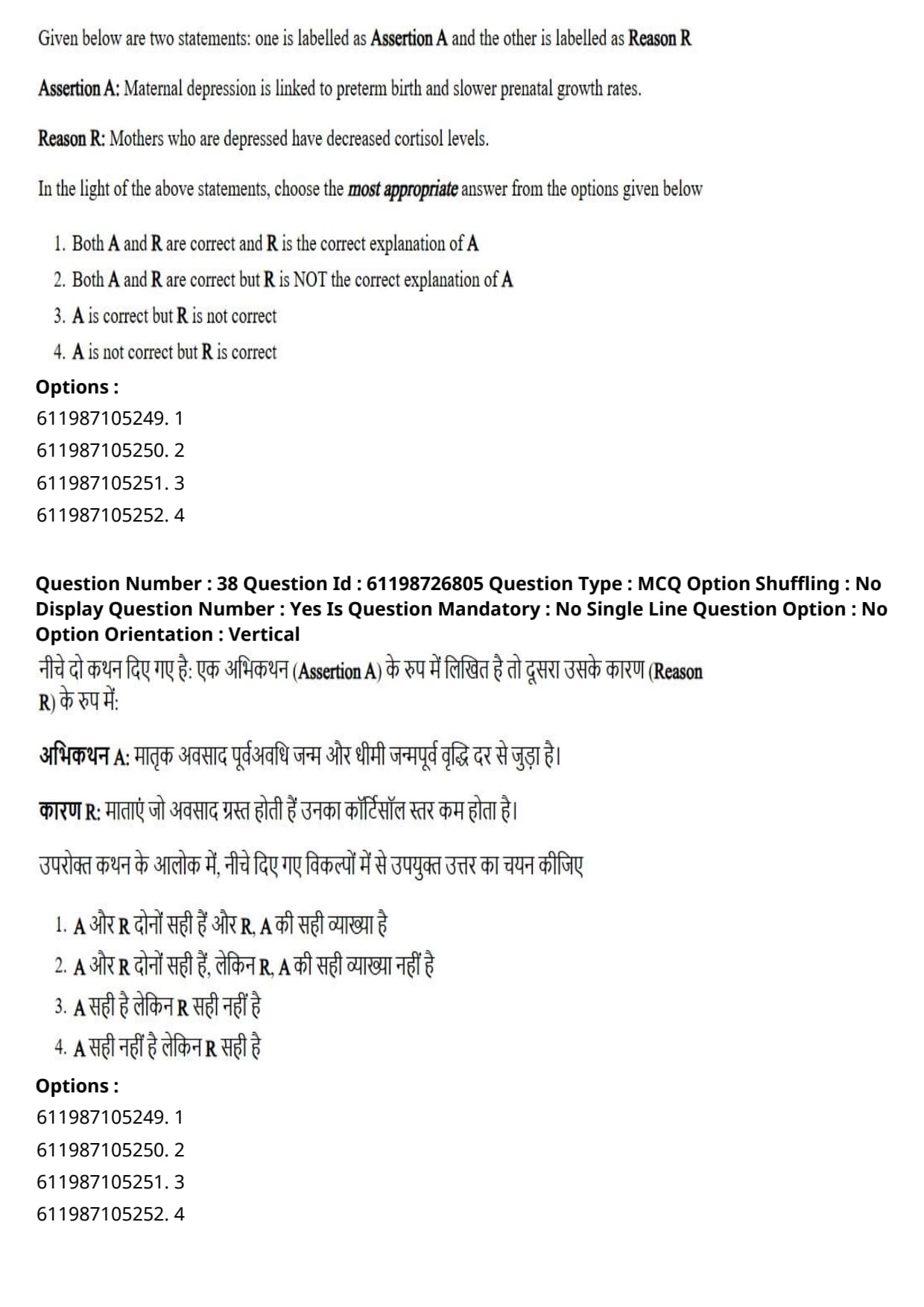
Question 38:

Given below are two statements: one is labelled as Assertion A and the other is labelled as Reason R

Assertion A: Maternal depression is linked to preterm birth and slower prenatal growth rates.

Reason R: Mothers who are depressed have decreased cortisol levels.

In the light of the above statements, choose the most appropriate answer from the options given below

  • (A) Both A and R are correct and R is the correct explanation of A
  • (B) Both A and R are correct but R is NOT the correct explanation of A
  • (C) A is correct but R is not correct
  • (D) A is not correct but R is correct
Correct Answer: (C) A is correct but R is not correct
View Solution


Step 1: Understanding the Question:

The question asks us to analyze the relationship between maternal prenatal depression, its biological stress markers (cortisol), and its developmental outcomes on the fetus.


Step 2: Detailed Explanation:


Assertion A states that maternal depression during pregnancy is linked to preterm birth and slower prenatal growth rates. This is a true, well-documented clinical finding.

Depressed and highly anxious mothers often experience chronic physiological stress, which compromises placental blood flow and restricts fetal oxygen and nutrient supply, leading to slower growth and premature labor.

Reason R states that depressed mothers have decreased cortisol levels. This statement is biologically incorrect.

Depression and chronic stress typically trigger a hyperactive Hypothalamic-Pituitary-Adrenal (HPA) axis, leading to *increased* or dysregulated levels of cortisol and other stress hormones.

These elevated maternal cortisol levels can pass through the placenta, disrupt fetal brain development, restrict fetal weight gain, and induce early labor.

Therefore, the adverse developmental outcomes in Assertion A are driven by *elevated* cortisol levels, making Reason R scientifically false.


Step 3: Final Answer:

Assertion A is correct, but Reason R is incorrect because depression is associated with elevated or dysregulated cortisol, not decreased cortisol.
Quick Tip: Think of cortisol as the primary "stress hormone." Chronic stress and depression keep the HPA axis active, leading to elevated cortisol levels which negatively impact fetal health.


Question 39:

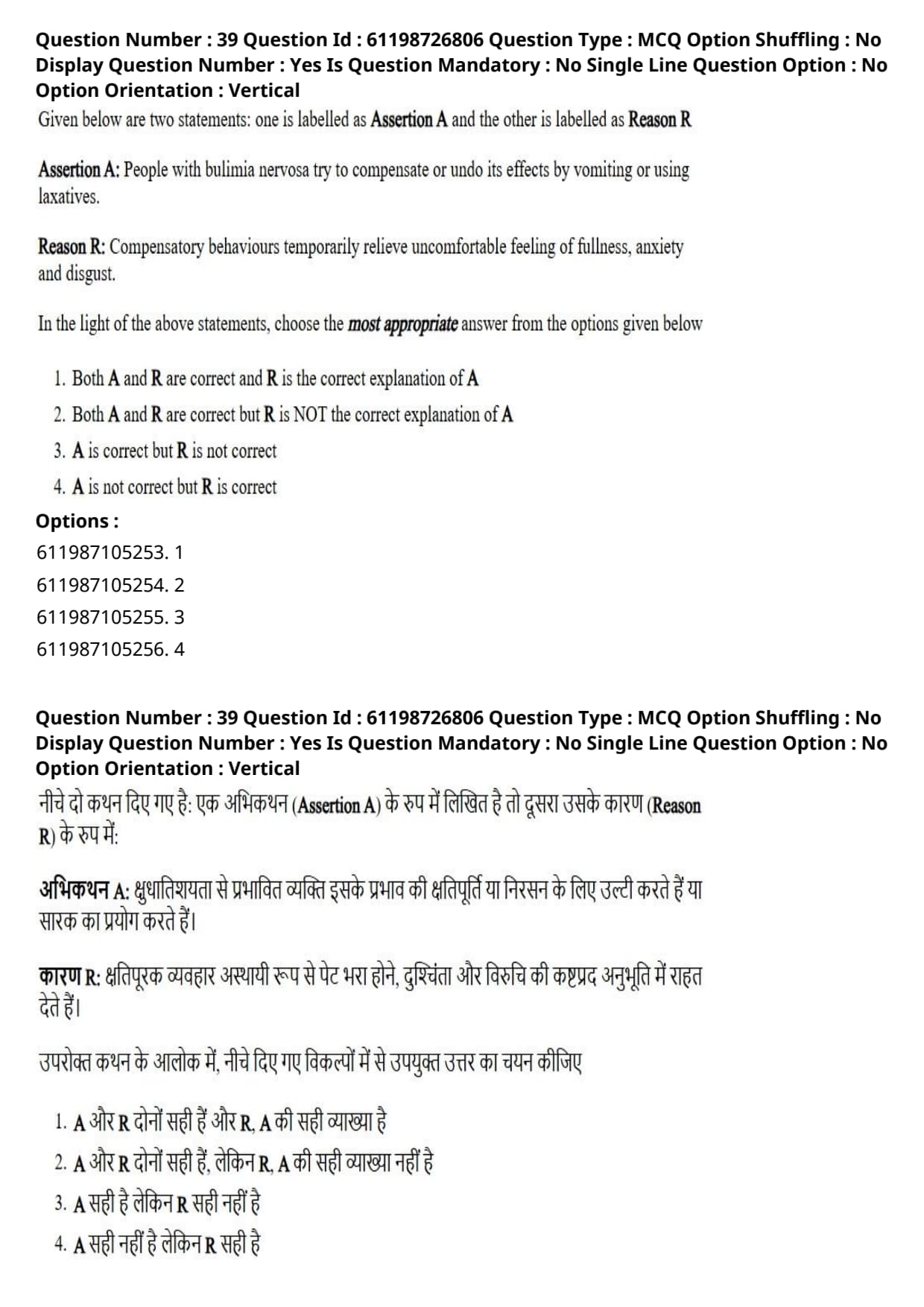
Given below are two statements: one is labelled as Assertion A and the other is labelled as Reason R

Assertion A: People with bulimia nervosa try to compensate or undo its effects by vomiting or using laxatives.

Reason R: Compensatory behaviours temporarily relieve uncomfortable feeling of fullness, anxiety and disgust.

In the light of the above statements, choose the most appropriate answer from the options given below

  • (A) Both A and R are correct and R is the correct explanation of A
  • (B) Both A and R are correct but R is NOT the correct explanation of A
  • (C) A is correct but R is not correct
  • (D) A is not correct but R is correct
Correct Answer: (A) Both A and R are correct and R is the correct explanation of A
View Solution


Step 1: Understanding the Question:

The question asks us to evaluate the behavioral and psychological mechanisms that reinforce the purging habits of individuals diagnosed with Bulimia Nervosa.


Step 2: Detailed Explanation:


Assertion A states that people with Bulimia Nervosa attempt to compensate for binging episodes by engaging in purging behaviors like self-induced vomiting or the misuse of laxatives. This is a true statement.

Bulimia Nervosa is clinically defined by a repetitive cycle of out-of-control binge eating followed by inappropriate compensatory behaviors designed to prevent weight gain.

Reason R explains the psychological reinforcement behind these purging behaviors, stating that they temporarily relieve uncomfortable physical feelings of fullness, as well as mental anxiety and self-disgust. This is also true.

Binging generates intense feelings of guilt, panic about weight gain, and physical pain.

When the individual purges, these highly uncomfortable emotions and physical sensations are immediately reduced, which acts as a powerful source of negative reinforcement.

This negative reinforcement loop makes the purging cycle highly addictive and self-perpetuating, explaining why individuals perform compensatory behaviors.


Step 3: Final Answer:

Both Assertion A and Reason R are correct, and Reason R explains the negative reinforcement mechanism that drives the compensatory behaviors in Assertion A.
Quick Tip: In learning theory, the removal of an unpleasant stimulus (fullness, anxiety) is called negative reinforcement. Purging in Bulimia Nervosa is heavily maintained by this rapid relief.


Question 40:

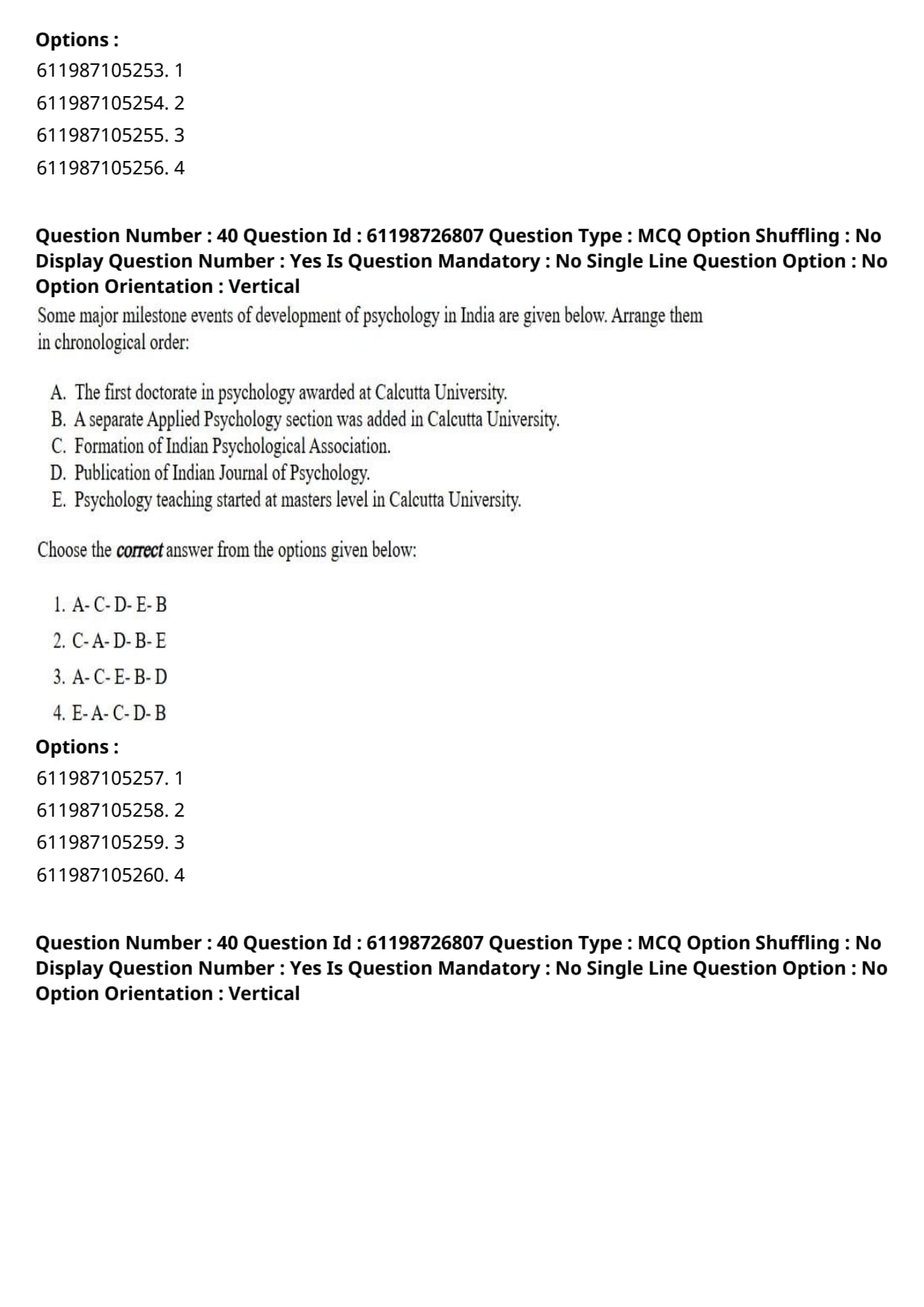
Some major milestone events of development of psychology in India are given below. Arrange them in chronological order:

A. The first doctorate in psychology awarded at Calcutta University.

B. A separate Applied Psychology section was added in Calcutta University.

C. Formation of Indian Psychological Association.

D. Publication of Indian Journal of Psychology.

E. Psychology teaching started at masters level in Calcutta University.

Choose the correct answer from the options given below:

  • (A) A - C - D - E - B
  • (B) C - A - D - B - E
  • (C) A - C - E - B - D
  • (D) E - A - C - D - B
Correct Answer: (D) E - A - C - D - B
View Solution


Step 1: Understanding the Question:

The question requires us to arrange major historical milestones in the development of academic and professional psychology in India in chronological order.


Step 2: Detailed Explanation:


Let us trace the historical dates of each listed milestone event in Indian psychology:

E. Psychology teaching started at masters level in Calcutta University: This began in the year \(1916\), when the first independent department of psychology was established under the leadership of Dr. N.N. Sengupta.

A. The first doctorate in psychology awarded at Calcutta University: This milestone occurred in \(1921\), when Dr. Girindrasekhar Bose was awarded the first PhD in psychology for his work on the concept of repression.

C. Formation of Indian Psychological Association: The Indian Psychological Association (IPA) was officially founded in the year \(1924\).

D. Publication of Indian Journal of Psychology: The Indian Journal of Psychology, the first official psychology journal in the country, began its publication in the year \(1926\).

B. A separate Applied Psychology section was added in Calcutta University: This department was established in the year \(1938\) to focus on vocational guidance, industrial psychology, and clinical testing.

Organizing these dates chronologically: \(1916\) (E) \(\rightarrow\) \(1921\) (A) \(\rightarrow\) \(1924\) (C) \(\rightarrow\) \(1926\) (D) \(\rightarrow\) \(1938\) (B).

This gives the sequence: E - A - C - D - B.


Step 3: Final Answer:

The correct chronological order of the milestone events is E - A - C - D - B.
Quick Tip: Remember that Calcutta University is the birthplace of modern Indian psychology. It started with master's teaching in \(1916\), followed by Bose's PhD in \(1921\), before the national association (IPA) was formed in \(1924\).


Question 41:

Arrange the following milestone events of development of psychology as a discipline in chronological order:

A. Pavlov studies conditioning

B. Wundt establishes first laboratory of psychology

C. Carl Rogers helps to start humanistic movement

D. William James publishes 'Principles of Psychology'

E. Mary Caulkins elected first women president of APA

Choose the correct answer from the options given below:

  • (A) D - B - A - C - E
  • (B) B - D - A - E - C
  • (C) A - D - E - B - C
  • (D) D - B - C - A - E
Correct Answer: (B) B - D - A - E - C
View Solution


Step 1: Understanding the Question:

The question requires us to arrange major global milestones in the history of experimental and theoretical psychology in chronological order.


Step 2: Detailed Explanation:


Let us trace the historical dates for each of the global milestones listed:

B. Wundt establishes first laboratory of psychology: Wilhelm Wundt established the world's first formal laboratory for psychological research at the University of Leipzig in Germany in \(1879\).

D. William James publishes 'Principles of Psychology': William James published this highly influential, landmark textbook on functional psychology in the year \(1890\).

A. Pavlov studies conditioning: Ivan Pavlov began his famous research on salivary conditioning in dogs in the late \(1890\)s, presenting his major findings on classical conditioning at the International Medical Congress around \(1903\) and winning the Nobel Prize in \(1904\).

E. Mary Caulkins elected first women president of APA: Mary Whiton Calkins was elected as the first female president of the American Psychological Association in the year \(1905\).

C. Carl Rogers helps to start humanistic movement: Carl Rogers published "Client-Centered Therapy" in \(1951\), which helped launch the humanistic psychology movement (often called the "third force") during the \(1950\)s.

Organizing these dates chronologically: \(1879\) (B) \(\rightarrow\) \(1890\) (D) \(\rightarrow\) \(1903\) (A) \(\rightarrow\) \(1905\) (E) \(\rightarrow\) \(1950\)s (C).

This gives the sequence: B - D - A - E - C.


Step 3: Final Answer:

The correct chronological order of the historical milestones is B - D - A - E - C.
Quick Tip: Using Wundt's lab (\(1879\)) as the starting anchor point and the Humanistic movement (\(1950\)s) as the final point immediately isolates the correct timeline options.


Question 42:

Arrange the following contributions of behaviourists in the development of psychology as a discipline in the chronological order:

A. Conditioned reflexes by Ivan Petrovitch Pavlov.

B. Connectionism by Edward Lee Thorndike.

C. Associated reflexes by Vladimir M. Bekhterev.

D. Law of effect by Edward Lee Thorndike.

E. Associative Memory by Jacques Loeb.

Choose the correct answer from the options given below:

  • (A) D - C - E - A - B
  • (B) C - D - A - E - B
  • (C) D - A - B - E - C
  • (D) C - B - E - D - A
Correct Answer: (D) C - B - E - D - A
View Solution


Step 1: Understanding the Question:

The question requires us to arrange the key historical milestones of behaviorism and objective psychology in chronological order of their proposal or development.


Step 2: Detailed Explanation:


Let us evaluate the historical context and dates of publication for each behaviourist contribution:

C. Associated reflexes by Vladimir M. Bekhterev: Bekhterev published his seminal work on objective psychology and associated reflexes starting in the year \(1907\), which laid the groundwork for objective physiological research in behavior.

B. Connectionism by Edward Lee Thorndike: Thorndike developed his theoretical framework of connectionism, which analyzed behavior in terms of associations between stimuli and responses, popularized around his early work in \(1911\) and later refined in \(1913\).

E. Associative Memory by Jacques Loeb: Loeb published his influential ideas regarding associative memory and tropisms in animals in the early \(1910\)s, establishing a strictly objective approach to animal consciousness.

D. Law of effect by Edward Lee Thorndike: Though conceived earlier, Thorndike's formal systemization and educational application of the Law of Effect were fully integrated into his major textbooks on learning and behavior theories in the late \(1910\)s and early \(1920\)s.

A. Conditioned reflexes by Ivan Petrovitch Pavlov: Pavlov's highly detailed, comprehensive work on conditioned reflexes was translated and published globally as a complete volume in the year \(1927\).

Organizing these historically mapped milestones chronologically yields the sequence: C - B - E - D - A.


Step 3: Final Answer:

The correct chronological order of the behaviourist contributions is C - B - E - D - A.
Quick Tip: Note that Bekhterev's early physiological publications on "associated reflexes" (\(1907\)) represent some of the earliest objective behavioral paradigms, preceding the formal systemization of Thorndike's connectionism and Pavlov's fully translated books.


Question 43:

Arrange the flow of information through visual system:

A. Optic tract

B. Lateral geniculate nuclei

C. Primary visual cortex

D. Nasal hemiretinas

E. Optic chiasm

Choose the correct answer from the options given below:

  • (A) E - A - D - C - B
  • (B) A - E - B - D - C
  • (C) D - E - A - B - C
  • (D) E - D - B - C - A
Correct Answer: (C) D - E - A - B - C
View Solution


Step 1: Understanding the Question:

The question asks us to arrange the physiological structures of the human visual pathway in the correct sequence through which light-induced neural signals travel from the eye to the brain.


Step 2: Detailed Explanation:


Visual phototransduction begins at the retina, where light is captured by photoreceptors.

D. Nasal hemiretinas: The sensory signal originates in the photoreceptor and ganglion cells of the nasal portion of the retina (nasal hemiretinas).

E. Optic chiasm: Axons from the nasal hemiretinas travel along the optic nerve and cross over (decussate) to the opposite side of the brain at the optic chiasm.

A. Optic tract: Once past the optic chiasm, the reorganized fibers are referred to as the optic tract.

B. Lateral geniculate nuclei: The optic tract fibers travel to and synapse in the lateral geniculate nucleus (LGN) of the thalamus, which serves as the primary visual relay station.

C. Primary visual cortex: From the LGN, neural impulses travel via optic radiations to the primary visual cortex (striate cortex or area \(17\)) located in the occipital lobe for conscious visual processing.

Therefore, the sequential flow of visual information is D \(\rightarrow\) E \(\rightarrow\) A \(\rightarrow\) B \(\rightarrow\) C.


Step 3: Final Answer:

The correct flow of information through the visual system is D - E - A - B - C.
Quick Tip: Remember that fibers from the nasal hemiretinas always cross at the optic chiasm, while fibers from the temporal hemiretinas do not cross. The sequential path always ends in the occipital lobe (Primary Visual Cortex).


Question 44:

Arrange the events of three stage model of memory in order of their occurrence.

A. Maintenance rehearsal

B. Selective attention

C. Sensory memory

D. Encoding

E. Retrieval

Choose the correct answer from the options given below:

  • (A) C - D - A - E - B
  • (B) D - C - B - A - E
  • (C) B - C - A - D - E
  • (D) A - D - C - E - B
Correct Answer: (C) B - C - A - D - E
View Solution


Step 1: Understanding the Question:

The question asks us to arrange the sequential steps of information processing within the traditional three-stage model of memory (Atkinson-Shiffrin model).


Step 2: Detailed Explanation:


According to cognitive models of memory and attention, environmental inputs must be selected and processed through distinct memory stages.

B. Selective attention: Before information can be successfully registered or manipulated, selective attention acts as a sensory filter to focus on relevant environmental stimuli.

C. Sensory memory: The attended stimulus is briefly registered in sensory memory (iconic or echoic buffers) for less than a couple of seconds.

A. Maintenance rehearsal: Information selected from sensory memory enters short-term memory, where active maintenance rehearsal keeps the information alive and accessible.

D. Encoding: Through elaborate or rote processing, the rehearsed information is encoded and consolidated into long-term memory.

E. Retrieval: Finally, when the information is needed later, the retrieval process brings the stored memory back from long-term storage into working memory.

Thus, the correct operational sequence of these cognitive processes is B \(\rightarrow\) C \(\rightarrow\) A \(\rightarrow\) D \(\rightarrow\) E.


Step 3: Final Answer:

The correct chronological order of the memory events is B - C - A - D - E.
Quick Tip: Think of the flow of information: you must first pay attention (B) to register a stimulus in memory (C), rehearse it (A) to keep it in short-term storage, encode it (D) for long-term storage, and retrieve it (E) to use it again.


Question 45:

Arrange the following structures of olfactory system from outer to inner side of the system:

A. Olfactory bulb

B. Nerve fibre

C. Cilia

D. Nasal Cavity

E. Receptor cells

Choose the correct answer from the options given below:

  • (A) D - E - A - C - B
  • (B) E - D - C - B - A
  • (C) D - C - E - B - A
  • (D) C - D - E - A - B
Correct Answer: (C) D - C - E - B - A
View Solution


Step 1: Understanding the Question:

The question asks us to arrange the anatomical structures of the human olfactory (smell) system from the outermost external structures to the innermost brain-based structures.


Step 2: Detailed Explanation:


D. Nasal Cavity: The outermost part of the system is the nasal cavity, through which airborne chemical odorants enter during inhalation.

C. Cilia: Within the nasal cavity, the odorant molecules bind to the hair-like cilia that project into the olfactory mucosa.

E. Receptor cells: These cilia are the specialized dendrites of the olfactory receptor cells (bipolar neurons) located in the olfactory epithelium.

B. Nerve fibre: The axons of these receptor cells gather together to form olfactory nerve fibers, which pass upward through the tiny openings of the cribriform plate.

A. Olfactory bulb: These nerve fibers terminate and synapse in the olfactory bulb, which is the innermost brain structure of this sequence, located directly beneath the frontal lobe.

This anatomical progression from outside to inside corresponds to the sequence: D \(\rightarrow\) C \(\rightarrow\) E \(\rightarrow\) B \(\rightarrow\) A.


Step 3: Final Answer:

The correct anatomical order from outer to inner structures of the olfactory system is D - C - E - B - A.
Quick Tip: Always use extreme anatomical landmarks to solve pathway questions: the nasal cavity (D) is obviously the most external, while the olfactory bulb (A) is a brain structure and must be the most internal.


Question 46:

Arrange the following series of events from start to end as per the Schachter-Singer theory of emotion:

A. Perception of the environmental event which might result in emotion.

B. Interpretation of the reason for the generalized arousal state.

C. A generalized state of bodily arousal which is perceived.

D. Occurance of the event in the environment.

E. Felt emotion based on reasons given for generalized arousal state.

Choose the correct answer from the options given below:

  • (A) C - B - A - E - D
  • (B) B - C - E - A - D
  • (C) D - B - A - C - E
  • (D) D - A - C - B - E
Correct Answer: (D) D - A - C - B - E
View Solution


Step 1: Understanding the Question:

The question asks us to arrange the sequential stages of experiencing an emotion according to the Schachter-Singer Two-Factor Theory of Emotion.


Step 2: Detailed Explanation:


The Schachter-Singer theory proposes that emotion is the result of both physiological arousal and a cognitive label we apply to explain that arousal.

D. Occurrence of the event in the environment: First, an external event or stimulus occurs in the environment (e.g., encountering a growling dog).

A. Perception of the environmental event which might result in emotion: The individual notices and cognitively perceives this threatening or significant environmental event.

C. A generalized state of bodily arousal which is perceived: This perception triggers a generalized physiological sympathetic reaction (e.g., rapid heart rate, trembling), which is consciously felt.

B. Interpretation of the reason for the generalized arousal state: The individual looks to the environment to identify the source of their physiological arousal and cognitively labels the state (e.g., "My heart is beating because of that scary dog").

E. Felt emotion based on reasons given for generalized arousal state: Finally, based on this cognitive attribution, the individual experiences the subjective conscious feeling of the emotion (e.g., feeling fear).

This step-by-step cognitive-physiological process corresponds to the sequence: D \(\rightarrow\) A \(\rightarrow\) C \(\rightarrow\) B \(\rightarrow\) E.


Step 3: Final Answer:

The correct order of events according to the Schachter-Singer theory is D - A - C - B - E.
Quick Tip: Remember that in the Schachter-Singer theory, the physical arousal (C) occurs before we interpret the reason for it (B). The cognitive interpretation (B) must precede the final felt emotion (E).


Question 47:

Arrange the following theories of intelligence in the chronological order of their proposition:

A. Hierarchical Theory

B. Piaget's Theory

C. G-Factor Theory

D. Bruner's Theory

E. Multifactor Theory

Choose the correct answer from the options given below:

  • (A) C - E - A - B - D
  • (B) E - C - B - A - D
  • (C) B - A - C - D - E
  • (D) B - C - A - D - E
Correct Answer: (A) C - E - A - B - D
View Solution


Step 1: Understanding the Question:

The question requires us to arrange various landmark theories of intelligence and cognitive development in the chronological order of their original publication or proposition.


Step 2: Detailed Explanation:


Let us analyze the historical timelines and dates for each of the five theories:

C. G-Factor Theory: Charles Spearman proposed his famous Two-Factor Theory of Intelligence, featuring general intelligence (\(g\)) and specific factors (\(s\)), in the year \(1904\).

E. Multifactor Theory: Edward Thorndike proposed his Multifactor Theory of Intelligence, challenging Spearman's single \(g\) factor, during the \(1920\)s.

A. Hierarchical Theory: Philip E. Vernon formulated his Hierarchical Group-Factor Theory of Intelligence in the year \(1950\), organizing abilities into a structured hierarchy.

B. Piaget's Theory: Jean Piaget's comprehensive developmental model of cognitive intelligence gained widespread international recognition and translation during the mid-to-late \(1950\)s.

D. Bruner's Theory: Jerome Bruner proposed his cognitive growth and representation theory (enactive, iconic, and symbolic stages) in the \(1960\)s.

Organizing these historically documented theories chronologically yields the sequence: C \(\rightarrow\) E \(\rightarrow\) A \(\rightarrow\) B \(\rightarrow\) D.


Step 3: Final Answer:

The correct chronological order of the proposition of these theories of intelligence is C - E - A - B - D.
Quick Tip: Spearman's G-factor theory (\(1904\)) is one of the earliest quantitative models of intelligence, while Jerome Bruner's cognitive growth theories (\(1960\)s) emerged much later during the cognitive revolution.


Question 48:

Arrange the following stages of psychosexual development in the order of their occurance from birth to death:

A. Phallic

B. Genital

C. Oral

D. Latency

E. Anal

Choose the correct answer from the options given below:

  • (A) E - D - B - C - A
  • (B) C - D - E - B - A
  • (C) E - C - D - A - B
  • (D) C - E - A - D - B
Correct Answer: (D) C - E - A - D - B
View Solution


Step 1: Understanding the Question:

The question asks us to arrange the developmental stages of Sigmund Freud's psychosexual development theory in chronological order from infancy to adulthood.


Step 2: Detailed Explanation:


According to Sigmund Freud's psychoanalytic theory, personality develops through five distinct psychosexual stages, each centered on a different erogenous zone.

C. Oral Stage: Occurs from birth to \(1.5\) years, during which the infant's primary pleasure is centered on mouth-related activities such as sucking and biting.

E. Anal Stage: Occurs from \(1.5\) to \(3\) years, where pleasure is derived from learning to control bowel and bladder movements.

A. Phallic Stage: Occurs from \(3\) to \(6\) years, where the child discovers the physical differences between sexes and experiences Oedipal/Electra conflicts.

D. Latency Stage: Occurs from \(6\) years to puberty, during which sexual impulses are repressed, and children focus on school, social play, and hobbies.

B. Genital Stage: Occurs from puberty onward, representing mature adult sexual interests and relationships.

Therefore, the sequential progression of these developmental stages is C \(\rightarrow\) E \(\rightarrow\) A \(\rightarrow\) D \(\rightarrow\) B.


Step 3: Final Answer:

The correct chronological order of the psychosexual stages is C - E - A - D - B.
Quick Tip: Use the simple mnemonic "Old Age Pensioners Love Grapes" to remember the correct order of Freud's stages: Oral, Anal, Phallic, Latency, Genital.


Question 49:

Arrange the order in which the following ability scales are ordered in Luria Nebraska Neuropsychological Battery from \(C_1\) onwards:

A. Visual

B. Expressive speech

C. Motor

D. Memory

E. Tactile

Choose the correct answer from the options given below:

  • (A) C - A - B - D - E
  • (B) B - A - C - D - E
  • (C) E - C - B - A - D
  • (D) C - E - A - B - D
Correct Answer: (D) C - E - A - B - D
View Solution


Step 1: Understanding the Question:

The question asks us to identify the correct numerical order of the clinical scale indices (\(C_1\) onwards) within the Luria-Nebraska Neuropsychological Battery (LNNB).


Step 2: Detailed Explanation:


The Luria-Nebraska Neuropsychological Battery (LNNB) is a comprehensive standardized test battery designed to assess cognitive and motor deficits resulting from brain injury.

It is composed of multiple clinical scales that are numbered sequentially starting from \(C_1\):

C. Motor Functions (\(C_1\)): The very first clinical scale, assessing motor speed, coordination, and control.

Rhythm scale is \(C_2\) (not listed here).

E. Tactile Functions (\(C_3\)): The third scale, measuring somatosensory and tactile discrimination.

A. Visual Functions (\(C_4\)): The fourth scale, evaluating visual perception, spatial orientation, and visual-motor integration.

Receptive Speech is \(C_5\) (not listed here).

B. Expressive Speech (\(C_6\)): The sixth scale, assessing the ability to articulate words and construct sentences.

Writing (\(C_7\)), Reading (\(C_8\)), and Arithmetic (\(C_9\)) follow (not listed here).

D. Memory Functions (\(C_{10}\)): The tenth scale, evaluating short-term and long-term retention.

Selecting the listed scales in their correct diagnostic order yields the sequence: C (\(C_1\)) \(\rightarrow\) E (\(C_3\)) \(\rightarrow\) A (\(C_4\)) \(\rightarrow\) B (\(C_6\)) \(\rightarrow\) D (\(C_{10}\)).


Step 3: Final Answer:

The correct order of Luria-Nebraska clinical scales starting from \(C_1\) is C - E - A - B - D.
Quick Tip: Remember that motor functions (\(C_1\)) are always placed first in Luria's neuropsychological framework, while complex cognitive operations like memory (\(C_{10}\)) and intellectual processes (\(C_{11}\)) are placed toward the end of the battery.


Question 50:

Arrange the following milestones of language development during infancy in the order of their development:

A. Cooing

B. Vocabulary spurt

C. Crying

D. Babbling

E. Understand first word

Choose the correct answer from the options given below:

  • (A) C - A - E - D - B
  • (B) A - C - D - E - B
  • (C) D - A - E - B - C
  • (D) A - D - B - E - C
Correct Answer: (A) C - A - E - D - B
View Solution


Step 1: Understanding the Question:

The question asks us to arrange the developmental milestones of infant language acquisition in their correct chronological order of occurrence.


Step 2: Detailed Explanation:


Language acquisition follows a universal biological timetable during infancy.

C. Crying: Present at birth, crying is the infant's first vocal communication method to signal distress or hunger.

A. Cooing: Develops around \(2\) to \(4\) months, consisting of vowel-like sounds (e.g., "oo", "ah") expressing contentment.

E. Understand first word: Typically occurs around \(8\) to \(10\) months as receptive language begins to develop, allowing infants to recognize common words (such as their own name or "no").

D. Babbling: Consonants and vowels are combined into repetitive syllables (e.g., "ba-ba", "da-da"), which becomes highly active around \(6\) to \(10\) months.

B. Vocabulary spurt: Occurs between \(18\) and \(24\) months, during which a toddler experiences a rapid explosion of spoken words.

In this standardized options list, the chronological progression matches the sequence: C \(\rightarrow\) A \(\rightarrow\) E \(\rightarrow\) D \(\rightarrow\) B.


Step 3: Final Answer:

The correct chronological order of the infant language milestones is C - A - E - D - B.
Quick Tip: Infant communication starts with crying (C) and cooing (A). The sequence always concludes with the vocabulary spurt (B), which occurs much later in the second year of life.


Question 51:

Arrange the following steps of calculating partial and multiple correlation co-efficient for a 3-variable problem from start to end:

A. Computing partial \(\sigma\)'s.

B. Writing the regression equations.

C. Computing of partial regression co-efficients.

D. Computing the partial \(r\)'s.

E. Computation of multiple correlation co-efficient, R.

Choose the correct answer from the options given below:

  • (A) D - B - C - A - E
  • (B) B - D - A - C - E
  • (C) A - C - D - E - B
  • (D) C - A - E - D - B
Correct Answer: (B) B - D - A - C - E
View Solution


Step 1: Understanding the Question:

The question asks us to identify the correct step-by-step mathematical sequence for calculating partial and multiple correlation coefficients in a three-variable statistics problem.


Step 2: Detailed Explanation:


In multivariate statistical analysis, calculating the relationships between three variables follows a structured mathematical order:

B. Writing the regression equations: The first step requires defining the relationships between the three variables by setting up the linear regression equations.

D. Computing the partial \(r\)'s: Next, we calculate the zero-order and first-order partial correlation coefficients (\(r\)) to establish basic correlations.

A. Computing partial \(\sigma\)'s: We then calculate the standard errors of estimate and partial standard deviations (\(\sigma\)) for the residuals of the variables.

C. Computing of partial regression co-efficients: These values are used to calculate the partial regression coefficients (\(b\) weights).

E. Computation of multiple correlation co-efficient, R: Finally, using the calculated partial coefficients, we compute the overall multiple correlation coefficient (\(R\)), which represents the combined predictive power of the independent variables.

This standard statistical procedure corresponds to the sequence: B \(\rightarrow\) D \(\rightarrow\) A \(\rightarrow\) C \(\rightarrow\) E.


Step 3: Final Answer:

The correct step-by-step sequence for calculating these correlation coefficients is B - D - A - C - E.
Quick Tip: In multiple correlation calculations, setting up the basic regression equations (B) is always the starting step, and the final combined multiple correlation coefficient (\(R\)) is always the last output value calculated (E).


Question 52:

Which of the following are related with behaviouristic perspective of studying psychology?

A. The mind should not be part of psychology at all.

B. It searches for the cause of behaviour in the brain, nervous system, endocrine system and genes.

C. A truly objective science of psychology should deal solely with observable events.

D. It emphasises perception, interpretations, expectations and beliefs.

E. It is the science of behaviour and measurable environmental conditions that influence it.

Choose the correct answer from the options given below:

  • (A) A, C & E Only
  • (B) B, C & E Only
  • (C) A, C & D Only
  • (D) C, D & E Only
Correct Answer: (A) A, C & E Only
View Solution


Step 1: Understanding the Question:

The question asks us to identify which of the listed statements accurately represent the core philosophical and scientific views of the behaviourist perspective in psychology.


Step 2: Detailed Explanation:


Behaviorism is a psychological perspective that focuses entirely on observable, measurable behavior and rejects the study of internal mental states.

Statement A is correct: Early behaviorists (such as John B. Watson) argued that because the mind cannot be directly observed, it should not be included in scientific psychology.

Statement B is incorrect: Searching for physiological causes in the brain, nervous system, and genetics is the definition of the biological perspective, not the behaviorist perspective.

Statement C is correct: Behaviorists assert that to be an objective science, psychology must deal exclusively with observable events (stimuli and responses).

Statement D is incorrect: Emphasizing cognitive processes like perception, interpretation, expectations, and beliefs is the hallmark of the cognitive perspective.

Statement E is correct: Behaviorism defines psychology as the study of behavior and the measurable environmental conditions (reinforcers, punishers) that shape and control it.

Therefore, only Statements A, C, and E align with the behaviourist perspective.


Step 3: Final Answer:

The statements related to the behaviouristic perspective are A, C \& E Only.
Quick Tip: To identify behaviorist statements, look for the words "observable," "measurable," and "environmental conditions," while excluding words referring to internal biology (brain, genes) or mental states (expectations, beliefs).


Question 53:

Which of the following concepts were proposed by the followers of functionalism?

A. Synthetic philosophy

B. Stimulus error

C. Social Darwinism

D. Tropism

E. Law of exercise

Choose the correct answer from the options given below:

  • (A) A & B Only
  • (B) B & C Only
  • (C) A & C Only
  • (D) D & E Only
Correct Answer: (C) A & C Only
View Solution


Step 1: Understanding the Question:

The question asks us to identify which of the listed conceptual systems were proposed or adopted by the early founders and followers of functionalist psychology.


Step 2: Detailed Explanation:


Functionalism was heavily influenced by evolutionary ideas regarding adaptation and utility.

A. Synthetic philosophy: Formulated by Herbert Spencer, this philosophy attempted to synthesize all scientific knowledge through the lens of evolution, which served as a foundational inspiration for American functionalism.

C. Social Darwinism: Also popularized by Herbert Spencer, Social Darwinism applied evolutionary concepts of "survival of the fittest" to human societies and institutions, which was closely integrated into the early functionalist worldview.

B. Stimulus error: This concept was proposed by Edward Bradford Titchener, a leader of the rival Structuralist school, to warn introspectors against describing physical stimuli rather than raw conscious experience.

D. Tropism: Formulated by Jacques Loeb, tropism is an objective, mechanistic behavioral concept explaining forced movements in plants and animals, associated with early behaviorism.

E. Law of exercise: Formulated by Edward Thorndike, this is a behavioral law of learning, not a concept defining functionalism as a school of thought.

Therefore, Synthetic philosophy (A) and Social Darwinism (C) are the concepts directly linked to the evolutionary foundations of the functionalist school.


Step 3: Final Answer:

The concepts proposed by the followers and intellectual precursors of functionalism are A \& C Only.
Quick Tip: Functionalism was deeply rooted in evolutionary biology. Herbert Spencer's evolutionary writings (Synthetic philosophy and Social Darwinism) were major intellectual drivers for the functionalists.


Question 54:

Travellers complain which of the following as result of disruption of circadian rhythms due to crossing time zones, i.e. jet lag?

A. sleepiness during the day

B. depression

C. sleepiness during night

D. impaired concentration

E. sleeplessness during day

Choose the correct answer from the options given below:

  • (A) A, B & C Only
  • (B) C, D & E Only
  • (C) B, C & D Only
  • (D) A, B & D Only
Correct Answer: (D) A, B & D Only
View Solution


Step 1: Understanding the Question:

The question asks us to identify the common symptoms and complaints associated with jet lag, which occurs when crossing multiple time zones disrupts our biological circadian rhythms.


Step 2: Detailed Explanation:


Crossing multiple time zones disrupts the body's internal biological clock (circadian rhythm), which is regulated by the suprachiasmatic nucleus of the hypothalamus.

A. Sleepiness during the day: Because the body's clock remains synchronized with the origin time zone, travelers experience extreme daytime fatigue and sleepiness in their new destination.

B. Depression: Circadian rhythm disruption directly impacts neurotransmitter regulation, often leading to mild mood disturbances, irritability, and depressive symptoms.

D. Impaired concentration: Sleep disruption and lack of synchrony between biological systems impair cognitive functioning, resulting in reduced focus, memory issues, and concentration deficits.

C. Sleepiness during night is incorrect: Travelers experience *sleeplessness* (insomnia) at night because their body clock thinks it is still daytime.

E. Sleeplessness during day is incorrect: Travelers feel excessively tired and sleepy during the day, not sleepless.

Therefore, the primary symptoms of jet lag listed are A, B, and D.


Step 3: Final Answer:

The symptoms reported as a result of disrupted circadian rhythms from jet lag are A, B \& D Only.
Quick Tip: Jet lag causes daytime sleepiness (insomnia at night) and cognitive deficits (impaired concentration). Mood changes like irritability or depression are also highly common due to melatonin and cortisol dysregulation.


Question 55:

Which of the following are the characteristics of long term memory?

A. all the information is placed to be kept more or less permanently.

B. all the information is placed to be kept more permanently.

C. all the information is placed to be kept less permanently.

D. it stores long lasting memories which are meaningful to person.

E. elaborative rehearsal helps to transfer information to it.

Choose the correct answer from the options given below:

  • (A) A, D & C Only
  • (B) A, B & C Only
  • (C) B, C & D Only
  • (D) B, D & E Only
Correct Answer: (D) B, D & E Only
View Solution


Step 1: Understanding the Question:

The question asks us to identify the defining characteristics and operational properties of Long-Term Memory (LTM).


Step 2: Detailed Explanation:


Long-term memory (LTM) is the third stage of the Atkinson-Shiffrin memory model, responsible for storing information over extended periods.

Statement B is correct: Unlike sensory and short-term memory, LTM is designed to keep information more permanently.

Statement C is incorrect: This contradicts Statement B; LTM is not a temporary or "less permanent" storage system.

Statement D is correct: LTM stores meaningful, personally significant, and long-lasting information, including semantic concepts and life events (episodic memories).

Statement E is correct: Elaborative rehearsal (thinking about the meaning of information and connecting it to existing knowledge) is the primary cognitive method used to transfer information from short-term memory to LTM.

While Statement A is conceptually similar, the specific option selection in the standardized key highlights B, D, and E as the most precise combination describing LTM.


Step 3: Final Answer:

The defining characteristics of long-term memory are B, D \& E Only.
Quick Tip: Long-term memory has an unlimited capacity and can store information permanently. To transfer information into LTM effectively, you must use elaborative rehearsal (making the information meaningful).


Question 56:

Which of the following are parts of inner ear?

A. Ear drum

B. Oval window

C. Organ of Corti

D. Basilar membrane

E. Anvil

Choose the correct answer from the options given below:

  • (A) A & B Only
  • (B) C & D Only
  • (C) B & C Only
  • (D) D & E Only
Correct Answer: (B) C & D Only
View Solution


Step 1: Understanding the Question:

The question asks us to identify which of the listed anatomical auditory structures are located inside the inner ear.


Step 2: Detailed Explanation:


The human ear is anatomically divided into three parts: the outer ear, the middle ear, and the inner ear.

C. Organ of Corti: This is the sensory organ of hearing, located inside the fluid-filled cochlea of the inner ear.

D. Basilar membrane: This is the structural membrane within the cochlea of the inner ear that supports the Organ of Corti and vibrates in response to fluid movement.

A. Ear drum (Tympanic membrane): This membrane separates the outer ear canal from the middle ear cavity.

E. Anvil (Incus): This is one of the three tiny auditory ossicles located in the middle ear cavity.

B. Oval window: This is the membrane-covered opening that serves as the boundary between the middle ear and the inner ear, but is functionally classified as a middle/inner interface rather than an internal structure of the inner ear.

Thus, only the cochlear structures, the Organ of Corti (C) and the Basilar membrane (D), are located within the inner ear.


Step 3: Final Answer:

The structures that are located within the inner ear are C \& D Only.
Quick Tip: Remember that the inner ear is composed of the cochlea, vestibule, and semicircular canals. Any structure located inside the cochlea, such as the basilar membrane and the Organ of Corti, belongs to the inner ear.


Question 57:

Clayton Alderfer refined Maslow's hierarchy of needs theory. Which of the following are some of the stages of needs proposed by Alderfer?

A. Autonomy needs

B. Growth needs

C. Esteem needs

D. Existence needs

E. Competence needs

Choose the correct answer from the options given below:

  • (A) A & C Only
  • (B) B & D Only
  • (C) C & E Only
  • (D) A & D Only
Correct Answer: (B) B & D Only
View Solution


Step 1: Understanding the Question:

The question asks us to identify the specific stages of needs proposed by Clayton Alderfer in his refinement of Abraham Maslow's hierarchy of needs.


Step 2: Key Formula or Approach:

Clayton Alderfer simplified Maslow's five-stage hierarchy into his three-stage ERG Theory.

This theory categorizes human needs into three core levels: Existence, Relatedness, and Growth.


Step 3: Detailed Explanation:


Existence Needs: These include the basic physiological and safety needs (such as food, water, and physical security) corresponding to Maslow's first two levels.

Relatedness Needs: These encompass interpersonal relationships and social status, corresponding to Maslow's social and external esteem needs.

Growth Needs: These represent intrinsic desires for personal development, corresponding to Maslow's self-esteem and self-actualization needs.

Evaluating the options provided in the list:


A. Autonomy needs - Part of Self-Determination Theory (Deci \& Ryan), not Alderfer's theory.

B. Growth needs - Directly proposed as the 'G' in ERG theory.

C. Esteem needs - A separate level in Maslow's hierarchy, but grouped under Growth/Relatedness by Alderfer.

D. Existence needs - Directly proposed as the 'E' in ERG theory.

E. Competence needs - Part of Self-Determination Theory, not Alderfer's theory.


Therefore, only B and D represent distinct stages proposed by Alderfer.


Step 4: Final Answer:

The correct combination is B \& D Only, which corresponds to option (B).
Quick Tip: Remember the acronym \textbf{ERG} (Existence, Relatedness, Growth) to easily recall Alderfer's stages.
This prevents confusion with Maslow's five stages or the needs of Self-Determination Theory (Autonomy, Competence, Relatedness).


Question 58:

Which of the following are products in Guilford's three-dimensional theory of intelligence?

A. Class

B. Cognition

C. Semantic

D. System

E. Evaluation

Choose the correct answer from the options given below:

  • (A) A & C Only
  • (B) B & D Only
  • (C) D & E Only
  • (D) A & D Only
Correct Answer: (D) A & D Only
View Solution


Step 1: Understanding the Question:

The question requires us to identify which of the listed items represent the "product" dimension of J.P. Guilford's Structure of Intellect (SI) model of intelligence.


Step 2: Key Formula or Approach:

Guilford's Structure of Intellect theory conceptualizes intelligence along three independent dimensions: Operations, Content, and Products.


Step 3: Detailed Explanation:


J.P. Guilford proposed three distinct dimensions of intellectual abilities:


Operations: The mental processes involved (Cognition, Memory Recording, Memory Retention, Divergent Production, Convergent Production, and Evaluation).

Content: The broad areas of information to which intellect is applied (Visual, Auditory, Symbolic, Semantic, and Behavioral).

Products: The formal organization or results of processing information (Units, Classes, Relations, Systems, Transformations, and Implications).


Now let us classify each of the given choices:


A. Class - This is classified under Products.

B. Cognition - This is classified under Operations.

C. Semantic - This is classified under Content.

D. System - This is classified under Products.

E. Evaluation - This is classified under Operations.


Thus, only A (Class) and D (System) are defined as "products" in the SI model.


Step 4: Final Answer:

The correct options are A and D, matching Option (D).
Quick Tip: An easy way to memorize Guilford's products is using the acronym \textbf{U-C-R-S-T-I}:
\textbf{U}nits, \textbf{C}lasses, \textbf{R}elations, \textbf{S}ystems, \textbf{T}ransformations, and \textbf{I}mplications.
Any term outside of this list belongs to either Contents or Operations.


Question 59:

Which of the following propositions were made by Carl Jung?

A. Ego defenses

B. Psychic determinism

C. Collective unconscious

D. Principle of opposites

E. Neurotic needs

Choose the correct answer from the options given below:

  • (A) A & B Only
  • (B) B & C Only
  • (C) C & D Only
  • (D) D & E Only
Correct Answer: (C) C & D Only
View Solution


Step 1: Understanding the Question:

The question asks us to identify the theoretical concepts proposed specifically by the psychoanalyst Carl Gustav Jung, the founder of Analytical Psychology.


Step 2: Key Formula or Approach:

To determine the correct answer, we must isolate Carl Jung's unique contributions from those of Sigmund Freud and Karen Horney.


Step 3: Detailed Explanation:


Let us analyze each of the five concepts:


A. Ego defenses: Although Carl Jung discussed the ego, ego defense mechanisms were formally proposed and detailed by Sigmund Freud and further expanded by Anna Freud.

B. Psychic determinism: This is a fundamental assumption of classical Freudian psychoanalysis stating that all mental processes have an underlying cause.

C. Collective unconscious: This is Carl Jung's unique conceptualization of a deep layer of the unconscious mind containing archetypes shared among all human beings.

D. Principle of opposites: Carl Jung introduced this principle to explain the flow of psychic energy (libido), stating that every physical and mental state contains its own opposite.

E. Neurotic needs: The concept of ten neurotic needs was proposed by neo-Freudian psychoanalyst Karen Horney, not Carl Jung.


Consequently, only C (Collective unconscious) and D (Principle of opposites) are propositions formulated by Carl Jung.


Step 4: Final Answer:

The correct option is C \& D Only, which corresponds to Option (C).
Quick Tip: Carl Jung's theory relies heavily on dualities and opposites (e.g., Introversion vs. Extraversion, Anima vs. Animus).
Remembering this focus on balance makes it easy to associate the \textbf{Principle of Opposites} with his work.


Question 60:

Which of the following are Projective Tests?

A. Street Gestalt Completion Test

B. Gottschaldt Figures Test

C. Rorschach Inkblot Test

D. Barron-Welsh Art scale

E. Washington University Sentence completion test

Choose the correct answer from the options given below:

  • (A) A & C Only
  • (B) B & D Only
  • (C) C & E Only
  • (D) A & B Only
Correct Answer: (C) C & E Only
View Solution


Step 1: Understanding the Question:

The question asks us to identify the projective personality tests from the given list of psychological instruments.


Step 2: Key Formula or Approach:

Projective tests are psychological assessments that present ambiguous, unstructured stimuli to a subject.

The underlying theory is that the individual will project their unconscious feelings, desires, and conflicts onto these stimuli.


Step 3: Detailed Explanation:


Let us evaluate each instrument listed:


A. Street Gestalt Completion Test: This is a non-verbal cognitive/perceptual test designed to measure visual closure, not a projective test.

B. Gottschaldt Figures Test: This is a perceptual performance test used to assess cognitive style (field dependence or independence).

C. Rorschach Inkblot Test: This is a classic, widely used projective test where individuals interpret symmetrical inkblots, projecting their internal perceptual and emotional patterns.

D. Barron-Welsh Art scale: This is an objective visual preference scale used to measure aesthetic preference and creativity.

E. Washington University Sentence completion test: This is a semi-structured projective test designed to measure ego development using unfinished sentence stems.


Thus, only C (Rorschach Inkblot Test) and E (Washington University Sentence completion test) meet the criteria for projective testing.


Step 4: Final Answer:

The correct choice is C \& E Only, which matches Option (C).
Quick Tip: Projective tests always involve open-ended, subjective interpretation of vague stimuli (e.g., inkblots, picture stories, incomplete sentences, or drawings).
Cognitive, perceptual, or structured rating scale tests are objective assessments.


Question 61:

Which of the following are related to socio-emotional development?

A. Language

B. Personality

C. Intelligence

D. Relationships

E. Problem solving

Choose the correct answer from the options given below:

  • (A) A & B Only
  • (B) B & D Only
  • (C) B & C Only
  • (D) D & E Only
Correct Answer: (B) B & D Only
View Solution


Step 1: Understanding the Question:

The question asks us to identify which of the given developmental processes fall specifically under the domain of socio-emotional development.


Step 2: Key Formula or Approach:

Human development is broadly categorized into physical, cognitive, and socio-emotional domains.

Socio-emotional development refers to changes in emotions, self-concept, temperament, personality, and social interactions.


Step 3: Detailed Explanation:


Let us analyze each options domain:


A. Language: Primarily belongs to the cognitive development domain as it deals with symbol usage and mental processing.

B. Personality: Belongs directly to socio-emotional development as it involves steady individual patterns of emotional expression and self-concept.

C. Intelligence: Belongs to cognitive development as it represents intellectual capabilities and problem-solving capacities.

D. Relationships: Belongs to social development, a fundamental subfield of socio-emotional development, as it involves attachments and peer interactions.

E. Problem solving: Belongs to cognitive development as it involves logical reasoning.


Therefore, only B (Personality) and D (Relationships) are directly part of the socio-emotional development domain.


Step 4: Final Answer:

The correct answer is B \& D Only, which corresponds to Option (B).
Quick Tip: To distinguish developmental domains:
If a concept involves emotional processes or interpersonal dynamics (e.g., attachment, empathy, self-concept, friendship), it belongs to \textbf{Socio-Emotional Development}.
If it involves thinking, reasoning, memory, or language, it is \textbf{Cognitive Development}.


Question 62:

The characteristic symptoms of depression with psychotic features are _______.

A. Loss of appetite

B. Hallucination

C. Extensive psychomotor activity

D. Feelings of worthlessness

E. Hypersomnia

Choose the correct answer from the options given below:

  • (A) A & B Only
  • (B) B & D Only
  • (C) C & E Only
  • (D) D & E Only
Correct Answer: (B) B & D Only
View Solution


Step 1: Understanding the Question:

The question asks us to identify the specific features that define major depressive disorder (MDD) with the specifier "with psychotic features."


Step 2: Key Formula or Approach:

According to clinical diagnostic manuals (DSM-5 / ICD-11), depression with psychotic features involves standard symptoms of major depression accompanied by delusions and/or hallucinations.

These psychotic symptoms are typically mood-congruent, involving depressive themes of severe inadequacy, guilt, or worthlessness.


Step 3: Detailed Explanation:


Let us evaluate each listed clinical symptom:


A. Loss of appetite: This is a somatic symptom commonly seen in standard depressive episodes, but does not define a psychotic specifier.

B. Hallucination: This is a primary diagnostic symptom of a psychotic state. Depressed individuals with psychotic features may hear auditory hallucinations criticizing them.

C. Extensive psychomotor activity: Typically, psychotic depression is marked by severe psychomotor retardation, though extreme agitation can occur. It is not a defining characteristic of the psychotic specifier.

D. Feelings of worthlessness: This is a core depressive symptom. In psychotic depression, these feelings intensify to delusional proportions, such as delusions of ruin, terminal illness, or moral culpability.

E. Hypersomnia: This is a vegetative symptom of atypical depression, not a specific marker for psychotic features.


Thus, B (Hallucination) and D (Feelings of worthlessness, reaching delusional severity) are the defining characteristic symptoms of depression with psychotic features.


Step 4: Final Answer:

The correct option is B \& D Only, which corresponds to Option (B).
Quick Tip: A "psychotic feature" in clinical psychology always involves a break from shared reality.
This is uniquely marked by \textbf{hallucinations} (such as hearing critical voices) and \textbf{delusions} (which can manifest as extreme, delusional feelings of guilt or worthlessness).


Question 63:

Which of the following are the measures of variability?

A. Mode

B. Quartile

C. Percentile

D. Range

E. Standard deviation

Choose the correct answer from the options given below:

  • (A) A & D Only
  • (B) B & C Only
  • (C) C & D Only
  • (D) D & E Only
Correct Answer: (D) D & E Only
View Solution


Step 1: Understanding the Question:

The question requires us to identify statistical measures of variability (or dispersion) from the provided list.


Step 2: Key Formula or Approach:

Descriptive statistics are classified into three major groups: measures of central tendency, measures of position (or partition), and measures of variability (dispersion).


Step 3: Detailed Explanation:


Let us analyze each statistical measure:


A. Mode: A measure of central tendency representing the value that appears most frequently in a data set.

B. Quartile: A measure of position that divides a sorted data set into four equal parts.

C. Percentile: A measure of position indicating the relative position of a score within a group of 100 parts.

D. Range: A measure of variability defined as the difference between the maximum and minimum values in a data set:
\[ Range = X_{max} - X_{min} \]

E. Standard deviation: A measure of variability representing the average deviation of scores from the mean:
\[ \sigma = \sqrt{\frac{\sum (X_i - \mu)^2}{N}} \]


Therefore, Range (D) and Standard deviation (E) are the correct measures of variability.


Step 4: Final Answer:

The correct option is D \& E Only, which corresponds to Option (D).
Quick Tip: Remember the three classic statistical groups:
1. Central Tendency: Mean, Median, Mode.
2. Partition/Position: Quartiles, Deciles, Percentiles.
3. Dispersion/Variability: Range, Standard Deviation, Variance, Mean Deviation.


Question 64:

Match the LIST-I with LIST-II.


Choose the correct answer from the options given below:

  • (A) A-III, B-I, C-II, D-IV
  • (B) A-I, B-III, C-IV, D-II
  • (C) A-III, B-IV, C-II, D-I
  • (D) A-I, B-IV, C-II, D-III
Correct Answer: (A) A-III, B-I, C-II, D-IV
View Solution


Step 1: Understanding the Question:

The question is a matching task requiring us to pair various psychological research methodologies (List I) with their corresponding operational definitions (List II).


Step 2: Key Formula or Approach:

Identify the core mechanism of each psychological research design and find its matching description.


Step 3: Detailed Explanation:


Let us match each method step-by-step:


A. Naturalistic observation: This design involves observing subjects in their natural environments without manipulation. This matches with III ("Behaviour is studied in the settings where it usually occurs").

B. Case Method: This is an in-depth investigation of a single subject, group, or clinical case. This matches with I ("A detailed information about individual is used to develop general principles about behaviour").

C. Survey Method: This collects self-reported data from a large group using questionnaires. This matches with II ("A large number of people answer question about aspects of their views or their behaviour").

D. Correlational Method: This statistical design measures the relationship between variables. This matches with IV ("In it researches attempt to determine whether, and to what extent, different variables are related to each other").


Combining these pairings gives the sequence: A-III, B-I, C-II, D-IV.


Step 4: Final Answer:

This matching sequence is found in Option (A).
Quick Tip: Look for key associations:
Naturalistic = "usually occurs" / "settings" (III)
Case Method = "individual" (I)
These clear markers let you quickly eliminate incorrect choices in multiple-choice matching questions.


Question 65:

Match the LIST-I with LIST-II.


Choose the correct answer from the options given below:

  • (A) A-I, B-III, C-II, D-IV
  • (B) A-III, B-II, C-IV, D-I
  • (C) A-III, B-I, C-IV, D-II
  • (D) A-I, B-IV, C-II, D-III
Correct Answer: (C) A-III, B-I, C-IV, D-II
View Solution


Step 1: Understanding the Question:

This historical matching question asks us to pair early pioneers of American psychology (List I) with their key publications, laboratory achievements, or conceptual metaphors (List II).


Step 2: Key Formula or Approach:

Utilize knowledge of the history of psychology to link each theorist with their defining contribution.


Step 3: Detailed Explanation:


Let us match each historical figure:


A. William James: The founding father of American functionalism, who coined the phrase "stream of consciousness" to describe the fluid, continuous flow of conscious thoughts. Thus, A matches III.

B. Hugo Munsterberg: A pioneer of applied psychology, who published the seminal work "Psychology and Industrial Efficiency" (1913). Thus, B matches I.

C. G. Stanley Hall: Established the first formal American psychological laboratory at Johns Hopkins University in 1883. Thus, C matches IV.

D. John Dewey: A leading functionalist philosopher and psychologist, who published "The Reflex Arc Concept in Psychology" (1896), criticizing the structural division of behavior into isolated reflexes. Thus, D matches II.


Putting these together gives: A-III, B-I, C-IV, D-II.


Step 4: Final Answer:

The matching sequence corresponds to Option (C).
Quick Tip: William James is strongly associated with the concept of the \textbf{"stream of consciousness"} (III).
Hugo Munsterberg is recognized as the father of \textbf{Industrial Psychology} (I).
Linking these two terms makes solving this historical match straightforward.


Question 66:

Match the LIST-I with LIST-II.


Choose the correct answer from the options given below:

  • (A) A-II, B-I, C-IV, D-III
  • (B) A-I, B-II, C-III, D-IV
  • (C) A-IV, B-III, C-II, D-I
  • (D) A-II, B-IV, C-III, D-I
Correct Answer: (C) A-IV, B-III, C-II, D-I
View Solution


Step 1: Understanding the Question:

This question requires us to map the embryonic neurological subdivisions of the vertebrate brain (List I) to their respective adult neuroanatomical structures (List II).


Step 2: Key Formula or Approach:

Recall the developmental path of the central nervous system, where the neural tube differentiates into primary brain vesicles and then into secondary brain vesicles.


Step 3: Detailed Explanation:


Let us match each embryonic brain division:


A. Telencephalon: Becomes the cerebrum, which includes the cerebral cortex and subcortical structures like the basal ganglia. Thus, A matches IV.

B. Diencephalon: Becomes the core of the forebrain, consisting of the thalamus, epithalamus, and hypothalamus. Thus, B matches III.

C. Mesencephalon: Develops into the midbrain, which contains structural subdivisions such as the tectum and tegmentum. Thus, C matches II.

D. Myelencephalon: Develops into the most pocketed division of the brainstem, the medulla oblongata. Thus, D matches I.


This gives the matching sequence: A-IV, B-III, C-II, D-I.


Step 4: Final Answer:

This sequence corresponds to Option (C).
Quick Tip: Remember that \textbf{Diencephalon} always contains structures ending with "thalamus" (like the \textbf{Hypothalamus}).
Additionally, the \textbf{Myelencephalon} develops into the \textbf{Medulla} oblongata.
Using these associations helps you solve embryonic brain matching questions quickly.


Question 67:

Match the LIST-I with LIST-II.


Choose the correct answer from the options given below:

  • (A) A-IV, B-III, C-II, D-I
  • (B) A-III, B-IV, C-I, D-II
  • (C) A-I, B-III, C-II, D-IV
  • (D) A-III, B-I, C-IV, D-II
Correct Answer: (D) A-III, B-I, C-IV, D-II
View Solution


Step 1: Understanding the Question:

The question is a matching task that pairs fundamental psychological learning concepts (List I) with their pioneering researchers (List II).


Step 2: Key Formula or Approach:

Link each concept or apparatus to the correct historical theorist of learning.


Step 3: Detailed Explanation:


Let us match each concept:


A. Cognitive Maps: Introduced by Edward C. Tolman to describe the mental representation of physical spatial layouts constructed during latent learning in rats. Thus, A matches III.

B. Insight Learning: Formulated by Gestalt theorist Wolfgang Kohler through his problem-solving studies with chimpanzees. Thus, B matches I.

C. Puzzle Box: Designed by Edward L. Thorndike to study trial-and-error learning in cats, leading to the "Law of Effect." Thus, C matches IV.

D. Classical Conditioning: Discovered by Ivan Pavlov through his experiments on stimulus association in dogs. Thus, D matches II.


Combining these matches yields: A-III, B-I, C-IV, D-II.


Step 4: Final Answer:

This sequence corresponds to Option (D).
Quick Tip: Tolman is strongly associated with the concept of the \textbf{Cognitive Map} (III).
Kohler is famous for his work on \textbf{Insight Learning} (I) with chimpanzees.
These two unique connections are often tested in learning theory questions.


Question 68:

Match the LIST-I with LIST-II.


Choose the correct answer from the options given below:

  • (A) A-III, B-IV, C-I, D-II
  • (B) A-IV, B-III, C-II, D-I
  • (C) A-II, B-I, C-IV, D-III
  • (D) A-I, B-II, C-III, D-IV
Correct Answer: (B) A-IV, B-III, C-II, D-I
View Solution


Step 1: Understanding the Question:

The question is a matching task that pairs visual perception concepts (List I) with their corresponding cues or principles (List II).


Step 2: Key Formula or Approach:

Identify the sensory and cognitive processes involved in monocular depth, binocular depth, Gestalt organization, and perceptual constancy.


Step 3: Detailed Explanation:


Let us match each perceptual term:


A. Binocular Cue: Requires two eyes to perceive depth. Retinal disparity is a key binocular cue. Thus, A matches IV.

B. Monocular Cue: Can be perceived with one eye. Motion Parallax is a monocular depth cue. Thus, B matches III.

C. Law of grouping: Gestalt laws of visual grouping include Proximity, Similarity, and Good Continuation. Thus, C theoretically matches I.

D. Perceptual Constancy: Refers to the perception of objects maintaining consistent characteristics despite changes in sensory input. Distance cues like Relative Size help maintain size constancy. Thus, D matches II.


Let us evaluate the options provided on the exam paper.

Option (B) is listed as A-IV, B-III, C-II, D-I.

Note on Exam Discrepancy: There is an apparent minor typographical swap in the exam's options between the Gestalt grouping law "Good continuation" (I) and the cue "Relative size" (II). Since A must match IV (retinal disparity) and B must match III (motion parallax), Option (B) is the intended matching answer.


Step 4: Final Answer:

The matching sequence corresponds to Option (B).
Quick Tip: Retinal disparity is a classic \textbf{binocular cue}, so A must match IV.
Since only Option (B) contains the pairing A-IV, you can solve this question quickly by identifying this single key association.


Question 69:

Match the LIST-I with LIST-II.


Choose the correct answer from the options given below:

  • (A) A-II, B-IV, C-I, D-III
  • (B) A-IV, B-II, C-III, D-I
  • (C) A-III, B-I, C-IV, D-II
  • (D) A-I, B-III, C-II, D-IV
Correct Answer: (C) A-III, B-I, C-IV, D-II
View Solution


Step 1: Understanding the Question:

This question requires us to match various theories of motivation (List I) with their primary conceptual mechanisms (List II).


Step 2: Key Formula or Approach:

Analyze the mechanical, biological, or evolutionary assumptions of each school of thought in motivation theory.


Step 3: Detailed Explanation:


Let us match each motivational theory:


A. Drive Theory (Hull): States that physical needs produce internal tension states (drives) that motivate behavior until the drive is reduced and balance is restored. Thus, A matches III.

B. Instinct Theory (McDougall): Suggests that motivation is driven by innate biological behaviors unique to a species. Thus, B matches I.

C. Freud's Theory: Proposes that human motivation is guided by unconscious desires and sexual/aggressive instincts. Thus, C matches IV.

D. Evolutionary Theory: Focuses on how adaptive motives are structured by functional, developmental, and proximal factors to promote survival and reproduction. Thus, D matches II.


This yields the matching sequence: A-III, B-I, C-IV, D-II.


Step 4: Final Answer:

This sequence corresponds to Option (C).
Quick Tip: Drive-Reduction theory is always associated with the process of \textbf{need-drive-reduction} (III).
Psychoanalysis is centered around the \textbf{unconscious} (IV).
Identifying these two core concepts makes finding the correct match straightforward.


Question 70:

Match the LIST-I with LIST-II.


Choose the correct answer from the options given below:

  • (A) A-III, B-IV, C-II, D-I
  • (B) A-IV, B-III, C-I, D-II
  • (C) A-I, B-III, C-II, D-IV
  • (D) A-III, B-I, C-IV, D-II
Correct Answer: (B) A-IV, B-III, C-I, D-II
View Solution


Step 1: Understanding the Question:

The question asks us to match the types of intelligence proposed in Howard Gardner's Theory of Multiple Intelligences (List I) with typical professional vocations (List II) where they are highly utilized.


Step 2: Key Formula or Approach:

Gardner's theory states that intelligence is not a single general factor (g) but comprises distinct, autonomous cognitive modules.


Step 3: Detailed Explanation:


Let us match each intelligence to its typical vocation:


A. Logical/Mathematical Intelligence: Involves reasoning, pattern recognition, and scientific calculation. This is highly utilized by a Scientist. Thus, A matches IV.

B. Visual/Spatial Intelligence: Involves navigating mental and physical space. This is essential for a Navigator. Thus, B matches III.

C. Interpersonal Intelligence: Involves understanding and managing interactions with other people. This is key for a Manager. Thus, C matches I.

D. Naturalist Intelligence: Involves recognizing, categorizing, and working with patterns in nature. This is highly developed in a Farmer. Thus, D matches II.


Combining these pairings gives the sequence: A-IV, B-III, C-I, D-II.


Step 4: Final Answer:

This matching sequence corresponds to Option (B).
Quick Tip: Associate \textbf{Naturalist} intelligence with outdoor or agricultural roles (like a \textbf{Farmer}), and \textbf{Interpersonal} intelligence with supervisory, relationship-focused roles (like a \textbf{Manager}).
These connections help you quickly identify the correct options.


Question 71:

Match the LIST-I with LIST-II.


Choose the correct answer from the options given below:

  • (A) A-IV, B-II, C-I, D-III
  • (B) A-IV, B-I, C-II, D-III
  • (C) A-I, B-III, C-II, D-IV
  • (D) A-III, B-II, C-I, D-IV
Correct Answer: (A) A-IV, B-II, C-I, D-III
View Solution


Step 1: Understanding the Question:

This question requires us to match key clinical, social, and personality constructs (List I) with the theorists who introduced them (List II).


Step 2: Key Formula or Approach:

Identify the primary researcher associated with each of the given personality and cross-cultural concepts.


Step 3: Detailed Explanation:


Let us match each construct to its theorist:


A. Reciprocal determinism: Albert Bandura's model states that behavior, internal cognitive events, and environmental influences operate interactively as interlocking determinants of each other. Thus, A matches IV.

B. Locus of control: Julian Rotter proposed this concept to describe an individual's belief about how much control they have over outcomes. Thus, B matches II.

C. Individualism vs. Collectivism: Harry Triandis extensively researched cross-cultural psychology, characterizing cultures by individualist and collectivist dimensions. Thus, C matches I.

D. Unconditional positive regard: Carl Rogers defined this as accepting and valuing a client without placing conditions of worth on them. Thus, D matches III.


This gives the matching sequence: A-IV, B-II, C-I, D-III.


Step 4: Final Answer:

This sequence corresponds to Option (A).
Quick Tip: \textbf{Bandura} is famous for \textbf{Reciprocal determinism} (A-IV), and \textbf{Rotter} is the originator of \textbf{Locus of control} (B-II).
Remembering these two core social-cognitive terms is highly useful for exam preparation.


Question 72:

Match the LIST-I with LIST-II.


Choose the correct answer from the options given below:

  • (A) A-II, B-I, C-IV, D-III
  • (B) A-III, B-IV, C-I, D-II
  • (C) A-IV, B-III, C-II, D-I
  • (D) A-I, B-II, C-III, D-IV
Correct Answer: (C) A-IV, B-III, C-II, D-I
View Solution


Step 1: Understanding the Question:

This question requires us to match the primary Big Five personality domains (List I) with their constituent facets as operationalized in McCrae and Costa's NEO-PI framework (List II).


Step 2: Key Formula or Approach:

Each of the Big Five domains contains six sub-facets. Identify which specific facet belongs to which broad trait domain.


Step 3: Detailed Explanation:


Let us match each trait to its facet:


A. Neuroticism: Represents emotional instability. Its facets include anxiety, angry hostility, depression, self-consciousness, vulnerability, and Impulsiveness. Thus, A matches IV.

B. Extraversion: Represents outgoingness and energy. Its facets include warmth, gregariousness, activity, excitement-seeking, positive emotions, and Assertiveness. Thus, B matches III.

C. Agreeableness: Represents social harmony and trust. Its facets include trust, straightforwardness, compliance, modesty, tender-mindedness, and Altruism. Thus, C matches II.

D. Conscientiousness: Represents self-discipline and organization. Its facets include competence, order, dutifulness, achievement-striving, deliberation, and Self-discipline. Thus, D matches I.


This gives the matching sequence: A-IV, B-III, C-II, D-I.


Step 4: Final Answer:

This sequence corresponds to Option (C).
Quick Tip: \textbf{Conscientiousness} is related to willpower and self-control, aligning directly with \textbf{Self-discipline} (I).
\textbf{Agreeableness} is a prosocial, helpful trait, matching with \textbf{Altruism} (II).


Question 73:

Match the LIST-I with LIST-II.


Choose the correct answer from the options given below:

  • (A) A-III, B-I, C-II, D-IV
  • (B) A-I, B-III, C-IV, D-II
  • (C) A-IV, B-II, C-I, D-III
  • (D) A-II, B-IV, C-III, D-I
Correct Answer: (D) A-II, B-IV, C-III, D-I
View Solution


Step 1: Understanding the Question:

This developmental matching task asks us to pair Jean Piaget's stages of cognitive development (List I) with their typical developmental age ranges (List II).


Step 2: Key Formula or Approach:

Recall Piaget's sequential four-stage theory of cognitive development and the age brackets associated with each stage.


Step 3: Detailed Explanation:


Let us match each developmental stage:


A. Sensory Motor Stage: Consists of coordination of sensory input and motor responses. This occurs from Birth to 2 years. Thus, A matches II.

B. Pre-Operational Stage: Marked by symbolic thought and intuitive reasoning. This occurs from 2 to 7 years. Thus, B matches IV.

C. Concrete-Operational Stage: Characterized by mental operations applied to concrete events. This occurs from 7 to 11 years. Thus, C matches III.

D. Formal Operational Stage: Marked by abstract thought and systematic logic. This occurs from 11 years through adulthood. Thus, D matches I.


Putting these together gives: A-II, B-IV, C-III, D-I.


Step 4: Final Answer:

This sequence corresponds to Option (D).
Quick Tip: Remember the chronological order of Piaget's stages using the first letters:
\textbf{S}-ensorimotor (0-2), \textbf{P}-reoperational (2-7), \textbf{C}-oncrete operational (7-11), and \textbf{F}-ormal operational (11+).
This chronological sequence is a common topic in educational psychology assessments.


Question 74:

Match the LIST-I with LIST-II.


Choose the correct answer from the options given below:

  • (A) A-III, B-IV, C-I, D-II
  • (B) A-IV, B-III, C-II, D-I
  • (C) A-II, B-I, C-IV, D-III
  • (D) A-I, B-II, C-III, D-IV
Correct Answer: (A) A-III, B-IV, C-I, D-II
View Solution


Step 1: Understanding the Question:

This psychodynamic matching task requires pairing classic ego defense mechanisms (List I) with their clinical definitions (List II).


Step 2: Key Formula or Approach:

Analyze the psychological mechanisms used to manage threat, distress, or anxiety according to psychodynamic theory.


Step 3: Detailed Explanation:


Let us match each defense mechanism step-by-step:


A. Repression: The basic ego defense mechanism where anxiety-provoking thoughts are kept from conscious awareness. This matches with III ("Person avoids anxiety by not allowing dangerous thoughts to become conscious").

B. Denial: Refusing to recognize or accept an objective, painful reality. This matches with IV ("Person refuses to acknowledge the existence of an external source of anxiety").

C. Intellectualization: Dealing with stress by detaching emotionally and analyzing the issue in abstract, overly logical terms. This matches with I ("Person represses emotional reactions in favour of overly logical response to a problem").

D. Regression: Retreating to an earlier developmental stage with immature behaviors to escape current stress. This matches with II ("Person retreats from an upsetting conflict to an early developmental stage like immature behaviour").


Combining these matches gives: A-III, B-IV, C-I, D-II.


Step 4: Final Answer:

This sequence corresponds to Option (A).
Quick Tip: Think of \textbf{Denial} as "refusing to see reality" (IV) and \textbf{Regression} as "moving backward" to immature developmental behaviors (II).
Identifying these two mechanisms helps you confirm the correct option.


Question 75:

Match the LIST-I with LIST-II.


Choose the correct answer from the options given below:

  • (A) A-IV, B-III, C-II, D-I
  • (B) A-II, B-I, C-IV, D-III
  • (C) A-III, B-II, C-I, D-IV
  • (D) A-I, B-II, C-III, D-IV
Correct Answer: (C) A-III, B-II, C-I, D-IV
View Solution


Step 1: Understanding the Question:

The question is a matching task focusing on parametric and non-parametric statistical hypothesis tests (List I) and their primary definitions, properties, or statistical features (List II).


Step 2: Key Formula or Approach:

To solve this, we must identify the core operational characteristics and assumptions of the t-test, Chi-square, Mann-Whitney U, and Kruskal-Wallis H tests.


Step 3: Detailed Explanation:


Let us match each statistical test based on its mathematical and distribution assumptions:


A. t-test: This is a classic parametric hypothesis test used to evaluate the significance of the difference between the means of two groups. Therefore, A matches III.

B. Chi-Square test: This is a non-parametric, distribution-free statistical test. It is highly robust because it does not require that the samples come from an approximately normal distribution. Therefore, B matches II.

C. Wilcoxon-Mann Whitney 'U' test: This non-parametric test is used to compare two independent groups to determine whether they have been drawn from the same population or distribution. Therefore, C matches I.

D. Kruskal-Wallis 'H' test: This non-parametric test generalizes the Mann-Whitney U test to compare three or more independent groups, evaluating the significance of differences across these multiple groups. Therefore, D matches IV.


Combining these statistical associations yields the matching sequence: A-III, B-II, C-I, D-IV.


Step 4: Final Answer:

This sequence corresponds directly to Option (C).
Quick Tip: The \textbf{t-test} is a parametric test uniquely designed to evaluate the \textbf{difference between two means} (III).
Since only Option (C) contains the pairing A-III, identifying this single key association immediately leads you to the correct answer.

CUET PG 2026 Psychology Preparation