




Ten CBSE board questions worth 23 marks is what Power Sharing gave the Class 10 Social Science paper in 2026. The Class 10 Civics Power Sharing PYQ compilation prints all ten exactly as CBSE set them, sorted by marks and tagged with the year and set code. It also carries a Detailed Solutions section that restates every question, works through the answer step by step and links back to the question.
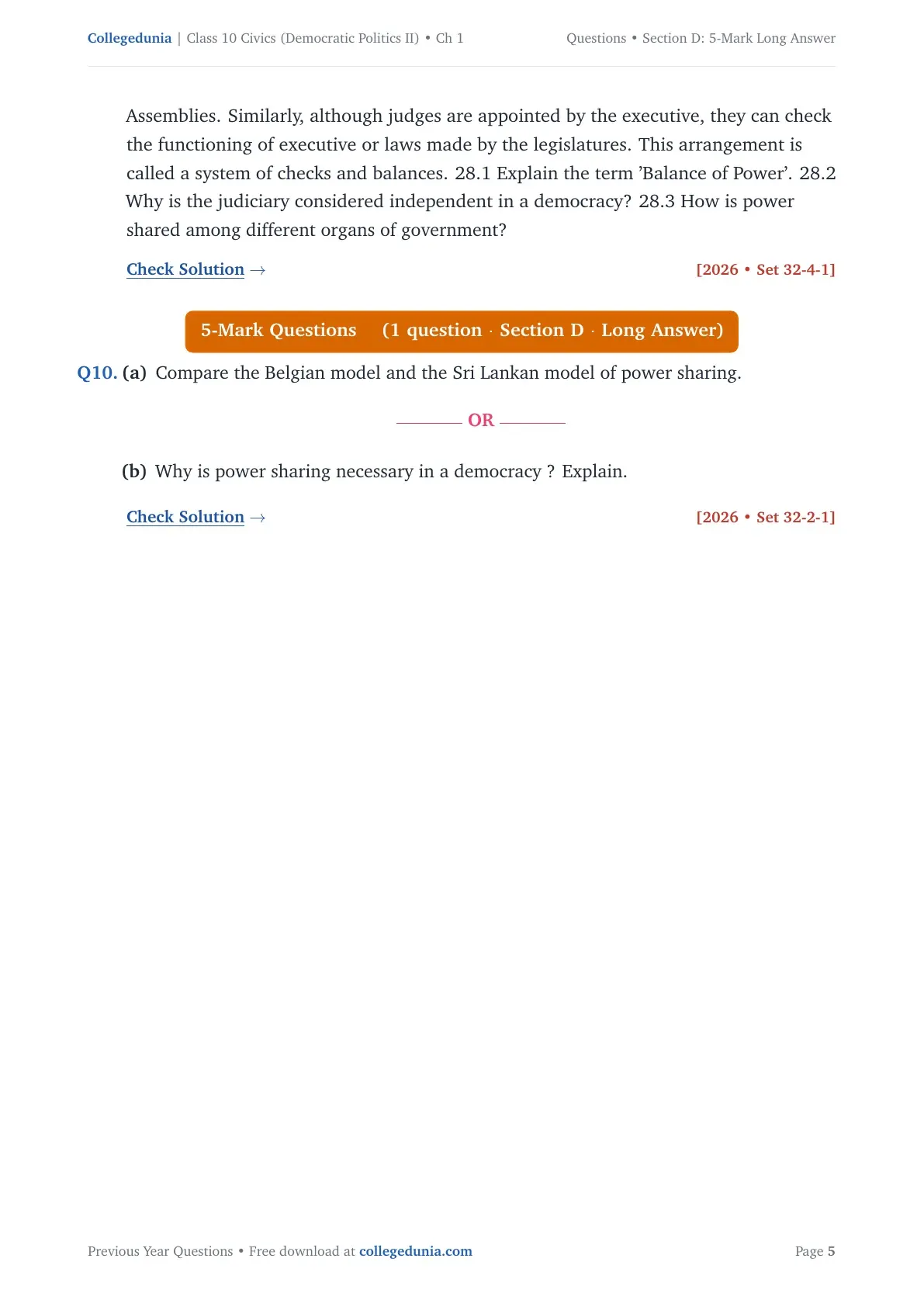
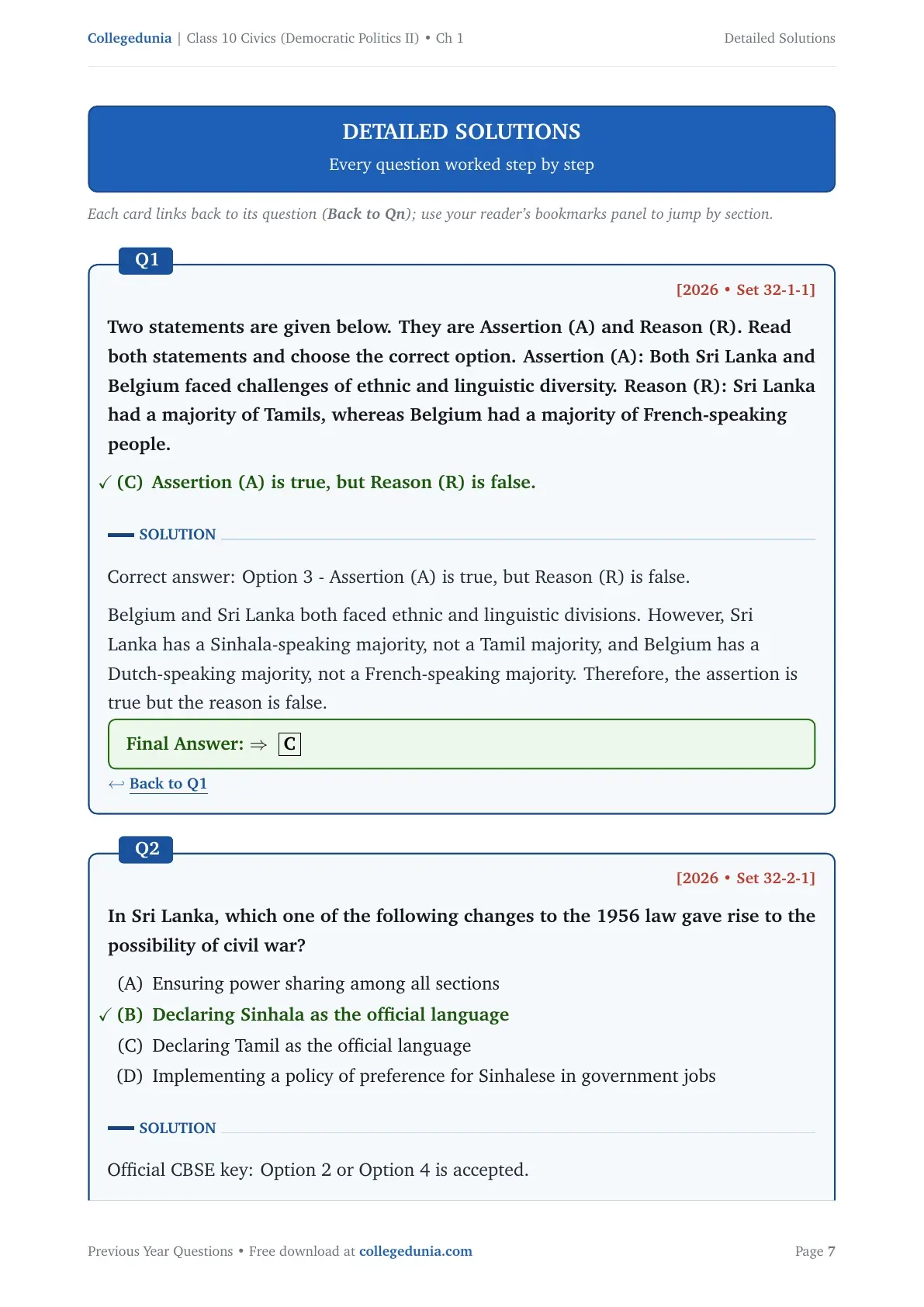
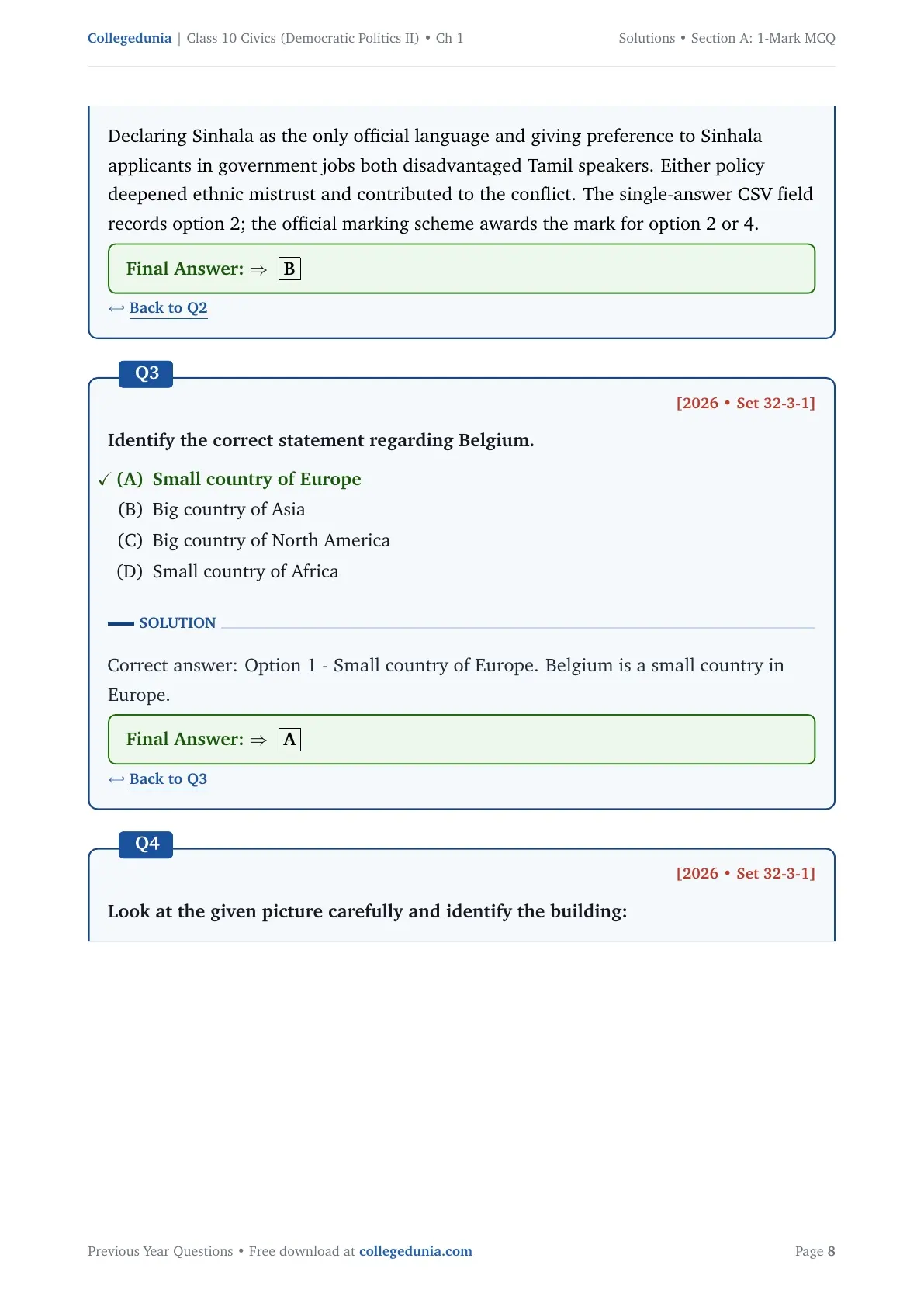
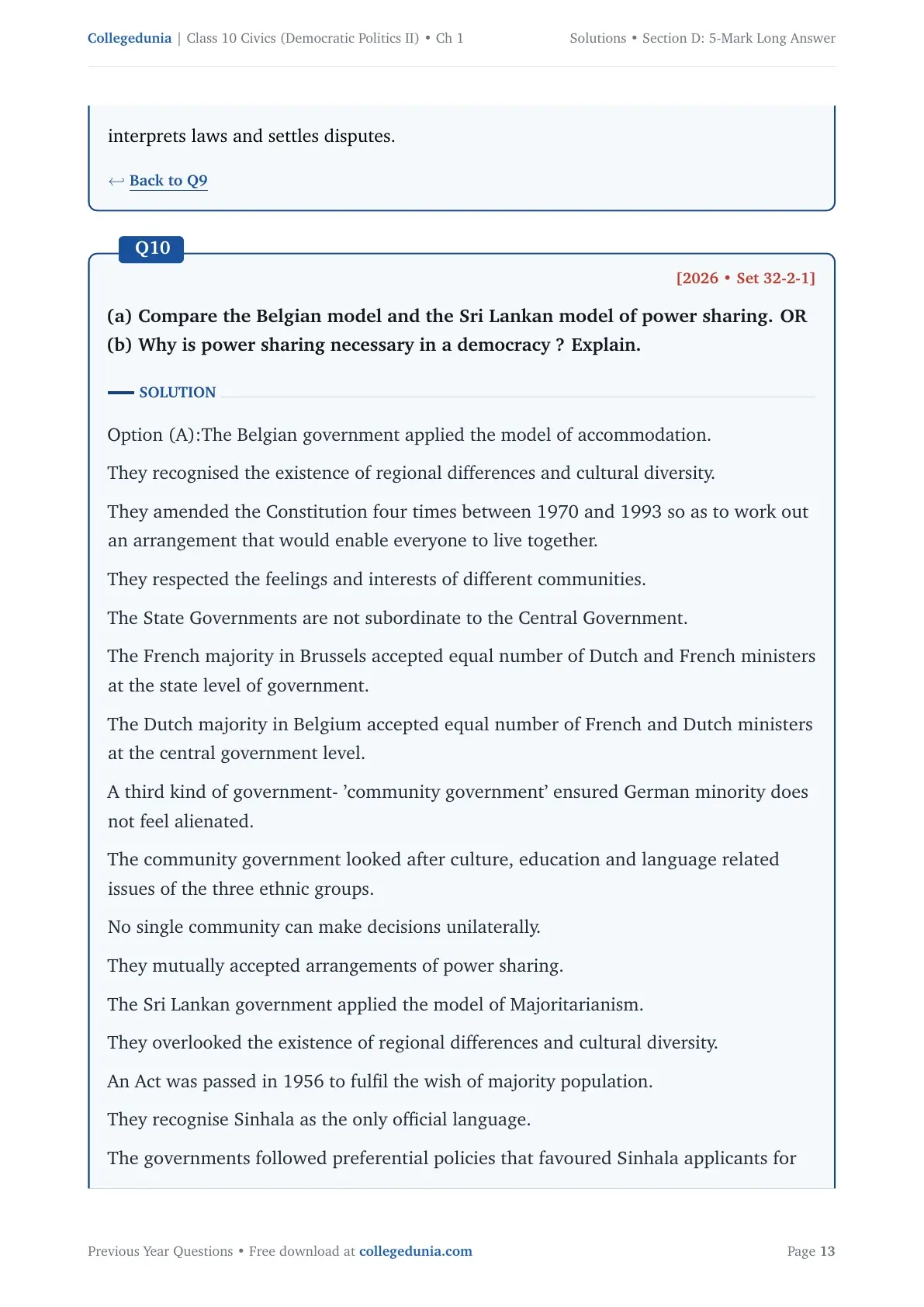
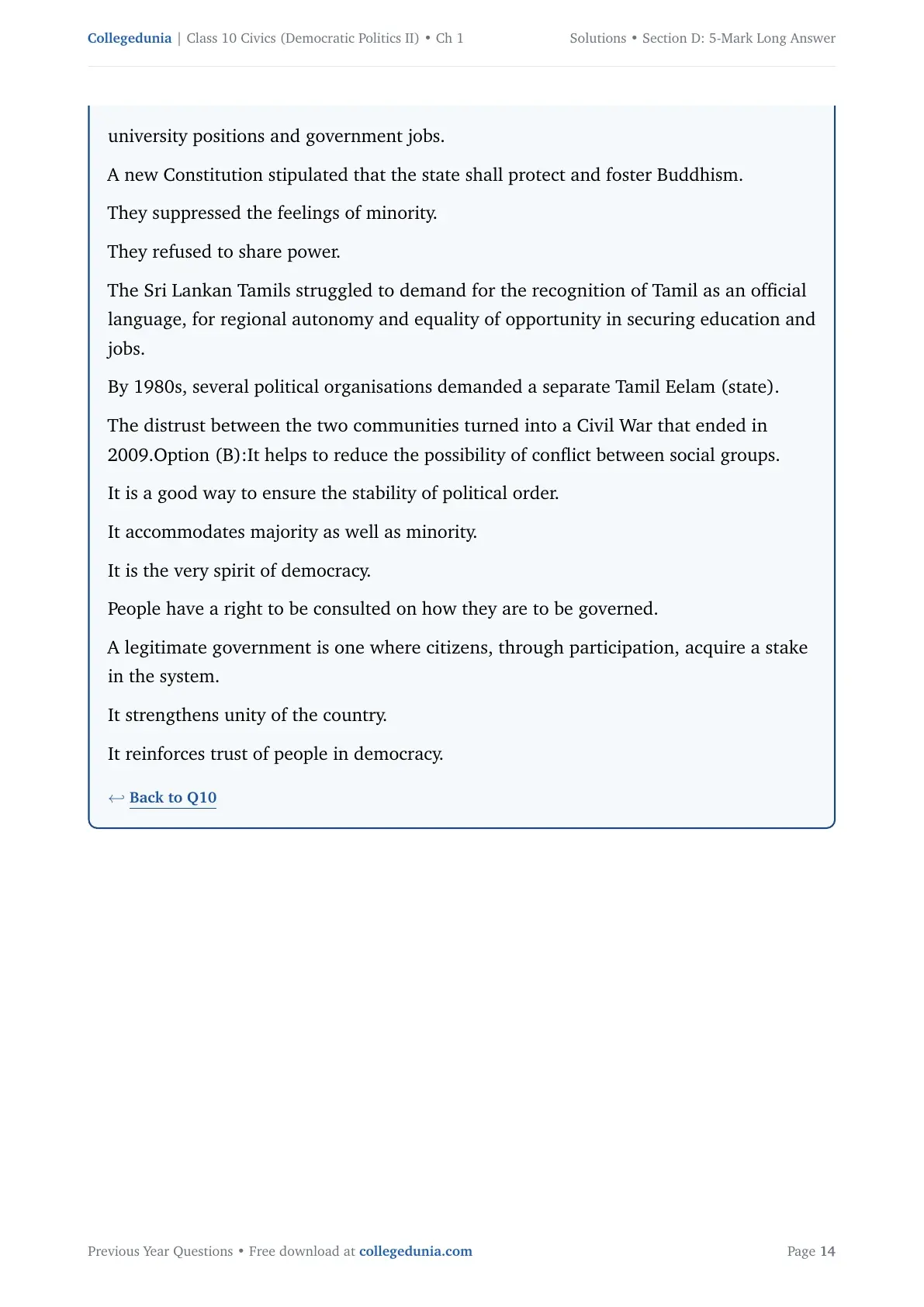
- 10 questions from 5 set codes: 6 one-mark MCQs, 3 four-mark case studies and one 5-mark long answer.
- Every question is tagged [2026 • Set 32-X-1], so you always know which paper it came from.
- Free 14-page PDF with a full worked solution for every question, according to the 2026-27 CBSE Class 10 Social Science syllabus.
Every question in this Power Sharing compilation is copied from the official CBSE 2026 Class 10 Social Science question papers, checked against the NCERT Democratic Politics II textbook, and grouped by marks band by the Collegedunia Civics team.
What the Power Sharing PYQ Set Covers from the 2026 CBSE Papers
Power Sharing is the opening chapter of Democratic Politics II, and the 2026 papers tested it the way the NCERT chapter is built. Two country stories, one idea, and four forms of sharing power.
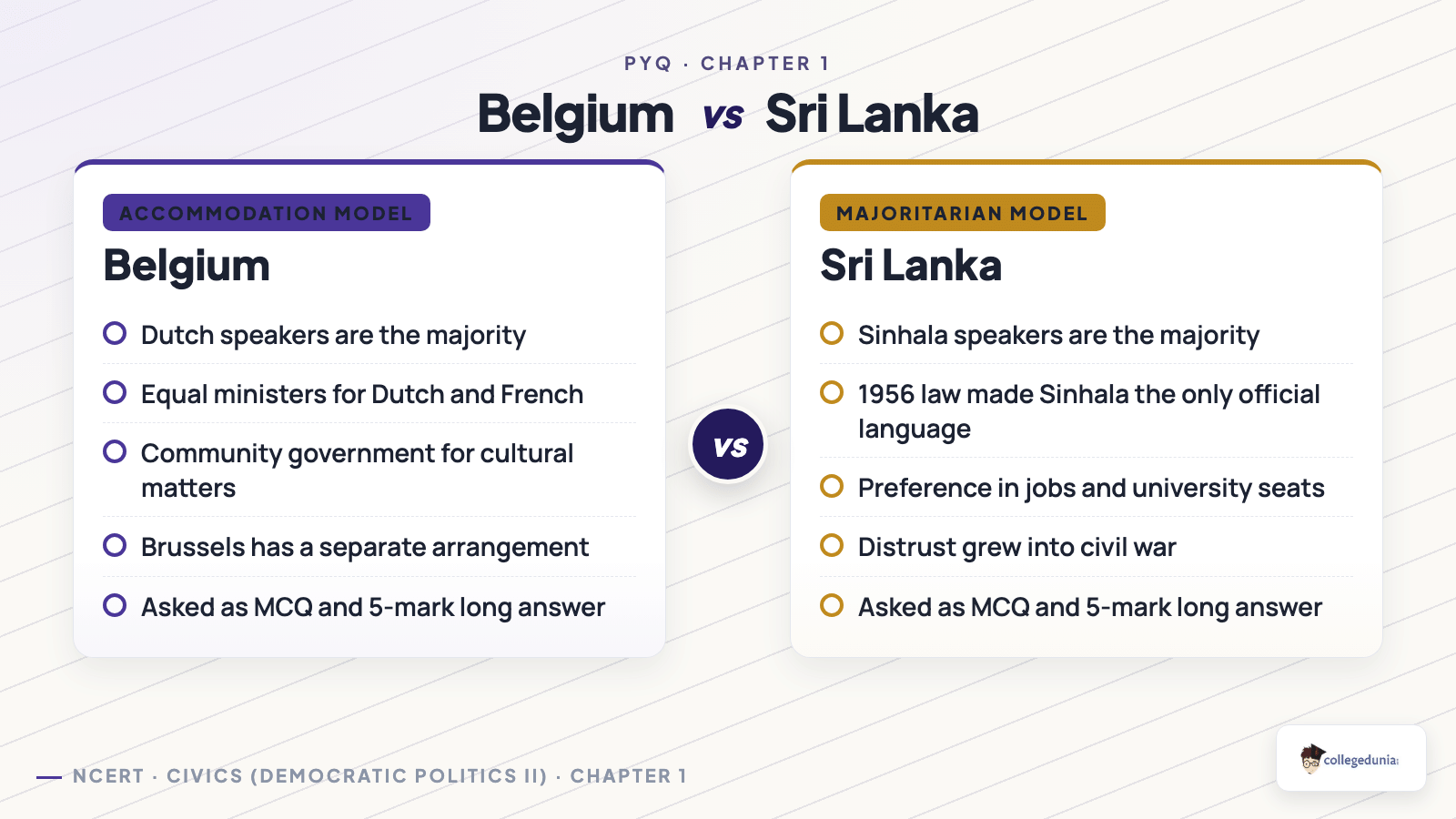
- Belgium and Sri Lanka as the contrast pair. Belgium accommodated its language groups; Sri Lanka did not.
- Majoritarianism in Sri Lanka, including the 1956 law that made Sinhala the only official language.
- Why power sharing is desirable, covering both the prudential reason and the moral reason.
- Forms of power sharing: among organs of government, among levels, among social groups, and among political parties and pressure groups.
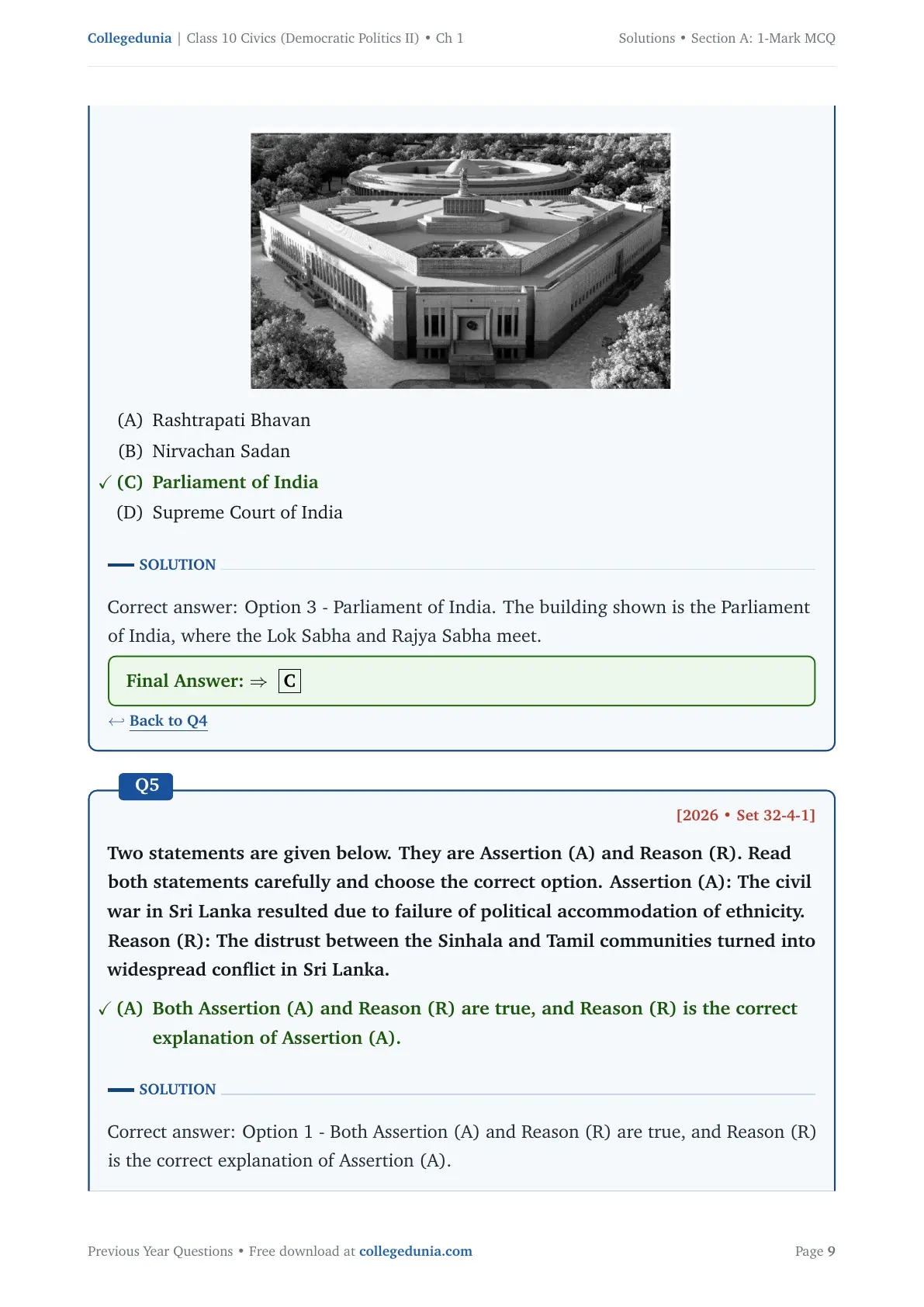
One 1-mark question is a picture-based identification of a building, printed with its four options as CBSE set it. The rest are text questions you can attempt straight off the page.
Marks-wise Split of the 10 Power Sharing Board Questions
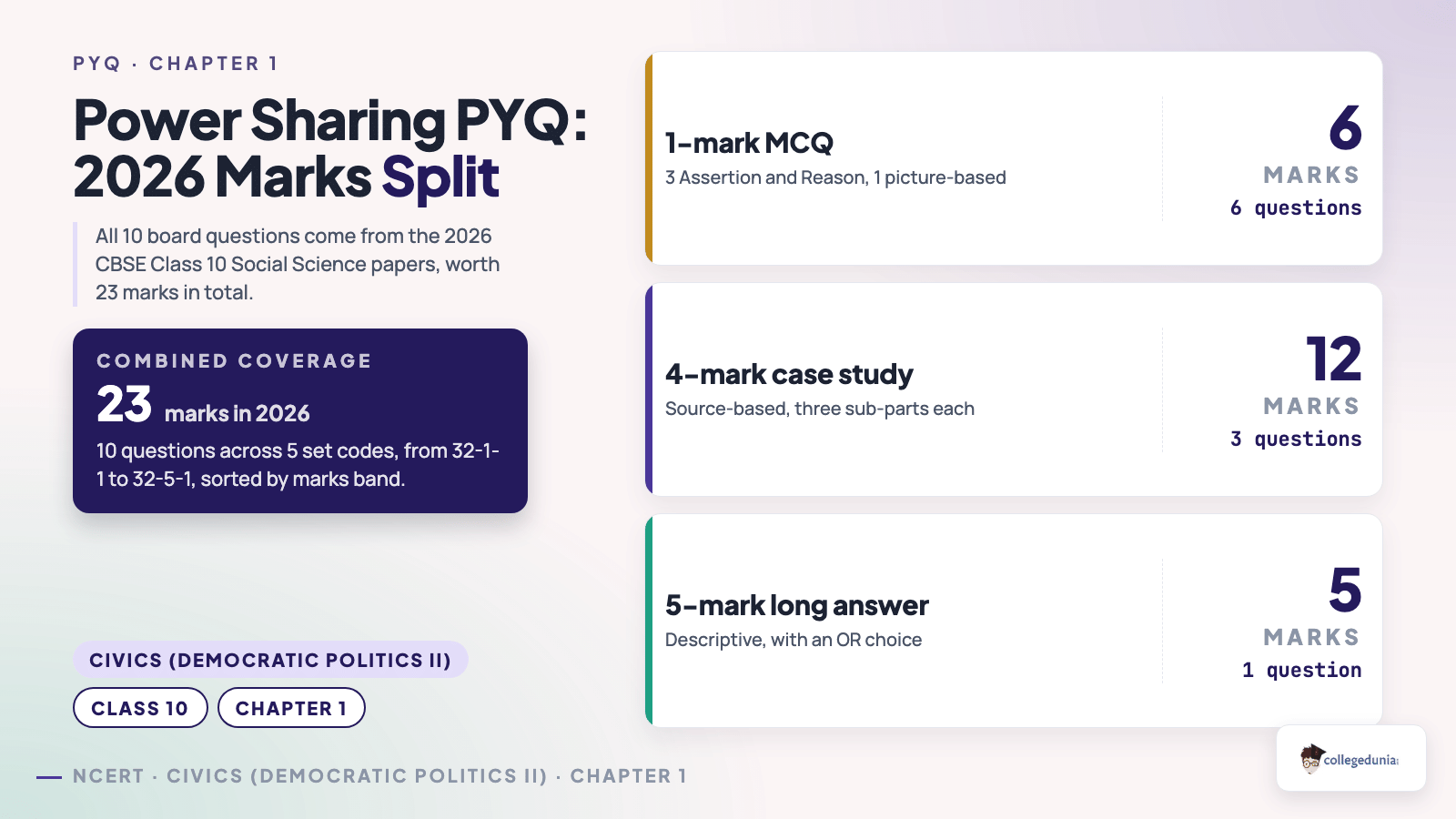
The table below shows how the ten questions divide across the CBSE marks bands. It tells you where your revision time actually goes.
| Marks | Questions | Total Marks | CBSE Section | Type |
|---|---|---|---|---|
| 1 mark | 6 | 6 | Section A | MCQ, three of them Assertion and Reason |
| 4 marks | 3 | 12 | Section E | Source-based case study, three sub-parts each |
| 5 marks | 1 | 5 | Section D | Long answer with an OR choice |
| Total | 10 | 23 | – | – |
The 4-mark case studies carry 12 of the 23 marks here, more than half. That is unusual for a Civics chapter and worth planning around.
Set-wise Spread of the Power Sharing Questions in the 2026 Papers
All ten questions come from the 2026 CBSE Class 10 Social Science board papers. Five set codes contributed, and no set gave more than three questions.
- Set 32-1-1 (2 questions): an Assertion and Reason MCQ on ethnic diversity in Belgium and Sri Lanka, plus the case study on parties, pressure groups and interest groups.
- Set 32-2-1 (2 questions): the Sinhala official-language MCQ, and the 5-mark long answer comparing the Belgian and Sri Lankan models.
- Set 32-3-1 (3 questions): the Belgium identification MCQ, the picture-based building MCQ, and the case study on forms of power sharing.
- Set 32-4-1 (2 questions): an Assertion and Reason MCQ on the Sri Lankan civil war, plus the case study on horizontal distribution and checks and balances.
- Set 32-5-1 (1 question): an Assertion and Reason MCQ on why Belgian leaders designed their power-sharing arrangements.
Belgium, Sri Lanka and the Forms of Power Sharing CBSE Actually Asked
Ten questions is a small set, so no topic frequency here is a firm trend. Still, the grouping is clear enough to guide one revision session.
| Topic Cluster | Questions | Marks Band |
|---|---|---|
| Sri Lanka, majoritarianism and the civil war | 3 | 1 and 5 mark |
| Belgium and its accommodation model | 3 | 1 and 5 mark |
| Forms of power sharing among parties and pressure groups | 2 | 4 mark |
| Horizontal power sharing and checks and balances | 1 | 4 mark |
| Why power sharing is necessary in a democracy | 1 | 4 and 5 mark |
Notice the overlap. The 5-mark question offers "compare the Belgian and Sri Lankan models" or "why is power sharing necessary in a democracy", and both branches are also touched by the case studies. Preparing those two answers properly covers a large part of the whole set.
How to Attempt Each Marks Band in the Power Sharing Questions
The PDF is ordered marks-ascending, the same order the CBSE paper uses. Attempt it in that order and the timing rehearses itself.
- 1-mark MCQs: about 45 seconds each. Three of the six are Assertion and Reason, where the trap is a true statement paired with a wrong explanation.
- 4-mark case study: read the source twice, then answer the three sub-parts in order. Roughly 30 to 40 words per sub-part is enough.
- 5-mark long answer: five clear points inside about 120 words. Read both branches of the OR before you pick one, then answer only that branch.
Case-study answers must come from the printed source plus your own chapter knowledge. Examiners look for both, so quote the source idea and then add the textbook term for it.
Common Mistakes Students Make in the Power Sharing Answers
- Getting the majority the wrong way round. In Sri Lanka the Sinhala speakers are the majority, and in Belgium the Dutch speakers are the majority. The 2026 Assertion and Reason MCQ turns on exactly this.
- Treating Assertion and Reason as two separate true or false checks. You also have to decide whether the Reason explains the Assertion.
- Writing the Belgian model as a list of institutions with no mention of the community government, which is the part the marking scheme rewards.
- Giving only the prudential reason for power sharing. The chapter gives two, prudential and moral, and a 5-mark answer needs both.
- Confusing horizontal with vertical sharing. Horizontal means legislature, executive and judiciary at the same level. Vertical means centre, state and local.
- Answering both branches of the OR question. Only one gets marked, and the time is gone.
Student Feedback on the Power Sharing Chapter
- 64% of students rated the Belgium versus Sri Lanka comparison as the sub-topic they find hardest to write in five points.
- Most-skipped in practice: the moral reason for power sharing. About 3 in 10 students wrote only the prudential reason.
- Toppers reported that writing the two country stories in a side-by-side table first made the 5-mark answer far quicker to recall.
Source: 2026-27 Class 10 Civics student poll. Sample of 11,540 students from CBSE schools across 14 states.
How to Use the Power Sharing PYQ PDF and Its Detailed Solutions
The PDF prints all ten questions first, then a Detailed Solutions section in which every question is restated, answered step by step and linked back to its place in the question set. That gives the same 14 pages two uses.
- Attempt cold. Do the six MCQs first, then the three case studies, then the long answer, with the solutions section still closed.
- Check against the worked solution. Each solution repeats the question, then takes the answer point by point, so you can see which point you left out.
- Rewrite what you missed. Any point the solution has and your answer did not is the point that would have cost you a mark.
Read straight through instead, and the same file works as a revision resource for the chapter. The Power Sharing NCERT Solutions page linked below covers the textbook exercise questions, which are a separate set from these board questions.
Power Sharing Class 10 Resources That Pair With This Question Set
Also Check: the same chapter in the other Collegedunia formats. The notes give you the content, this page gives you the board questions.
| Resource | Power Sharing Class 10 Link |
|---|---|
| NCERT Solutions | Power Sharing Class 10 NCERT Solutions |
| Revision Notes | Power Sharing Class 10 Revision Notes |
| Handwritten Notes | Power Sharing Class 10 Handwritten Notes |
| NCERT Book PDF | Power Sharing Class 10 NCERT Book PDF |
All Class 10 Civics Chapter PYQ PDFs for the 2026-27 Session
Democratic Politics II has five chapters. The chapterwise PYQ compilations for the rest are being built the same way, from the official CBSE papers.
| Chapter | Topic | Previous Year Questions |
|---|---|---|
| Chapter 1 | Power Sharing | This page |
| Chapter 2 | Federalism | Federalism PYQ PDF (coming soon) |
| Chapter 3 | Gender, Religion and Caste | Gender, Religion and Caste PYQ PDF (coming soon) |
| Chapter 4 | Political Parties | Political Parties PYQ PDF (coming soon) |
| Chapter 5 | Outcomes of Democracy | Outcomes of Democracy PYQ PDF (coming soon) |
Power Sharing Class 10 PYQ FAQs
What Students Ask About the Power Sharing Board Questions
Ques. How many questions are in the Class 10 Civics Power Sharing PYQ PDF?
Ans. Ten questions worth 23 marks. That is 6 one-mark MCQs, 3 four-mark case studies and one 5-mark long answer, all from the 2026 CBSE Class 10 Social Science board papers. It is a small, focused set, not a full chapter bank.
Ques. Does the Power Sharing PYQ PDF include answers?
Ans. Yes. The questions are printed as CBSE set them, with the year and set code under each one, and a Detailed Solutions section follows. Every solution restates its question, works the answer step by step and links back to the question, so you can attempt the set first and mark it yourself afterwards.
Ques. Which CBSE papers were used to build it?
Ans. Five set codes from the 2026 board cycle: 32-1-1, 32-2-1, 32-3-1, 32-4-1 and 32-5-1. Because every question comes from a single year, this set shows you the 2026 pattern rather than a multi-year trend.
Ques. Which Power Sharing topic carried the most marks in 2026?
Ans. The 4-mark source-based case studies carried 12 of the 23 marks. Their sources were the forms of power sharing, the argument against undivided political power, and the horizontal sharing of power among the legislature, executive and judiciary.
Ques. What is power sharing in Class 10 Civics?
Ans. Power sharing means distributing political power among different organs of government, different levels of government, different social groups, and different political parties and pressure groups, instead of holding it in one place. NCERT gives two reasons for it: a prudential reason about avoiding conflict, and a moral reason about democracy itself.
Ques. Why do the 2026 papers keep comparing Belgium and Sri Lanka?
Ans. Because the NCERT chapter opens with them as a contrast pair. Belgium recognised its regional and cultural differences and built a power-sharing arrangement around them. Sri Lanka followed a majoritarian route, including the 1956 law that made Sinhala the only official language, and the distrust that followed grew into civil war.
Ques. Are these questions still valid for the 2026-27 syllabus?
Ans. Yes. Power Sharing stays as the first chapter of the Civics unit in the 2026-27 CBSE Class 10 Social Science syllabus, and the question types in this set, MCQ, source-based case study and long answer, are the same types the paper uses.



Comments