




The NCERT Exemplar Class 10 Science book for Chapter 10, The Human Eye and the Colourful World, gives higher-order questions beyond the textbook. This page hosts the free NCERT Exemplar PDF plus a short guide for your CBSE board exam 2026-27.
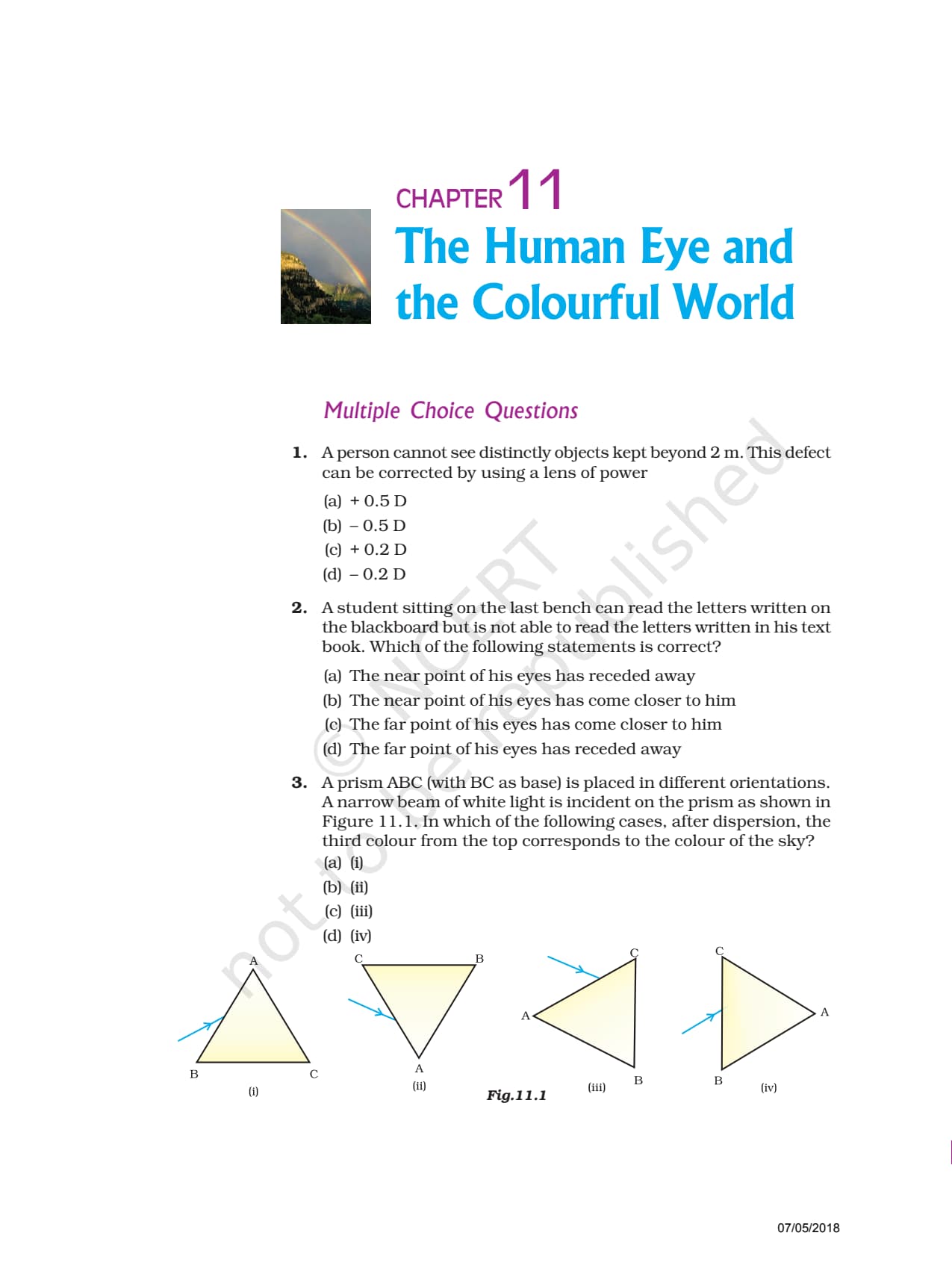
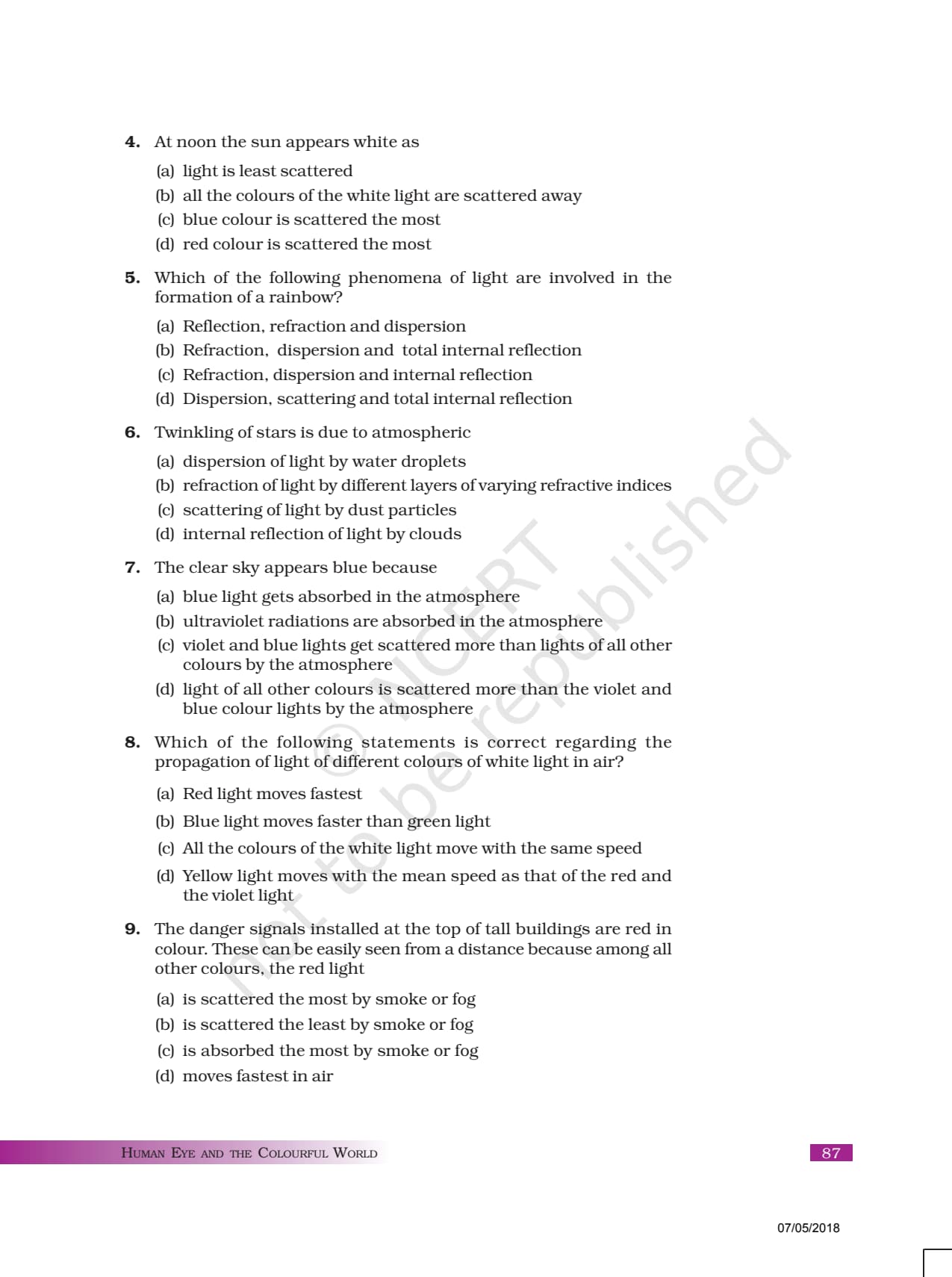
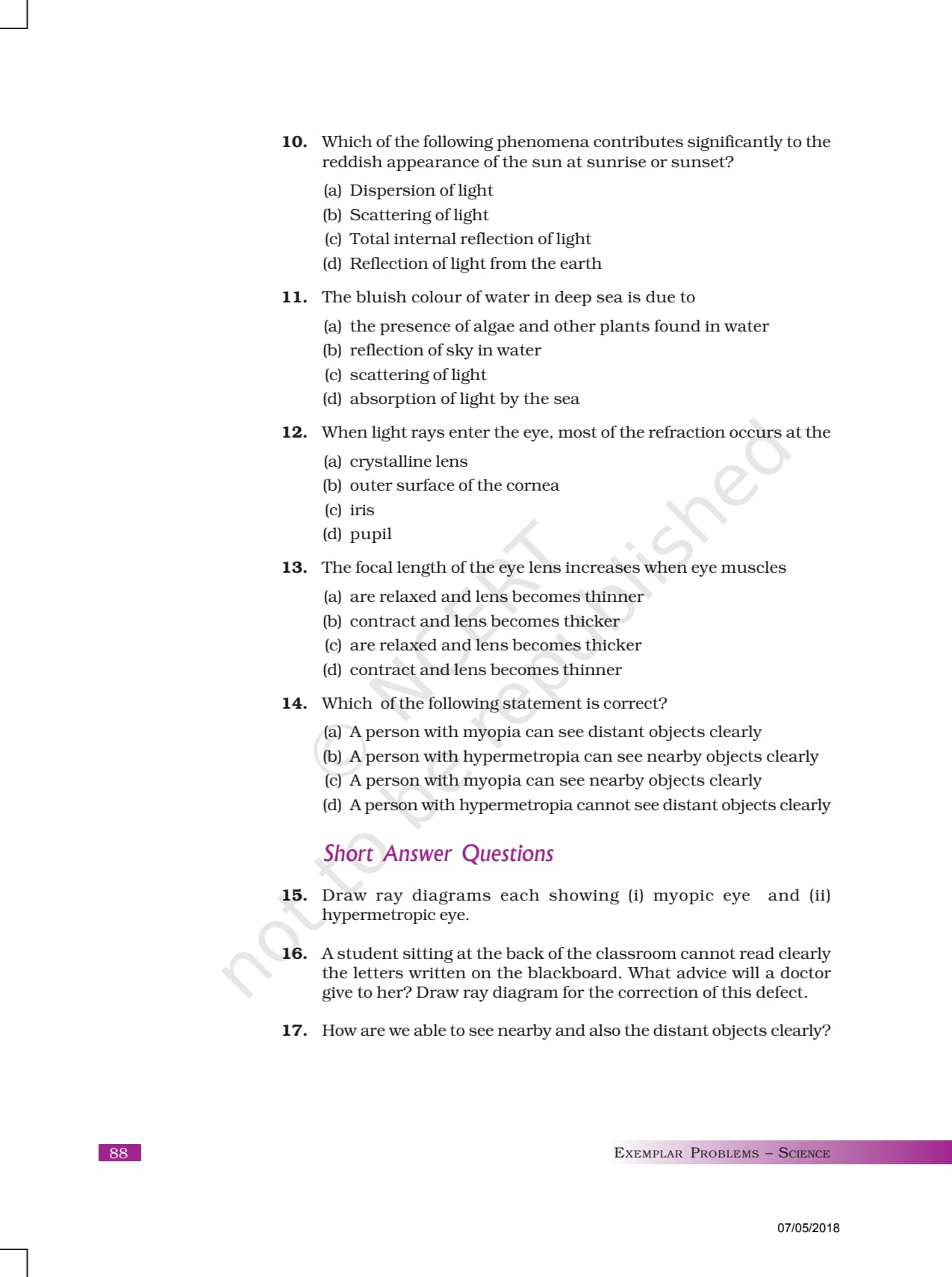
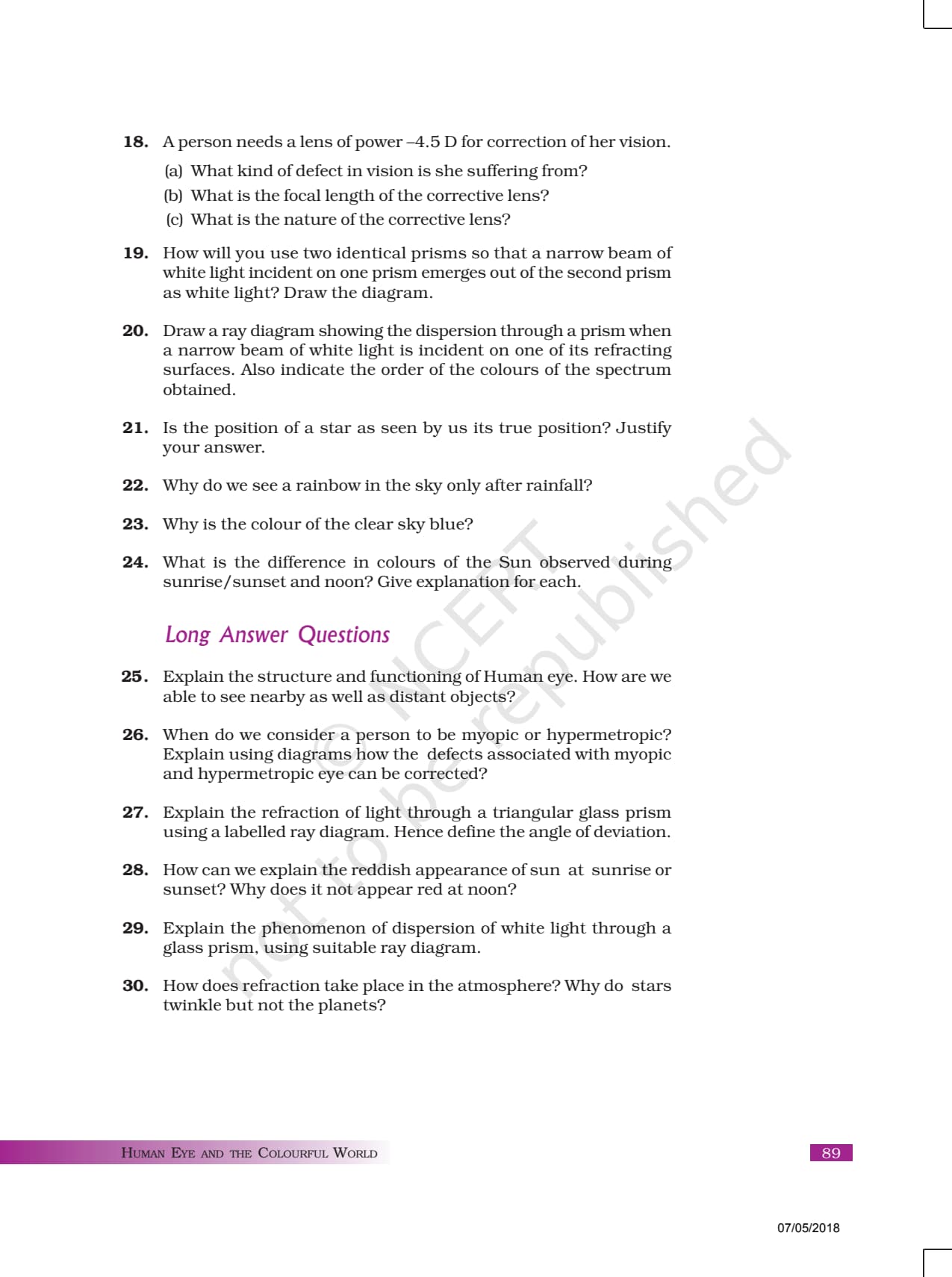
- What you get: the full official NCERT Exemplar Class 10 Science Chapter 10 PDF, free.
- Question types: MCQs, short and long answers on the eye, eye defects, prisms, dispersion, atmospheric refraction, and scattering.
- Best for: CBSE board exam 2026-27 practice plus school tests and Olympiad prep.
Read or download the complete NCERT Exemplar Class 10 Science Chapter 10 PDF from the card above. It is mapped to the 2026-27 syllabus.
This page hosts the official NCERT Exemplar PDF and a study guide by Collegedunia Science experts, checked against the CBSE Class 10 board pattern.
Also Check:
What is the NCERT Exemplar Class 10 Science Book?
The NCERT Exemplar Class 10 Science is an extra problem book by NCERT, separate from your textbook. For Chapter 10, it tests how well you understand the human eye and the colourful world, not just whether you can repeat a definition.
- Made by NCERT: the level matches your CBSE Class 10 syllabus 2026-27.
- Higher-order thinking: questions give a power value, a ray diagram, or a daily-life case and ask you to reason.
- Board and beyond: many CBSE board and school questions follow this style.
- Free and official: the PDF here is the real NCERT book.
The Human Eye and the Colourful World Class 10 Science Full Chapter Video
Source: Magnet Brains on YouTube
What is Inside Chapter 10 of the NCERT Exemplar Class 10 Science
The Exemplar opens with MCQs, then short and long answers. Many are built around an eye defect, a ray diagram, or a sky observation, so you keep linking lens power to focal length using P = 1f (in m) with the correct sign. The table shows the layout.
| Section | What it tests | Sample idea from Chapter 10 |
|---|---|---|
| Multiple Choice Questions | Quick concept checks with one correct option | Choosing the lens power needed to correct a person who cannot see beyond 2 m |
| Short Answer Questions | Two to three line answers with a reason or a small diagram | Drawing ray diagrams for a myopic eye and a hypermetropic eye |
| Long Answer Questions | Full answers with labelled ray diagrams | Explaining the structure and working of the human eye and the power of accommodation |
The big ideas recur: the eye and its parts, accommodation, near and far point, myopia, hypermetropia, presbyopia, and the corrective lens for each. Others bring in the prism, dispersion, atmospheric refraction, twinkling stars, the Tyndall effect, and why the sky is blue and the sun reddish.
Question Types in the NCERT Exemplar Class 10 Science Chapter 10
Each format trains a different skill for the CBSE board exam 2026-27.
- Single-correct MCQs: one clean idea, such as which part of the eye does most refraction.
- Diagram-based MCQs: you read a prism diagram and pick the correct case.
- Numerical MCQs: you compute a value, such as the lens power for a person who cannot see beyond 2 m.
- Reasoning MCQs: you decide a cause, such as why the sky is blue or why danger signals are red.
- Short answer (SA): two to three lines with a reason, such as why we see a rainbow after rainfall.
- Long answer (LA): full labelled ray diagrams, such as the structure and working of the human eye.
Why Solve the NCERT Exemplar for Chapter 10 The Human Eye and the Colourful World
The textbook teaches the chapter; the Exemplar tests whether you can use it. Solving it for The Human Eye and the Colourful World is a sure way to lift your Science score.
- You master the eye and its defects. A concave lens of negative power corrects myopia and a convex lens of positive power corrects hypermetropia, the single most-tested idea here.
- You handle prism and dispersion cleanly. Refraction through a prism, the angle of deviation, and the splitting of white light appear often, so neat ray diagrams pay off.
- You explain sky phenomena. Atmospheric refraction, the twinkling of stars, and advance sunrise are CBSE favourites.
- You connect scattering to real life. The blue sky, the reddish sun, the white noon sun, the Tyndall effect, and red danger signals all appear.
For full worked answers, use the linked NCERT Exemplar Solutions page. Try the questions first, then check your work.
How to Use the NCERT Exemplar Class 10 Science Chapter 10 PDF
Treat the Exemplar as a practice book, not a reading book. A three-step routine keeps your study focused before the board exam 2026-27.
- Step 1, learn first. Finish the chapter in your textbook and Notes page so you know the eye, accommodation, the defects, the prism, dispersion, and scattering.
- Step 2, attempt on your own. Try the MCQs first, then short, then long answers. Draw every ray diagram by hand.
- Step 3, check and fix. Compare with the Exemplar Solutions page. Mark wrong questions and redo them next day.
Topics Covered in NCERT Exemplar Class 10 Science Chapter 10
Every question sits on a small set of core ideas. If you are clear on the points below, you can attempt the whole chapter. Use this as a revision checklist for the 2026-27 session.
| Topic | What you must know |
|---|---|
| Structure of the human eye | The cornea, iris, pupil, eye lens, retina, and the fact that most refraction happens at the outer surface of the cornea |
| Power of accommodation | How the ciliary muscles change the focal length of the eye lens so we can see both near and distant objects clearly |
| Near point and far point | That the normal near point is about 25 cm and the far point is at infinity for a healthy eye |
| Eye defects and correction | Myopia corrected with a concave lens of negative power, hypermetropia with a convex lens of positive power, and presbyopia with a bifocal lens; power and focal length linked by P = 1f (in m) |
| Refraction through a prism | How a ray bends towards the base of a triangular prism, and what the angle of deviation means |
| Dispersion of white light | Why a prism splits white light into the band of seven colours, with violet bending most and red least |
| Atmospheric refraction | Why stars twinkle but planets do not, and why we get advance sunrise and delayed sunset |
| Scattering of light | The Tyndall effect, why the clear sky is blue, why the sun is reddish at sunrise and sunset, and why it is white at noon |
Master these eight ideas and you can answer almost every Chapter 10 Exemplar question.
Student Feedback
In a Collegedunia poll of 1,180 Class 10 students, 81% said the NCERT Exemplar was the most useful book for scoring above 90 in Science. Many found this chapter cleared up the confusion between myopia, hypermetropia, and the sign of the lens power.
Source: Collegedunia Class 10 Science student poll, 2026-27 session.
Other Resources for Class 10 Science Chapter 10
Use the table below for the other free Collegedunia resources for this chapter.
| Resource | Open |
|---|---|
| NCERT Solutions | Chapter 10 NCERT Solutions |
| Revision Notes | Chapter 10 Notes |
| Formula Sheet | Chapter 10 Formula Sheet |
| Handwritten Notes | Chapter 10 Handwritten Notes |
| Exemplar Solutions | Chapter 10 Exemplar Solutions |
| NCERT Book PDF | Chapter 10 NCERT Book PDF |
| Exemplar Book PDF | Chapter 10 Exemplar Book PDF (this page) |
NCERT Exemplar Book Class 10 Science: All Chapters
Use the table below to download the NCERT Exemplar PDF for any other Class 10 Science chapter, 2026-27 session.
| Chapter | Exemplar Book PDF |
|---|---|
| Chapter 1 | Chemical Reactions and Equations Exemplar PDF |
| Chapter 2 | Acids, Bases and Salts Exemplar PDF |
| Chapter 3 | Metals and Non-metals Exemplar PDF |
| Chapter 4 | Carbon and its Compounds Exemplar PDF |
| Chapter 5 | Life Processes Exemplar PDF |
| Chapter 6 | Control and Coordination Exemplar PDF |
| Chapter 7 | How do Organisms Reproduce Exemplar PDF |
| Chapter 8 | Heredity Exemplar PDF |
| Chapter 9 | Light - Reflection and Refraction Exemplar PDF |
| Chapter 11 | Electricity Exemplar PDF |
| Chapter 12 | Magnetic Effects of Electric Current Exemplar PDF |
| Chapter 13 | Our Environment Exemplar PDF |
NCERT Exemplar Class 10 Science Chapter 10 FAQs
Ques. Where can I download the NCERT Exemplar Class 10 Science Chapter 10 PDF?
Ans. You can download the NCERT Exemplar Class 10 Science Chapter 10 The Human Eye and the Colourful World PDF for free from the download card at the top of this page. It is the official NCERT book, mapped to the 2026-27 syllabus.
Ques. Is the NCERT Exemplar Class 10 Science enough for the board exam?
Ans. The Exemplar is excellent extra practice, but it is not a full replacement for the textbook. Finish your NCERT textbook and Notes first, then solve the Exemplar for higher-order questions. Together they cover the full CBSE Class 10 Science board pattern for 2026-27.
Ques. What types of questions are in Chapter 10 of the NCERT Exemplar?
Ans. Chapter 10 of the Exemplar has multiple choice questions (including diagram and numerical based), short answer questions, and long answer questions. They cover the human eye, the power of accommodation, eye defects and their correction, refraction through a prism, dispersion, atmospheric refraction, and the scattering of light.
Ques. How is the NCERT Exemplar different from the NCERT textbook?
Ans. Both are made by NCERT. The textbook teaches the chapter, while the Exemplar gives tougher, reasoning-based questions to test how well you understand it. Many CBSE board and school test questions follow the Exemplar style.
Ques. Where can I find solutions to the Chapter 10 Exemplar questions?
Ans. Full step-by-step answers to every question are on the NCERT Exemplar Solutions page for Class 10 Science Chapter 10. Try the questions on your own first, then check your answers there.
Ques. Which topics from Chapter 10 are most important for the Exemplar?
Ans. The most tested topics are the structure and working of the human eye, the power of accommodation, myopia and hypermetropia with their corrective lenses, refraction and dispersion through a prism, atmospheric refraction and the twinkling of stars, and the scattering of light that makes the sky blue and the sun reddish at sunrise and sunset.
Ques. Why does the clear sky appear blue in Chapter 10 Class 10 Science?
Ans. The clear sky appears blue because violet and blue light, which have shorter wavelengths, are scattered much more by the molecules of air than the other colours. Our eyes are more sensitive to blue than to violet, so the sky looks blue. This idea from the scattering of light is a common Exemplar and board question.
Ques. Is the NCERT Exemplar Class 10 Science Chapter 10 PDF free?
Ans. Yes. The full NCERT Exemplar Class 10 Science Chapter 10 PDF on this page is free to read and download. No sign-up is needed.



Comments