




The class 11 chemistry formula sheet chapter 8 organic chemistry some basic principles and techniques gathers every nomenclature rule, electronic effect, stability order and estimation formula tested in the Boards, JEE Main, JEE Advanced, NEET, CUET and NDA exams. It lists each rule, stability order and quantitative-analysis formula so students can revise the whole chapter fast.
Organic Chemistry: Some Basic Principles and Techniques is the gateway chapter to organic chemistry, so its nomenclature, hybridisation and electronic-effect ideas return in every organic chapter that follows.
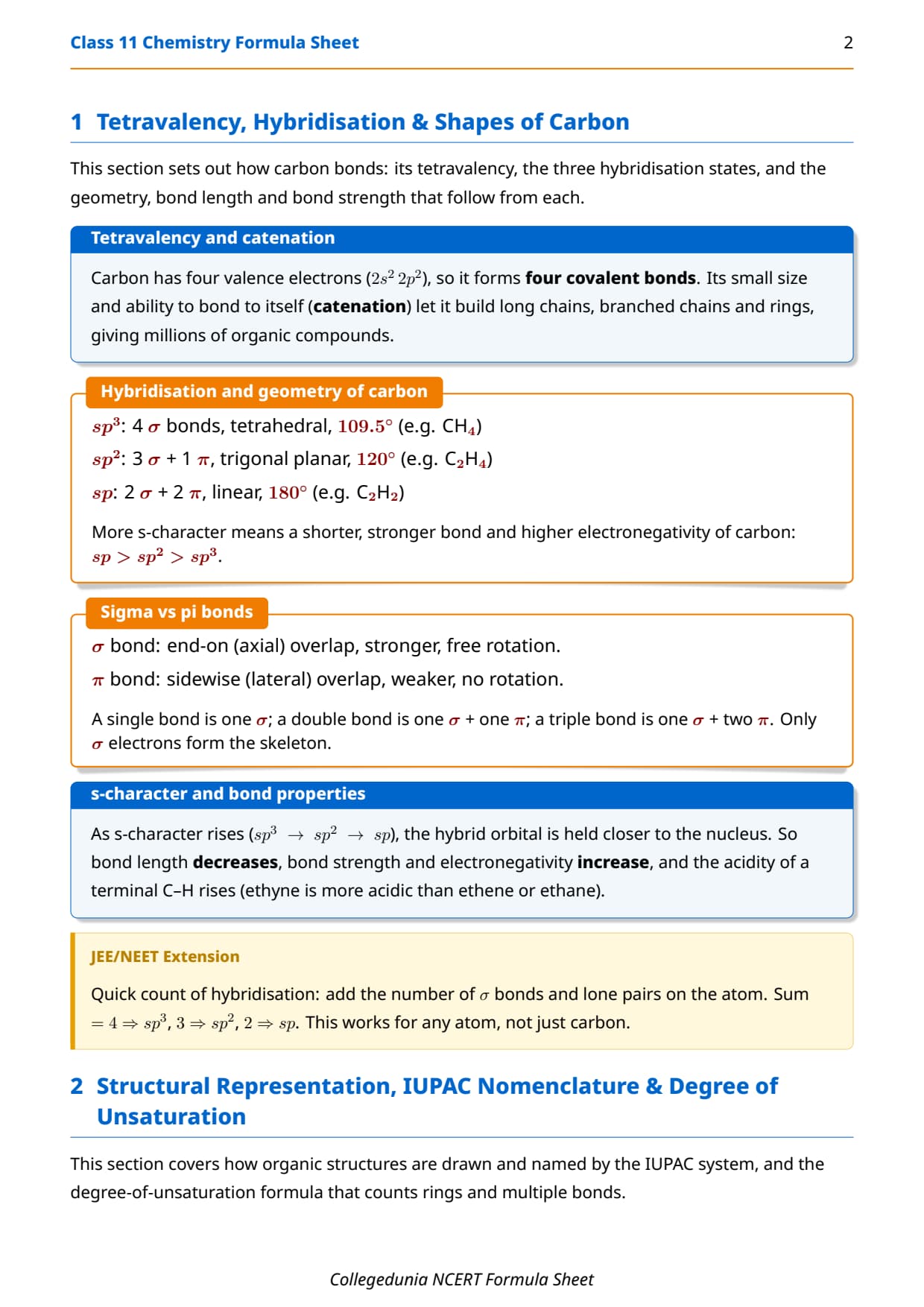
- Covers IUPAC nomenclature, hybridisation and the degree-of-unsaturation formula, plus the shapes and bond lengths of carbon.
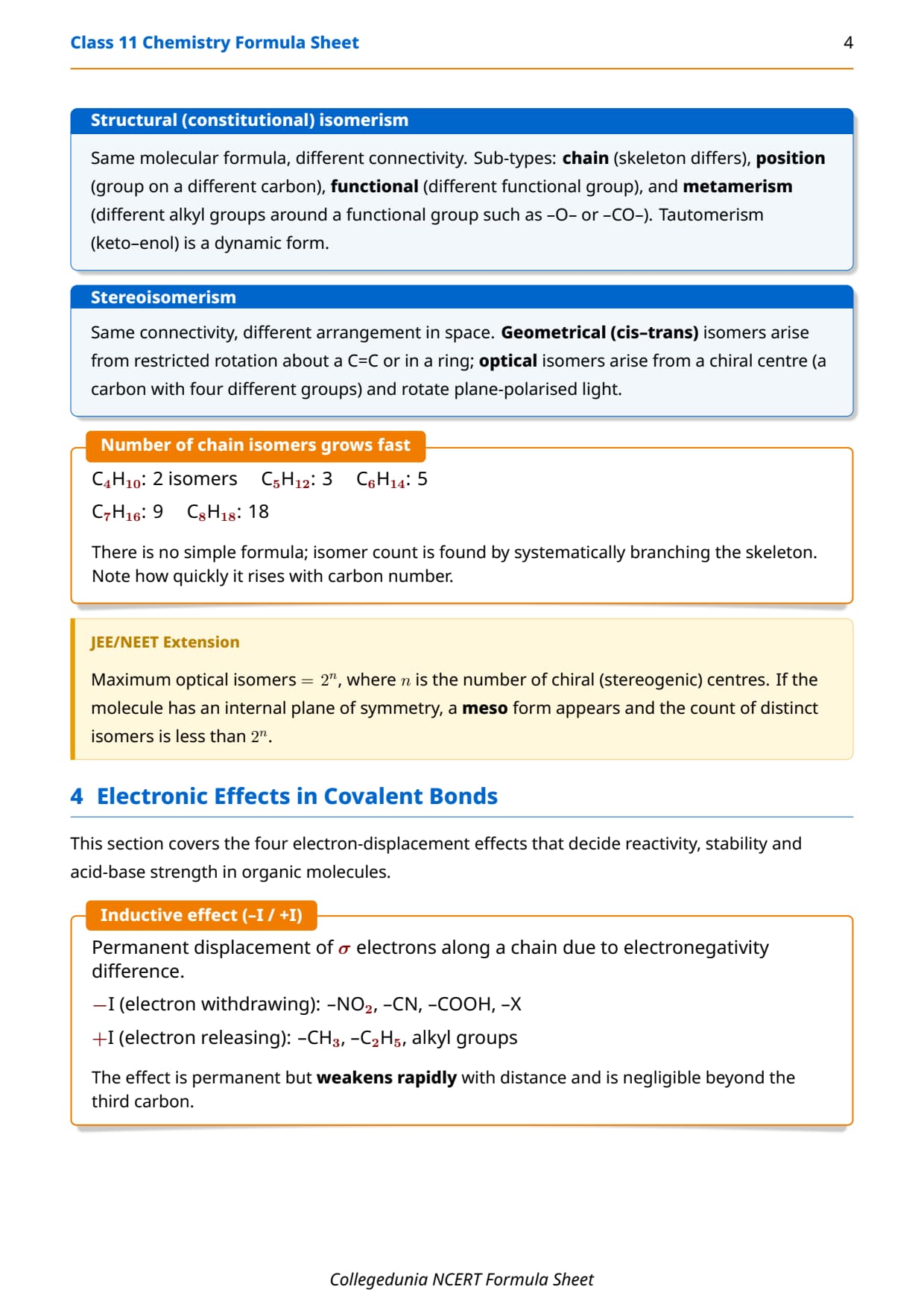
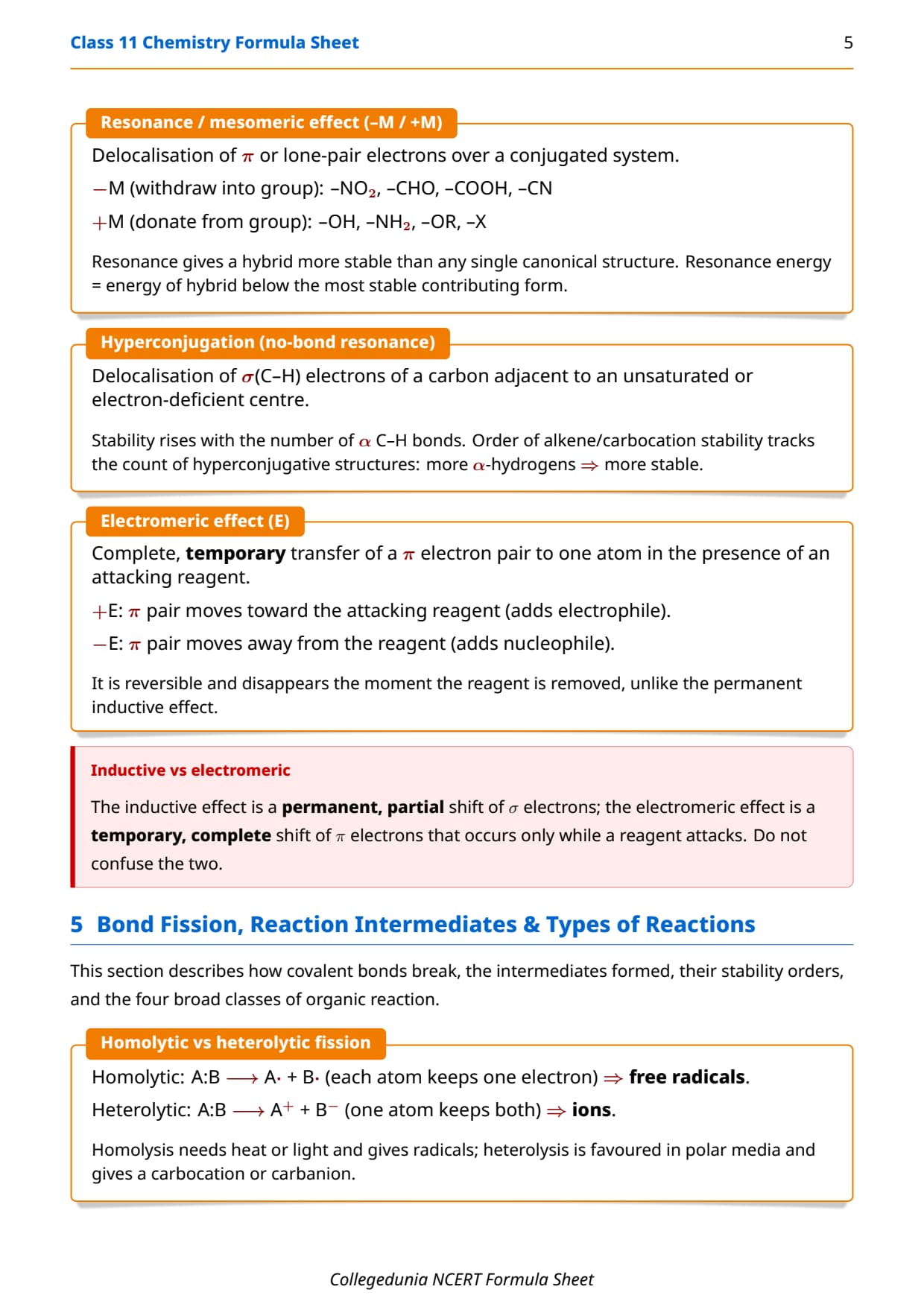
- Lists the four electronic effects inductive, resonance, hyperconjugation and electromeric side by side with their signs.
- Helps students recall carbocation, carbanion and free-radical stability orders and the estimation formulas for C, H, N, S, X and P.
This class 11 chemistry formula sheet chapter 8 organic chemistry some basic principles and techniques is curated by subject experts and checked against the 2026-27 NCERT and recent CBSE, JEE and NEET papers.
All Organic Chemistry Some Basic Principles and Techniques Formulas at a Glance
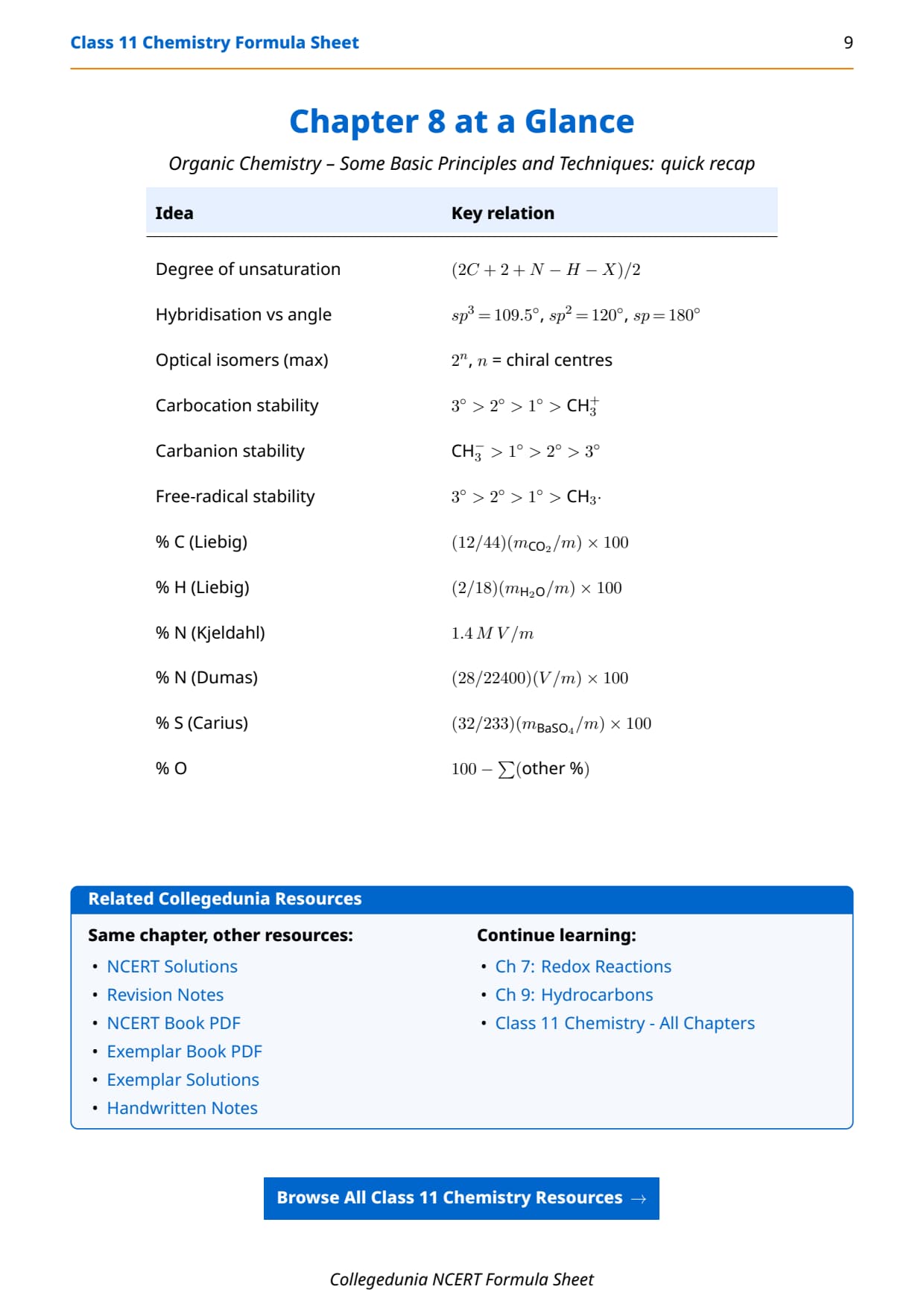
Every key relation of this chapter sits in one table below, with its meaning and use. Learn the degree-of-unsaturation and hybridisation rows first, since almost every structure question uses them.
| Formula or rule | What it means | Where it is used |
|---|---|---|
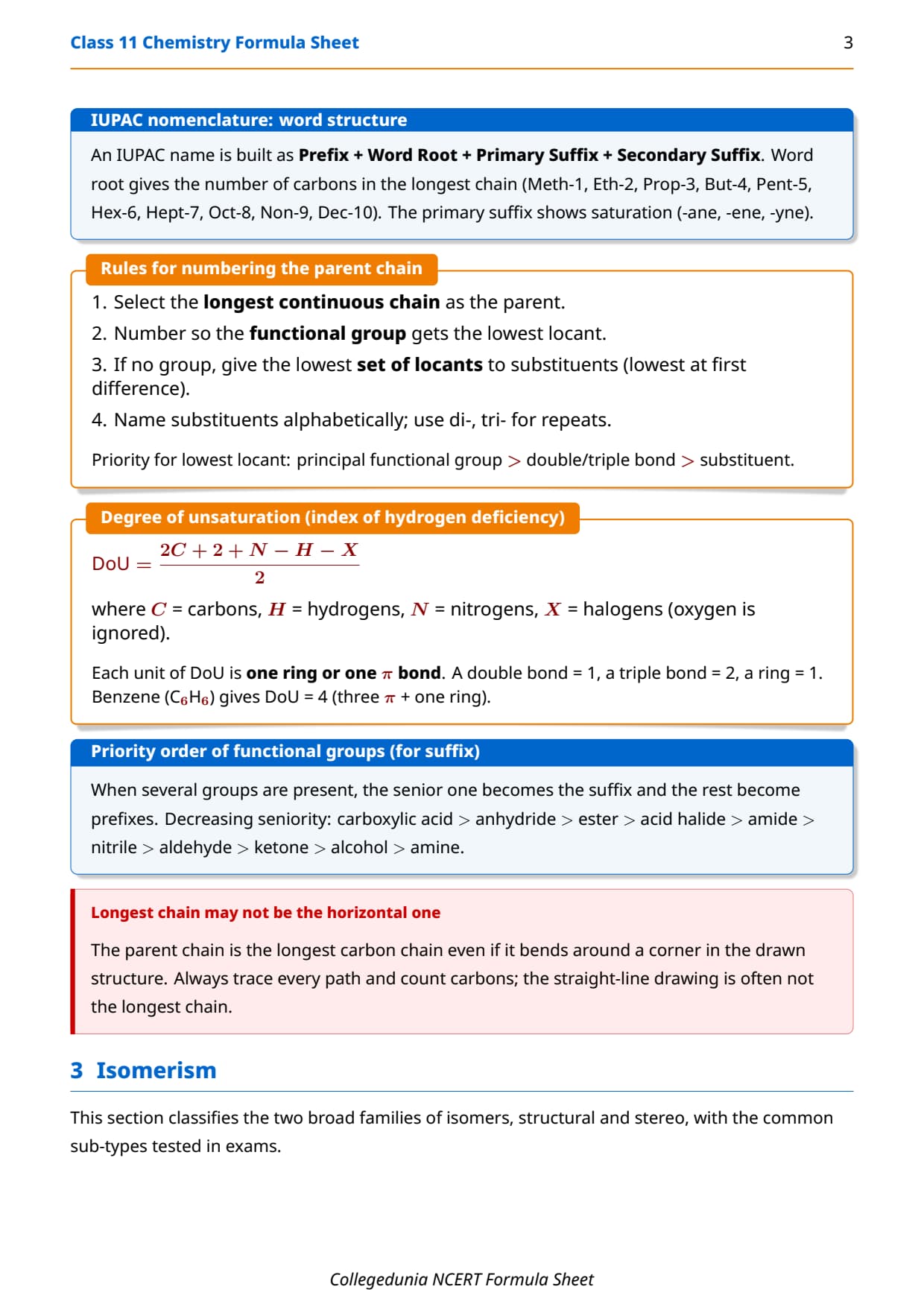
| DoU = (2C + 2 + N − H − X)/2 | Degree of unsaturation (rings + π bonds) | Deducing structure from formula |
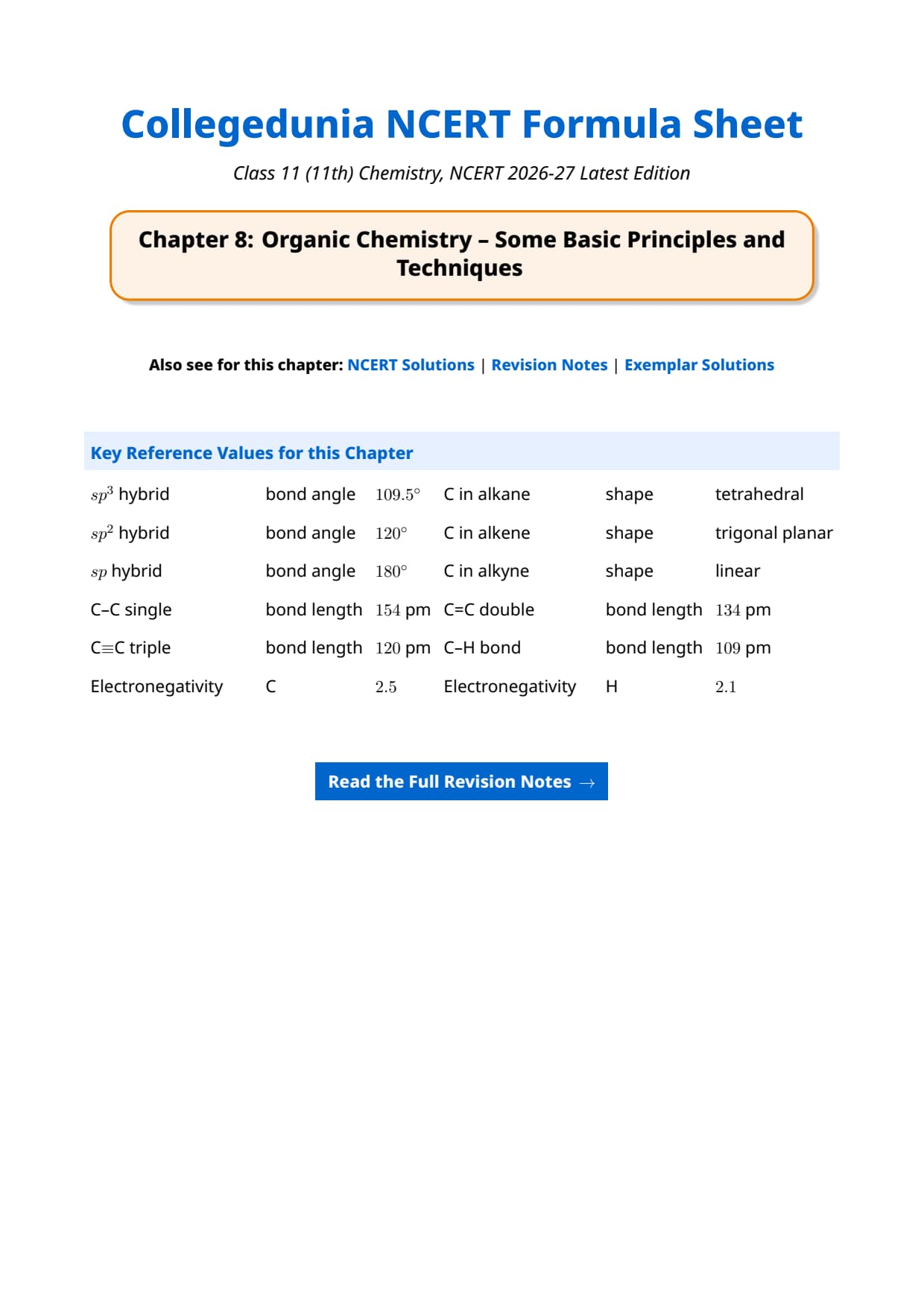
| sp3 = 109.5°, sp2 = 120°, sp = 180° | Hybridisation to bond angle and shape | Geometry of carbon |
| Max optical isomers = 2n | n = number of chiral centres | Stereoisomerism counting |
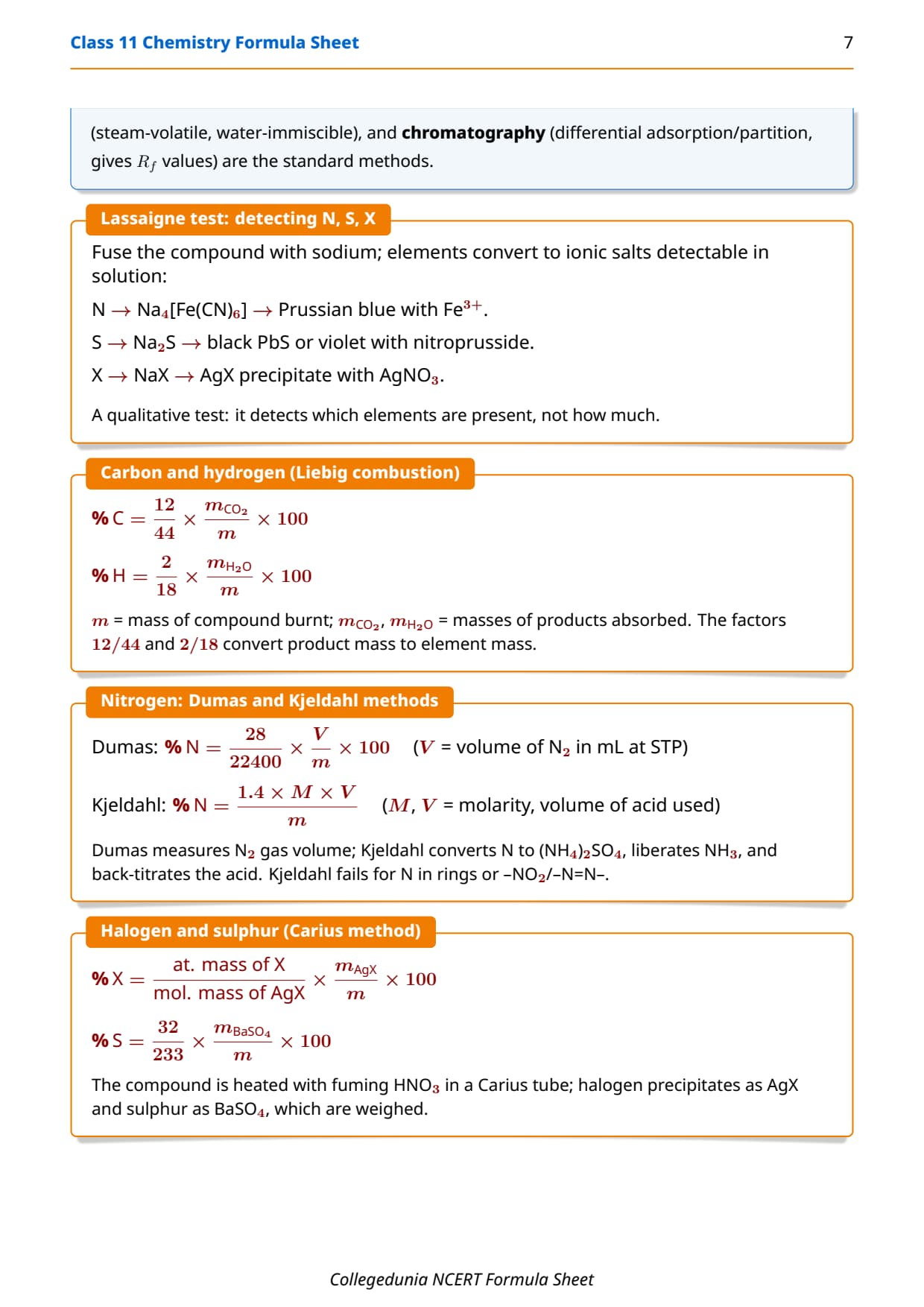
| % C = (12/44)(mCO2/m) × 100 | Carbon by Liebig combustion | Quantitative analysis |
| % H = (2/18)(mH2O/m) × 100 | Hydrogen by Liebig combustion | Quantitative analysis |
| % N = 1.4 MV/m | Nitrogen by the Kjeldahl method | Estimation of nitrogen |
| % S = (32/233)(mBaSO4/m) × 100 | Sulphur by the Carius method | Estimation of sulphur |
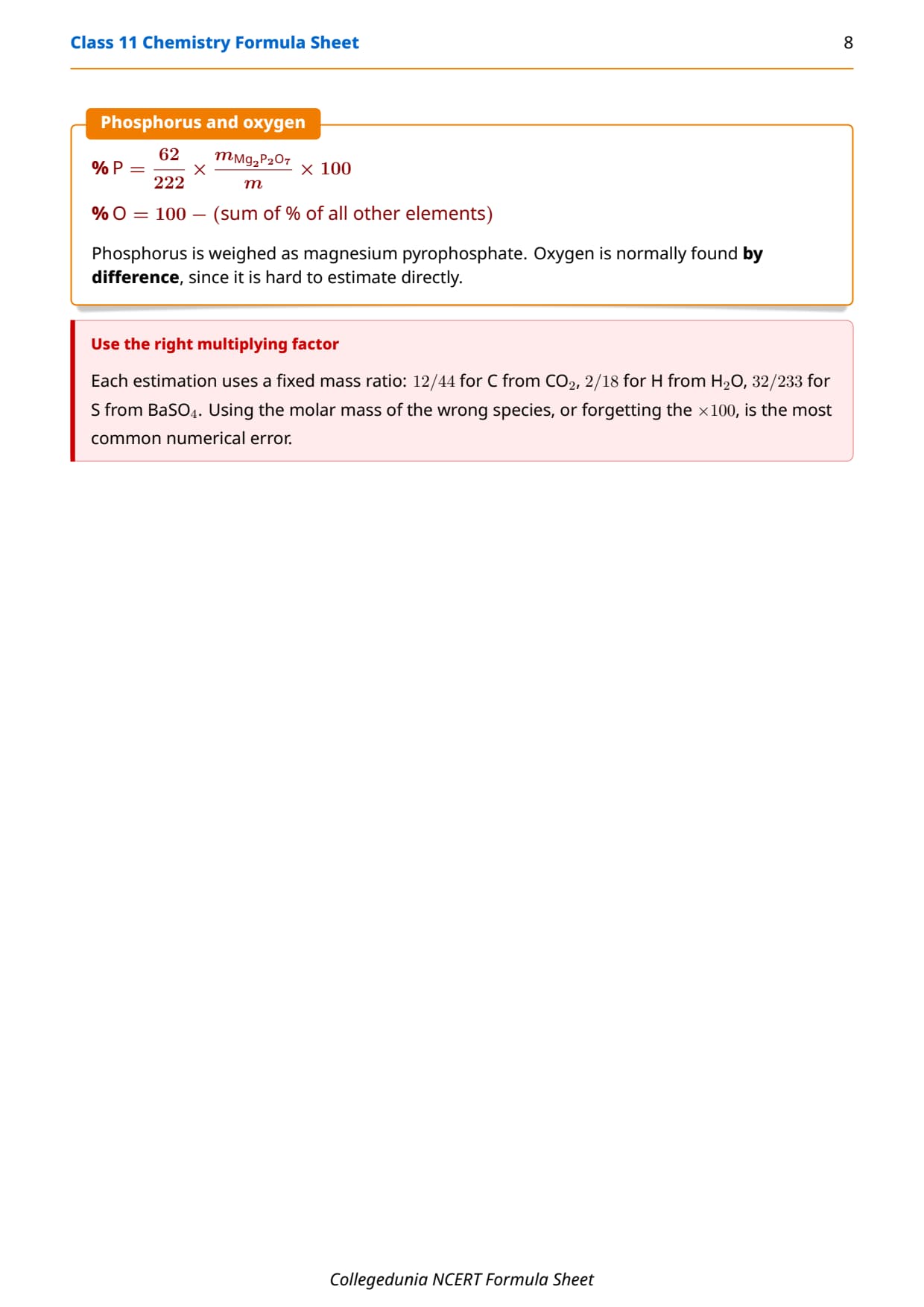
| % O = 100 − Σ(other %) | Oxygen found by difference | Composition check |
A double bond adds 1 to the degree of unsaturation, a triple bond adds 2, and each ring adds 1.
Stability Orders and Electronic Effects
You must also connect reactivity to the electronic effects and the stability of the reaction intermediates. These orders decide the major product of most organic reactions.
| Species or effect | Order or sign | Reason |
|---|---|---|
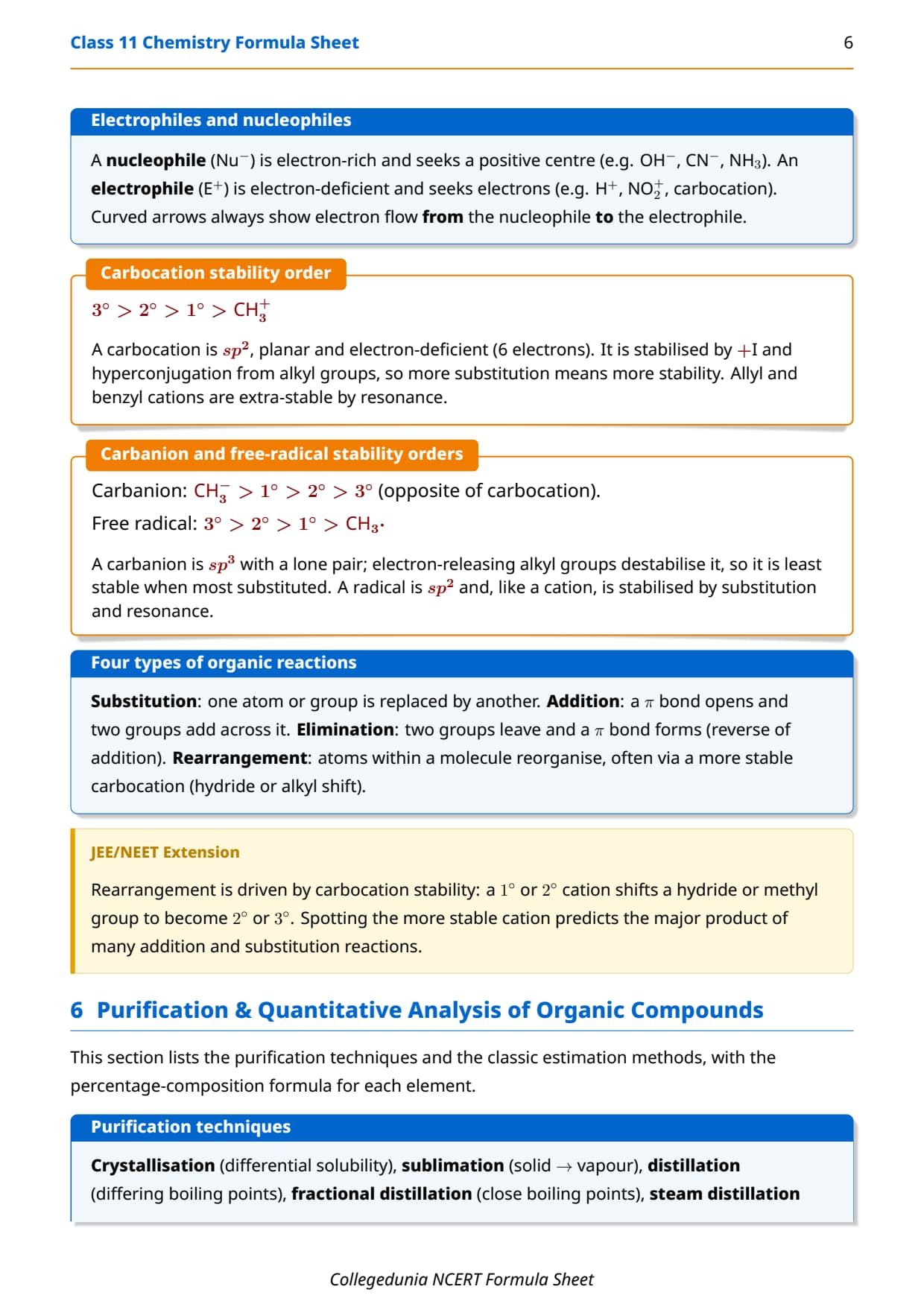
| Carbocation stability | 3° > 2° > 1° > CH3+ | +I and hyperconjugation from alkyl groups |
| Carbanion stability | CH3− > 1° > 2° > 3° | Alkyl groups destabilise the lone pair |
| Free-radical stability | 3° > 2° > 1° > CH3· | Hyperconjugation and resonance |
| Inductive effect | +I releases, −I withdraws | Permanent σ shift, weakens with distance |
| Resonance (mesomeric) | +M donates, −M withdraws | Delocalised π or lone-pair electrons |
| Electromeric effect | +E and −E | Temporary, complete π shift on attack |
By homolytic fission a bond splits to give two free radicals, while heterolytic fission gives a carbocation and a carbanion. The medium and the reagent decide which path a reaction takes.
Key Values and Rules for Organic Chemistry Some Basic Principles and Techniques
Boards and entrance papers often ask for a bond angle, a stability order or the priority of a functional group. The list below has the key values and rules used in this chapter.
- Bond angles: sp3 = 109.5°, sp2 = 120°, sp = 180°, giving tetrahedral, trigonal planar and linear shapes.
- Bond lengths: C−C = 154 pm, C=C = 134 pm, C≡C = 120 pm; more s-character means a shorter, stronger bond.
- Functional-group priority for suffix: carboxylic acid > ester > amide > nitrile > aldehyde > ketone > alcohol > amine.
- Lassaigne test: nitrogen gives Prussian blue, sulphur gives black lead sulphide, and halogens give a silver halide precipitate.
- Estimation factors: 12/44 for C from CO2, 2/18 for H from H2O, 32/233 for S from BaSO4.
How to Revise Organic Chemistry Some Basic Principles and Techniques Formulas Before the Exam
Use this class 11 chemistry formula sheet chapter 8 organic chemistry some basic principles and techniques for a fast recap the night before a test, in about 20 minutes.
- First 7 minutes: write the degree-of-unsaturation formula and the three hybridisation-to-angle links, then name two branched structures.
- Next 7 minutes: recall the four electronic effects with their +/− signs and the three intermediate stability orders.
- Last 6 minutes: revise the estimation formulas for C, H, N, S and halogen, and the Lassaigne test colours.
Finish by solving one degree-of-unsaturation problem and one Kjeldahl nitrogen numerical.
Student Feedback on the Organic Chemistry Some Basic Principles and Techniques Formula Sheet
What 12,860 students told us about their Organic Chemistry Some Basic Principles and Techniques revision:
- 68% of students rated IUPAC nomenclature of branched and multi-group compounds as the hardest part.
- Most-skipped step: applying the correct multiplying factor in the estimation numericals.
- Students who learned the electronic effects before the reaction types found mechanisms much easier.
Source: 2026-27 Class 11 Chemistry student poll. Sample of 12,860 students from CBSE schools across 14 states, conducted before the 2026 boards.
Other Organic Chemistry Some Basic Principles and Techniques Class 11 Chemistry Resources
Pair this formula sheet with the solved answers, notes and textbook PDF.
| Resource | Link |
|---|---|
| NCERT Solutions | Organic Chemistry Some Basic Principles and Techniques Class 11 NCERT Solutions |
| Revision Notes | Organic Chemistry Some Basic Principles and Techniques Class 11 Notes |
| Handwritten Notes | Organic Chemistry Some Basic Principles and Techniques Class 11 Handwritten Notes |
| NCERT Book PDF | Organic Chemistry Some Basic Principles and Techniques Class 11 Book PDF |
NCERT Formula Sheet for Class 11 Chemistry: All Chapters
Jump to any other Class 11 Chemistry formula sheet below.
| Chapter | Formula Sheet |
|---|---|
| Chapter 1 | Some Basic Concepts of Chemistry |
| Chapter 2 | Structure of Atom |
| Chapter 3 | Classification of Elements and Periodicity in Properties |
| Chapter 4 | Chemical Bonding and Molecular Structure |
| Chapter 5 | Thermodynamics |
| Chapter 6 | Equilibrium |
| Chapter 7 | Redox Reactions |
| Chapter 8 | Organic Chemistry: Some Basic Principles and Techniques |
| Chapter 9 | Hydrocarbons |
FAQs on Organic Chemistry Some Basic Principles and Techniques Class 11 Chemistry Formula Sheet
Organic Chemistry Some Basic Principles and Techniques Formula Sheet - Frequently Asked Questions
Ques. What formulas does the class 11 chemistry formula sheet chapter 8 organic chemistry some basic principles and techniques cover?
Ans. This class 11 chemistry formula sheet chapter 8 organic chemistry some basic principles and techniques covers the degree of unsaturation (2C + 2 + N − H − X)/2, hybridisation and shapes of carbon, the four electronic effects, carbocation, carbanion and free-radical stability orders, and the quantitative estimation formulas for carbon, hydrogen, nitrogen, sulphur, halogen and phosphorus.
Ques. How do you calculate the degree of unsaturation?
Ans. The degree of unsaturation is DoU = (2C + 2 + N − H − X)/2, counting carbons, hydrogens, nitrogens and halogens while ignoring oxygen. Each unit stands for one ring or one π bond. Benzene, C6H6, gives a value of 4, which is three double bonds plus one ring.
Ques. What is the order of stability of carbocations?
Ans. Carbocation stability is 3° > 2° > 1° > CH3+. A carbocation is electron-deficient, so electron-releasing alkyl groups stabilise it through the +I effect and hyperconjugation. Allyl and benzyl carbocations are even more stable because of resonance.
Ques. What is the difference between the Kjeldahl and Dumas methods?
Ans. In the Kjeldahl method nitrogen is turned into ammonium sulphate, ammonia is liberated and absorbed in acid, and the percentage is % N = 1.4 MV/m. In the Dumas method the compound is burnt and the nitrogen gas is measured as % N = (28/22400)(V/m) × 100. Kjeldahl fails for nitrogen in rings or in nitro and azo groups, where Dumas is used.



Comments