




The class 11 chemistry formula sheet chapter 3 classification of elements and periodicity in properties gathers every periodic trend, definition and rule tested in the Boards, JEE Main, JEE Advanced, NEET, CUET and NDA exams. It lists each trend, key relation and exception so students can revise the whole chapter fast.

Classification of Elements and Periodicity in Properties is a trend-based chapter, so its rules on atomic radius, ionization enthalpy and electronegativity return in bonding, the s-block and the p-block later.
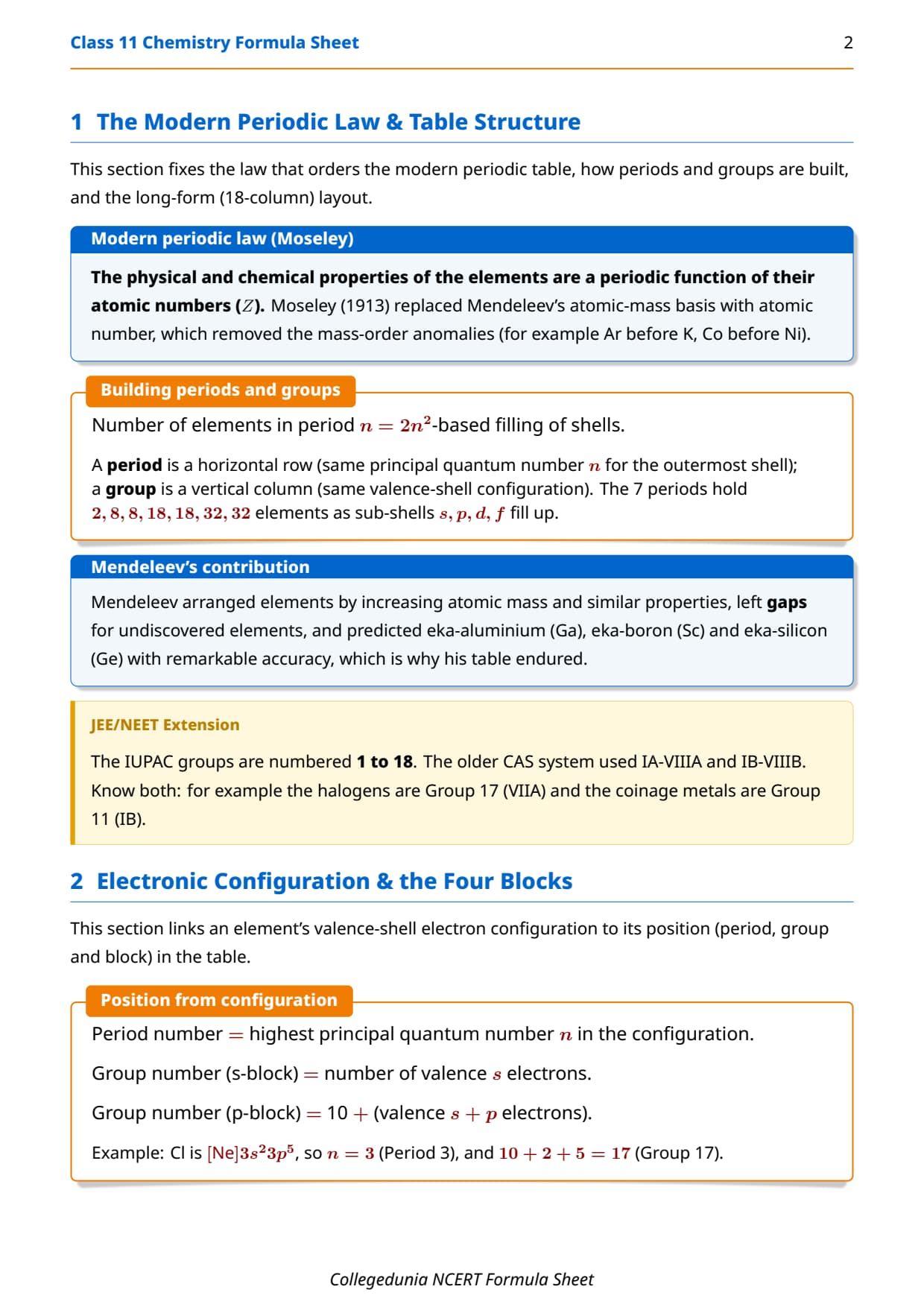
- Covers the modern periodic law, electronic configuration and the four blocks, plus how to read an element's position from its configuration.
- Lists the periodic trends atomic and ionic radius, ionization enthalpy, electron gain enthalpy and electronegativity side by side.
- Helps students explain effective nuclear charge, screening, the diagonal relationship, anomalous first members and nomenclature of elements with Z greater than 100.
This class 11 chemistry formula sheet chapter 3 classification of elements and periodicity in properties is curated by subject experts and checked against the 2026-27 NCERT and recent CBSE, JEE and NEET papers.
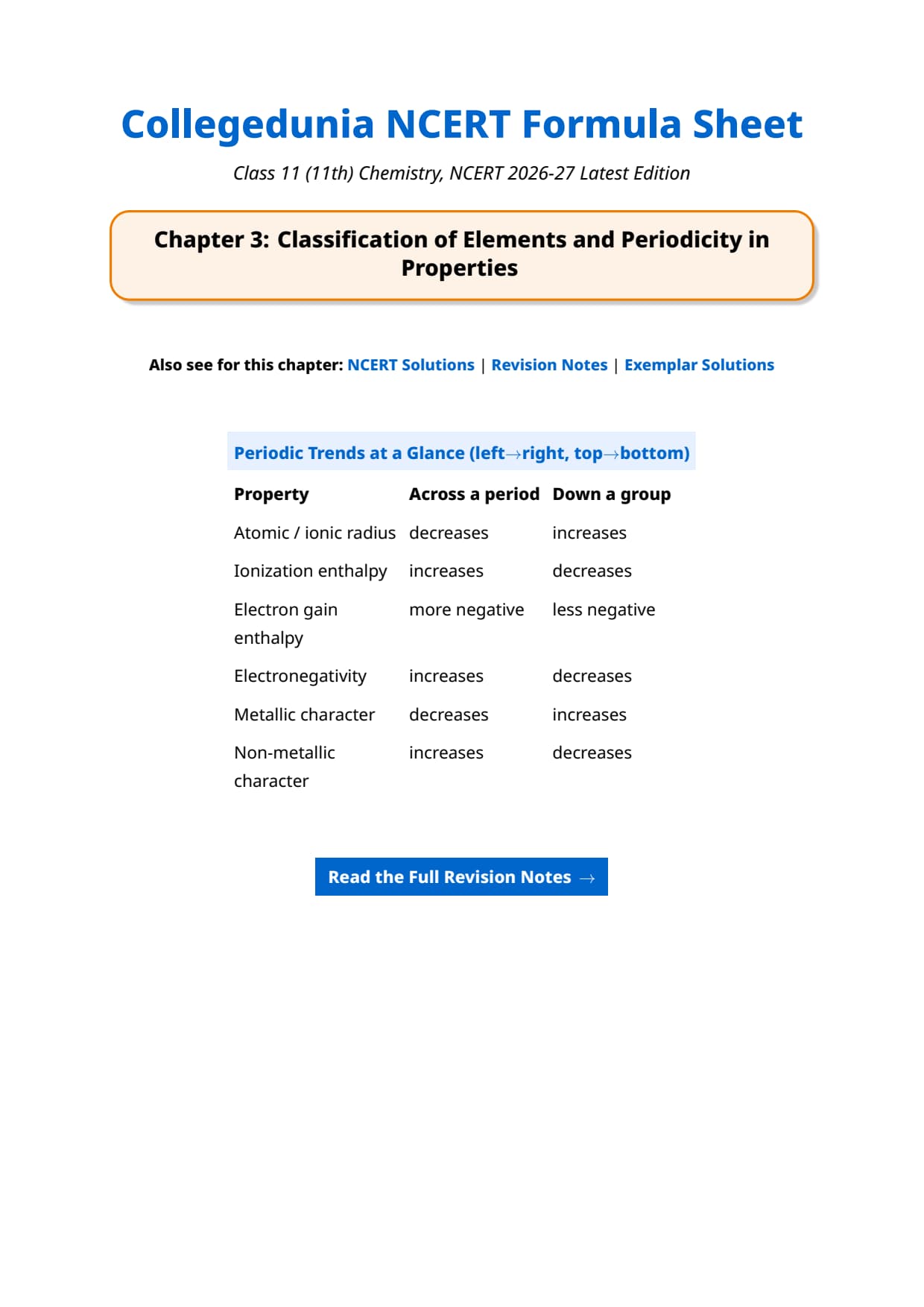
All Classification of Elements and Periodicity in Properties Trends at a Glance
Every major periodic trend sits in one table below, with the direction it moves across a period and down a group. Learn the radius and ionization enthalpy rows first, since almost every question builds on them.
| Property | Across a period (left to right) | Down a group (top to bottom) |
|---|---|---|
| Atomic and ionic radius | Decreases | Increases |
| Effective nuclear charge Zeff | Increases | Almost constant, slight rise |
| Ionization enthalpy | Increases | Decreases |
| Electron gain enthalpy | More negative | Less negative |
| Electronegativity | Increases | Decreases |
| Metallic character | Decreases | Increases |
| Non-metallic character | Increases | Decreases |
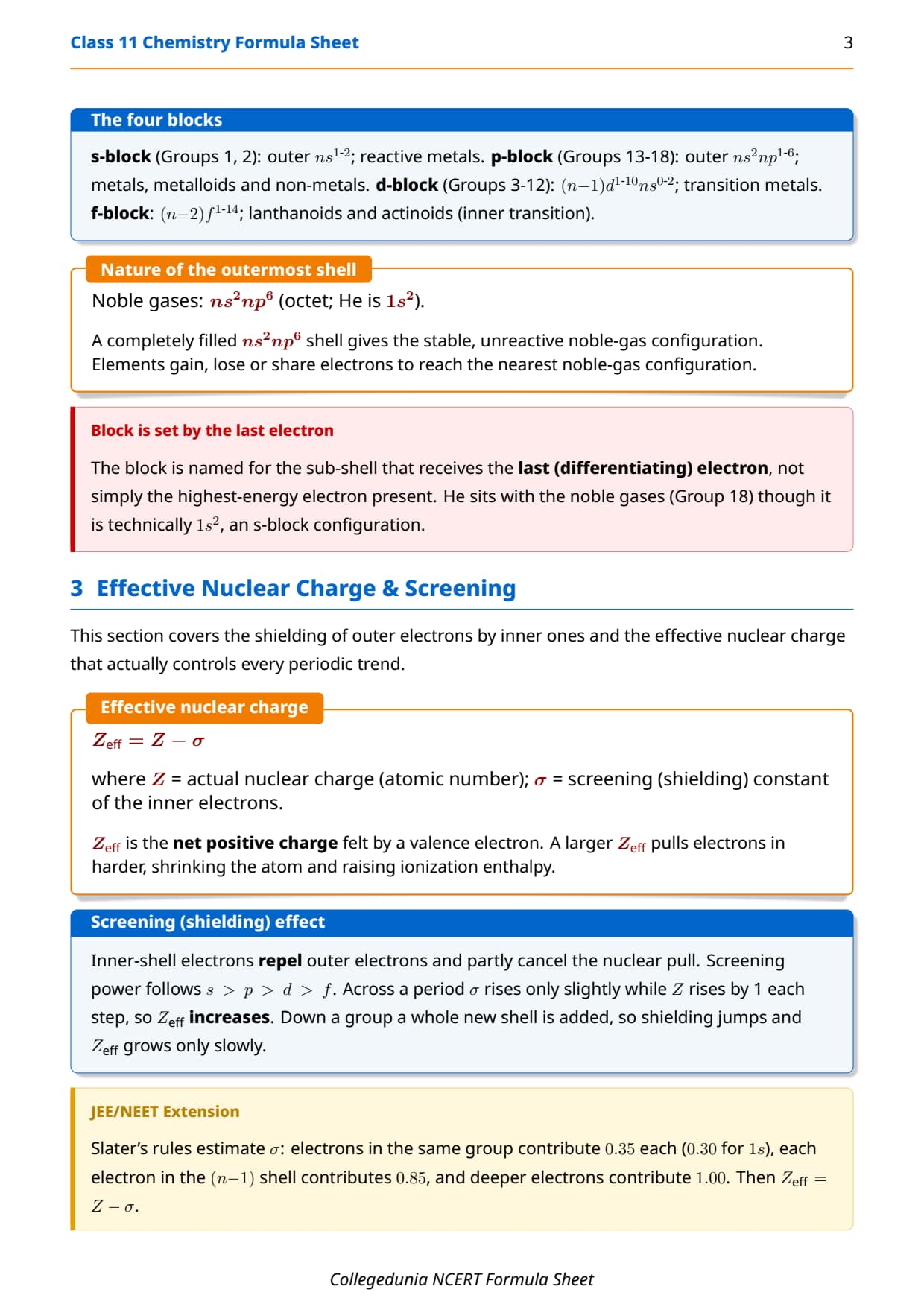
Almost all periodic trends are driven by the rise in effective nuclear charge across a period and the addition of a new shell down a group.
Effective Nuclear Charge and Position Relations
You must also connect an element's configuration to its position and to the net charge felt by its valence electrons. These relations let students place any element and predict its trends.
| Quantity | Relation | Meaning |
|---|---|---|
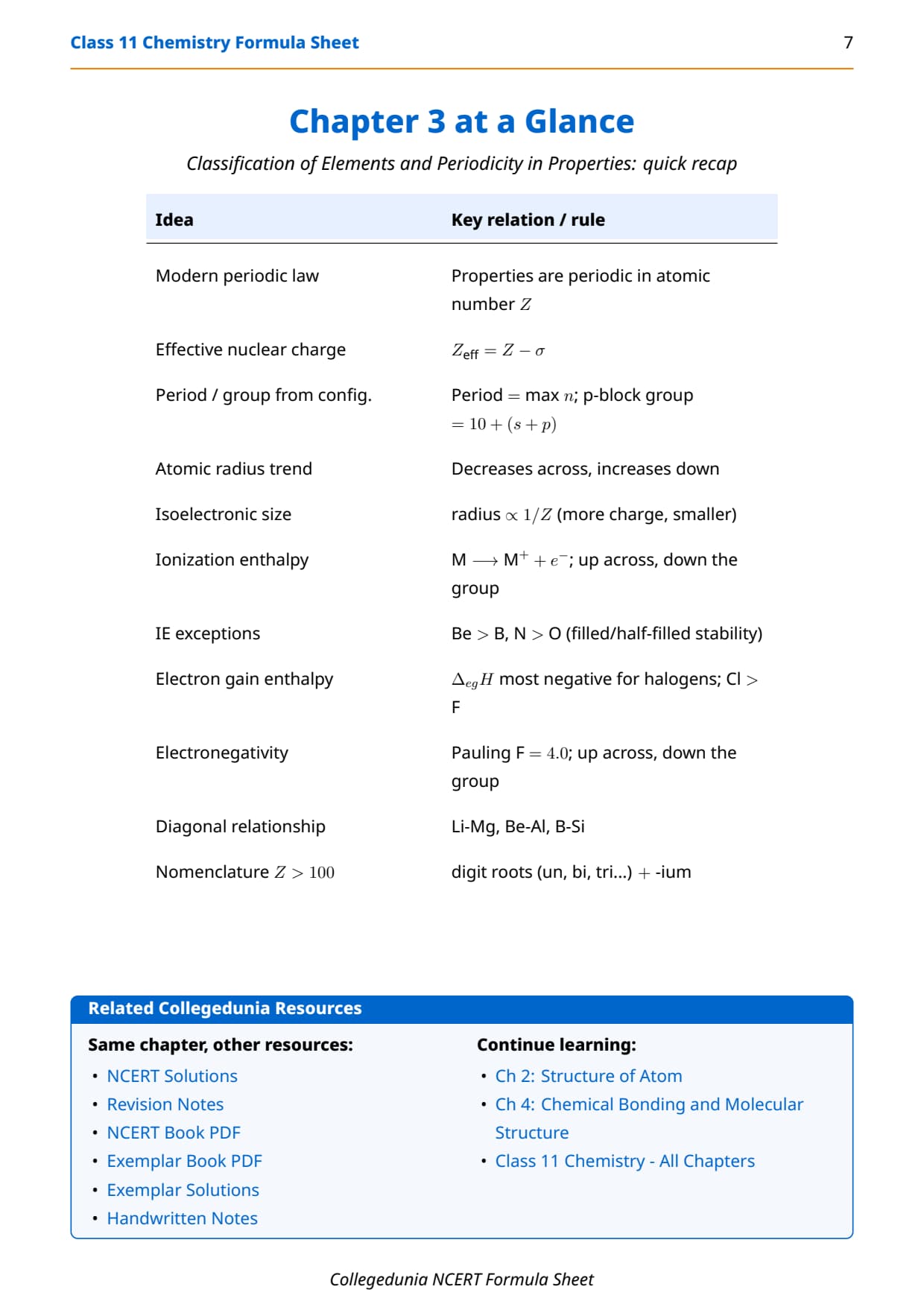
| Effective nuclear charge | Zeff = Z − σ | Net pull on a valence electron after screening |
| Period number | Highest n in the configuration | Which horizontal row the element is in |
| Group (s-block) | Number of valence s electrons | Groups 1 and 2 |
| Group (p-block) | 10 + (valence s + p) | Groups 13 to 18 |
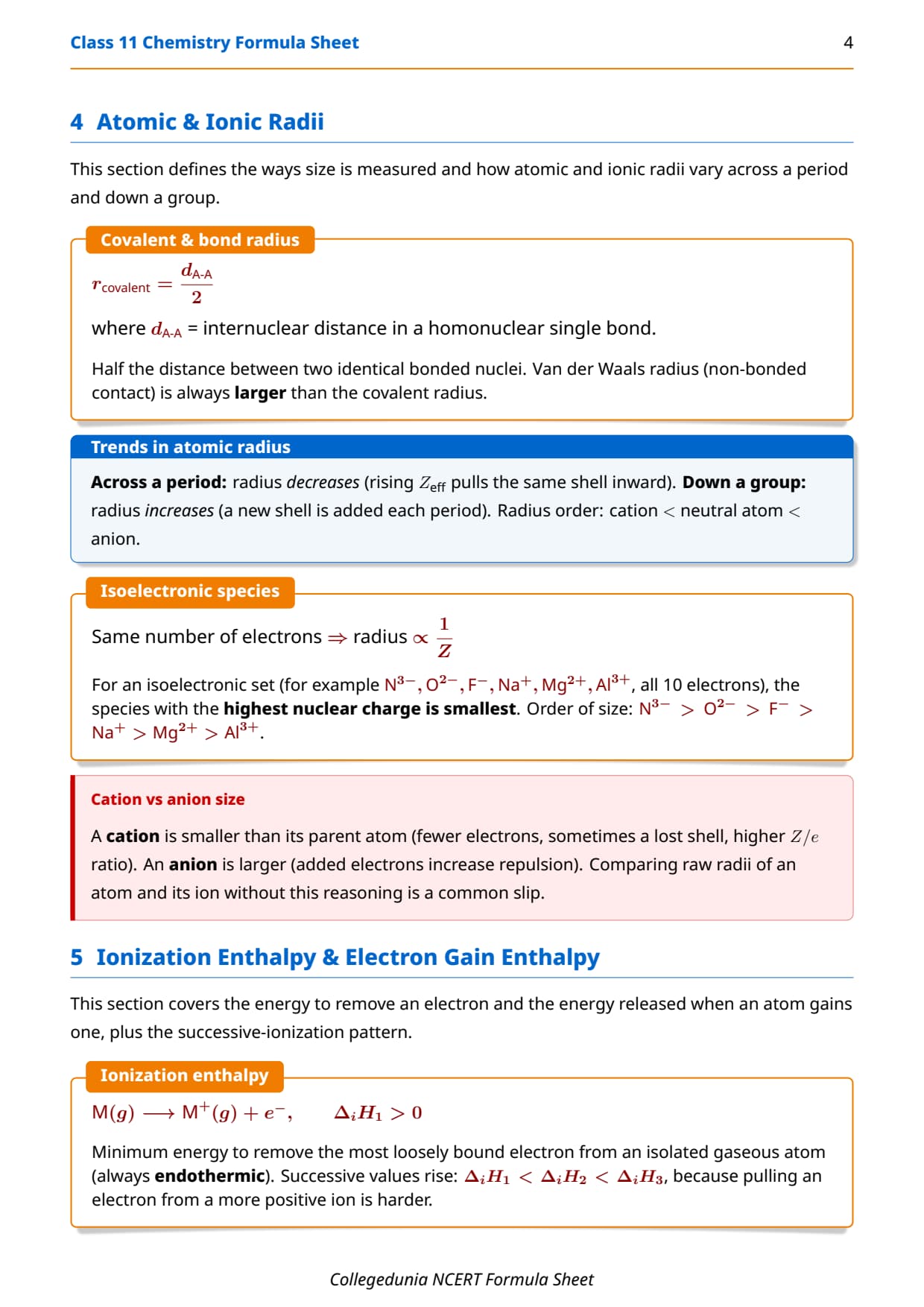
| Isoelectronic size | radius ∝ 1/Z | More nuclear charge means a smaller ion |
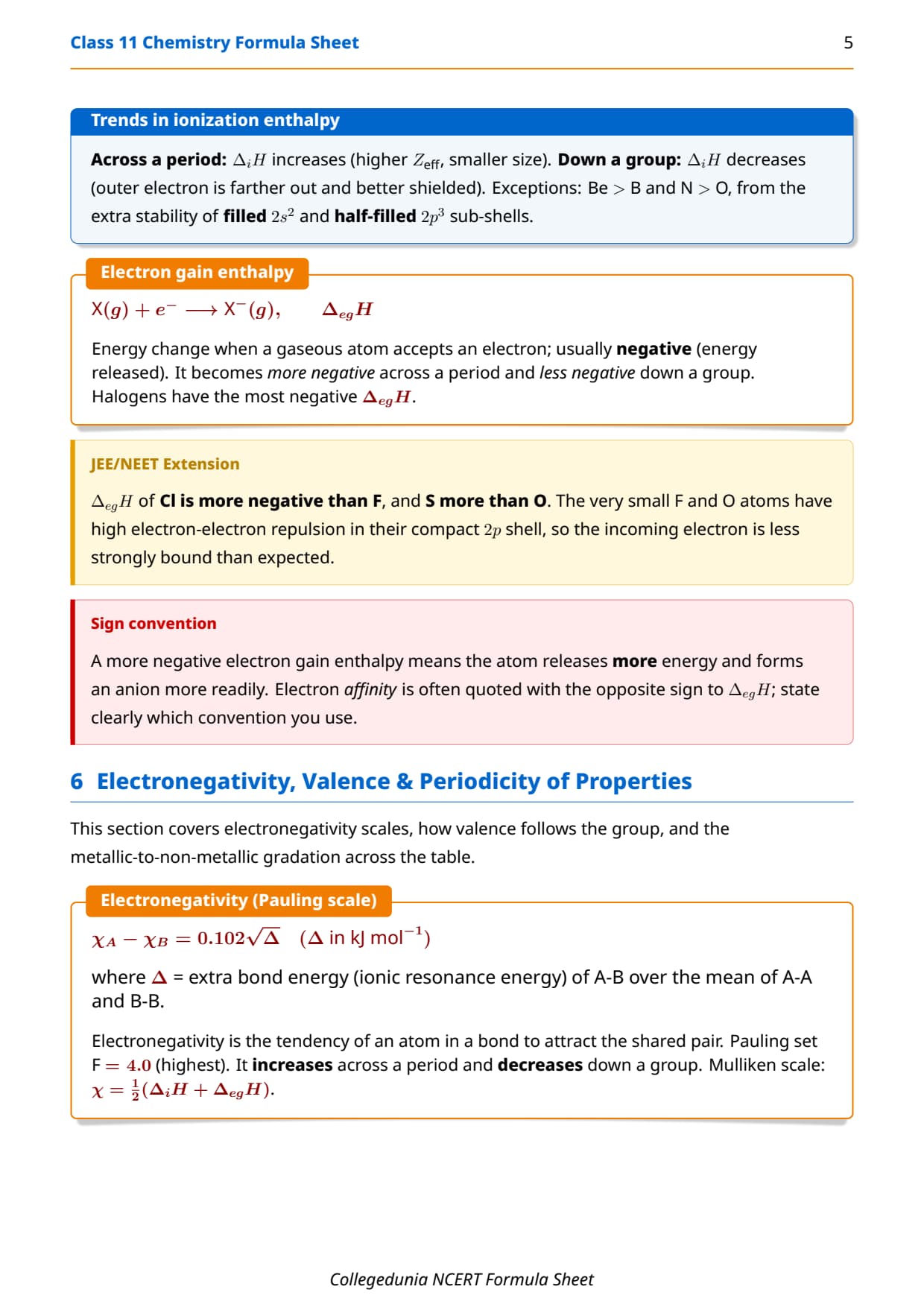
| Electronegativity (Mulliken) | χ = ½(ΔiH + ΔegH) | Average of ionization and electron gain enthalpy |
By the modern periodic law, the properties of the elements are a periodic function of their atomic numbers. Every trend in this chapter follows from ordering the elements by Z.
Key Definitions and Exceptions for Classification of Elements and Periodicity in Properties
Boards and entrance papers often ask for a definition or the reason behind an exception. The list below has the values, scales and irregular cases used in this chapter.
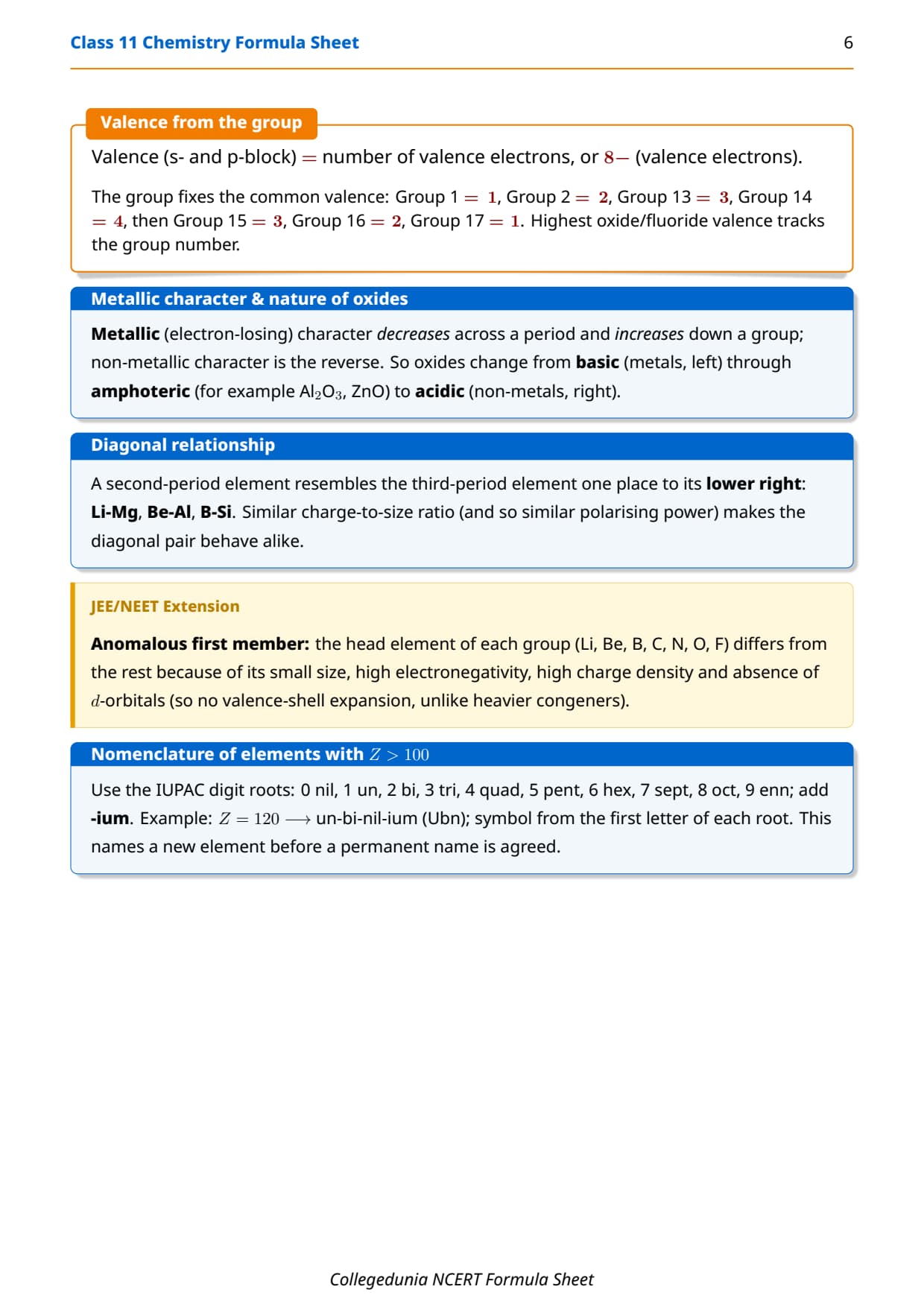
- Four blocks: s-block (Groups 1 to 2), p-block (Groups 13 to 18), d-block transition metals (Groups 3 to 12), f-block inner transition (lanthanoids and actinoids).
- Ionization enthalpy exceptions: Be greater than B and N greater than O, because filled 2s2 and half-filled 2p3 sub-shells are extra stable.
- Electron gain enthalpy exceptions: Cl is more negative than F, and S more than O, because the small F and O atoms have high electron-electron repulsion.
- Electronegativity scale: Pauling sets F = 4.0 as the highest; it increases across a period and decreases down a group.
- Diagonal relationship: Li resembles Mg, Be resembles Al, and B resembles Si, because of a similar charge-to-size ratio.
How to Revise Classification of Elements and Periodicity in Properties Before the Exam
Use this class 11 chemistry formula sheet chapter 3 classification of elements and periodicity in properties for a fast recap the night before a test, in about 20 minutes.
- First 7 minutes: write the four periodic trends and their direction across a period and down a group.
- Next 7 minutes: practise placing three elements in their period, group and block from their configuration.
- Last 6 minutes: recall the ionization enthalpy and electron gain enthalpy exceptions and the diagonal relationship pairs.
Finish by ordering one isoelectronic set by size and naming one element with Z greater than 100.
Student Feedback on the Classification of Elements and Periodicity in Properties Formula Sheet
What 12,840 students told us about their Classification of Elements and Periodicity in Properties revision:
- 68% of students rated the ionization enthalpy and electron gain enthalpy exceptions as the hardest part.
- Most-skipped step: reading period, group and block correctly from an electronic configuration.
- Students who learned the effective nuclear charge idea first found every other trend easier to explain.
Source: 2026-27 Class 11 Chemistry student poll. Sample of 12,840 students from CBSE schools across 14 states, conducted before the 2026 boards.
Other Classification of Elements and Periodicity in Properties Class 11 Chemistry Resources
Pair this formula sheet with the solved answers, notes and textbook PDF.
NCERT Formula Sheet for Class 11 Chemistry: All Chapters
Jump to any other Class 11 Chemistry formula sheet below.
| Chapter | Formula Sheet |
|---|---|
| Chapter 1 | Some Basic Concepts of Chemistry |
| Chapter 2 | Structure of Atom |
| Chapter 3 | Classification of Elements and Periodicity in Properties |
| Chapter 4 | Chemical Bonding and Molecular Structure |
| Chapter 5 | Thermodynamics |
| Chapter 6 | Equilibrium |
| Chapter 7 | Redox Reactions |
| Chapter 8 | Organic Chemistry: Some Basic Principles and Techniques |
| Chapter 9 | Hydrocarbons |
FAQs on Classification of Elements and Periodicity in Properties Class 11 Chemistry Formula Sheet
Classification of Elements and Periodicity in Properties Formula Sheet - Frequently Asked Questions
Ques. What does the class 11 chemistry formula sheet chapter 3 classification of elements and periodicity in properties cover?
Ans. This class 11 chemistry formula sheet chapter 3 classification of elements and periodicity in properties covers the modern periodic law, electronic configuration and the four blocks, effective nuclear charge Zeff = Z − σ, atomic and ionic radius, ionization enthalpy, electron gain enthalpy, electronegativity, the diagonal relationship and the nomenclature of elements with Z greater than 100.
Ques. Why does atomic radius decrease across a period but increase down a group?
Ans. Across a period the nuclear charge rises by one each step while electrons enter the same shell, so Zeff increases and pulls the shell inward, decreasing radius. Down a group a new principal shell is added each period, which outweighs the higher charge, so the radius increases.
Ques. Why is the ionization enthalpy of nitrogen higher than that of oxygen?
Ans. Nitrogen is [He]2s22p3, a stable half-filled 2p sub-shell, so extra energy is needed to remove an electron. Oxygen is [He]2s22p4, where removing the paired electron relieves repulsion, so its ionization enthalpy is lower. The same reason makes beryllium higher than boron.
Ques. What is the diagonal relationship in the periodic table?
Ans. The diagonal relationship pairs Li with Mg, Be with Al, and B with Si. These diagonal neighbours have a similar charge-to-size ratio and so similar polarising power, which makes their chemistry alike despite being in different groups.



Comments