




The class 11 chemistry formula sheet chapter 4 chemical bonding and molecular structure gathers every bonding rule, geometry and formula tested in the Boards, JEE Main, JEE Advanced, NEET, CUET and NDA exams. It lists each relation, key value and shape rule so students can revise the whole chapter fast.
Chemical Bonding and Molecular Structure explains why atoms join and what shape the molecule takes, so its VSEPR, hybridisation and molecular orbital ideas return in every later chapter on structure and reactivity.
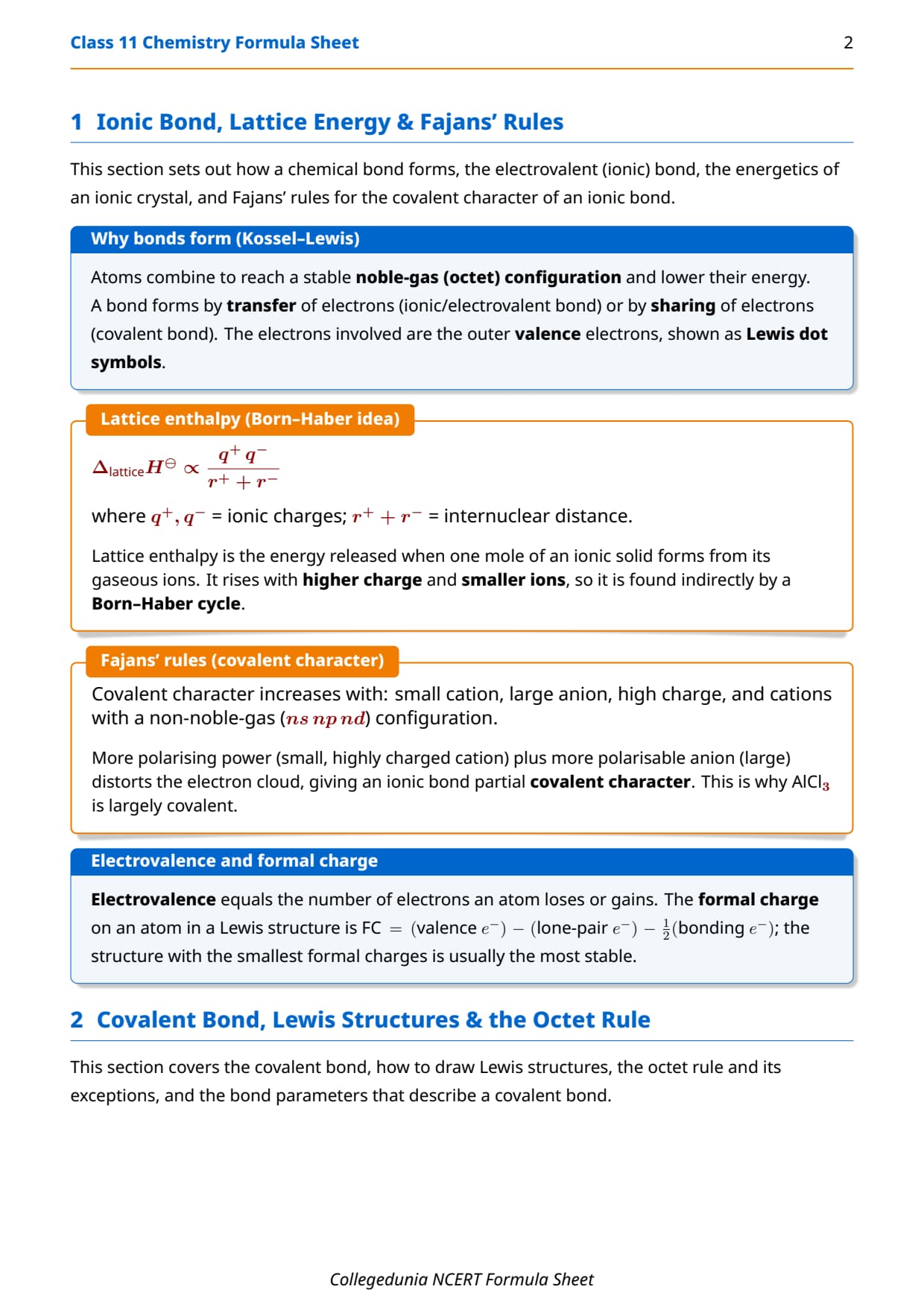
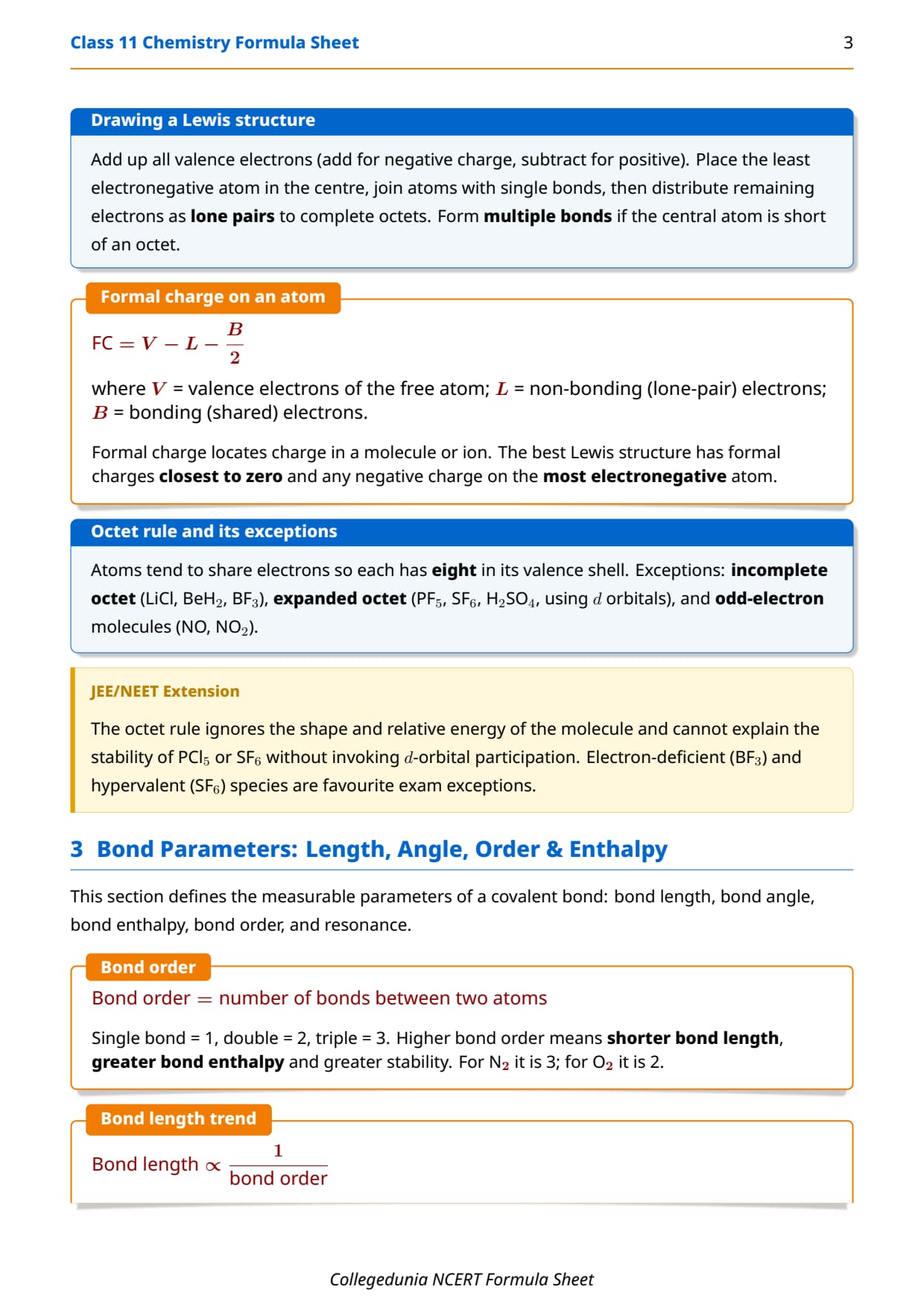
- Covers the ionic and covalent bond, Lewis structures and formal charge, plus the octet rule and its exceptions.
- Lists the VSEPR shapes, hybridisation schemes and bond parameters like bond length, angle, order and enthalpy side by side.
- Helps students find dipole moment, percentage ionic character, molecular orbital bond order and magnetic behaviour.
This class 11 chemistry formula sheet chapter 4 chemical bonding and molecular structure is curated by subject experts and checked against the 2026-27 NCERT and recent CBSE, JEE and NEET papers.
All Chemical Bonding and Molecular Structure Formulas at a Glance
Every bonding and structure formula sits in one table below, with its meaning and unit. Learn the bond order and dipole rows first, since they decide stability and polarity in most questions.
| Formula | What it means | Unit |
|---|---|---|
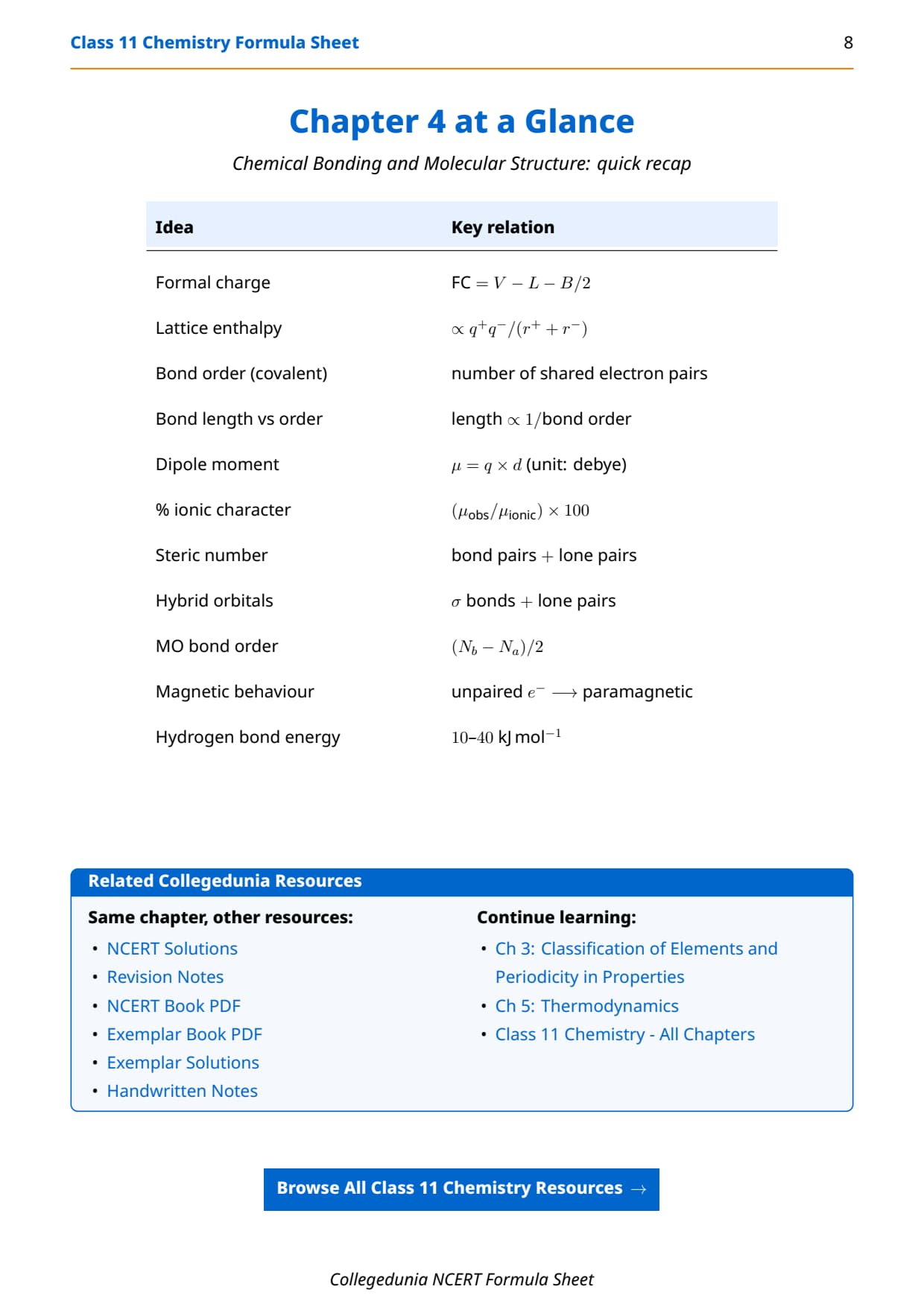
| FC = V − L − B/2 | Formal charge on an atom in a Lewis structure | Dimensionless (charge) |
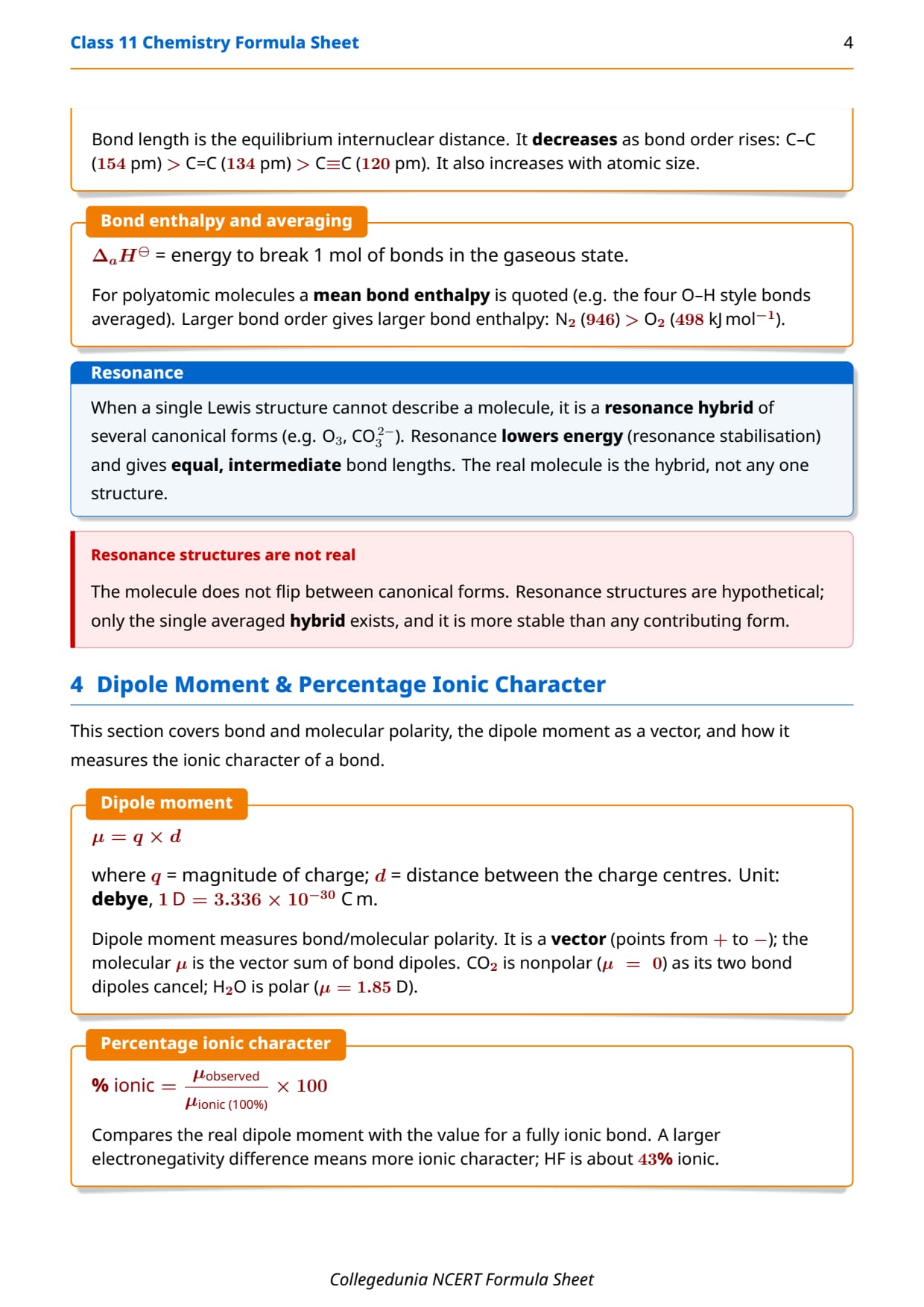
| μ = q × d | Dipole moment from charge and separation | Debye (D) |
| % ionic = (μobs/μionic) × 100 | Percentage ionic character of a bond | Percent (%) |
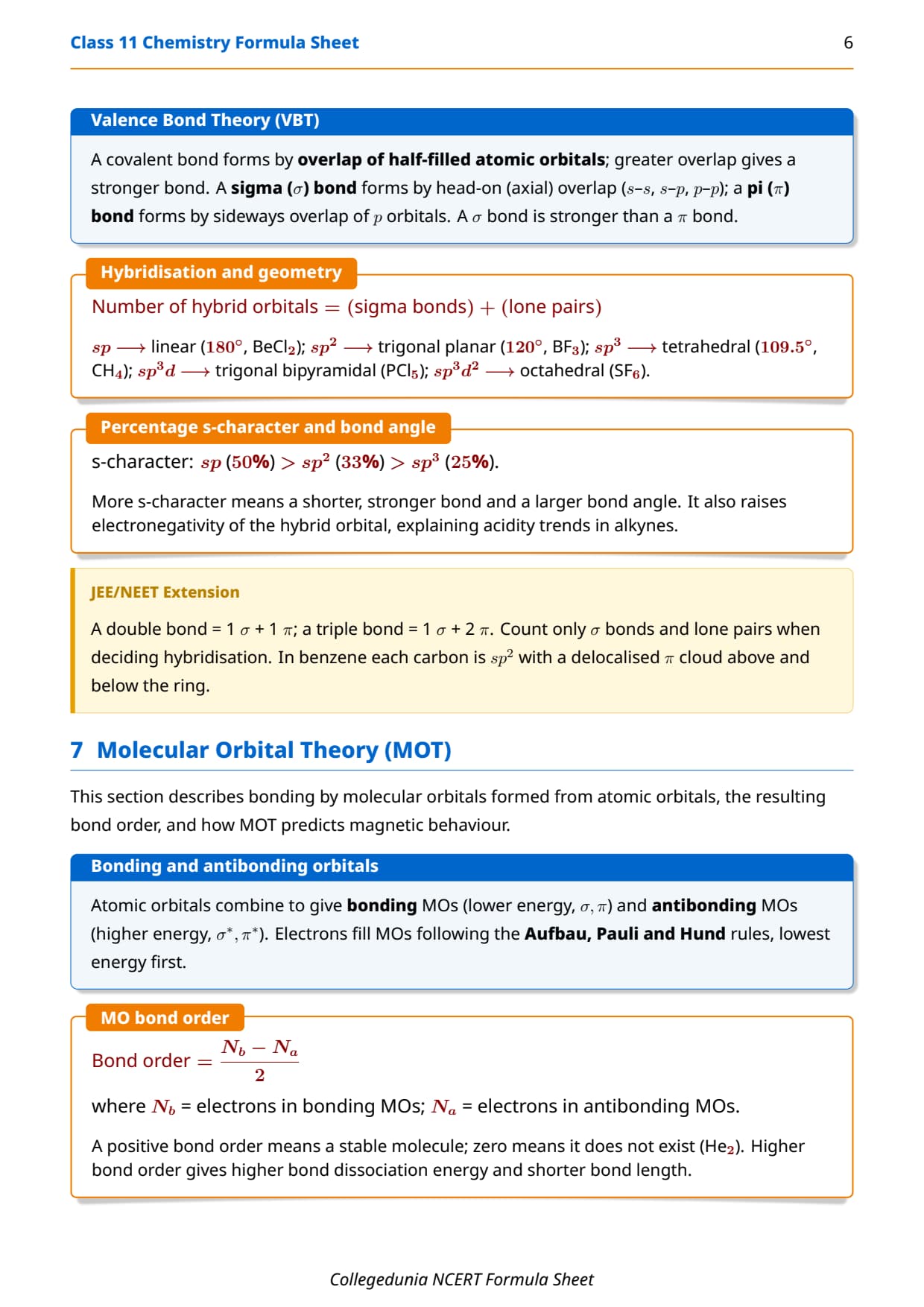
| Bond order = (Nb − Na)/2 | Molecular orbital bond order | Dimensionless |
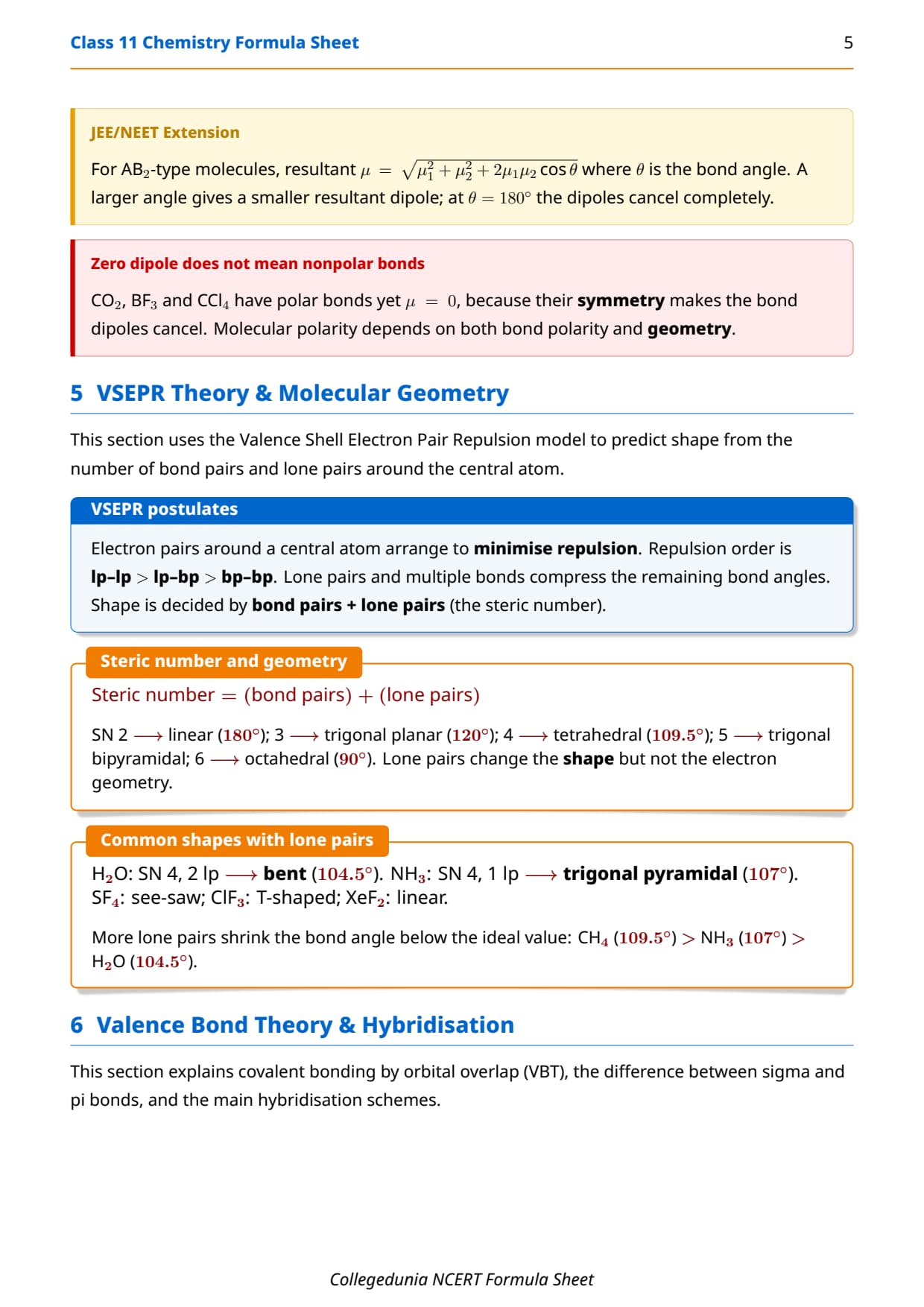
| Steric number = bp + lp | Bond pairs plus lone pairs, fixes VSEPR shape | Count |
| Hybrid orbitals = σ bonds + lp | Number of hybrid orbitals on the central atom | Count |
| Bond length ∝ 1/bond order | Higher bond order gives a shorter bond | pm |
| ΔlatticeH ∝ q+q−/(r++r−) | Lattice enthalpy of an ionic solid | kJ mol-1 |
A molecule is nonpolar only when its bond dipoles cancel by symmetry, as in CO2, BF3 and CCl4.
VSEPR Shapes and Hybridisation Relations
You must also link the number of electron pairs to the shape and the hybridisation. These rows solve most geometry and bond-angle questions in Chapter 4.
| Steric number | Hybridisation and geometry | Example |
|---|---|---|
| 2 | sp, linear, 180° | BeCl2, CO2 |
| 3 | sp2, trigonal planar, 120° | BF3, C in benzene |
| 4 | sp3, tetrahedral, 109.5° | CH4, NH4+ |
| 5 | sp3d, trigonal bipyramidal | PCl5 |
| 6 | sp3d2, octahedral, 90° | SF6 |
| 4 (2 lone pairs) | bent, 104.5° | H2O |
| 4 (1 lone pair) | trigonal pyramidal, 107° | NH3 |
By VSEPR theory, lone pair to lone pair repulsion is stronger than lone pair to bond pair, which is stronger than bond pair to bond pair. This is why the bond angle falls from CH4 to NH3 to H2O.
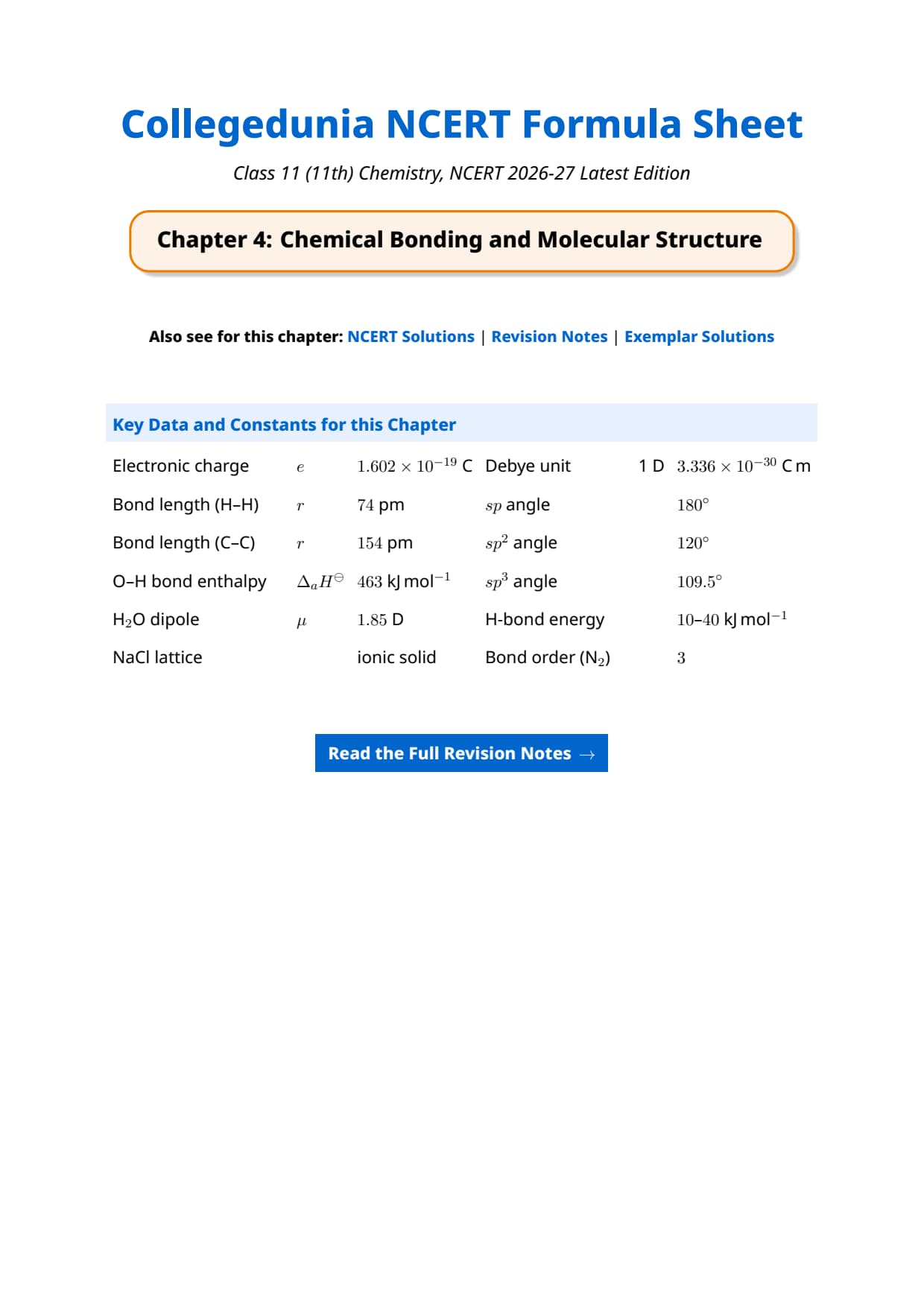
Key Data and Constants for Chemical Bonding and Molecular Structure
Boards and entrance papers often ask for a bond value or a shape rule. The list below has the key data used in this chapter.
- Dipole unit: 1 debye (D) = 3.336 × 10⁻³⁰ C m; H2O has μ = 1.85 D.
- Bond angles: sp = 180°, sp2 = 120°, sp3 = 109.5°, H2O = 104.5°, NH3 = 107°.
- Bond lengths: C–C = 154 pm, C=C = 134 pm, C≡C = 120 pm, H–H = 74 pm.
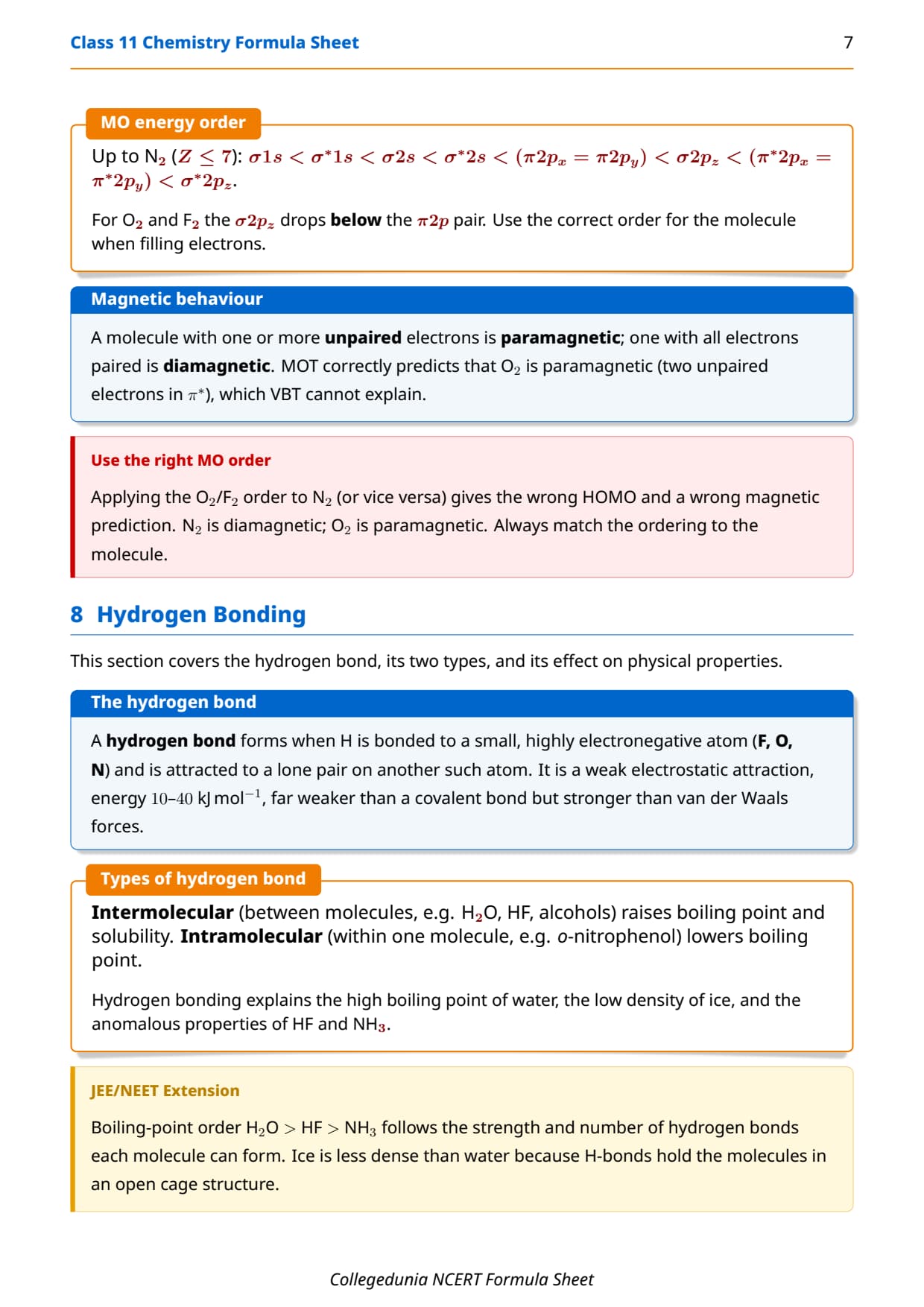
- Hydrogen bond energy: about 10 to 40 kJ mol-1, far weaker than a covalent bond but stronger than van der Waals forces.
- Bond order: N2 = 3 (diamagnetic), O2 = 2 (paramagnetic, two unpaired electrons).
How to Revise Chemical Bonding and Molecular Structure Formulas Before the Exam
Use this class 11 chemistry formula sheet chapter 4 chemical bonding and molecular structure for a fast recap the night before a test, in about 20 minutes.
- First 7 minutes: write the VSEPR steric-number table and the five hybridisation shapes with their angles.
- Next 7 minutes: practise the molecular orbital diagram for N2 and O2 and read off bond order and magnetic behaviour.
- Last 6 minutes: recall formal charge, dipole moment and Fajans' rules for covalent character.
Finish by predicting the shape of one molecule from Lewis structure and checking its dipole moment.
Student Feedback on the Chemical Bonding and Molecular Structure Formula Sheet
What 14,260 students told us about their Chemical Bonding and Molecular Structure revision:
- 68% of students rated molecular orbital theory and bond order as the hardest part.
- Most-skipped step: using symmetry to decide whether a molecule with polar bonds is nonpolar.
- Students who learned the VSEPR steric-number table first found geometry questions much easier.
Source: 2026-27 Class 11 Chemistry student poll. Sample of 14,260 students from CBSE schools across 15 states, conducted before the 2026 boards.
Other Chemical Bonding and Molecular Structure Class 11 Chemistry Resources
Pair this formula sheet with the solved answers, notes and textbook PDF.
| Resource | Link |
|---|---|
| NCERT Solutions | Chemical Bonding and Molecular Structure Class 11 NCERT Solutions |
| Revision Notes | Chemical Bonding and Molecular Structure Class 11 Notes |
| Handwritten Notes | Chemical Bonding and Molecular Structure Class 11 Handwritten Notes |
| NCERT Book PDF | Chemical Bonding and Molecular Structure Class 11 Book PDF |
NCERT Formula Sheet for Class 11 Chemistry: All Chapters
Jump to any other Class 11 Chemistry formula sheet below.
| Chapter | Formula Sheet |
|---|---|
| Chapter 1 | Some Basic Concepts of Chemistry |
| Chapter 2 | Structure of Atom |
| Chapter 3 | Classification of Elements and Periodicity in Properties |
| Chapter 4 | Chemical Bonding and Molecular Structure |
| Chapter 5 | Thermodynamics |
| Chapter 6 | Equilibrium |
| Chapter 7 | Redox Reactions |
| Chapter 8 | Organic Chemistry: Some Basic Principles and Techniques |
| Chapter 9 | Hydrocarbons |
FAQs on Chemical Bonding and Molecular Structure Class 11 Chemistry Formula Sheet
Chemical Bonding and Molecular Structure Formula Sheet - Frequently Asked Questions
Ques. What formulas does the class 11 chemistry formula sheet chapter 4 chemical bonding and molecular structure cover?
Ans. This class 11 chemistry formula sheet chapter 4 chemical bonding and molecular structure covers formal charge FC = V − L − B/2, dipole moment μ = q × d, percentage ionic character, the VSEPR steric-number rule, the five hybridisation shapes and the molecular orbital bond order (Nb − Na)/2.
Ques. How do you find the hybridisation of a central atom?
Ans. Count the sigma bonds plus lone pairs on the central atom. A total of 2 gives sp, 3 gives sp2, 4 gives sp3, 5 gives sp3d and 6 gives sp3d2. A double bond counts as one sigma bond for this purpose.
Ques. Why is oxygen paramagnetic while nitrogen is diamagnetic?
Ans. In molecular orbital theory, O2 has two unpaired electrons in its π*2p orbitals, which makes it paramagnetic with a bond order of 2. N2 has all electrons paired and a bond order of 3, so it is diamagnetic. Valence bond theory cannot explain the paramagnetism of oxygen.
Ques. Why does carbon dioxide have zero dipole moment?
Ans. CO2 is linear, so its two equal carbon to oxygen bond dipoles act along the same line in opposite directions and cancel exactly, giving μ = 0. The bonds are polar, but the symmetry of the molecule makes it nonpolar overall. BF3 and CCl4 are nonpolar for the same reason.



Comments