




The class 11 chemistry formula sheet chapter 5 thermodynamics gathers every energy, enthalpy, entropy and Gibbs energy formula tested in the Boards, JEE Main, JEE Advanced, NEET, CUET and NDA exams. It lists each formula, sign convention and key value so students can revise the whole chapter fast.

Thermodynamics is the scoring numerical chapter of Class 11 Chemistry, and its first-law, Hess's-law and spontaneity rules return in Equilibrium, Electrochemistry and Chemical Kinetics.
- Covers the first law, internal energy and expansion work, plus the link between heat, work and enthalpy.
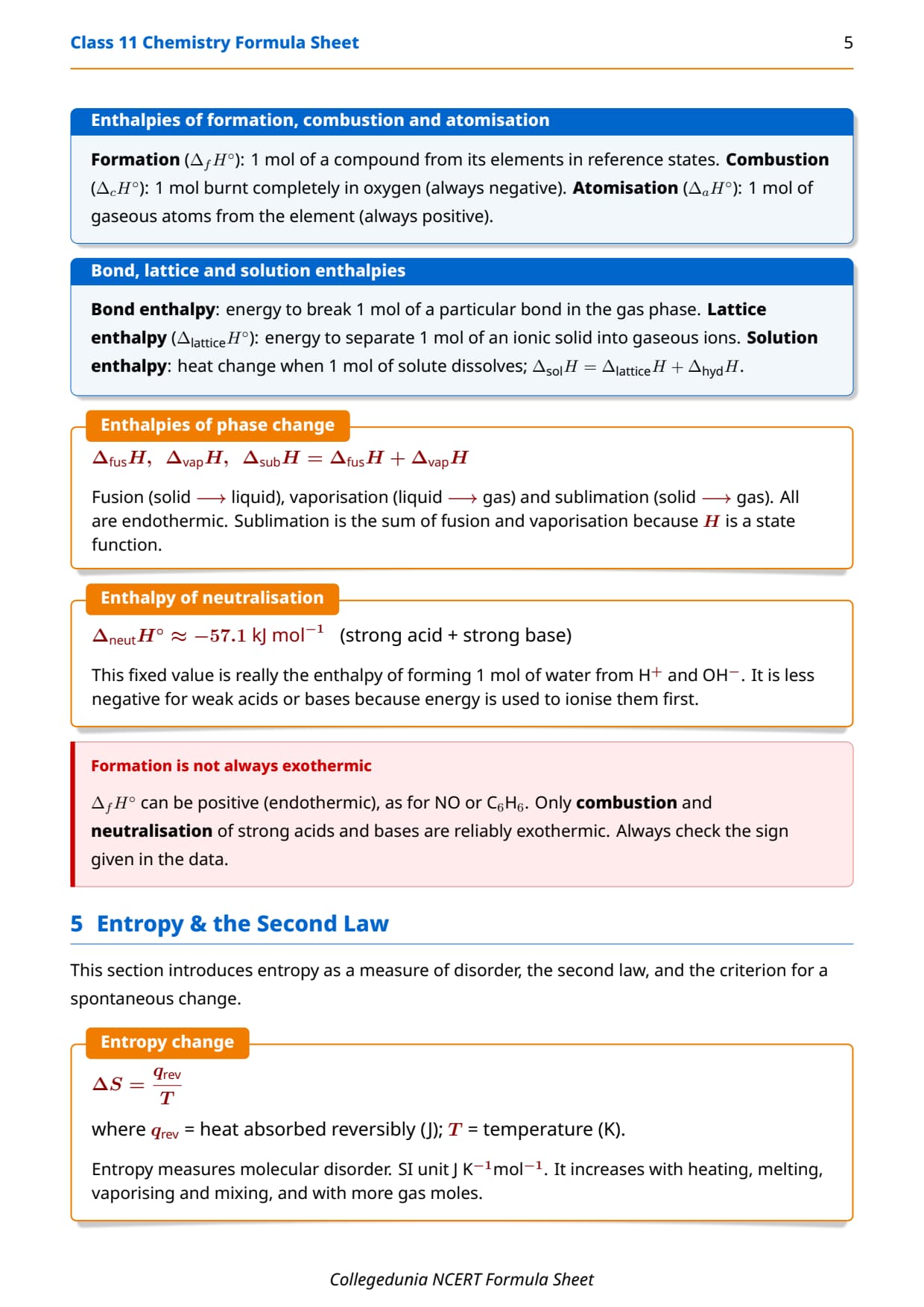
- Lists the standard enthalpies of formation, combustion, bond, lattice, solution and atomisation side by side.
- Helps students apply Hess's law, Kirchhoff's equation and the Gibbs energy test for spontaneity.
This class 11 chemistry formula sheet chapter 5 thermodynamics is curated by subject experts and checked against the 2026-27 NCERT and recent CBSE, JEE and NEET papers.
All Thermodynamics Formulas at a Glance
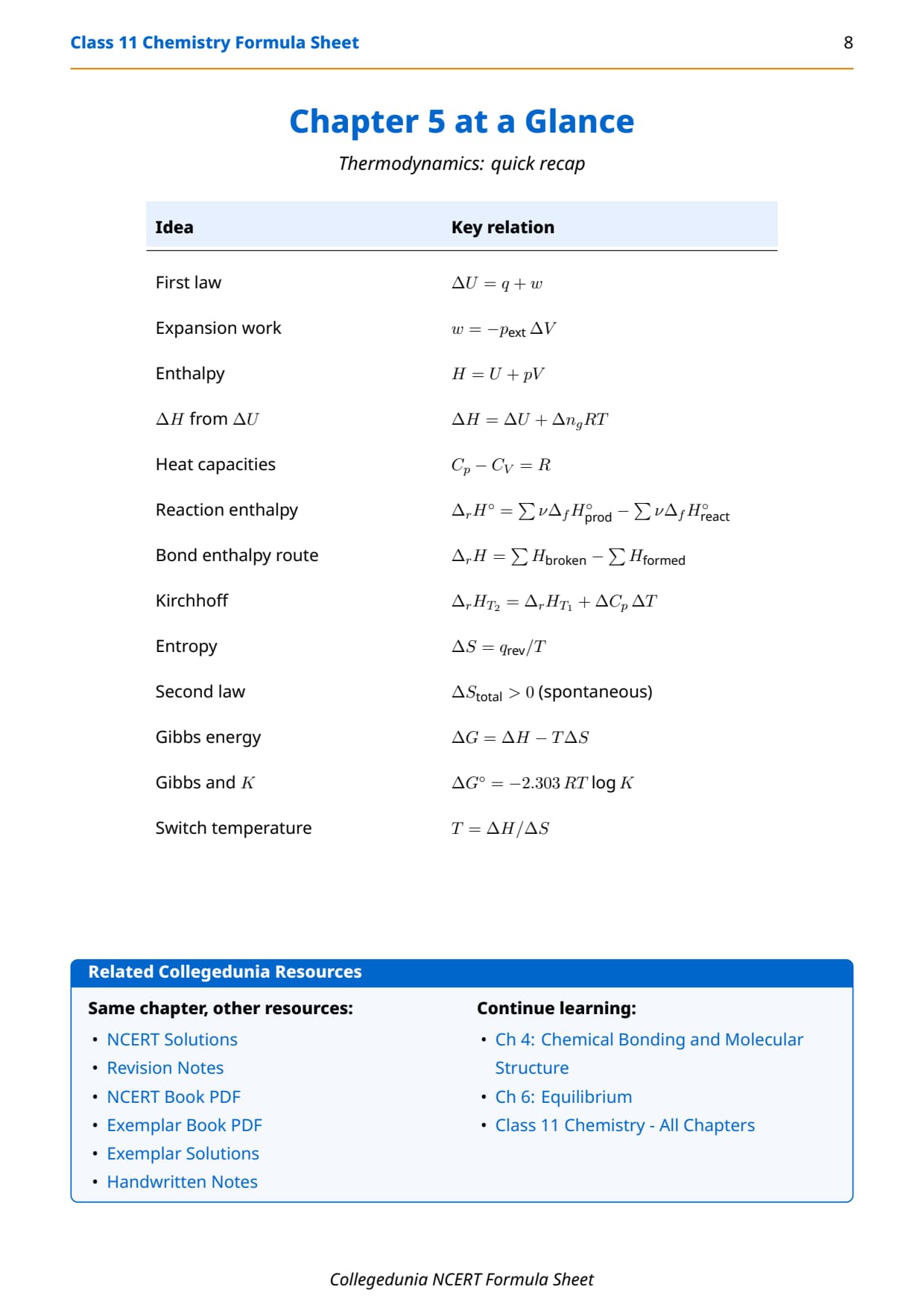
Every energy, enthalpy and Gibbs energy formula sits in one table below, with its meaning and unit. Learn the first-law and Gibbs energy rows first, since almost every numerical uses them.
| Formula | What it means | Unit |
|---|---|---|
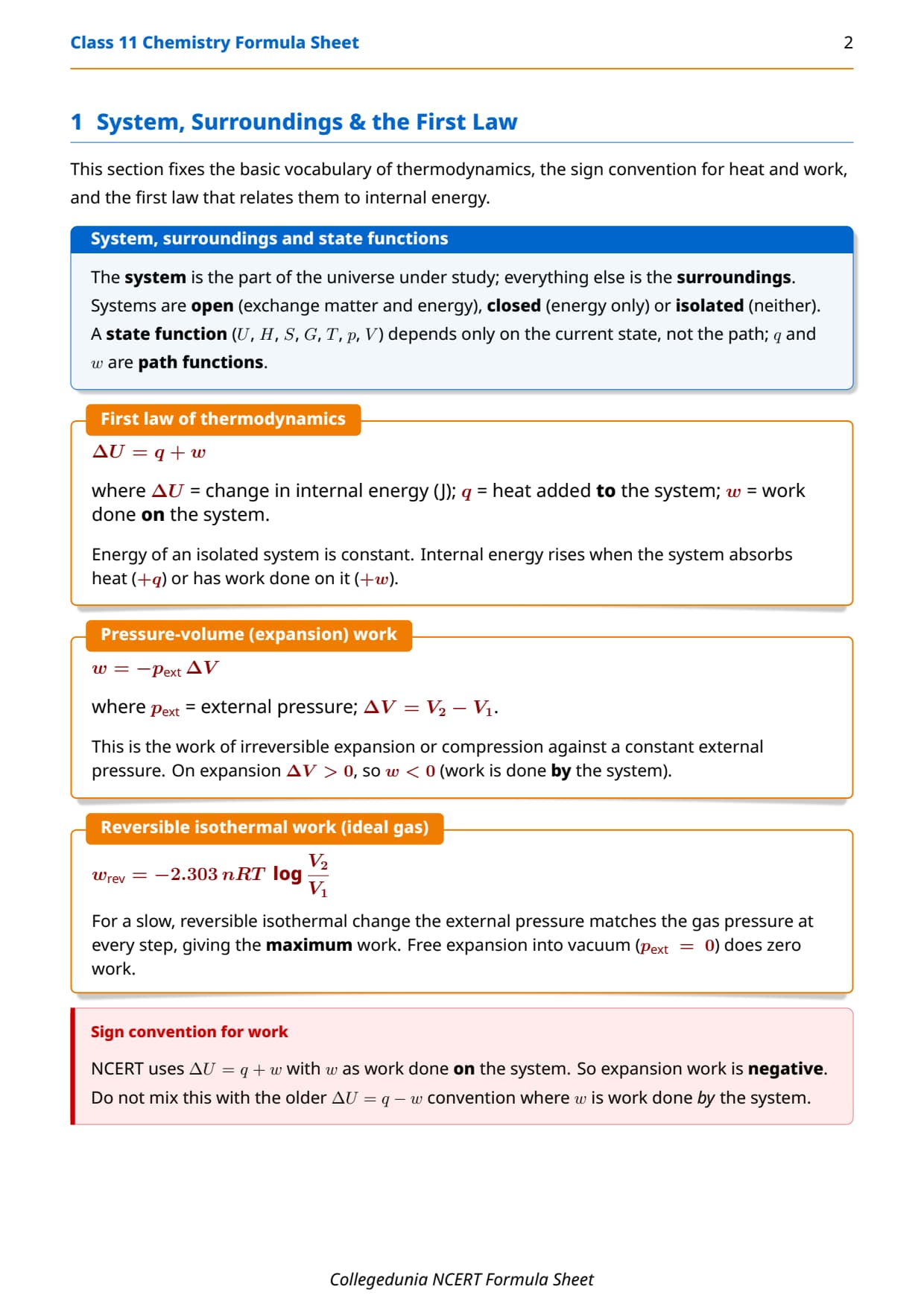
| ΔU = q + w | First law, internal energy change | J |
| w = −pextΔV | Pressure-volume expansion work | J |
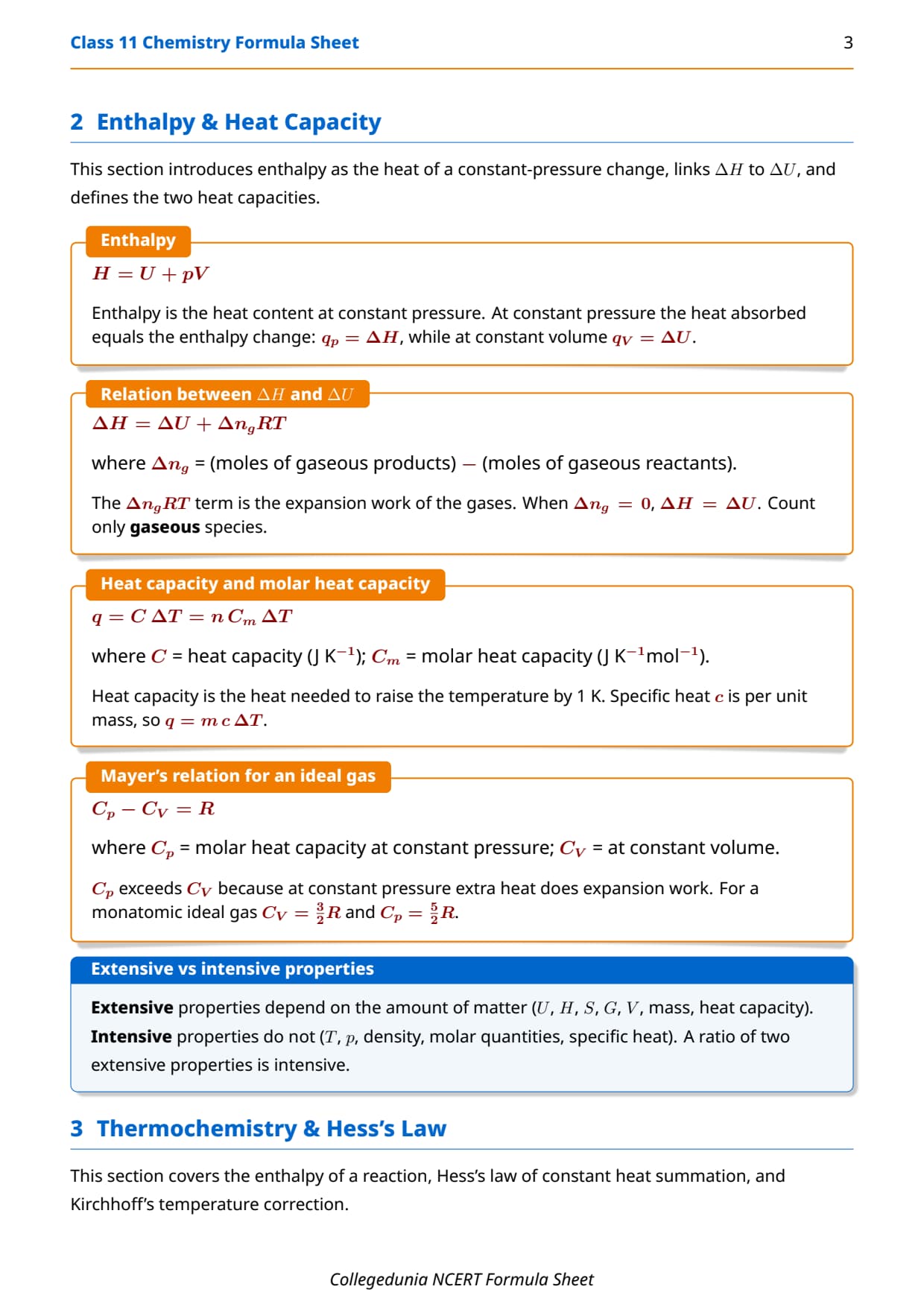
| H = U + pV | Enthalpy, heat at constant pressure | J |
| ΔH = ΔU + ΔngRT | Links enthalpy and internal energy | J |
| Cp − CV = R | Mayer relation for an ideal gas | J K-1 mol-1 |
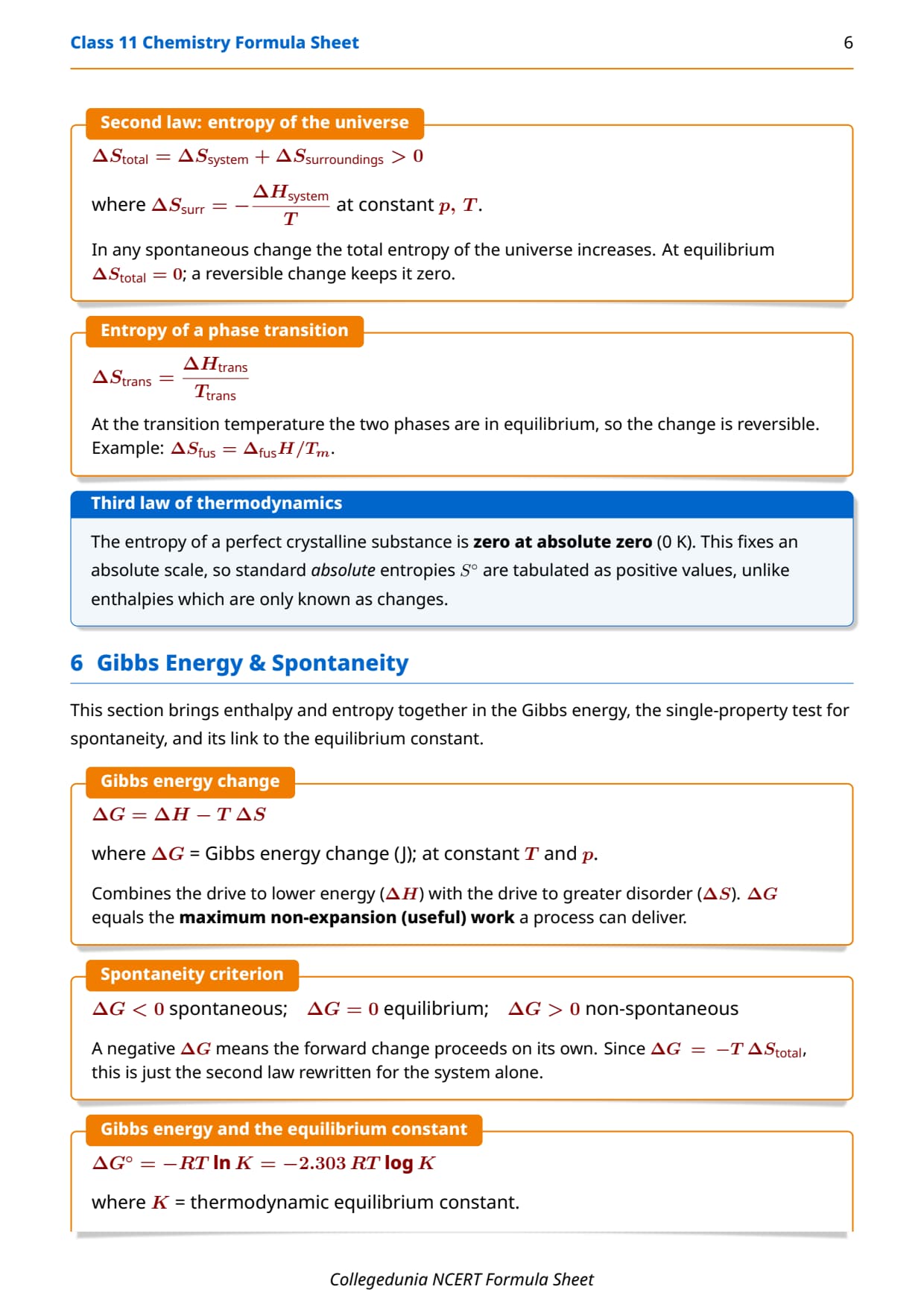
| ΔS = qrev/T | Entropy change, measure of disorder | J K-1 mol-1 |
| ΔG = ΔH − TΔS | Gibbs energy change | J |
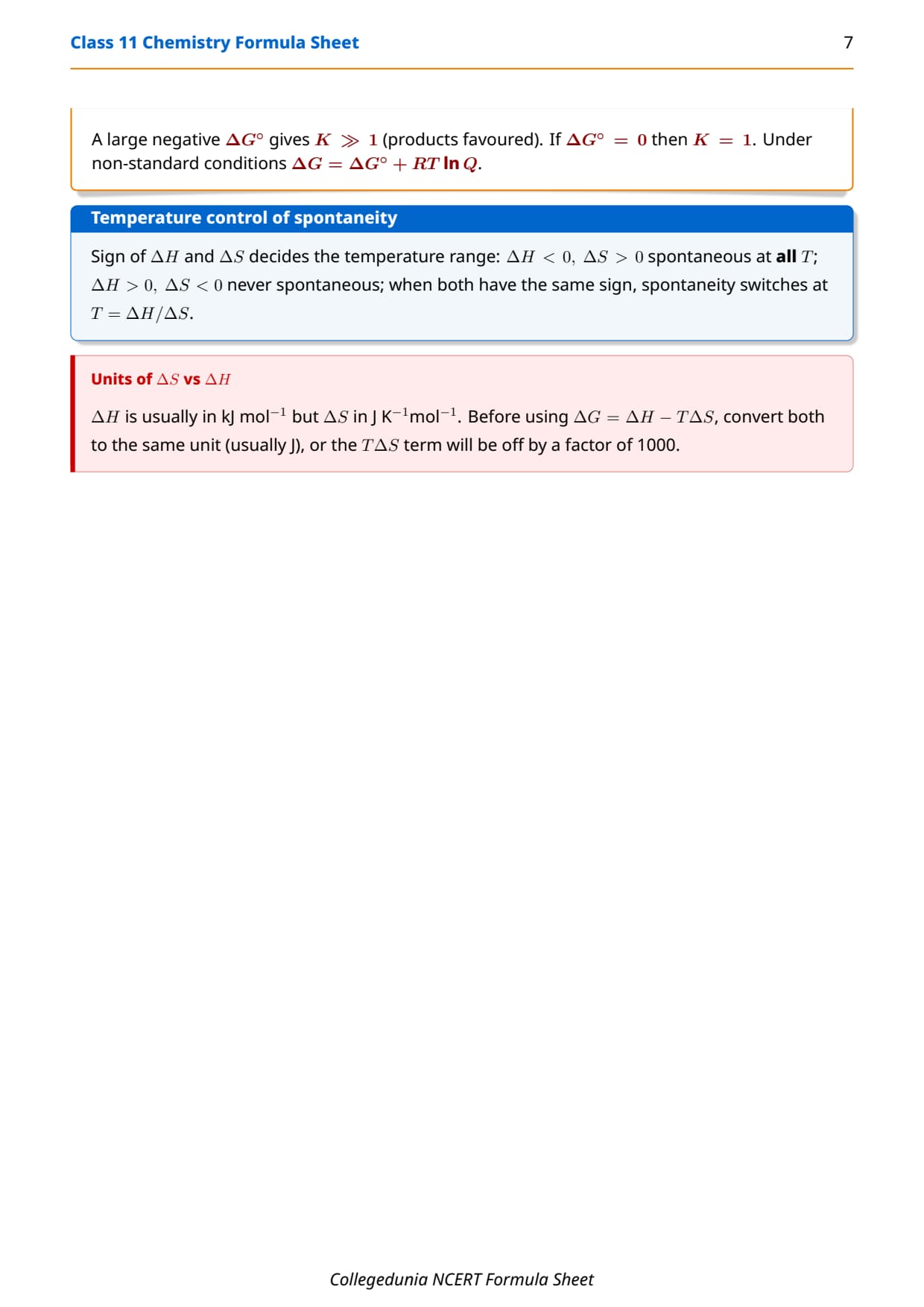
| ΔG° = −2.303 RT log K | Gibbs energy and equilibrium constant | J |
A change is spontaneous only when ΔG is negative, which is the second law rewritten for the system.
Enthalpy and Thermochemistry Relations
You must also connect reaction enthalpies through Hess's law and the tabulated standard enthalpies. These relations solve most Chapter 5 numericals.
| Quantity | Relation | Note |
|---|---|---|
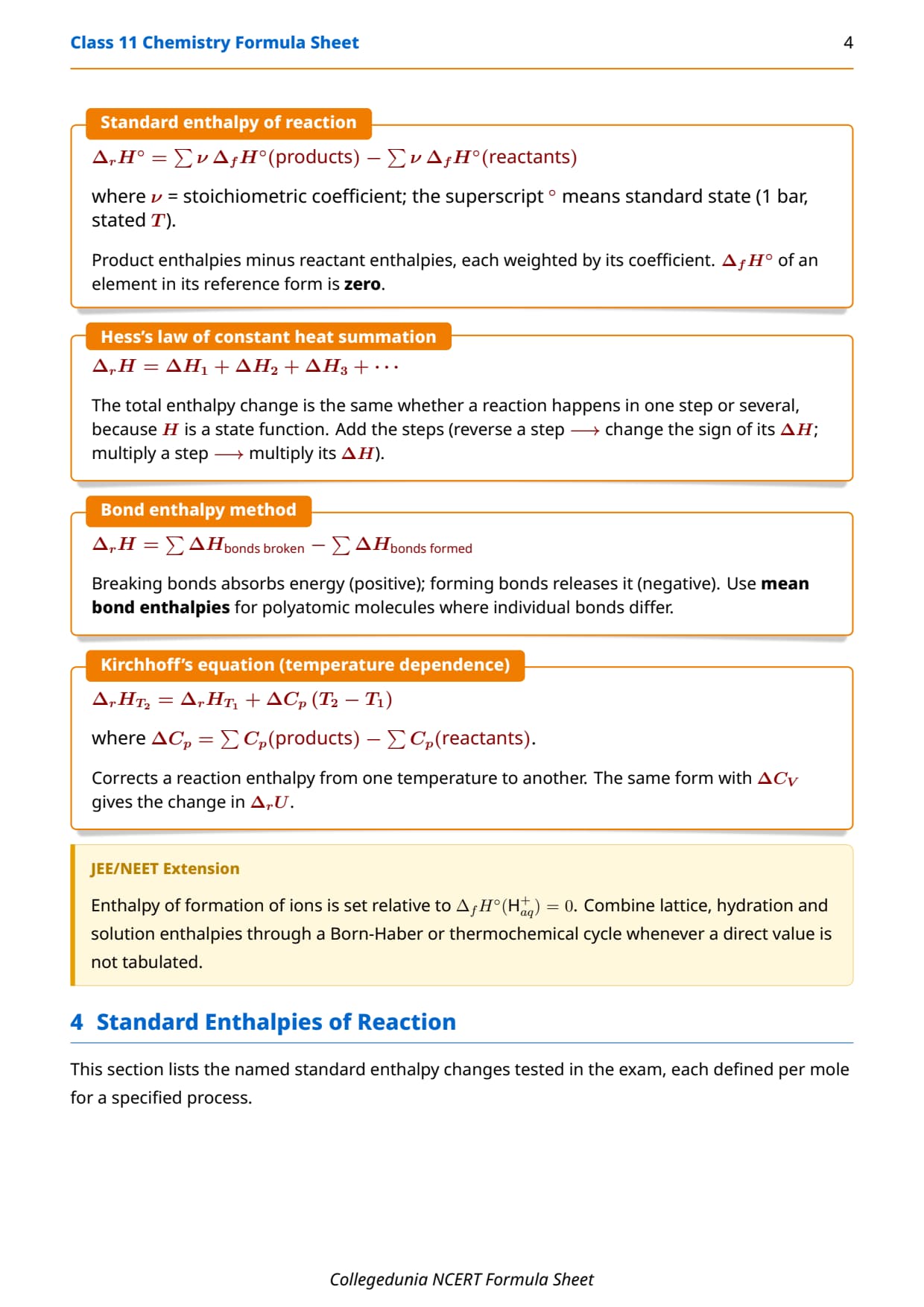
| Reaction enthalpy | ΔrH° = ΣνΔfH°prod − ΣνΔfH°react | Element in reference form has ΔfH° = 0 |
| Hess's law | ΔrH = ΔH1 + ΔH2 + ... | Total ΔH independent of path |
| Bond enthalpy route | ΔrH = ΣHbroken − ΣHformed | Use mean bond enthalpies |
| Kirchhoff equation | ΔrHT2 = ΔrHT1 + ΔCpΔT | Temperature correction |
| Solution enthalpy | ΔsolH = ΔlatticeH + ΔhydH | Born-Haber cycle |
| Neutralisation (strong) | ΔneutH° ≈ −57.1 kJ mol-1 | Formation of 1 mol water |
By Hess's law of constant heat summation, the total enthalpy change is the same in one step or many. Every thermochemical cycle you build depends on this rule.
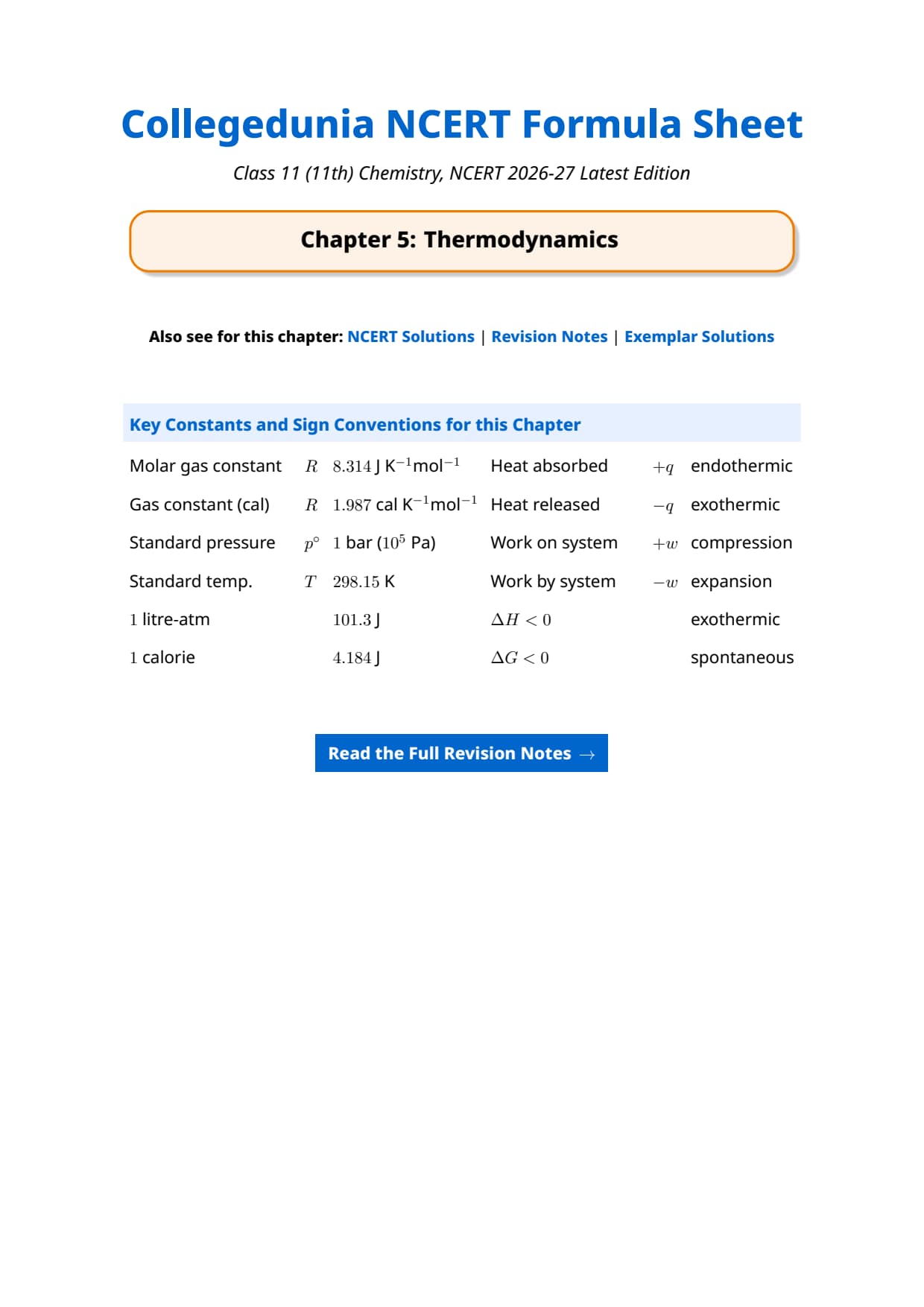
Key Constants and Sign Conventions for Thermodynamics
Boards and entrance papers often ask for a constant value or a sign rule. The list below has the key numbers and the conventions used in this chapter.
- Molar gas constant: R = 8.314 J K-1 mol-1 = 1.987 cal K-1 mol-1.
- Standard state: pressure 1 bar (105 Pa), with data usually quoted at 298.15 K.
- Energy conversions: 1 calorie = 4.184 J and 1 litre-atmosphere = 101.3 J.
- Heat sign rule: heat absorbed is +q (endothermic); heat released is −q (exothermic).
- Spontaneity rule: ΔG < 0 spontaneous, ΔG = 0 equilibrium, ΔG > 0 non-spontaneous.
How to Revise Thermodynamics Formulas Before the Exam
Use this class 11 chemistry formula sheet chapter 5 thermodynamics for a fast recap the night before a test, in about 20 minutes.
- First 7 minutes: write the first law ΔU = q + w, the enthalpy link ΔH = ΔU + ΔngRT and Cp − CV = R.
- Next 7 minutes: practise a Hess's-law cycle and a bond-enthalpy calculation.
- Last 6 minutes: recall the Gibbs energy test and the four ΔH, ΔS sign combinations.
Finish by solving one ΔG = ΔH − TΔS numerical and one ΔG° = −2.303 RT log K conversion.
Student Feedback on the Thermodynamics Formula Sheet
What 12,860 students told us about their Thermodynamics revision:
- 68% of students rated the entropy and Gibbs energy spontaneity questions as the hardest part.
- Most-skipped step: fixing the sign of work in the first law and converting kJ to J before the TΔS term.
- Students who learned the first law and Gibbs energy rows first found thermochemistry much easier.
Source: 2026-27 Class 11 Chemistry student poll. Sample of 12,860 students from CBSE schools across 14 states, conducted before the 2026 boards.
Other Thermodynamics Class 11 Chemistry Resources
Pair this formula sheet with the solved answers, notes and textbook PDF.
| Resource | Link |
|---|---|
| NCERT Solutions | Thermodynamics Class 11 NCERT Solutions |
| Revision Notes | Thermodynamics Class 11 Notes |
| Handwritten Notes | Thermodynamics Class 11 Handwritten Notes |
| NCERT Book PDF | Thermodynamics Class 11 Book PDF |
NCERT Formula Sheet for Class 11 Chemistry: All Chapters
Jump to any other Class 11 Chemistry formula sheet below.
| Chapter | Formula Sheet |
|---|---|
| Chapter 1 | Some Basic Concepts of Chemistry |
| Chapter 2 | Structure of Atom |
| Chapter 3 | Classification of Elements and Periodicity in Properties |
| Chapter 4 | Chemical Bonding and Molecular Structure |
| Chapter 5 | Thermodynamics |
| Chapter 6 | Equilibrium |
| Chapter 7 | Redox Reactions |
| Chapter 8 | Organic Chemistry: Some Basic Principles and Techniques |
| Chapter 9 | Hydrocarbons |
FAQs on Thermodynamics Class 11 Chemistry Formula Sheet
Thermodynamics Formula Sheet - Frequently Asked Questions
Ques. What formulas does the class 11 chemistry formula sheet chapter 5 thermodynamics cover?
Ans. This class 11 chemistry formula sheet chapter 5 thermodynamics covers the first law ΔU = q + w, enthalpy H = U + pV with ΔH = ΔU + ΔngRT, the heat-capacity relation Cp − CV = R, Hess's law, the standard enthalpies, entropy ΔS = qrev/T and Gibbs energy ΔG = ΔH − TΔS.
Ques. What is the relation between enthalpy change and internal energy change?
Ans. The relation is ΔH = ΔU + ΔngRT, where Δng is the change in the number of moles of gas. When no gas moles change, ΔH = ΔU. Count only gaseous species when finding Δng.
Ques. When is a reaction spontaneous in thermodynamics?
Ans. A process is spontaneous when ΔG = ΔH − TΔS < 0. If ΔH < 0 and ΔS > 0 it is spontaneous at all temperatures; if both have the same sign, spontaneity switches at T = ΔH/ΔS.
Ques. What is Hess's law of constant heat summation?
Ans. Hess's law states that ΔrH = ΔH1 + ΔH2 + ... because enthalpy is a state function that depends only on the initial and final states. Reversing a step changes the sign of its ΔH, and multiplying a step multiplies its ΔH. It lets students find enthalpies that are hard to measure directly.



Comments