




The class 11 physics formula sheet chapter 4 laws of motion gathers every force, momentum and friction formula tested in the Boards, JEE Main, JEE Advanced, NEET, CUET and NDA exams. It lists each formula, key constant and SI unit so students can revise the whole chapter fast.
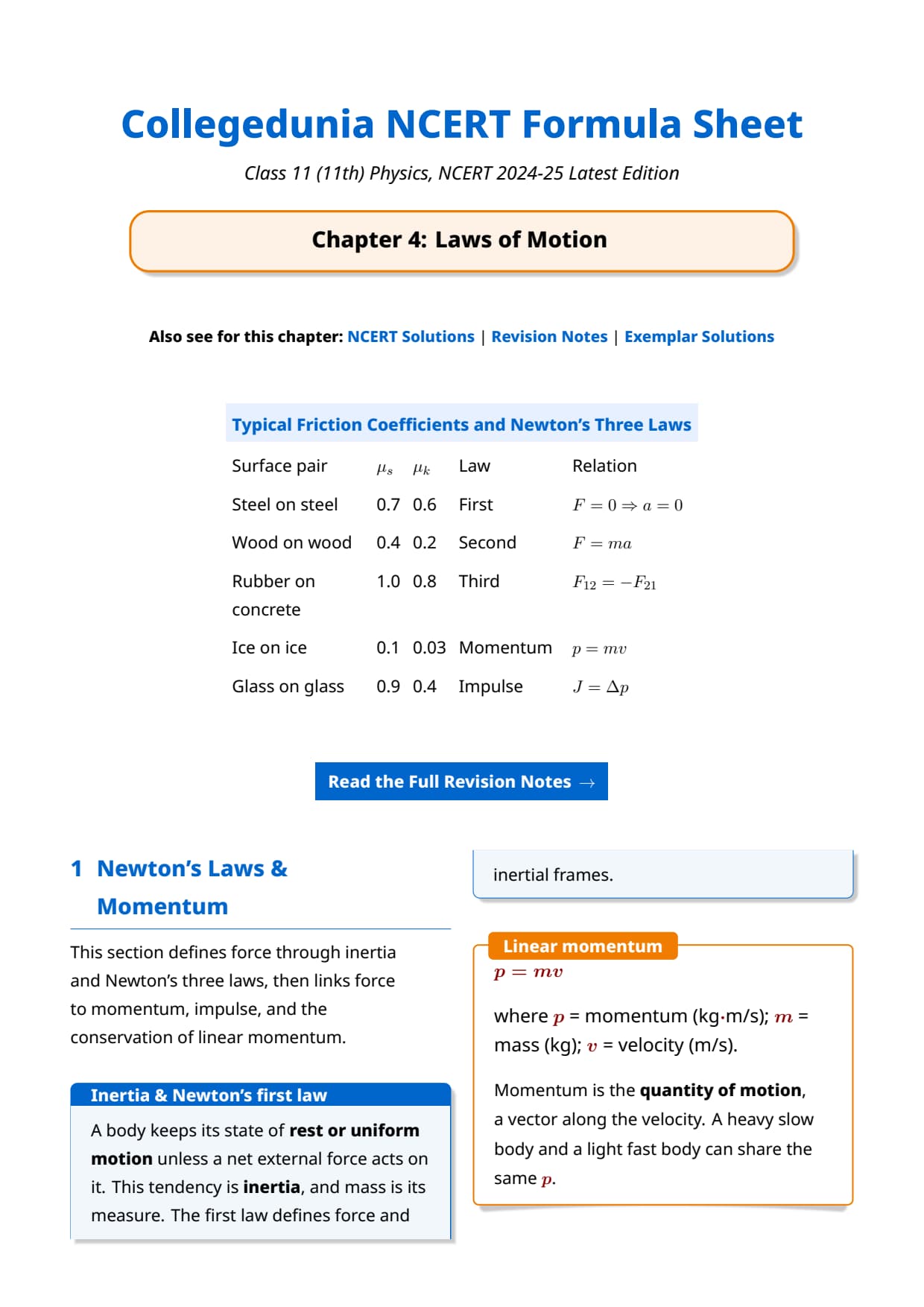
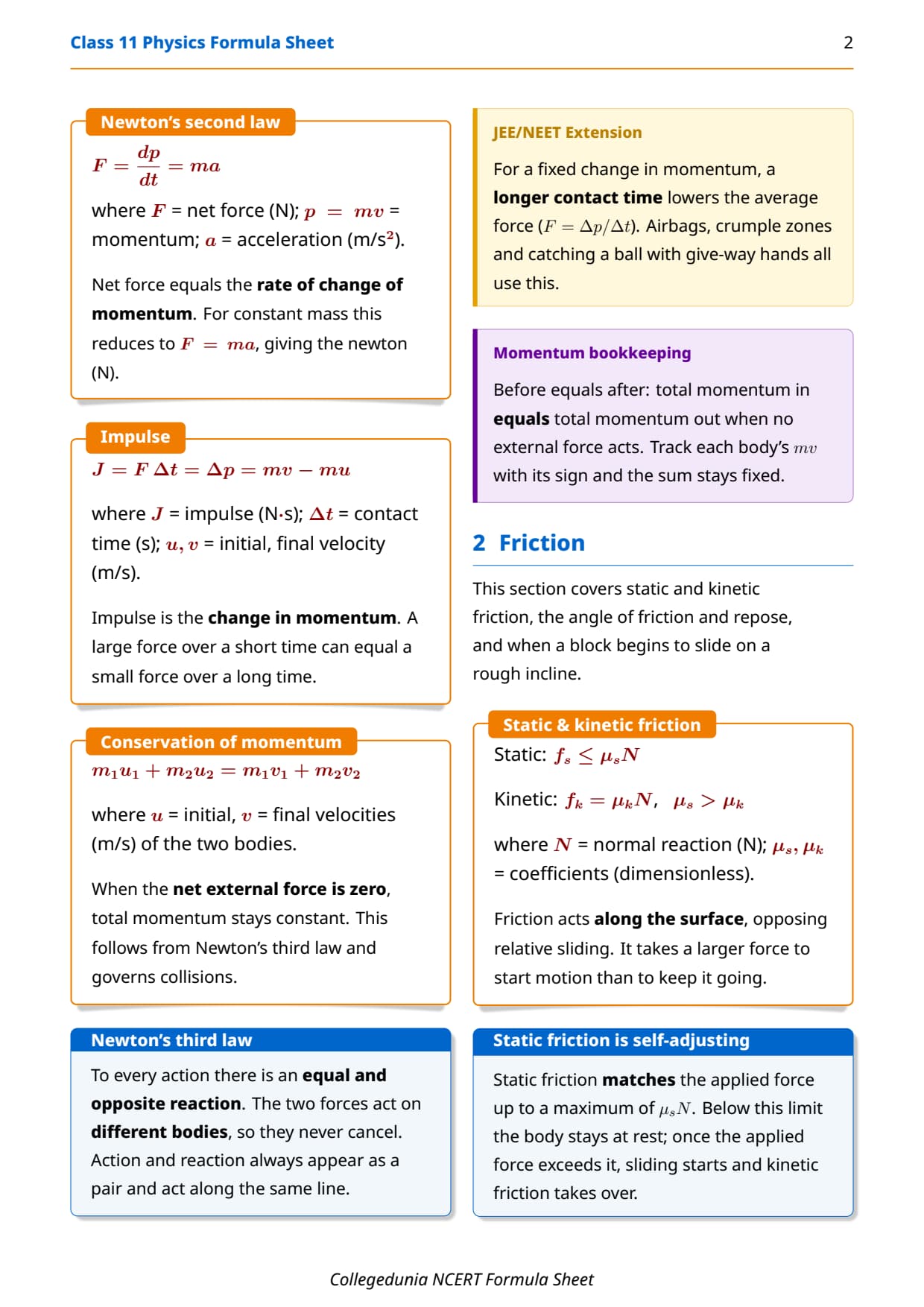
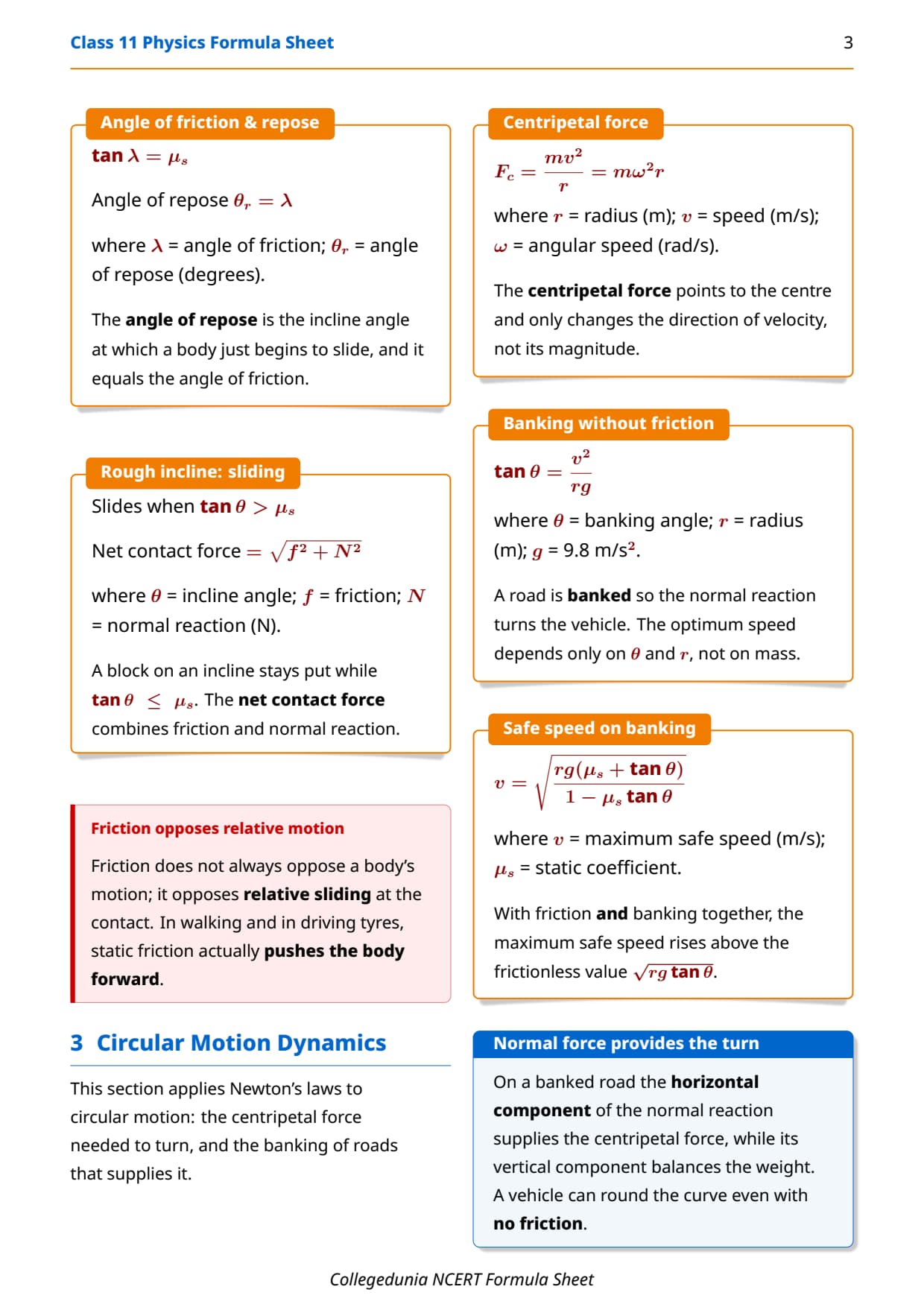
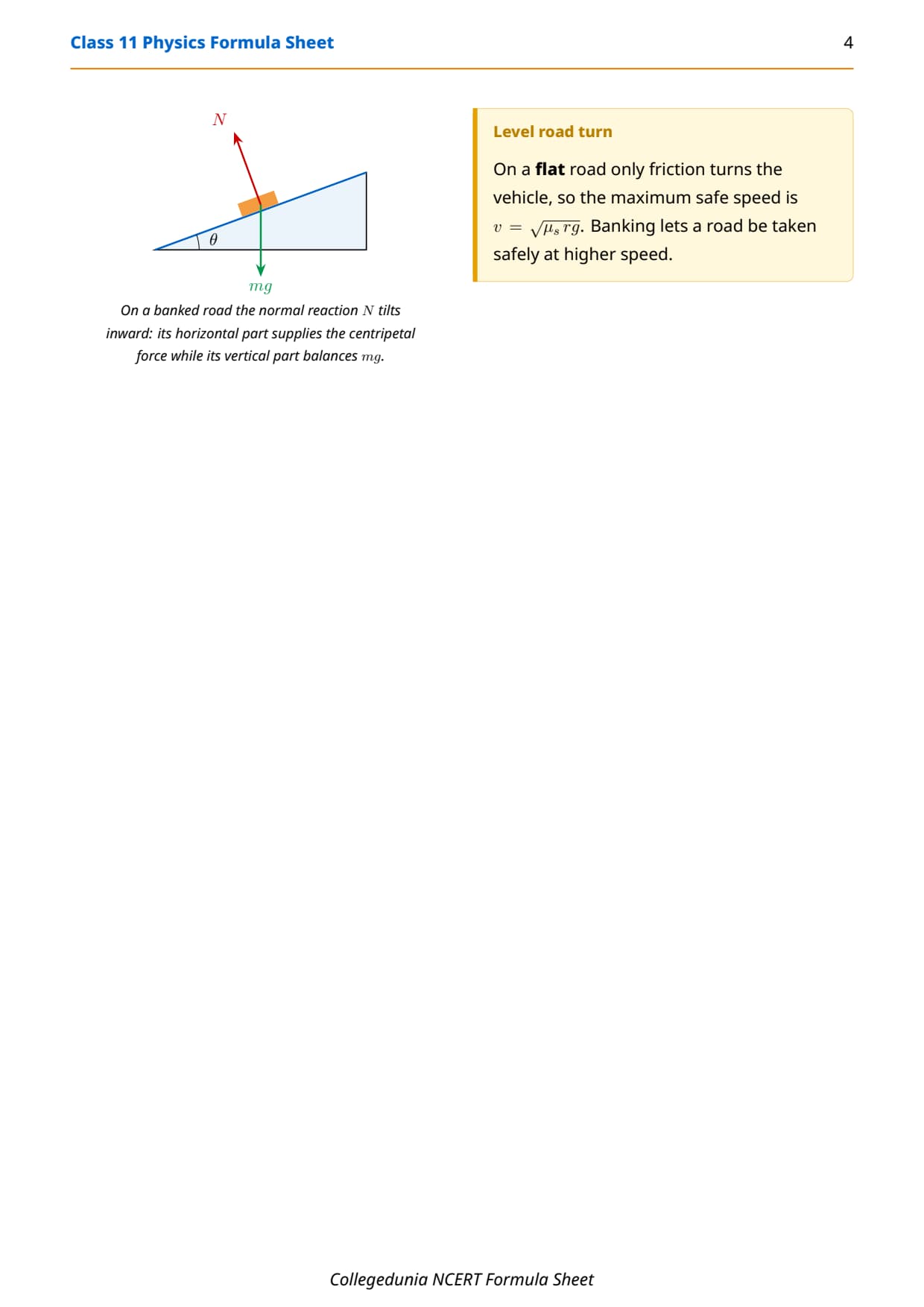
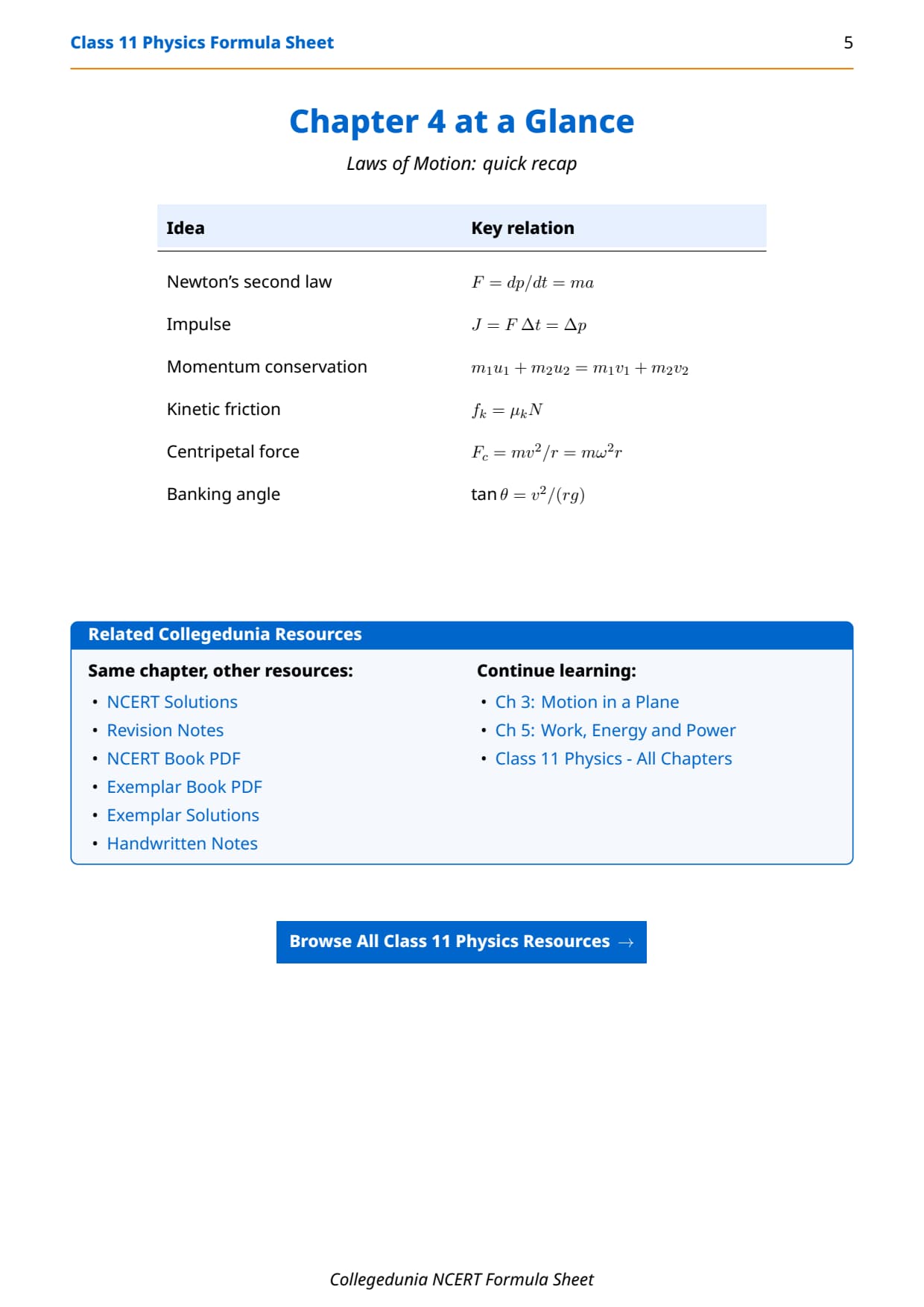
Laws of Motion links force to acceleration, so its equations power almost every mechanics numerical that follows.
- Covers Newton's three laws, momentum, impulse and conservation of momentum.
- Lists the friction, banking and lift formulae asked in numericals.
- Helps students set up free-body diagrams and solve connected-body problems quickly.
This class 11 physics formula sheet chapter 4 laws of motion is curated by subject experts and checked against the 2026-27 NCERT and recent CBSE and JEE papers.
All Laws of Motion Formulas at a Glance
Every core formula sits in one table below, with its meaning and SI unit. Learn Newton's second law and the friction rows first, since most numericals build on them.
| Formula | What it means | SI unit |
|---|---|---|
| p = mv | Linear momentum of a body | kg m s-1 |
| F = ma = dp/dt | Newton's second law, net force equals rate of change of momentum | newton (N) |
| J = FΔt = Δp | Impulse equals force times time, and equals change in momentum | N s |
| FAB = −FBA | Newton's third law, action and reaction are equal and opposite | newton (N) |
| m1u1 + m2u2 = m1v1 + m2v2 | Conservation of momentum with no external force | kg m s-1 |
| fs ≤ μsN | Limiting static friction, its maximum value | newton (N) |
| fk = μkN | Kinetic friction while surfaces slide | newton (N) |
| tanθ = μs | Angle of repose, the slope at which sliding just begins | degree or radian |
| tanθ = v2/rg | Banking of a road for the ideal frictionless speed | Dimensionless |
| vmax = √(rg tanθ) | Maximum safe speed on a banked road without friction | m s-1 |
| T = m(g + a) | Tension in a string lifting mass m with acceleration a | newton (N) |
| W' = m(g ± a) | Apparent weight in a lift, plus for up, minus for down | newton (N) |
Static friction is self-adjusting up to μsN, while kinetic friction stays fixed at μkN once sliding starts.
Key Constants and Definitions for Laws of Motion
Boards and entrance papers often ask for a constant or a short definition. By the principle of momentum conservation, the total momentum of an isolated system stays constant, which explains recoil and rocket motion.
- Acceleration due to gravity: g = 9.8 m s-2 near the Earth's surface.
- 1 newton gives a 1 kg mass an acceleration of 1 m s-2.
- Coefficient of friction μ is dimensionless and usually μs > μk.
- Inertia is a body's tendency to resist any change in its state of rest or motion.
How to Revise Laws of Motion Formulas Before the Exam
Use this class 11 physics formula sheet chapter 4 laws of motion for a fast recap the night before a test, in about 20 minutes.
- First 7 minutes: write Newton's three laws, momentum and impulse from memory.
- Next 7 minutes: write the friction, angle of repose and banking formulae.
- Last 6 minutes: solve one lift and one pulley problem using free-body diagrams.
Finish by checking one conservation-of-momentum numerical, such as a collision or recoil.
Student Feedback on the Laws of Motion Formula Sheet
What 13,120 students told us about their Laws of Motion revision:
- 71% of students rated friction and banking as the hardest formulae to recall.
- Most-skipped step: drawing the free-body diagram before applying F = ma.
- Students who memorised the impulse-momentum link solved collision numericals faster.
Source: 2026-27 Class 11 Physics student poll. Sample of 13,120 students from CBSE schools across 14 states, conducted before the 2026 boards.
Other Laws of Motion Class 11 Physics Resources
Pair this formula sheet with the solved answers, notes and textbook PDF.
| Resource | Link |
|---|---|
| NCERT Solutions | Laws of Motion Class 11 NCERT Solutions |
| Revision Notes | Laws of Motion Class 11 Notes |
| Handwritten Notes | Laws of Motion Class 11 Handwritten Notes |
| NCERT Book PDF | Laws of Motion Class 11 Book PDF |
NCERT Formula Sheet for Class 11 Physics: All Chapters
Jump to any other Class 11 Physics formula sheet below.
| Chapter | Formula Sheet |
|---|---|
| Chapter 1 | Units and Measurements |
| Chapter 2 | Motion in a Straight Line |
| Chapter 3 | Motion in a Plane |
| Chapter 4 | Laws of Motion |
| Chapter 5 | Work, Energy and Power |
| Chapter 6 | System of Particles and Rotational Motion |
| Chapter 7 | Gravitation |
| Chapter 8 | Mechanical Properties of Solids |
| Chapter 9 | Mechanical Properties of Fluids |
| Chapter 10 | Thermal Properties of Matter |
| Chapter 11 | Thermodynamics |
| Chapter 12 | Kinetic Theory |
| Chapter 13 | Oscillations |
| Chapter 14 | Waves |
FAQs on Laws of Motion Class 11 Physics Formula Sheet
Laws of Motion Formula Sheet - Frequently Asked Questions
Ques. What formulas does the class 11 physics formula sheet chapter 4 laws of motion cover?
Ans. This class 11 physics formula sheet chapter 4 laws of motion covers Newton's three laws, linear momentum, impulse and conservation of momentum. It also lists limiting and kinetic friction, the angle of repose, banking of roads, tension in strings and apparent weight in a lift.
Ques. What is the difference between static and kinetic friction?
Ans. Static friction opposes an applied force and rises up to a maximum of μsN. Once the body slides, kinetic friction acts with a constant value μkN, and usually μs > μk.
Ques. What is the impulse-momentum theorem?
Ans. Impulse is the product of force and the time for which it acts, J = FΔt, and it equals the change in momentum Δp. It explains why follow-through and cushioning reduce the force felt.
Ques. How do you find the safe speed on a banked road?
Ans. For an ideal frictionless banked road, tanθ = v2/rg, so the safe speed is v = √(rg tanθ). With friction, the maximum speed rises to √[rg(μ + tanθ)/(1 − μ tanθ)].



Comments