




The class 11 physics formula sheet chapter 6 system of particles and rotational motion gathers every centre of mass, torque, angular momentum and moment of inertia formula tested in the Boards, JEE Main, JEE Advanced, NEET, CUET and NDA exams. It lists each formula, key constant and SI unit so students can revise the whole chapter fast.
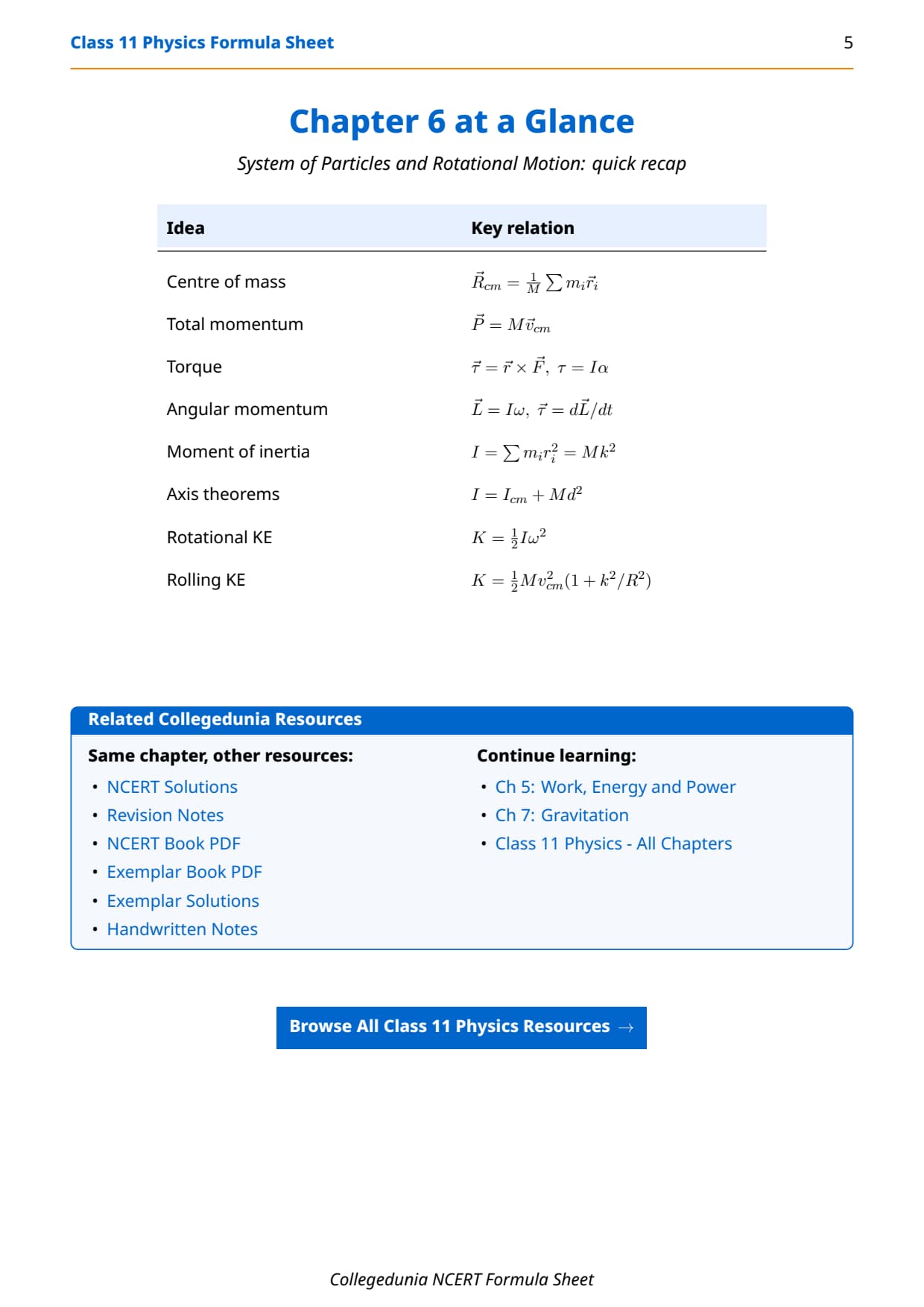
Rotational motion builds on Newton's laws, so its torque and angular momentum results reappear in every mechanics numerical.
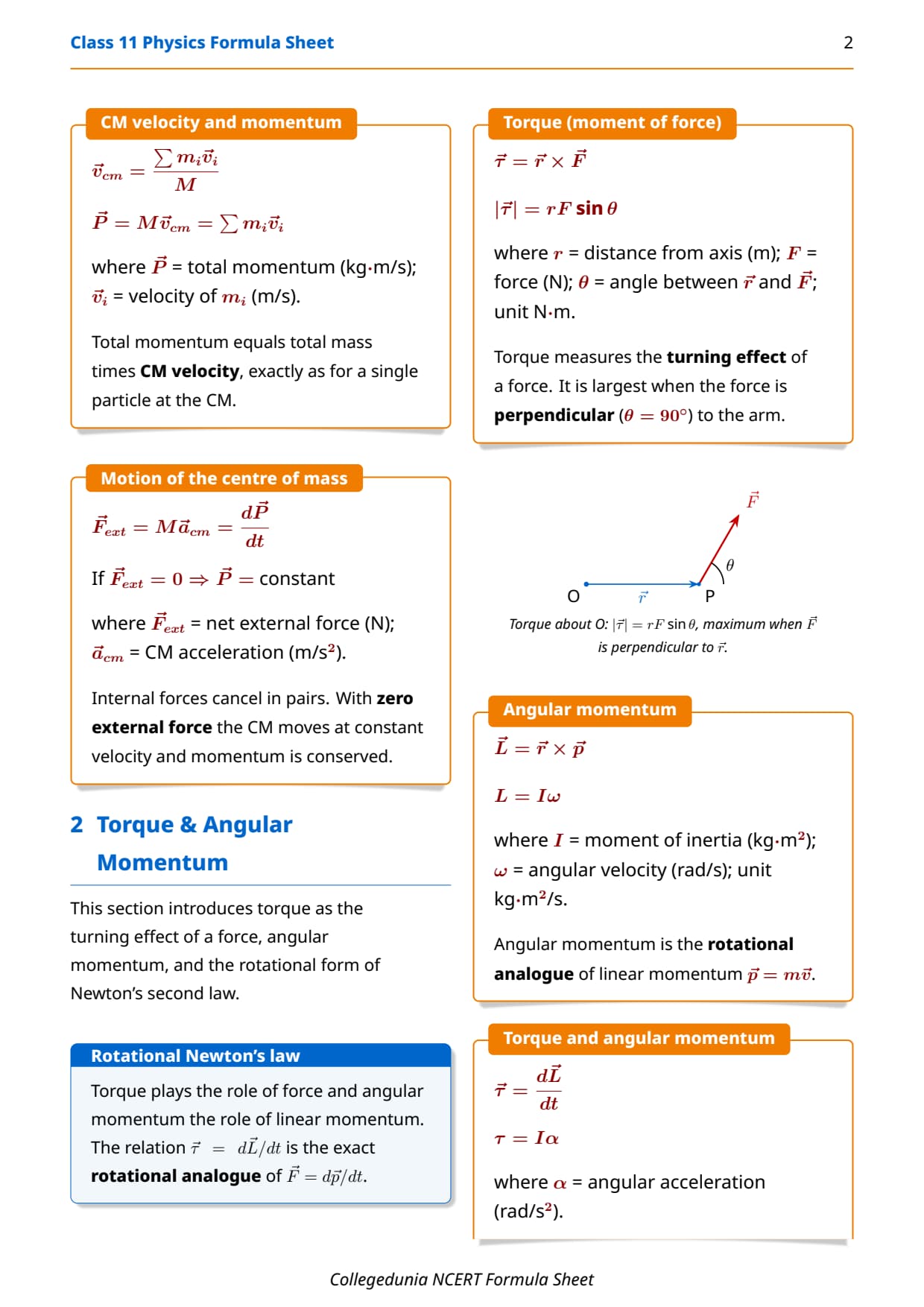
- Covers centre of mass, torque, angular momentum and the angular equations of motion.
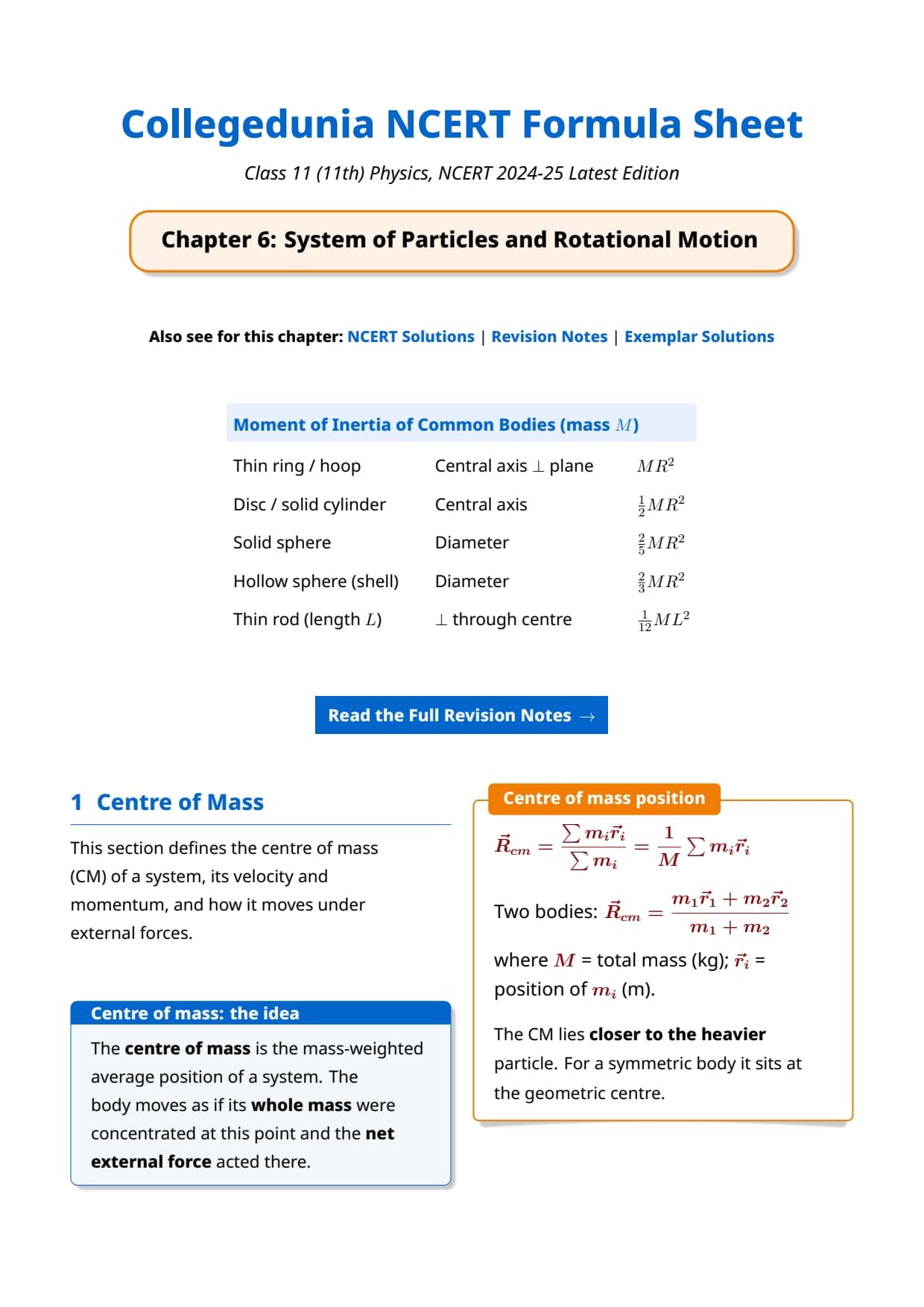
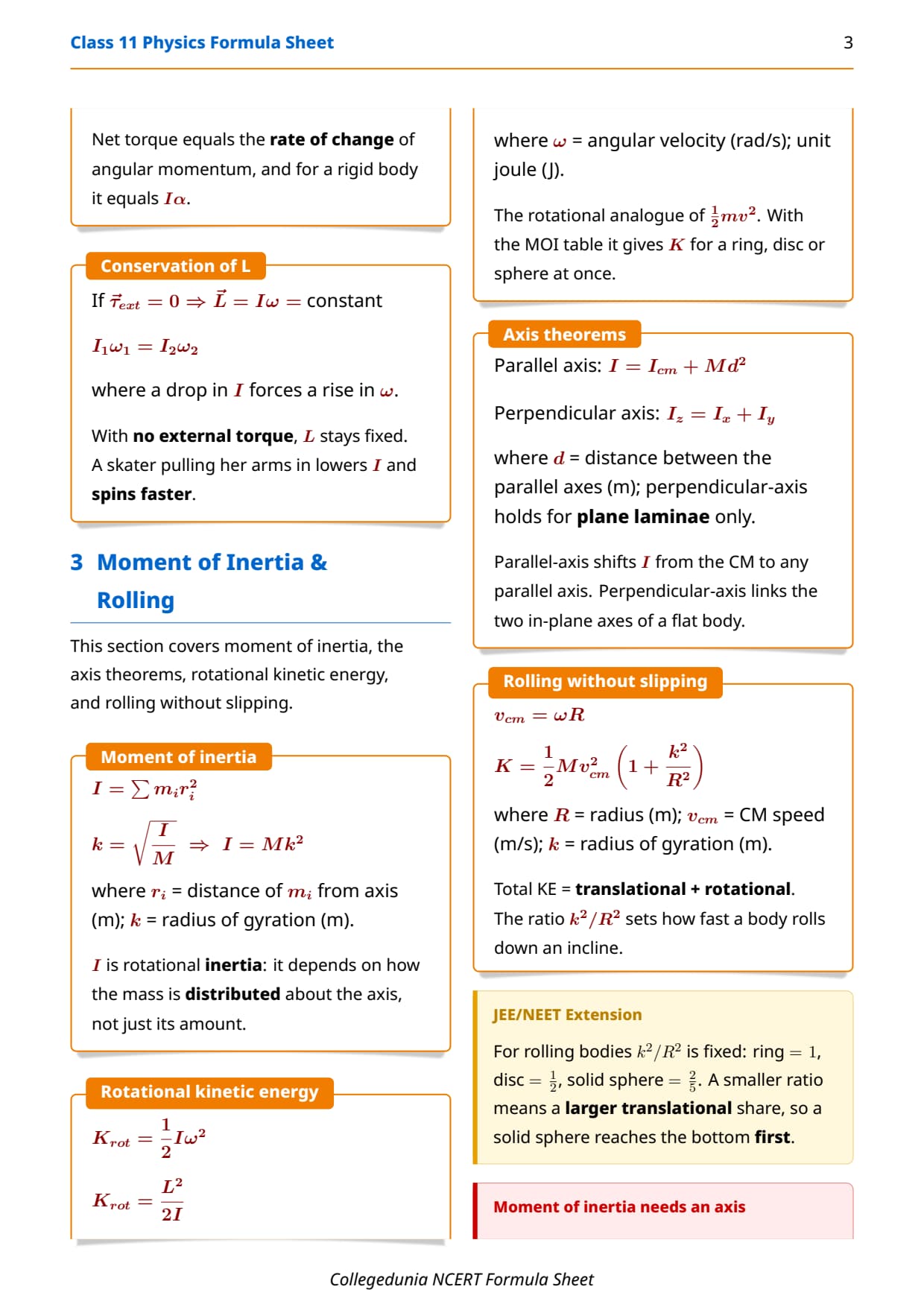
- Lists the moment of inertia of a ring, disc, rod and sphere, plus both axis theorems.
- Helps students solve rolling, rotational kinetic energy and rigid-body problems quickly.
This class 11 physics formula sheet chapter 6 system of particles and rotational motion is curated by subject experts and checked against the 2026-27 NCERT and recent CBSE and JEE papers.
All System of Particles and Rotational Motion Formulas at a Glance
Every rotational formula sits in one table below, with its meaning and SI unit. Learn the torque and angular momentum rows first, since most numericals use them.
| Formula | What it means | SI unit |
|---|---|---|
| xcm = (Σmixi)/(Σmi) | Centre of mass of a system of particles | metre (m) |
| τ = rF sinθ | Torque, the turning effect of a force | N m |
| L = Iω | Angular momentum of a rigid body | kg m2 s-1 |
| τ = Iα | Rotational form of Newton's second law | N m |
| τ = dL/dt | Torque equals rate of change of angular momentum | N m |
| I = Σmiri2 | Moment of inertia about an axis | kg m2 |
| KErot = ½ Iω2 | Rotational kinetic energy | joule (J) |
| vcm = Rω | Rolling without slipping condition | m s-1 |
| KEroll = ½ mv2(1 + k2/R2) | Total energy of a rolling body | joule (J) |
Torque is the rotational analogue of force, and moment of inertia is the rotational analogue of mass.
Moment of Inertia of Common Bodies
Remember the moment of inertia I of standard shapes. Each value below is about the axis named.
| Body (axis) | Moment of inertia | SI unit |
|---|---|---|
| Ring (through centre, perpendicular) | MR2 | kg m2 |
| Disc (through centre, perpendicular) | ½ MR2 | kg m2 |
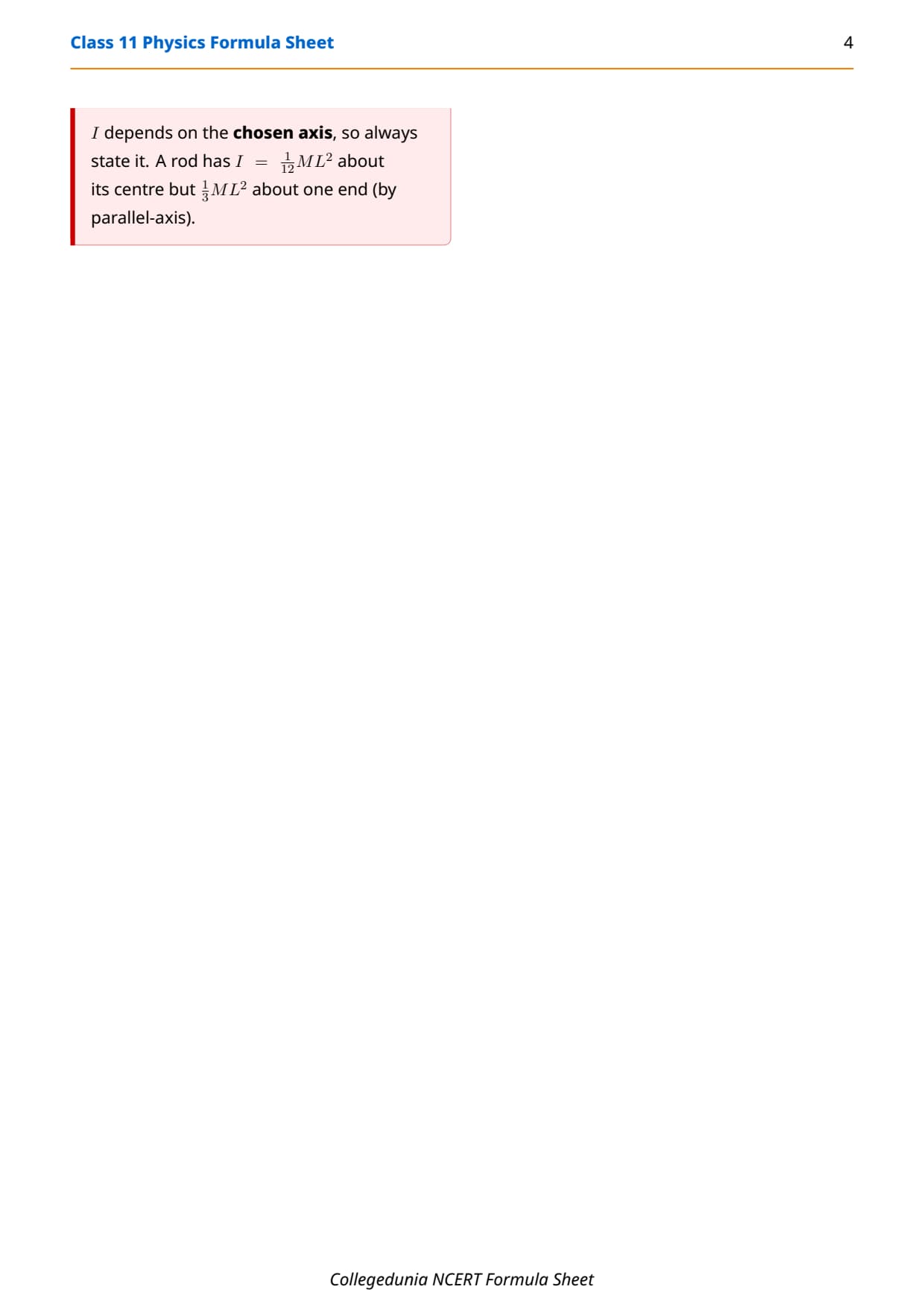
| Rod (through centre, perpendicular) | ML2/12 | kg m2 |
| Solid sphere (through centre) | (2/5)MR2 | kg m2 |
| Hollow sphere (through centre) | (2/3)MR2 | kg m2 |
| Solid cylinder (about its axis) | ½ MR2 | kg m2 |
By the parallel axes theorem, I = Icm + Md2. The perpendicular axes theorem gives Iz = Ix + Iy for a plane lamina.
Key Definitions and Constants for Rotational Motion
Boards and entrance papers often ask for a definition or relation. The list below has the key quantities to recall.
- Radius of gyration: I = Mk2, so k = √(I/M).
- Angular momentum conservation: if τext = 0, then Iω stays constant.
- Work and power of a torque: W = τθ and P = τω.
- Vector forms: τ = r × F and L = r × p.
How to Revise System of Particles and Rotational Motion Formulas Before the Exam
Use this class 11 physics formula sheet chapter 6 system of particles and rotational motion for a fast recap the night before a test, in about 20 minutes.
- First 7 minutes: write torque, angular momentum and the two rotational equations from memory.
- Next 7 minutes: write the moment of inertia of a ring, disc, rod and solid sphere.
- Last 6 minutes: apply both axis theorems and solve one rolling-body energy problem.
Finish by showing a solid sphere beats a ring down an incline.
Student Feedback on the Rotational Motion Formula Sheet
What 11,460 students told us about their rotational motion revision:
- 71% of students rated moment of inertia as the hardest part to memorise.
- Most-skipped step: applying the parallel axes theorem before finding energy.
- Students who learned the standard-shape values first solved rolling faster.
Source: 2026-27 Class 11 Physics student poll. Sample of 11,460 students from CBSE schools across 14 states, conducted before the 2026 boards.
Other System of Particles and Rotational Motion Class 11 Physics Resources
Pair this formula sheet with the solved answers, notes and book PDF.
| Resource | Link |
|---|---|
| NCERT Solutions | System of Particles and Rotational Motion Class 11 NCERT Solutions |
| Revision Notes | System of Particles and Rotational Motion Class 11 Notes |
| Handwritten Notes | System of Particles and Rotational Motion Class 11 Handwritten Notes |
| NCERT Book PDF | System of Particles and Rotational Motion Class 11 Book PDF |
NCERT Formula Sheet for Class 11 Physics: All Chapters
Jump to any other Class 11 Physics formula sheet below.
| Chapter | Formula Sheet |
|---|---|
| Chapter 1 | Units and Measurements |
| Chapter 2 | Motion in a Straight Line |
| Chapter 3 | Motion in a Plane |
| Chapter 4 | Laws of Motion |
| Chapter 5 | Work, Energy and Power |
| Chapter 6 | System of Particles and Rotational Motion |
| Chapter 7 | Gravitation |
| Chapter 8 | Mechanical Properties of Solids |
| Chapter 9 | Mechanical Properties of Fluids |
| Chapter 10 | Thermal Properties of Matter |
| Chapter 11 | Thermodynamics |
| Chapter 12 | Kinetic Theory |
| Chapter 13 | Oscillations |
| Chapter 14 | Waves |
FAQs on System of Particles and Rotational Motion Class 11 Physics Formula Sheet
System of Particles and Rotational Motion Formula Sheet - Frequently Asked Questions
Ques. What formulas does the class 11 physics formula sheet chapter 6 system of particles and rotational motion cover?
Ans. This class 11 physics formula sheet chapter 6 system of particles and rotational motion covers centre of mass, torque τ = rF sinθ, angular momentum L = Iω, the rotational law τ = Iα, the moment of inertia of standard shapes, both axis theorems, rotational kinetic energy and rolling.
Ques. What is the moment of inertia of a solid sphere?
Ans. The moment of inertia of a solid sphere about a diameter through its centre is (2/5)MR2. A hollow sphere gives (2/3)MR2 and a ring gives MR2.
Ques. What are the parallel and perpendicular axes theorems?
Ans. The parallel axes theorem states I = Icm + Md2, shifting the axis by a distance d. The perpendicular axes theorem, valid for a plane lamina, states Iz = Ix + Iy.
Ques. What is the total kinetic energy of a rolling body?
Ans. A body rolling without slipping has both translational and rotational energy, so its total is ½ mv2(1 + k2/R2), where k is the radius of gyration and the rolling condition is vcm = Rω.



Comments