




The Class 11 Physics NCERT Solutions Chapter 4 Laws of Motion will help students prepare for Boards, JEE Main, JEE Advanced, NEET, CUET and NDA in 2026-27. Every back-exercise question is solved with full working, so students can check each free-body diagram, force balance, friction calculation, and momentum step one line at a time.
This chapter turns the motion ideas from earlier chapters into cause-and-effect physics, and its methods are used in almost every mechanics problem that follows.
- CBSE Weightage: 6 to 8 marks, usually one numerical on friction or connected bodies plus a short answer on Newton's laws.
- Questions solved: all Exercise 4.1 onward, covering Newton's laws, momentum, impulse, friction, and circular motion.
- Key formulas: F = ma, impulse = change in momentum, limiting friction f = μN, and the banking-of-roads speed relation.
Each solution in this Class 11 Physics NCERT Solutions Chapter 4 Laws of Motion compilation is curated by subject experts, based on the 2026-27 NCERT textbook, and refined against the last five years of CBSE Board, JEE Main and NEET papers.
Newton's Three Laws of Motion and the Concept of Inertia
The whole chapter rests on Newton's three laws. They connect the forces on a body to how its motion changes. The NCERT questions ask students to state each law and then use it in a numerical, so the solved answers do both.
- First law (law of inertia): a body stays at rest or in uniform motion unless a net external force acts on it. Inertia is this tendency to resist a change in motion, and it grows with mass.
- Second law: the net force equals the rate of change of momentum, which for constant mass gives F = ma. This law gives the number in every force numerical.
- Third law: every action has an equal and opposite reaction, and the two forces act on different bodies.
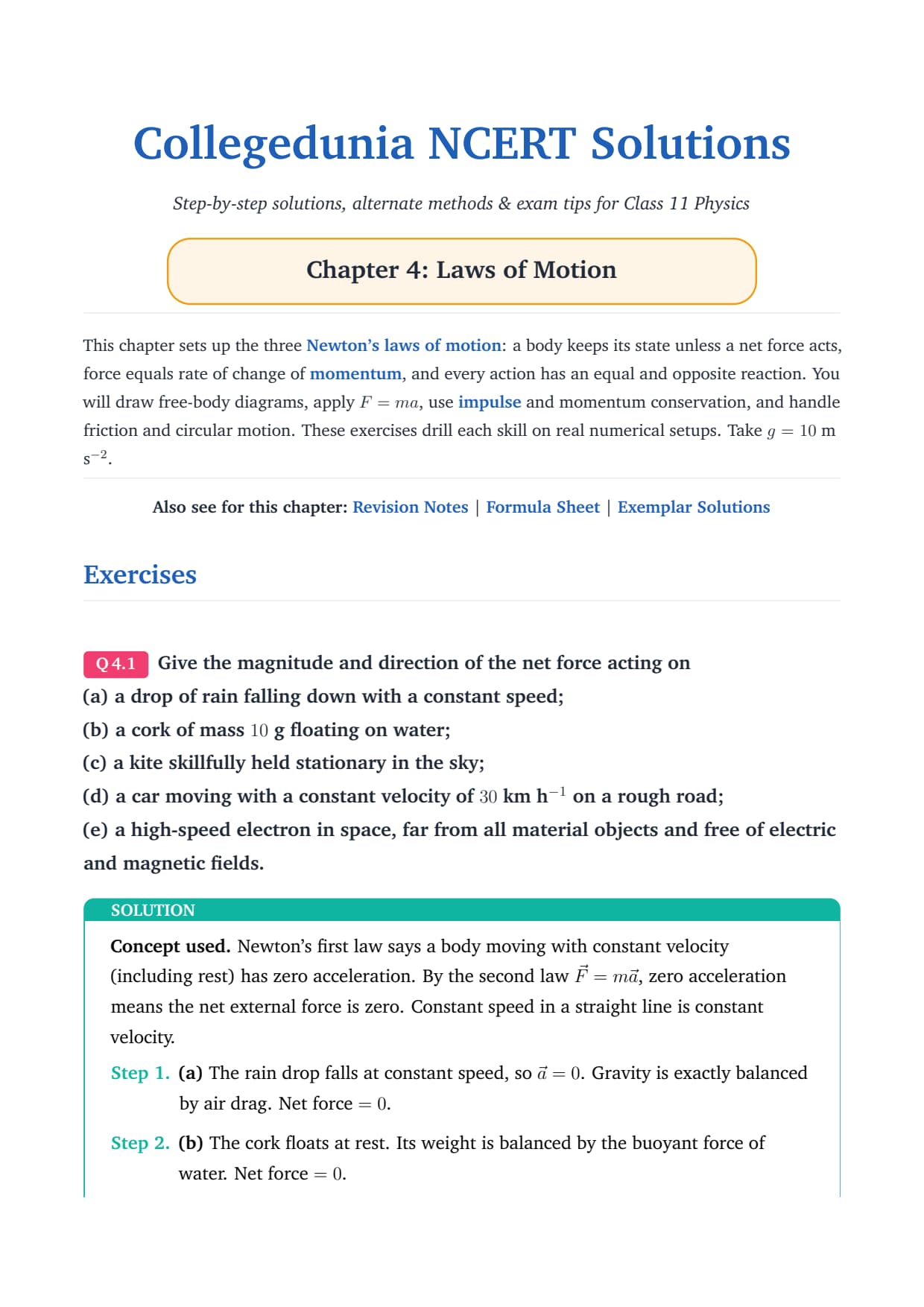
A common error is to add an action and its reaction as if they cancel. Action and reaction act on two different bodies, so they never cancel on the same object. Questions like Exercise 4.1 test the first law with everyday examples, and the solutions explain the reasoning a student can reproduce in the exam.
Linear Momentum, Impulse and Newton's Second Law
Linear momentum is the product of mass and velocity, written p = mv. It measures how hard it is to stop a moving body. Newton's second law is really a statement about momentum, and the NCERT solutions use this form whenever a force acts for a short time.
- Second law in full form: F = dp/dt, the force equals the rate of change of momentum.
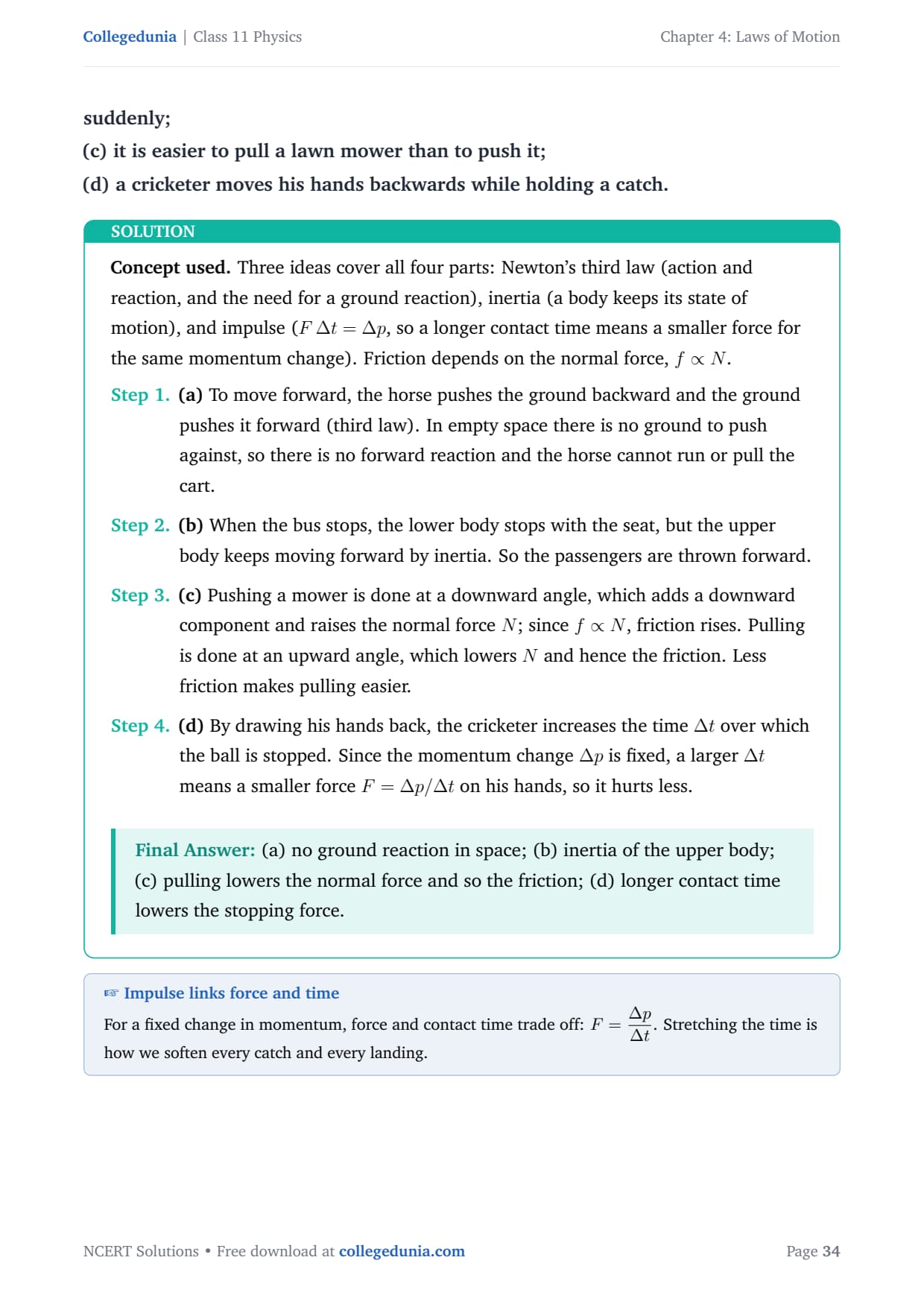
- Impulse: the product of force and the time it acts, J = F Δt.
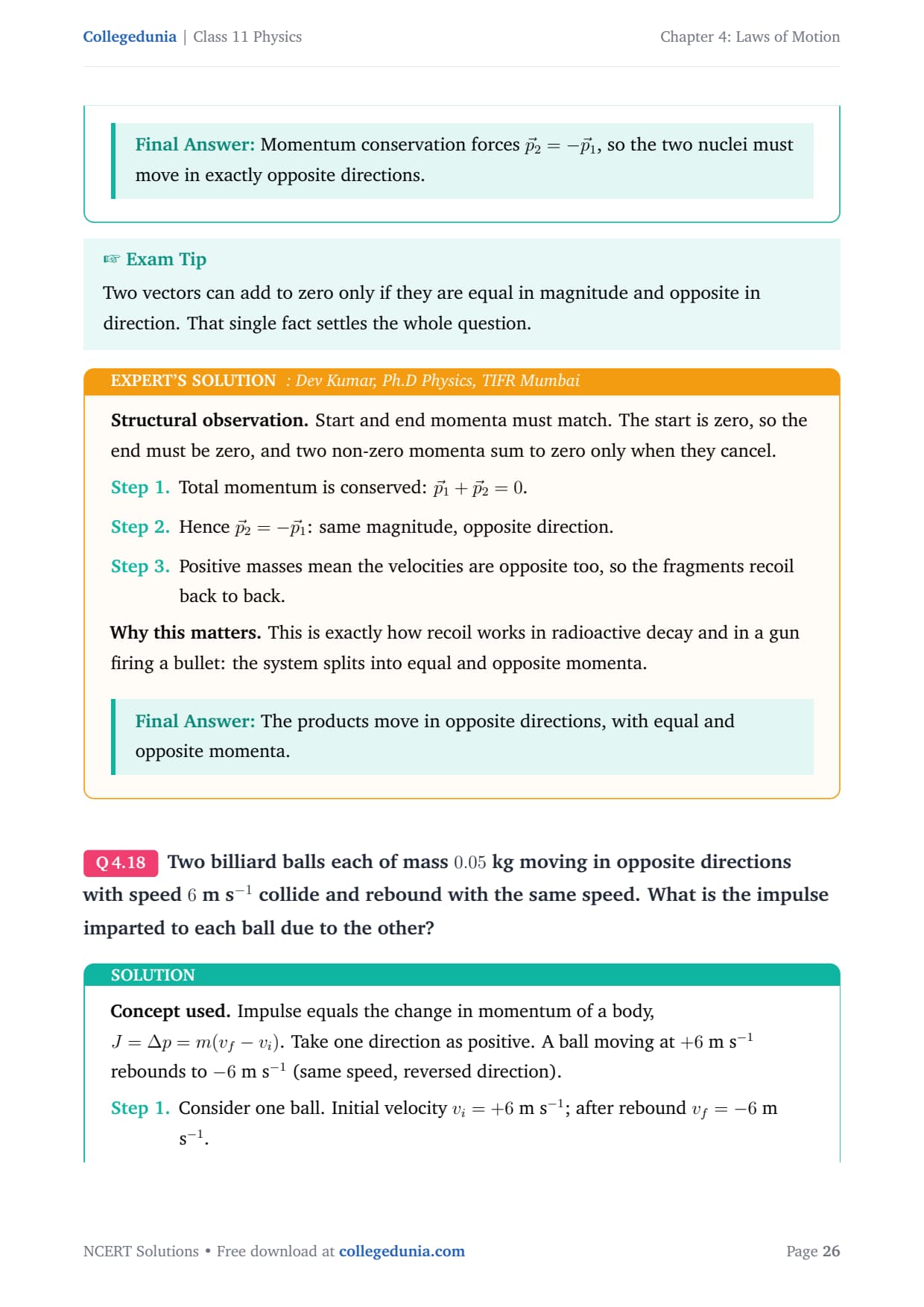
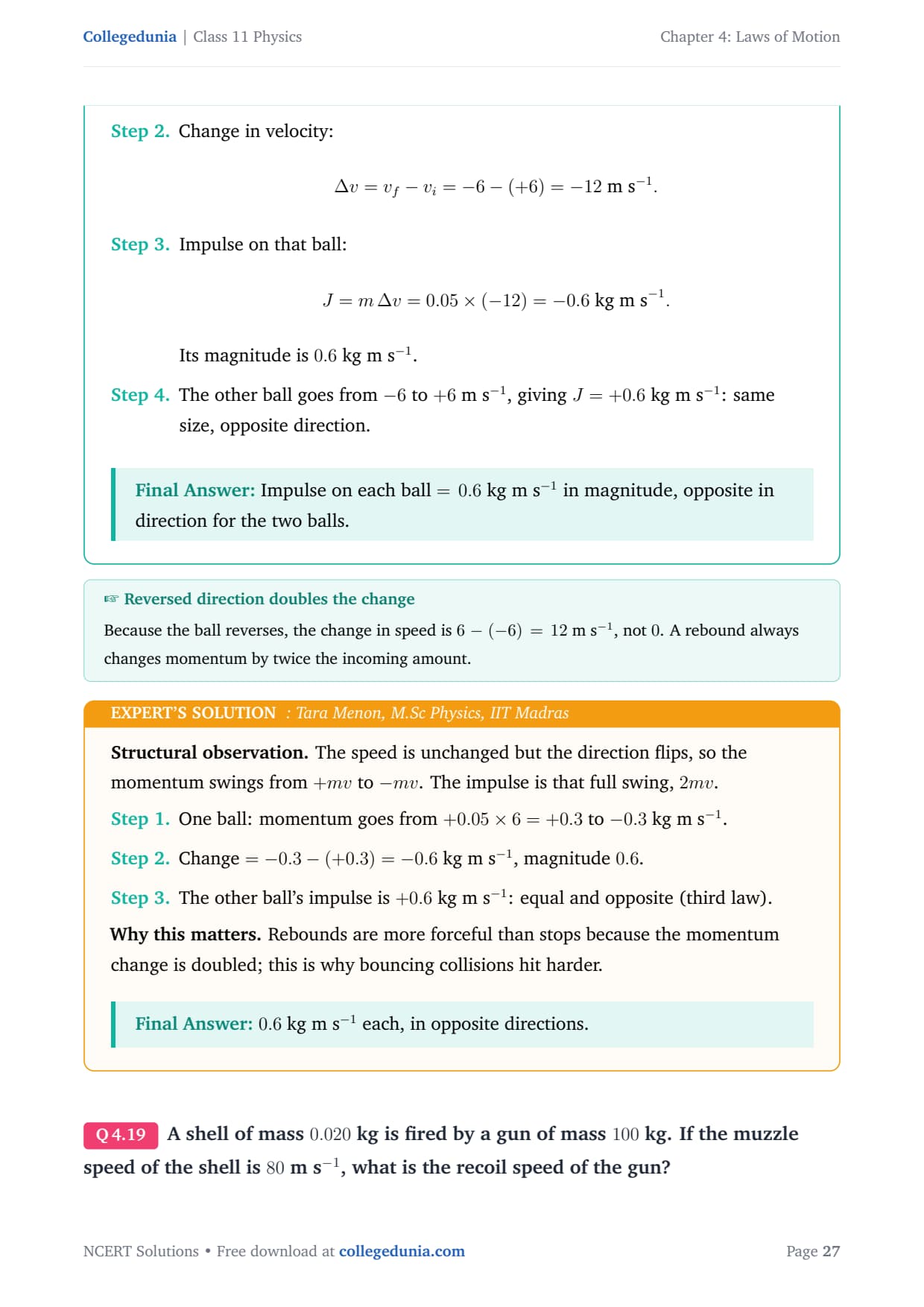
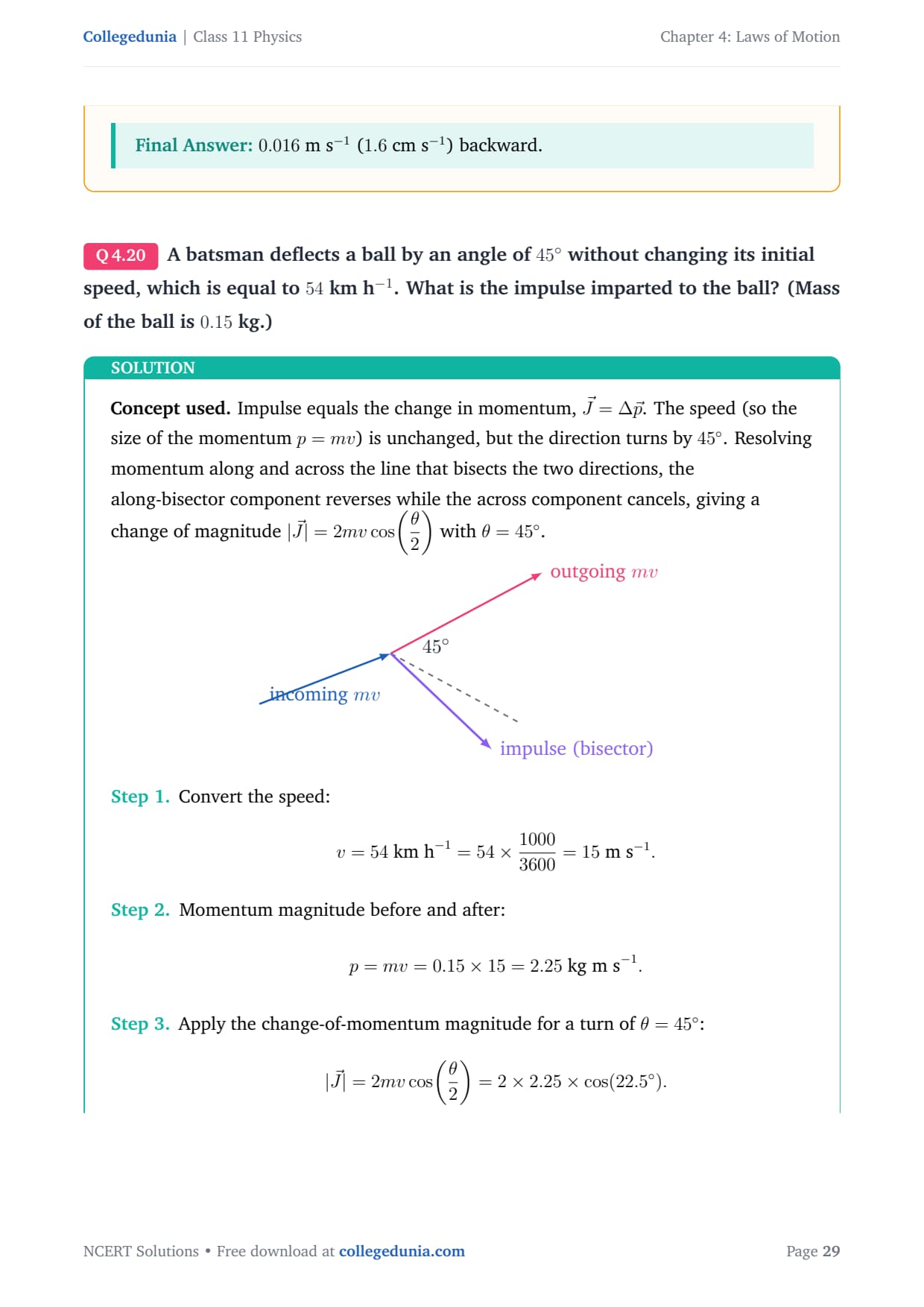
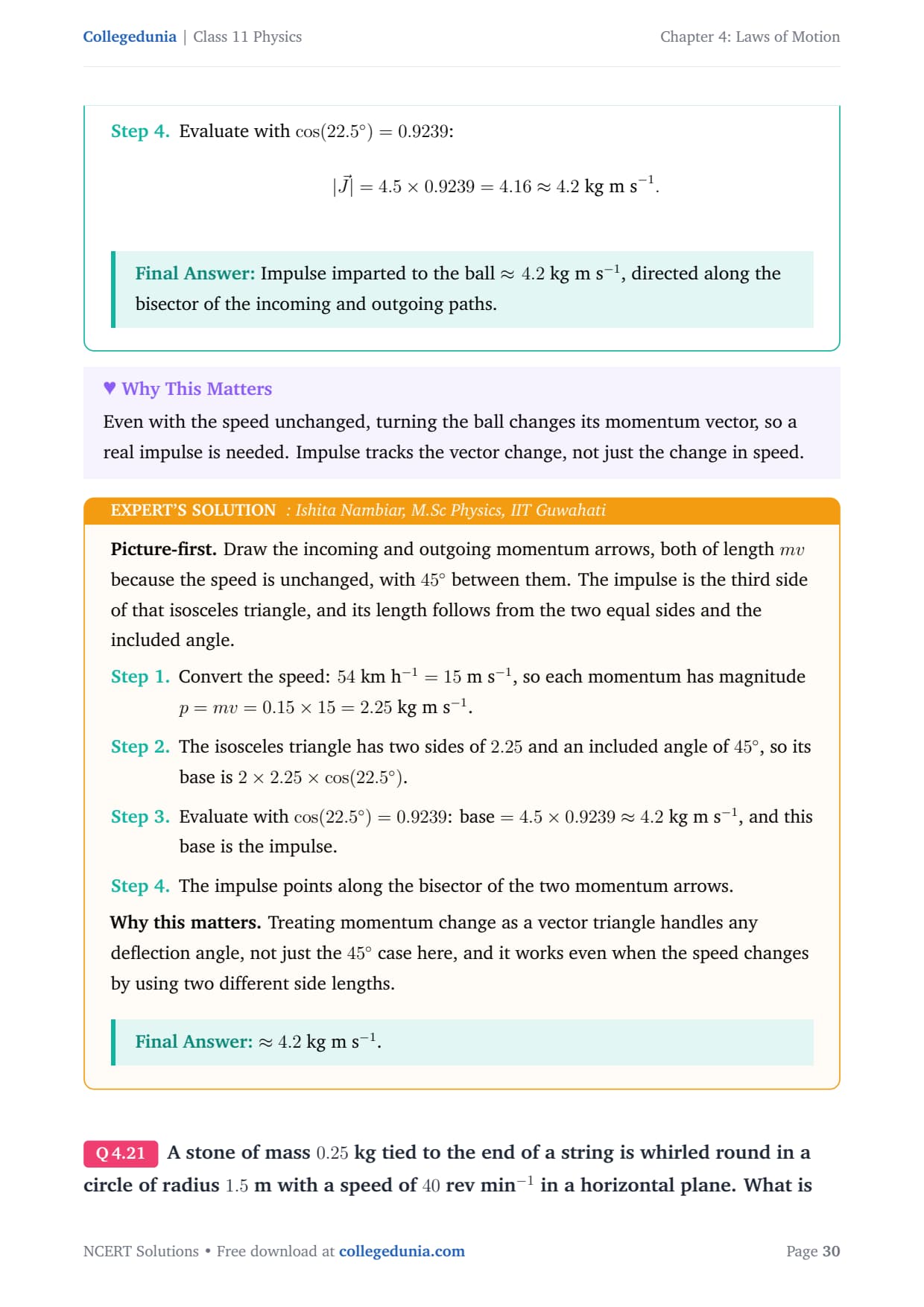
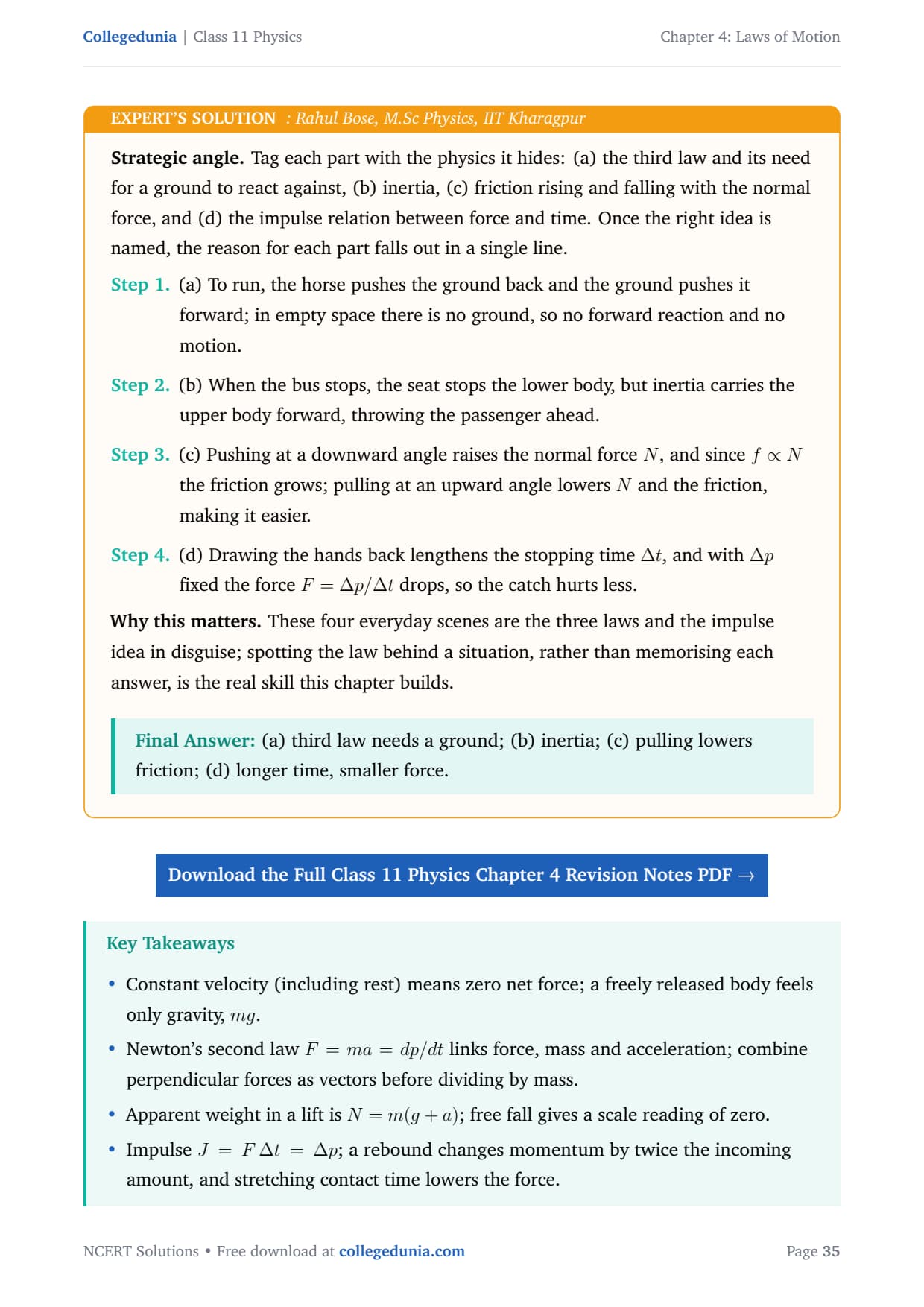
- Impulse-momentum theorem: impulse equals the change in momentum, F Δt = Δp.
This theorem explains why a longer contact time means a smaller force for the same change in momentum, which is the idea behind airbags and a cricketer pulling the hands back while catching. Numericals such as Exercise 4.10 give a force and a time and ask for the change in velocity. Write the impulse first, set it equal to the change in momentum, then solve for the unknown. The Class 11 Physics NCERT Solutions Chapter 4 Laws of Motion show this order on separate lines so no step is skipped.
Conservation of Momentum and Equilibrium of Forces
When no external force acts on a system, its total momentum does not change. This law of conservation of momentum follows directly from Newton's third law, and it solves every collision and recoil problem in the chapter without needing the force itself.
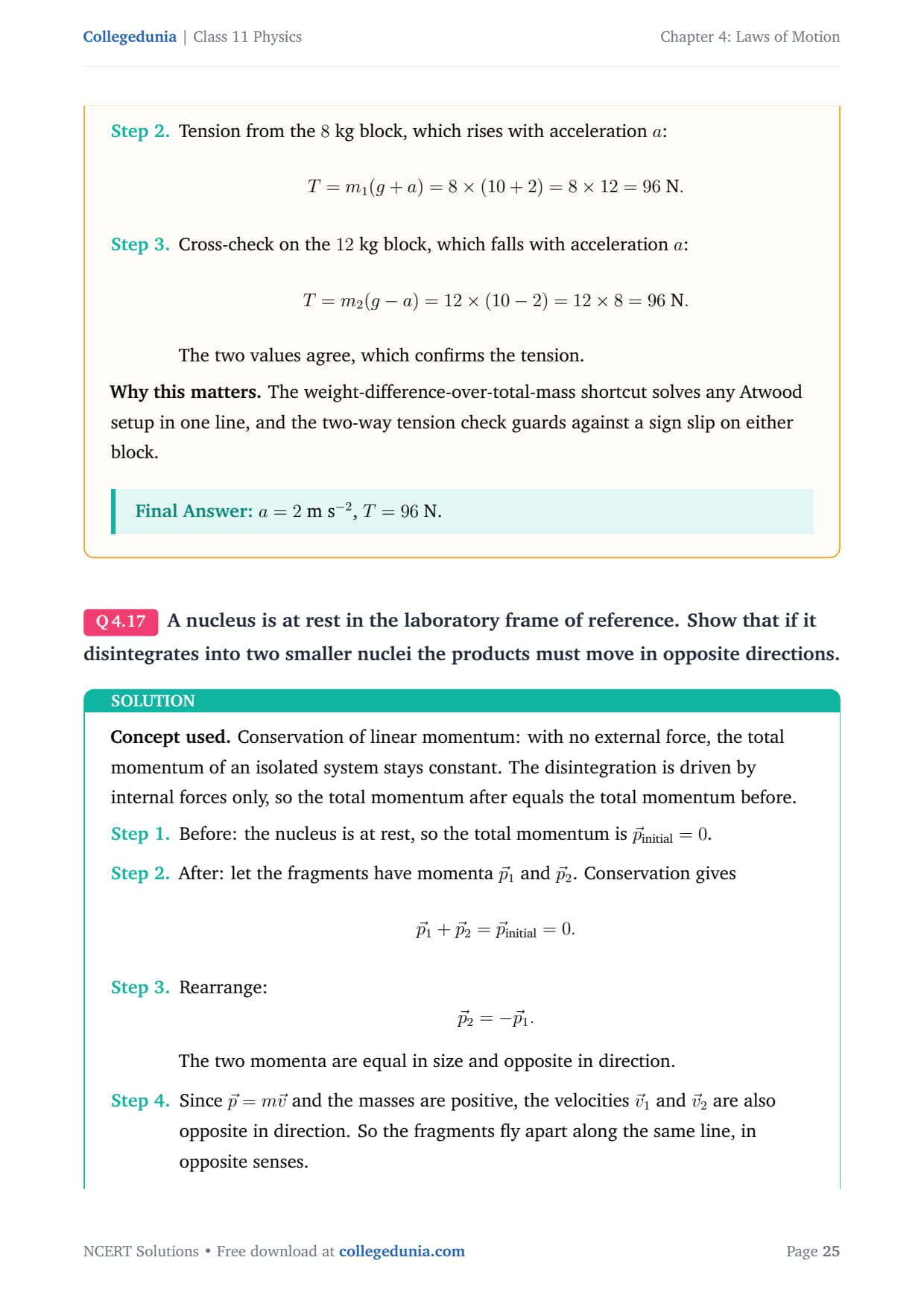
- Conservation rule: total momentum before equals total momentum after, m1u1 + m2u2 = m1v1 + m2v2.
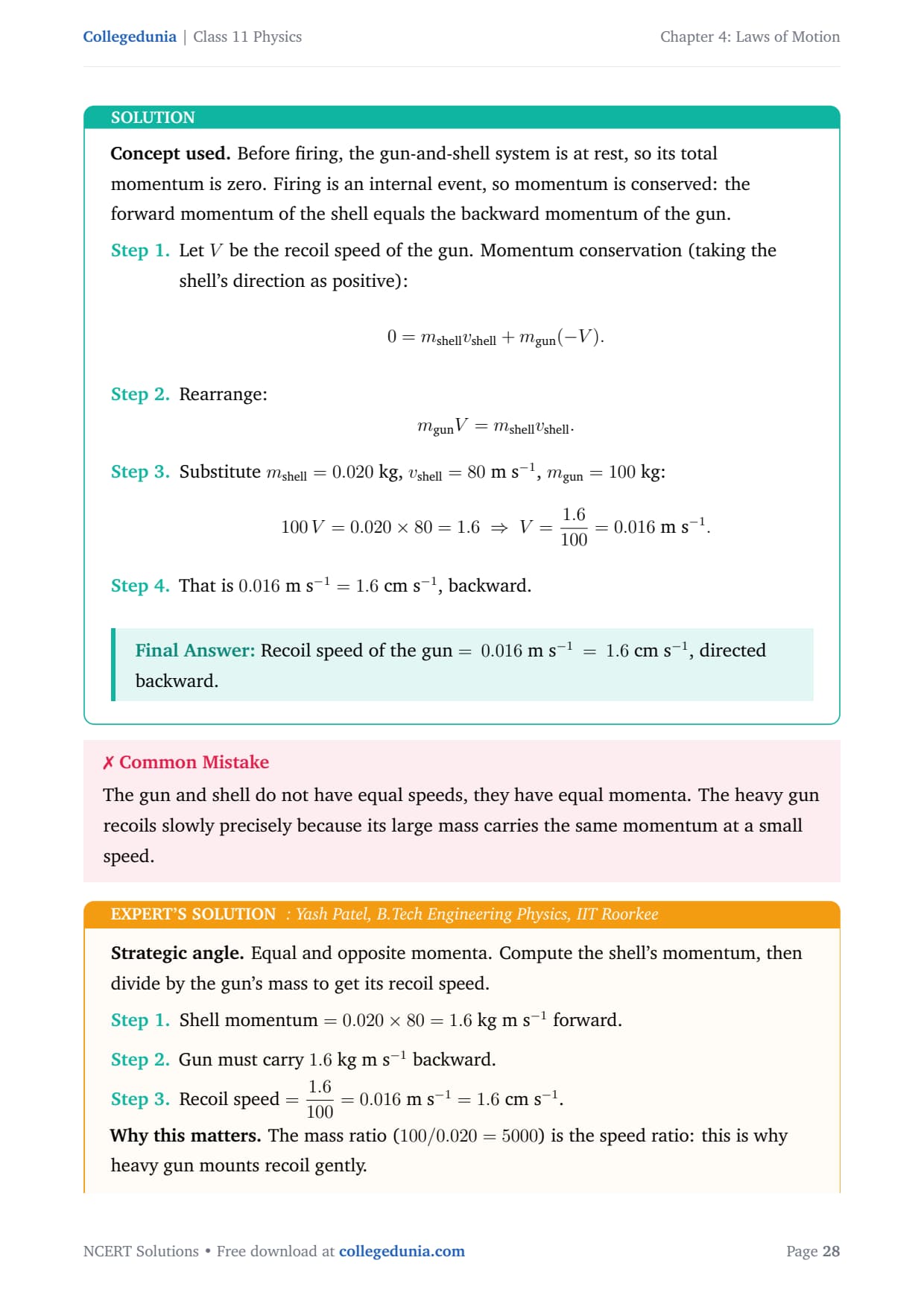
- Recoil of a gun: the forward momentum of the bullet equals the backward momentum of the gun, so the gun kicks back.
- Equilibrium of forces: when the net force is zero, the body is in equilibrium and its acceleration is zero.
For a body in equilibrium under three forces, the forces form a closed triangle, and this idea is tested in the concurrent-force problems. If three forces keep a body in equilibrium, each force is proportional to the sine of the angle between the other two. Questions like Exercise 4.15 ask students to find an unknown tension or angle, and the solved answers resolve the forces into components before applying the equilibrium condition.
Free-Body Diagrams and Friction: Static, Kinetic and Rolling
A free-body diagram shows a single body with every force on it drawn as an arrow. It is the first step in almost every numerical, and the NCERT solutions draw one before writing any equation. Once the diagram is clear, the force equations follow directly.
| Type of friction | When it acts | Key relation |
|---|---|---|
| Static friction | Body is at rest, on the verge of sliding | fs ≤ μsN |
| Kinetic friction | Body is already sliding | fk = μkN |
| Rolling friction | Body rolls without sliding | Smallest of the three |
Static friction adjusts itself up to a maximum called limiting friction, while kinetic friction stays roughly constant. Rolling friction is much smaller than sliding friction, which is why wheels and ball bearings are used. Problems on an inclined plane, such as Exercise 4.20, ask for the acceleration when friction acts. The solved answers resolve the weight along and across the slope, then subtract friction from the driving force, exactly as CBSE expects.
Dynamics of Circular Motion and Banking of Roads
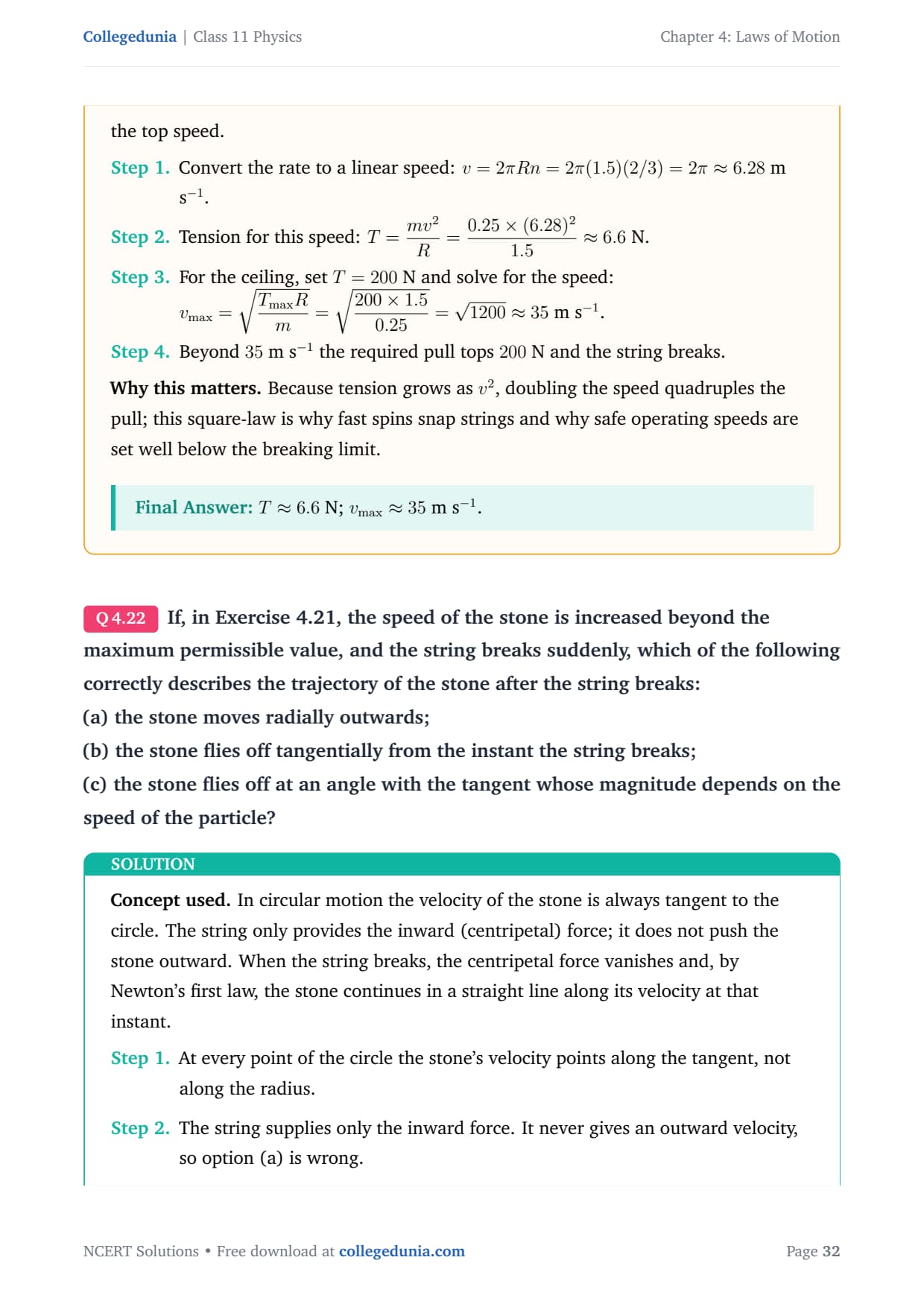
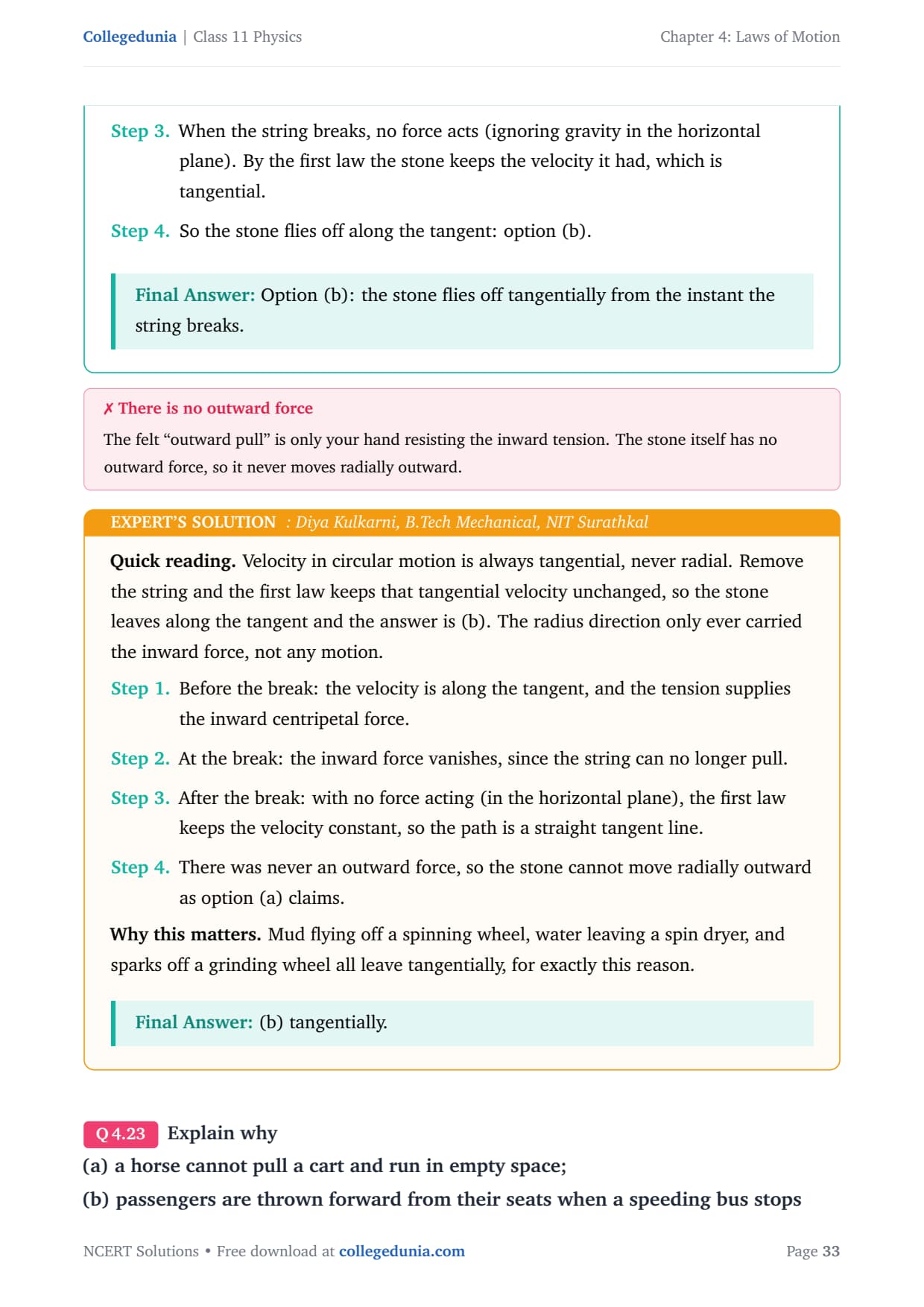
A body moving in a circle at steady speed still accelerates, because its direction keeps changing. This centripetal acceleration points to the centre and needs a real force to supply it. The NCERT solutions identify that force in each case before writing the equation.
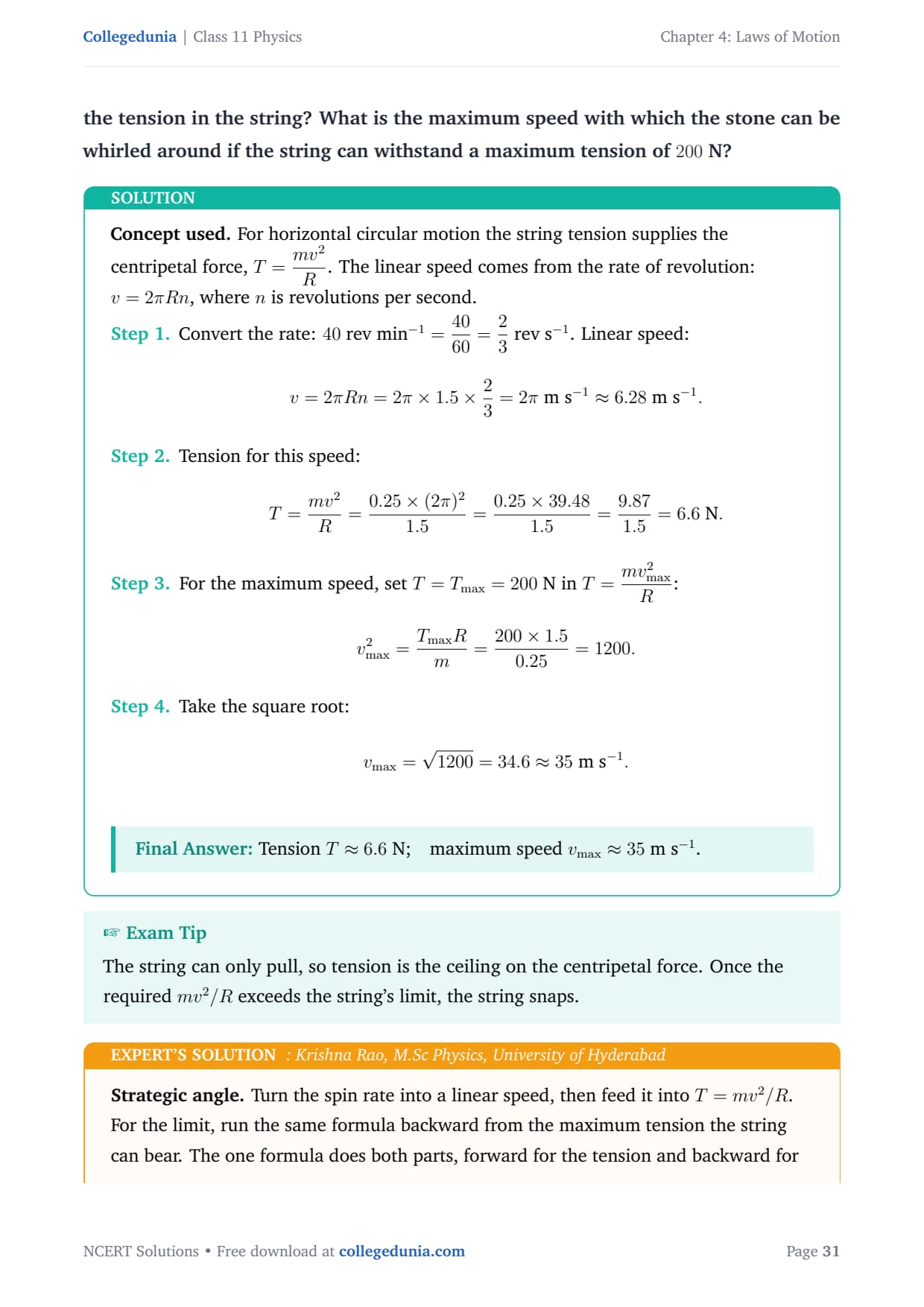
- Centripetal force: the net inward force, F = mv2/r, supplied by tension, gravity, or friction depending on the situation.
- Car on a level road: friction alone provides the centripetal force, so the safe speed is limited by v = √(μrg).
- Banking of roads: tilting the road lets a part of the normal force point inward, so a car can turn even without friction.
For a frictionless banked road, the safe speed is v = √(rg tan θ), where θ is the banking angle. Banking lets a vehicle take a turn safely without depending only on friction. The NCERT Solutions for Class 11 Physics Chapter 4 Laws of Motion work the banking and level-road cases side by side, so students see exactly which force supplies the turn in each. This comparison is a favourite in JEE Main and NEET objective papers.
Exercise-wise Breakdown for Class 11 Physics Chapter 4 Laws of Motion
The NCERT back-exercise splits into clear groups. Use this map to plan which answers to practise first for the 2026-27 boards. Every group links to the full solved set.
| Question group | Exercises | What it covers |
|---|---|---|
| Newton's laws and inertia | Exercise 4.1 to Exercise 4.5 | Stating the three laws, reasoning questions, simple F = ma numericals |
| Momentum and impulse | Exercise 4.6 to Exercise 4.12 | Impulse-momentum theorem, conservation of momentum, recoil |
| Friction and connected bodies | Exercise 4.13 to Exercise 4.22 | Free-body diagrams, inclined planes, pulley systems, friction |
| Circular motion | Exercise 4.23 onward | Centripetal force, level-road turns, banking of roads |
Solving the groups in this order builds the skills in the same sequence the chapter teaches them. Start with Newton's laws, then momentum, then friction and circular motion, because each group uses the one before it.
Common Mistakes Students Make in the Laws of Motion Chapter
These slips happen while drawing the diagram or setting up the equation, not because the concept is unclear. Each one costs 1 to 3 marks in the CBSE paper, so the solved answers point them out at the exact step.
Mistake 1: Treating action and reaction as forces that cancel. They act on two different bodies, so they never cancel on the same free-body diagram.
Mistake 2: Using kinetic friction when the body has not started sliding yet. Check whether the applied force has crossed the limiting static friction first.
Mistake 3: Forgetting to resolve the weight along and across an inclined plane before writing the force equations.
Mistake 4: Assuming friction supplies the centripetal force on a banked road. On a banked turn, a part of the normal force does that job.
Student Feedback on the Laws of Motion Chapter
What 12,840 students told us about their Laws of Motion revision:
- 71% of students rated friction and inclined-plane numericals as the hardest part of the chapter.
- Most-skipped step: drawing the free-body diagram before writing equations, missed by about 3 in 10 students.
- Students who practised the banking-of-roads case reported the circular-motion questions felt much easier.
Source: 2026-27 Class 11 Physics student poll. Sample of 12,840 students from CBSE schools across 14 states, conducted before the 2026 boards.
Practice Questions for Class 11 Physics Chapter 4 Laws of Motion
Once the solved answers are clear, test yourself on the full question set. The practice page has every NCERT question with a step-by-step Solution and an Expert Solution behind a click.
Practice Questions: Laws of Motion
Attempt all NCERT questions with detailed and expert solutions.
Open Practice QuestionsOther Laws of Motion Class 11 Physics Resources
| Resource | Link |
|---|---|
| NCERT Solutions | You are here |
| Notes | Laws of Motion Class 11 Notes |
| Handwritten Notes | Laws of Motion Class 11 Handwritten Notes |
| Formula Sheet | Laws of Motion Class 11 Formula Sheet |
| NCERT Book PDF | Laws of Motion Class 11 Book PDF |
NCERT Solutions for Class 11 Physics: All Chapters
Jump to the solutions for any other Class 11 Physics chapter below.
| Chapter | NCERT Solutions |
|---|---|
| Chapter 1 | Units and Measurements |
| Chapter 2 | Motion in a Straight Line |
| Chapter 3 | Motion in a Plane |
| Chapter 4 | Laws of Motion |
| Chapter 5 | Work, Energy and Power |
| Chapter 6 | System of Particles and Rotational Motion |
| Chapter 7 | Gravitation |
| Chapter 8 | Mechanical Properties of Solids |
| Chapter 9 | Mechanical Properties of Fluids |
| Chapter 10 | Thermal Properties of Matter |
| Chapter 11 | Thermodynamics |
| Chapter 12 | Kinetic Theory |
| Chapter 13 | Oscillations |
| Chapter 14 | Waves |
FAQs on Class 11 Physics Chapter 4 Laws of Motion NCERT Solutions
Laws of Motion NCERT Solutions - Frequently Asked Questions
Ques. How many questions are solved in the Class 11 Physics NCERT Solutions Chapter 4 Laws of Motion?
Ans. This page solves every NCERT back-exercise question of Class 11 Physics Chapter 4 Laws of Motion, starting from Exercise 4.1. The questions cover Newton's three laws, momentum and impulse, friction, and circular motion. Each answer has a step-by-step Solution and an Expert Solution.
Ques. What are Newton's three laws of motion in Chapter 4?
Ans. Newton's first law says a body keeps its state of rest or uniform motion unless a net force acts on it. The second law says the net force equals mass times acceleration, F = ma. The third law says every action has an equal and opposite reaction, and the two forces act on different bodies.
Ques. What is the difference between static and kinetic friction?
Ans. Static friction acts when a body is still at rest and adjusts itself up to a maximum called limiting friction. Once the body starts sliding, kinetic friction takes over and stays roughly constant. Kinetic friction is usually a little smaller than the maximum static friction, which is why a body suddenly jerks forward when it starts to move.
Ques. How does banking of roads help a car take a turn?
Ans. On a banked road the surface is tilted, so a part of the normal force points inward and supplies the centripetal force. This lets a car turn safely even when friction is small. For a frictionless banked road, the safe speed is v = √(rg tan θ), where θ is the banking angle. The Class 11 Physics Chapter 4 solutions work this case step by step.
Ques. What is the weightage of Laws of Motion in the CBSE board exam?
Ans. Laws of Motion carries about 6 to 8 marks in the CBSE Class 11 Physics paper, usually one numerical on friction or connected bodies plus a short answer on Newton's laws. It is also a heavy topic in JEE Main and NEET, where free-body diagrams and circular motion appear as objective questions.
Ques. What is impulse and how is it related to momentum?
Ans. Impulse is the product of a force and the time for which it acts. By the impulse-momentum theorem, this impulse equals the change in the body's momentum. A longer contact time means a smaller force for the same change in momentum, which is why airbags and cushioned catches reduce injury. The NCERT Solutions for Class 11 Physics Chapter 4 Laws of Motion apply this in every short-impact numerical.



Comments