




The class 11 physics formula sheet chapter 5 work energy and power gathers every work, energy, power and collision formula tested in the Boards, JEE Main, JEE Advanced, NEET, CUET and NDA exams. It lists each formula, key relation and SI unit so students can revise the whole chapter fast.
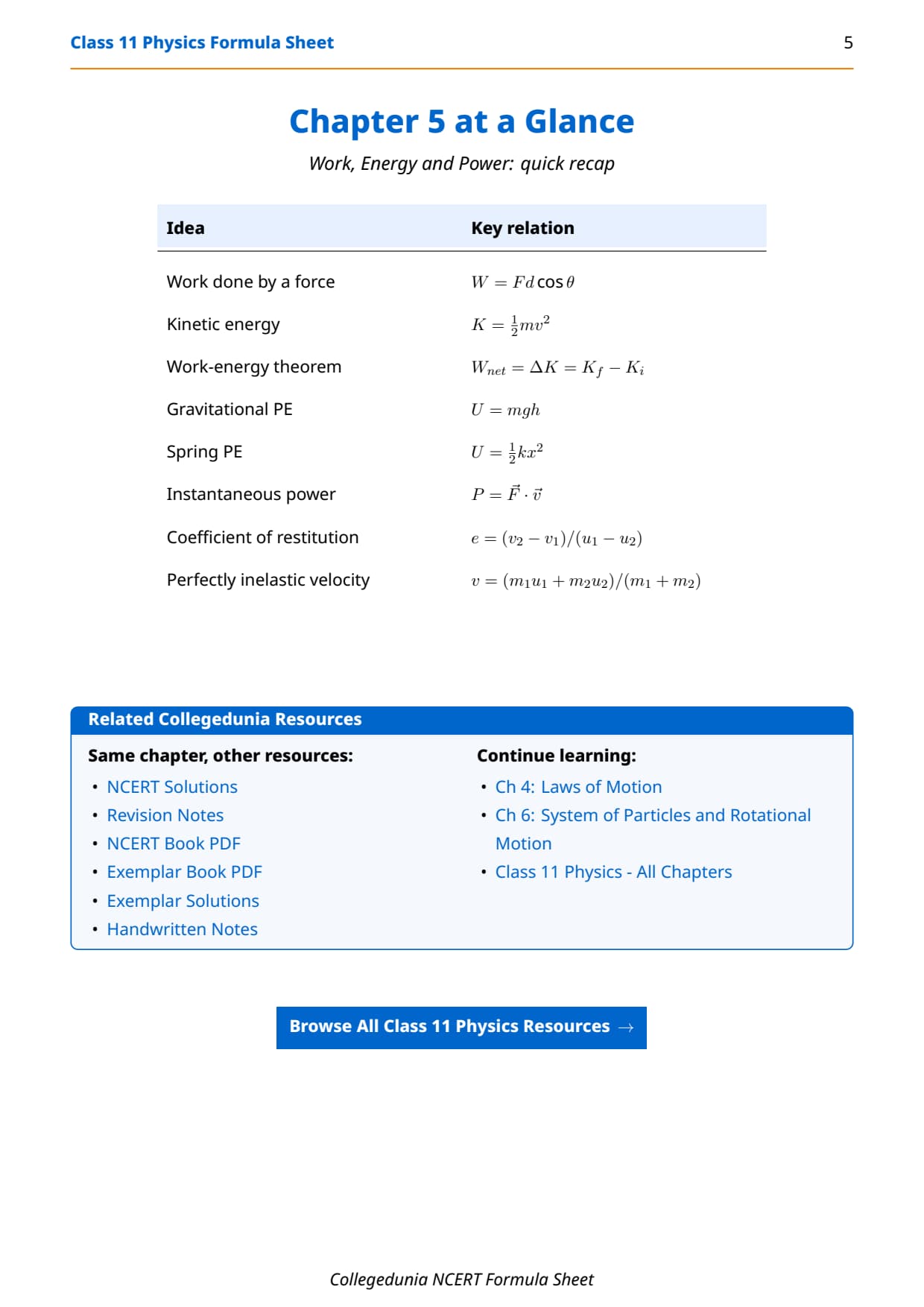
Work, Energy and Power builds directly on the Laws of Motion, and its conservation ideas return in rotation, gravitation and oscillations.
- Covers work, the work-energy theorem, kinetic and potential energy and both forms of power.
- Lists the collision formulae, coefficient of restitution and elastic and inelastic cases.
- Helps students solve numericals fast using energy conservation.
This class 11 physics formula sheet chapter 5 work energy and power is curated by subject experts and checked against the 2026-27 NCERT and recent CBSE and JEE papers.
All Work, Energy and Power Formulas at a Glance
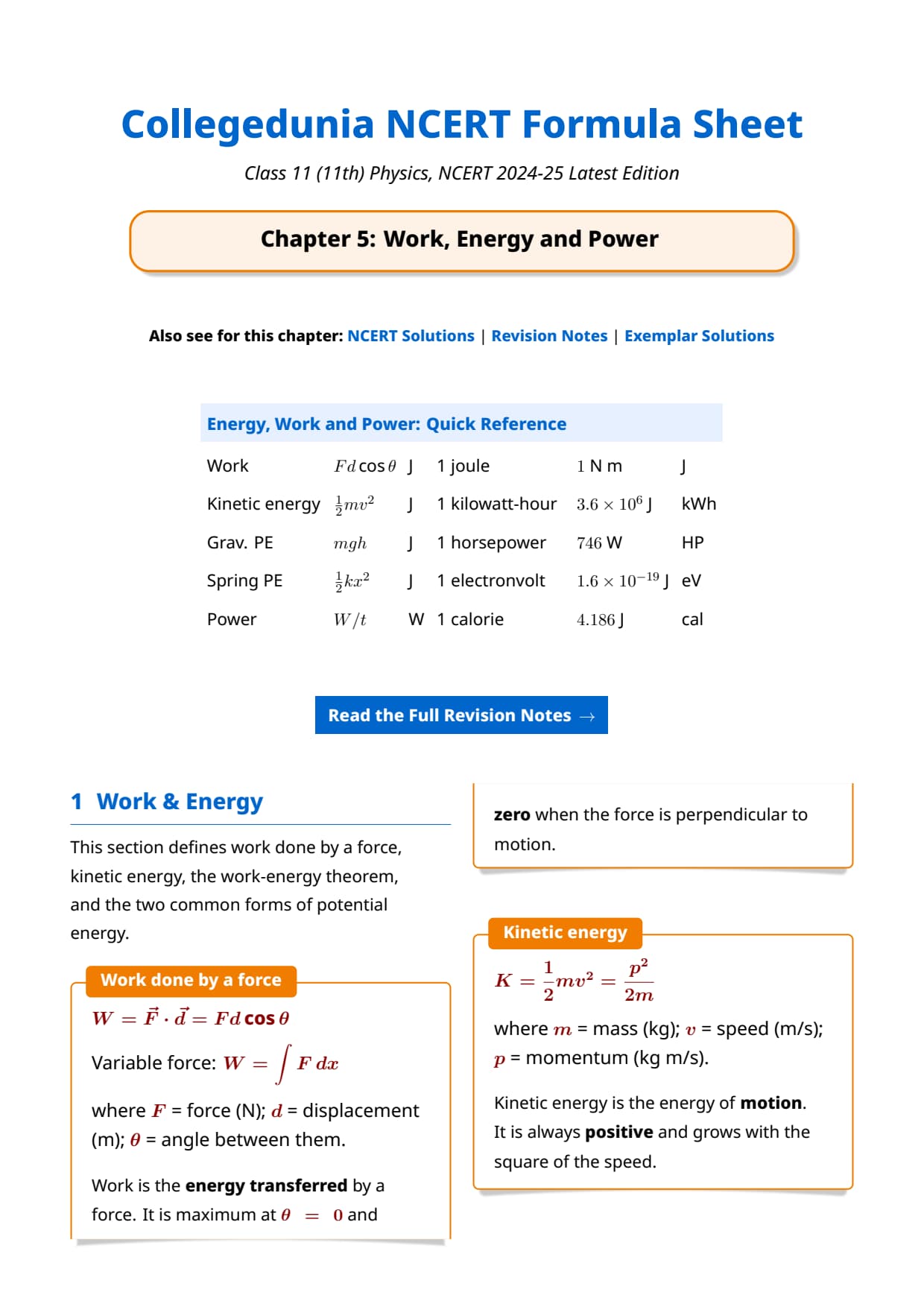
Every core formula sits in one table below, with its meaning and SI unit. Learn the work-energy theorem and conservation rows first, since most numericals use them.
| Formula | What it means | SI unit |
|---|---|---|
| W = Fs cosθ | Work by a constant force at angle θ to the displacement | joule (J) |
| W = ∫F·ds | Work by a variable force, the area under the F-s graph | joule (J) |
| K = ½mv2 | Kinetic energy of a body of mass m moving at speed v | joule (J) |
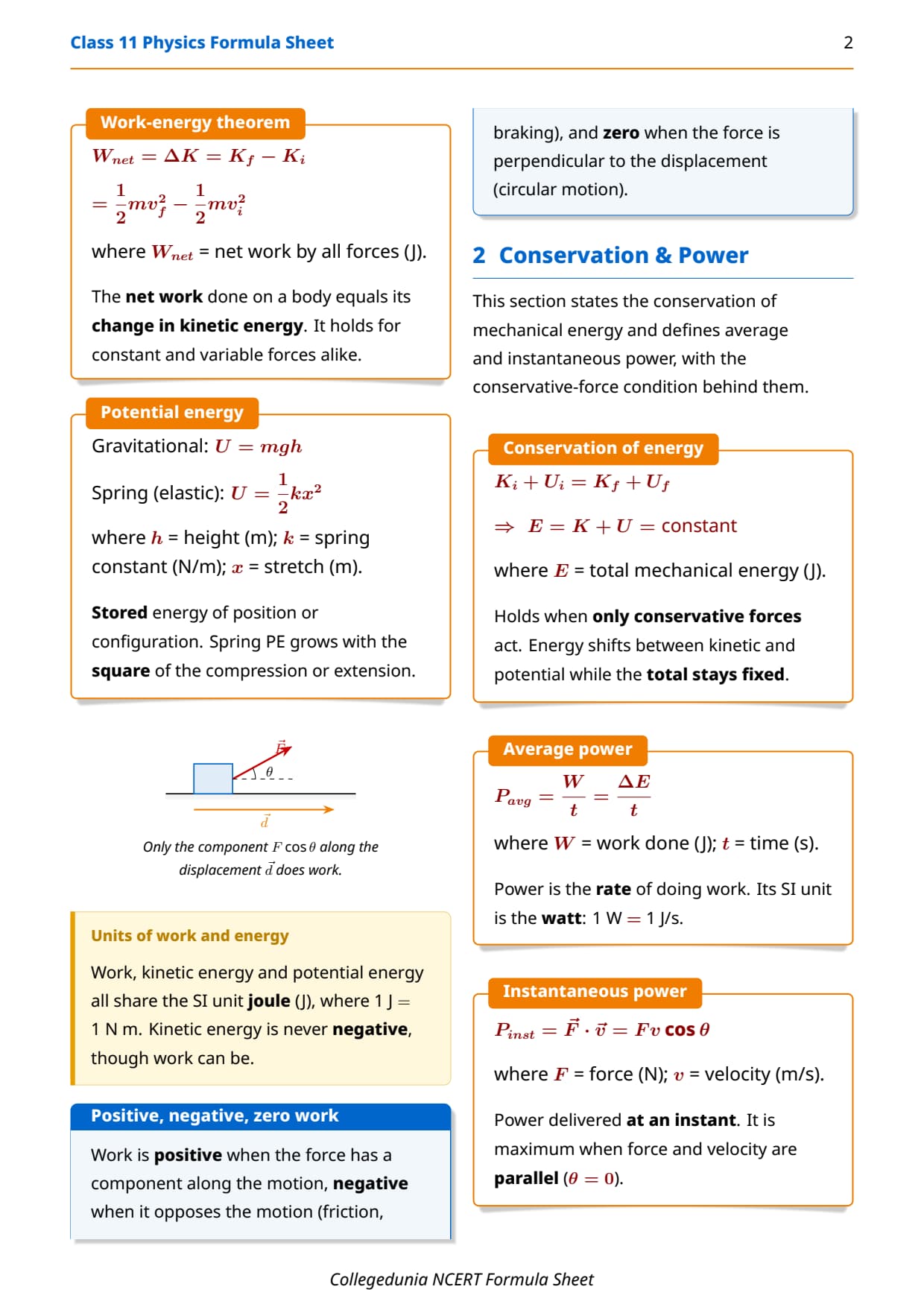
| Wnet = ΔK = ½mv2 − ½mu2 | Work-energy theorem: net work equals change in kinetic energy | joule (J) |
| U = mgh | Gravitational potential energy near the Earth's surface | joule (J) |
| U = ½kx2 | Elastic potential energy of a spring stretched by x | joule (J) |
| F = −dU/dx | Conservative force is the negative gradient of potential energy | newton (N) |
| K + U = constant | Conservation of mechanical energy when only conservative forces act | joule (J) |
| Pavg = W/t | Average power, work done per unit time | watt (W) |
| P = dW/dt = F·v = Fv cosθ | Instantaneous power as force times velocity | watt (W) |
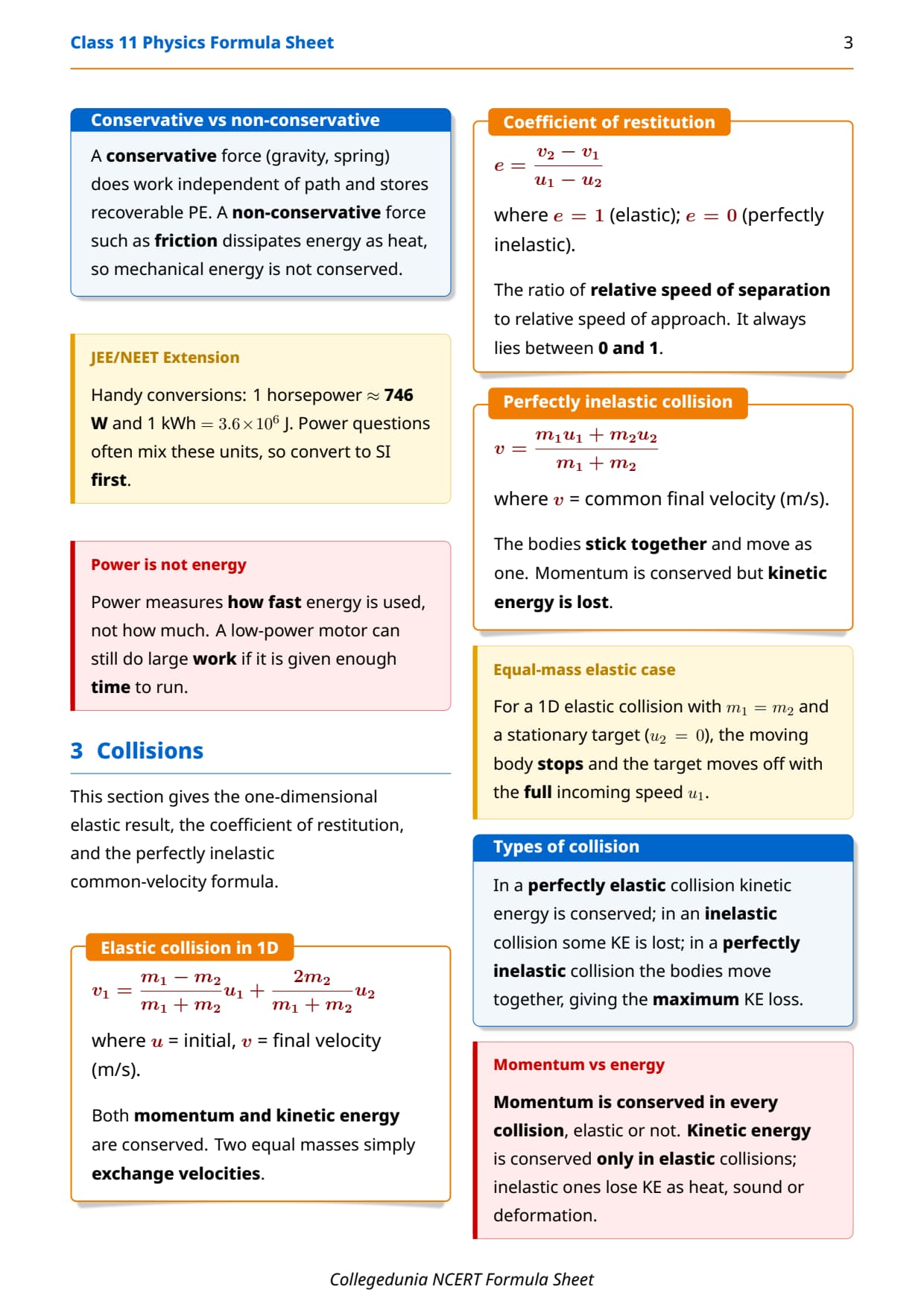
| e = (v2 − v1)/(u1 − u2) | Coefficient of restitution from relative velocities | Dimensionless |
The work-energy theorem holds for every force, but K + U stays constant only when the forces are conservative.
Collision Formulas for Work, Energy and Power
Every collision conserves momentum. Whether kinetic energy is conserved decides elastic versus inelastic.
| Case | Key relation | Notes |
|---|---|---|
| Momentum (all collisions) | m1u1 + m2u2 = m1v1 + m2v2 | Always conserved |
| Elastic (e = 1) | u1 − u2 = v2 − v1 | Kinetic energy conserved |
| Perfectly inelastic (e = 0) | v = (m1u1 + m2u2)/(m1 + m2) | Bodies move together; K lost |
The coefficient of restitution e = 1 for an elastic collision and e = 0 for a perfectly inelastic one.
Key Constants and Definitions for Work, Energy and Power
Boards and entrance papers often ask for a definition or unit. Keep these key relations ready.
- Work and energy: the joule, where 1 J = 1 N m = 1 kg m2 s-2.
- Power: the watt, where 1 W = 1 J s-1; 1 hp = 746 W.
- Commercial unit of energy: 1 kWh = 3.6 × 10⁶ J.
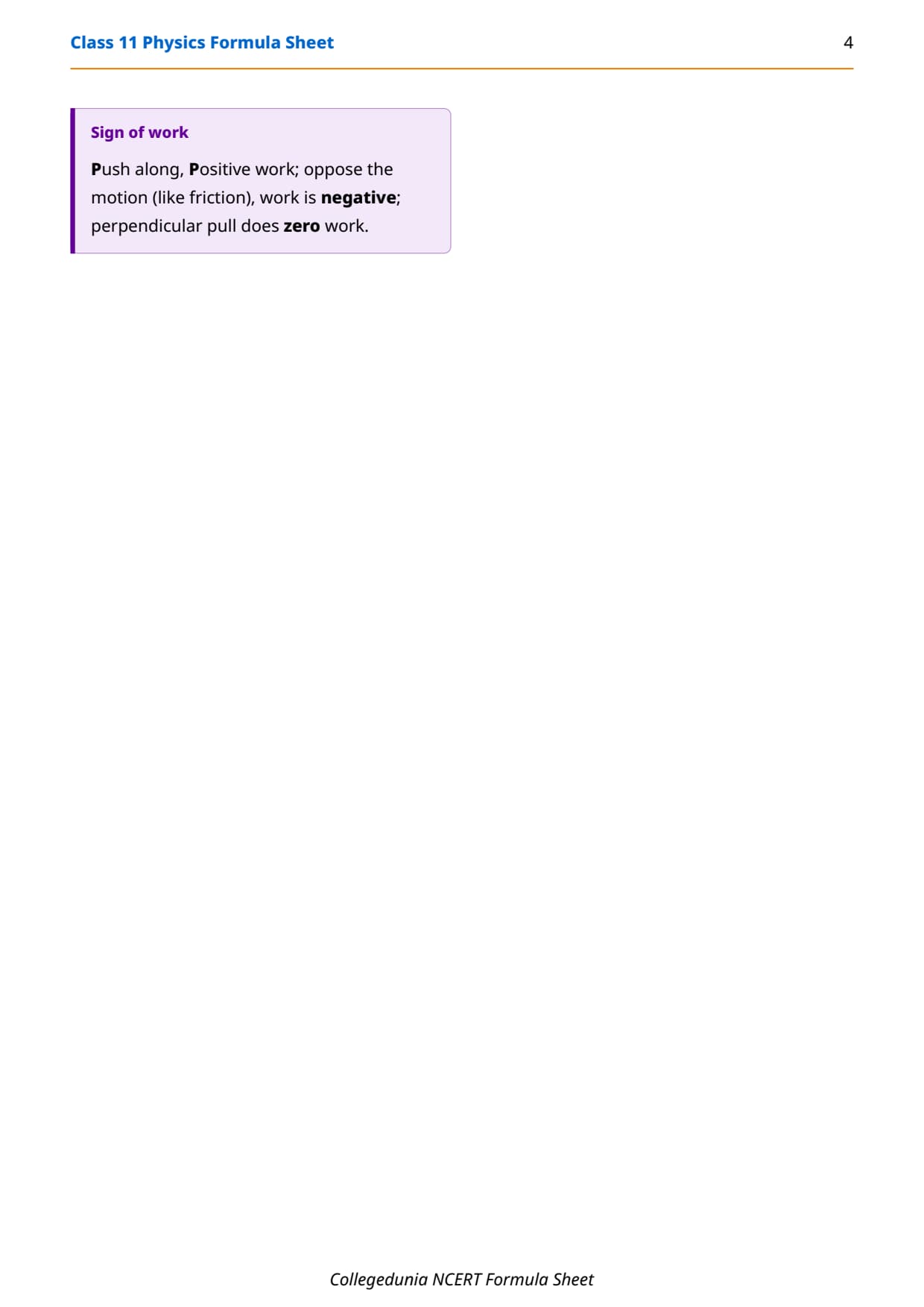
- Work sign: positive when θ < 90°, zero at 90°, negative when θ > 90°.
- Conservative force: work depends only on the end points.
How to Revise Work, Energy and Power Formulas Before the Exam
Use this class 11 physics formula sheet chapter 5 work energy and power for a fast recap the night before a test, in about 20 minutes.
- First 7 minutes: write the work formula, work-energy theorem and both kinetic and potential energy formulas.
- Next 7 minutes: write average and instantaneous power, then the spring energy formula.
- Last 6 minutes: recall the collision relations and the meaning of the coefficient of restitution.
Finish by solving one collision numerical using energy conservation.
Student Feedback on the Work, Energy and Power Formula Sheet
What 13,120 students told us about their Work, Energy and Power revision:
- 71% of students rated the collision formulae as the hardest part.
- Most-skipped step: applying the cosθ sign correctly when work is negative.
- Students who mastered energy conservation first solved numericals noticeably faster.
Source: 2026-27 Class 11 Physics student poll. Sample of 13,120 students from CBSE schools across 14 states, conducted before the 2026 boards.
Other Work, Energy and Power Class 11 Physics Resources
Pair this formula sheet with the solved answers, notes and textbook PDF.
| Resource | Link |
|---|---|
| NCERT Solutions | Work, Energy and Power Class 11 NCERT Solutions |
| Revision Notes | Work, Energy and Power Class 11 Notes |
| Handwritten Notes | Work, Energy and Power Class 11 Handwritten Notes |
| NCERT Book PDF | Work, Energy and Power Class 11 Book PDF |
NCERT Formula Sheet for Class 11 Physics: All Chapters
Jump to any other Class 11 Physics formula sheet below.
| Chapter | Formula Sheet |
|---|---|
| Chapter 1 | Units and Measurements |
| Chapter 2 | Motion in a Straight Line |
| Chapter 3 | Motion in a Plane |
| Chapter 4 | Laws of Motion |
| Chapter 5 | Work, Energy and Power |
| Chapter 6 | System of Particles and Rotational Motion |
| Chapter 7 | Gravitation |
| Chapter 8 | Mechanical Properties of Solids |
| Chapter 9 | Mechanical Properties of Fluids |
| Chapter 10 | Thermal Properties of Matter |
| Chapter 11 | Thermodynamics |
| Chapter 12 | Kinetic Theory |
| Chapter 13 | Oscillations |
| Chapter 14 | Waves |
FAQs on Work, Energy and Power Class 11 Physics Formula Sheet
Work Energy and Power Formula Sheet - Frequently Asked Questions
Ques. What formulas does the class 11 physics formula sheet chapter 5 work energy and power cover?
Ans. This class 11 physics formula sheet chapter 5 work energy and power covers work by constant and variable forces, the work-energy theorem, kinetic and potential energy, energy conservation, average and instantaneous power, and the collision relations with the coefficient of restitution.
Ques. What is the work-energy theorem?
Ans. The work-energy theorem states Wnet = ΔK = ½mv2 − ½mu2. It holds for all forces, so it gives a fast way to find speed without using acceleration.
Ques. How is instantaneous power related to velocity?
Ans. Instantaneous power is P = F·v = Fv cosθ, where θ is the angle between force and velocity. Average power is total work divided by time; both are in watts.
Ques. What is the coefficient of restitution?
Ans. The coefficient of restitution is e = (v2 − v1)/(u1 − u2). It equals 1 for a perfectly elastic collision, 0 for a perfectly inelastic collision, and lies between 0 and 1 for a real collision.



Comments