




The Class 11 Physics NCERT Solutions Chapter 6 System of Particles and Rotational Motion will help students prepare for Boards, JEE Main, JEE Advanced, NEET, CUET and NDA in 2026-27. Every back-exercise question is solved with full working, so students can check each centre-of-mass calculation, torque balance, moment-of-inertia value, and angular-momentum step one line at a time.
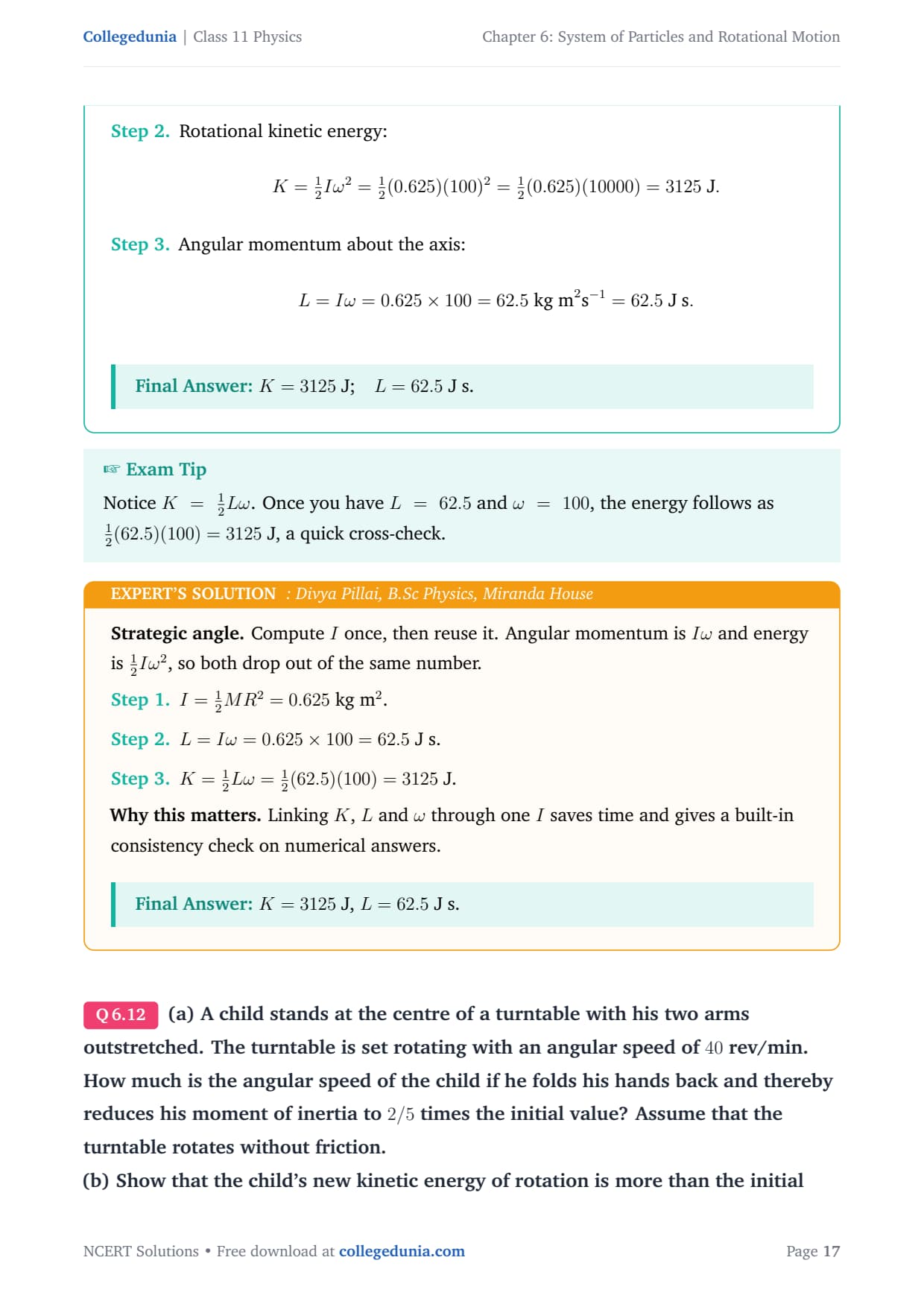
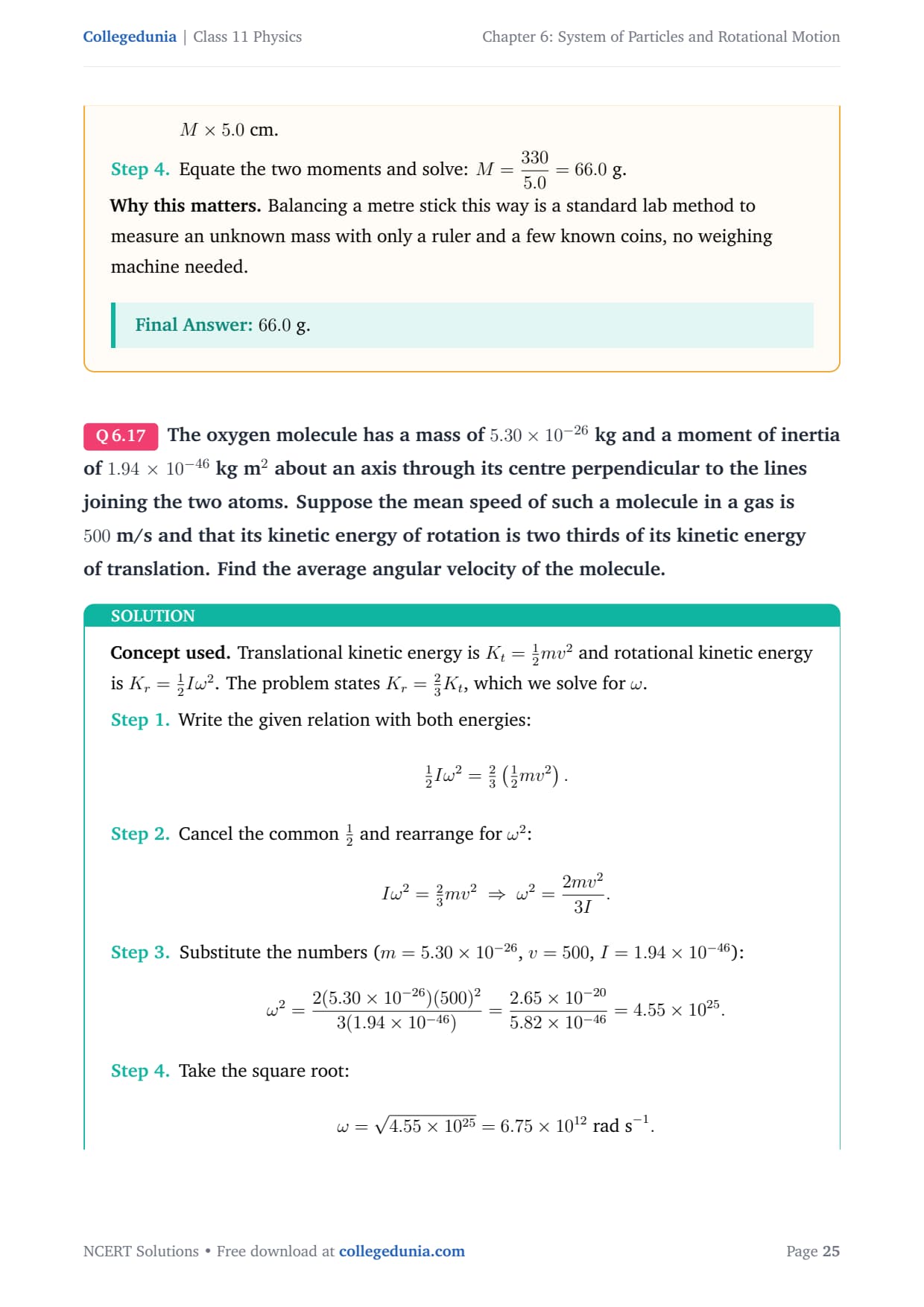
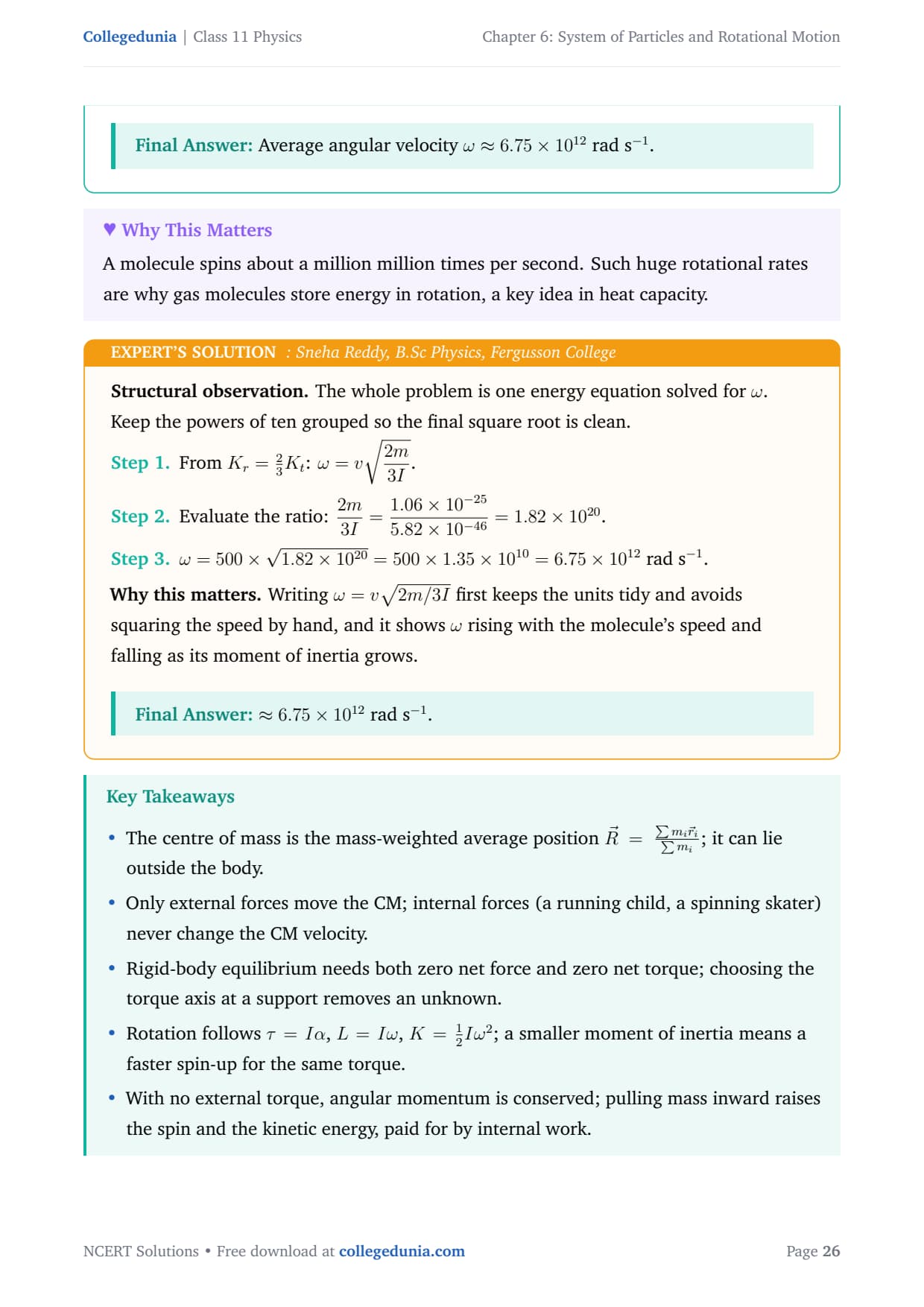
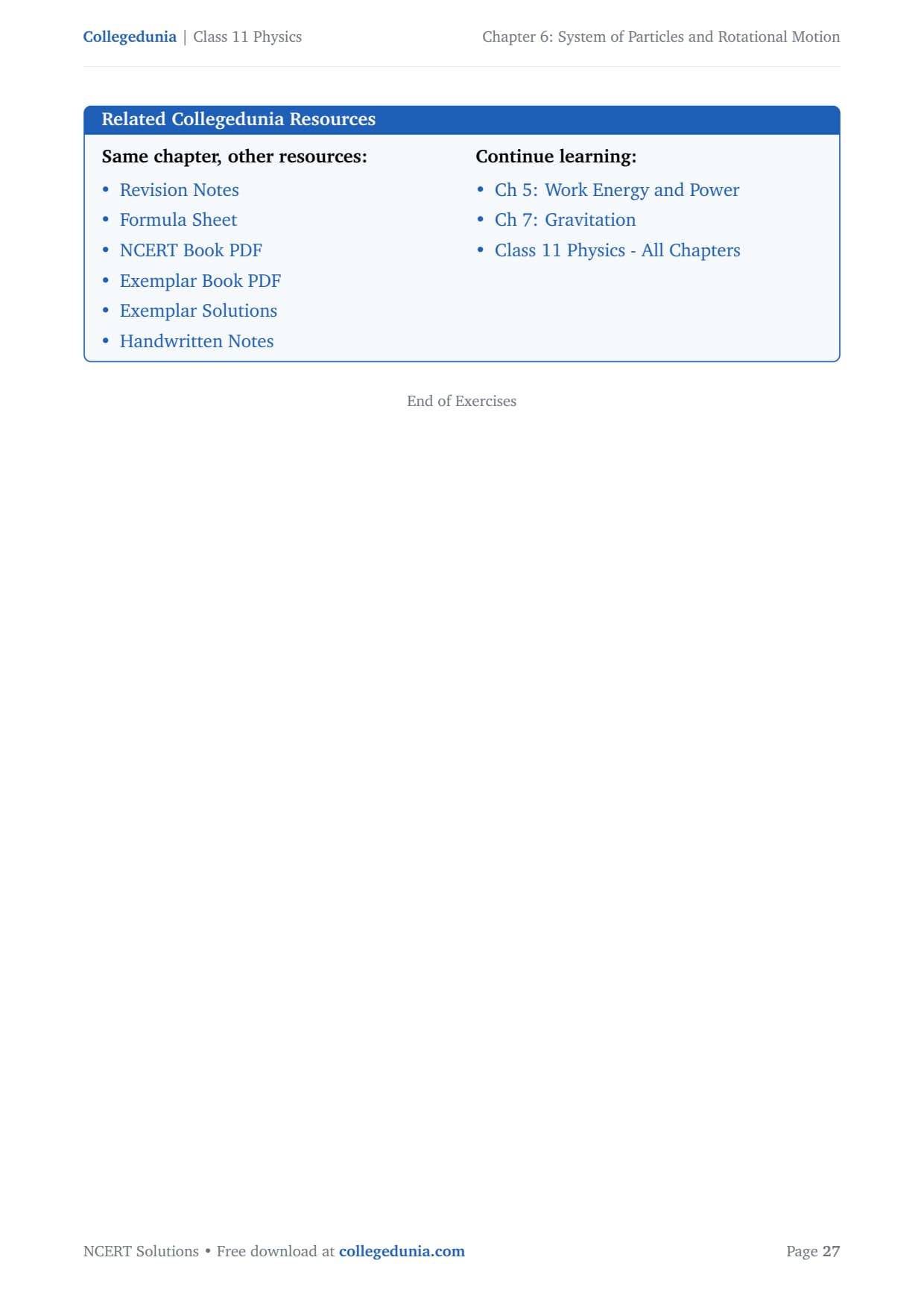
This chapter moves physics from point particles to extended bodies, and it is one of the highest-scoring mechanics chapters in the paper.
- CBSE Weightage: 6 to 8 marks, usually one numerical on moment of inertia plus one short answer on centre of mass or torque.
- Questions solved: all Exercise 6.1 onward, covering centre of mass, torque, angular momentum, moment of inertia and rolling motion.
- Key formulas: torque, angular momentum, moment of inertia of standard bodies, and the parallel and perpendicular axes theorems.
Each solution in this Class 11 Physics NCERT Solutions Chapter 6 System of Particles and Rotational Motion compilation is curated by subject experts, based on the 2026-27 NCERT textbook, and refined against the last five years of CBSE Board, JEE Main and NEET papers.
Centre of Mass and Motion of the Centre of Mass
Every extended body behaves as if its whole mass sits at one point. This point is the centre of mass. The chapter opens here because it lets students treat a large object as a single particle. The NCERT numericals ask students to find this point for a set of particles and for uniform shapes.
- System of particles: the centre of mass position is the mass-weighted average, R = (Σmi ri) / M.
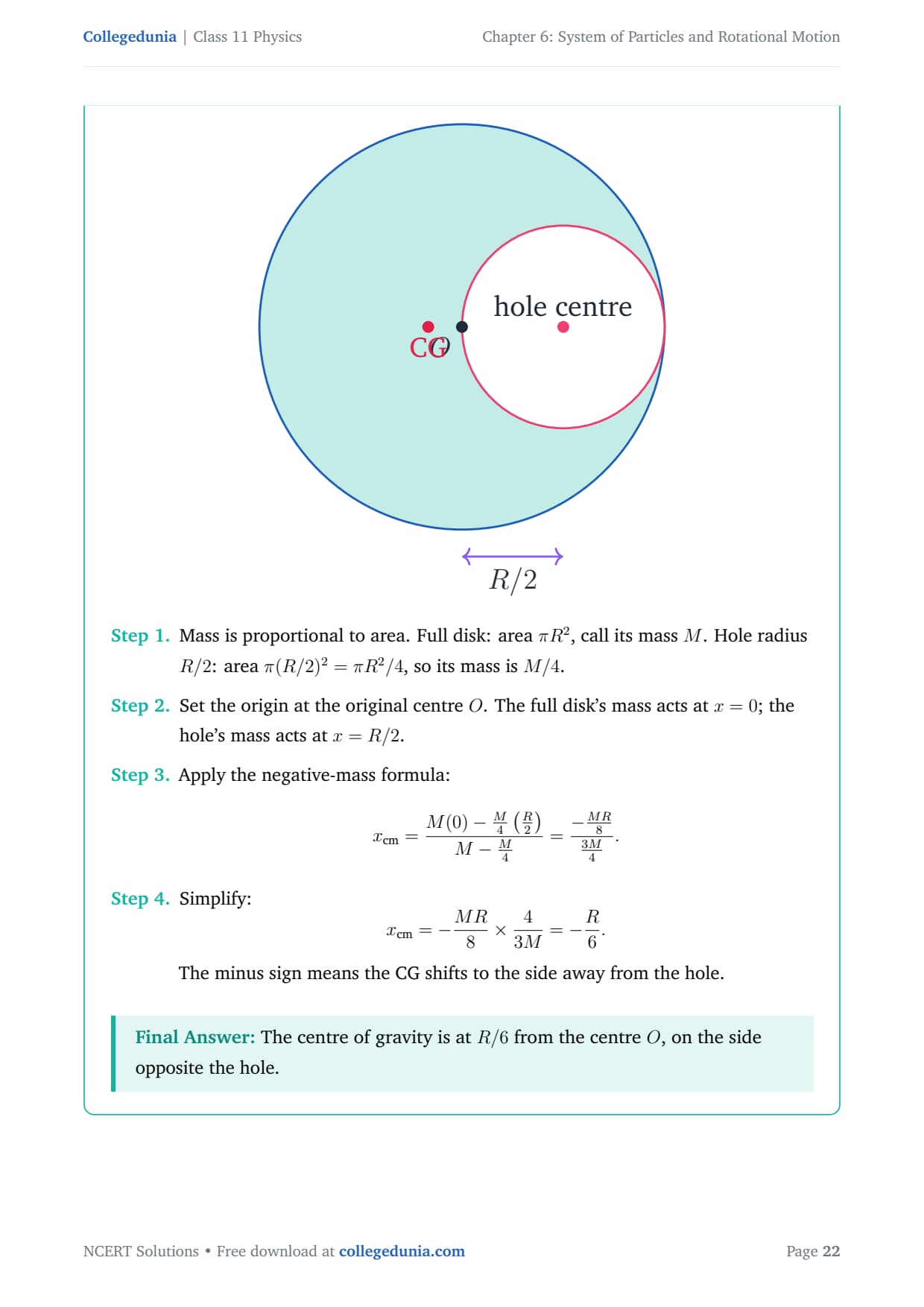
- Uniform bodies: for a ring, disc, rod or sphere, the centre of mass sits at the geometric centre.
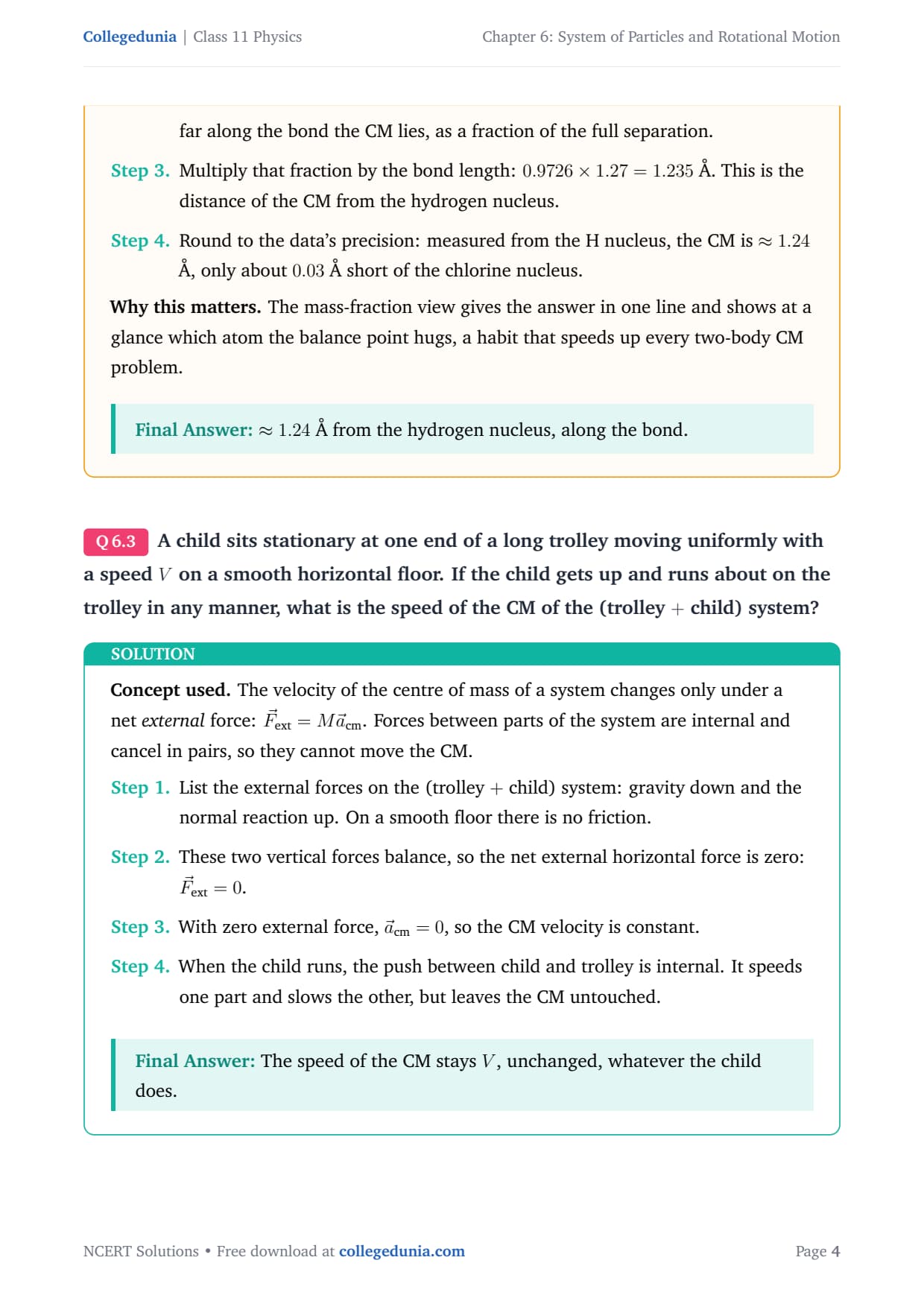
- Motion of the centre of mass: it moves as if the total external force acts on the total mass at that one point.
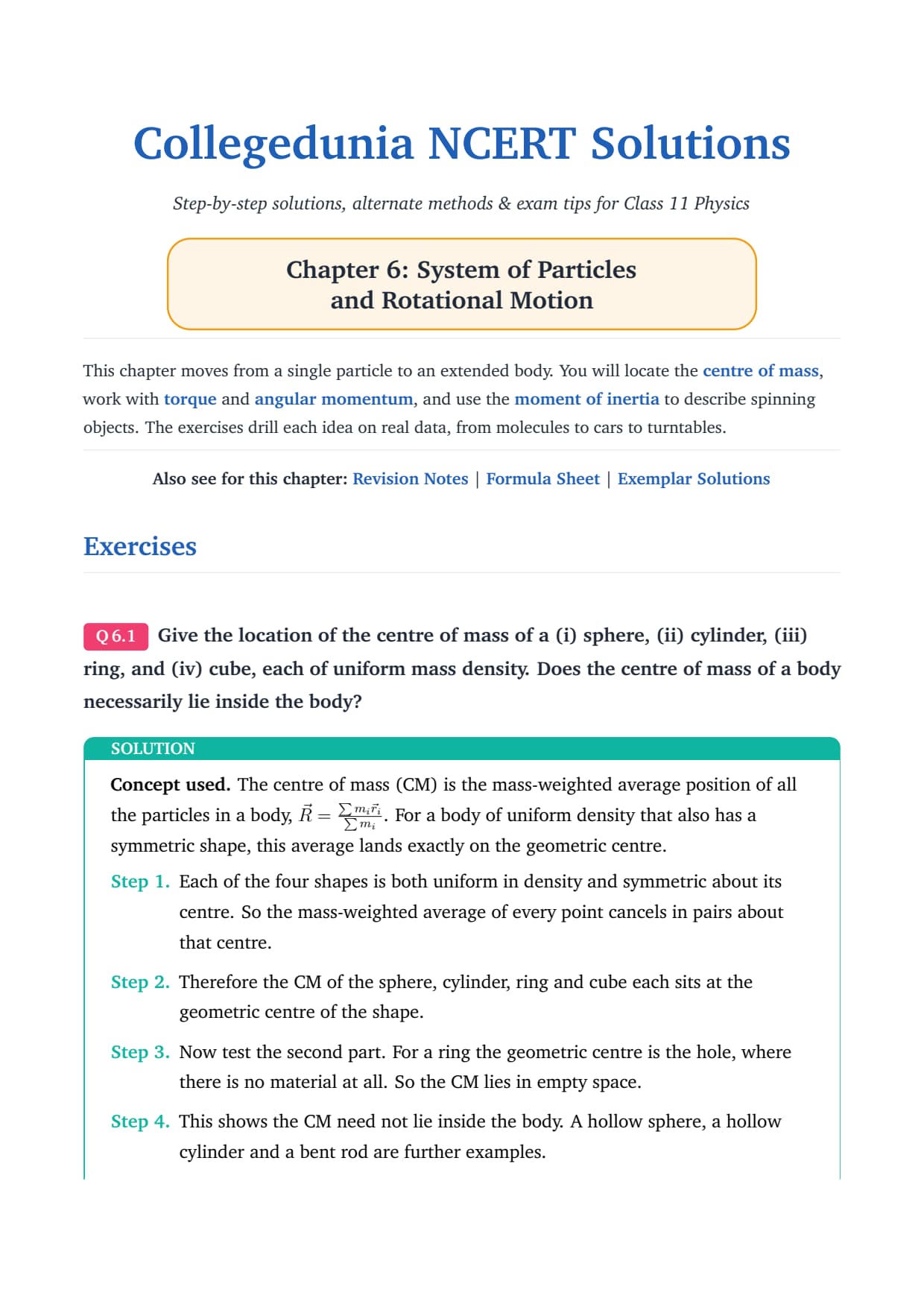
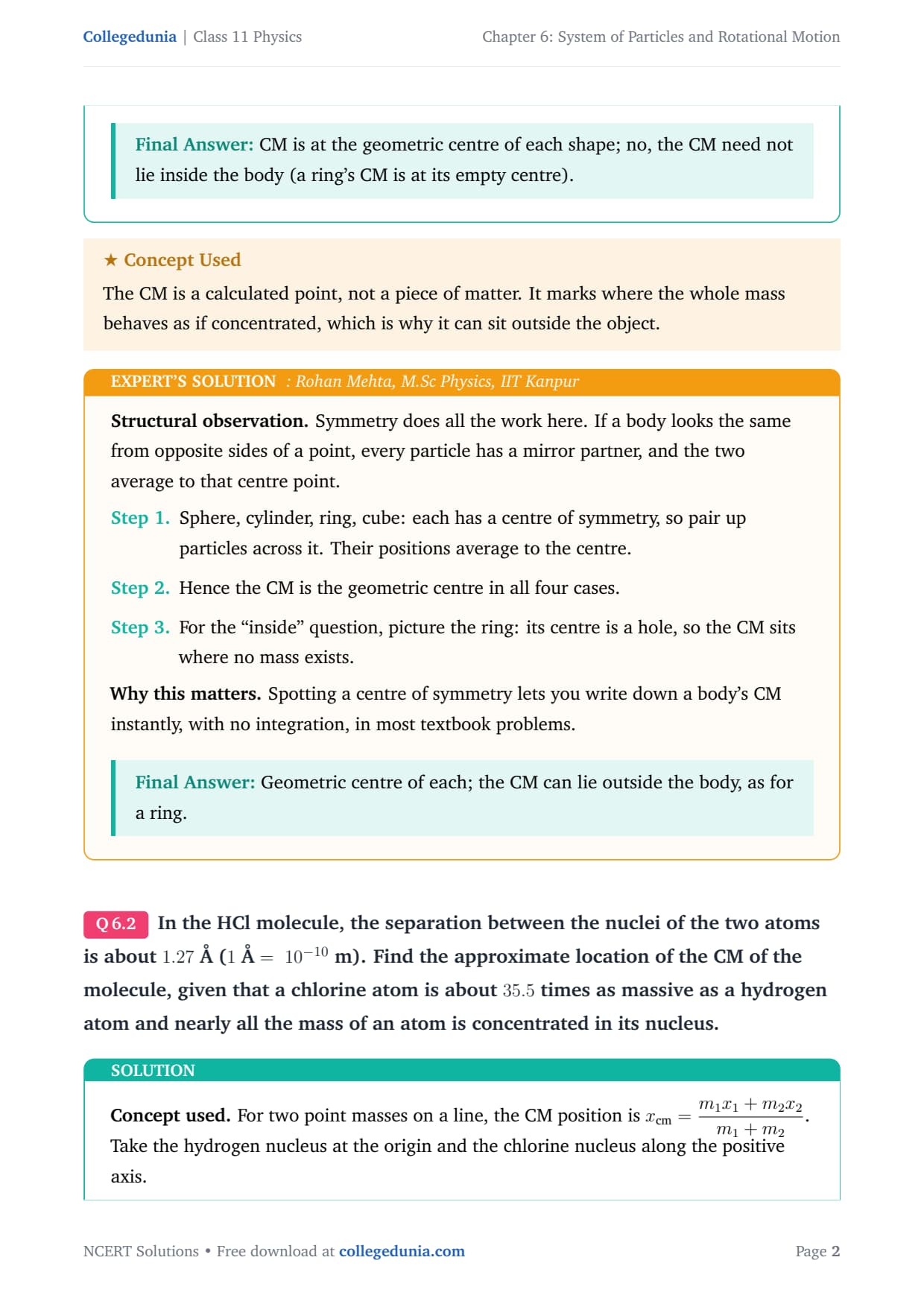
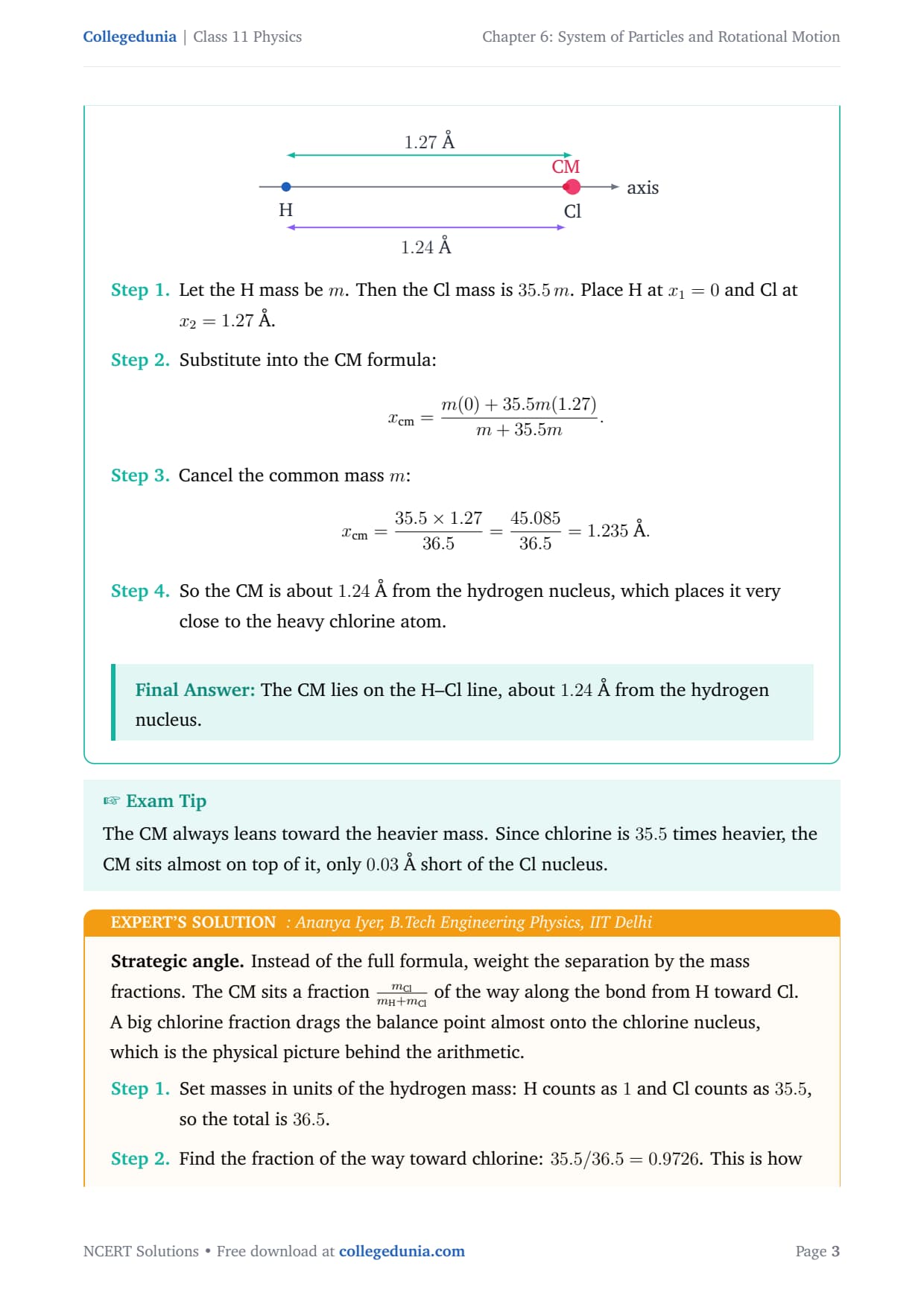
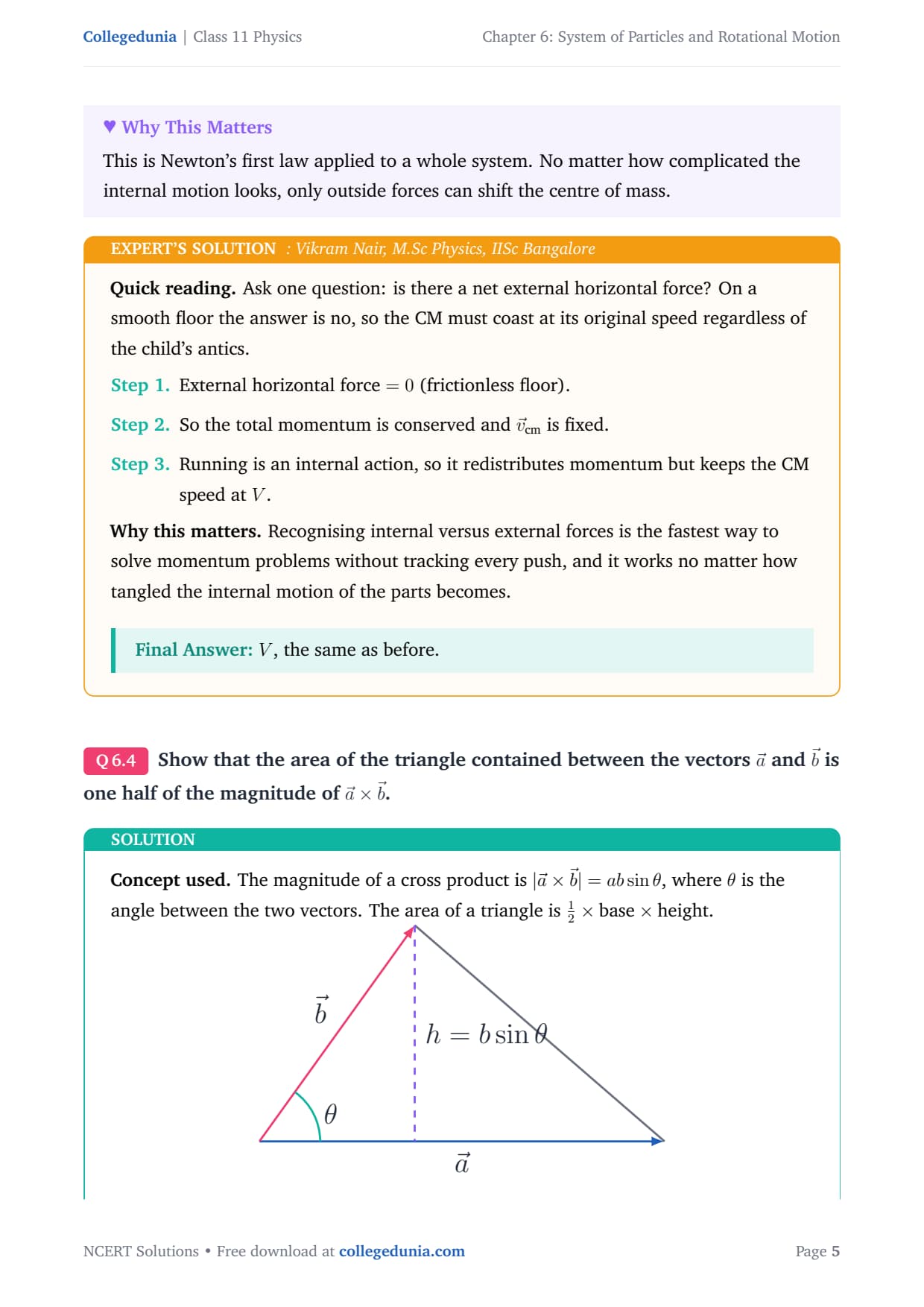
A key result the solutions use again and again is that the centre of mass moves only under an external force; internal forces cancel out. Questions such as Exercise 6.1 ask students to locate the centre of mass of common shapes. The Class 11 Physics NCERT Solutions Chapter 6 System of Particles and Rotational Motion explain the symmetry argument first, then confirm it with the formula, so no step is skipped.
Torque and Angular Momentum of a Rigid Body
To turn a body, you need a torque, not just a force. Torque is the rotational version of force, and angular momentum is the rotational version of linear momentum. These two ideas run through most of the numericals in Class 11 Physics Chapter 6 solutions, so the answers define each one in words before using it.
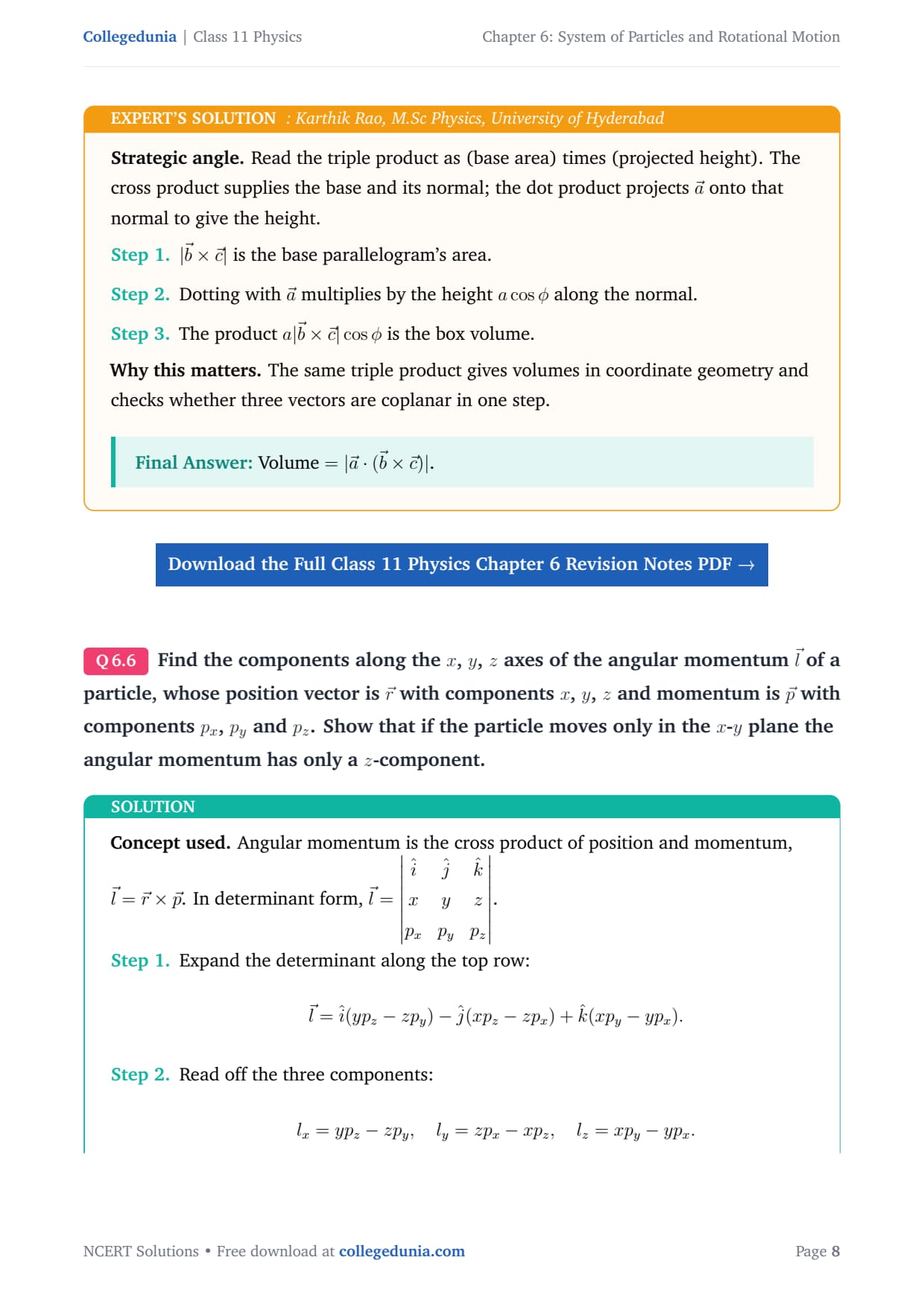
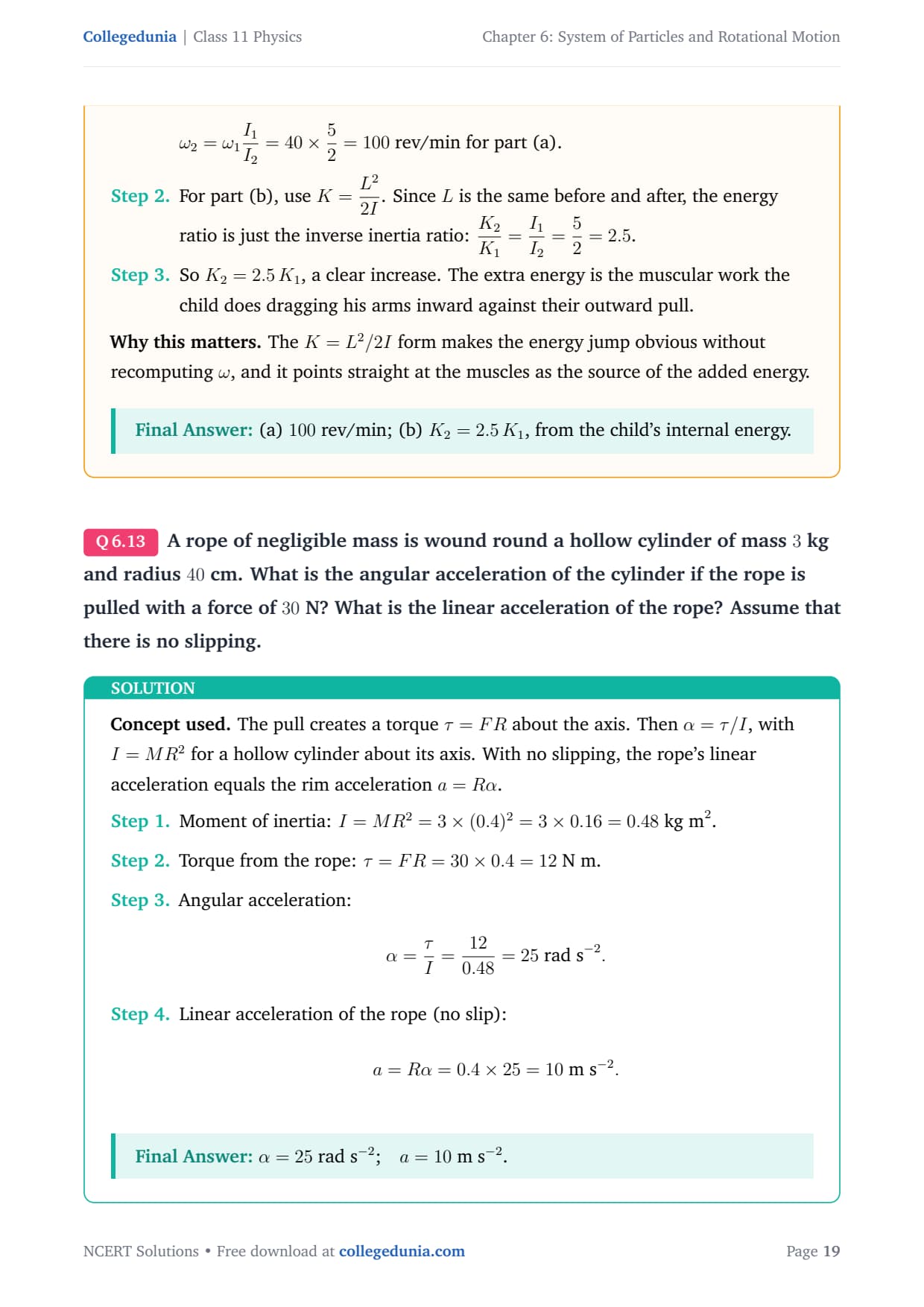
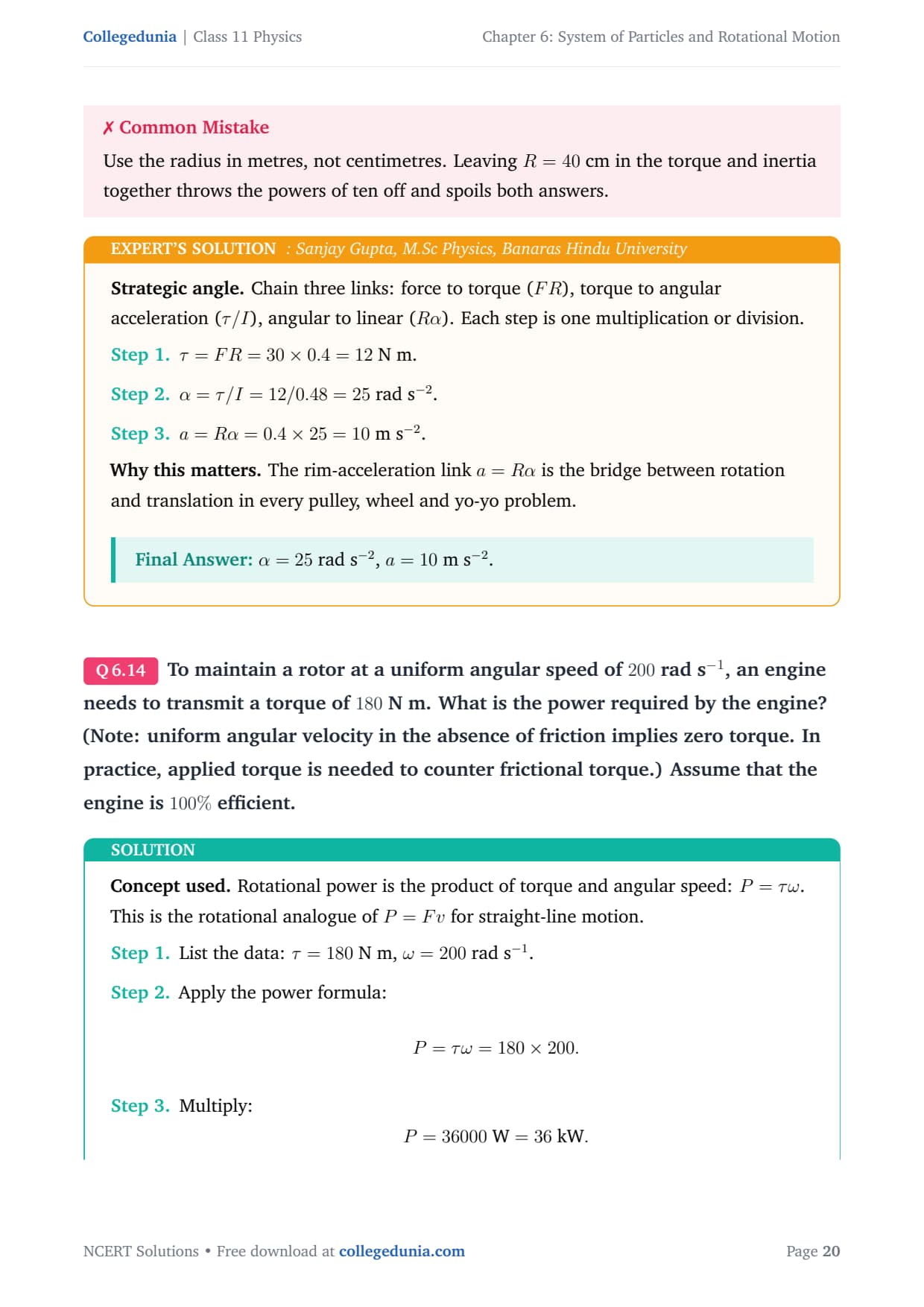
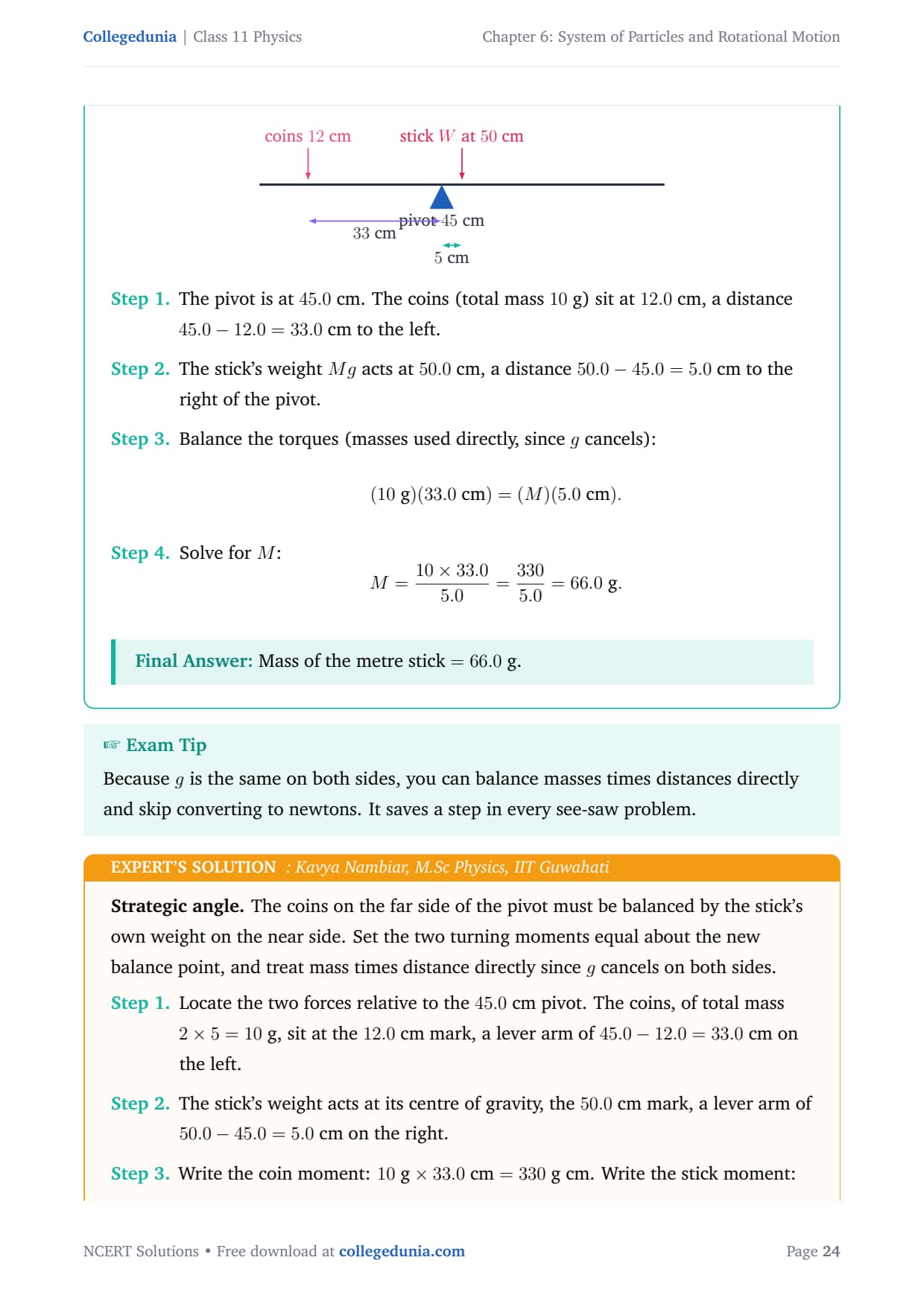
- Torque: τ = r × F, the turning effect of a force about an axis. Its size is r F sinθ.
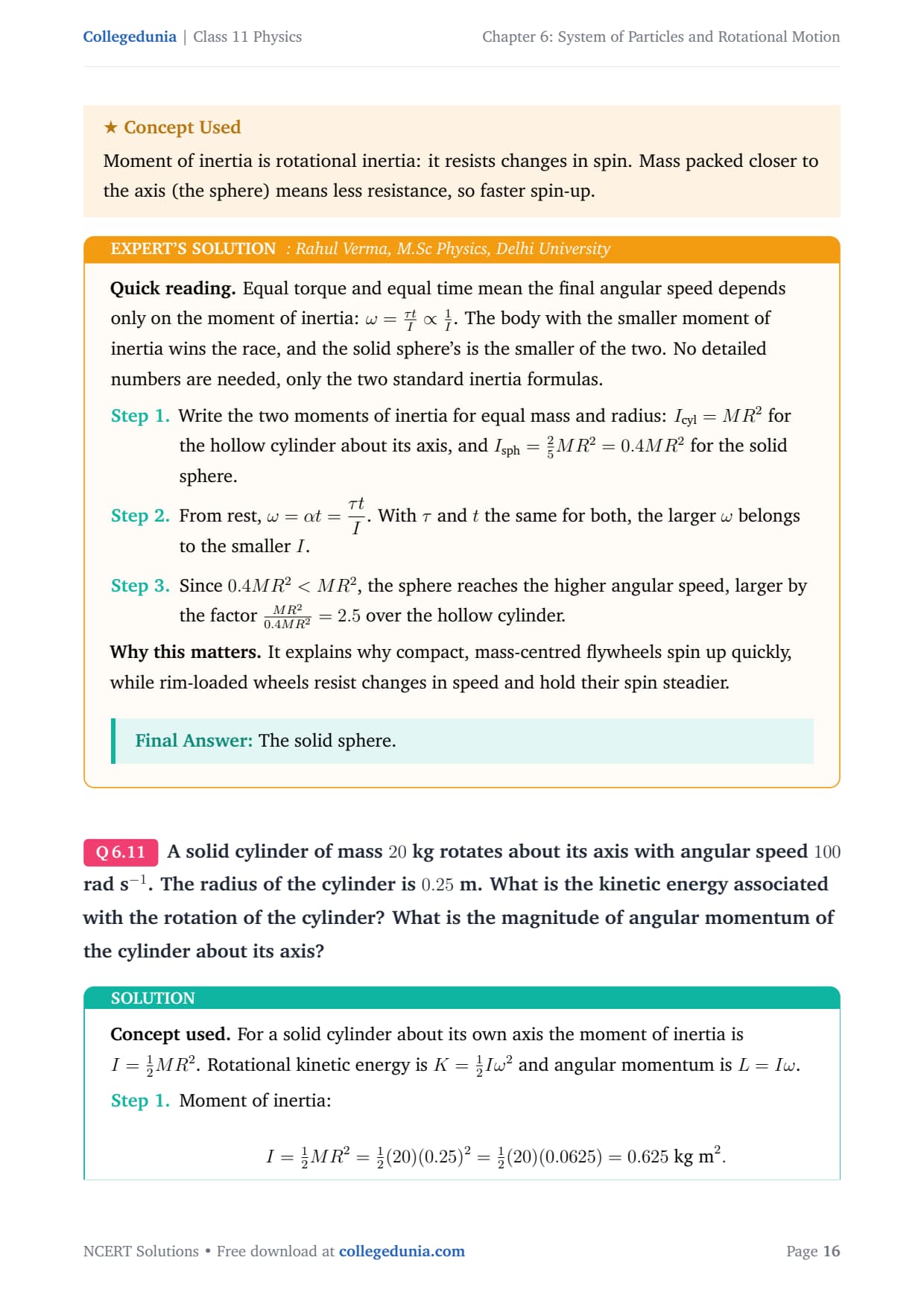
- Angular momentum: L = r × p for a particle, and L = I ω for a rigid body about a fixed axis.
- Link between them: torque equals the rate of change of angular momentum, τ = dL/dt.
The relation τ = dL/dt is the rotational form of Newton's second law. The direction of torque and angular momentum is set by the right-hand rule, and the solutions state this direction on its own line so students do not lose the sign. Numericals here often give a force and a position vector and ask for the torque about the origin.
Conservation of Angular Momentum in Rotational Motion
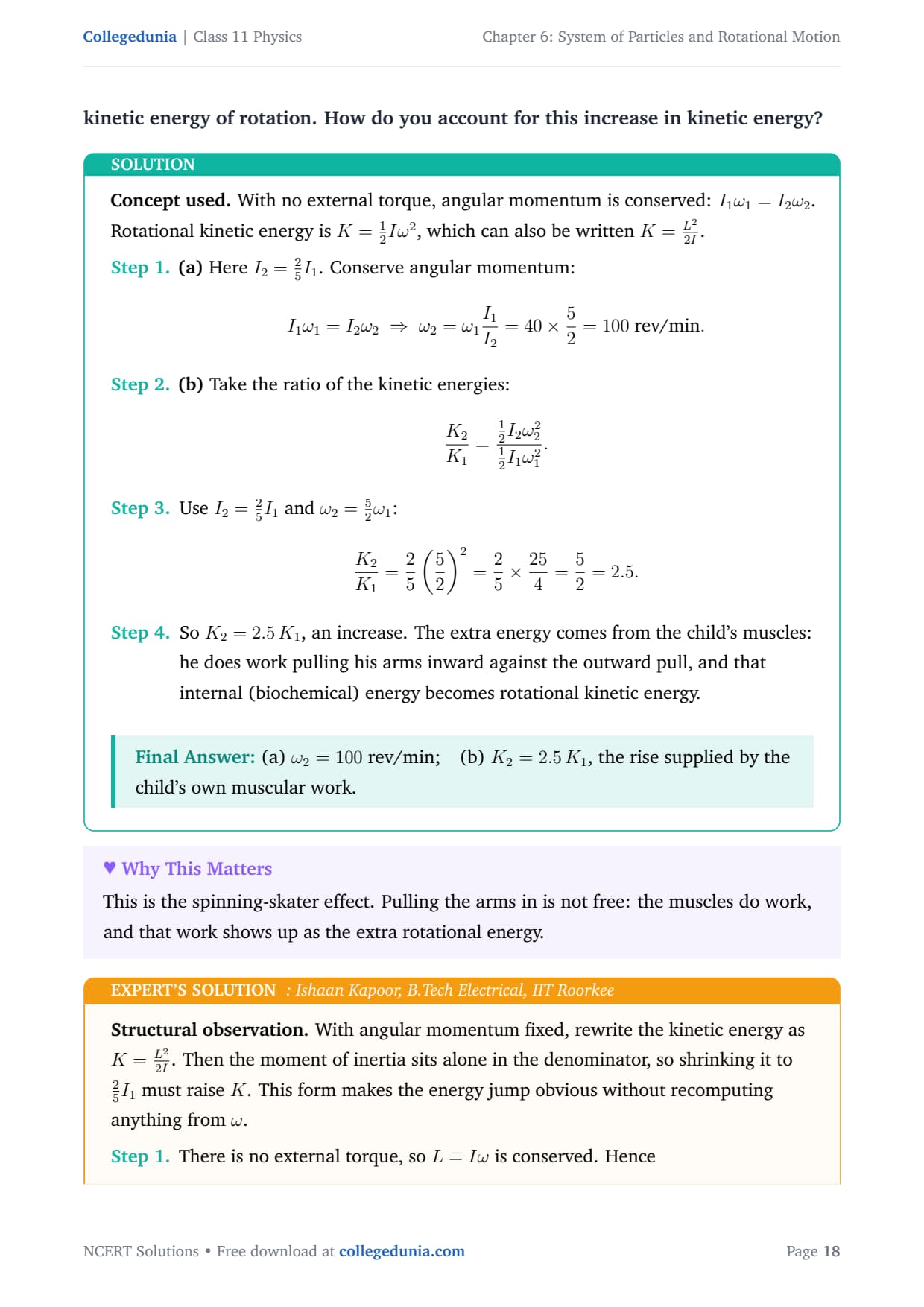
When the net external torque on a body is zero, its angular momentum stays constant. This is the conservation of angular momentum, and it explains many real effects, from a spinning skater to a diver curling up. The NCERT solutions apply it to problems where the moment of inertia changes while the body spins.
| Situation | What stays constant | Result |
|---|---|---|
| Skater pulls arms in | L = I ω | Moment of inertia falls, so angular speed rises |
| Diver tucks the body | L = I ω | Spin rate increases in mid-air |
| No external torque | I1 ω1 = I2 ω2 | Product of inertia and angular speed is fixed |
The exam favourite here is the equation I1 ω1 = I2 ω2. If the moment of inertia halves, the angular speed doubles, because their product cannot change. The solutions show this step clearly so students can reproduce it in the exam without guessing which quantity rises.
Moment of Inertia and Radius of Gyration
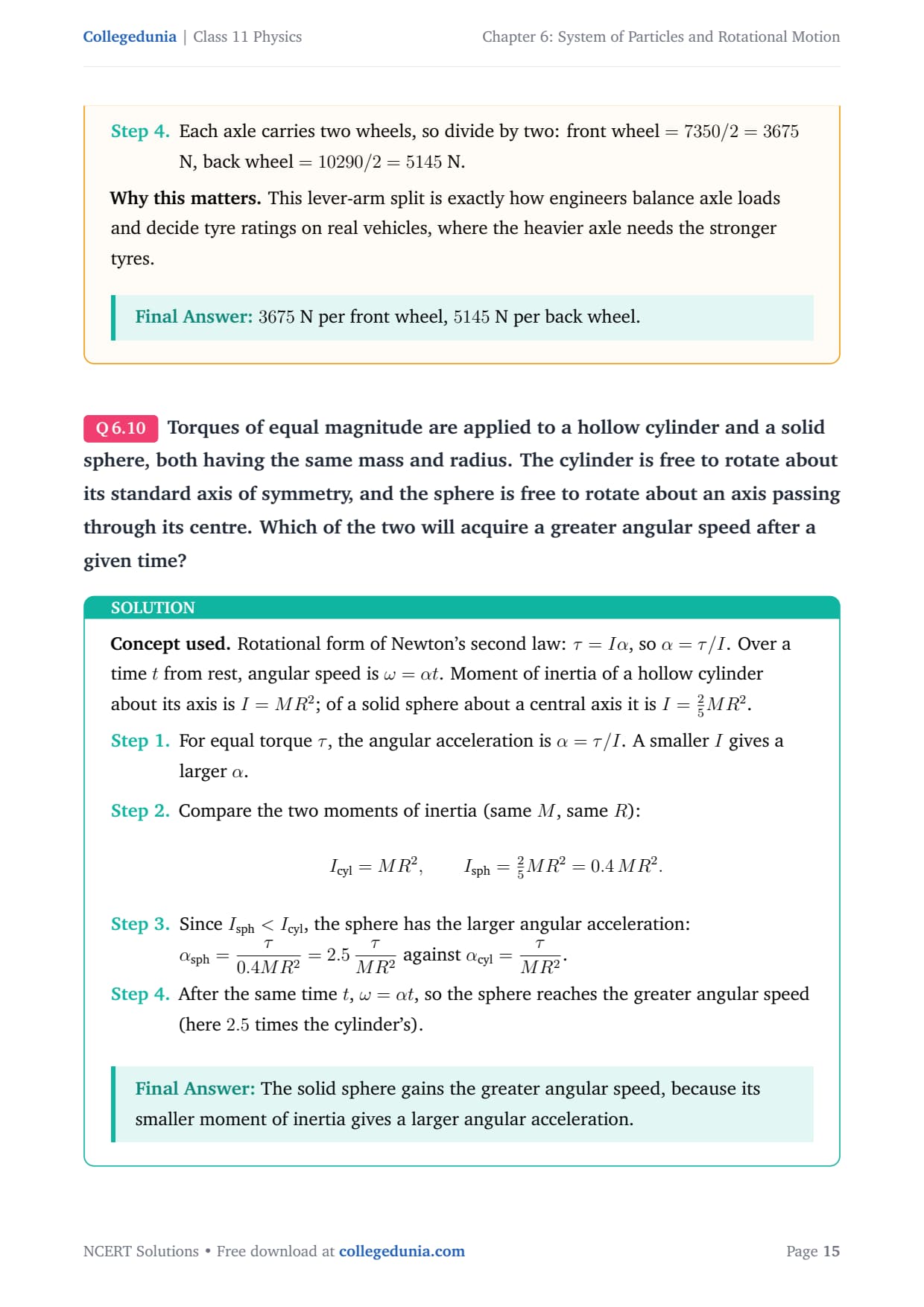
The moment of inertia measures how hard it is to change a body's rotation. It plays the same role in rotation that mass plays in straight-line motion. Its value depends on both the mass and how that mass is spread about the axis. The radius of gyration is a neat way to state this spread as a single distance.
| Body (axis) | Moment of inertia |
|---|---|
| Thin rod (through centre, perpendicular) | M L2 / 12 |
| Ring (through centre, perpendicular) | M R2 |
| Disc (through centre, perpendicular) | M R2 / 2 |
| Solid sphere (through centre) | 2 M R2 / 5 |
The radius of gyration k is defined by I = M k2, so it is the distance from the axis at which the whole mass could sit to give the same moment of inertia. Numericals like Exercise 6.7 give the mass and shape and ask for the moment of inertia or the radius of gyration. The Class 11 Physics NCERT Solutions Chapter 6 System of Particles and Rotational Motion quote the standard formula, then substitute numbers on a separate line.
Theorems of Parallel and Perpendicular Axes
Standard formulas give the moment of inertia about an axis through the centre. To shift to any other axis, the chapter gives two theorems. These two results save huge effort in the exam, and almost every moment-of-inertia numerical uses at least one of them.
- Parallel axes theorem: I = Icm + M d2, where d is the distance between the two parallel axes.
- Perpendicular axes theorem: for a flat body, Iz = Ix + Iy, where z is perpendicular to the plane.
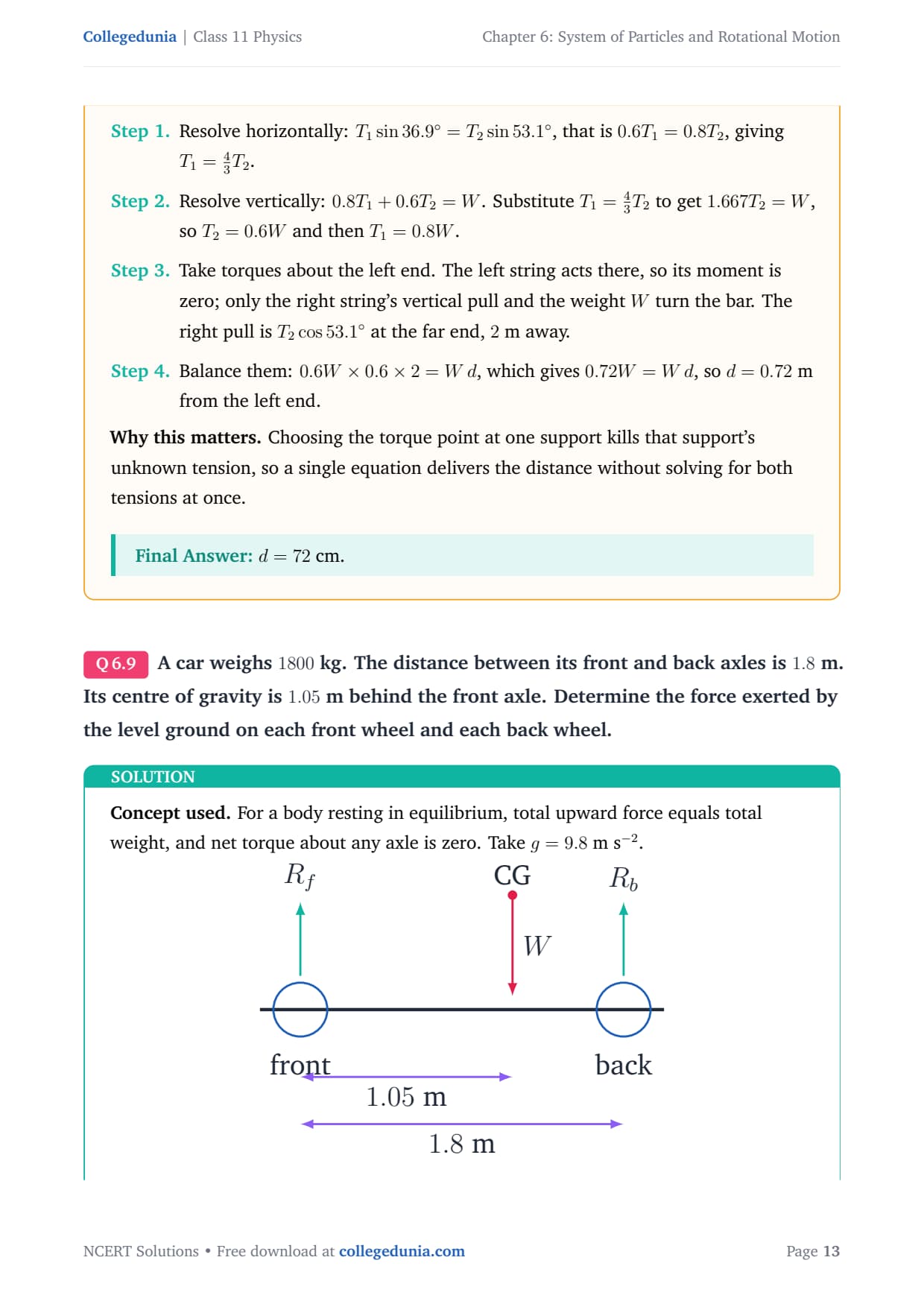
The perpendicular axes theorem works for planar bodies only, such as a ring or a disc, while the parallel axes theorem works for any body. Always add the term M d2 when moving away from the centre of mass, never subtract it. Questions such as Exercise 6.9 ask students to combine both theorems, and the NCERT Solutions for Class 11 Physics Chapter 6 System of Particles and Rotational Motion show which theorem to apply at each step.
Rolling Motion and Equilibrium of a Rigid Body
Rolling motion joins straight-line motion and rotation in one problem, so it is the natural end of the chapter. A rolling body both moves forward and spins, and the two motions are linked by the contact condition. The chapter also sets the rules for a body that is not moving at all, called equilibrium.
- Rolling without slipping: the contact point is momentarily at rest, so v = R ω links speed and spin.
- Total kinetic energy: a rolling body has both translational and rotational energy, ½M v2 + ½I ω2.
- Equilibrium of a rigid body: needs both zero net force and zero net torque, so the body neither moves nor turns.
For equilibrium, both conditions must hold together. A body can have zero net force yet still rotate, so the torque condition is separate and must be checked on its own. The rolling numericals compare a ring, disc and sphere down the same incline, and the solutions explain why the sphere reaches the bottom first. This ranking is a favourite in JEE Main and NEET objective papers.
Exercise-wise Breakdown for Class 11 Physics Chapter 6 System of Particles and Rotational Motion
The NCERT back-exercise splits into clear groups. Use this map to plan which answers to practise first for the 2026-27 boards. Every group links to the full solved set.
| Question group | Exercises | What it covers |
|---|---|---|
| Centre of mass | Exercise 6.1 to Exercise 6.4 | Centre of mass of shapes and particle systems, motion of the centre of mass |
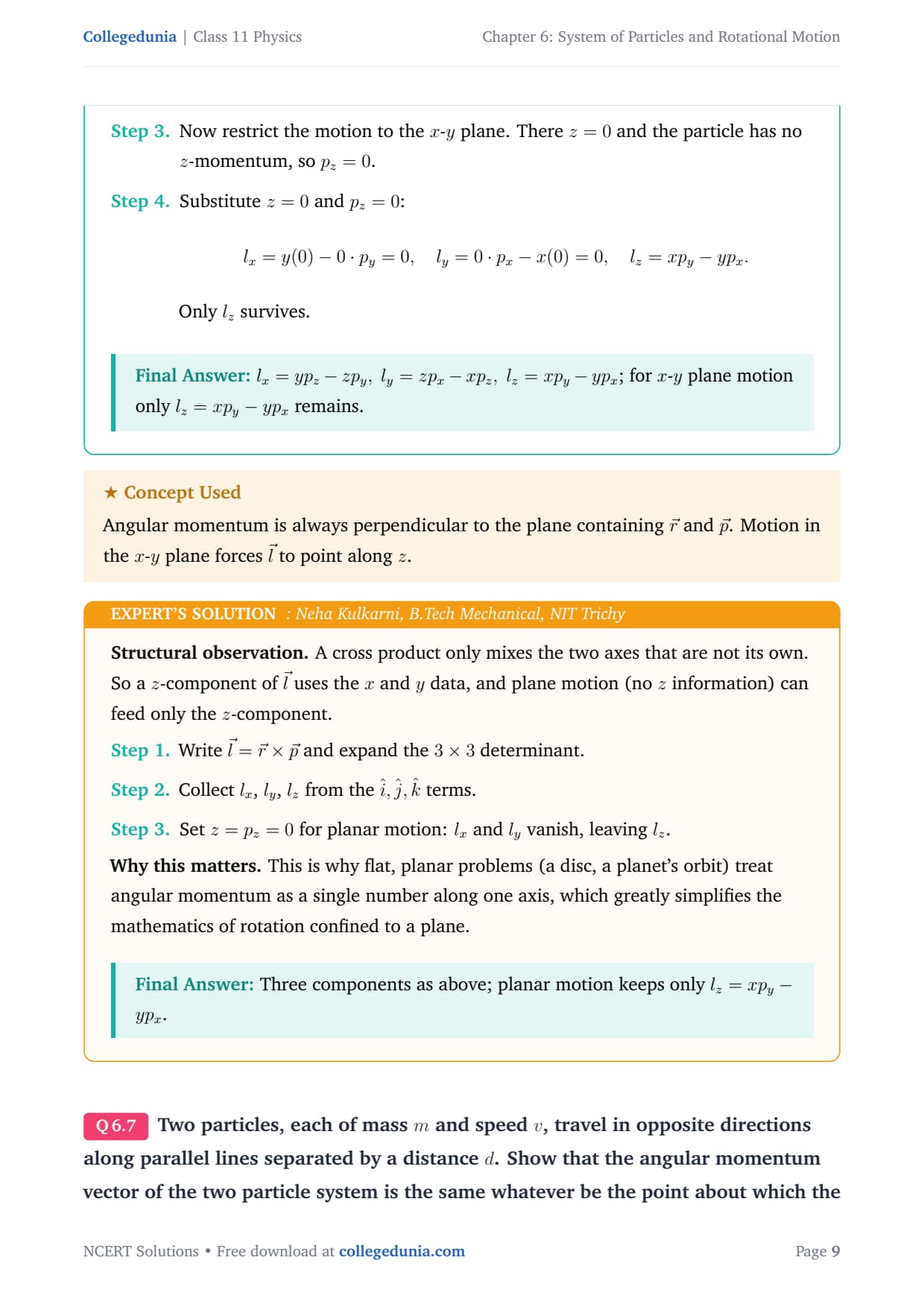
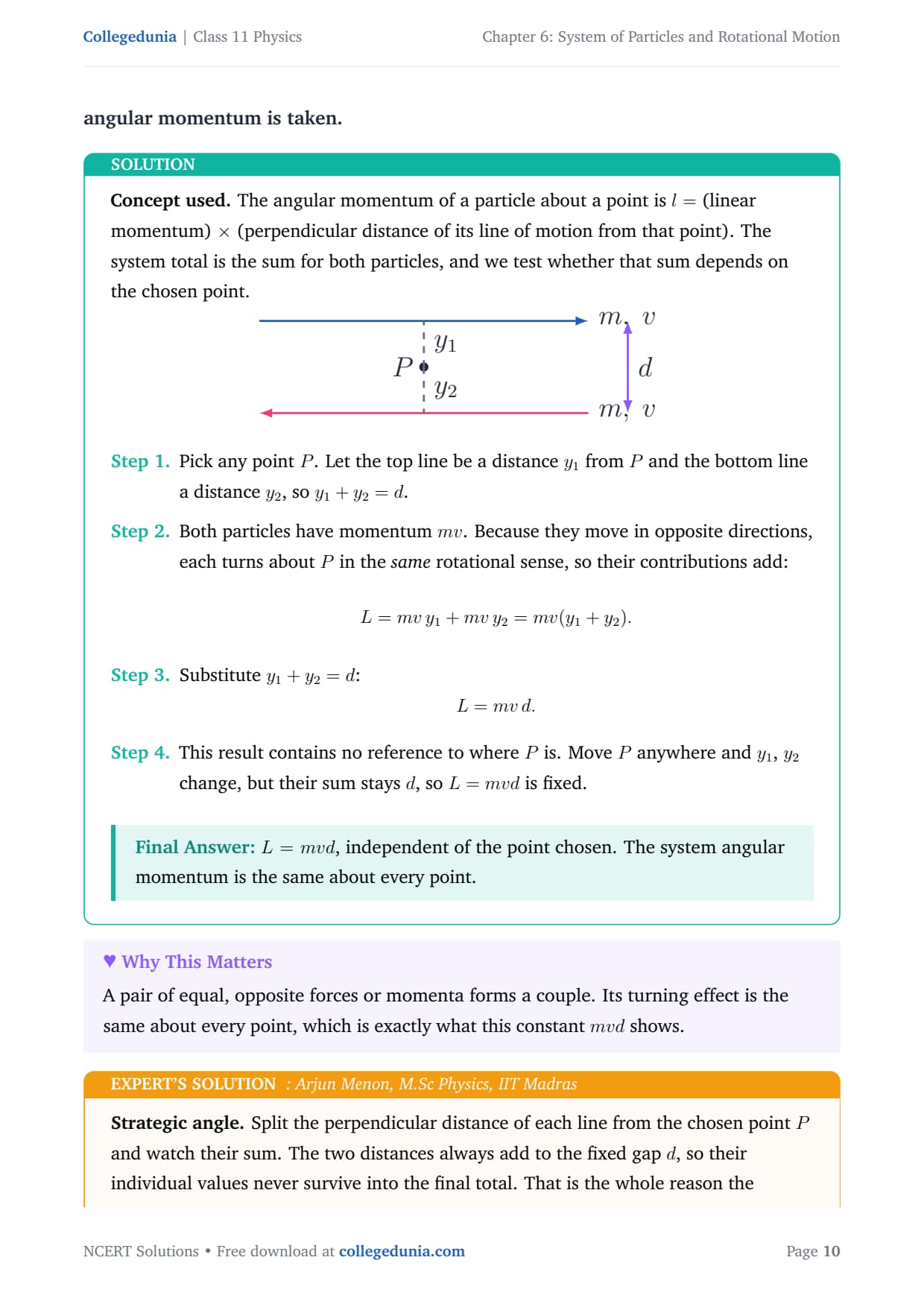
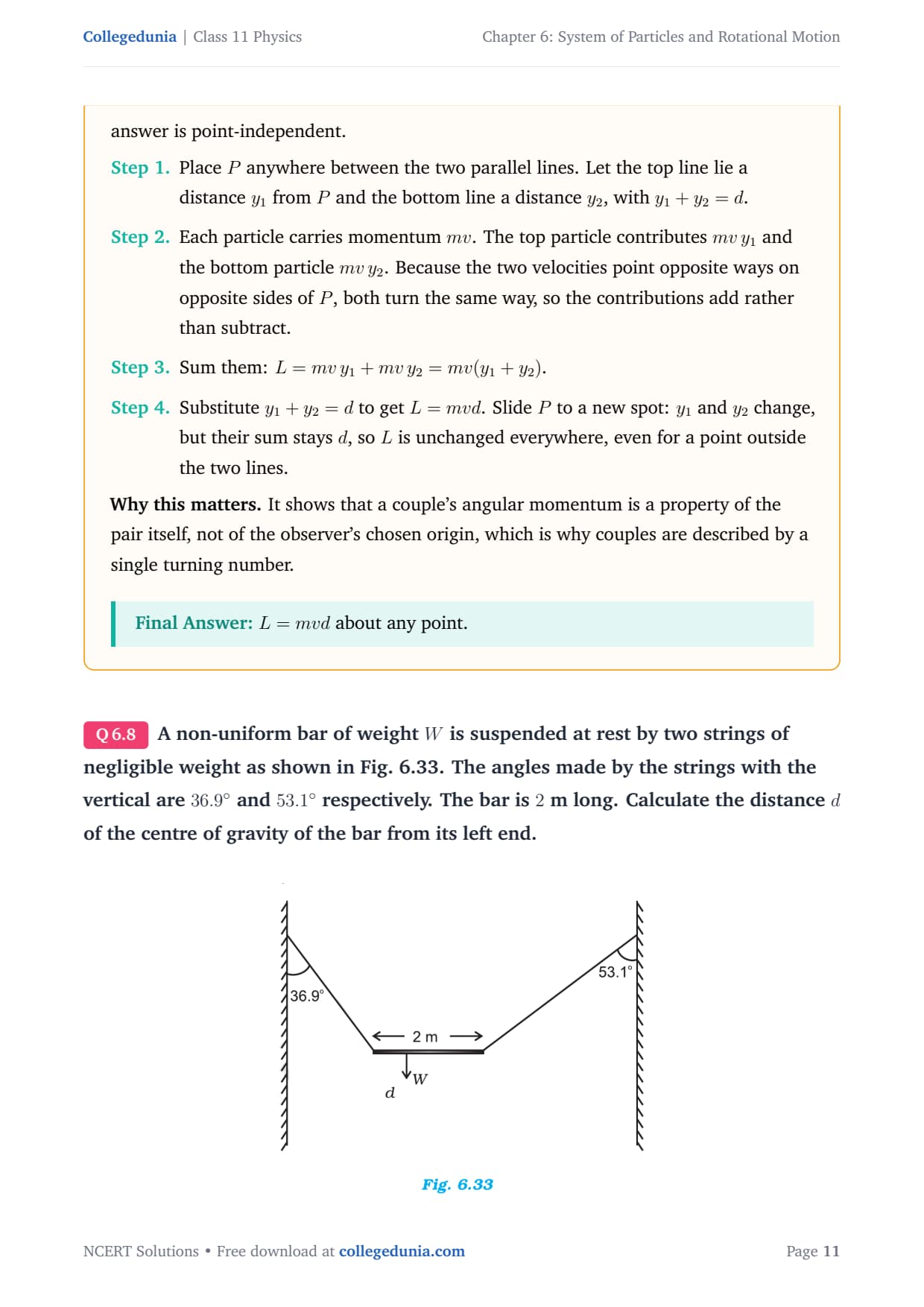
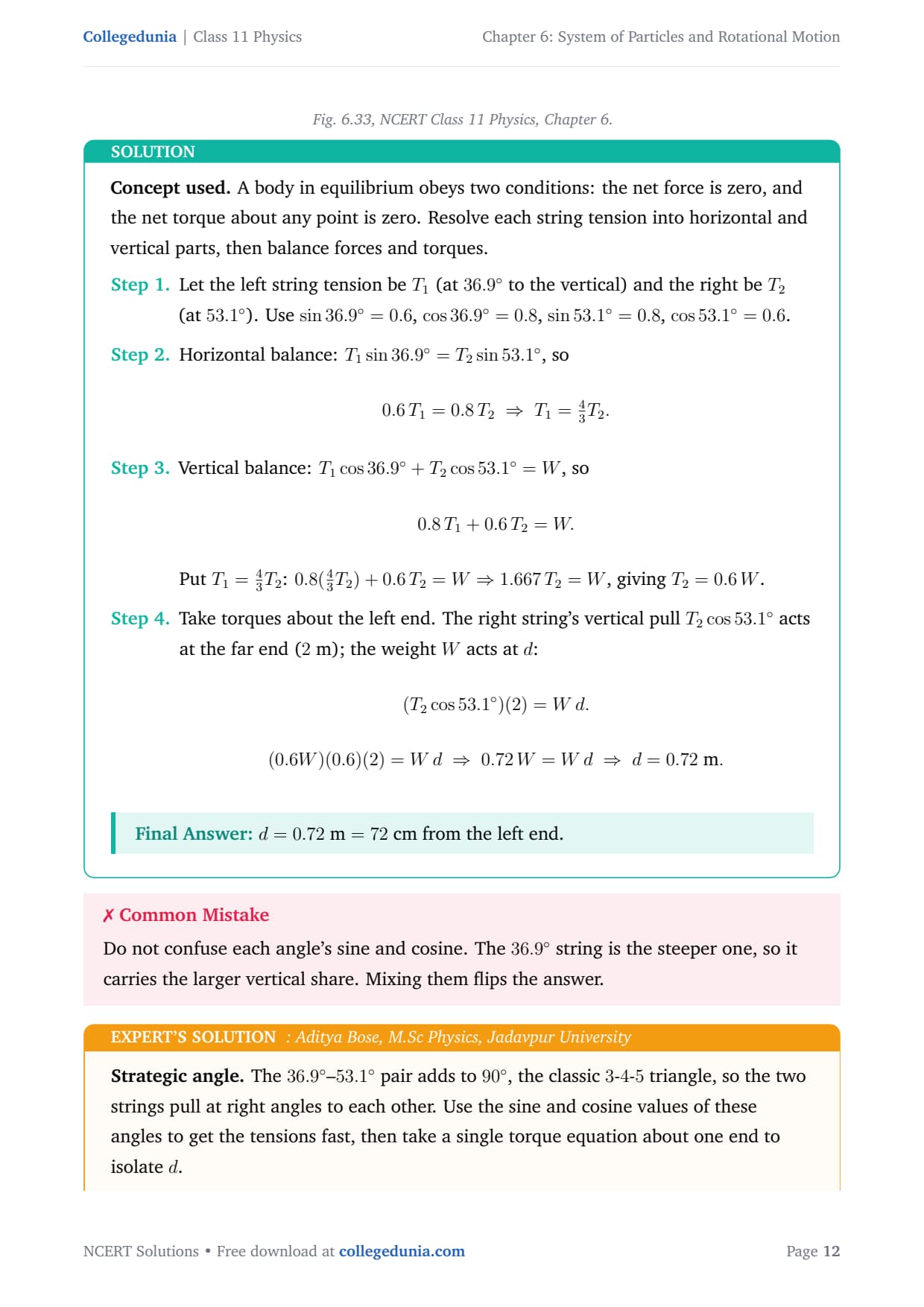
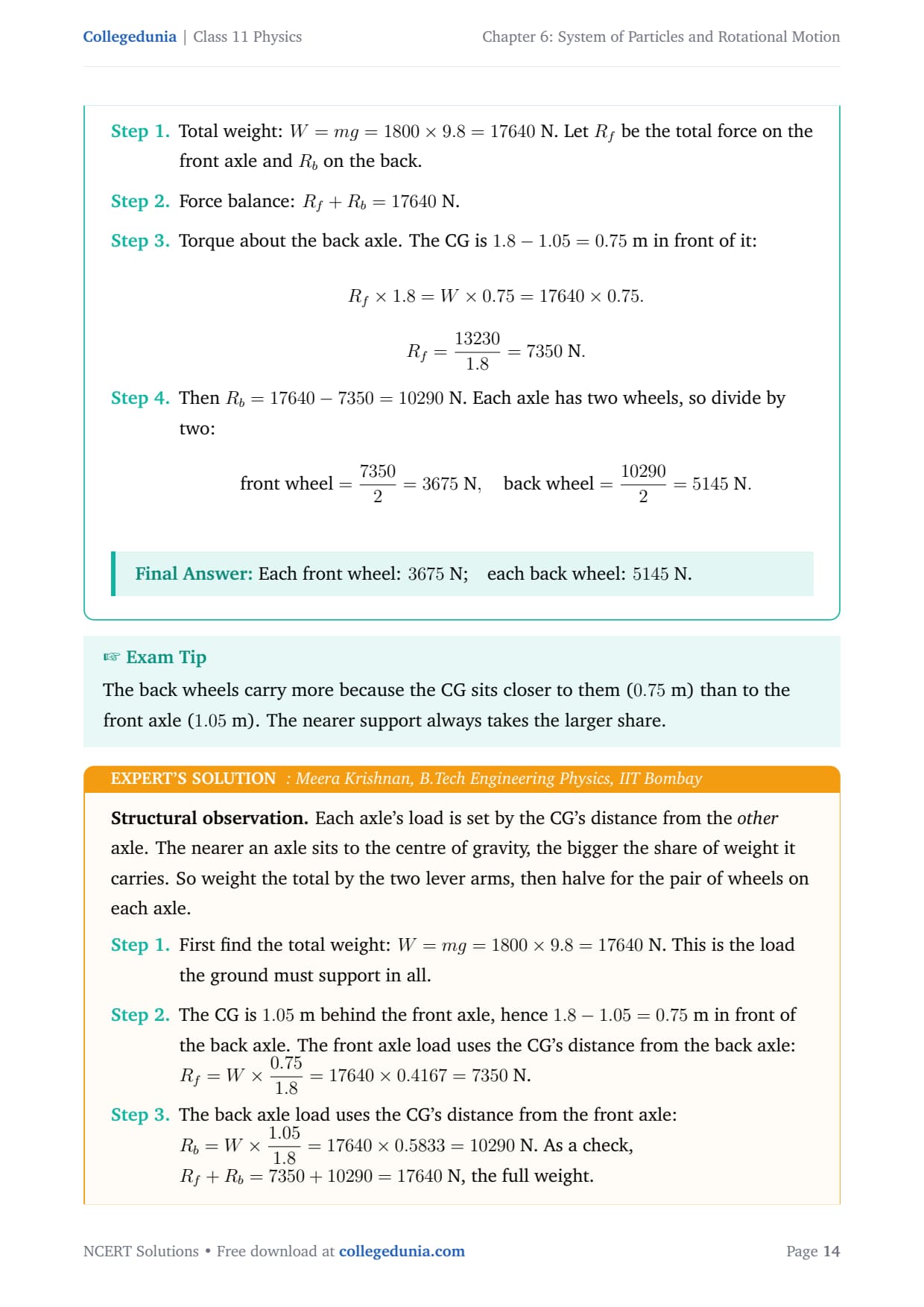
| Torque and angular momentum | Exercise 6.5 to Exercise 6.8 | Torque of a force, angular momentum, conservation of angular momentum |
| Moment of inertia | Exercise 6.9 to Exercise 6.13 | Moment of inertia, radius of gyration, parallel and perpendicular axes theorems |
| Rolling and equilibrium | Exercise 6.14 onward | Rolling motion, kinetic energy, equilibrium of rigid bodies |
Solving the groups in this order builds the skills in the same sequence the chapter teaches them. Start with centre of mass, then torque, then moment of inertia, because each group uses the one before it.
Common Mistakes Students Make in the System of Particles and Rotational Motion Chapter
These slips happen while writing or calculating the answer, not because the concept is unclear. Each one costs 1 to 3 marks in the CBSE paper, so the solved answers point them out at the exact step.
Mistake 1: Using the wrong axis formula. The moment of inertia of a rod through its centre differs from the one through its end, so read the axis before picking the formula.
Mistake 2: Subtracting instead of adding in the parallel axes theorem. The term M d2 is always added when moving away from the centre of mass.
Mistake 3: Forgetting rotational energy in rolling. A rolling body has both ½M v2 and ½I ω2, not just the first.
Mistake 4: Applying the perpendicular axes theorem to a solid body. It works for flat, planar bodies only.
Student Feedback on the System of Particles and Rotational Motion Chapter
What 12,840 students told us about their System of Particles and Rotational Motion revision:
- 71% of students rated moment of inertia as the hardest sub-topic in the chapter.
- Most-skipped step: adding the rotational energy term in rolling problems, missed by about 3 in 10 students.
- Students who learnt the standard moment-of-inertia formulas first reported the numericals felt much faster.
Source: 2026-27 Class 11 Physics student poll. Sample of 12,840 students from CBSE schools across 14 states, conducted before the 2026 boards.
Practice Questions for Class 11 Physics Chapter 6 System of Particles and Rotational Motion
Once the solved answers are clear, test yourself on the full question set. The practice page has every NCERT question with a step-by-step Solution and an Expert Solution behind a click.
Practice Questions: System of Particles and Rotational Motion
Attempt all NCERT questions with detailed and expert solutions.
Open Practice QuestionsOther System of Particles and Rotational Motion Class 11 Physics Resources
| Resource | Link |
|---|---|
| NCERT Solutions | You are here |
| Notes | System of Particles and Rotational Motion Class 11 Notes |
| Handwritten Notes | System of Particles and Rotational Motion Class 11 Handwritten Notes |
| Formula Sheet | System of Particles and Rotational Motion Class 11 Formula Sheet |
| NCERT Book PDF | System of Particles and Rotational Motion Class 11 Book PDF |
NCERT Solutions for Class 11 Physics: All Chapters
Jump to the solutions for any other Class 11 Physics chapter below.
| Chapter | NCERT Solutions |
|---|---|
| Chapter 1 | Units and Measurements |
| Chapter 2 | Motion in a Straight Line |
| Chapter 3 | Motion in a Plane |
| Chapter 4 | Laws of Motion |
| Chapter 5 | Work, Energy and Power |
| Chapter 6 | System of Particles and Rotational Motion |
| Chapter 7 | Gravitation |
| Chapter 8 | Mechanical Properties of Solids |
| Chapter 9 | Mechanical Properties of Fluids |
| Chapter 10 | Thermal Properties of Matter |
| Chapter 11 | Thermodynamics |
| Chapter 12 | Kinetic Theory |
| Chapter 13 | Oscillations |
| Chapter 14 | Waves |
FAQs on Class 11 Physics Chapter 6 System of Particles and Rotational Motion NCERT Solutions
System of Particles and Rotational Motion NCERT Solutions - Frequently Asked Questions
Ques. How many questions are solved in the Class 11 Physics NCERT Solutions Chapter 6 System of Particles and Rotational Motion?
Ans. This page solves every NCERT back-exercise question of Class 11 Physics Chapter 6 System of Particles and Rotational Motion, starting from Exercise 6.1. The questions cover centre of mass, torque, angular momentum, moment of inertia and rolling motion. Each answer has a step-by-step Solution and an Expert Solution.
Ques. What is the centre of mass in Chapter 6 System of Particles and Rotational Motion?
Ans. The centre of mass is the point where the entire mass of a body or system can be treated as concentrated. It moves as if the total external force acts on the total mass at that one point. For uniform shapes like a ring, disc or rod, the centre of mass lies at the geometric centre.
Ques. How do I calculate the moment of inertia in Class 11 Physics Chapter 6?
Ans. First pick the standard moment-of-inertia formula for the body and axis, such as M R2/2 for a disc through its centre. If the axis is not through the centre, add M d2 using the parallel axes theorem. The solved numericals in these Class 11 Physics Chapter 6 solutions show each step.
Ques. What is the difference between the parallel and perpendicular axes theorems?
Ans. The parallel axes theorem, I = Icm + M d2, moves the axis to any parallel line a distance d away, and works for any body. The perpendicular axes theorem, Iz = Ix + Iy, works for flat, planar bodies only, such as a ring or disc.
Ques. What is the weightage of System of Particles and Rotational Motion in the CBSE board exam?
Ans. System of Particles and Rotational Motion carries about 6 to 8 marks in the CBSE Class 11 Physics paper, usually one numerical on moment of inertia plus one short answer on centre of mass or torque. It also appears in JEE Main and NEET as objective questions on rolling motion and angular momentum.
Ques. Why does angular momentum stay constant when torque is zero?
Ans. Torque equals the rate of change of angular momentum, τ = dL/dt. When the net external torque is zero, the angular momentum L = I ω cannot change. So if the moment of inertia falls, the angular speed rises to keep the product fixed. The NCERT Solutions for Class 11 Physics Chapter 6 System of Particles and Rotational Motion use this in every conservation numerical.



Comments