



Class 12 Biology Chapter 3 Reproductive Health covers five sections on programmes, contraception, MTP, STIs, and infertility. Every number, threshold, and classification from these sections is distilled here as a one-pass recall set for NEET 2027 and CBSE Boards. Students can download the full Reproductive Health Formula Sheet PDF from this page.
- CBSE Weightage: 6 to 8 marks (Unit Reproduction)
- NEET Weightage: 2 to 4 questions per year (high-yield recall block)
- AIIMS / CUET Weightage: Direct recall on ART, MTP limits, and STI classification
Why the Reproductive Health Formula Sheet Matters for NEET 2027 and CBSE Boards
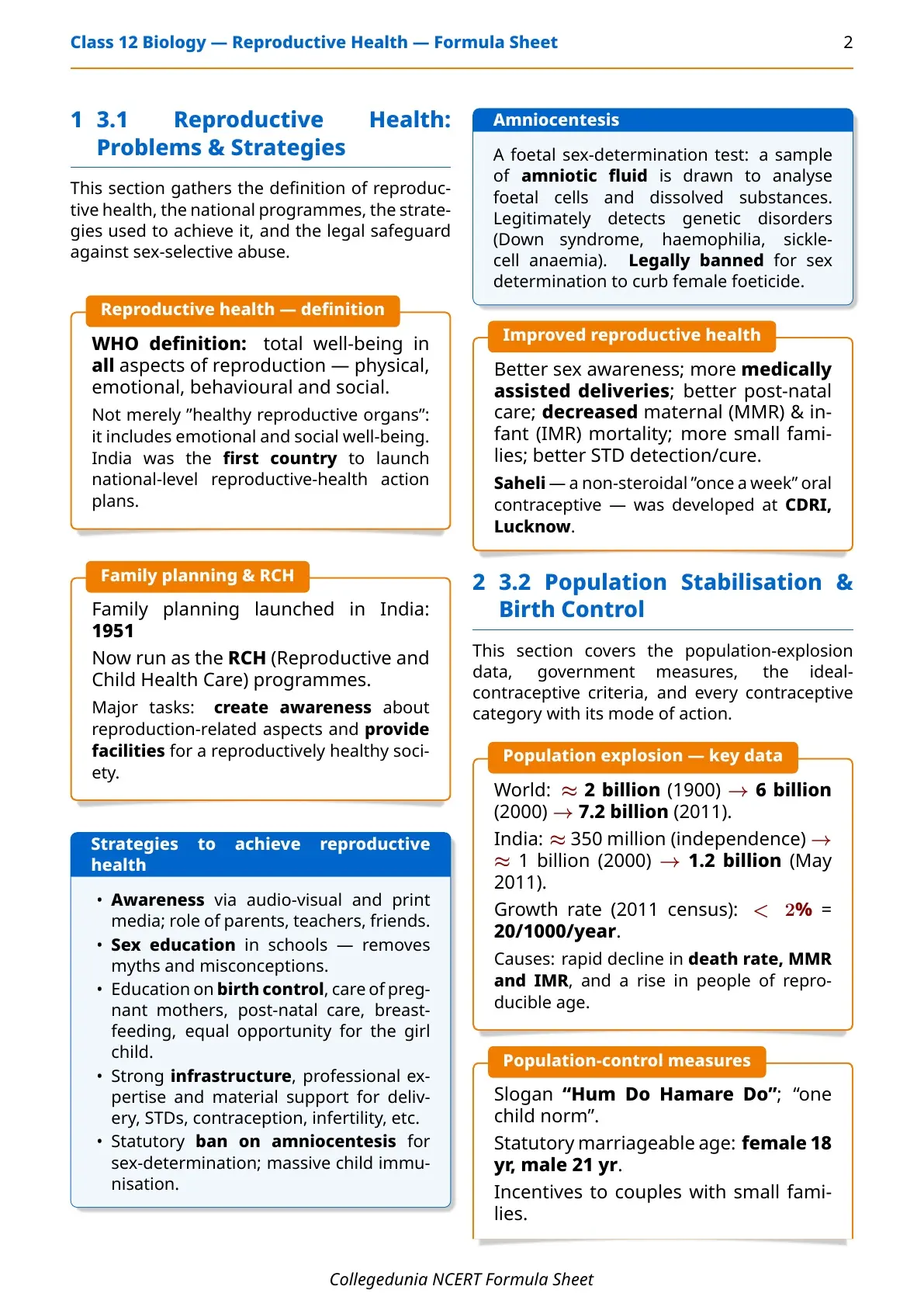
Reproductive Health is one of the most predictable scoring chapters in NEET Biology. Every question is direct recall: a legal cut-off, a contraceptive category, an STI pathogen, or an ART full form. Students who have memorised these facts can clear the chapter in under a minute per question. For CBSE Boards, a single missed threshold such as the 12-week MTP limit can cost a full mark.
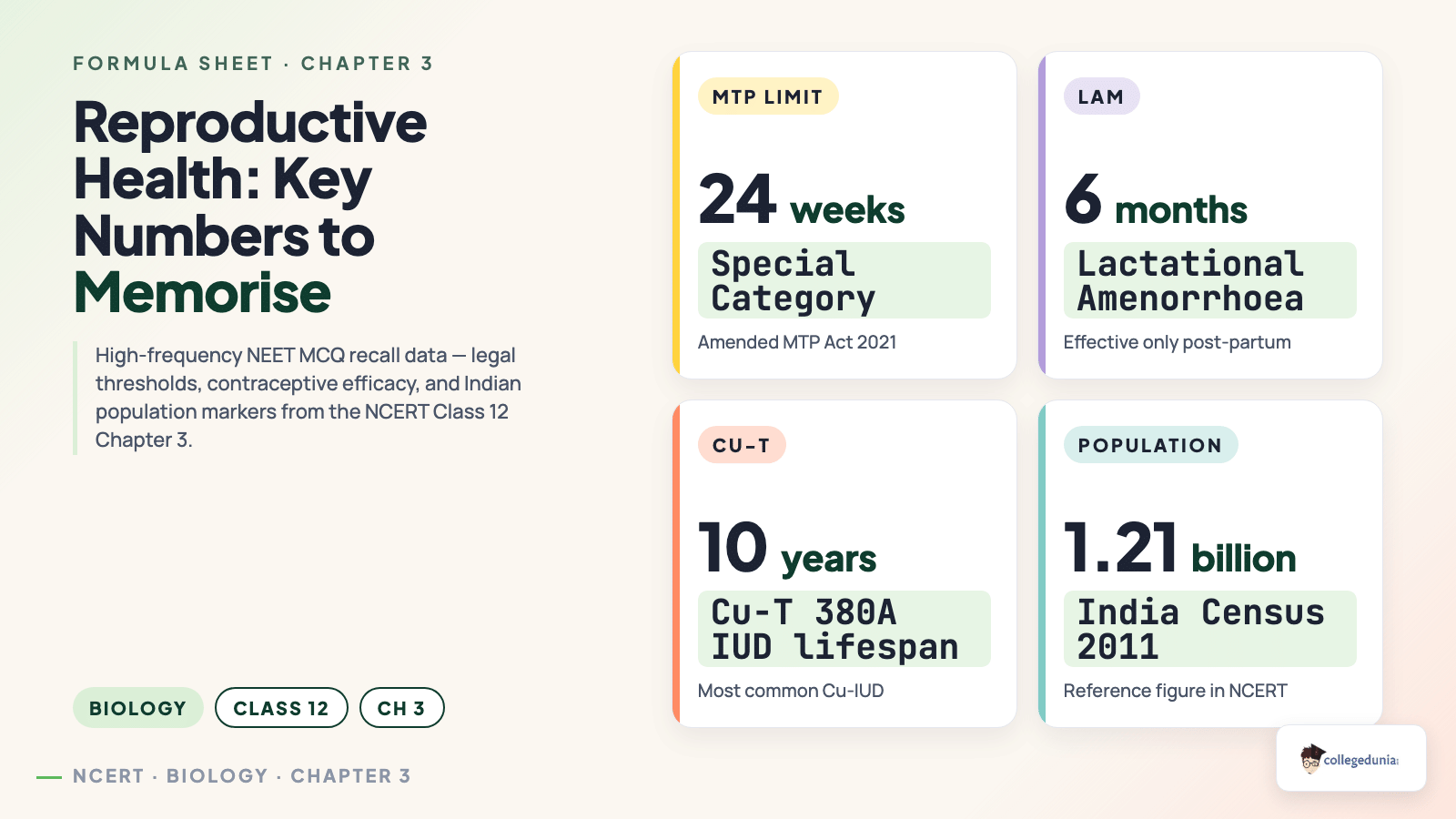
How This Reproductive Health Formula Sheet Helps Students for NEET 2027
This sheet is built for the final revision phase, when students need every recall fact in one scan.
- 2026-27 NCERT Alignment: Every threshold and category matches the current NCERT print, including the Section 3.2 title "Population Stabilisation and Birth Control".
- One-Pass Recall: Legal limits, contraceptive classes, STI lists, and ART abbreviations are grouped so a single read covers the chapter.
- Exam-Shaped Facts: Facts are stored the way NEET phrases them, so recall in the exam hall is faster.
Reproductive Health Video Lecture for Class 12 Biology
Source: Magnet Brains on YouTube
Reproductive Health Symbol and Abbreviation Glossary for Class 12 Biology
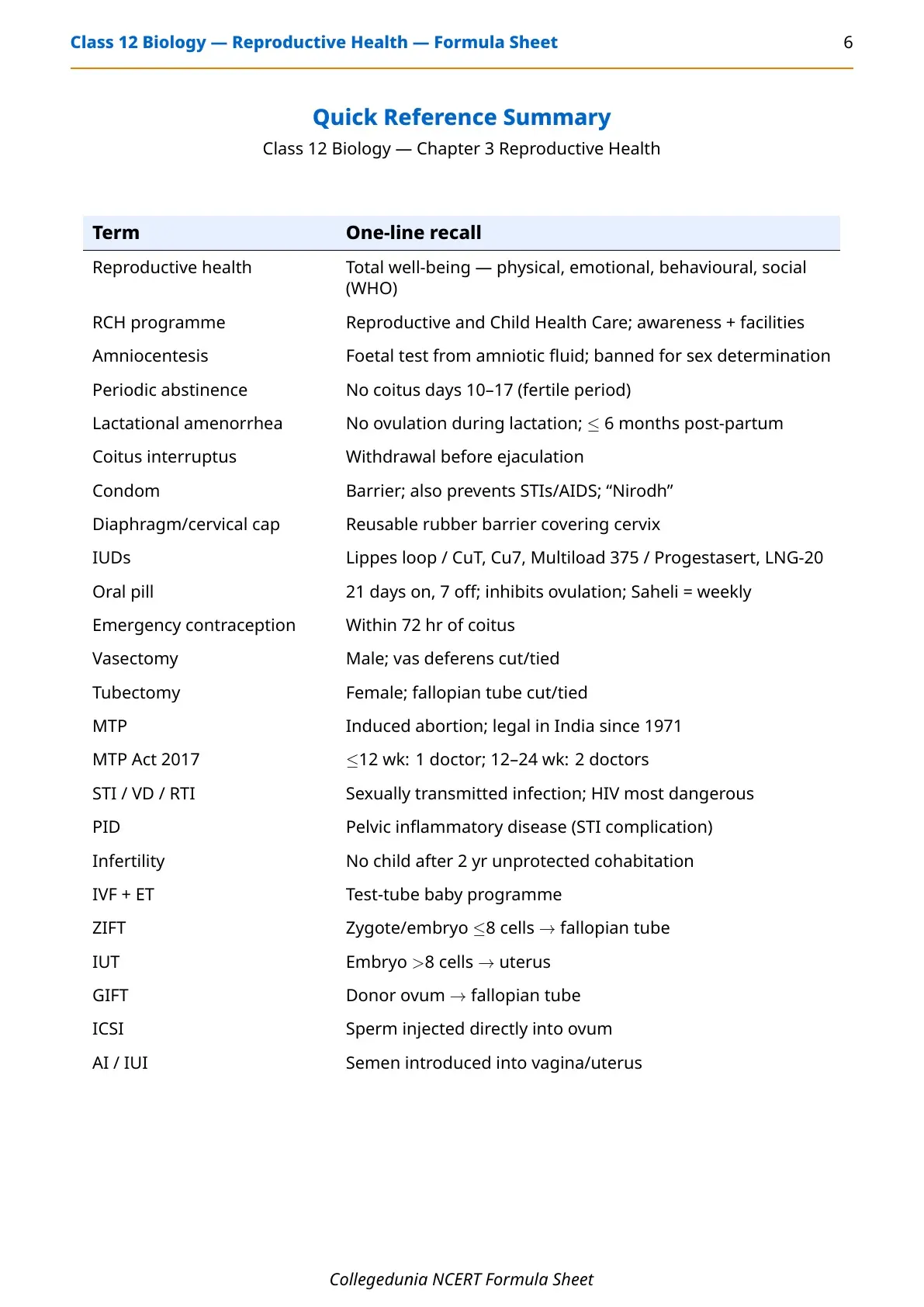
Revise this abbreviation table until every expansion is automatic. NEET tests full-form questions directly from this list.
| Abbreviation | Full Form |
|---|---|
| RCH | Reproductive and Child Health Care |
| MMR / IMR | Maternal Mortality Rate / Infant Mortality Rate |
| IUD | Intra Uterine Device |
| MTP | Medical Termination of Pregnancy |
| STI / VD / RTI | Sexually Transmitted Infection / Venereal Disease / Reproductive Tract Infection |
| PID | Pelvic Inflammatory Disease |
| ART | Assisted Reproductive Technology |
| IVF, ET | In Vitro Fertilisation, Embryo Transfer |
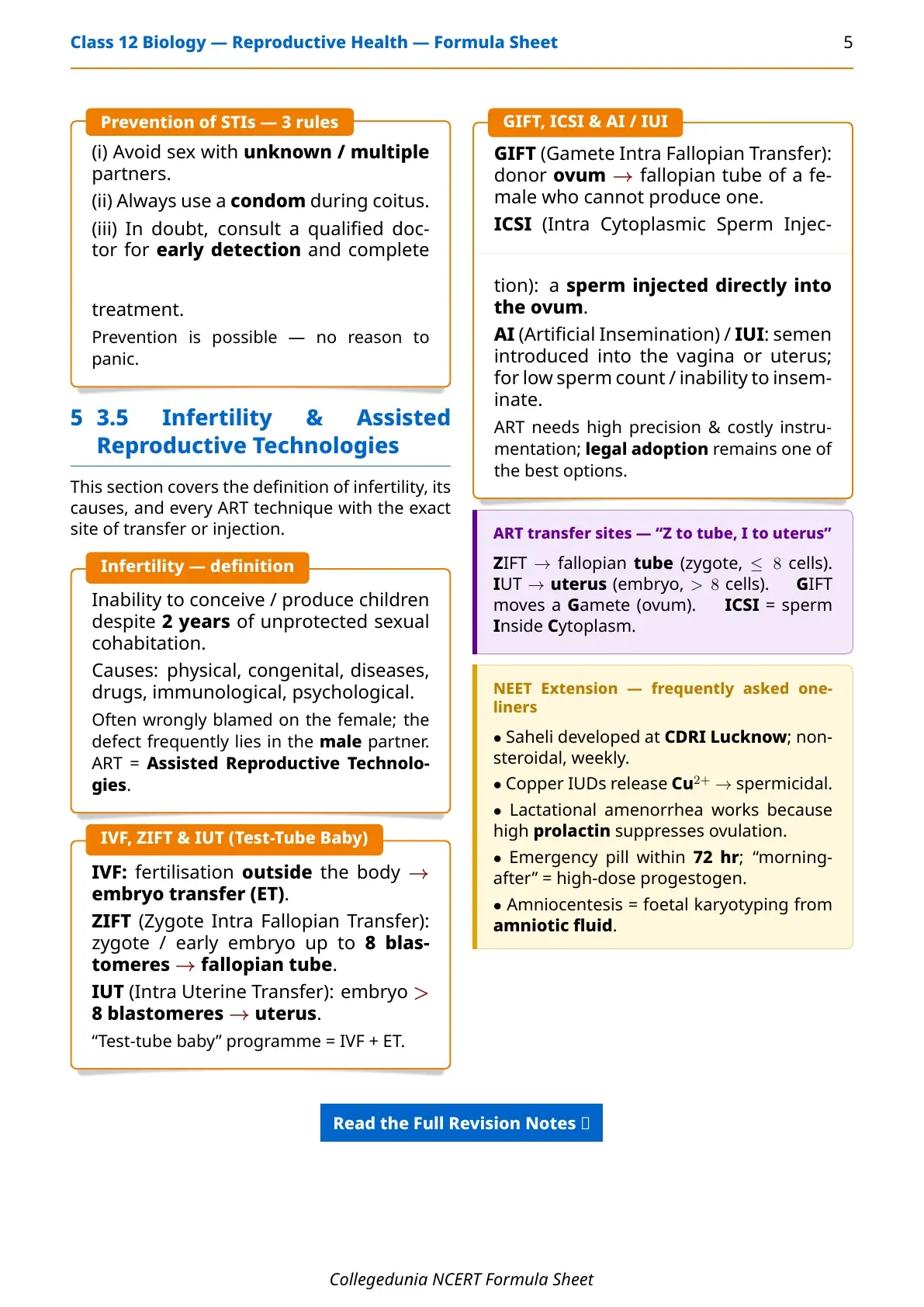
| ZIFT, IUT | Zygote Intra Fallopian Transfer, Intra Uterine Transfer |
| GIFT, ICSI | Gamete Intra Fallopian Transfer, Intra Cytoplasmic Sperm Injection |
| AI, IUI | Artificial Insemination, Intra Uterine Insemination |
NEET tests this boundary: ZIFT takes up to 8 blastomeres; IUT takes more than 8.
Reproductive Health Numerical Facts and Legal Thresholds at a Glance
Every value below has appeared in CBSE or NEET as a direct recall question.
| Fact / Quantity | Value | NCERT Section |
|---|---|---|
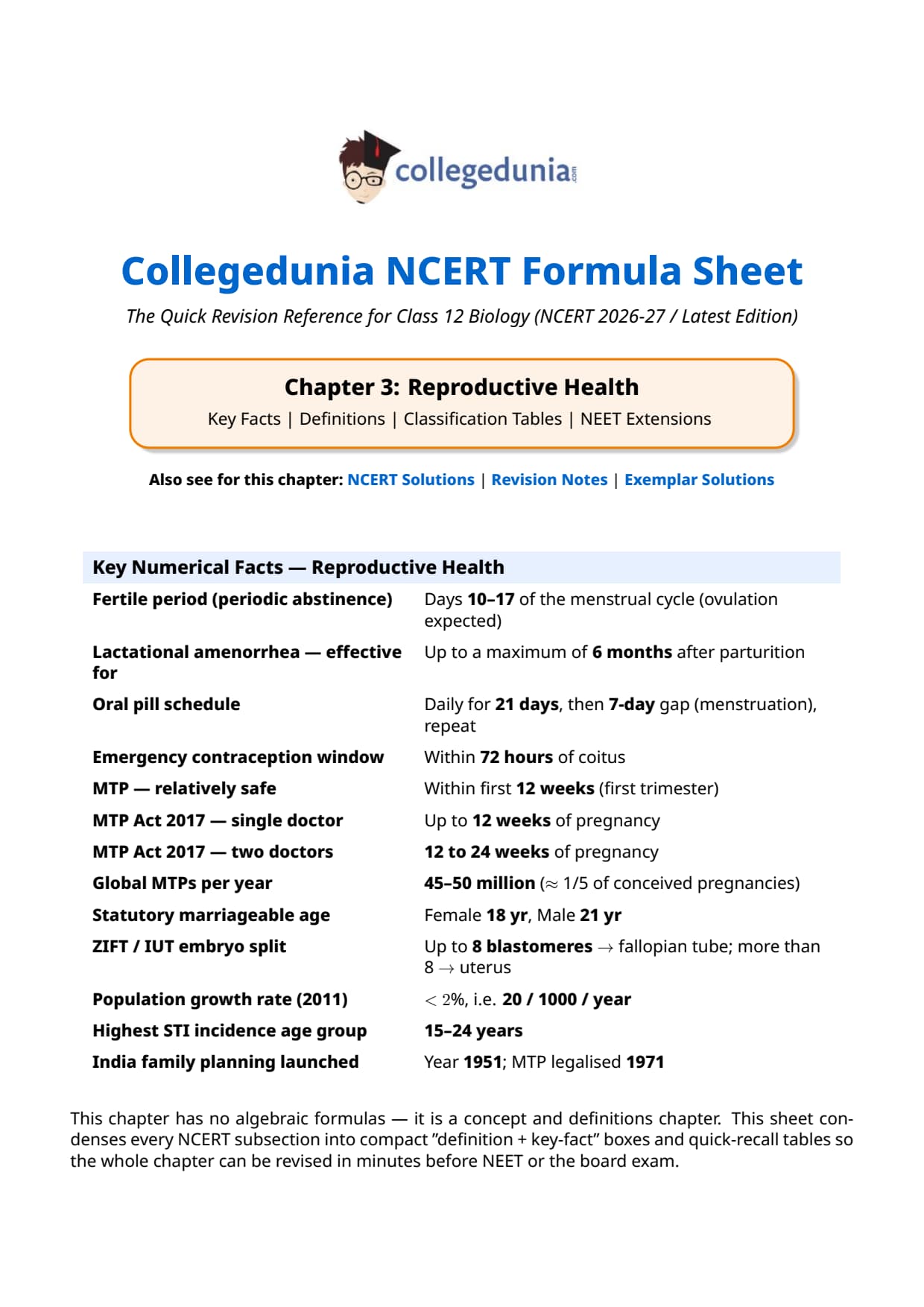
| Family planning programmes initiated (India, first in the world) | 1951 | 3.1 |
| MTP legalised in India | 1971 | 3.3 |
| MTP Amendment Act (1 practitioner up to 12 wk; 2 for 12 to 24 wk) | 2017 | 3.3 |
| Safe MTP window (first trimester) | Up to 12 weeks | 3.3 |
| Marriageable age (female / male) | 18 / 21 years | 3.2 |
| Periodic abstinence (fertile period) | Day 10 to 17 of cycle | 3.2 |
| Oral pill schedule (start within first 5 days) | 21 days, then 7-day gap | 3.2 |
| Emergency contraception window | Within 72 hours of coitus | 3.2 |
| Lactational amenorrhea effective period | Up to 6 months post-parturition | 3.2 |
| STI high-incidence age group | 15 to 24 years | 3.4 |
| Infertility definition window | 2 years | 3.5 |
| Blastomere cut-off (ZIFT up to 8; IUT more than 8) | 8 blastomeres | 3.5 |
The 1951, 1971, 2017, 12-week, 72-hour and 8-blastomere values are the most repeated recall hits across recent NEET papers. Prioritise them on the last day.
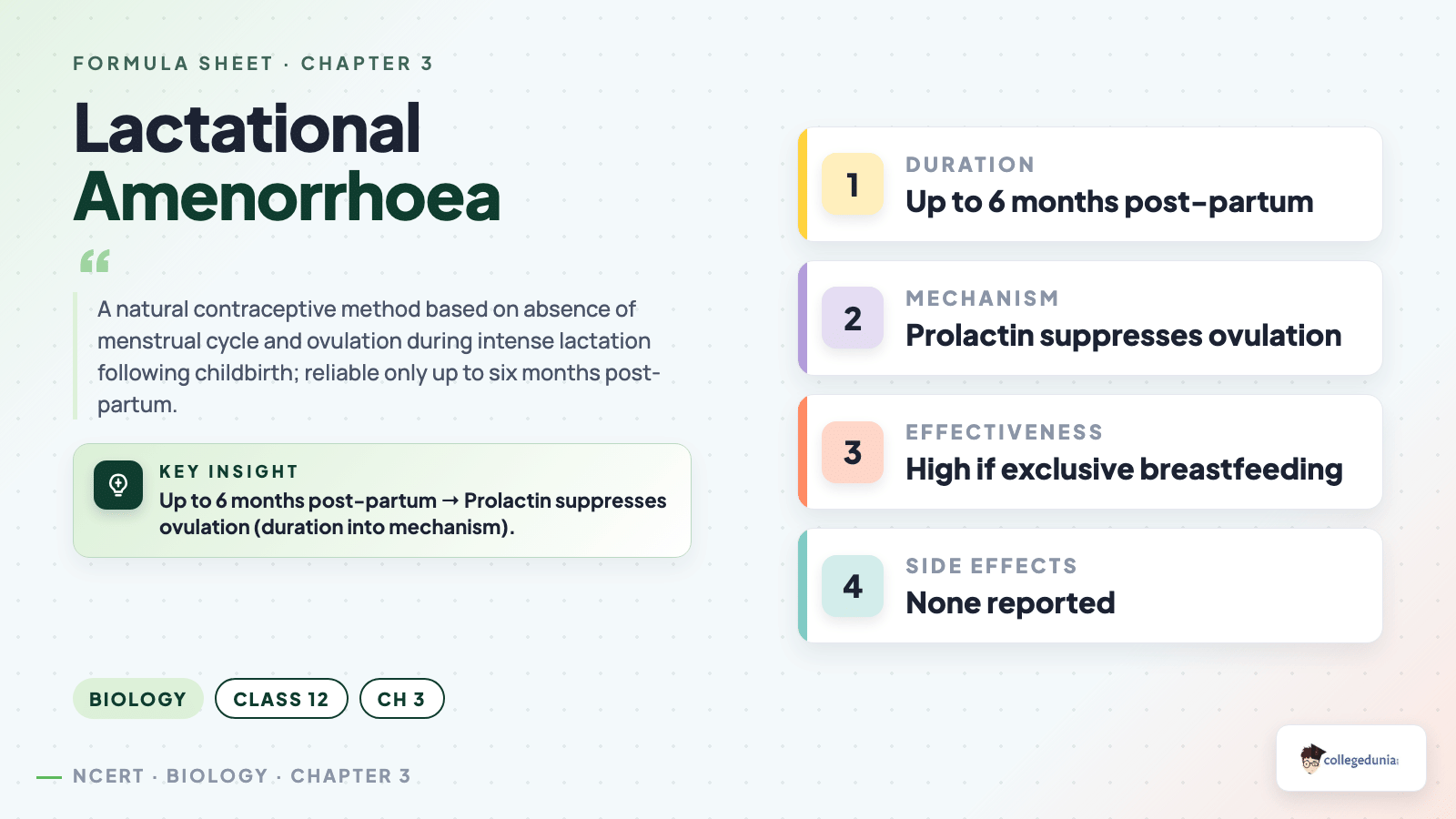
Reproductive Health Quick-Fact Cards for NEET MCQ Recall
These cards isolate the highest-trap numbers NEET uses to build wrong options.
When to Use Which Contraceptive Category in Class 12 Biology
NEET gives a one-line scenario and asks for the matching contraceptive class. Match the cue to the correct category below.
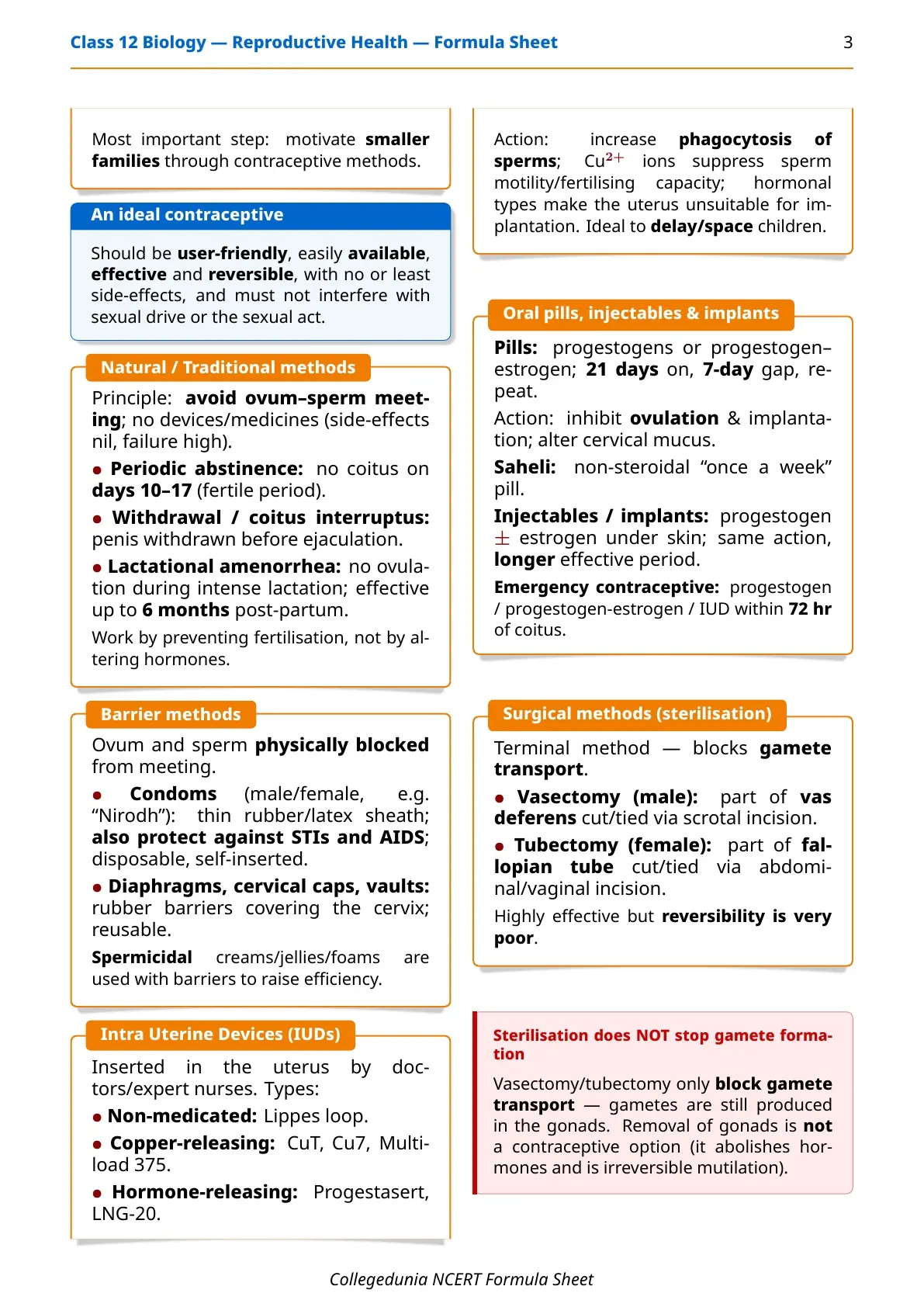
- No device or medicine, avoids gamete meeting: Natural / Traditional (periodic abstinence, coitus interruptus, lactational amenorrhea).
- Physical barrier so semen does not reach the tract: Barrier (condoms, diaphragms, cervical caps, vaults, with spermicides).
- Sperm phagocytosis up, Cu ions suppress motility: Copper-releasing IUDs (CuT, Cu7, Multiload 375).
- Uterus unsuitable and cervix hostile, plus the above: Hormone-releasing IUDs (Progestasert, LNG-20).
- Inhibits ovulation and implantation, 21-day schedule: Oral pills; Saheli is the non-steroidal once-a-week pill.
- Terminal method, blocks gamete transport: Surgical, vasectomy (male) and tubectomy (female).
Reproductive Health Common NEET Question Pattern Templates
NEET reuses a small set of question shapes. Recognise the template to quickly retrieve the right row.
| Question Cue | What to Retrieve | Answer Anchor |
|---|---|---|
| "developed at CDRI, Lucknow" | Named contraceptive | Saheli (non-steroidal, once-a-week pill) |
| "two registered medical practitioners needed" | MTP gestation window | More than 12, fewer than 24 weeks |
| "sperm injected directly into the ovum" | ART technique | ICSI |
| "ovum from donor into fallopian tube" | ART technique | GIFT |
| "bacterial vs viral STI" | STI classification | Bacterial: gonorrhoea, syphilis, chlamydiasis; Viral: herpes, hepatitis-B, HIV, warts |
| "banned for sex-determination" | Diagnostic technique | Amniocentesis |
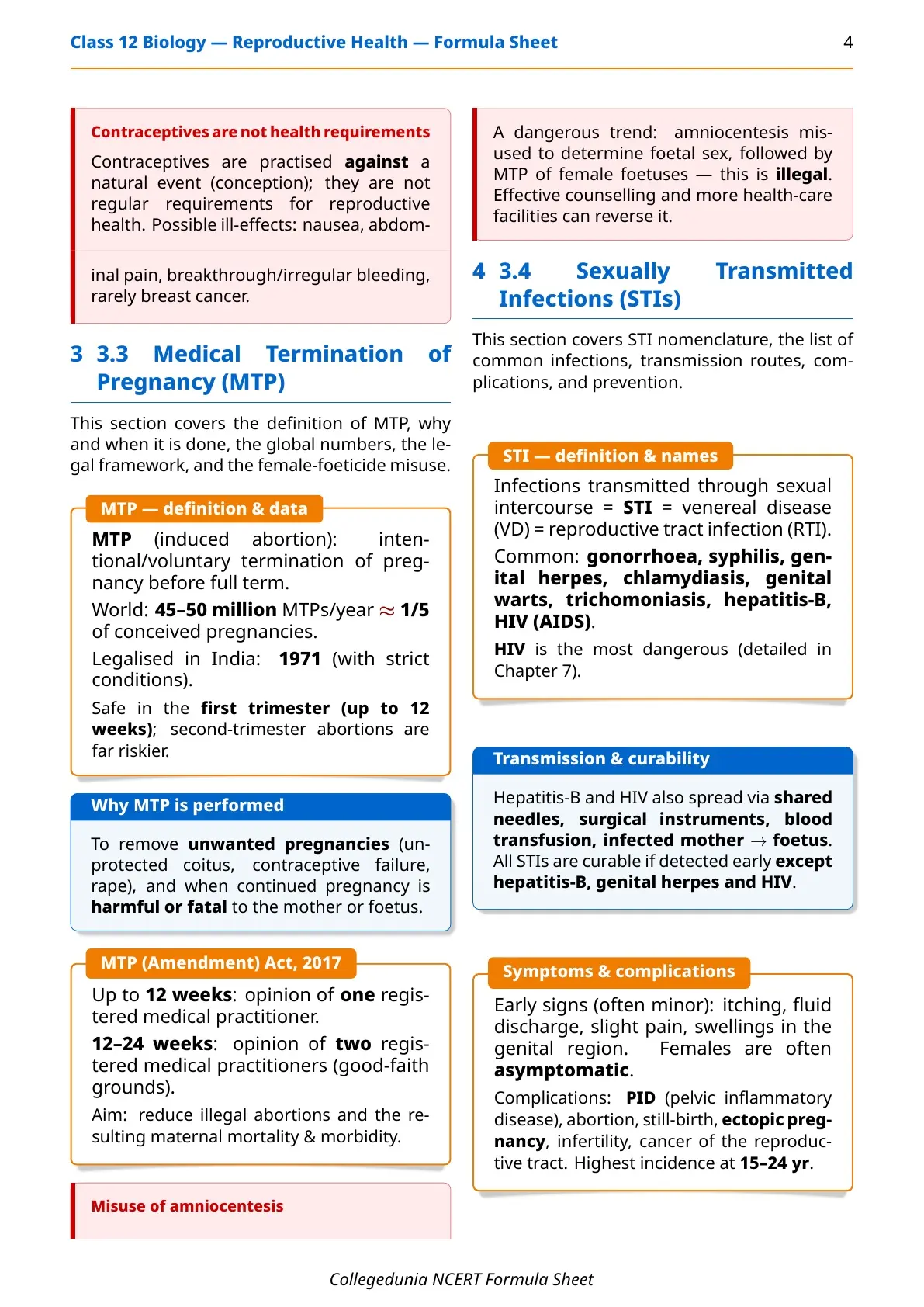
Hepatitis-B, genital herpes and HIV are not completely curable, while most other STIs are curable if detected early. This distinction is a frequent CBSE one-mark question.
One-Shot Reproductive Health Revision Tips for Class 12 Biology
Use these in the last 24 hours to refresh recall.
- Chain the legal anchors: 1951, 1971, 2017, plus the 12-week and 24-week MTP limits.
- Memorise the seven contraceptive categories in NCERT order: Natural, Barrier, IUDs, Oral pills, Injectables, Implants, Surgical.
- Split STIs into curable and not-fully-curable (hepatitis-B, genital herpes, HIV); this is a standing one-mark question.
- Group every ART full form (IVF, ET, ZIFT, IUT, GIFT, ICSI, AI, IUI) with its distinguishing feature.
How Frequently Has Reproductive Health Been Asked in CBSE and NEET?
Three areas recur most across CBSE Board and NEET papers:
- Contraceptive methods and modes of action: asked almost every year as IUD-type differences or the action of oral pills.
- ART abbreviations and definitions: NEET standing favourite, especially ZIFT vs IUT and GIFT vs IVF.
- MTP legal limits and amniocentesis misuse: regular CBSE short-answer and NEET single-statement question.
Full PYQ map: Reproductive Health Class 12 Biology NCERT Solutions
Student Feedback
What 11,200 students told us about the Chapter 3 Reproductive Health Formula Sheet:
- 70% of students surveyed marked ART (ZIFT vs GIFT vs IUI) terminology as the hardest sub-topic.
- 58% reported losing 1-2 marks on the MTP Act time-window numbers, even when the rest of their answer was correct.
- 4 out of 5 students said the amniocentesis labelled diagram was the most-skipped figure in their answer sheet.
- Average student took 4.9 hours for the first read of the chapter, and 2.0 hours for a focused revision pass before the board exam.
Source: 2025-26 Class 12 Biology student survey. Sample of 11,200 students from CBSE-affiliated schools across 18 states.
Other Resources for Reproductive Health Class 12 Biology
| Resource | Link |
|---|---|
| Formula Sheet | Reproductive Health Formula Sheet |
| NCERT Solutions | Reproductive Health Class 12 Biology NCERT Solutions |
| Notes | Reproductive Health Class 12 Biology Notes |
| Handwritten Notes | Reproductive Health Class 12 Biology Handwritten Notes |
| Exemplar Solutions | Reproductive Health Class 12 Biology NCERT Exemplar Solutions |
| NCERT Book PDF | Reproductive Health Class 12 Biology NCERT Book PDF |
| Exemplar Book PDF | Reproductive Health Class 12 Biology NCERT Exemplar Book PDF |
NCERT Formula Sheet for Class 12 Biology: All Chapters
Jump to the formula sheet of any other Class 12 Biology chapter, each built to the same one-pass recall design.
| Chapter | Resource |
|---|---|
| Chapter 1 | Sexual Reproduction in Flowering Plants Formula Sheet |
| Chapter 2 | Human Reproduction Formula Sheet |
| Chapter 3 | Reproductive Health Formula Sheet |
| Chapter 4 | Principles of Inheritance and Variation Formula Sheet |
| Chapter 5 | Molecular Basis of Inheritance Formula Sheet |
| Chapter 6 | Evolution Formula Sheet |
| Chapter 7 | Human Health and Disease Formula Sheet |
| Chapter 8 | Microbes in Human Welfare Formula Sheet |
| Chapter 9 | Biotechnology - Principles and Processes Formula Sheet |
| Chapter 10 | Biotechnology and its Applications Formula Sheet |
| Chapter 11 | Organisms and Populations Formula Sheet |
| Chapter 12 | Ecosystem Formula Sheet |
| Chapter 13 | Biodiversity and Conservation Formula Sheet |
Reproductive Health Class 12 Biology Formula Sheet FAQs
Ques. Where can I download the Reproductive Health Class 12 Biology Formula Sheet PDF?
Ans. You can download the Reproductive Health Class 12 Biology Formula Sheet PDF directly from this page. Both the Normal and HD versions are available, and both are free.
Ques. Is this Formula Sheet aligned with the 2026-27 NCERT?
Ans. Yes. This page reflects the current 2026-27 syllabus for Class 12 Biology. The new NCERT edition keeps all five sections of Reproductive Health intact, including the Section 3.2 heading "Population Stabilisation and Birth Control".
Ques. Does Reproductive Health have any formulas to learn?
Ans. No, this is a recall chapter with no equations. The formula sheet instead consolidates every legal threshold, contraceptive category, STI list, and ART abbreviation, which is exactly what CBSE and NEET test from this chapter.
Ques. How many pages is the Class 12th Biology Reproductive Health Formula Sheet PDF?
Ans. The Formula Sheet PDF runs approximately 6 to 8 pages and covers the numerical facts, legal thresholds, contraceptive classification, STI lists, and the full ART abbreviation set from Sections 3.1 to 3.5.
Ques. What is the safe time limit for Medical Termination of Pregnancy?
Ans. MTP is considered relatively safe during the first trimester, up to 12 weeks of pregnancy. Under the MTP Amendment Act 2017, one registered medical practitioner is needed up to 12 weeks, and two are needed for pregnancies of more than 12 but fewer than 24 weeks.
Ques. How is this Formula Sheet useful for NEET 2027 preparation?
Ans. Reproductive Health is a high-yield recall chapter in NEET. This sheet groups every number, full form, and classification the way NEET phrases its questions, so it is ideal for the last-week revision sweep when speed of recall matters most.
Ques. What is the difference between ZIFT and IUT?
Ans. ZIFT (Zygote Intra Fallopian Transfer) transfers a zygote or early embryo with up to 8 blastomeres into the fallopian tube, while IUT (Intra Uterine Transfer) transfers an embryo with more than 8 blastomeres into the uterus. The 8-blastomere cut-off is a frequent NEET question.



Comments