




Coordination Compounds is the top-scoring inorganic chapter of Class 12. This Collegedunia formula sheet puts every nomenclature rule, CFSE table, and hybridisation cue on one revision page, fully retained in the 2026-27 NCERT.
- CBSE Weightage: 7 to 8 marks
- JEE Main Weightage: 4 to 6 percent (3 to 4 questions per paper)
- NEET Weightage: 3 to 4 questions per year
Curated by subject experts and mapped to the 2026-27 NCERT edition.
Also Check:
- Coordination Compounds Class 12 Chemistry Notes
- Coordination Compounds Class 12 Chemistry NCERT Solutions
Coordination Compounds Class 12 Chemistry Explained
Source: Magnet Brains on YouTube
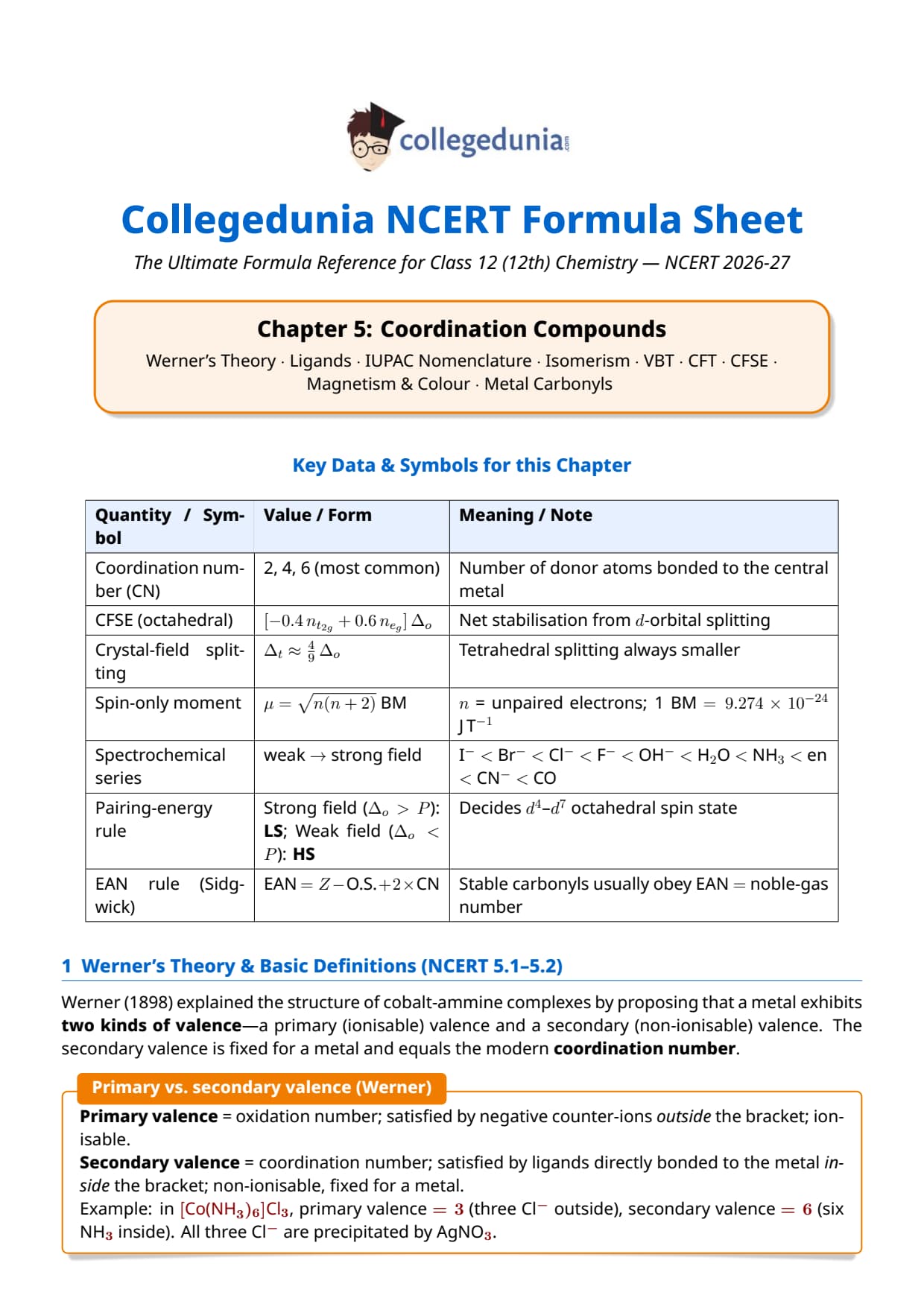
Coordination Compounds Symbol Glossary for Class 12 Chemistry
The glossary below locks in every notation used in the master table.
| Symbol | Meaning | Typical Unit / Value |
|---|---|---|
| M | Central metal atom or ion | - |
| L | Generic ligand (neutral or charged) | - |
| CN | Coordination number (secondary valency) | integer, usually 4 or 6 |
| OS | Oxidation state of M (primary valency) | integer, often +2 / +3 |
| Δo | Octahedral crystal field splitting | kJ mol-1 or cm-1 |
| Δt | Tetrahedral crystal field splitting | kJ mol-1 |
| P | Electron pairing energy | kJ mol-1 |
| n | Number of unpaired electrons in d-orbital of Mn+ | dimensionless |
| μ | Spin-only magnetic moment | Bohr Magneton (BM) |
| EAN | Effective atomic number | dimensionless |
Coordination Compounds All Important Formulae for Class 12 Chemistry
The master table lists every formula and relation in NCERT Chapter 5, with units, section, and exam cue. All entries are retained in 2026-27.
| Concept | Formula / Relation | Value or Unit | NCERT Ref | Common Use |
|---|---|---|---|---|
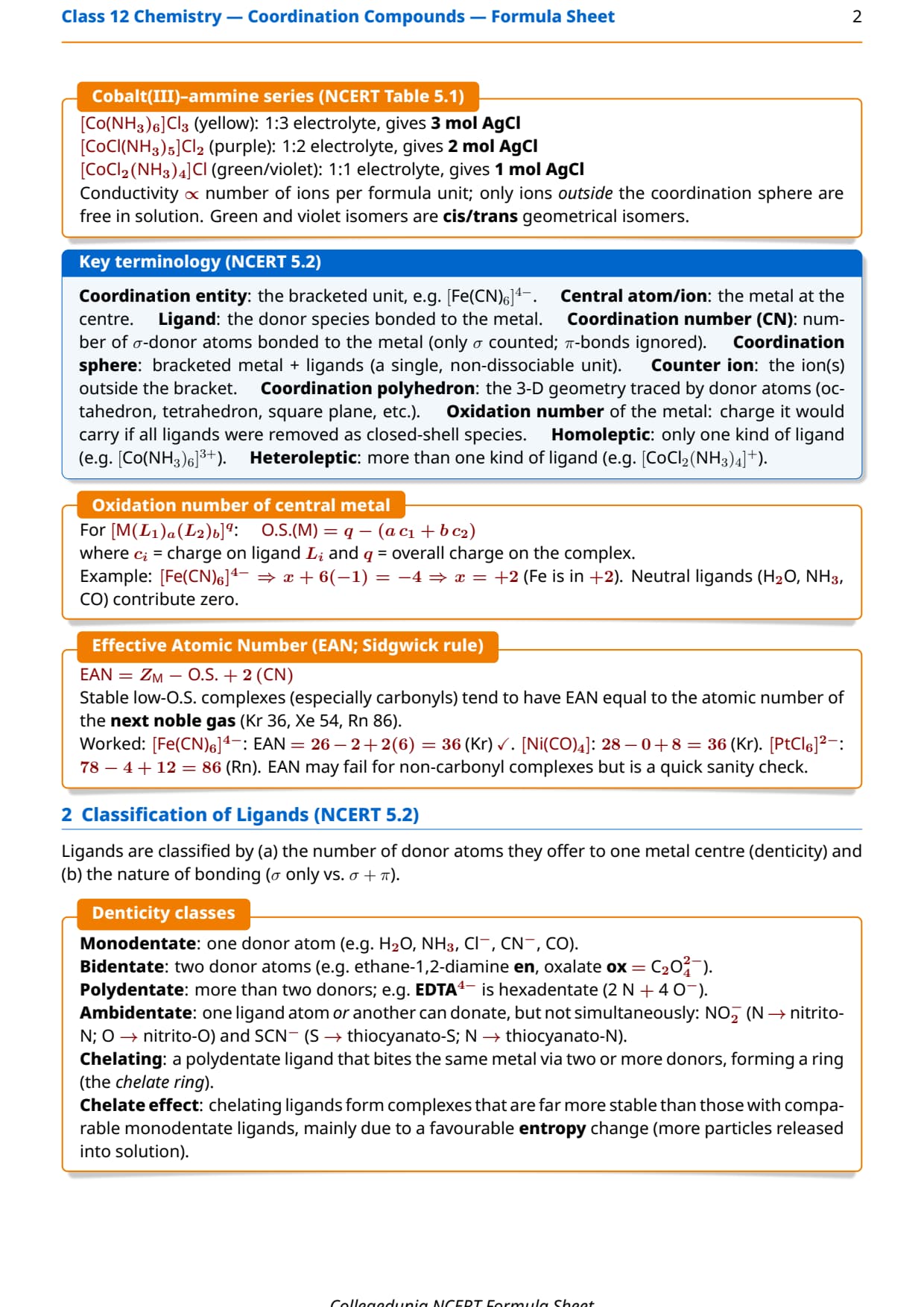
| Werner's primary valency | Equals OS of M, satisfied by negative ions | - | 5.1 | Identify counter ion |
| Werner's secondary valency | Equals CN of M, satisfied by ligands | - | 5.1 | Identify ligand count |
| Coordination sphere notation | [M(L)n]q | q = net charge | 5.2 | Bracket convention |
| OS of central metal | OS(M) = q - ∑ (charge of each L) | integer | 5.3 | Compute from formula |
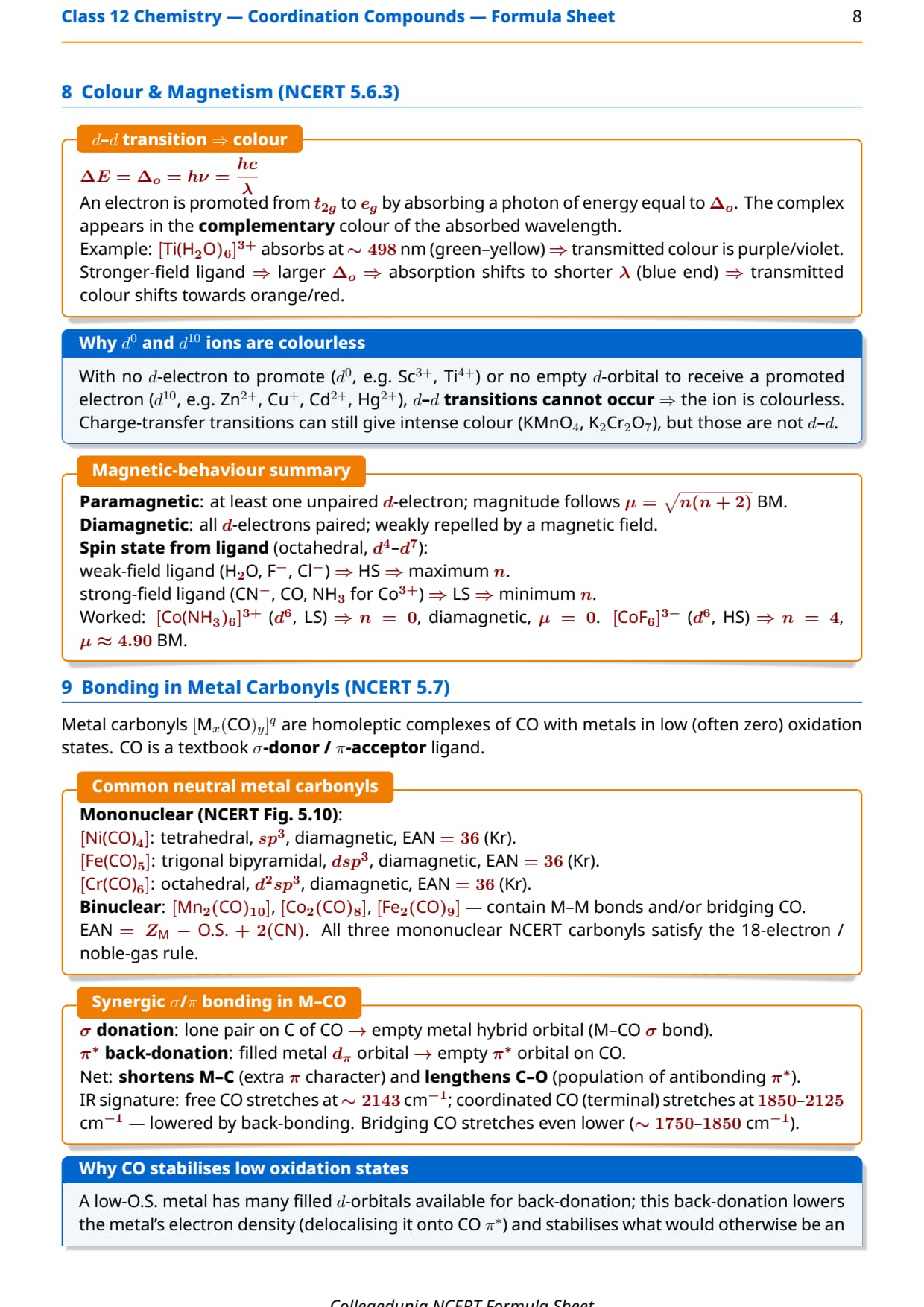
| EAN rule | EAN = Z(M) - OS(M) + 2 × CN | dimensionless | 5.5 | Stability of complex |
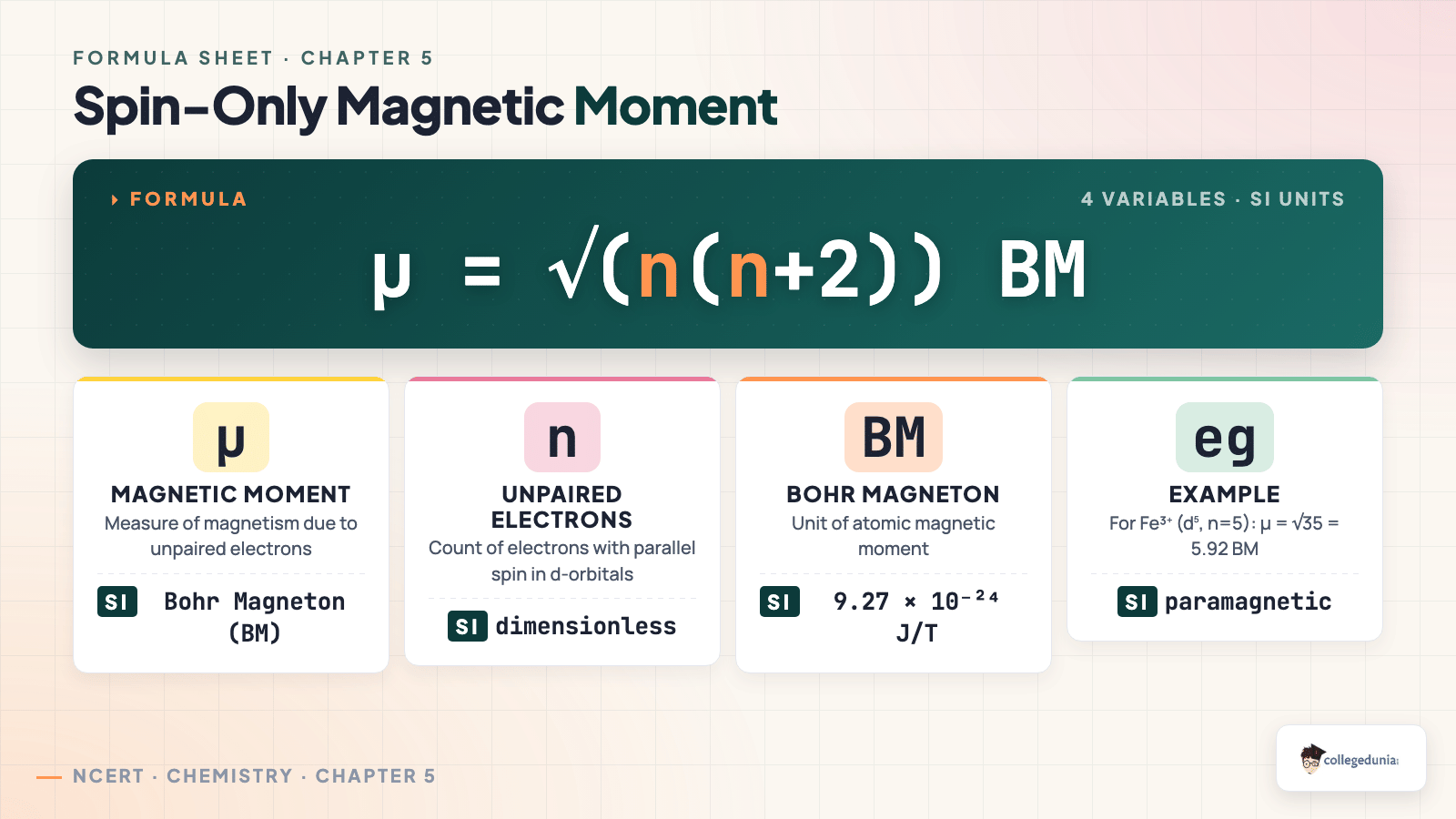
| Spin-only magnetic moment | μ = √n(n+2) | BM | 5.7 | From n unpaired e- |
| μ for n = 1 | μ = 1.73 | BM | 5.7 | d1, d9 low spin |
| μ for n = 2 | μ = 2.83 | BM | 5.7 | d2, d8 octahedral |
| μ for n = 3 | μ = 3.87 | BM | 5.7 | d3, d7 low spin |
| μ for n = 4 | μ = 4.90 | BM | 5.7 | d4, d6 high spin (oct) |
| μ for n = 5 | μ = 5.92 | BM | 5.7 | d5 high spin (Fe3+, Mn2+) |
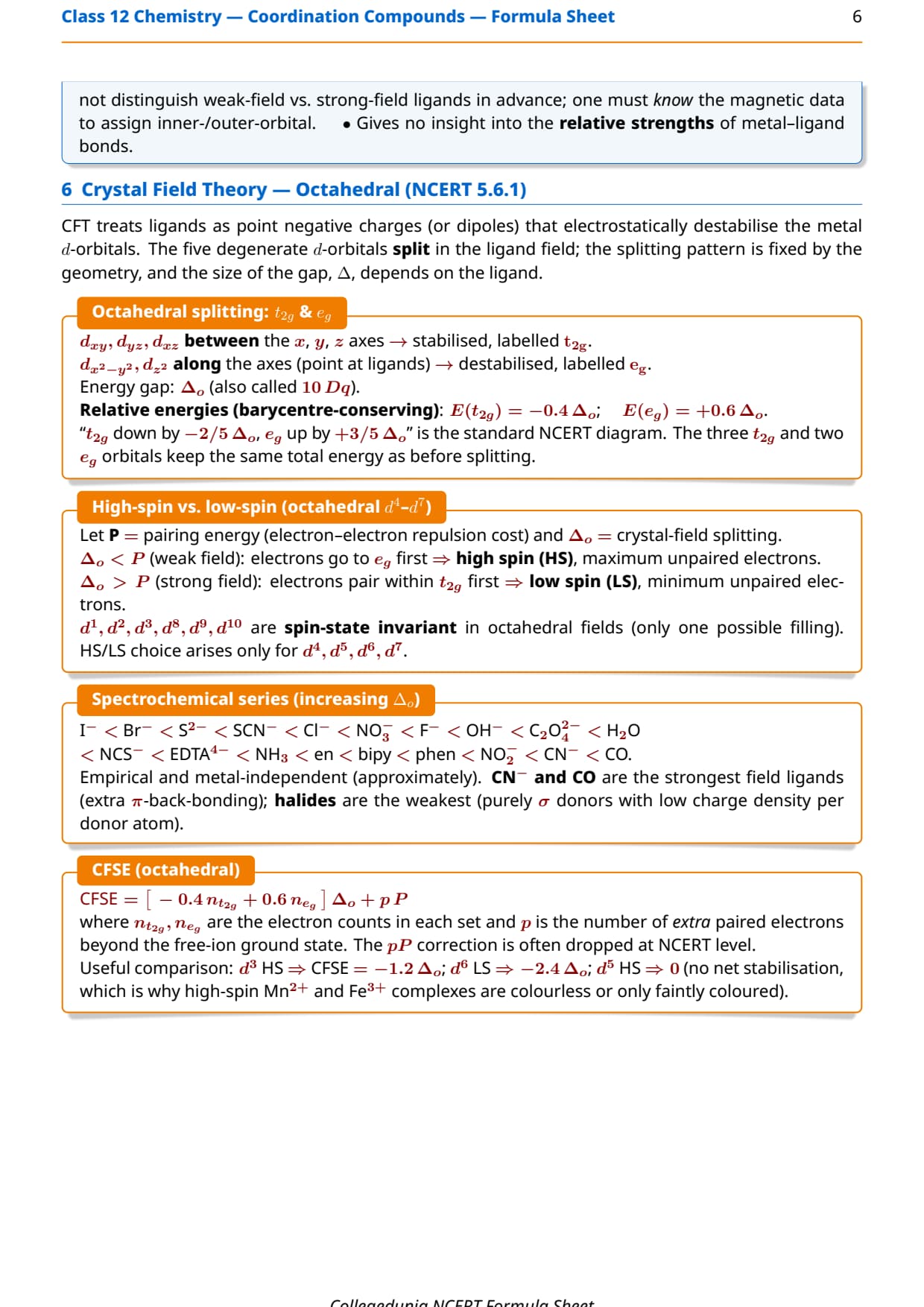
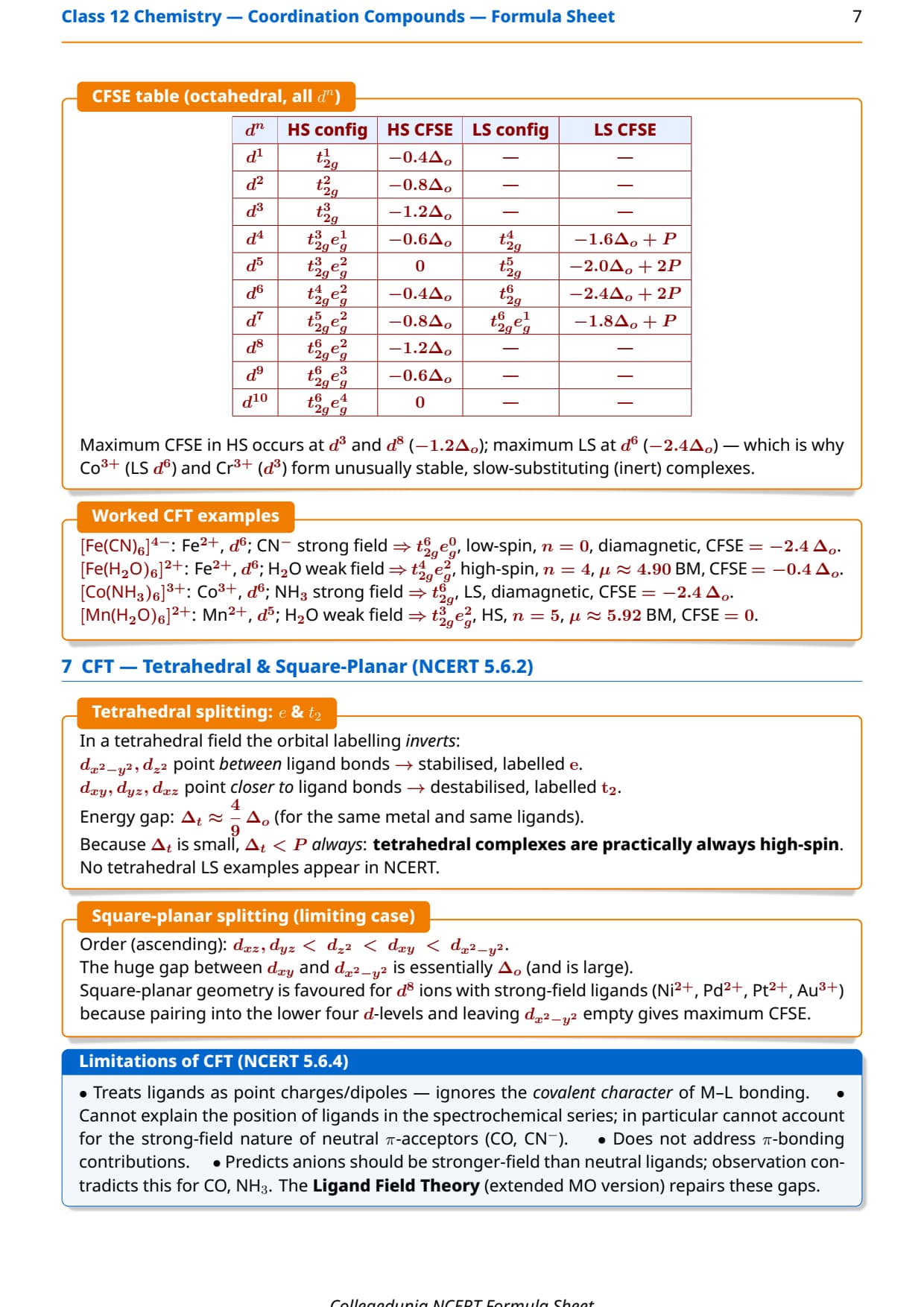
| Tetrahedral vs octahedral splitting | t = 49o ≈ 0.45 o | kJ mol-1 | 5.7 | Why tet is always high spin |
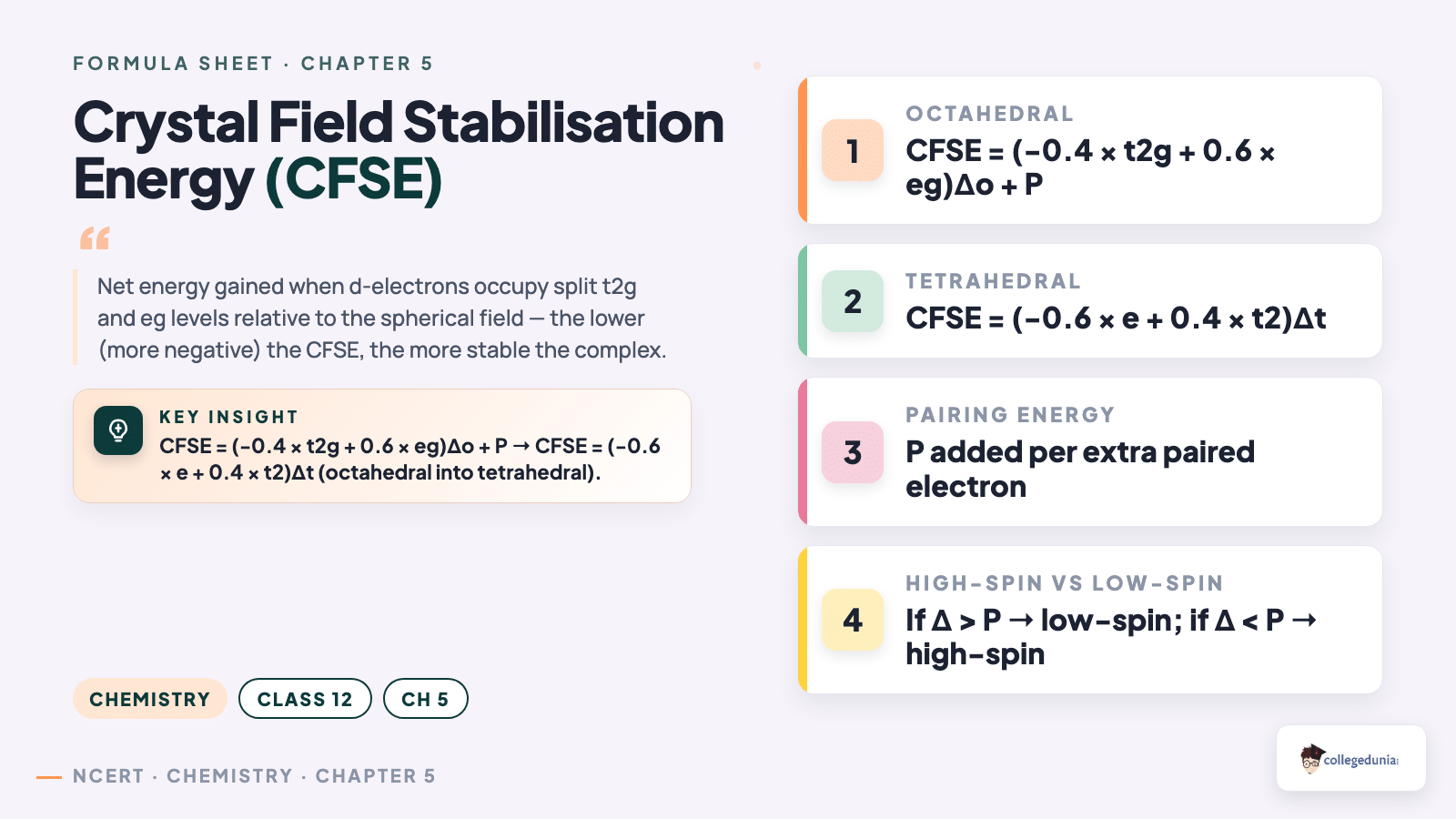
| CFSE (octahedral) | CFSE = [-0.4 n(t2g) + 0.6 n(eg)] o + xP | kJ mol-1 | 5.7 | Stability + spin state |
| CFSE (tetrahedral) | CFSE = [-0.6 n(e) + 0.4 n(t2)] t | kJ mol-1 | 5.7 | Always high spin |
| Low-spin condition | o > P | - | 5.7 | Strong-field ligand |
| High-spin condition | o < P | - | 5.7 | Weak-field ligand |
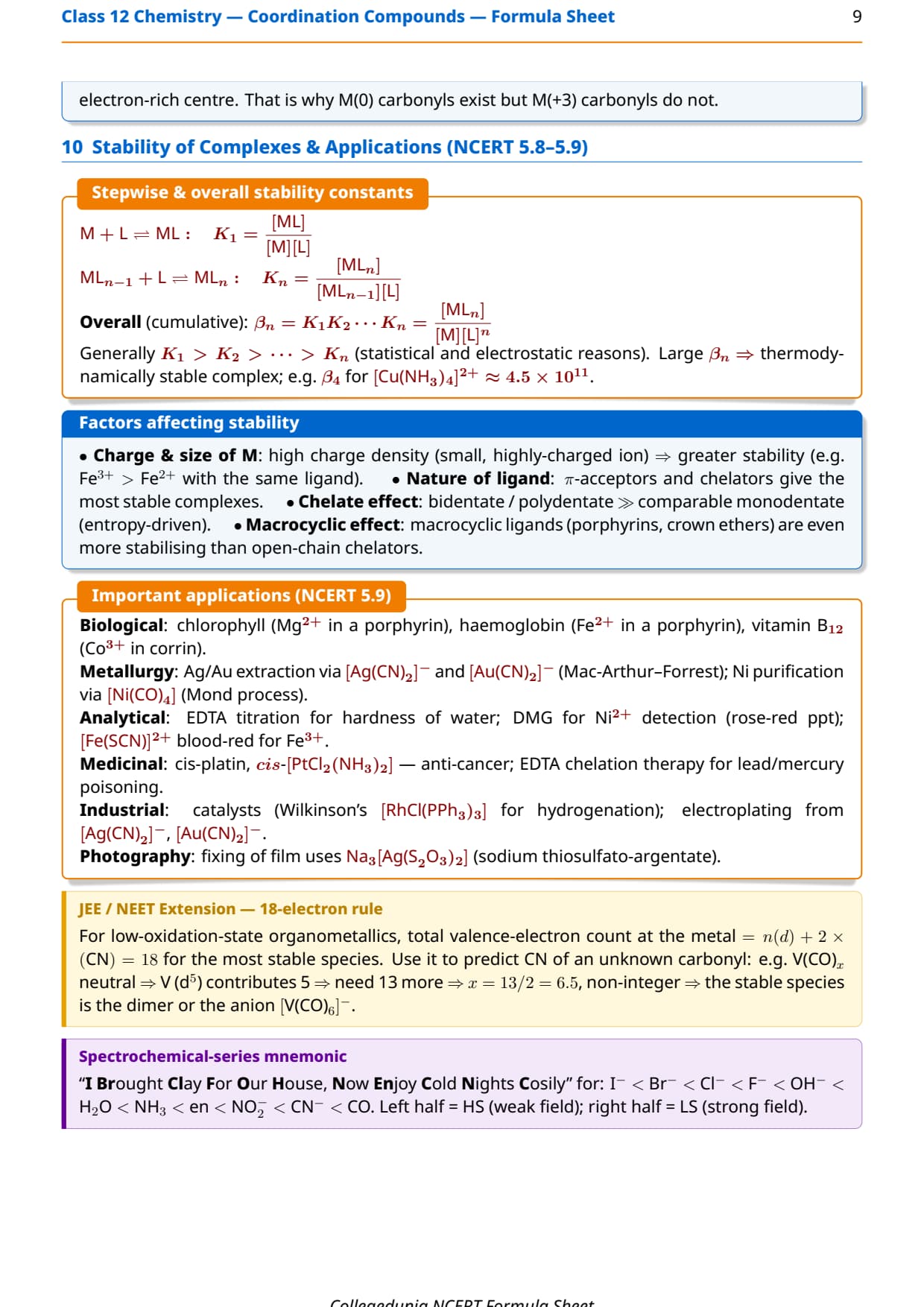
| Spectrochemical series (key cues) | I- < Br- < Cl- < F- < OH- < H2O < NH3 < en < NO2- < CN- < CO | - | 5.7 | Rank Δo |
| Stability constant (overall) | n = [MLn][M][L]n | varies | 5.6 | Compare complex stability |
| Stepwise stability | Kn = [MLn][MLn-1][L] | varies | 5.6 | K1 > K2 > ... typical |
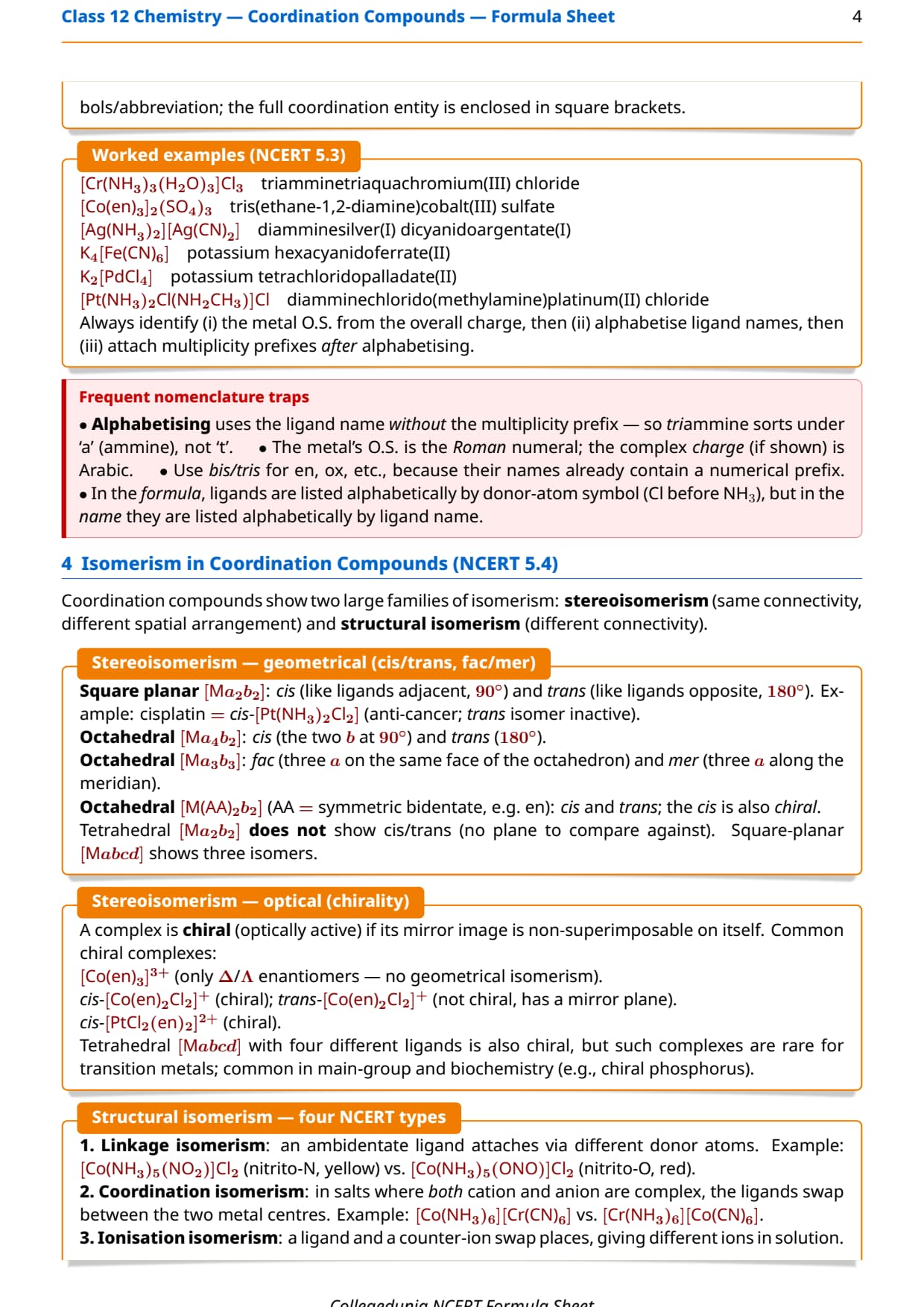
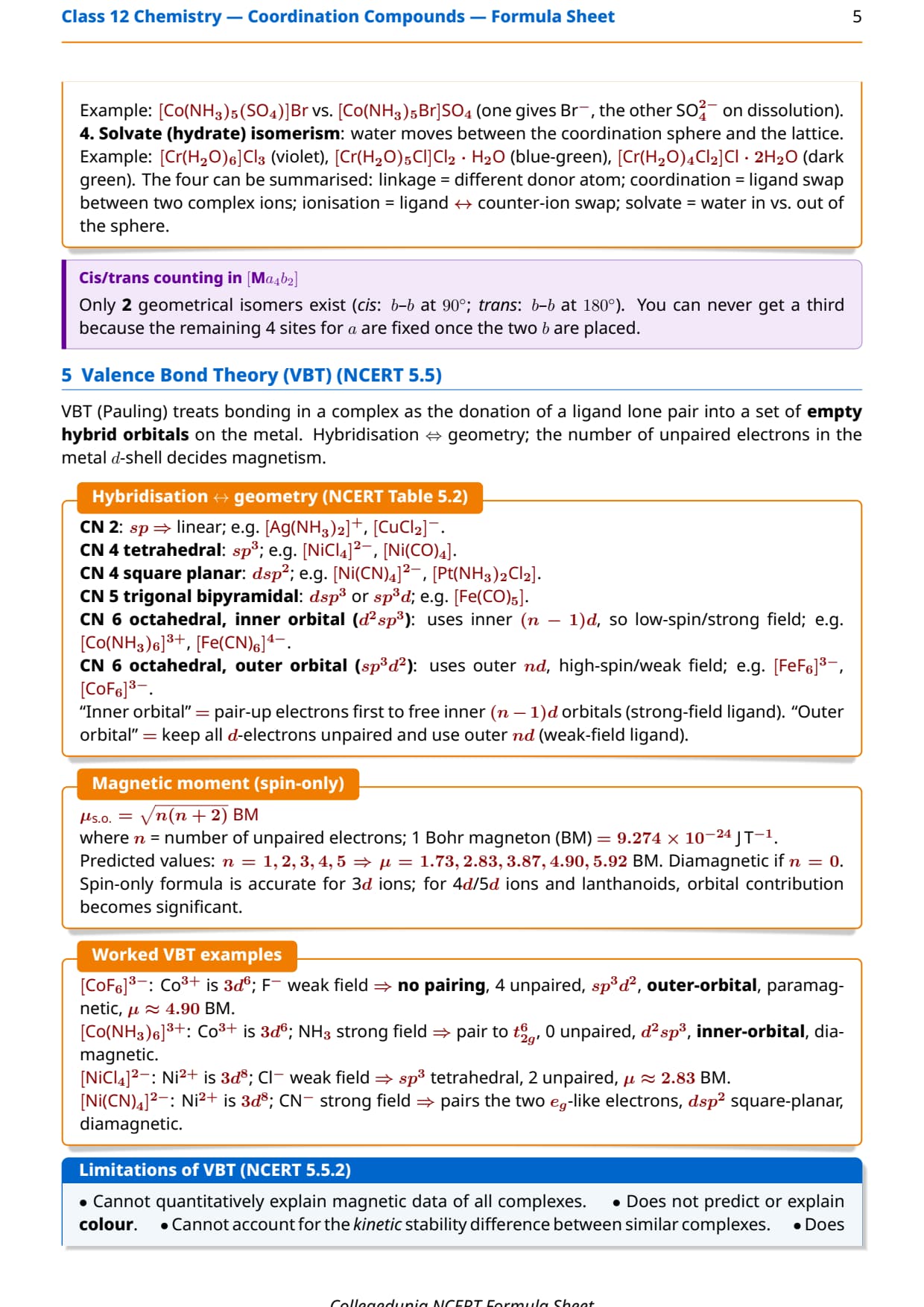
| Geometrical isomerism (CN 6) | [Ma4b2] → cis, trans | - | 5.4 | 2 isomers |
| Geometrical isomerism (CN 6) | [Ma3b3] → fac, mer | - | 5.4 | 2 isomers |
| Optical isomerism | [M(en)3]n+ → Δ, Λ | - | 5.4 | Chelate octahedral |
| Linkage isomerism | NO2- vs ONO-; SCN- vs NCS- | - | 5.4 | Ambidentate ligand |
| Wavelength of d-d transition | o = hcλ | J per ion | 5.7 | Colour of complex |
| Hybridisation (CN 4 sq planar) | dsp2 (inner) or sp2d | - | 5.7 | d8 low spin (Ni2+, Pt2+) |
| Hybridisation (CN 4 tetrahedral) | sp3 | - | 5.7 | NiCl42-, [Ni(CO)4] |
| Hybridisation (CN 6) | d2sp3 (inner) or sp3d2 (outer) | - | 5.7 | Low spin vs high spin |
CFSE shortcut: write the d-electron count, fill t2g and eg from the spectrochemical cue, then plug into the formula. Forgetting the +xP correction is the most common 1-mark slip in CFSE numericals.
How will Collegedunia's Coordination Compounds Formula Sheet Help You?
Built for a 30-minute last-pass revision before any Chemistry paper.
- 2026-27 NCERT Alignment: Matches Sections 5.1 to 5.8 of the current print.
- One-Page Printability: The master table fits one A4 landscape sheet.
- Field Tagging: Each ligand is tagged strong or weak so CFSE direction is instant.
- Expert Verification: Cross-checked against the last five JEE Main and NEET papers.
Why the Coordination Compounds Formula Sheet is a Top-Yield Asset for Class 12th Boards and Entrances
CBSE carries at least one 5-mark long-answer on this chapter in every board paper since 2019. JEE Main rotates two to four CFSE, hybridisation, or isomer MCQs per paper, and NEET asks one EAN or magnetic-moment question every year.
When to Use Which Formula in Coordination Compounds
Match the question stem to the formula.
- "Find OS of M in [M(L)n]q": OS = q - sum of ligand charges. Neutral ligands contribute 0.
- "Compute EAN": EAN = Z(M) - OS(M) + 2 x CN. Compare with nearest noble-gas number.
- "Calculate μ": read spin state from the ligand field, count unpaired d-electrons, apply μ = √n(n+2) BM.
- "Predict hybridisation": CN 4 weak → sp3; CN 4 strong d8 → dsp2; CN 6 strong → d2sp3; CN 6 weak → sp3d2.
- "Count isomers": apply the geometrical-isomer rules and check optical activity in chelated octahedrals.
Coordination Compounds CFSE Configuration Reference Table
These CFSE rows cover almost every numerical asked since 2021. Use them as the lookup table while solving.
| d-electron count | Field | t2g, eg filling | CFSE | Unpaired e- |
|---|---|---|---|---|
| d4 | Weak (high spin) | t2g3 eg1 | -0.6 Δo | 4 |
| d4 | Strong (low spin) | t2g4 eg0 | -1.6 Δo + P | 2 |
| d5 | Weak (high spin) | t2g3 eg2 | 0 | 5 |
| d5 | Strong (low spin) | t2g5 eg0 | -2.0 Δo + 2P | 1 |
| d6 | Weak (high spin) | t2g4 eg2 | -0.4 Δo | 4 |
| d6 | Strong (low spin) | t2g6 eg0 | -2.4 Δo + 2P | 0 |
| d7 | Weak (high spin) | t2g5 eg2 | -0.8 Δo | 3 |
| d7 | Strong (low spin) | t2g6 eg1 | -1.8 Δo + P | 1 |
Related Links:
- d- and f-Block Elements Class 12 Chemistry Formula Sheet
- Haloalkanes and Haloarenes Class 12 Chemistry Formula Sheet
Student Feedback
In a Collegedunia poll of 900 Class 12 students, 78% said the one-page CFSE and hybridisation table cut their Coordination Compounds revision time before boards.
Other Resources for Coordination Compounds Class 12 Chemistry
- Coordination Compounds Class 12 Chemistry Formula Sheet
- Coordination Compounds Class 12 Chemistry NCERT Solutions
- Coordination Compounds Class 12 Chemistry Notes
- Coordination Compounds Class 12 Chemistry NCERT Book PDF
- Coordination Compounds Class 12 Chemistry NCERT Exemplar Book PDF
- Coordination Compounds Class 12 Chemistry NCERT Exemplar Solutions
- Coordination Compounds Class 12 Chemistry Handwritten Notes
NCERT Formula Sheet for Class 12 Chemistry: All Chapters
Jump to the formula sheet for any other chapter of Class 12 Chemistry below.
| Chapter | Resource |
|---|---|
| Chapter 1 | Solutions Formula Sheet |
| Chapter 2 | Electrochemistry Formula Sheet |
| Chapter 3 | Chemical Kinetics Formula Sheet |
| Chapter 4 | d- and f-Block Elements Formula Sheet |
| Chapter 6 | Haloalkanes and Haloarenes Formula Sheet |
| Chapter 7 | Alcohols, Phenols and Ethers Formula Sheet |
| Chapter 8 | Aldehydes, Ketones and Carboxylic Acids Formula Sheet |
| Chapter 9 | Amines Formula Sheet |
| Chapter 10 | Biomolecules Formula Sheet |
Coordination Compounds Class 12 Chemistry Formula Sheet FAQs
Ques. Where can I download the Coordination Compounds Class 12 Chemistry Formula Sheet PDF?
Ans. You can download the Coordination Compounds Class 12 Chemistry Formula Sheet PDF directly from this Collegedunia page. Both the Normal and HD versions are available and free.
Ques. Is this Formula Sheet aligned with the 2026-27 NCERT?
Ans. Yes. This page reflects the current 2026-27 syllabus for Class 12 Chemistry. The Coordination Compounds chapter is fully retained in the new edition with no formula cuts; every relation in Sections 5.1 to 5.8 of the NCERT remains examinable.
Ques. How many pages is the Class 12th Chemistry Coordination Compounds Formula Sheet PDF?
Ans. The Formula Sheet PDF runs approximately 8 pages and covers the master formula table, symbol glossary, CFSE configuration reference, quick-fact MCQ cards, when-to-use decision tree, and four common numerical pattern templates.
Ques. What is the formula for CFSE in an octahedral complex?
Ans. The crystal field stabilisation energy of an octahedral complex is CFSE = [-0.4 n(t2g) + 0.6 n(eg)] Δo + xP, where n(t2g) and n(eg) are the electrons in the lower and higher d-orbital sets and xP is the energy cost of x extra electron pairs formed (relative to the free ion).
Ques. How do I compute the EAN of a coordination complex?
Ans. EAN (Effective Atomic Number) = Z(M) - OS(M) + 2 x CN, where Z(M) is the atomic number of the central metal, OS is its oxidation state, and CN is the coordination number. For [Ni(CO)4], EAN = 28 - 0 + 8 = 36 (Kr config), justifying the high stability.
Ques. Why is Δt always less than Δo?
Ans. For the same metal, ligands and bond distances, Δt = (4/9) Δo ≈ 0.45 Δo. Tetrahedral geometry has only 4 ligands (vs 6) and none of them sits directly along the d-orbital lobes, so the splitting is smaller. Consequently Δt never exceeds the pairing energy P, and tetrahedral complexes are always high spin.
Ques. How do I rank ligands using the spectrochemical series?
Ans. The series ranks ligands by the Δo they produce: I- < Br- < Cl- < F- < OH- < H2O < NH3 < en < NO2- < CN- < CO. Strong-field ligands at the right end (CN-, CO, en, NO2-) drive low-spin configurations; weak-field ligands at the left end (halides, water) keep complexes high spin.
Ques. What types of isomerism are shown by coordination compounds?
Ans. Coordination compounds show structural isomerism (ionisation, hydrate, linkage, coordination) and stereoisomerism (geometrical cis-trans and fac-mer, optical Δ / Λ). [Co(NH3)4Cl2]+ shows cis-trans; [Co(en)3]3+ shows optical activity; NO2- vs ONO- gives linkage isomers.
Ques. What is the spin-only magnetic moment formula for coordination compounds?
Ans. The spin-only magnetic moment is μ = √n(n+2) BM, where n is the number of unpaired d-electrons in the metal ion after considering the ligand field. Quick values: n = 1 gives 1.73 BM, n = 2 gives 2.83 BM, n = 3 gives 3.87 BM, n = 4 gives 4.90 BM, n = 5 gives 5.92 BM. Always classify the ligand as strong or weak field first, then count unpaired electrons.
Ques. What is the difference between primary valence and secondary valence in Werner's theory?
Ans. Primary valence equals the oxidation state of the central metal, is ionisable, and is satisfied by anions outside the coordination sphere. Secondary valence equals the coordination number, is non-ionisable, satisfied by ligands inside the sphere, and is directional - it fixes the geometry. In [Co(NH3)5Cl]Cl2, Co3+ has primary valence 3 and secondary valence 6.
Ques. What is the chelate effect and why does it stabilise complexes?
Ans. The chelate effect is the extra thermodynamic stability of complexes formed by polydentate (chelating) ligands compared to monodentate-only analogues. The driver is entropy: replacing two monodentate ligands with one bidentate ligand releases free water molecules into the bulk, raising disorder. [Ni(en)3]2+ is about 105 times more stable than [Ni(NH3)6]2+; EDTA4- sequesters Pb2+ and Hg2+ in heavy-metal therapy through five chelate rings.
Ques. What is the synergic effect in metal carbonyls like Ni(CO)4?
Ans. Metal carbonyls have a two-way bond. The C lone pair of CO donates into an empty metal hybrid orbital ( σ donation), and a filled metal d-orbital donates back into the empty π* anti-bonding orbital of CO ( π back-bonding). Back-donation strengthens the M-C bond and weakens the C-O bond, dropping the C-O stretching frequency from 2143 cm-1 in free CO to roughly 2050 cm-1 in Ni(CO)4. Ni(CO)4 uses sp3 hybridisation, is tetrahedral and diamagnetic, with EAN = 36.
Ques. Which coordination compounds appear in biology - haemoglobin, chlorophyll, Vitamin B12?
Ans. Haemoglobin is an Fe2+-porphyrin complex that binds O2 reversibly. Chlorophyll is the Mg2+-porphyrin (chlorin) that drives photosynthesis. Vitamin B12 (cyanocobalamin) is a Co3+-corrin complex with CN- as the sixth ligand. Cisplatin (cis-[Pt(NH3)2Cl2]) is the platinum anticancer drug; only the cis isomer cross-links with DNA. EDTA chelates lead and mercury in heavy-metal therapy.



Comments