




The NCERT Formula Sheet for Class 12 Chemistry Chapter 9 Amines helps you revise every important reaction and trend in one place. Check the Collegedunia formulas below.
- CBSE Weightage: 4 to 6 marks
- JEE Main Weightage: 2 to 3 percent (2 to 3 questions per paper)
- NEET Weightage: 1 to 2 questions per year
Curated by Collegedunia subject experts and mapped to the 2026-27 NCERT edition.
Also Check:
- Amines Class 12 Chemistry Notes
- Amines Class 12 Chemistry NCERT Solutions
- CBSE Class 12 Chemistry Syllabus 2026-27
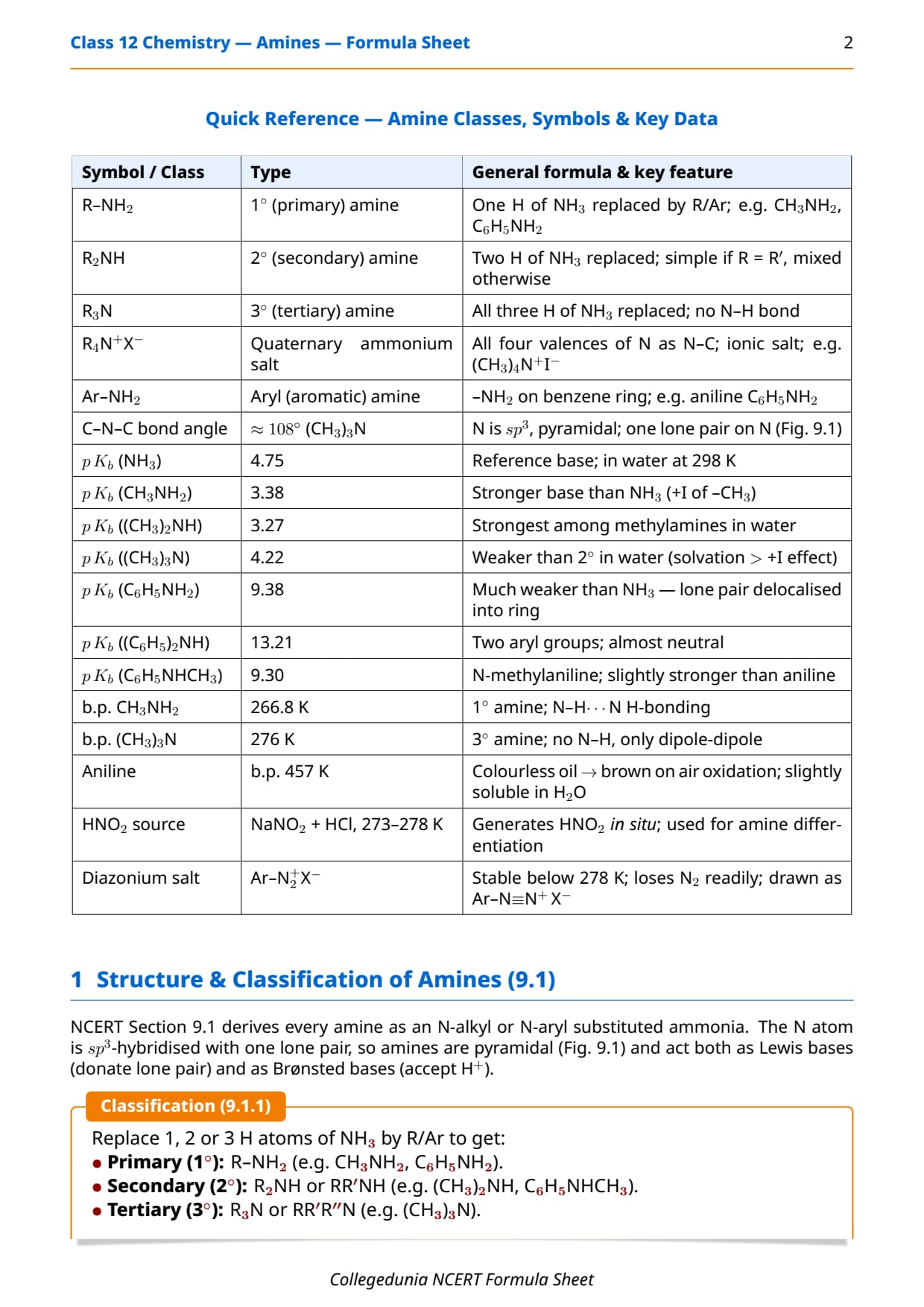
Amines Symbol and Notation Glossary for 12th Chemistry
Every notation used in the master table is defined below.
| Symbol | Meaning |
|---|---|
| R-NH2 | Primary (1°) amine |
| R2NH or R-NHR' | Secondary (2°) amine |
| R3N | Tertiary (3°) amine |
| R4N+X- | Quaternary ammonium salt |
| Ar-NH2 | Arylamine |
| Ar-N2+X- | Arenediazonium salt |
| Kb, pKb | Base dissociation constant / its -log |
| +I effect | Inductive electron donation |
| EAS | Electrophilic aromatic substitution |
| EDG / EWG | Electron-donating / withdrawing group |
| PhSO2Cl | Benzenesulphonyl chloride (Hinsberg) |
| H3PO2 | Hypophosphorous acid |
Amines Class 12 Chemistry Explained
Source: Magnet Brains on YouTube
Amines All Important Formulae and Reactions for Class 12 Chemistry
The master table lists every formula, named reaction, and trend in NCERT Chapter 9 with reagents, conditions, and section reference. All entries are retained in the 2026-27 syllabus.
| Concept / Reaction | Formula / Equation | Conditions | NCERT Ref |
|---|---|---|---|
| Primary amine general formula | R-NH2 or CnH2n+3N (saturated) | - | 9.1 |
| Secondary amine | R2NH or R-NHR' | - | 9.1 |
| Tertiary amine | R3N | - | 9.1 |
| Quaternary ammonium salt | R4N+X- | - | 9.1 |
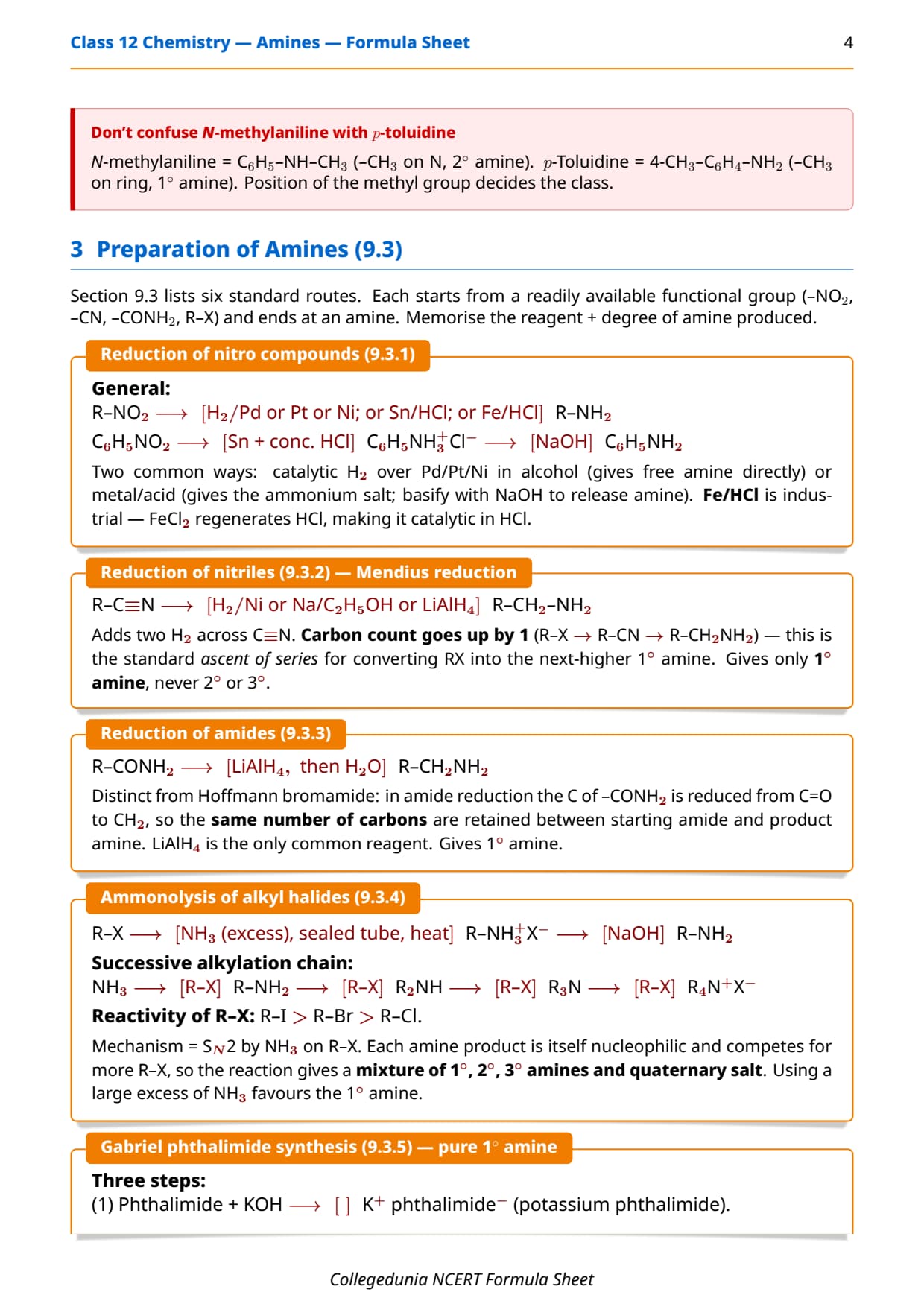
| 1. Reduction of nitro compound | R-NO2 H2/Ni or Fe/HCl R-NH2 | H2/Ni, Pd, Pt or Fe/HCl, Sn/HCl, Zn/HCl | 9.4 |
| 2. Ammonolysis of alkyl halide | R-X + NH3 EtOH, sealed, 373 K R-NH3+X- NaOH R-NH2 | excess NH3, sealed tube | 9.4 |
| 3. Reduction of nitrile (ascent) | R-C≡N LiAlH4/ether or H2/Ni R-CH2-NH2 | LiAlH4 dry ether | 9.4 |
| 4. Reduction of amide | R-CONH2 LiAlH4/ether R-CH2-NH2 | LiAlH4 | 9.4 |
| 5. Gabriel phthalimide synthesis | Phthalimide KOH K-phthalimide R-X N-alkyl OH-/H2O,Δ R-NH2 | aliphatic R-X only | 9.4 |
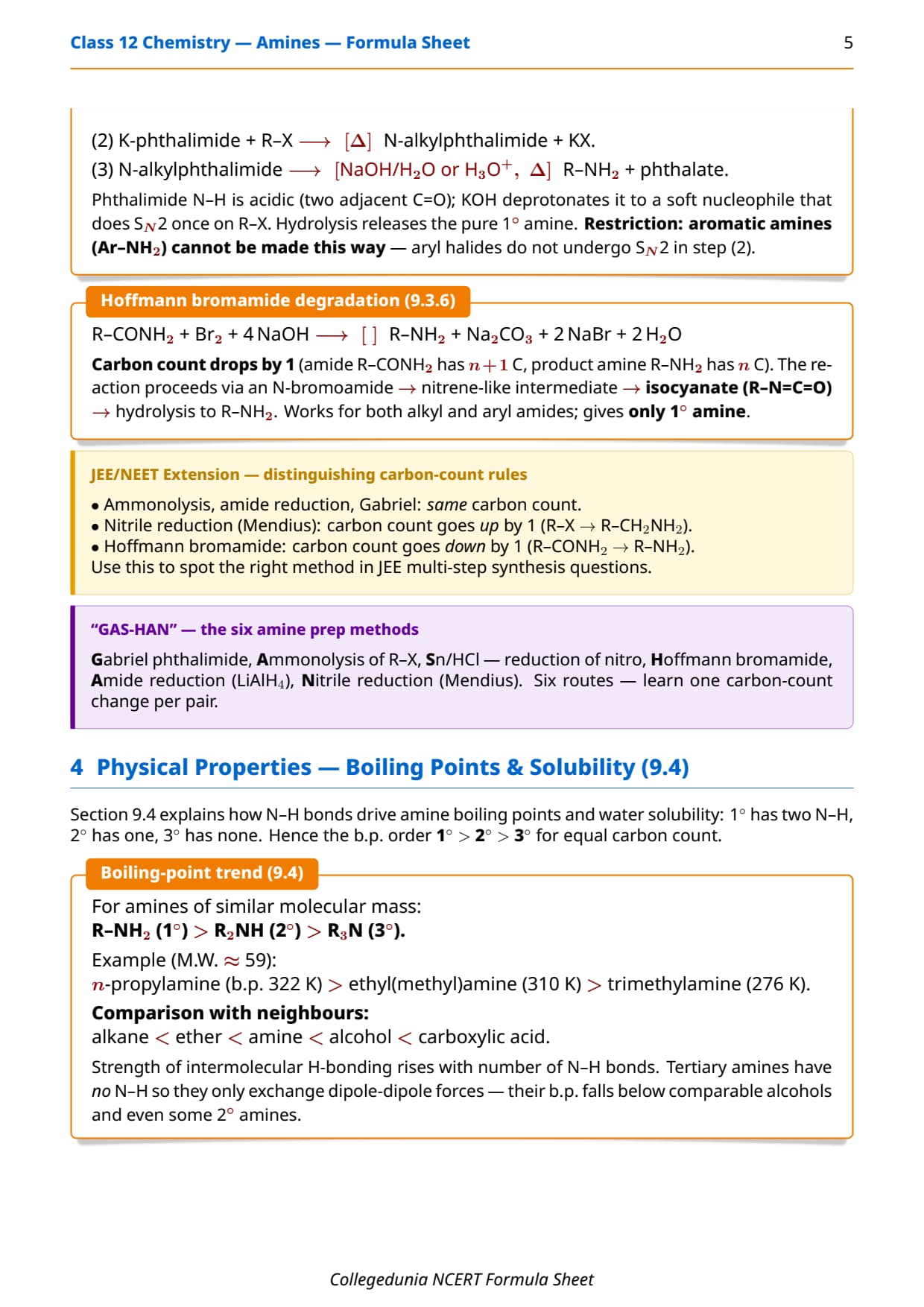
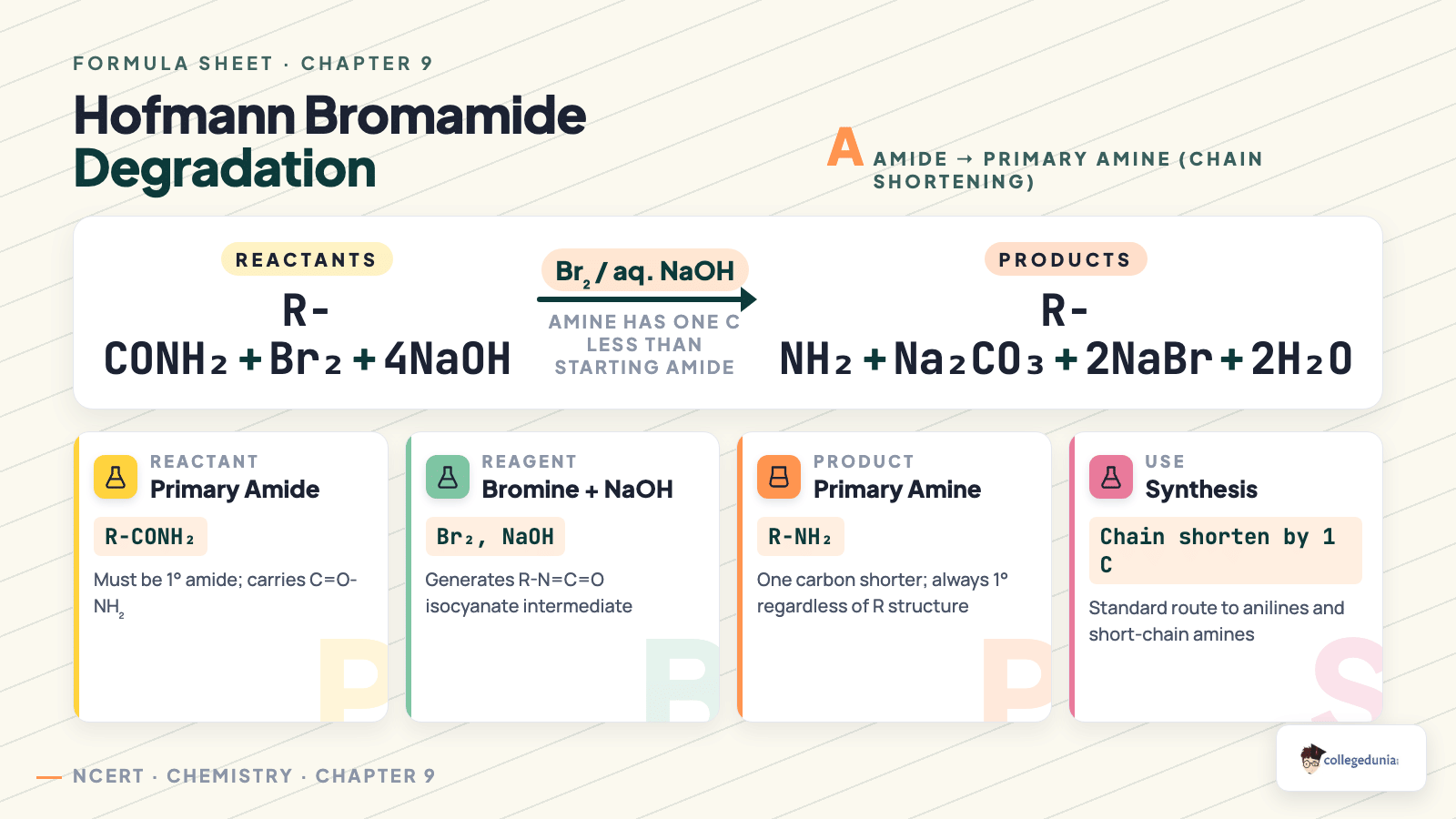
| 6. Hoffmann bromamide degradation | R-CONH2 + Br2 + 4NaOH → R-NH2 + Na2CO3 + 2NaBr + 2H2O | aq. Br2/NaOH | 9.4 |
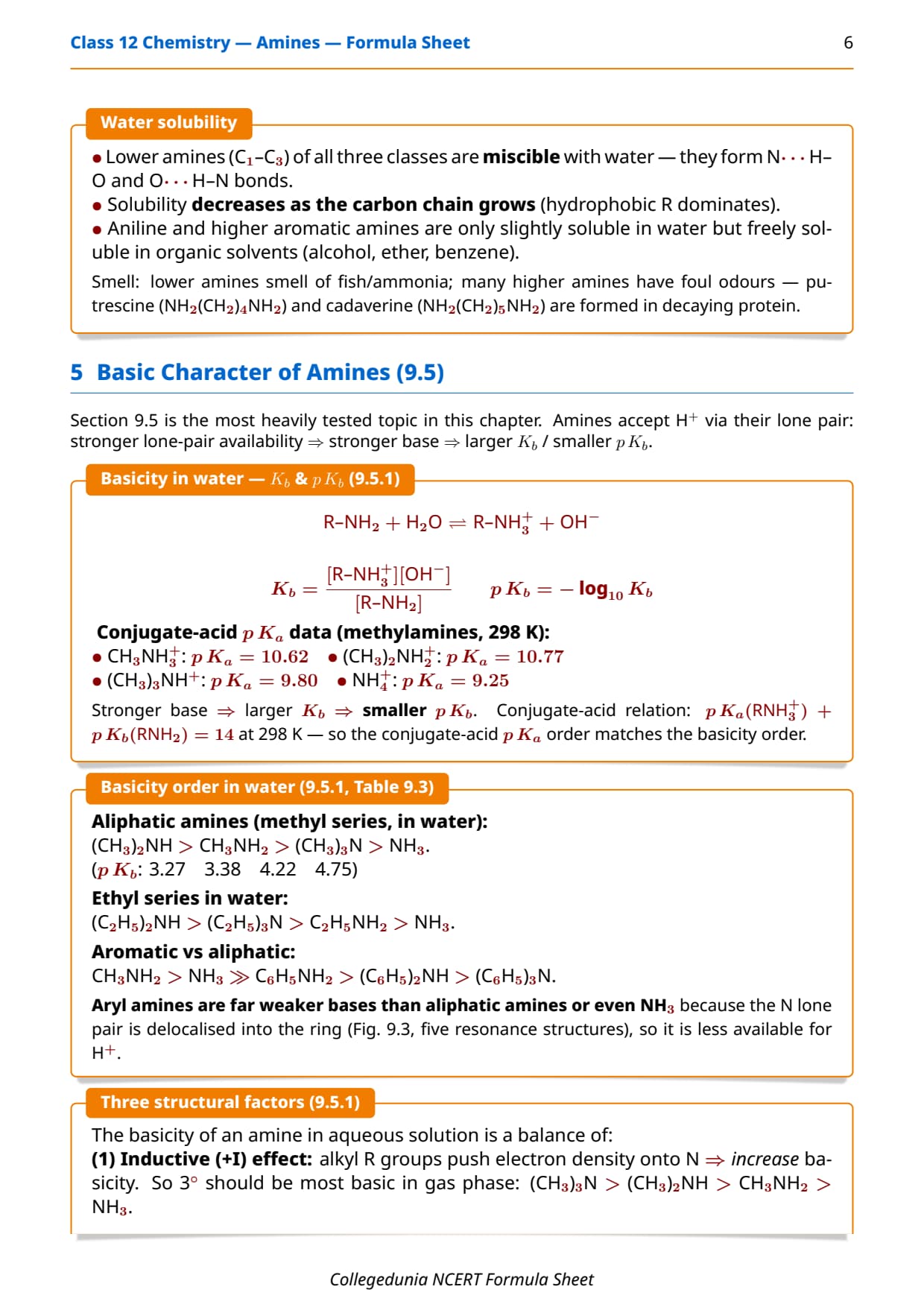
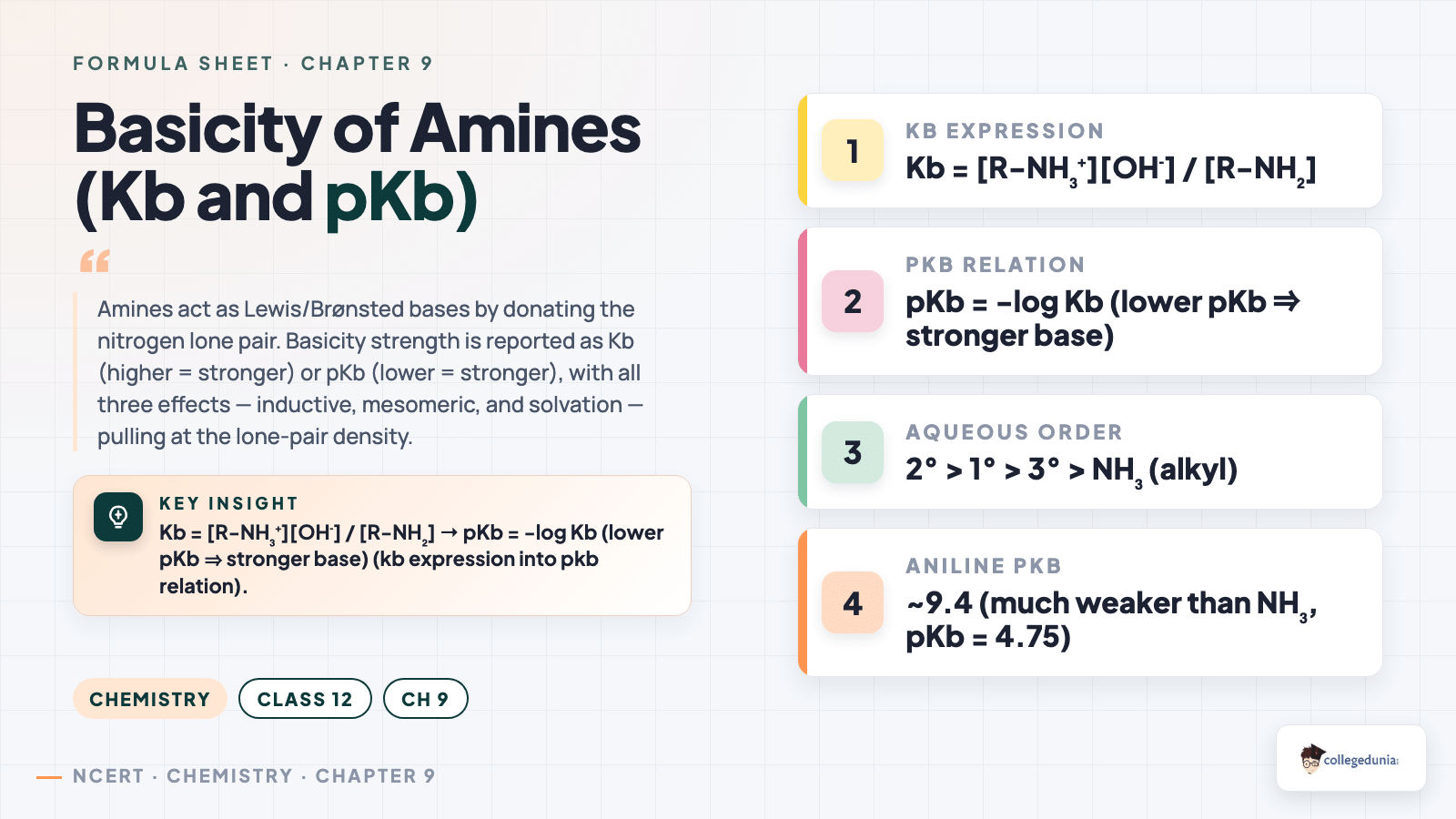
| Kb definition | Kb = [R-NH3+][OH-][R-NH2]; pKb = -log Kb | aq. soln. | 9.6 |
| Gas-phase basicity (alkyl) | 3∘ > 2∘ > 1∘ > NH3 | no solvent | 9.6 |
| Aqueous basicity (methyl series) | (CH3)2NH > CH3NH2 > (CH3)3N > NH3 | in water | 9.6 |
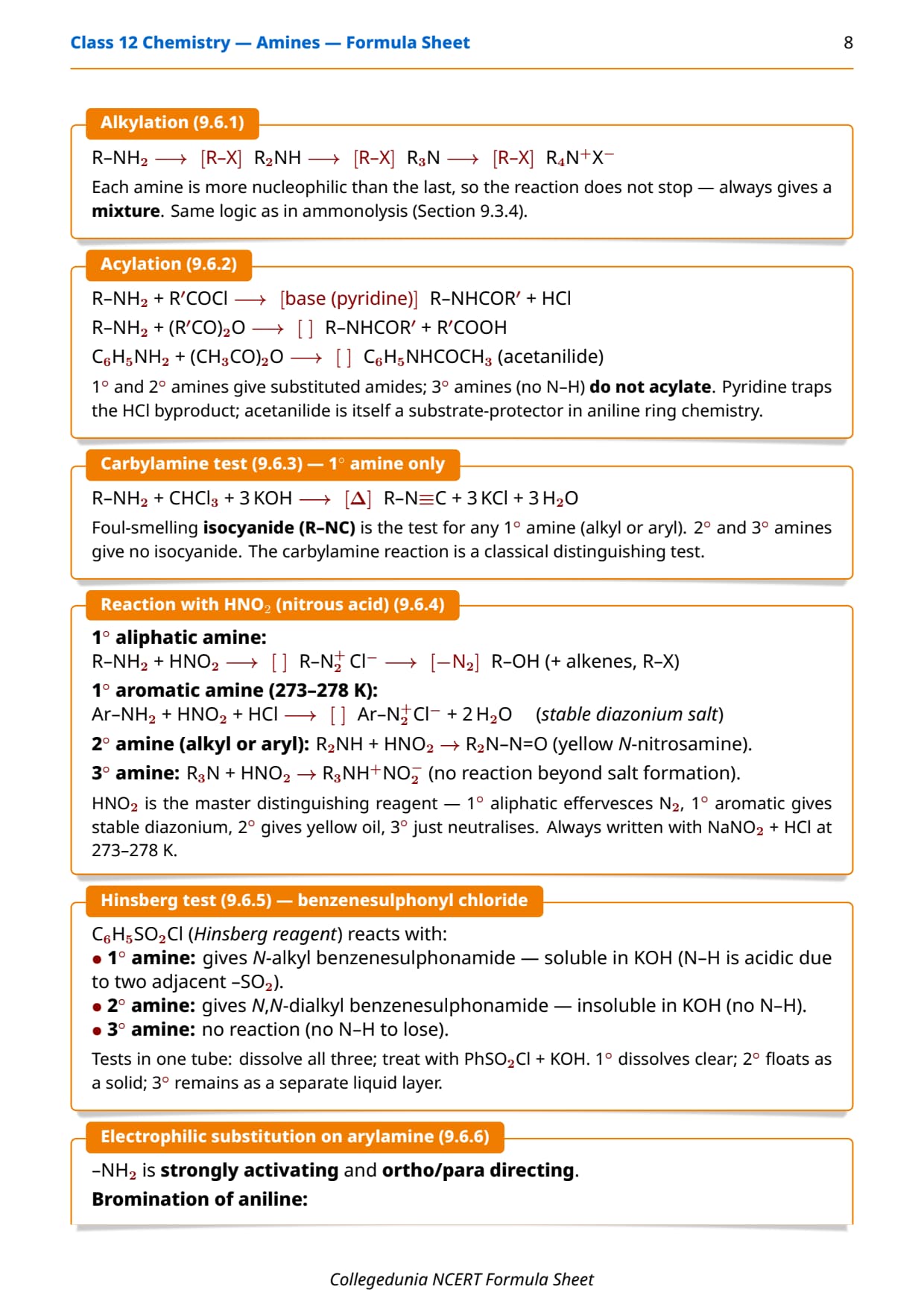
| Alkylation (over-alkylation) | R-NH2 R'X R-NHR' R'X R-NR'2 R'X R-NR'+3X- | R'-X excess | 9.6 |
| Acylation | R-NH2 + R'-COCl pyridine R-NH-CO-R' + HCl | pyridine mops up HCl | 9.6 |
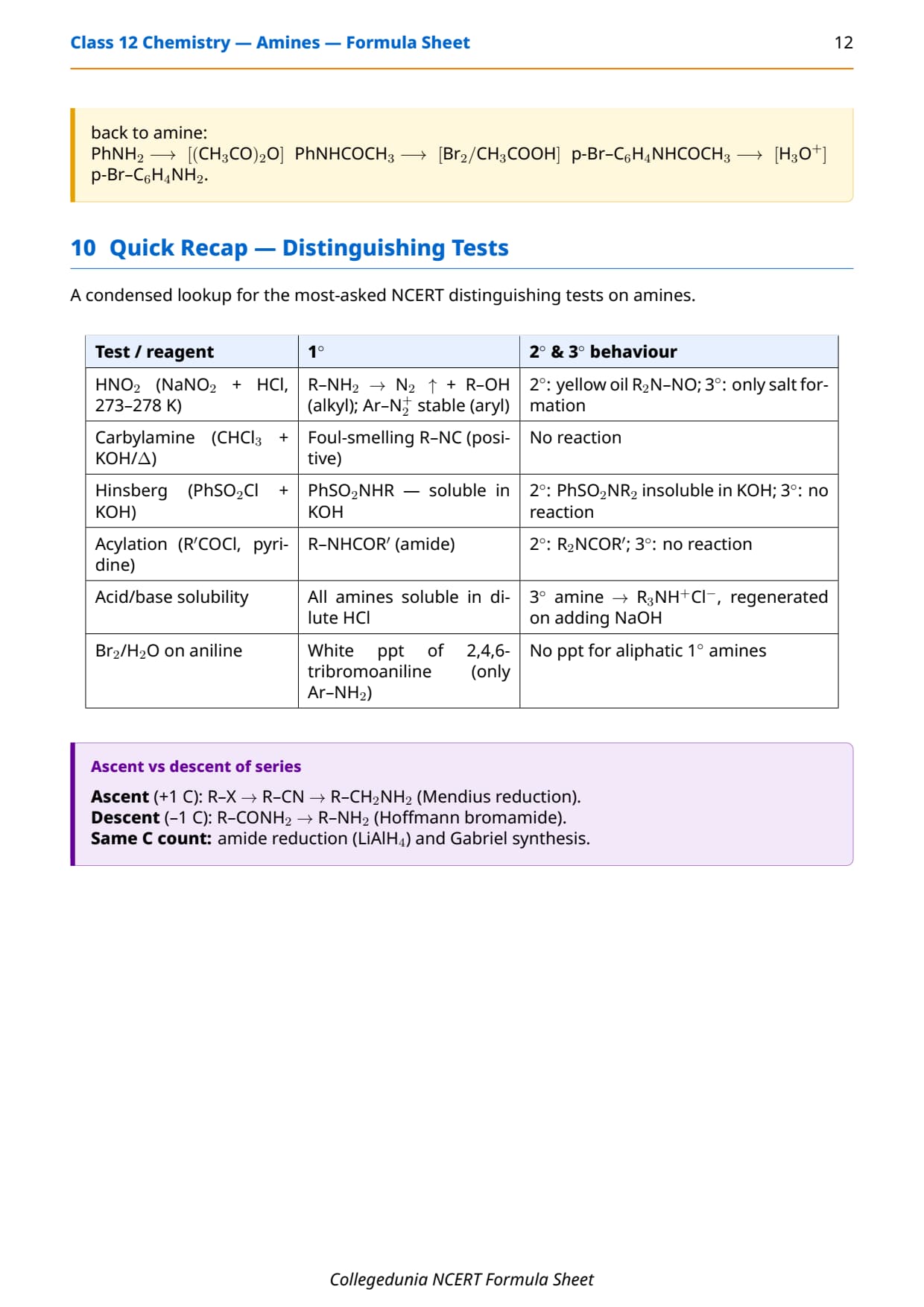
| Carbylamine test (1° only) | R-NH2 + CHCl3 + 3KOH Δ R-N≡C + 3KCl + 3H2O | alc. KOH, Δ | 9.6 |
| HNO2 on 1° aliphatic | R-NH2 + HNO2 → R-OH + N2↑ + H2O | NaNO2/HCl | 9.6 |
| HNO2 on 1° aromatic (diazotisation) | Ar-NH2 + NaNO2 + 2HCl 273-278 K Ar-N2+Cl- + NaCl + 2H2O | 273 to 278 K only | 9.7 |
| HNO2 on 2° amine | R2NH + HNO2 → R2N-N=O + H2O | NaNO2/HCl | 9.6 |
| Hinsberg test (1°/2°/3°) | 1°: R-NH2 + PhSO2Cl → PhSO2NHR (NaOH-soluble); 2°: R2NH → PhSO2NR2 (NaOH-insoluble); 3°: no rxn | PhSO2Cl + KOH | 9.6 |
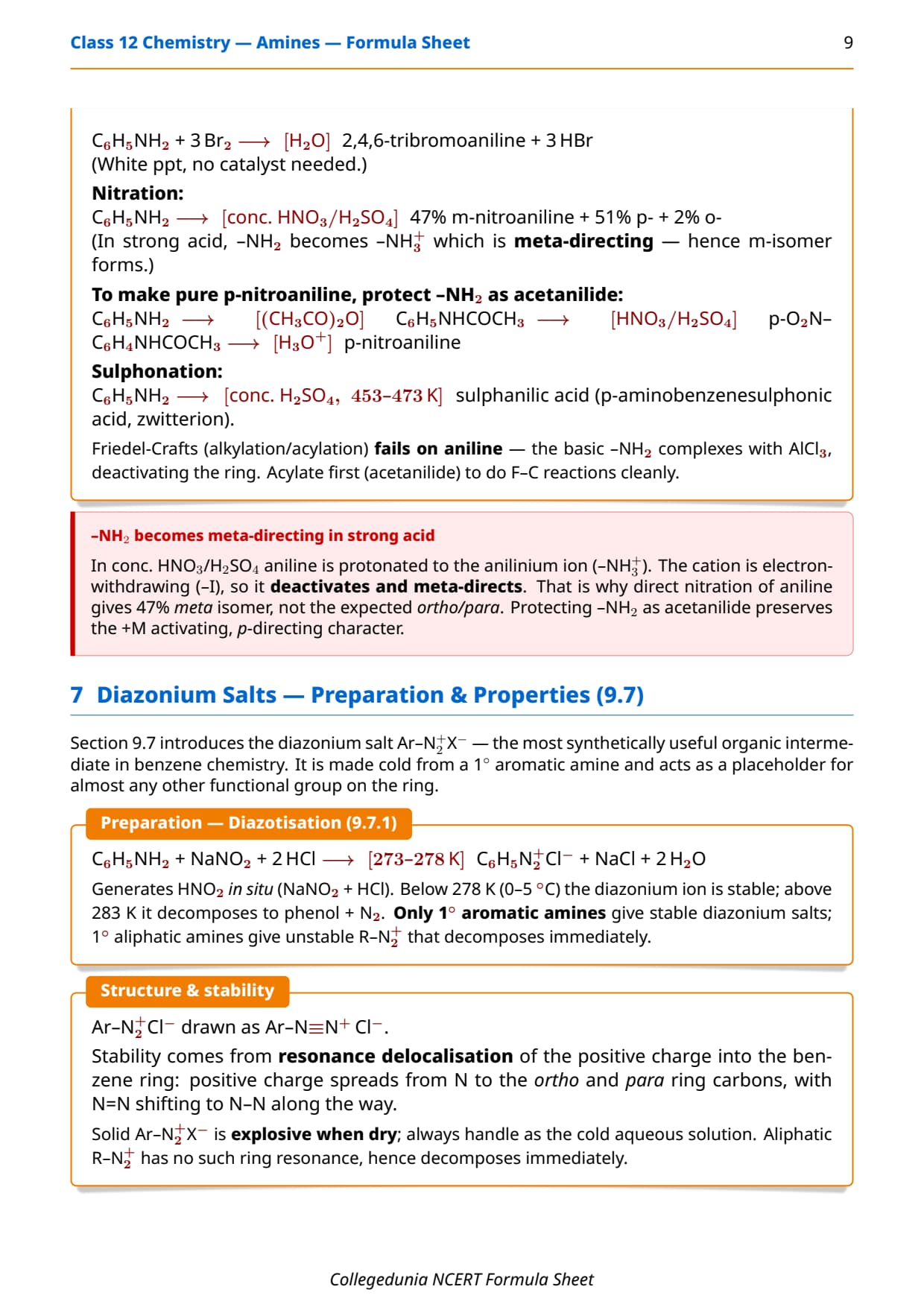
| Bromination of aniline (aq) | C6H5NH2 + 3Br2 → 2,4,6-tribromoaniline↓ + 3HBr | Br2/H2O, RT | 9.6 |
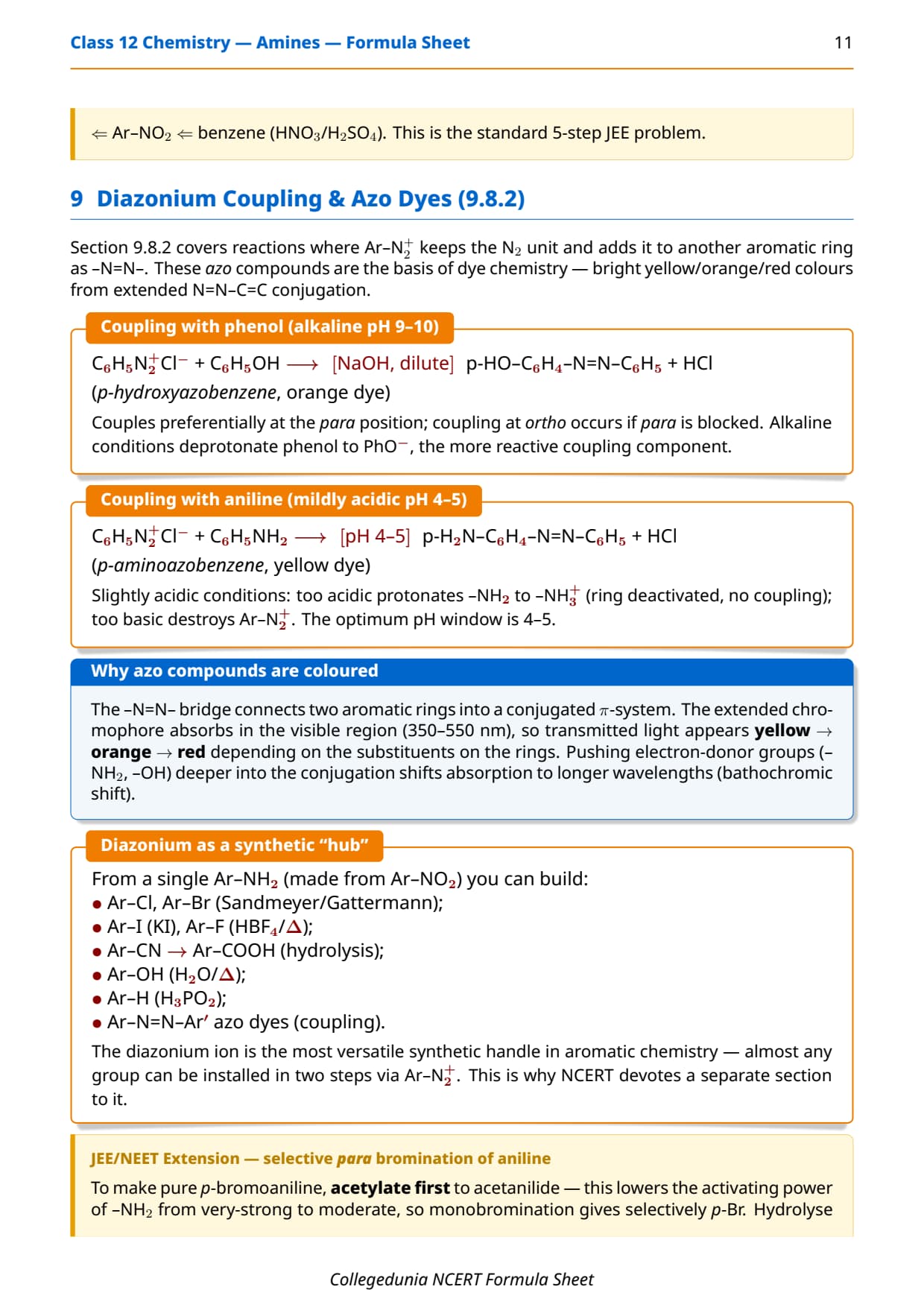
| Controlled p-bromoaniline | C6H5NH2 Ac2O acetanilide Br2/CH3COOH p-Br-acetanilide H3O+ p-bromoaniline | protect-brominate-deprotect | 9.6 |
| Nitration of aniline (direct) | C6H5NH2 HNO3/H2SO4 47% m + 51% p + 2% o | conc. HNO3/H2SO4, 288 K | 9.6 |
| Friedel-Crafts on aniline | fails | AlCl3 + R-Cl | 9.6 |
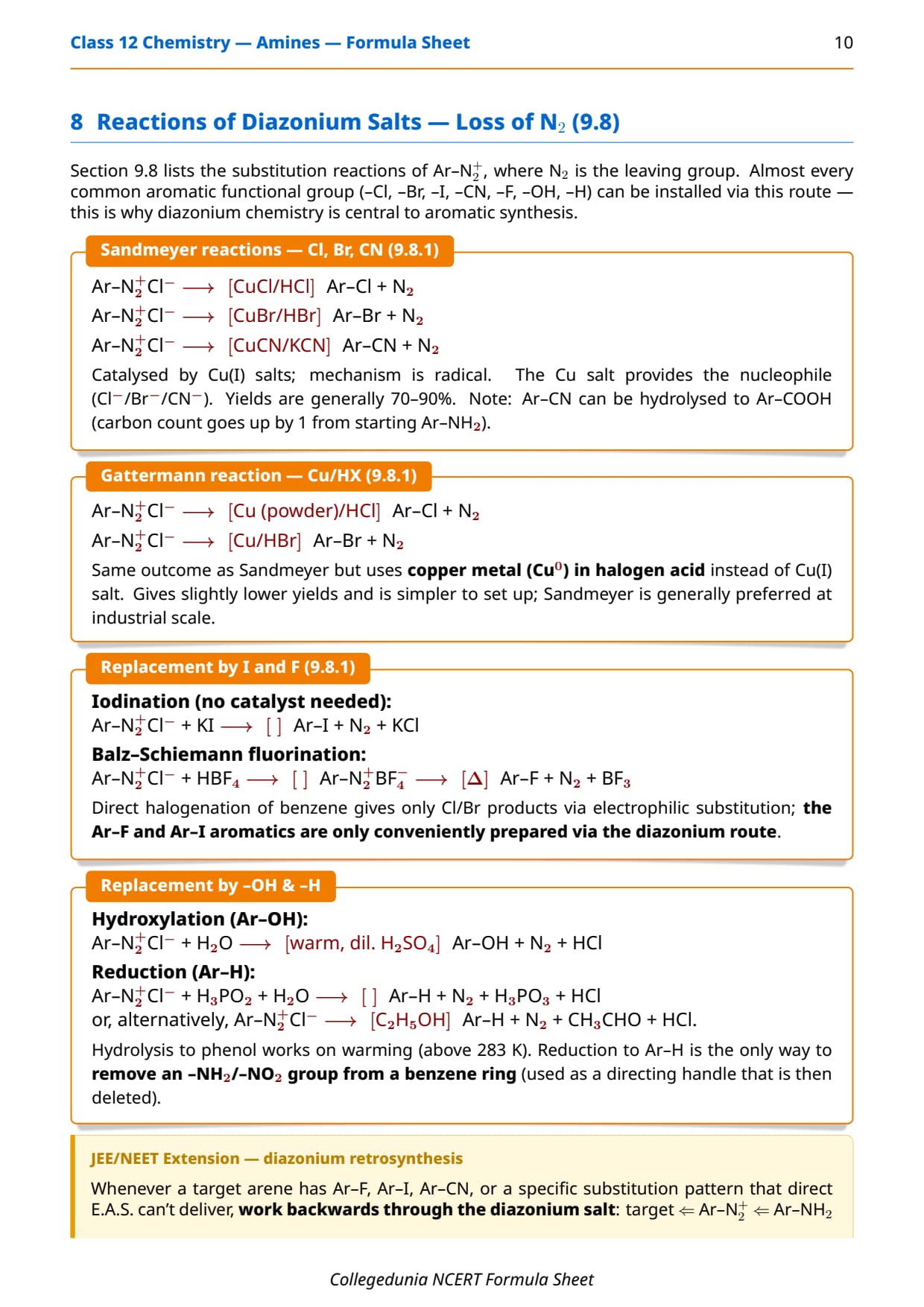
| Sandmeyer (Cl) | Ar-N2+Cl- CuCl/HCl Ar-Cl + N2↑ | Cu(I) catalyst | 9.9 |
| Sandmeyer (Br) | Ar-N2+Cl- CuBr/HBr Ar-Br + N2↑ | CuBr/HBr | 9.9 |
| Sandmeyer (CN) | Ar-N2+Cl- CuCN/KCN Ar-CN + N2↑ | CuCN/KCN | 9.9 |
| Gattermann (Cl, Br) | Ar-N2+Cl- Cu powder/HX Ar-X + N2↑ | Cu metal, HCl or HBr | 9.9 |
| Iodide (KI) | Ar-N2+Cl- + KI → Ar-I + N2↑ + KCl | aqueous KI | 9.9 |
| Schiemann (F) | Ar-N2+Cl- + HBF4 → Ar-N2+BF4- Δ Ar-F + N2↑ + BF3 | HBF4, dry heat | 9.9 |
| Reduction to arene (-H) | Ar-N2+Cl- + H3PO2 + H2O → Ar-H + N2↑ + H3PO3 + HCl | H3PO2 or EtOH | 9.9 |
| Hydroxyl (-OH, phenol) | Ar-N2+ + H2O → Ar-OH + N2↑ + H+ | warm to 283 K | 9.9 |
| Nitro (-NO2) | Ar-N2+BF4- + NaNO2 Cu Ar-NO2 + N2↑ | NaNO2/Cu | 9.9 |
| Coupling with phenol | C6H5N2+Cl- + C6H5OH OH-, 0-5 ∘ C p-HO-C6H4-N=N-C6H5 | mild base, 0 to 5°C | 9.9 |
Exam tip: Sandmeyer (CuX) and Gattermann (Cu metal + HX) give the same Ar-X product, but Sandmeyer wins on yield.
Basicity and Reactivity Reference Table for Amines
The trends below power most 1-mark basicity MCQs on Chapter 9.
| Compound | Structure | pKb | Class |
|---|---|---|---|
| Ammonia | NH3 | 4.75 | reference |
| Methanamine | CH3-NH2 | 3.38 | aliphatic 1° |
| N-Methylmethanamine | (CH3)2-NH | 3.27 | aliphatic 2° |
| N,N-Dimethylmethanamine | (CH3)3-N | 4.22 | aliphatic 3° |
| Ethanamine | C2H5-NH2 | 3.29 | aliphatic 1° |
| N-Ethylethanamine | (C2H5)2-NH | 3.00 | aliphatic 2° |
| N,N-Diethylethanamine | (C2H5)3-N | 3.25 | aliphatic 3° |
| Phenylmethanamine (benzylamine) | C6H5-CH2-NH2 | 4.70 | aliphatic 1° |
| Aniline | C6H5-NH2 | 9.38 | aromatic 1° |
| N-Methylaniline | C6H5-NH-CH3 | 9.30 | aromatic 2° |
| N,N-Dimethylaniline | C6H5-N(CH3)2 | 8.92 | aromatic 3° |
| p-Toluidine | p-CH3-C6H4-NH2 | 8.92 | aromatic 1° |
| p-Nitroaniline | p-O2N-C6H4-NH2 | 13.0 | aromatic 1° |
Student Feedback
In a Collegedunia poll of 900 Class 12 students, 78% said the diazonium conversion rows and the Hinsberg-carbylamine test summary were the fastest part of this Amines sheet to revise before the exam.
Other Resources for Amines Class 12 Chemistry
NCERT Formula Sheet for Class 12 Chemistry: All Chapters
Jump to the formula sheet for any other chapter of Class 12 Chemistry below.
| Chapter | Resource |
|---|---|
| Chapter 1 | Solutions Formula Sheet |
| Chapter 2 | Electrochemistry Formula Sheet |
| Chapter 3 | Chemical Kinetics Formula Sheet |
| Chapter 4 | d- and f-Block Elements Formula Sheet |
| Chapter 5 | Coordination Compounds Formula Sheet |
| Chapter 6 | Haloalkanes and Haloarenes Formula Sheet |
| Chapter 7 | Alcohols, Phenols and Ethers Formula Sheet |
| Chapter 8 | Aldehydes, Ketones and Carboxylic Acids Formula Sheet |
| Chapter 10 | Biomolecules Formula Sheet |
Amines Class 12 Chemistry Formula Sheet FAQs
Ques. Where can I download the Amines Class 12 Chemistry Formula Sheet PDF?
Ans. You can download the Amines Class 12 Chemistry Formula Sheet PDF directly from this Collegedunia page. Both the Normal and HD versions are available and free of cost.
Ques. Is this Formula Sheet aligned with the 2026-27 NCERT?
Ans. Yes. This page reflects the current 2026-27 syllabus for Class 12 Chemistry. Amines is fully retained in the new edition with no formula cuts; every reaction in Sections 9.1 to 9.10 of the NCERT remains examinable.
Ques. How many pages is the Class 12th Chemistry Amines Formula Sheet PDF?
Ans. The Formula Sheet PDF runs approximately 9 pages and covers the master reaction table, symbol glossary, pKb reference, quick-fact MCQ cards, and four common numerical pattern templates.
Ques. What is the difference between Hoffmann bromamide and Gabriel phthalimide synthesis?
Ans. Both produce primary amines but differ in the starting material, the carbon count change, and the substrate scope. Hoffmann bromamide degradation starts from an amide (R-CONH2), uses Br2 with 4 equivalents of NaOH, and the product amine has one carbon fewer than the amide because the R group migrates from carbonyl C to N (alkyl and aryl amides both work). Gabriel phthalimide synthesis starts from phthalimide, alkylates with R-X (SN2), then hydrolyses to give a pure 1° amine with the same carbon count as the alkyl halide; it works only for aliphatic amines because aryl halides do not undergo SN2 on the phthalimide anion.
Ques. Why is aniline a weaker base than methylamine?
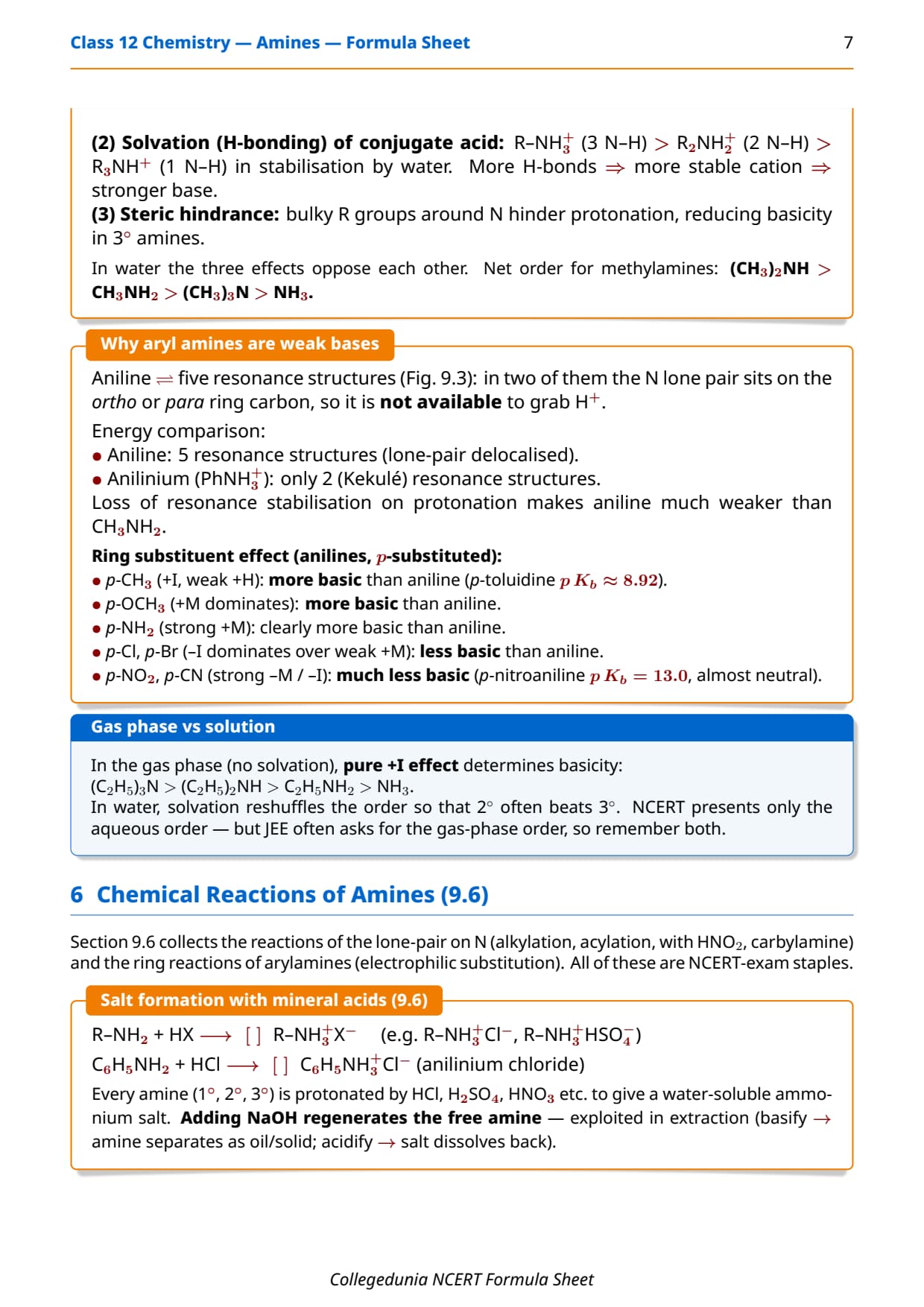
Ans. In aniline (C6H5-NH2), the lone pair on nitrogen is delocalised into the aromatic ring through five resonance structures, making it much less available to accept a proton. Once protonated, the anilinium ion (C6H5-NH3+) has only two Kekule resonance structures, so the cation is far less stabilised than the neutral aniline. Methylamine has no such delocalisation - the methyl group is a +I donor that increases electron density on N, so the lone pair is fully available and the methylammonium cation is stabilised by hyperconjugation. Numerically, pKb (aniline) = 9.38 versus pKb (methylamine) = 3.38, a roughly 106-fold difference in Kb.
Ques. Why are aryl diazonium salts stable while alkyl diazonium salts decompose immediately?
Ans. In an aryl diazonium salt (Ar-N2+), the positive charge on the terminal nitrogen is delocalised into the aromatic ring by resonance, spreading the charge over two nitrogen atoms and the ortho/para ring carbons. This delocalisation stabilises the cation enough for the salt to exist in aqueous solution at 273-278 K. In an alkyl diazonium salt (R-N2+), there is no aromatic ring to accept the charge; the localised positive nitrogen is immediately attacked by water or any nucleophile, releasing N2 gas and giving R-OH (or other substitution / elimination products). That is why HNO2 on a 1° aliphatic amine gives R-OH plus a measurable volume of N2, while the same reagent on a 1° aromatic amine gives an isolable diazonium chloride.
Ques. Why does Friedel-Crafts alkylation fail on aniline?
Ans. Friedel-Crafts reactions need a Lewis acid catalyst, typically AlCl3. The nitrogen lone pair of aniline is more basic than a typical aromatic electron pair, so AlCl3 coordinates strongly to N rather than activating the alkyl halide. This generates an Ar-N+H2-AlCl3- complex in which the N now bears a formal positive charge. The aryl ring connected to this strongly electron-withdrawing group is heavily deactivated, so any electrophile (the R+ or RCO+) cannot attack. The standard workaround is to protect the amine as acetanilide (C6H5-NHCOCH3), perform the Friedel-Crafts on the acetanilide, then hydrolyse back to the substituted aniline.
Ques. What is the Balz-Schiemann reaction and how does it appear in the formula table?
Ans. The Balz-Schiemann reaction is the only Class 12 route to aryl fluoride from an aryl diazonium salt. The diazonium chloride (Ar-N2+Cl-) is first treated with HBF4 to precipitate aryl diazonium fluoroborate (Ar-N2+BF4-), which is then heated dry to release N2 and BF3, leaving Ar-F. The formula table lists it as Schiemann under NCERT Section 9.9 with reagent "HBF4, dry heat" and the common-use cue "Only route to Ar-F".
Ques. What is the difference between Sandmeyer and Gattermann reagents?
Ans. Sandmeyer uses cuprous halide (CuCl, CuBr, or CuCN) dissolved in the corresponding halogen acid and gives high yields of aryl halide or aryl nitrile. Gattermann uses copper powder (Cu metal) in HCl or HBr and gives lower-yield aryl halides. Both convert Ar-N2+ to Ar-X (X = Cl, Br), but the catalyst tells them apart in an MCQ: Cu(I) salt = Sandmeyer, Cu metal + HX = Gattermann. The formula table shows both rows side by side under NCERT Section 9.9.
Ques. What is the basicity order of amines in gas phase versus aqueous solution?
Ans. In the gas phase, basicity follows the pure inductive (+I) effect: 3° > 2° > 1° > NH3. In aqueous solution, the order flips because the protonated amine (RnNH(4-n)+) needs N-H bonds to hydrogen-bond with water; fewer N-H bonds means less solvation, which destabilises the conjugate acid. The aqueous order is therefore 2° > 1° > 3° > NH3 for the methylamine series, and 2° > 3° > 1° > NH3 for bulkier ethyl groups. Aromatic amines (aniline) sit far below NH3 because the lone pair delocalises into the ring.
Ques. What is the Hinsberg test and how does it distinguish 1°, 2°, and 3° amines?
Ans. The Hinsberg test uses benzenesulphonyl chloride (C6H5SO2Cl) in aqueous KOH. A primary amine (R-NH2) reacts to give an N-monoalkyl sulphonamide (PhSO2NHR) whose remaining N-H is acidic enough to be deprotonated by NaOH, so the product is soluble in alkali. A secondary amine (R2NH) gives an N,N-dialkyl sulphonamide (PhSO2NR2) with no N-H, so it is insoluble in NaOH. A tertiary amine (R3N) has no N-H to start with and does not react at all - it remains free amine, which on acidification dissolves as the ammonium salt. The three outcomes - NaOH-soluble product, NaOH-insoluble product, no reaction - cleanly separate all three classes in one test.



Comments