



The class 10 civics handwritten notes chapter 2 Federalism have been carefully prepared and scanned for quick last-minute revision, according to the latest 2026-27 CBSE syllabus.
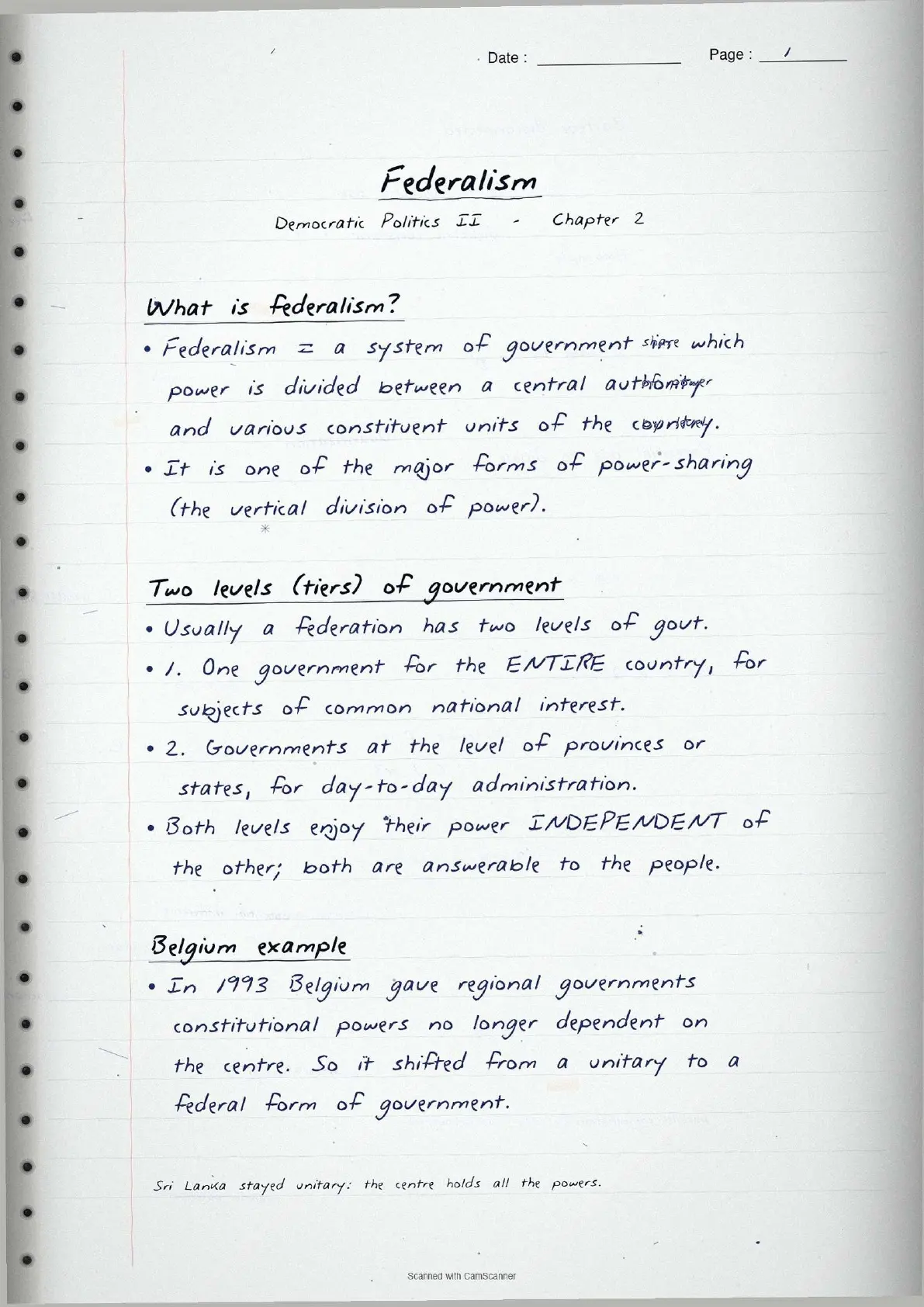
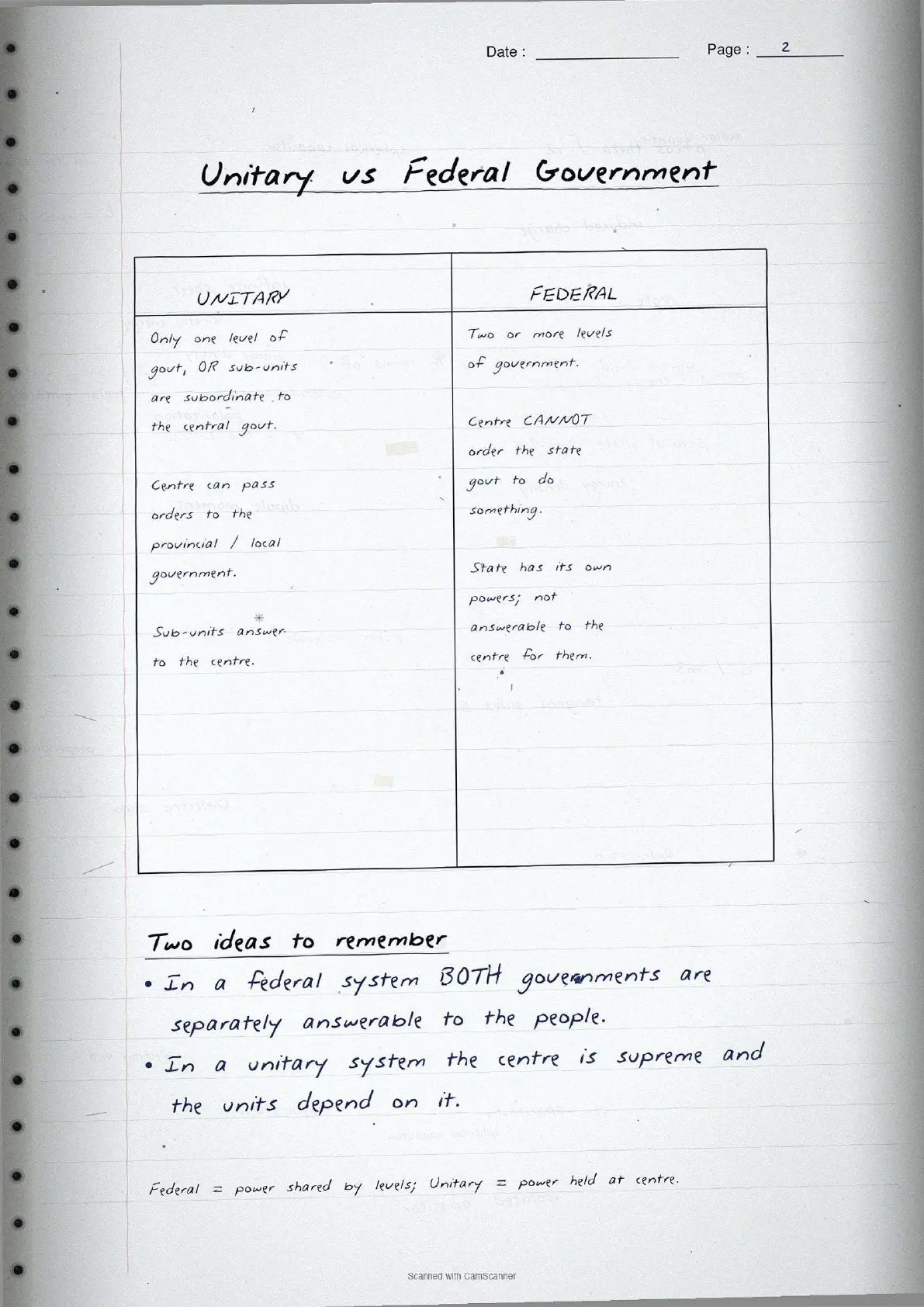
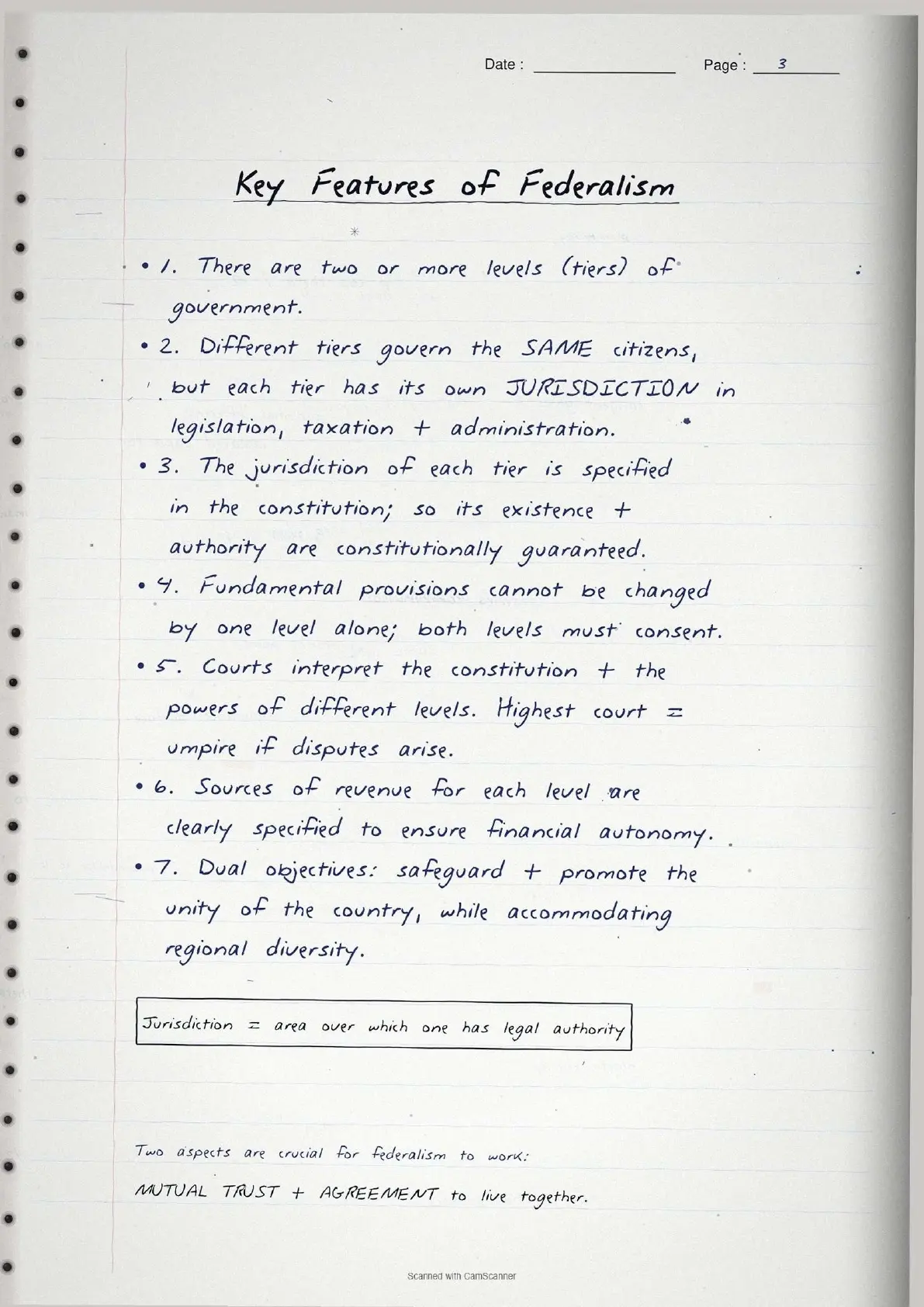
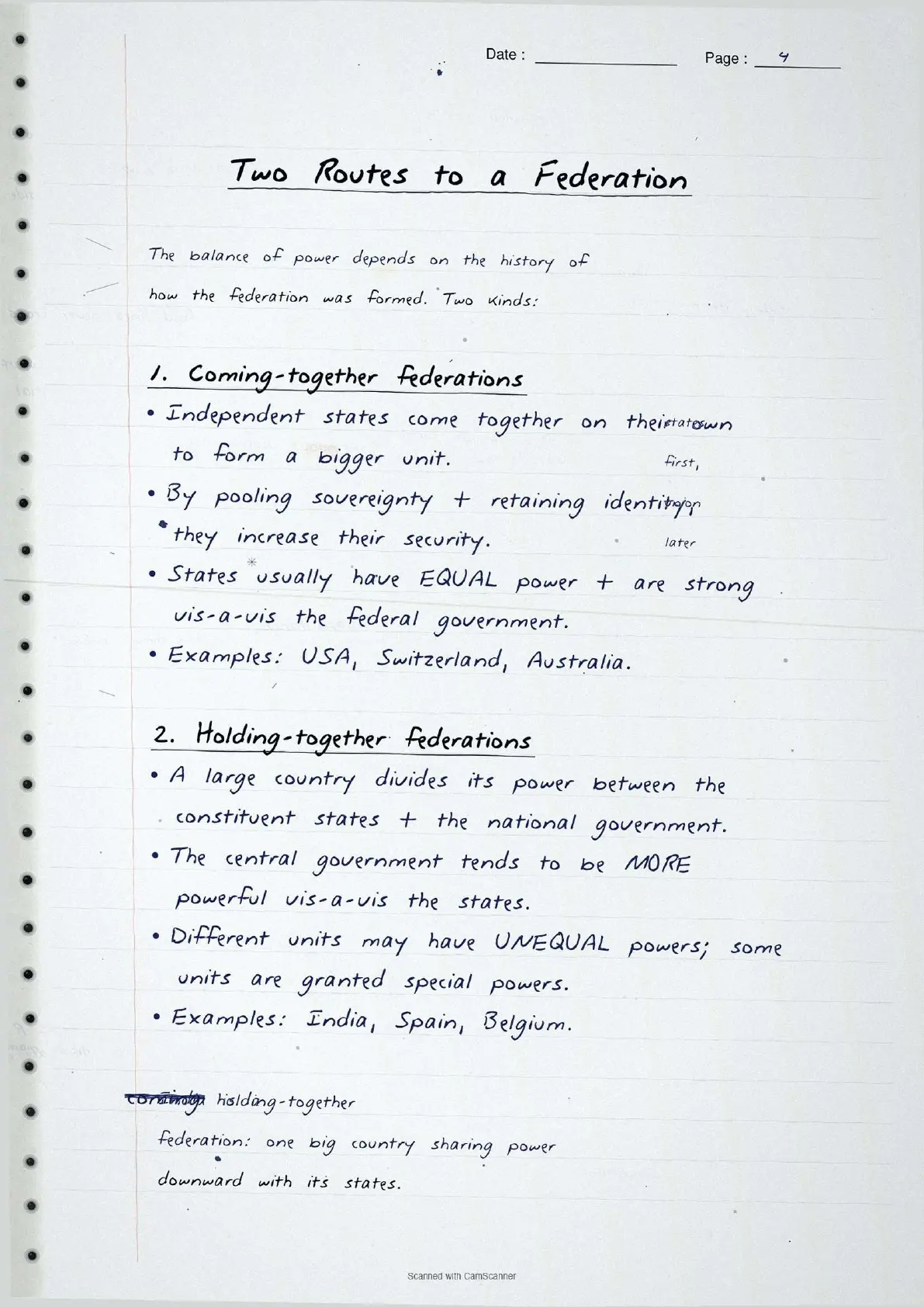
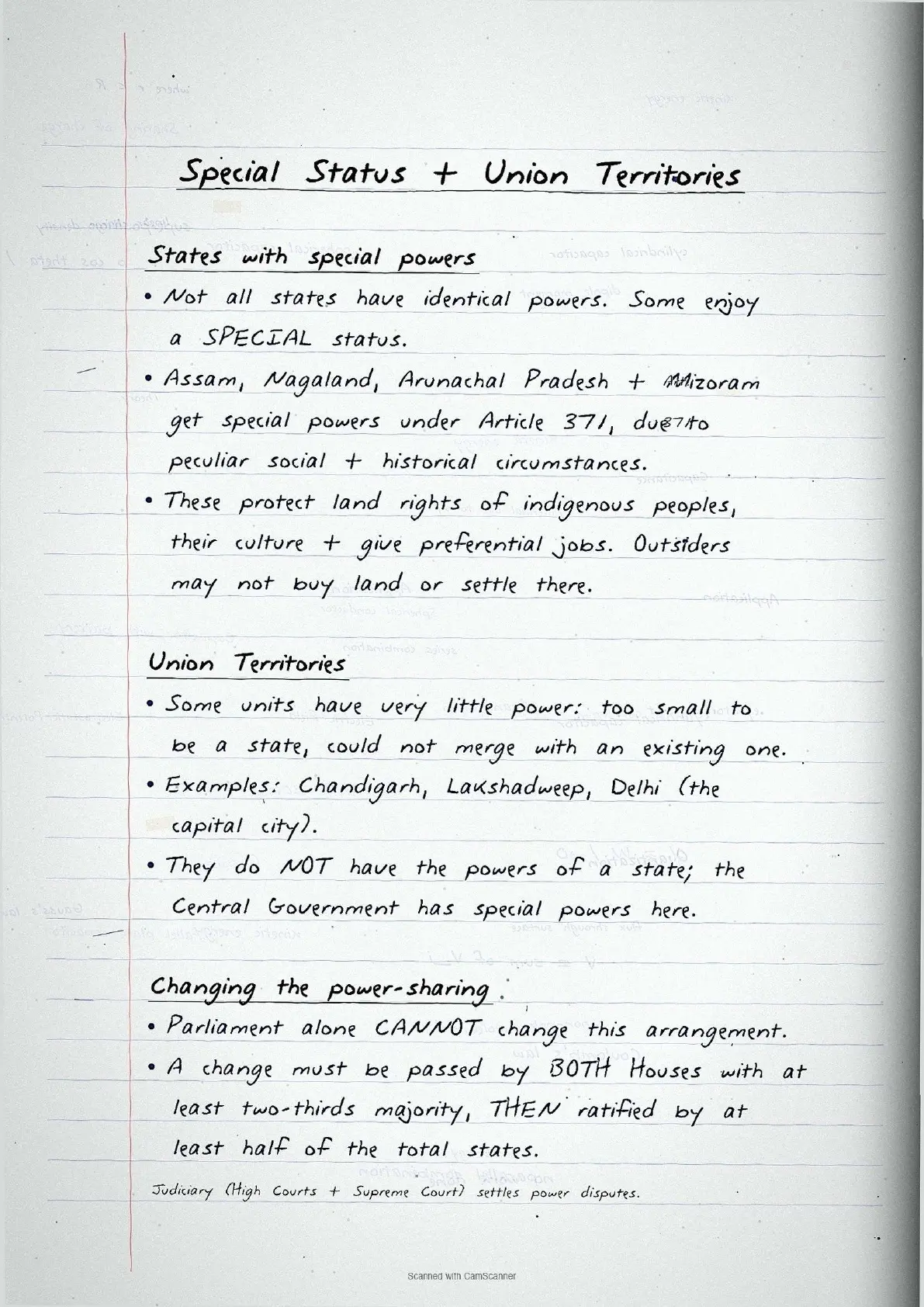
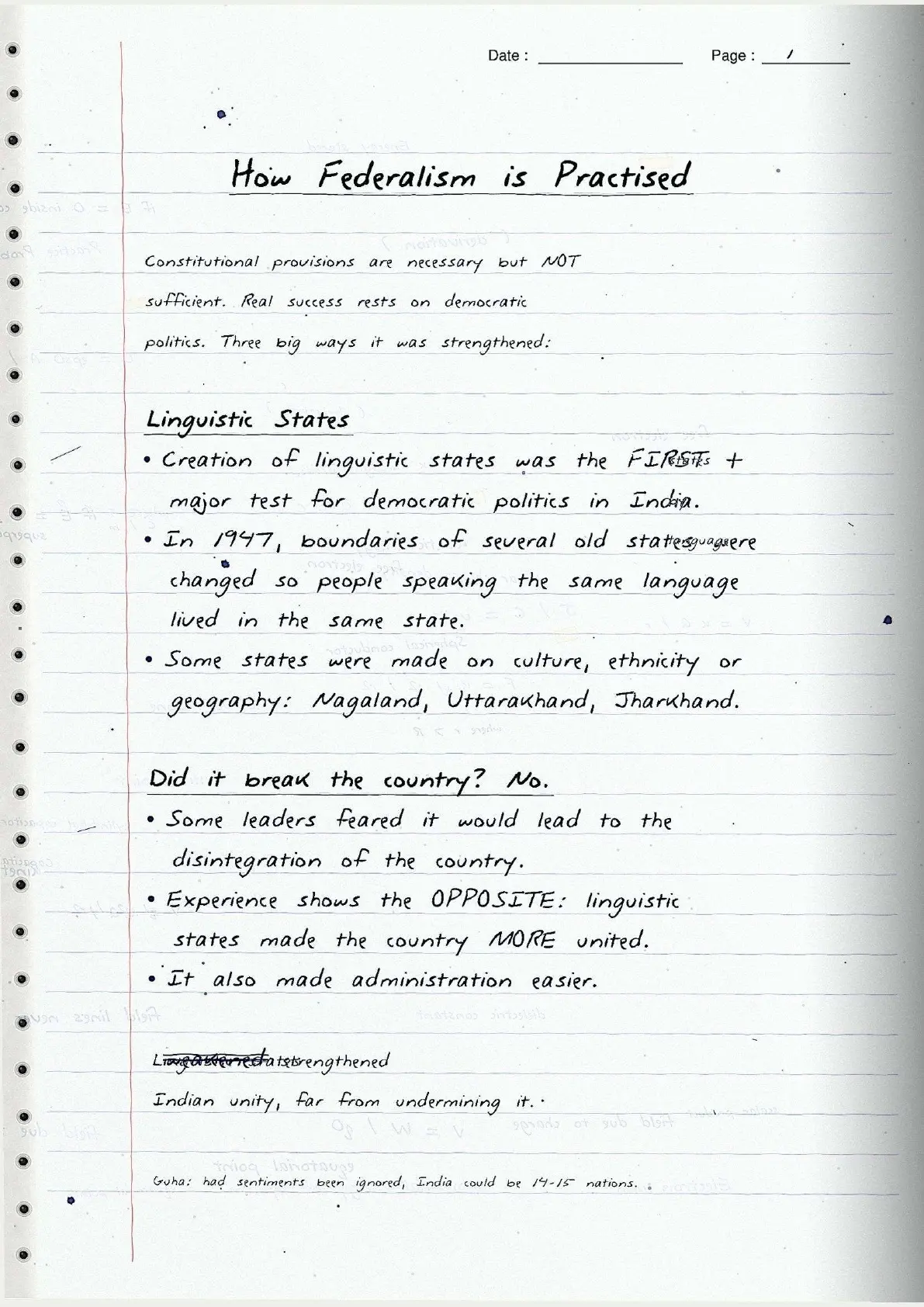
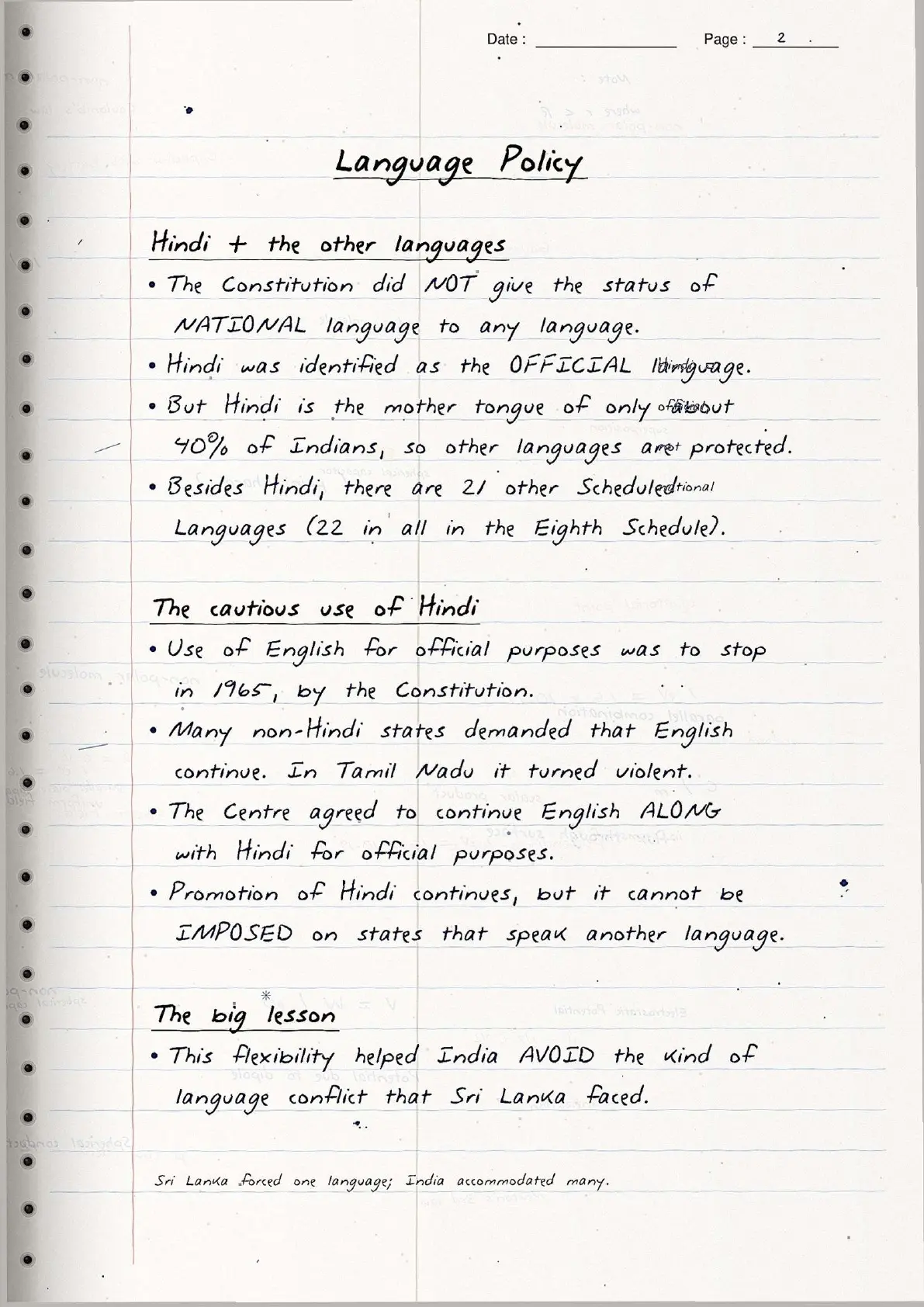
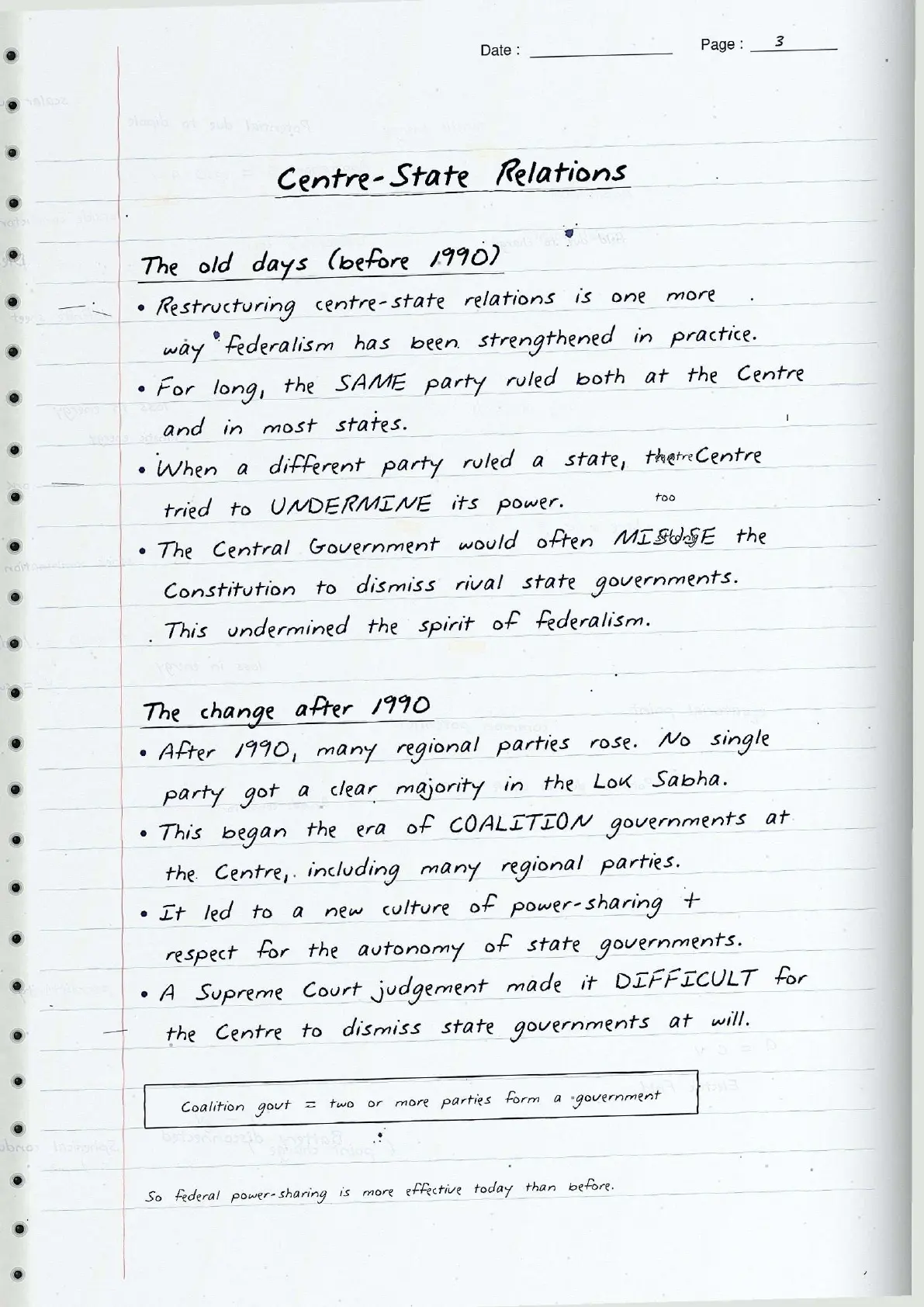
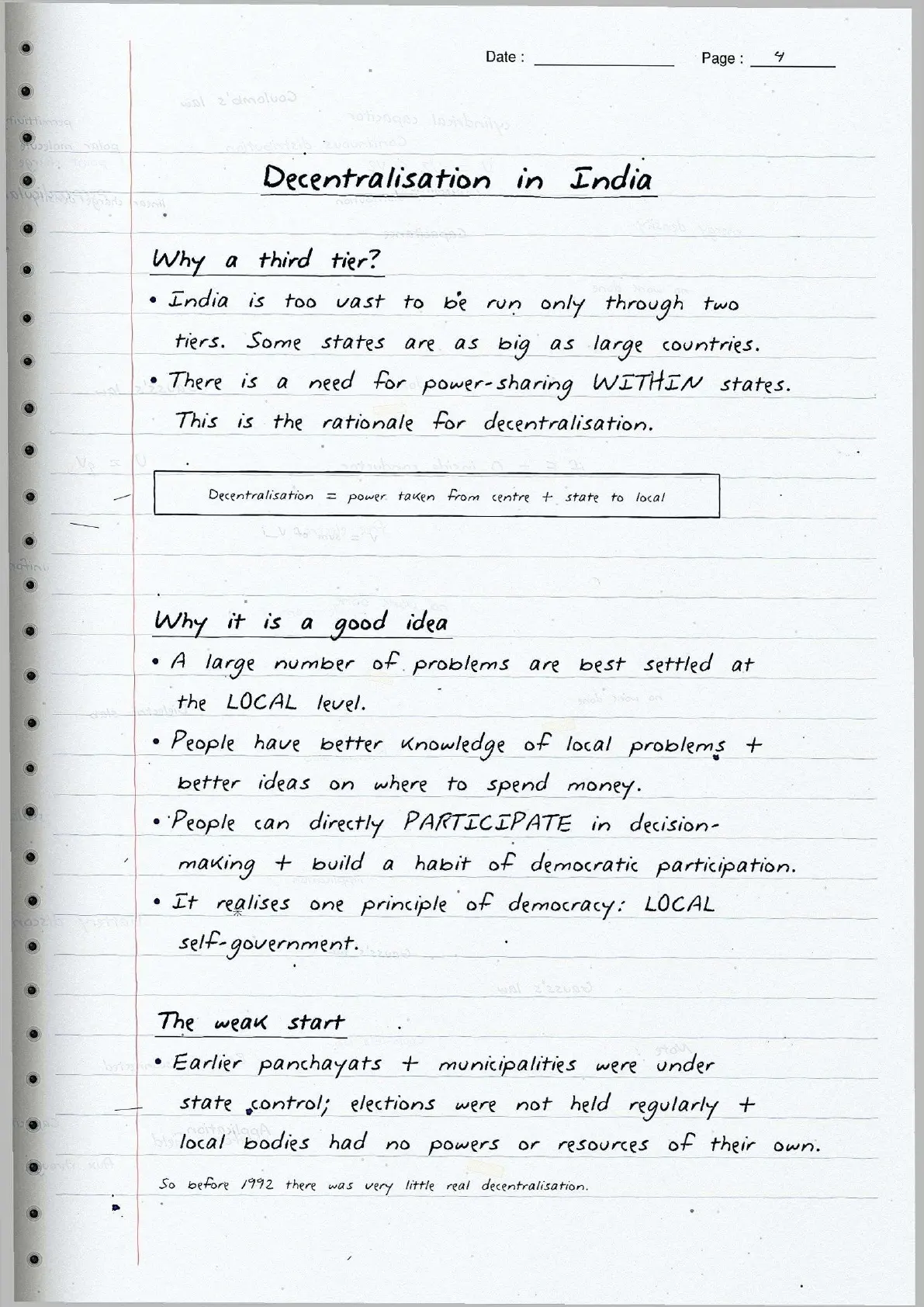
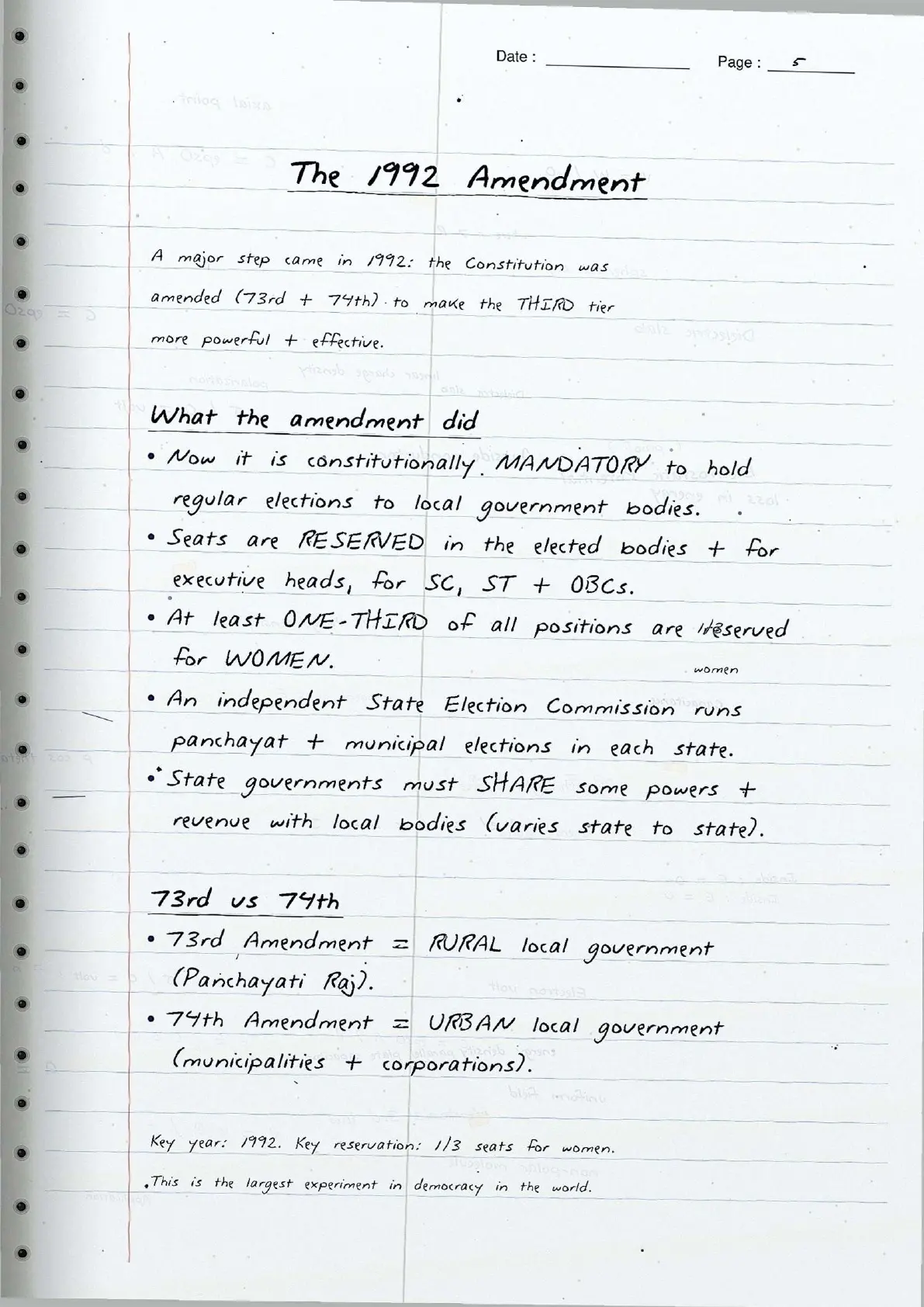
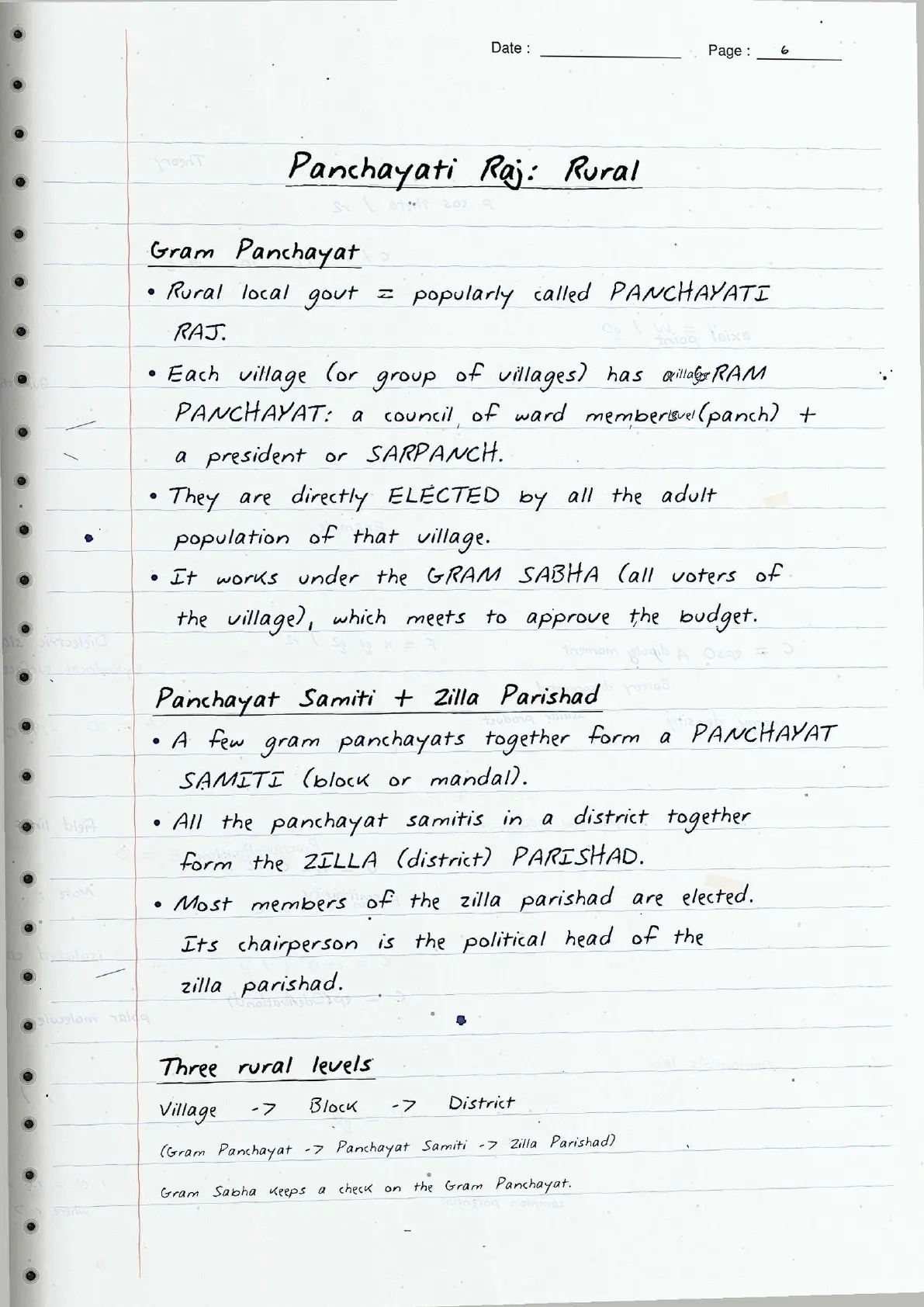
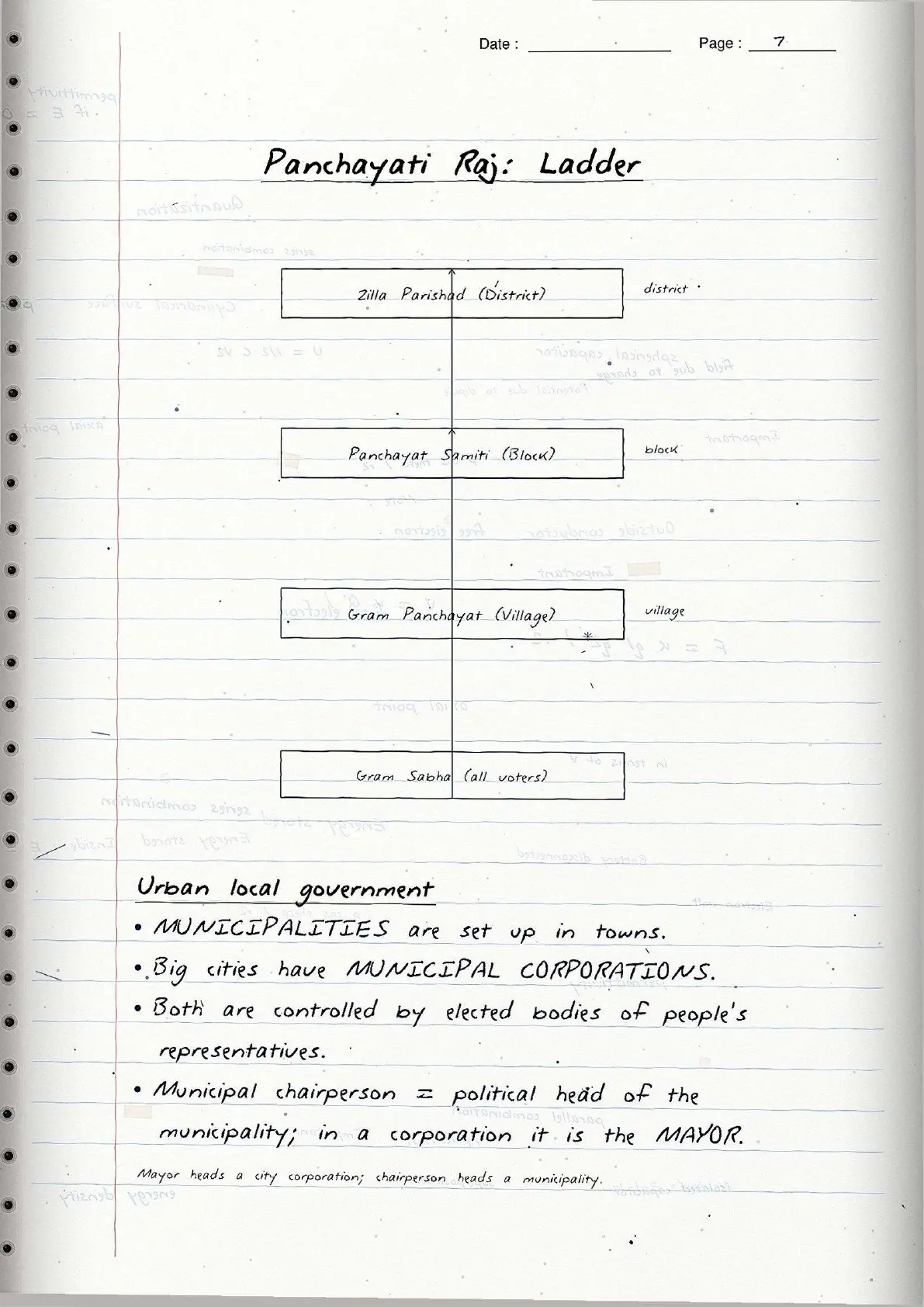
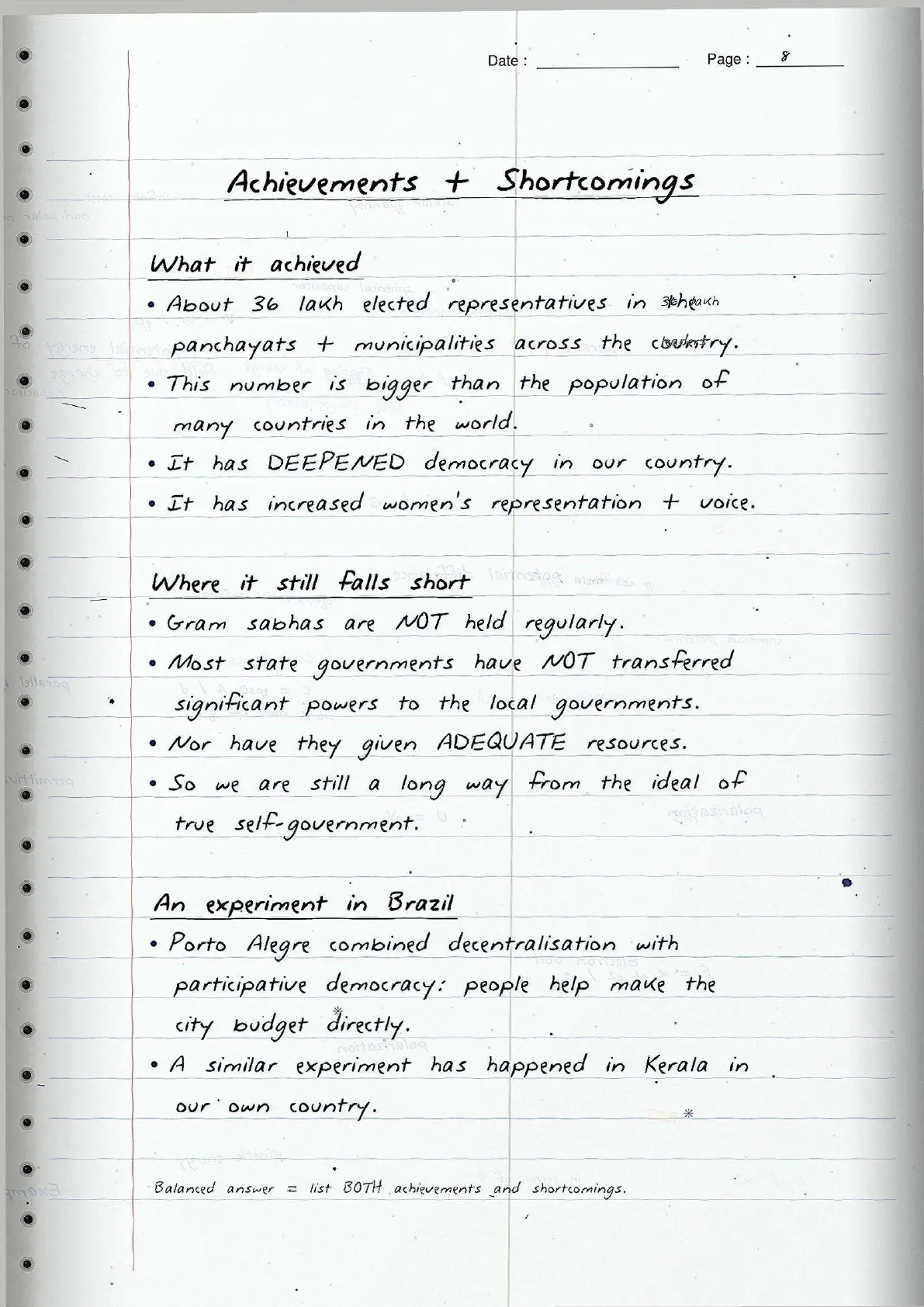
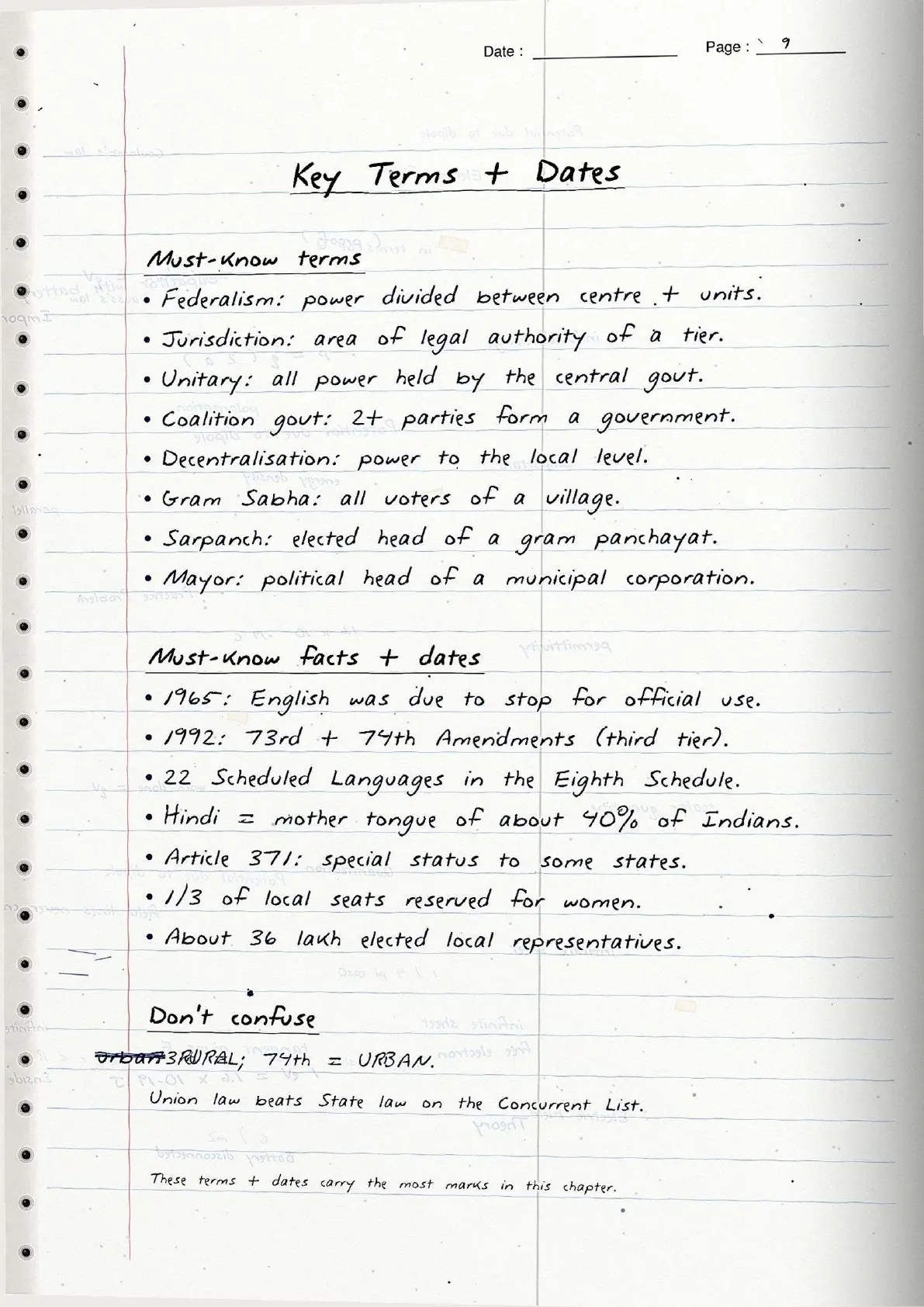
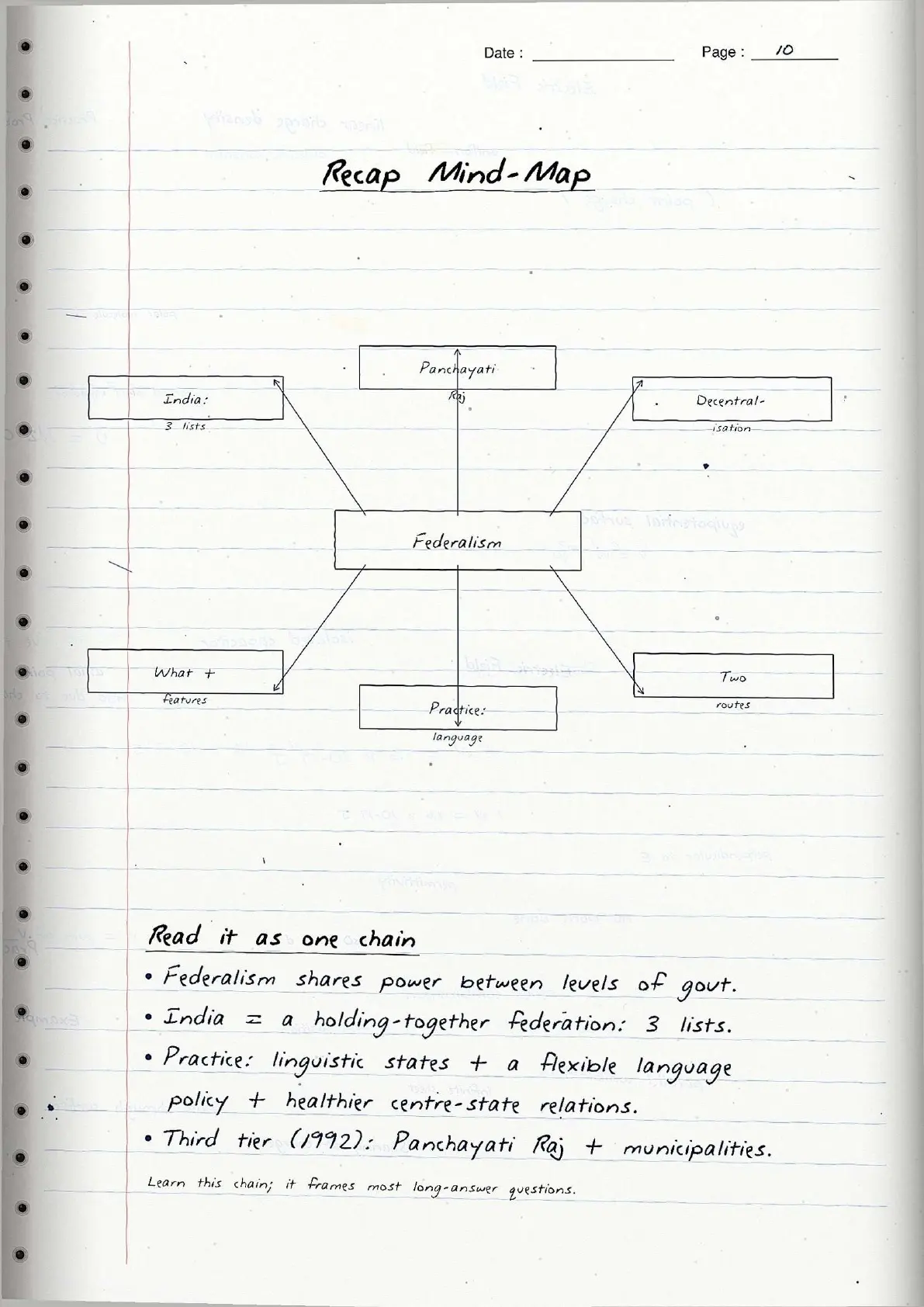
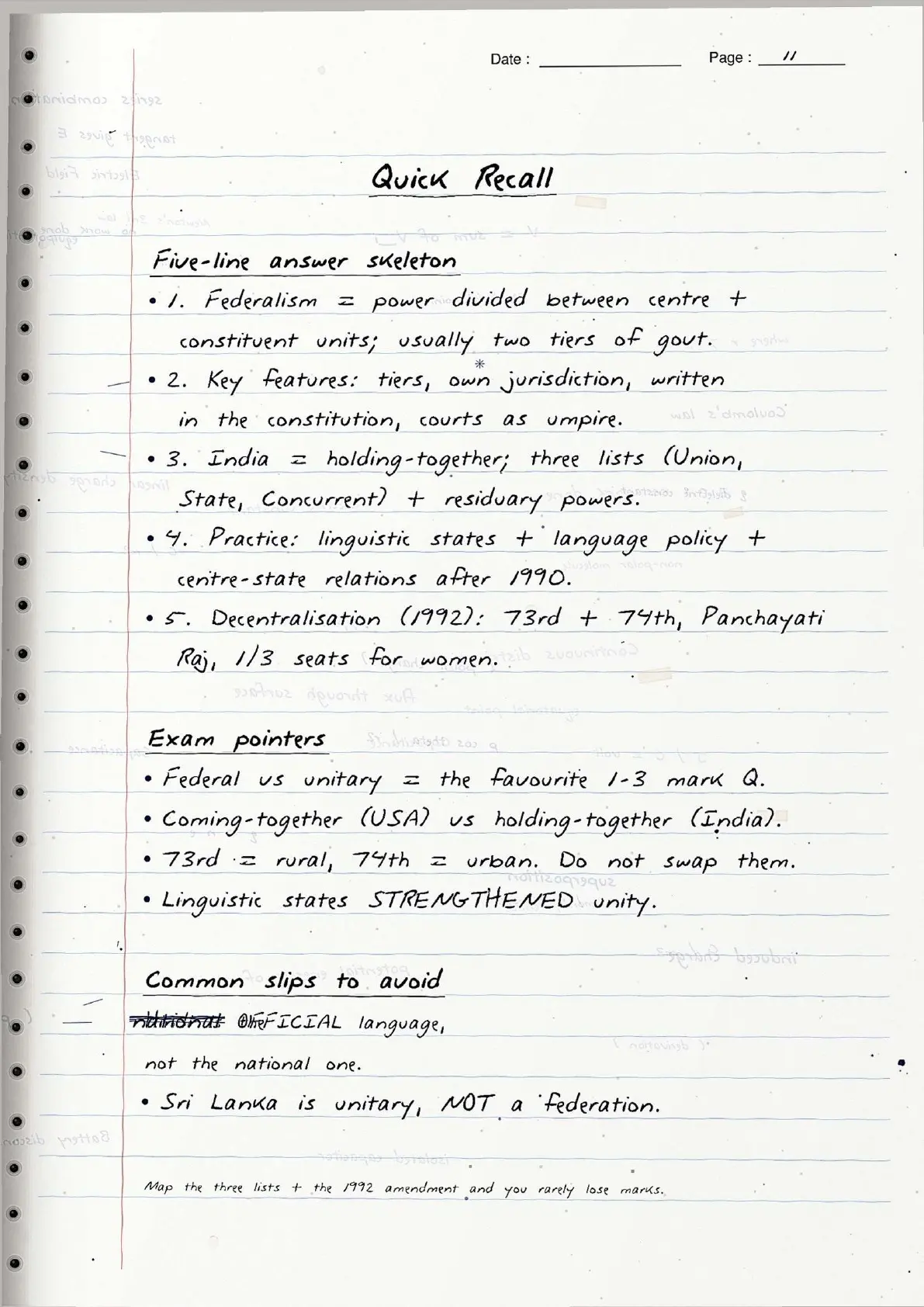
They turn the whole Federalism chapter into clean, pen-on-paper notebook pages, with the seven features, the three Lists and the local government tiers all boxed for fast recall before the board exam.
- Scanned-style pages with a boxed seven-features list and a labelled three-tier government diagram.
- This Class 10 Civics chapter usually carries 5 to 6 marks in the board paper.
- Pairs with the NCERT Solutions, Notes and Book PDF for the same chapter, linked lower on this page.
These Federalism handwritten notes are prepared from the official NCERT Democratic Politics II textbook and checked against the last five years of CBSE board papers.
Federalism Class 10 Civics Explained in Simple Language
Source: Magnet Brains on YouTube
What These Federalism Handwritten Notes Include
The class 10 civics handwritten notes chapter 2 Federalism cover the chapter the way a topper's notebook would, with every key term boxed for quick recall. They keep the focus on what the board paper asks, so a student can flip through the whole chapter in minutes. The notebook is split into clear page groups.
- Concept pages: what federalism is, the two-tier idea, and the seven key features.
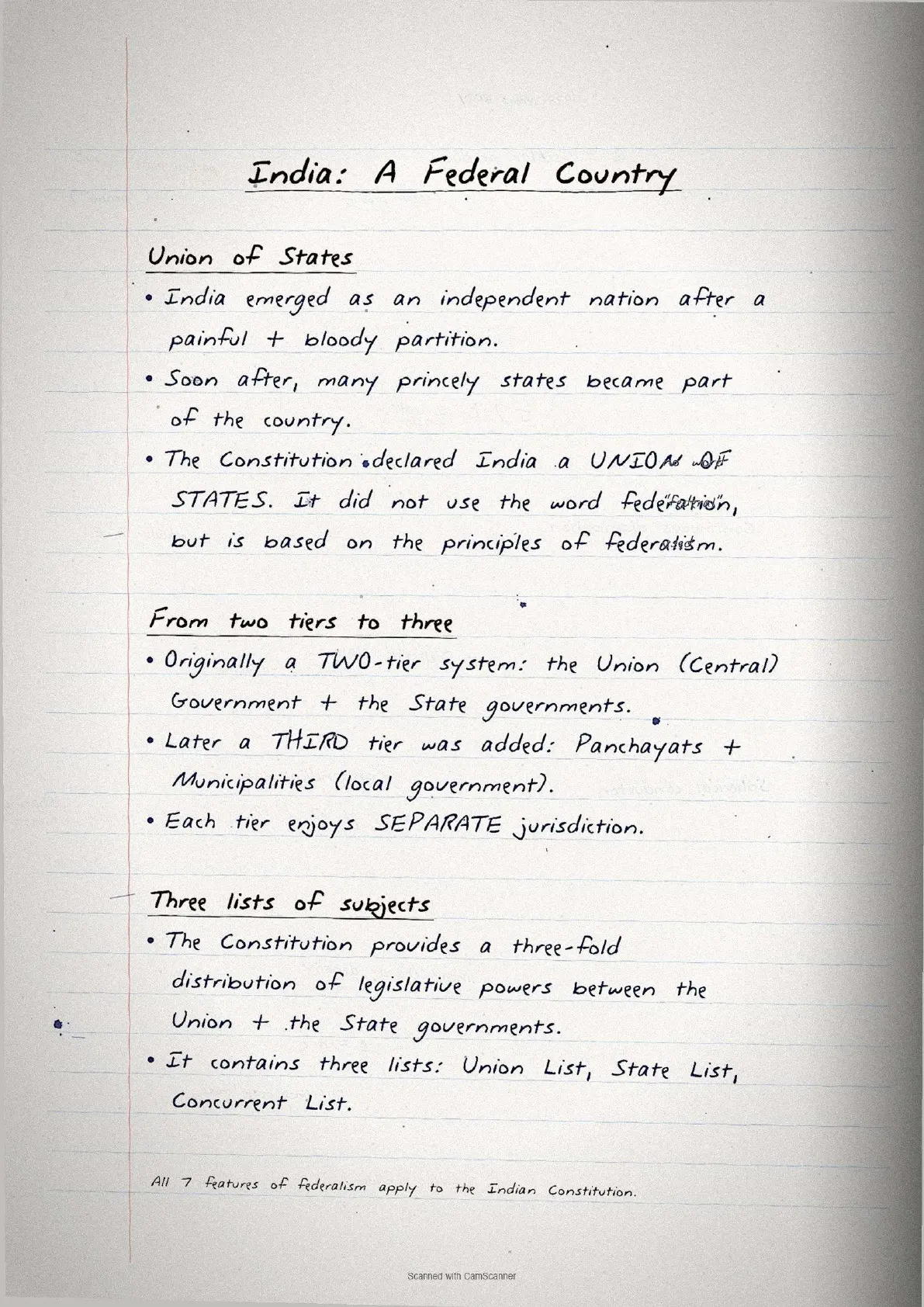
- India pages: India as a Union of States, the three Lists, and linguistic states.
- Local government pages: decentralisation and the 73rd and 74th Amendments of 1992.
Because every term and amendment is boxed and underlined, the pages double as a flashcard set. This is why students reach for handwritten notes in the last week, when re-reading the textbook feels too slow.
The Federalism Features and Objectives Pages
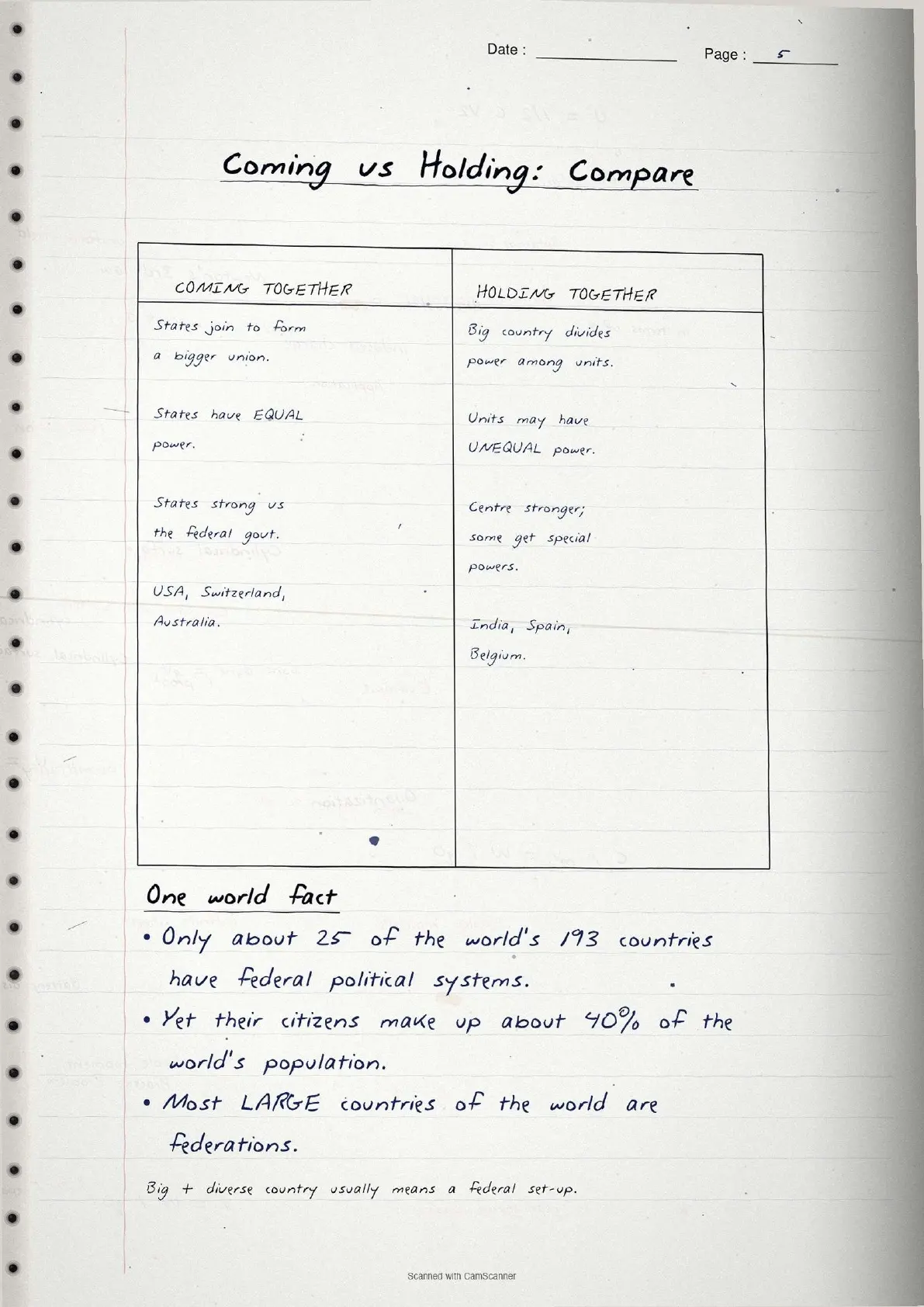
The features pages are the heart of the notebook. They lay out the definition first, then the seven features, then the dual objective, so the chapter flows the way the exam expects. Coming-together and holding-together federations are kept side by side, since the contrast is a regular short answer.
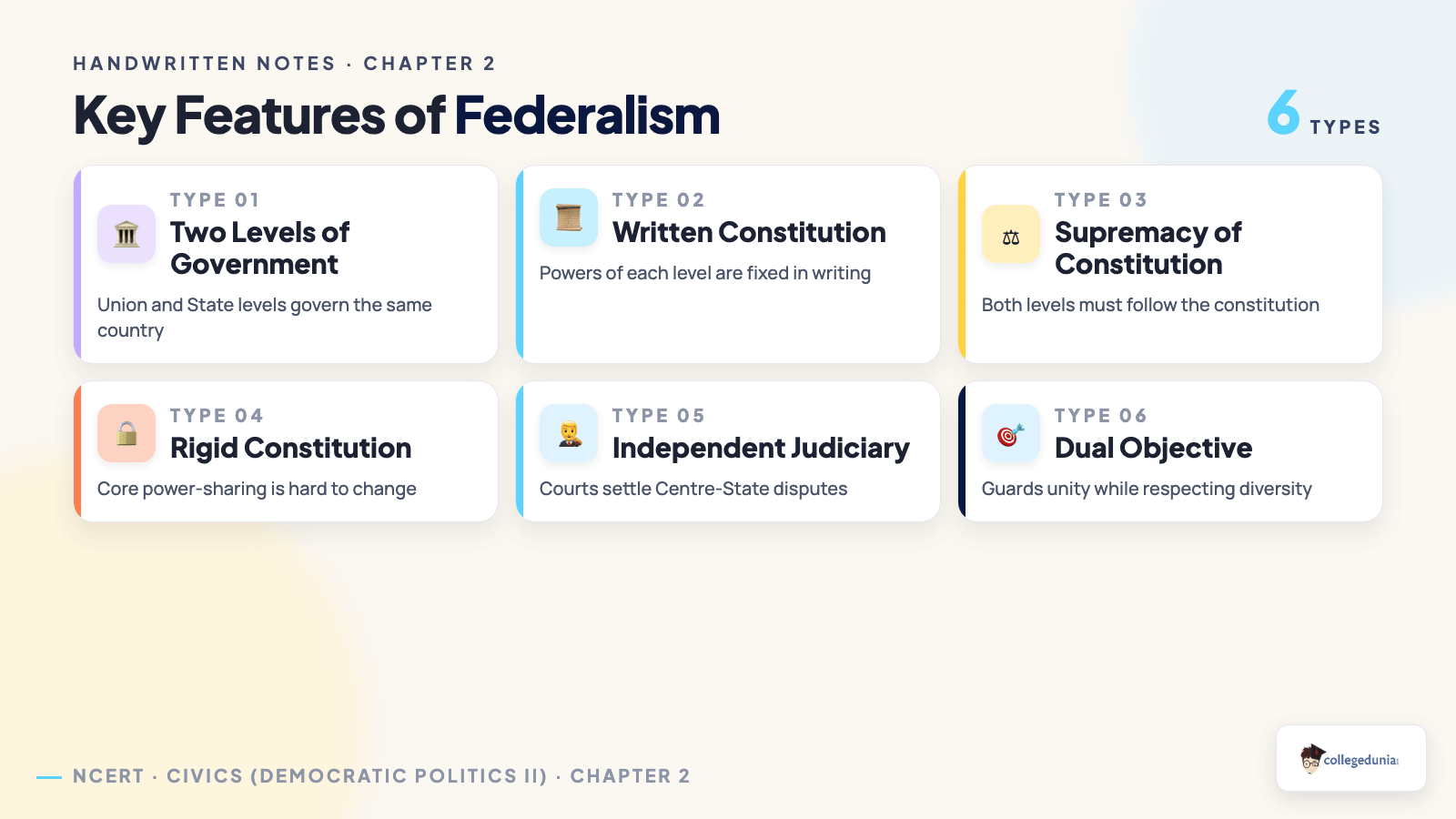
- Two levels of government: the same country is governed by a Union level and a State level.
- Written constitution: the powers of each level are fixed in writing and not easy to change.
- Independent judiciary: the courts settle disputes between the Centre and the States.
- Two objectives at once: federalism guards the unity of the country while it respects its diversity.
The page students mark most is the coming-together versus holding-together split, since it is the most repeated 3-mark answer in this chapter. The USA is the model for coming-together, while India, Spain and Belgium are holding-together unions where a strong Centre shares power with the States.
The Three Lists and Decentralisation Pages
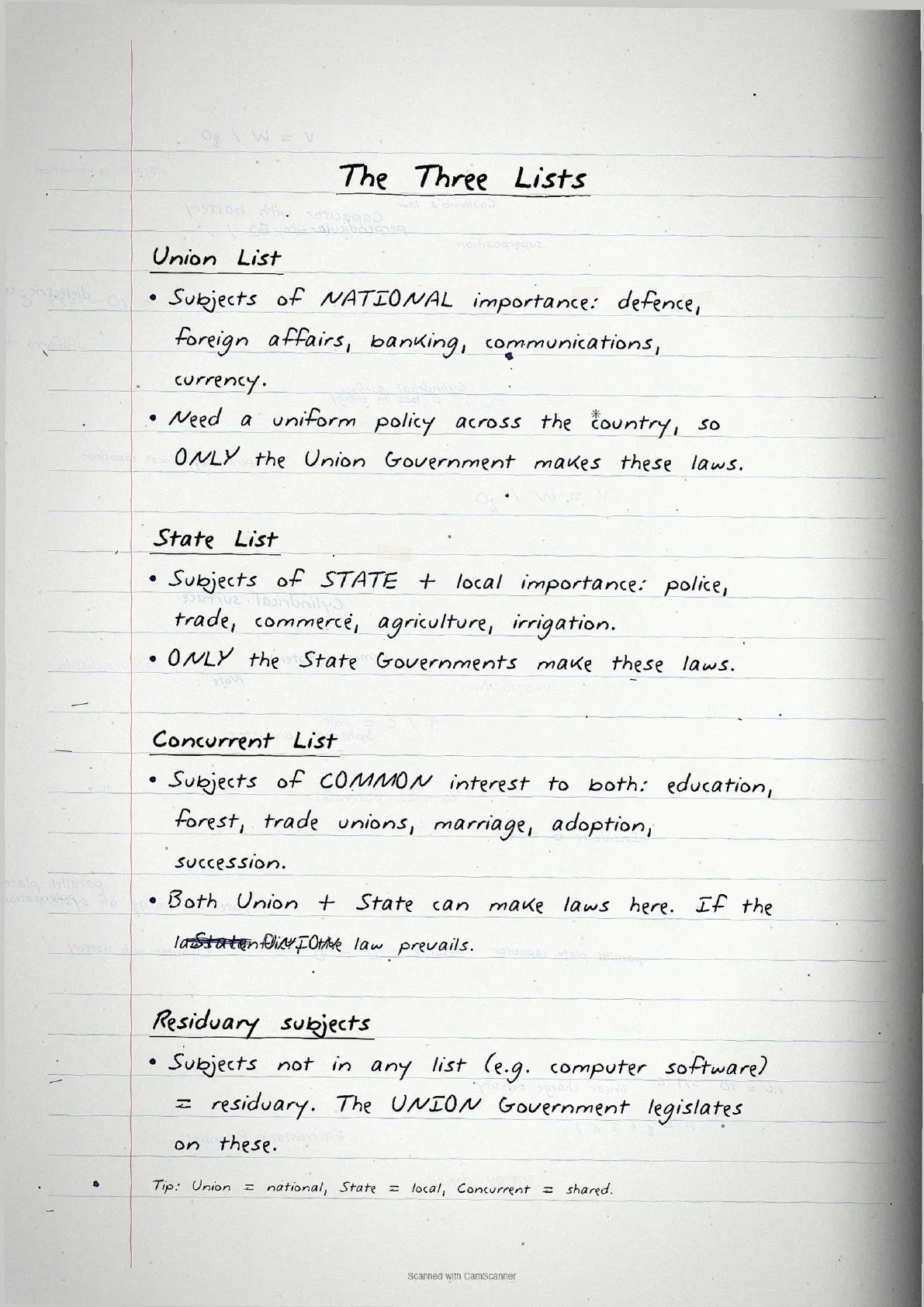
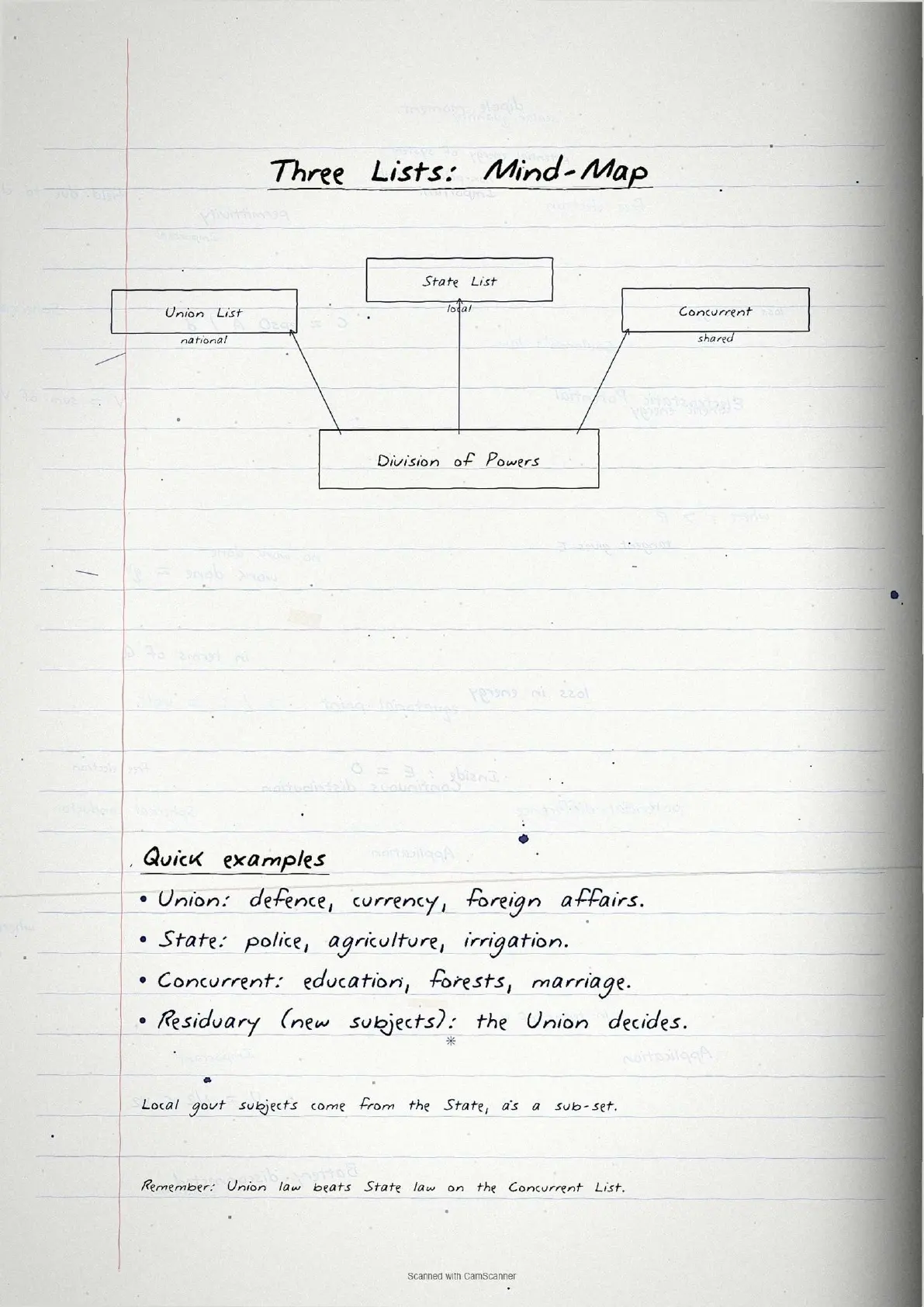
These pages box the division of powers and the third tier, so students can answer "which level decides" questions without hunting. The three-Lists table below is the page students photograph most before the exam.
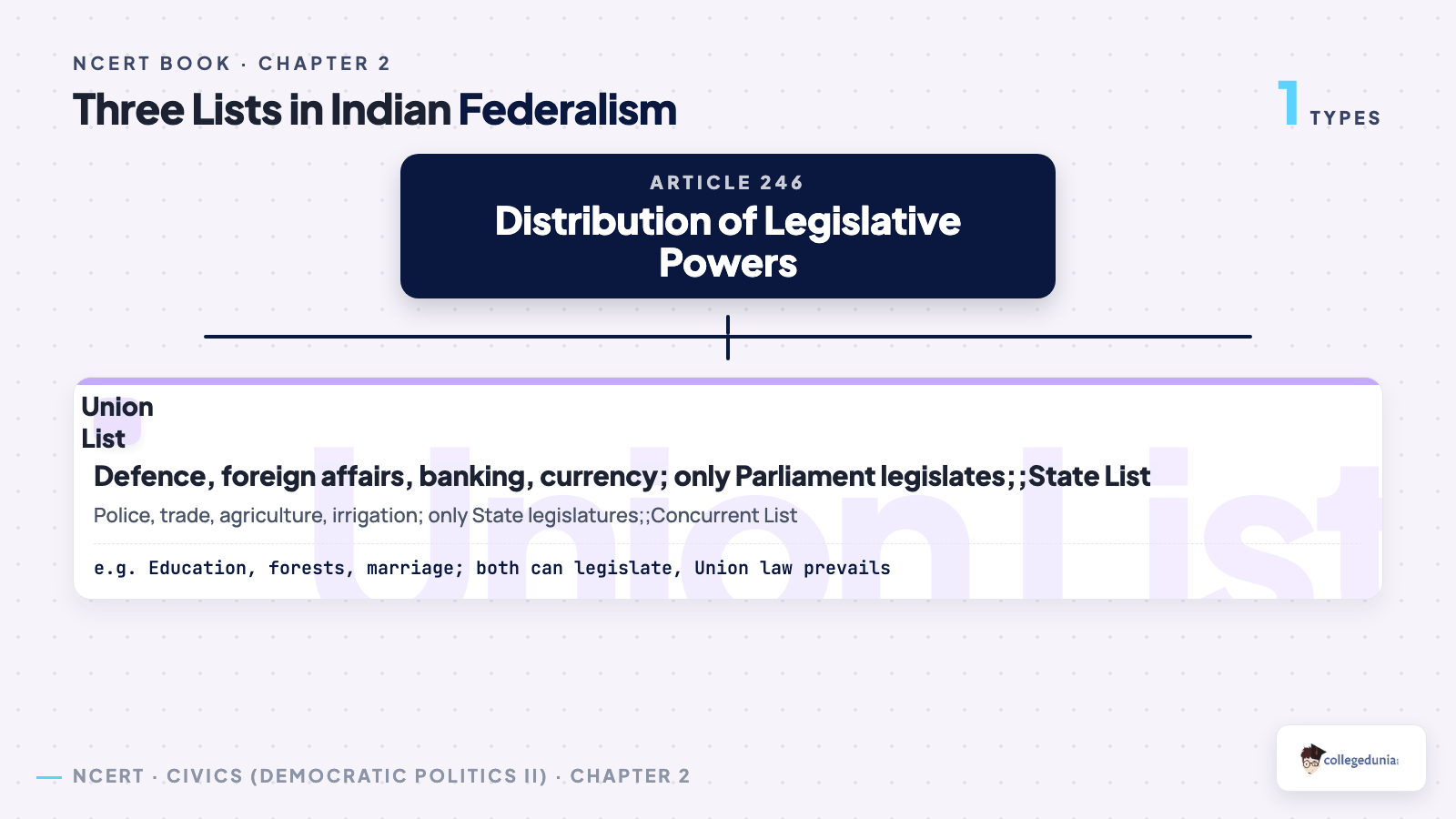
| List | Who makes the laws and on what subjects |
|---|---|
| Union List | Only the central government, on defence, foreign affairs, banking and currency. |
| State List | Only the State governments, on police, trade, agriculture and irrigation. |
| Concurrent List | Both levels, on education, forests and marriage; the Union law wins in a clash. |
The one line worth boxing in red is that residuary subjects (new subjects not on any list) go to the Union government. The third tier, added by the 73rd and 74th Amendments in 1992, set up the Panchayati Raj for villages and municipalities for towns, with regular elections and reserved seats for women.
How to Use These Federalism Handwritten Notes
These notes work best as the final layer of revision, after a student has read the chapter once. A simple routine gets the most out of them in the last week before the exam.
- First pass: read every page once and say each boxed feature and List subject aloud.
- Second pass: cover the right side of the three-Lists table and recall the subjects.
- Third pass: redraw the three tiers of government from memory.
- Night before: skim only the boxed terms and the red-line cautions.
Used this way, the notebook turns into a self-test rather than a re-read. The boxed layout means a student can spot a weak topic in seconds and go back to the full Notes or Solutions for it.
Common Mistakes These Notes Help You Avoid
The boxed, underlined layout is built to stop the slips that cost marks. The notes flag each one in the margin so students fix it before the exam.
- Calling India a federation by coming together, it is a holding-together federation.
- Putting police on the Union List, police is a State List subject.
- Saying both levels are equal in the Concurrent List, the Union law wins in a clash.
- Confusing the 73rd Amendment (rural, Panchayati Raj) with the 74th (urban, municipalities).
- Treating a unitary government and a federal government as the same thing.
Each caution sits next to the topic it guards, so a student sees it at the moment of revision. Fixing these five is the quickest jump from an average answer to a full-mark one.
Other Resources for Federalism Class 10 Civics
These handwritten notes are the quick last-minute layer. To revise the full chapter, students should use them alongside the other resources for the same chapter, all linked in the table below.
| Resource | Best used for |
|---|---|
| Federalism Class 10 NCERT Solutions | Step-by-step answers to all the back-exercise questions |
| Federalism Class 10 Notes | Full chapter summary with every feature, List and amendment |
| Federalism NCERT Book PDF | Reading the original NCERT chapter text, cartoons and boxes |
Tip: read the full Notes first, then use these handwritten pages for the final recall round. The two together cover both understanding and speed for the 2026-27 boards.
All Class 10 Civics Handwritten Notes by Chapter
The table links the Handwritten Notes for every chapter in Class 10 Civics (Democratic Politics II), so students can move across the course in one click. Federalism is highlighted.
| Chapter | Handwritten Notes |
|---|---|
| Chapter 1 | Power-sharing |
| Chapter 2 | Federalism |
| Chapter 3 | Gender, Religion and Caste |
| Chapter 4 | Political Parties |
| Chapter 5 | Outcomes of Democracy |
Student Feedback
In a Collegedunia poll of 11,400 Class 10 Social Science students before the 2026 boards, 76% of students said scanned-style handwritten notes felt faster to revise from than the printed textbook for this chapter. Most students used the boxed three-Lists table to recall which level decides what in the exam.
Source: 2026-27 Class 10 Social Science student poll. Sample of 11,400 students from CBSE schools across 12 states.
Class 10 Civics Chapter 2 Federalism Handwritten Notes Common Questions
Ques. Where can I download the class 10 civics handwritten notes chapter 2 Federalism PDF?
Ans. You can download the Federalism Class 10 Civics handwritten notes PDF free from this page. The scanned-style pages follow the 2026-27 NCERT syllabus and cover the seven features, the three Lists and the local government tiers.
Ques. Are these handwritten notes good for last-minute revision of Federalism?
Ans. Yes. The boxed seven-features list, the labelled three-tier diagram and the red-line cautions make the pages quick to skim, which is why students prefer them in the final week before the board exam.
Ques. Do these notes explain the three Lists of subjects?
Ans. Yes. The notes carry a boxed table of the Union List, State List and Concurrent List with example subjects, and they flag that residuary subjects and Concurrent List clashes go to the Union government.
Ques. Do the notes cover the 73rd and 74th Amendments?
Ans. Yes. The decentralisation pages box the 1992 step: the 73rd Amendment set up rural Panchayati Raj and the 74th Amendment set up urban municipalities, both with regular elections and reserved seats for women.
Ques. Are these handwritten notes enough on their own for Class 10 Civics Chapter 2?
Ans. They are strong for fast revision and recall. For full preparation, pair these Class 10 Civics handwritten notes with the NCERT Solutions for the back-exercise questions and the full Notes for the detailed explanations.



Comments