




The NCERT Solutions for Class 10 Civics Chapter 2 Federalism cover every textbook and exercise question for the 2026-27 CBSE syllabus.
Chapter2FederalismSolutions.pdf?page=1&dpi=150)
Chapter2FederalismSolutions.pdf?page=2&dpi=150)
Chapter2FederalismSolutions.pdf?page=3&dpi=150)
Chapter2FederalismSolutions.pdf?page=4&dpi=150)
Chapter2FederalismSolutions.pdf?page=5&dpi=150)
Chapter2FederalismSolutions.pdf?page=6&dpi=150)
Chapter2FederalismSolutions.pdf?page=7&dpi=150)
Chapter2FederalismSolutions.pdf?page=8&dpi=150)
Chapter2FederalismSolutions.pdf?page=9&dpi=150)
Chapter2FederalismSolutions.pdf?page=10&dpi=150)
Chapter2FederalismSolutions.pdf?page=11&dpi=150)
Chapter2FederalismSolutions.pdf?page=12&dpi=150)
Chapter2FederalismSolutions.pdf?page=13&dpi=150)
Chapter2FederalismSolutions.pdf?page=14&dpi=150)
Chapter2FederalismSolutions.pdf?page=15&dpi=150)
Chapter2FederalismSolutions.pdf?page=16&dpi=150)
Chapter2FederalismSolutions.pdf?page=17&dpi=150)
Chapter2FederalismSolutions.pdf?page=18&dpi=150)
Chapter2FederalismSolutions.pdf?page=19&dpi=150)
Chapter2FederalismSolutions.pdf?page=20&dpi=150)
Each answer names the features, lists and amendments the NCERT text uses, from Centre-State division to the 73rd and 74th Constitutional Amendments of 1992.
- 12 NCERT questions solved, each with a clear step-by-step format that matches the board answer pattern.
- Civics (Democratic Politics) carries real marks in the Class 10 Social Science board paper, and Federalism is a frequent source of 3 and 5 mark questions.
- Free PDF download in Normal and HD, plus a Hindi-medium read of every answer.
What This Class 10 Civics Chapter Covers for the Boards
This chapter explains how India shares power between a central authority and the States, so the same citizens are governed by two or more levels of government. The ncert solutions class 10 civics chapter 2 Federalism on this page keep every feature, list and year you need for the exam.
- What is federalism: power divided between the Centre and the States, each with its own jurisdiction guaranteed by the Constitution.
- Key features: two or more tiers of government, a supreme Constitution, courts that settle disputes, and separate revenue sources.
- Coming-together versus holding-together federations, and the three Lists, with who legislates on each.
- Linguistic States, language policy, and the third tier of local government under the 73rd and 74th Amendments of 1992.
One-Shot Revision of Federalism for Class 10 Boards
Source: Magnet Brains on YouTube
Federalism Class 10 Question Answer: Exercise Section
The exercise questions in class 10 civics chapter 2 federalism test both short recall and clear comparison. The board often picks the federal versus unitary difference and the local government before and after 1992 question for 3 and 5 mark slots.
| Question | What a full-mark answer must include |
|---|---|
| Difference between a federal and a unitary government | In a federal system, power is shared between two or more levels of government, each with its own jurisdiction guaranteed by the Constitution; in a unitary system, there is one level (or any lower level is subordinate to and controlled by the central government). |
| State any two features of Indian federalism | Any two of: two or more tiers of government; jurisdictions specified in the Constitution; the Constitution is supreme and cannot be changed by one level alone; courts settle Centre to State disputes; separate sources of revenue for each tier. |
| Differences in local government before and after 1992 | Before 1992 local bodies existed but elections were not regular and they had few powers; after the 1992 amendments, regular elections, reserved seats for SC, ST, OBC and one-third for women, a State Election Commission and a State Finance Commission became mandatory. |
| Fill in the blank on coming-together and holding-together | The United States is an example of a coming-together federation, while India is an example of a holding-together federation. |
Tip: learn one feature or one year per point. That single line of detail is usually worth one mark in the board scheme.
Federalism Class 10 Important Questions: Long Answer Section
The long-answer questions carry the heavier marks. Each item in the federalism class 10 important questions set asks you to explain a process or compare two cases.
- The three-tier government: the Union, the States, and the third tier of local government across rural Panchayati Raj and urban Municipalities.
- The three Lists with examples: Union List (defence, currency), State List (police, agriculture) and Concurrent List (education, forests).
- How language policy held India together: no language was imposed and 22 Scheduled Languages are recognised, unlike Sri Lanka's Sinhala-only policy that caused conflict.
- Reasons for decentralisation: local problems are best solved by local people, who know their own needs and resources best.
- Centre to State sharing in practice: the real test of federalism, since the party at the Centre is not always the same as in the States.
Memorise that local self-government was made mandatory by the 73rd and 74th Constitutional Amendments of 1992, as the decentralisation question appears most years.
The Three Lists of the Indian Constitution Explained for Class 10
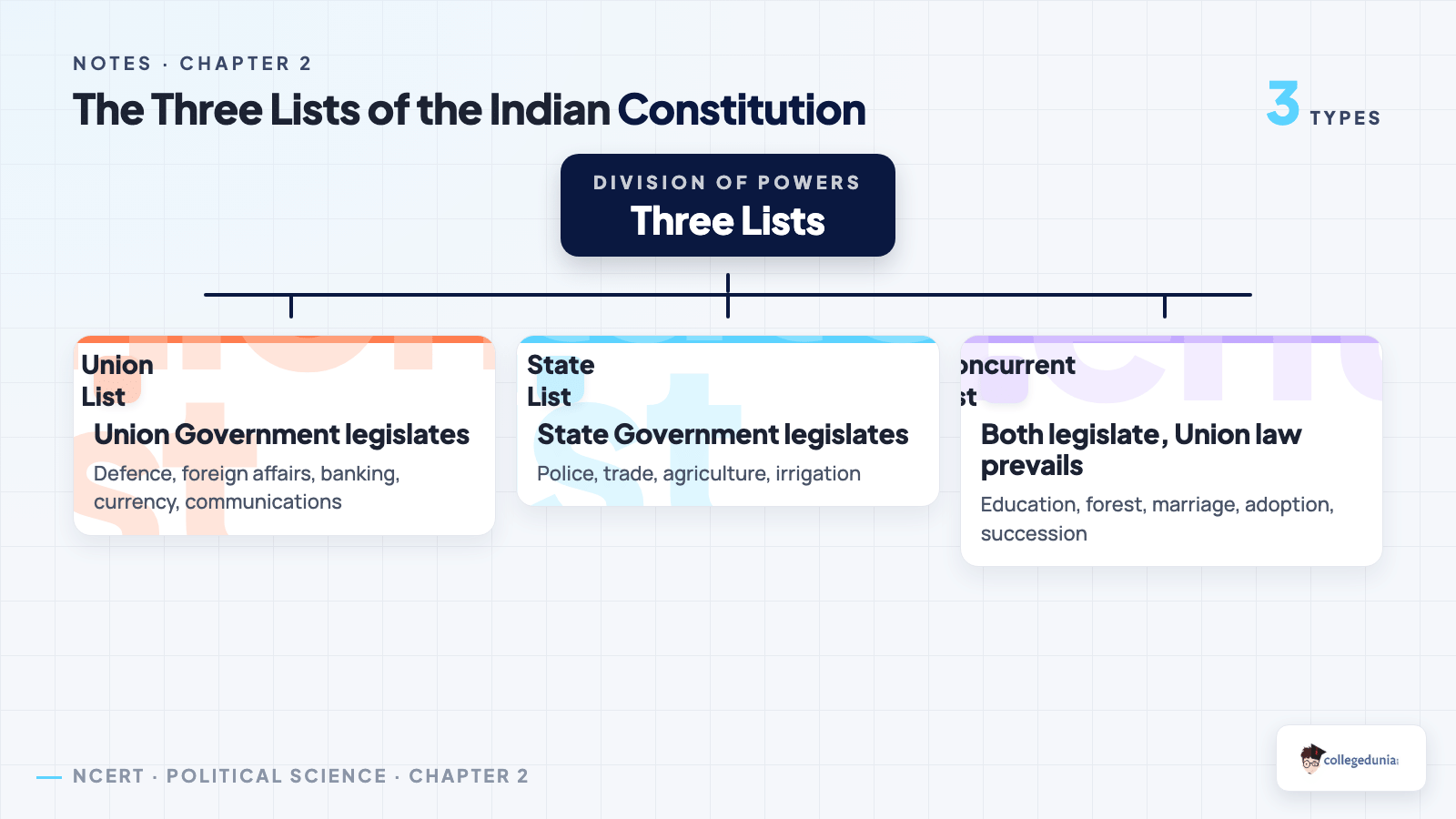
The division of subjects into three Lists is one of the most asked topics here. The Constitution decides which level makes laws on which subject, and a residuary clause covers anything new. A neat memory line is "Union for the country, State for the locality, Concurrent for both".
| List | Who legislates | Example subjects |
|---|---|---|
| Union List | Only the Union Government | Defence, foreign affairs, banking, communications and currency (about 100 subjects). |
| State List | Only the State Government | Police, trade, commerce, agriculture and irrigation (about 61 subjects). |
| Concurrent List | Both, with Union law prevailing on conflict | Education, forests, trade unions, marriage, adoption and succession. |
| Residuary subjects | The Union Government | New subjects not in any list, such as computer software. |
For any answer here, name one or two example subjects per List and state that the Union decides residuary subjects.
Coming-Together vs Holding-Together Federations
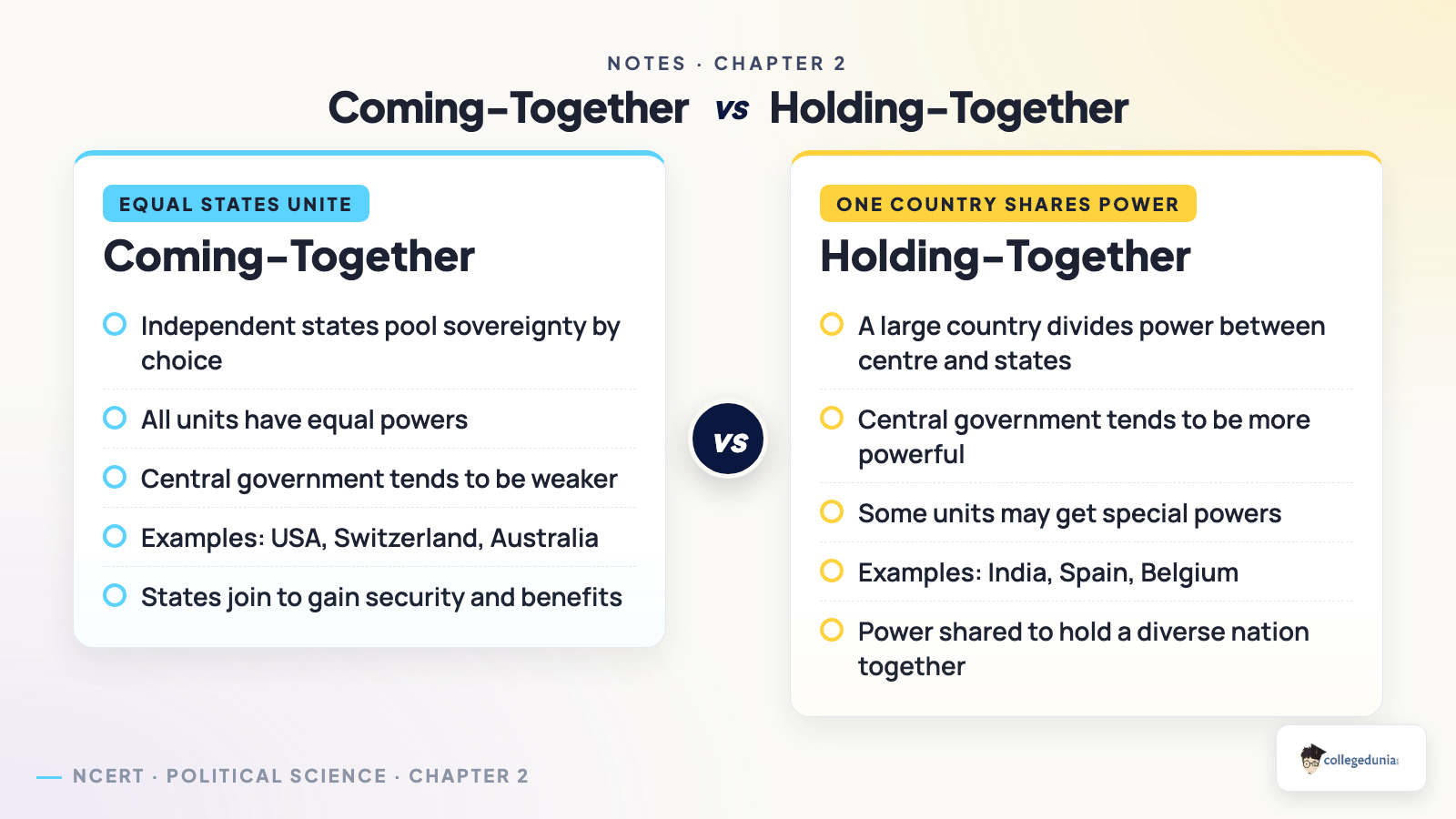
India belongs to the holding-together type, and the board likes to test whether you can tell the two routes apart. In a coming-together federation, independent states pool sovereignty and stay equally strong. In a holding-together federation, a large country divides power between the Centre and the States, the Centre tends to be stronger, and some units may get special powers.
| Type | Examples | Key idea |
|---|---|---|
| Coming-together | United States, Australia, Switzerland | Independent and equally powerful states join together and pool sovereignty, so all units stay equally strong. |
| Holding-together | India, Spain, Belgium | A large country shares power between the Centre and the States, the Centre tends to be stronger, and some units may get special powers. |
Say clearly that India is a holding-together federation and the United States is a coming-together federation. That contrast often carries the mark.
Common Mistakes Students Make in this Class 10 Civics Chapter
A few slips lose easy marks every year. Fix these before the exam.
- Confusing the three Lists, for example placing education in the State List when it is actually in the Concurrent List.
- Thinking India is a coming-together federation. India is a holding-together federation, where the Centre tends to be more powerful.
- Forgetting that the 73rd and 74th Constitutional Amendments date to 1992, and that they made local self-government mandatory.
- Calling India a confederation. India is a federation, where the Constitution divides and guarantees power between levels.
How to Use the NCERT Solutions Class 10 Civics Chapter 2 Page
Use this page in three short blocks so revision stays focused. Read first, attempt the questions, then compare and fix the gaps.
- Read and list: read the NCERT chapter and note every feature, list and amendment year.
- Attempt first: answer all 12 questions on your own before opening the solutions.
- Compare and flag: match your answer with the step-by-step solution and mark the missing fact-lines.
For long-answer practice, write the three Lists answer and the decentralisation answer in full once.
Practice All NCERT Solutions for this Class 10 Civics Chapter with Step-by-Step Solutions
Open the question bank below to attempt all 12 solved questions with collapsible Solution and Expert Solution tabs. Every answer is mapped to the NCERT text.
All Solved Questions for this Class 10 Civics Chapter
Practise every textbook and exercise question with step-by-step solutions and an expert version for board marks.
Class 10 Civics Other Resources for this Chapter
Pair these solutions with the other Class 10 Civics resources for the same chapter, linked below.
| Resource | Best used for |
|---|---|
| Federalism Class 10 Notes | Quick concept recap before the exam |
| Federalism Class 10 Handwritten Notes | Last-minute scanned revision |
| Federalism Class 10 NCERT Book PDF | Reading the original chapter text |
All Chapters NCERT Solutions for Class 10 Civics (Democratic Politics II)
Browse the full set of ncert solutions for class 10 civics chapter by chapter.
| Chapter | NCERT Solutions |
|---|---|
| Chapter 1 | Power Sharing Class 10 NCERT Solutions |
| Chapter 2 | Federalism Class 10 NCERT Solutions |
| Chapter 3 | Gender, Religion and Caste Class 10 NCERT Solutions |
| Chapter 4 | Political Parties Class 10 NCERT Solutions |
| Chapter 5 | Outcomes of Democracy Class 10 NCERT Solutions |
Student Feedback
In a Collegedunia poll of 9,460 Class 10 students before the 2026 boards, 68% of students rated the three Lists (Union, State and Concurrent) as the part they most often mixed up under exam pressure. About 61% of students found the coming-together versus holding-together comparison hardest to recall, and the 73rd and 74th Amendments of 1992 were left for last by about 35% of students.
Source: 2026-27 Class 10 Civics student poll. Sample of 9,460 students from CBSE schools across 13 states.
Federalism Class 10 Civics NCERT Solutions FAQs
Ques. Where can I download the NCERT Solutions Class 10 Civics Chapter 2 Federalism PDF?
Ans. You can download the federalism class 10 ncert solutions PDF directly from this page. Both the Normal and HD versions are free, and a Hindi-medium read is available too.
Ques. How many questions are solved in class 10 civics chapter 2 federalism?
Ans. All 12 NCERT questions are solved, each with a step-by-step solution and an expert version for the long-answer marks, so you can revise the full exercise from one place.
Ques. Is this NCERT Solutions page aligned with the 2026-27 syllabus?
Ans. Yes. This page reflects the current 2026-27 syllabus for Class 10 Civics, and every answer is checked against the latest NCERT edition of Democratic Politics II.
Ques. What is federalism in class 10 Civics?
Ans. Federalism is a system of government in which power is divided between a central authority and its constituent units, such as States. There are two or more levels of government, and each level has its own jurisdiction guaranteed by the Constitution. The ncert solutions class 10 civics chapter 2 Federalism set explains every feature in detail.
Ques. What is the difference between a federal and a unitary government?
Ans. In a federal government, power is shared between two or more levels, each with its own jurisdiction protected by the Constitution. In a unitary government, there is only one level of government, or any lower level is subordinate to and controlled by the central government.
Ques. What are the three Lists in the Indian Constitution?
Ans. The three Lists are the Union List (defence, foreign affairs, currency), the State List (police, trade, agriculture) and the Concurrent List (education, forests, marriage). The Union Government decides residuary subjects that are not in any list.
Ques. Why is India called a holding-together federation?
Ans. India is a holding-together federation because a large country chose to share power between the Centre and the States. The Centre tends to be more powerful, and some units may be given special powers, unlike a coming-together federation such as the United States where equally strong states pool their power.



Comments