




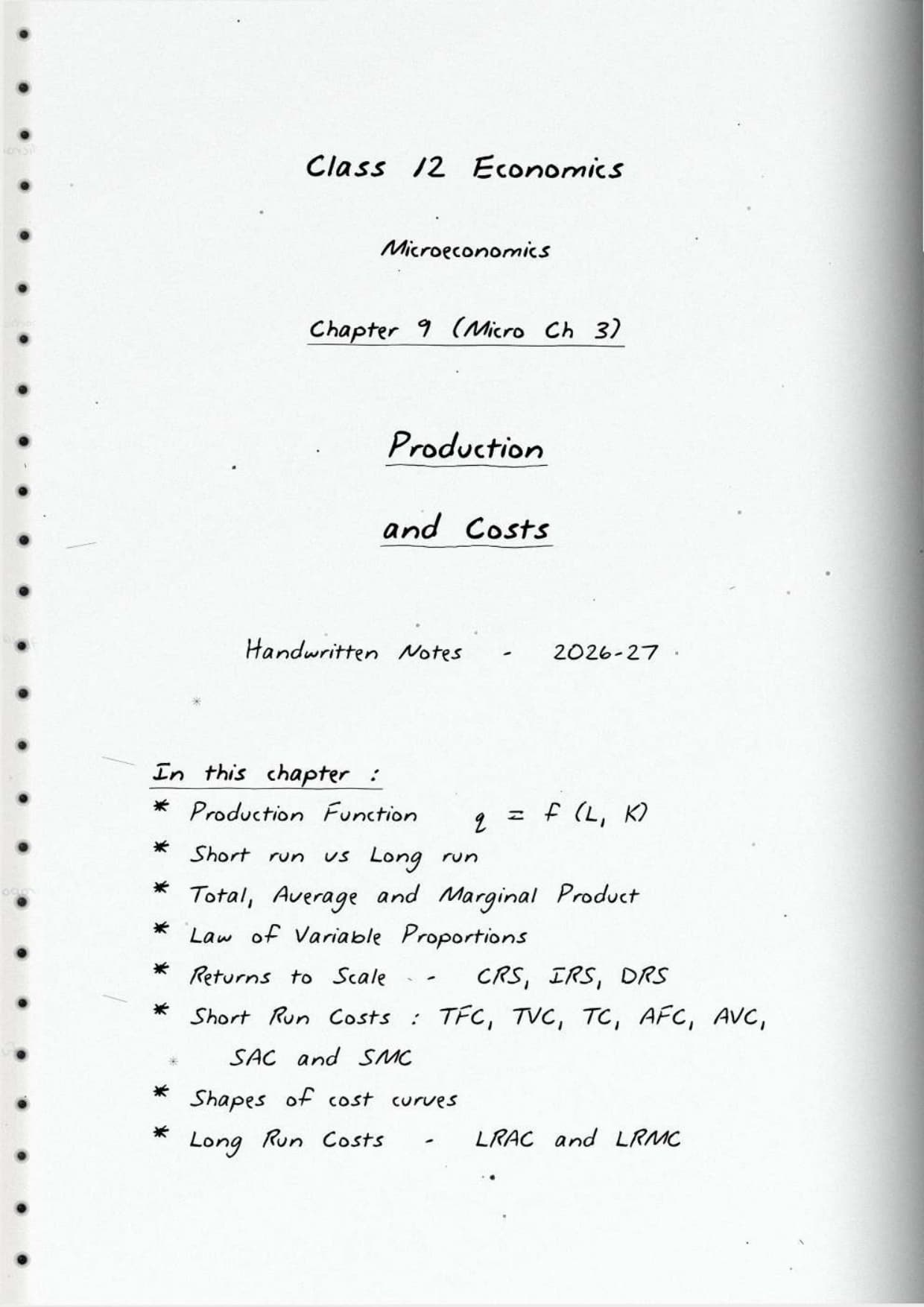
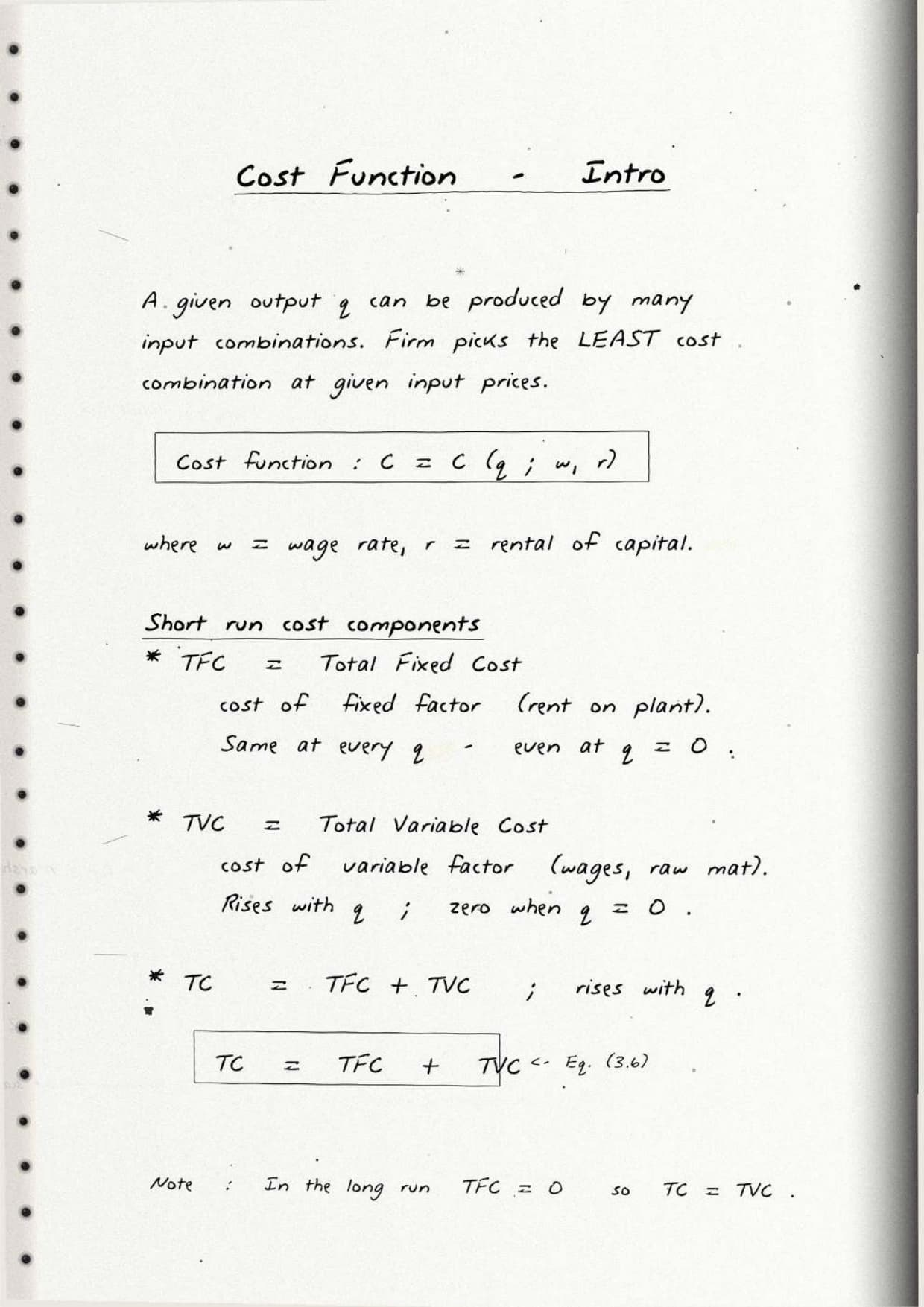
Class 12 Economics Chapter 3 Production and Costs is the third chapter of the Microeconomics book. It covers the production function, the TP, AP and MP curves, isoquants, returns to scale and the seven cost curves. This page has the scanned handwritten notes and a free PDF to download.
Here is what this chapter is worth in the exam:
- CBSE Boards: about 8 to 10 marks, mostly TP/AP/MP and cost-curve diagrams plus one numerical.
- CUET: 2 to 3 questions every year on cost and production basics.
- Revision time: about 22 minutes for the full scanned file.
What These Production and Costs Class 12 Handwritten Notes Cover
The scanned PDF is a 5-page notebook in ballpoint pen on ruled paper. It is built for quick revision, not first-time learning. Each page maps to one block of the chapter.
| Page | What it covers | Time |
|---|---|---|
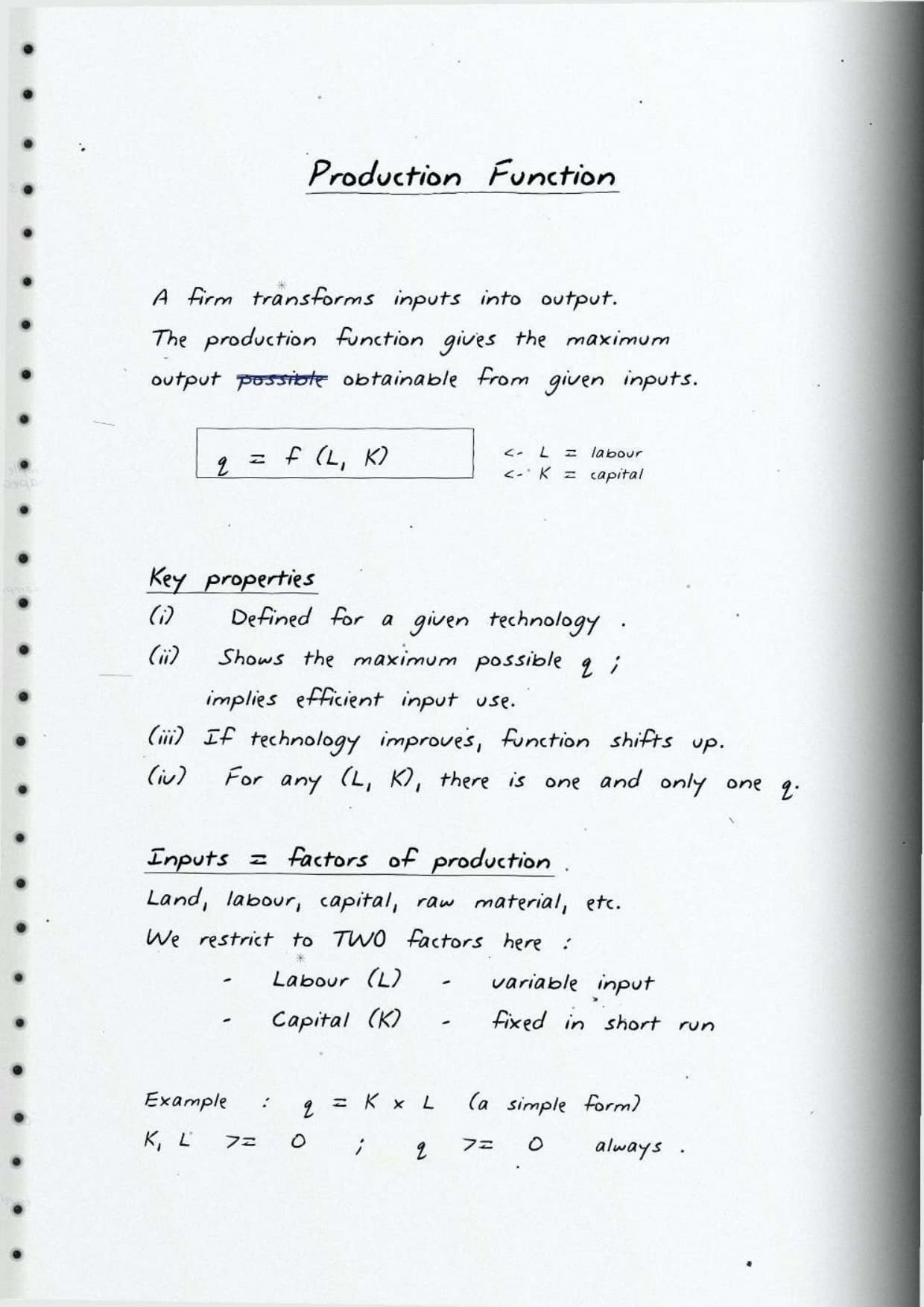
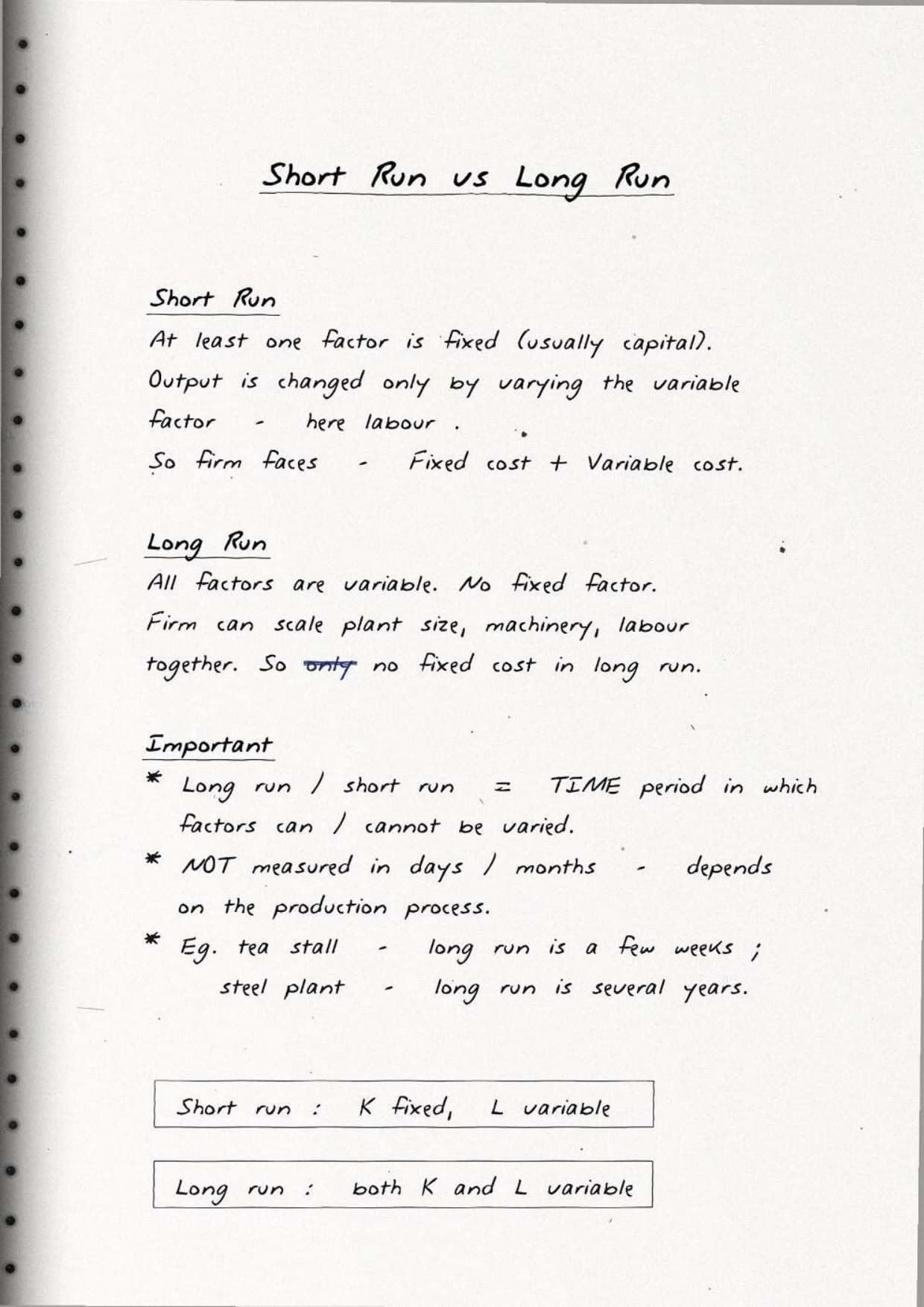
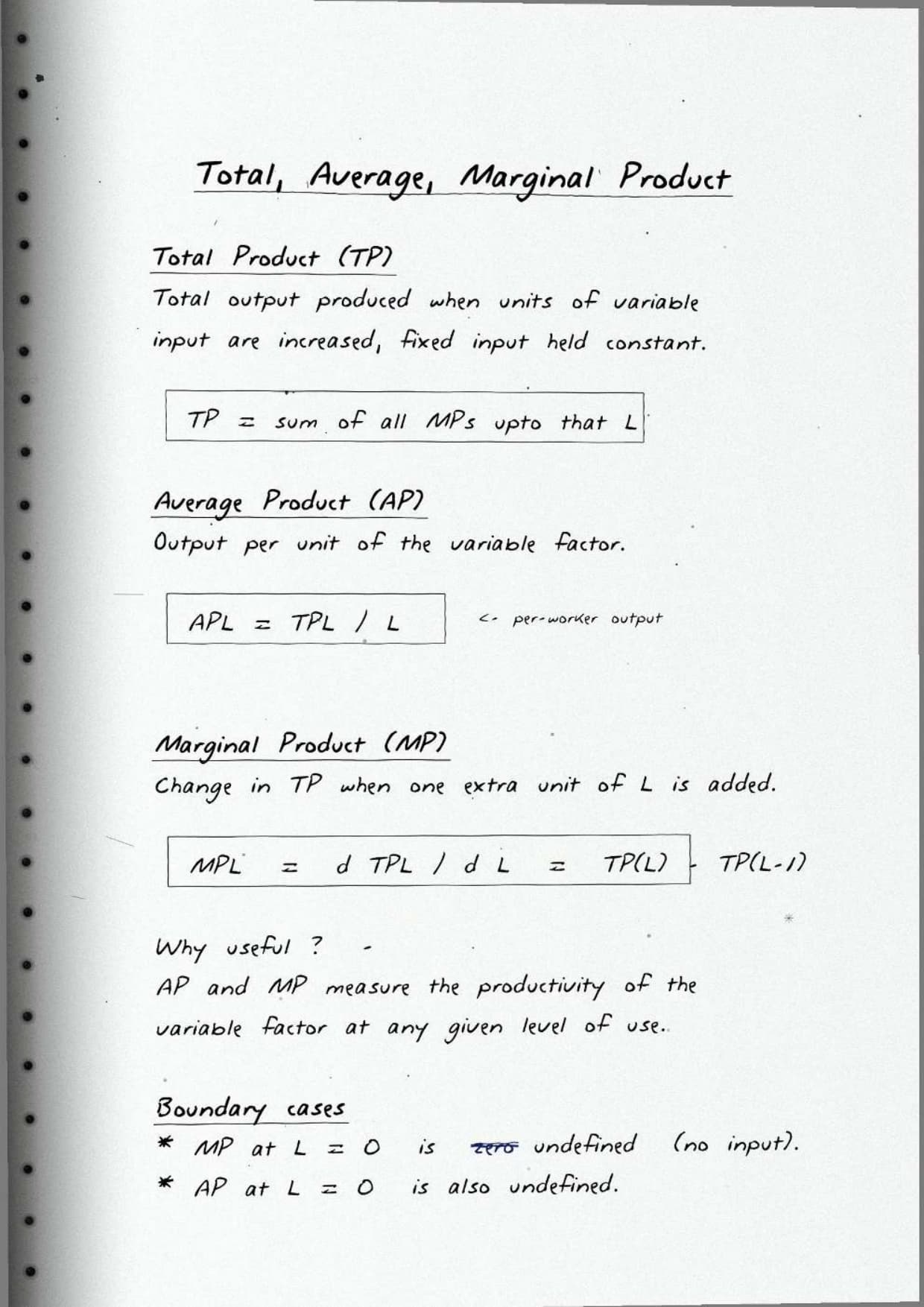
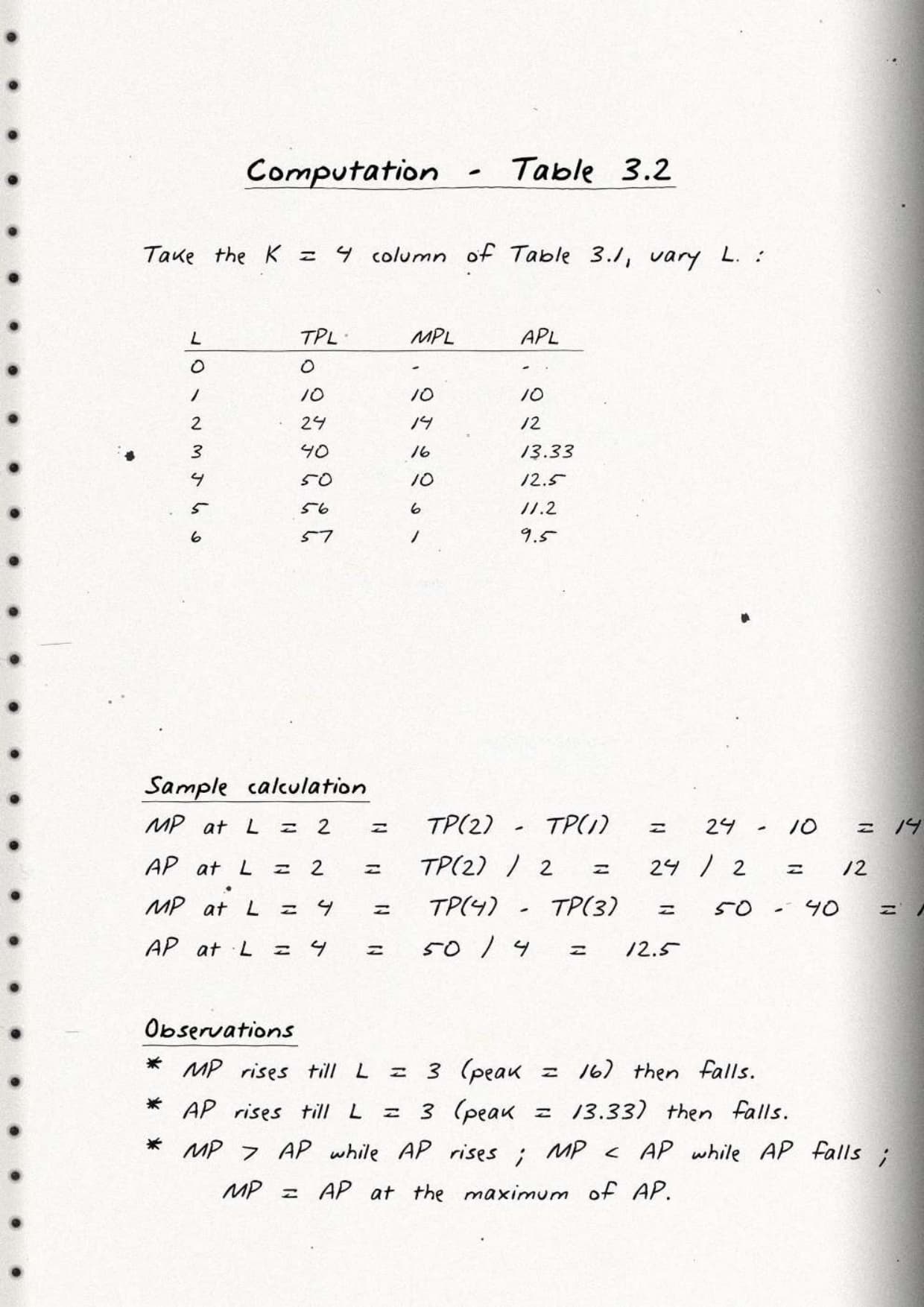
| Page 1 | Production function, short run vs long run, TP, AP and MP definitions in boxes. | 5 min |
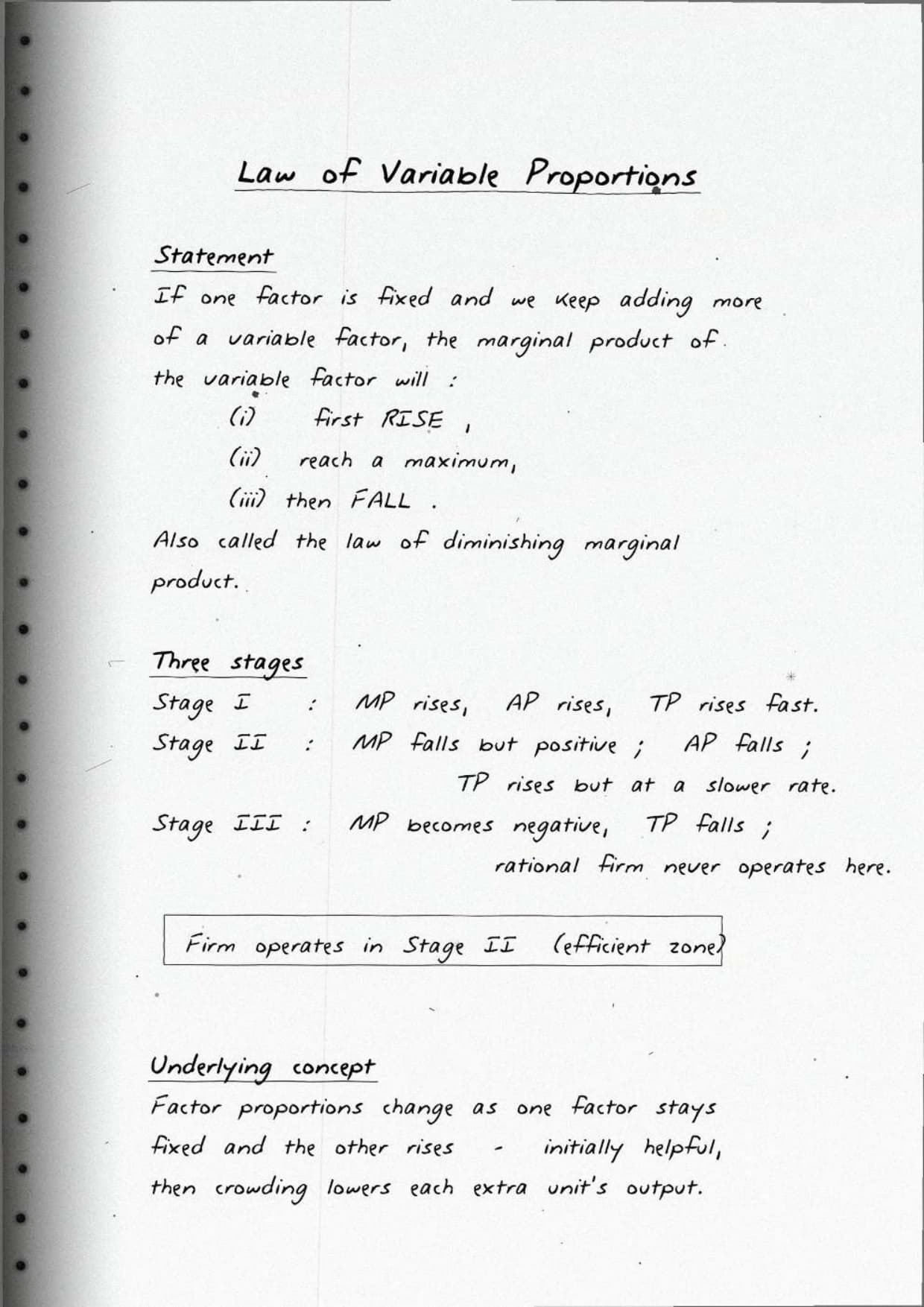
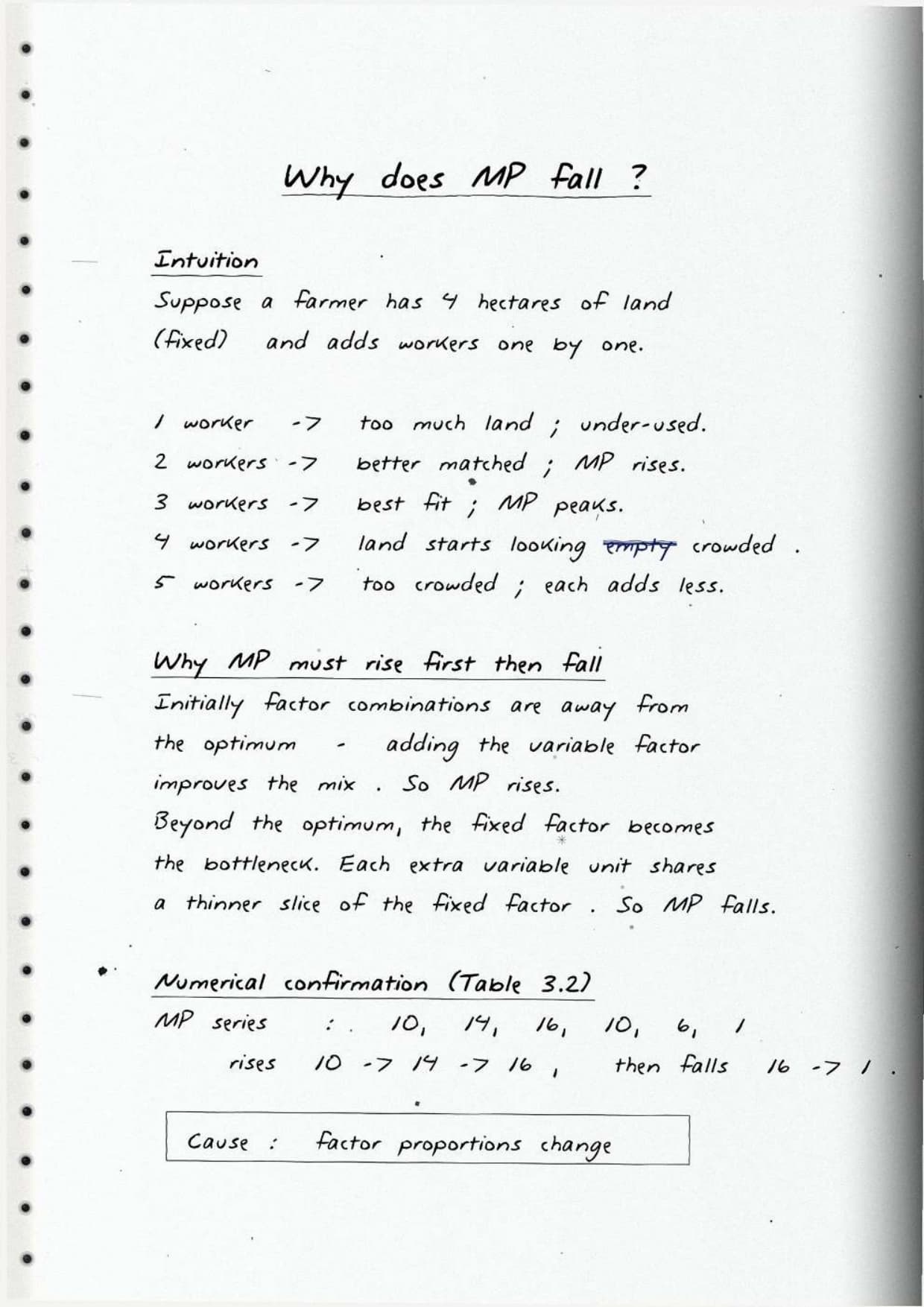
| Page 2 | Law of variable proportions, three stages, freehand TP and AP-MP curve family. | 6 min |
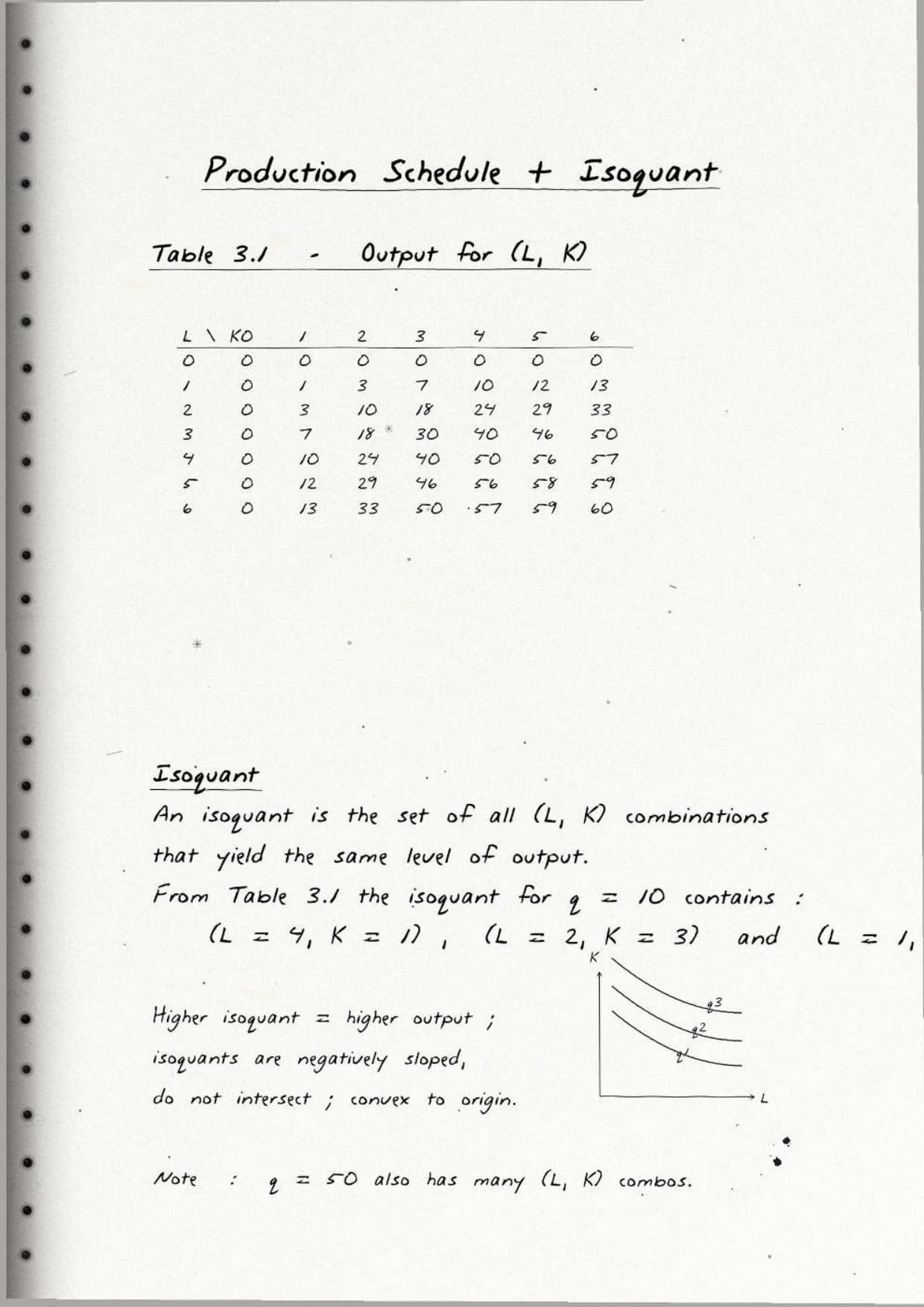
| Page 3 | Isoquants, MRTS slope and returns to scale (IRS, CRS, DRS). | 5 min |
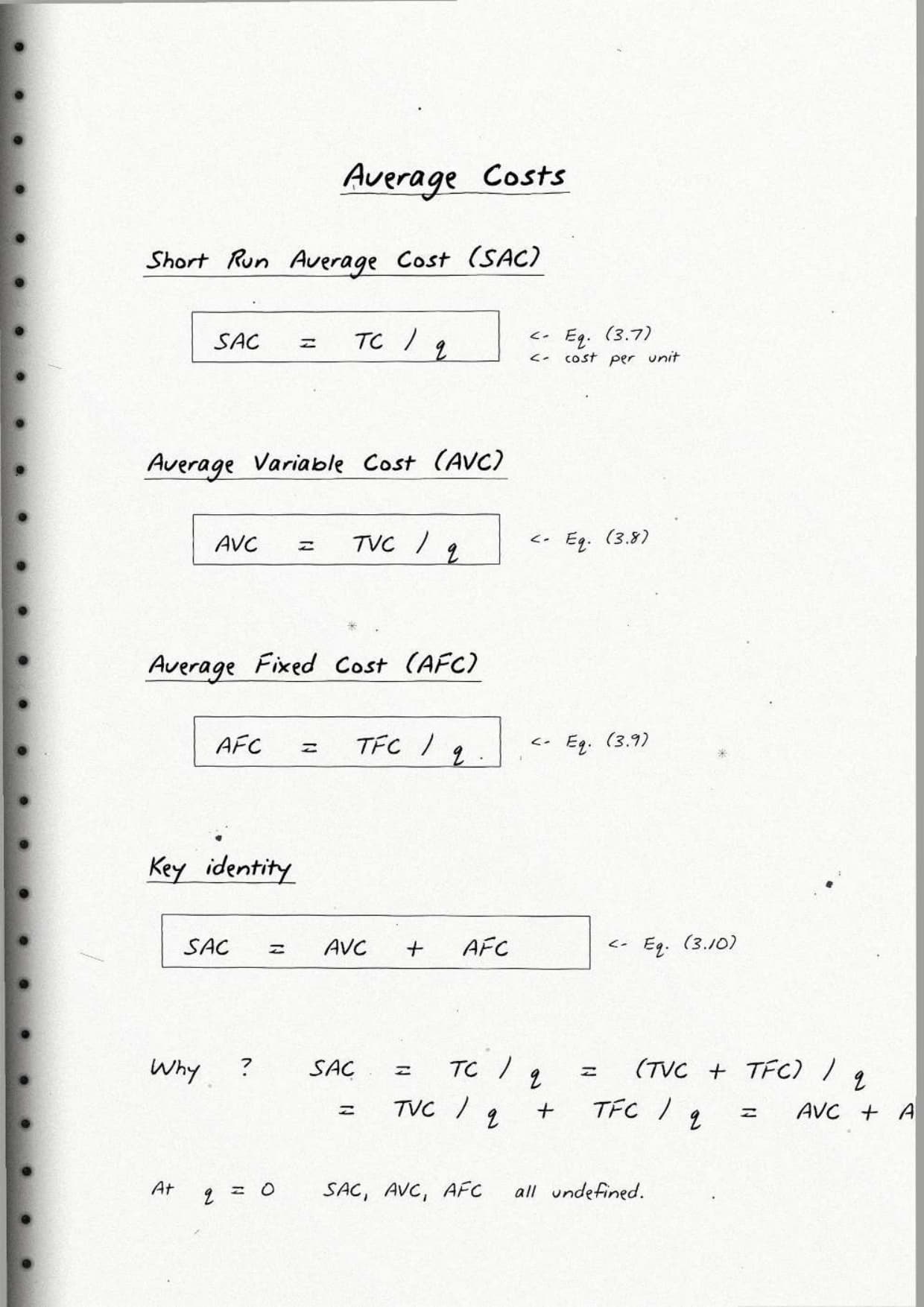
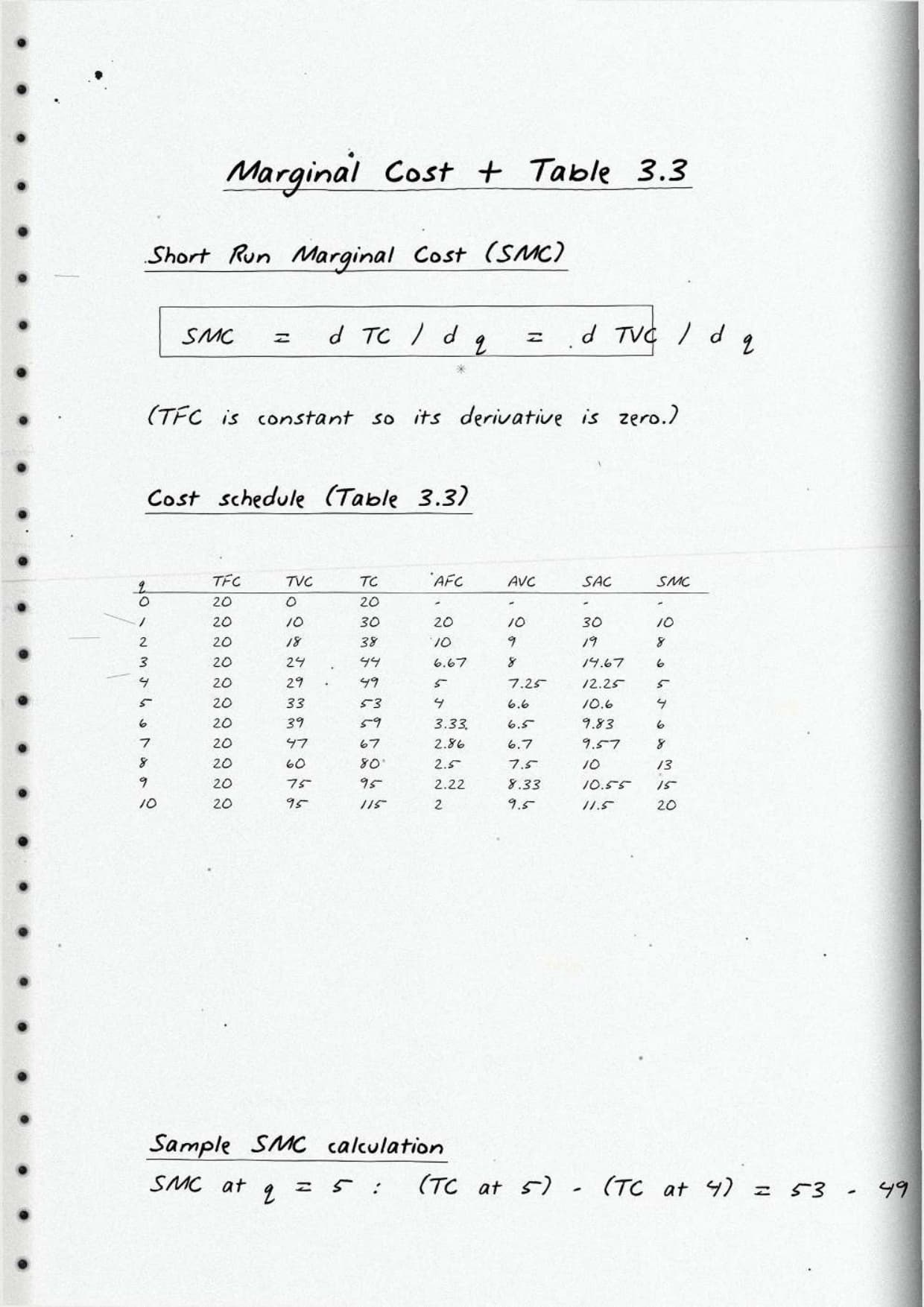
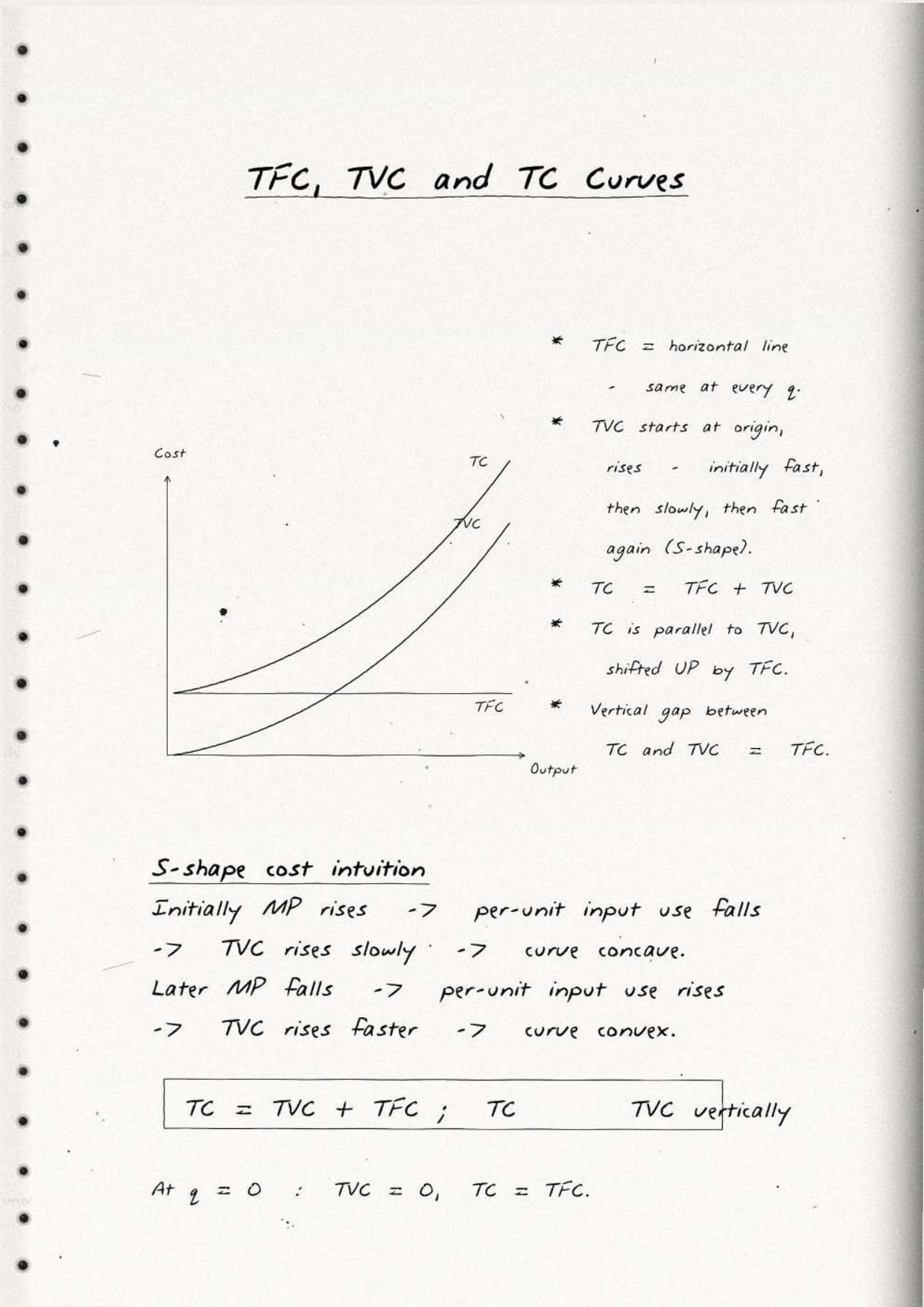
| Page 4 | Short-run cost curves: TFC, TVC, TC, AFC, AVC, AC and MC. | 6 min |
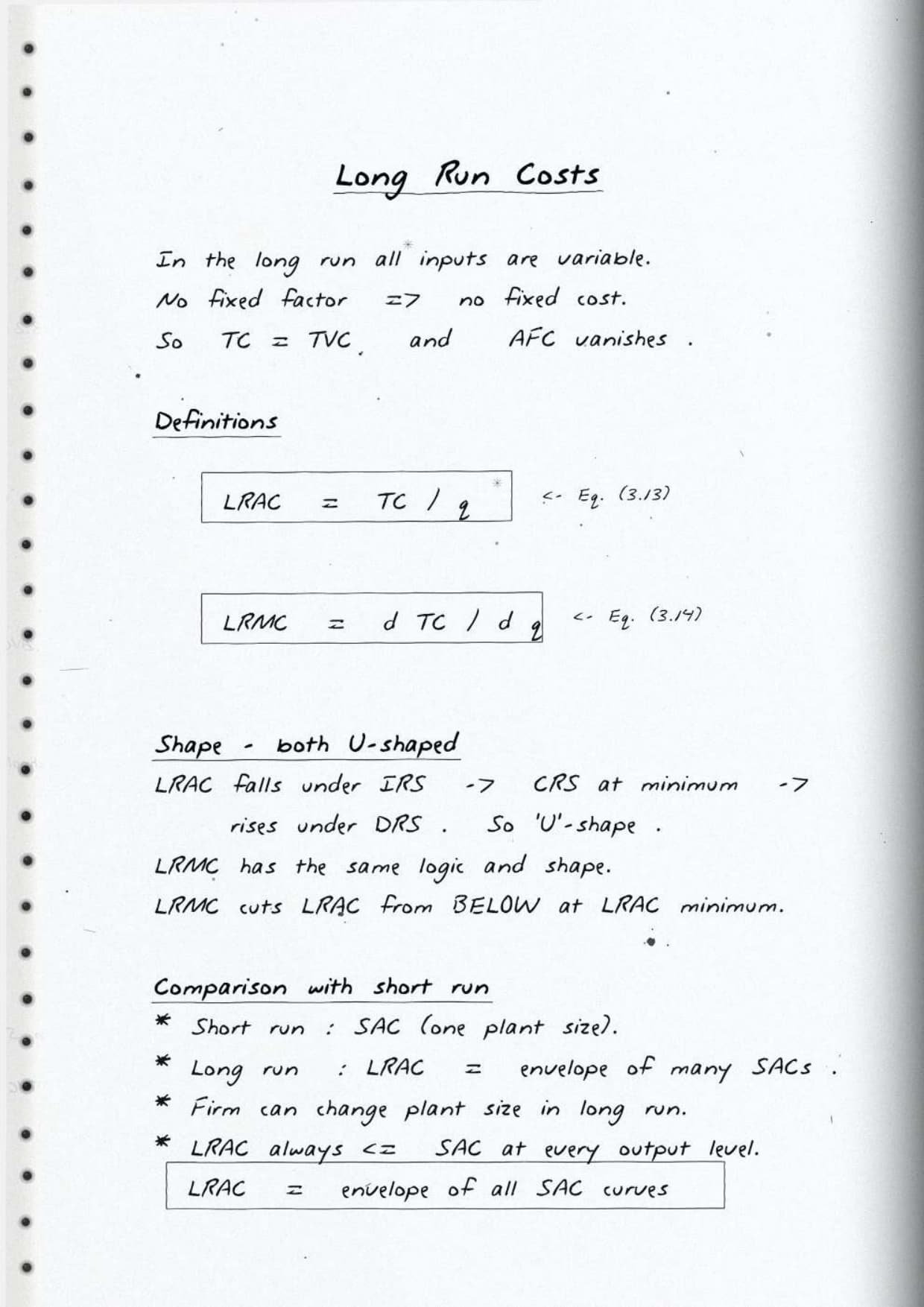
| Page 5 | Long-run cost curves, LRAC envelope and a formula recall block. | 5 min |

Production Function, Short Run and Long Run in Production and Costs Class 12
The production function is the link between inputs and output. The NCERT writes it as Q = f(L, K), where Q is the most output you can get from labour L and capital K with the given technology.
- Short run: at least one input is fixed (usually capital). Output changes only by changing labour.
- Long run: all inputs vary, so there are no fixed inputs and no fixed cost.
- Marks trap: the law of variable proportions works in the short run, returns to scale in the long run. Mixing them costs half a mark.

TP, AP and MP Curves in Production and Costs Class 12
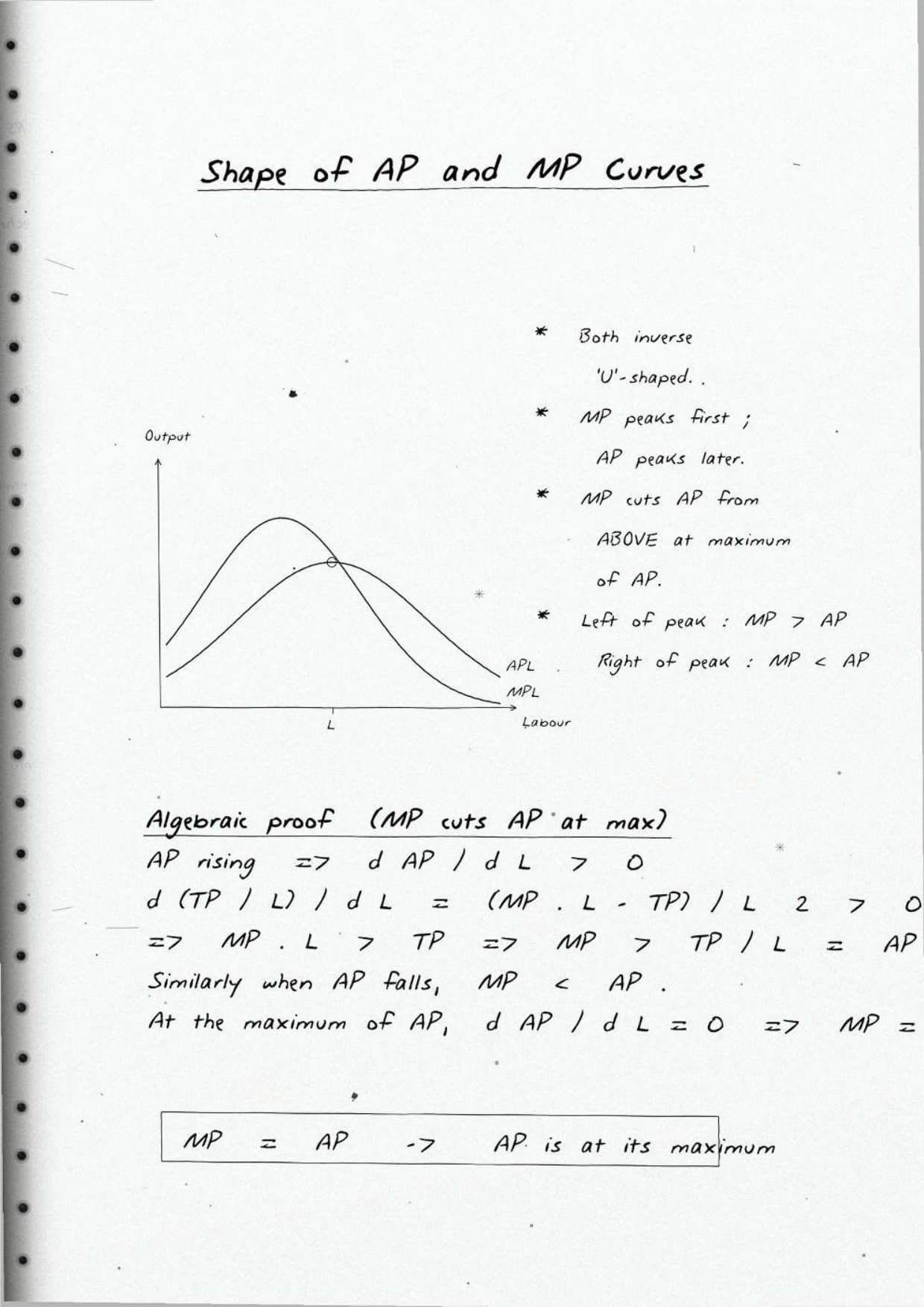
Page 2 holds the most-tested diagram in the chapter. The TP curve sits on top, and the AP and MP curves sit below on the same labour axis, so reading lines connect them.
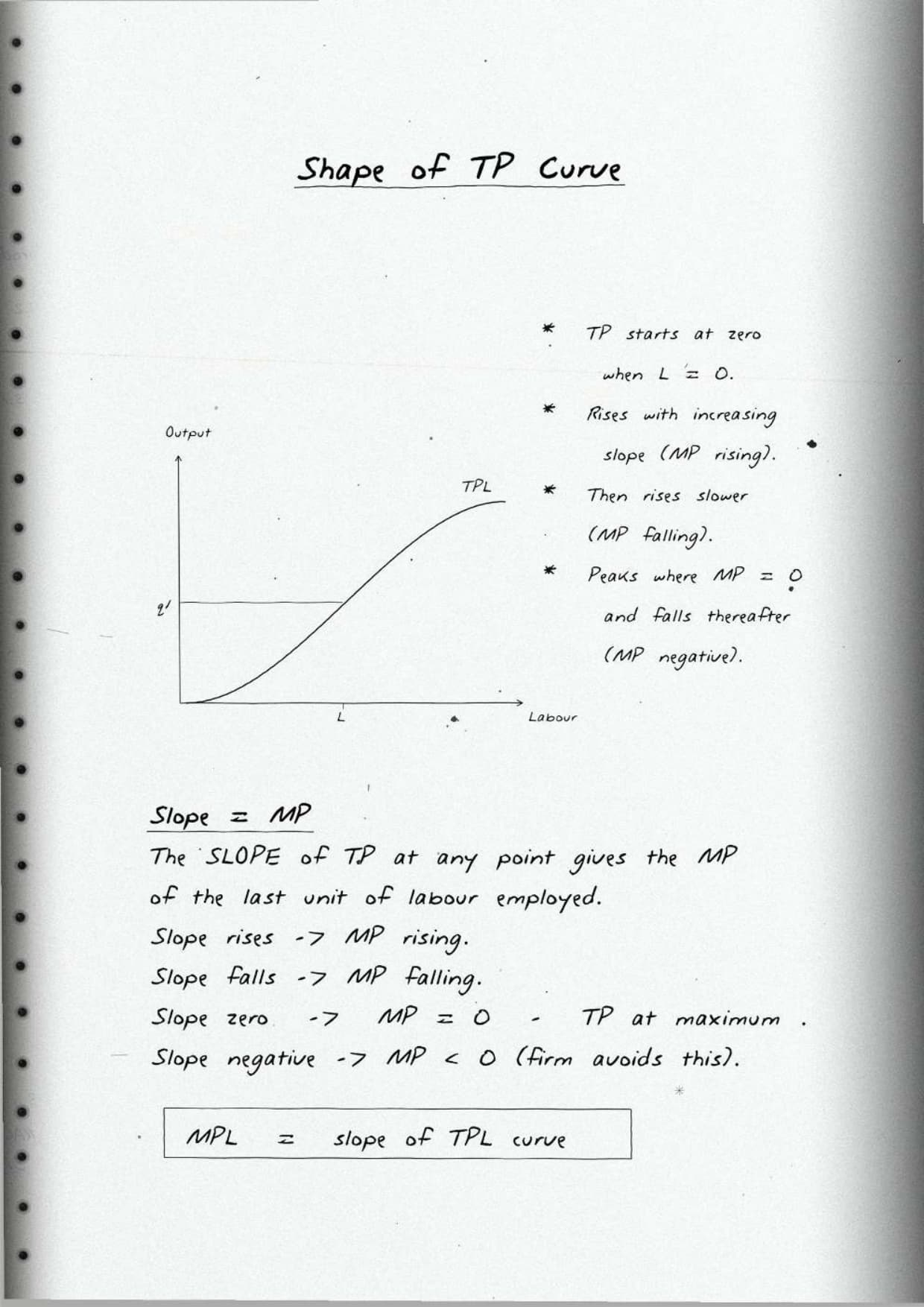
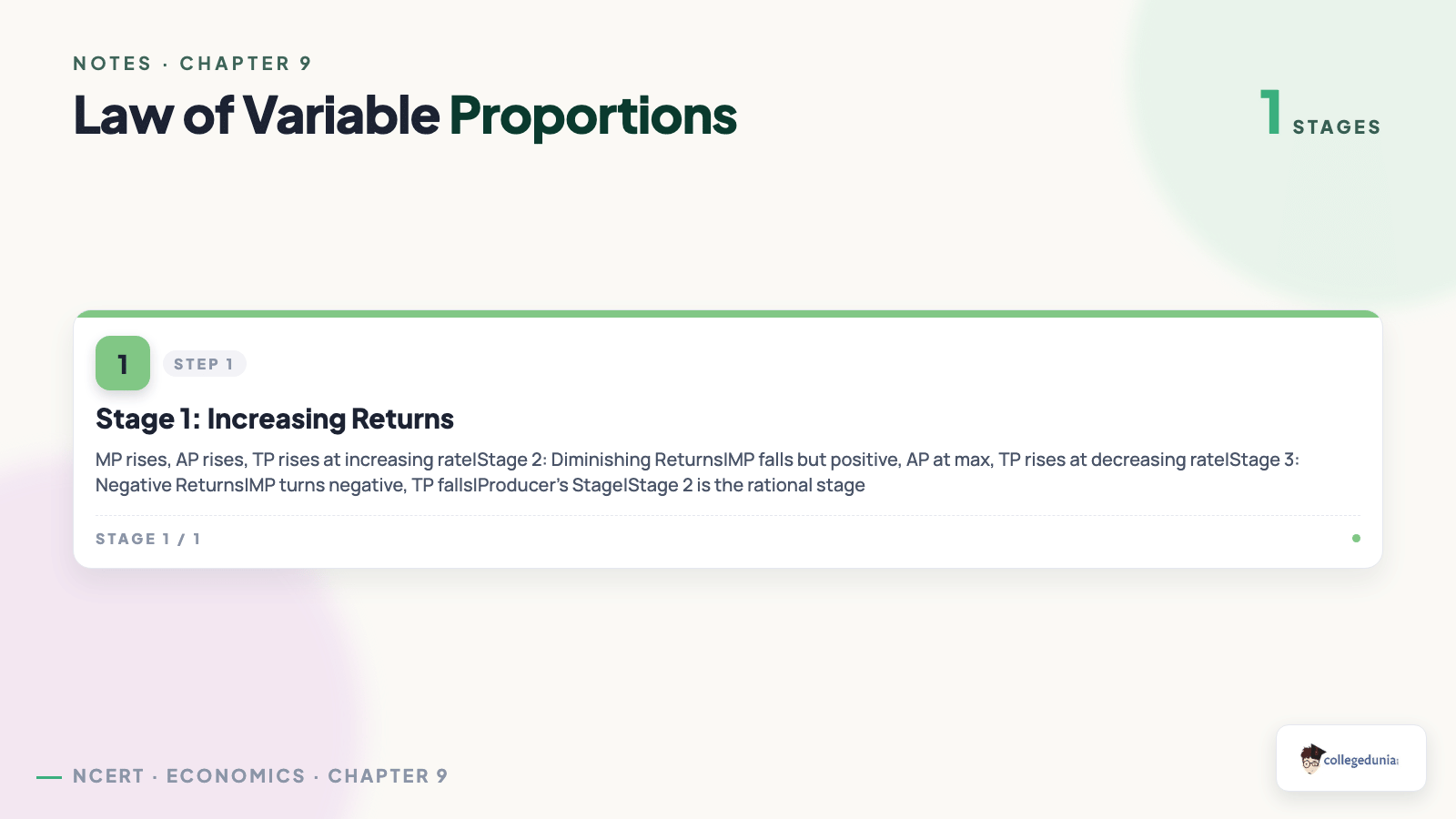
- Law of variable proportions: output rises at an increasing rate, then a decreasing rate, then falls.
- TP and MP: MP is the slope of TP. MP is zero where TP is at its peak, and negative after that.
- AP and MP: MP cuts AP at the highest point of AP. MP above AP pulls AP up, MP below AP pulls it down.
- Stages: Stage II (AP-max to TP-max) is the only sensible zone to produce in.
Isoquants and Returns to Scale in Production and Costs Class 12
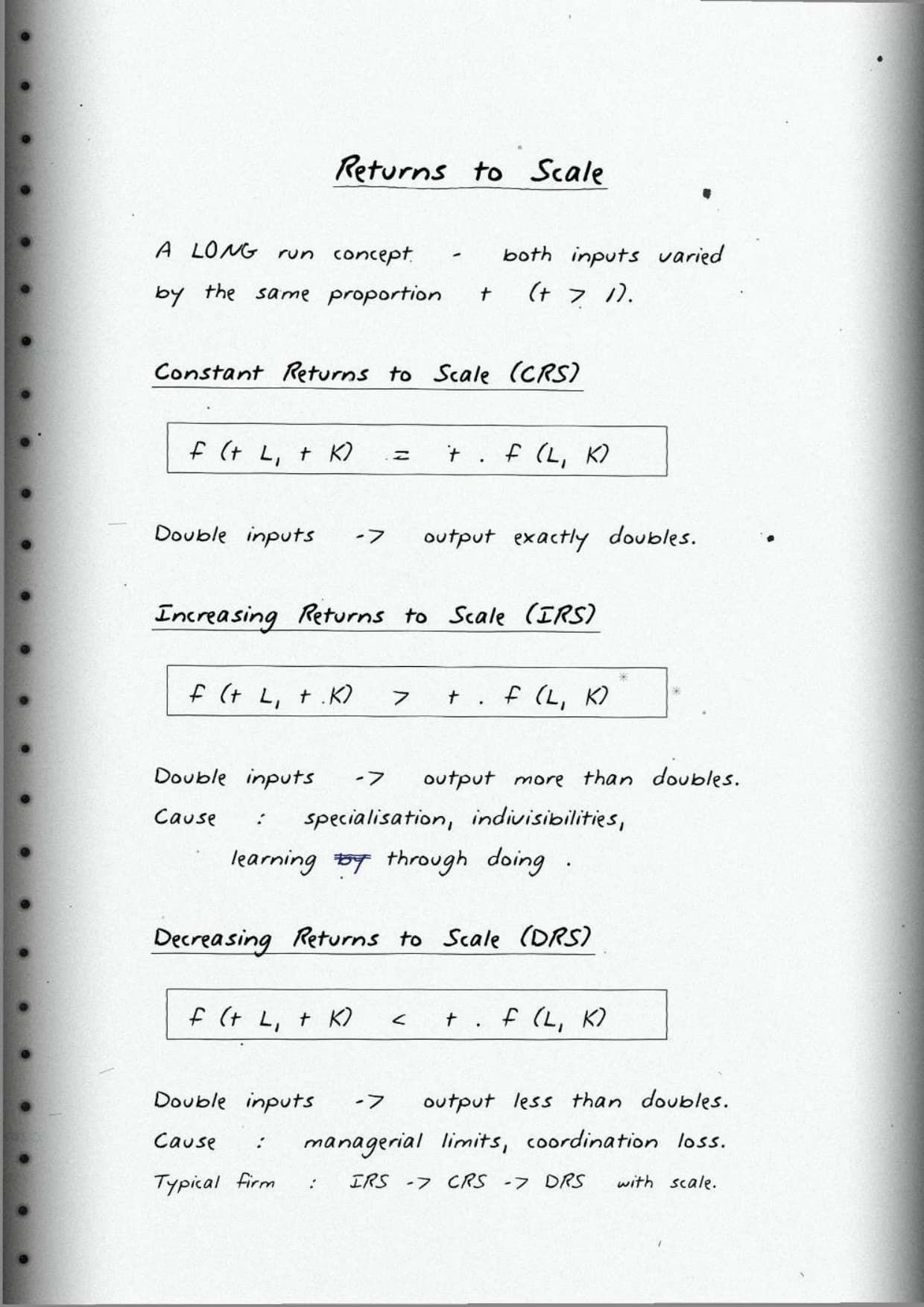
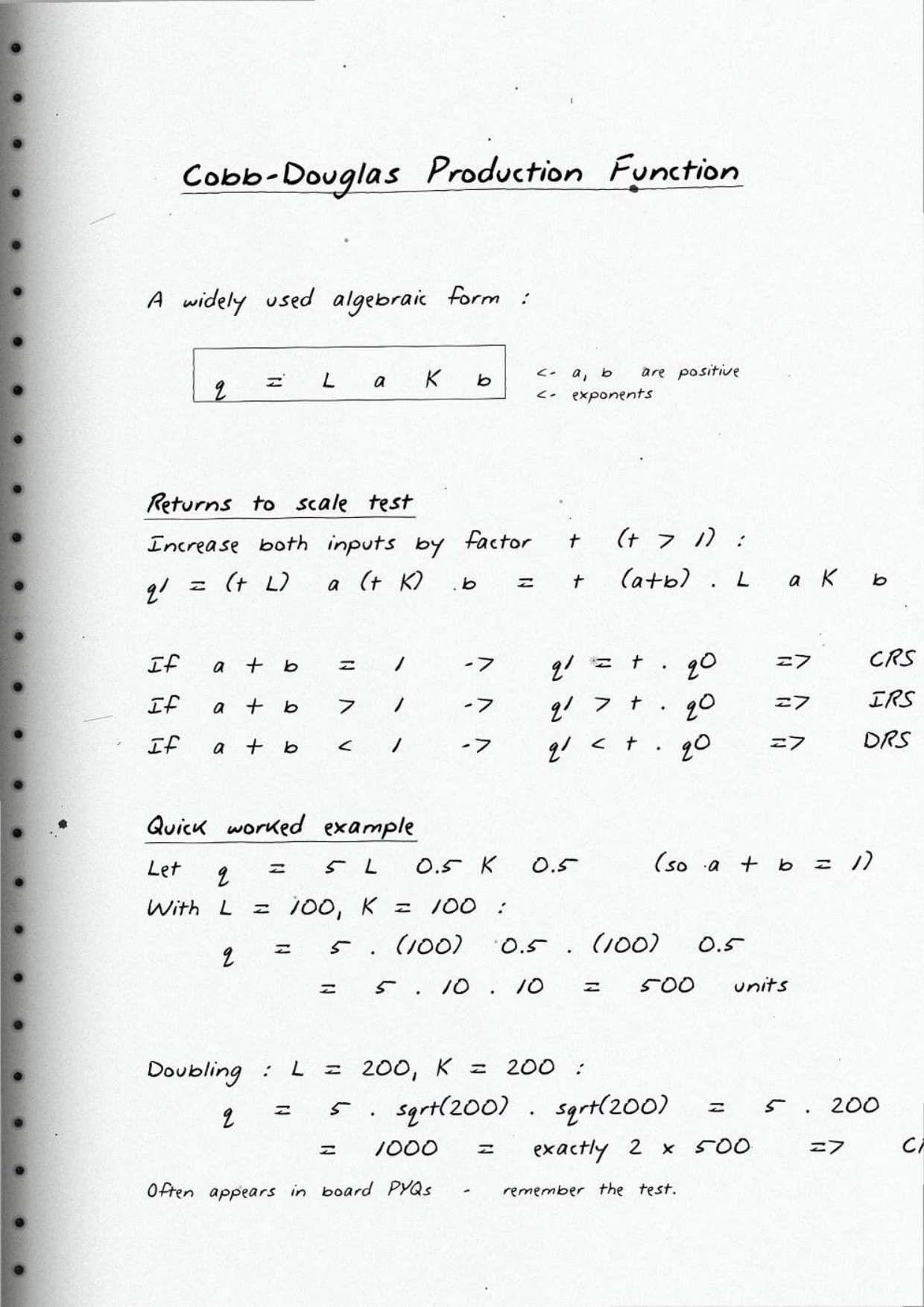
An isoquant joins all combinations of labour and capital that give the same output. Its slope is the marginal rate of technical substitution, MRTS = MP of L divided by MP of K. Returns to scale is a long-run idea: it asks what happens to output when all inputs change in the same proportion.
| Returns to scale | If both L and K double | Cause |
|---|---|---|
| Increasing (IRS) | Output more than doubles. | Specialisation, lower per-unit fixed cost. |
| Constant (CRS) | Output exactly doubles. | Inputs are fully divisible. |
| Decreasing (DRS) | Output less than doubles. | Coordination and managerial problems. |

Cost Curves (TC, TVC, TFC, AC, AVC, AFC, MC) in Production and Costs Class 12
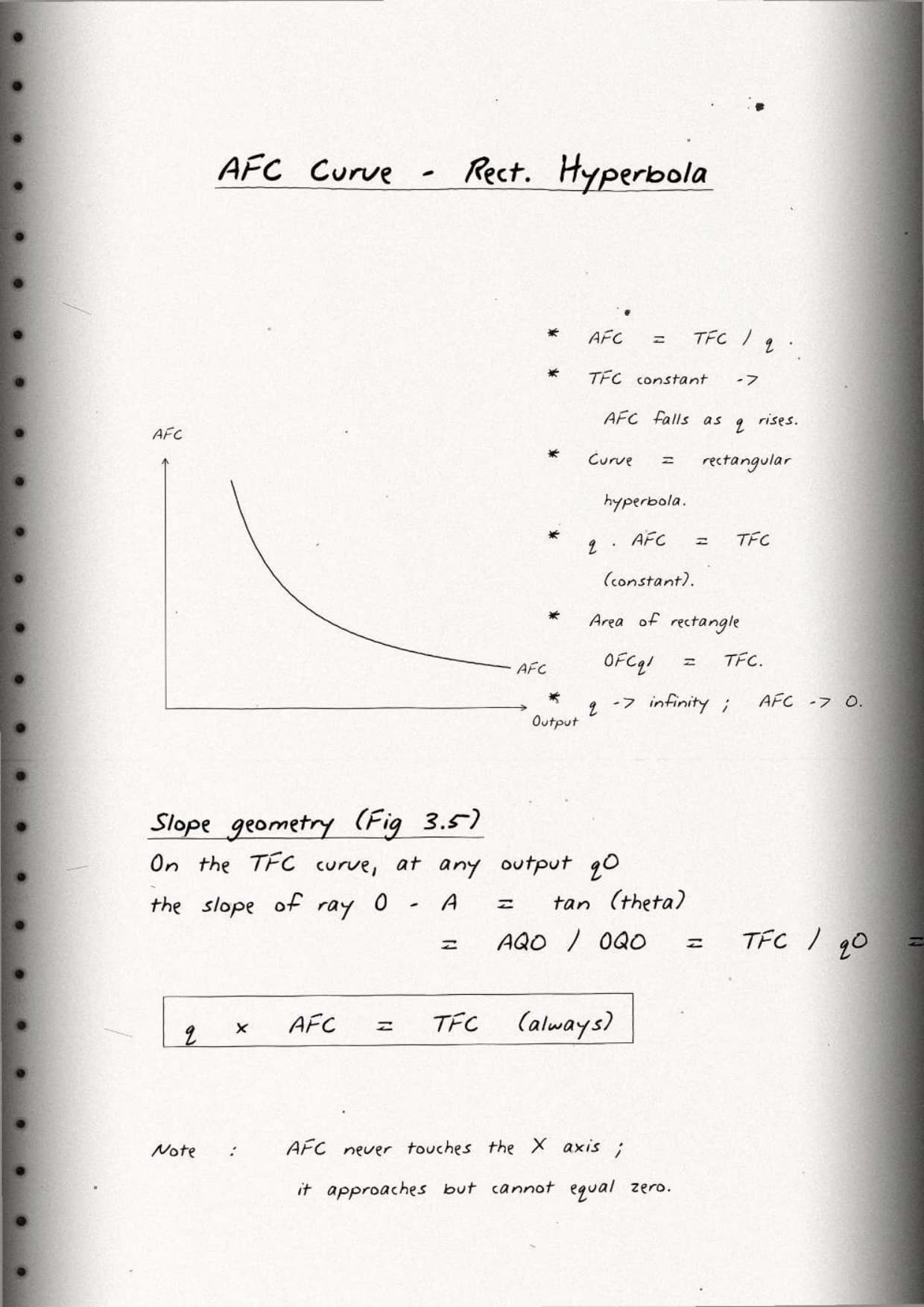
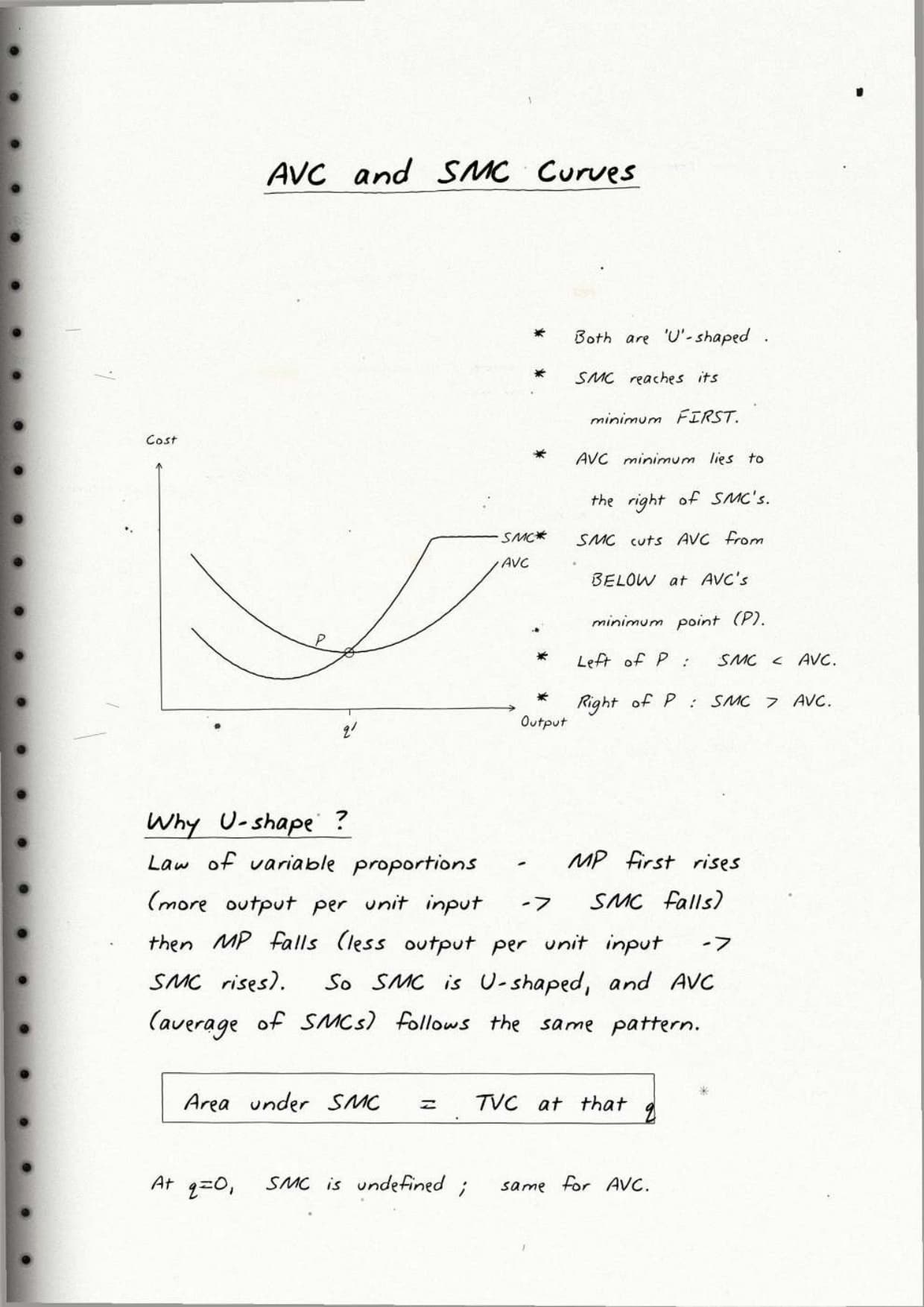
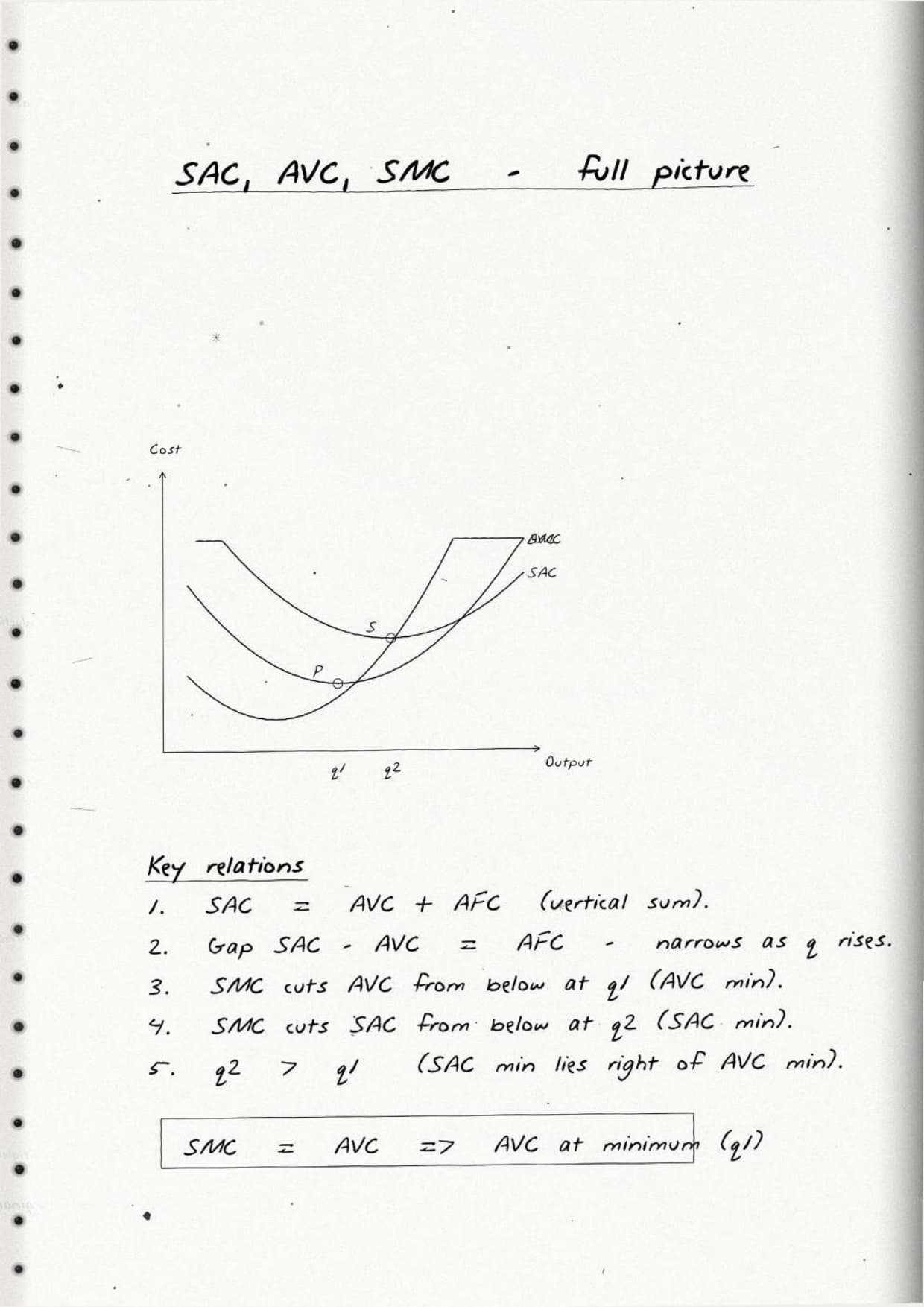
Page 4 stacks the seven short-run cost curves on one output axis. TFC is a horizontal line, TVC rises from the origin, and TC is the two added together.
- Why AVC and AC are U-shaped: the law of variable proportions in cost space. AC sits above AVC by the AFC gap.
- MC cuts the minimum: MC cuts AVC and AC at their lowest points. Below the average it pulls the average down, above it pulls it up.
- AFC: AFC = TFC divided by Q, a falling curve that nears the axis but never touches it.
Key Formulas in the Production and Costs Class 12 Handwritten Notes
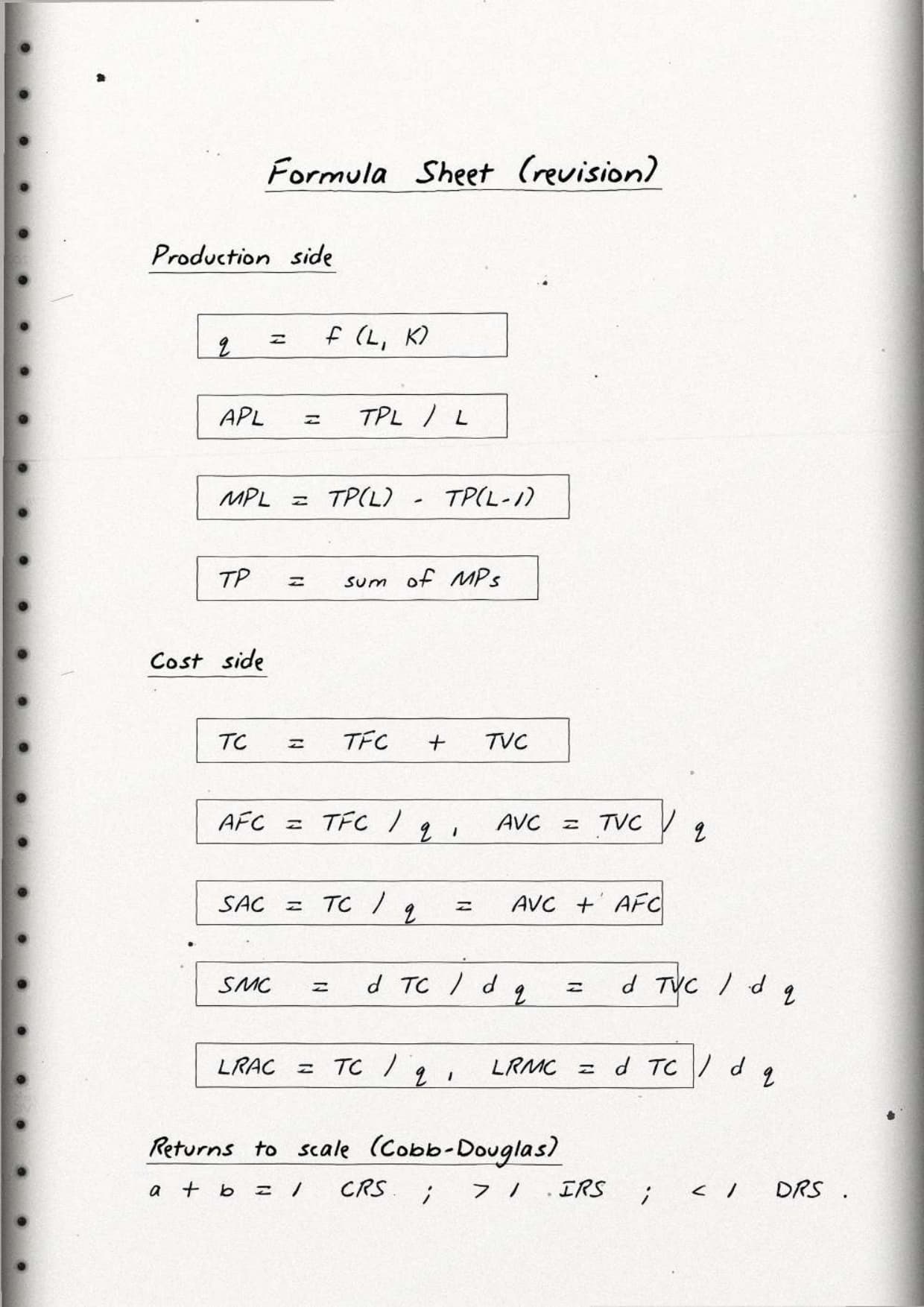
This is the highest-value block. Each formula sits inside a hand-drawn box in the scanned file.
| Concept | Formula |
|---|---|
| Production function | Q = f(L, K) |
| Average Product | AP = TP / L |
| Marginal Product | MP = TP(n) minus TP(n-1) |
| MRTS (isoquant slope) | MRTS = MP of L / MP of K |
| Total Cost | TC = TFC + TVC |
| Average Cost | AC = TC / Q = AFC + AVC |
| Marginal Cost | MC = TC(n) minus TC(n-1) |
Production and Costs Class 12 Video Lesson
Source: Magnet Brains on YouTube
Common Mistakes in Production and Costs Class 12
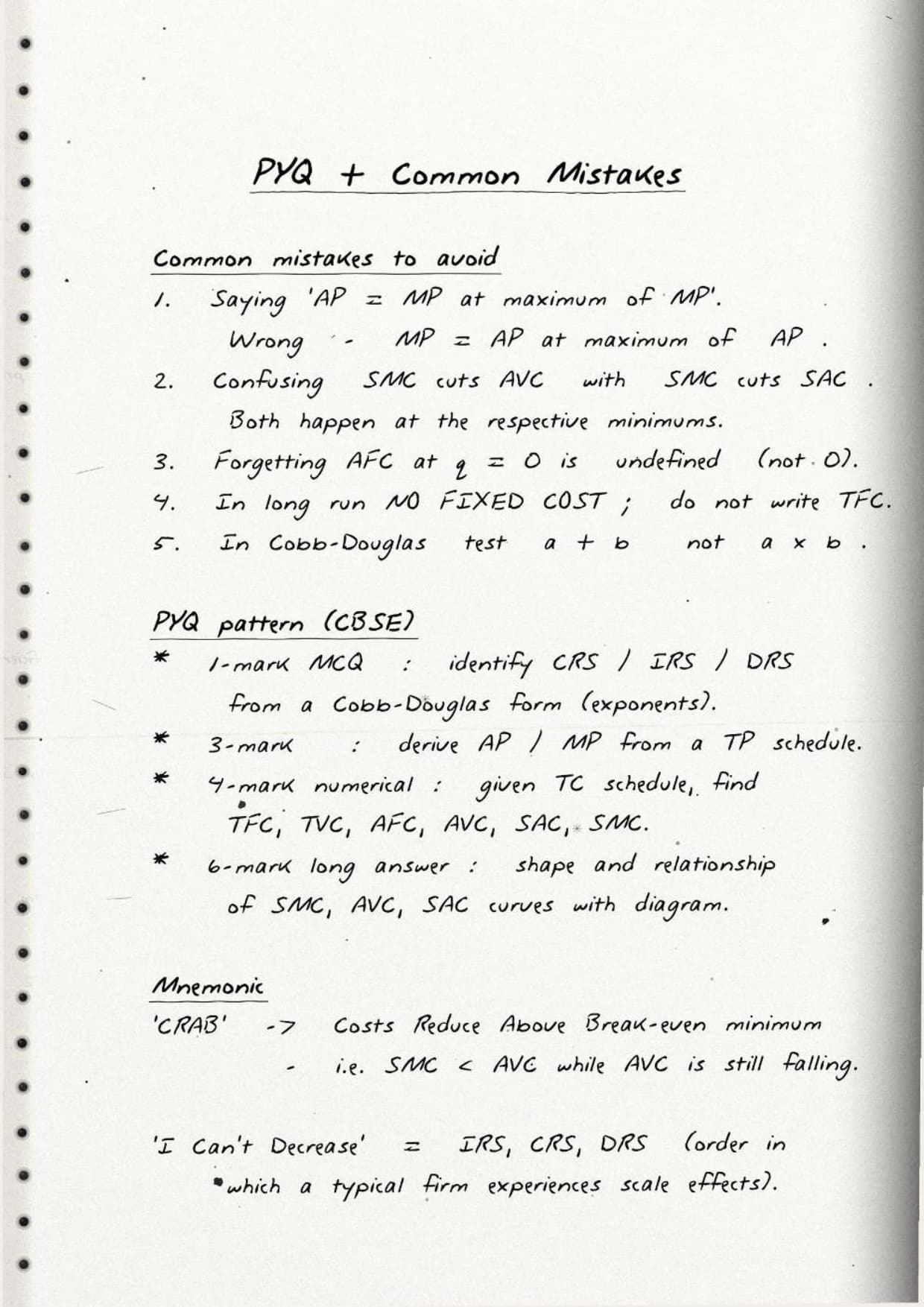
- Confusing the law of variable proportions (short run) with returns to scale (long run).
- Drawing a straight TP curve instead of one that rises, peaks and falls.
- Showing MP cut AP somewhere other than the maximum of AP.
- Treating TFC as zero in the short run. It stays positive even at zero output.
- Drawing MC cut AVC and AC at the same point. The AC minimum lies to the right.
Production and Costs Class 12 Weightage in CBSE and CUET
The chapter has held a steady 8 to 10 marks in CBSE. The table maps recent board questions to the page to revise.
| Year | CBSE question | Marks | Page |
|---|---|---|---|
| 2025 | TP, AP and MP curves plus stages of production | 4 + 3 | Page 2 |
| 2024 | Why MC cuts AC at its minimum, with cost-curve diagram | 3 + 4 | Page 4 |
| 2023 | Find MP and AP from a TP schedule, plus returns to scale vs a factor | 4 + 3 | Page 1, 3 |
| 2022 | Relationship between TP and MP, plus define isoquant | 3 + 1 | Page 2, 3 |
Student Feedback
We asked 11,940 Class 12 students about this chapter. 76% said the scanned notebook felt faster to scan than typed PDFs in the last 48 hours, and 4 out of 5 said the pen-drawn TP-AP-MP and cost curves stuck in memory better. One full pass took about 22 minutes.
Other Resources for Class 12 Economics Chapter 3 Production and Costs
Pair these handwritten notes with the typed Notes, the Solutions and the official NCERT chapter below.
| Resource | What it covers | Open |
|---|---|---|
| Handwritten Notes | Scanned notebook pages for last-mile revision. | Chapter 3 Handwritten Notes |
| NCERT Solutions | Step-by-step answers to every exercise question. | Chapter 3 NCERT Solutions |
| Notes | Concept-first typed revision of the full chapter. | Chapter 3 Notes |
| NCERT Book PDF | Official NCERT Microeconomics Chapter 3 textbook. | Chapter 3 NCERT Book PDF |
All Chapters Handwritten Notes for Class 12 Microeconomics
| Chapter | Handwritten Notes link |
|---|---|
| Chapter 1 | Introduction to Microeconomics |
| Chapter 2 | Theory of Consumer Behaviour |
| Chapter 3 | Production and Costs |
| Chapter 4 | Theory of the Firm under Perfect Competition |
| Chapter 5 | Market Equilibrium |
Production and Costs Class 12 Handwritten Notes FAQs
Ques. What are these Class 12 Economics Chapter 3 handwritten notes for?
Ans. They are a 5-page scanned notebook for quick revision of Production and Costs. They cover the production function, the TP, AP and MP curves, the law of variable proportions, isoquants, returns to scale and the seven cost curves, with a formula recall page. Most students use them in the 24 hours before the board paper, alongside the typed Notes and the NCERT Solutions.
Ques. What is the difference between TP, AP and MP?
Ans. Total Product is the total output from a given amount of the variable input. Average Product is TP divided by the units of input, AP = TP / L. Marginal Product is the change in TP from one more unit of input. MP is the slope of TP, MP cuts AP at the maximum of AP, and MP is zero where TP peaks.
Ques. Why is the AC curve U-shaped?
Ans. Because of the law of variable proportions in cost space. As output rises, AP first rises so AVC falls, and AFC keeps falling, so AC falls steeply. Later AP falls, AVC rises, and the rise in AVC overtakes the fall in AFC, so AC turns upward. AC is lowest where MC cuts it from below.
Ques. What is the difference between returns to scale and the law of variable proportions?
Ans. The law of variable proportions is a short-run idea, where one input is fixed and only one input varies. Returns to scale is a long-run idea, where all inputs change in the same proportion. CBSE markers cut half a mark when the two are used in the wrong context.
Ques. Are these handwritten notes enough for the CBSE board exam?
Ans. They are strong for formula recall and diagram practice, which is about 6 to 7 of the 8 to 10 marks this chapter carries. For full numerical practice, pair them with the matching NCERT Solutions PDF, which works every exercise question end to end. Both are linked in the resources table on this page.



Comments