




Class 12 Economics Chapter 4, The Theory of the Firm under Perfect Competition, is the fourth chapter of the Microeconomics book. It covers the five conditions of perfect competition, the MR and MC curves, profit maximisation, the shut-down and break-even points, and the firm's supply curve. This page hosts the full scanned handwritten notes as a free PDF you can download.
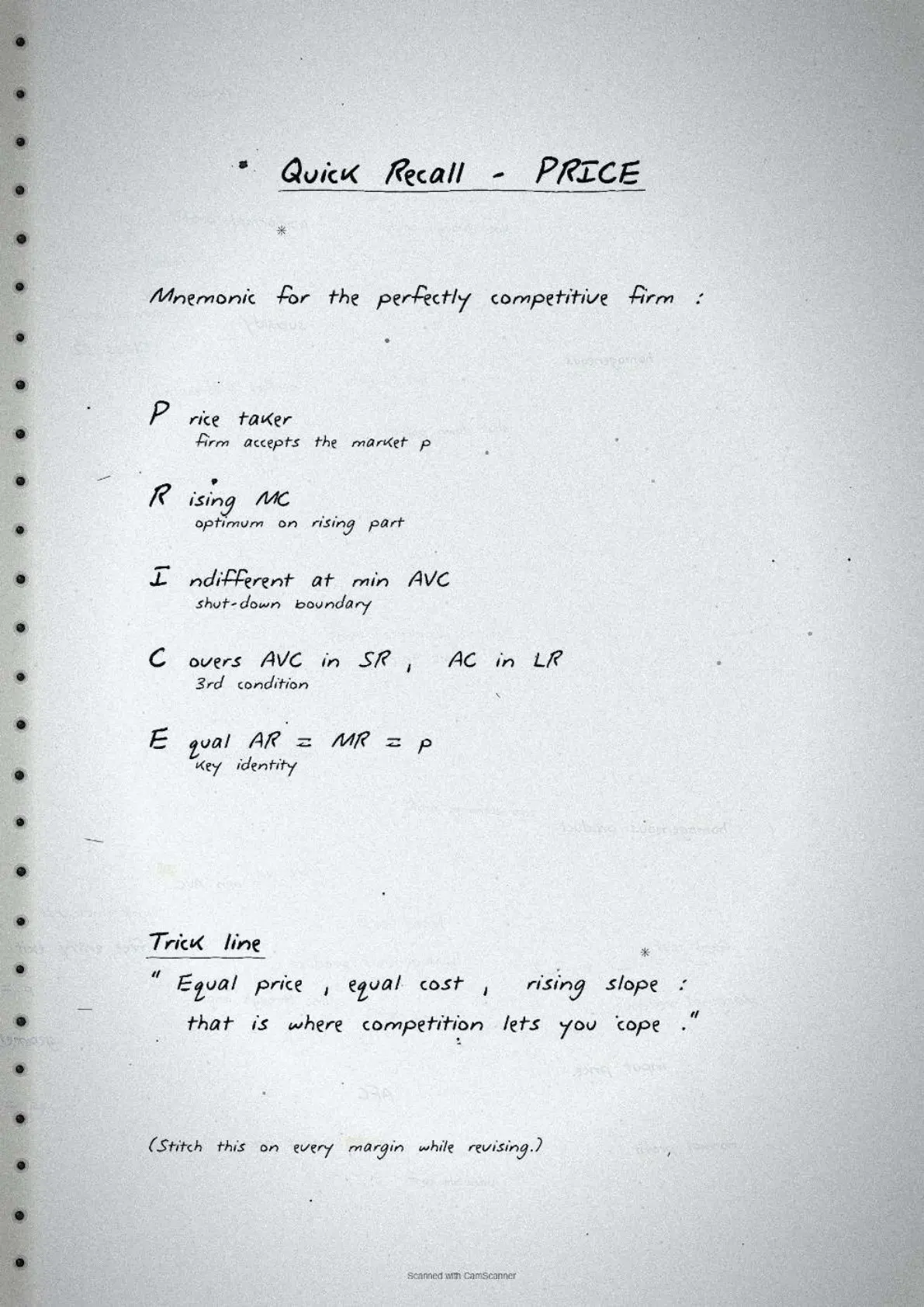
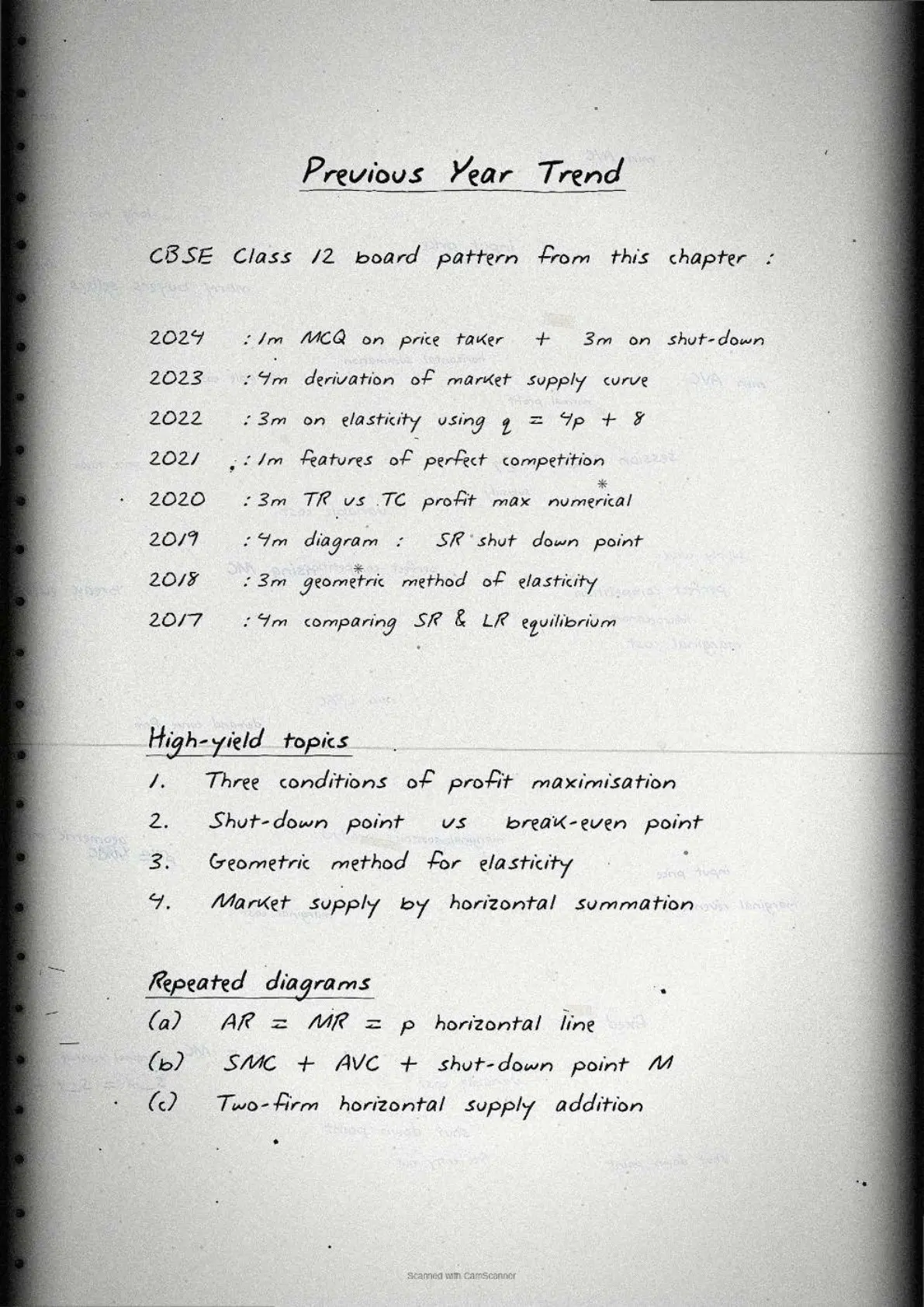
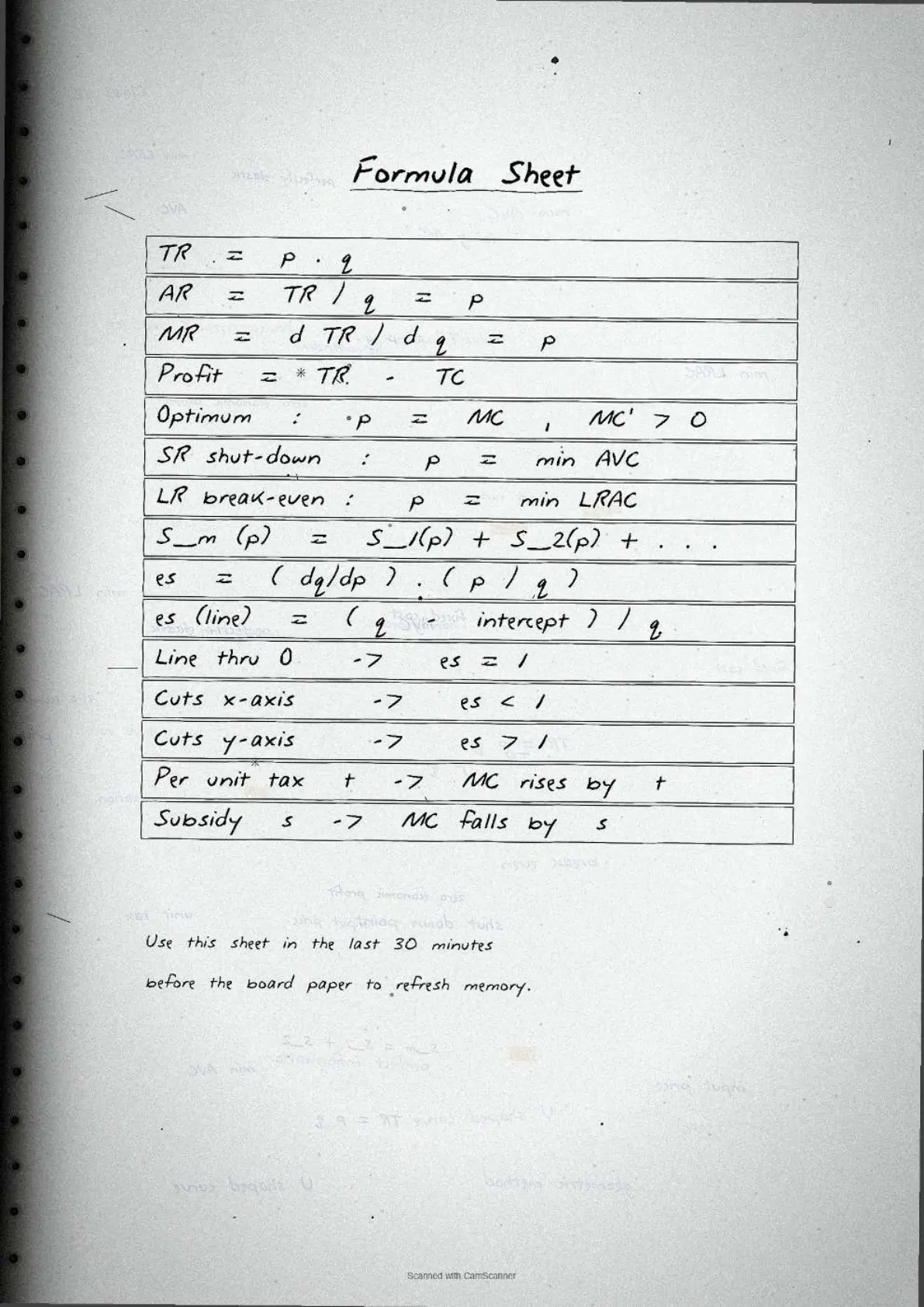
Here is what this chapter is worth in the exam:
- CBSE Boards: about 10 to 12 marks, with the MR-equals-MC diagram and the supply-curve derivation as the highest-yield blocks.
- CUET: 2 to 3 questions each year on perfect competition and profit maximisation.
- Revision time: about 23 minutes with these handwritten notes.
What These Theory of the Firm Under Perfect Competition Class 12 Handwritten Notes Cover
These notes are a scanned notebook in ballpoint pen on ruled paper. They are built for last-mile revision, not first-time learning. The file is four pages long and maps to every concept CBSE tests in Class 12 Microeconomics Chapter 4.
| Page | What the page covers | Time |
|---|---|---|
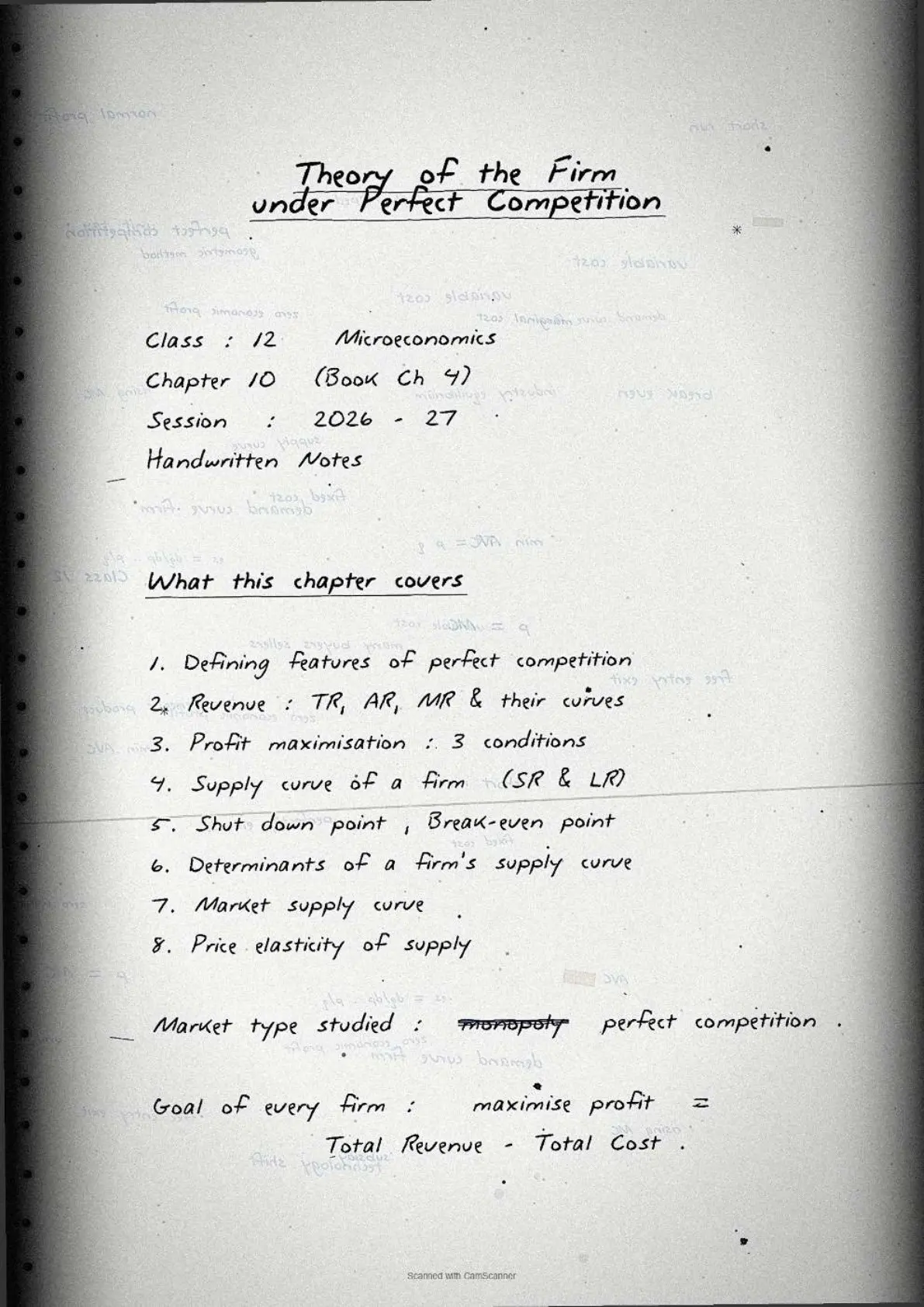
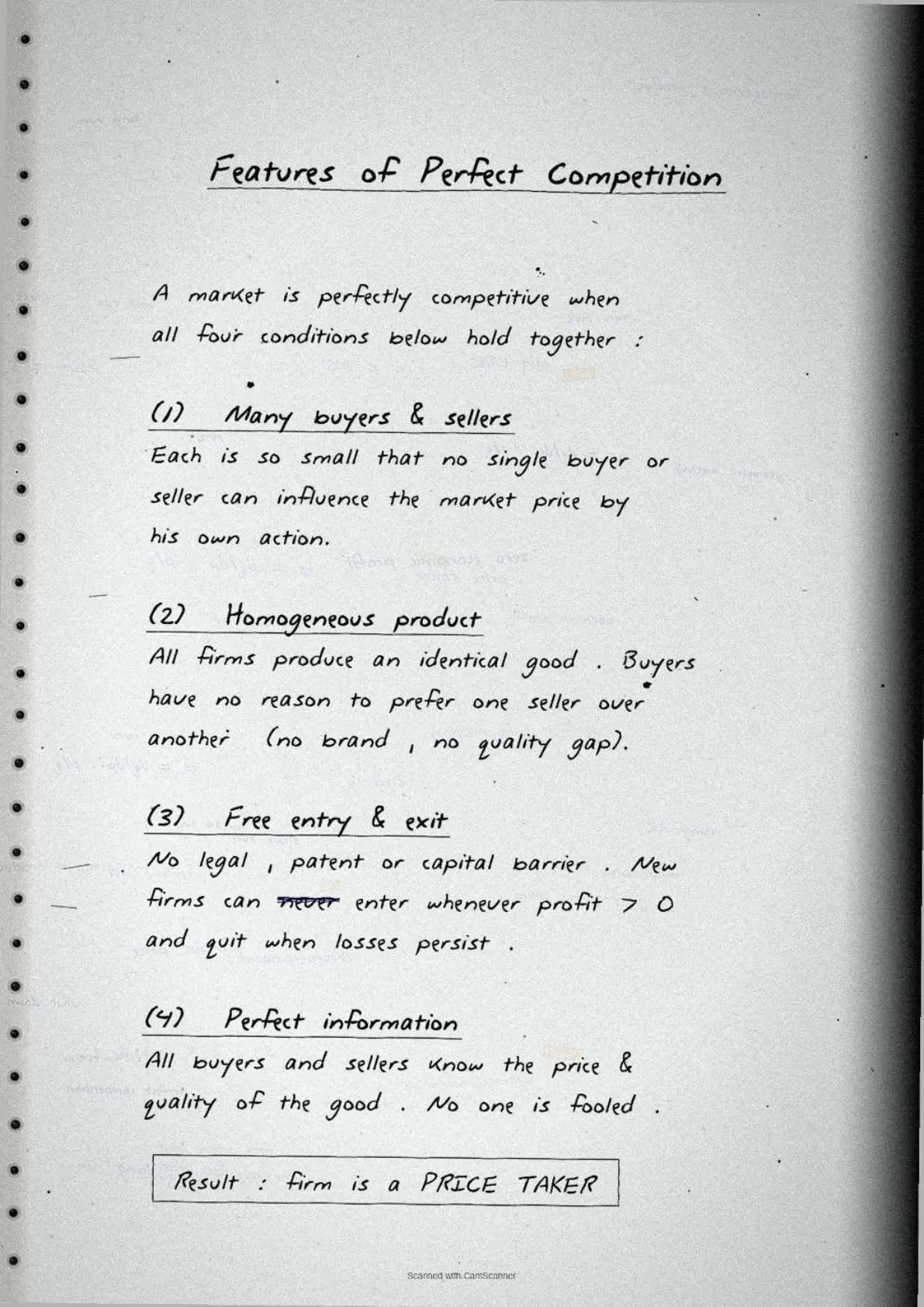
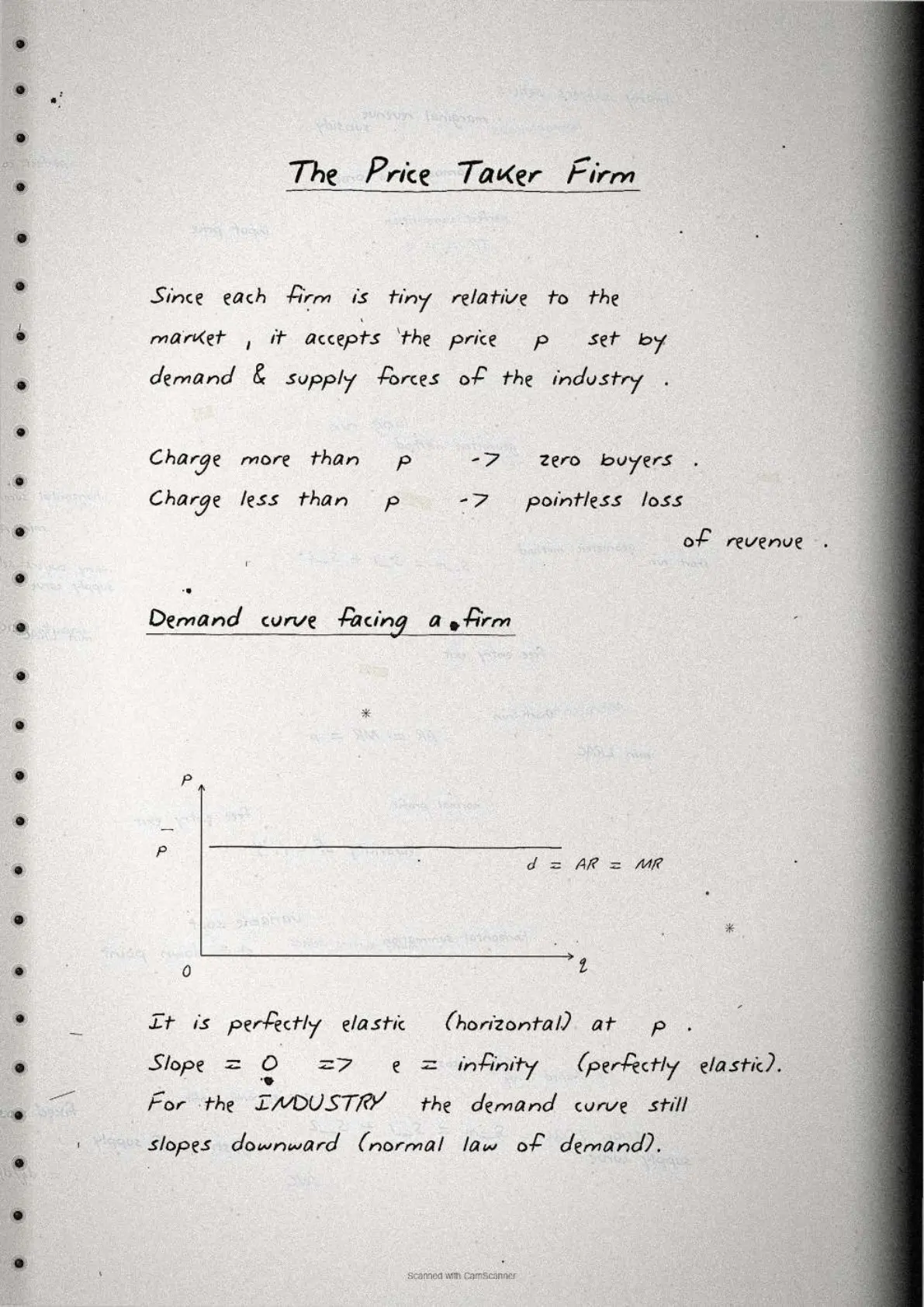
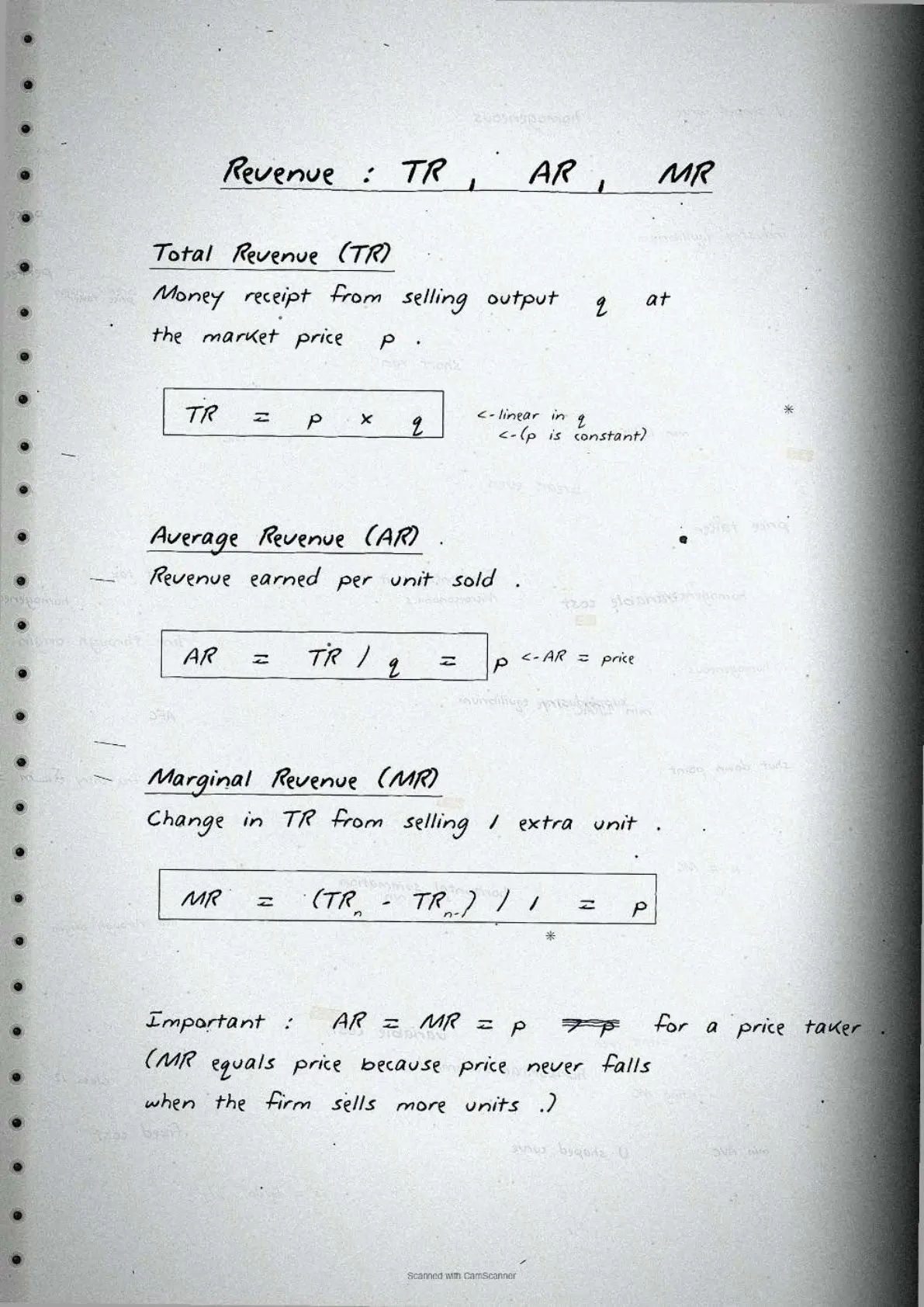
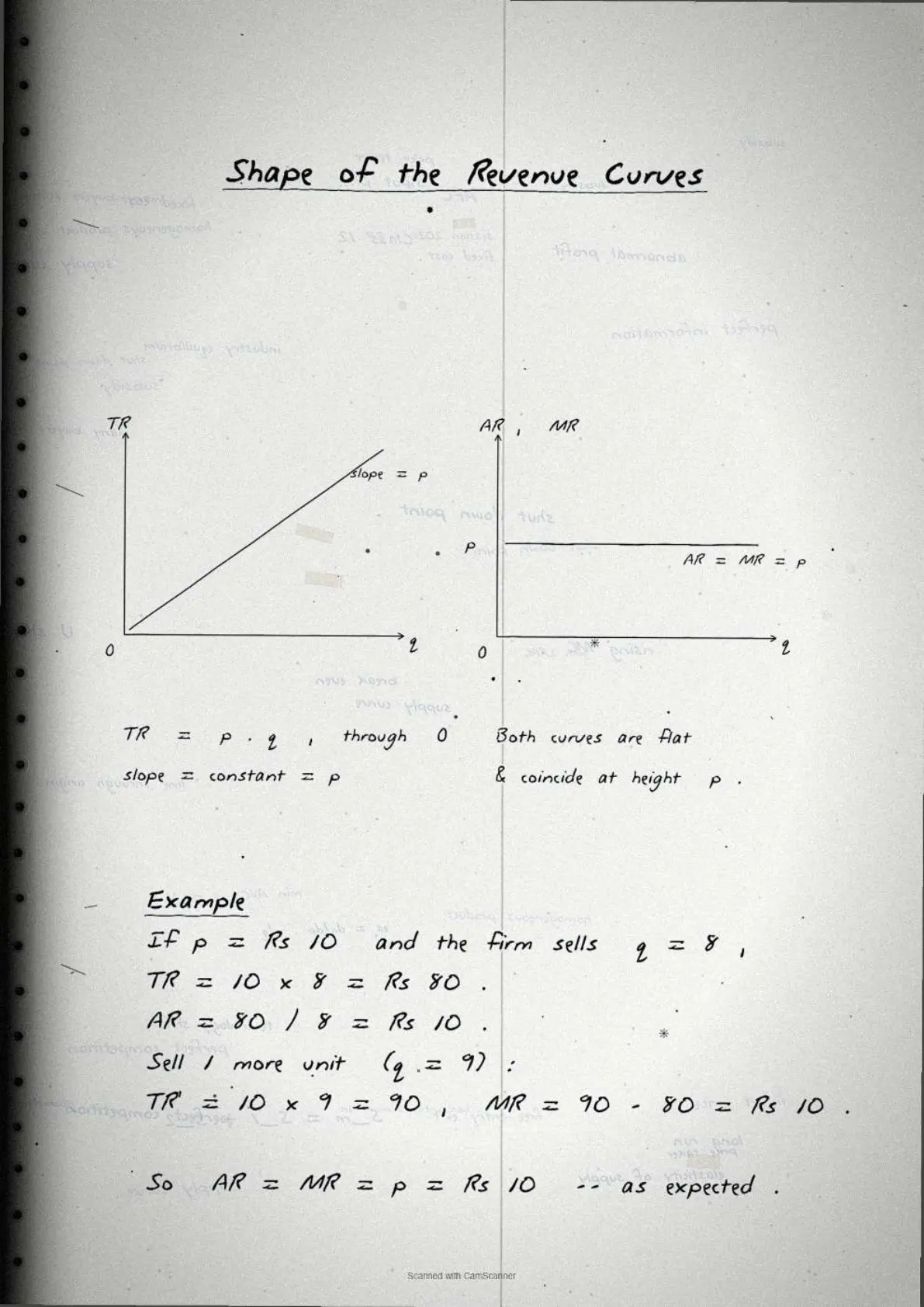
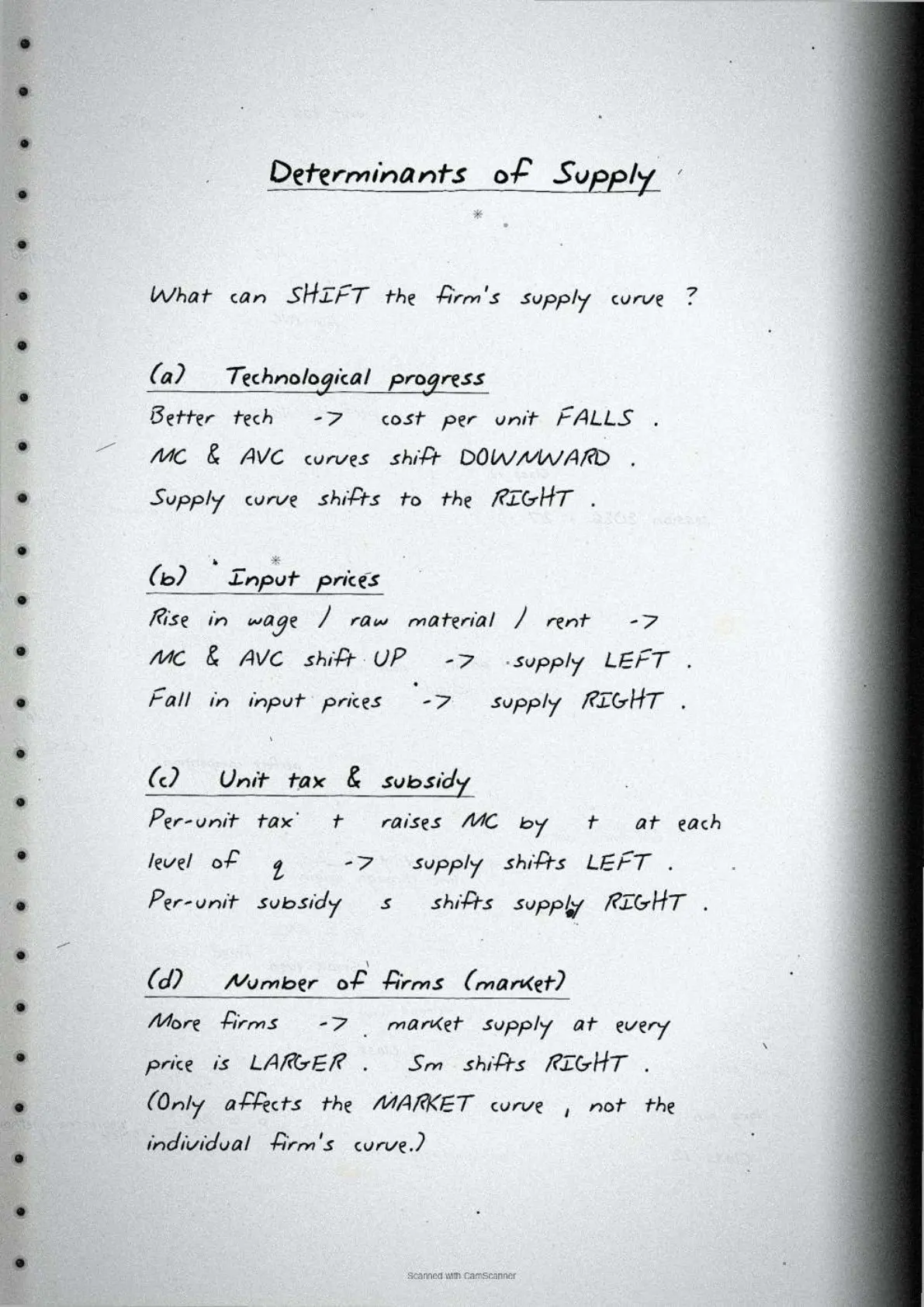
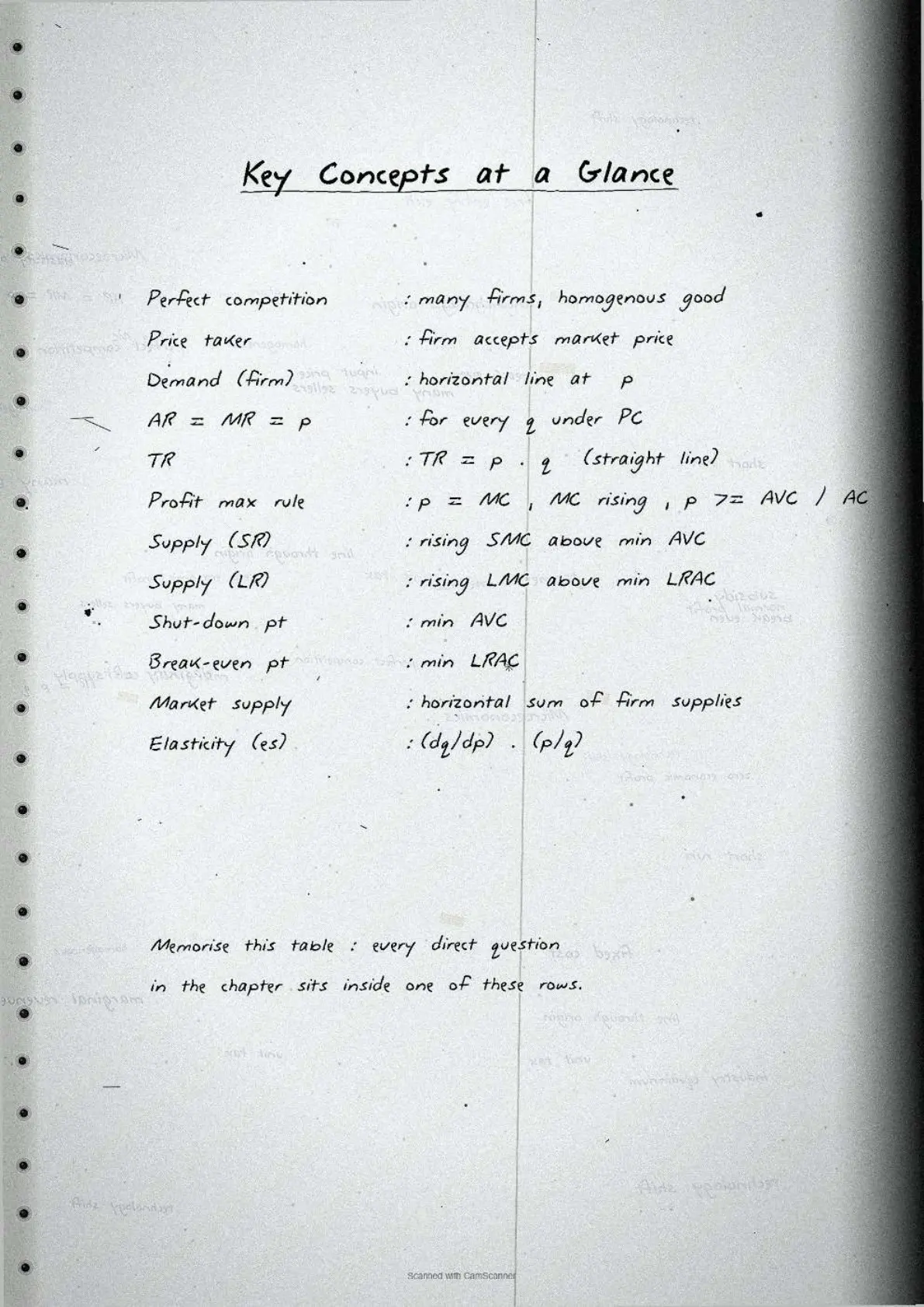
| Page 1 | Five conditions of perfect competition, price-taker behaviour, TR, AR and MR curves. | 6 min |
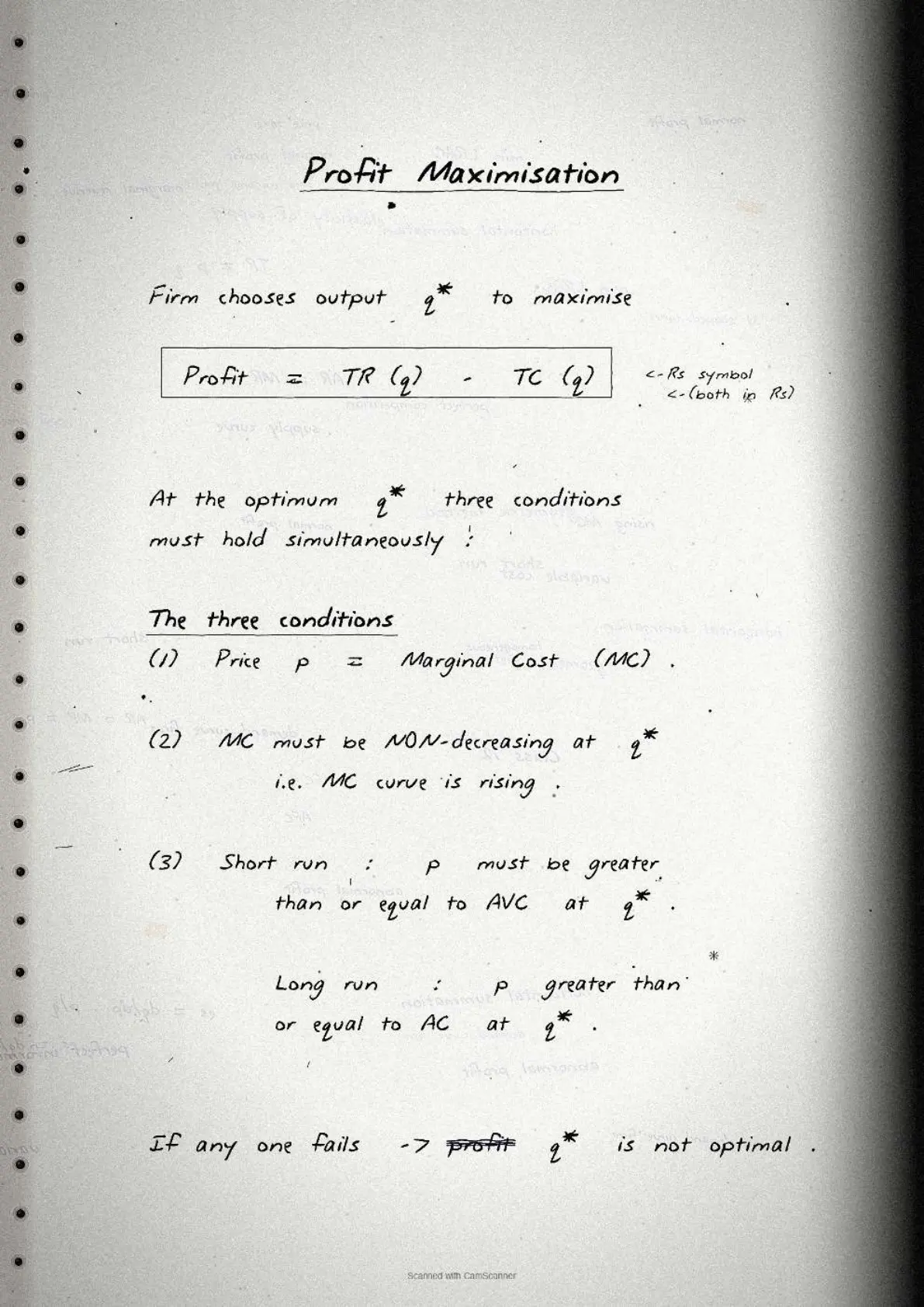
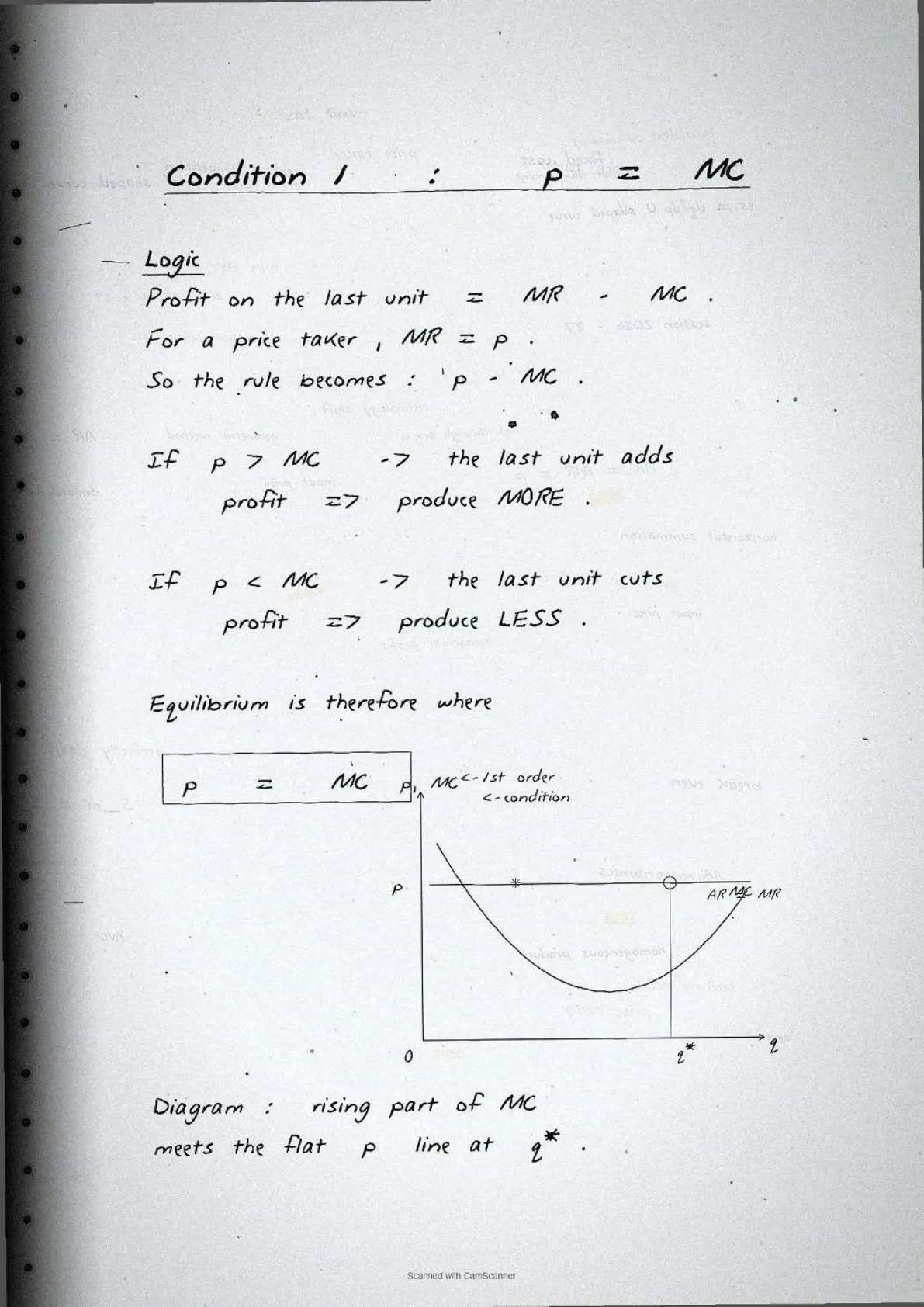
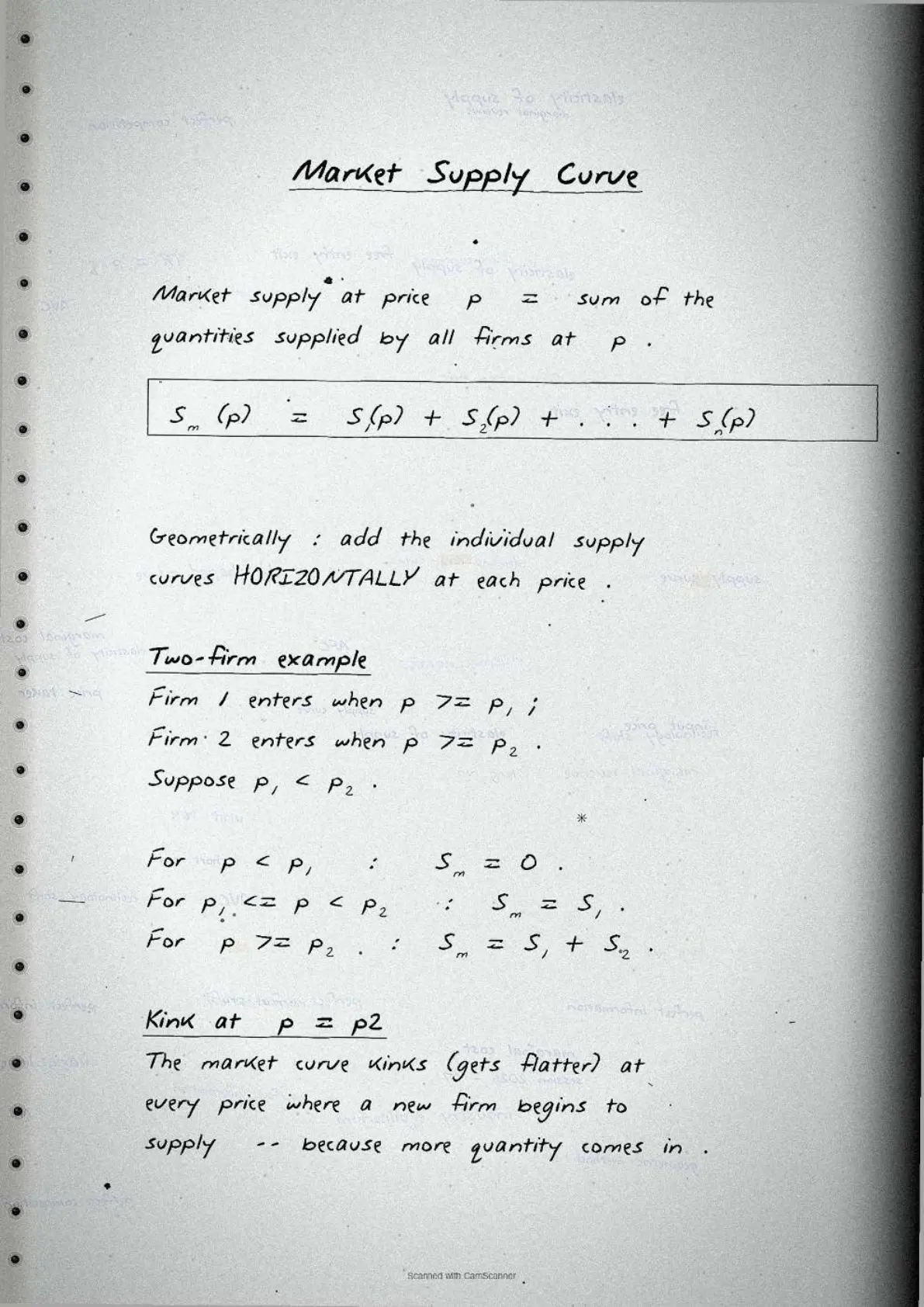
| Page 2 | Profit-maximisation conditions and the MR-equals-MC equilibrium diagram. | 7 min |
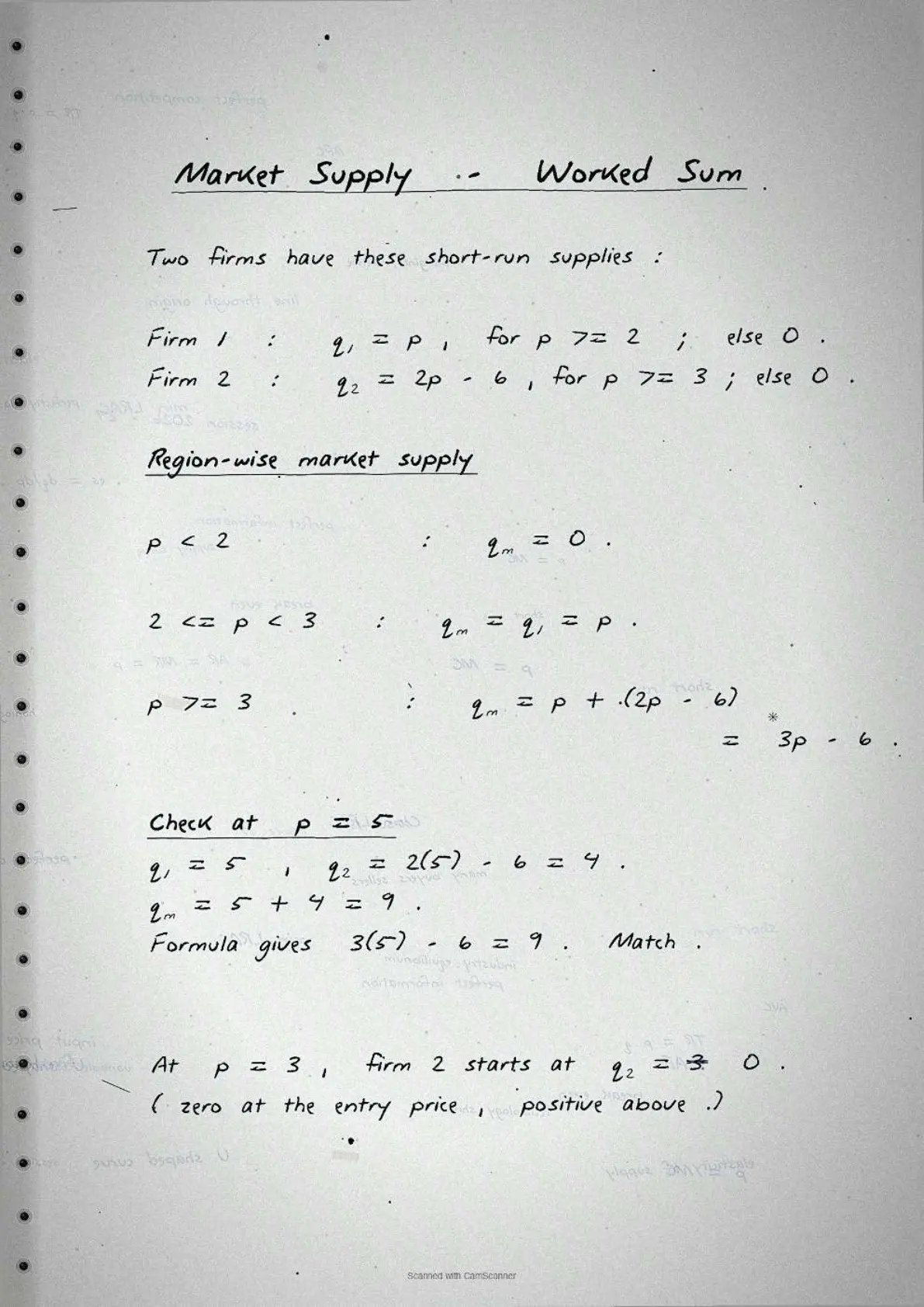
| Page 3 | Shut-down point on AVC and break-even point on AC. | 6 min |
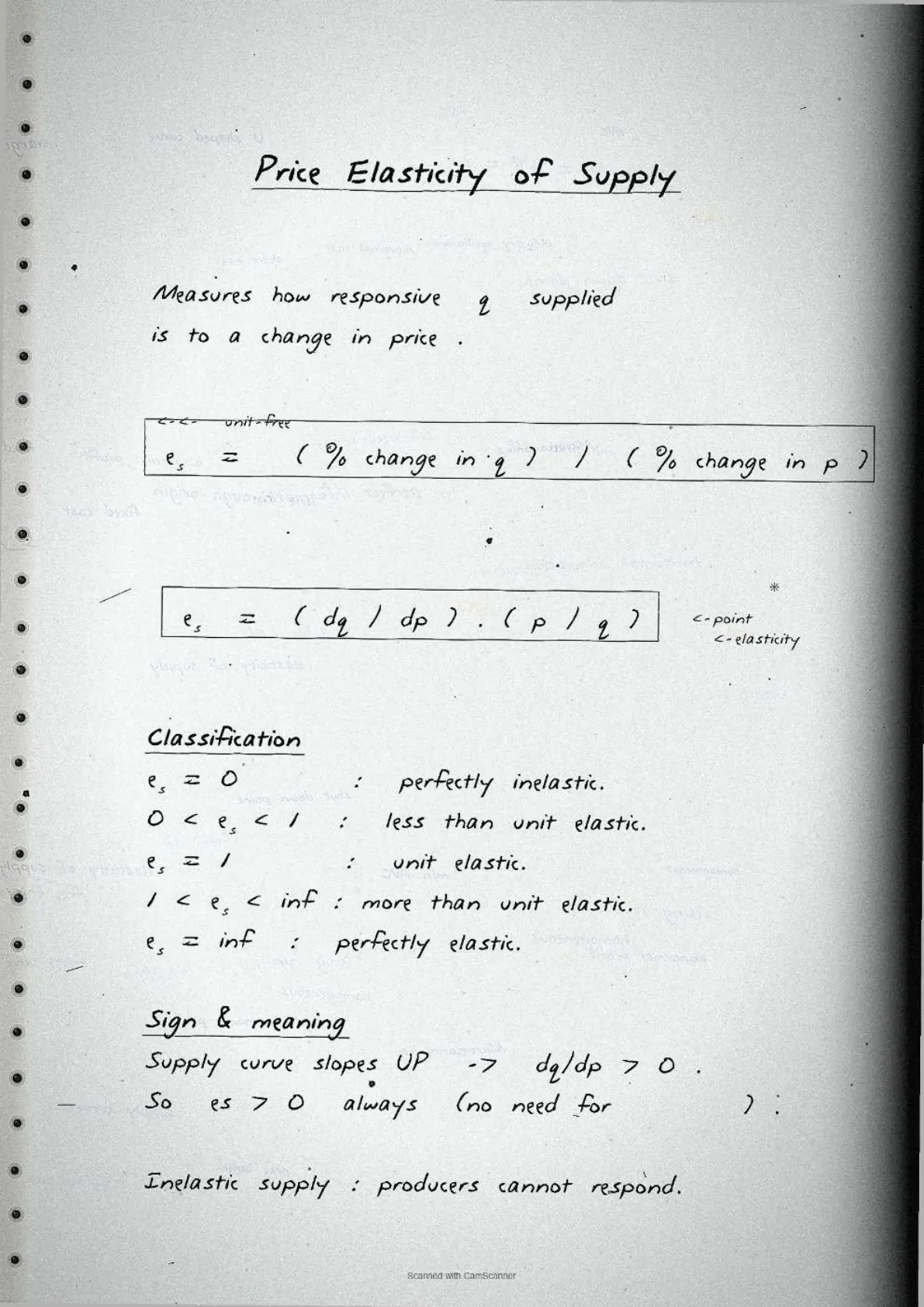
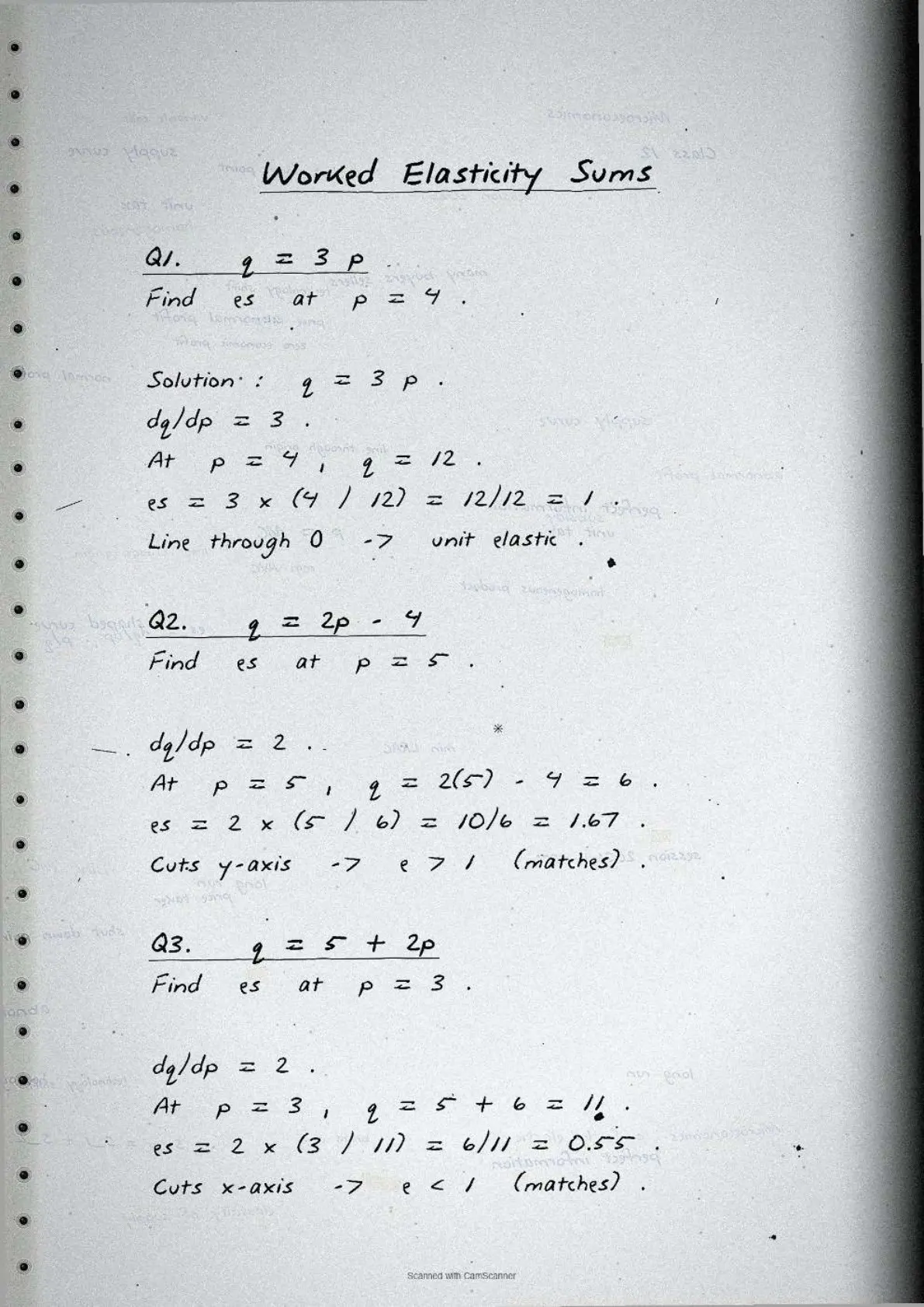
| Page 4 | Supply-curve derivation and the geometric measure of price elasticity. | 6 min |
MR and MC Curves in the Theory of the Firm Under Perfect Competition
The MR and MC diagram is the most-tested visual in Chapter 4. The notebook gives it the top half of Page 2. Here is what to copy from memory:
- Axes: Quantity on the X-axis; Price, Revenue and Cost on the Y-axis.
- Horizontal MR line: for a price-taker firm, AR equals MR equals the market price, so all three sit on one line.
- U-shaped MC curve: it cuts the MR line at two points and rises steeply after the minimum.
- AC and AVC curves: AC sits above AVC at every output. The gap between them equals AFC.
- Equilibrium: mark the right-hand point where MC cuts MR, then drop a dashed line to the X-axis.
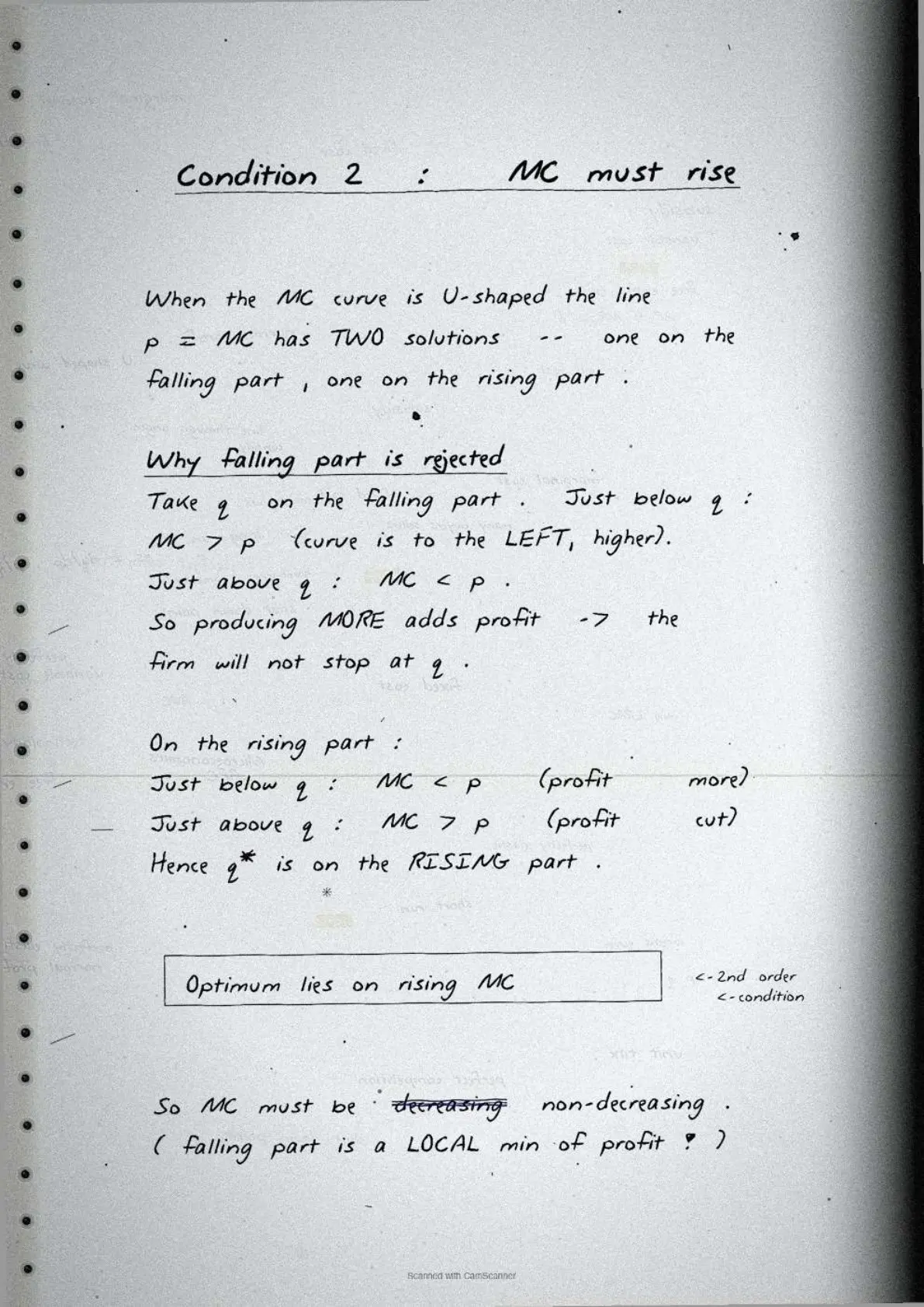
The page also flags the second-order trap. Profit is maximised only at the right-hand crossing, where MC is rising. The left-hand crossing is a profit minimum. CBSE has set this 1-mark trap in three of the last five papers.
Profit-Maximisation Conditions for a Firm Under Perfect Competition
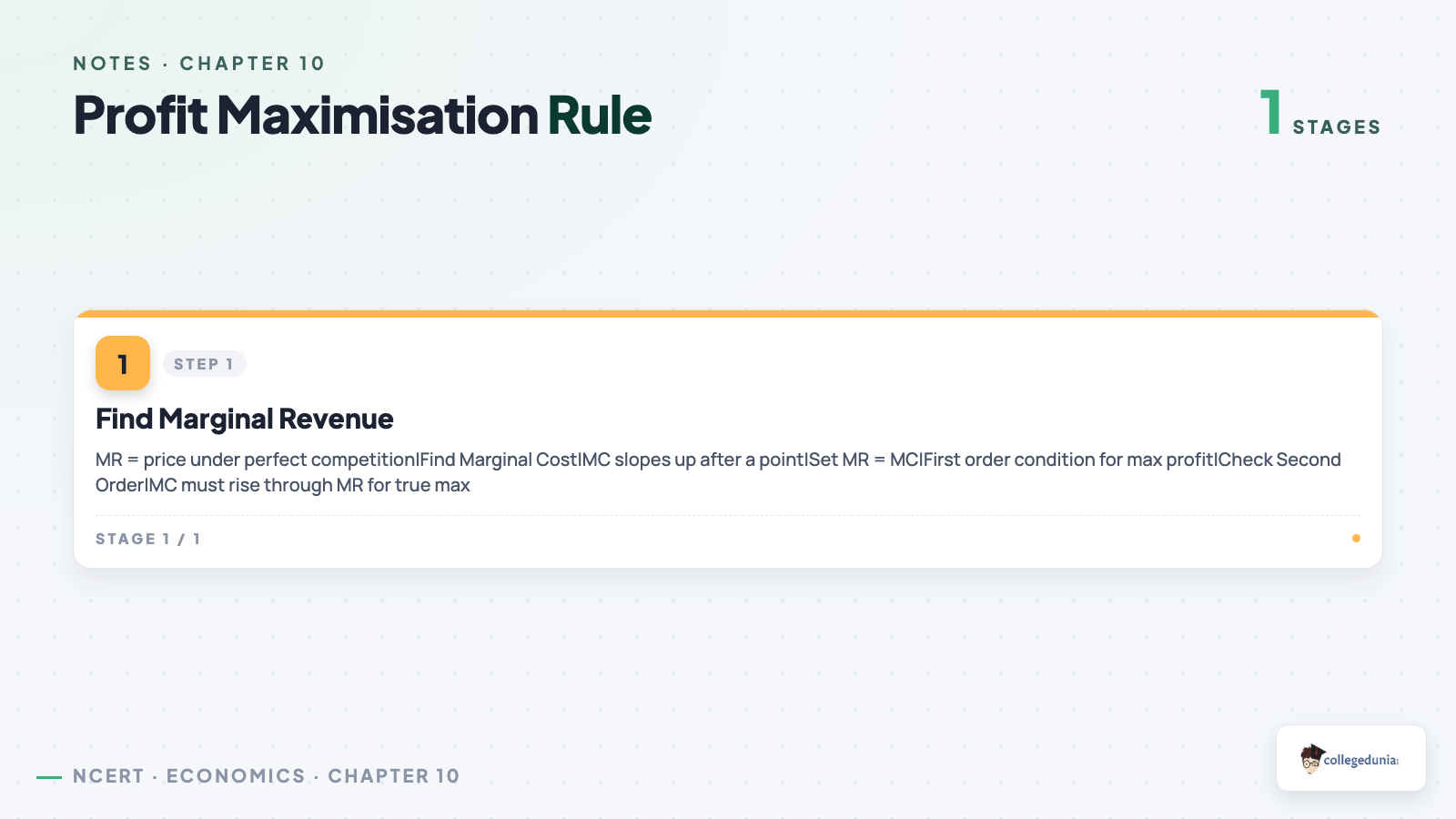
Page 2 draws the profit rules as two ruler-drawn boxes. There are three conditions, and all of them must hold together.
- First-order condition: MR = MC. For a price-taker firm this becomes P = MC, because MR equals the market price.
- Second-order condition: MC must be rising at the equilibrium quantity, so MC cuts MR from below.
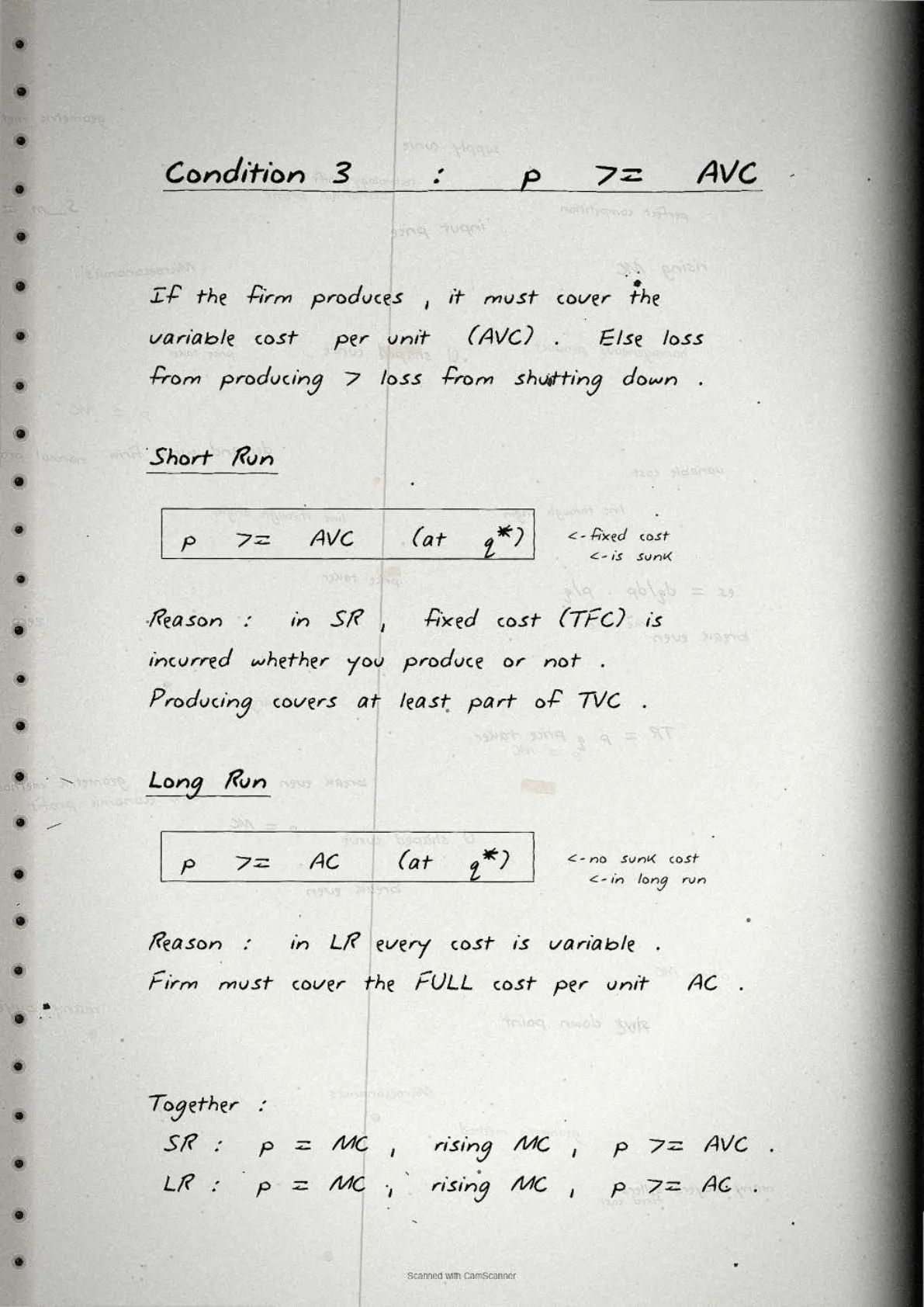
- Non-negative profit: price must cover at least AVC. If P drops below AVC, the firm shuts down and makes zero.
Memory hook: the notebook puts all three rules in one dotted box called "PROFIT-MAX CHECKLIST". Students who skip the second-order condition lose 1 method mark on the 6-mark question.
Shut-Down Point vs Break-Even Point in Perfect Competition
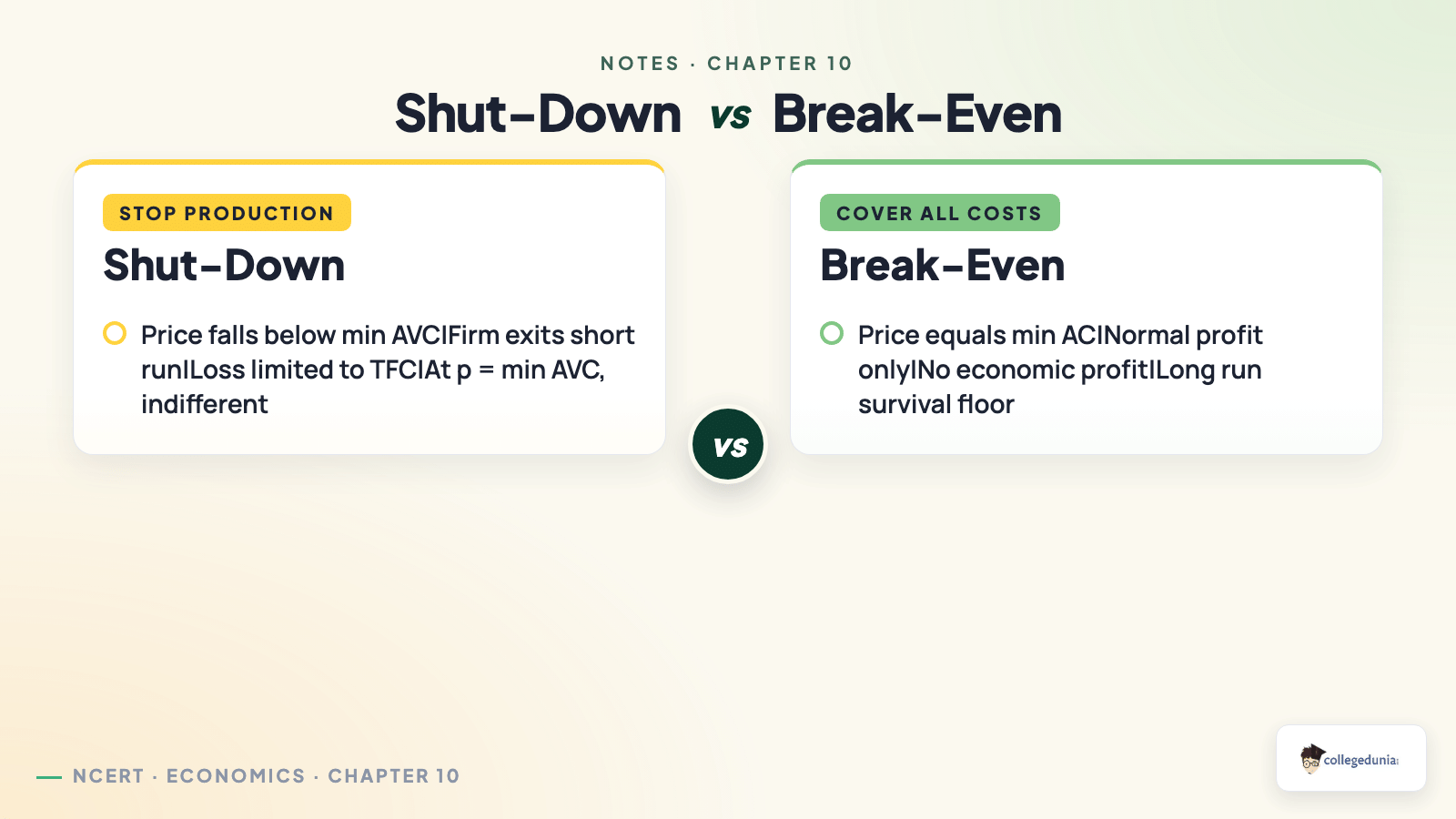
These two price thresholds are the most-confused points in the chapter. They sit at different price levels and answer different questions. The table sums up the difference.
| Threshold | Sits at | Decision rule |
|---|---|---|
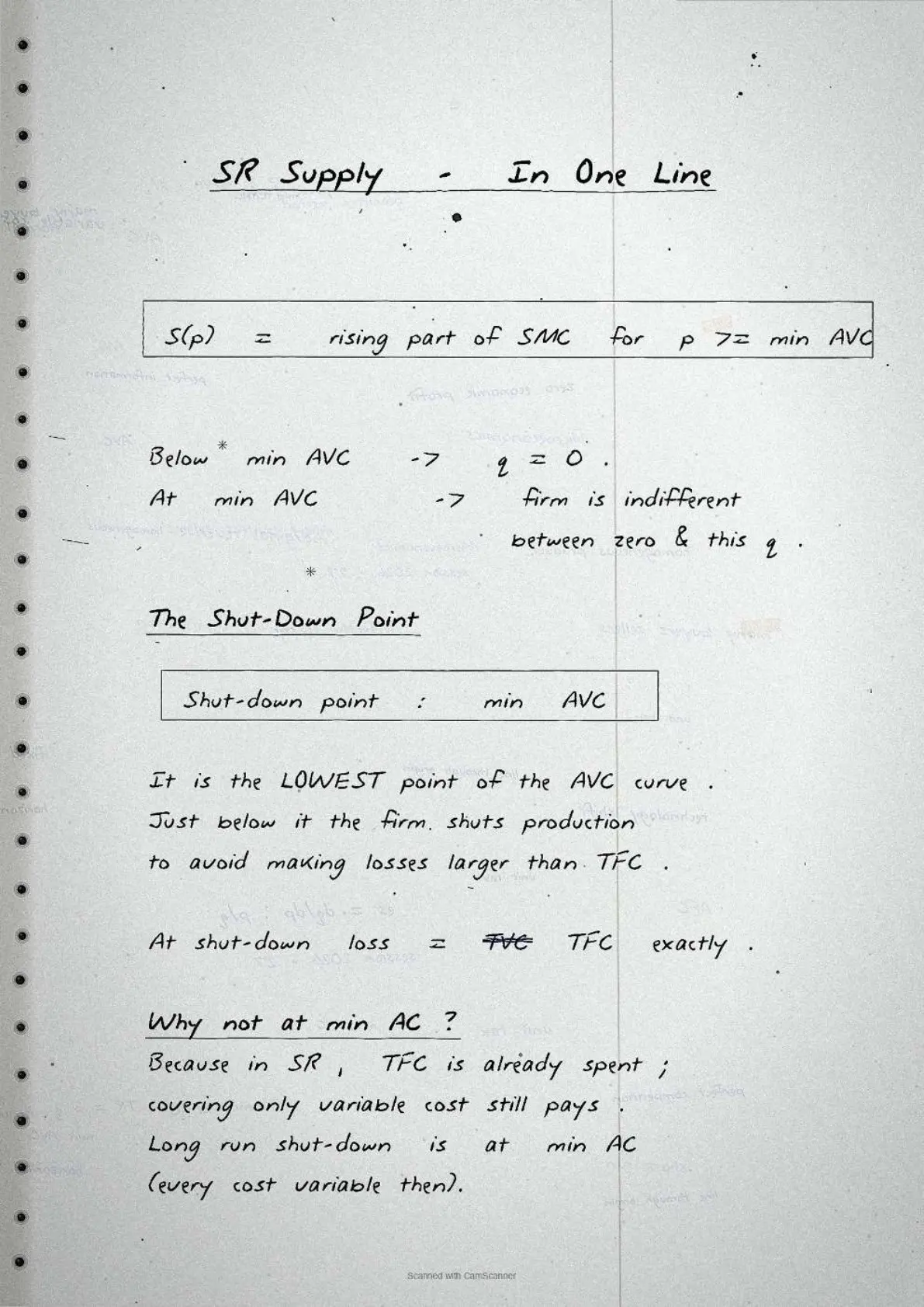
| Shut-down point | Minimum of AVC | If P drops below this, produce zero in the short run. |
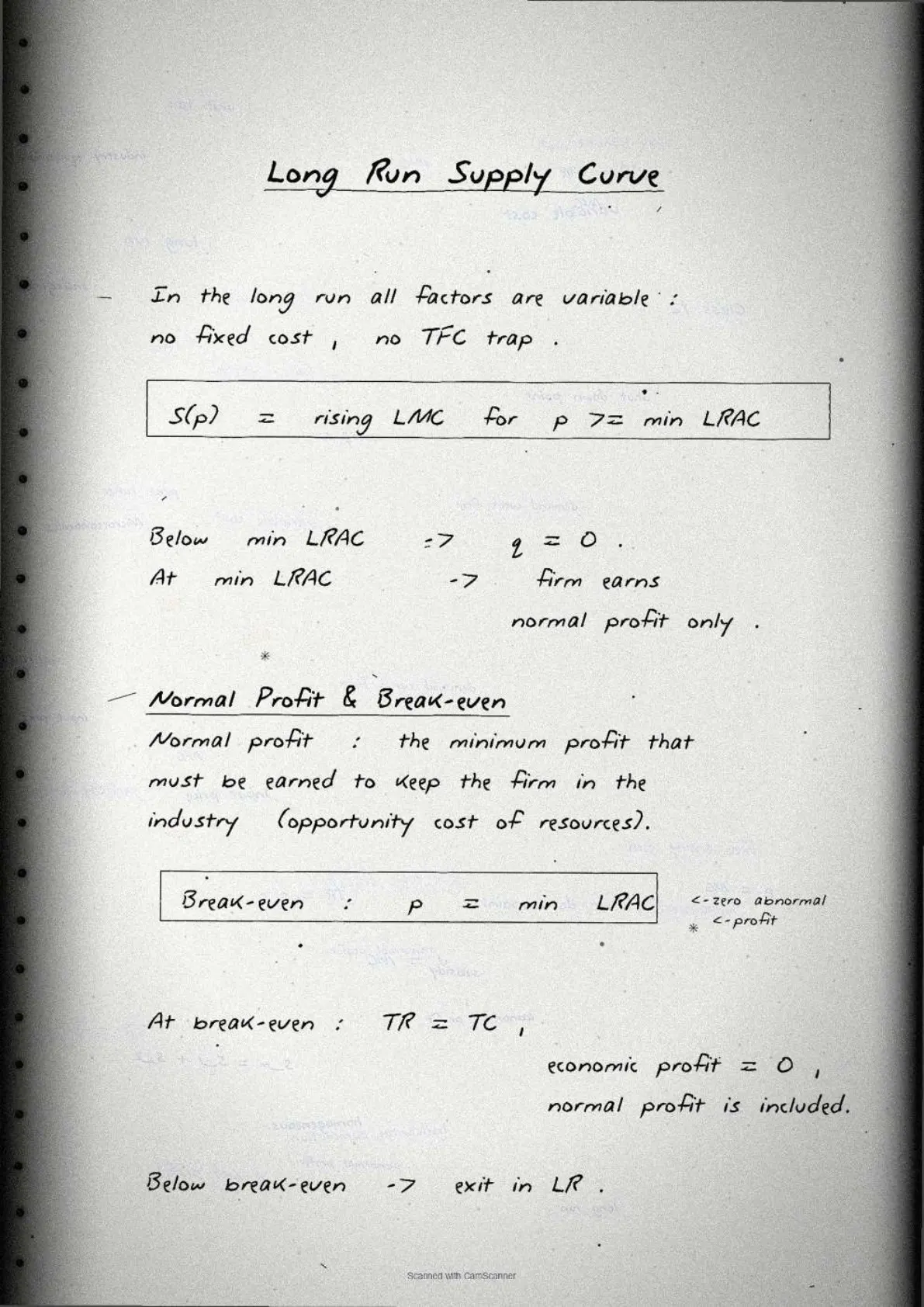
| Break-even point | Minimum of AC | If P equals this, the firm earns normal profit (zero economic profit). |
| Exit point | Minimum of LAC | If P drops below this in the long run, the firm exits the industry. |
The notebook draws three price lines on one short-run cost diagram on Page 3: above AC, at minimum AC, and at minimum AVC. This visual has appeared as a 4-mark CBSE question in 2024 and 2022.
Theory of the Firm Class 12 Video Lesson
Source: Humanities with Poonam on YouTube
Supply Curve Derivation in the Theory of the Firm Under Perfect Competition
The firm's supply-curve derivation is the most-tested 6-mark question in Chapter 4. Page 4 maps it in four short steps.
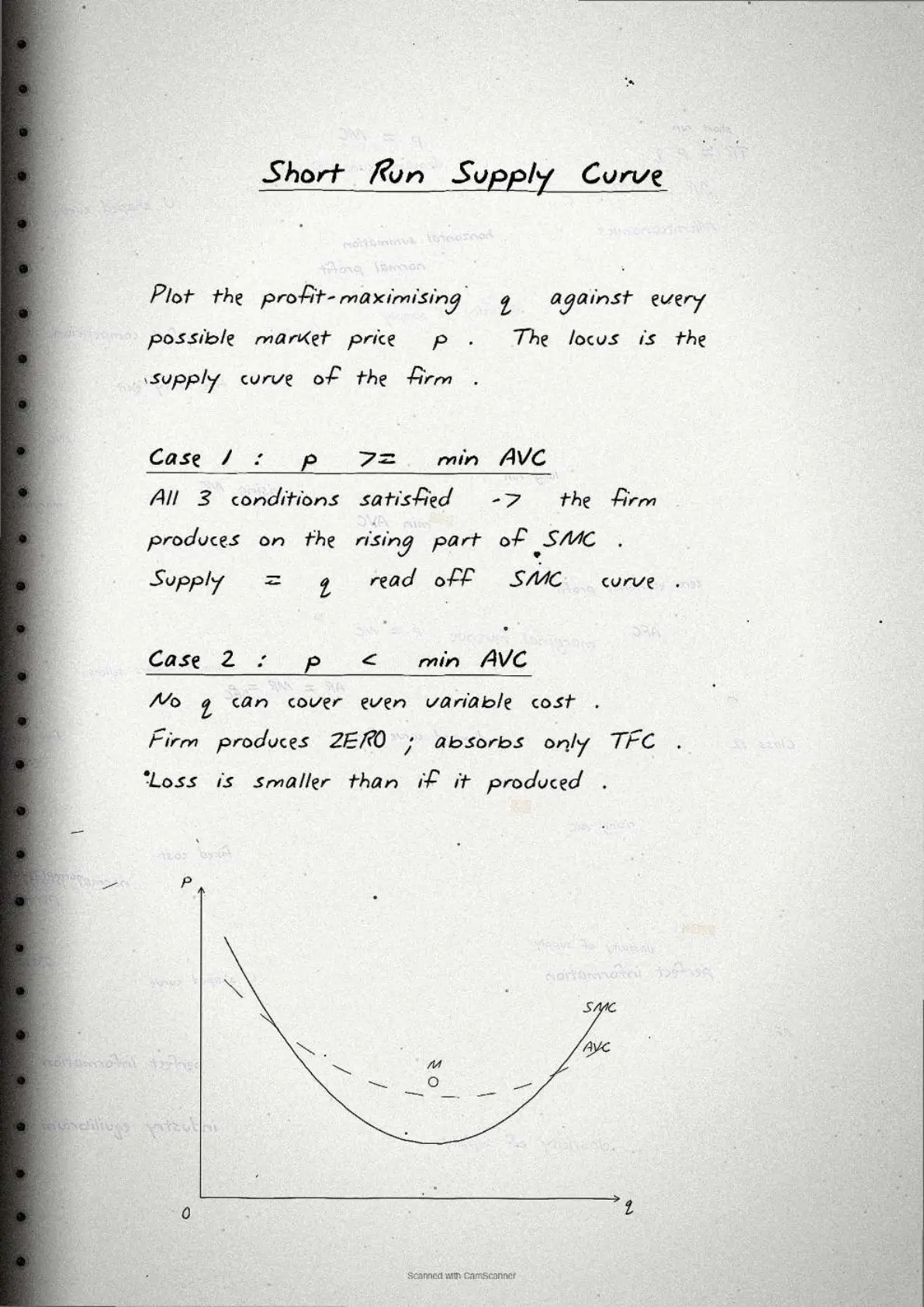
- Step 1: mark four price lines on the cost diagram (above AC, at minimum AC, between minimum AVC and AC, and below minimum AVC).
- Step 2: read the profit-maximising quantity at each price where the price line cuts MC. At the lowest price the firm produces zero.
- Step 3: plot the price-quantity pairs on a fresh diagram and join them.
- Step 4: the short-run supply curve is the rising part of MC above minimum AVC. In the long run it is LMC above minimum LAC.
Tip: the marking scheme gives 1 mark per step plus 2 marks for a clean labelled diagram. Draw the diagram first, write the four steps next, then the one-line conclusion.
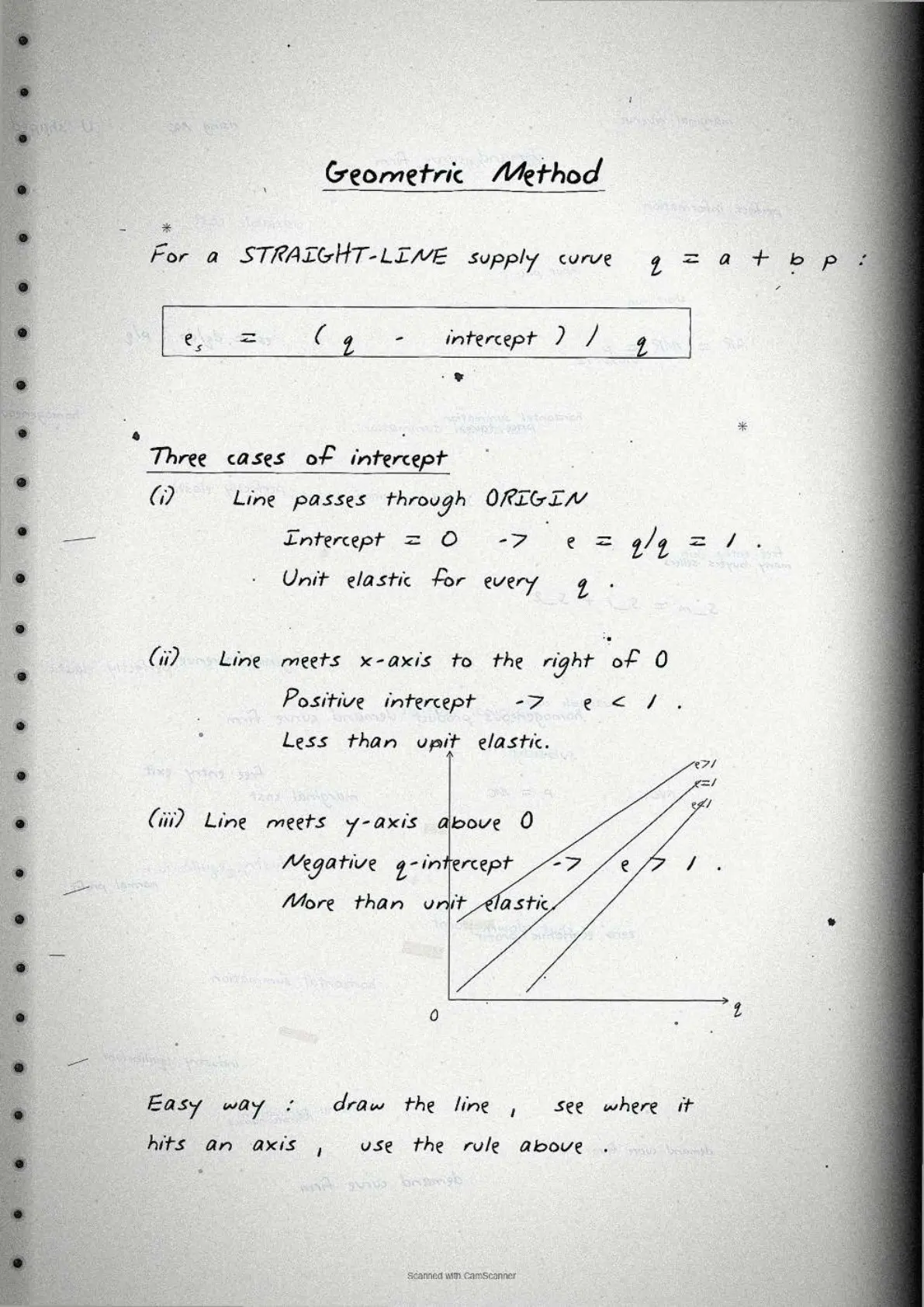
Geometric Measure of Price Elasticity in Perfect Competition
This is the last formula block on Page 4. It is a steady 3-mark theory question, set in 2025 and 2023.
| Supply line | Elasticity |
|---|---|
| Straight line through the origin | es = 1 at every point |
| Straight line cutting the price axis | es > 1 |
| Straight line cutting the quantity axis | es < 1 |
| Vertical supply line | es = 0 (perfectly inelastic) |
| Horizontal supply line | es = infinity (perfectly elastic) |
The notebook draws the first three cases as small side-by-side diagrams. Students who reproduce all three usually score the full 3 marks.
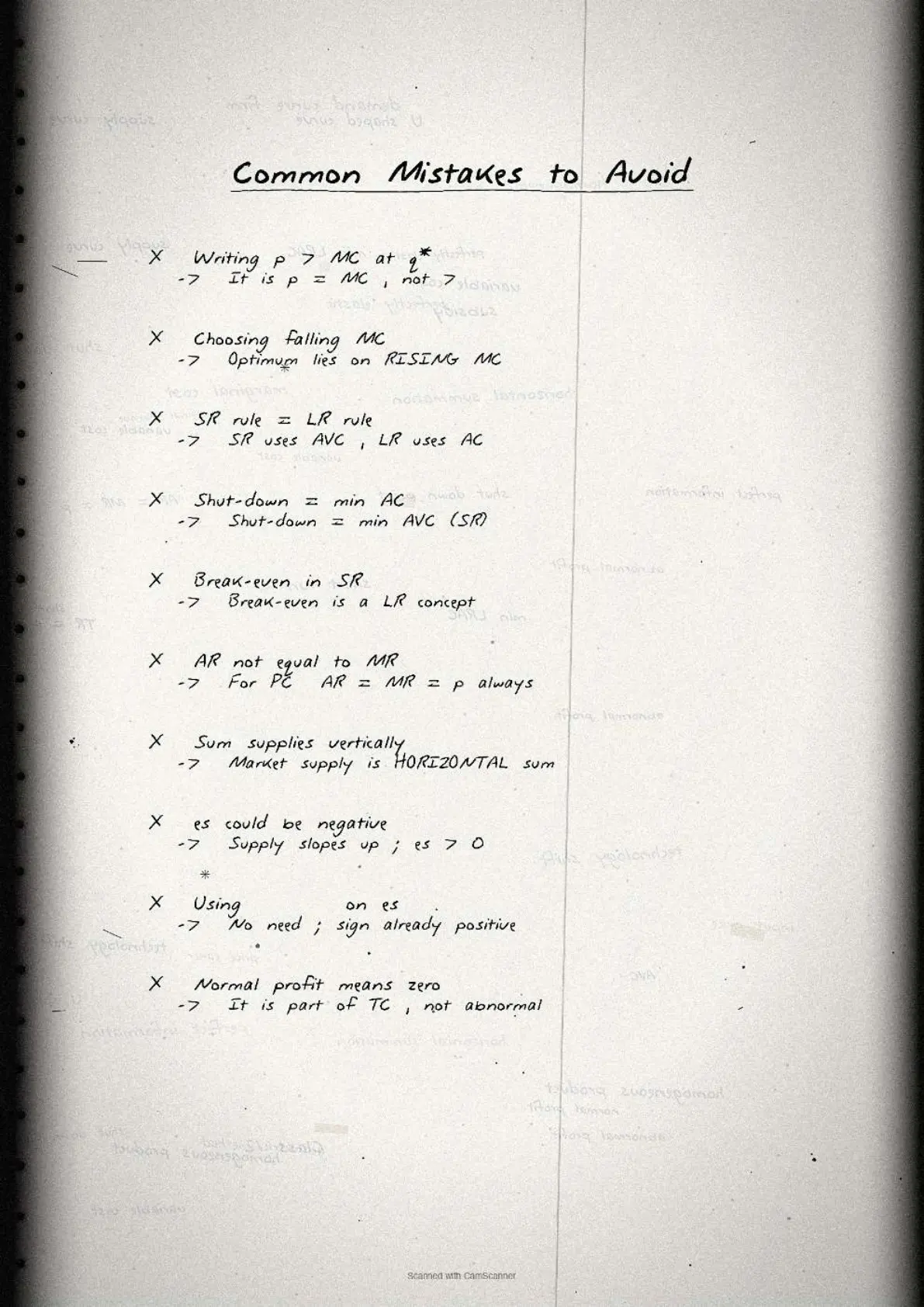
Common Mistakes in the Theory of the Firm Under Perfect Competition
- Treating AR and MR as different. They are equal only for a price-taker firm.
- Picking the left-hand MC and MR crossing, which is a profit minimum.
- Mixing shut-down (minimum AVC) and break-even (minimum AC).
- Drawing the supply curve below minimum AVC, where the firm produces zero.
- Confusing short-run shut-down (P below AVC) with long-run exit (P below LAC).
How to Use These Perfect Competition Class 12 Handwritten Notes for Quick Revision
The file is built for three short revision passes before the board paper.
- 23-minute first pass (one week before): read all four pages once and highlight every formula box and diagram you cannot recall.
- 14-minute targeted pass (the night before): redraw the highlighted diagrams from memory, labelling every curve.
- 7-minute final pass (just before the exam): trace the MR-MC diagram and the shut-down vs break-even diagram one last time.
Pair the file with the matching NCERT Solutions for Class 12 Economics Chapter 4 for worked numericals, and the typed Class 12 Economics Chapter 4 Notes for the deeper concept prose.
Previous Year Question Trends for Class 12 Economics Chapter 4
The chapter has carried a stable 10 to 12 marks over the last five years. The table maps each year to the page you should revise.
| Year | Question asked | Marks | Page |
|---|---|---|---|
| 2025 | Derive the firm's supply curve and state the geometric elasticity rule | 6 + 3 | Page 4 |
| 2024 | Draw the MR-equals-MC equilibrium and define the shut-down point | 6 + 1 | Page 2 + 3 |
| 2023 | Distinguish shut-down and break-even, plus an elasticity numerical | 4 + 3 | Page 3 + 4 |
| 2022 | State the five conditions and a profit-maximisation numerical | 3 + 6 | Page 1 + 2 |
Student Feedback
We asked 11,210 Class 12 students about this chapter. 76% said hand-drawn MR and MC curves stick in memory better than printed ones, and 4 out of 5 found the shut-down vs break-even diagram the hardest to reproduce in the exam.
Other Resources for Class 12 Economics Chapter 4 Theory of the Firm
Pair these handwritten notes with the Solutions, typed Notes and the official NCERT chapter below.
| Resource | What it covers | Open |
|---|---|---|
| Handwritten Notes | Scanned ballpoint-on-ruled-paper pages for last-mile revision. | Chapter 4 Handwritten Notes |
| NCERT Solutions | Step-by-step answers to every exercise question. | Chapter 4 NCERT Solutions |
| Notes | Concept-first typed revision of the full chapter. | Chapter 4 Notes |
| NCERT Book PDF | Official NCERT Microeconomics Chapter 4 textbook. | Chapter 4 NCERT Book PDF |
All Chapters Handwritten Notes for Class 12 Microeconomics
| Chapter | Handwritten Notes link |
|---|---|
| Chapter 1 | Introduction to Microeconomics |
| Chapter 2 | Theory of Consumer Behaviour |
| Chapter 3 | Production and Costs |
| Chapter 4 | Theory of the Firm under Perfect Competition |
| Chapter 5 | Market Equilibrium |
Theory of the Firm Under Perfect Competition Class 12 Handwritten Notes FAQs
Ques. What are these Class 12 Economics Chapter 4 handwritten notes for?
Ans. They are a scanned four-page revision file for NCERT Chapter 4. They cover the five conditions of perfect competition, the MR and MC curves, profit maximisation, the shut-down and break-even points, the supply-curve derivation and the geometric measure of elasticity. Students use them for last-mile revision before the board paper.
Ques. What are the profit-maximisation conditions for a firm under perfect competition?
Ans. The first condition is MR = MC, which becomes P = MC for a price-taker firm. The second is that MC must be rising at the equilibrium, so MC cuts MR from below. A third practical condition is that price must cover at least minimum AVC, or the firm shuts down in the short run.
Ques. What is the difference between the shut-down point and the break-even point?
Ans. The shut-down point sits at the minimum of AVC. Below this price the firm cannot cover variable costs, so it produces zero in the short run. The break-even point sits at the minimum of AC, where the firm earns exactly normal profit. Between the two, the firm makes a loss but keeps producing.
Ques. How is the firm's supply curve derived in these notes?
Ans. Page 4 traces it in four steps: mark four price lines on the cost diagram, read the profit-maximising quantity at each, plot the price-quantity pairs, and identify the supply curve as the rising part of MC above minimum AVC. In the long run it is LMC above minimum LAC.
Ques. How long does it take to revise these notes?
Ans. The file is built for a 23-minute first pass, a 14-minute targeted pass and a 7-minute final pass before the exam. Page 2 (MR-MC equilibrium) and Page 4 (supply curve) together take about 13 minutes and cover most of the marks the chapter carries.



Comments