




The Class 6 English Poorvi Chapter 5 Culture and Tradition handwritten notes have been prepared for quick 2026-27 revision. The PDF covers Hamara Bharat, folk arts, The Kites, Ila Sachani and the National War Memorial poem.
- Best use: revise art forms, poem devices and Ila Sachani's life before class tests.
- PDF focus: topper's handwritten notes with short answer cues and vocabulary support.
- Chapter value: this unit links culture, craft, courage, food, festivals and national memory.
Chapter5CultureandTraditionHandwrittenNotes.pdf?page=1&dpi=150)
Chapter5CultureandTraditionHandwrittenNotes.pdf?page=2&dpi=150)
Chapter5CultureandTraditionHandwrittenNotes.pdf?page=3&dpi=150)
Chapter5CultureandTraditionHandwrittenNotes.pdf?page=4&dpi=150)
Chapter5CultureandTraditionHandwrittenNotes.pdf?page=5&dpi=150)
Chapter5CultureandTraditionHandwrittenNotes.pdf?page=6&dpi=150)
Chapter5CultureandTraditionHandwrittenNotes.pdf?page=7&dpi=150)
Chapter5CultureandTraditionHandwrittenNotes.pdf?page=8&dpi=150)
Chapter5CultureandTraditionHandwrittenNotes.pdf?page=9&dpi=150)
Chapter5CultureandTraditionHandwrittenNotes.pdf?page=10&dpi=150)
Chapter5CultureandTraditionHandwrittenNotes.pdf?page=11&dpi=150)
Chapter5CultureandTraditionHandwrittenNotes.pdf?page=12&dpi=150)
Chapter5CultureandTraditionHandwrittenNotes.pdf?page=13&dpi=150)
Chapter5CultureandTraditionHandwrittenNotes.pdf?page=14&dpi=150)
Chapter5CultureandTraditionHandwrittenNotes.pdf?page=15&dpi=150)
Chapter5CultureandTraditionHandwrittenNotes.pdf?page=16&dpi=150)
Chapter5CultureandTraditionHandwrittenNotes.pdf?page=17&dpi=150)
Chapter5CultureandTraditionHandwrittenNotes.pdf?page=18&dpi=150)
Chapter5CultureandTraditionHandwrittenNotes.pdf?page=19&dpi=150)
Chapter5CultureandTraditionHandwrittenNotes.pdf?page=20&dpi=150)
Chapter5CultureandTraditionHandwrittenNotes.pdf?page=21&dpi=150)
Chapter5CultureandTraditionHandwrittenNotes.pdf?page=22&dpi=150)
Chapter5CultureandTraditionHandwrittenNotes.pdf?page=23&dpi=150)
Chapter5CultureandTraditionHandwrittenNotes.pdf?page=24&dpi=150)
Chapter5CultureandTraditionHandwrittenNotes.pdf?page=25&dpi=150)
Chapter5CultureandTraditionHandwrittenNotes.pdf?page=26&dpi=150)
Chapter5CultureandTraditionHandwrittenNotes.pdf?page=27&dpi=150)
Chapter5CultureandTraditionHandwrittenNotes.pdf?page=28&dpi=150)
Chapter5CultureandTraditionHandwrittenNotes.pdf?page=29&dpi=150)
Chapter5CultureandTraditionHandwrittenNotes.pdf?page=30&dpi=150)
Student Feedback: In a Collegedunia classroom check-in with 12,420 Class 6 English students, 78% said Culture and Tradition became easier after grouping the unit into folk arts, kite imagery, Ila Sachani and national memory.
Culture and Tradition Handwritten Notes Overview
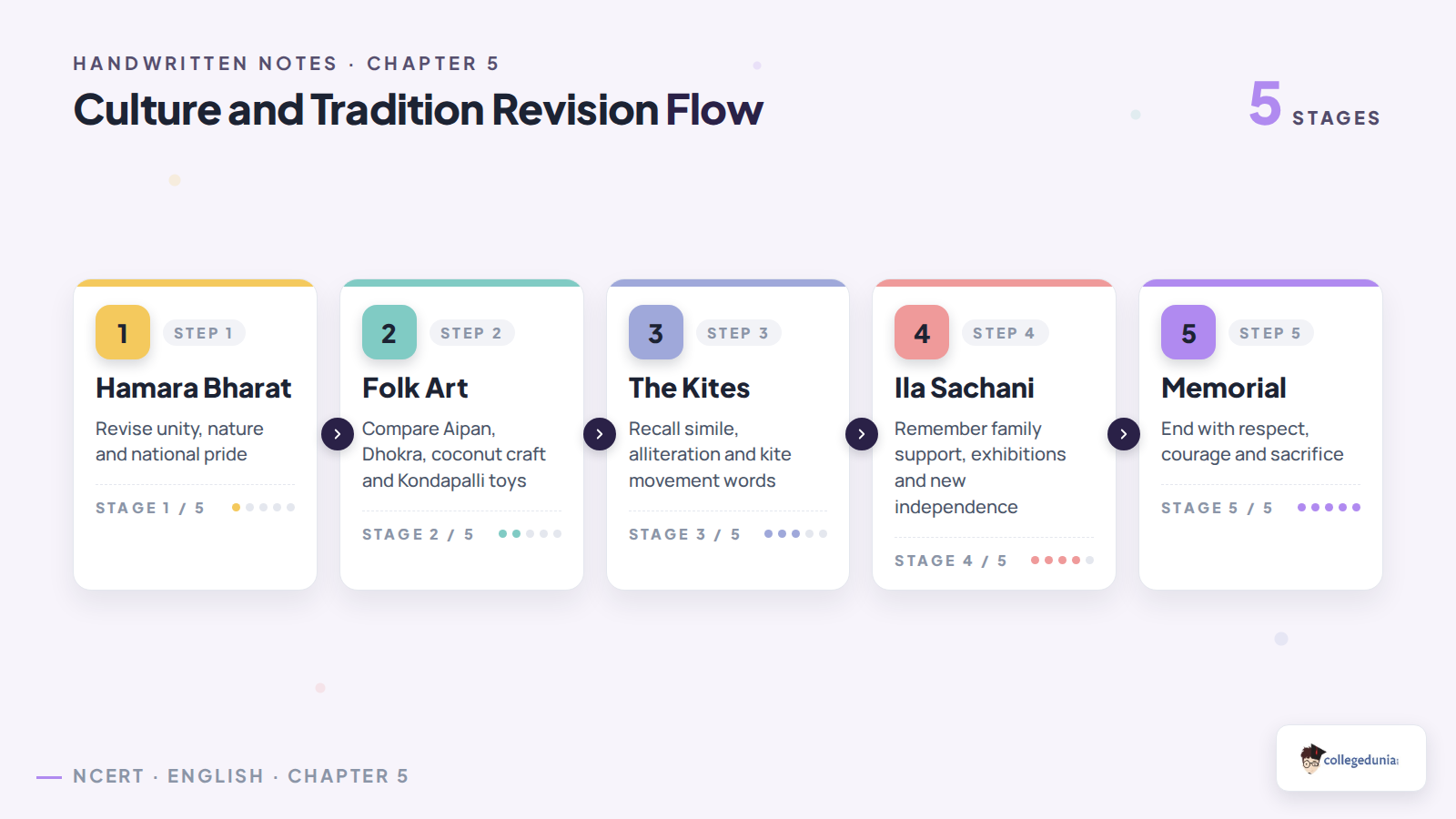
Culture and Tradition is Unit 5 of the Class 6 Poorvi textbook. It begins with unity in diversity, then moves through Indian craft forms, a kite poem, Ila Sachani's life and the National War Memorial.
| Part | Main idea | Revision cue |
|---|---|---|
| Hamara Bharat | Bharat is known for wisdom, courage, nature and unity. | Use unity in diversity in answers. |
| Kalakritiyon ka Bharat | Children explain folk arts from different states. | Compare state, art form and material. |
| The Kites | The child imagines flying high on a kite. | Revise simile and alliteration. |
| Ila Sachani | Ila turns a challenge into art and independence. | Write family support plus will power. |
Culture and Tradition Folk Arts Table for Class 6
The folk-art section is the easiest place to score marks if students remember the table. Each speaker names a state, one art form and the things used to make it.
- Aipan from Uttarakhand uses white rice paste and geru.
- Dhokra from Odisha uses clay, wax, brass scrap and fire.
- Coconut shell craft from Kerala is biodegradable.
- Kondapalli toys from Andhra Pradesh use soft wood and makku.
Culture and Tradition Video Explanation for Class 6
Source: Social-Class on YouTube
The Kites Poem Devices and Kite Vocabulary
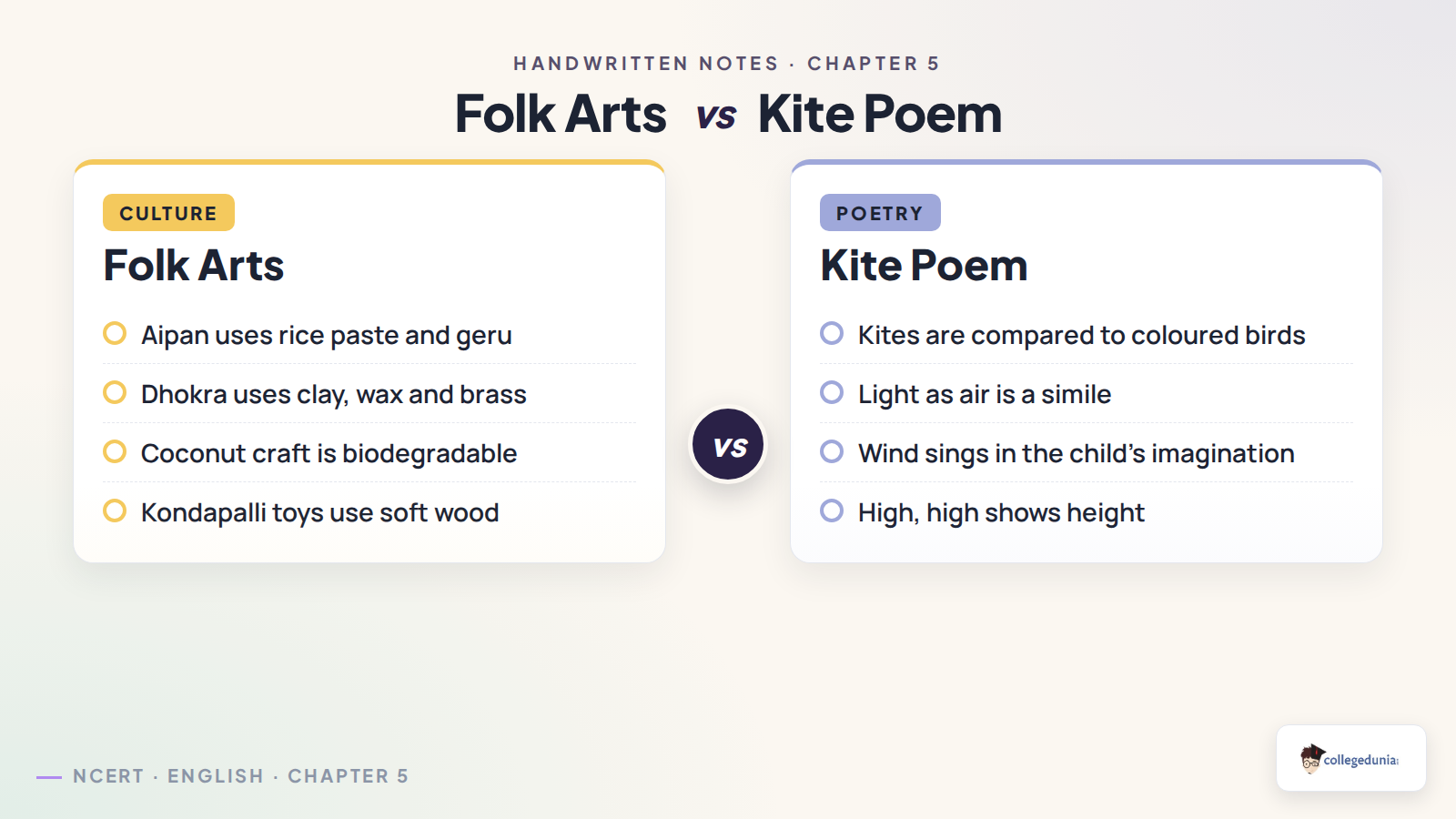
The Kites uses simple images to show freedom and wonder. The child sees kites like coloured birds and wishes to be light enough to sail in the sky.
- Simile: kites are compared to coloured birds using like.
- Simile: the child wants to be as light as air.
- Alliteration: wind-whipped sky repeats the starting consonant sound.
- Kite movement words are glide, dive, soar, swoop, circle and drift.
Ila Sachani Answer Points for Culture and Tradition
Ila Sachani's story teaches courage through art. She was born with hands she could not use in the usual way. Her family helped her learn Kathiawar embroidery with her feet.
- Ila's mother and grandmother taught her embroidery.
- Her brother and sister supported her practice.
- The state exhibition made her work famous.
- New independence means income, confidence and joy through her skill.
Exam tip: when writing about Ila, connect family support with her own determination.
Culture and Tradition Grammar and Writing Tasks
The language tasks in Culture and Tradition are built around useful classroom skills. Students revise sequence words, simple present tense, quantity words and short writing tasks.
| Skill | What to remember | Example |
|---|---|---|
| Process words | Use order words for steps. | First, then, after that, finally. |
| Present tense | Add s or es with he, she and it. | She draws flowers. |
| Quantity words | Use many for countable nouns and much for uncountable nouns. | many awards, much milk. |
| Writing | Keep details clear and specific. | I am a Kite, local art paragraph. |
How to Revise Culture and Tradition Quickly
A short revision plan works better than rereading the full unit in one sitting. Use the handwritten PDF once for art forms, once for poem devices and once for Ila Sachani.
- First revise the opening idea of Bharat and unity in diversity.
- Next make a four-row table for Aipan, Dhokra, coconut craft and Kondapalli toys.
- Then revise The Kites through simile, alliteration and movement words.
- Finally write three answer points for Ila Sachani and the memorial poem.
Common Mistakes in Culture and Tradition Class 6
Most wrong answers happen when students mix states, art forms or poem devices. The PDF keeps each cue short so revision stays clear.
- Do not mix Dhokra with Kondapalli toys. One is metal craft, one is toy making.
- Do not write that coconut shell craft harms the environment. The chapter calls it biodegradable.
- Do not forget that simile uses like or as.
- Do not call Ila weak. The story shows strength, focus and creativity.
- Do not skip the National War Memorial poem. It closes the unit with respect and sacrifice.
Related NCERT Resources for Culture and Tradition Class 6
| Resource | Best use | Link |
|---|---|---|
| NCERT Book PDF | Read the official source chapter. | Open book PDF |
| NCERT Notes | Revise the chapter in typed format. | Open notes |
| NCERT Solutions | Practise textbook questions after revision. | Open solutions |
More Class 6 English Poorvi Handwritten Notes
| Chapter | Title | Handwritten Notes |
|---|---|---|
| Chapter 1 | Fables and Folk Tales | Open notes |
| Chapter 2 | Friendship | Open notes |
| Chapter 3 | Nurturing Nature | Open notes |
| Chapter 4 | Sports and Wellness | Open notes |
Culture and Tradition Class 6 Handwritten Notes FAQs
Ques. What is covered in Culture and Tradition handwritten notes?
Ans. The notes cover Hamara Bharat, folk arts, The Kites, Ila Sachani, grammar tasks, writing tasks and the National War Memorial poem.
Ques. Are these handwritten notes based on the 2026-27 Poorvi textbook?
Ans. Yes. The PDF follows Class 6 English Poorvi Chapter 5 Culture and Tradition for the 2026-27 session.
Ques. Which art forms should students revise from this unit?
Ans. Students should revise Aipan, Dhokra, coconut shell craft and Kondapalli toys with their states and materials.
Ques. How should students use the handwritten PDF?
Ans. Students should revise one folk-art table, one poem device, one Ila Sachani answer and one grammar task before practising answers.



Comments