



The Class 6 Science Chapter 12 Beyond Earth handwritten notes help you revise stars, constellations, planets, moons, asteroids, comets, the Milky Way, and the Universe according to the 2026-27 NCERT Curiosity textbook.
- Best for quick revision: short notes, hand-drawn diagrams, and exam-ready facts in one PDF.
- Important facts: 88 constellations, eight planets, one Moon, and one Solar System map.
- Use before practice: revise these notes before solving the NCERT back exercise.
Chapter12BeyondEarthHandwrittenNotes.pdf?page=1&dpi=150)
Chapter12BeyondEarthHandwrittenNotes.pdf?page=2&dpi=150)
Chapter12BeyondEarthHandwrittenNotes.pdf?page=3&dpi=150)
Chapter12BeyondEarthHandwrittenNotes.pdf?page=4&dpi=150)
Chapter12BeyondEarthHandwrittenNotes.pdf?page=5&dpi=150)
Chapter12BeyondEarthHandwrittenNotes.pdf?page=6&dpi=150)
Chapter12BeyondEarthHandwrittenNotes.pdf?page=7&dpi=150)
Chapter12BeyondEarthHandwrittenNotes.pdf?page=8&dpi=150)
Chapter12BeyondEarthHandwrittenNotes.pdf?page=9&dpi=150)
Chapter12BeyondEarthHandwrittenNotes.pdf?page=10&dpi=150)
Chapter12BeyondEarthHandwrittenNotes.pdf?page=11&dpi=150)
Chapter12BeyondEarthHandwrittenNotes.pdf?page=12&dpi=150)
Chapter12BeyondEarthHandwrittenNotes.pdf?page=13&dpi=150)
Chapter12BeyondEarthHandwrittenNotes.pdf?page=14&dpi=150)
Chapter12BeyondEarthHandwrittenNotes.pdf?page=15&dpi=150)
Chapter12BeyondEarthHandwrittenNotes.pdf?page=16&dpi=150)
Chapter12BeyondEarthHandwrittenNotes.pdf?page=17&dpi=150)
Chapter12BeyondEarthHandwrittenNotes.pdf?page=18&dpi=150)
Chapter12BeyondEarthHandwrittenNotes.pdf?page=19&dpi=150)
Chapter12BeyondEarthHandwrittenNotes.pdf?page=20&dpi=150)
Chapter12BeyondEarthHandwrittenNotes.pdf?page=21&dpi=150)
Chapter12BeyondEarthHandwrittenNotes.pdf?page=22&dpi=150)
Chapter12BeyondEarthHandwrittenNotes.pdf?page=23&dpi=150)
These topper-style handwritten revision notes follow the NCERT Curiosity chapter and keep the hardest sky-watching facts in one place.
Beyond Earth Handwritten Notes: What the PDF Covers
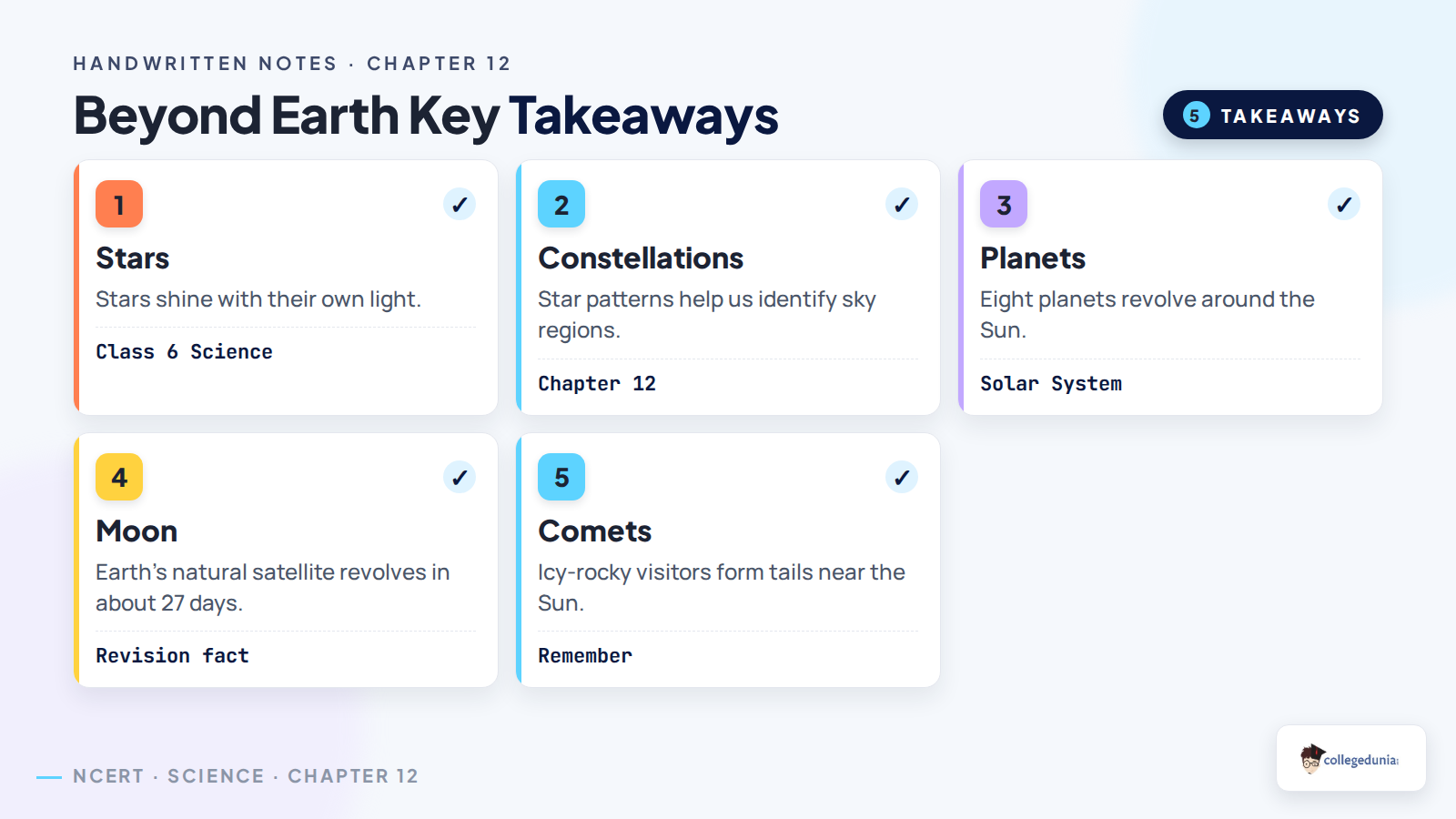
The Beyond Earth chapter starts with the night sky in Nubra, Ladakh. It then moves from stars to the Solar System. The PDF keeps this same order, so students can revise the chapter without jumping between topics.
| Topic | What to revise |
|---|---|
| Stars and constellations | Star light, Orion, Sirius, Big Dipper, Little Dipper, and Pole Star. |
| Night sky watching | Light pollution, safe observation, sky maps, and locating constellations. |
| Solar System | Sun, eight planets, moons, asteroids, comets, Milky Way, and Universe. |
Beyond Earth Important Facts Every Class 6 Student Should Know
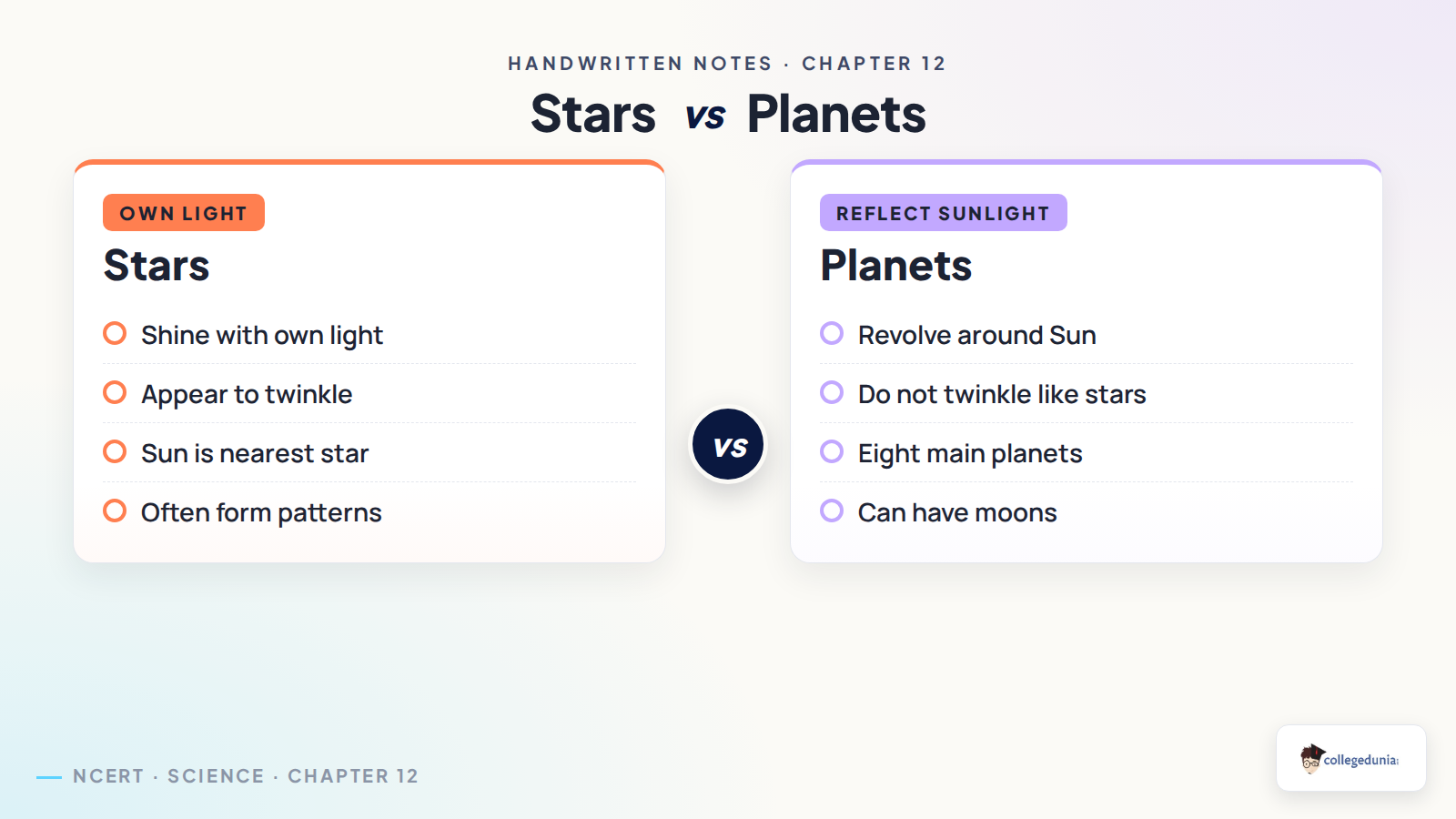
The chapter has many direct one-line facts. These are useful for short answers and matching questions. The sky is divided into 88 constellations, as listed by the International Astronomical Union.
- The Pole Star appears nearly fixed in the northern sky.
- Sirius is the brightest star in the night sky.
- Venus is a planet, not a star, even when called Morning Star.
- Pluto is a dwarf planet, not one of the eight planets.
Beyond Earth One Shot Revision Video
Source: Magnet Brains on YouTube
Solar System Order in Beyond Earth Class 6 Notes
The notes use a simple planet order line: Mercury, Venus, Earth, Mars, Jupiter, Saturn, Uranus, Neptune. Learn it once, then check every Solar System diagram against this order.
| Group | Planets | Key point |
|---|---|---|
| Inner planets | Mercury, Venus, Earth, Mars | Smaller and rocky. |
| Outer planets | Jupiter, Saturn, Uranus, Neptune | Larger and mostly gas or ice. |
| Dwarf planet | Pluto | Beyond Neptune and smaller than the Moon. |
Moon, Asteroids and Comets in Beyond Earth
The Moon is Earth's natural satellite. It takes about 27 days to complete one revolution around Earth. The chapter also explains that asteroids are rocky objects, while comets are icy-rocky visitors with tails near the Sun.
- Moon: about one quarter of Earth's diameter and about 384000 km away.
- Asteroids: many move between Mars and Jupiter in the asteroid belt.
- Comets: Halley's Comet appears about every 76 years.
How to Use the Beyond Earth Handwritten Notes
Use the PDF as a 20-minute revision sheet before answering the textbook questions. First read the headings. Then cover the answers and redraw the diagrams from memory. End with the common mistakes page.
- Revise the constellation and Pole Star pages first.
- Write the planet order without looking at the PDF.
- Check Moon, asteroid, comet, and Milky Way facts.
- Try NCERT questions 1 to 11 after revision.
Student Feedback on Beyond Earth Revision
What 12,860 students told us about this chapter: most students found the planet order easy, but they mixed up stars, planets, satellites, and dwarf planets.
74% of students said a one-page Solar System order chart helped them revise faster before the 2026 school tests.
Source: 2026 Class 6 Science student survey by Collegedunia.
Common Mistakes in the Beyond Earth Chapter
Many students lose marks because they write common names as scientific facts. Use the lines below as a final check before the test.
- Do not write that Venus is a star. It is a planet.
- Do not write Pluto as one of the eight planets.
- Do not say constellation lines are real lines in the sky.
- Do not confuse rotation with revolution.
| Related Class 6 Beyond Earth Resources | Use it for |
|---|---|
| Beyond Earth Class 6 NCERT Solutions | Step-by-step answers to textbook questions. |
| Beyond Earth Class 6 Notes | Typed summary and important terms. |
| Beyond Earth Class 6 NCERT Book PDF | Official textbook chapter PDF. |
| More Class 6 Science Handwritten Notes | Chapter focus |
|---|---|
| Exploring Magnets Handwritten Notes | Magnets, poles, and magnetic effects. |
| Measurement of Length and Motion Handwritten Notes | Measurement, motion, and units. |
| Temperature and Its Measurement Handwritten Notes | Temperature, thermometer, and readings. |
Beyond Earth Class 6 Science Handwritten Notes FAQs
Ques. What do the Beyond Earth handwritten notes cover?
Ans. The notes cover stars, constellations, night sky watching, the Solar System, Moon, asteroids, comets, Milky Way, and the Universe.
Ques. Are the Beyond Earth handwritten notes useful for quick revision?
Ans. Yes. The PDF uses short points, tables, and hand-drawn diagrams so students can revise the chapter before solving NCERT questions.
Ques. What is the correct order of planets in the Solar System?
Ans. The order is Mercury, Venus, Earth, Mars, Jupiter, Saturn, Uranus, and Neptune.
Ques. Why is Venus called the Morning Star or Evening Star?
Ans. Venus shines brightly near dawn or dusk. It is still a planet, not a star.



Comments