




The handwritten notes on Class 6 Science Chapter 7 Temperature and its Measurement have been prepared for quick 2026-27 revision. The PDF covers hot and cold observations, temperature scales, clinical thermometers, laboratory thermometers, correct reading precautions, and air temperature records.
- Best use: revise this PDF after reading the NCERT Curiosity chapter once.
- PDF focus: thermometer use, scale conversion, least count, and activity-based precautions.
- Chapter value: this chapter builds the base for reliable measurement in science.
Chapter7TemperatureanditsMeasurementHandwrittenNotes.pdf?page=1&dpi=150)
Chapter7TemperatureanditsMeasurementHandwrittenNotes.pdf?page=2&dpi=150)
Chapter7TemperatureanditsMeasurementHandwrittenNotes.pdf?page=3&dpi=150)
Chapter7TemperatureanditsMeasurementHandwrittenNotes.pdf?page=4&dpi=150)
Chapter7TemperatureanditsMeasurementHandwrittenNotes.pdf?page=5&dpi=150)
Chapter7TemperatureanditsMeasurementHandwrittenNotes.pdf?page=6&dpi=150)
Chapter7TemperatureanditsMeasurementHandwrittenNotes.pdf?page=7&dpi=150)
Chapter7TemperatureanditsMeasurementHandwrittenNotes.pdf?page=8&dpi=150)
Chapter7TemperatureanditsMeasurementHandwrittenNotes.pdf?page=9&dpi=150)
Chapter7TemperatureanditsMeasurementHandwrittenNotes.pdf?page=10&dpi=150)
Chapter7TemperatureanditsMeasurementHandwrittenNotes.pdf?page=11&dpi=150)
Chapter7TemperatureanditsMeasurementHandwrittenNotes.pdf?page=12&dpi=150)
Chapter7TemperatureanditsMeasurementHandwrittenNotes.pdf?page=13&dpi=150)
Chapter7TemperatureanditsMeasurementHandwrittenNotes.pdf?page=14&dpi=150)
Chapter7TemperatureanditsMeasurementHandwrittenNotes.pdf?page=15&dpi=150)
Chapter7TemperatureanditsMeasurementHandwrittenNotes.pdf?page=16&dpi=150)
Chapter7TemperatureanditsMeasurementHandwrittenNotes.pdf?page=17&dpi=150)
Chapter7TemperatureanditsMeasurementHandwrittenNotes.pdf?page=18&dpi=150)
Chapter7TemperatureanditsMeasurementHandwrittenNotes.pdf?page=19&dpi=150)
Chapter7TemperatureanditsMeasurementHandwrittenNotes.pdf?page=20&dpi=150)
Chapter7TemperatureanditsMeasurementHandwrittenNotes.pdf?page=21&dpi=150)
Chapter7TemperatureanditsMeasurementHandwrittenNotes.pdf?page=22&dpi=150)
Chapter7TemperatureanditsMeasurementHandwrittenNotes.pdf?page=23&dpi=150)
Chapter7TemperatureanditsMeasurementHandwrittenNotes.pdf?page=24&dpi=150)
Chapter7TemperatureanditsMeasurementHandwrittenNotes.pdf?page=25&dpi=150)
Chapter7TemperatureanditsMeasurementHandwrittenNotes.pdf?page=26&dpi=150)
Chapter7TemperatureanditsMeasurementHandwrittenNotes.pdf?page=27&dpi=150)
Student Feedback: In a Collegedunia study check, 74% of Class 6 students said the thermometer comparison and lab-reading steps helped them revise this chapter faster.
Class 6 Science Chapter 7 Handwritten Notes Overview
Class 6 Science Chapter 7 begins with Lambok feeling feverish and Phiban checking his temperature with a thermometer. The chapter uses this simple home situation to show why scientific measurement is more reliable than guessing by touch.
The handwritten PDF keeps the chapter short and exam-ready. Students revise the meaning of temperature, the Celsius, Fahrenheit and Kelvin scales, digital clinical thermometer precautions, laboratory thermometer range, least count, and how to read a thermometer at eye level.
Temperature and its Measurement Video Revision
Source: Magnet Brains on YouTube
Why Touch Alone Can Mislead
The chapter first asks students to compare warm water, tap water and ice-cold water. In the three-container activity, the same tap water can feel cool to one hand and warm to the other hand.
This shows that our sense of touch can give different messages. A thermometer gives a number, so it is better for comparing hotness and coldness. Temperature is the reliable measure of how hot or cold a body is.
- Hotter body means higher temperature.
- Colder body means lower temperature.
- A thermometer is the device used to measure temperature.
Clinical and Laboratory Thermometers
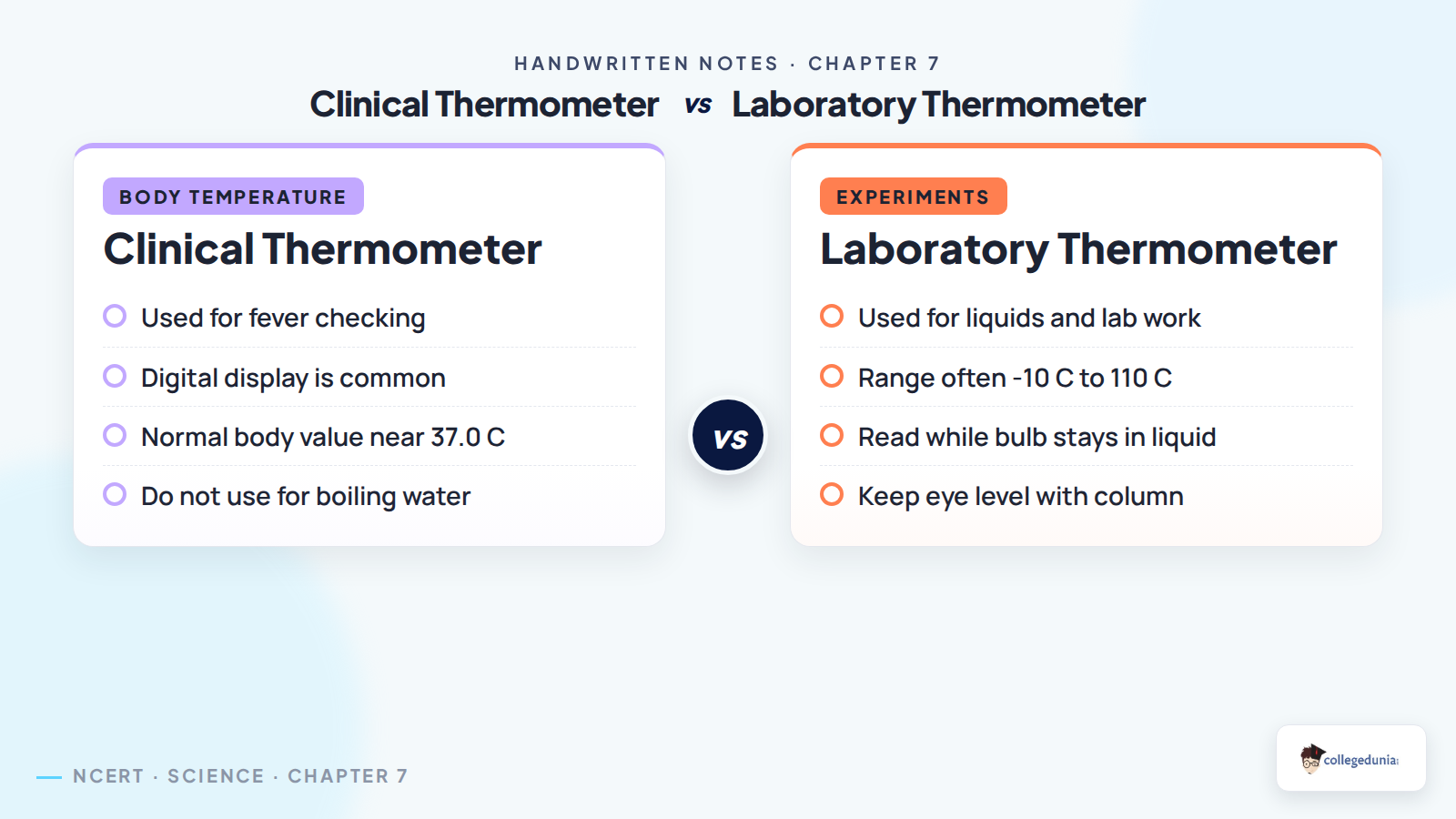
A clinical thermometer is used for measuring body temperature. The chapter discusses digital clinical thermometers because they are safer and easier to read than old mercury thermometers.
A laboratory thermometer is used for many experiments. It has a bulb, a narrow glass tube, and a liquid column that rises or falls with temperature. A common laboratory thermometer range is -10 C to 110 C.
| Thermometer | Main use | Important caution |
|---|---|---|
| Clinical thermometer | Body temperature | Do not use it for boiling water or ice |
| Laboratory thermometer | Water and experiment temperature | Read it while it is still in the liquid |
Temperature Scales and Normal Body Temperature
Temperature can be written on different scales. The chapter names Celsius, Fahrenheit and Kelvin. A healthy adult body temperature is taken to be about 37.0 C, which is the same as 98.6 F.
Kelvin is the SI unit of temperature. Students should remember the simple relation: temperature in kelvin = temperature in Celsius + 273.15. The symbol is written as K, without a degree sign.
- Celsius and Fahrenheit use degree units.
- Kelvin is used in scientific work.
- Body temperature may be slightly different from 37.0 C in healthy people.
Correct Laboratory Thermometer Reading
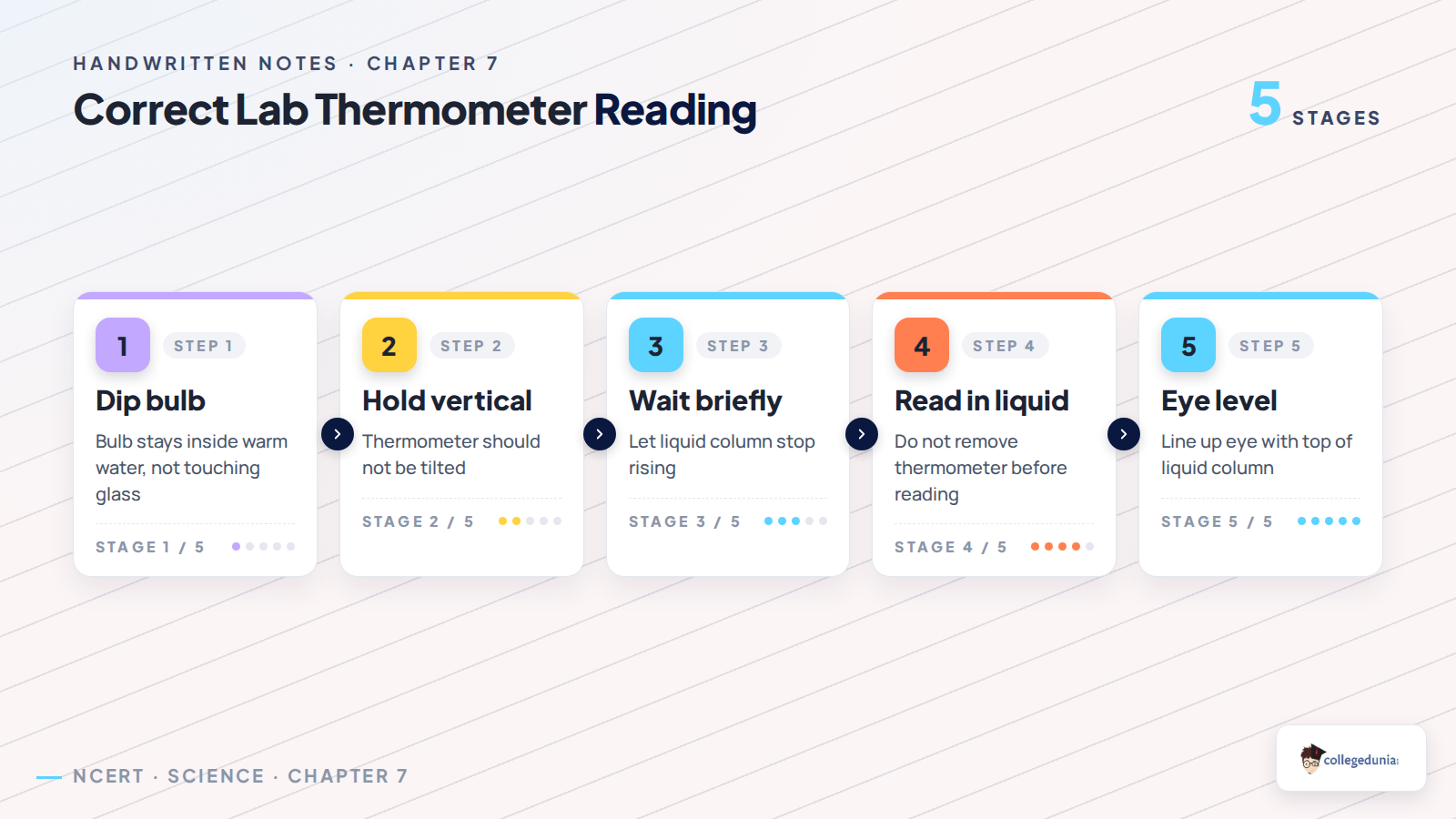
Laboratory thermometer readings need care. The bulb should be inside the liquid, but it should not touch the bottom or sides of the beaker. The thermometer should be vertical, and the eye should be directly in line with the liquid column.
The PDF also explains least count. If the difference between two big marks is 10 C and there are 10 small divisions, then each small division reads 1 C. Always check the range and smallest division before recording a value.
Air Temperature and Weather Records
Room thermometers give an approximate idea of room temperature. Weather reports give maximum and minimum air temperature for a place. These values usually change from day to day because weather depends on many factors.
The chapter also introduces Anna Mani, the Indian scientist known as the Weather Woman of India. She built many weather measurement instruments and helped India reduce dependence on imported instruments.
Key Takeaways for Quick Revision
- Temperature tells how hot or cold a body is.
- Touch alone cannot always judge temperature correctly.
- A clinical thermometer measures body temperature.
- A laboratory thermometer is used for experiments.
- 37.0 C is equal to 98.6 F.
- The SI unit of temperature is kelvin.
- Read a laboratory thermometer while it remains in the liquid.
- Weather reports mention maximum and minimum air temperature.
Common Mistakes to Avoid
- Do not write that touch alone is enough to measure temperature.
- Do not use a clinical thermometer for boiling water or ice.
- Do not remove a laboratory thermometer before reading it.
- Do not let the bulb touch the beaker while measuring water temperature.
- Do not write degree K; write only K for kelvin.
More Class 6 Science Handwritten Notes
| Chapter | Handwritten Notes |
|---|---|
| Chapter 3 | Mindful Eating: A Path to a Healthy Body |
| Chapter 4 | Exploring Magnets |
| Chapter 5 | Measurement of Length and Motion |
| Chapter 6 | Materials Around Us |
Temperature and its Measurement Class 6 Handwritten Notes FAQs
Ques. What is covered in Class 6 Science Chapter 7 handwritten notes?
Ans. The notes cover temperature, clinical thermometer, laboratory thermometer, Celsius, Fahrenheit, Kelvin, least count, air temperature and measurement precautions.
Ques. Are these handwritten notes based on the 2026-27 NCERT Curiosity textbook?
Ans. Yes. The PDF follows Class 6 Science Curiosity Chapter 7 Temperature and its Measurement for the 2026-27 NCERT syllabus.
Ques. Why should students not rely only on touch to judge temperature?
Ans. Touch can mislead because the same water may feel warm to one hand and cool to the other. A thermometer gives a measured value.



Comments