



The handwritten notes on Class 6 Science Chapter 6 Materials Around Us have been prepared for quick 2026-27 revision. The PDF covers objects and materials, grouping by properties, lustre, hardness, transparency, solubility, floating and sinking, mass, volume and matter.
- Best use: revise this PDF after reading the NCERT Curiosity chapter once.
- PDF focus: material properties, classroom activities and short exam-ready definitions.
- Chapter value: this chapter builds the base for matter and classification in science.
Chapter6MaterialsAroundUsHandwrittenNotes.pdf?page=1&dpi=150)
Chapter6MaterialsAroundUsHandwrittenNotes.pdf?page=2&dpi=150)
Chapter6MaterialsAroundUsHandwrittenNotes.pdf?page=3&dpi=150)
Chapter6MaterialsAroundUsHandwrittenNotes.pdf?page=4&dpi=150)
Chapter6MaterialsAroundUsHandwrittenNotes.pdf?page=5&dpi=150)
Chapter6MaterialsAroundUsHandwrittenNotes.pdf?page=6&dpi=150)
Chapter6MaterialsAroundUsHandwrittenNotes.pdf?page=7&dpi=150)
Chapter6MaterialsAroundUsHandwrittenNotes.pdf?page=8&dpi=150)
Chapter6MaterialsAroundUsHandwrittenNotes.pdf?page=9&dpi=150)
Chapter6MaterialsAroundUsHandwrittenNotes.pdf?page=10&dpi=150)
Chapter6MaterialsAroundUsHandwrittenNotes.pdf?page=11&dpi=150)
Chapter6MaterialsAroundUsHandwrittenNotes.pdf?page=12&dpi=150)
Chapter6MaterialsAroundUsHandwrittenNotes.pdf?page=13&dpi=150)
Chapter6MaterialsAroundUsHandwrittenNotes.pdf?page=14&dpi=150)
Chapter6MaterialsAroundUsHandwrittenNotes.pdf?page=15&dpi=150)
Chapter6MaterialsAroundUsHandwrittenNotes.pdf?page=16&dpi=150)
Chapter6MaterialsAroundUsHandwrittenNotes.pdf?page=17&dpi=150)
Chapter6MaterialsAroundUsHandwrittenNotes.pdf?page=18&dpi=150)
Chapter6MaterialsAroundUsHandwrittenNotes.pdf?page=19&dpi=150)
Chapter6MaterialsAroundUsHandwrittenNotes.pdf?page=20&dpi=150)
Chapter6MaterialsAroundUsHandwrittenNotes.pdf?page=21&dpi=150)
Chapter6MaterialsAroundUsHandwrittenNotes.pdf?page=22&dpi=150)
Chapter6MaterialsAroundUsHandwrittenNotes.pdf?page=23&dpi=150)
Chapter6MaterialsAroundUsHandwrittenNotes.pdf?page=24&dpi=150)
Chapter6MaterialsAroundUsHandwrittenNotes.pdf?page=25&dpi=150)
Chapter6MaterialsAroundUsHandwrittenNotes.pdf?page=26&dpi=150)
Chapter6MaterialsAroundUsHandwrittenNotes.pdf?page=27&dpi=150)
Chapter6MaterialsAroundUsHandwrittenNotes.pdf?page=28&dpi=150)
Chapter6MaterialsAroundUsHandwrittenNotes.pdf?page=29&dpi=150)
Student Feedback: In a Collegedunia study check, 72% of Class 6 students said the properties table and transparency examples helped them revise this chapter faster.
|
Table of Contents |
Class 6 Science Chapter 6 Handwritten Notes Overview
Class 6 Science Chapter 6 begins with Ghulan and Sheeta comparing everyday objects in their classroom. The chapter asks students to observe what objects are made of and how materials differ in look, touch and use.
The handwritten PDF keeps the chapter short and test-ready. Students revise the meaning of material, object-material examples, grouping by properties, solubility tests, floating and sinking, and the idea that matter has mass and occupies space.
Materials Around Us Video Revision
Source: Science Class 6 on YouTube
Objects, Materials and Grouping
An object is the thing we use or see, while a material is the substance used to make it. A bottle is an object, while glass or plastic is the material. A table is an object, while wood, metal or plastic may form it.
One object may contain many materials. A school bag may have cloth, plastic zip, metal buckle and thread. One material may also make many objects. Paper can make notebooks, bags, cartons, labels and cards.
Grouping means arranging materials based on a common property. Use only one property at a time while grouping, such as lustre, hardness, transparency, solubility or floating.
Properties Used to Group Materials
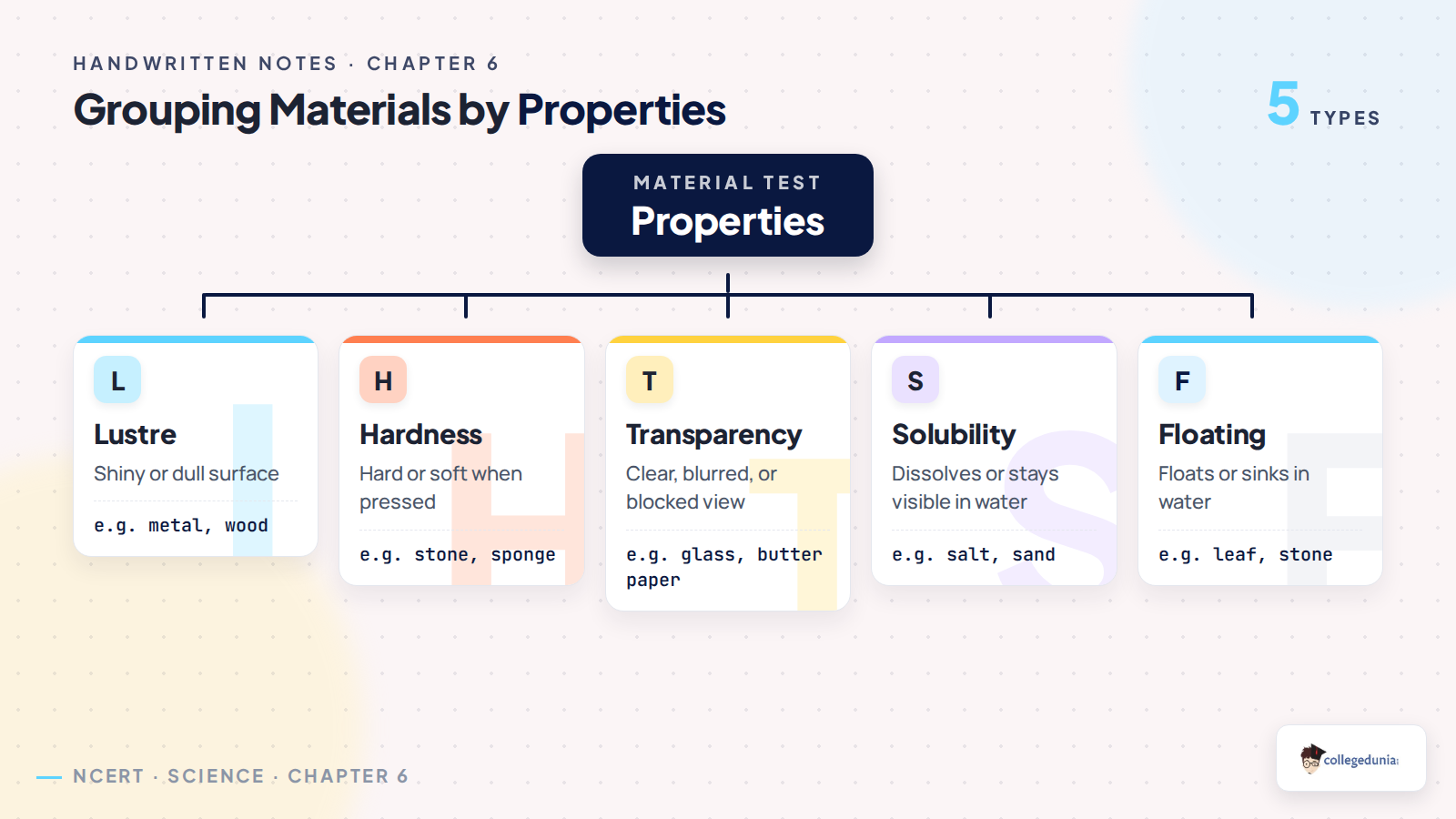
The chapter teaches students to observe materials before making a conclusion. Appearance, lustre, texture, hardness and transparency can be checked directly. Solubility and floating need a simple water test.
| Property | Meaning | Example |
|---|---|---|
| Lustre | Shiny or dull surface | Metal is usually shiny |
| Hardness | Hard or soft when pressed or scratched | Stone is hard, sponge is soft |
| Solubility | Dissolves or does not dissolve in water | Salt dissolves, sand does not |
| Floating | Floats or sinks in water | Leaf floats, stone sinks |
Transparency, Translucency and Opacity
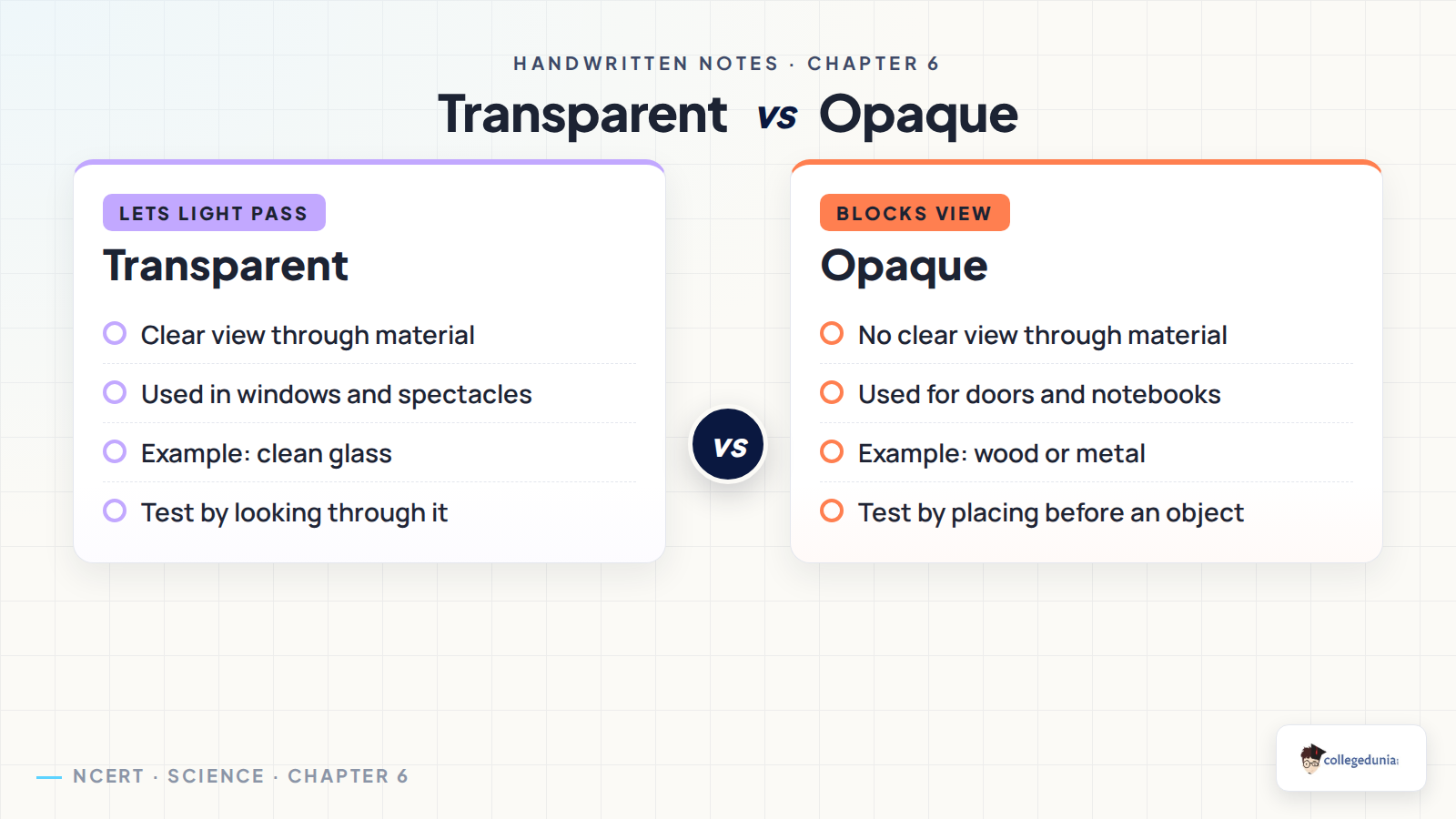
Transparent materials allow a clear view through them. Translucent materials allow light to pass but give a blurred view. Opaque materials do not allow us to see through them.
Clean glass is transparent, butter paper is translucent and wood is opaque. To test this property, place the material between your eye and an object. If the object is seen clearly, the material is transparent.
Solubility, Floating and Sinking
A substance is soluble in water if it mixes completely and seems to disappear. Salt and sugar are common examples. Sand, chalk powder and many oils are insoluble in water.
Some materials float on water and some sink. A dry leaf usually floats, while a stone usually sinks. Shape, trapped air and material together affect floating, so do not decide only from weight.
- Use small amounts while testing solubility.
- Stir and wait before writing the result.
- Record whether the substance dissolves, settles or floats.
Mass, Volume and Matter
Mass tells how much matter an object has. Volume is the space occupied by an object. Anything that has mass and occupies space is called matter. Materials around us are forms of matter.
Air is also matter because it has mass and occupies space. This idea helps students move from everyday objects to a more scientific meaning of substances, pure substances and mixtures.
Key Takeaways for Quick Revision
- A material is a substance used to make an object.
- Object and material are not the same thing.
- Materials can be grouped using common properties.
- Lustre means shiny appearance.
- Transparent materials give a clear view.
- Salt dissolves in water, while sand stays visible.
- Floating depends on material, shape and trapped air.
- Matter has mass and occupies space.
Common Mistakes to Avoid
- Do not write that all shiny objects are metals.
- Do not confuse transparent with translucent.
- Do not decide floating only by weight.
- Do not write only the object name when the question asks for material.
- Do not call air empty space, because air is also matter.
Related NCERT Resources for This Chapter
| Resource | Link |
|---|---|
| Chapter 5 Handwritten Notes | Measurement of Length and Motion |
| Chapter 4 Handwritten Notes | Exploring Magnets |
| Chapter 3 Handwritten Notes | Mindful Eating: A Path to a Healthy Body |
More Class 6 Science Handwritten Notes
| Chapter | Handwritten Notes |
|---|---|
| Chapter 1 | The Wonderful World of Science |
| Chapter 2 | Diversity in the Living World |
| Chapter 3 | Mindful Eating: A Path to a Healthy Body |
| Chapter 4 | Exploring Magnets |
| Chapter 5 | Measurement of Length and Motion |
Materials Around Us Class 6 Handwritten Notes FAQs
Ques. What is covered in Class 6 Science Chapter 6 handwritten notes?
Ans. The notes cover materials, grouping, lustre, hardness, transparency, solubility, floating, sinking, mass, volume and matter.
Ques. Are these handwritten notes based on the 2026-27 NCERT Curiosity textbook?
Ans. Yes. The PDF follows Class 6 Science Curiosity Chapter 6 Materials Around Us for the 2026-27 NCERT syllabus.
Ques. What is the difference between object and material?
Ans. An object is the thing we use or see, while a material is the substance used to make it. For example, bottle is an object and glass is a material.



Comments