



The handwritten notes on Class 6 Science Chapter 8 A Journey through States of Water are prepared for quick 2026-27 revision. The PDF covers states of water, evaporation, condensation, melting, freezing, factors affecting evaporation, and the water cycle.
- Best use: revise this PDF after reading the NCERT Curiosity chapter once.
- PDF focus: state changes, daily examples, activity conclusions, and common mistakes.
- Chapter value: this chapter builds the base for matter, weather, and water cycle ideas.
Chapter8AJourneythroughStatesofWaterHandwrittenNotes.compressed.pdf?page=1&dpi=150)
Chapter8AJourneythroughStatesofWaterHandwrittenNotes.compressed.pdf?page=2&dpi=150)
Chapter8AJourneythroughStatesofWaterHandwrittenNotes.compressed.pdf?page=3&dpi=150)
Chapter8AJourneythroughStatesofWaterHandwrittenNotes.compressed.pdf?page=4&dpi=150)
Chapter8AJourneythroughStatesofWaterHandwrittenNotes.compressed.pdf?page=5&dpi=150)
Chapter8AJourneythroughStatesofWaterHandwrittenNotes.compressed.pdf?page=6&dpi=150)
Chapter8AJourneythroughStatesofWaterHandwrittenNotes.compressed.pdf?page=7&dpi=150)
Chapter8AJourneythroughStatesofWaterHandwrittenNotes.compressed.pdf?page=8&dpi=150)
Chapter8AJourneythroughStatesofWaterHandwrittenNotes.compressed.pdf?page=9&dpi=150)
Chapter8AJourneythroughStatesofWaterHandwrittenNotes.compressed.pdf?page=10&dpi=150)
Chapter8AJourneythroughStatesofWaterHandwrittenNotes.compressed.pdf?page=11&dpi=150)
Chapter8AJourneythroughStatesofWaterHandwrittenNotes.compressed.pdf?page=12&dpi=150)
Chapter8AJourneythroughStatesofWaterHandwrittenNotes.compressed.pdf?page=13&dpi=150)
Chapter8AJourneythroughStatesofWaterHandwrittenNotes.compressed.pdf?page=14&dpi=150)
Chapter8AJourneythroughStatesofWaterHandwrittenNotes.compressed.pdf?page=15&dpi=150)
Chapter8AJourneythroughStatesofWaterHandwrittenNotes.compressed.pdf?page=16&dpi=150)
Chapter8AJourneythroughStatesofWaterHandwrittenNotes.compressed.pdf?page=17&dpi=150)
Chapter8AJourneythroughStatesofWaterHandwrittenNotes.compressed.pdf?page=18&dpi=150)
Chapter8AJourneythroughStatesofWaterHandwrittenNotes.compressed.pdf?page=19&dpi=150)
Chapter8AJourneythroughStatesofWaterHandwrittenNotes.compressed.pdf?page=20&dpi=150)
Chapter8AJourneythroughStatesofWaterHandwrittenNotes.compressed.pdf?page=21&dpi=150)
Chapter8AJourneythroughStatesofWaterHandwrittenNotes.compressed.pdf?page=22&dpi=150)
Chapter8AJourneythroughStatesofWaterHandwrittenNotes.compressed.pdf?page=23&dpi=150)
Chapter8AJourneythroughStatesofWaterHandwrittenNotes.compressed.pdf?page=24&dpi=150)
Chapter8AJourneythroughStatesofWaterHandwrittenNotes.compressed.pdf?page=25&dpi=150)
Chapter8AJourneythroughStatesofWaterHandwrittenNotes.compressed.pdf?page=26&dpi=150)
Chapter8AJourneythroughStatesofWaterHandwrittenNotes.compressed.pdf?page=27&dpi=150)
Chapter8AJourneythroughStatesofWaterHandwrittenNotes.compressed.pdf?page=28&dpi=150)
Chapter8AJourneythroughStatesofWaterHandwrittenNotes.compressed.pdf?page=29&dpi=150)
Chapter8AJourneythroughStatesofWaterHandwrittenNotes.compressed.pdf?page=30&dpi=150)
Student Feedback: In a Collegedunia study check, 76% of Class 6 students said the evaporation and condensation comparison helped them revise this chapter faster.
|
Table of Contents |
Class 6 Science Chapter 8 Handwritten Notes Overview
Class 6 Science Chapter 8 starts with Aavi and Thirav discussing ice in lemonade. The question is simple: are ice and liquid water different substances, or are they different forms of the same substance?
The handwritten PDF answers this through NCERT activities. Students revise why ice, water, and water vapour are three states of water. They also learn how evaporation and condensation explain everyday observations like drying clothes, disappearing puddles, droplets on cold glasses, and cloud formation.
States of Water Video Revision
Source: Magnet Brains on YouTube
Ice, Water and Water Vapour
NCERT first asks students to observe an ice cube kept in a cup. The ice slowly changes into liquid water. This shows that ice and water are not different substances. They are two states of the same substance.
Water vapour is the gaseous state of water. It is usually invisible, so students should not confuse visible steam droplets with water vapour itself. The chapter uses daily examples to make this point clear.
| State of water | Example | Key property |
|---|---|---|
| Solid | Ice | Has fixed shape and volume |
| Liquid | Water | Flows and takes container shape |
| Gas | Water vapour | Spreads in air and has no fixed shape |
Evaporation and Condensation
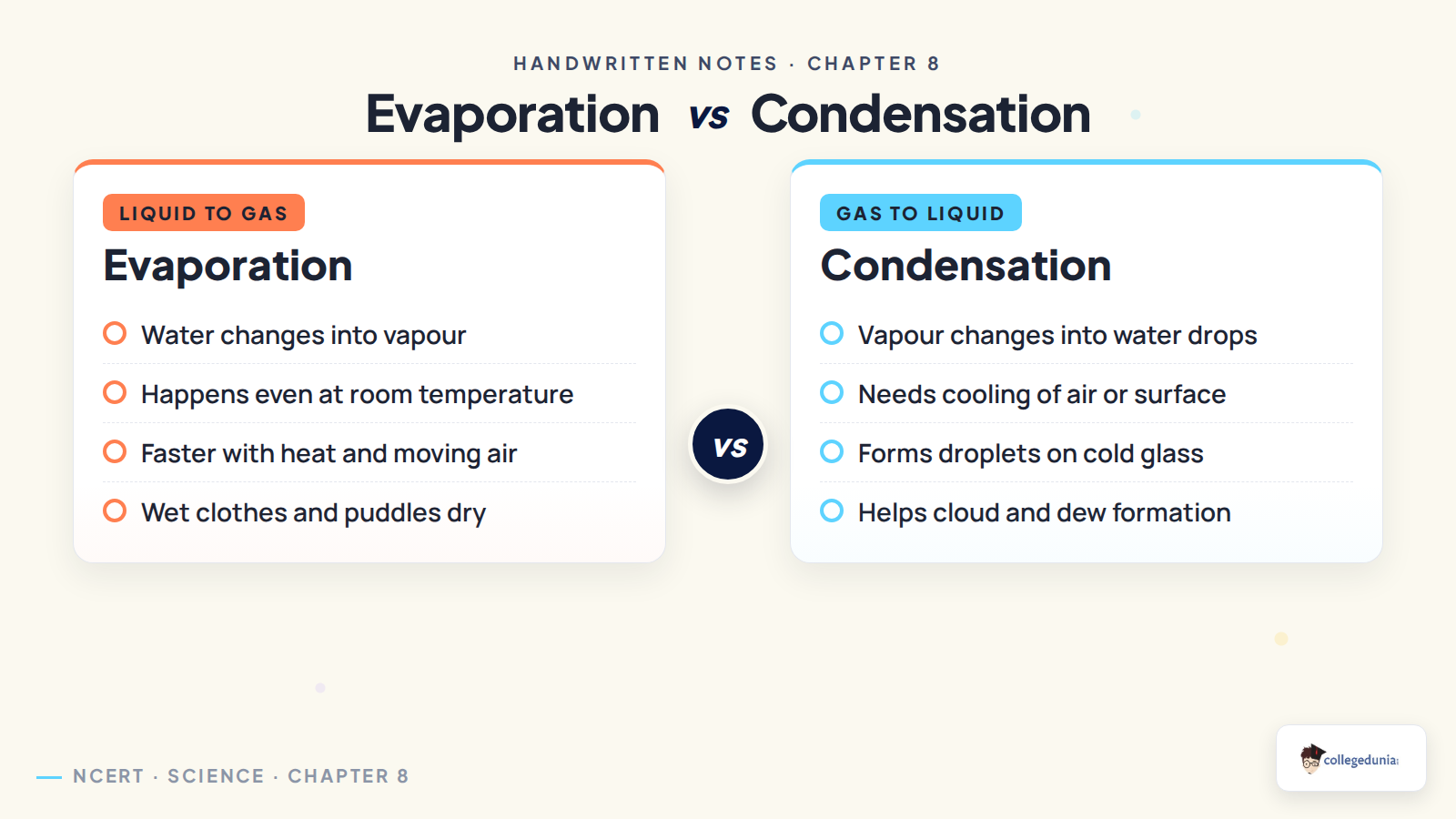
Evaporation is the conversion of liquid water into water vapour. It happens continuously, even at room temperature. This is why wet utensils, clothes, mopped floors, sweat, and puddles dry after some time.
Condensation is the conversion of water vapour into liquid water. In the cold glass activity, droplets form on the outside surface because water vapour in the surrounding air cools and turns into liquid drops.
- Evaporation explains water disappearing from a steel plate.
- Condensation explains droplets on a cold glass tumbler.
- Both processes are changes of state, not loss of matter.
Changing States by Heating and Cooling
Heating and cooling can change water from one state to another. When ice gets heat, it melts into liquid water. When liquid water is cooled in a freezer, it freezes into ice.
When liquid water gains enough heat, it changes into vapour. When vapour cools, it condenses back into liquid water. The substance remains water during these changes. Only the state changes.
| Process | Change | Daily example |
|---|---|---|
| Melting | Solid to liquid | Ice cube becoming water |
| Freezing | Liquid to solid | Water becoming ice in a freezer |
| Evaporation | Liquid to gas | Wet clothes drying |
| Condensation | Gas to liquid | Drops on a cold bottle |
Factors that Make Evaporation Faster
NCERT asks students to think about why water evaporates faster in some situations. Heat, surface area, moving air, and humidity all affect the rate of evaporation.
A thin spread of water dries faster than a deep layer because more surface is open to air. Clothes dry faster in sunlight and wind. Humid air slows drying because it already contains more water vapour.
- More heat: gives water particles more energy.
- Larger surface area: lets more particles escape at once.
- Moving air: carries water vapour away from the wet surface.
- Dry air: accepts more water vapour than humid air.
Water Cycle Link in Chapter 8
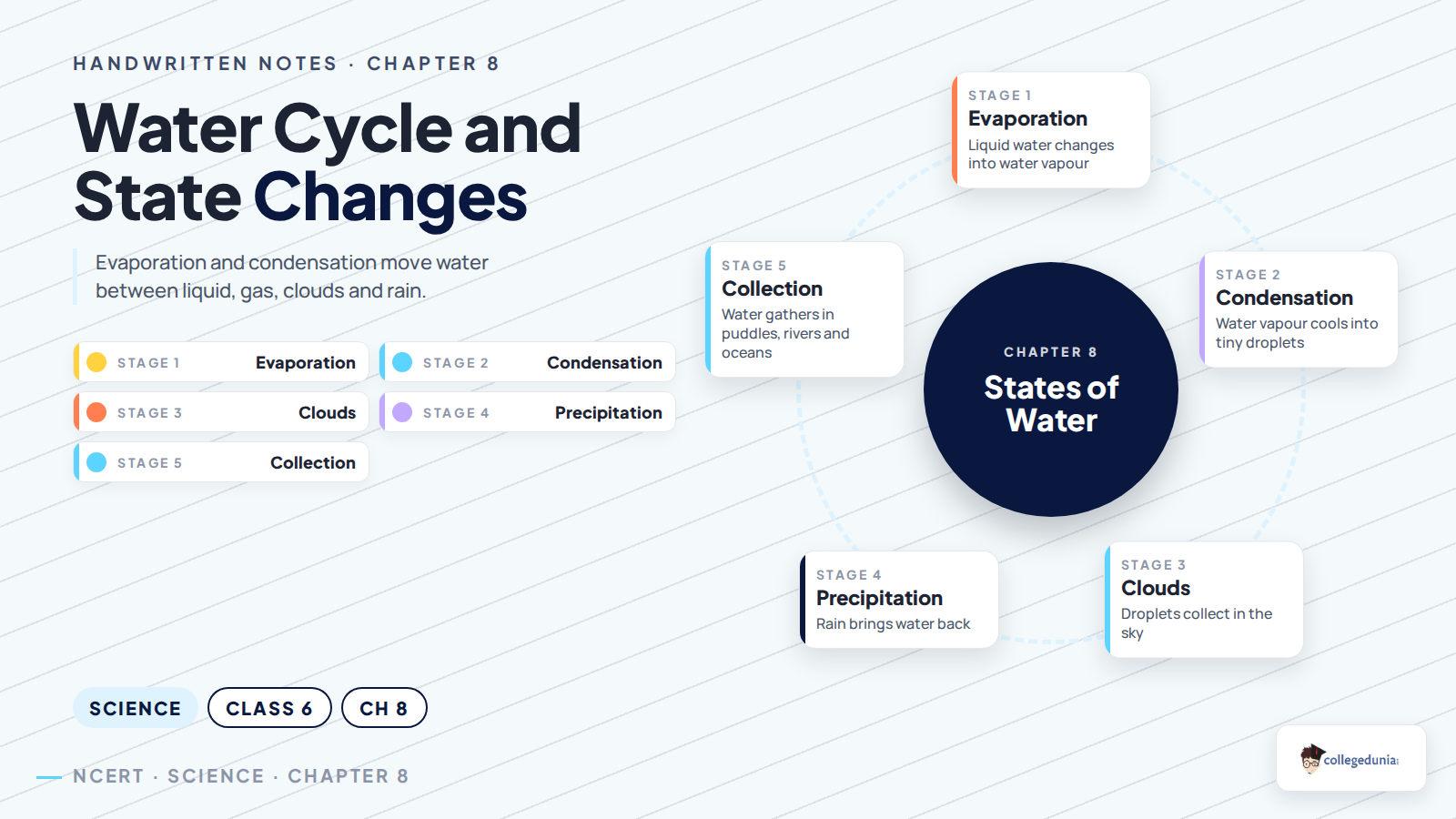
The chapter links evaporation and condensation to the water cycle. Water evaporates from oceans, rivers, lakes, soil, and wet surfaces. Water vapour rises, cools, and condenses into tiny droplets that form clouds.
Rain brings water back to the ground. Some water collects in rivers and oceans, some seeps into soil, and some evaporates again. This cycle keeps moving water through nature.
Key Takeaways for Quick Revision
- Ice, water, and water vapour are three states of the same substance.
- Evaporation changes liquid water into water vapour.
- Condensation changes water vapour into liquid water.
- Melting changes solid ice into liquid water.
- Freezing changes liquid water into solid ice.
- Heat, surface area, moving air, and humidity affect evaporation.
- Water cycle depends on evaporation, condensation, rain, and collection.
Common Mistakes to Avoid
- Do not write that water disappears into nothing during evaporation.
- Do not say droplets on a cold glass come from inside the glass.
- Do not confuse visible steam droplets with invisible water vapour.
- Do not write that ice and water are different substances.
- Do not mix up melting, freezing, evaporation, and condensation.
Related NCERT Resources for This Chapter
| Resource | Link |
|---|---|
| Chapter 8 NCERT Book PDF | A Journey through States of Water Book PDF |
| Chapter 8 Notes | A Journey through States of Water Notes |
| Chapter 8 NCERT Solutions | A Journey through States of Water Solutions |
More Class 6 Science Handwritten Notes
| Chapter | Handwritten Notes |
|---|---|
| Chapter 4 | Exploring Magnets |
| Chapter 5 | Measurement of Length and Motion |
| Chapter 6 | Materials Around Us |
| Chapter 7 | Temperature and its Measurement |
Quick Questions for Revision
A Journey through States of Water Class 6 Handwritten Notes FAQs
Ques. What is covered in Class 6 Science Chapter 8 handwritten notes?
Ans. The notes cover states of water, evaporation, condensation, melting, freezing, faster evaporation factors and the water cycle.
Ques. Are these handwritten notes based on the 2026-27 NCERT Curiosity textbook?
Ans. Yes. The PDF follows Class 6 Science Curiosity Chapter 8 A Journey through States of Water for the 2026-27 NCERT syllabus.
Ques. What is the main difference between evaporation and condensation?
Ans. Evaporation changes liquid water into vapour, while condensation changes water vapour back into liquid water droplets.



Comments