



NCERT Handwritten Notes for Class 7 Arts (Kriti) Chapter 8 The Music of the People help students revise folk songs, unique voices, women in music, reform songs and regional instruments according to the 2026-27 NCERT syllabus. The PDF keeps each topic in clear handwritten revision pages for quick classroom and home study.
- Download a 24-page handwritten revision PDF for Class 7 Arts Chapter 8.
- Revise Bihu, lullaby, qawwali, Mirabai, Annamacharya, Mukunda Das and regional instruments.
- Use the notes before folk-song activities, musician interviews and self-assessment.
Chapter8TheMusicofthePeopleHandwrittenNotes.pdf?page=1&dpi=150)
Chapter8TheMusicofthePeopleHandwrittenNotes.pdf?page=2&dpi=150)
Chapter8TheMusicofthePeopleHandwrittenNotes.pdf?page=3&dpi=150)
Chapter8TheMusicofthePeopleHandwrittenNotes.pdf?page=4&dpi=150)
Chapter8TheMusicofthePeopleHandwrittenNotes.pdf?page=5&dpi=150)
Chapter8TheMusicofthePeopleHandwrittenNotes.pdf?page=6&dpi=150)
Chapter8TheMusicofthePeopleHandwrittenNotes.pdf?page=7&dpi=150)
Chapter8TheMusicofthePeopleHandwrittenNotes.pdf?page=8&dpi=150)
Chapter8TheMusicofthePeopleHandwrittenNotes.pdf?page=9&dpi=150)
Chapter8TheMusicofthePeopleHandwrittenNotes.pdf?page=10&dpi=150)
Chapter8TheMusicofthePeopleHandwrittenNotes.pdf?page=11&dpi=150)
Chapter8TheMusicofthePeopleHandwrittenNotes.pdf?page=12&dpi=150)
Chapter8TheMusicofthePeopleHandwrittenNotes.pdf?page=13&dpi=150)
Chapter8TheMusicofthePeopleHandwrittenNotes.pdf?page=14&dpi=150)
Chapter8TheMusicofthePeopleHandwrittenNotes.pdf?page=15&dpi=150)
Chapter8TheMusicofthePeopleHandwrittenNotes.pdf?page=16&dpi=150)
Chapter8TheMusicofthePeopleHandwrittenNotes.pdf?page=17&dpi=150)
Chapter8TheMusicofthePeopleHandwrittenNotes.pdf?page=18&dpi=150)
Chapter8TheMusicofthePeopleHandwrittenNotes.pdf?page=19&dpi=150)
Chapter8TheMusicofthePeopleHandwrittenNotes.pdf?page=20&dpi=150)
Chapter8TheMusicofthePeopleHandwrittenNotes.pdf?page=21&dpi=150)
Chapter8TheMusicofthePeopleHandwrittenNotes.pdf?page=22&dpi=150)
Chapter8TheMusicofthePeopleHandwrittenNotes.pdf?page=23&dpi=150)
Chapter8TheMusicofthePeopleHandwrittenNotes.pdf?page=24&dpi=150)
Clear handwritten notes on folk music, social reform and regional instruments.
The Music of the People Snapshot
Chapter 8 explains how music changes from region to region in India. Lok sangeet means music of and by the people, and it carries local life through lyrics, tune, rhythm and instruments.
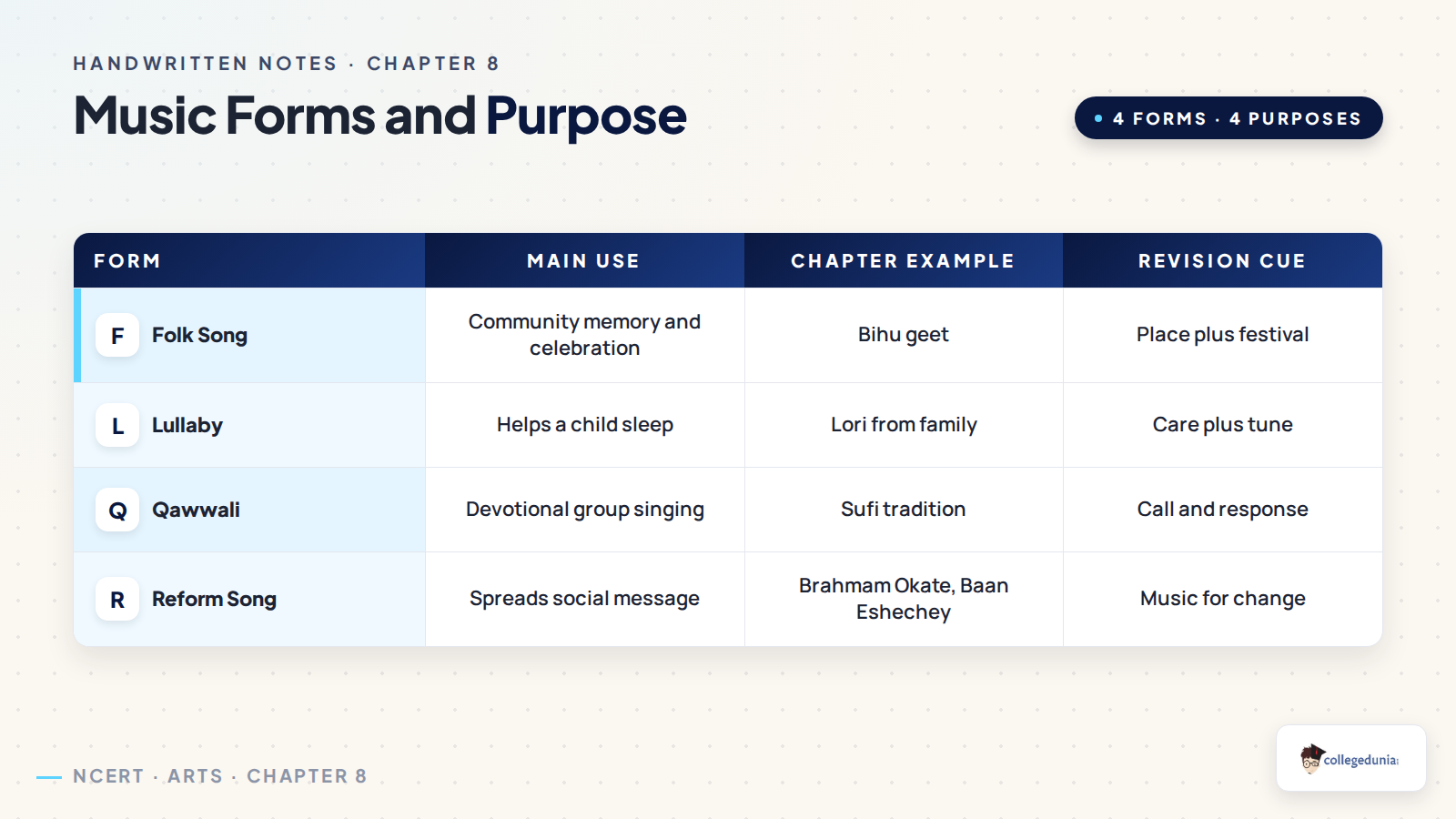
The fastest way to revise the chapter is to connect every song form with its purpose. Folk songs show community life, lullabies show care, qawwalis show devotion and reform songs carry a social message.
| Topic | What to Remember |
|---|---|
| Lok sangeet | Music that belongs to people, place and community memory. |
| Voice | Every voice is unique, and pitch cannot be judged by gender alone. |
| Social reform | Songs can carry ideas of equality, action and change. |
Folk Songs and Community
The chapter opens with an Assamese Bihu song by Bhupen Hazarika. The song captures the joyful spirit of Bohag Bihu through rain, clouds, dance, dhol and celebration.
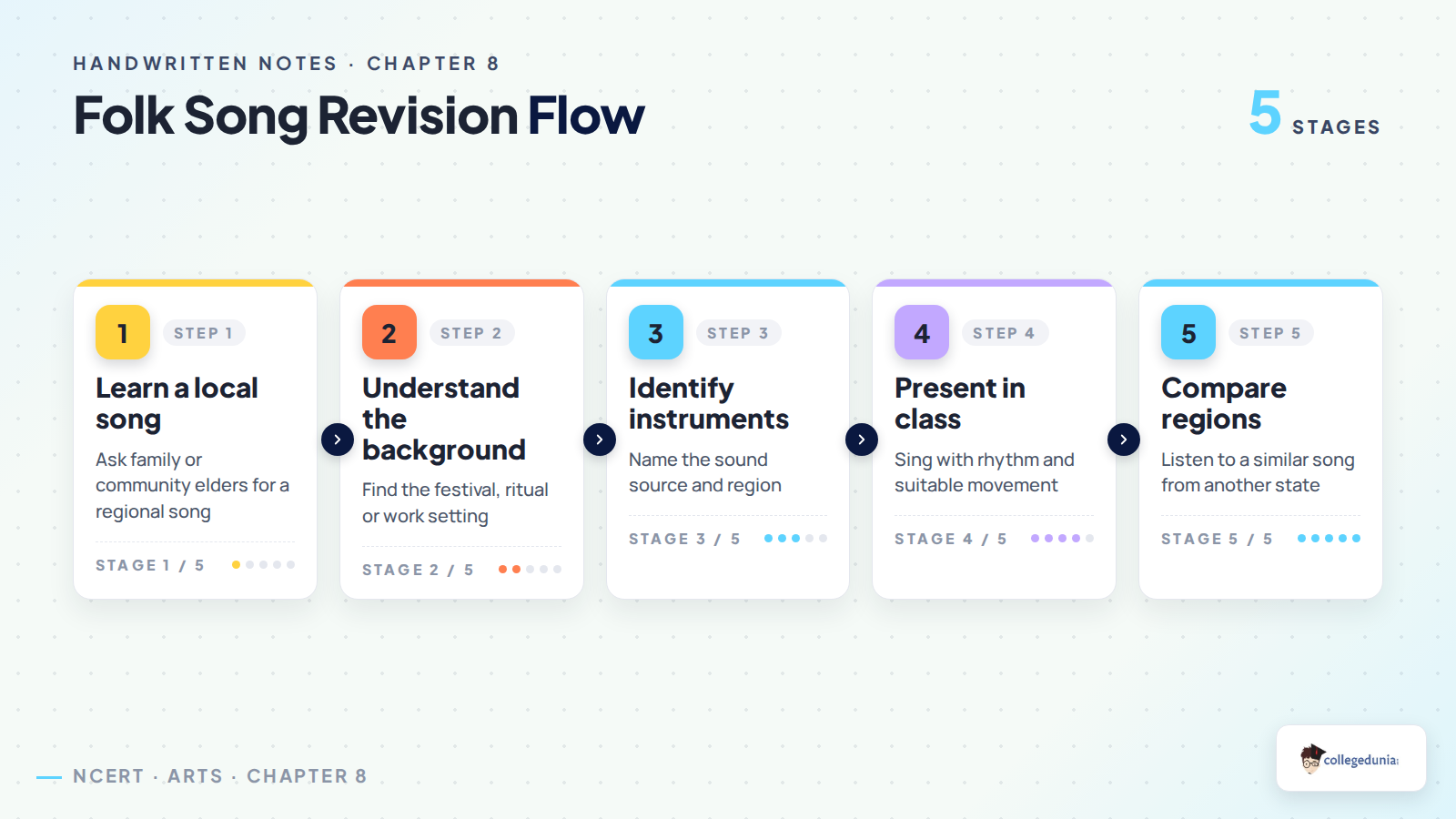
Students are asked to learn a folk song from their own region. They should find the background of the song, identify instruments, present it in class and compare it with a song from another region.
- Bihu geet: connects festival, dance, rhythm and nature.
- Regional song activity: asks students to learn, sing, record and present.
- Community link: shows how songs keep traditions alive.
Unique Voices and Stereotypes
The chapter explains that no two voices sound exactly the same. Some voices are sharp and clear, while others are rich, deep, soft or gentle.
It also asks students to question fixed ideas about male and female voices. Usha Uthup, Teejan Bai, Kumar Gandharv and D K Pattammal are given as examples of artists with distinctive voices.
A good answer should say that an unusual voice can become an artist's strength.
Women in Music
Chapter 8 introduces women who shaped Indian music through devotion, poetry and performance. Mirabai was a poet and devotee of Shree Krishna from the 15th century CE.
Her bhajans are still sung in devotional and classical styles. The chapter also asks students to learn about Lal Ded, the Kashmiri mystic poet known for vakhs with deep philosophical meaning.
| Person | Revision Cue |
|---|---|
| Mirabai | Bhakti poet and Krishna devotee, remembered for bhajans. |
| Lal Ded | Kashmiri mystic poet, known for short poems called vakhs. |
| Roshanara Begum | Named in the qawwali activity as a female qawwali singer. |
Music and Social Reform
Music can express a point of view and ask people to work for change. The chapter gives examples of composers and poets who used songs to question social conditions.
Annamacharya composed devotional songs and preached brotherhood. The song Brahmam Okate says that God is one and lives in all beings.
Charankavi Mukunda Das used songs and plays to spread Swadeshi ideas in Bengal. His song Baan Eshechey asks people to arise and act before opportunities are lost.
Instruments and Regions
Different regions in India have instruments that are characteristic of those places. Some instruments may be played in more than one state, and the same instrument may also have different names.
Activities 8.7 and 8.8 ask students to classify instruments and place them on a map of India. Mohuri, Noot, Kopong, Pepa, Pung, Ghummat and Madal are some examples from the chapter.
- Use images to recognise the instrument quickly.
- Write the region or state name clearly.
- Remember that names can change across places.
The Music of the People Chapter Video
Source: NCERT OFFICIAL on YouTube
Related NCERT Class 7 Arts (Kriti) Resources
Use these related resources when you want the official book chapter or nearby handwritten notes from the same Arts (Kriti) unit.
| Resource | Link |
|---|---|
| NCERT Book PDF | Class 7 Arts Chapter 8 NCERT Book PDF |
| Previous Chapter | Class 7 Arts Chapter 7 Handwritten Notes |
| Earlier Chapter | Class 7 Arts Chapter 6 Handwritten Notes |
All Chapters for Class 7 Arts (Kriti) Handwritten Notes
| Chapter | Handwritten Notes |
|---|---|
| Chapter 2 Say More without Speech Mime | Download Notes |
| Chapter 3 Let's Design Stage Technicals 2 | Download Notes |
| Chapter 4 Story of India's Storytelling Tradition | Download Notes |
| Chapter 5 Making Music | Download Notes |
| Chapter 6 Music, Emotions and Creativity | Download Notes |
| Chapter 7 Ragas and Talas/Taal | Download Notes |
FAQs on NCERT Class 7 Arts Chapter 8 Handwritten Notes
Ques. What is covered in Class 7 Arts Chapter 8 The Music of the People?
Ans. The chapter covers folk songs, Bihu, unique voices, lullaby, qawwali, Mirabai, Lal Ded, reform songs and regional instruments.
Ques. What does lok sangeet mean?
Ans. Lok sangeet means music of and by the people. It reflects festivals, rituals, occupations, beliefs and local traditions.
Ques. Why is music linked with social reform in this chapter?
Ans. The chapter shows that songs can spread ideas of equality, brotherhood, action and community change.
Ques. Why are these handwritten notes useful?
Ans. The notes turn the chapter into short handwritten pages with tables, quick points and activity cues for revision.



Comments