


These Class 10 Civics notes Chapter 1 Power-sharing explain why no single group should hold all the power in a democracy, using the real stories of Belgium and Sri Lanka.
Chapter1Power-sharingNotes.pdf?page=1&dpi=150)
Chapter1Power-sharingNotes.pdf?page=2&dpi=150)
Chapter1Power-sharingNotes.pdf?page=3&dpi=150)
Chapter1Power-sharingNotes.pdf?page=4&dpi=150)
Chapter1Power-sharingNotes.pdf?page=5&dpi=150)
Chapter1Power-sharingNotes.pdf?page=6&dpi=150)
Chapter1Power-sharingNotes.pdf?page=7&dpi=150)
Chapter1Power-sharingNotes.pdf?page=8&dpi=150)
Chapter1Power-sharingNotes.pdf?page=9&dpi=150)
Chapter1Power-sharingNotes.pdf?page=10&dpi=150)
Chapter1Power-sharingNotes.pdf?page=11&dpi=150)
Chapter1Power-sharingNotes.pdf?page=12&dpi=150)
Chapter1Power-sharingNotes.pdf?page=13&dpi=150)
Chapter1Power-sharingNotes.pdf?page=14&dpi=150)
Chapter1Power-sharingNotes.pdf?page=15&dpi=150)
Chapter1Power-sharingNotes.pdf?page=16&dpi=150)
Chapter1Power-sharingNotes.pdf?page=17&dpi=150)
Chapter1Power-sharingNotes.pdf?page=18&dpi=150)
Chapter1Power-sharingNotes.pdf?page=19&dpi=150)
Chapter1Power-sharingNotes.pdf?page=20&dpi=150)
The notes cover majoritarianism, accommodation, the prudential and moral reasons for sharing power, and the four forms power-sharing takes, all according to the latest 2026-27 CBSE syllabus.
- Belgium vs Sri Lanka is the single most tested idea here, worth 3 to 5 marks in most board papers.
- Notes cover both reasons for power-sharing (prudential and moral) and all four forms with examples.
- Written according to the rationalised 2026-27 CBSE Class 10 Democratic Politics II textbook.
These Collegedunia revision notes are curated by Social Science subject experts, according to the 2026-27 NCERT Democratic Politics II textbook, and refined against the last five years of CBSE Class 10 Civics board papers.
Student Feedback: What 11,400 students told us about this chapter
84% of Class 10 students said that learning the Belgium vs Sri Lanka contrast as one clean line - Belgium accommodated, Sri Lanka imposed - was the fastest way to score the 3 to 5 mark question. Students who memorised the two number sets (Belgium 59-40-1 and Sri Lanka 74-18-7) wrote sharper, fact-backed answers.
Top scorers said the prudential vs moral reason question trips up most students. The trick they shared: a reason about stability or unity is prudential, and a reason about rights or the spirit of democracy is moral. Students who labelled one of each clearly scored full marks on that question.
Source: 2026-27 Class 10 Social Science student poll. Sample of 11,400 students from CBSE schools across 14 states, conducted before the 2026 boards.
What the Class 10 Civics Notes Chapter 1 Power-sharing Cover
Power-sharing is the first chapter of Democratic Politics II. It builds on the idea that power in a democracy is split among the legislature, executive, and judiciary, then uses two real countries to show what happens when power is shared and when it is not.
- Two case studies: Belgium chose accommodation and stayed united; Sri Lanka chose majoritarianism and slid into a long civil war.
- Why power-sharing is desirable: two reasons - prudential (practical gains, stability, unity) and moral (the very spirit of democracy).
- Four forms of power-sharing: among organs of government (horizontal), among levels of government (vertical), among social groups, and among political parties and pressure groups.
- Key terms: ethnic, majoritarianism, prudential, civil war, community government - each one is a possible one-mark question.
Power-sharing Class 10 Explained in Simple Language
Source: Magnet Brains on YouTube
Belgium and Sri Lanka: Two Democracies, Same Problem of Diversity
Belgium and Sri Lanka are both small democracies with a mix of language and religious groups. Both faced the same question - should the majority rule alone, or should power be shared? They answered in opposite ways, which is why the chapter pairs them.
Ethnic composition of Belgium
- 59% live in the Flemish region and speak Dutch.
- 40% live in the Wallonia region and speak French.
- The remaining 1% of Belgians speak German.
- In the capital Brussels, 80% speak French and 20% speak Dutch - the reverse of the country as a whole.
The minority French-speaking community was rich and powerful, which the Dutch majority resented. The tension was sharpest in Brussels, where the Dutch were a majority in the country but a minority in the capital.
Ethnic composition of Sri Lanka
- Sinhala-speakers form the major group at 74%; most are Buddhists.
- Tamil-speakers form 18%; they split into Sri Lankan Tamils (native, north and east) and Indian Tamils (descended from colonial plantation workers).
- About 7% are Christians, both Tamil and Sinhala.
Majoritarianism in Sri Lanka and How It Led to Civil War
Majoritarianism is the belief that the majority community can rule however it wants, ignoring the minority's needs. After independence in 1948, Sri Lanka's Sinhala leaders used their majority to build dominance step by step.
The majoritarian measures
| Year / measure | What it did |
|---|---|
| 1956 Act | Recognised Sinhala as the only official language, ignoring Tamil. |
| Preferential policies | Favoured Sinhala applicants for university seats and government jobs. |
| New constitution | Made the state protect and foster Buddhism. |
These measures alienated the Sri Lankan Tamils, who felt their rights, jobs, and language were denied. Their demands for Tamil as an official language and for regional autonomy were repeatedly refused. By the 1980s some groups demanded a separate state called Tamil Eelam in the north and east. The distrust grew into a civil war that killed thousands, displaced many, and ended only in 2009.
Accommodation in Belgium: The Four Levels of Government
Belgian leaders faced the same diversity as Sri Lanka but took the opposite path. Between 1970 and 1993 they amended their constitution four times to let every community live together. The model is complicated, but it works.
Elements of the Belgian model
- Equal ministers: The Constitution requires an equal number of Dutch and French-speaking ministers in the central government, so no community can decide alone.
- Powers to states: Many central powers were given to the State Governments of the two regions, and these states are not subordinate to the centre.
- Separate Brussels government: Both communities have equal representation in the capital's government.
- Community government: A third kind of government, elected by people of one language group, handles cultural, educational, and language matters.
These arrangements avoided civil strife and stopped the country from splitting on language lines. When the European Union formed, Brussels was chosen as its headquarters.
Belgium vs Sri Lanka: The Comparison Table Every Student Must Know
This contrast is the most tested idea in the chapter. Keep this table ready for the long-answer question.
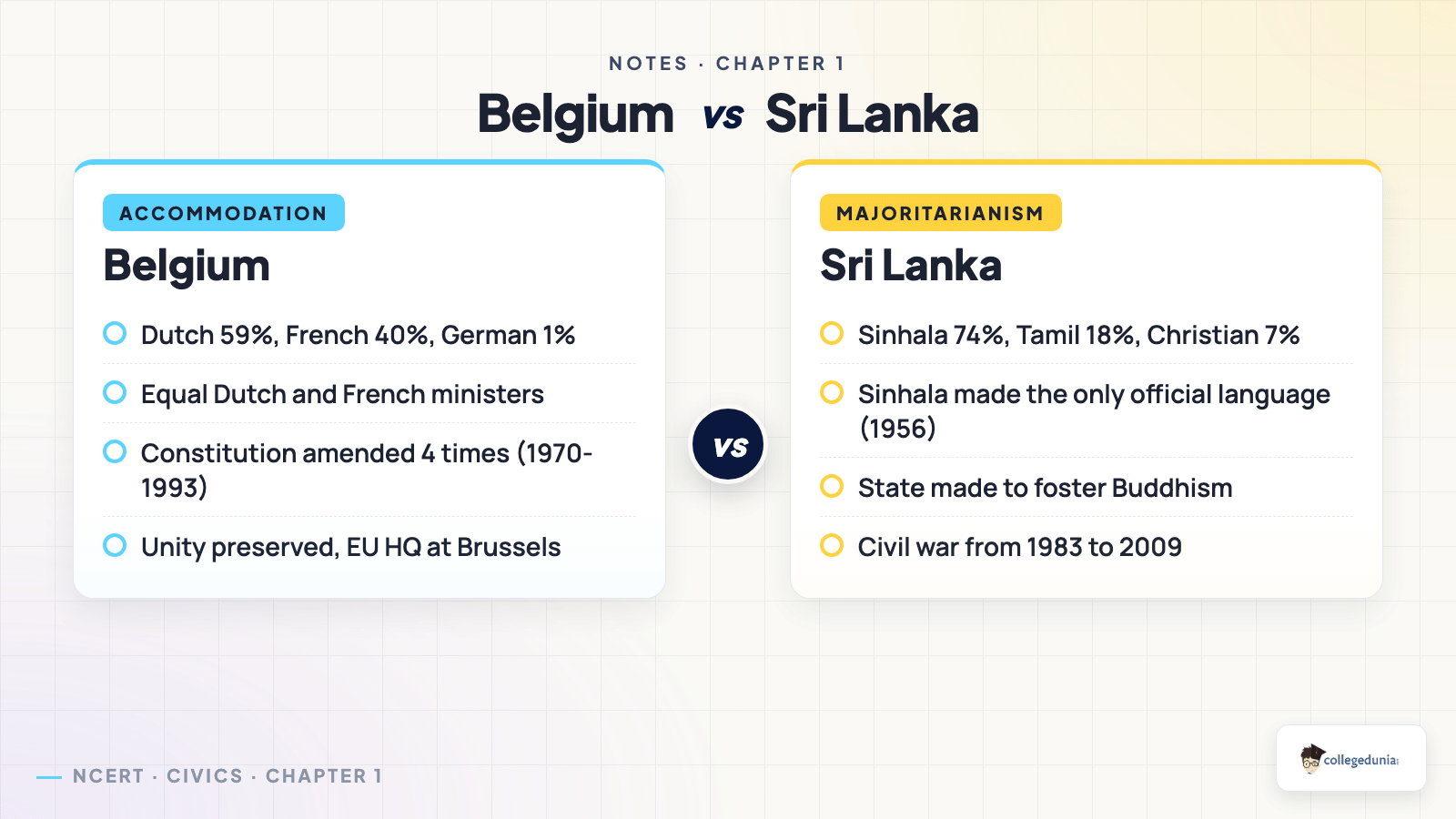
| Basis | Belgium | Sri Lanka |
|---|---|---|
| Approach | Accommodation - shared power | Majoritarianism - imposed will |
| Majority community | Dutch (59%) did not dominate | Sinhala (74%) sought supremacy |
| Treatment of minority | Equal ministers, community government | Tamil rights and language denied |
| Constitution | Amended 4 times (1970-1993) | Made the state foster Buddhism |
| Result | Unity preserved, EU HQ at Brussels | Civil war (1983-2009) |
Tip: For "How did Belgium and Sri Lanka deal differently with power-sharing?", build your answer around the first row of this table, then add two or three supporting rows.
Why Power-sharing Is Desirable: Prudential and Moral Reasons
The chapter gives two sets of reasons for sharing power: the practical and the principled. NCERT names them prudential and moral, and telling them apart is a common exam question.
| Prudential reasons (practical) | Moral reasons (principled) |
|---|---|
| Reduces conflict between social groups | Power-sharing is the very spirit of democracy |
| Ensures the stability of the political order | People have a right to be consulted on how they are governed |
| Protects national unity in the long run | Participation gives citizens a stake in the system |
| Stresses better outcomes | Stresses the act of sharing as valuable in itself |
Four Forms of Power-sharing in Modern Democracies with Examples
Power-sharing takes four common forms. The first two split power within and across governments; the last two share it among social groups and among parties and pressure groups.
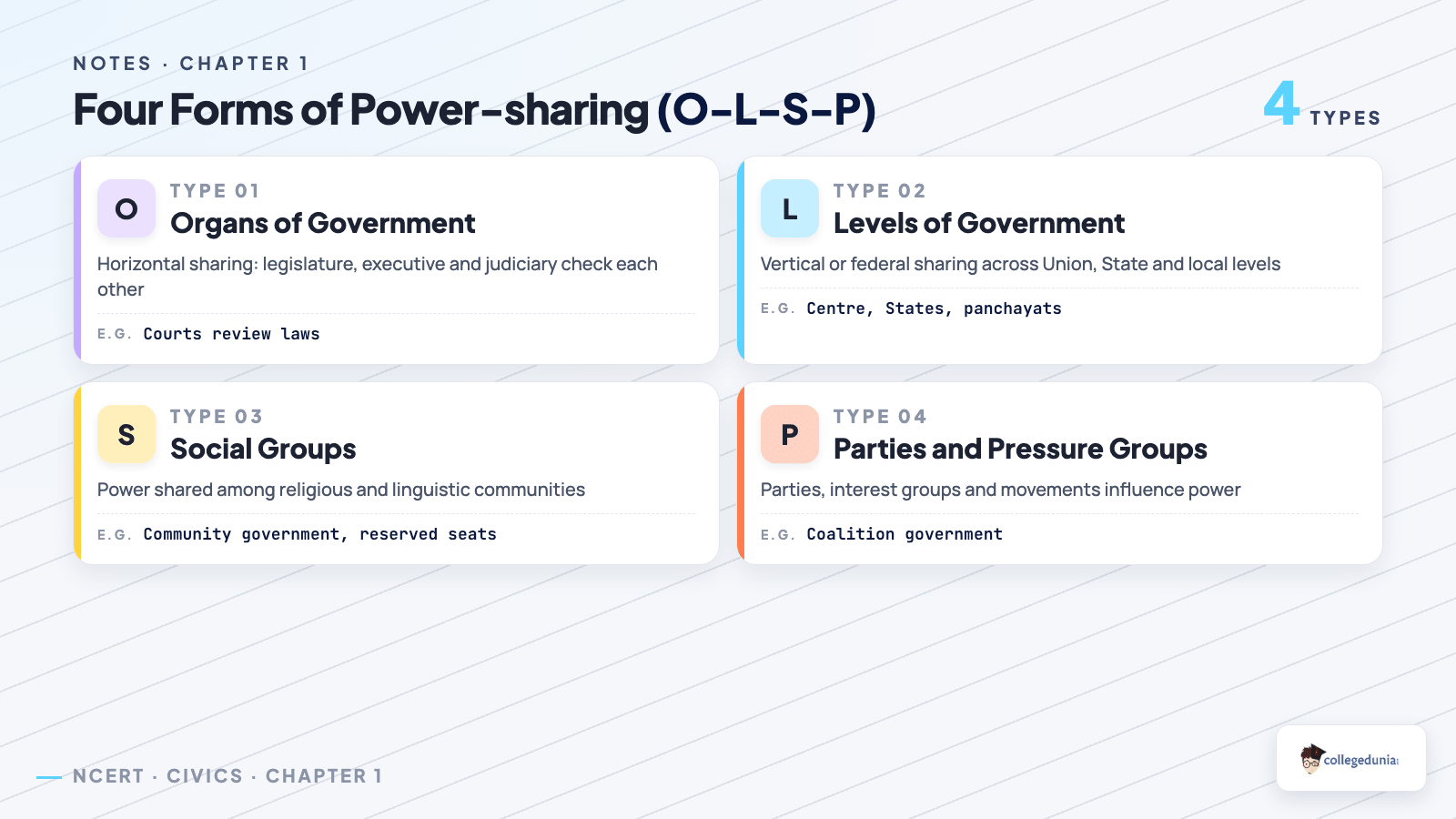
| Form | Who shares power | Example |
|---|---|---|
| 1. Among organs of government (horizontal) | Legislature, executive, judiciary at the same level - checks and balances | Courts can review laws made by the legislature |
| 2. Among levels of government (vertical / federal) | Union, state, and local governments at different levels | India's Centre, States, and panchayats |
| 3. Among social groups | Religious and linguistic communities | Community government in Belgium; reserved constituencies in India |
| 4. Among parties and pressure groups | Political parties, interest groups, and movements | Coalition governments; farmers' and traders' associations |
Remember the four forms as the mnemonic "O-L-S-P" - Organs, Levels, Social groups, Parties. The first is horizontal sharing (across organs at the same level), the second is vertical or federal sharing (across centre, state, local), and the last two share power among people rather than institutions.
Identifying the Form of Power-sharing in Unseen Examples
The board often gives an unseen situation and asks which form it shows. Ask one question - who is sharing power with whom? - and match the answer to one of the four forms.
| Example | Form |
|---|---|
| A High Court orders the State Government to improve children's homes | Horizontal (judiciary checks the executive) |
| Canada's Ontario government settles a land claim with an aboriginal community | Social groups (government with a community) |
| Two parties merge to fight elections on a common list | Parties (alliance / coalition) |
| State finance ministers ask the federal government to share revenue | Vertical (levels of government) |
The chapter ends with three students - Thomman, Mathayi, and Ouseph - arguing about when power-sharing is needed. Ouseph is right: every society needs some power-sharing, even a small one with no social divisions, because it is the spirit of democracy. Note that any option saying power-sharing is needed "only" in divided or big countries is wrong.
Quick Revision Summary and Key Terms for Power-sharing
Use this the night before the exam. Belgium vs Sri Lanka and the four forms usually carry 3 to 5 marks; the prudential and moral reasons and the definition of majoritarianism carry 1 to 3 marks. The same themes repeat every year.
| Term | Meaning |
|---|---|
| Majoritarianism | Belief that the majority may rule as it wishes, ignoring the minority |
| Prudential | Based on careful calculation of gains and losses (outcomes) |
| Civil war | A violent internal conflict so intense it resembles a war |
| Community government | A government elected by a language community over cultural and educational matters (Belgium) |
Five facts you must not forget:
- Belgium = accommodation; Sri Lanka = majoritarianism.
- Belgium amended its constitution four times (1970-1993).
- Sri Lanka's civil war ran 1983-2009.
- Two reasons for power-sharing: prudential (outcomes) and moral (the act itself).
- Four forms: organs (horizontal), levels (vertical), social groups, parties and pressure groups.
Also Check: The full step-by-step answers to every textbook question are at the Power-sharing Class 10 NCERT Solutions page.
Other Resources for Class 10 Civics Chapter 1 Power-sharing
Pair these revision notes with the matching NCERT Solutions, handwritten notes, and the official NCERT book chapter. All resources for Class 10 Civics Chapter 1 are linked below.
| Resource | What it covers | Open |
|---|---|---|
| Notes | Concept-first revision notes on Belgium and Sri Lanka, majoritarianism, accommodation, prudential and moral reasons, and the four forms of power-sharing. | You are here |
| NCERT Solutions | Step-by-step answers to every textbook question on power-sharing, with point-wise marking-scheme style answers for the 2026-27 boards. | Class 10 Civics Chapter 1 NCERT Solutions |
| Handwritten Notes | Scanned-style handwritten pages covering the Belgium vs Sri Lanka contrast, the two reasons, and the four forms for quick one-shot revision. | Class 10 Civics Chapter 1 Handwritten Notes |
| NCERT Book PDF | Official NCERT Democratic Politics II Chapter 1 Power-sharing textbook in PDF form, with the Belgium and Sri Lanka maps and the original exercises. | Class 10 Civics Chapter 1 NCERT Book PDF |
Notes for Class 10 Civics (Democratic Politics II): All Chapters
Related Links: Use the table below to open the revision notes for the other chapters of Class 10 Civics. Every chapter has the same concept-first notes style, a full PDF download, and a revision FAQ.
| Chapter | Notes link |
|---|---|
| Chapter 1 | Power-sharing Notes (You are here) |
| Chapter 2 | Federalism Notes |
| Chapter 3 | Gender, Religion and Caste Notes |
| Chapter 4 | Political Parties Notes |
| Chapter 5 | Outcomes of Democracy Notes |
Frequently Asked Questions on Class 10 Civics Chapter 1 Power-sharing
Ques. What does Chapter 1 Power-sharing cover in Class 10 Civics?
Ans. Chapter 1 Power-sharing in Class 10 Civics (Democratic Politics II) explains why power in a democracy should not rest with one person or group. It uses two case studies - Belgium, which shared power among its communities (accommodation), and Sri Lanka, where the Sinhala majority imposed its will (majoritarianism) and the country slid into civil war. The chapter then gives two reasons for power-sharing: prudential reasons (it reduces conflict and protects unity) and moral reasons (it is the spirit of democracy). It ends with the four forms of power-sharing in modern democracies: among organs of government (horizontal), among levels of government (vertical or federal), among social groups, and among political parties and pressure groups.
Ques. How did Belgium and Sri Lanka deal differently with power-sharing?
Ans. Belgium chose accommodation. Its Dutch (59%), French (40%), and German (1%) communities agreed to share power: the constitution requires an equal number of Dutch and French ministers, many central powers were given to the state governments, Brussels has a separate government with equal representation, and a community government handles cultural and language matters. Belgium amended its constitution four times between 1970 and 1993 and stayed united. Sri Lanka chose majoritarianism. The Sinhala majority (74%) made Sinhala the only official language in 1956, favoured Sinhalas for jobs and university seats, and made the state foster Buddhism. This alienated the Tamil minority and led to a civil war that lasted until 2009.
Ques. What is the difference between prudential and moral reasons for power-sharing?
Ans. Prudential reasons are practical - they are based on careful calculation of gains and losses. Power-sharing is good prudentially because it reduces conflict between social groups, ensures the stability of the political order, and protects the unity of the nation in the long run. Moral reasons are principled - power-sharing is the very spirit of democracy. People have a right to be consulted on how they are governed, and participation gives citizens a stake in the system. The simple test: if a reason talks about stability or unity it is prudential; if it talks about rights or the spirit of democracy it is moral. Prudential reasons stress better outcomes, while moral reasons stress the act of sharing itself.
Ques. What are the four forms of power-sharing in modern democracies?
Ans. The four forms are: (1) Among different organs of government - the legislature, executive, and judiciary share power at the same level, which is called horizontal distribution or a system of checks and balances. (2) Among governments at different levels - a central or union government and state and local governments, called vertical distribution or federal division. (3) Among different social groups - religious and linguistic groups, such as the community government in Belgium or reserved constituencies in India. (4) Among political parties, pressure groups, and movements - through competition between parties, coalition governments, and interest groups influencing decisions. A useful mnemonic is O-L-S-P: Organs, Levels, Social groups, Parties.
Ques. What is majoritarianism and how did it cause civil war in Sri Lanka?
Ans. Majoritarianism is the belief that the majority community should be able to rule a country however it wants, ignoring the wishes and needs of the minority. In Sri Lanka, after independence in 1948, the Sinhala majority used a series of measures to establish dominance: the 1956 Act made Sinhala the only official language, government policies favoured Sinhalas for jobs and university seats, and a new constitution made the state foster Buddhism. These steps made the Sri Lankan Tamils feel that their language, culture, and rights were denied. Their demands for autonomy were refused, and by the 1980s some groups demanded a separate state called Tamil Eelam. The distrust turned into a civil war that killed thousands and ended only in 2009.
Ques. Why is power-sharing the spirit of democracy?
Ans. Power-sharing is the spirit of democracy because a democratic government means ruling with the consent of the people who are affected by its decisions. People have a right to be consulted on how they are to be governed, and a legitimate government is one in which citizens, through participation, acquire a stake in the system. This is the moral reason for power-sharing - it values the very act of sharing power, not just its results. This is why the student Ouseph is correct in the chapter when he says every society needs some form of power-sharing, even a small society with no social divisions. Power-sharing is good for all democracies, not only for divided ones.
Ques. Where can I download the Class 10 Civics Chapter 1 Power-sharing Notes PDF?
Ans. You can download the Class 10 Civics Chapter 1 Power-sharing Notes PDF directly from this page using the Download button at the top of the article. Both the regular typed version and the handwritten version are available for free. The PDF covers the Belgium and Sri Lanka case studies, majoritarianism and its link to the Sri Lankan civil war, the elements of the Belgian model, the prudential and moral reasons for power-sharing, the four forms of power-sharing with examples, a key-terms glossary, a common-mistakes section, and a last-day revision summary, all according to the 2026-27 CBSE syllabus.
Ques. Is Chapter 1 Power-sharing important for the CBSE Class 10 board exam?
Ans. Yes, Power-sharing is one of the most consistently tested chapters in the CBSE Class 10 Social Science paper. The Belgium vs Sri Lanka comparison and the four forms of power-sharing usually appear as 3-mark or 5-mark questions, while the prudential and moral reasons and the definition of majoritarianism appear as 1-mark or 3-mark items. Because the question themes repeat from year to year, focused revision of the comparison table, the four forms (O-L-S-P), and one prudential plus one moral reason is one of the most efficient ways to score well in this chapter.



Comments