


The NCERT Notes for Class 10 Economics Chapter 2 Sectors of the Indian Economy cover every classification, graph, and definition the CBSE board paper tests.
Chapter2SectorsoftheIndianEconomyNotes.pdf?page=1&dpi=150)
Chapter2SectorsoftheIndianEconomyNotes.pdf?page=2&dpi=150)
Chapter2SectorsoftheIndianEconomyNotes.pdf?page=3&dpi=150)
Chapter2SectorsoftheIndianEconomyNotes.pdf?page=4&dpi=150)
Chapter2SectorsoftheIndianEconomyNotes.pdf?page=5&dpi=150)
Chapter2SectorsoftheIndianEconomyNotes.pdf?page=6&dpi=150)
Chapter2SectorsoftheIndianEconomyNotes.pdf?page=7&dpi=150)
Chapter2SectorsoftheIndianEconomyNotes.pdf?page=8&dpi=150)
Chapter2SectorsoftheIndianEconomyNotes.pdf?page=9&dpi=150)
Chapter2SectorsoftheIndianEconomyNotes.pdf?page=10&dpi=150)
Chapter2SectorsoftheIndianEconomyNotes.pdf?page=11&dpi=150)
Chapter2SectorsoftheIndianEconomyNotes.pdf?page=12&dpi=150)
Chapter2SectorsoftheIndianEconomyNotes.pdf?page=13&dpi=150)
Chapter2SectorsoftheIndianEconomyNotes.pdf?page=14&dpi=150)
Chapter2SectorsoftheIndianEconomyNotes.pdf?page=15&dpi=150)
Chapter2SectorsoftheIndianEconomyNotes.pdf?page=16&dpi=150)
Chapter2SectorsoftheIndianEconomyNotes.pdf?page=17&dpi=150)
Chapter2SectorsoftheIndianEconomyNotes.pdf?page=18&dpi=150)
Chapter2SectorsoftheIndianEconomyNotes.pdf?page=19&dpi=150)
Chapter2SectorsoftheIndianEconomyNotes.pdf?page=20&dpi=150)
Chapter2SectorsoftheIndianEconomyNotes.pdf?page=21&dpi=150)
Chapter2SectorsoftheIndianEconomyNotes.pdf?page=22&dpi=150)
Chapter2SectorsoftheIndianEconomyNotes.pdf?page=23&dpi=150)
These class 10 economics notes chapter 2 Sectors of the Indian Economy group economic activity in three ways, by nature of work, by employment, and by ownership, all as quick-recall tables for the 2026-27 session.
- CBSE Weightage: 6 to 8 marks per board paper from Unit 2 Sectors of the Indian Economy
- Question Spread: usually 1 MCQ or fill-up, one 3-mark difference question, and one 5-mark answer on the tertiary sector or unemployment
Also Check: Development Class 10 Economics Notes and the CBSE Class 10 Social Science Syllabus 2026-27.
|
Table of Contents |
Sectors of the Indian Economy Class 10 Notes Overview
This chapter answers two questions: how much does each sector produce, and how many people does it employ? The notes follow the NCERT order, from the primary, secondary, and tertiary split to GDP and GVA, then the employment mismatch and the ownership groups.
| Topic | What It Covers | Board Weightage |
|---|---|---|
| Primary, Secondary, Tertiary | Nature-of-activity classification, examples, and the production chain | 1 to 3 marks |
| GDP, GVA, Final Goods | Why only final goods are counted, double counting, how GDP is measured | 1 to 3 marks |
| Rising Tertiary Sector | Four reasons services grow, plus the two-faces caution | 3 to 5 marks |
| Underemployment | Disguised versus open unemployment, with rural and urban examples | 3 to 4 marks |
| MGNREGA 2005 | Right to Work, 100 days, ways to create rural employment | 3 to 5 marks |
| Organised and Unorganised | Working conditions, who needs protection, and how to protect them | 3 to 5 marks |
| Public and Private | Ownership basis, examples, and why the government must spend | 1 to 3 marks |
The two biggest mark-earners are the rising tertiary sector reasons and the organised versus unorganised comparison. Practise both as full 5-mark answers.
Sectors of the Indian Economy Class 10 Explained in Simple Language
Source: Magnet Brains on YouTube
What the Sectors of the Indian Economy Class 10 Notes PDF Contains
- Master classification map of the three criteria: nature of activity, employment conditions, and ownership.
- GVA and employment bar graphs for 1977-78 and 2017-18, plus the final-goods double-counting example.
- Four reasons the tertiary sector rises with the BGIN mnemonic, and the disguised versus open unemployment split.
- MGNREGA 2005 key features, the organised versus unorganised table, and a key-terms glossary for night-before revision.
Three Ways NCERT Classifies the Sectors of the Indian Economy
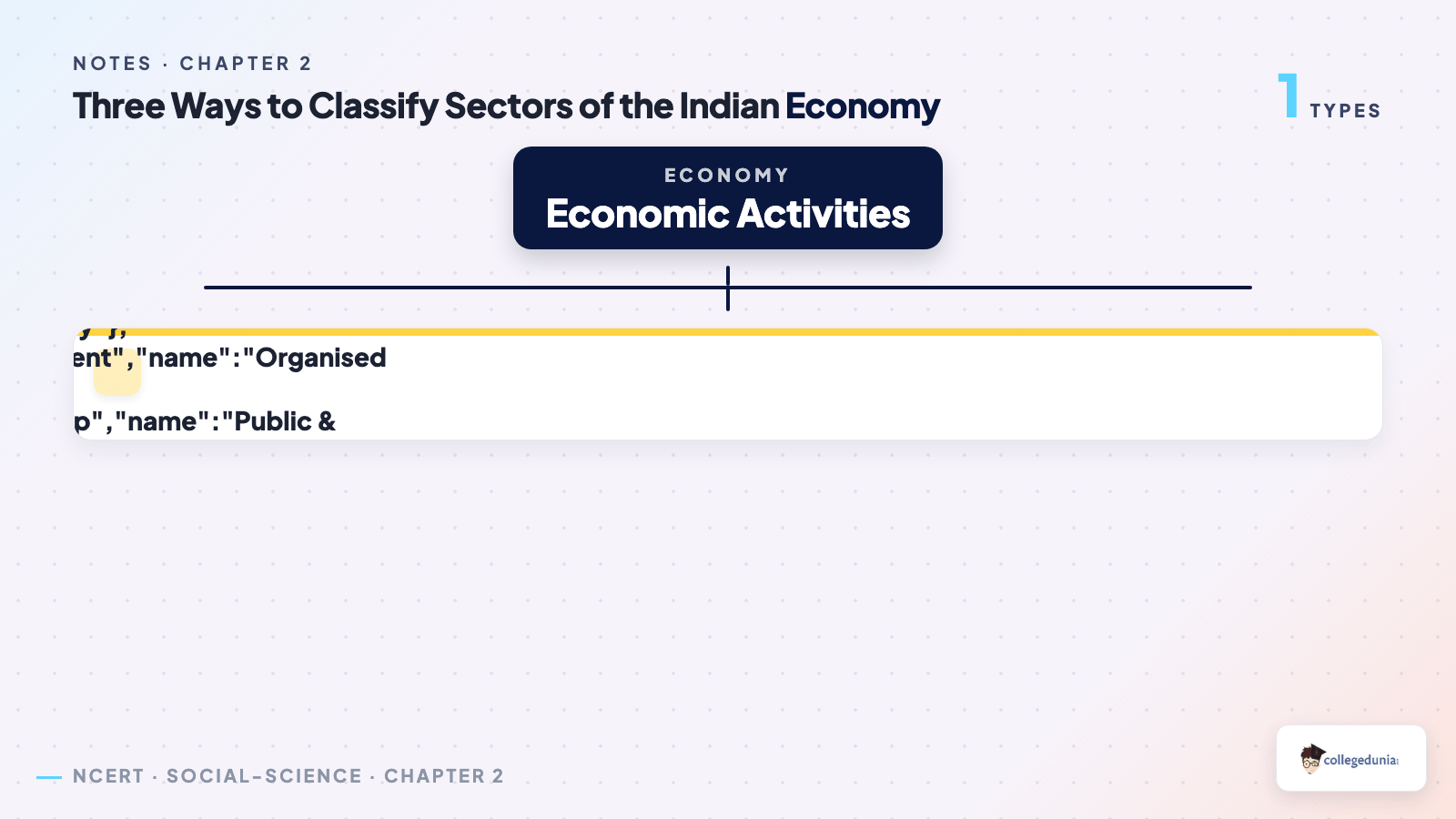
NCERT slices the same economy three ways, and each slice answers a different question. Mixing the criteria up is the most common mistake here, so lock the table below first.
| Criterion | Sectors | Most Important Conclusion |
|---|---|---|
| Nature of activity | Primary, Secondary, Tertiary | Tertiary produces the most GVA, but primary still employs the most workers. |
| Employment conditions | Organised, Unorganised | Most Indian workers are in the unorganised sector and need protection. |
| Ownership of assets | Public, Private | The public sector exists for welfare; the government spends where private firms will not. |
A board question often asks "On what basis are sectors classified?" Name all three: nature of activity, employment conditions, and ownership of assets. Primary uses natural resources, secondary turns them into goods, and tertiary supports both with services.
Why the Tertiary Sector Is Rising in the Indian Economy
Over the forty years NCERT studies, the tertiary sector grew fastest and became India's largest producing sector. Board questions ask for these four reasons.
- Basic services: hospitals, schools, police, courts, banks, and defence, which the government must provide in a developing country.
- Growth of primary and secondary sectors: more farming and industry raise demand for transport, trade, and storage.
- Rising income: as people earn more, they want more services like eating out, tourism, and private schools.
- New IT-based services: software, call centres, and internet services have grown fast in the last two decades.
One caution earns marks too. Not all of the service sector grows equally well. Skilled IT and medical jobs prosper, while many small shopkeepers and repair workers barely earn a living.
Disguised Unemployment and Underemployment in the Indian Economy
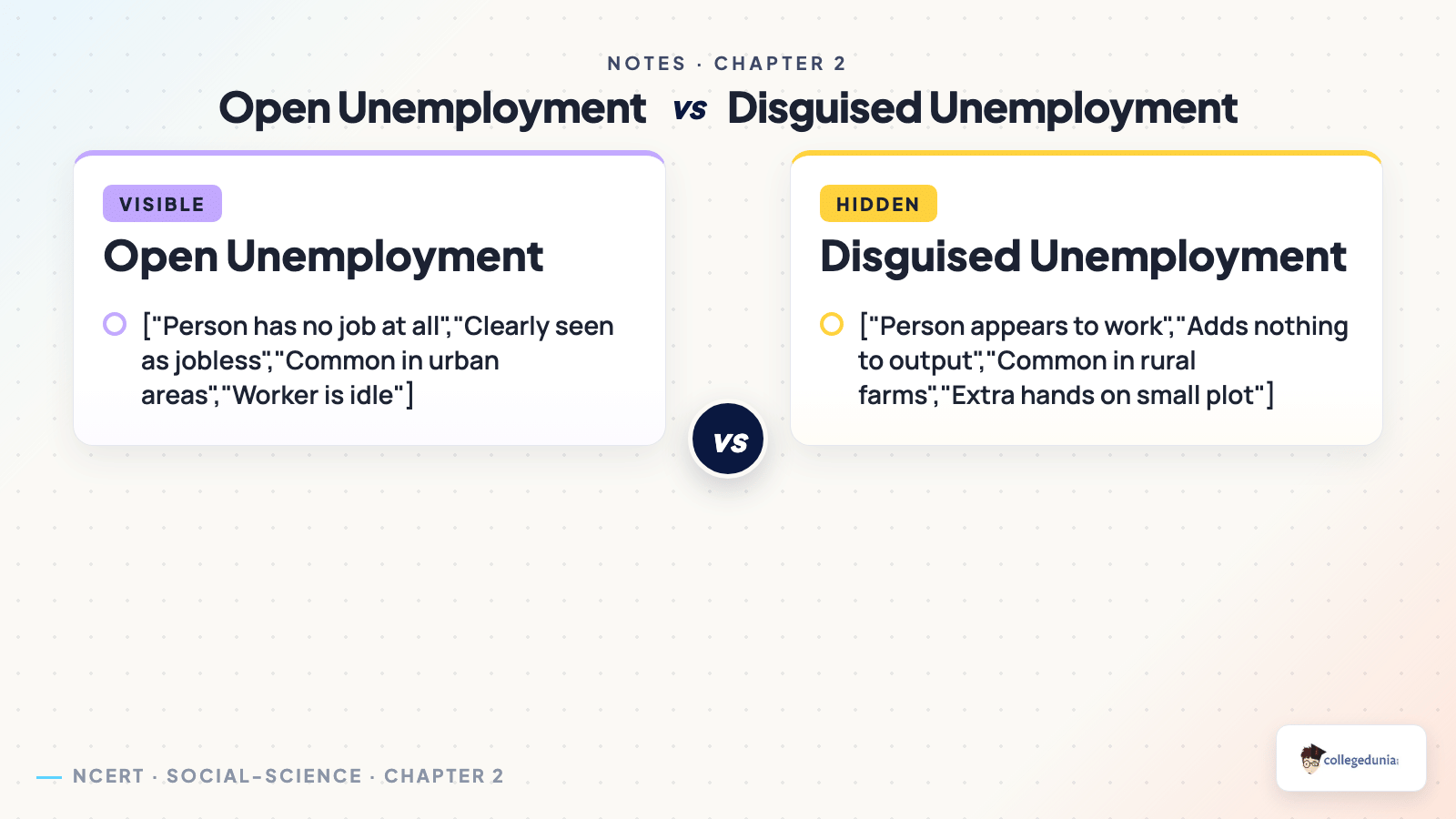
The primary sector still employs nearly half of all workers but produces little output. People look busy yet are not fully used. This is underemployment, also called disguised unemployment.
- Underemployment: more people work on a farm than needed; if some left, output would not fall.
- Disguised unemployment: the extra workers seem employed but add nothing to output, so their joblessness is hidden.
- Open unemployment: a person has no work at all and is clearly jobless, common in towns.
How MGNREGA 2005 Creates Employment in Rural India
If so many workers are underemployed, how do we create better jobs? NCERT lists long-term measures and one landmark Right to Work law.
- Irrigation and cheap credit: a funded well or dam lets a farmer grow a second crop and employ more family members.
- Transport, storage, and agro-industry: better roads, cold storage, and dal mills create local jobs near farms.
- Education and health: opening schools and hospitals can create about 20 lakh jobs in education and many more in health.
- MGNREGA 2005: guarantees 100 days of wage work a year in about 625 districts, plus an unemployment allowance if no work is given.
In 2025, MGNREGA 2005 was replaced by the Viksit Bharat-G RAM G 2025 mission. Treat both as the same Right to Work guarantee, and write MGNREGA 2005 unless asked for the new name.
Organised and Unorganised Sectors of the Indian Economy
The second classification looks at how people are employed, not what is produced. The organised sector covers registered enterprises with secure terms; the unorganised sector covers small units outside government control.
| Basis | Organised Sector | Unorganised Sector |
|---|---|---|
| Registration | Registered by the government | Largely outside government control |
| Job security | High; secure employment | Low; can be dismissed any time |
| Working hours | Fixed, with overtime paid | Long, with no overtime |
| Benefits | PF, gratuity, paid leave, pension | Almost none |
| Example | Government office, registered factory | Street vendor, daily-wage helper |
Public and Private Sectors in the Indian Economy
The third classification looks at who owns the assets. The public sector is government-owned and works for welfare; the private sector is owned by individuals or companies for profit.
- Public sector examples: Railways and the post office, owned by the government and run for welfare.
- Private sector examples: Tata Iron and Steel (TISCO) and Reliance Industries (RIL), run for profit.
- Why the government spends: on costly roads, dams, and electricity, and on health, education, and water for the poorest.
How to Use the Sectors of the Indian Economy Notes Page Most Effectively
These notes work best as a three-block revision plan: once deeply, then twice quickly.
- First read: learn the three classifications, GDP versus GVA, and the four tertiary reasons.
- Second pass: drill the tables and the two bar graphs, and recite the BGIN mnemonic.
- Night before: read the glossary and key facts, then attempt last year's PYQ.
For data questions, quote real numbers. Primary's employment share fell from 71% to 44%, while the tertiary GVA share rose to about half by 2017-18.
Student Feedback
In a Collegedunia poll of 11,400 Class 10 students before the 2026 boards, 78% said the three-classification table was the single thing they revised the night before the exam. Most asked for the GVA and employment graphs in one place, which these notes provide.
Source: Collegedunia Class 10 student survey, 2026 boards.
Other Resources for This Chapter
Pair these notes with the other Class 10 Economics resources for this chapter, linked below.
| Resource | Open |
|---|---|
| NCERT Solutions | Sectors of the Indian Economy Class 10 NCERT Solutions |
| Notes | Sectors of the Indian Economy Class 10 Notes |
| Handwritten Notes | Sectors of the Indian Economy Class 10 Handwritten Notes |
| NCERT Book PDF | Sectors of the Indian Economy Class 10 NCERT Book PDF |
NCERT Notes for Class 10 Economics: All Chapters
| Chapter | Title |
|---|---|
| Chapter 1 | Development Notes |
| Chapter 3 | Money and Credit Notes |
| Chapter 4 | Globalisation and the Indian Economy Notes |
| Chapter 5 | Consumer Rights Notes |
Frequently Asked Questions
Ques. What are the three ways sectors of the Indian economy are classified in Class 10?
Ans.
Sectors are classified on three bases. By nature of activity into primary, secondary, and tertiary; by conditions of employment into organised and unorganised; and by ownership of assets into public and private. Each classification answers a different question about the economy.
Ques. Why is the tertiary sector becoming the most important in the Indian economy?
Ans.
NCERT gives four reasons: basic services like schools, banks, and police are always needed; growth of farming and industry raises demand for transport and trade; rising income makes people want more services; and new IT-based services like software and call centres have grown fast. By 2017-18 the tertiary sector became the largest producing sector in India.
Ques. What is disguised unemployment with an example?
Ans.
Disguised unemployment is hidden unemployment where people appear to be working but add nothing to output. For example, if five members of a family work on a small plot that only needs two or three, the extra members are disguisedly unemployed. If they left, farm output would not fall.
Ques. What is the difference between the organised and unorganised sector?
Ans.
The organised sector covers registered enterprises with regular, secure jobs, fixed hours, paid leave, provident fund, and pension. The unorganised sector covers small, scattered units outside government control, with low-paid, irregular work and almost no benefits. Most Indian workers are in the unorganised sector.
Ques. What is MGNREGA 2005 in Class 10 Economics Chapter 2?
Ans.
MGNREGA 2005 is the Mahatma Gandhi National Rural Employment Guarantee Act, a Right to Work law. It guarantees 100 days of wage employment a year to rural households in about 625 districts, and pays an unemployment allowance if the government fails to provide work. In 2025 it was replaced by the Viksit Bharat-G RAM G mission.
Ques. Are these Class 10 Economics Chapter 2 notes aligned to the 2026-27 syllabus?
Ans.
Yes. Every classification, graph year, definition, and update like the Viksit Bharat-G RAM G 2025 mission matches the latest 2026-27 NCERT textbook and the current CBSE board pattern.
Ques. Are these Collegedunia notes free to download?
Ans.
Yes. The complete PDF is free to download from this page, with no signup or paywall.



Comments