




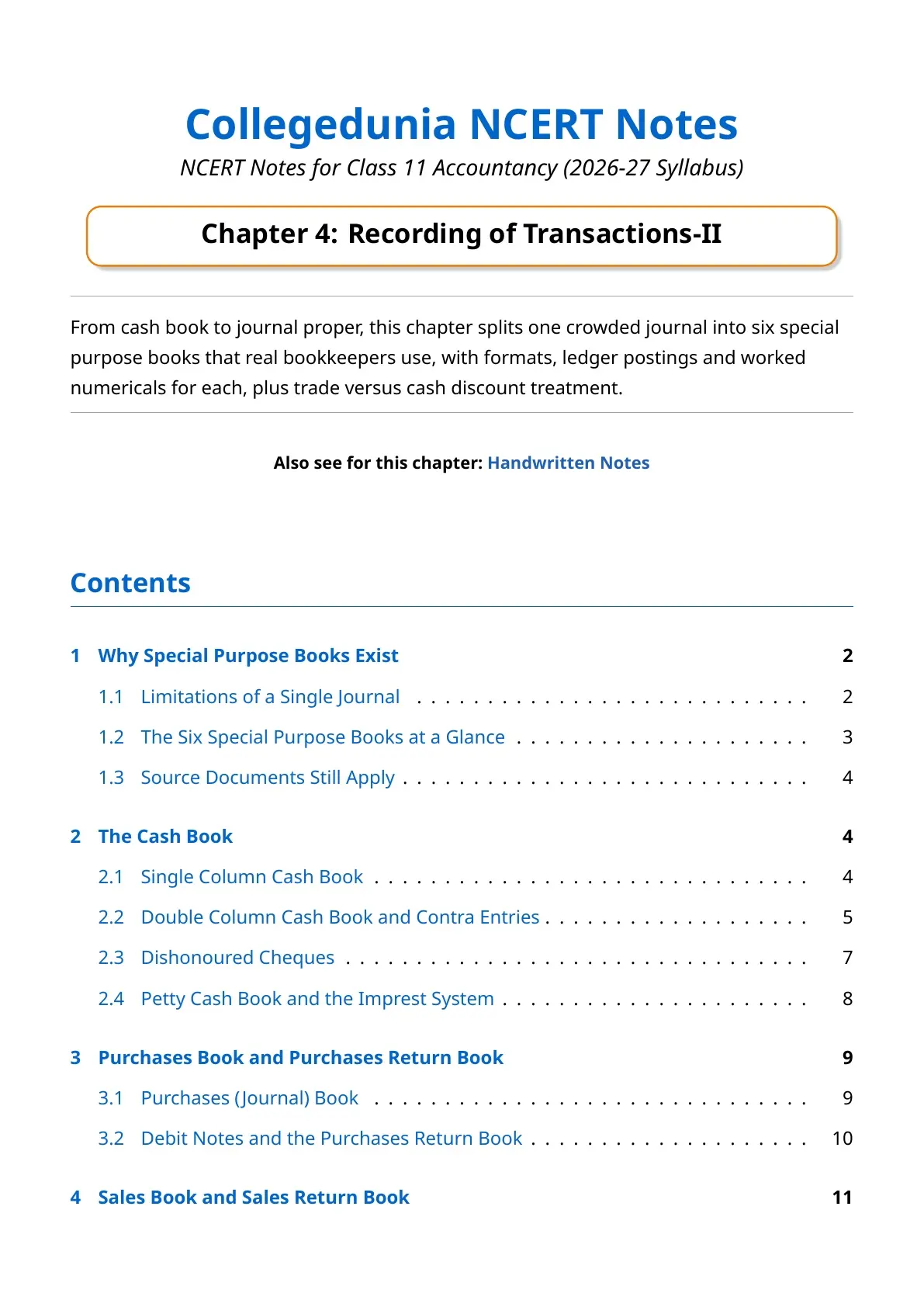
Inside the NCERT Notes Class 11 Accountancy Chapter 4 Recording of Transactions-II, you will find the cash book formats with contra entries marked, the purchases and sales book layouts side by side, and a clear trade discount versus cash discount comparison, all according to the latest 2026-27 CBSE syllabus.
- CBSE Weightage: Recording of Transactions-I and II together carry 6 to 8 marks most years, often a full numerical question.
- Covers: Cash book, petty cash book, purchases and sales books, purchases and sales return books, and journal proper, according to the 2026-27 NCERT.
- CUET Weightage: Cash book and discount numericals are a recurring MCQ topic in CUET Commerce.
This NCERT Notes Class 11 Accountancy Chapter 4 Recording of Transactions-II page is curated by subject experts, according to the 2026-27 NCERT, and checked against the last five years of CBSE board question papers.
Why Recording of Transactions-II Splits the Journal Into Six Special Books
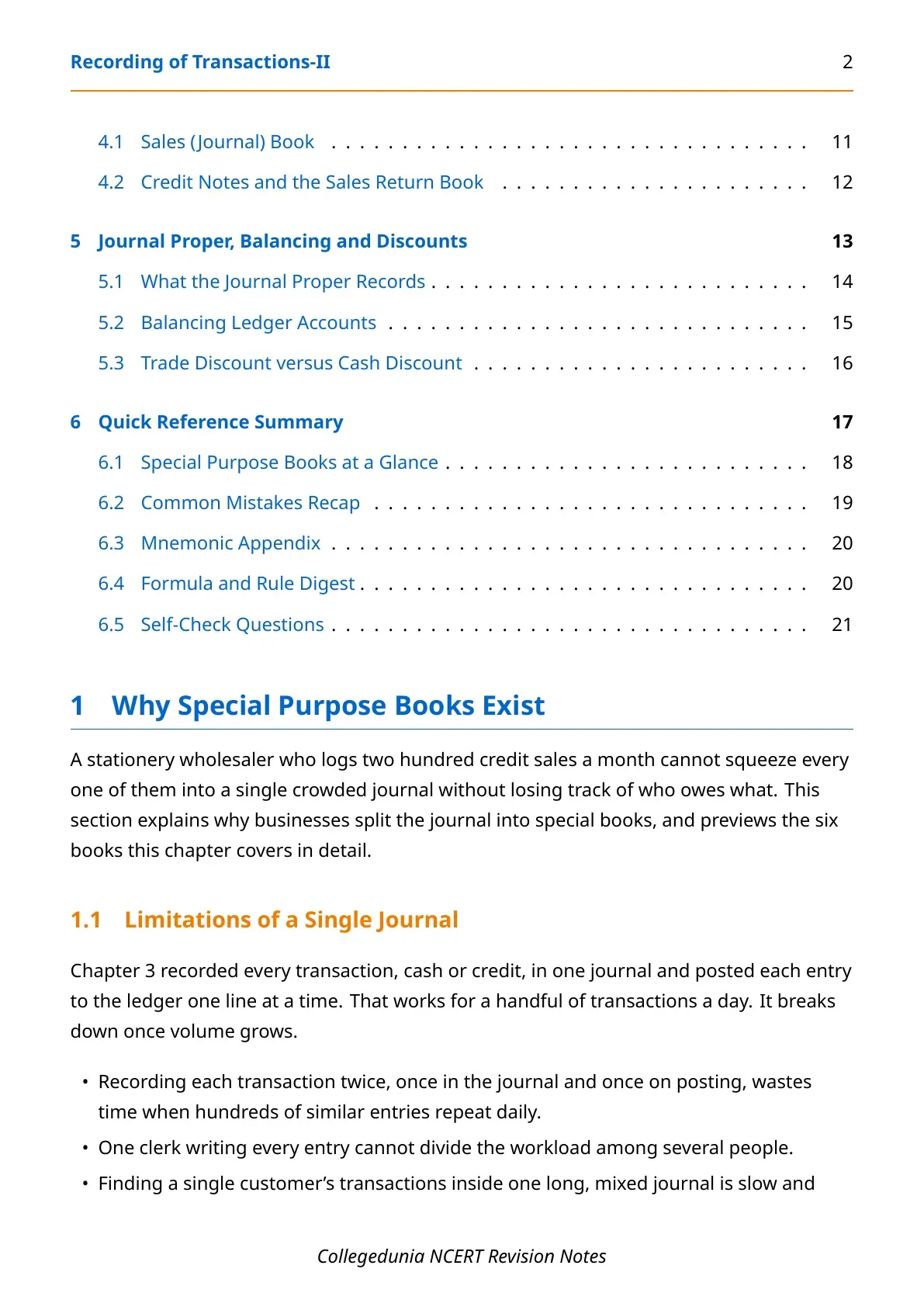
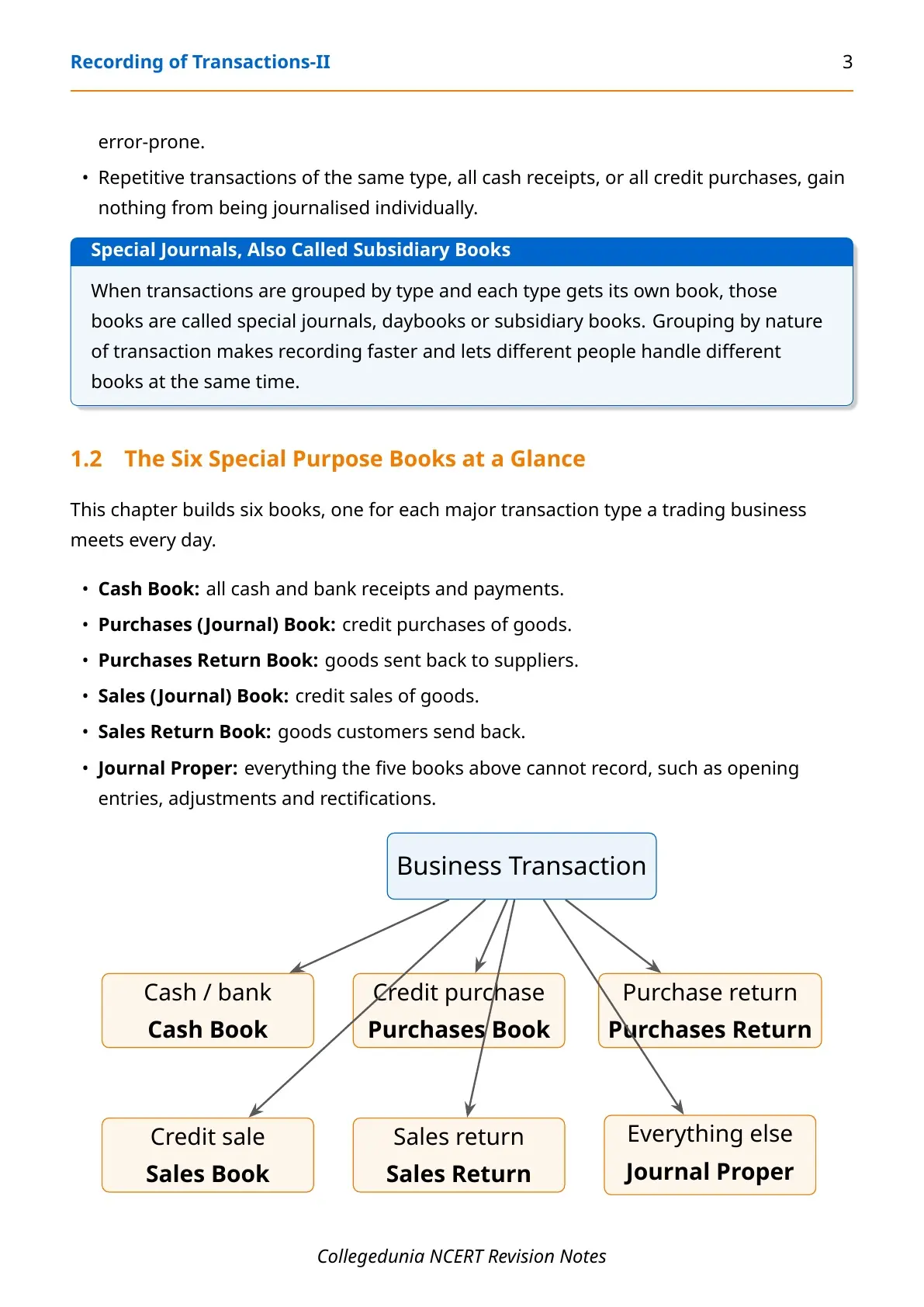
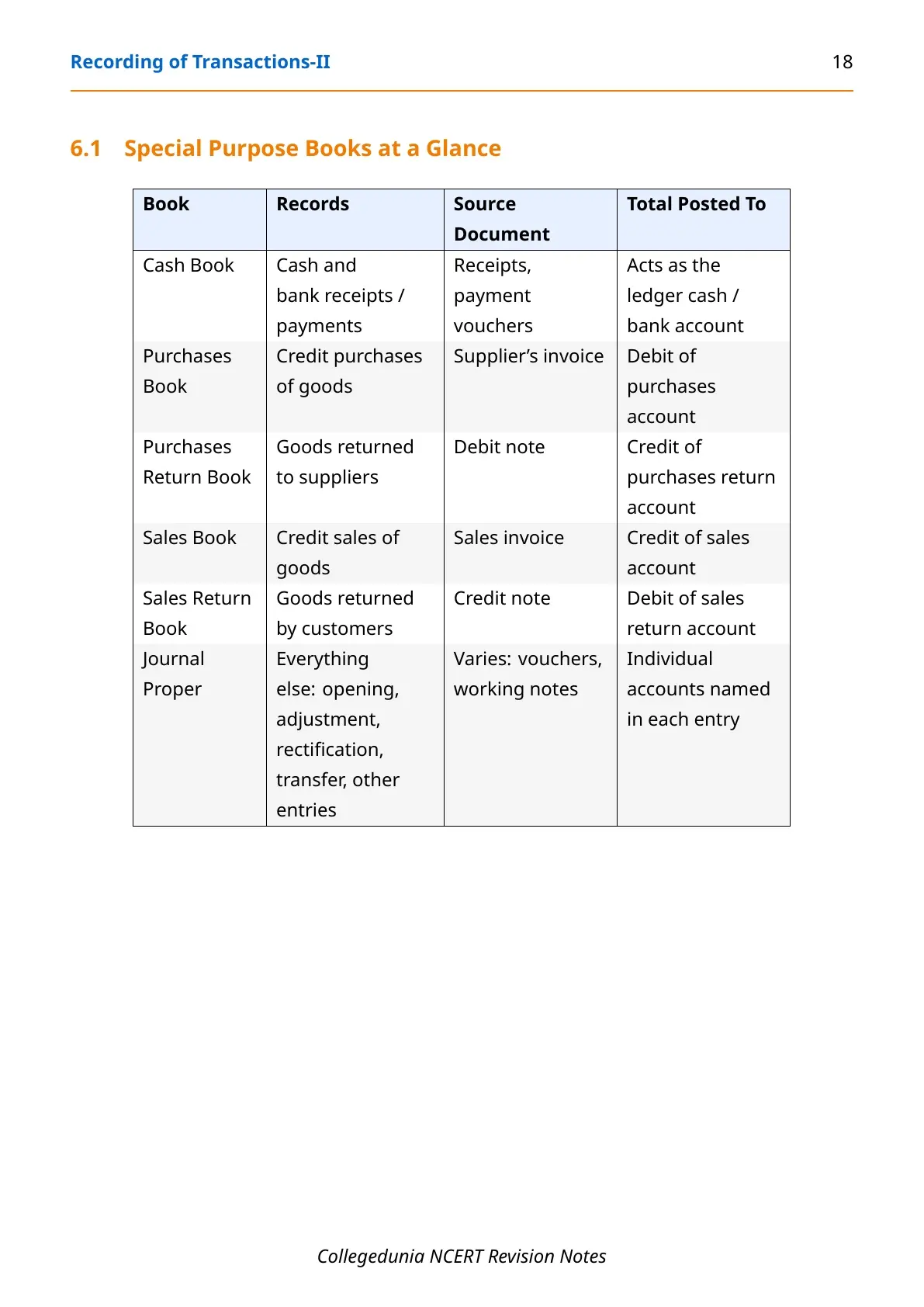
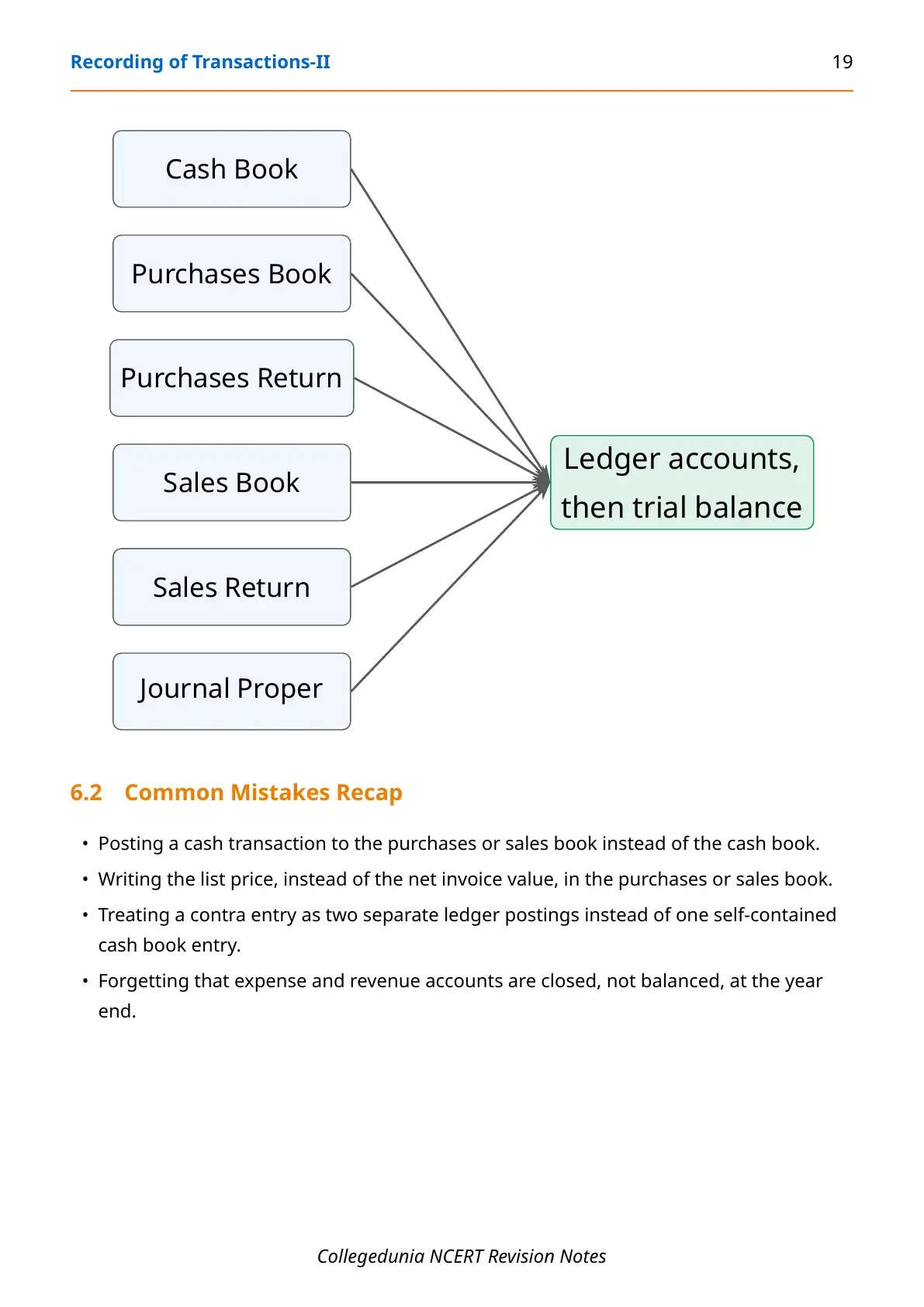
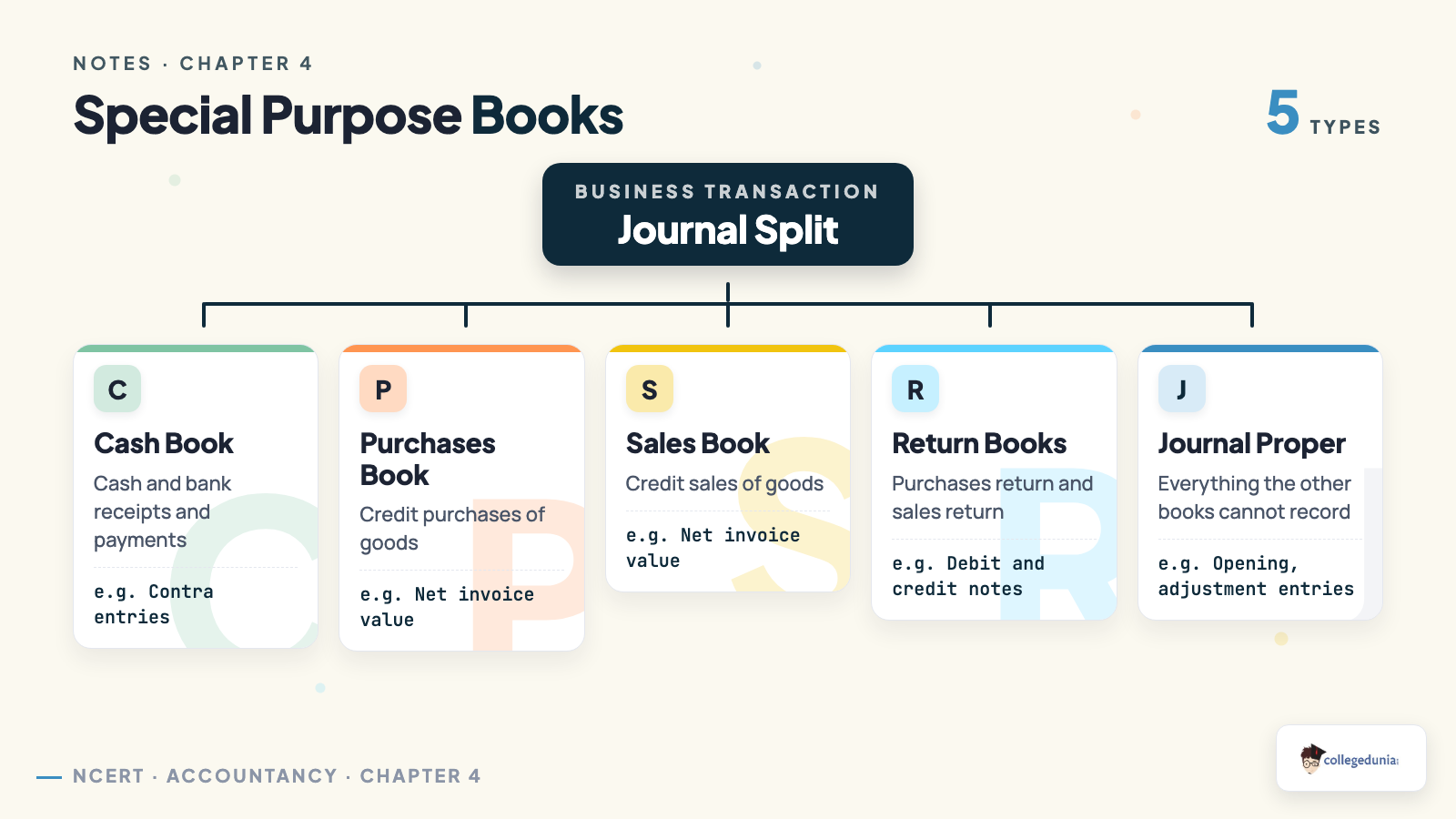
A business that logs hundreds of transactions a day cannot journalise each one by hand. This chapter splits the single journal into six special purpose books, one for each type of transaction, so entries can be recorded faster and by different people at once.
| Special Purpose Book | Records |
|---|---|
| Cash Book | All cash and bank receipts and payments |
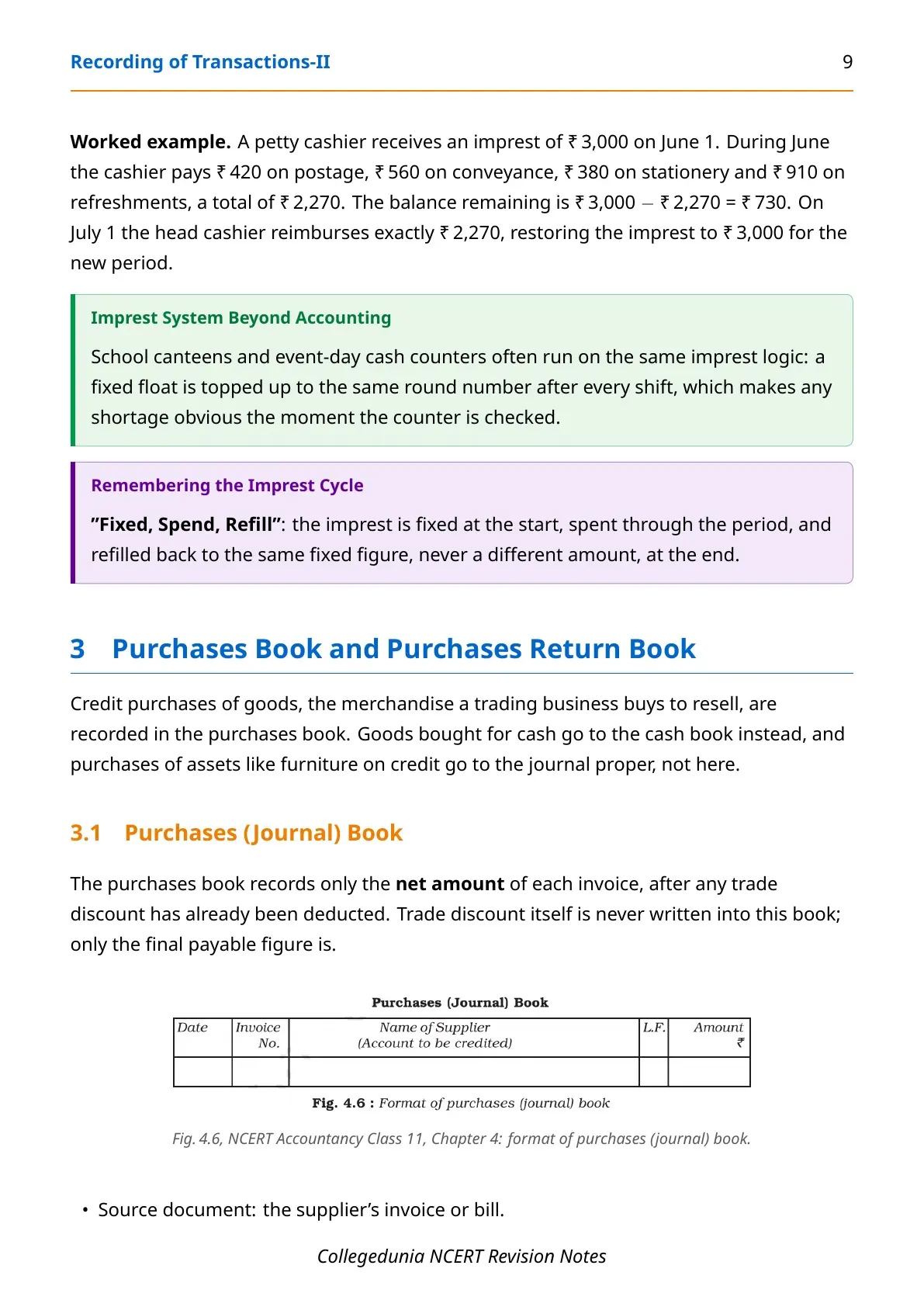
| Purchases (Journal) Book | Credit purchases of goods |
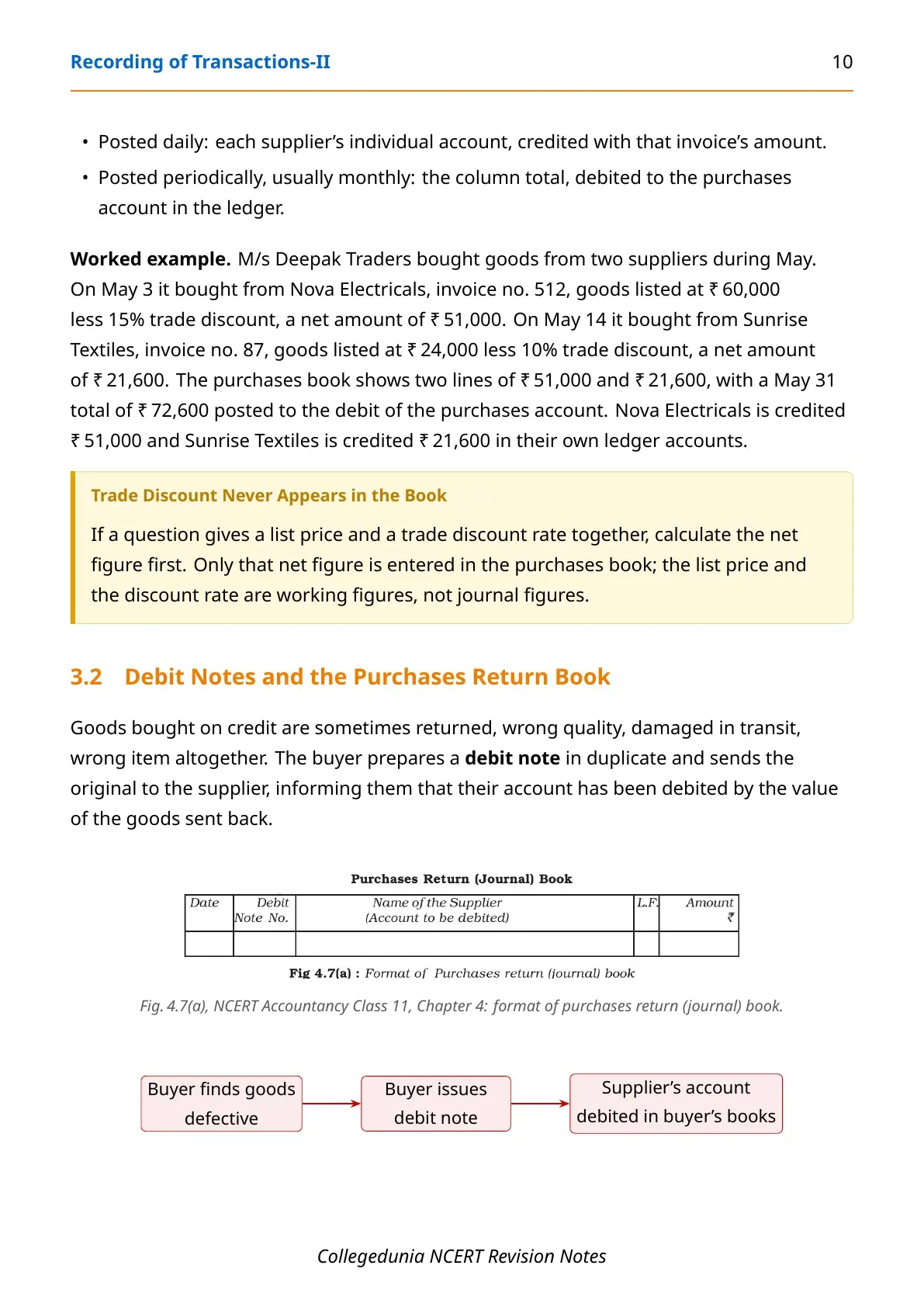
| Purchases Return Book | Goods sent back to suppliers |
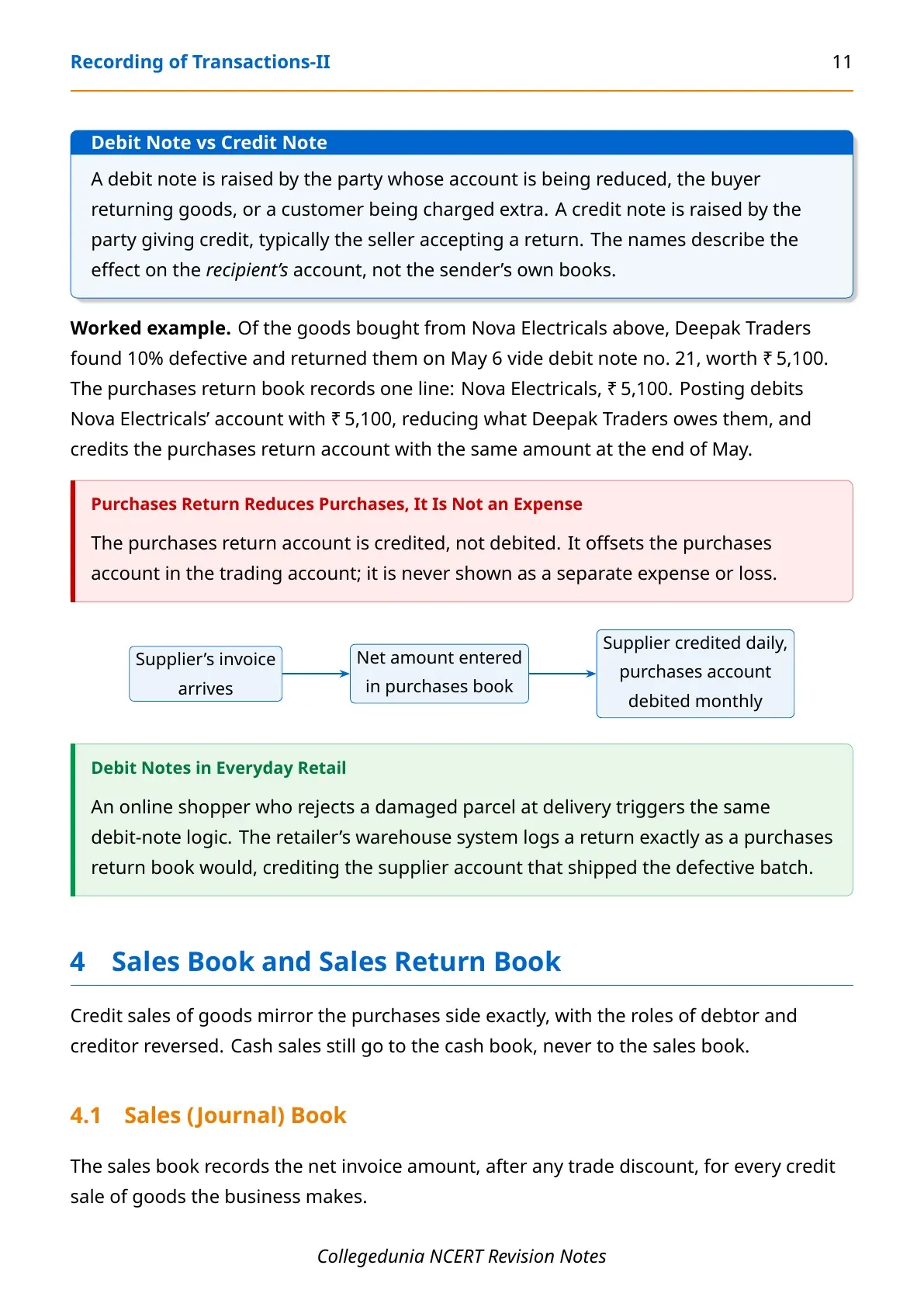
| Sales (Journal) Book | Credit sales of goods |
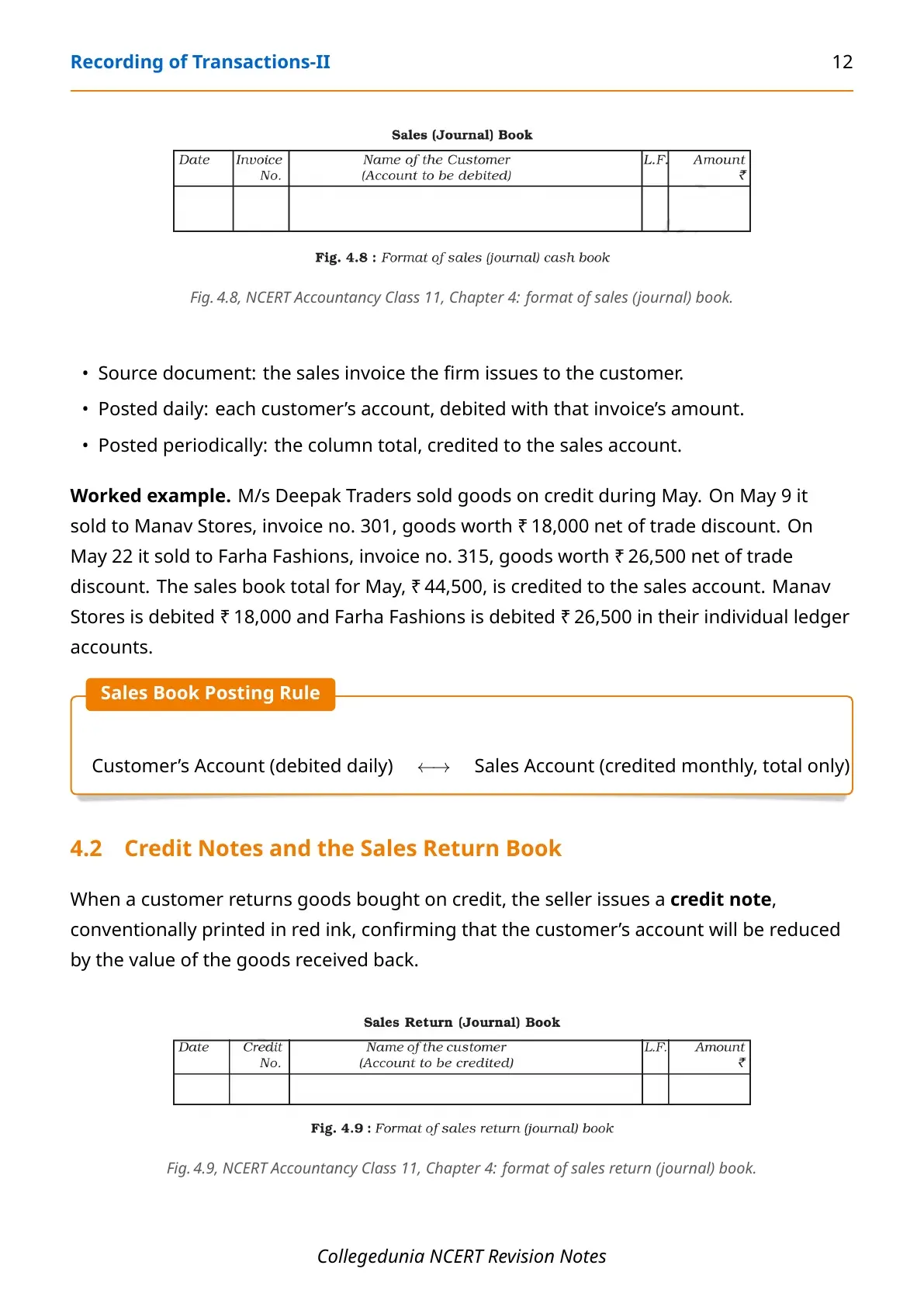
| Sales Return Book | Goods customers send back |
| Journal Proper | Everything the other five books cannot record |
Each special book still needs a source document to trigger the entry, the same rule Chapter 3 taught for the plain journal. A transaction is matched to a book by its nature, never by its amount.
Recording of Transactions-II Cash Book Solved Example
Source: Eduxir on YouTube
Cash Book Formats: Single Column, Double Column and Contra Entries
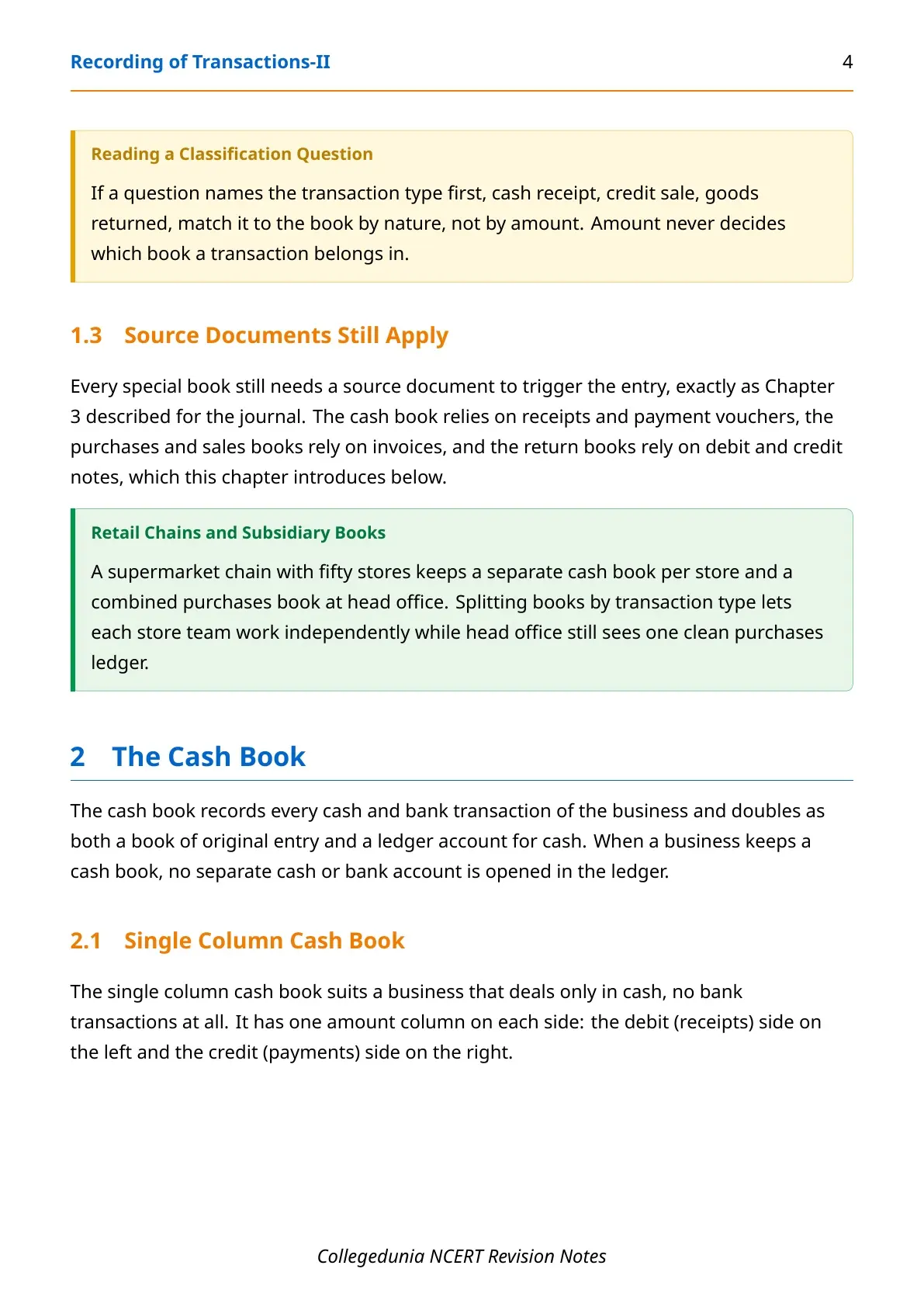
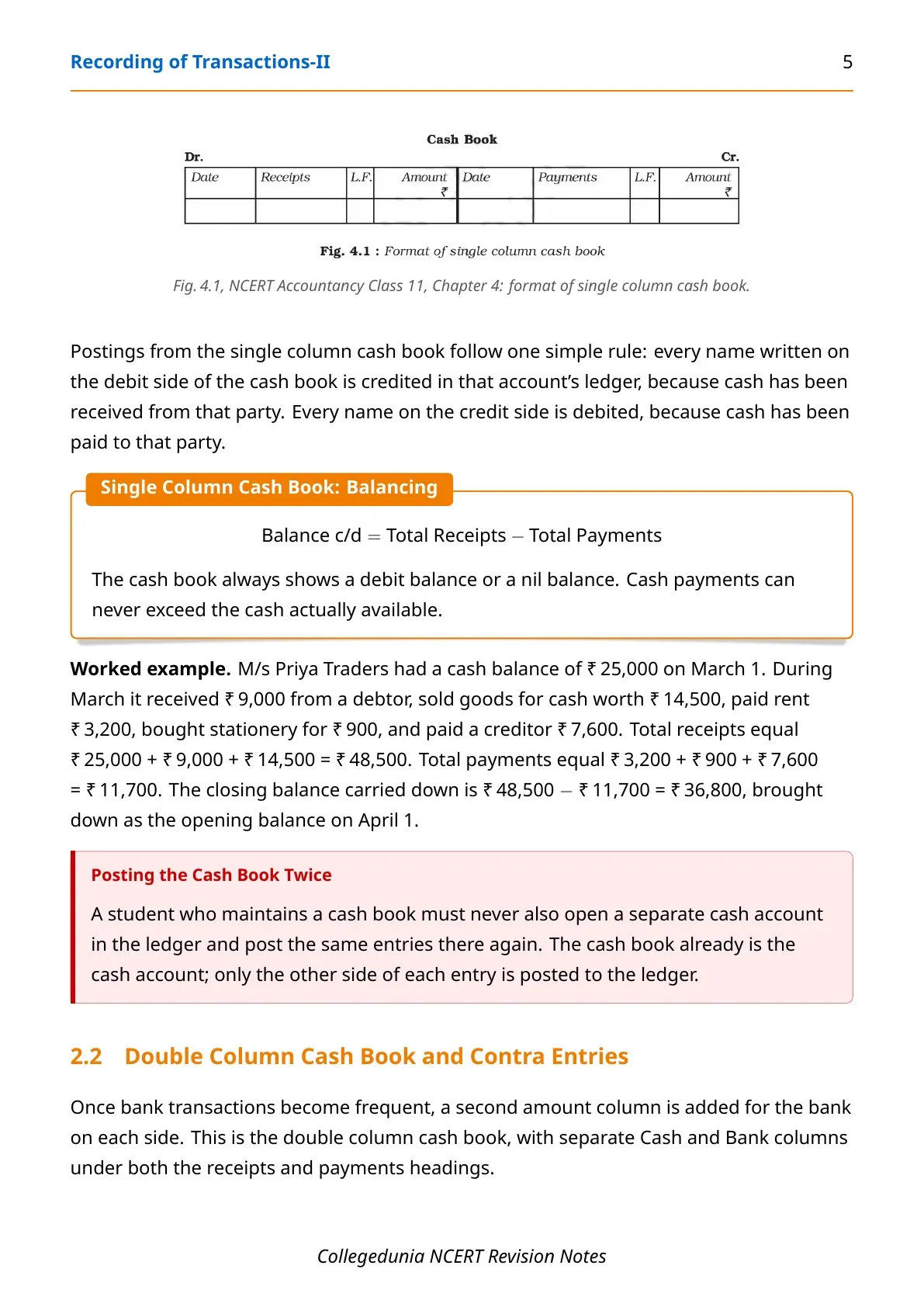
The cash book records every cash and bank transaction and doubles as both a book of original entry and a ledger account for cash. When a business keeps a cash book, no separate cash account is opened in the ledger.
- Single column cash book: one amount column each side, for a business dealing only in cash.
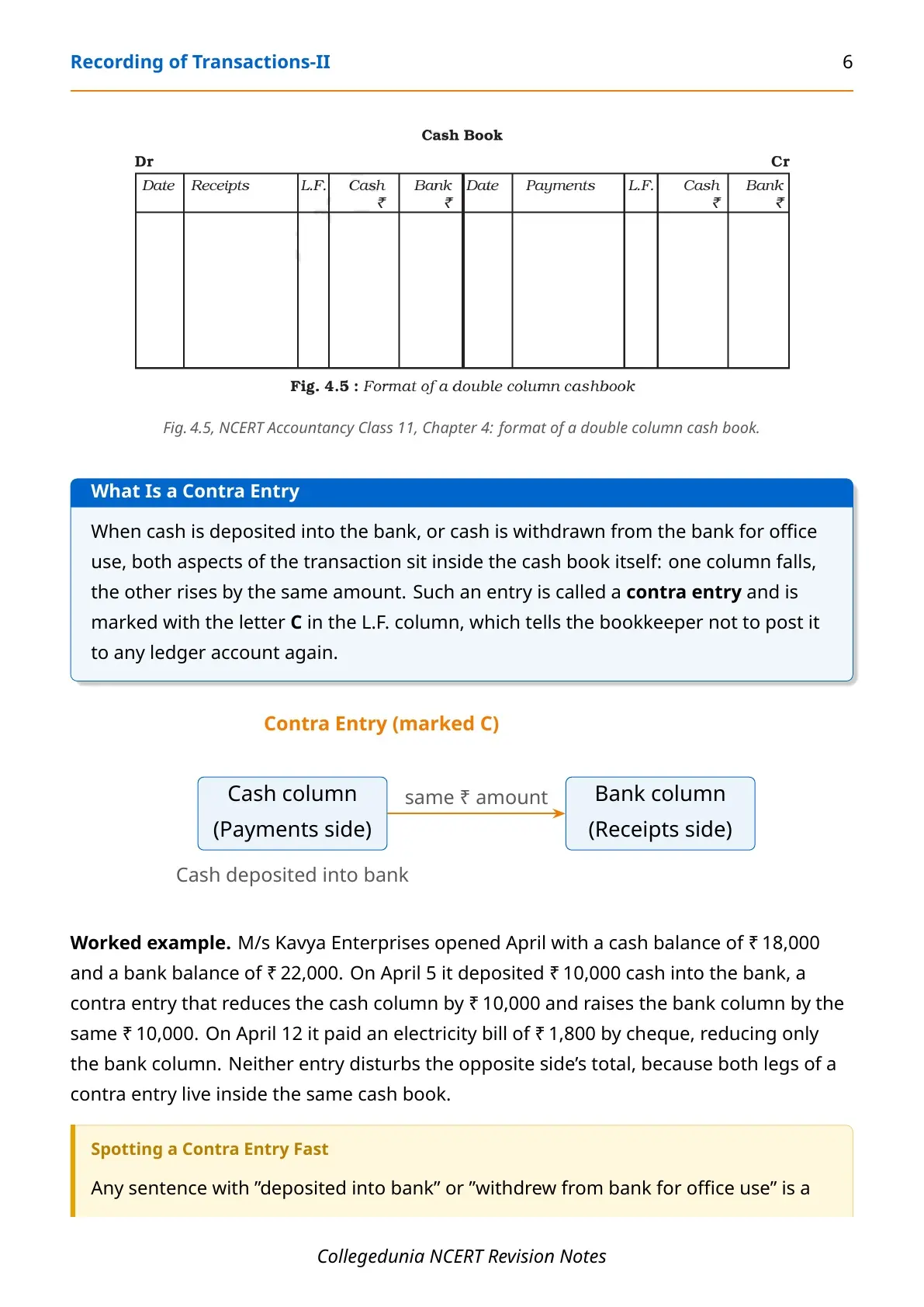
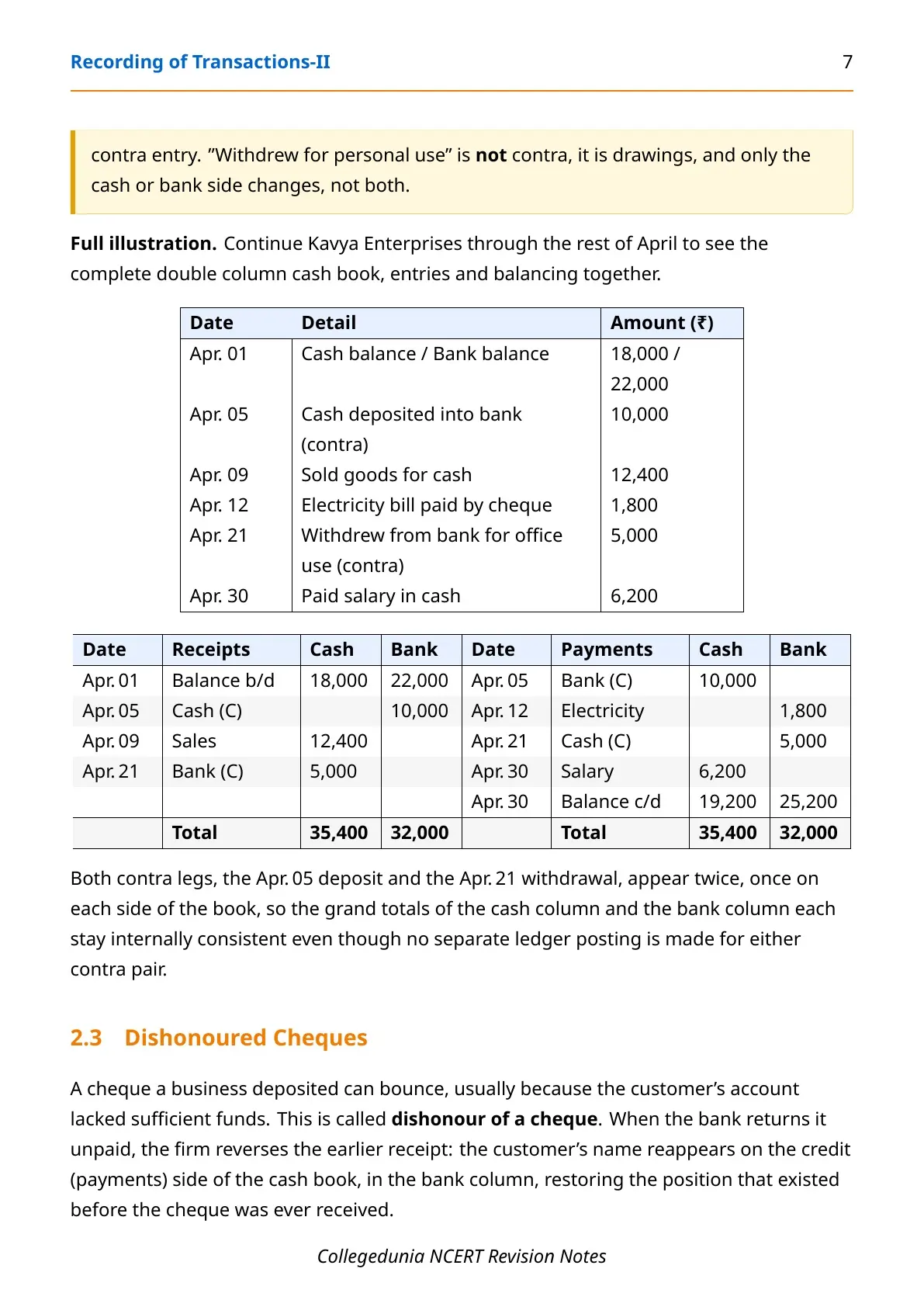
- Double column cash book: adds a bank column beside the cash column on both sides.
- Contra entry: cash deposited into the bank, or cash withdrawn from the bank for office use, marked "C" in the L.F. column since it never gets posted to a ledger.
A dishonoured cheque is one the bank returns unpaid, usually for insufficient funds. The firm reverses the earlier receipt by writing the customer's name back on the credit side, bank column, restoring the position before the cheque was ever received.
Petty Cash Book and the Imprest System Explained
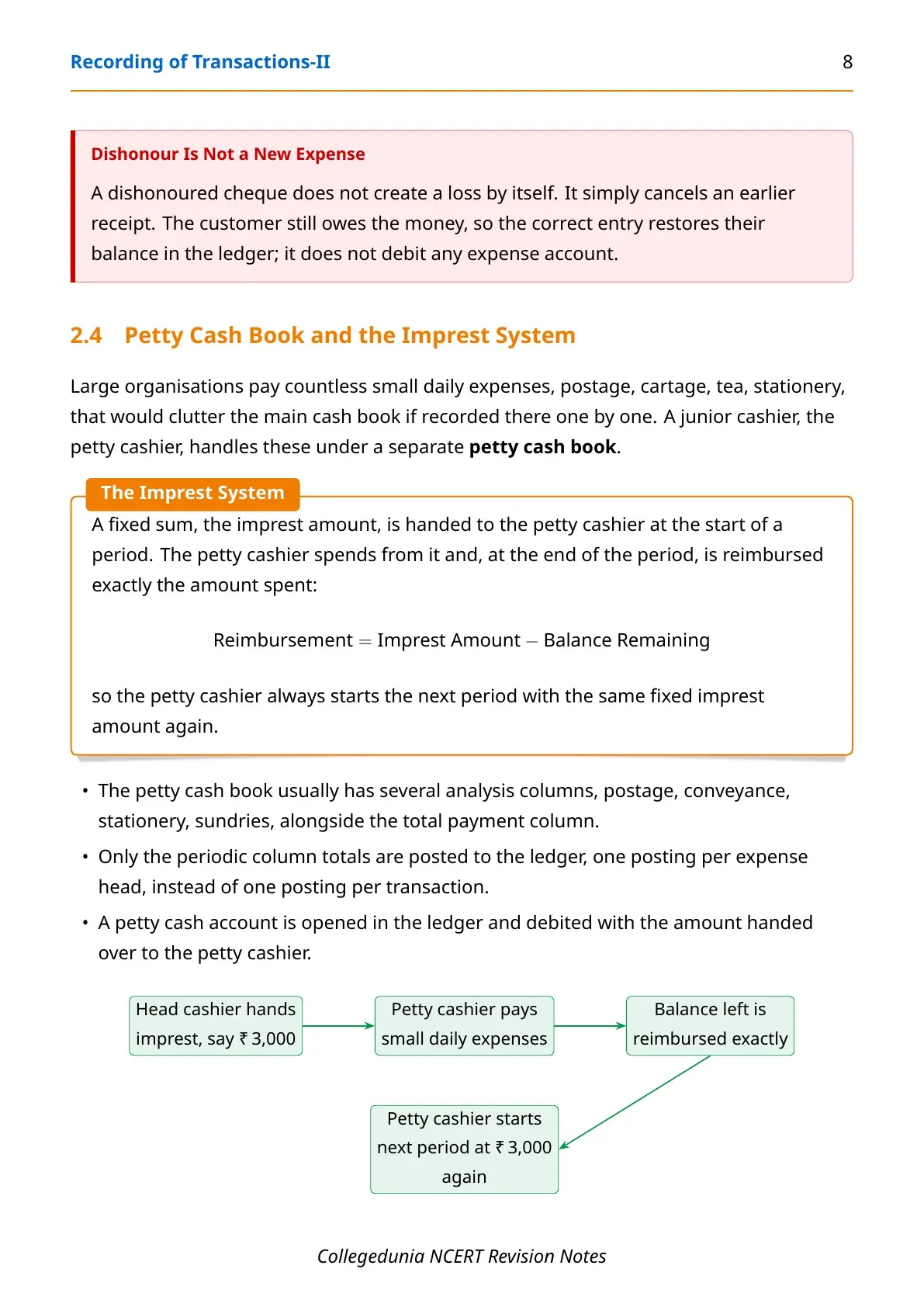
Large firms hand small daily expenses, postage, cartage, stationery, to a junior cashier under a separate petty cash book, run on the imprest system.
- Only the periodic column totals, postage, conveyance, stationery, are posted to the ledger, not each transaction.
- A petty cash account is opened in the ledger and debited with the amount handed to the petty cashier.
Purchases Book and Purchases Return Book with Debit Notes
The Purchases (Journal) Book records only credit purchases of goods, using the net invoice amount after trade discount. Trade discount itself is never written into any book.
| Step | Detail |
|---|---|
| Source document | Supplier's invoice or bill |
| Daily posting | Supplier's individual account, credited |
| Monthly posting | Column total, debited to purchases account |
When goods bought on credit are returned, wrong quality or damaged, the buyer sends a debit note and the transaction lands in the Purchases Return Book. Posting debits the supplier's account and credits the purchases return account with the periodic total.
Sales Book and Sales Return Book with Credit Notes
The Sales (Journal) Book mirrors the purchases side: it records the net invoice amount for every credit sale of goods, with the customer's account debited daily and the sales account credited monthly.
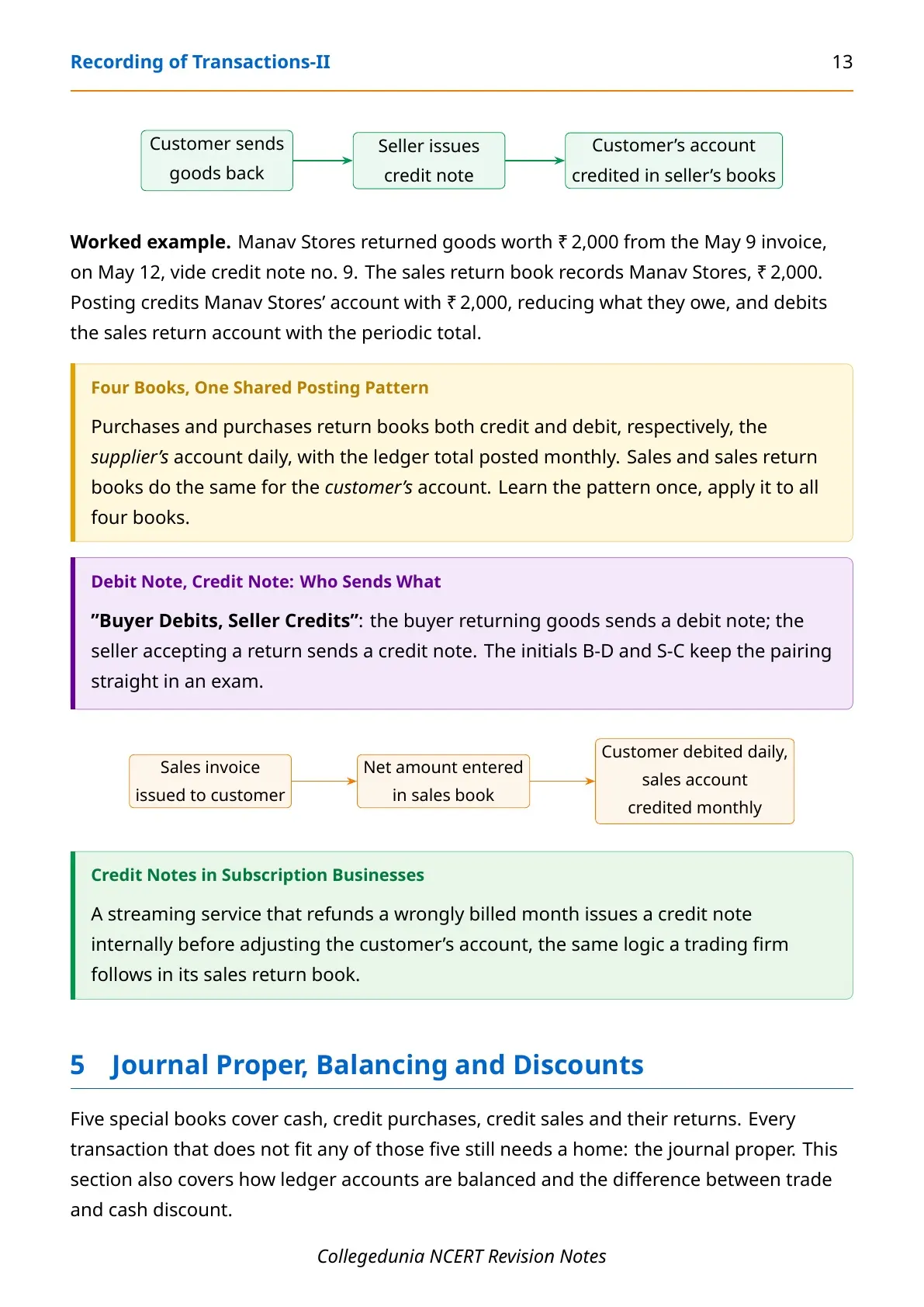
When a customer returns goods bought on credit, the seller issues a credit note, and the entry goes into the Sales Return Book. Posting credits the customer's account and debits the sales return account with the periodic total.
Journal Proper and Balancing Ledger Accounts
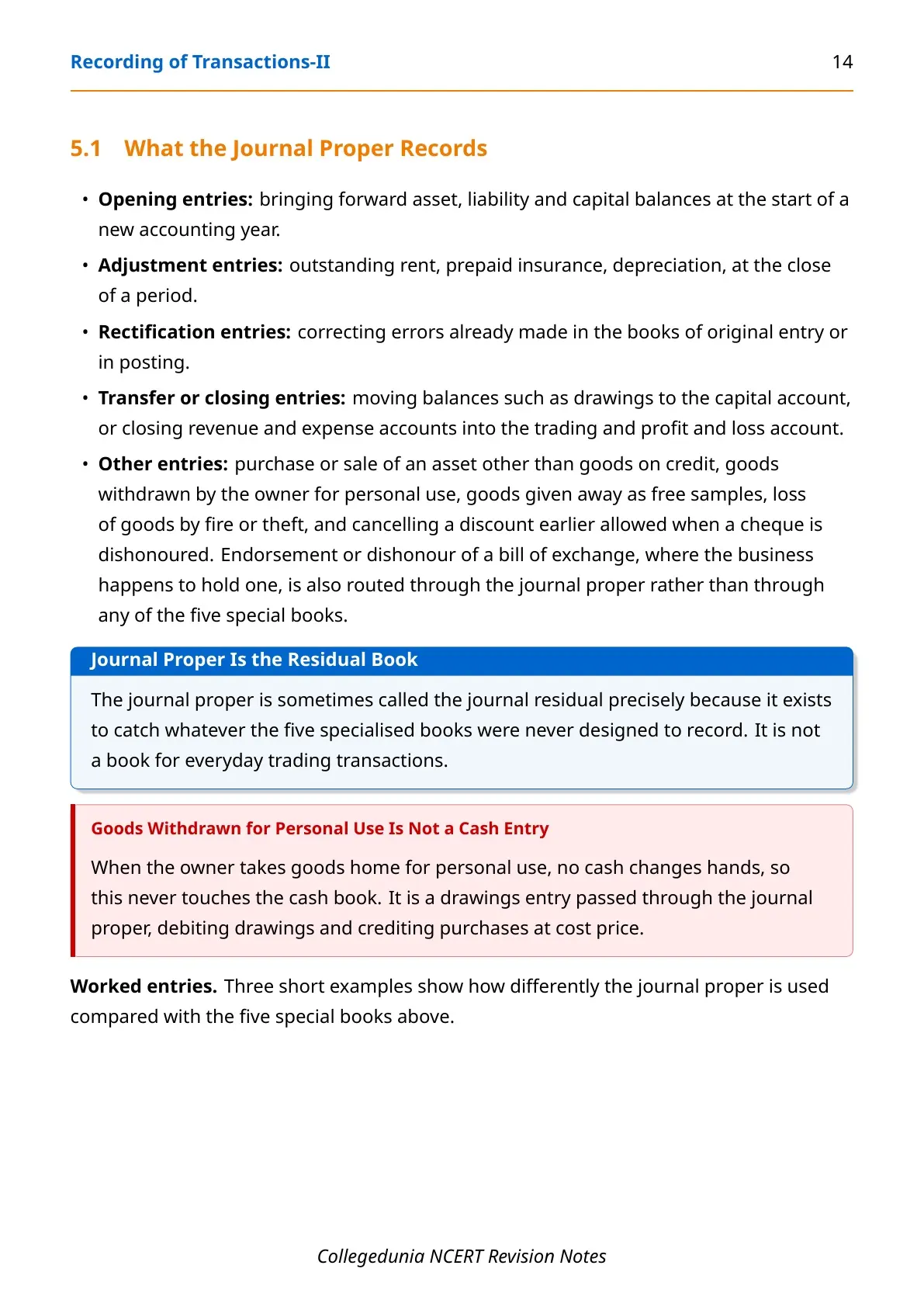
Transactions that fit none of the five special books above go into the Journal Proper, sometimes called the journal residual.
- Opening entries: bringing forward asset, liability and capital balances at the start of a new year.
- Adjustment entries: outstanding rent, prepaid insurance, depreciation.
- Rectification and transfer entries: correcting errors, closing revenue and expense accounts.
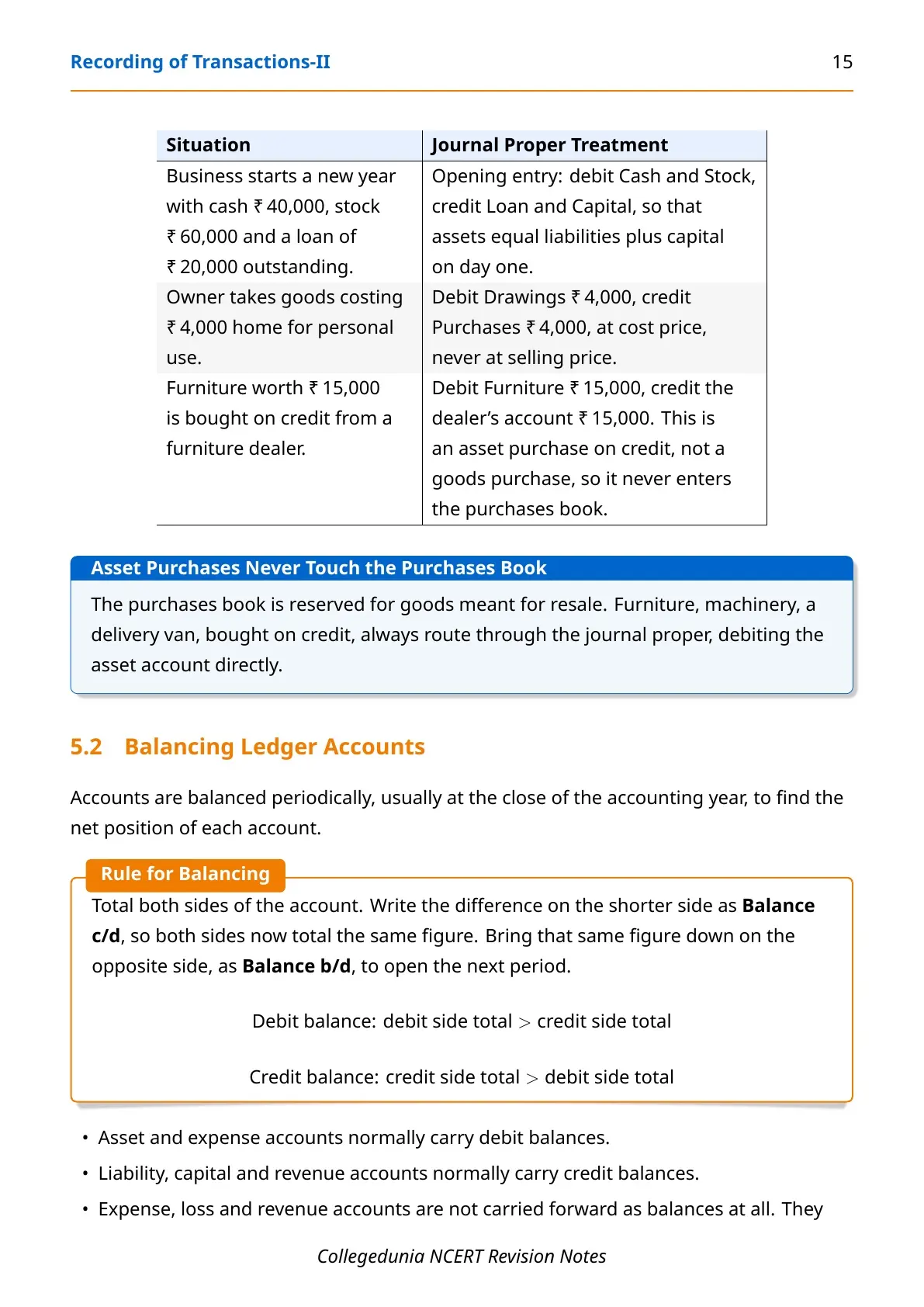
- Other entries: goods withdrawn for personal use, asset purchases on credit, loss of goods by fire.
At the close of a period, ledger accounts are balanced: both sides are totalled, the difference is written on the shorter side as Balance c/d, then brought down on the opposite side as Balance b/d.
Trade Discount versus Cash Discount: The Difference That Costs Marks
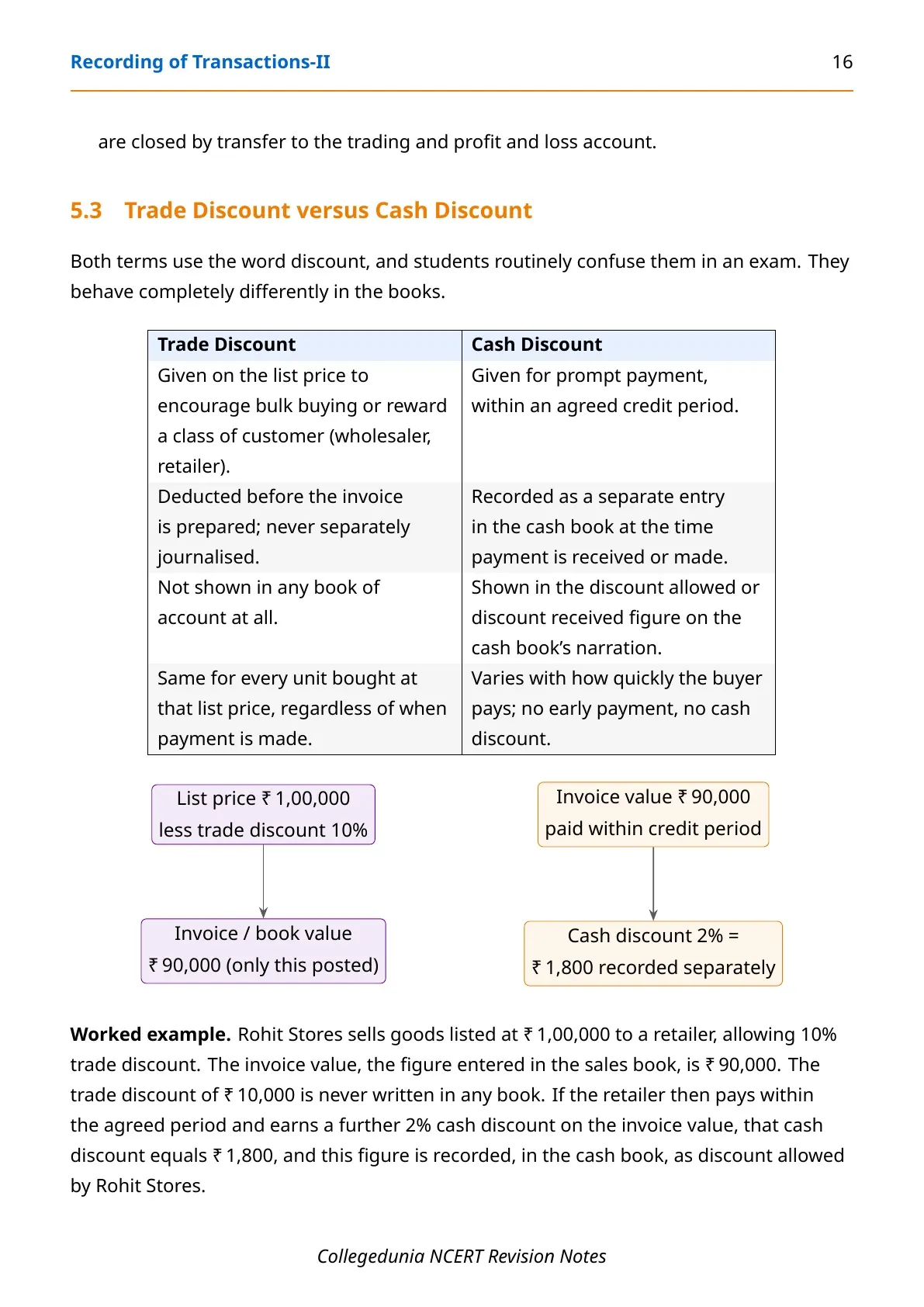
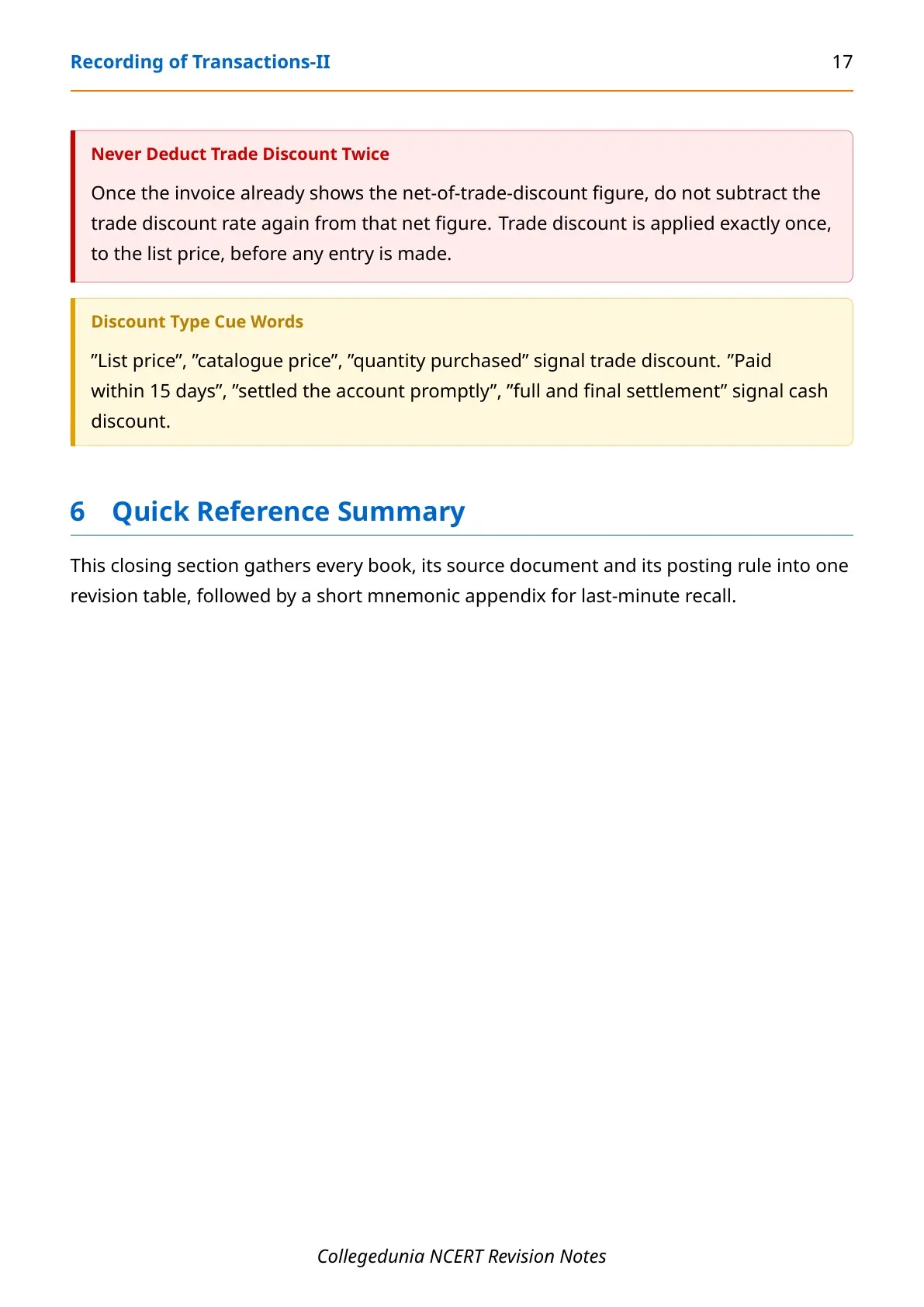
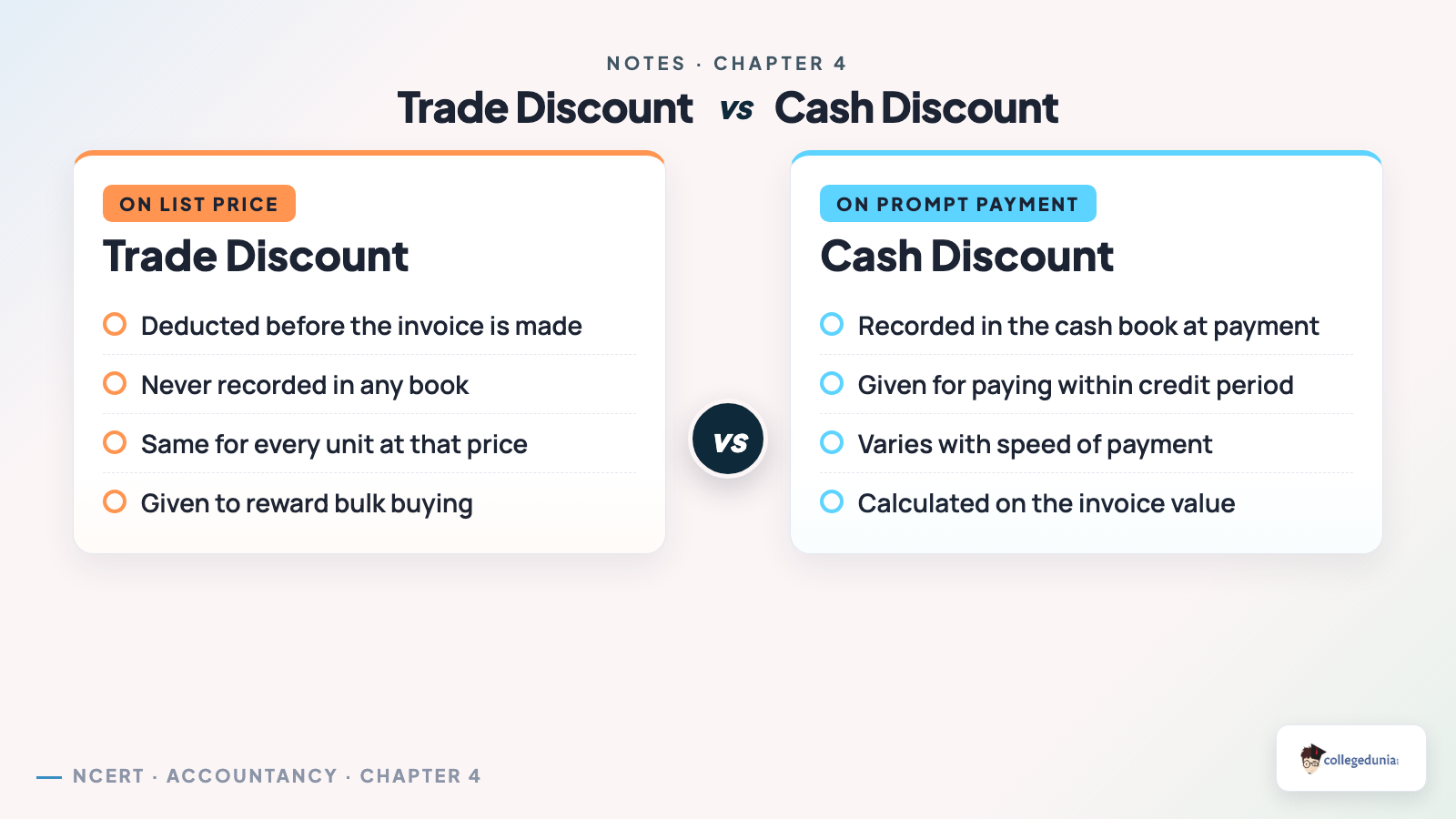
Both terms use the word discount, and CBSE examiners know students confuse them. Trade discount is deducted from the list price before the invoice is prepared and is never entered in any book. Cash discount is given for prompt payment and is recorded separately in the cash book when payment is actually made.
| Trade Discount | Cash Discount |
|---|---|
| Given on list price for bulk buying | Given for prompt payment within a credit period |
| Deducted before the invoice is made | Recorded as a cash book entry at payment time |
| Never shown in any book | Shown in the discount allowed / received figure |
A ₹1,00,000 list price with 10% trade discount books at ₹90,000; that ₹90,000 is what any further cash discount is calculated on, never the original list price.
Recording of Transactions-II Topic-wise Weightage for CBSE Class 11
Cash book and journal proper questions carry the most weight in this chapter, since board papers often combine a cash book numerical with a short trade-versus-cash-discount question.
| Sub-topic | Weightage | CBSE Frequency |
|---|---|---|
| Double column cash book with contra entries | High | Almost every year |
| Purchases and sales books with trade discount | High | Almost every year |
| Petty cash book and the imprest system | Medium | 3 out of last 5 years |
| Purchases and sales return books | Medium | 3 out of last 5 years |
| Journal proper and balancing | Low | 1-2 out of last 5 years |
Important Formats and Formulas to Remember
These are the exact formats and formulas this chapter is built on. Keep this box open while practising cash book and discount numericals.
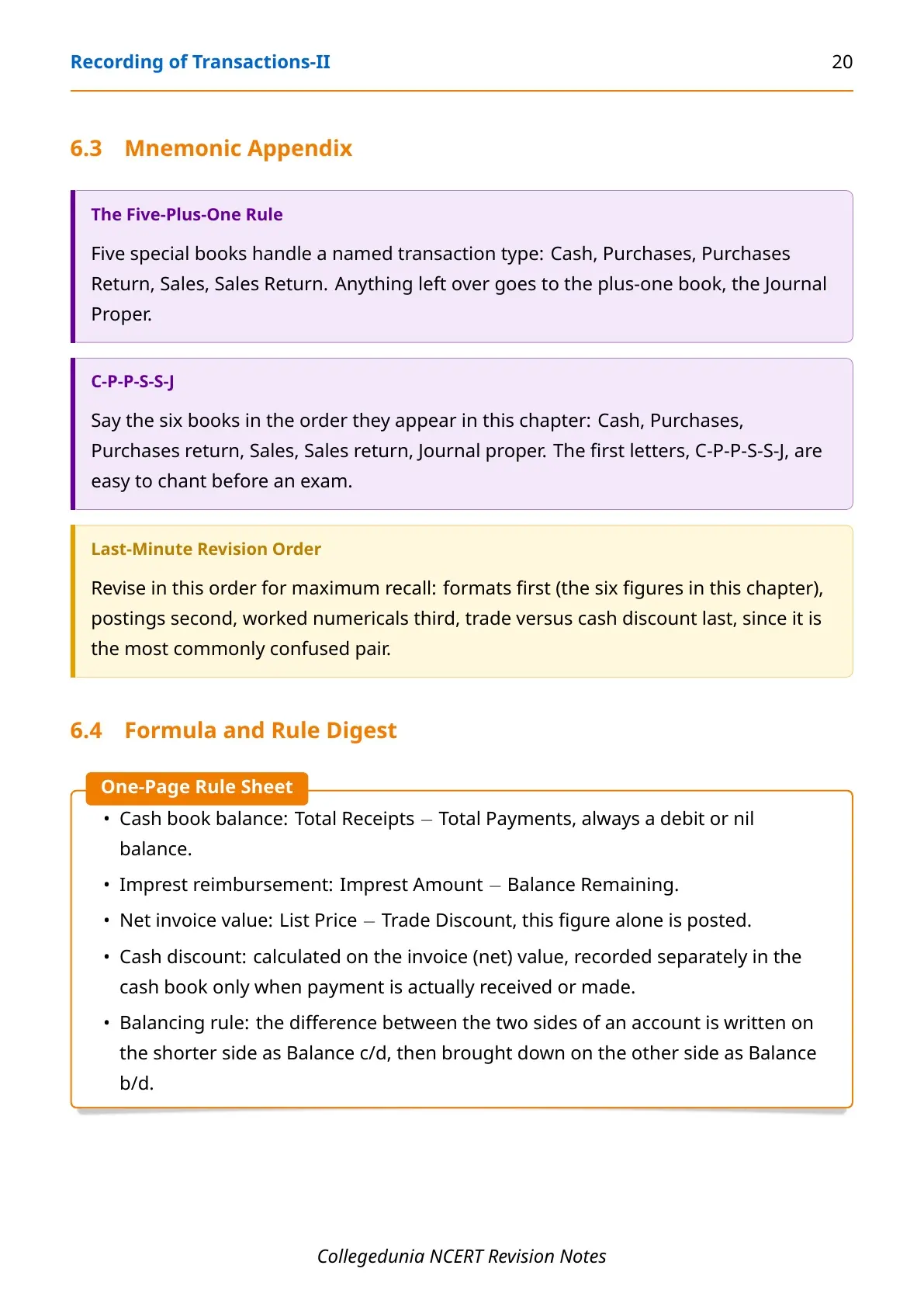
- Cash book balance: Total Receipts − Total Payments, always a debit or nil balance.
- Imprest reimbursement: Imprest Amount − Balance Remaining.
- Net invoice value: List Price − Trade Discount, the only figure posted in the books.
- Balancing rule: the difference between the two sides goes on the shorter side as Balance c/d, then Balance b/d opens the next period.
Common Mistakes Students Make in the Recording of Transactions-II Chapter
| Mistake | Fix |
|---|---|
| Posting a cash transaction to the purchases or sales book | Cash transactions always go to the cash book, never a credit book. |
| Writing the list price instead of the net invoice value | Only the net-of-trade-discount figure is entered in the purchases or sales book. |
| Treating a contra entry as two separate ledger postings | Both legs of a contra entry sit inside the cash book; neither is posted to the ledger. |
| Forgetting expense and revenue accounts are closed, not balanced | Only asset, liability and capital accounts carry a balance forward. |
Key Accounting Terms Glossary for Recording of Transactions-II
| Term | Meaning |
|---|---|
| Contra entry | An entry with both legs inside the cash book, marked "C" |
| Imprest system | A fixed float given to the petty cashier and topped up to the same figure each period |
| Debit note | Sent by the buyer returning goods to a supplier |
| Credit note | Sent by the seller accepting goods back from a customer |
| Trade discount | Deducted from list price; never recorded in any book |
| Cash discount | Given for prompt payment; recorded in the cash book |
How Collegedunia's Notes Help You With Recording of Transactions-II
The NCERT Notes Class 11 Accountancy Chapter 4 Recording of Transactions-II on this page are built to match how Class 11 board papers actually test this chapter.
- 2026-27 NCERT Alignment: Every format and rule matches the current NCERT print.
- All Six Books in One Place: Cash book, petty cash book, purchases, sales and both return books, with formats side by side.
- Solved Cash Book and Discount Examples: A full worked contra-entry cash book plus a trade-versus-cash-discount problem.
- Quick Recall Boxes: Formats, formulas and mnemonics in one place for last-day revision.
Recording of Transactions-II Class 11 Accountancy Resources
Besides the NCERT Notes Class 11 Accountancy Chapter 4 Recording of Transactions-II on this page, every other resource type for this chapter sits in one place below.
| Resource | Status |
|---|---|
| Recording of Transactions-II Class 11 Notes | You are reading this page |
| Recording of Transactions-II Class 11 Handwritten Notes | Available |
| Recording of Transactions-II Class 11 NCERT Solutions | (coming soon) |
| Recording of Transactions-II Class 11 NCERT Book PDF | (coming soon) |
NCERT Notes for Class 11 Accountancy: All Chapters
Jump to the notes for any other Class 11 Accountancy chapter.
| Chapter | Notes |
|---|---|
| Chapter 1 | Introduction to Accounting |
| Chapter 2 | Theory Base of Accounting |
| Chapter 3 | Recording of Transactions-I |
| Chapter 4 | Recording of Transactions-II (this page) |
| Chapter 5 | Bank Reconciliation Statement (coming soon) |
| Chapter 6 | Trial Balance and Rectification of Errors (coming soon) |
| Chapter 7 | Depreciation, Provisions and Reserves (coming soon) |
Recording of Transactions-II Class 11 Accountancy Notes FAQs
Ques. What is a contra entry in the double column cash book?
Ans. A contra entry records a transaction where both the cash and bank columns of the cash book are affected, such as depositing cash into the bank or withdrawing cash from the bank for office use. It is marked "C" in the L.F. column and is never posted to any ledger account.
Ques. What is the imprest system in a petty cash book?
Ans. Under the imprest system, a fixed sum is handed to the petty cashier at the start of a period. The cashier spends from it and is reimbursed exactly the amount spent at the end of the period, so the next period always starts with the same fixed float.
Ques. What is the difference between a debit note and a credit note?
Ans. A debit note is prepared by the buyer when goods bought on credit are returned to the supplier. A credit note is prepared by the seller when goods sold on credit are received back from a customer. The buyer debits, the seller credits.
Ques. What is the difference between trade discount and cash discount?
Ans. Trade discount is deducted from the list price before the invoice is prepared and is never recorded in any book of account. Cash discount is given for prompt payment within an agreed credit period and is recorded as a separate entry in the cash book when payment is actually received or made.
Ques. What transactions are recorded in the journal proper?
Ans. The journal proper records opening entries, adjustment entries, rectification entries, transfer or closing entries, and other entries such as goods withdrawn for personal use or the credit purchase of an asset other than goods, none of which fit the five special purpose books.
Ques. Are these Class 11 Accountancy notes aligned with the 2026-27 NCERT?
Ans. Yes. These notes follow the current 2026-27 NCERT print for Class 11 Accountancy Chapter 4, Recording of Transactions-II, including its cash book, purchases, sales and return book formats.
Ques. How many pages is the Class 11 Accountancy Chapter 4 Notes PDF?
Ans. The Notes PDF runs to 21 pages and covers the cash book, petty cash book, purchases and sales books, purchases and sales return books, journal proper, balancing ledger accounts, and trade versus cash discount, with solved numerical examples.
Ques. What is a purchases return book used for?
Ans. The purchases return book records goods that a business bought on credit and then sent back to the supplier, usually because of poor quality or damage. Each entry is backed by a debit note and the periodic total is credited to the purchases return account.
Ques. How is a cash book balanced?
Ans. A cash book is balanced the same way as any ledger account: total receipts minus total payments gives the balance carried down on the credit side, which is then brought down as the opening balance on the debit side of the next period.



Comments