




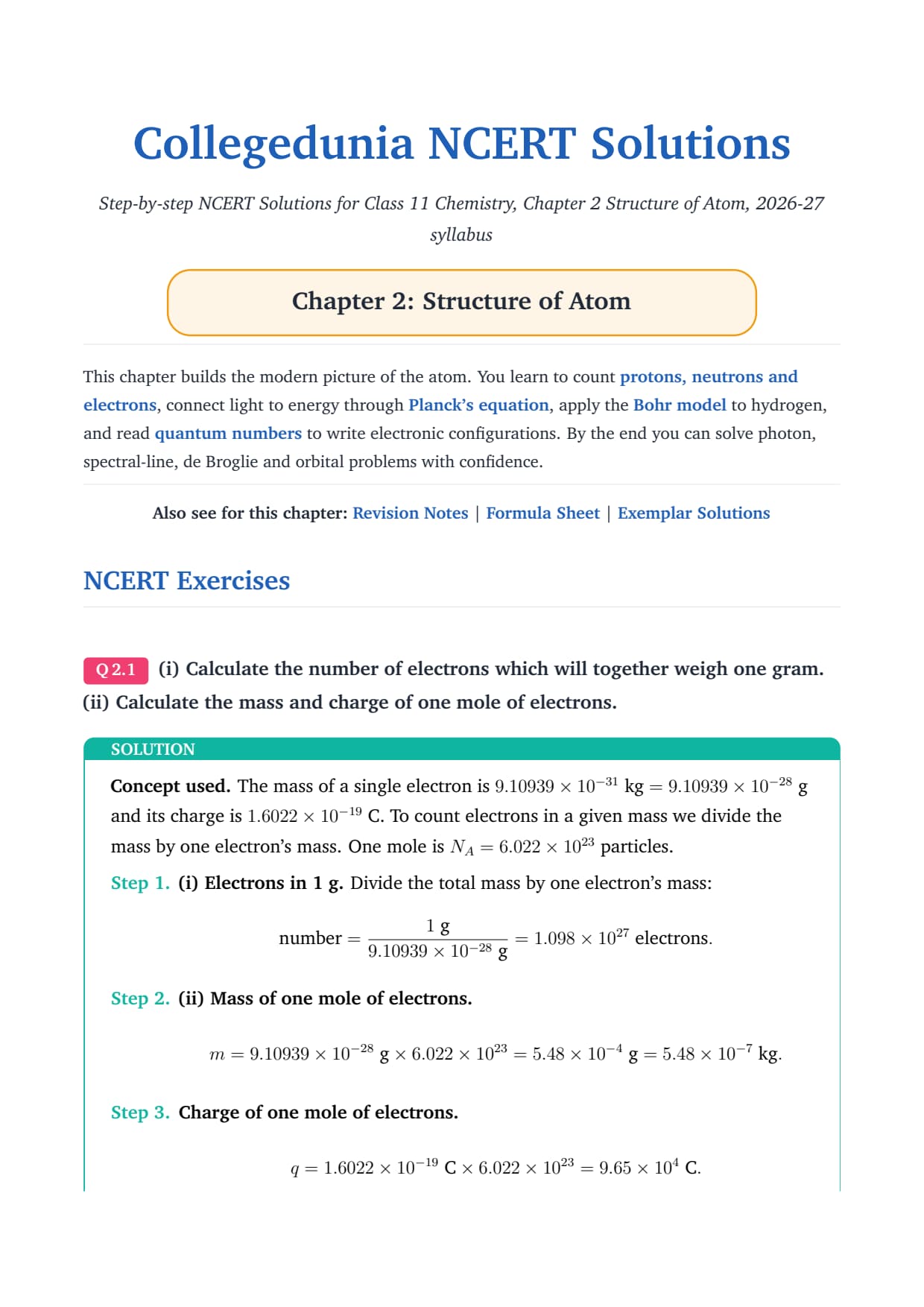
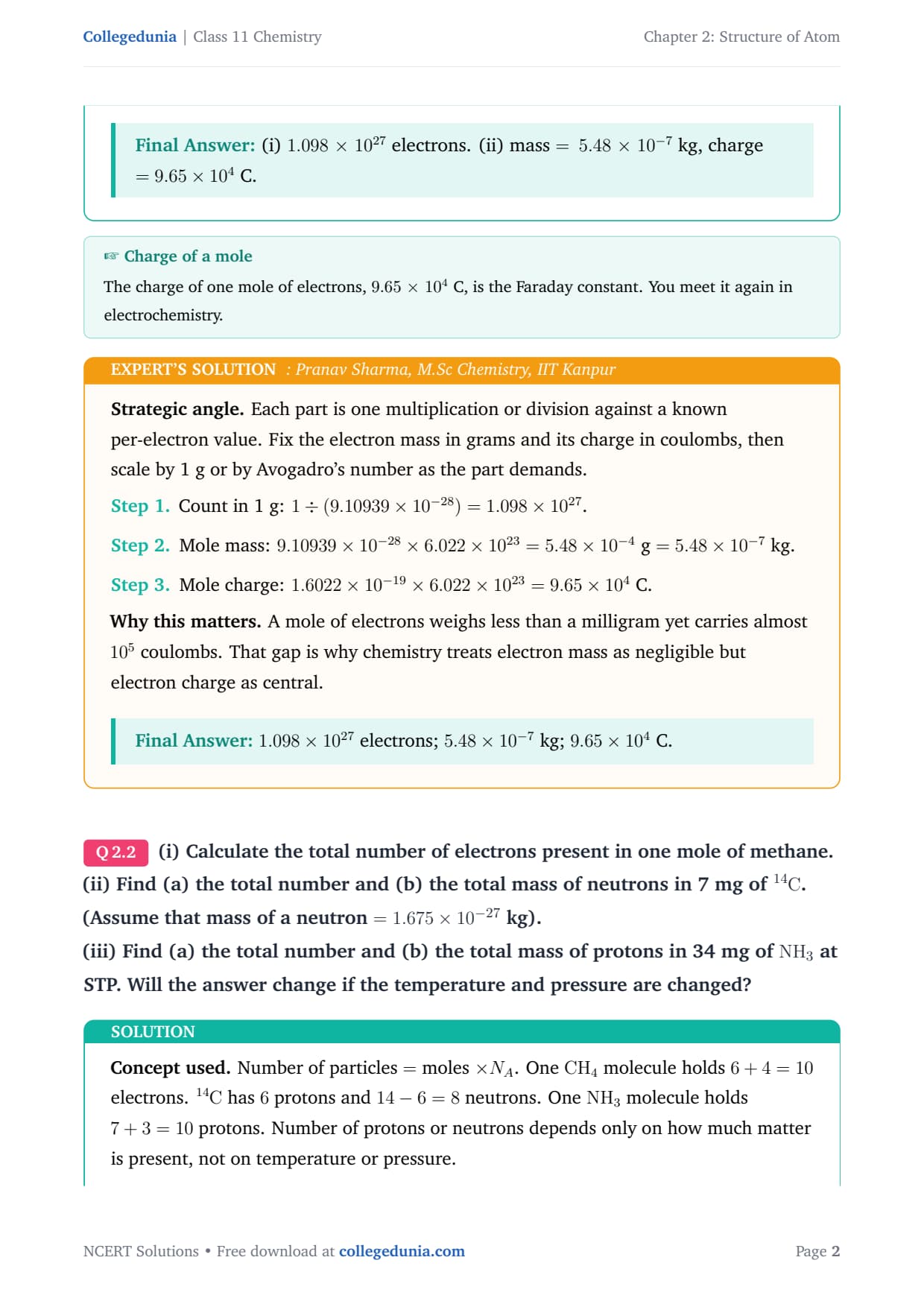
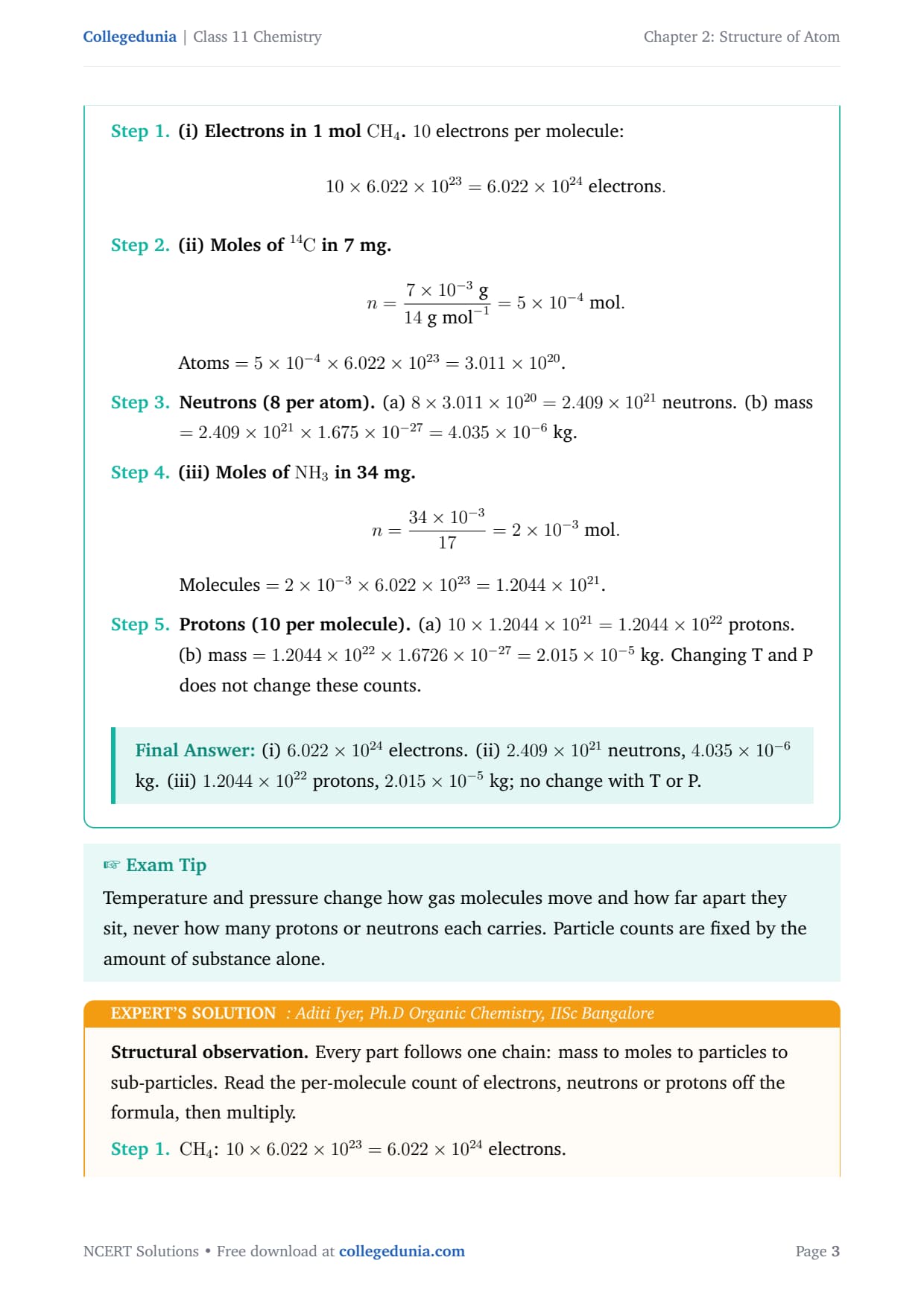
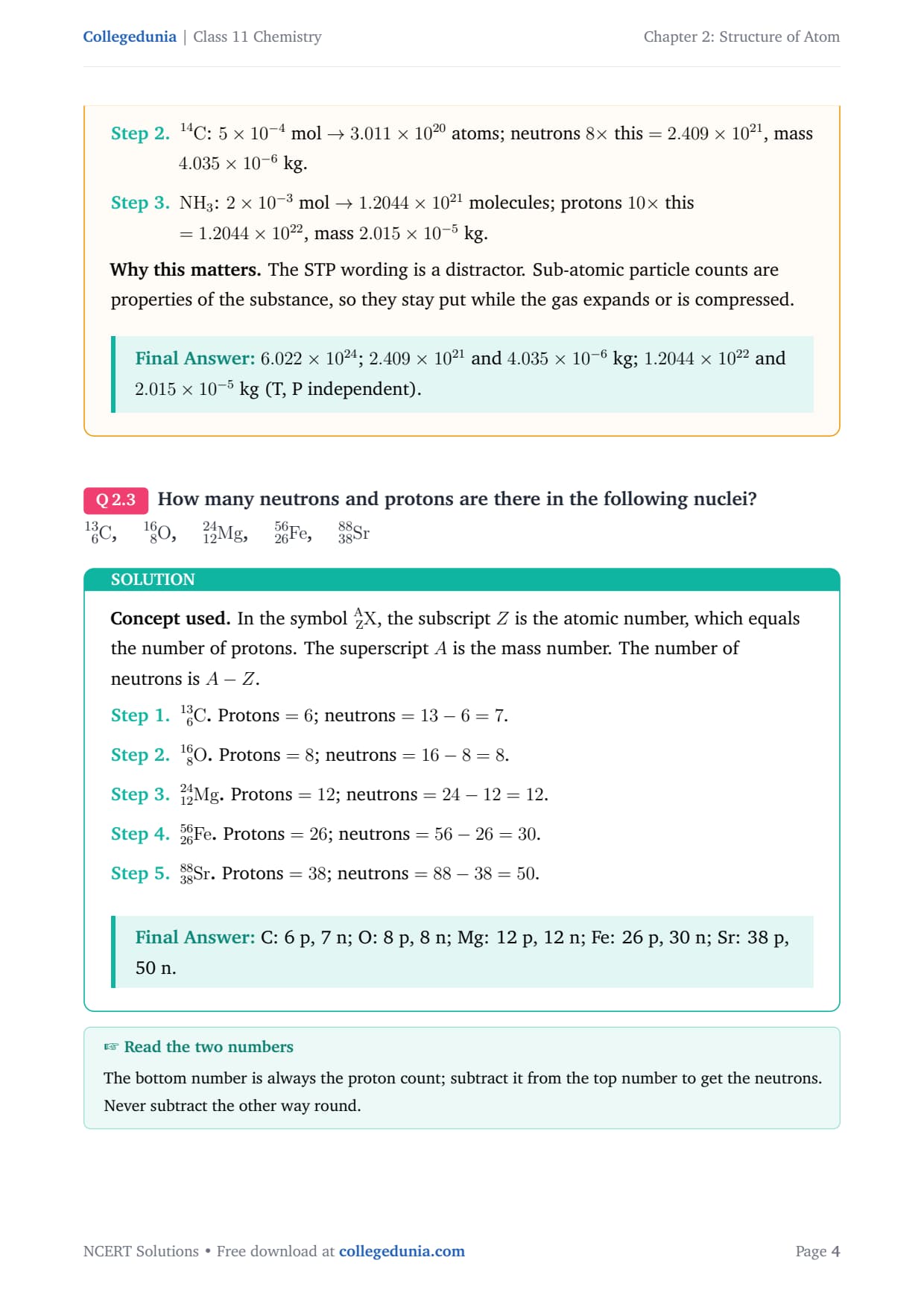
The class 11 chemistry NCERT solutions chapter 2 Structure of Atom cover every intext and back-exercise question, according to the latest 2026-27 CBSE syllabus, and help students prepare for the CBSE Boards, JEE Main, JEE Advanced, NEET and CUET. Each answer is worked step by step, from the discovery of subatomic particles to quantum numbers, orbital shapes and electronic configuration.
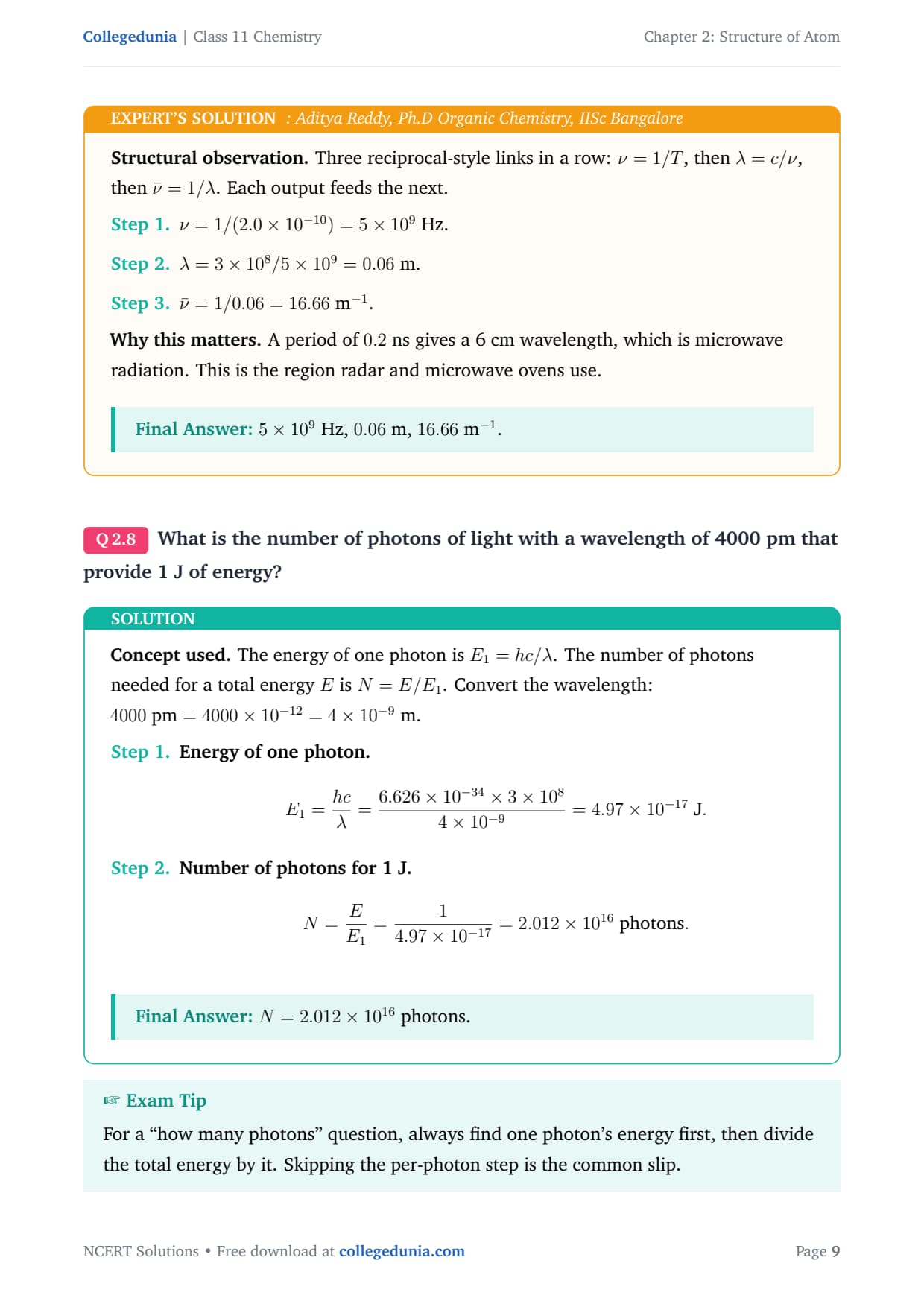
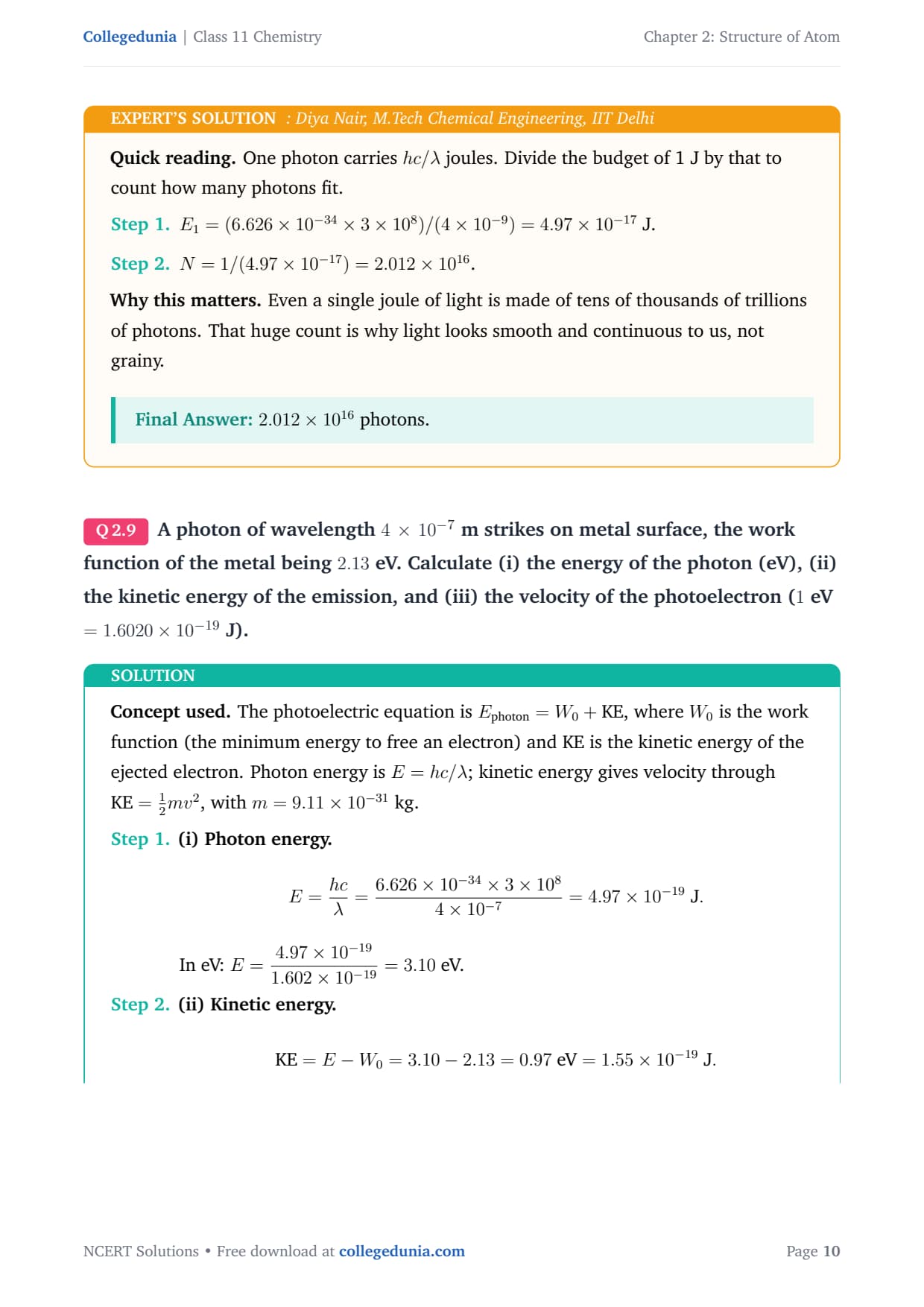
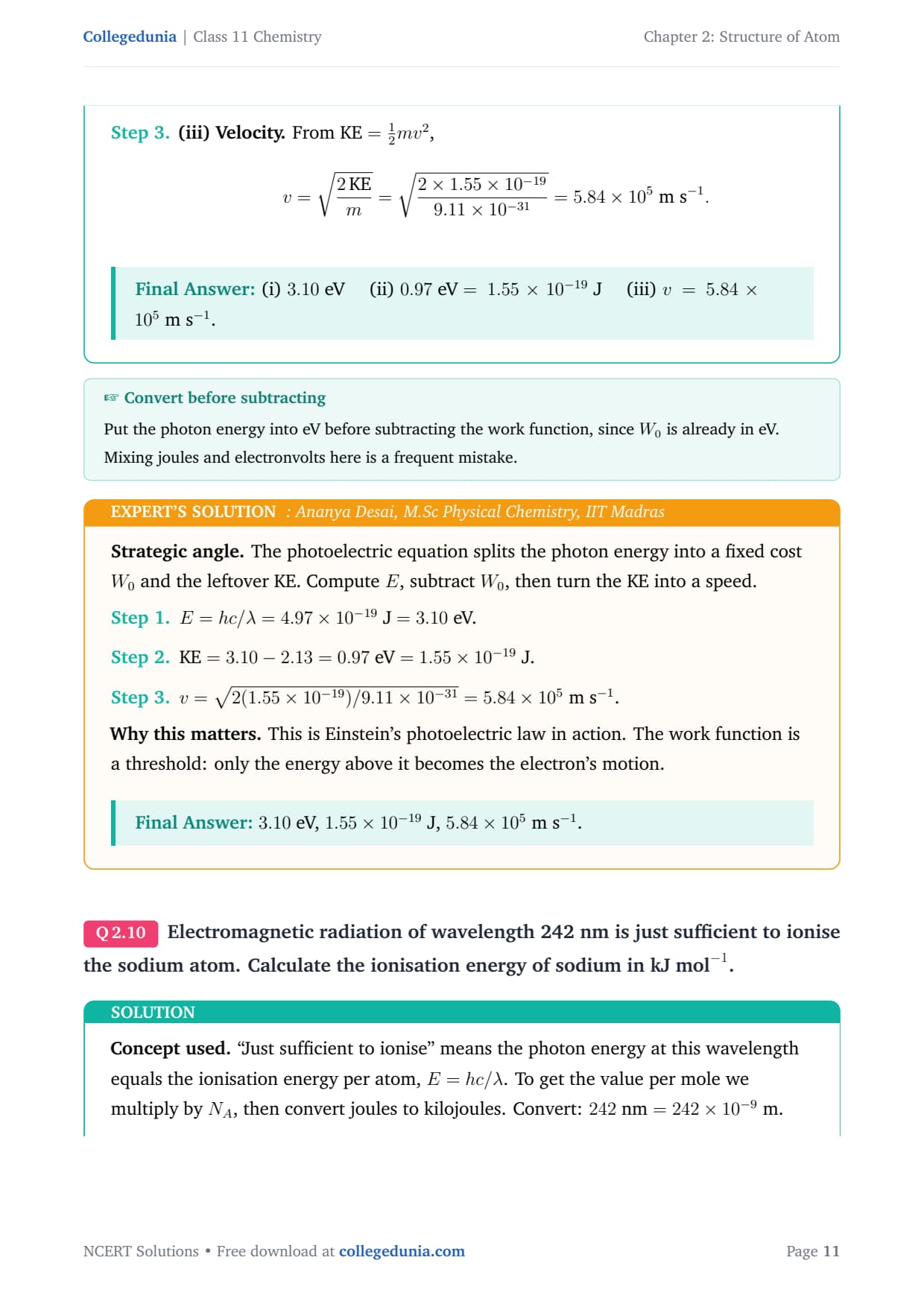
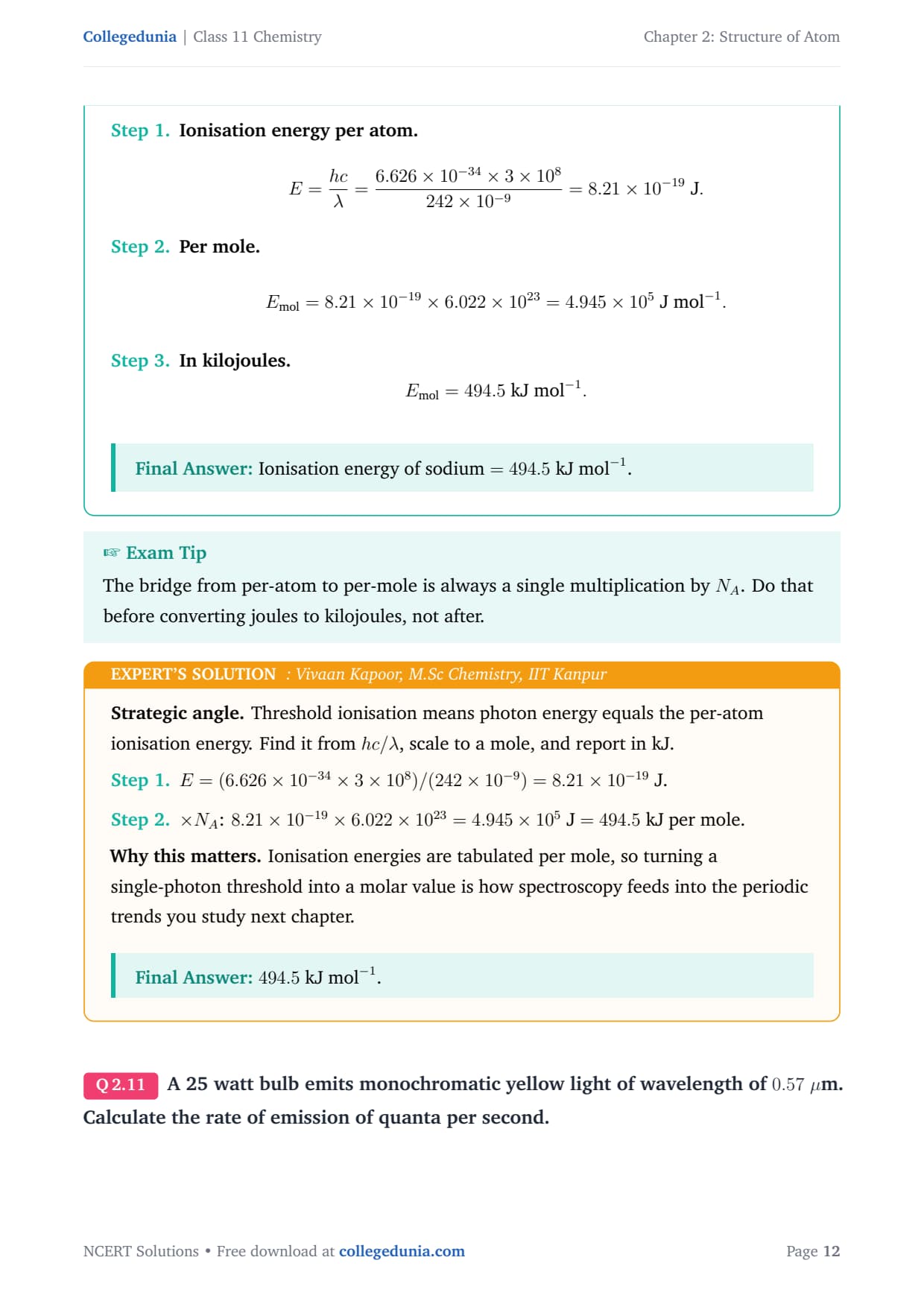
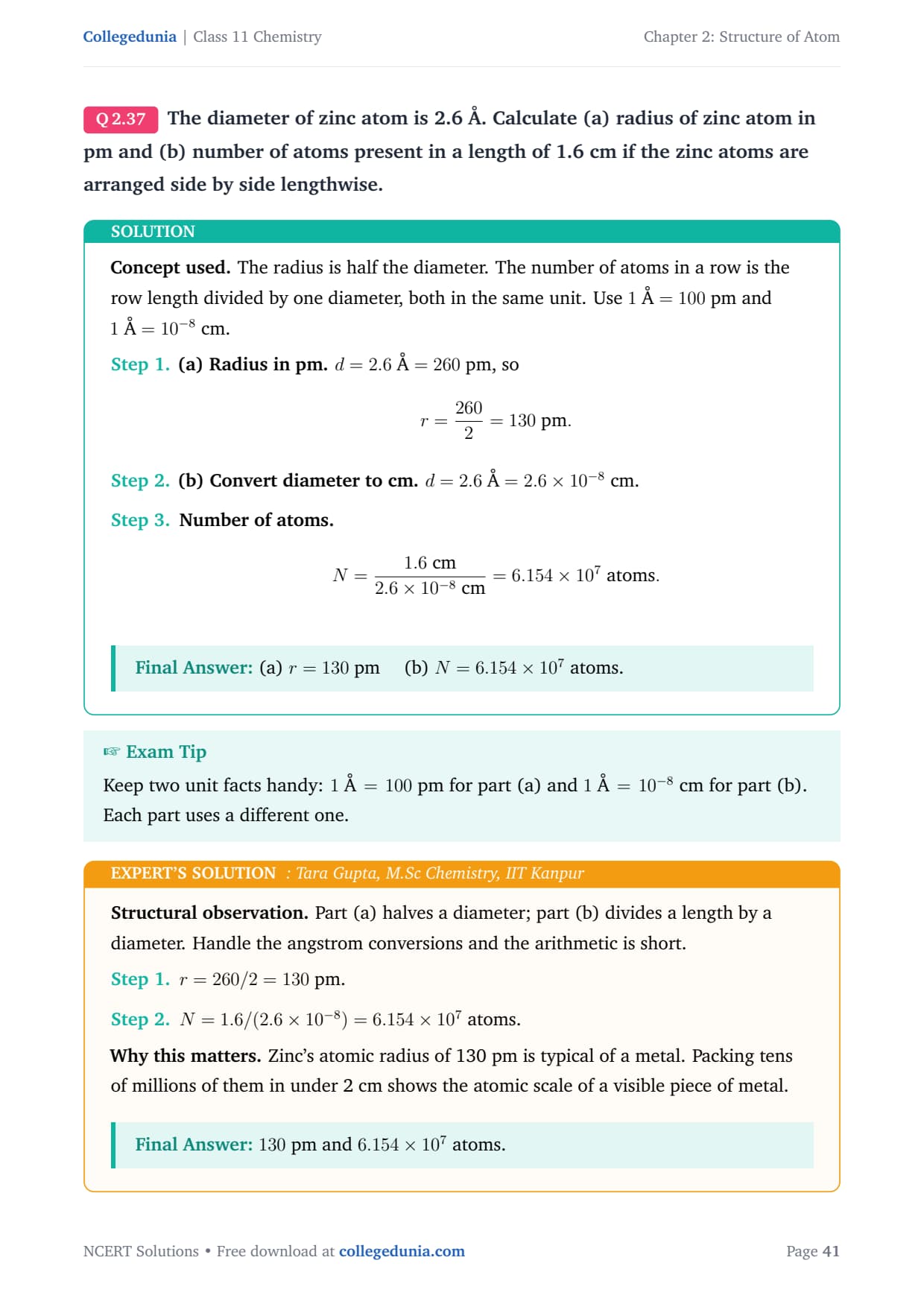
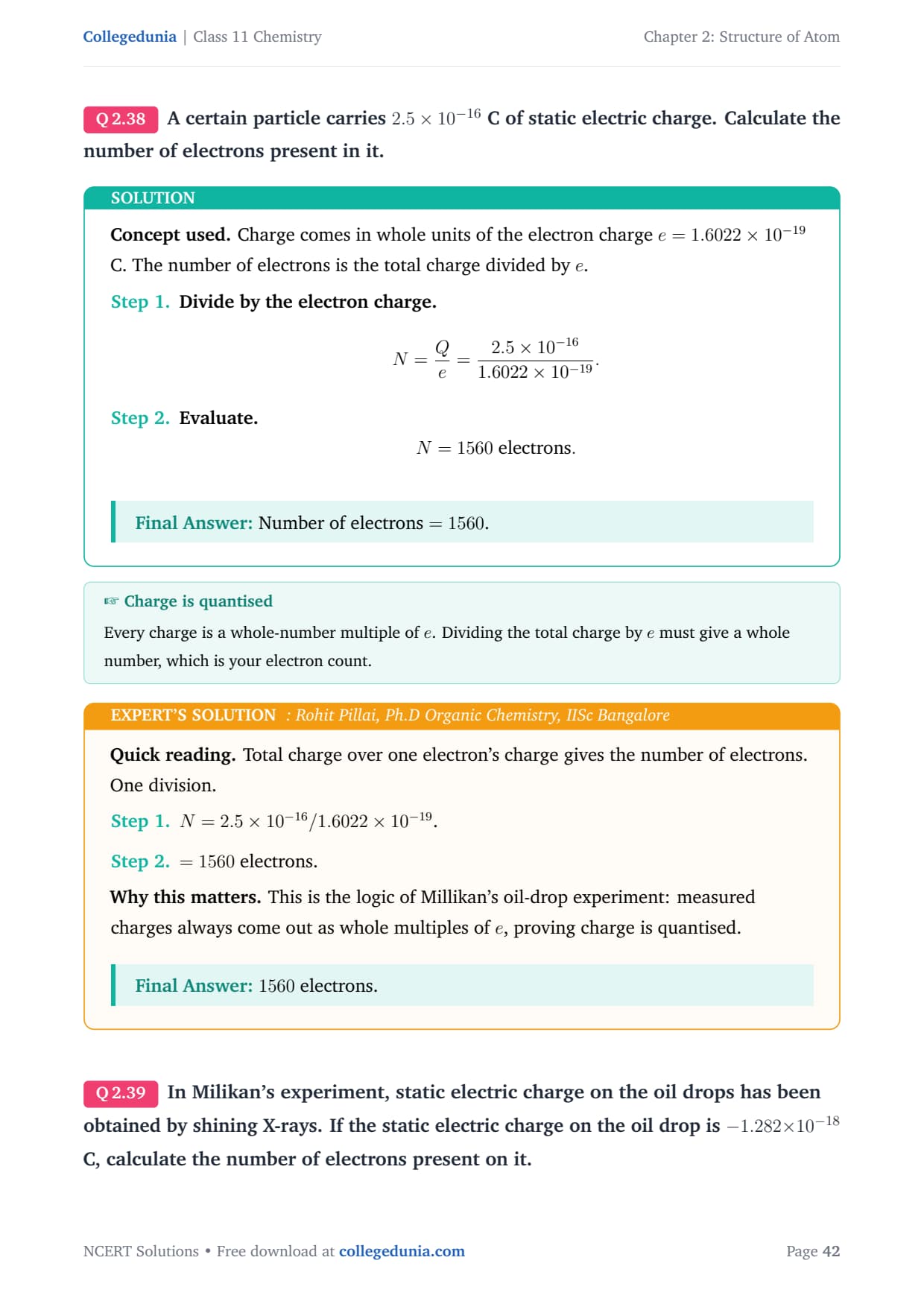
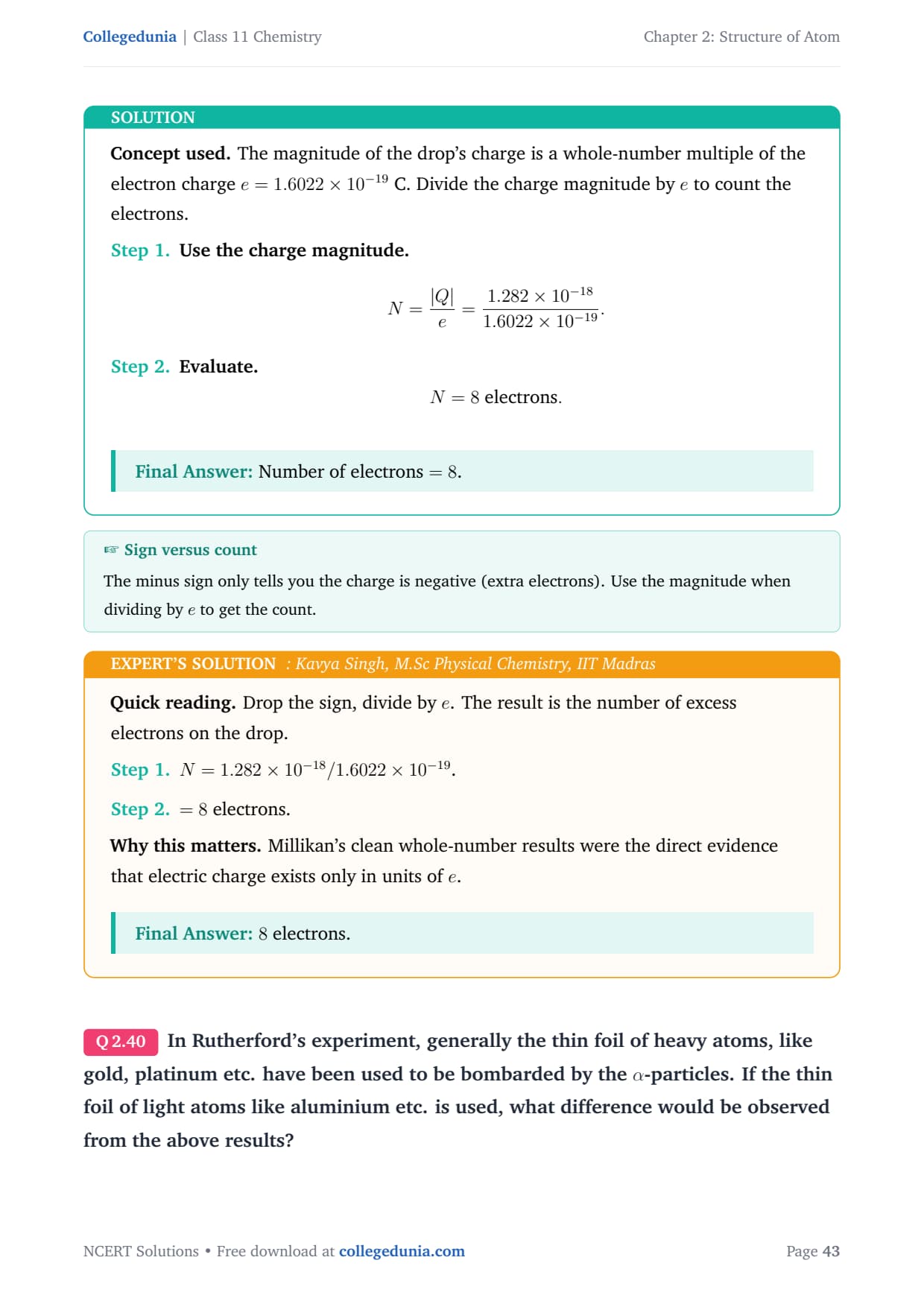
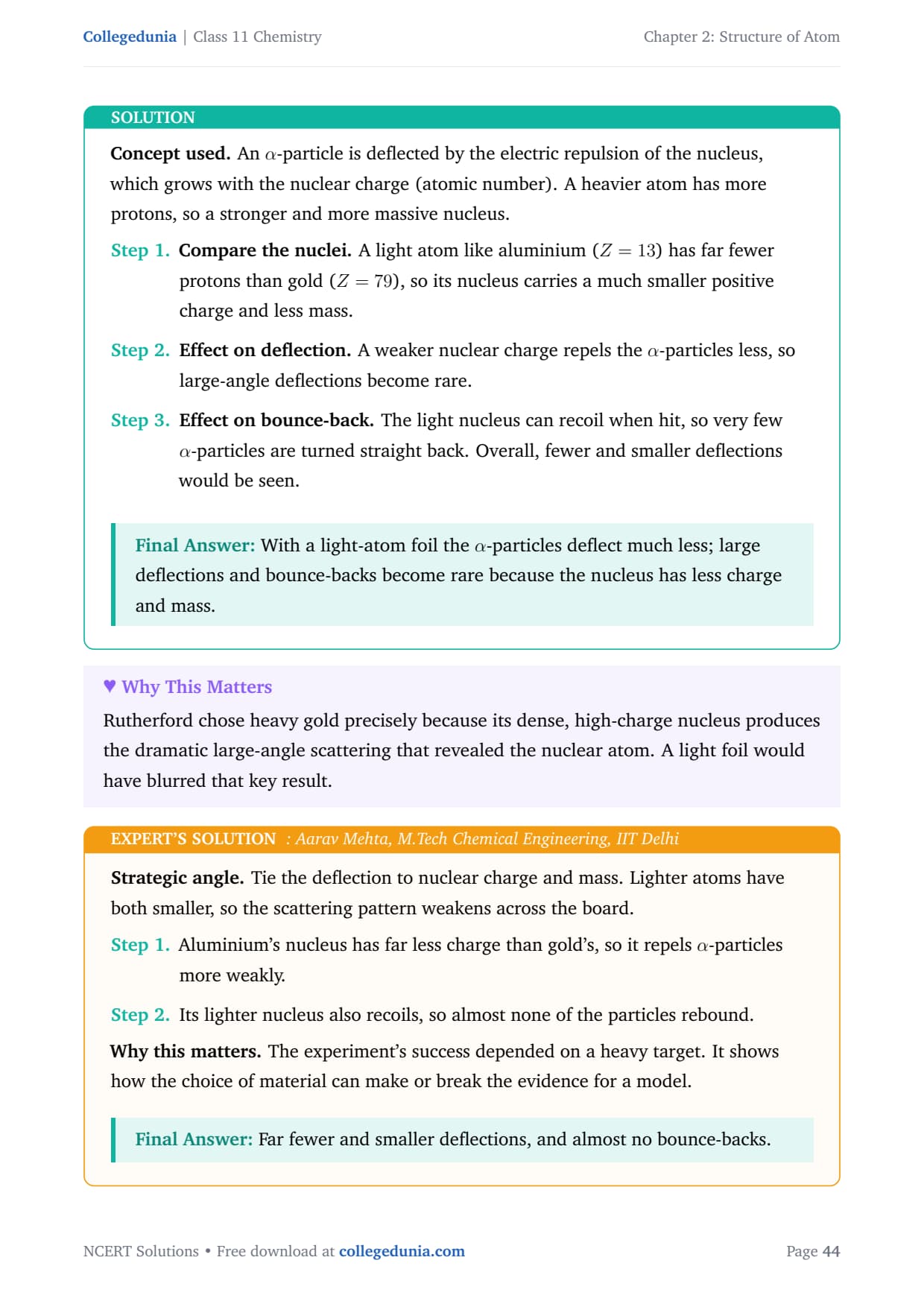
This chapter builds the model of the atom that the whole of physical chemistry rests on, so the ideas here return in bonding, the periodic table and spectroscopy.
- CBSE Weightage: 7 to 9 marks, one of the highest-scoring chapters in the Physical Chemistry unit.
- Topics covered: subatomic particles, Thomson, Rutherford and Bohr models, photoelectric effect, dual nature, quantum numbers, orbital shapes, and the filling rules.
- Exercise count: 67 back-exercise questions plus intext questions, a mix of numerical and short-answer.
These class 11 chemistry NCERT solutions chapter 2 Structure of Atom are curated by subject experts, based on the 2026-27 NCERT textbook, and checked against the last five years of CBSE Board, JEE Main and NEET papers.
Why Structure of Atom Matters and What the Chapter Covers
The atom is the smallest unit of an element that keeps its identity. This chapter traces how scientists looked inside it, from stray particles in a discharge tube to the modern quantum picture. Get this model right and later chapters make far more sense.
- Foundation for bonding: the way electrons fill orbitals decides how atoms join to form molecules.
- Explains the periodic table: repeating electron patterns are why elements fall into groups and periods.
- Links to spectra: the energy levels here explain the coloured lines in an atomic spectrum.
Almost every idea in Class 11 and Class 12 inorganic chemistry traces back to electronic configuration. That is why toppers revisit this chapter first. The class 11 chemistry NCERT solutions chapter 2 Structure of Atom below follow the same order as the NCERT textbook, so you can check your working line by line.
Discovery of the Electron, Proton and Neutron
Before the atom's parts were known, chemists thought it was indivisible. Experiments with discharge tubes changed that, revealing three subatomic particles. Their charge and mass are common one-mark questions, so learn the table below by heart.
| Particle | Charge | Relative mass | Discovered by |
|---|---|---|---|
| Electron | −1 | 1/1837 of a proton | J. J. Thomson (cathode rays) |
| Proton | +1 | 1 u | Goldstein (anode/canal rays) |
| Neutron | 0 | 1 u | James Chadwick |
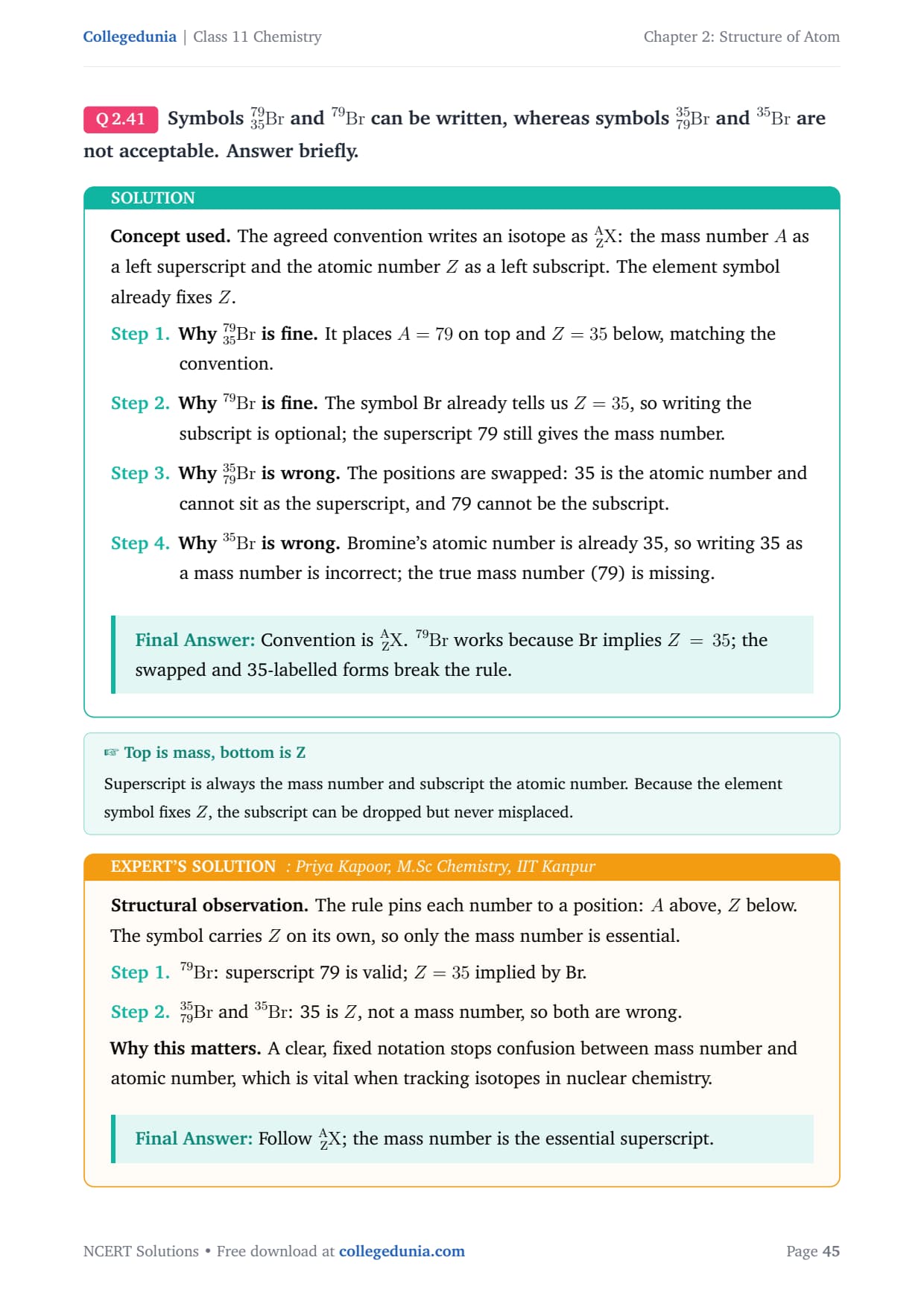
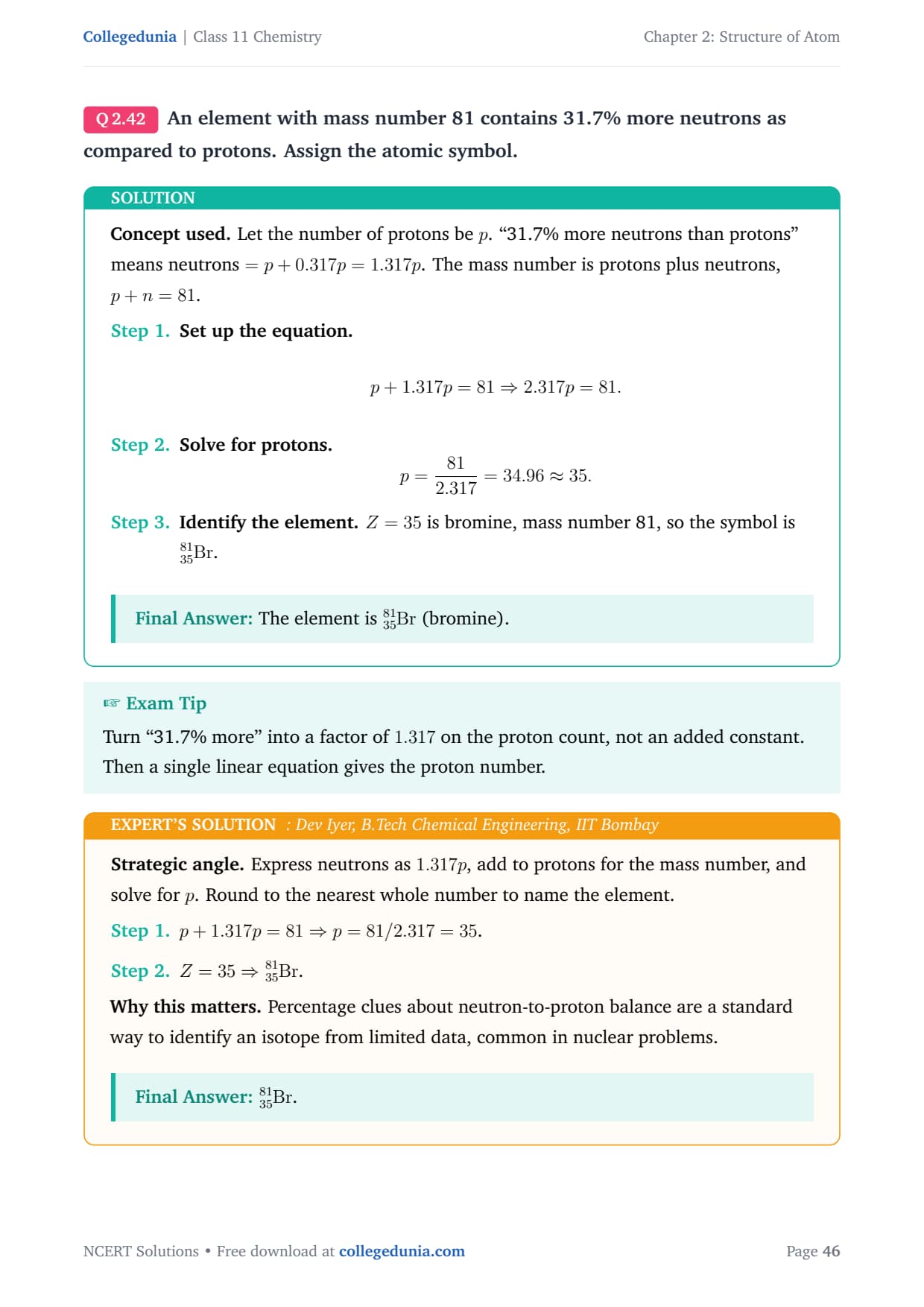
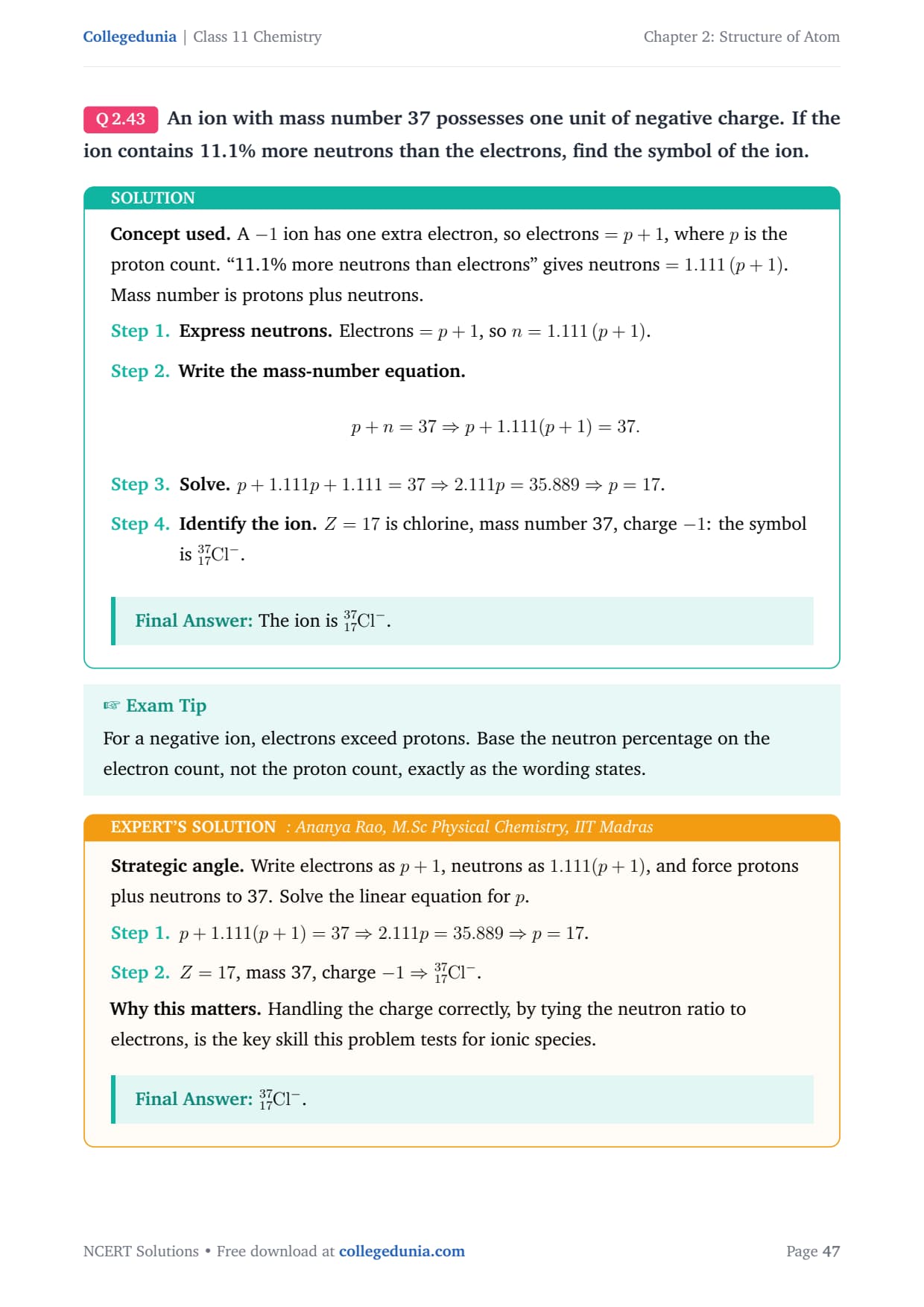
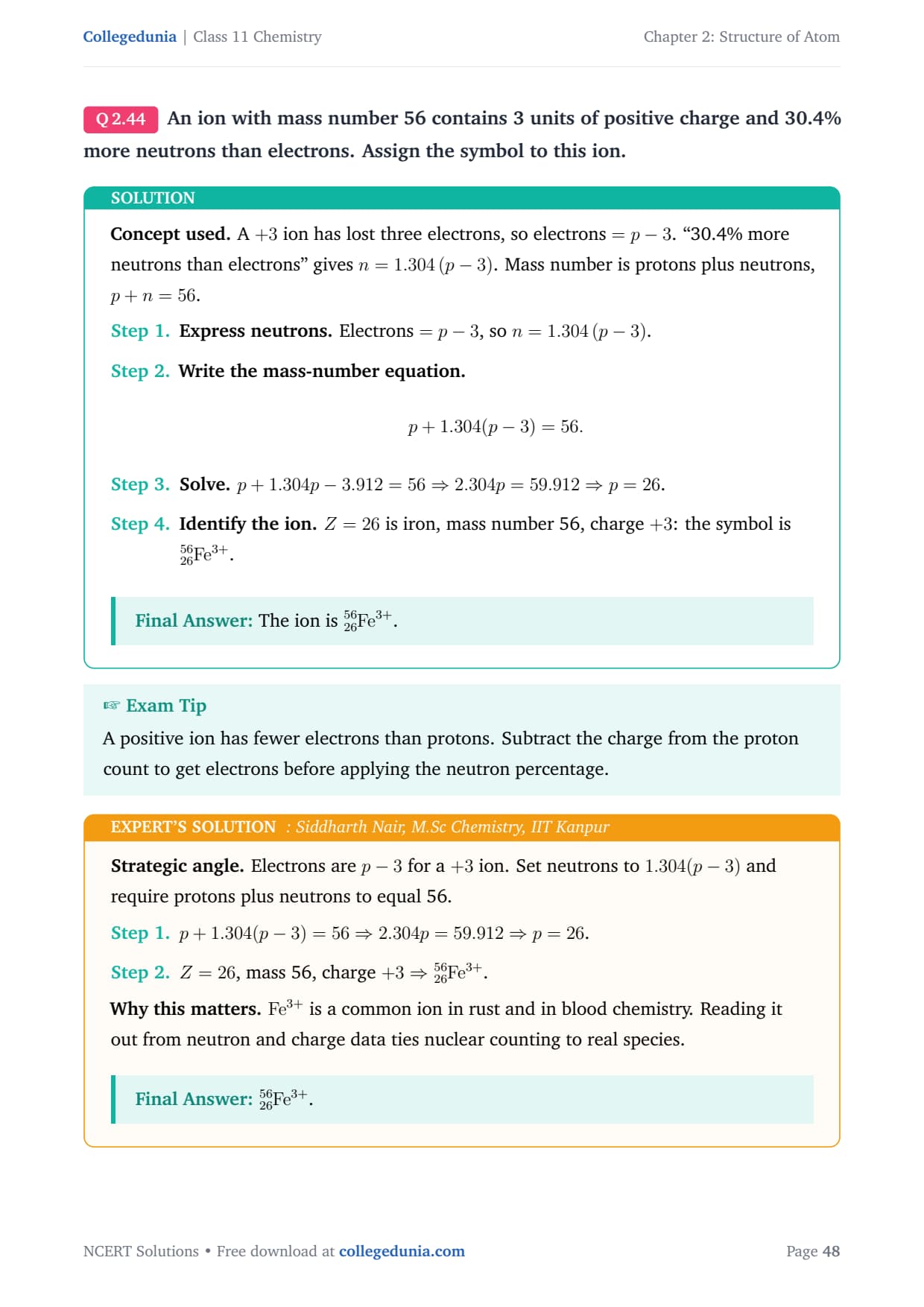
The cathode ray experiment showed a beam that bent towards a positive plate, proving electrons carry a negative charge. Millikan's oil-drop experiment then fixed the electron charge at 1.6 × 10⁻¹⁹ C. An atom is neutral because the number of protons equals the number of electrons. The atomic number Z counts the protons, while the mass number A counts protons plus neutrons.
Thomson and Rutherford Atomic Models
Once the parts were known, the question became how they sit inside the atom. Two early atomic models answered it in very different ways, and the shift between them is a favourite short-answer question.
- Thomson's model: the atom is a sphere of positive charge with electrons stuck in it, like plums in a pudding.
- Rutherford's model: a tiny dense positive nucleus sits at the centre, with electrons moving around it in mostly empty space.
Rutherford fired alpha particles at a thin gold foil. Most passed straight through, but a few bounced back sharply. This scattering proved the positive charge is packed into a tiny nucleus, not spread out. Yet the model had a flaw: a moving electron should lose energy and spiral into the nucleus, which does not happen. That failure is exactly what Bohr's model was built to fix.
Bohr's Model of the Hydrogen Atom
Niels Bohr solved Rutherford's problem by borrowing the idea of quantised energy. In Bohr's model, electrons move only in fixed circular paths called shells, each with a set energy. This model explains the hydrogen spectrum with real accuracy.
- Electrons revolve only in certain allowed orbits of fixed energy, called stationary states.
- An electron in an orbit does not lose or gain energy, so it does not fall into the nucleus.
- Energy is absorbed or emitted only when an electron jumps between orbits.
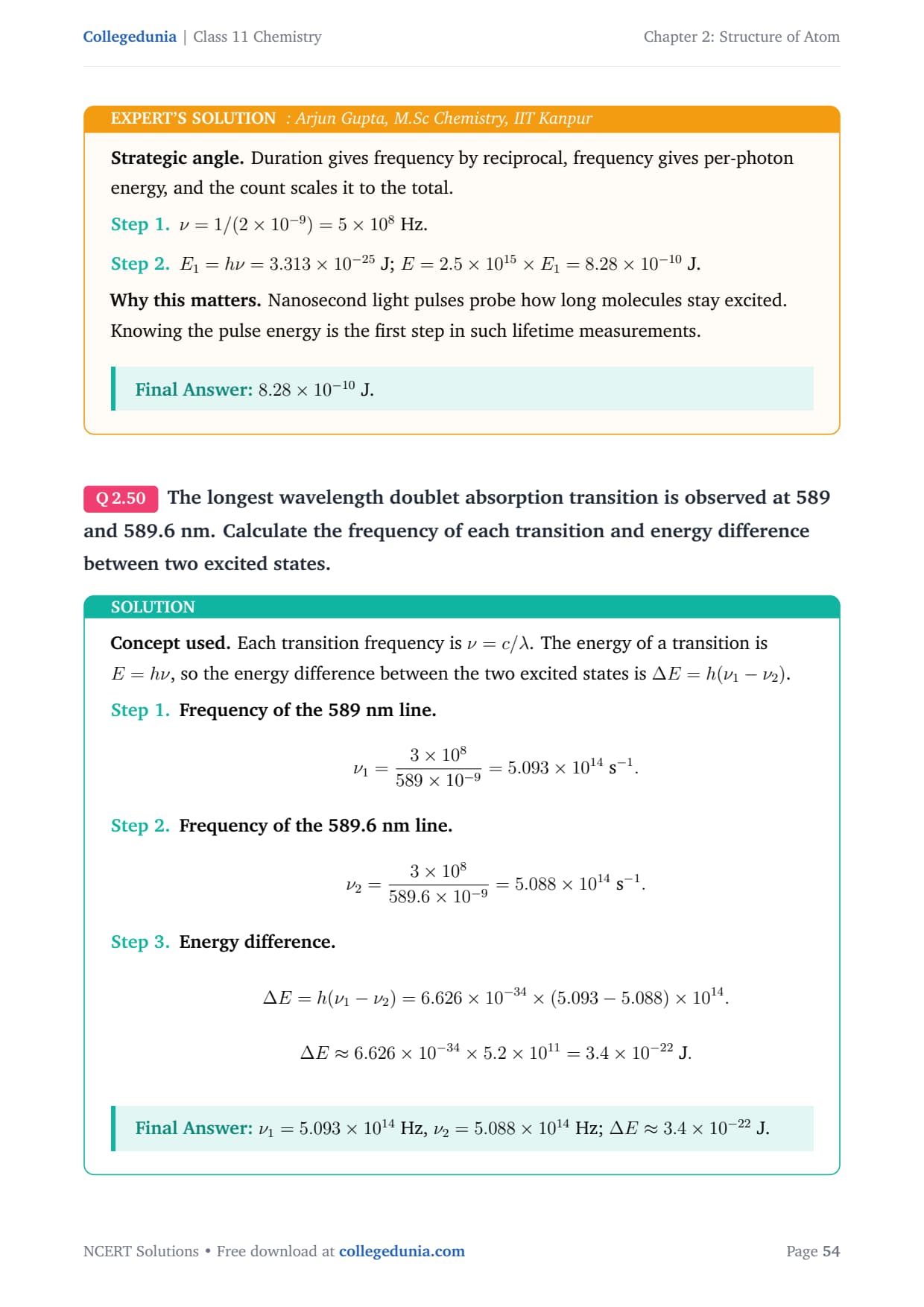
- The energy of the jump equals the difference between the two levels, given by E = hν.
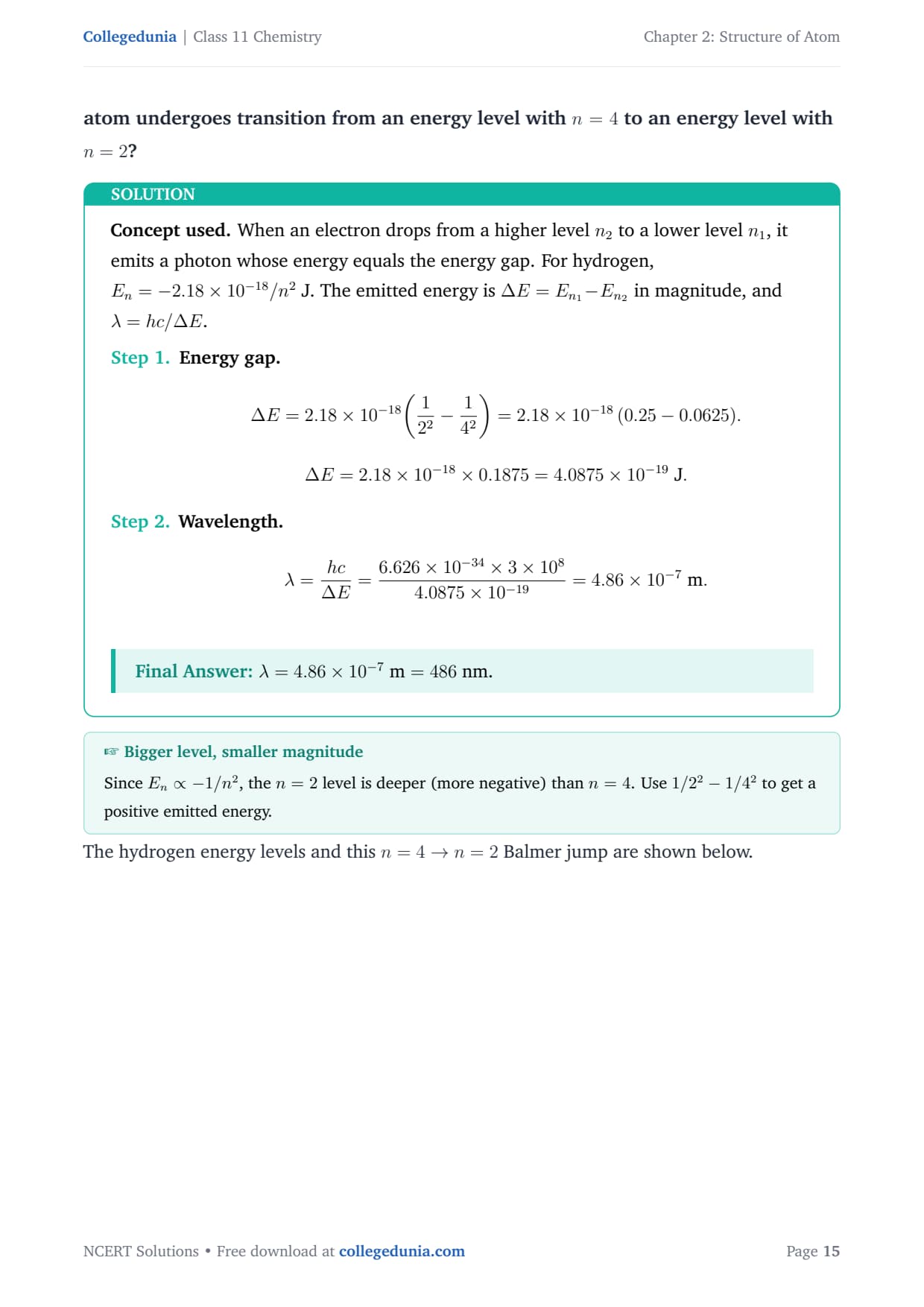
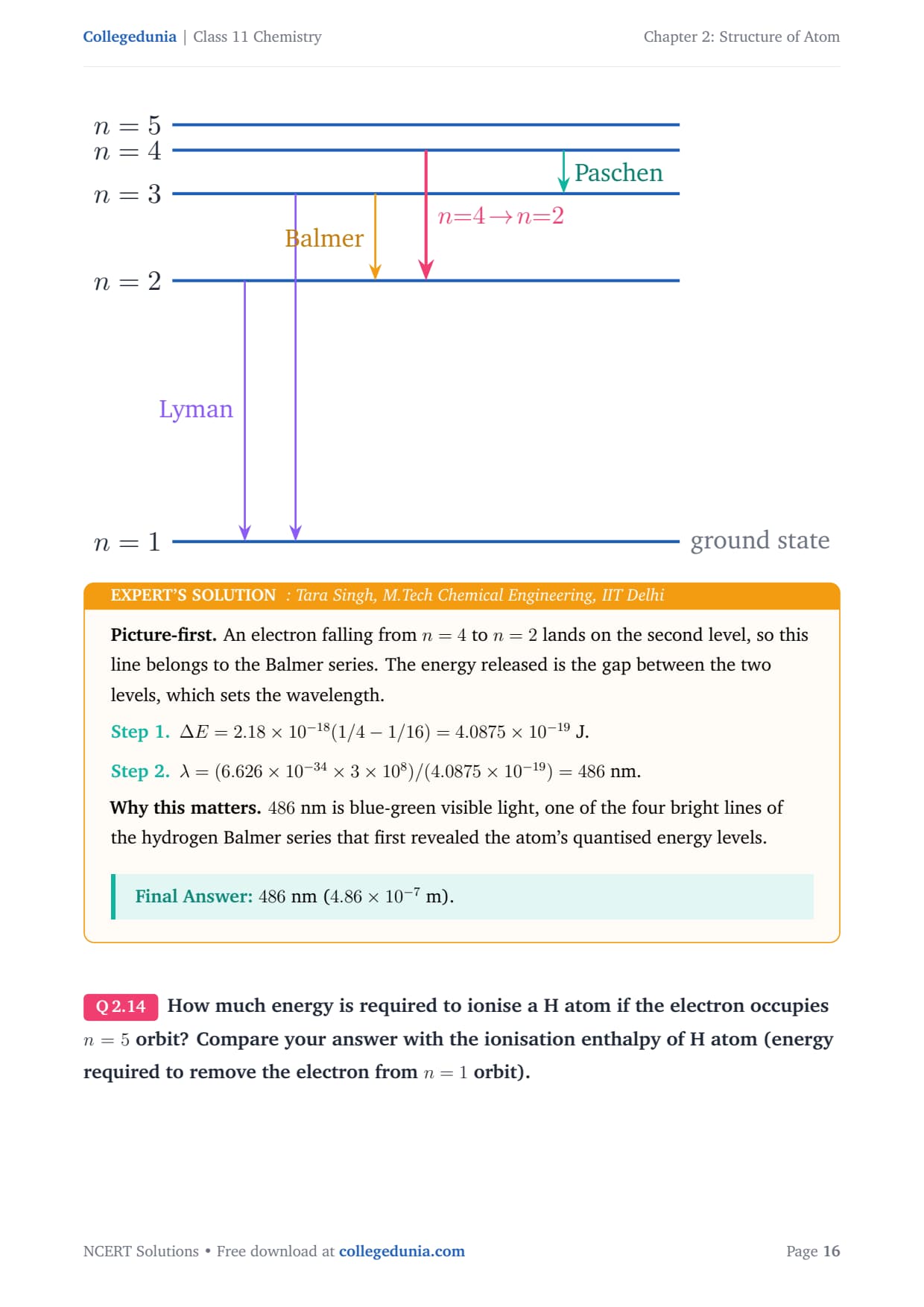
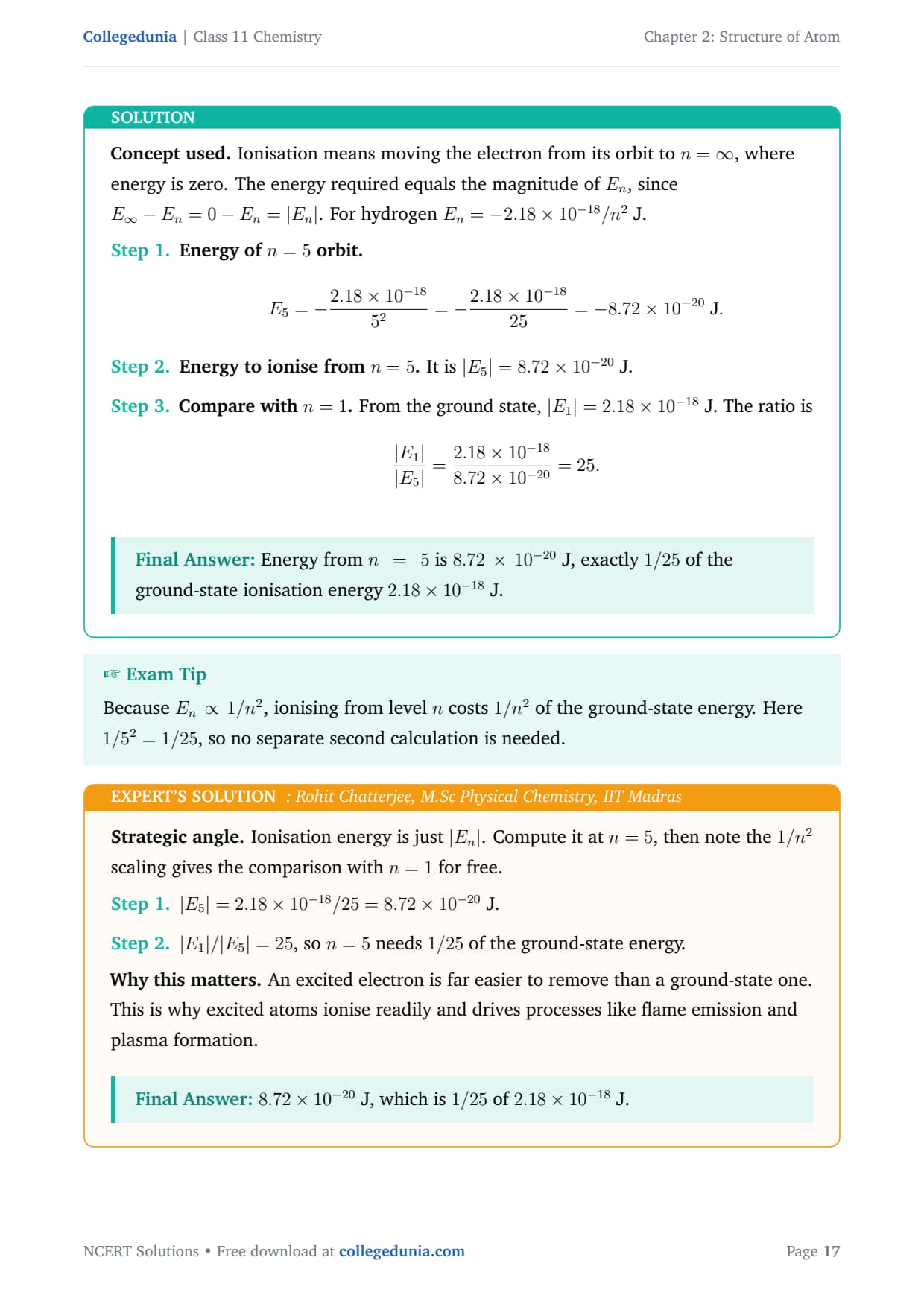
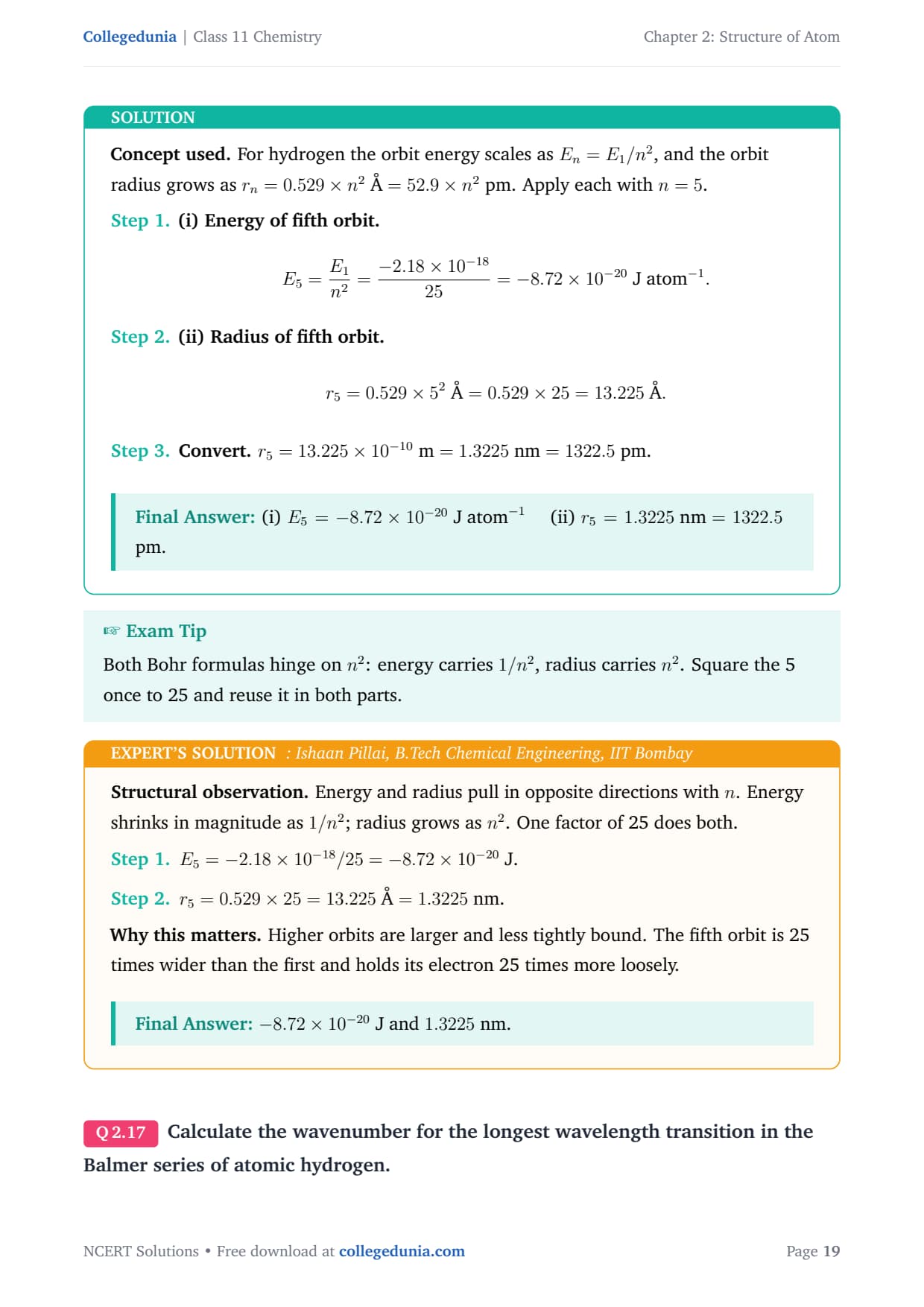
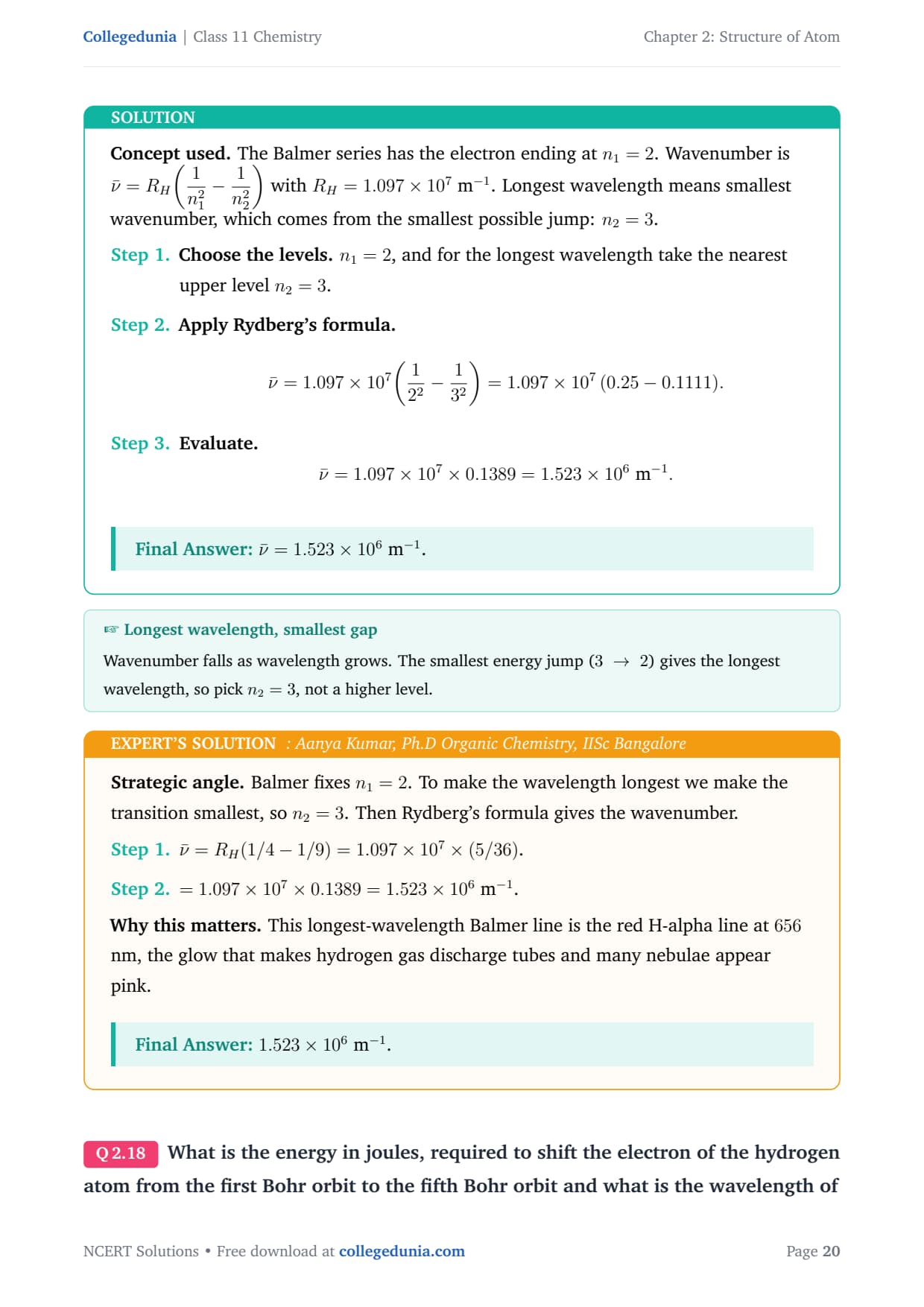
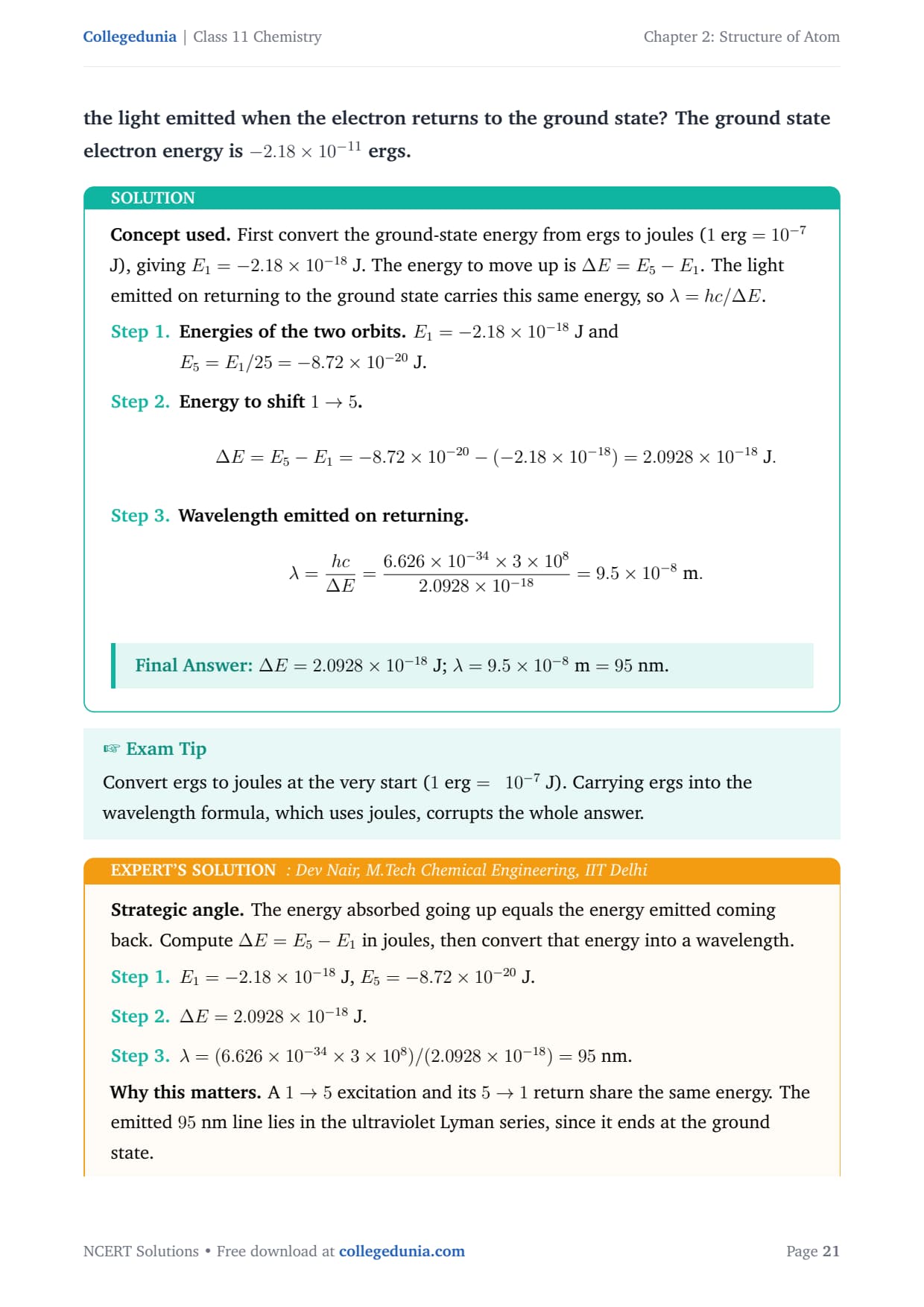
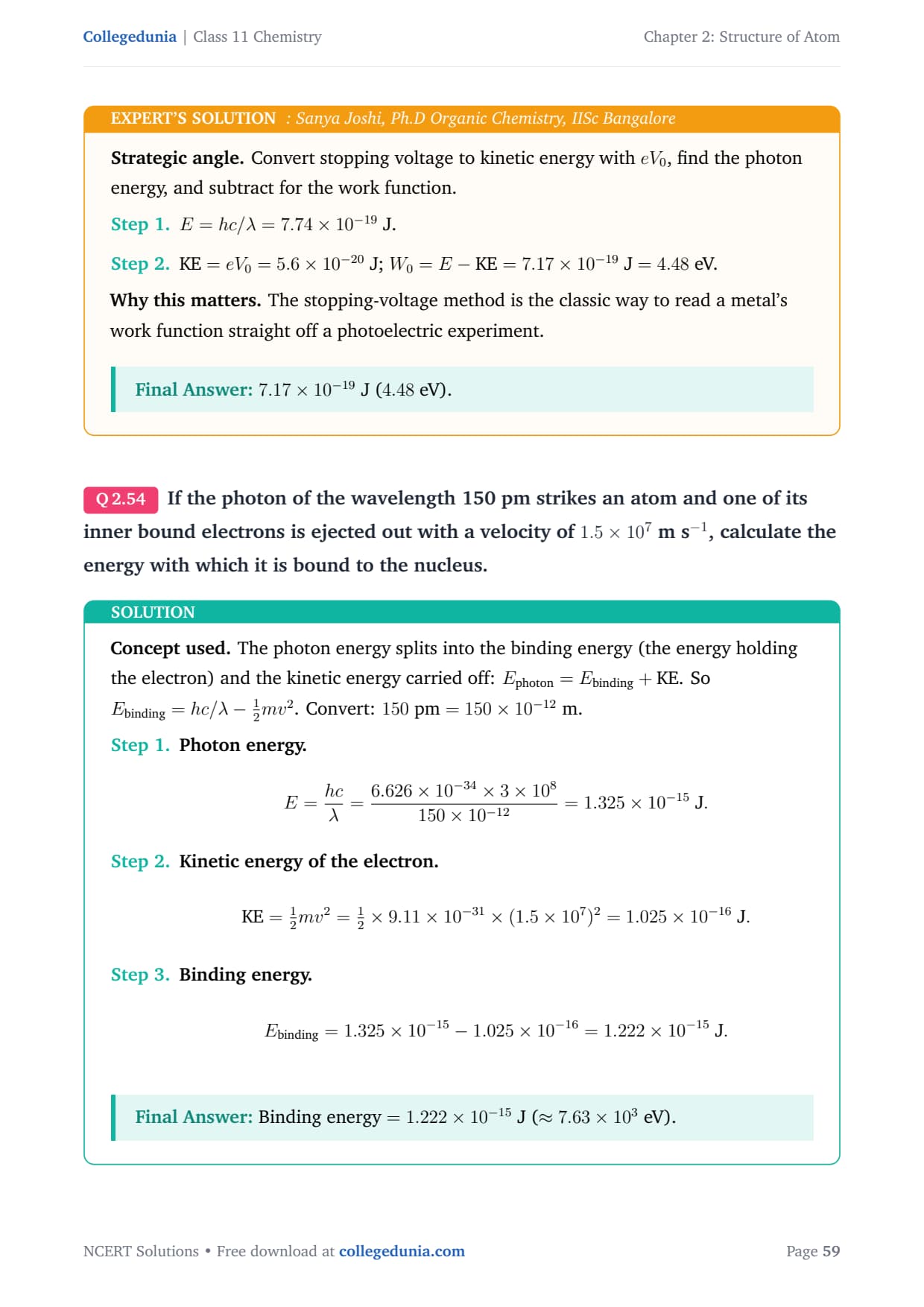
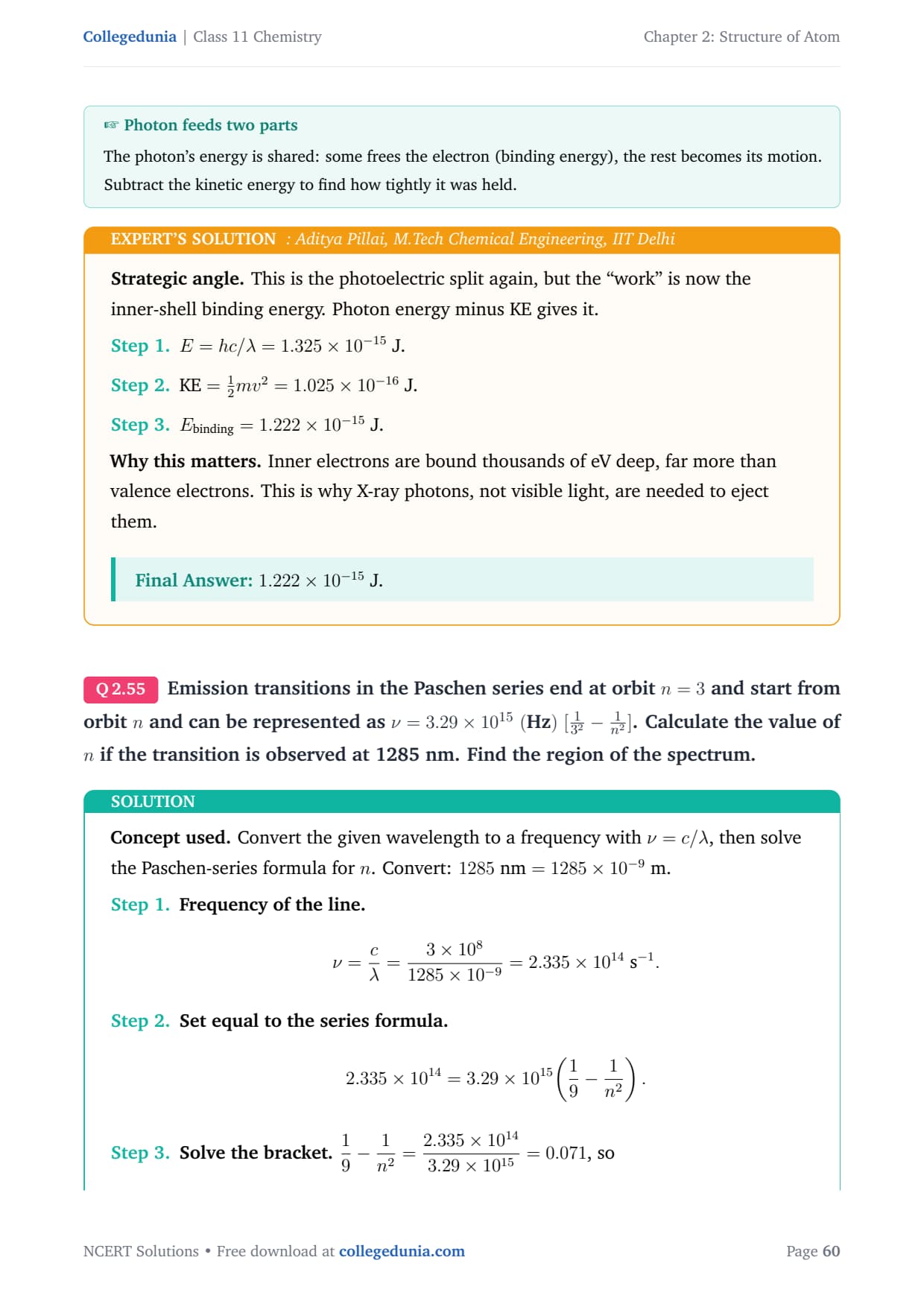
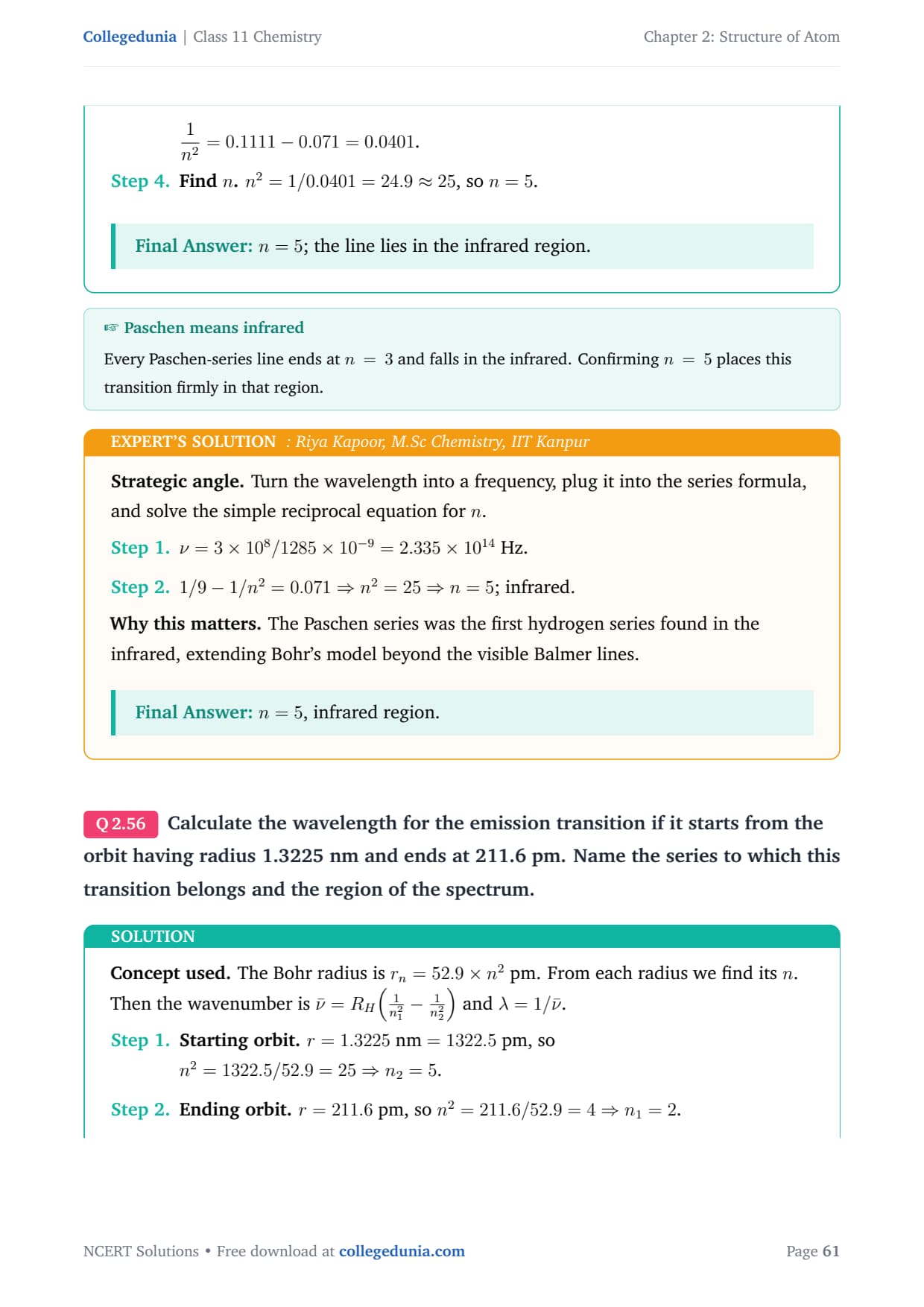
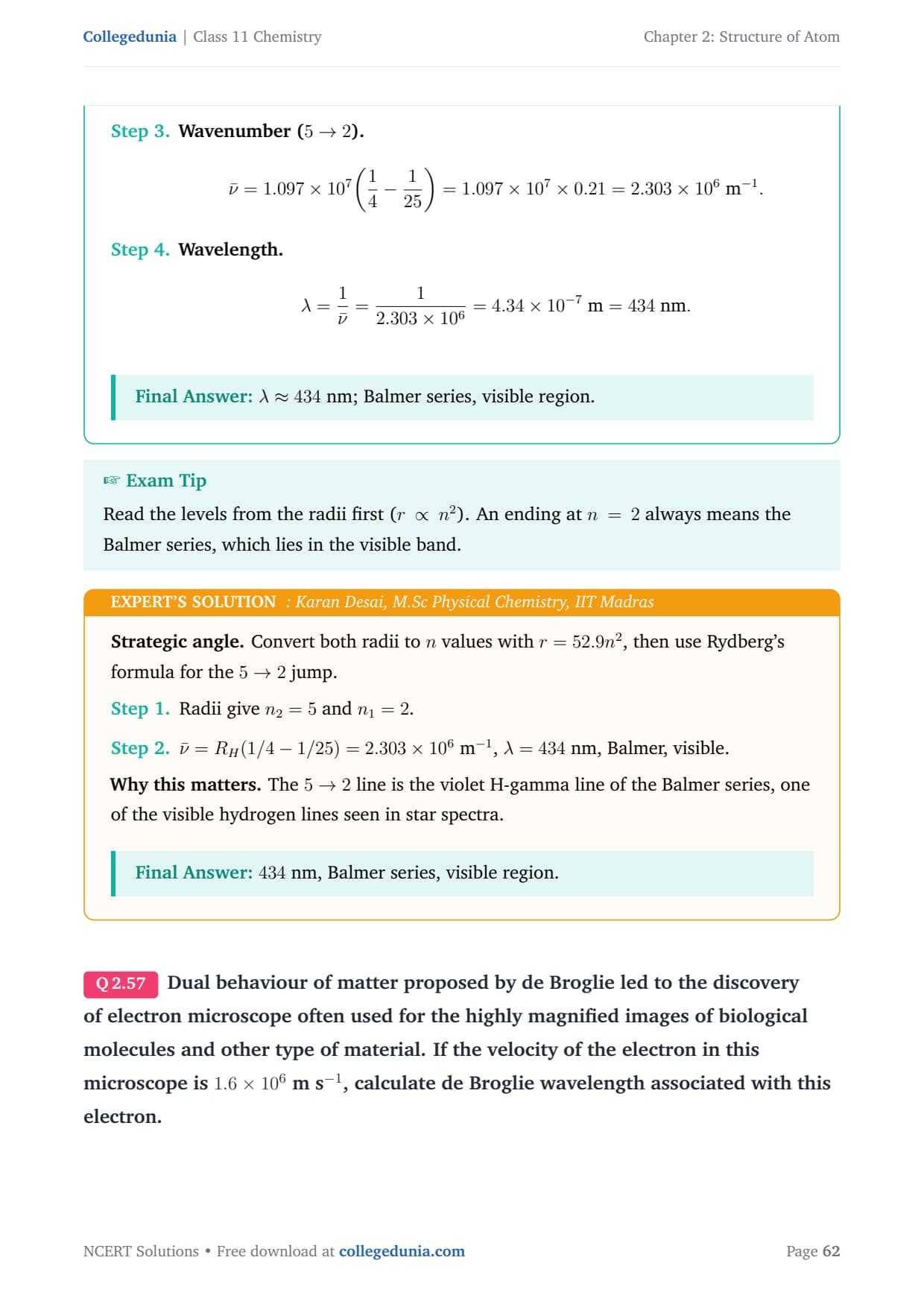
For hydrogen the energy of the n-th level is En = −13.6/n2 eV. When an electron falls to a lower level it releases a photon, which shows up as a line in the emission spectrum. The Balmer, Lyman and Paschen series each match a set of these jumps. Bohr's model works perfectly for hydrogen but fails for atoms with more than one electron, which opened the door to quantum mechanics.
Photoelectric Effect and the Dual Nature of Matter
Two experiments forced scientists to accept that light and matter both behave in two ways. The photoelectric effect and de Broglie's idea of matter waves are the bridge from the Bohr model to the quantum model.
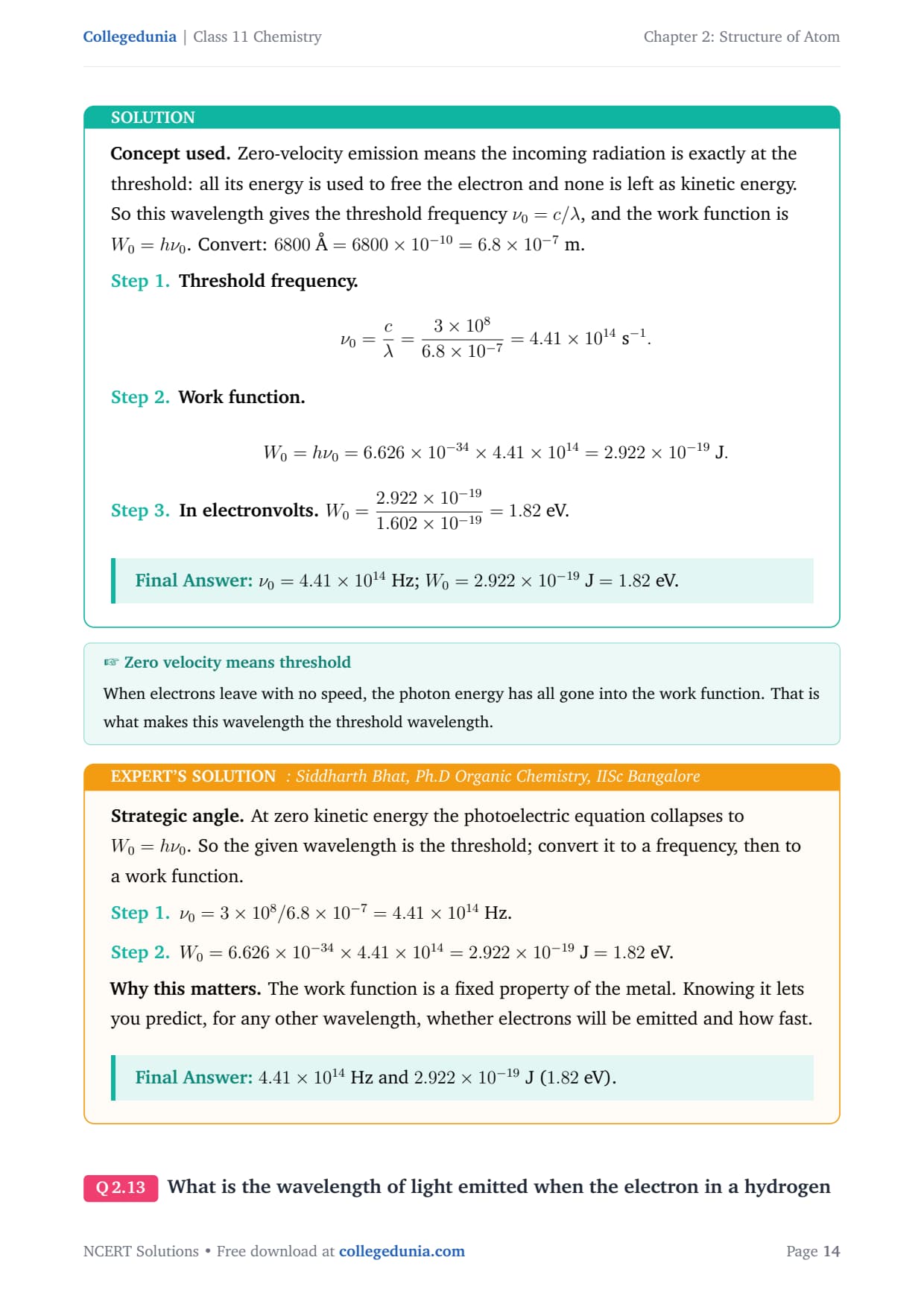
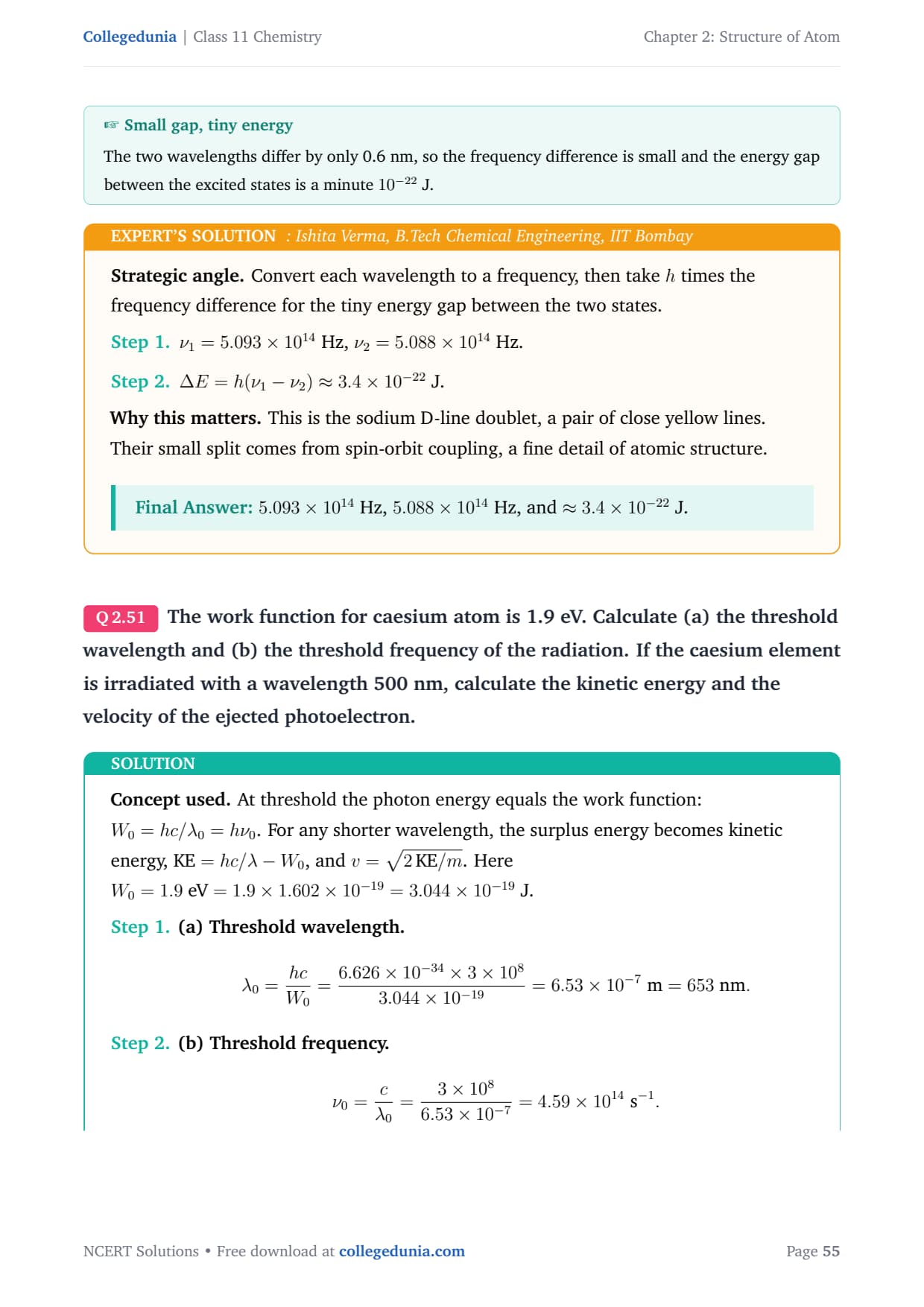
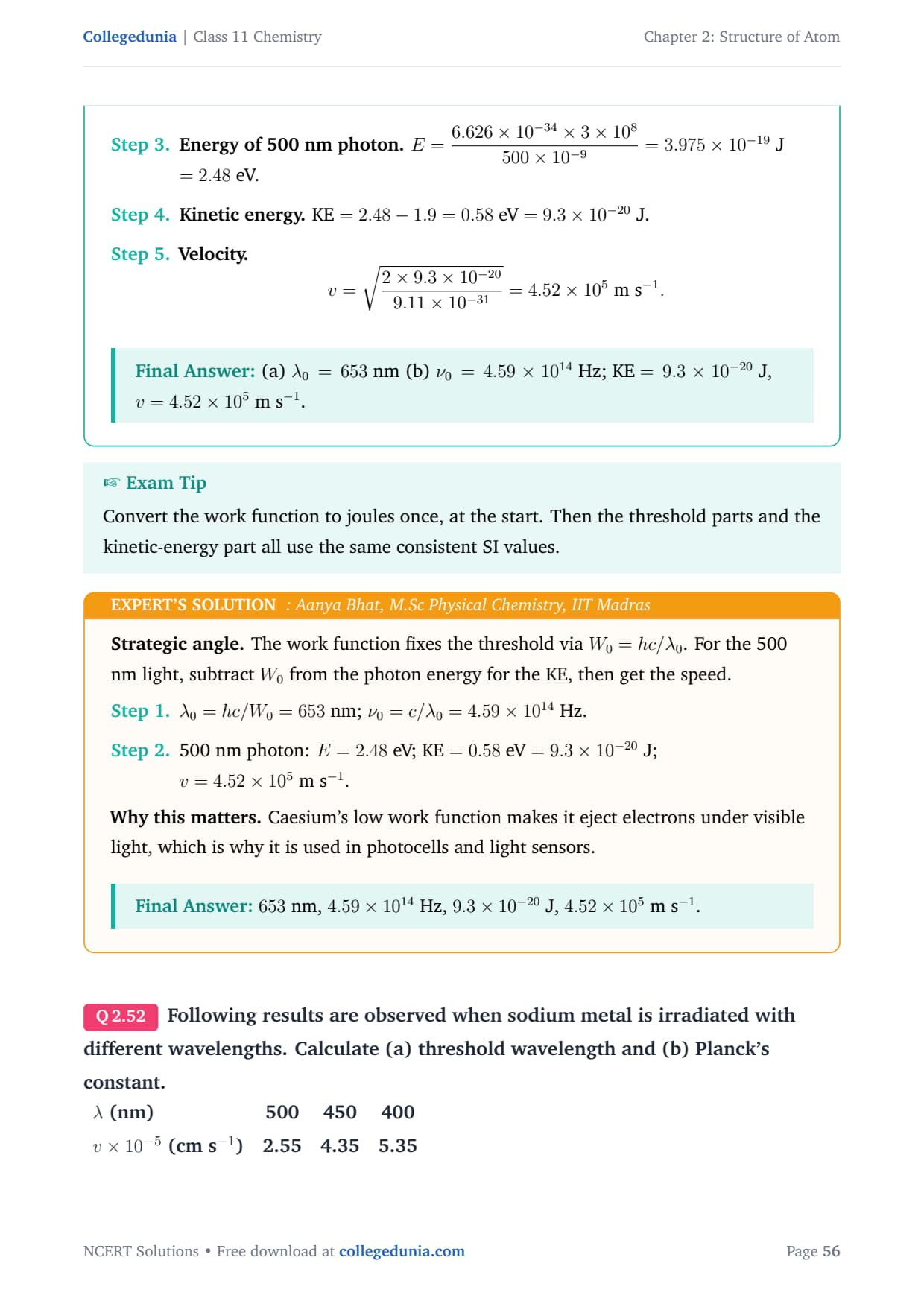
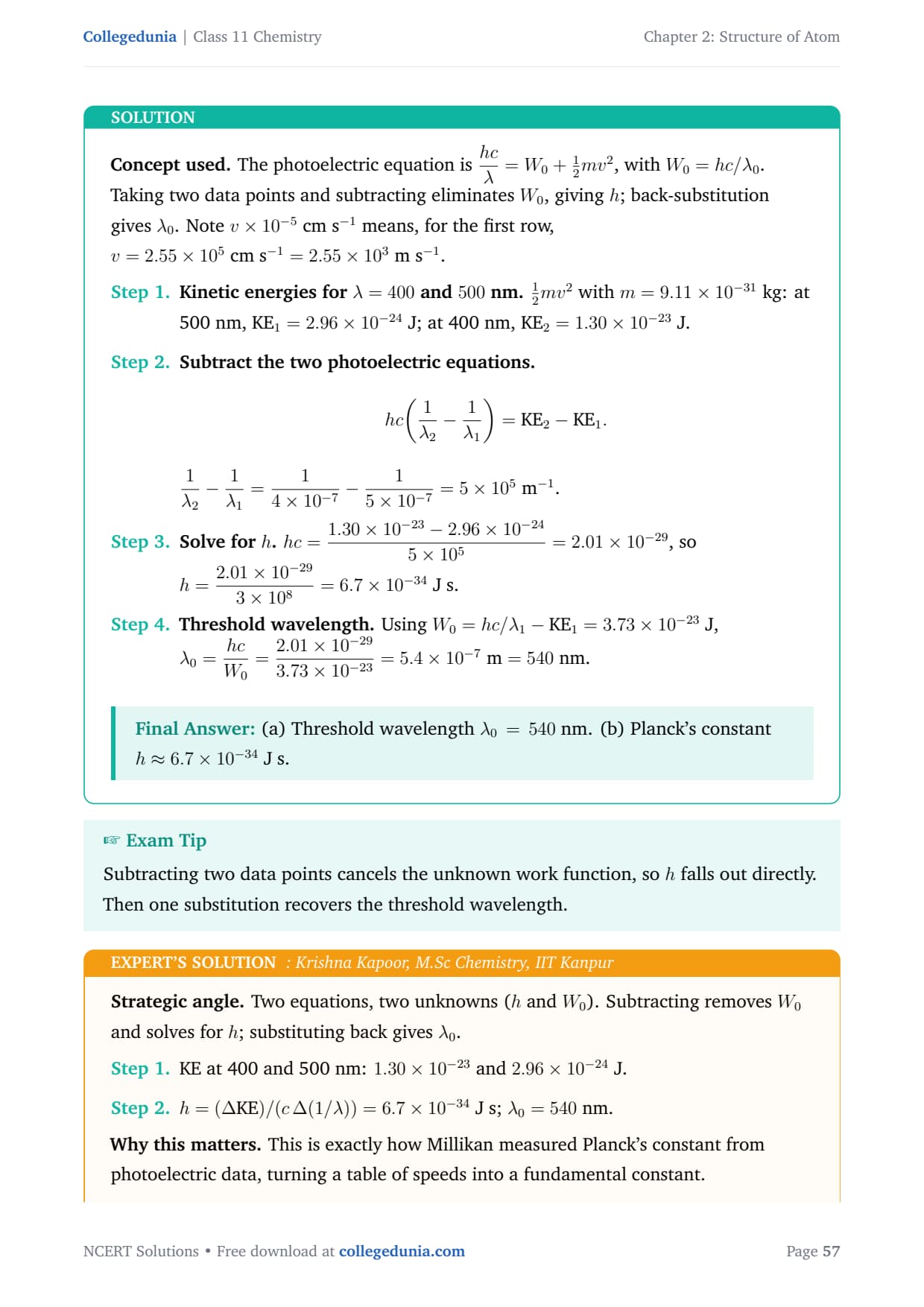
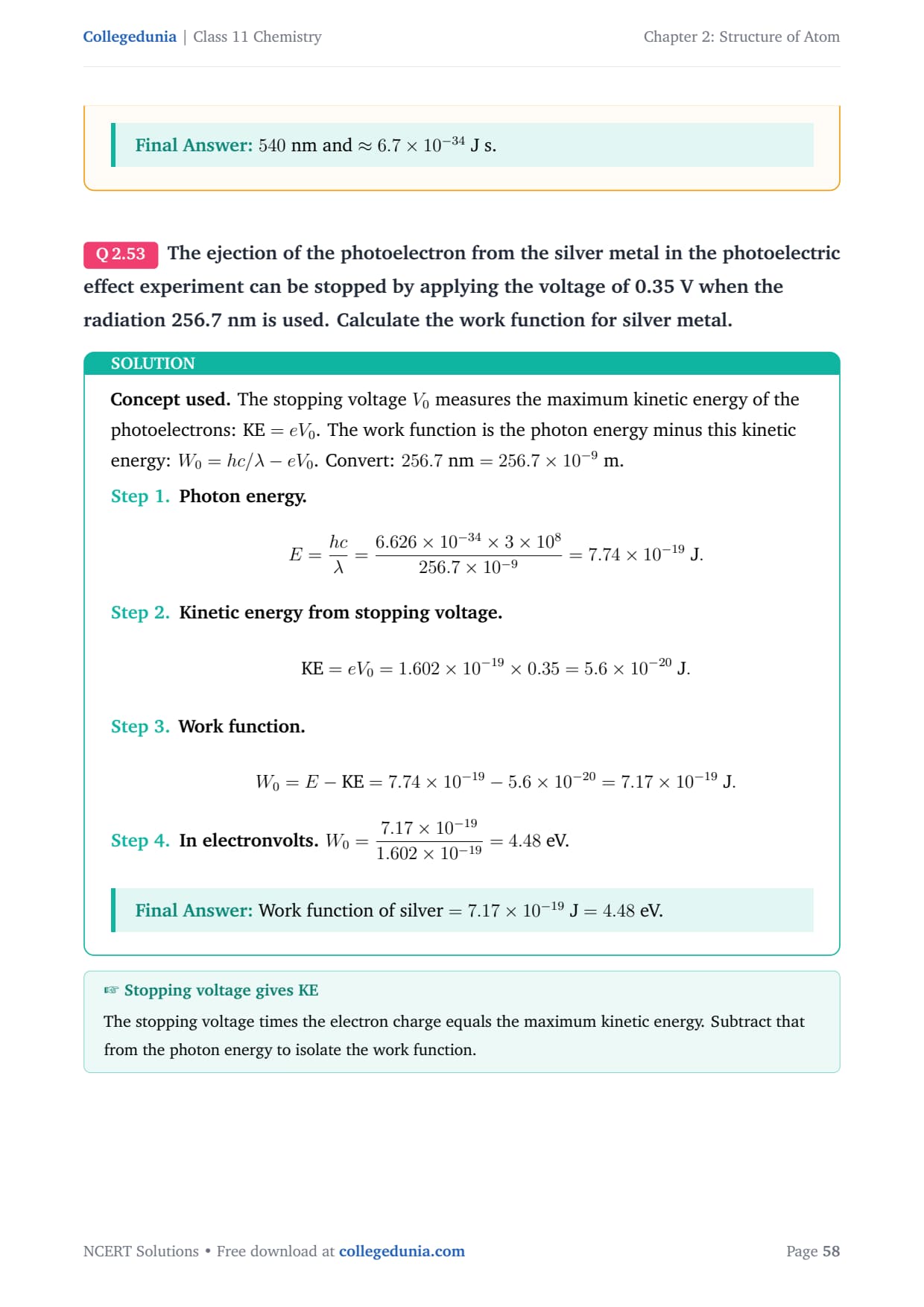
- Photoelectric effect: light shining on a metal ejects electrons, but only if its frequency is above a threshold value.
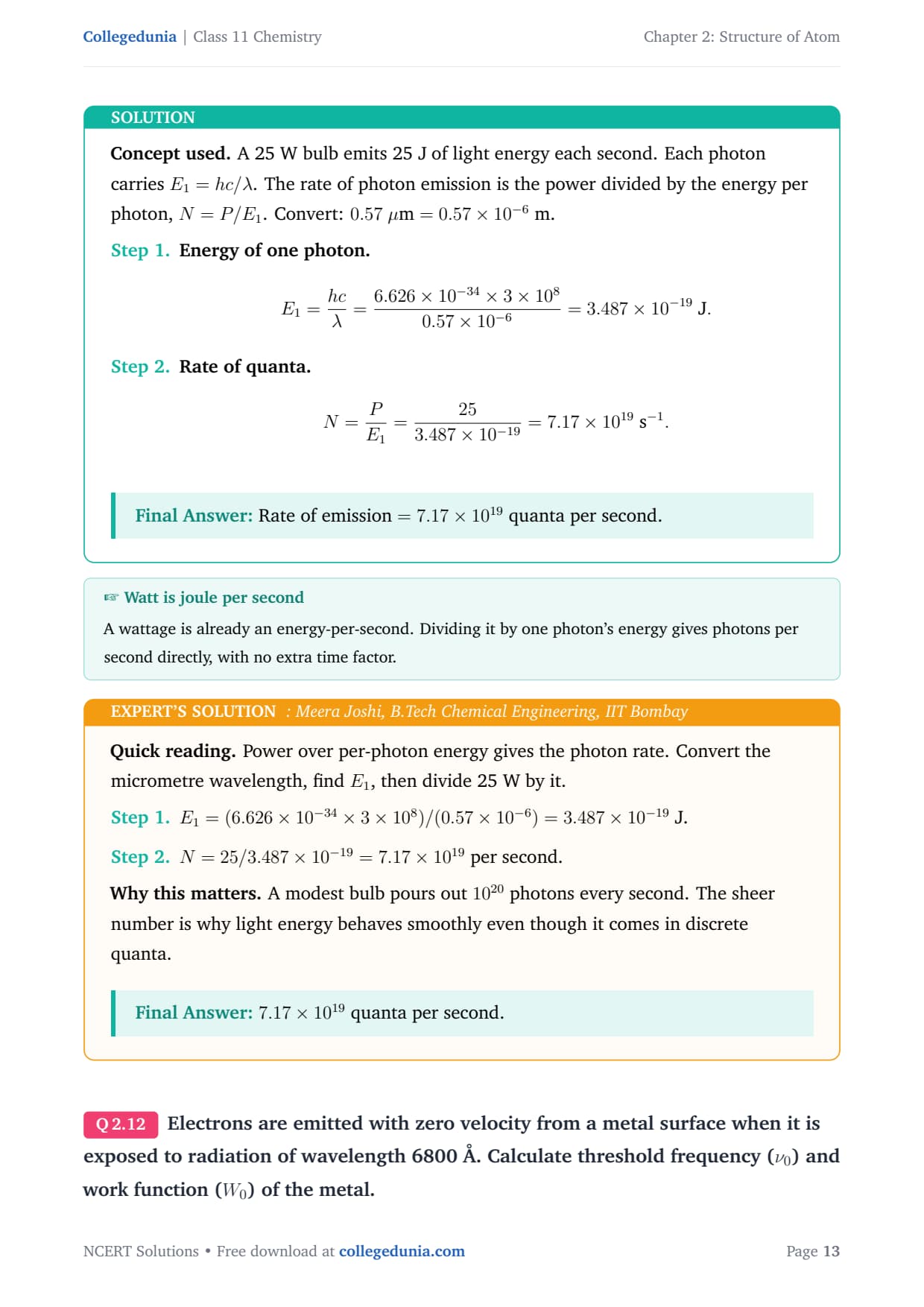
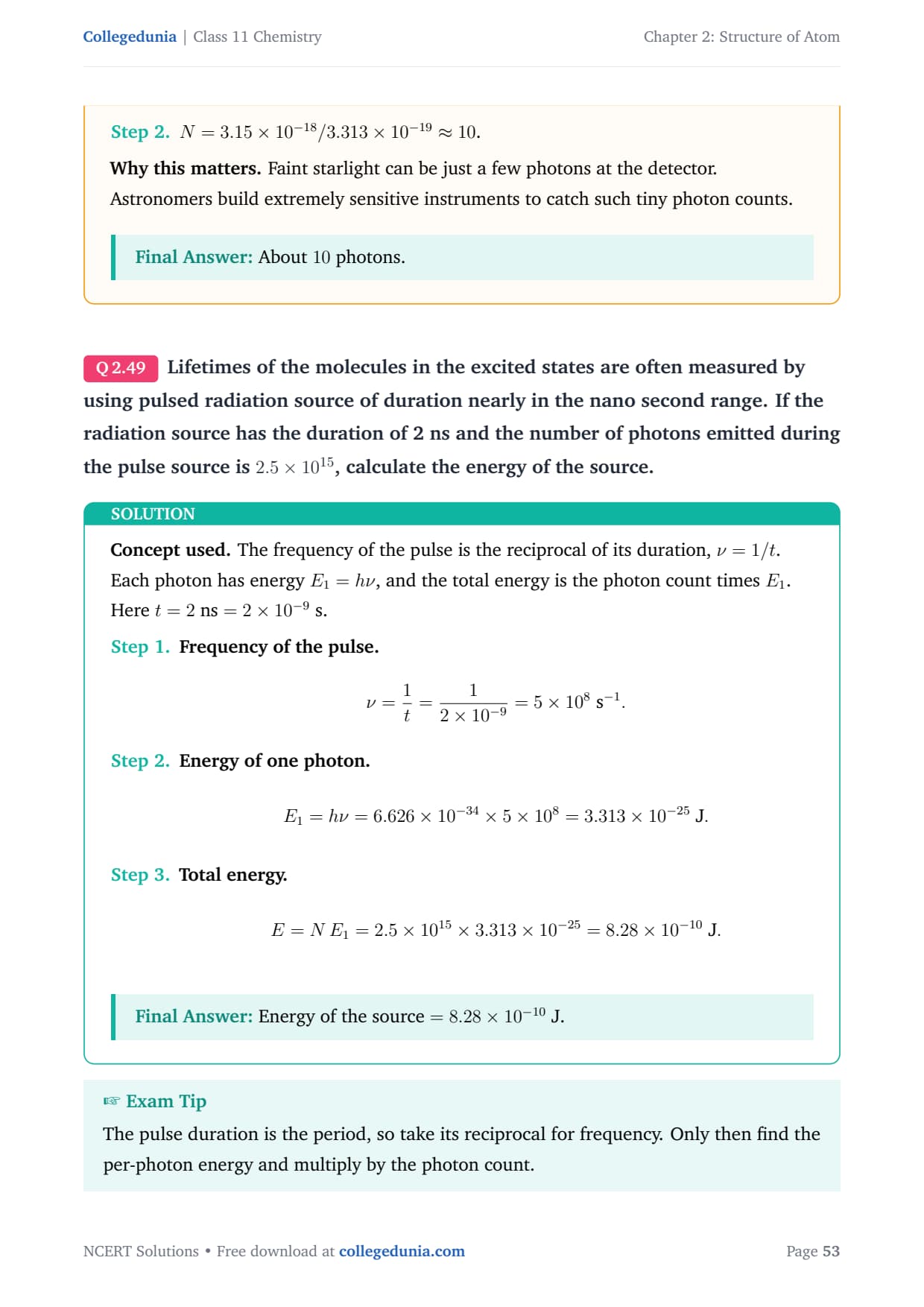
- Photon energy: light comes in packets of energy E = hν, where h is Planck's constant, 6.626 × 10⁻³⁴ J s.
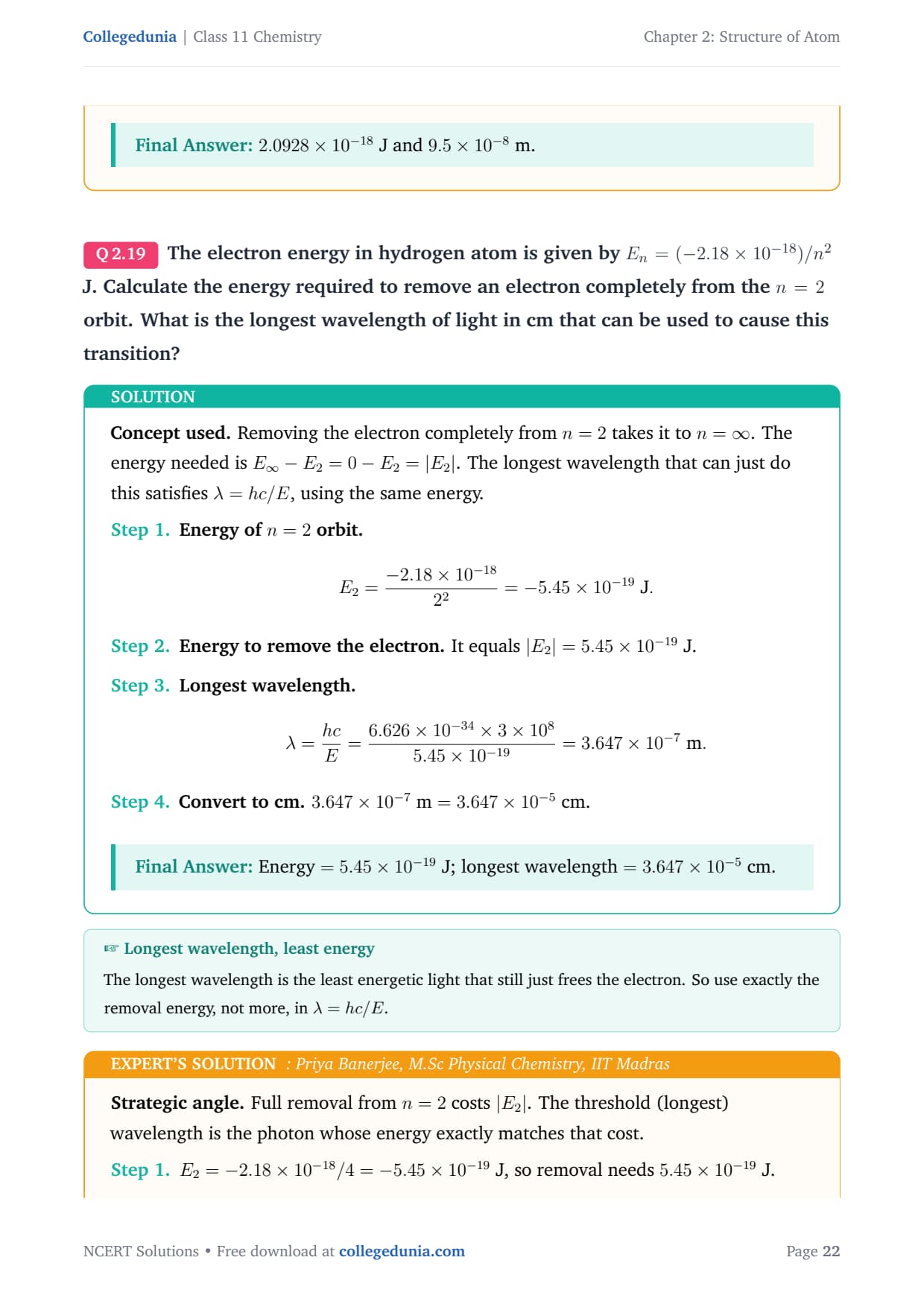
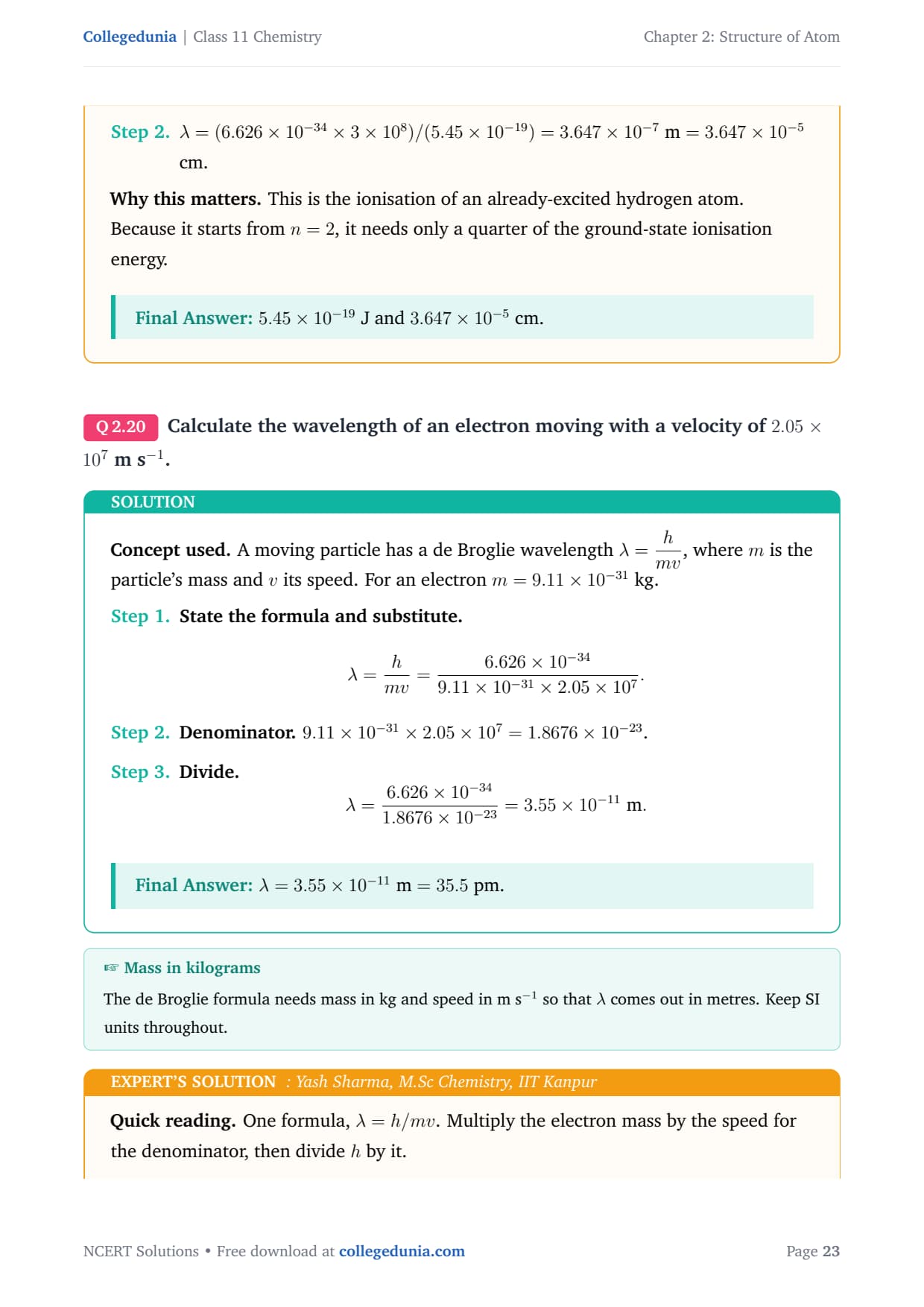
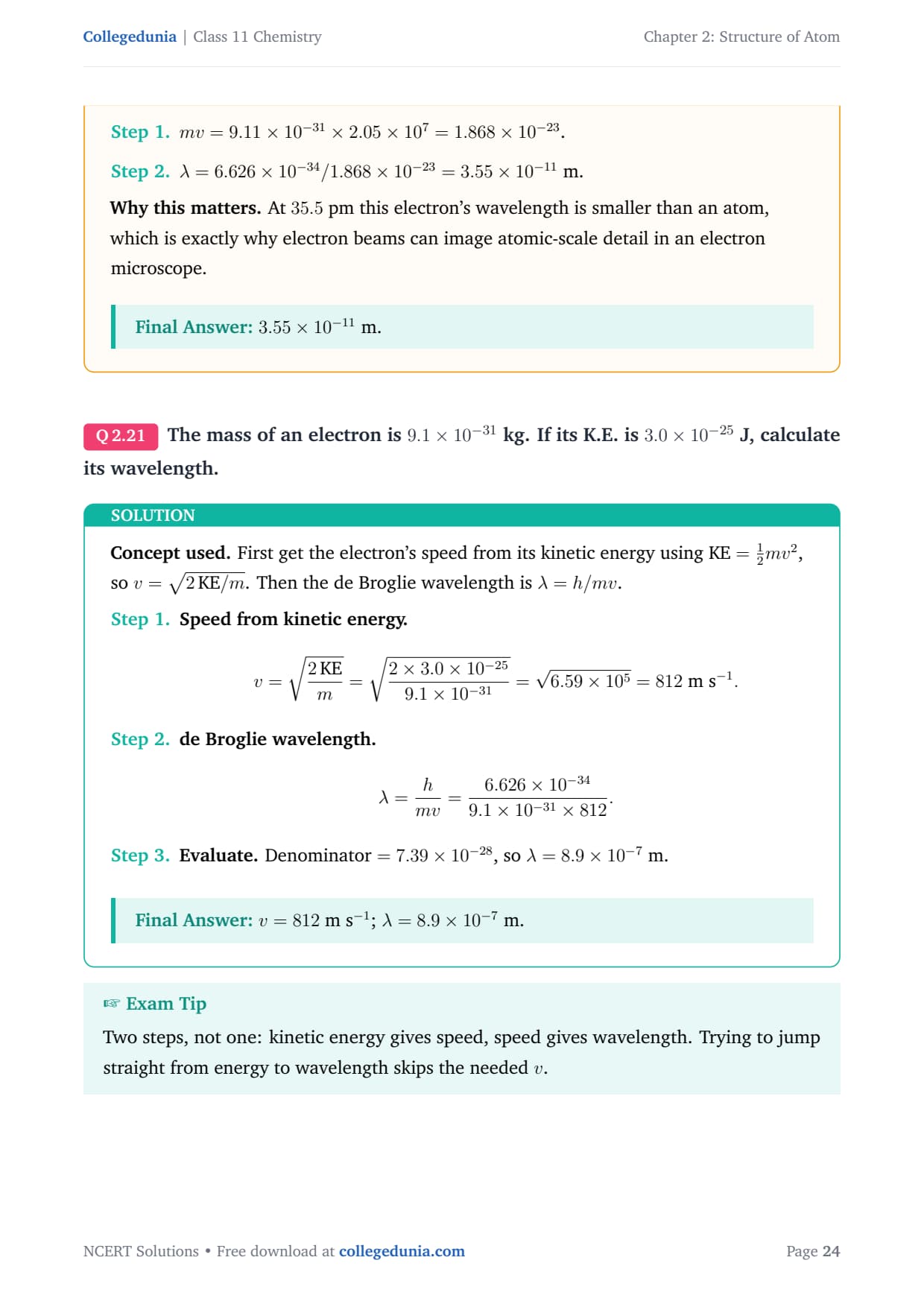
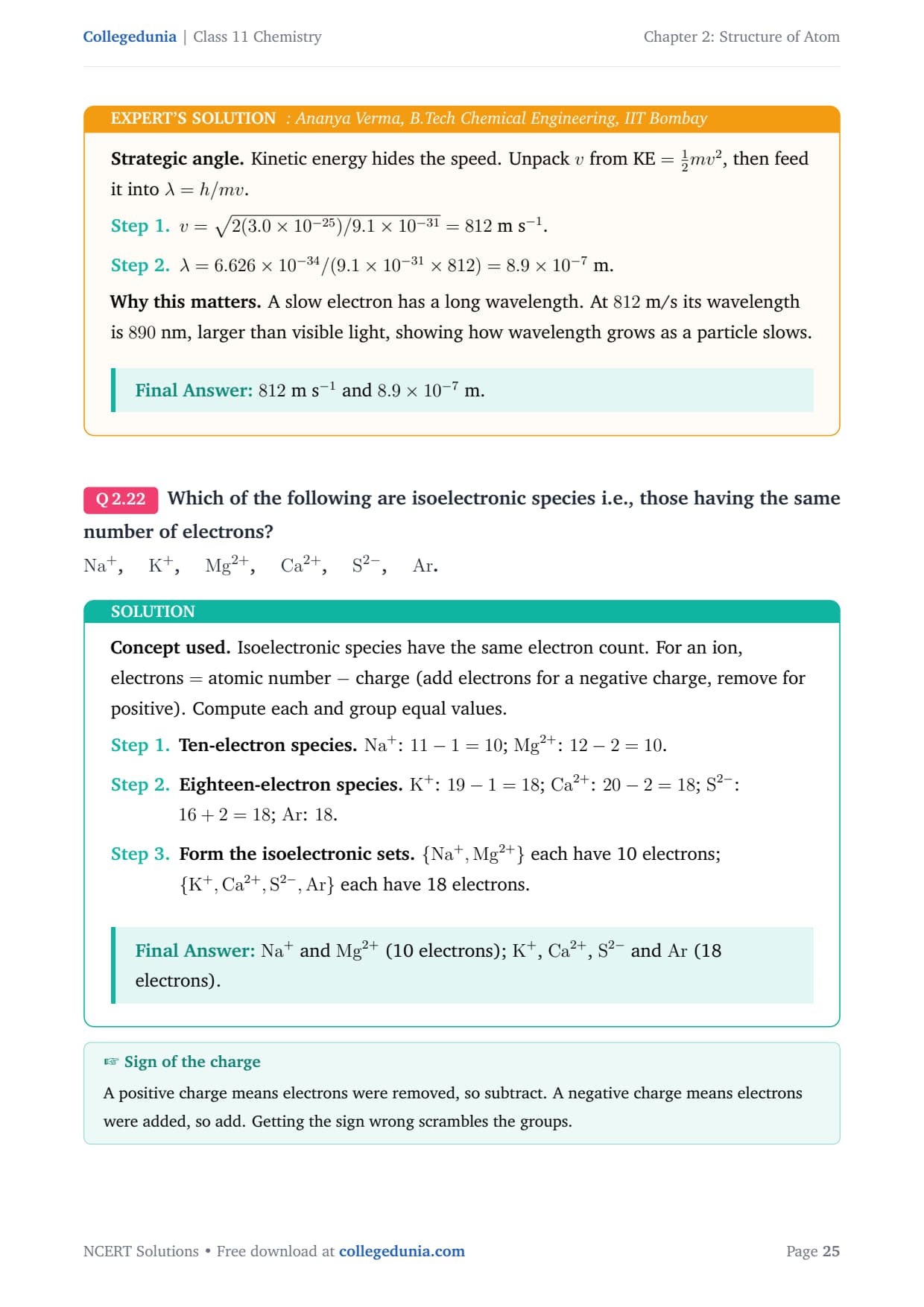
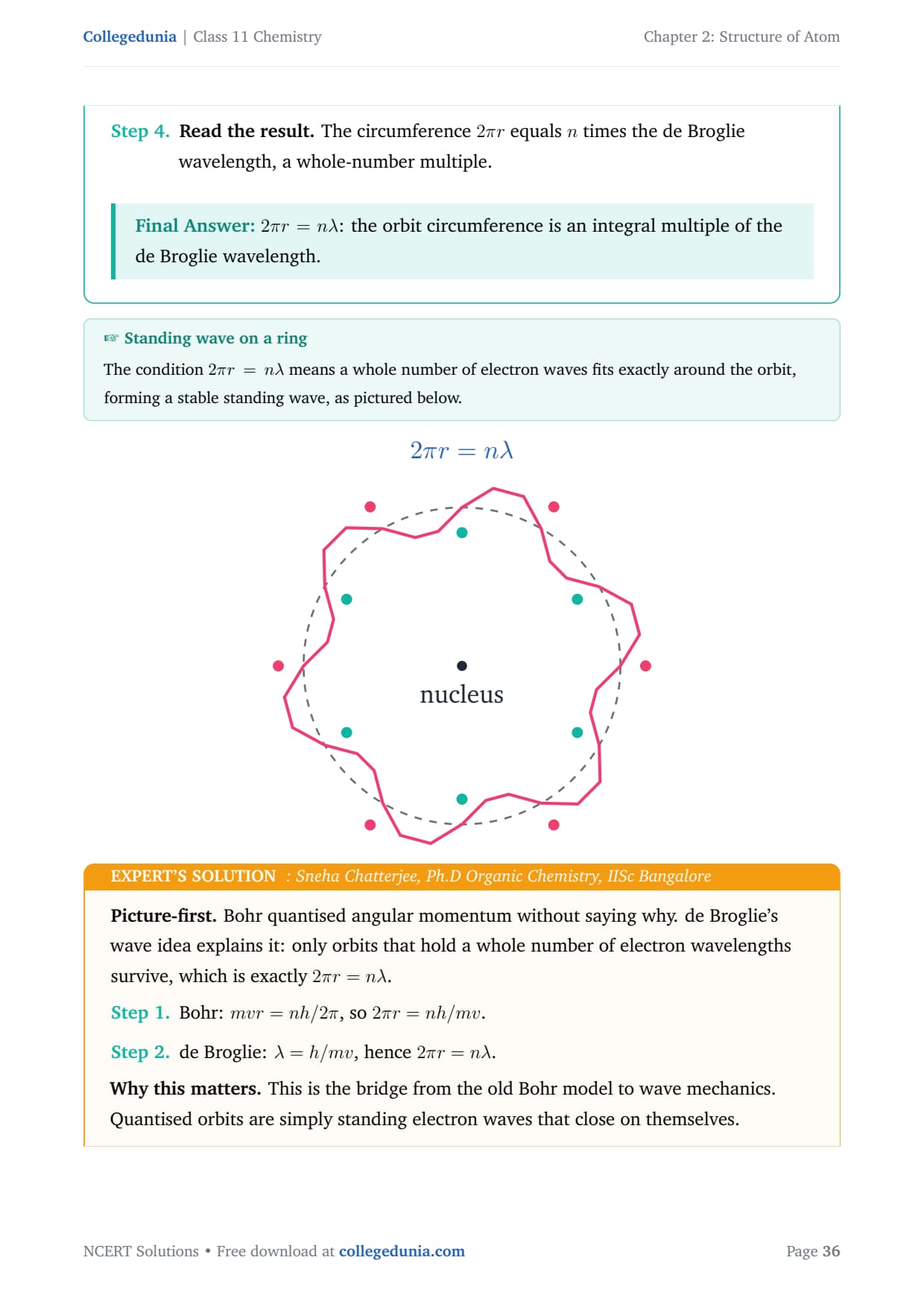
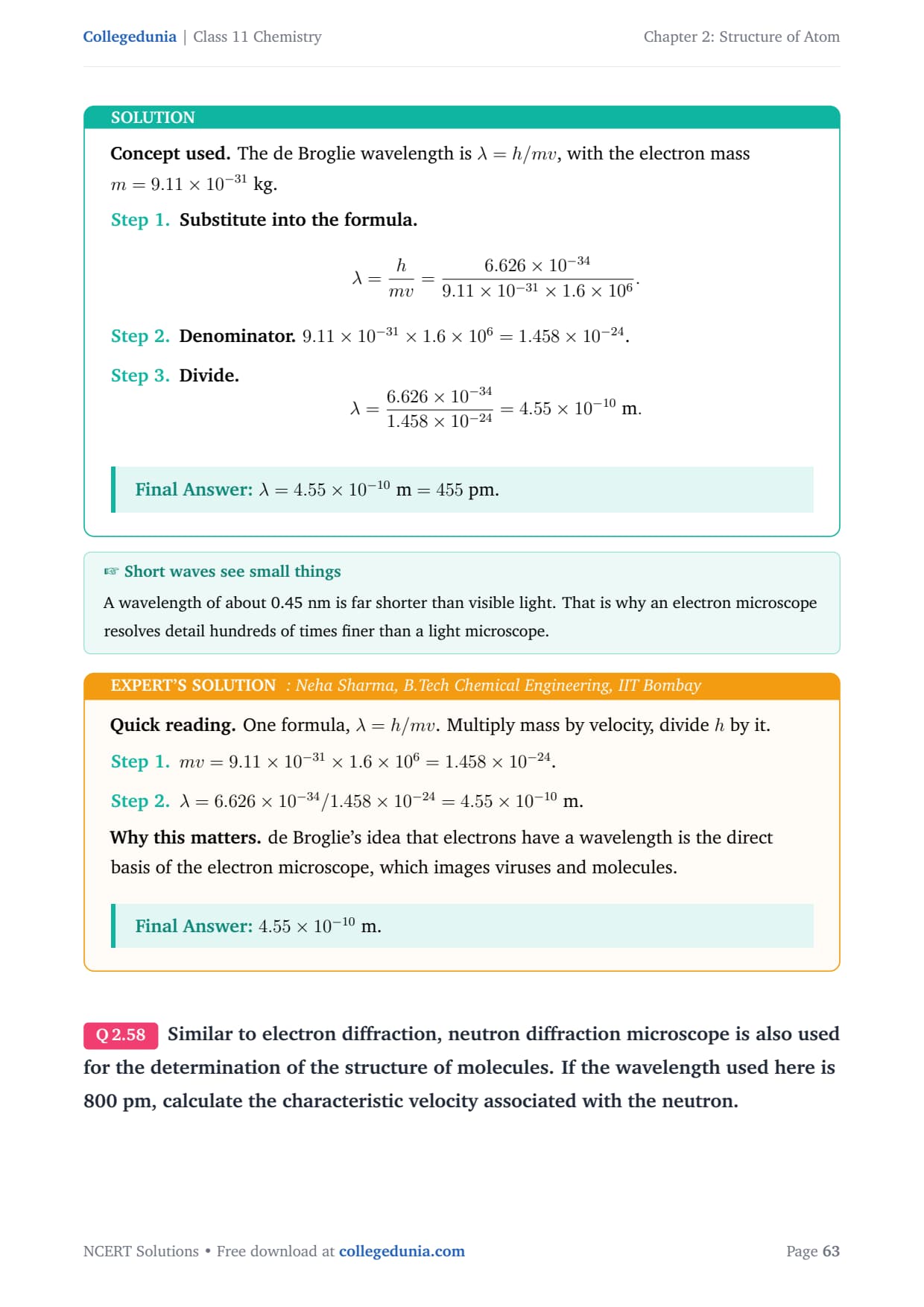
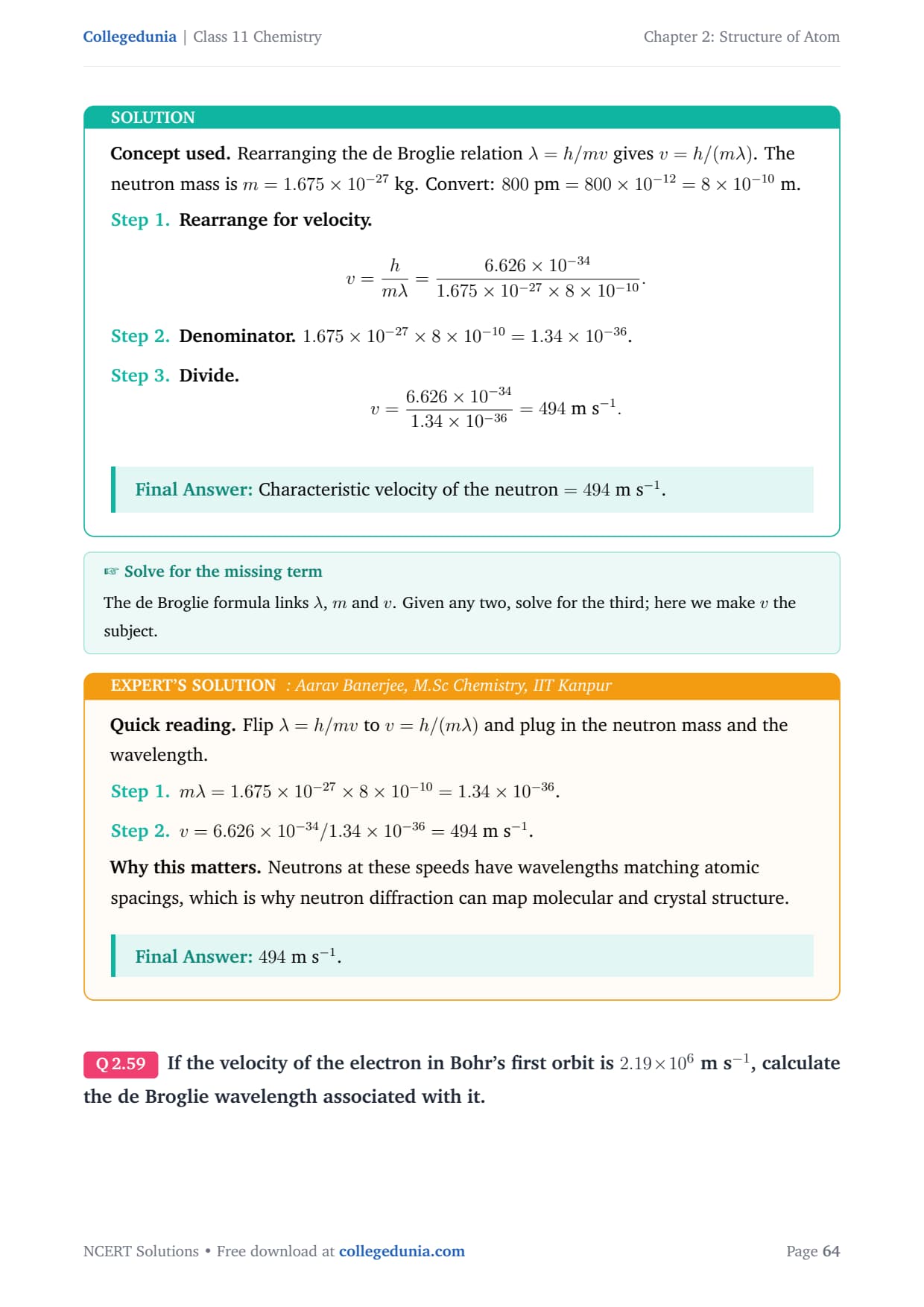
- de Broglie relation: every moving particle has a wavelength λ = h/mv, so matter has a wave nature too.
The photoelectric effect proved light behaves as particles, since a dim high-frequency beam ejects electrons while a bright low-frequency beam does not. Below the threshold frequency, no electron is emitted however bright the light is. Heisenberg's uncertainty principle then showed you cannot know an electron's exact position and momentum at once. Together these ideas replace the fixed orbit with a region of probability called an orbital.
Quantum Numbers and the Shapes of Orbitals
The quantum model describes each electron with four quantum numbers, an address that fixes its energy, shape, orientation and spin. Every question on orbitals starts here, so learn what each number stands for.
| Quantum number | Symbol | What it tells you |
|---|---|---|
| Principal | n | The shell and the main energy level; larger n means larger size. |
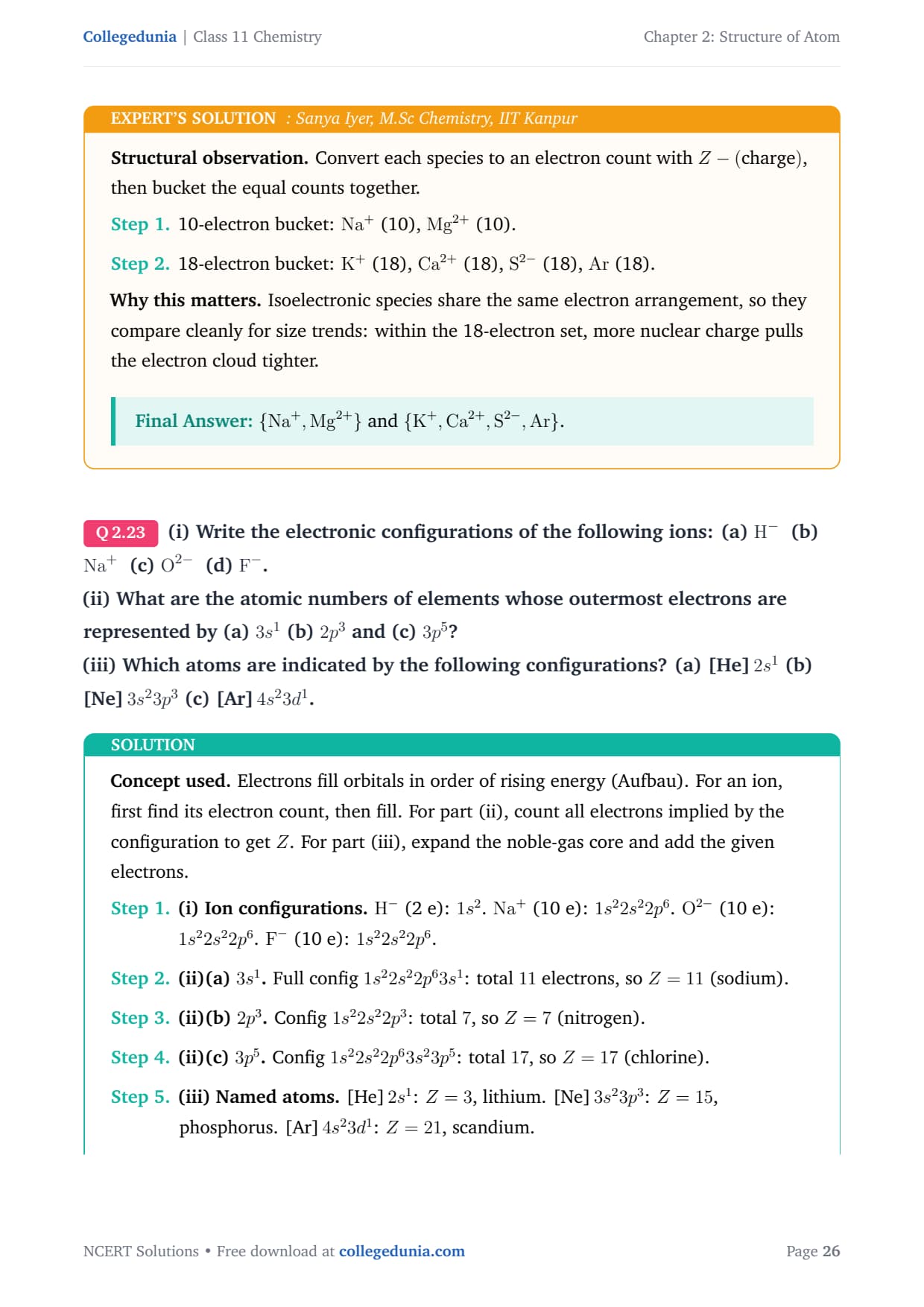
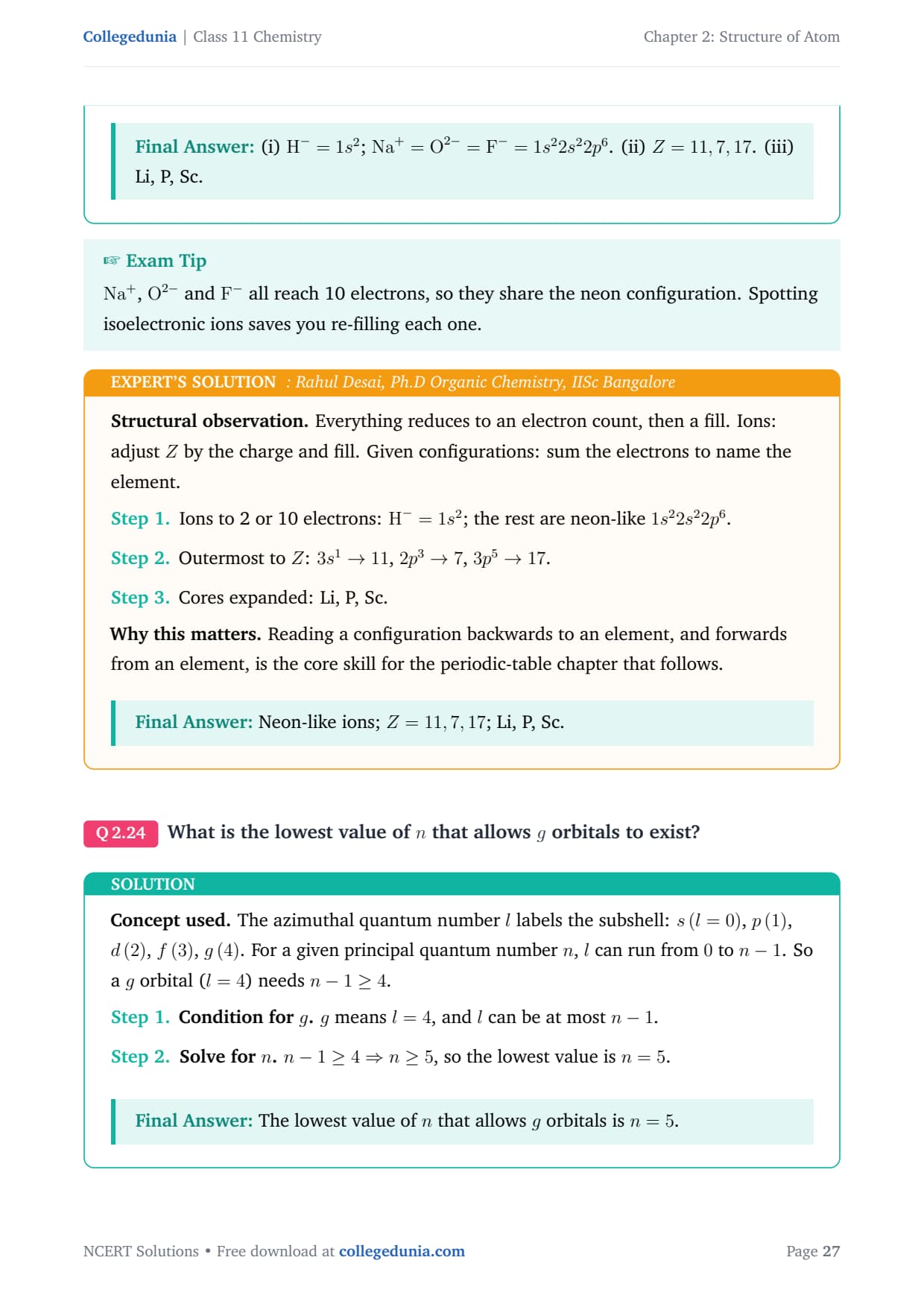
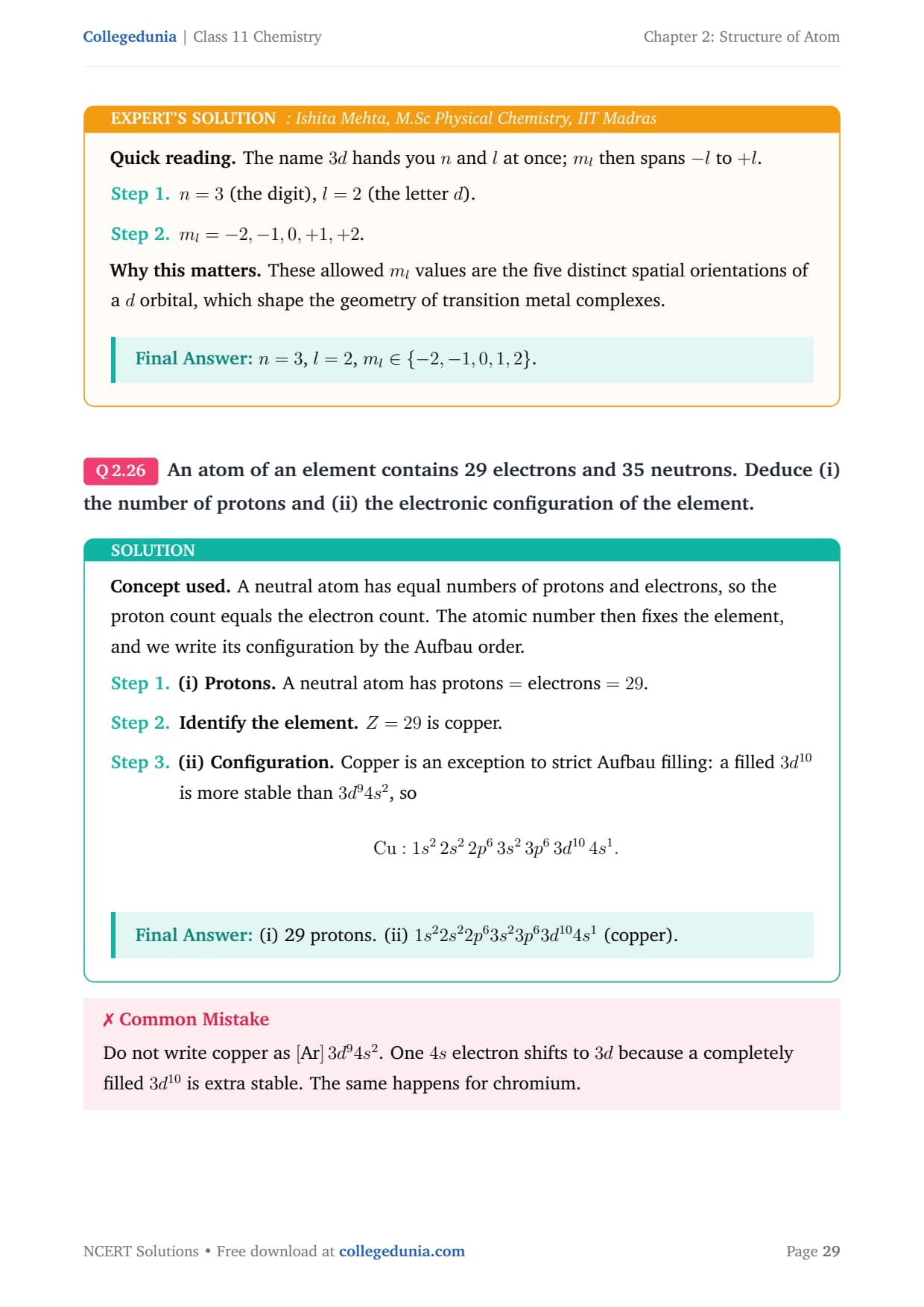
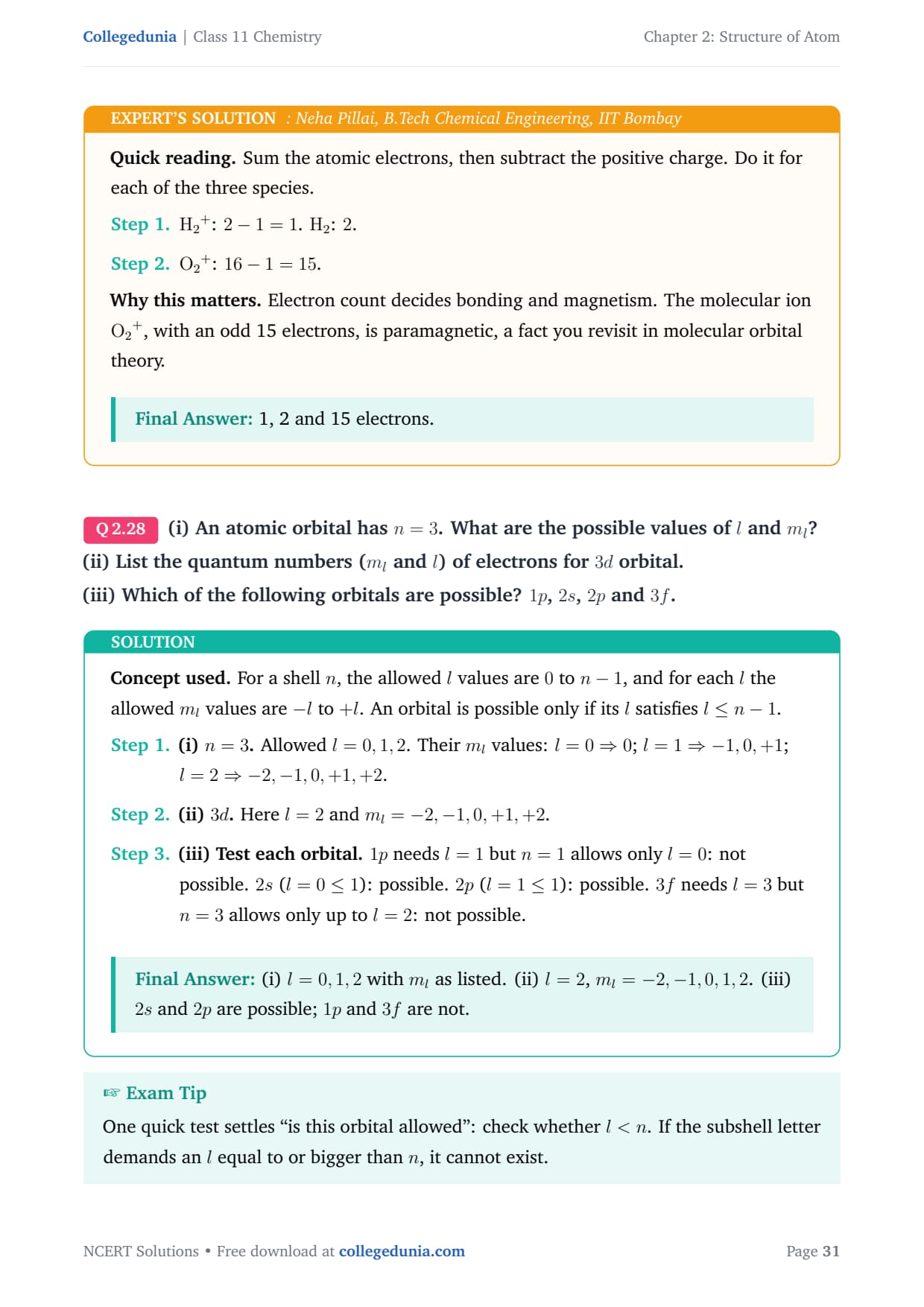
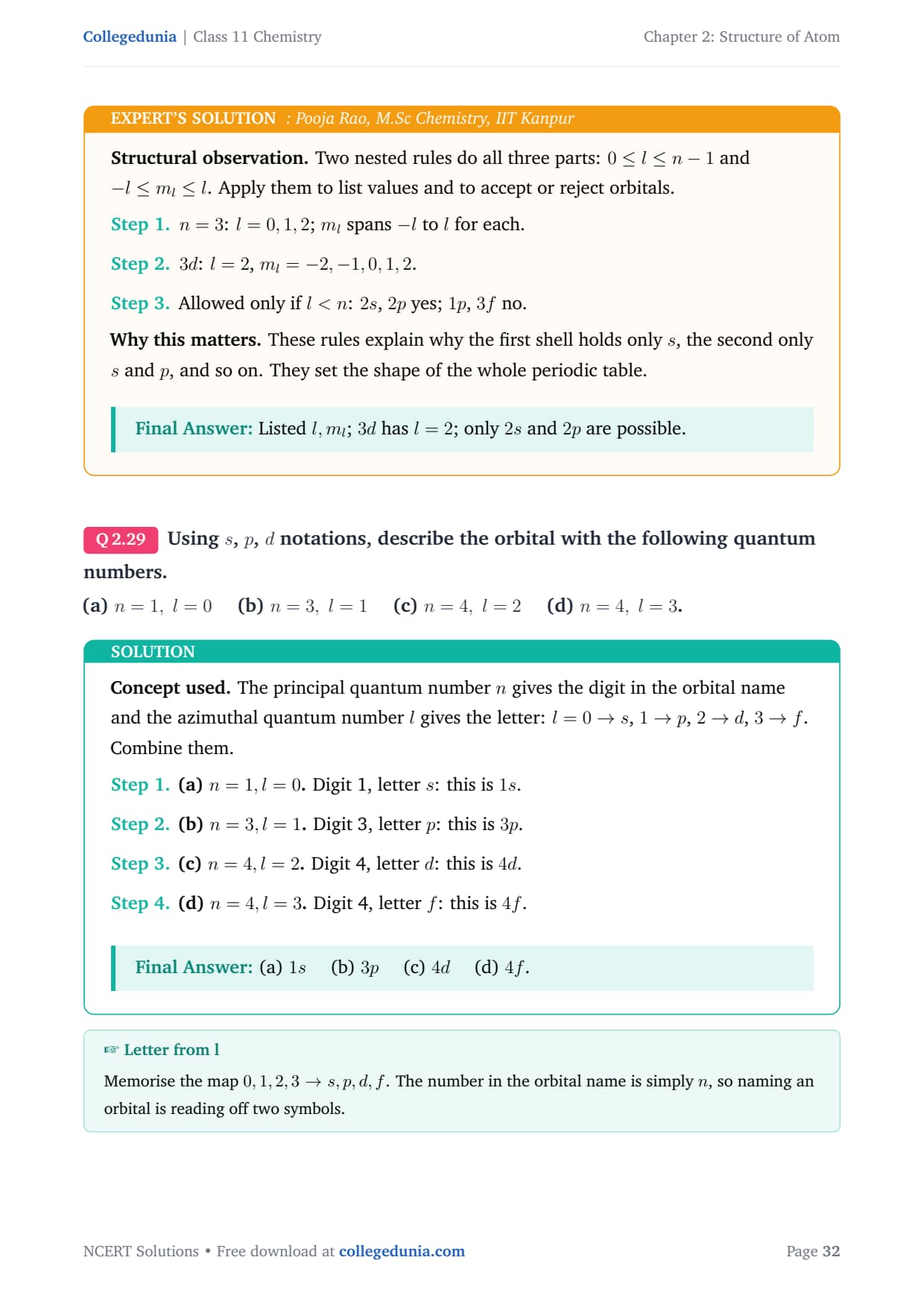
| Azimuthal | l | The subshell and orbital shape; l = 0, 1, 2, 3 give s, p, d, f. |
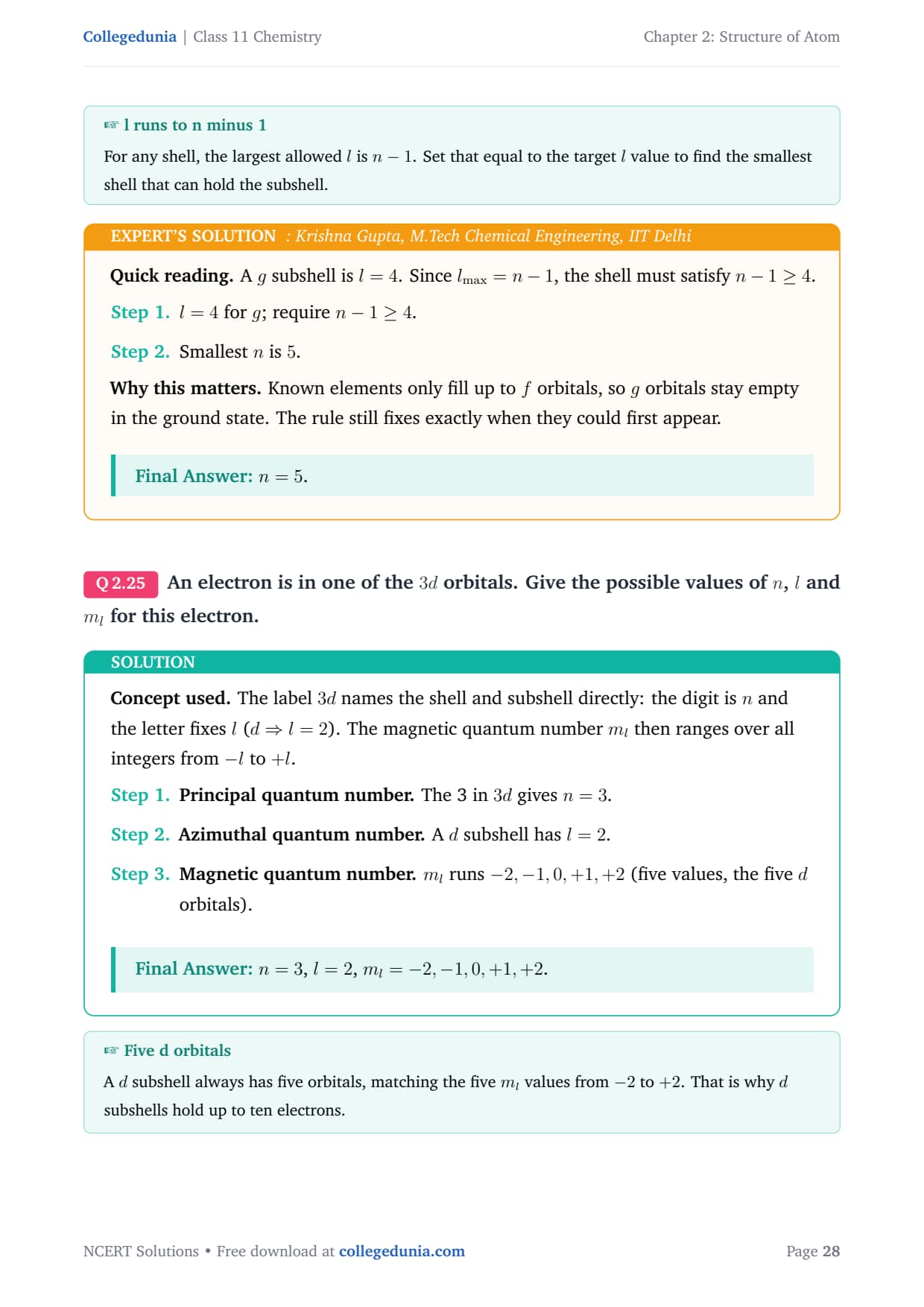
| Magnetic | ml | The orientation of the orbital in space; ranges from −l to +l. |
| Spin | ms | The direction of electron spin, either +1/2 or −1/2. |
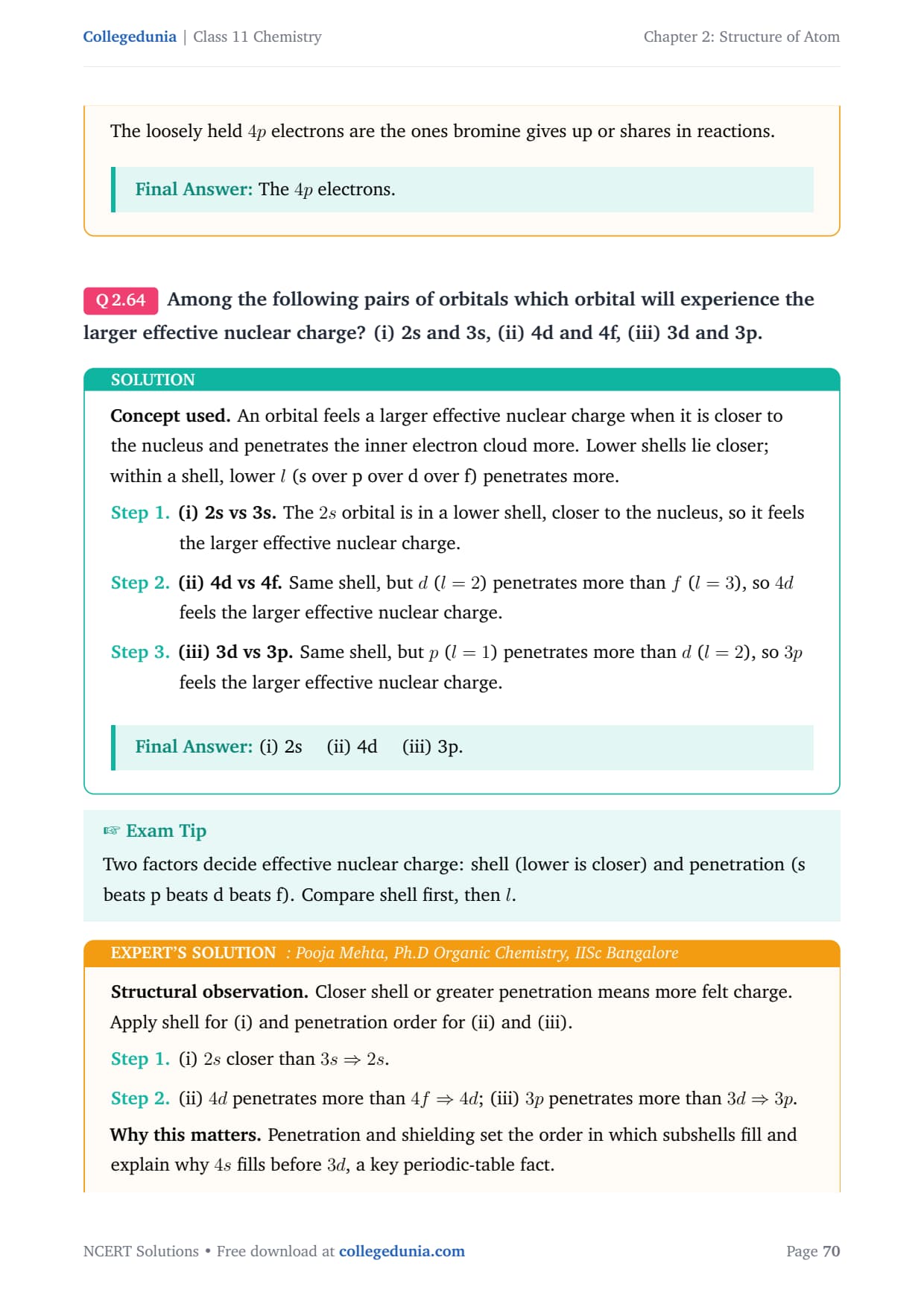
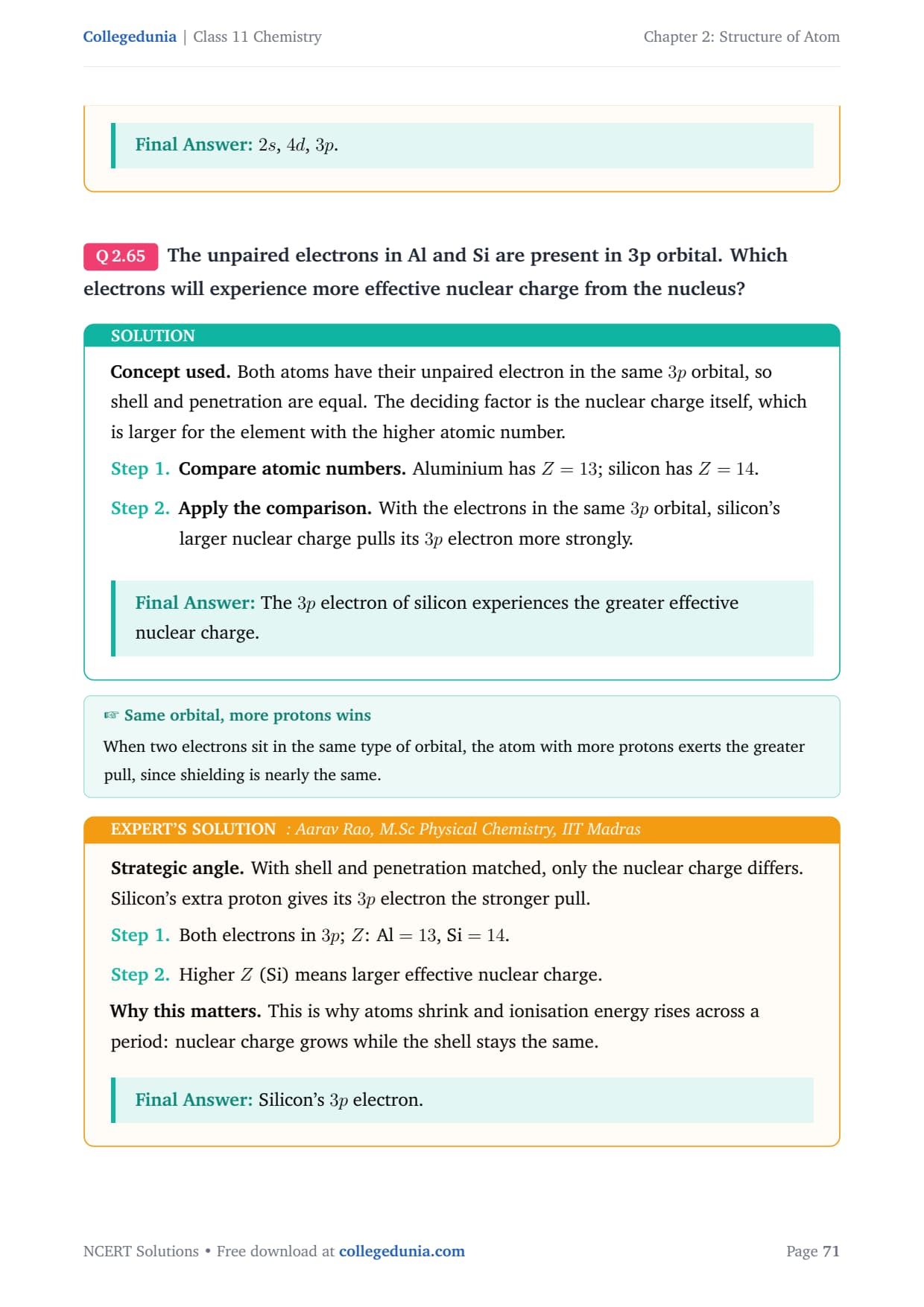
An orbital is the region around the nucleus where an electron is most likely found. An s orbital is spherical, a p orbital is dumb-bell shaped, and d orbitals have more complex four-lobed shapes. A node is a point or surface where the chance of finding the electron is zero. The number of radial nodes is n − l − 1, a result that comes up often in JEE numericals.
Aufbau Principle, Pauli Rule and Electronic Configuration
Filling electrons into orbitals follows three rules. Applied in order, they give the electronic configuration of any atom, the single most tested skill in the chapter.
- Aufbau principle: electrons fill the lowest energy orbital first, following the order 1s, 2s, 2p, 3s, 3p, 4s, 3d, and so on.
- Pauli exclusion principle: no two electrons in an atom can have all four quantum numbers the same, so an orbital holds at most two electrons with opposite spin.
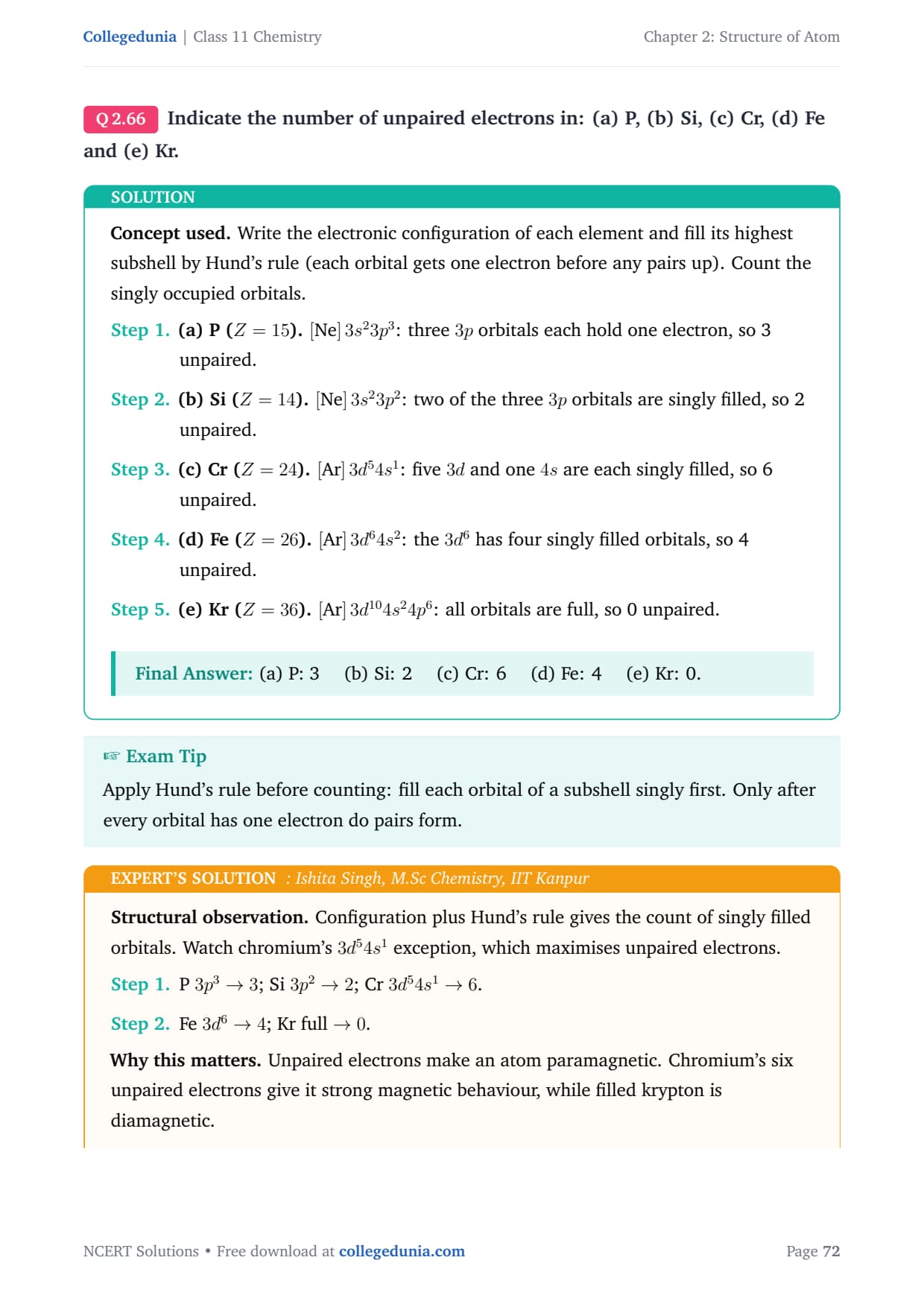
- Hund's rule: electrons fill each orbital of a subshell singly before any pairing begins.
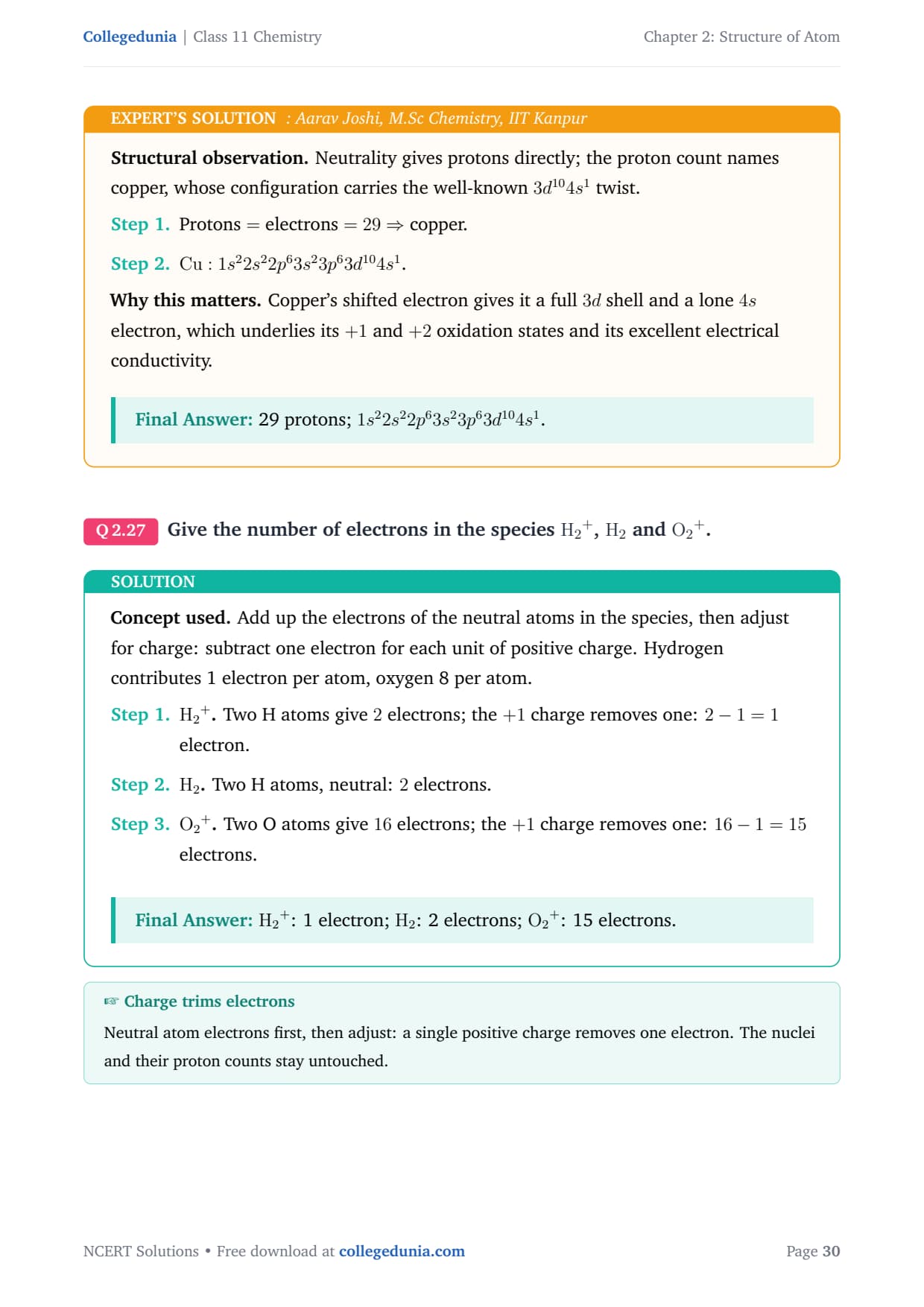
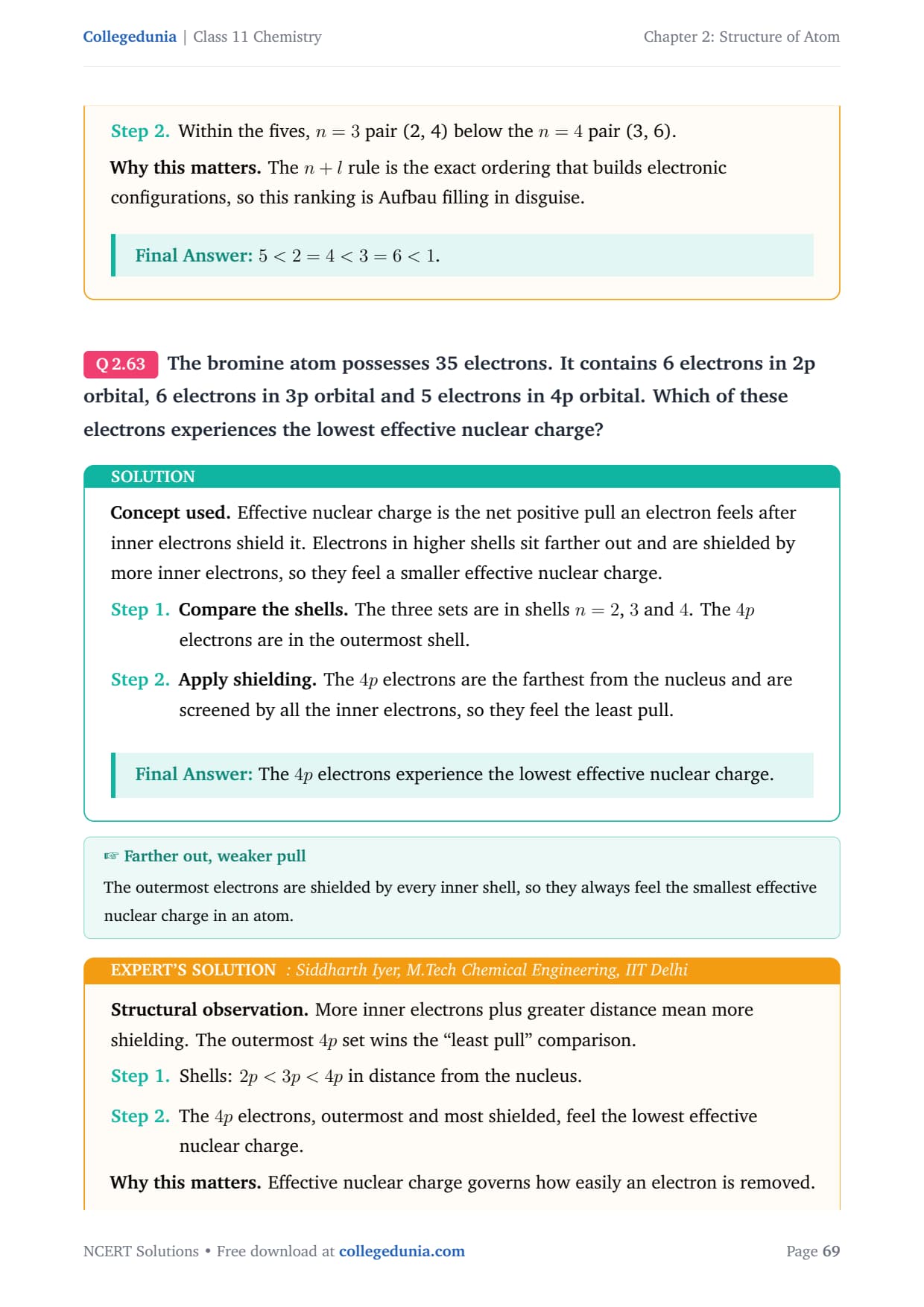
For example, the configuration of oxygen (Z = 8) is 1s2 2s2 2p4. The lower energy of an orbital is judged by the (n + l) rule: the orbital with the lower n + l value fills first. Chromium and copper break the simple order because a half-filled or fully-filled d subshell is extra stable, giving 3d54s1 and 3d104s1. These two exceptions are asked almost every year, so memorise them.
Structure of Atom Exercise-wise Breakdown
The NCERT back exercise has 67 questions, split between numerical and short-answer types. The intext questions test the same ideas in shorter form. The table below maps the question blocks to their topics so you can plan your practice.
| Question block | What it tests |
|---|---|
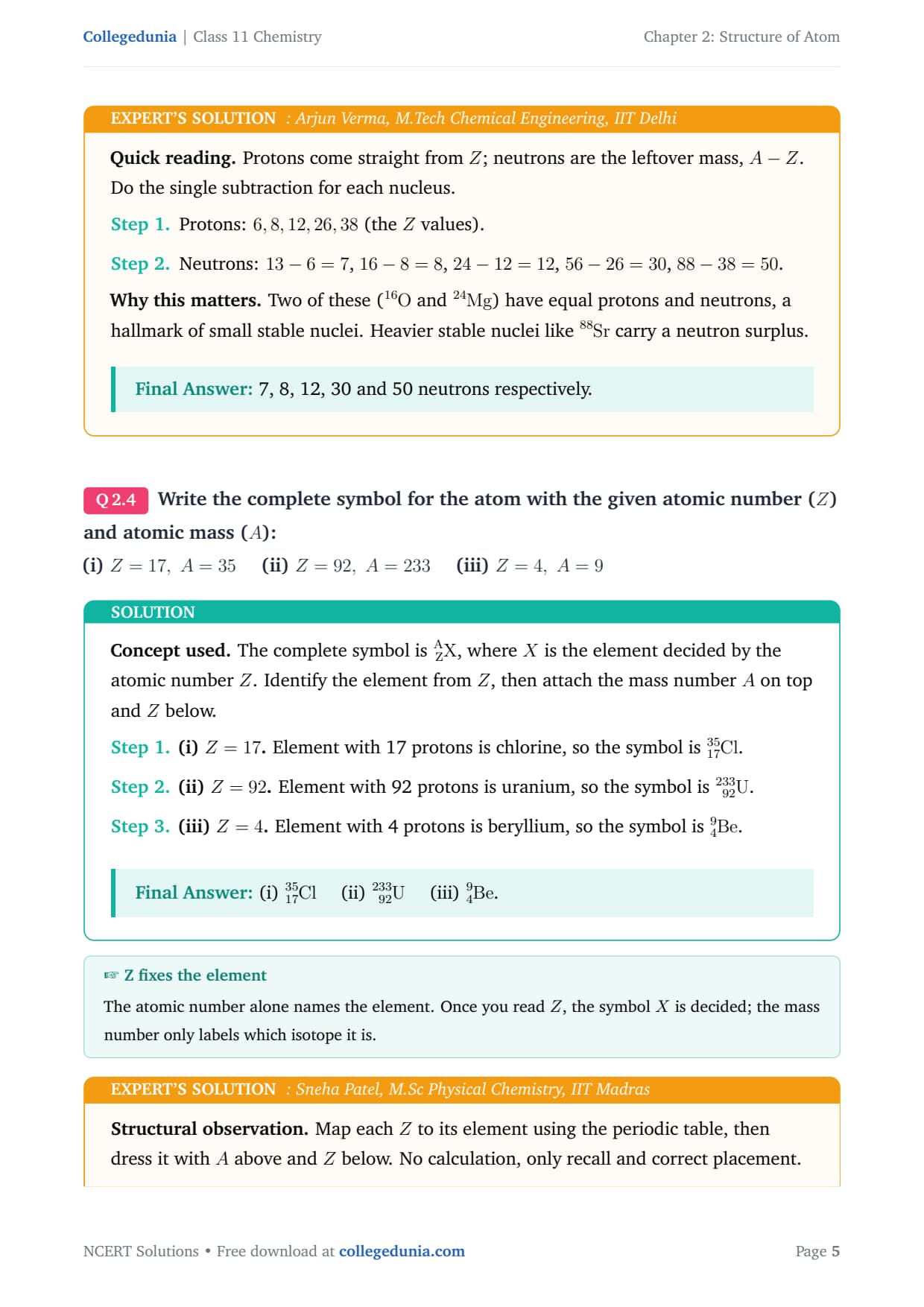
| Q 2.1 to 2.14 | Atomic number, mass number, isotopes, and subatomic particle counts. |
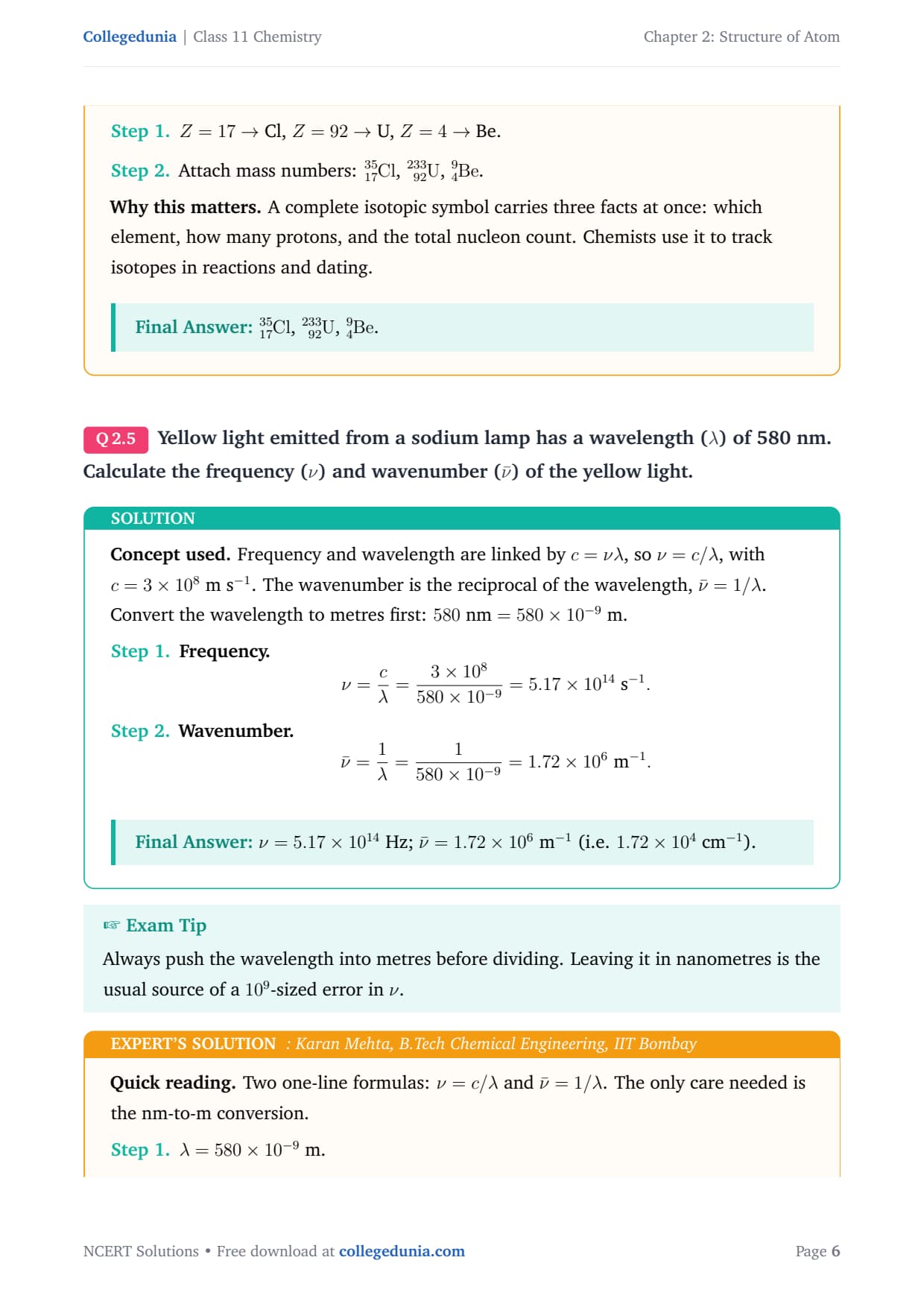
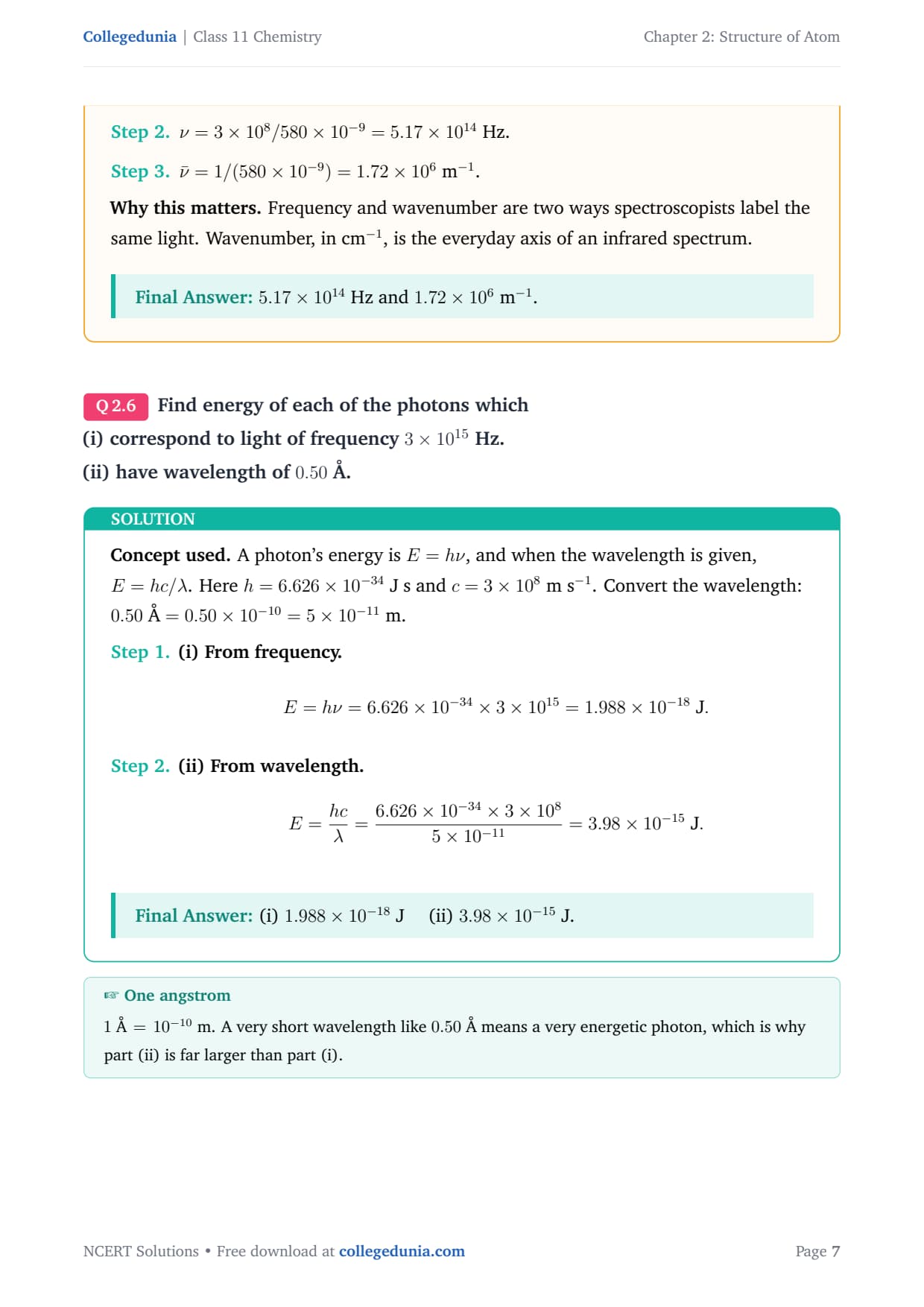
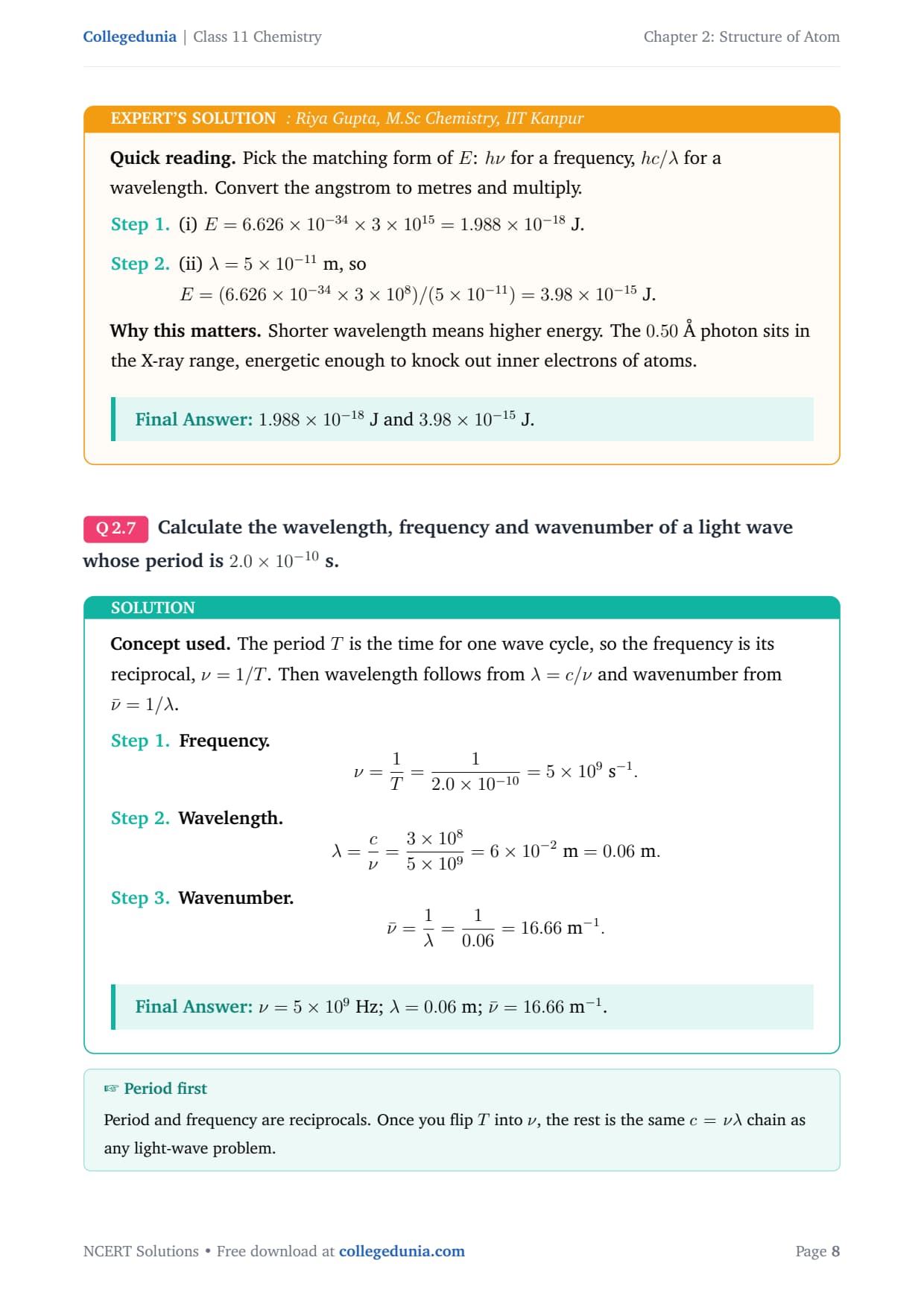
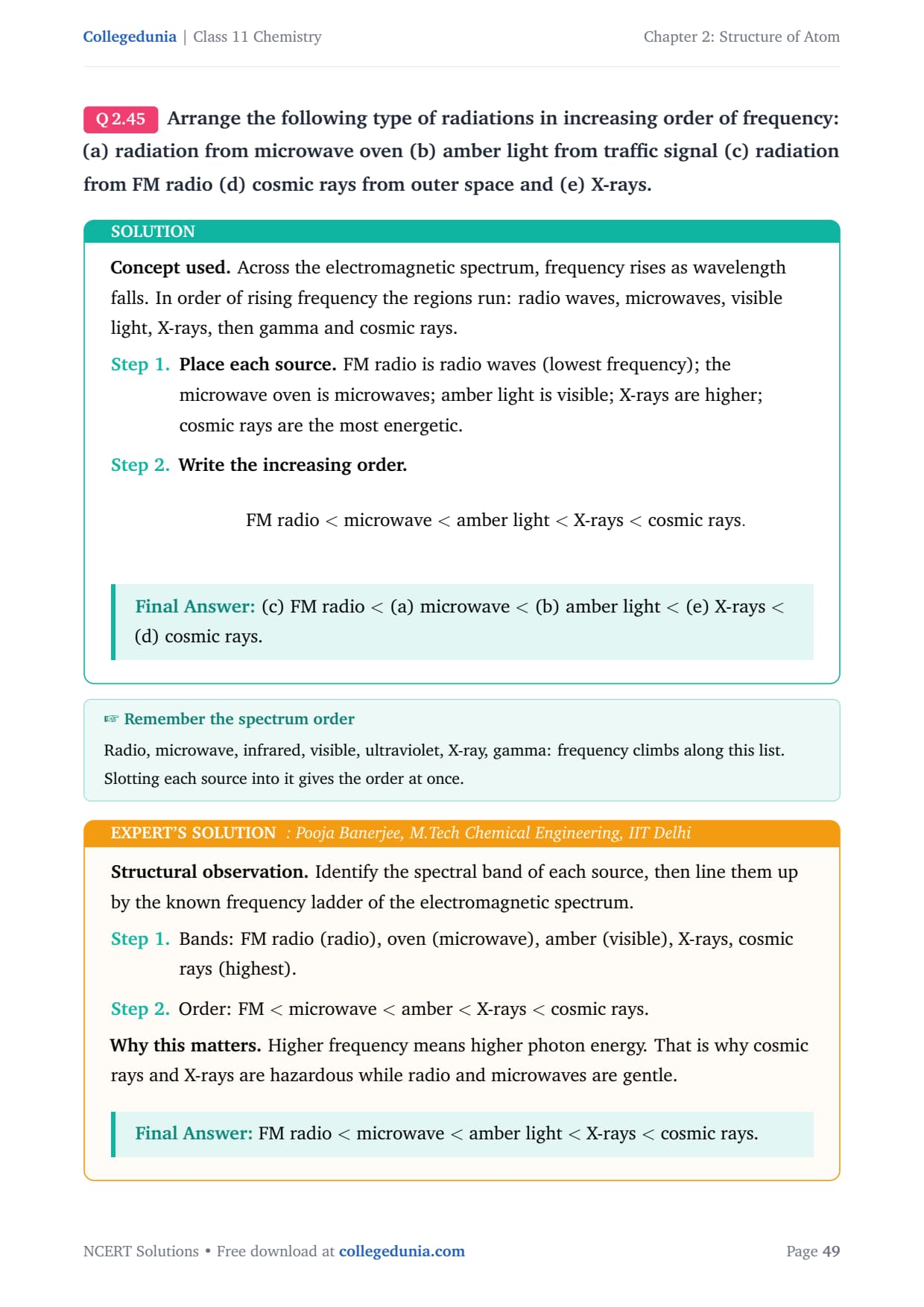
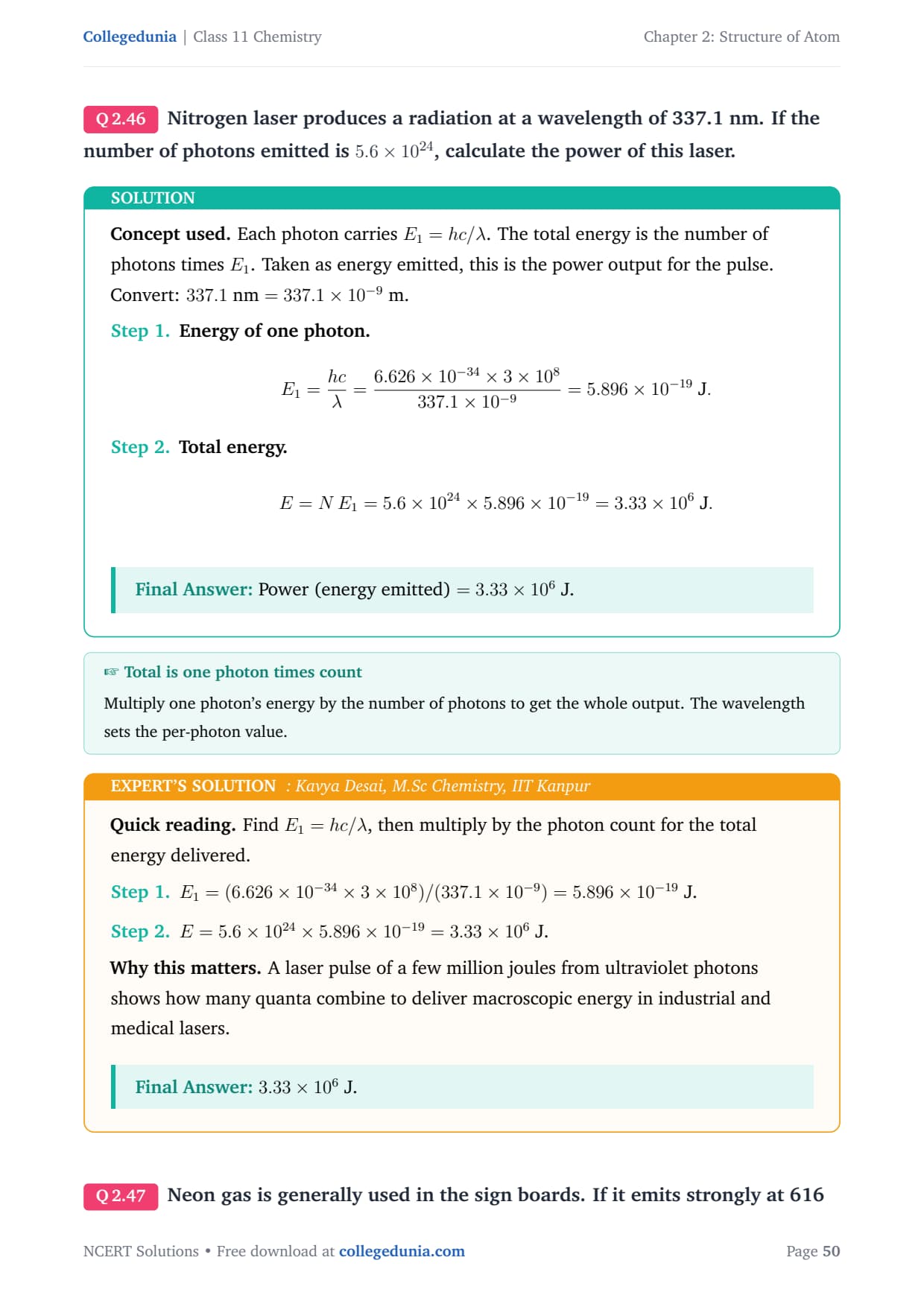
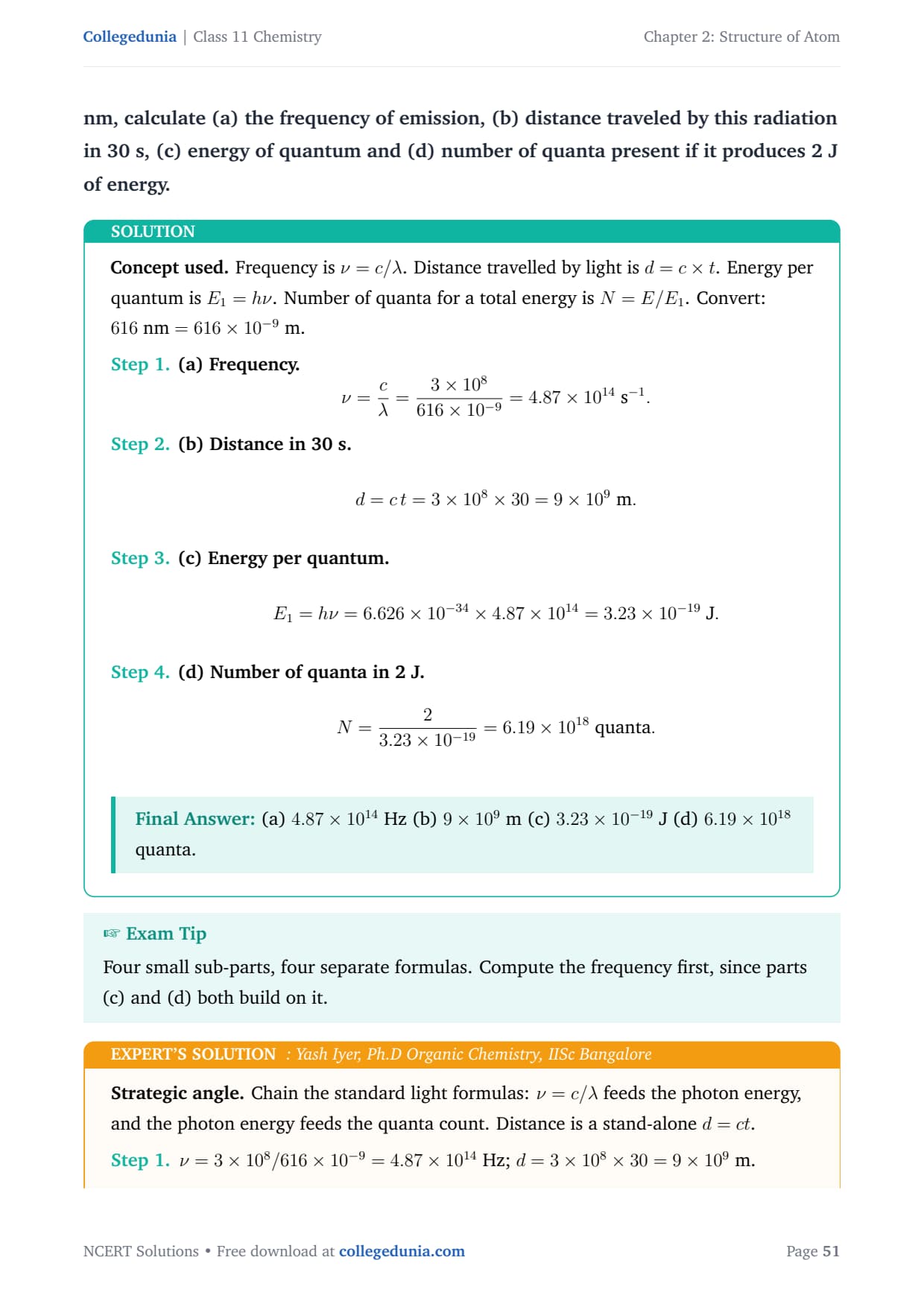
| Q 2.15 to 2.30 | Electromagnetic radiation, frequency, wavelength, and photon energy. |
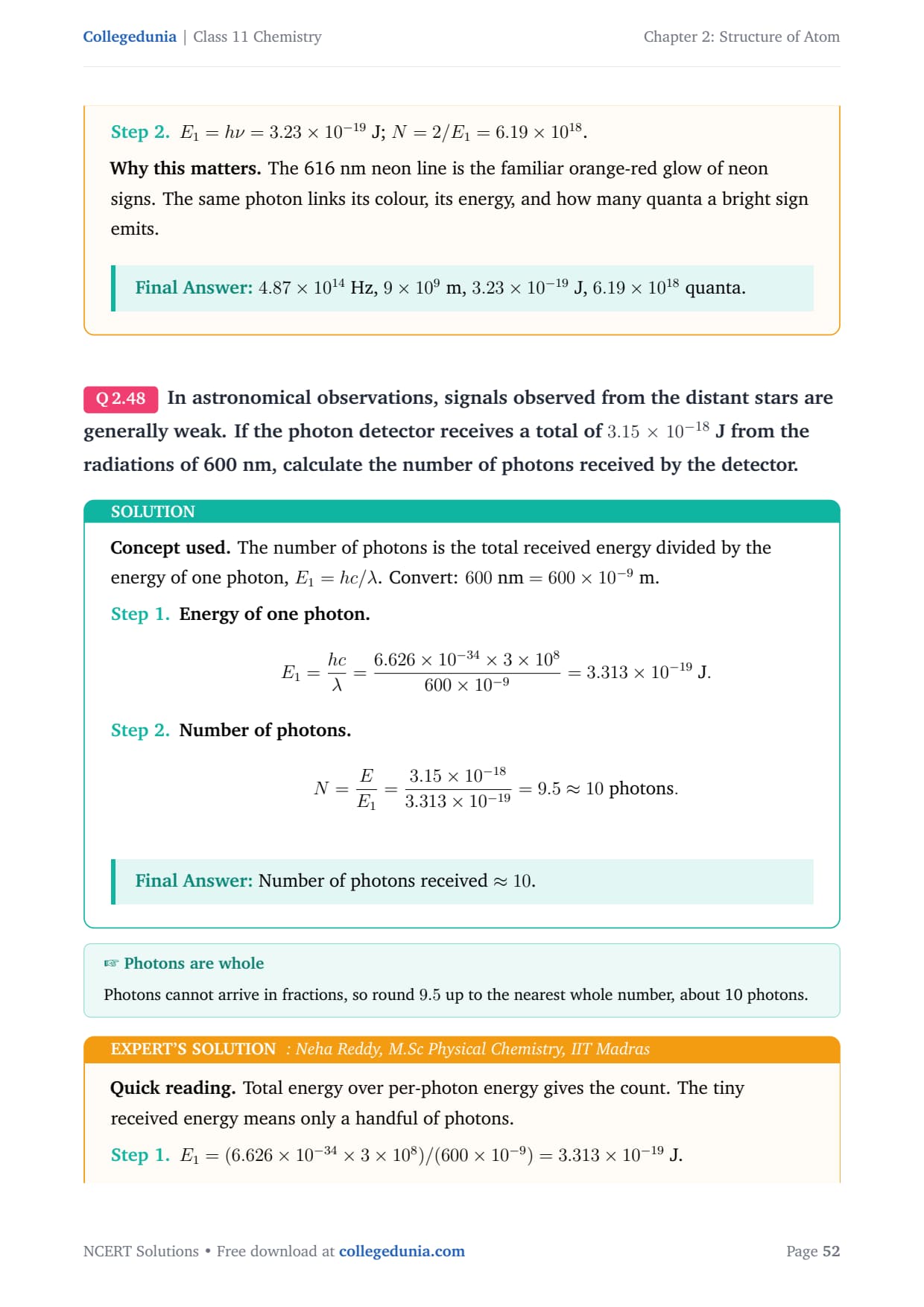
| Q 2.31 to 2.50 | Bohr model, spectral lines, de Broglie wavelength, and uncertainty principle. |
| Q 2.51 to 2.67 | Quantum numbers, orbital shapes, and electronic configuration. |
The intext questions before the exercise are shorter and check one idea each, such as finding a wavelength or writing a configuration. Solve the intext set first, then the back exercise. Every question in the class 11 chemistry NCERT solutions chapter 2 Structure of Atom PDF is solved with each step shown, so you can compare your working line by line.
Practice the solved questions: Work through the full question bank with step-by-step answers and expert tips.
Common Mistakes Students Make in the Structure of Atom Chapter
Most marks are lost on small habits, not on hard ideas. Each slip below costs 1 to 2 marks, so watch for them at the exact step.
Mistake 1: Mixing up atomic number and mass number. Z counts protons; A counts protons plus neutrons.
Mistake 2: Forgetting Hund's rule and pairing electrons too early. Fill each orbital of a subshell singly first.
Mistake 3: Writing the 4s and 3d order wrong. 4s fills before 3d, but 3d is written before 4s in the final configuration.
Mistake 4: Missing the chromium and copper exceptions. A half-filled or fully-filled d subshell is more stable.
Student Feedback on the Structure of Atom Solutions
What 14,860 students told us about their Structure of Atom preparation:
- 61% of students rated quantum numbers and orbital shapes as the hardest part of the chapter.
- Most-skipped step: applying the (n + l) rule correctly for the 4s and 3d ordering, missed by about 3 in 10 students.
- Students who learnt the Aufbau order early said writing electronic configurations became automatic.
Source: 2026-27 Class 11 Chemistry student poll. Sample of 14,860 students from CBSE schools across 15 states, conducted before the 2026 boards.
Other Structure of Atom Class 11 Chemistry Resources
Pair these solutions with the revision notes and the NCERT textbook PDF for the same chapter.
| Resource | Link |
|---|---|
| NCERT Notes | Structure of Atom Class 11 Notes |
| NCERT Book PDF | Structure of Atom Class 11 Book PDF |
NCERT Solutions for Class 11 Chemistry: All Chapters
Jump to the step-by-step solutions for any other Class 11 Chemistry chapter below.
| Chapter | NCERT Solutions |
|---|---|
| Chapter 1 | Some Basic Concepts of Chemistry |
| Chapter 2 | Structure of Atom |
| Chapter 3 | Classification of Elements and Periodicity in Properties |
| Chapter 4 | Chemical Bonding and Molecular Structure |
| Chapter 5 | Thermodynamics |
| Chapter 6 | Equilibrium |
| Chapter 7 | Redox Reactions |
| Chapter 8 | Organic Chemistry Some Basic Principles and Techniques |
| Chapter 9 | Hydrocarbons |
FAQs on Structure of Atom Class 11 NCERT Solutions
Structure of Atom NCERT Solutions - Frequently Asked Questions
Ques. What do the class 11 chemistry NCERT solutions chapter 2 Structure of Atom cover?
Ans. These solutions cover all 67 back-exercise questions and the intext questions, including the discovery of the electron, proton and neutron, the Thomson, Rutherford and Bohr models, the photoelectric effect and dual nature, the four quantum numbers, orbital shapes, and the Aufbau, Pauli and Hund rules for electronic configuration. Every question is solved step by step.
Ques. What are the four quantum numbers in Class 11 Chemistry Chapter 2?
Ans. The principal quantum number (n) gives the shell and main energy level. The azimuthal quantum number (l) gives the subshell and orbital shape. The magnetic quantum number (ml) gives the orientation of the orbital. The spin quantum number (ms) gives the direction of electron spin, either +1/2 or −1/2.
Ques. Why did Rutherford's atomic model fail?
Ans. Rutherford's model placed electrons moving around a central nucleus. According to classical physics, a charged particle moving in a circle continuously loses energy as radiation. Such an electron would spiral into the nucleus within a fraction of a second, so the atom could not be stable. The model also could not explain the line spectrum of hydrogen. Bohr's model fixed both problems.
Ques. What is the difference between an orbit and an orbital?
Ans. An orbit is a fixed circular path in the Bohr model where an electron is assumed to move. An orbital is a region of space around the nucleus where the chance of finding an electron is highest, from the quantum model. An orbit is a definite path, while an orbital gives only the probability of finding an electron and can hold at most two electrons.
Ques. What is the electronic configuration of chromium and why is it an exception?
Ans. Chromium (Z = 24) has the configuration 1s2 2s2 2p6 3s2 3p6 3d5 4s1. The simple Aufbau order would predict 3d44s2, but one 4s electron shifts to 3d because a half-filled 3d5 subshell gives extra stability. Copper is a similar exception with 3d104s1 because a fully-filled d subshell is stable.
Ques. What is the weightage of Structure of Atom in CBSE Class 11?
Ans. Structure of Atom carries about 7 to 9 marks in the CBSE Class 11 Chemistry paper, through questions on quantum numbers, electronic configuration and the Bohr model. It is also heavily tested in JEE Main and NEET, where numericals on photon energy, de Broglie wavelength and spectral lines appear every year.



Comments