




The class 11 chemistry NCERT solutions chapter 4 Chemical Bonding and Molecular Structure cover every intext and back-exercise question, according to the latest 2026-27 CBSE syllabus, and help students prepare for the CBSE Boards, JEE Main, JEE Advanced, NEET and CUET. Each answer is worked step by step, from the Kossel-Lewis approach and Lewis structures to VSEPR shapes, hybridization, and molecular orbital theory.
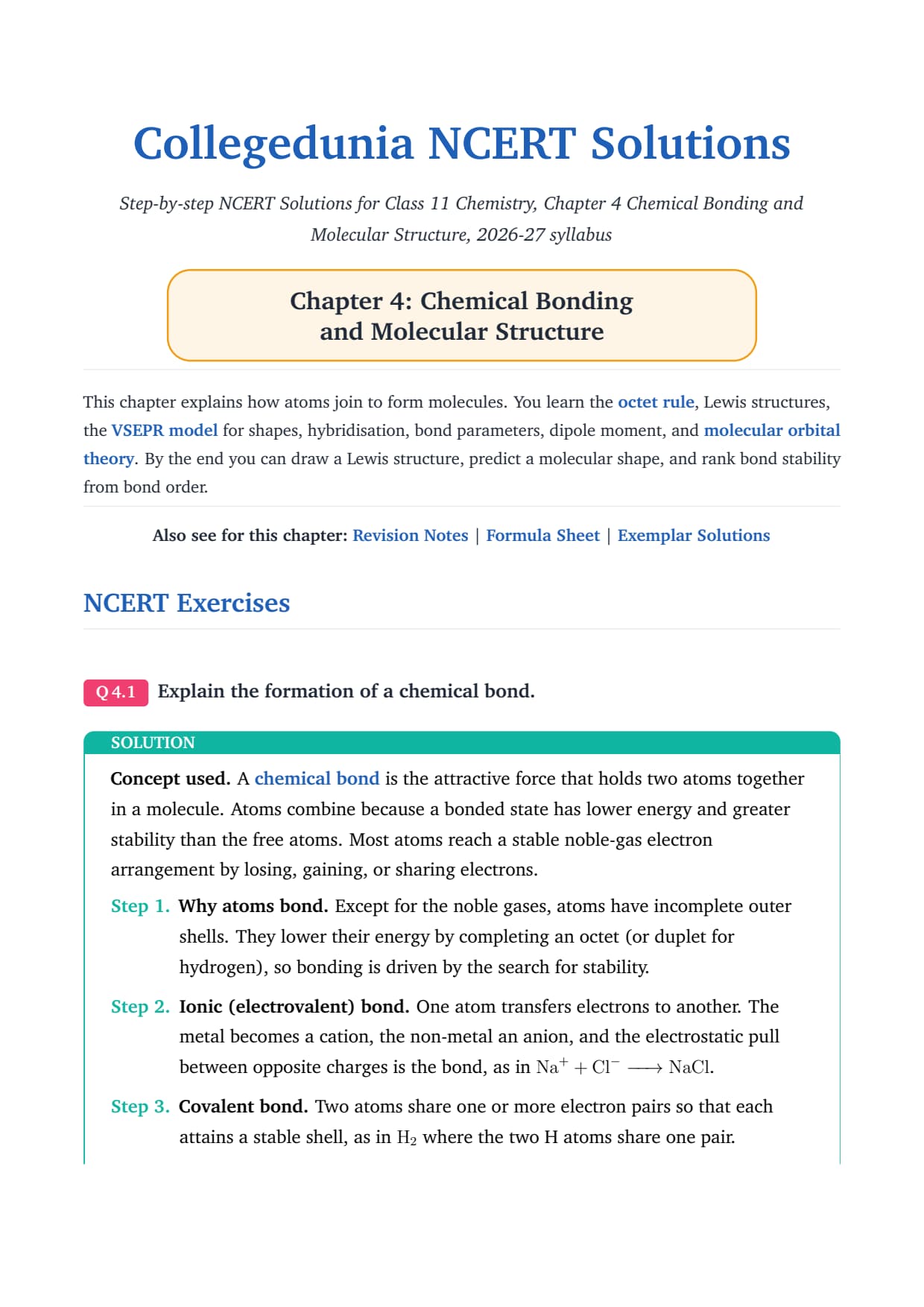
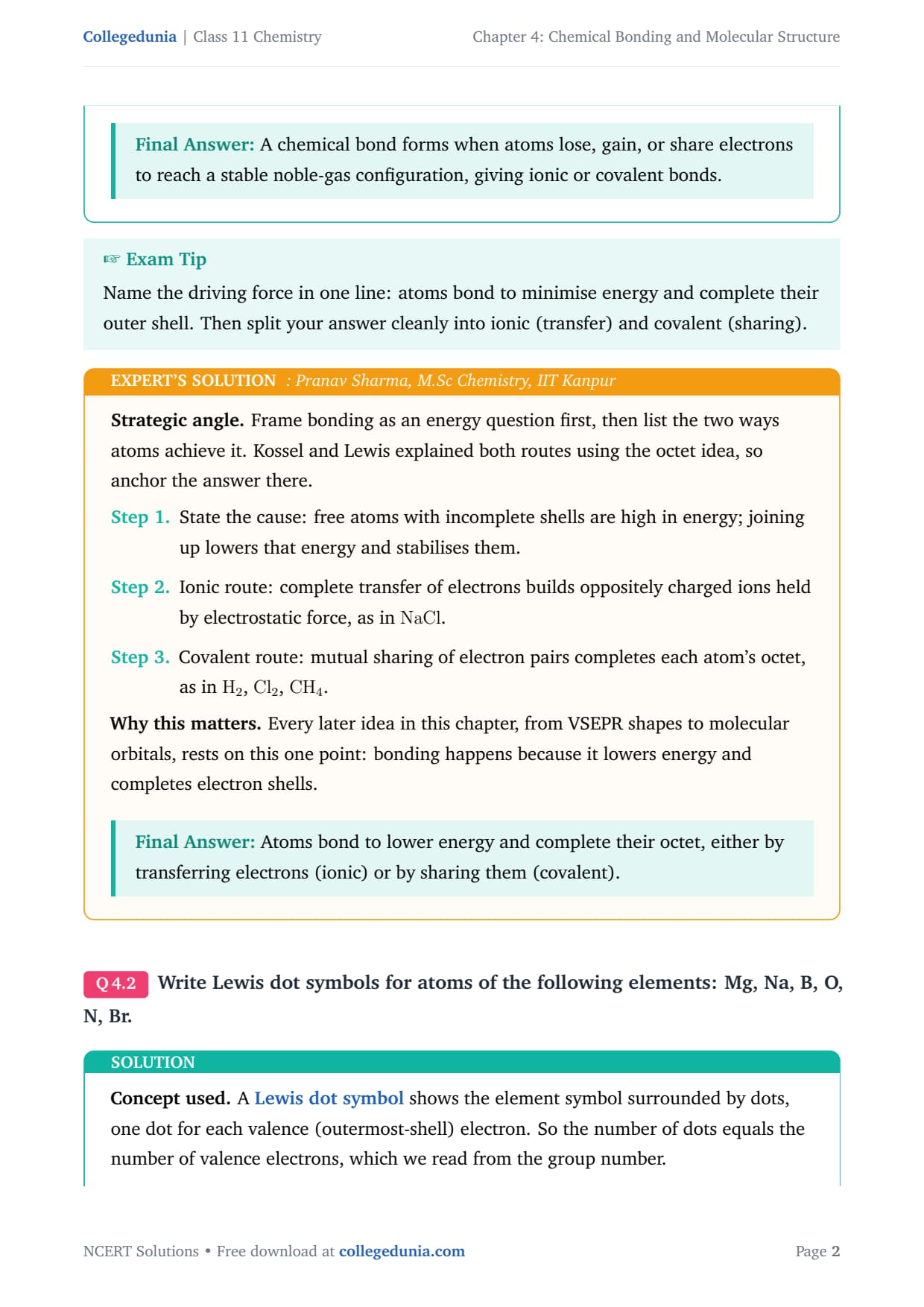
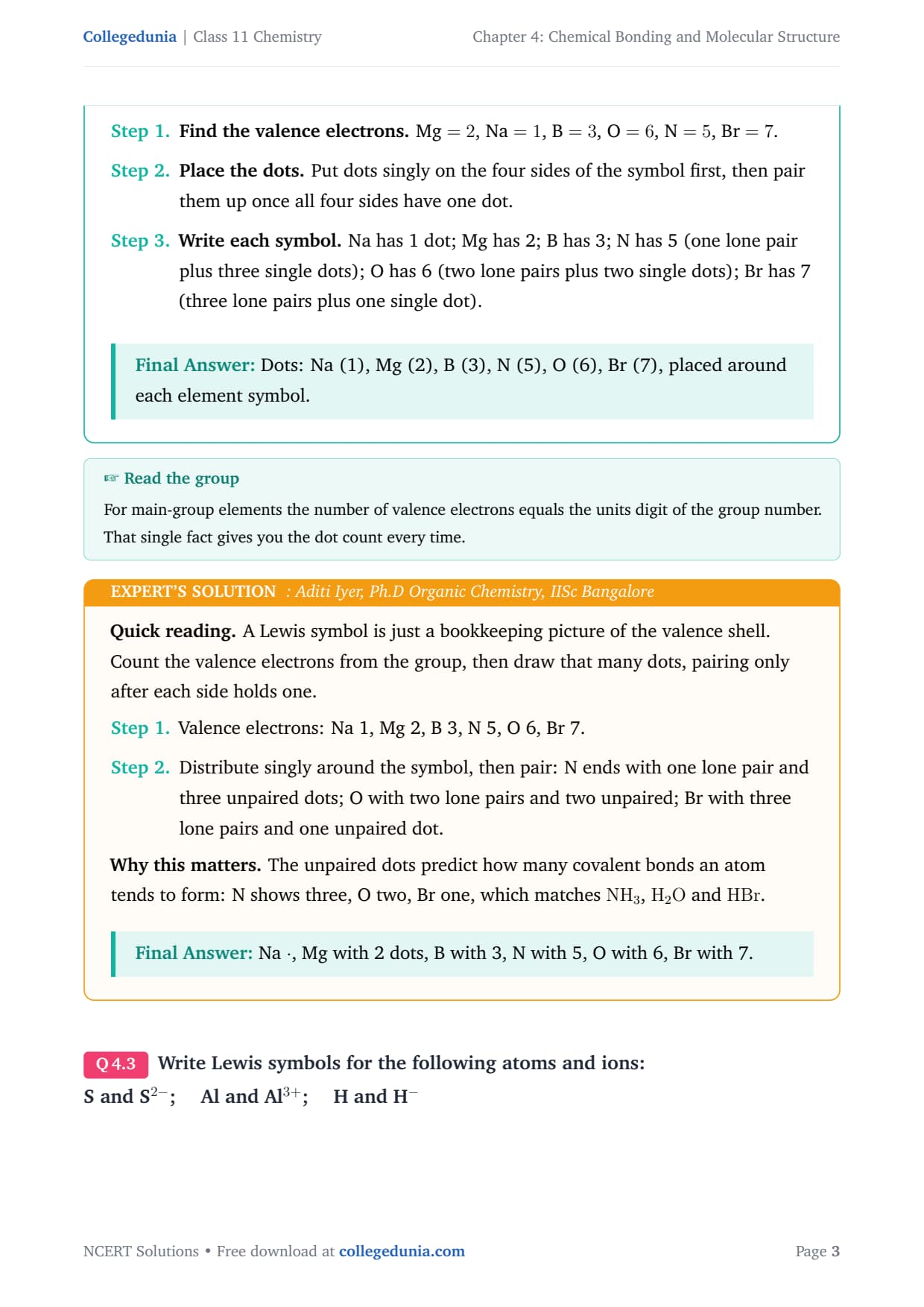
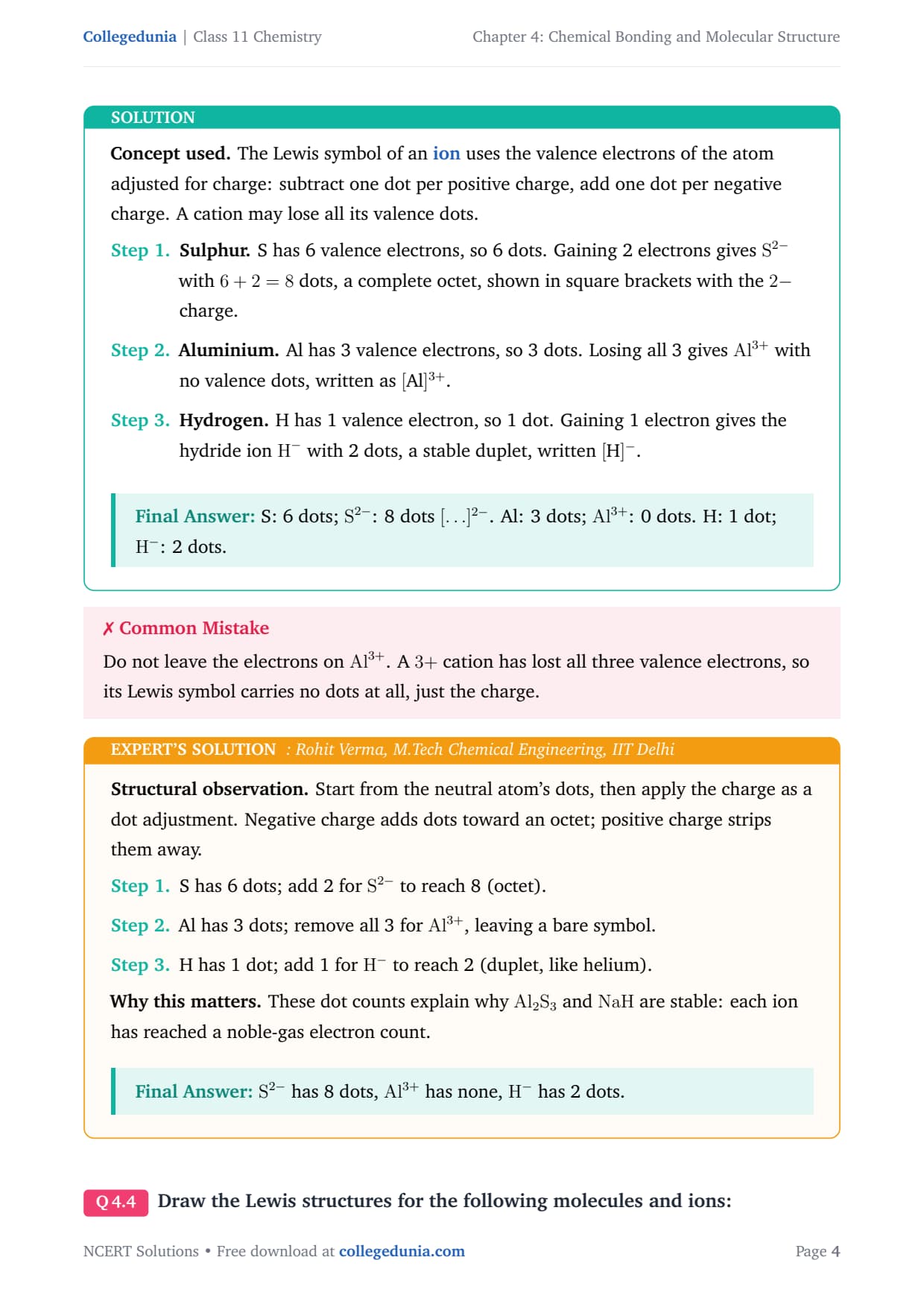
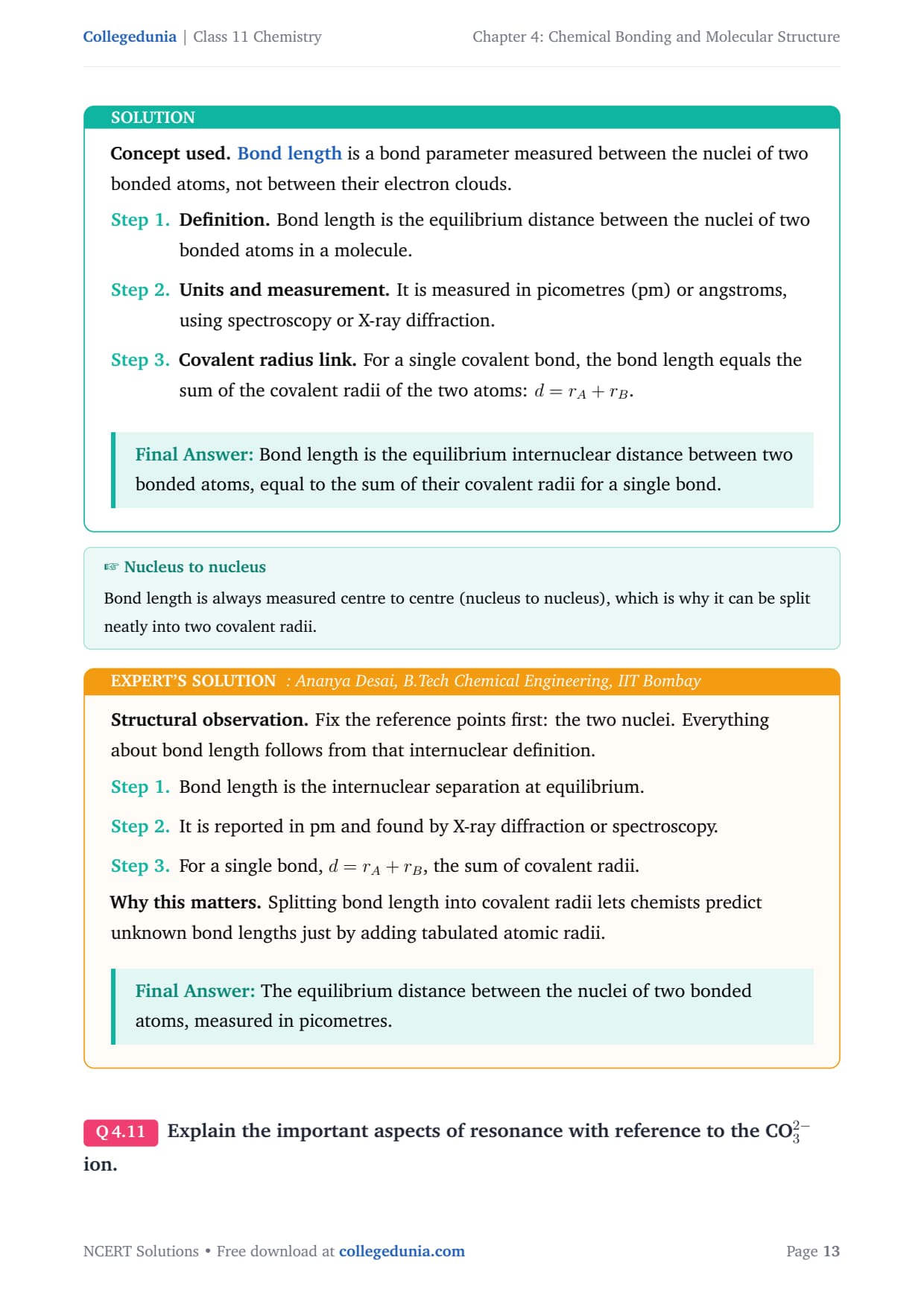
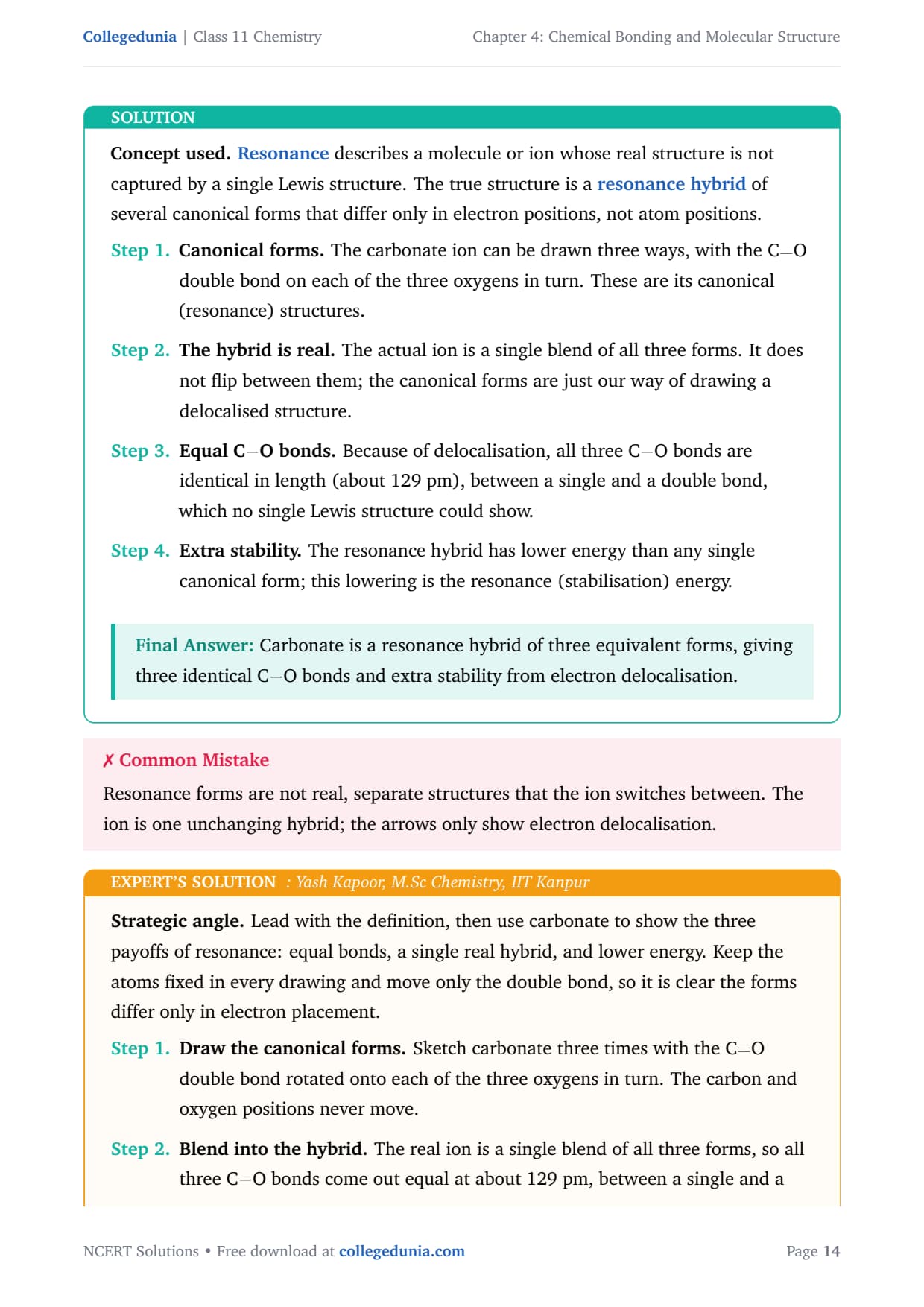
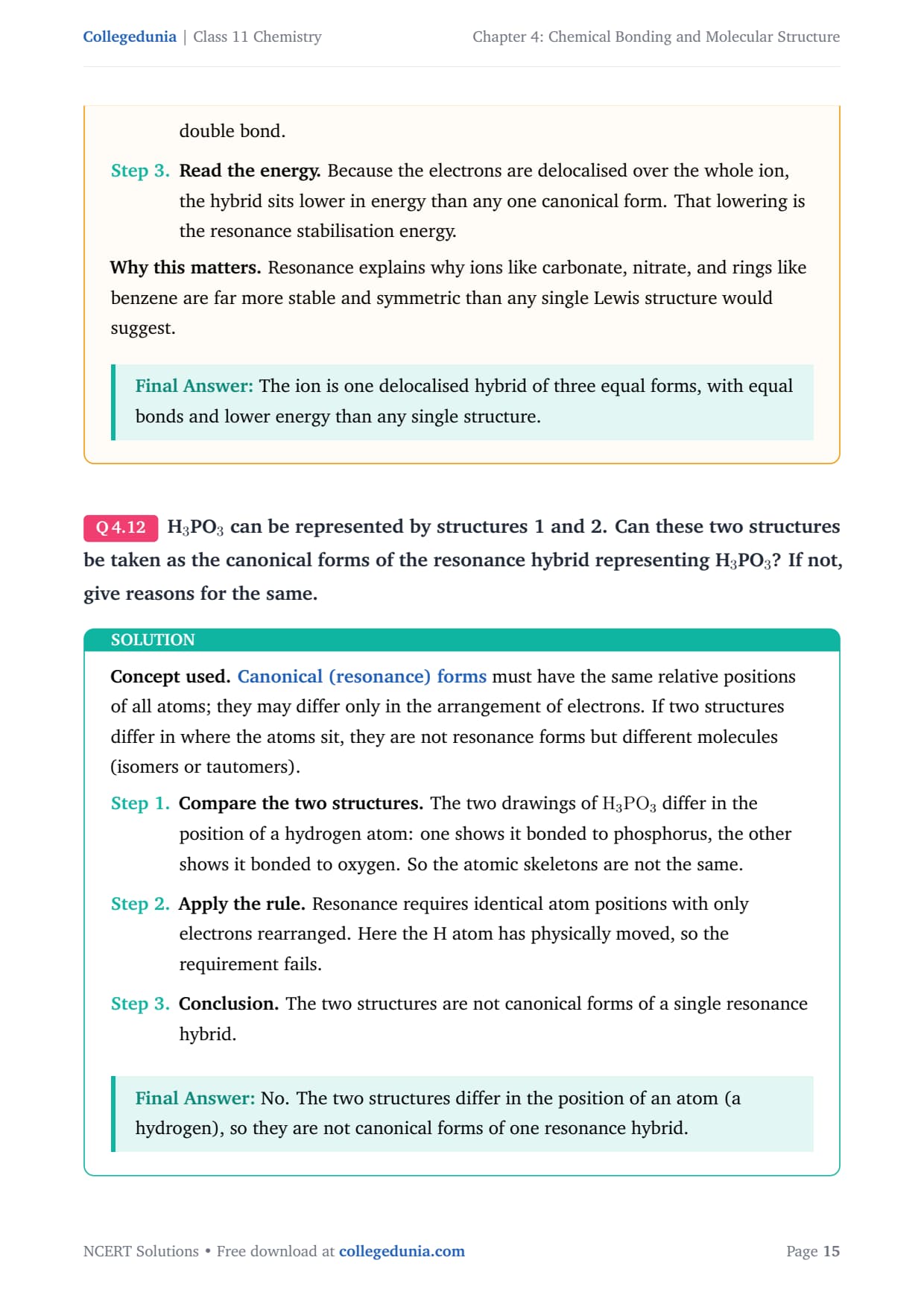
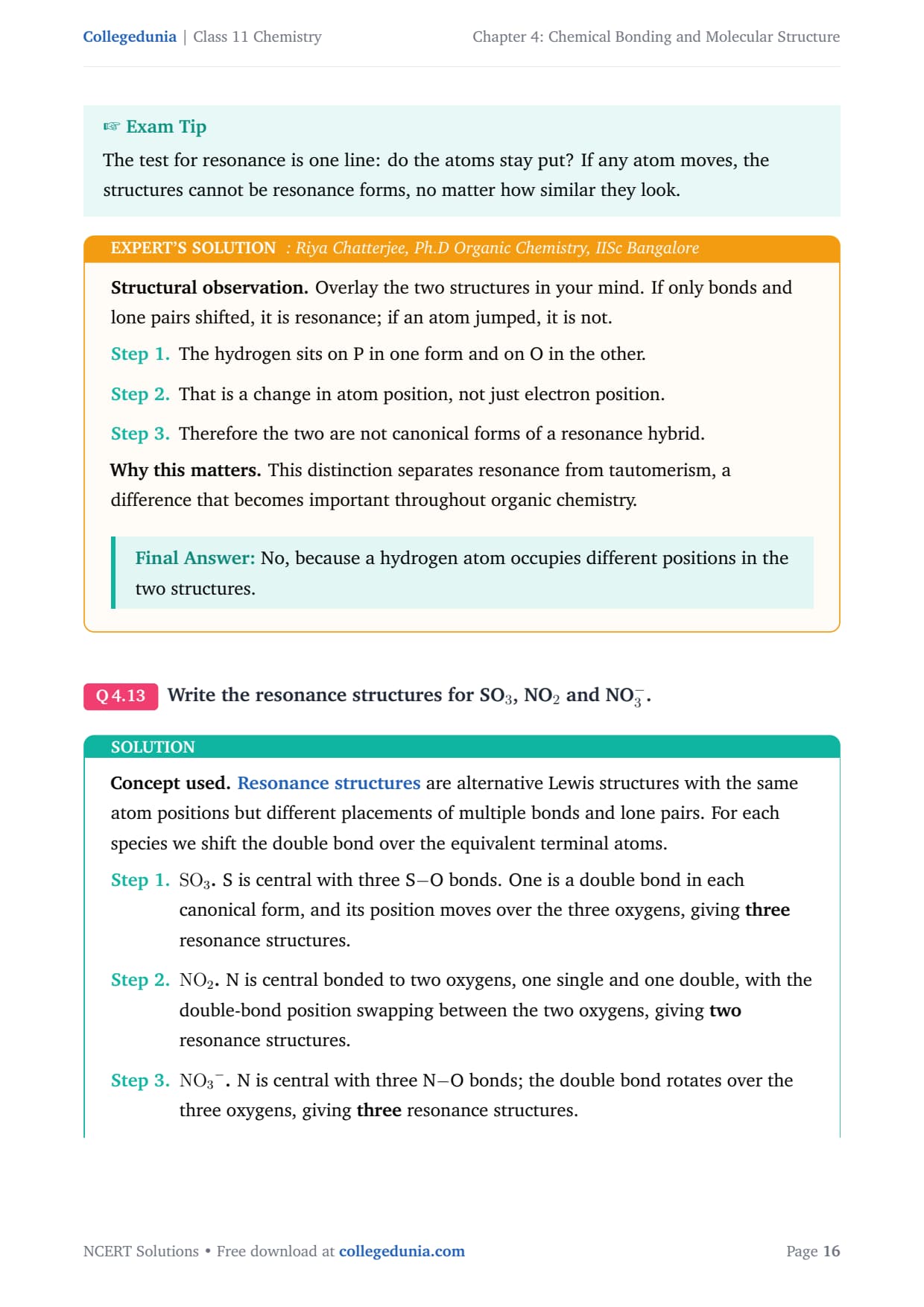
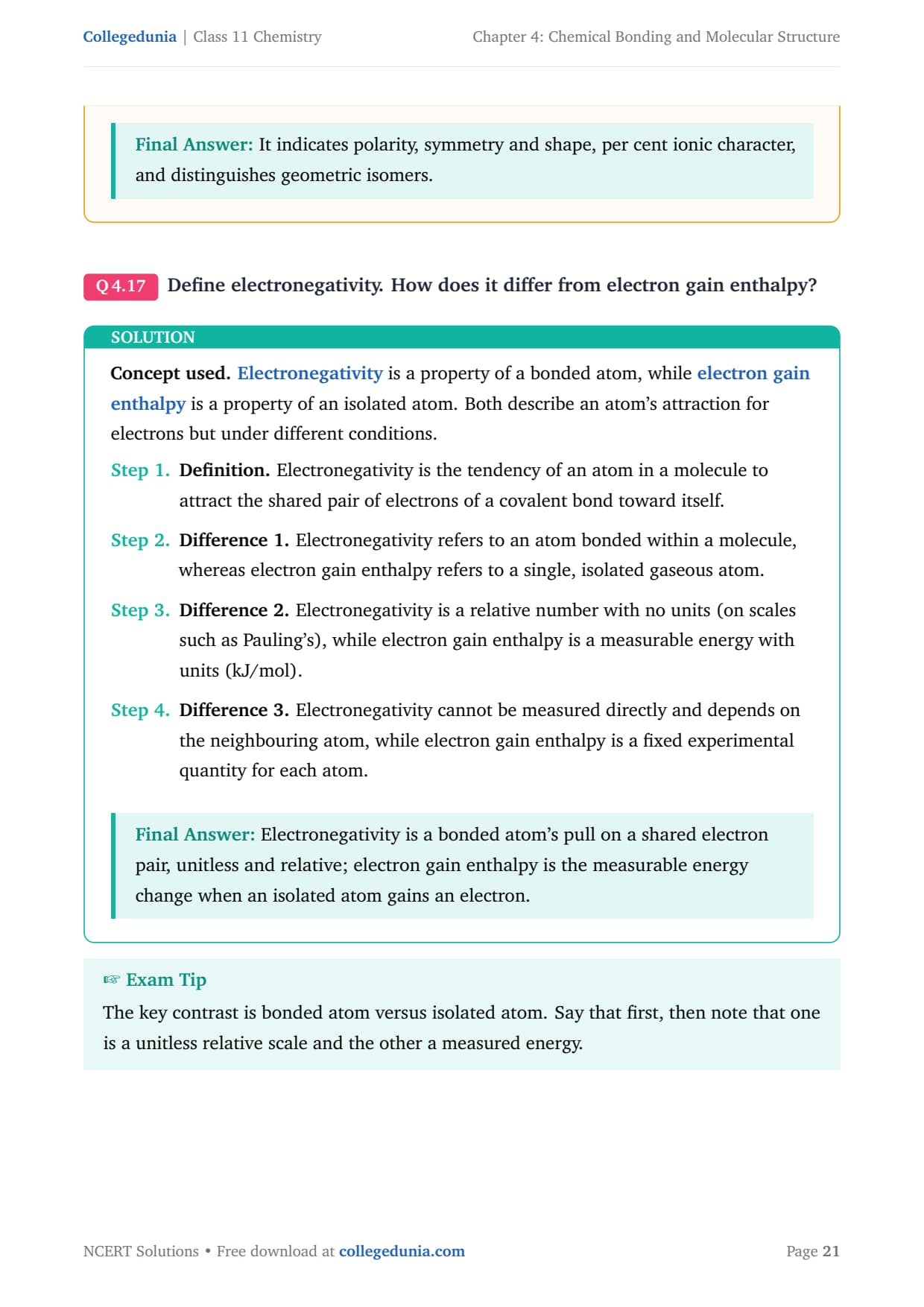
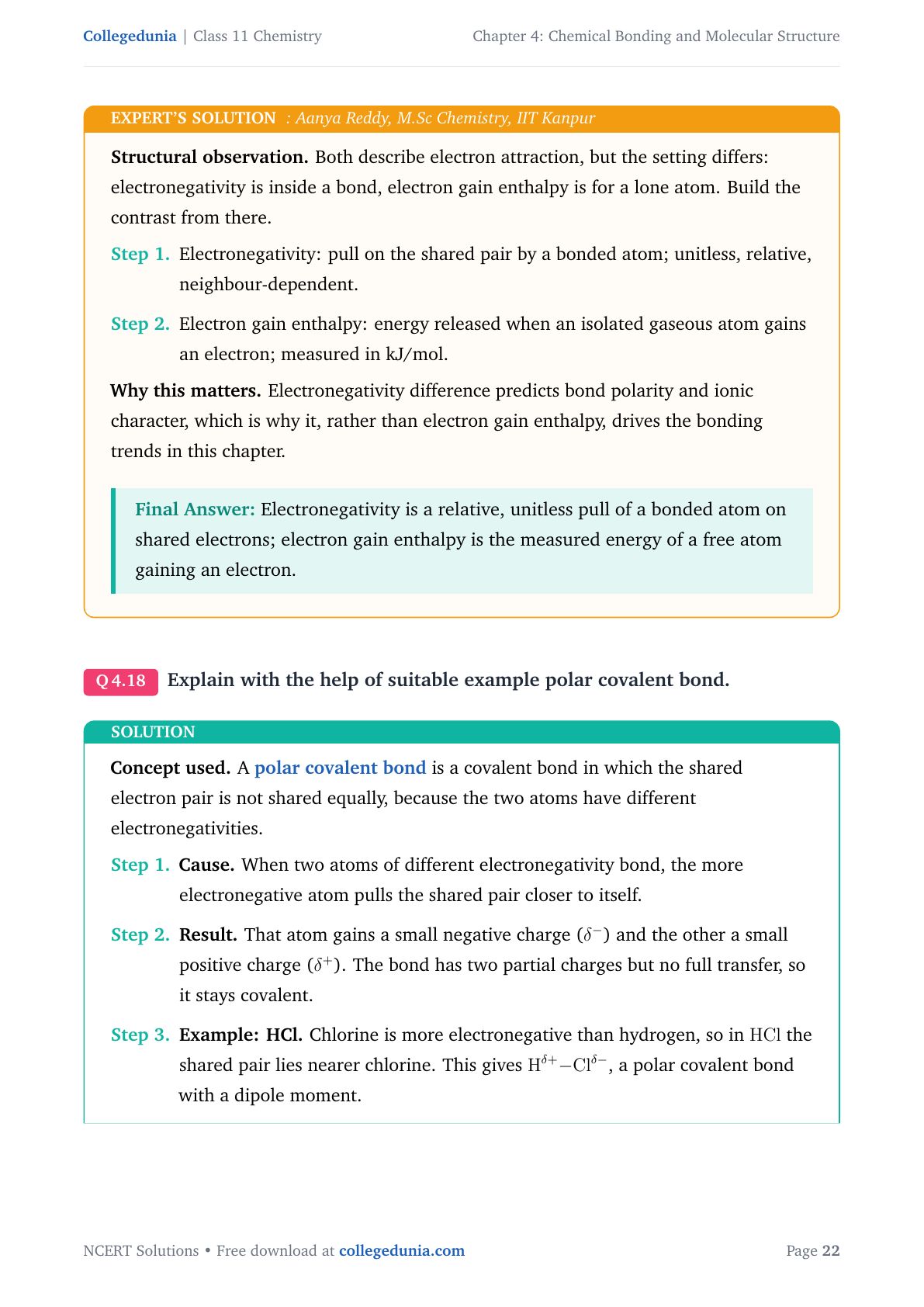
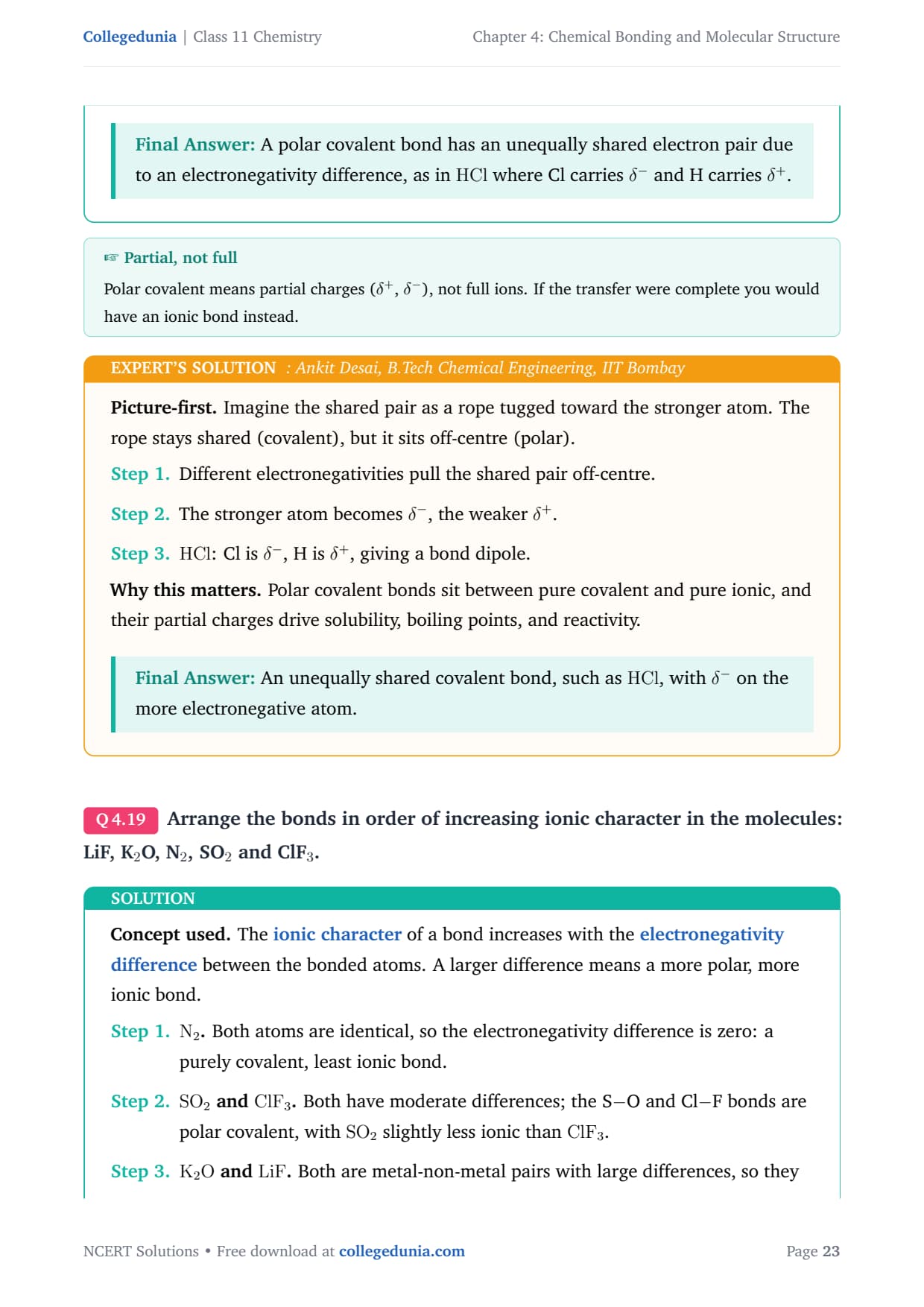
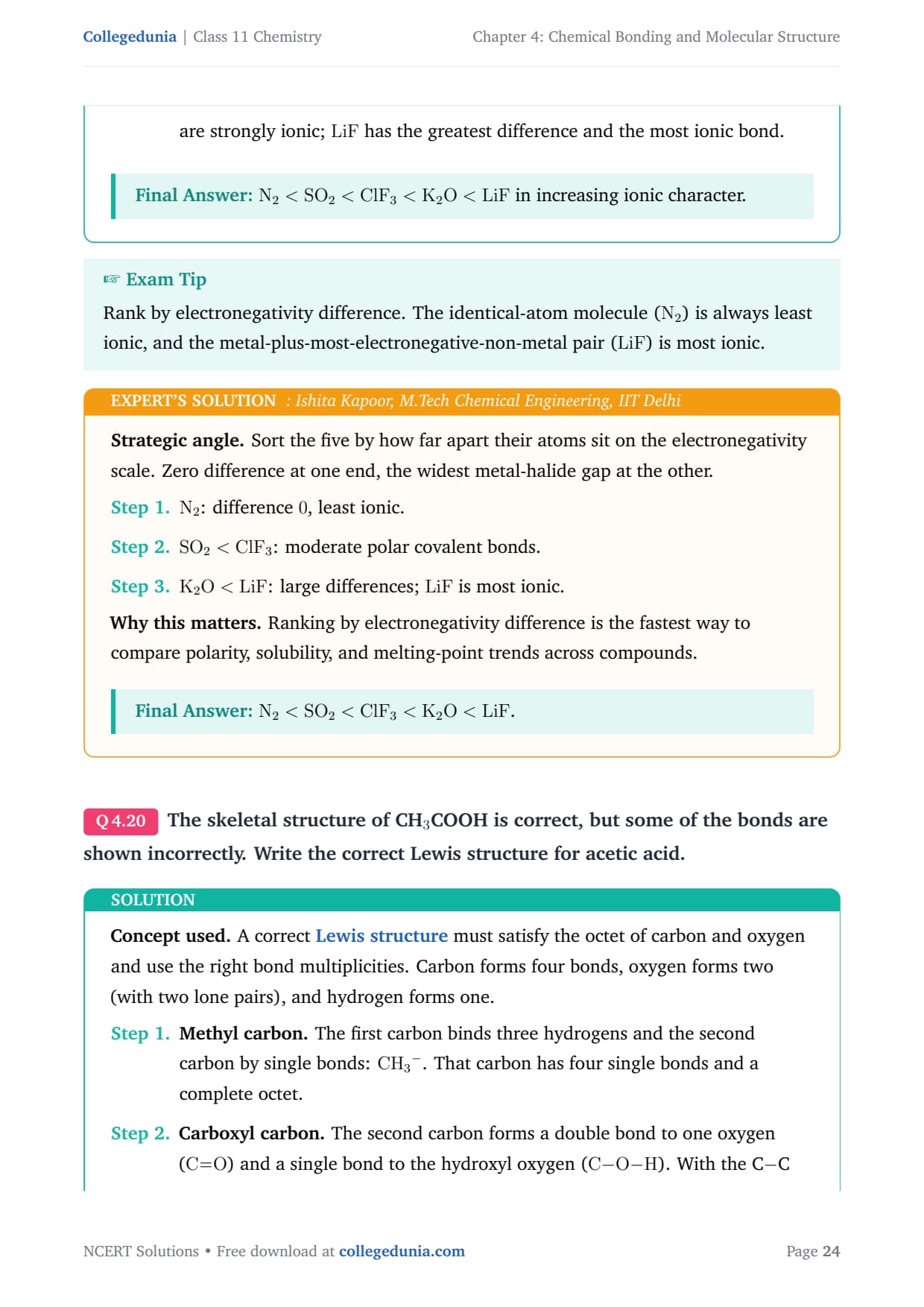
This chapter explains why atoms bond and what shape the resulting molecule takes, so it links the periodic table you just learned to the reactions you meet all year.
- CBSE Weightage: 6 to 7 marks, one of the highest-scoring theory chapters in the Class 11 paper.
- Topics covered: Kossel-Lewis approach, ionic and covalent bonds, Lewis structures, formal charge, VSEPR theory, valence bond theory, hybridization, molecular orbital theory, and hydrogen bonding.
- Exercise count: 40 back-exercise questions plus intext questions, a mix of reasoning, structure-drawing and short numerical parts.
These class 11 chemistry NCERT solutions chapter 4 Chemical Bonding and Molecular Structure are curated by subject experts, based on the 2026-27 NCERT textbook, and checked against the last five years of CBSE Board, JEE Main and NEET papers.
What Chemical Bonding and Molecular Structure Covers in Class 11
Atoms rarely stay alone. They join into molecules to reach a stable, lower-energy state. This chapter teaches you why that happens and how to predict the shape, polarity and stability of the molecule that forms. Master it and half of organic and inorganic chemistry becomes easier.
- Core question: why do atoms combine, and what holds them together once they do.
- Key skill: drawing a correct Lewis structure and then predicting the molecular shape from it.
- Why it matters: bonding decides boiling point, solubility, reactivity and polarity, the properties tested across every later chapter.
The shape of a molecule controls how it behaves. Water bends, carbon dioxide stays straight, and that single difference explains why one is a liquid and the other a gas at room temperature. The class 11 chemistry NCERT solutions chapter 4 Chemical Bonding and Molecular Structure below follow the same order as the NCERT textbook.
Kossel-Lewis Approach and the Octet Rule
The Kossel-Lewis approach was the first clear idea of why atoms bond. Kossel explained ionic bonding by electron transfer, while Lewis pictured atoms as cubes sharing electrons to complete an outer shell of eight. Both ideas gave us the octet rule.
- Atoms combine to reach the stable electron arrangement of the nearest noble gas.
- They do this by losing, gaining or sharing electrons until the outer shell holds eight.
- Lewis symbols show only the valence electrons as dots around the element symbol.
- A shared pair of electrons is a single covalent bond, shown as a line.
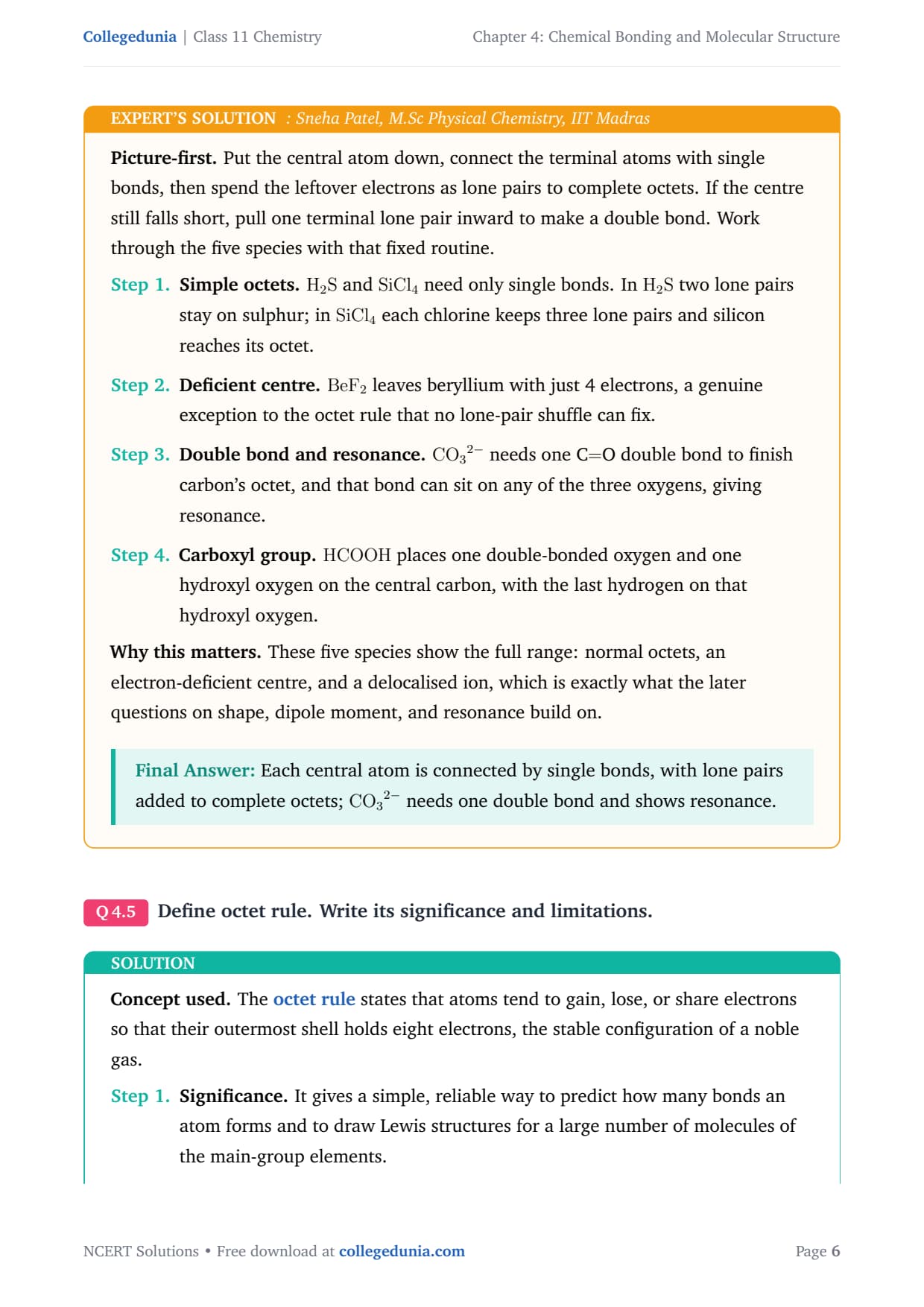
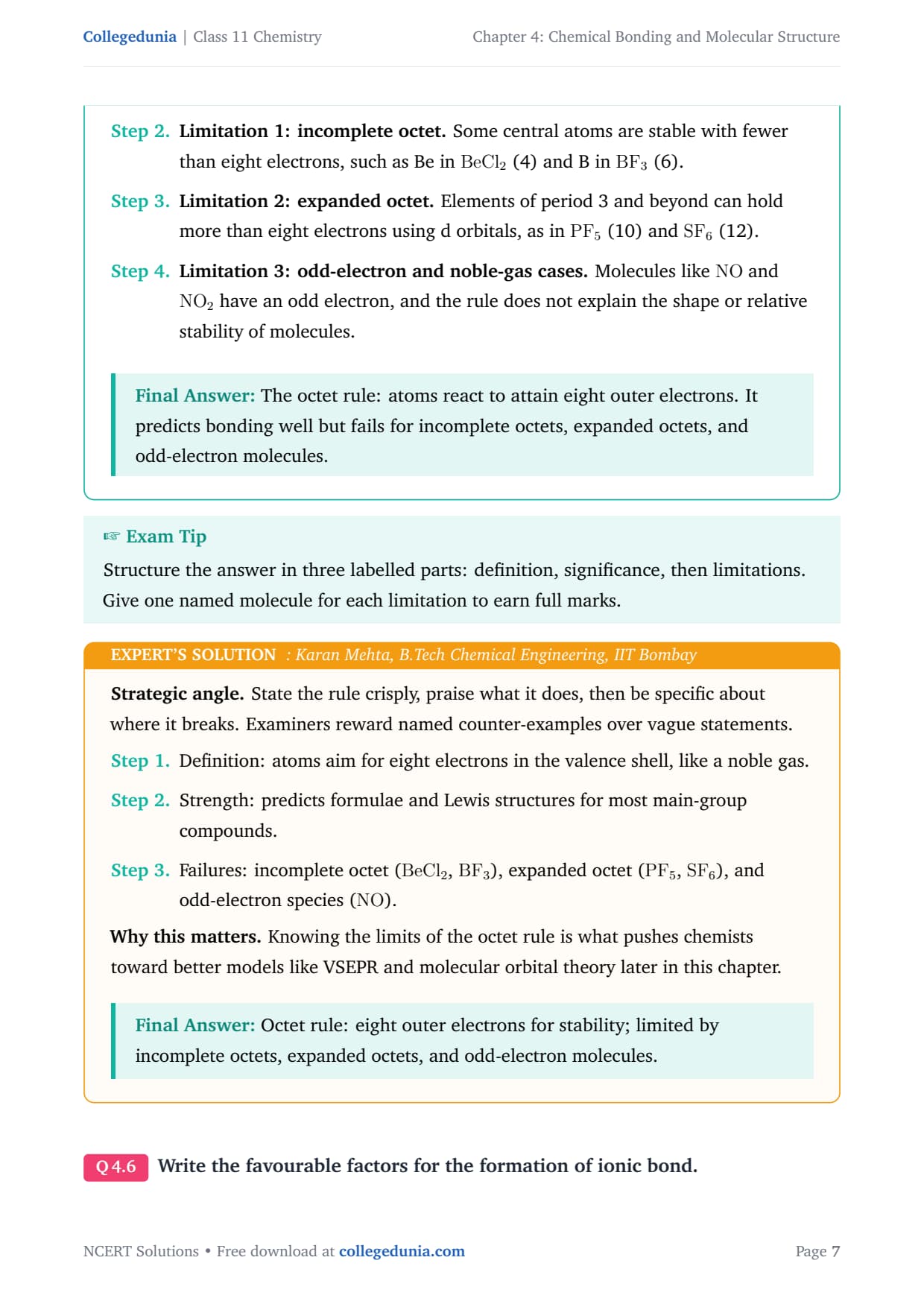
The octet rule works well for the second-period elements, but it has clear limits. Incomplete octets appear in BeCl2 and BF3, while expanded octets appear in SF6 and PF5. Odd-electron molecules like NO also break the rule. Knowing these exceptions is a common short-answer question in the boards.
Ionic Bond and Covalent Bond Formation
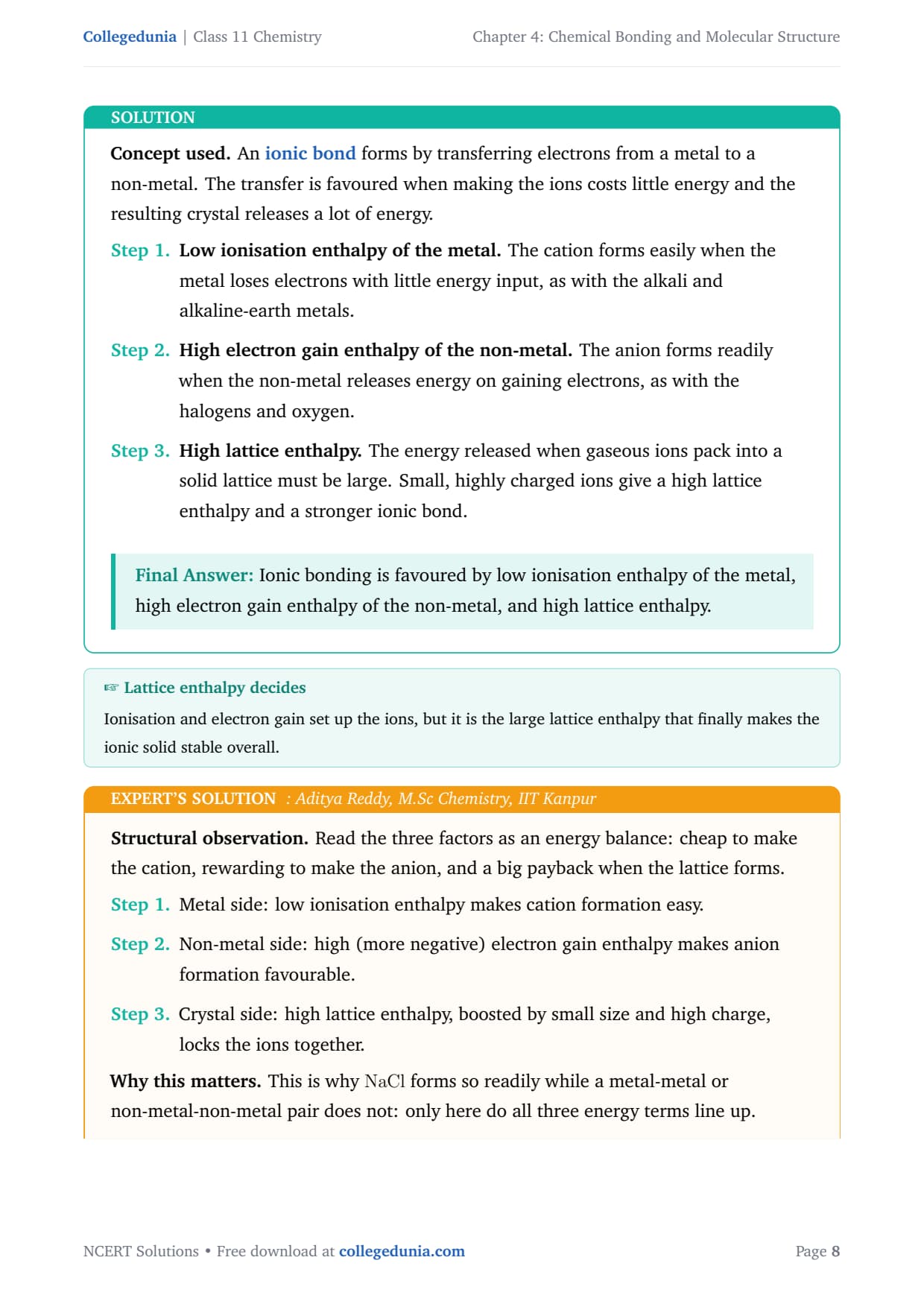
An ionic bond forms when one atom transfers electrons to another, creating oppositely charged ions that attract. A covalent bond forms when two atoms share electrons. Which one forms depends on the difference in electronegativity between the atoms.
| Feature | Ionic bond | Covalent bond |
|---|---|---|
| How it forms | Transfer of electrons | Sharing of electrons |
| Typical elements | Metal + non-metal | Non-metal + non-metal |
| Example | NaCl, MgO | H2, CH4 |
| State at room temperature | Usually solid | Gas, liquid or soft solid |
The energy released when gaseous ions form a mole of ionic solid is the lattice enthalpy, and a higher value means a stronger, more stable crystal. Smaller ions with higher charge give the highest lattice enthalpy. That is why MgO melts far higher than NaCl. For covalent bonds, more shared pairs give a shorter, stronger bond, so a triple bond is stronger than a double bond.
Lewis Structures and Formal Charge with Step-by-Step Working
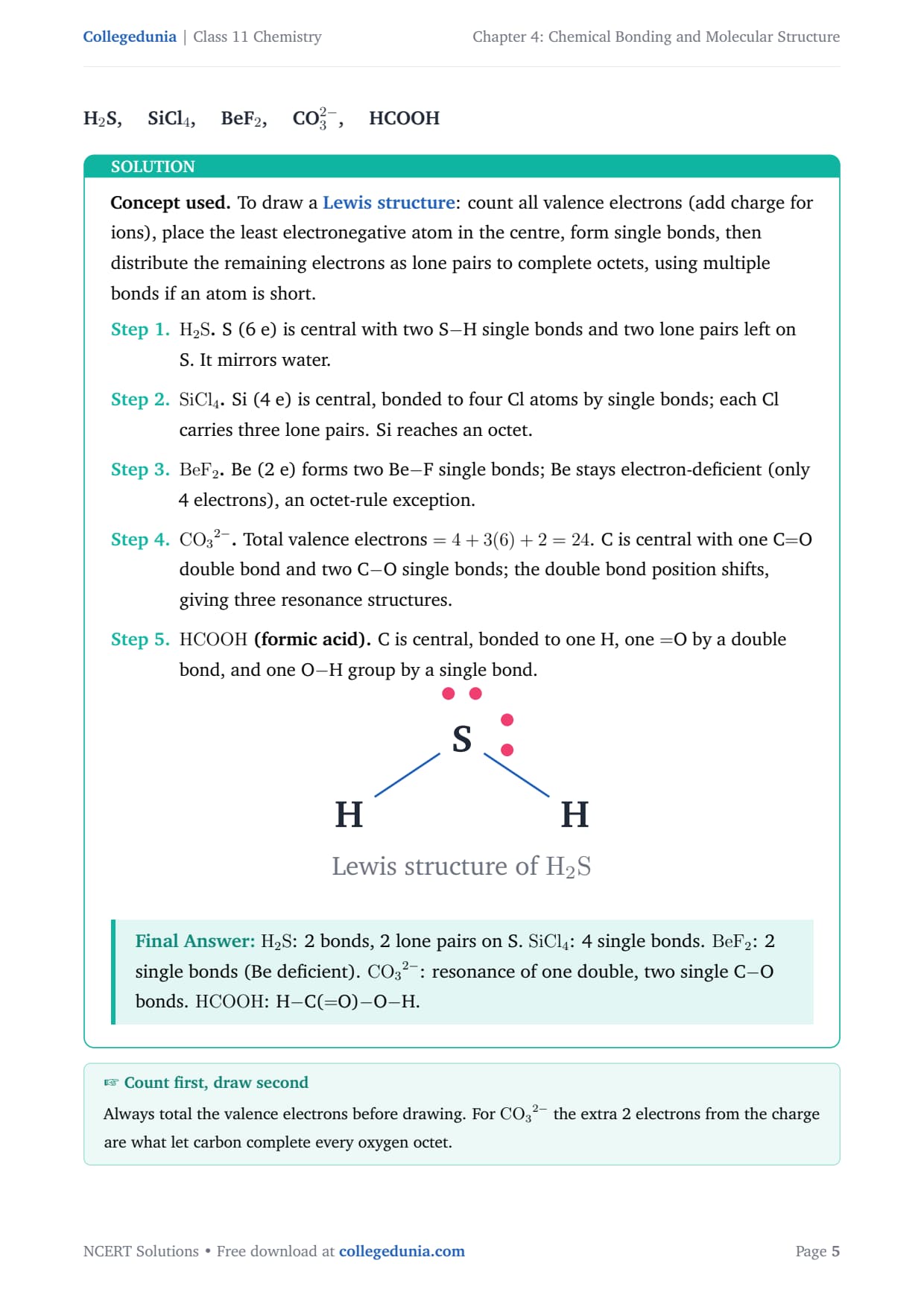
A Lewis structure shows every bonding pair and lone pair in a molecule. Drawing it correctly is the first step to predicting shape, so the NCERT solutions walk through each one in order.
- Add up the valence electrons of all atoms, adjusting for the ion's charge.
- Place the least electronegative atom in the centre and join the others with single bonds.
- Complete the octets of the outer atoms with lone pairs.
- Put any leftover electrons on the central atom, then form double or triple bonds if it lacks an octet.
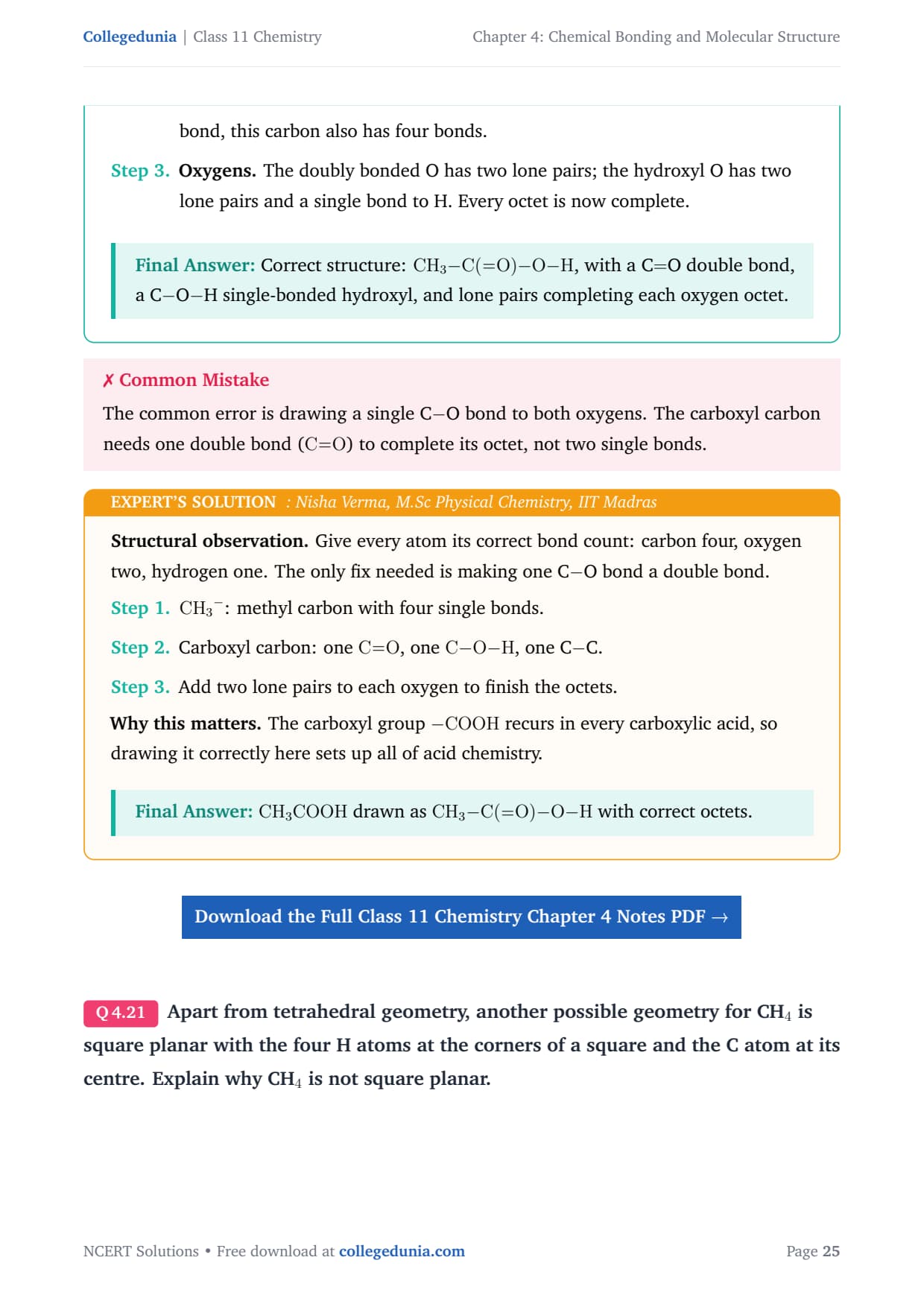
To choose between two valid structures, use the formal charge: formal charge = valence electrons − lone-pair electrons − (bonding electrons ÷ 2). The best structure keeps formal charges closest to zero. For CO2, the O=C=O arrangement gives every atom a formal charge of zero, which is why it is the accepted structure. Several exercise questions ask you to draw the structure and justify it this way.
VSEPR Theory and Molecular Geometry
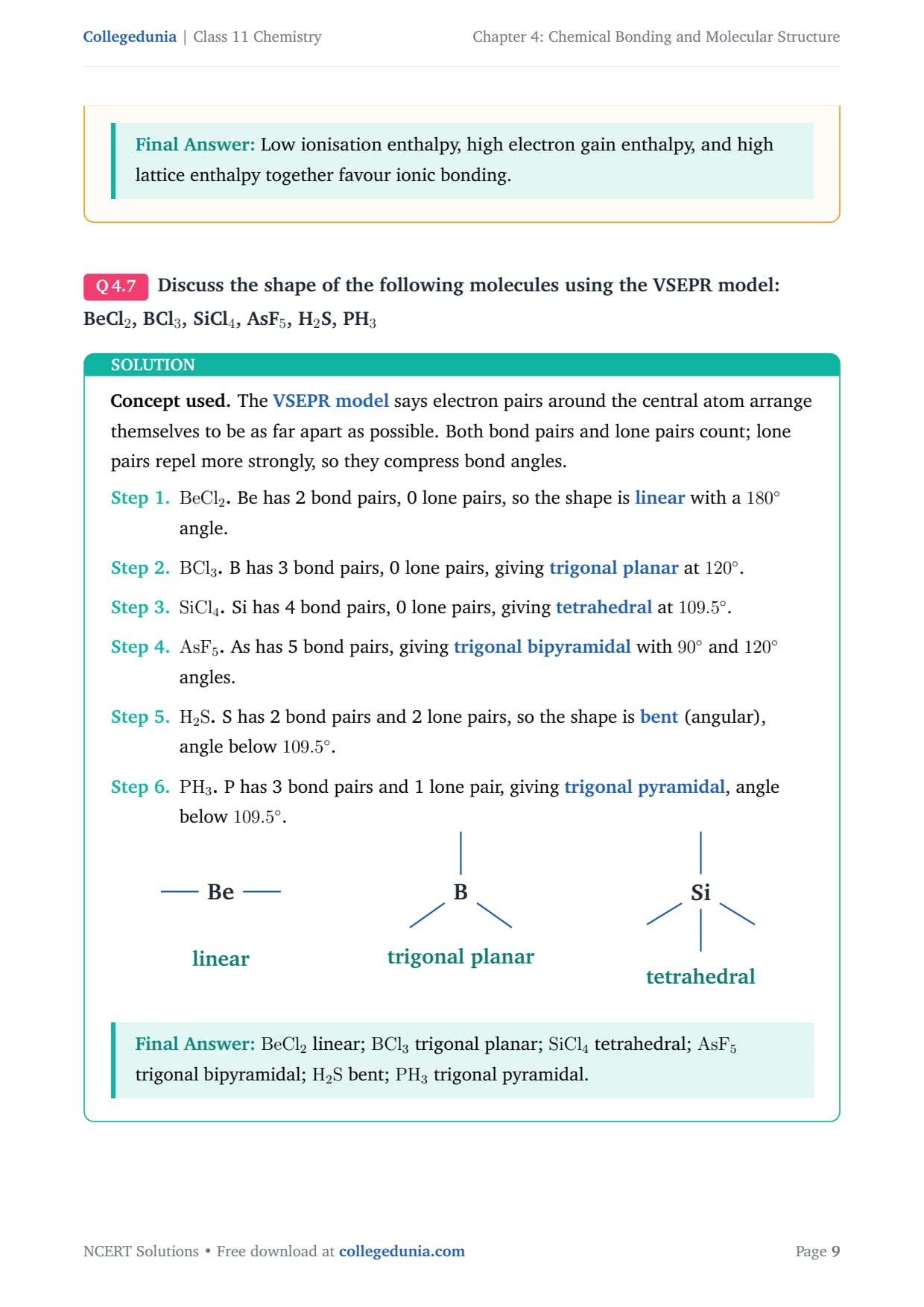
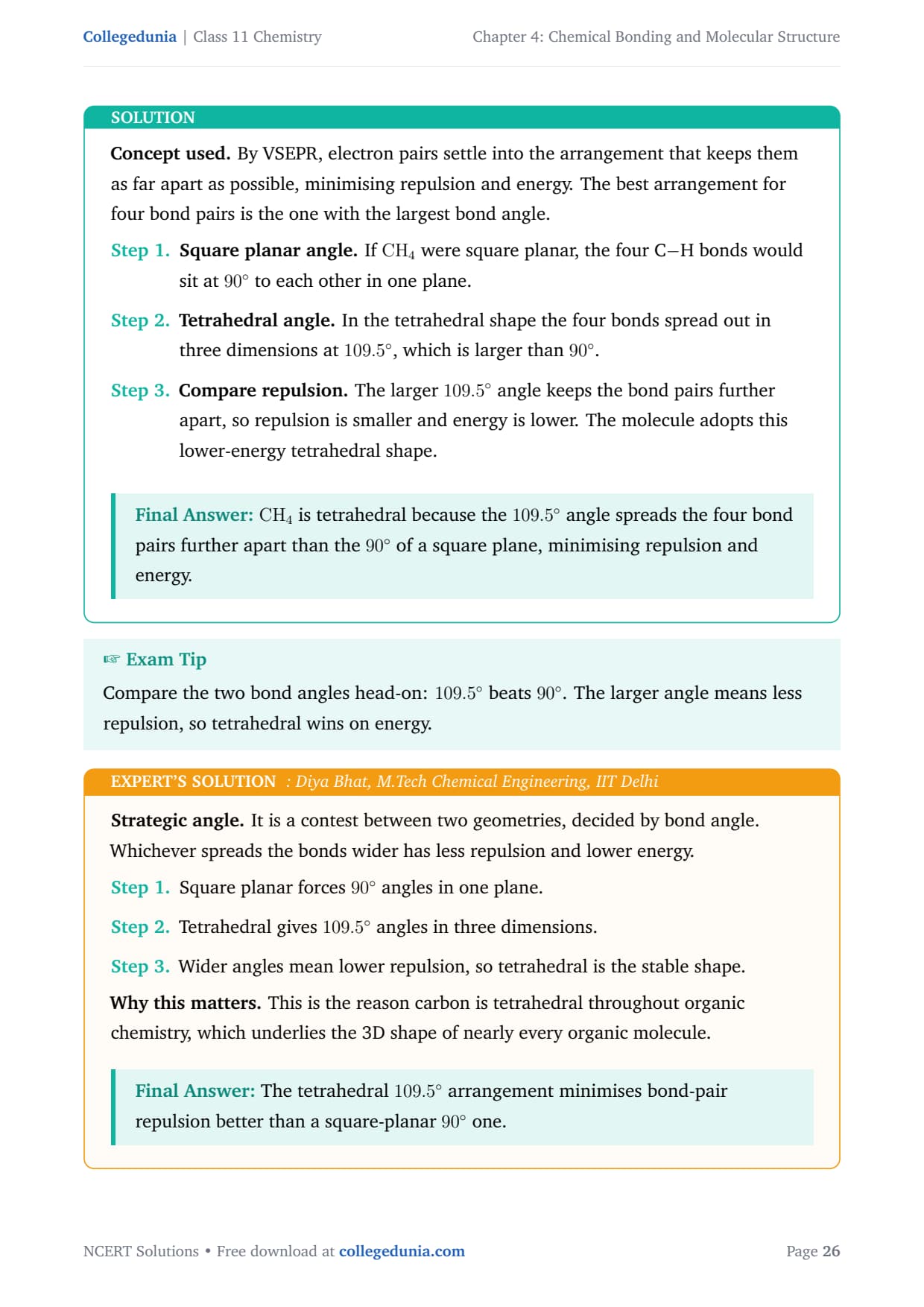
The VSEPR theory predicts molecular shape from the idea that electron pairs around the central atom repel and spread as far apart as possible. Lone pairs repel more strongly than bonding pairs, so they push bonding pairs closer and bend the shape.
| Electron pairs | Shape | Bond angle | Example |
|---|---|---|---|
| 2 | Linear | 180° | BeCl2 |
| 3 | Trigonal planar | 120° | BF3 |
| 4 | Tetrahedral | 109.5° | CH4 |
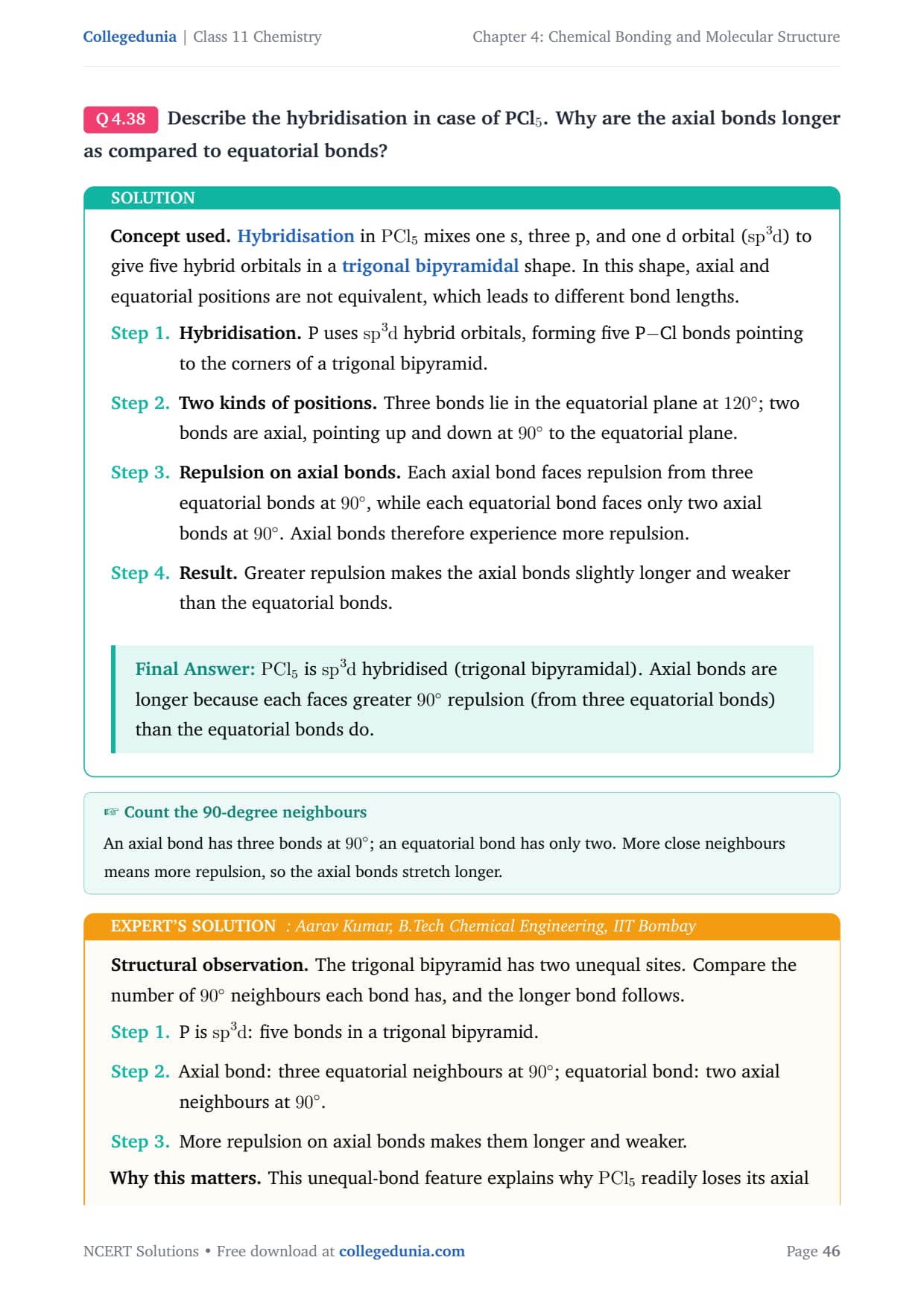
| 5 | Trigonal bipyramidal | 120° and 90° | PF5 |
| 6 | Octahedral | 90° | SF6 |
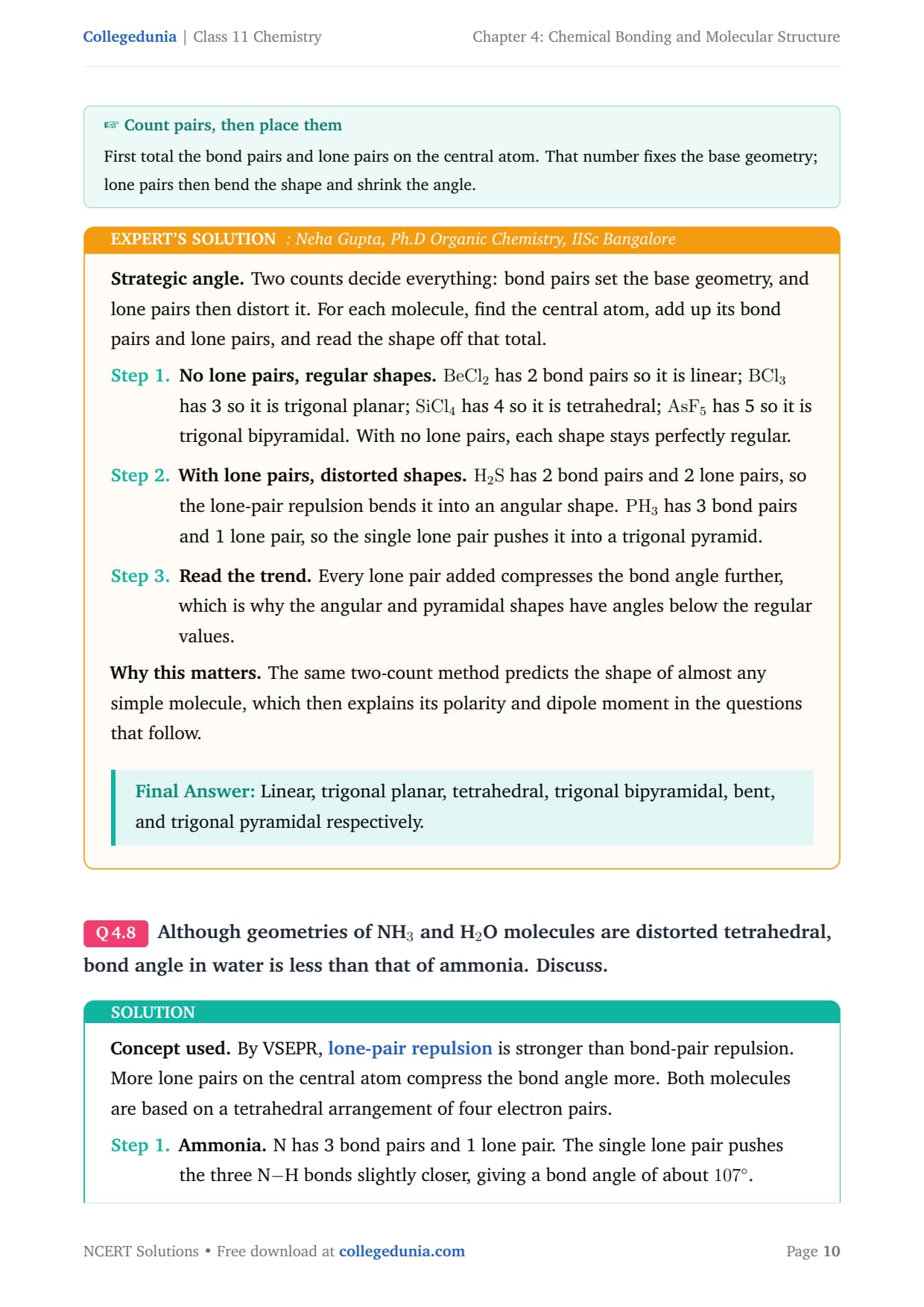
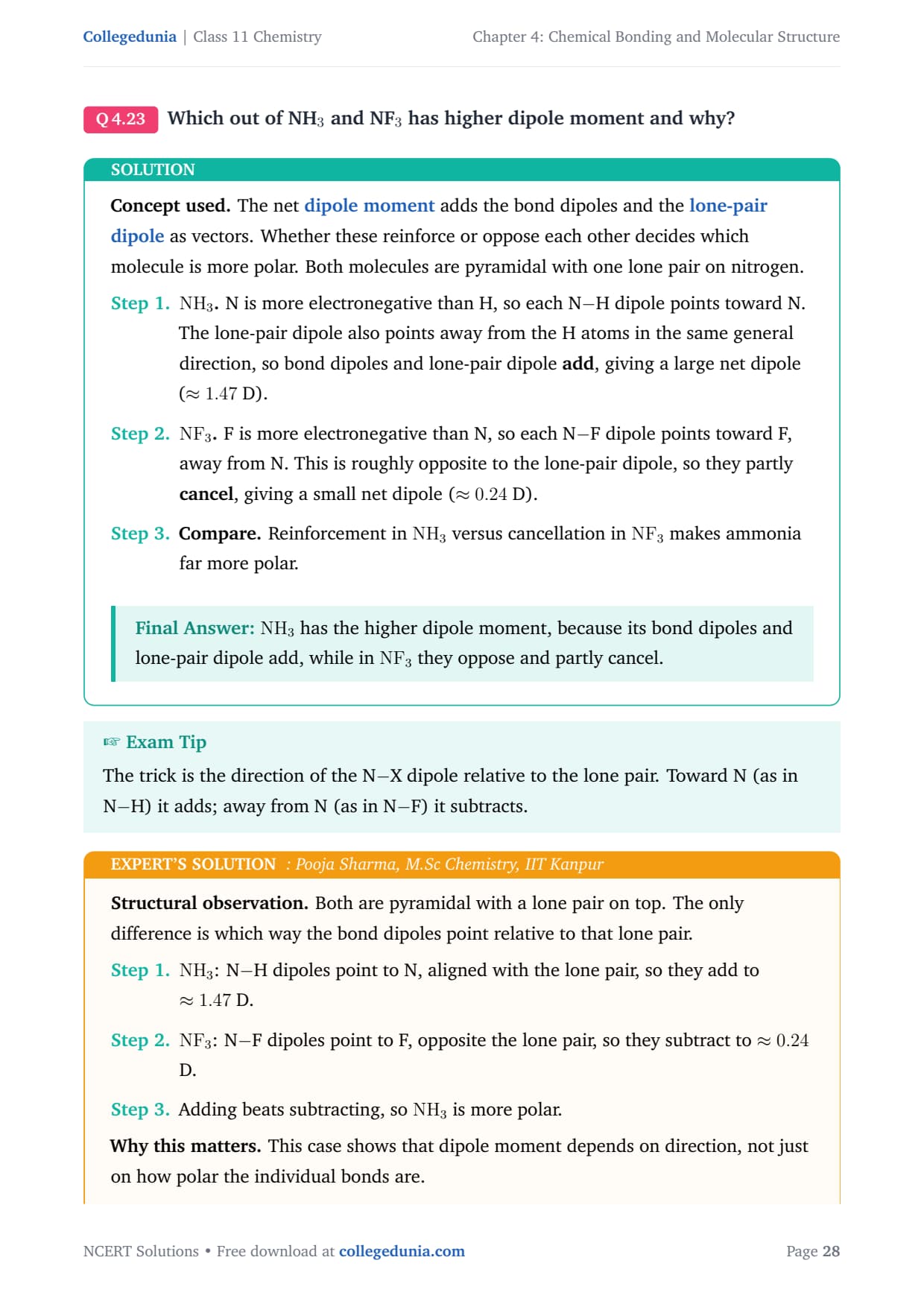
Lone pairs explain the shapes that look odd at first. Water has two lone pairs, so its bond angle drops to 104.5° and the molecule is bent, not linear. Ammonia has one lone pair, so it is pyramidal with a 107° angle. Lone pair repulsion order: lone-lone > lone-bond > bond-bond. Learn this order, because it decides every distorted angle the exercise asks about.
Valence Bond Theory and Hybridization sp, sp2 and sp3
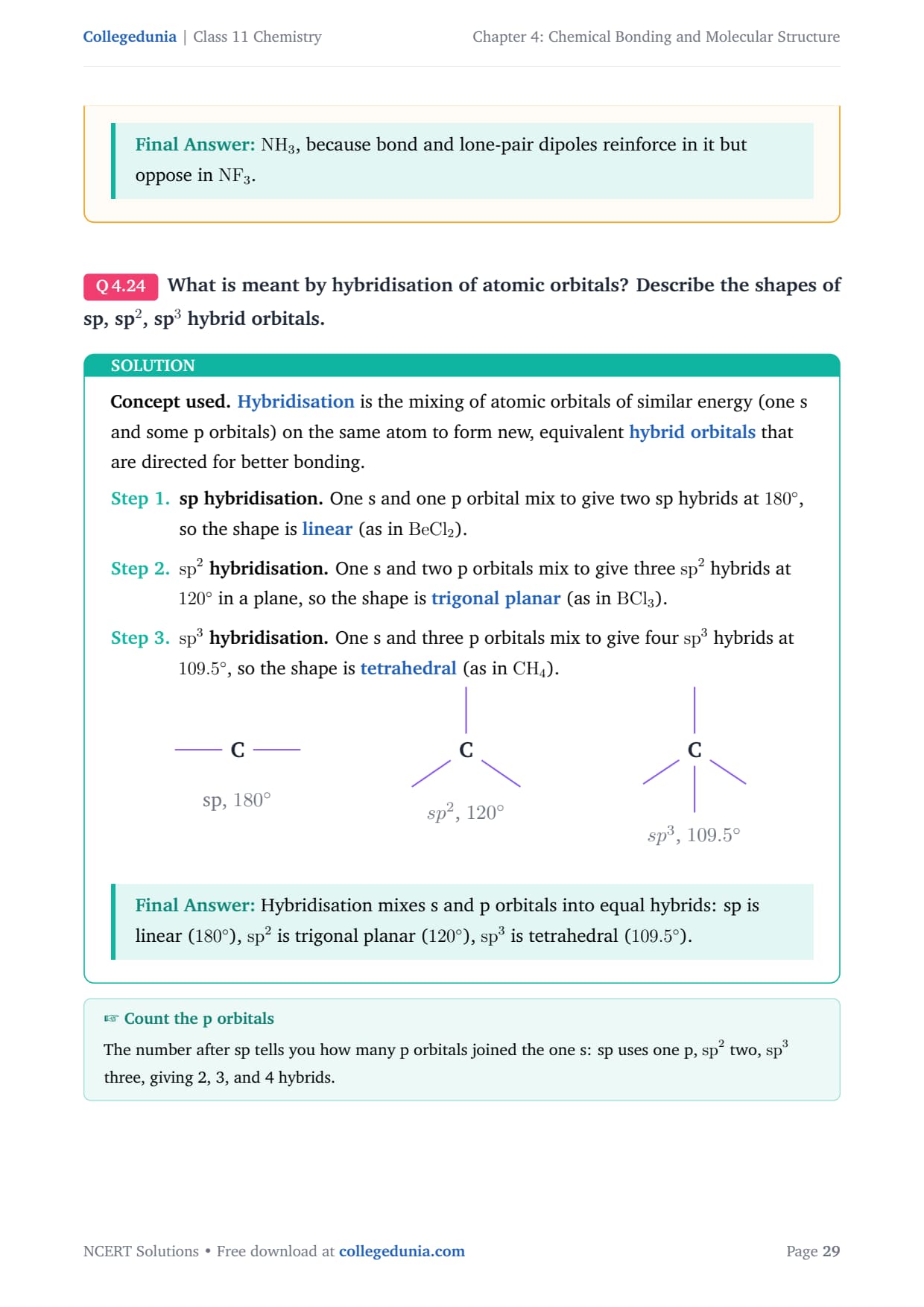
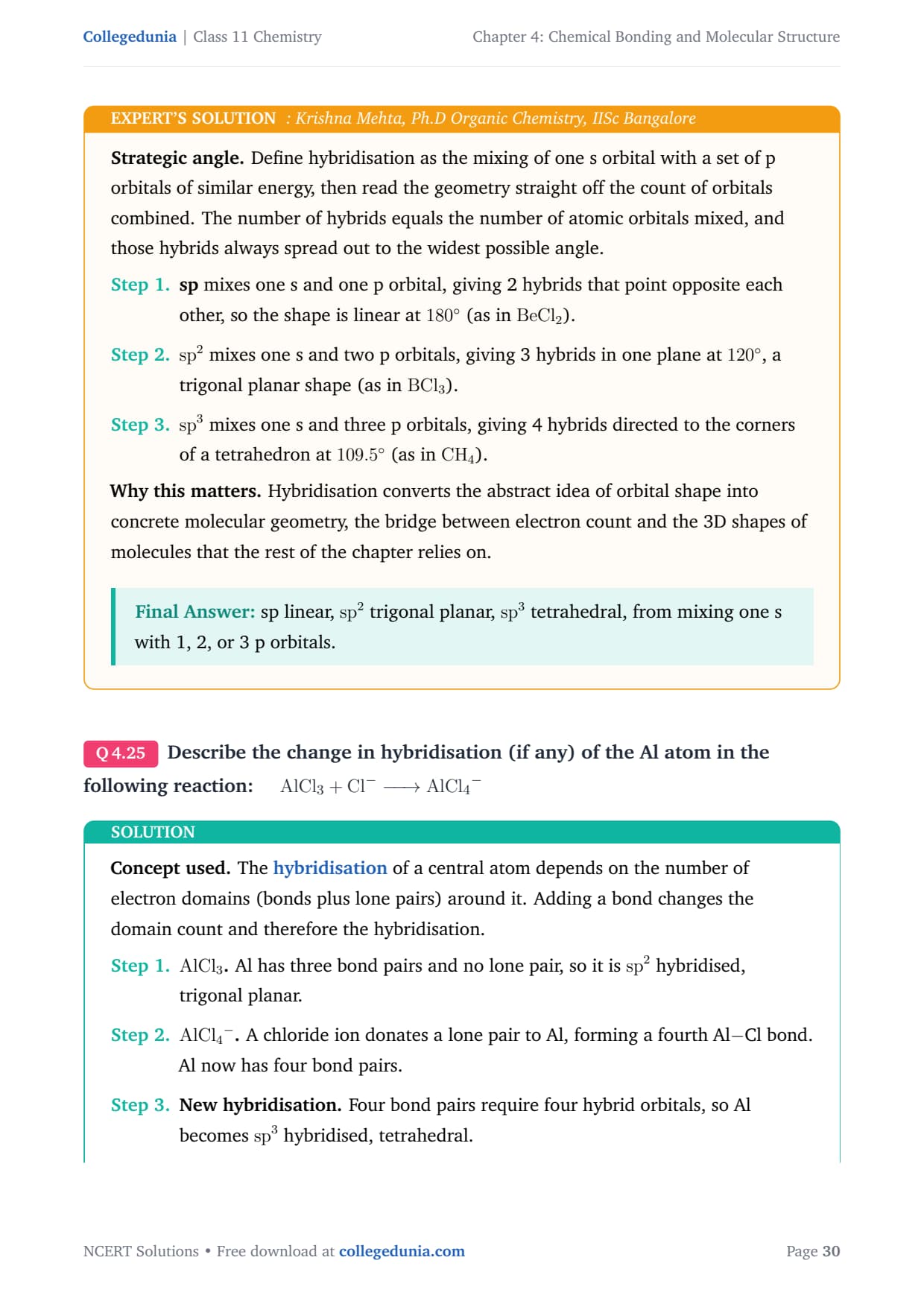
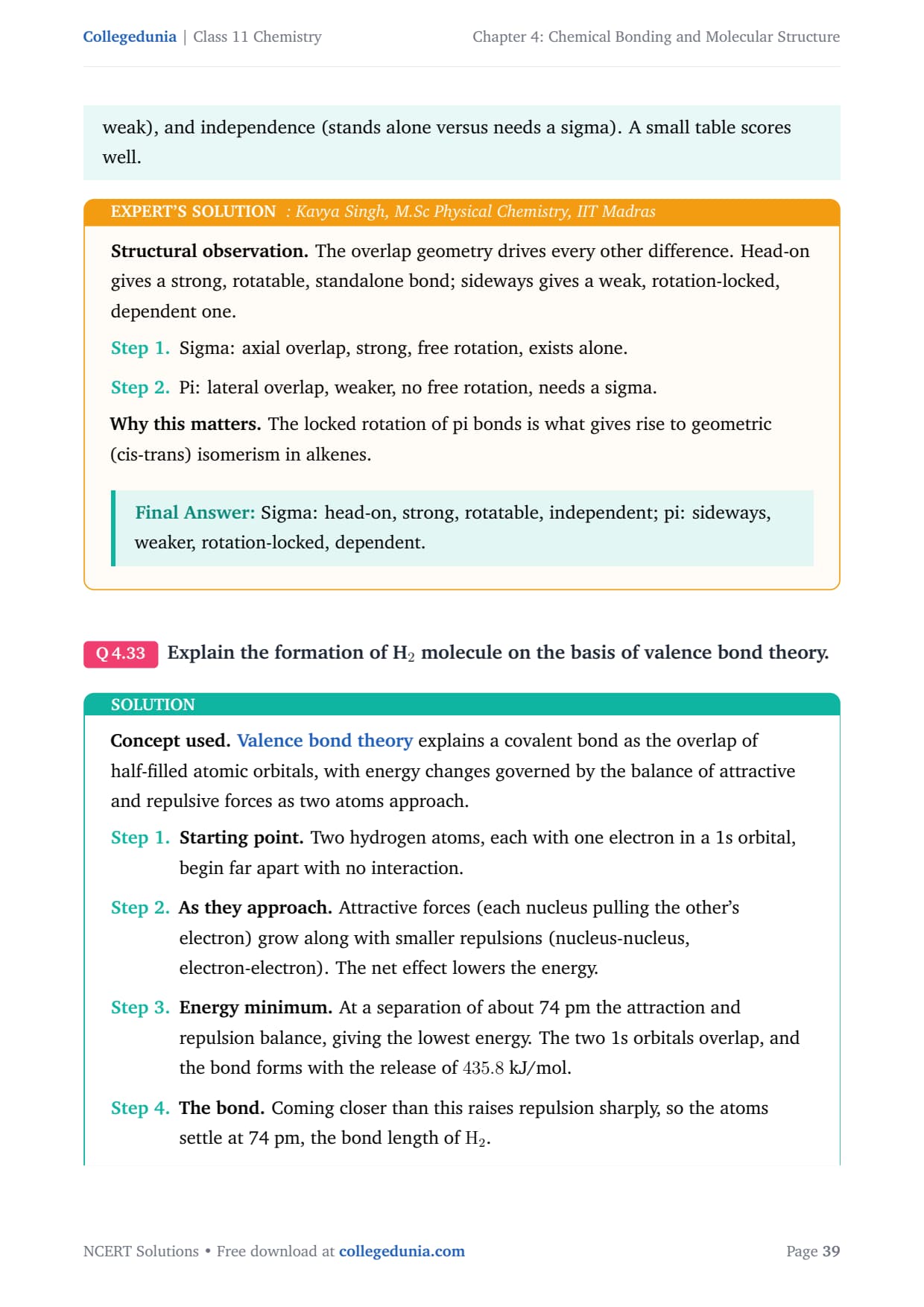
Valence bond theory says a covalent bond forms when two half-filled atomic orbitals overlap. Greater overlap means a stronger bond. To explain equal bonds and real shapes, orbitals mix into new equivalent orbitals through hybridization.
| Hybridization | Shape | Bond angle | Example |
|---|---|---|---|
| sp | Linear | 180° | BeCl2, C2H2 |
| sp2 | Trigonal planar | 120° | BF3, C2H4 |
| sp3 | Tetrahedral | 109.5° | CH4, NH3 |
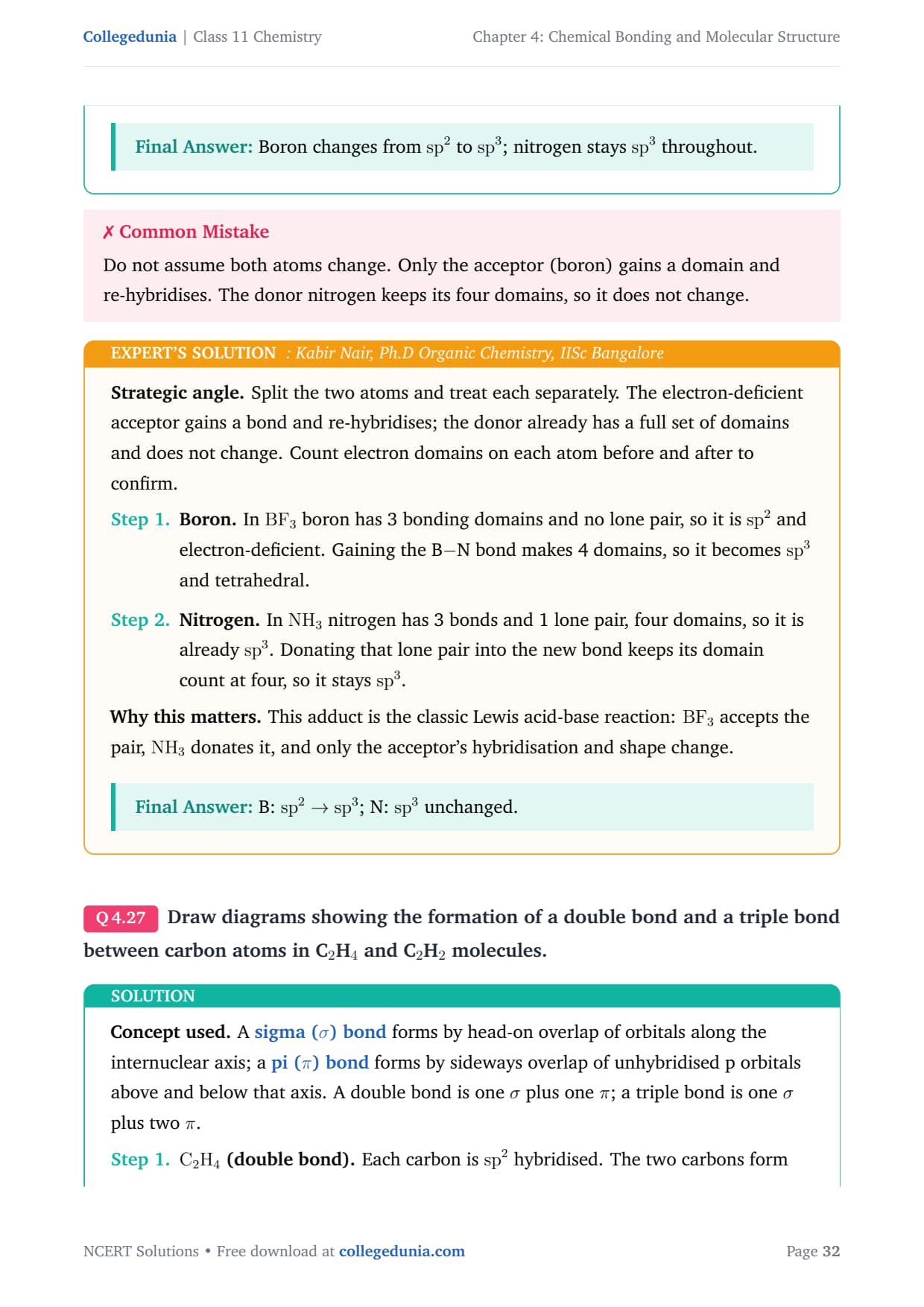
An end-on overlap gives a strong sigma bond, while a side-on overlap of p orbitals gives a weaker pi bond. A single bond is one sigma bond; a double bond is one sigma and one pi; a triple bond is one sigma and two pi. Count sigma bonds and lone pairs on the central atom to read off its hybridization. Two regions mean sp, three mean sp2, and four mean sp3, a quick trick that saves time in the exam.
Molecular Orbital Theory, Bond Order and Magnetic Behaviour
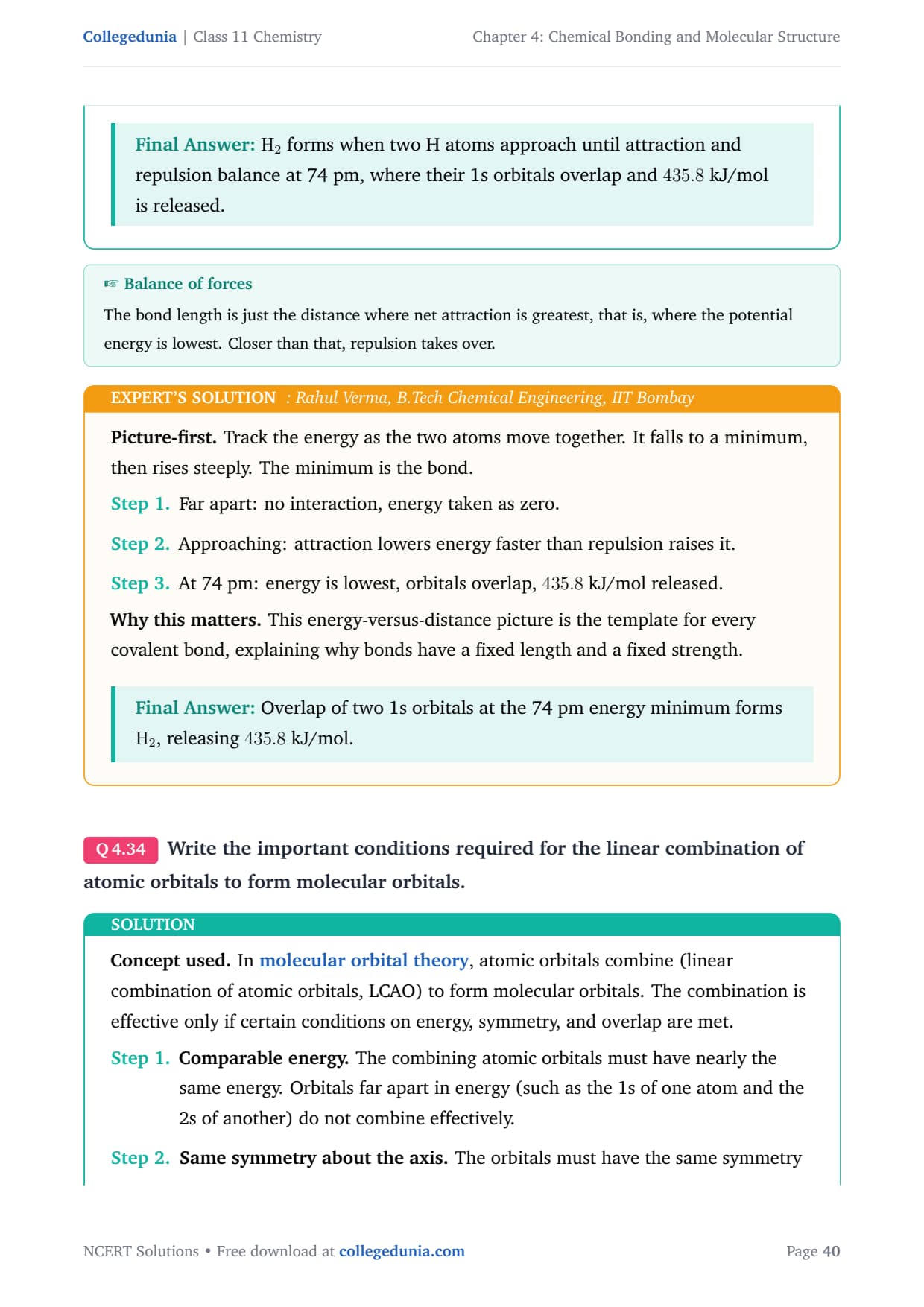
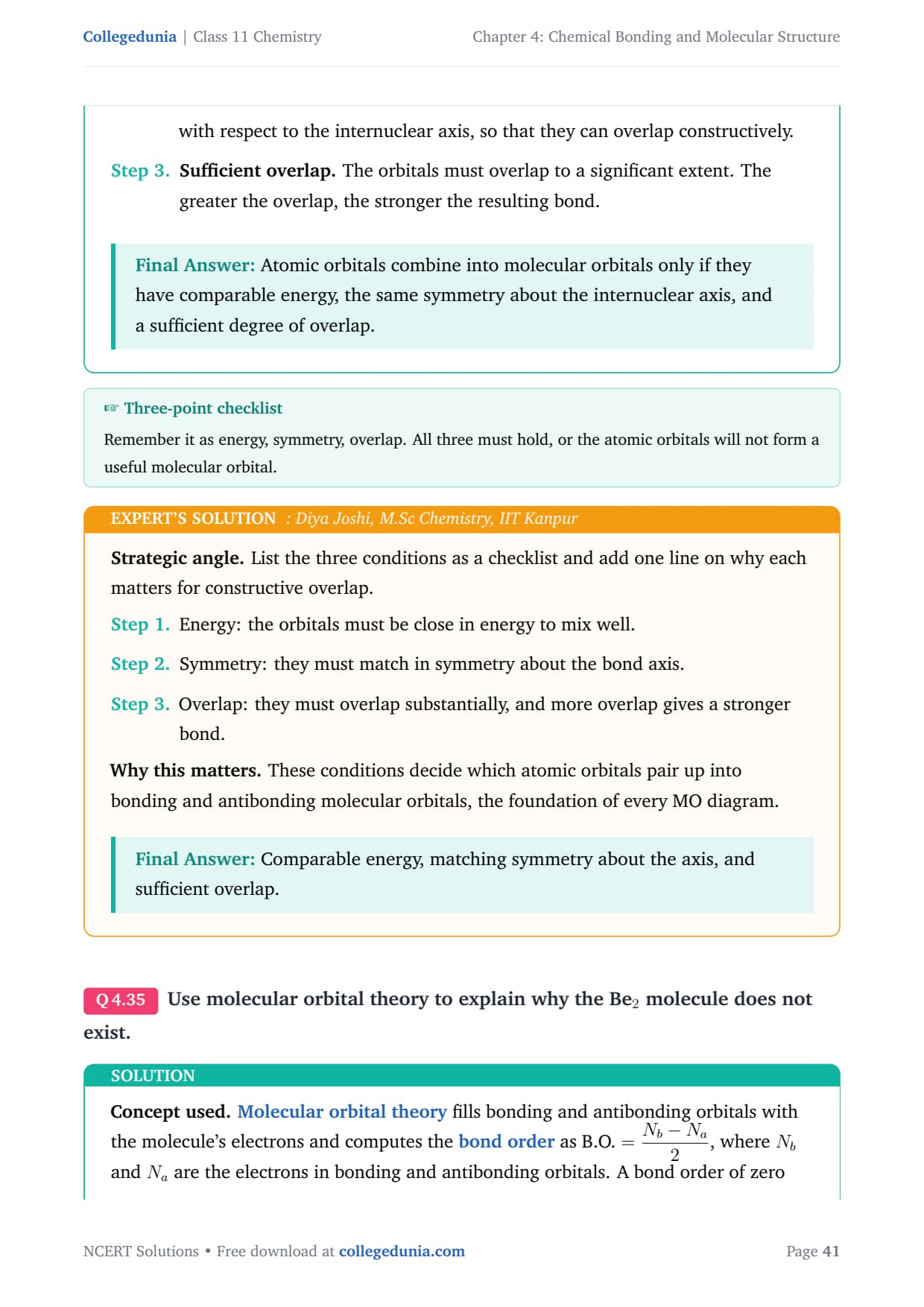
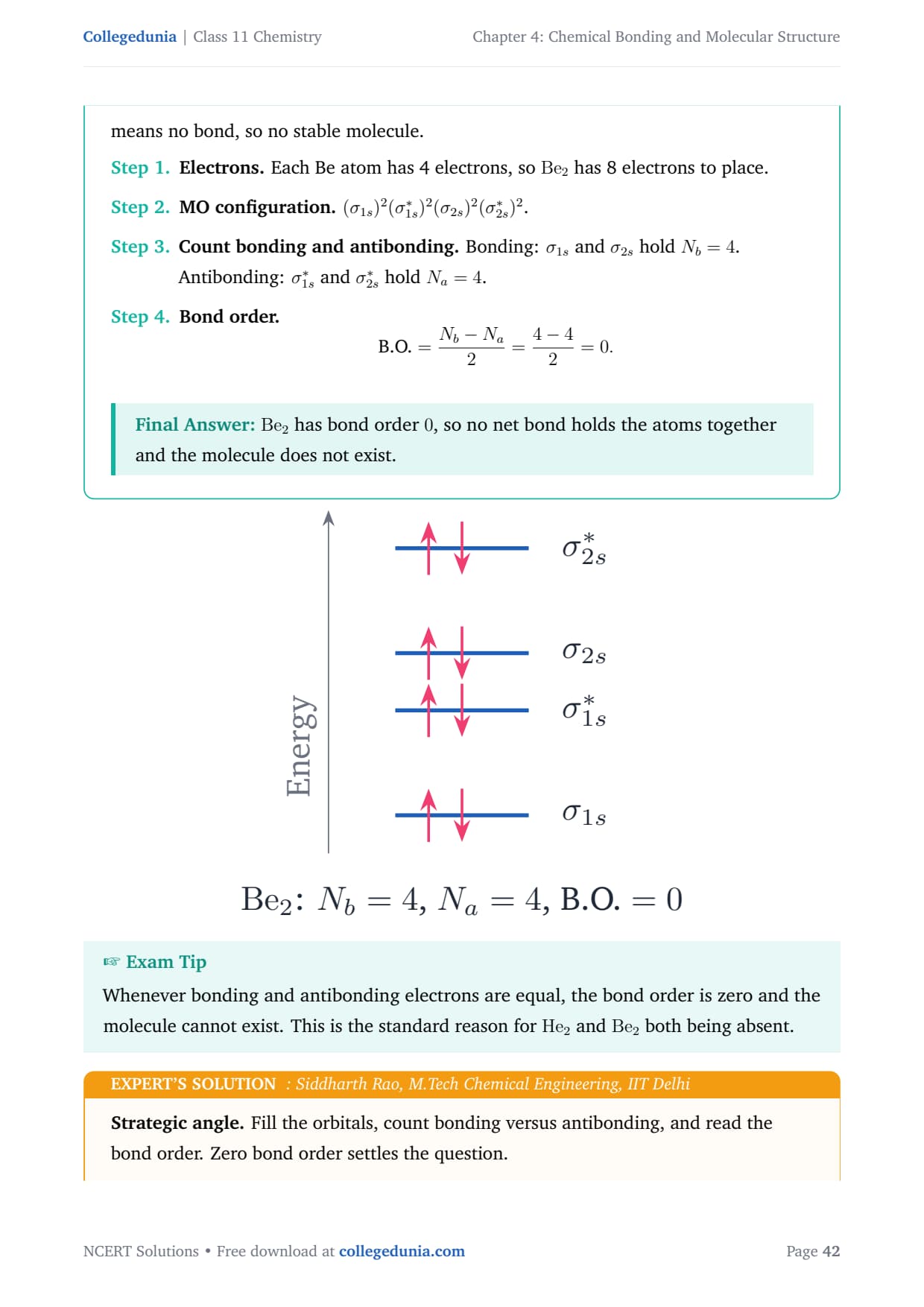
Molecular orbital theory treats a molecule as one unit. Atomic orbitals combine to form bonding and antibonding molecular orbitals, and electrons fill them in order of energy. This model explains bond strength and magnetism better than valence bond theory.
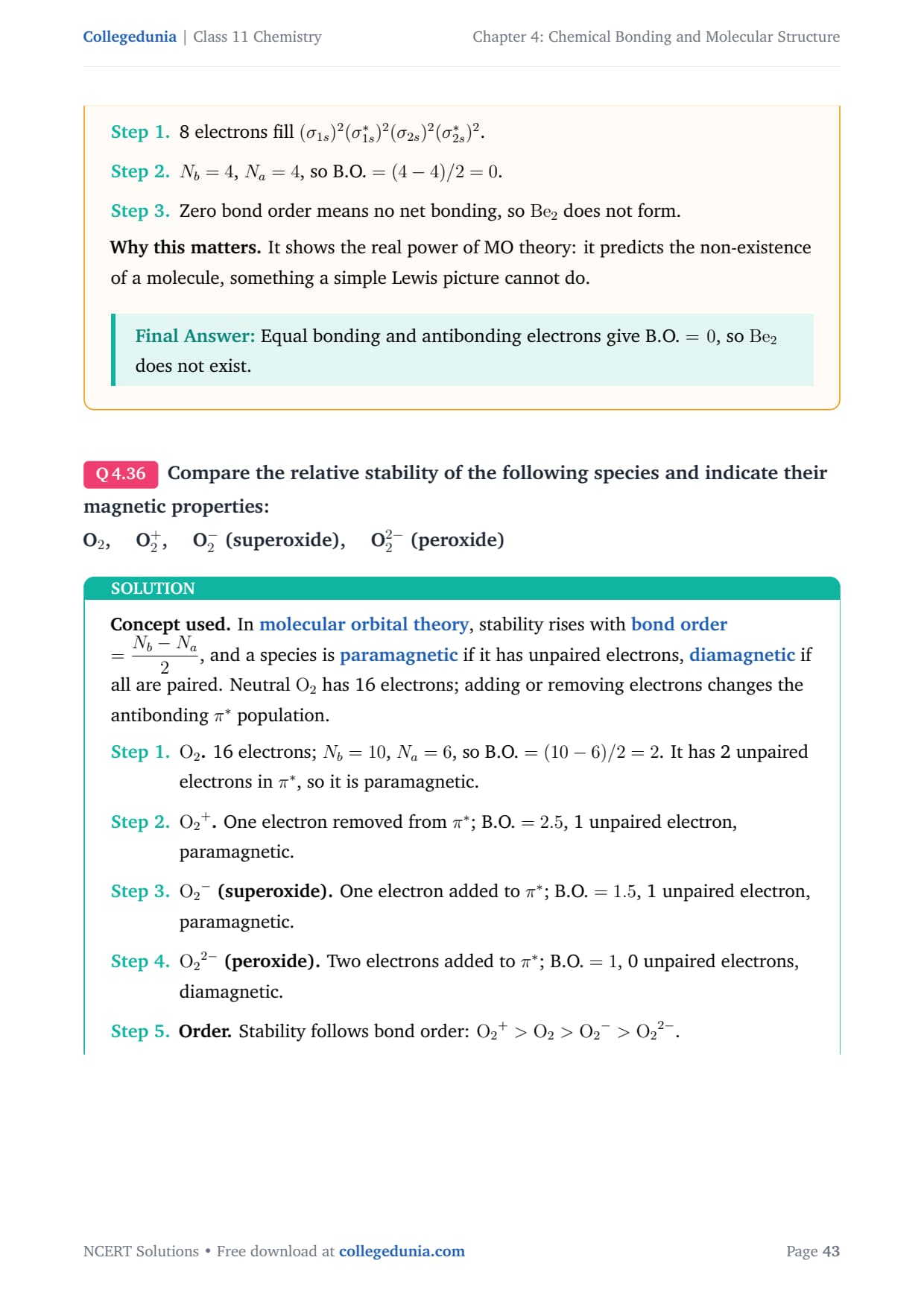
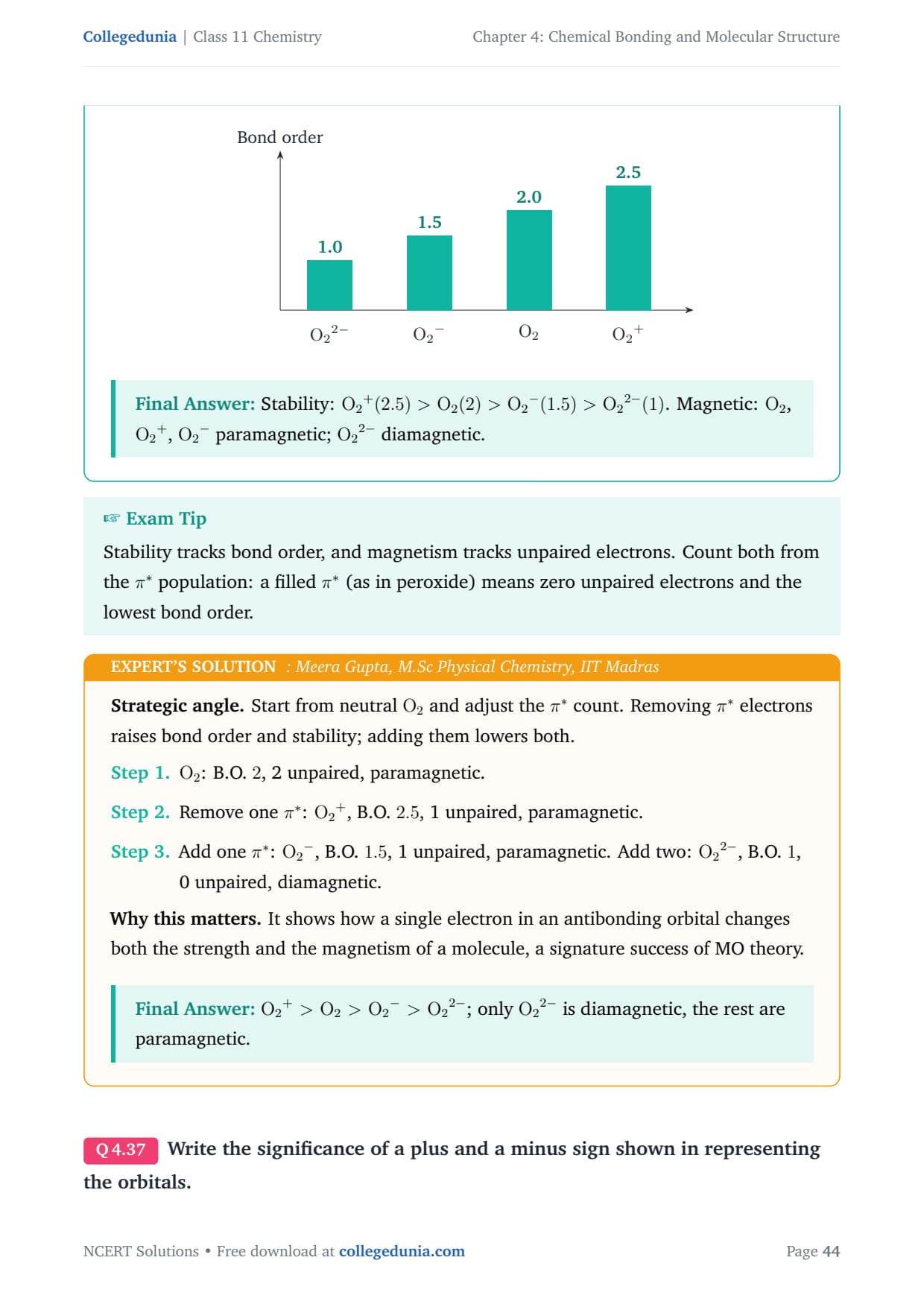
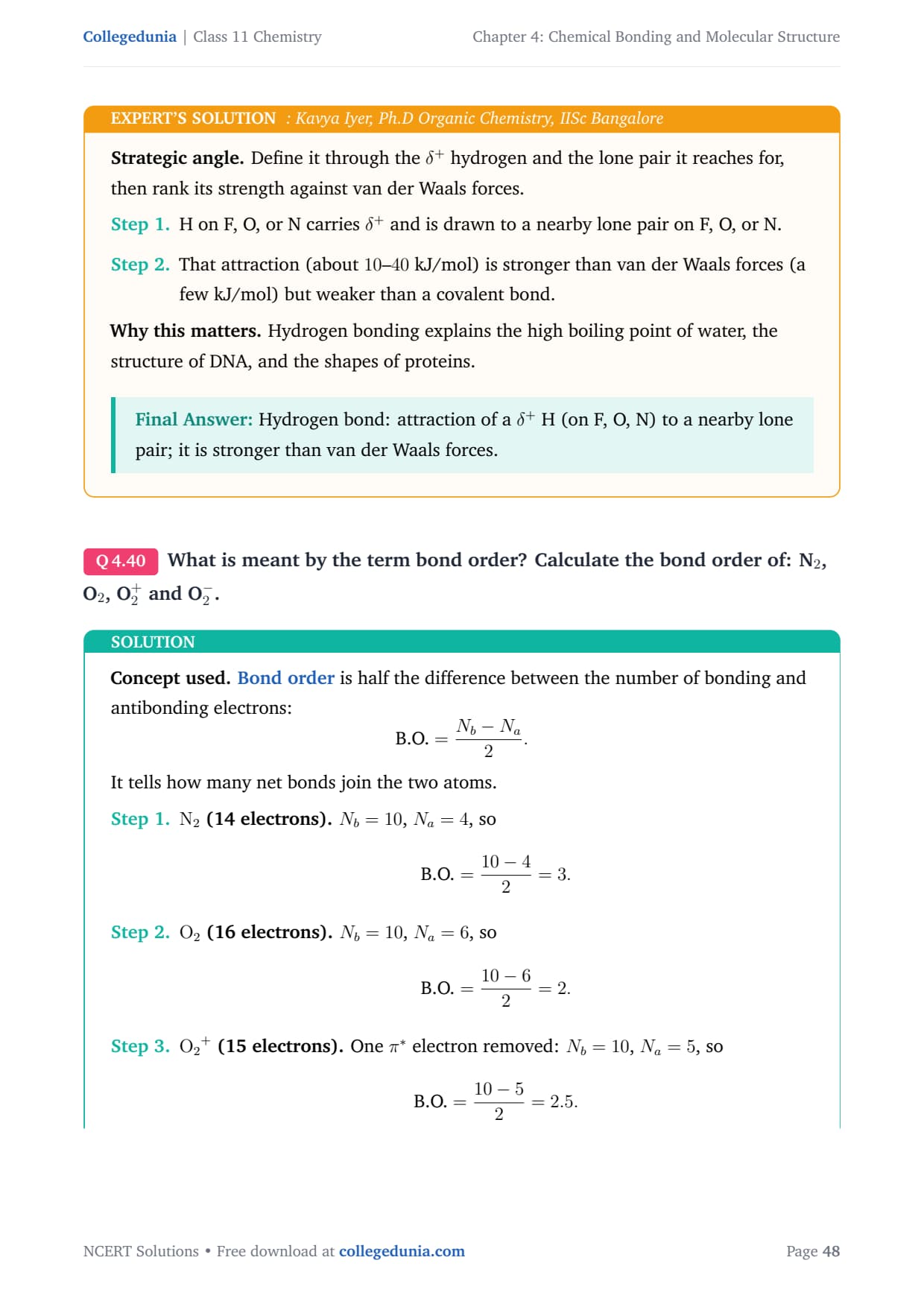
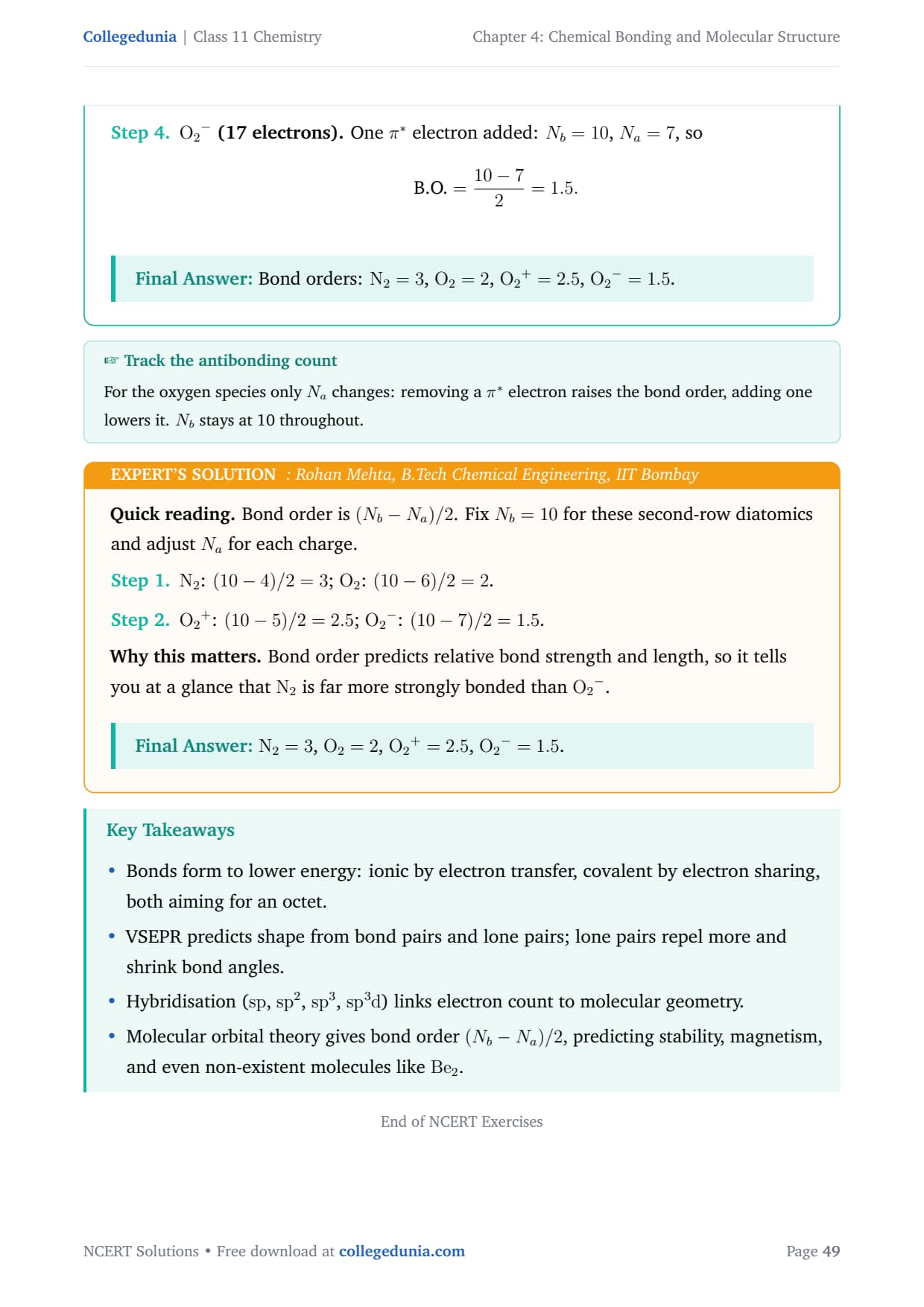
- Bond order = (bonding electrons − antibonding electrons) ÷ 2.
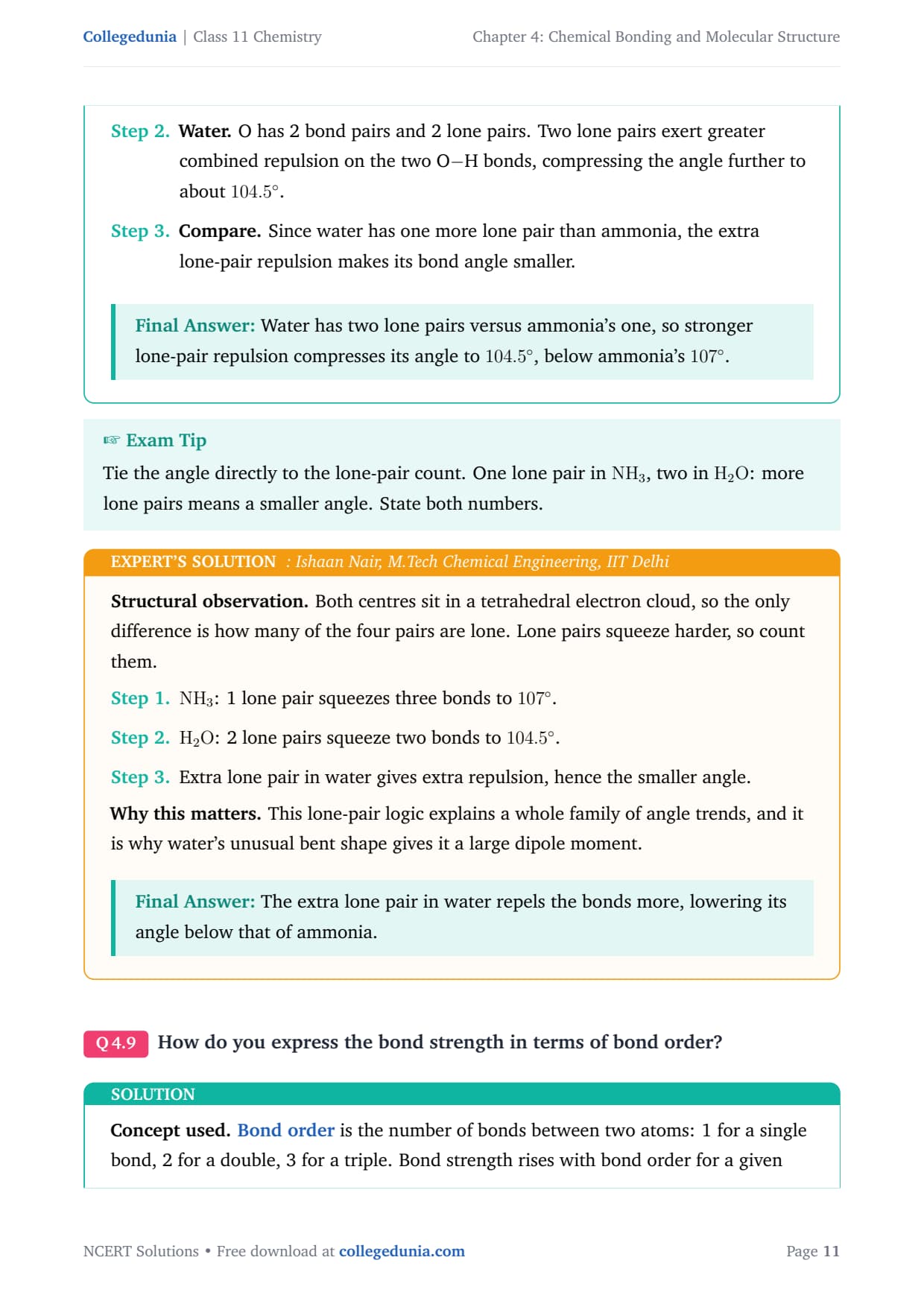
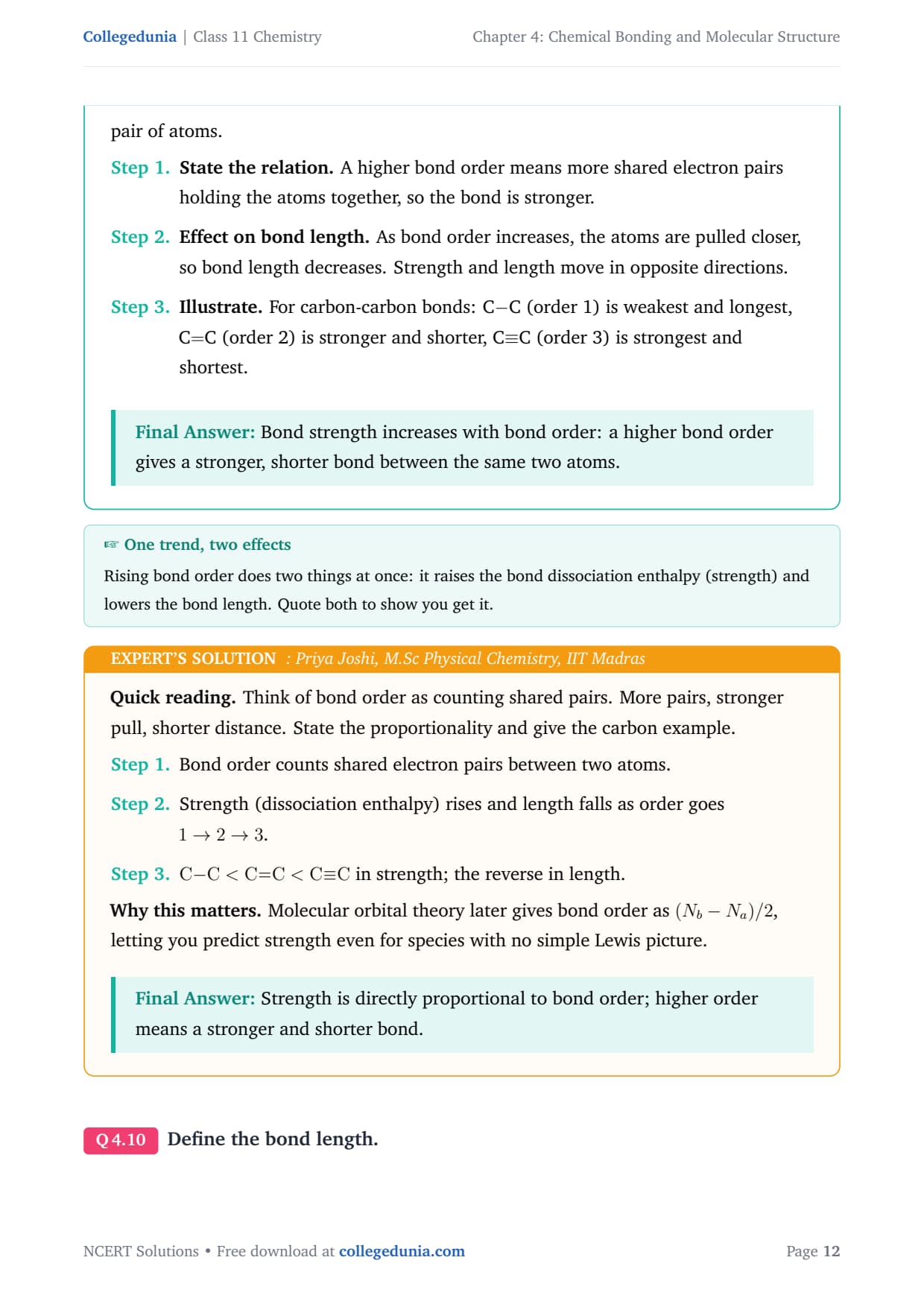
- A higher bond order means a stronger, shorter bond and a more stable molecule.
- A bond order of zero means the molecule does not exist, as with He2.
- Unpaired electrons make a molecule paramagnetic; all paired electrons make it diamagnetic.
The oxygen molecule is the classic proof of this theory. O2 has two unpaired electrons, so it is paramagnetic, a fact the Lewis structure cannot explain but molecular orbital theory predicts at once. For N2 the bond order is 3, which matches its very strong triple bond. Questions on this section ask you to draw the energy diagram, find the bond order, and state whether the molecule is magnetic.
Hydrogen Bonding and Its Effect on Properties
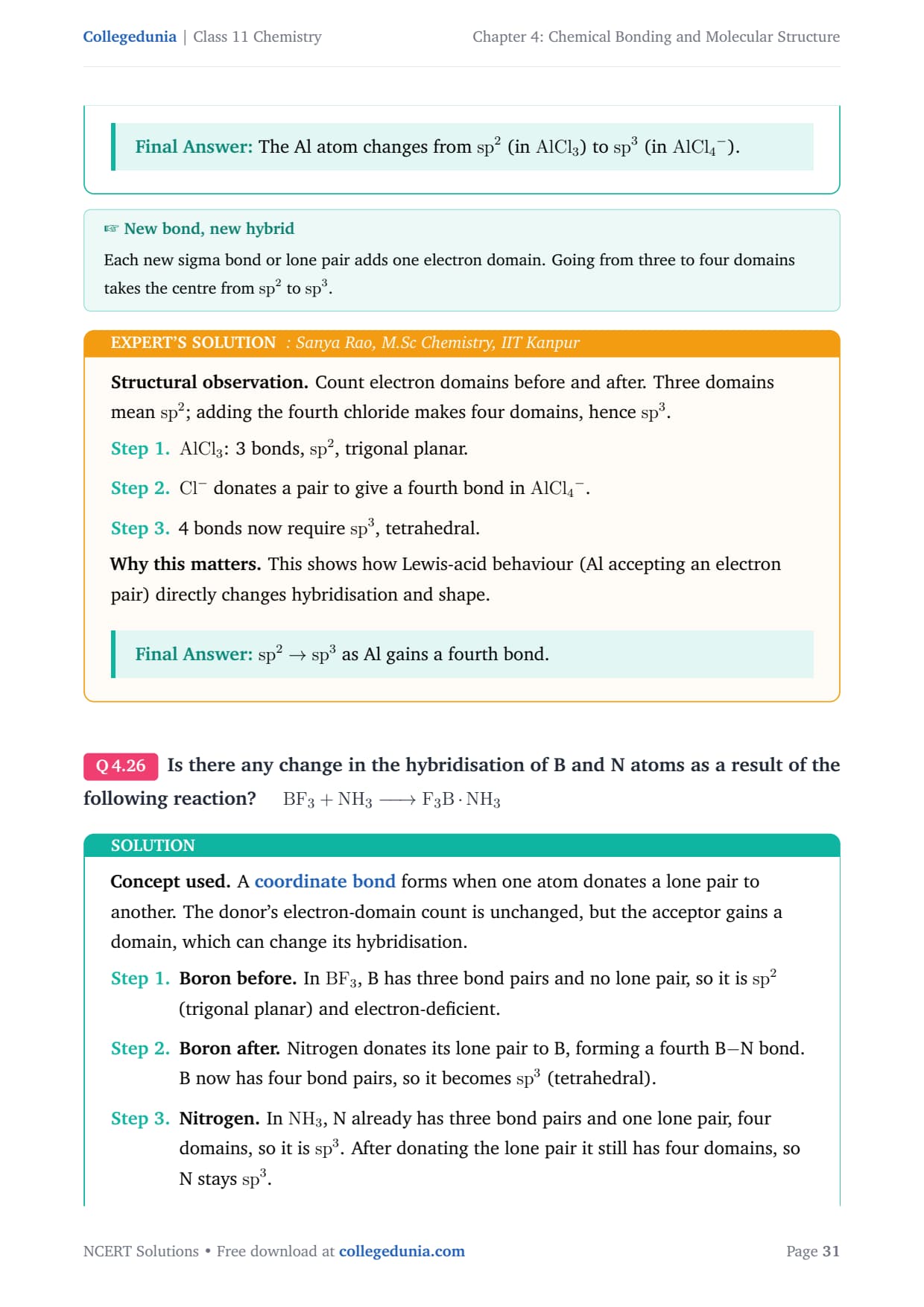
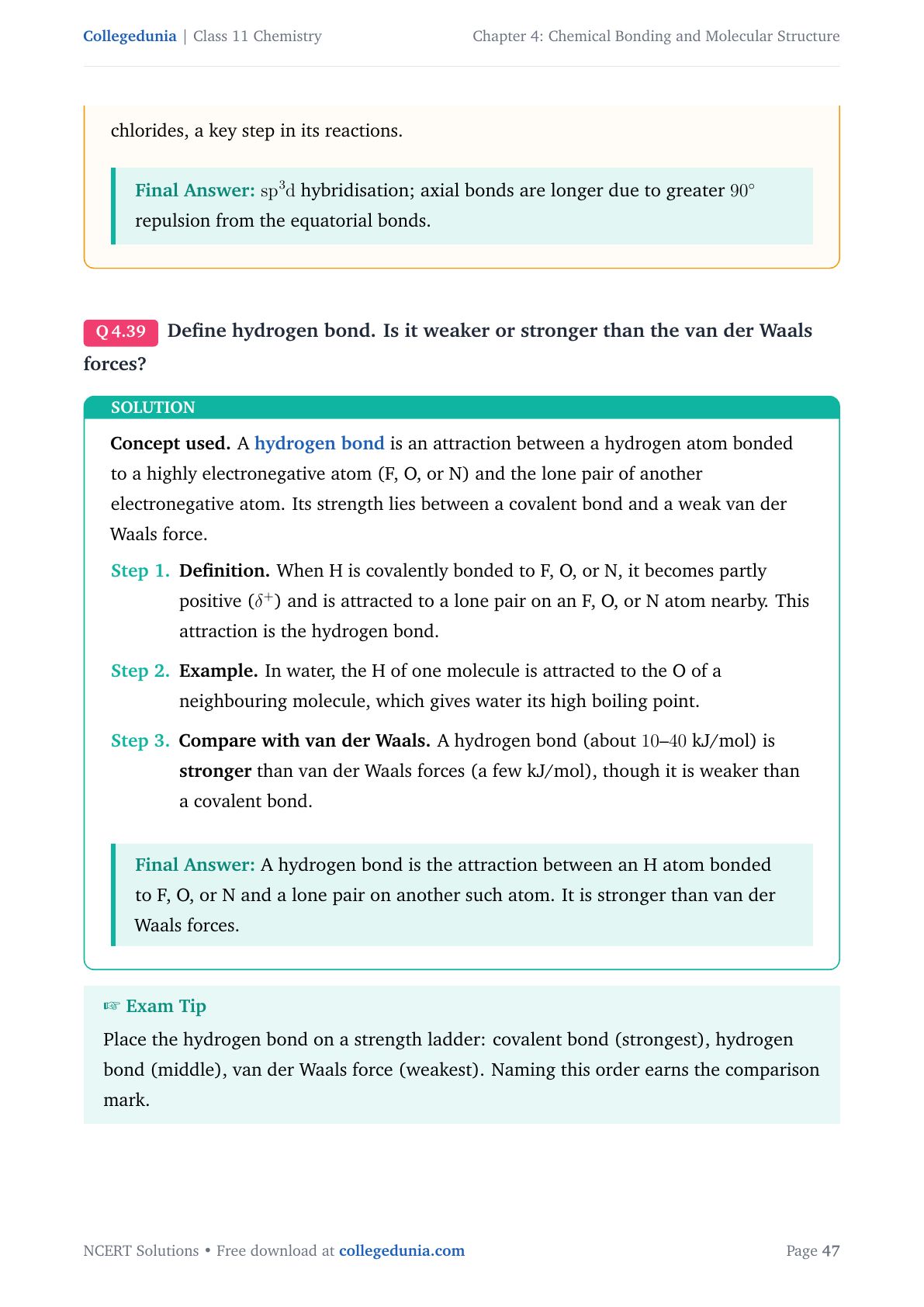
A hydrogen bond is the attraction between a hydrogen atom bonded to a highly electronegative atom (N, O or F) and a lone pair on another such atom. It is weaker than a covalent bond but strong enough to change physical properties sharply.
- Intermolecular hydrogen bonds act between molecules, as in water and HF.
- Intramolecular hydrogen bonds act within one molecule, as in ortho-nitrophenol.
- They raise boiling point, melting point and viscosity above what molecular mass alone predicts.
Hydrogen bonding is why water is a liquid while H2S, a heavier molecule, is a gas. It also explains why ice floats, since the open hydrogen-bonded network makes ice less dense than liquid water. This topic appears often in one-mark reasoning questions, so link every property back to the strength and number of hydrogen bonds.
Chemical Bonding and Molecular Structure Exercise-wise Breakdown
The NCERT back exercise has 40 questions, a mix of reasoning, structure-drawing and short calculation. The intext questions test the same ideas in shorter form. The table below maps the question blocks to their topics so you can plan your practice.
| Question block | What it tests |
|---|---|
| Q 4.1 to 4.10 | Kossel-Lewis approach, octet rule, ionic bond and Lewis symbols. |
| Q 4.11 to 4.20 | Lewis structures, formal charge and bond parameters. |
| Q 4.21 to 4.30 | VSEPR shapes, bond angles, dipole moment and polarity. |
| Q 4.31 to 4.40 | Hybridization, valence bond theory, molecular orbital theory and hydrogen bonding. |
The intext questions before the exercise are shorter and check one idea each, such as drawing a Lewis structure or naming a shape. Solve the intext set first, then the back exercise. Every question in the class 11 chemistry NCERT solutions chapter 4 Chemical Bonding and Molecular Structure PDF is solved with each step shown, so you can compare your working line by line.
Practice the solved questions: Work through the full question bank with step-by-step answers and expert tips.
Chemical Bonding and Molecular Structure Class 11 Solved Practice Questions
Common Mistakes Students Make in the Chemical Bonding and Molecular Structure Chapter
Most marks are lost on small slips, not on hard ideas. Each mistake below costs 1 to 2 marks, so watch for it at the exact step.
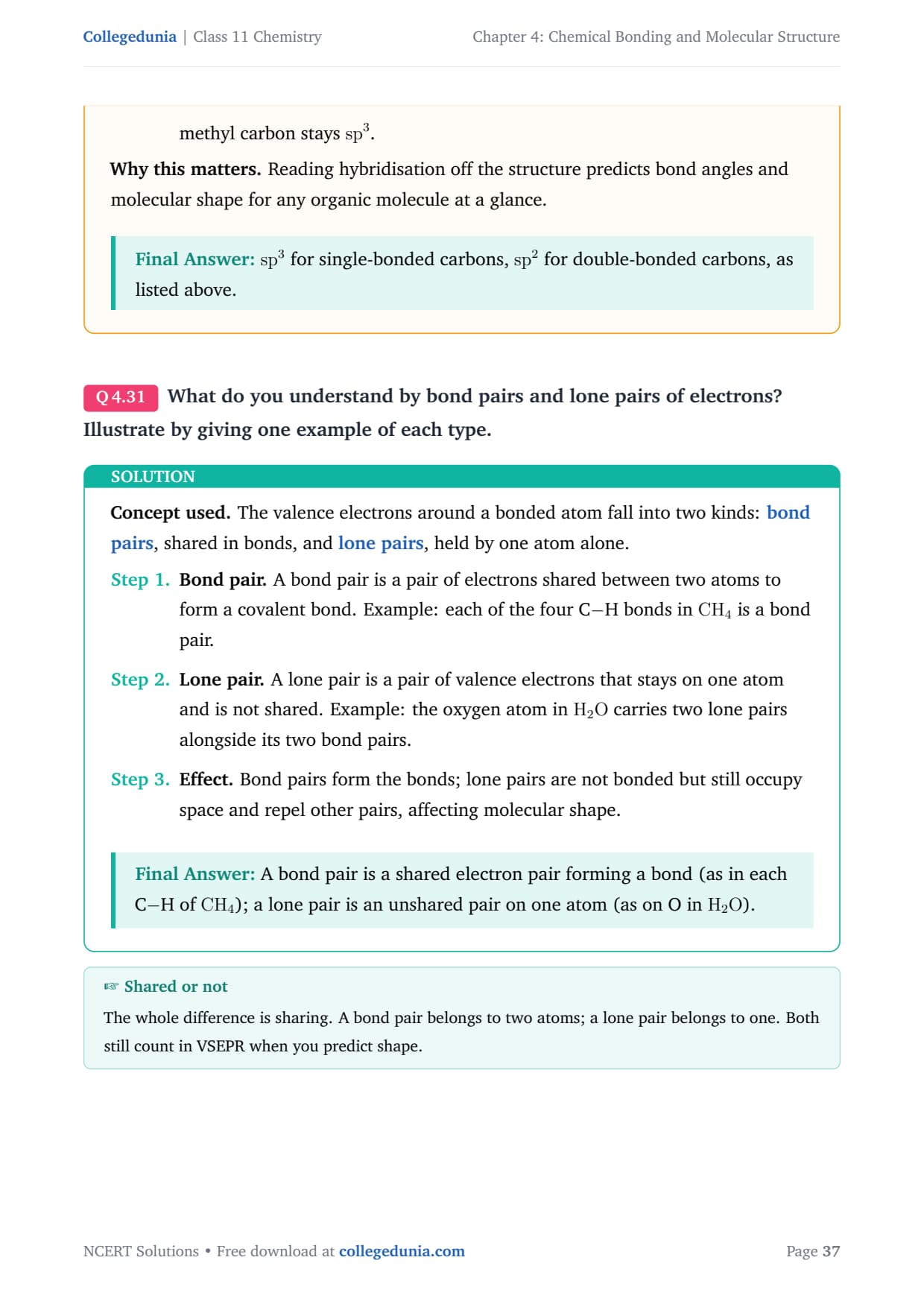
Mistake 1: Forgetting lone pairs when predicting shape. Count both bonding pairs and lone pairs before using VSEPR.
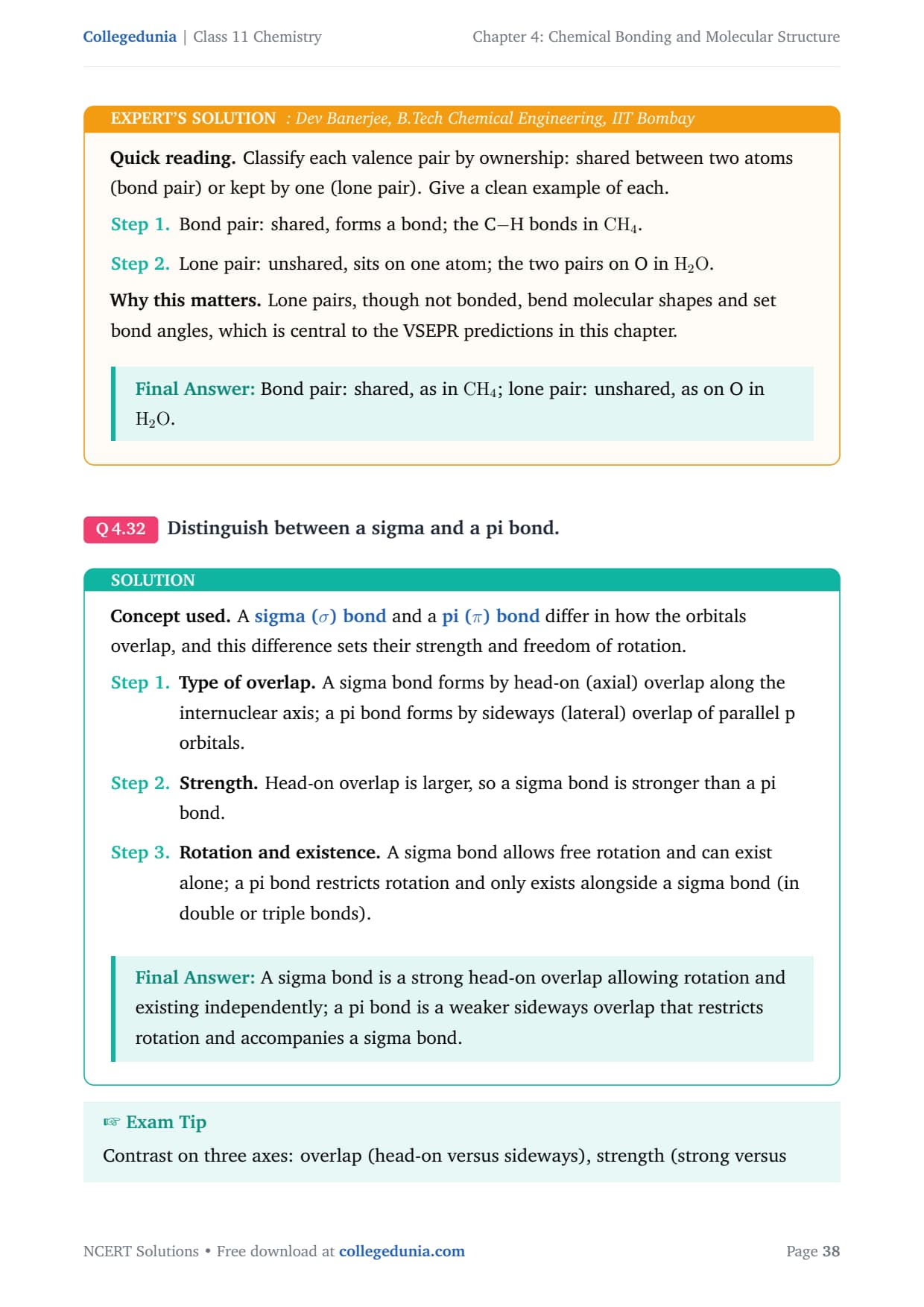
Mistake 2: Mixing up sigma and pi bonds. A single bond is one sigma; a double bond adds one pi; a triple bond adds two pi.
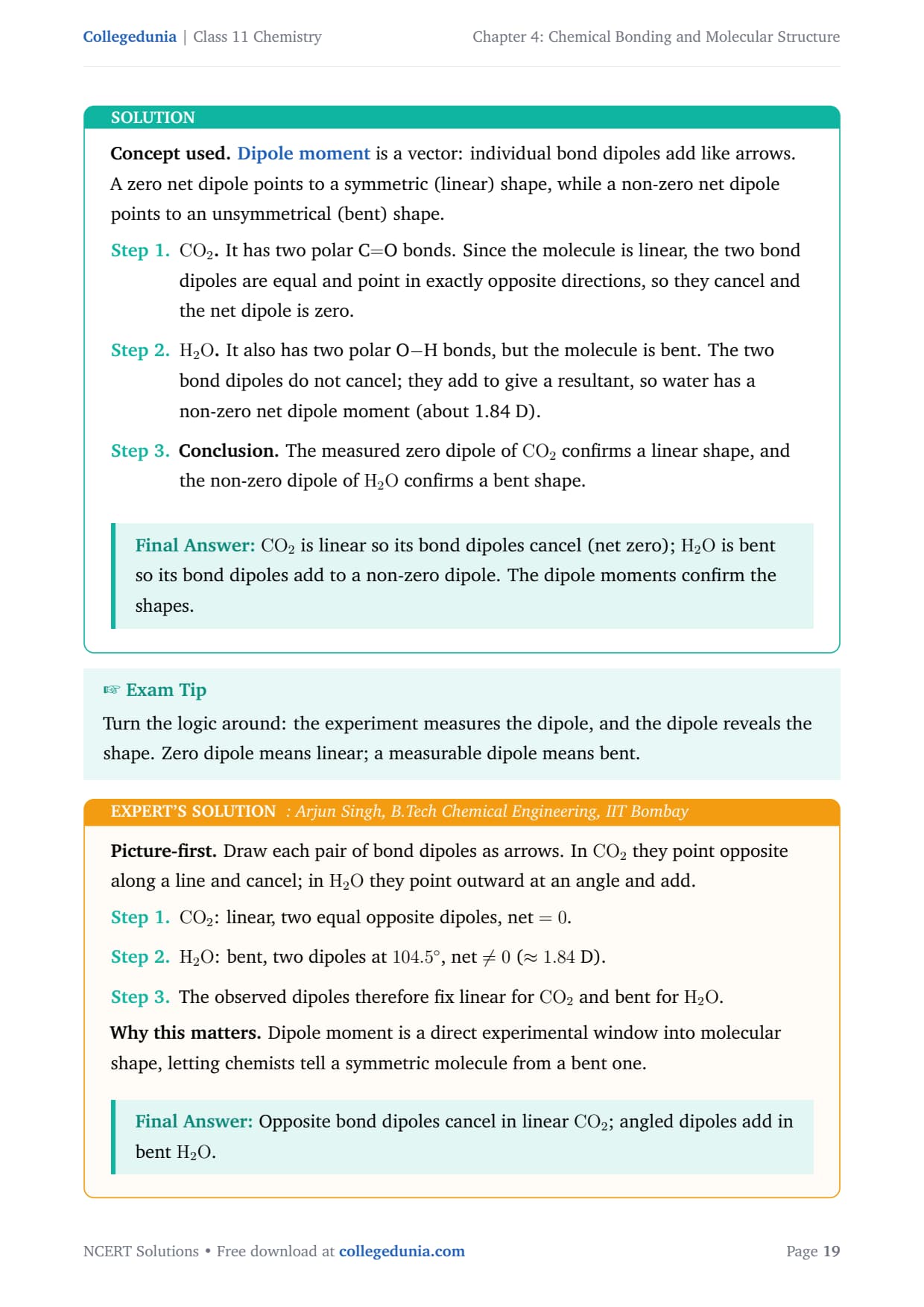
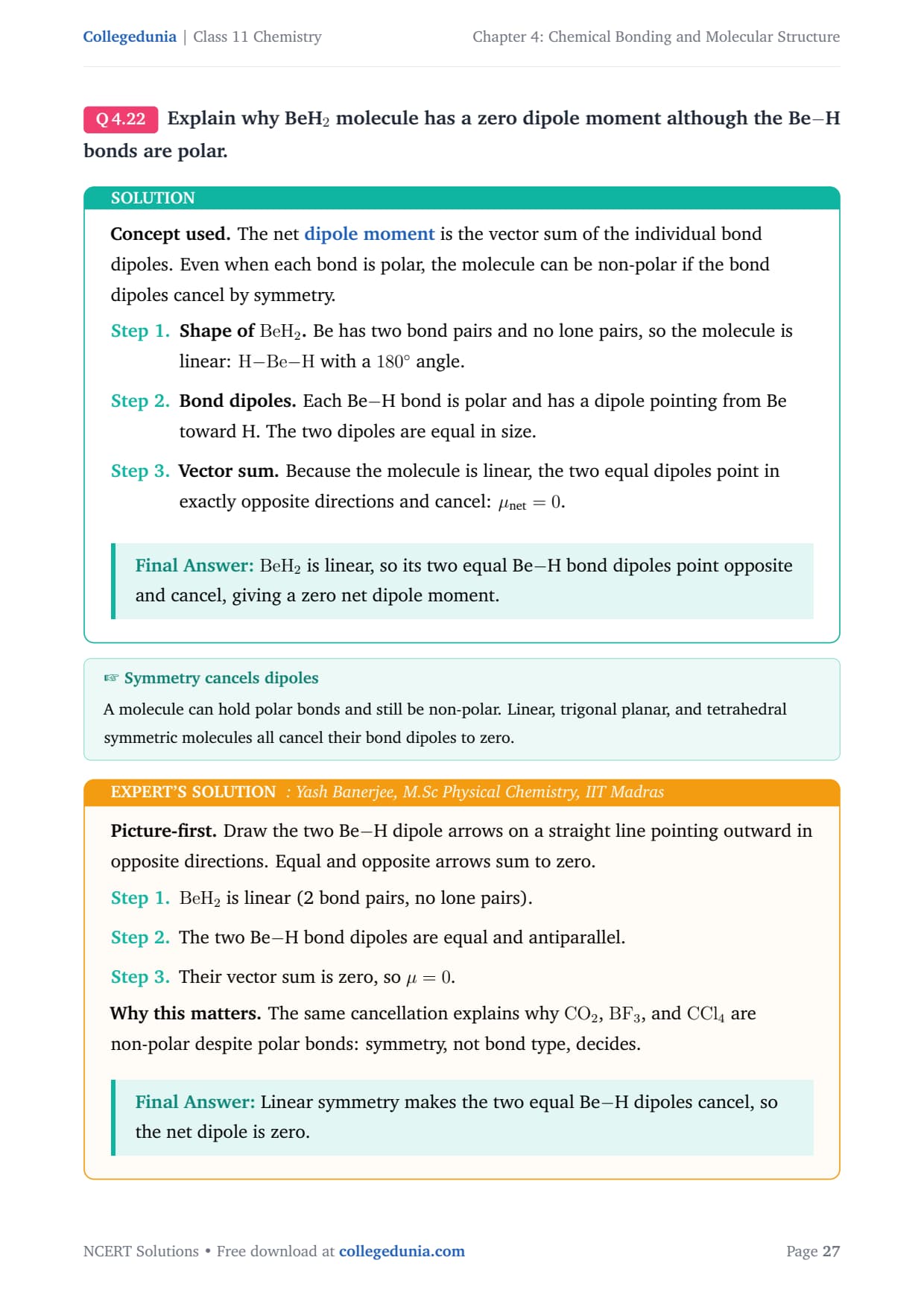
Mistake 3: Calling a molecule non-polar just because its bonds are polar. Check the shape, since a symmetric shape like CO2 cancels the dipoles.
Mistake 4: Wrong bond order because bonding and antibonding electrons were swapped. Fill the molecular orbital diagram in the correct energy order first.
Student Feedback on the Chemical Bonding and Molecular Structure Solutions
What 14,120 students told us about their Chemical Bonding and Molecular Structure preparation:
- 61% of students rated the molecular orbital theory diagrams as the hardest part of the chapter.
- Most-skipped step: checking the shape before deciding whether a molecule is polar, missed by about 3 in 10 students.
- Students who learned the VSEPR shapes first said hybridization and polarity became far easier.
Source: 2026-27 Class 11 Chemistry student poll. Sample of 14,120 students from CBSE schools across 15 states, conducted before the 2026 boards.
Other Chemical Bonding and Molecular Structure Class 11 Chemistry Resources
Pair these solutions with the revision notes and the NCERT textbook PDF for the same chapter.
| Resource | Link |
|---|---|
| NCERT Notes | Chemical Bonding and Molecular Structure Class 11 Notes |
| NCERT Book PDF | Chemical Bonding and Molecular Structure Class 11 Book PDF |
NCERT Solutions for Class 11 Chemistry: All Chapters
Jump to the step-by-step solutions for any other Class 11 Chemistry chapter below.
| Chapter | NCERT Solutions |
|---|---|
| Chapter 1 | Some Basic Concepts of Chemistry |
| Chapter 2 | Structure of Atom |
| Chapter 3 | Classification of Elements and Periodicity in Properties |
| Chapter 4 | Chemical Bonding and Molecular Structure |
| Chapter 5 | Thermodynamics |
| Chapter 6 | Equilibrium |
| Chapter 7 | Redox Reactions |
| Chapter 8 | Organic Chemistry Some Basic Principles and Techniques |
| Chapter 9 | Hydrocarbons |
FAQs on Chemical Bonding and Molecular Structure Class 11 NCERT Solutions
Chemical Bonding and Molecular Structure NCERT Solutions - Frequently Asked Questions
Ques. What do the class 11 chemistry NCERT solutions chapter 4 Chemical Bonding and Molecular Structure cover?
Ans. These solutions cover all 40 back-exercise questions and the intext questions, including the Kossel-Lewis approach and octet rule, ionic and covalent bond formation, Lewis structures with formal charge, VSEPR theory and molecular geometry, valence bond theory, hybridization, molecular orbital theory with bond order, and hydrogen bonding. Every question is solved step by step.
Ques. What is the octet rule in Class 11 Chemistry Chapter 4?
Ans. The octet rule states that atoms lose, gain or share electrons so that their outer shell holds eight electrons, matching the stable arrangement of the nearest noble gas. It explains most bonds in second-period elements. Exceptions include incomplete octets in BF3, expanded octets in SF6, and odd-electron molecules like NO.
Ques. How does VSEPR theory predict the shape of a molecule?
Ans. VSEPR theory predicts shape from the repulsion between electron pairs on the central atom, which arrange as far apart as possible. Two pairs give a linear shape, three give trigonal planar, and four give tetrahedral. Lone pairs repel more than bonding pairs, so they bend the shape, making water bent at 104.5° and ammonia pyramidal at 107°.
Ques. What is the difference between sigma and pi bonds?
Ans. A sigma bond forms by the end-on, head-to-head overlap of orbitals and is strong. A pi bond forms by the side-on overlap of p orbitals and is weaker. A single bond has one sigma bond, a double bond has one sigma and one pi, and a triple bond has one sigma and two pi bonds.
Ques. How do you calculate bond order using molecular orbital theory?
Ans. Bond order is half the difference between the number of electrons in bonding and antibonding molecular orbitals. A higher bond order means a stronger, shorter and more stable bond, while a bond order of zero means the molecule does not exist. For example, N2 has a bond order of 3 and O2 has a bond order of 2.
Ques. Why is O2 paramagnetic and how does hydrogen bonding affect boiling point?
Ans. Molecular orbital theory places two unpaired electrons in the antibonding orbitals of O2, which makes it paramagnetic, a result the Lewis structure cannot explain. Hydrogen bonding is the attraction between a hydrogen atom bonded to N, O or F and a lone pair on another such atom. It raises boiling point, melting point and viscosity, which is why water is a liquid while heavier H2S is a gas.



Comments