




These NCERT notes explain galvanic and fuel cells, Faraday's laws, redox reactions, and the Nernst equation. Every topic is covered, so 2-3 focused hours replace a full textbook read. Download the notes PDF from this page.
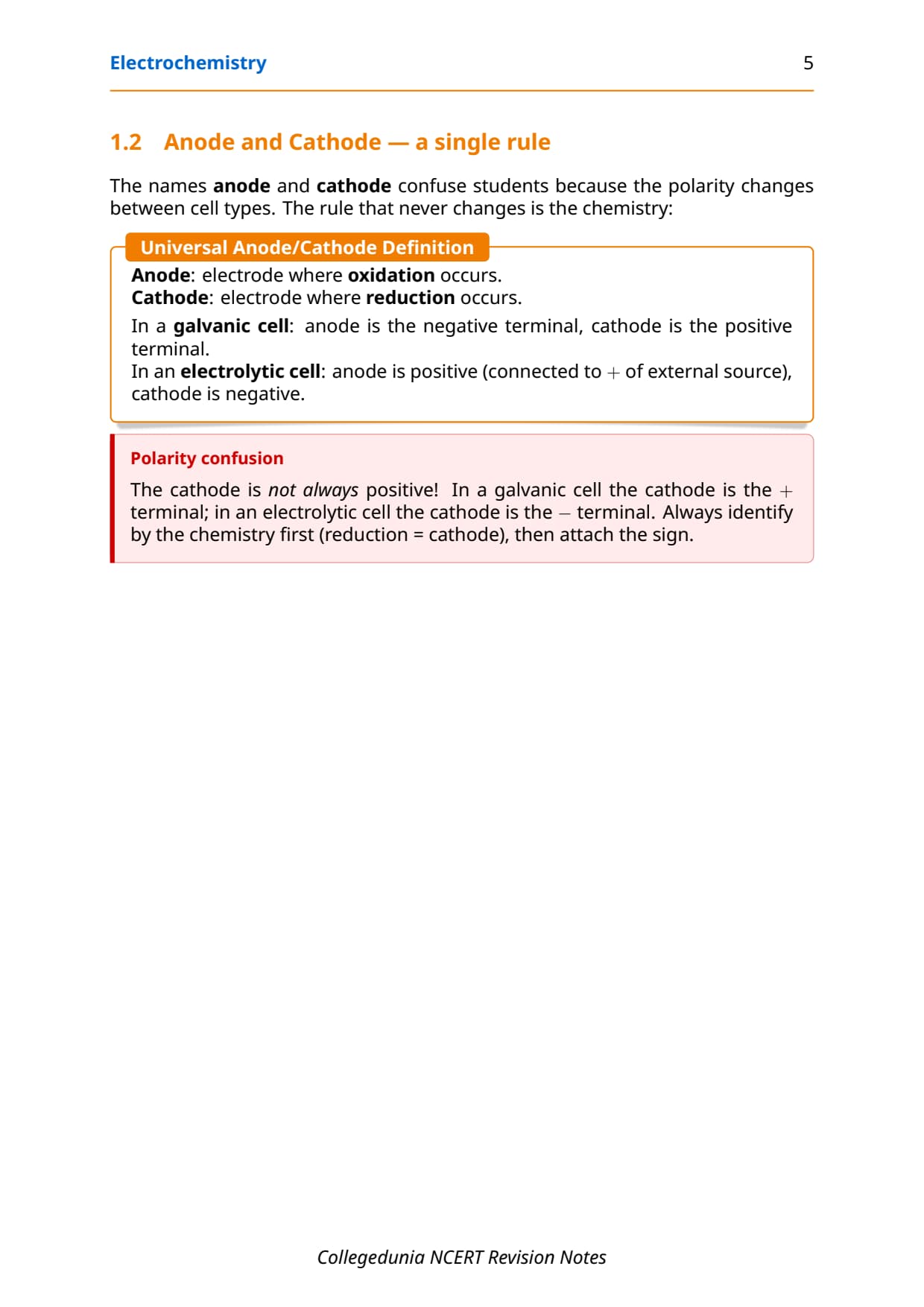
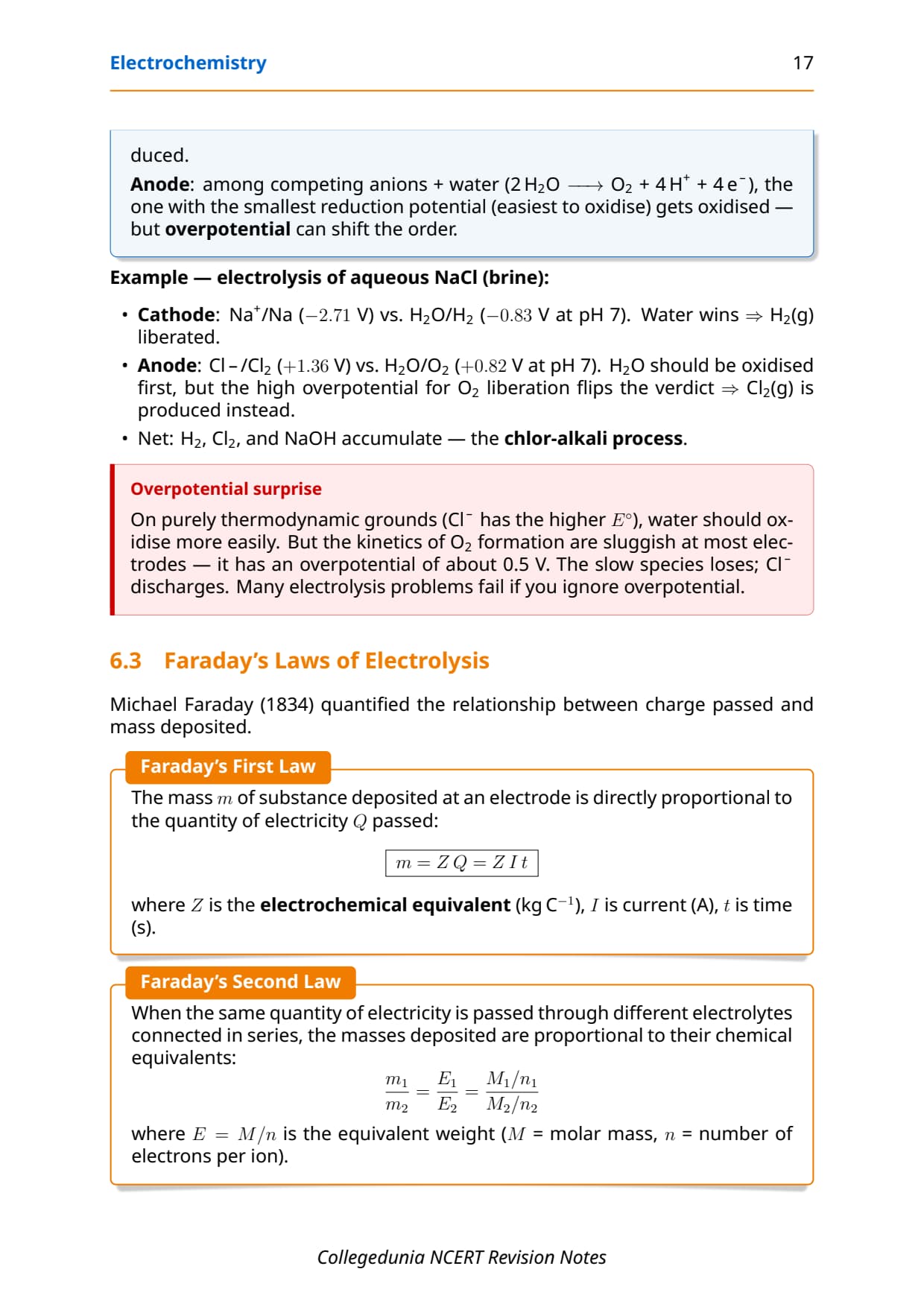
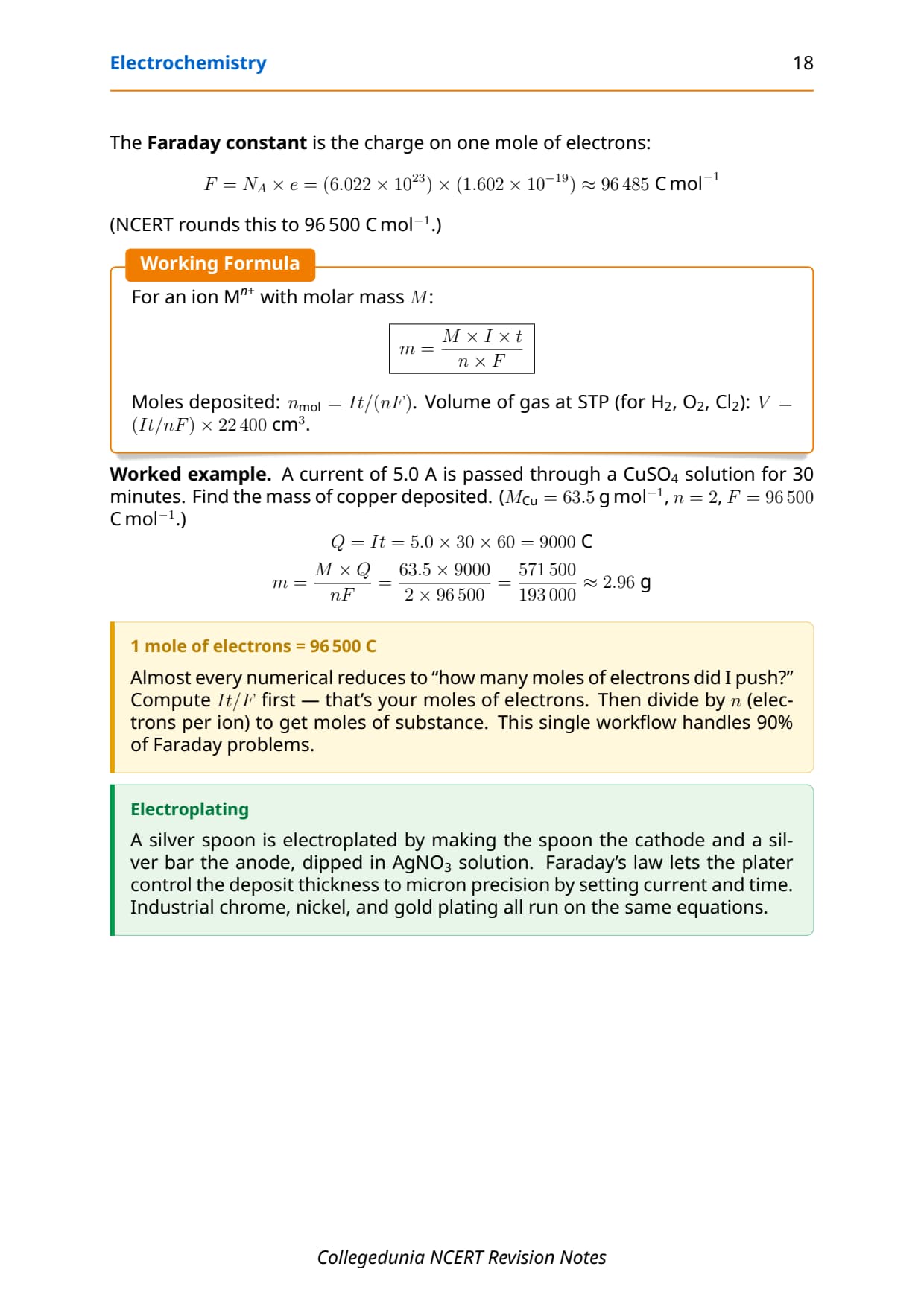
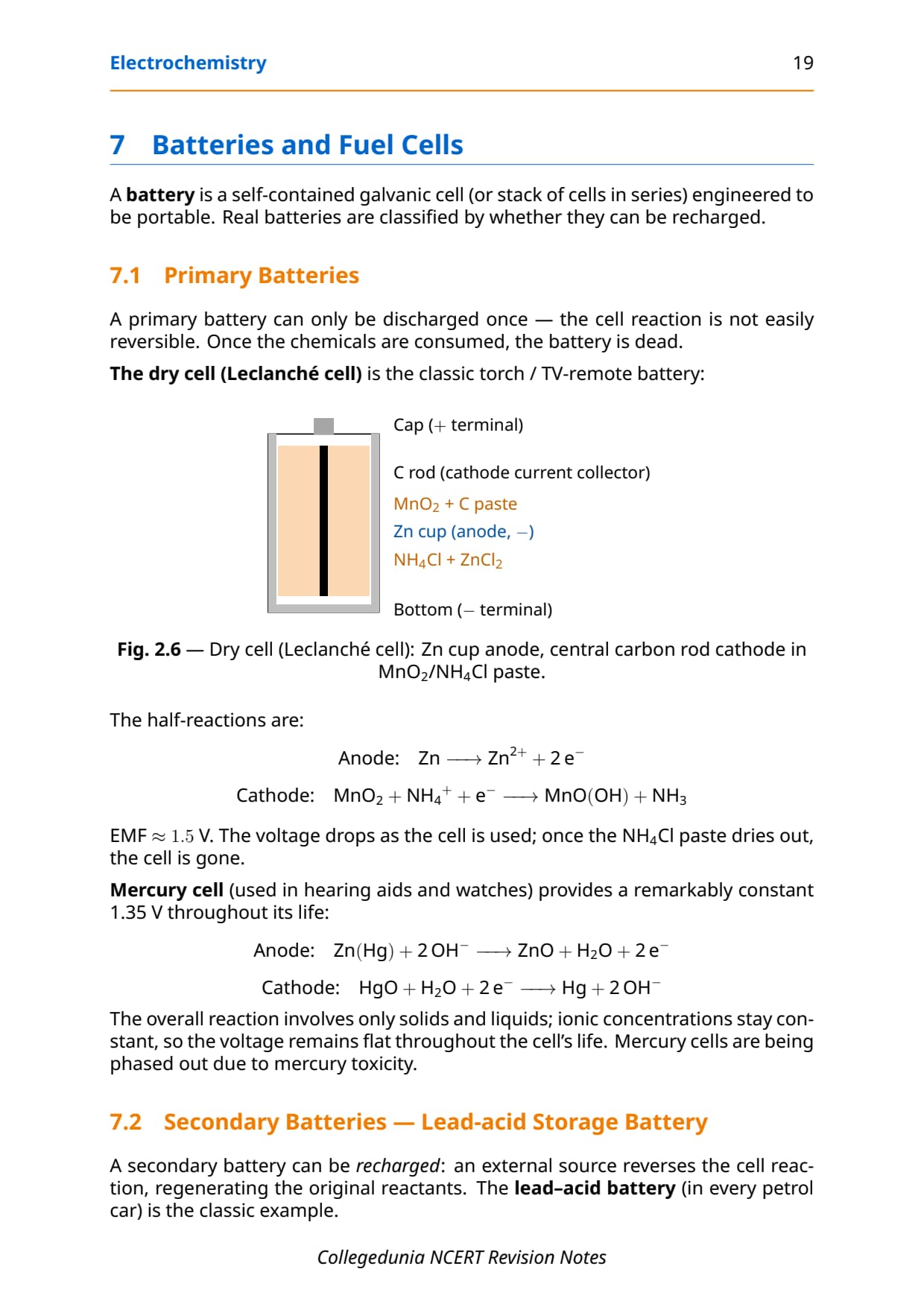
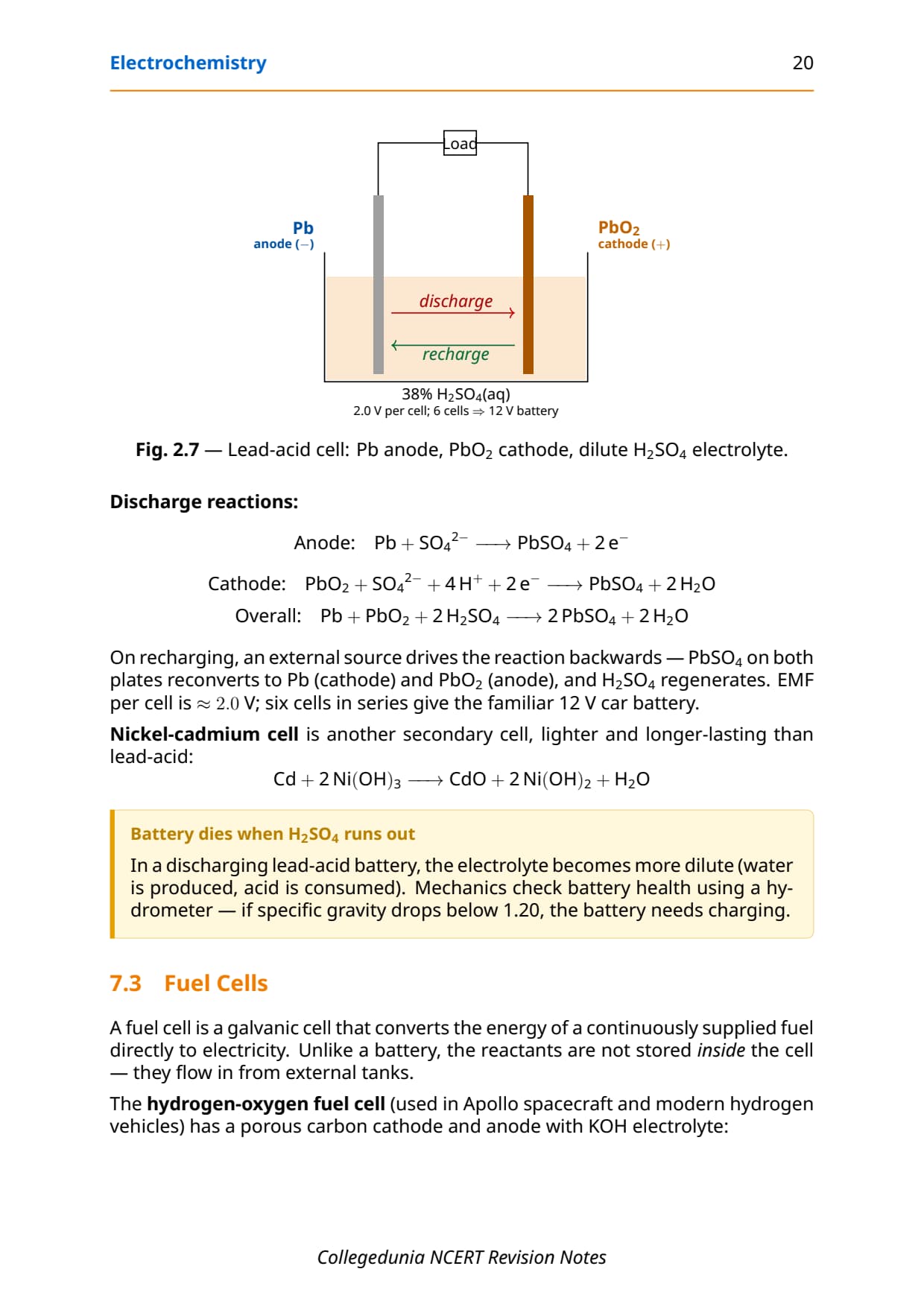
Class 12 Chemistry Chapter 2 Electrochemistry is a high-scoring CBSE unit, also frequent in JEE Main and NEET. This page has the 2026-27 notes PDF, sub-topic weightage, and PYQ trends.
- CBSE Weightage: In CBSE Boards, the Electrochemistry Chapter carries around 5 to 7 marks (Unit III shares 13 marks with Chapters 1 and 3) every year.
- JEE Main Weightage: The total marks weightage of Electrochemistry in Physical Chemistry varies 4 to 5% (typically 2 questions per shift) in JEE Main.
- NEET Weightage: NEET students can see direct formula-based 1 to 3 questions per year from Physical Chemistry Class 12 Chapter 2 portion.
These notes condense every Nernst derivation, Kohlrausch application, and battery or corrosion case study from the 2026-27 NCERT into a 24-page PDF, with worked board-style numericals after each topic.
How will Collegedunia's NCERT Notes Help You with Electrochemistry?
The notes target the four sub-topics where students lose marks: Nernst algebra, molar-conductivity plots, Faraday-counting, and corrosion diagrams.
- 2026-27 NCERT aligned: topics dropped from the older syllabus are flagged.
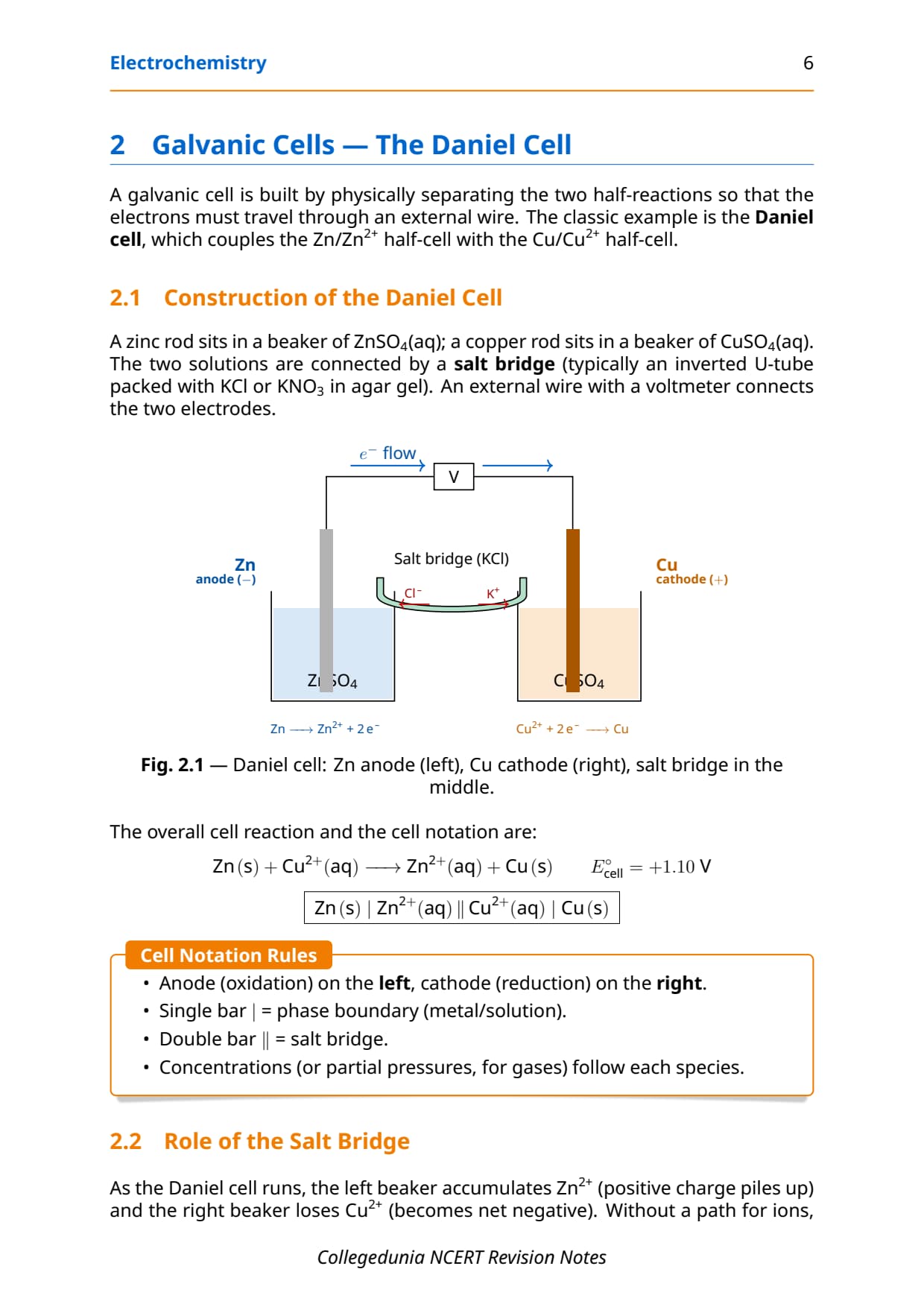
- Colour diagrams: Daniell cell, salt bridge, and corrosion redrawn with cell-notation conventions.
- Formula recap: each topic closes with a yellow formula strip and a "what CBSE asks" tag.
Electrochemistry Class 12 Chemistry Video Lecture
Source: Magnet Brains on YouTube
Electrochemistry Topic-by-Topic Notes for Class 12 Chemistry
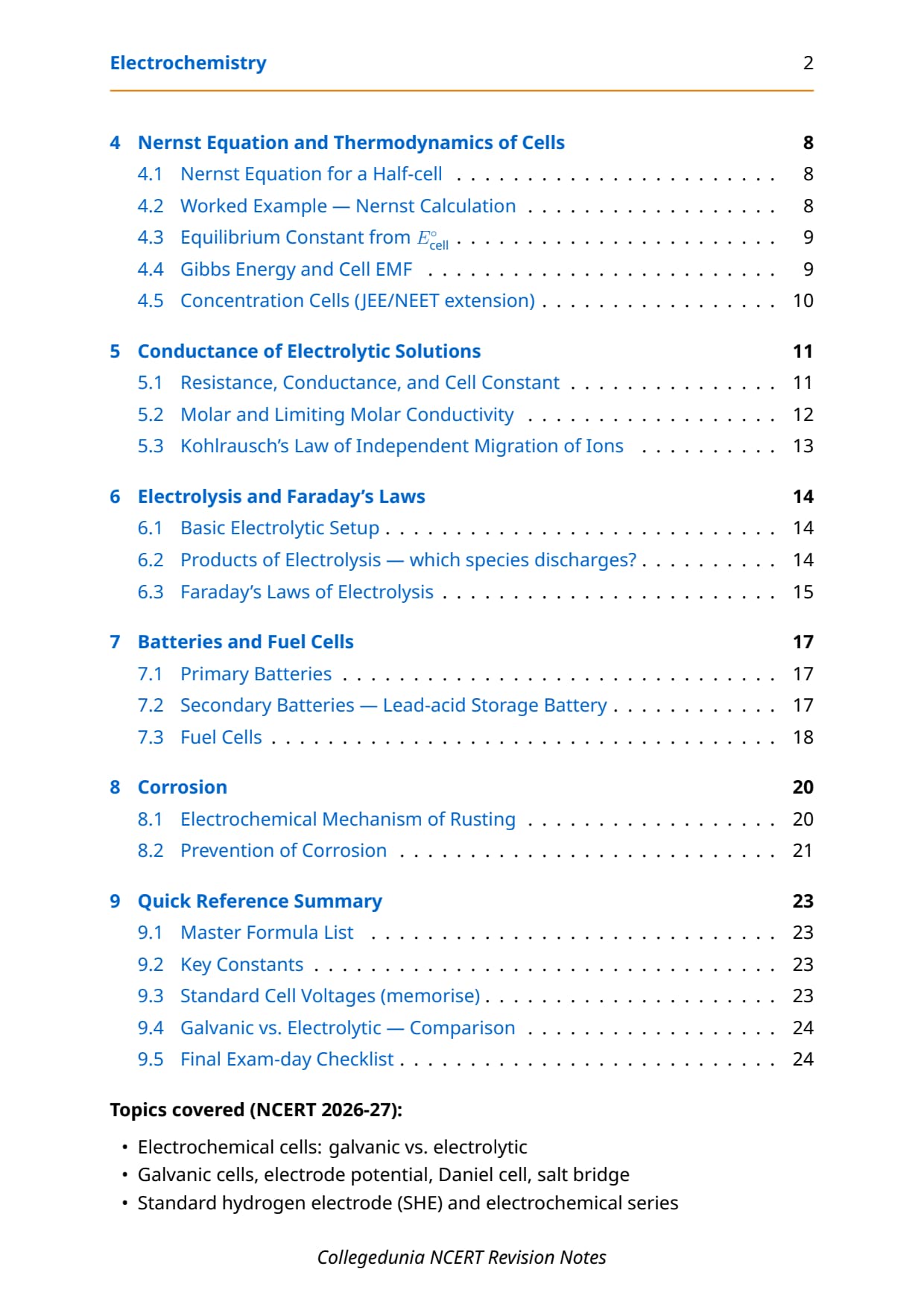
The chapter splits into a few themes, each with its concept and key formulae.
Redox Reactions and Electrochemical Cells
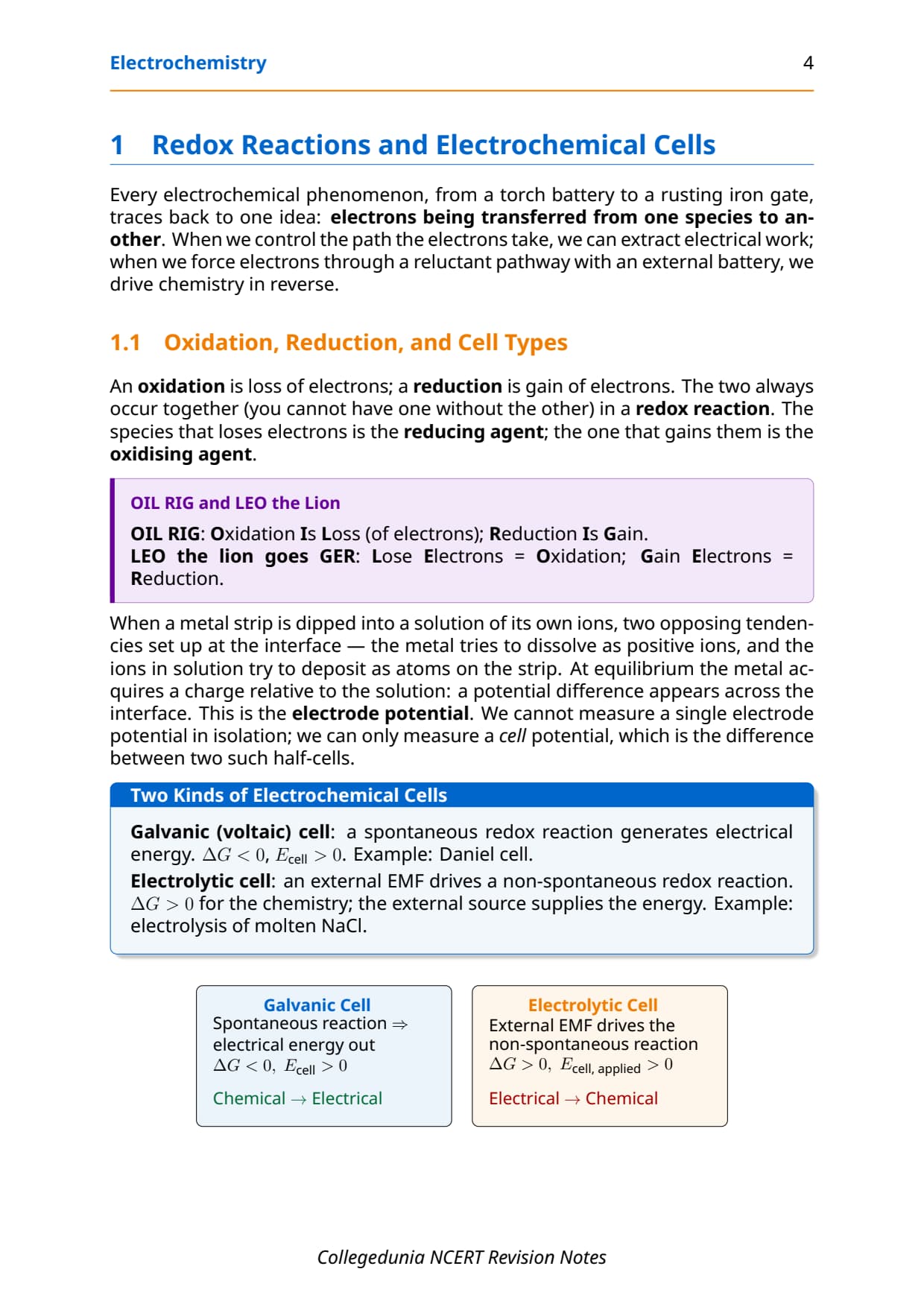
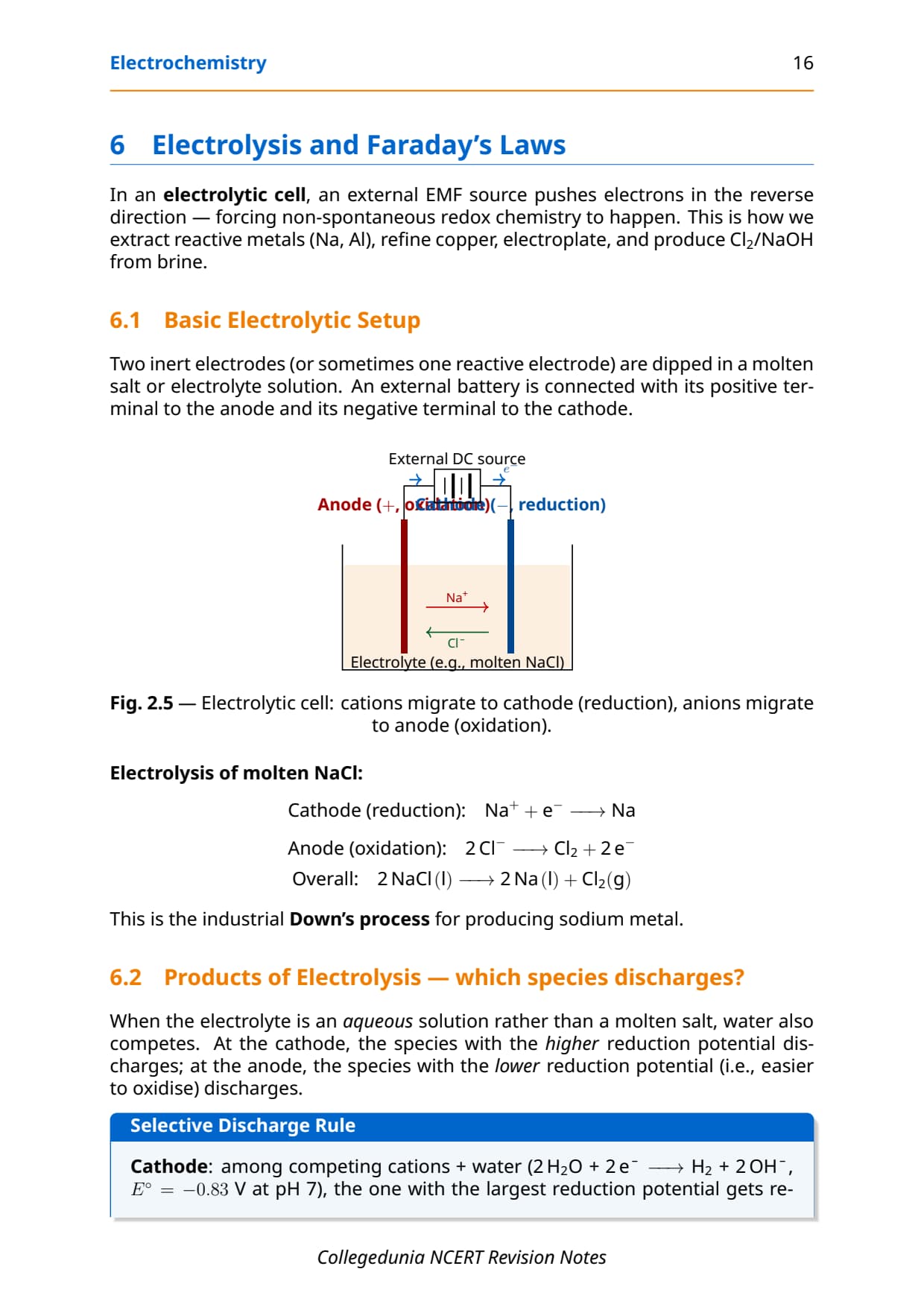
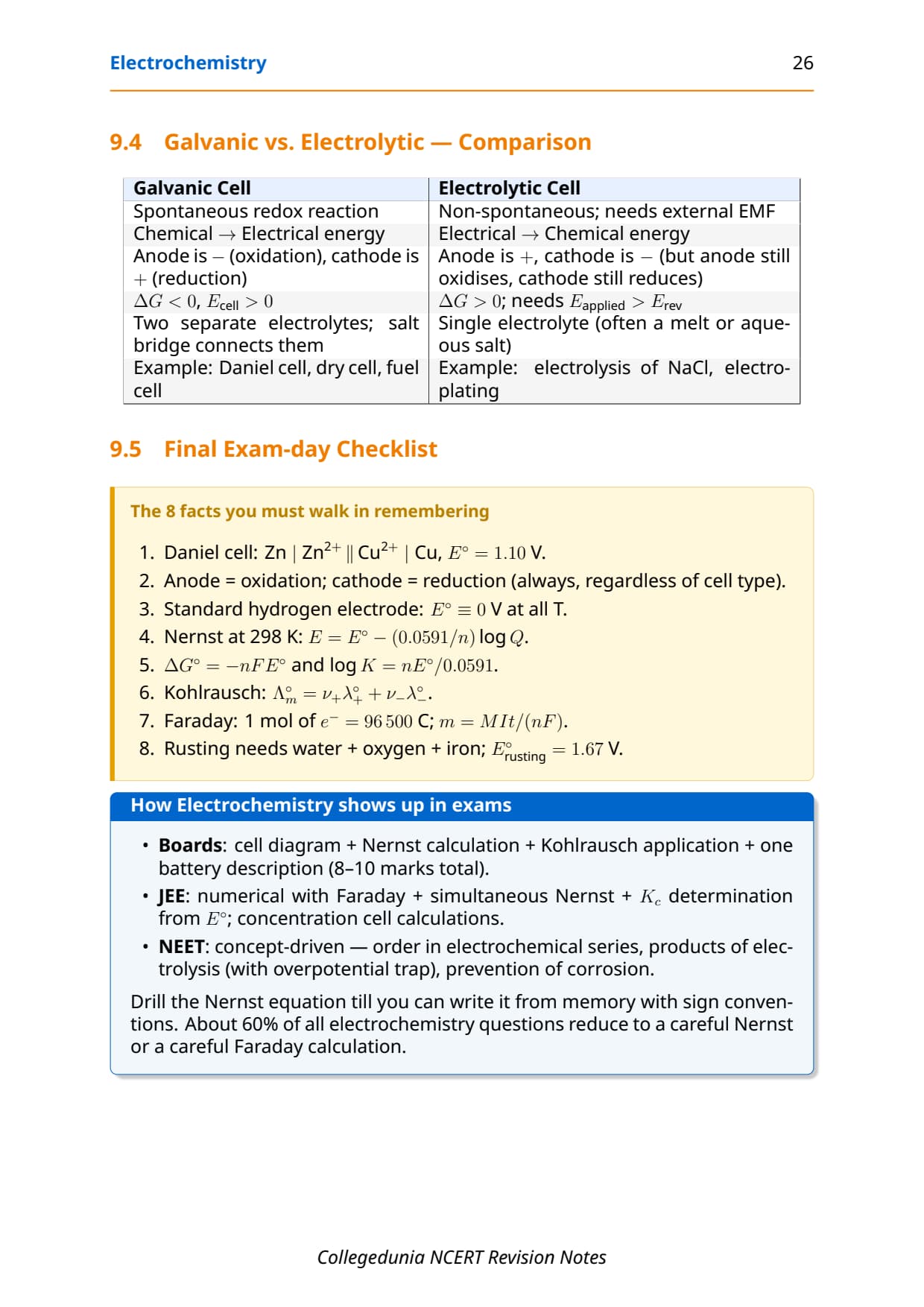
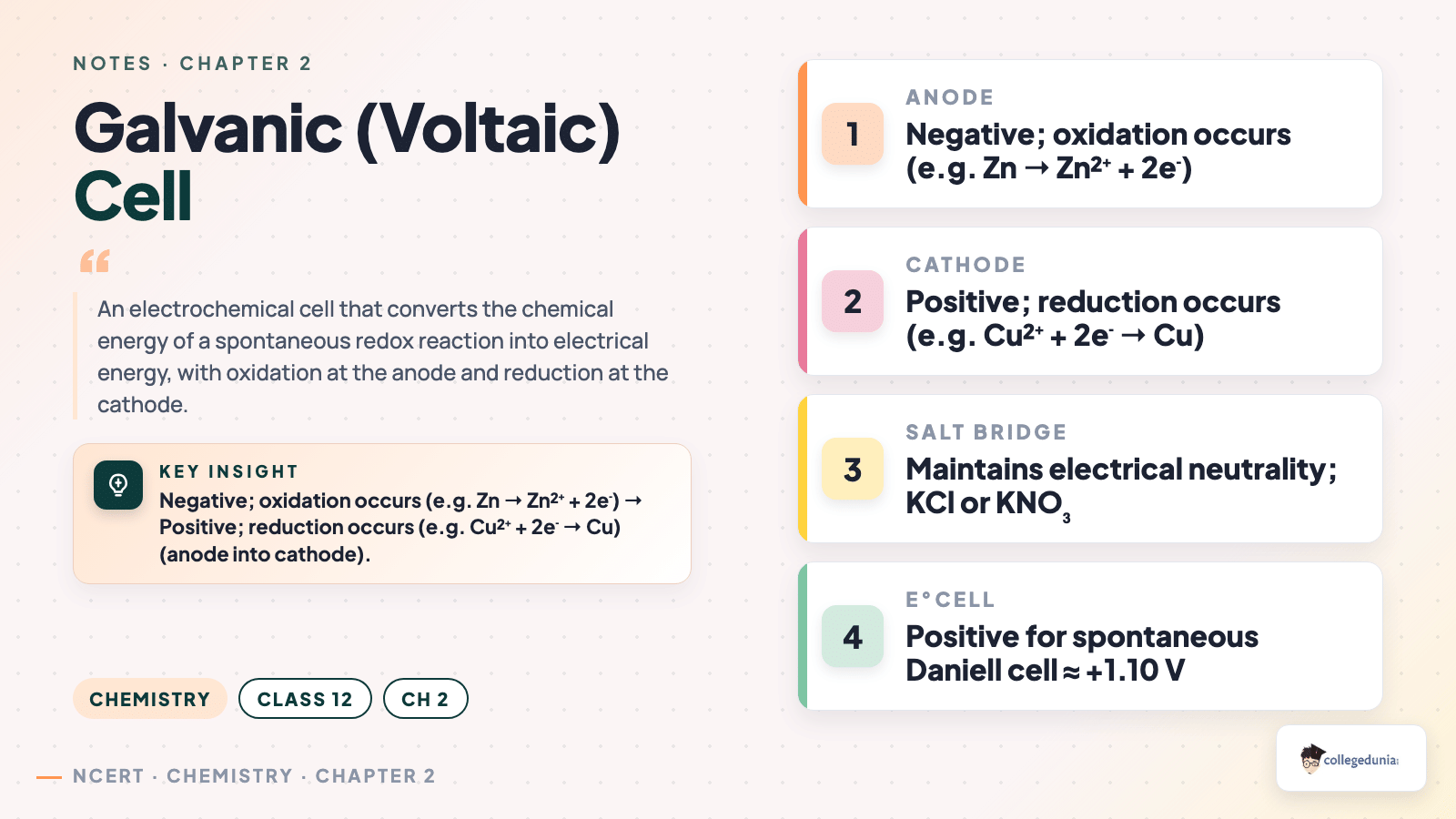
A cell either converts chemical energy into electrical energy (galvanic cell) or uses electrical energy to drive a non-spontaneous reaction (electrolytic cell). In the Daniell cell, Zn is oxidised at the anode and Cu2+ reduced at the cathode, giving 1.1 V at standard conditions. Notation: anode | solution || solution | cathode.
Standard Electrode Potential and the EMF of a Cell
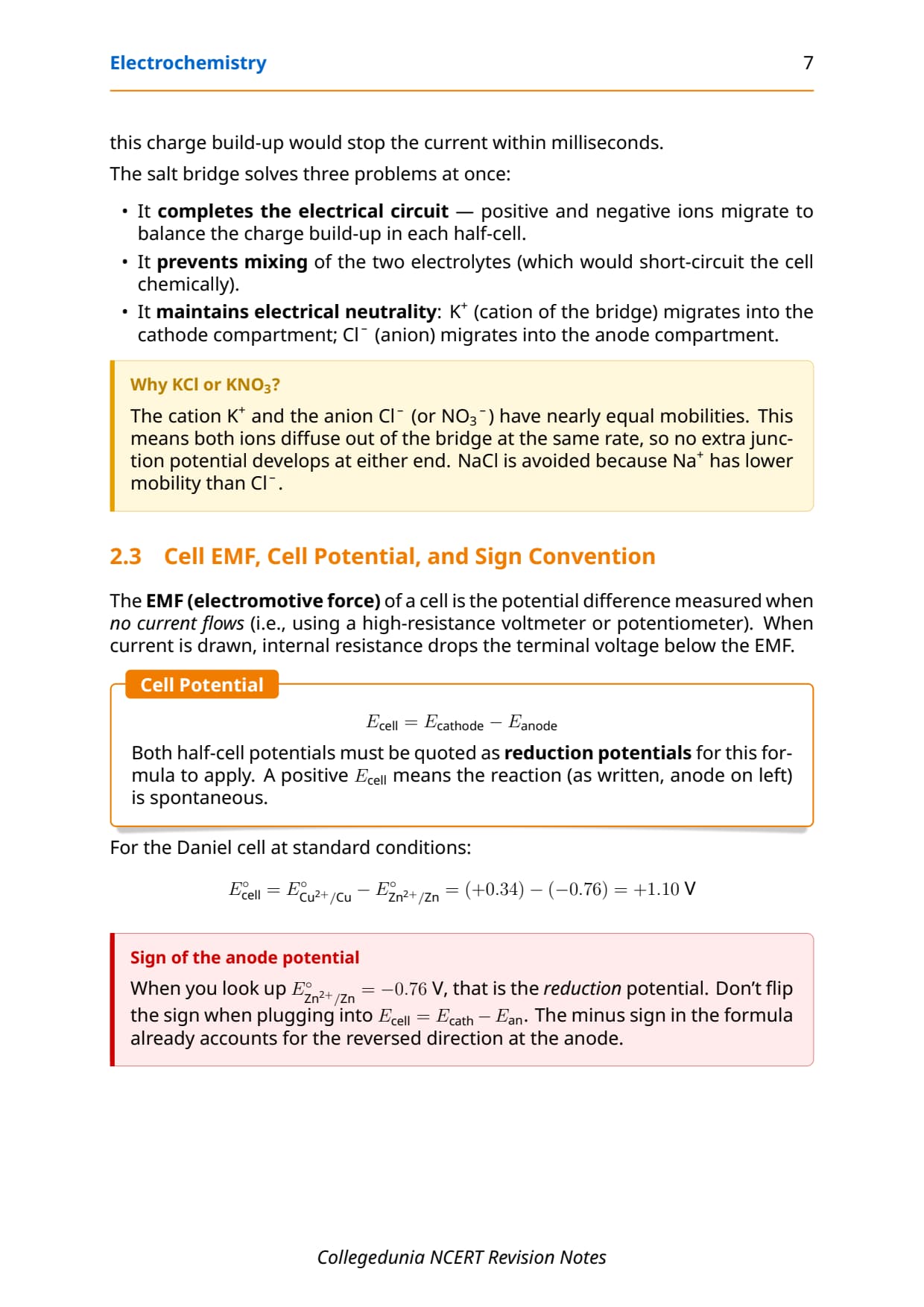
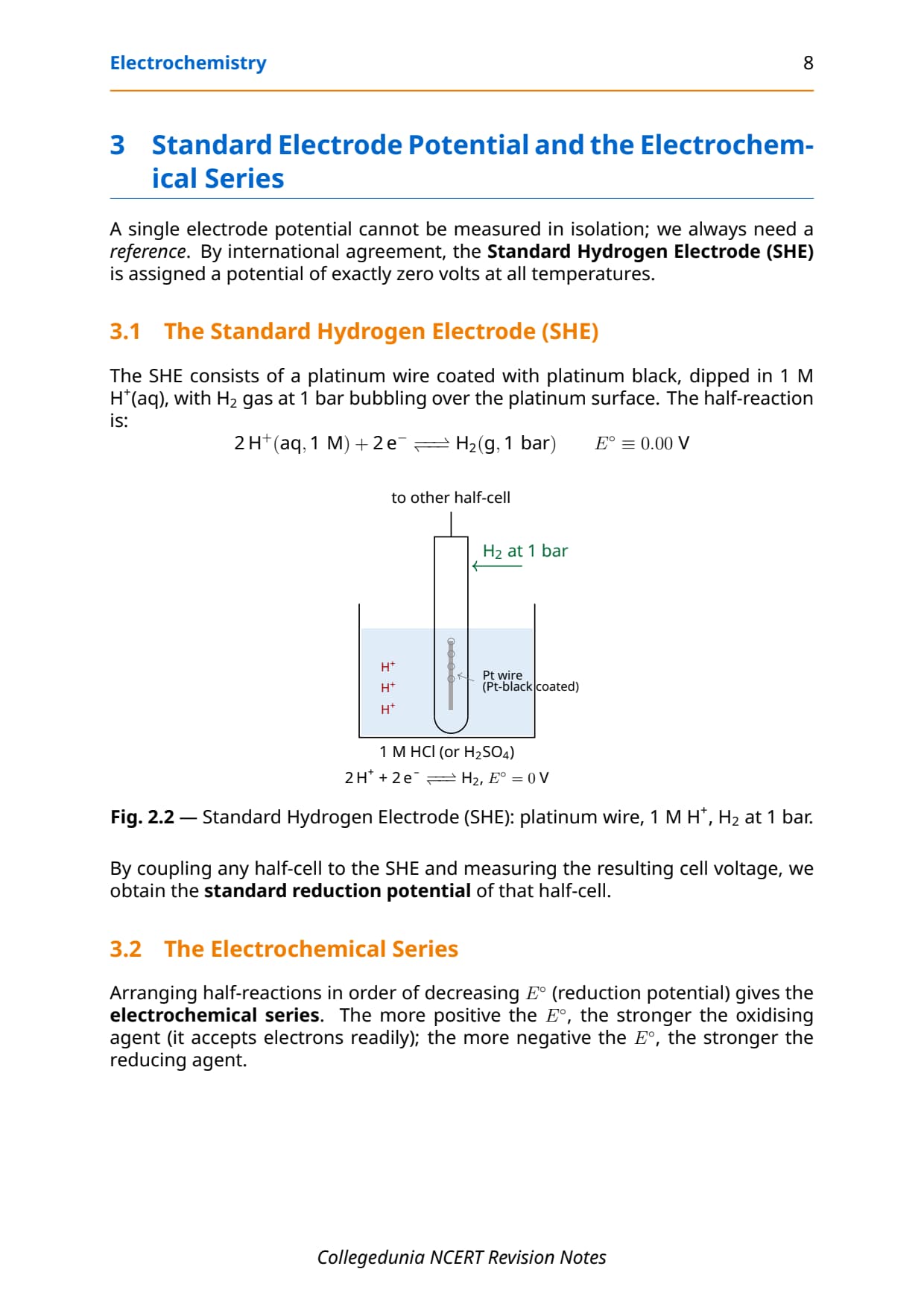
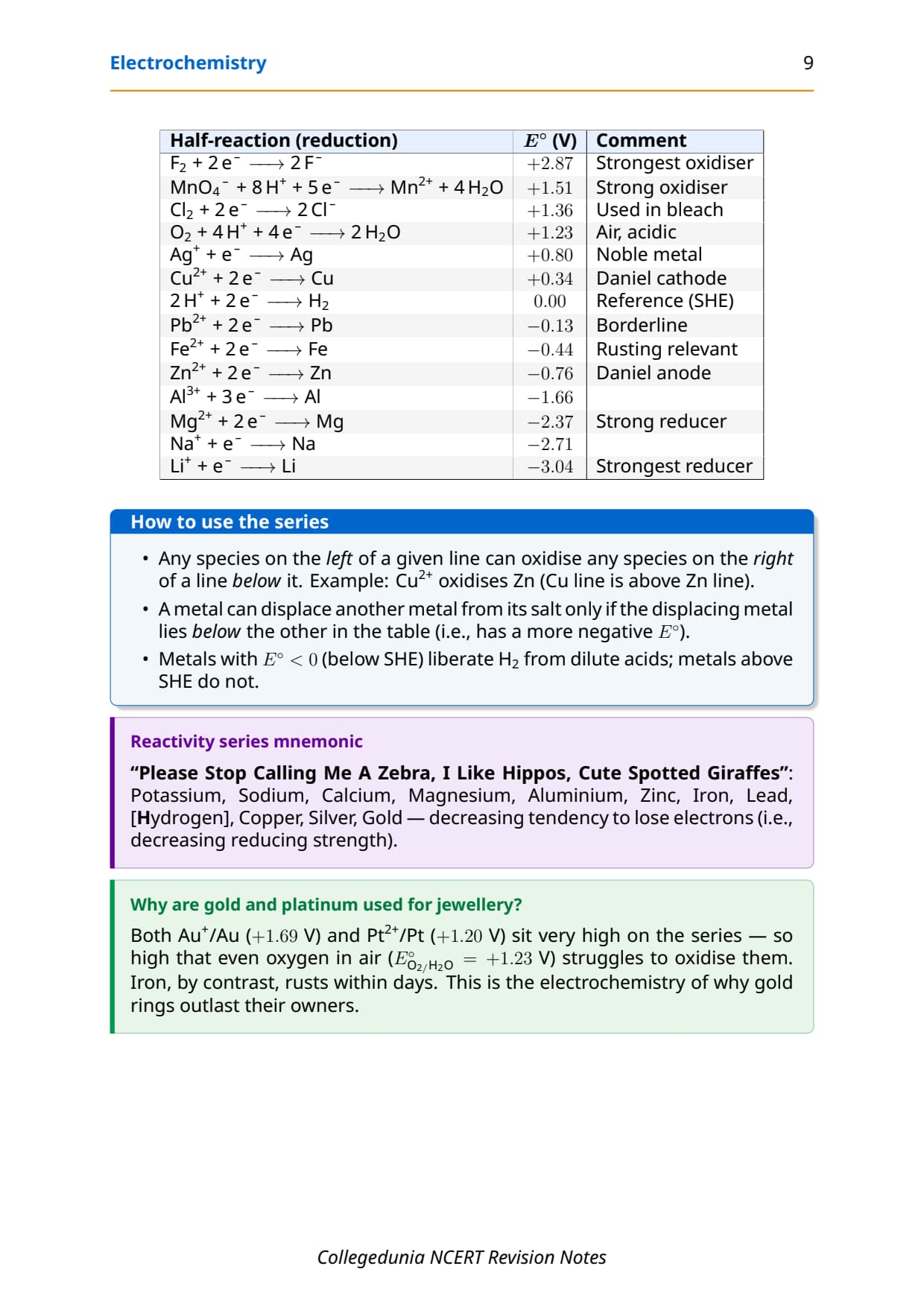
The standard hydrogen electrode (SHE) is the reference at E° = 0.00 V. Standard EMF is E∘cell = E∘cathode - E∘anode from reduction potentials; positive E∘cell means spontaneous.
Nernst Equation and Cell EMF Under Non-Standard Conditions
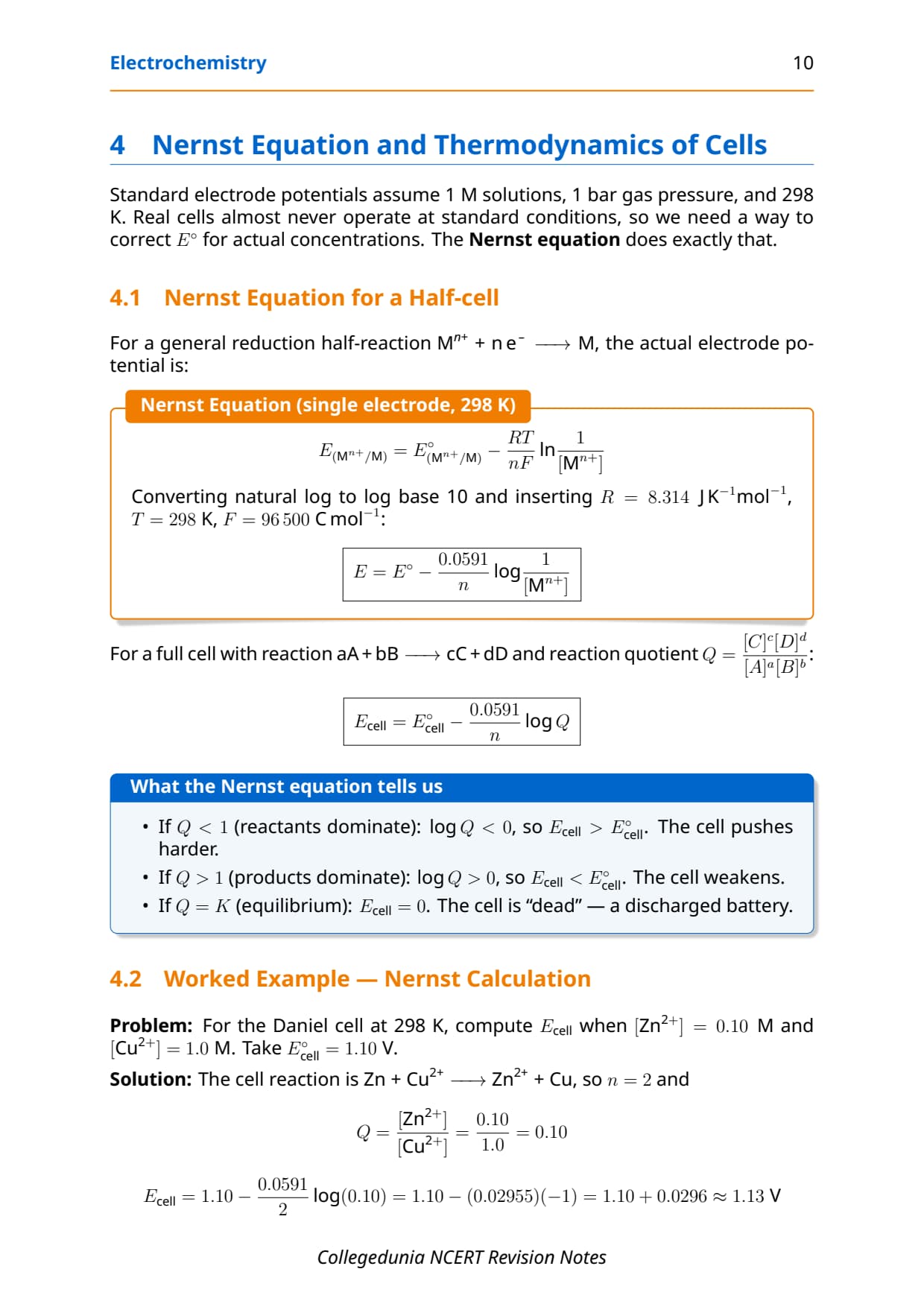
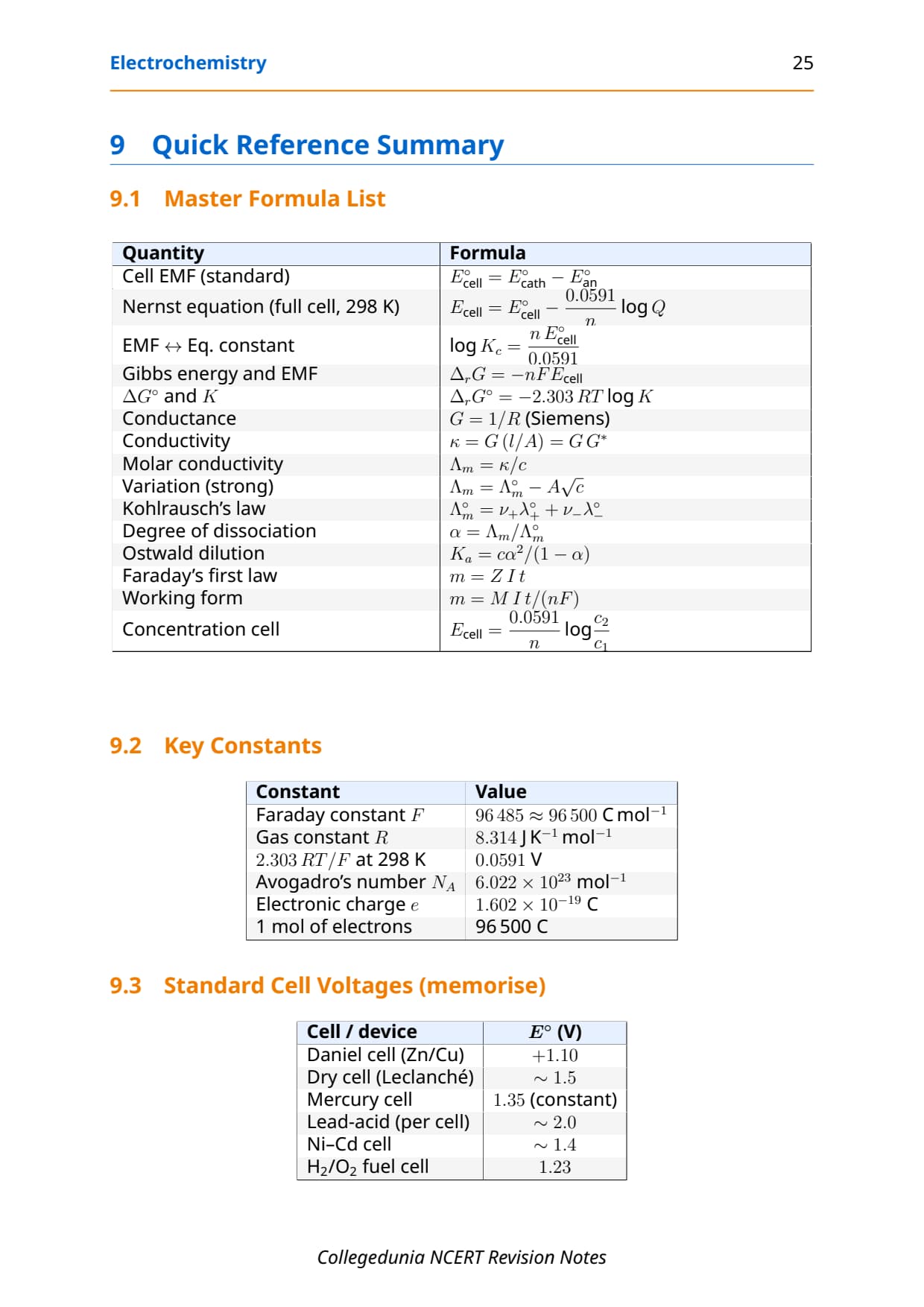
The Nernst equation gives cell EMF at any concentration: $$ E_{cell} = E^{\circ}_{cell} - \frac{0.0591}{n} \log Q \quad (\text{at 298 K}) $$ where n is the electrons transferred and Q the reaction quotient. At equilibrium Ecell = 0 and Q = Kc , giving log Kc = n E∘cell0.0591 .
Conductance of Electrolytic Solutions
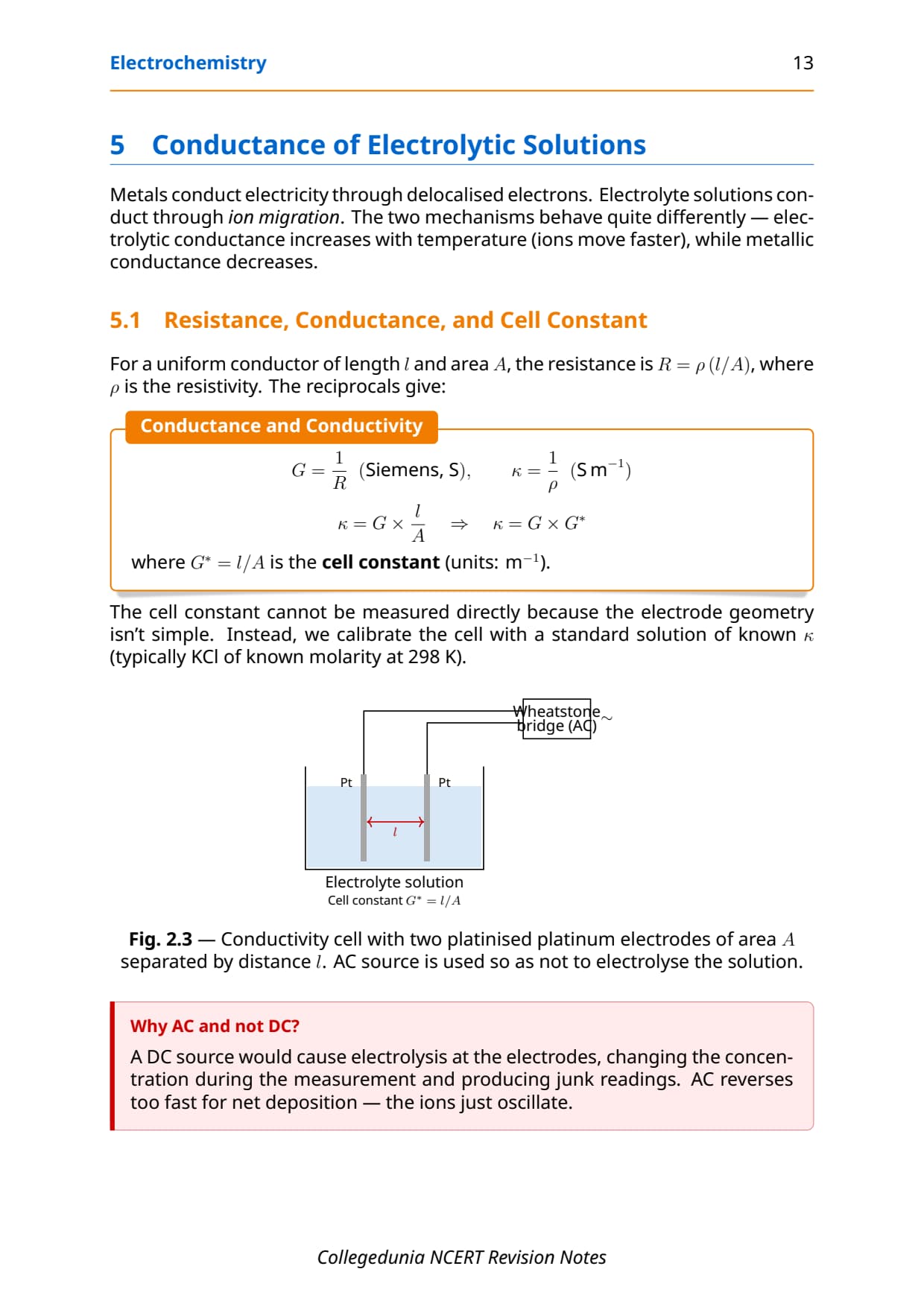
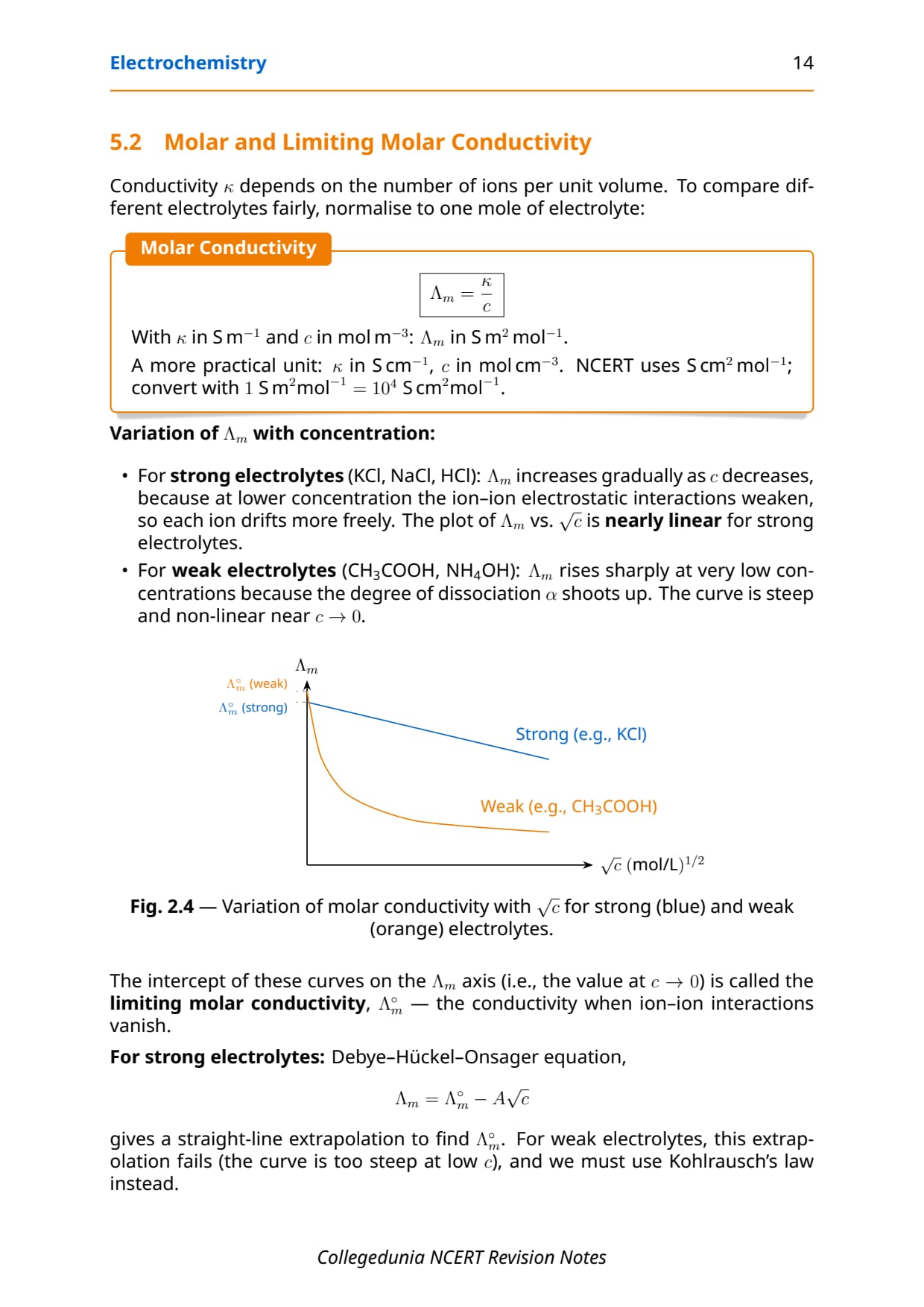
Specific conductivity κ = 1/ρ is the conductance of a 1-cm cube; molar conductivity m = κ × 1000/c is per mole. On dilution, m rises slightly for strong electrolytes but sharply for weak ones.
Kohlrausch's Law and Its Applications
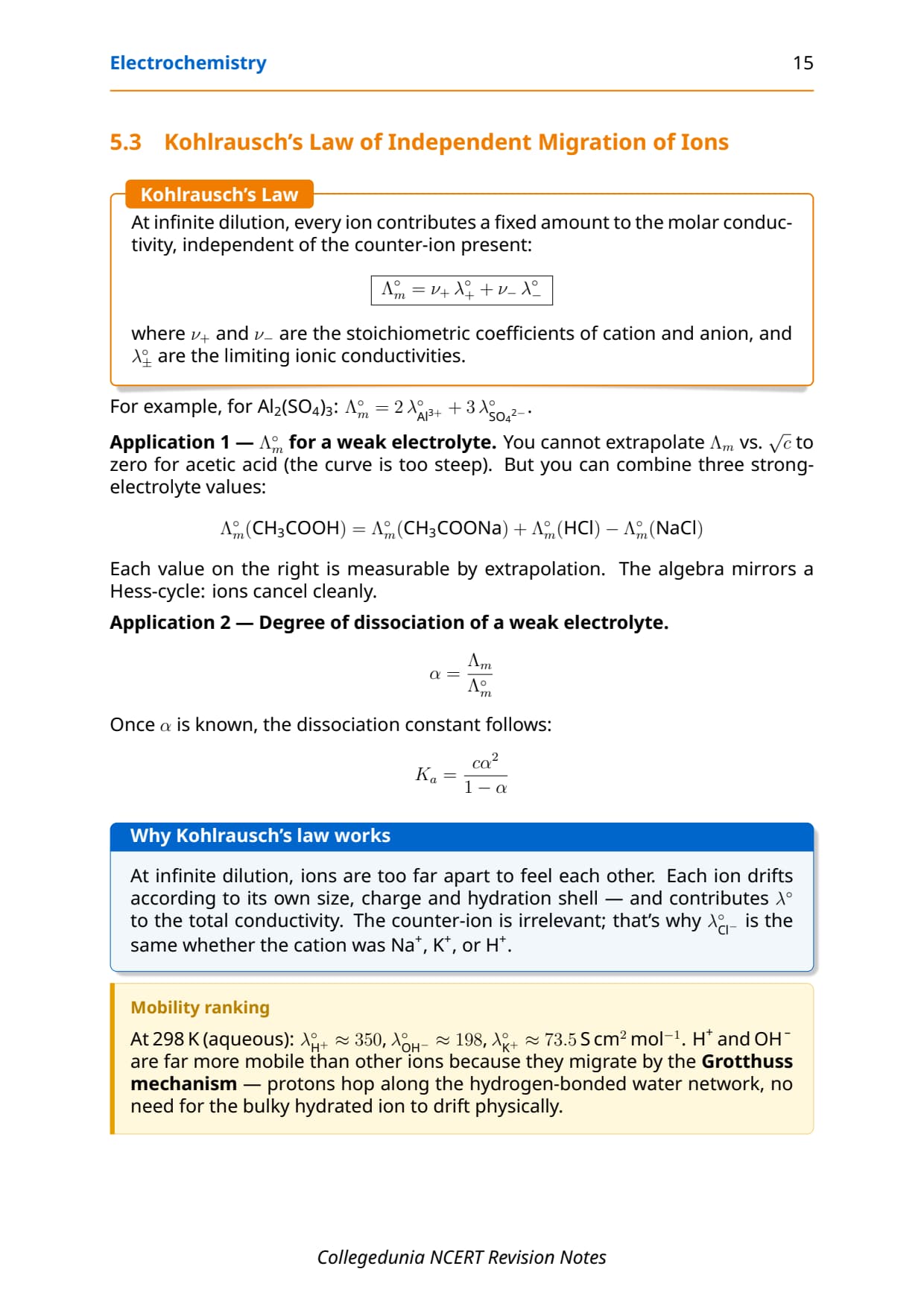
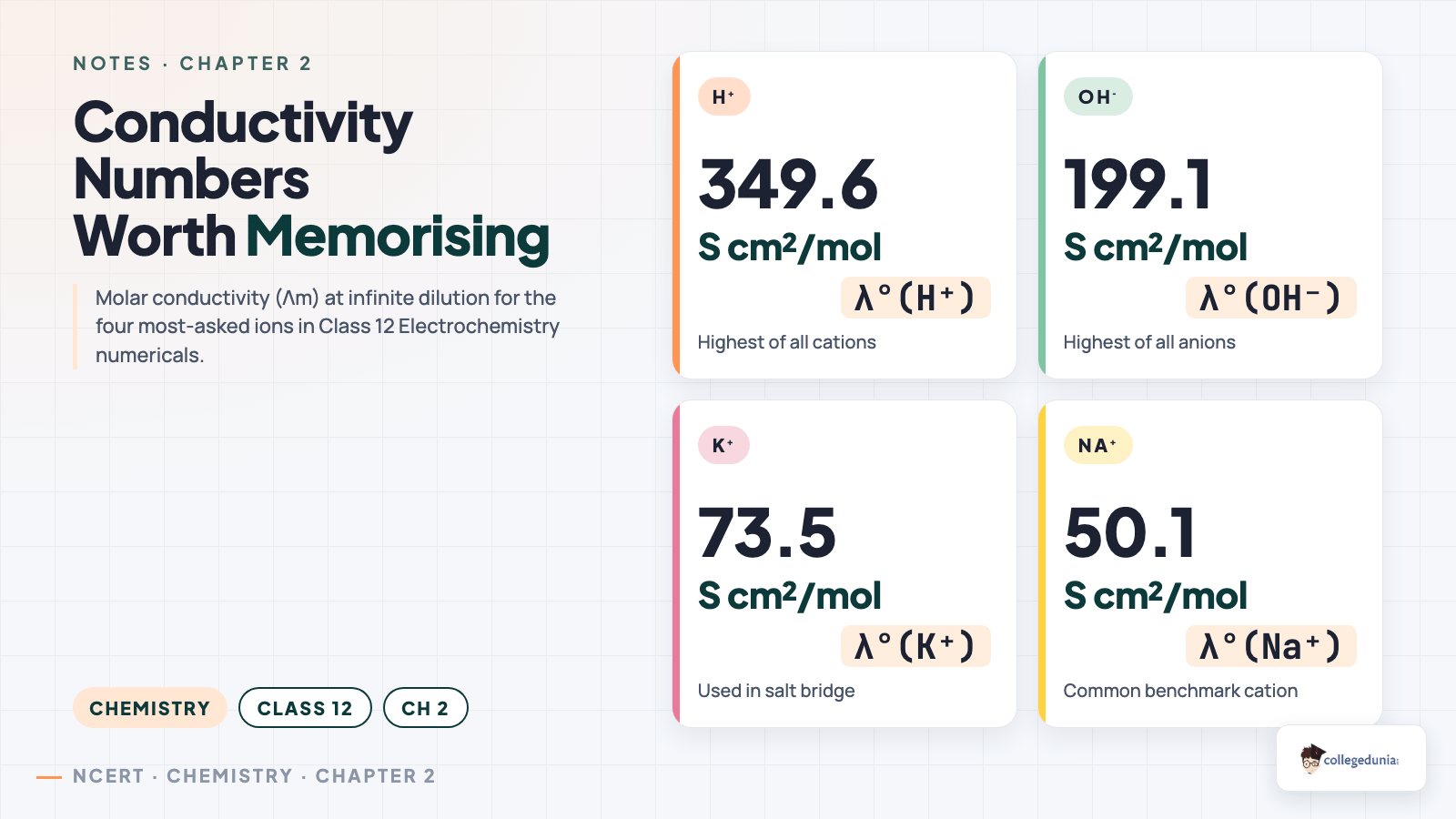
At infinite dilution, molar conductivity is the sum of the limiting ionic conductivities: m∘ = + +∘ + - -∘ . It lets you find m∘ for weak electrolytes, the degree of dissociation α = mc / m∘ , and Ka of a weak acid.
Electrolysis and Faraday's Laws
Faraday's first law: mass deposited is proportional to charge, m = M I tn F . Second law: equal charge deposits masses in the ratio of equivalent masses. The Faraday constant F = 96{,}500 C mol-1 is the charge per mole of electrons.
Batteries, Fuel Cells and Corrosion
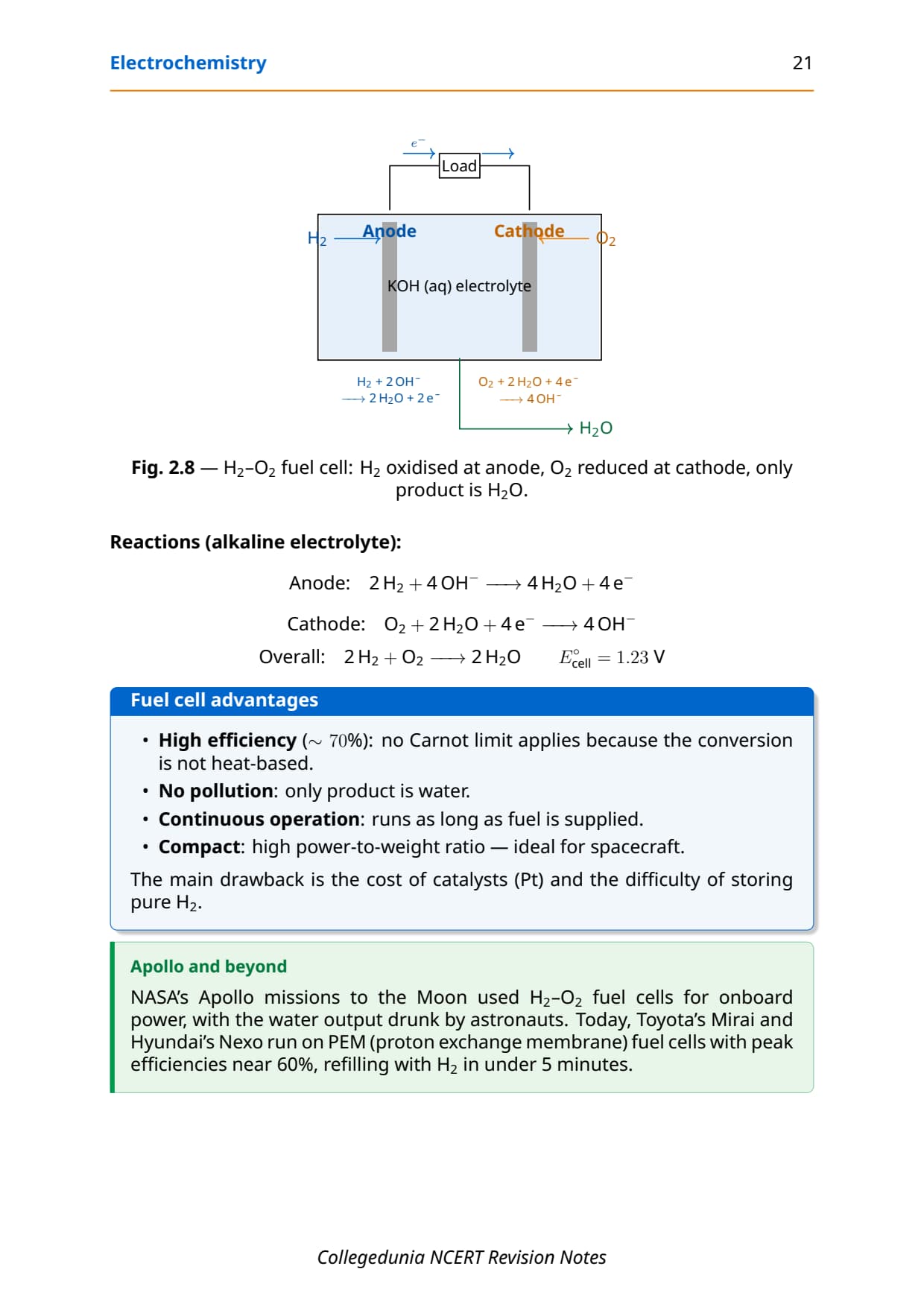
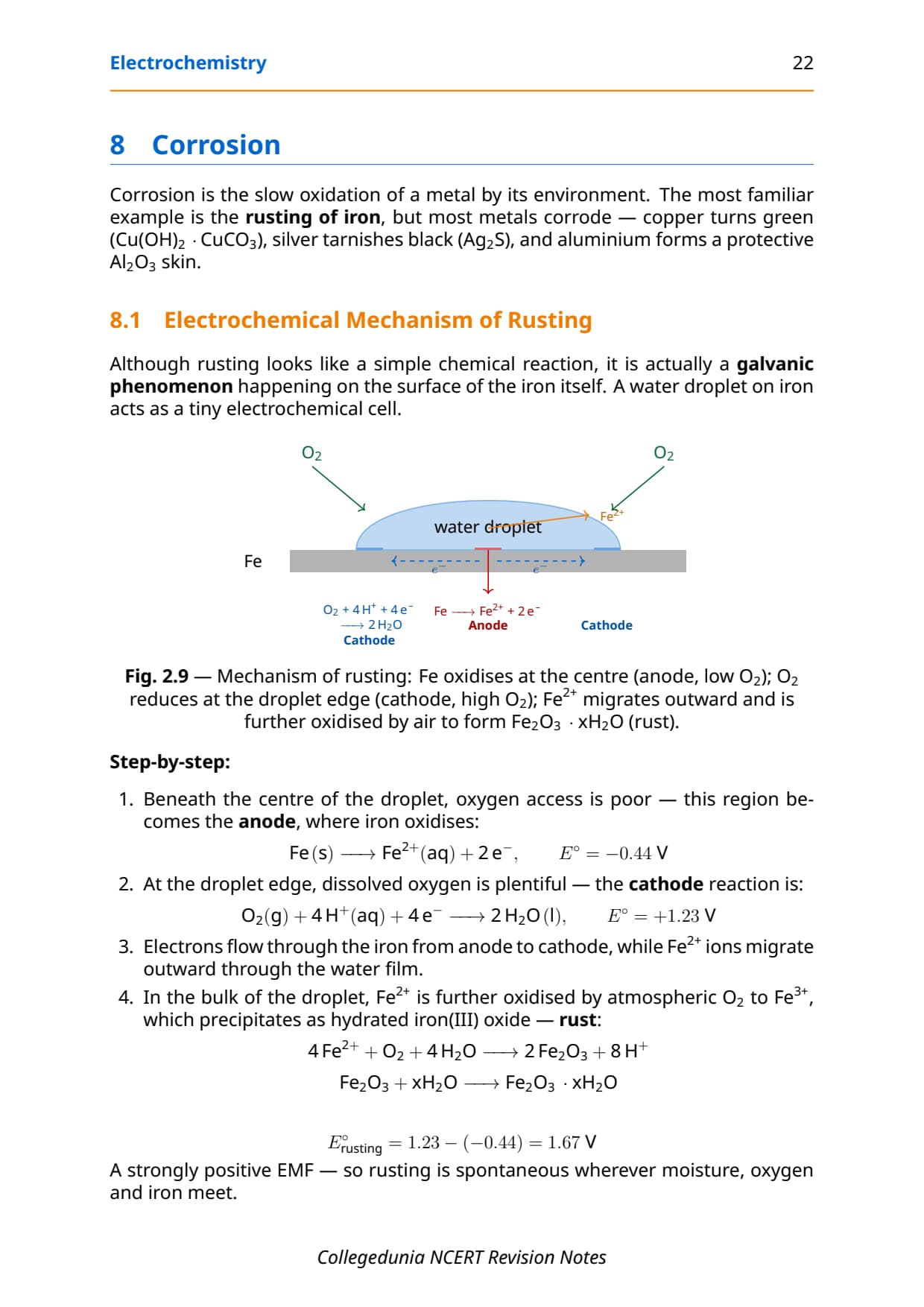
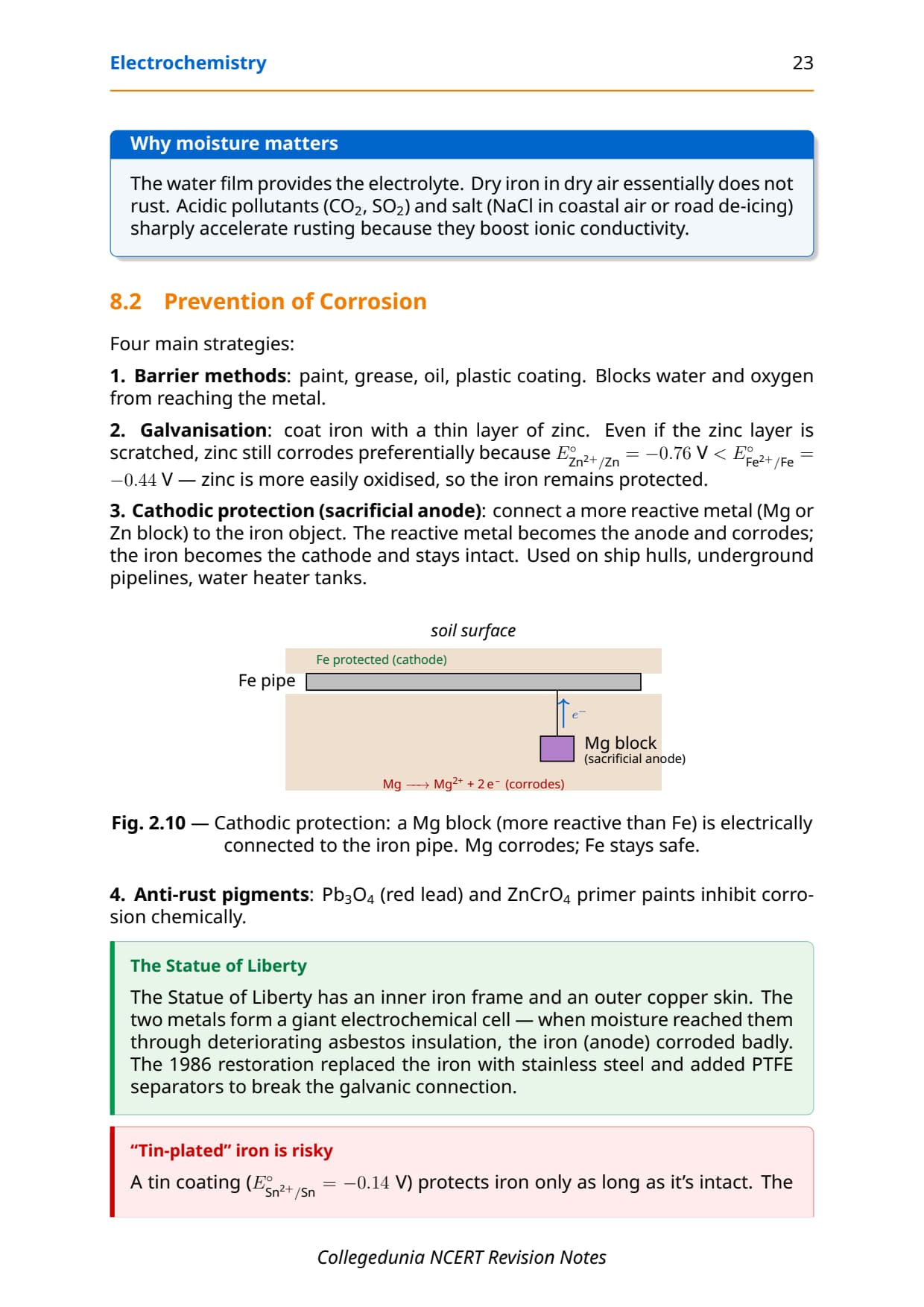
Primary cells (dry, mercury) cannot be recharged; secondary cells (lead-acid, nickel-cadmium) can. Hydrogen-oxygen fuel cells give continuous electricity from gaseous fuels and power spacecraft. Corrosion is an electrochemical process where iron acts as the anode with water and oxygen; galvanising, painting, and cathodic protection prevent it.
Electrochemistry Topic-wise Weightage for CBSE Class 12 Chemistry
This table shows which sub-topics CBSE favours. Prioritise the High rows.
| Sub-topic | Weightage | CBSE Frequency |
|---|---|---|
| Nernst Equation and Cell EMF | High | Every year |
| Kohlrausch's Law and Molar Conductivity | High | 4 out of last 5 years |
| Electrolysis and Faraday's Laws (numerical) | Medium | 3 out of last 5 years |
| Standard Electrode Potential / Electrochemical Series | Medium | 3 out of last 5 years |
| Batteries (Lead-Acid, Mercury, Fuel Cell) | Medium | 2 out of last 5 years |
| Corrosion Mechanism | Low | 1 out of last 5 years |
Electrochemistry Important Derivations for Class 12 Boards
These four derivations carry the bulk of the 3-mark and 5-mark long-answer questions in Boards and JEE Main.
- Nernst equation from Gibbs energy: proves Ecell = E∘cell - RTnF ln Q and its 298 K form. CBSE 2024, 2022; JEE Main 2025.
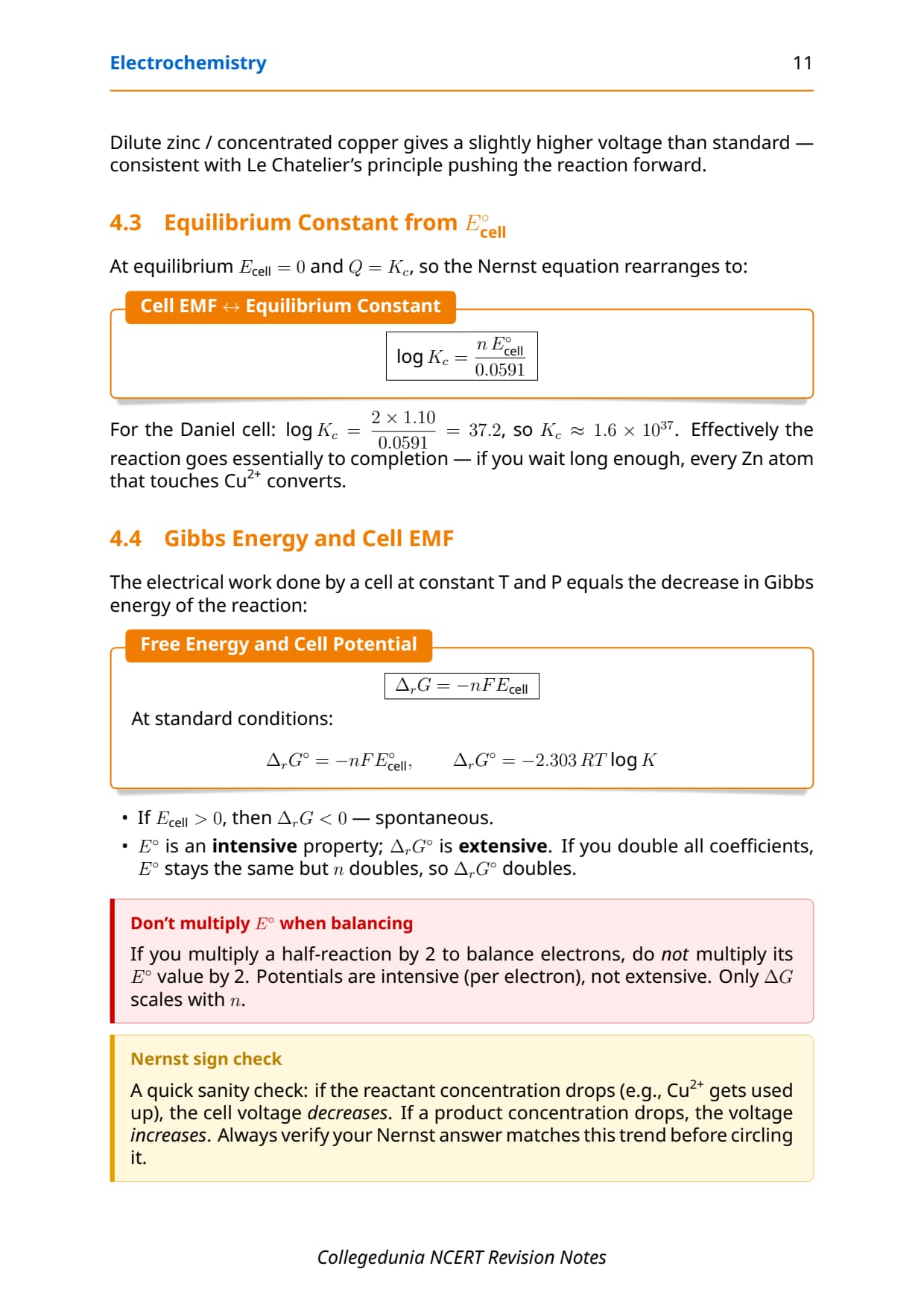
- E∘cell and equilibrium constant: proves log Kc = n E∘cell0.0591 . CBSE 2023, 2021.
- Kohlrausch's law for weak m∘ : gets m∘ of acetic acid from HCl, NaCl, CH3COONa. CBSE 2025, 2023.
- Electrolysis: derives m = M I tn F from Faraday's first law. CBSE 2024, JEE Main 2024.
Electrochemistry Top 6 Formulae for Quick Recall
These six cover almost every Boards and JEE Main numerical. The full master sheet is on the Formula Sheet.
| Quantity | Formula |
|---|---|
| Standard cell EMF | E∘cell = E∘cathode - E∘anode |
| Nernst equation (298 K) | Ecell = E∘cell - 0.0591n log Q |
| Gibbs energy from EMF | Δ G∘ = -nFE∘cell |
| Molar conductivity | m = κ × 1000c |
| Kohlrausch's law | m∘ = + +∘ + - -∘ |
| Faraday's first law | m = M I tn F |
Full master sheet: Electrochemistry Class 12 Chemistry Formula Sheet
Electrochemistry Common Misconceptions to Unlearn
Three confusions cost students easy marks, each a 1- to 2-mark hit.
Electrochemistry Class 12th Real-World Applications You Should Know
Four applications often surface as 1-mark assertion-reason questions.
- Lithium-ion batteries in phones and EVs use the same redox principle as the Daniell cell, with lithium intercalation.
- Hydrogen-oxygen fuel cells power spacecraft, generating electricity continuously and emitting only water.
- Electroplating applies Faraday's first law to coat chrome on car parts and silver on cutlery.
- Cathodic protection connects iron to a more reactive metal (Mg, Zn), forcing iron to act as the cathode.
Electrochemistry Previous Year Questions and Their Frequency
These three topics are the most-asked across CBSE, JEE Main and NEET from 2021 to 2026. The full year-wise map is on the NCERT Solutions page.
| Topic | Asked in |
|---|---|
| Nernst equation numerical (find Ecell at given concentration) | CBSE 2025, 2024, 2022; JEE Main 2025, 2024, 2023; NEET 2024, 2023 |
| Molar conductivity vs concentration plot interpretation | CBSE 2024, 2023, 2021; JEE Main 2025, 2022; NEET 2025 |
| Faraday's-law charge / mass calculation | CBSE 2025, 2022; JEE Main 2024; NEET 2022 |
Full year-wise PYQ map: Electrochemistry Class 12 Chemistry NCERT Solutions
Student Feedback
In a Collegedunia poll of 1,080 Class 12 students, 81% said the step-by-step Nernst and Kohlrausch numericals cleared their biggest doubts.
Other Resources for Electrochemistry Class 12 Chemistry
| Resource | Link |
|---|---|
| NCERT Solutions | Electrochemistry Class 12 Chemistry NCERT Solutions |
| Formula Sheet | Electrochemistry Class 12 Chemistry Formula Sheet |
| NCERT Book PDF | Electrochemistry Class 12 Chemistry NCERT Book PDF |
| NCERT Exemplar Book PDF | Electrochemistry Class 12 Chemistry NCERT Exemplar Book PDF |
| NCERT Exemplar Solutions | Electrochemistry Class 12 Chemistry NCERT Exemplar Solutions |
| Handwritten Notes | Electrochemistry Class 12 Chemistry Handwritten Notes |
| Notes | Electrochemistry Class 12 Chemistry Notes |
NCERT Notes for Class 12 Chemistry: All Chapters
Jump to the Notes for any other chapter below.
| Chapter | Resource |
|---|---|
| Chapter 1 | Solutions Notes |
| Chapter 2 | Electrochemistry Notes |
| Chapter 3 | Chemical Kinetics Notes |
| Chapter 4 | The d- and f-Block Elements Notes |
| Chapter 5 | Coordination Compounds Notes |
| Chapter 6 | Haloalkanes and Haloarenes Notes |
| Chapter 7 | Alcohols, Phenols and Ethers Notes |
| Chapter 8 | Aldehydes, Ketones and Carboxylic Acids Notes |
| Chapter 9 | Amines Notes |
Electrochemistry Class 12 Chemistry Notes FAQs
Ques. Where can I download Electrochemistry Class 12 Chemistry Notes PDF?
Ans. You can download the Electrochemistry Class 12 Chemistry Notes PDF directly from this page. Both the Normal and HD versions are available, and both are free.
Ques. Are these notes aligned with the 2026-27 NCERT?
Ans. Yes. The notes reflect the current 2026-27 syllabus for Class 12 Chemistry. The new NCERT edition retained Electrochemistry in full, so every Nernst equation, Kohlrausch's law application, electrolysis numerical, and corrosion mechanism in the older edition is preserved.
Ques. How many pages is the Class 12th Chemistry Electrochemistry Notes PDF?
Ans. The Notes PDF runs approximately 24 pages and covers all six themes of the chapter: redox basics, standard electrode potential, the Nernst equation, electrolytic conductance and Kohlrausch's law, Faraday's laws of electrolysis, and batteries plus corrosion.
Ques. Which derivations are most important in Class 12 Electrochemistry?
Ans. Four derivations carry the bulk of long-answer questions: the Nernst equation from Gibbs energy, the relation between standard cell EMF and the equilibrium constant, the determination of limiting molar conductivity of a weak electrolyte using Kohlrausch's law, and the derivation of m = MIt/nF from Faraday's first law. All four have appeared in CBSE Boards within the last three years.
Ques. Is Electrochemistry a high-scoring chapter for Class 12 Boards?
Ans. Yes. Electrochemistry typically carries 5 to 7 marks in CBSE Class 12 Chemistry, with at least one 3-mark derivation or numerical asked every year. The chapter also contributes 4 to 5% of JEE Main Chemistry and 2 to 3 questions per NEET paper, making it a strong return on revision time.
Ques. What is the weightage of Electrochemistry in JEE Main and NEET?
Ans. Electrochemistry contributes about 4 to 5% of the JEE Main Chemistry section, typically two questions per shift. In NEET, the chapter contributes 2 to 3 questions per year, usually one conceptual question on cell EMF and one Nernst-equation numerical.
Ques. How is the Nernst equation different at 298 K compared to other temperatures?
Ans. The general form is Ecell = E∘cell - (RT/nF)ln Q . At 298 K, substituting R, T and F and converting natural log to base-10 log gives the compact CBSE form Ecell = E∘cell - (0.0591/n)log Q . Use the 0.0591 form only when the problem specifies 298 K.
Ques. Why does molar conductivity of a strong electrolyte increase slowly on dilution but that of a weak electrolyte rises sharply?
Ans. In a strong electrolyte (e.g. KCl), all ions are already present at any concentration; dilution only reduces ion-ion attraction, so molar conductivity rises modestly. In a weak electrolyte (e.g. CH3COOH), the degree of dissociation rises sharply on dilution, releasing many more ions per mole, so molar conductivity rises steeply.
Ques. What is the standard hydrogen electrode and why is its potential taken as 0.00 V?
Ans. The standard hydrogen electrode (SHE) is a platinised-platinum strip dipped in 1 M H+ with H2(g) bubbled at 1 bar and 298 K. The half-reaction 2H+(aq) + 2e- → H2(g) is assigned E∘ = 0.00 V by convention so that every other half-cell can be ranked against it on the electrochemical series. Positive E∘ values are stronger oxidising agents than H+; negative values are stronger reducing agents than H2.
Ques. How does a hydrogen-oxygen fuel cell work and where is it used?
Ans. An H2-O2 fuel cell uses porous carbon electrodes loaded with a Pt/Ag catalyst in aqueous KOH at ~ 523-573 K. At the anode H2 + 2OH- → 2H2O + 2e-; at the cathode O2 + 2H2O + 4e- → 4OH-. Net reaction 2H2 + O2 → 2H2O with EMF ~ 1.23 V. Used in Apollo spacecraft and modern fuel-cell EVs because it is ~ 70% efficient and the only by-product is water.
Ques. What is the lead-acid battery reaction and why is it rechargeable?
Ans. A lead storage cell has Pb at the anode, PbO2 at the cathode and 38% H2SO4 as electrolyte, giving ~ 2.0 V per cell (six in series = 12 V car battery). Discharge: Pb + PbO2 + 2H2SO4 → 2PbSO4 + 2H2O. On charging, an external EMF reverses the reaction, regenerating Pb and PbO2. The reversibility of the PbSO4 crust is what makes the cell a secondary (rechargeable) battery.



Comments