




Class 12 Economics Chapter 1 Introduction to Microeconomics is the first chapter of the Microeconomics book. It explains scarcity, choice, the Production Possibility Frontier and opportunity cost. This page has the full revision notes and a free PDF to download.
Here is what this chapter is worth in the exam:
- CBSE Boards: about 6 marks, mostly short theory plus one PPF question.
- CUET: 2 to 3 questions every year on the basic concepts.
- Revision time: about 35 minutes with these notes.
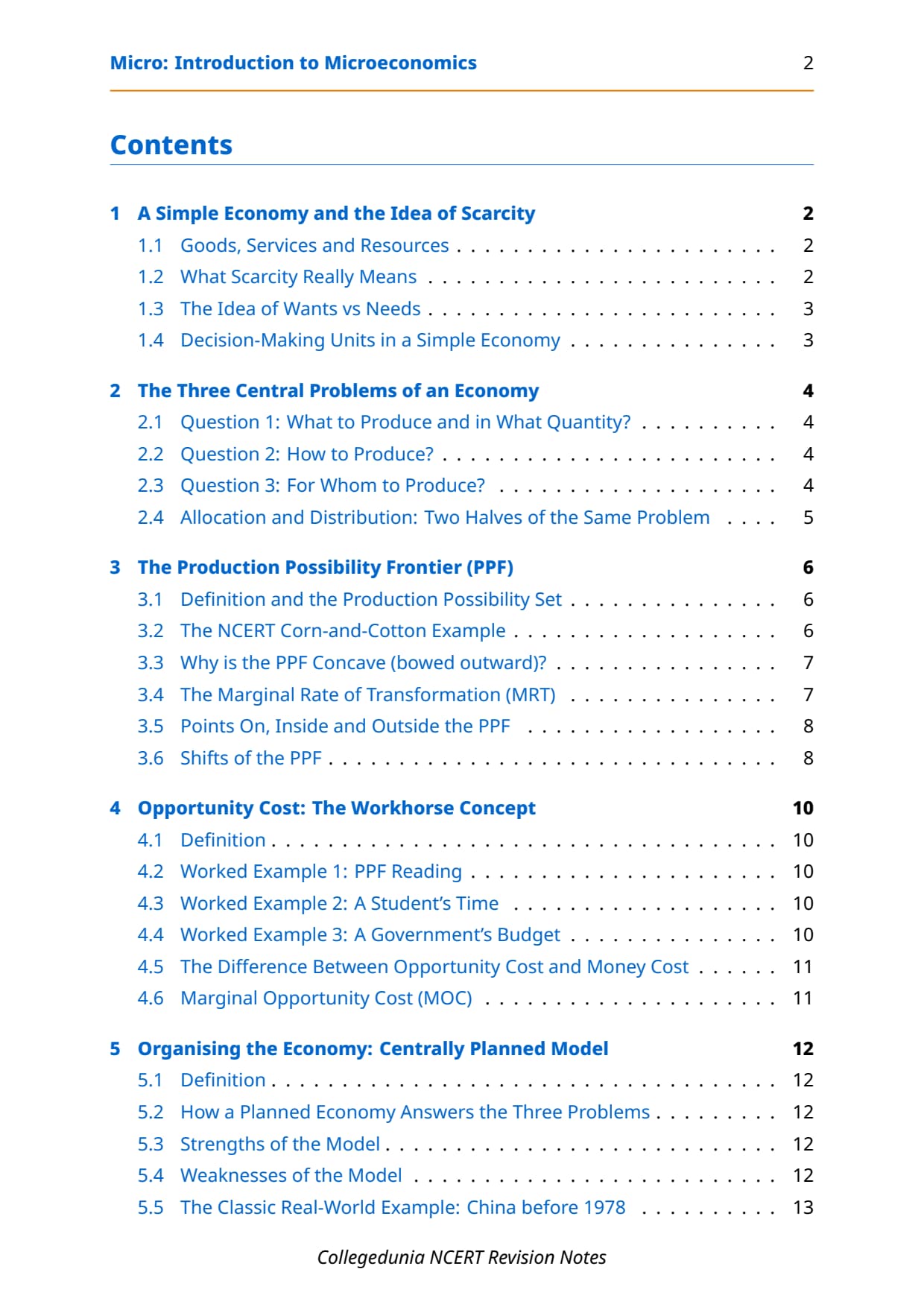
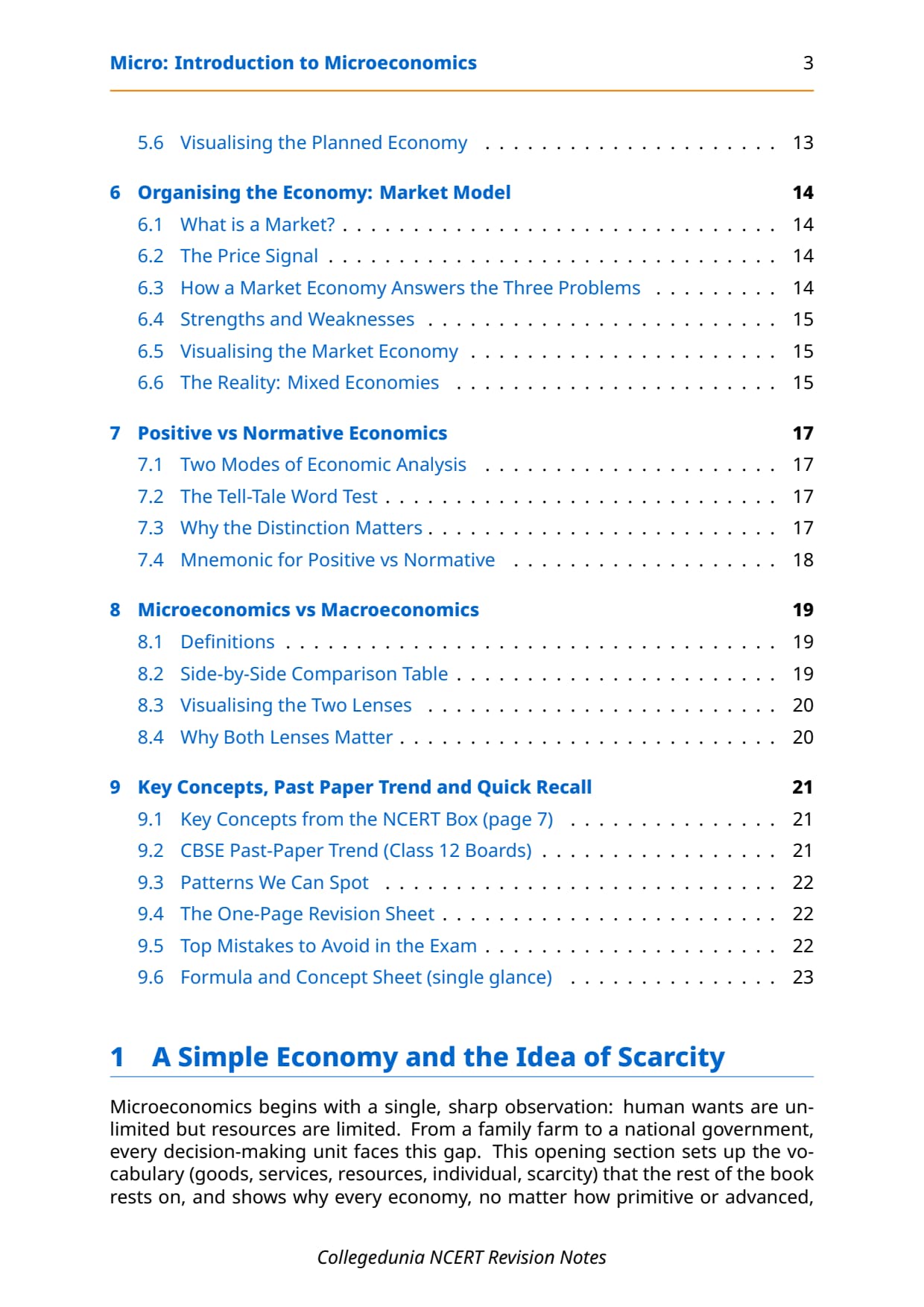
What These Introduction to Microeconomics Notes Cover
The chapter splits into five small topics. The notes give each one a short, exam-ready summary:
- Scarcity (1 mark): why limited resources force every economy to choose.
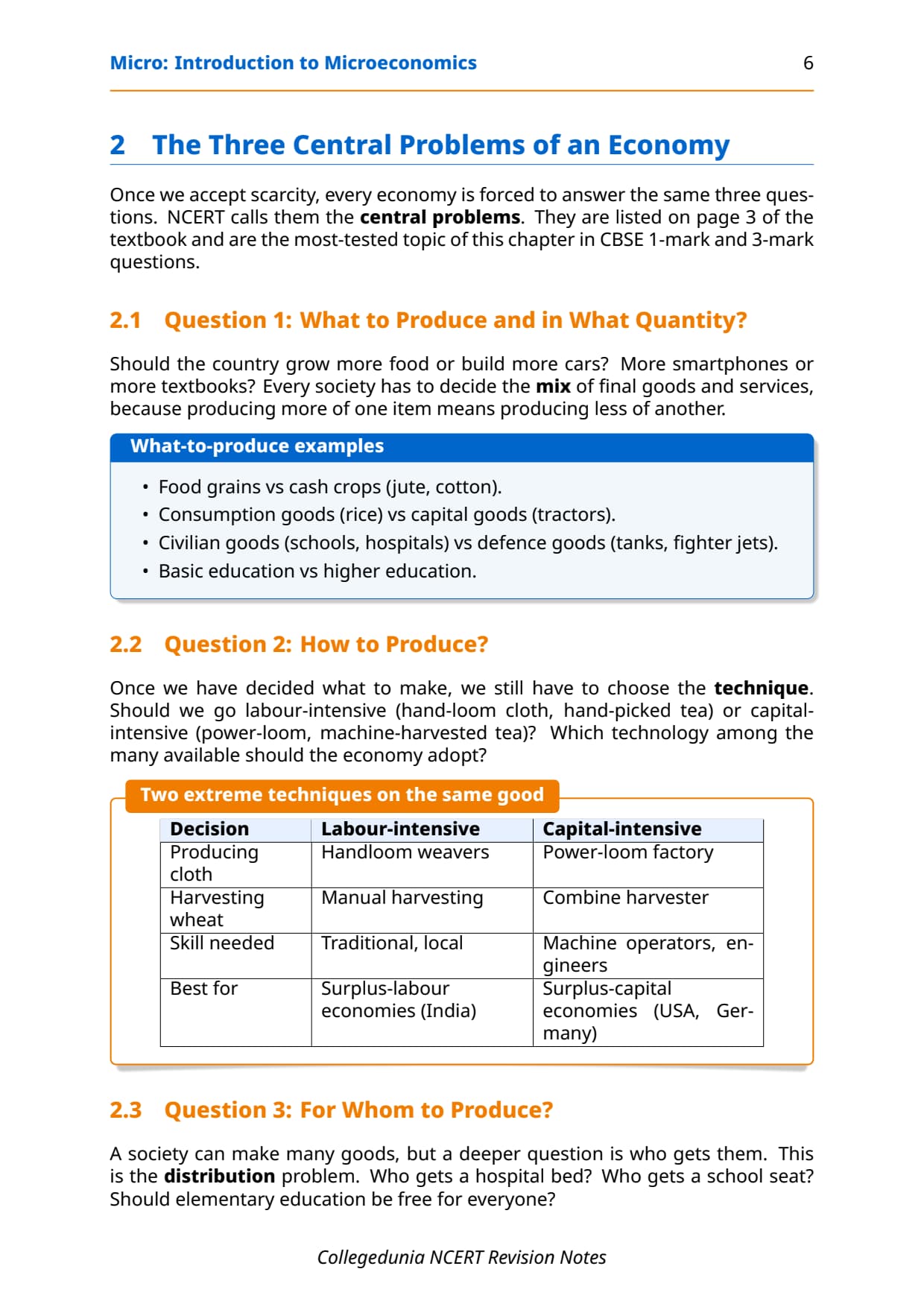
- Central problems (3 marks): what to produce, how to produce, and for whom.
- PPF (3 to 4 marks): the curve, its shape, and points on, inside and outside it.
- Opportunity cost and MRT (3 marks): the cost of every choice.
- Positive vs normative, micro vs macro (3 marks): the two key comparisons.
Scarcity and the Three Central Problems of an Economy
This is the most-tested part of the chapter. Most questions start with a definition here. The lines below are short enough to write in a board answer.
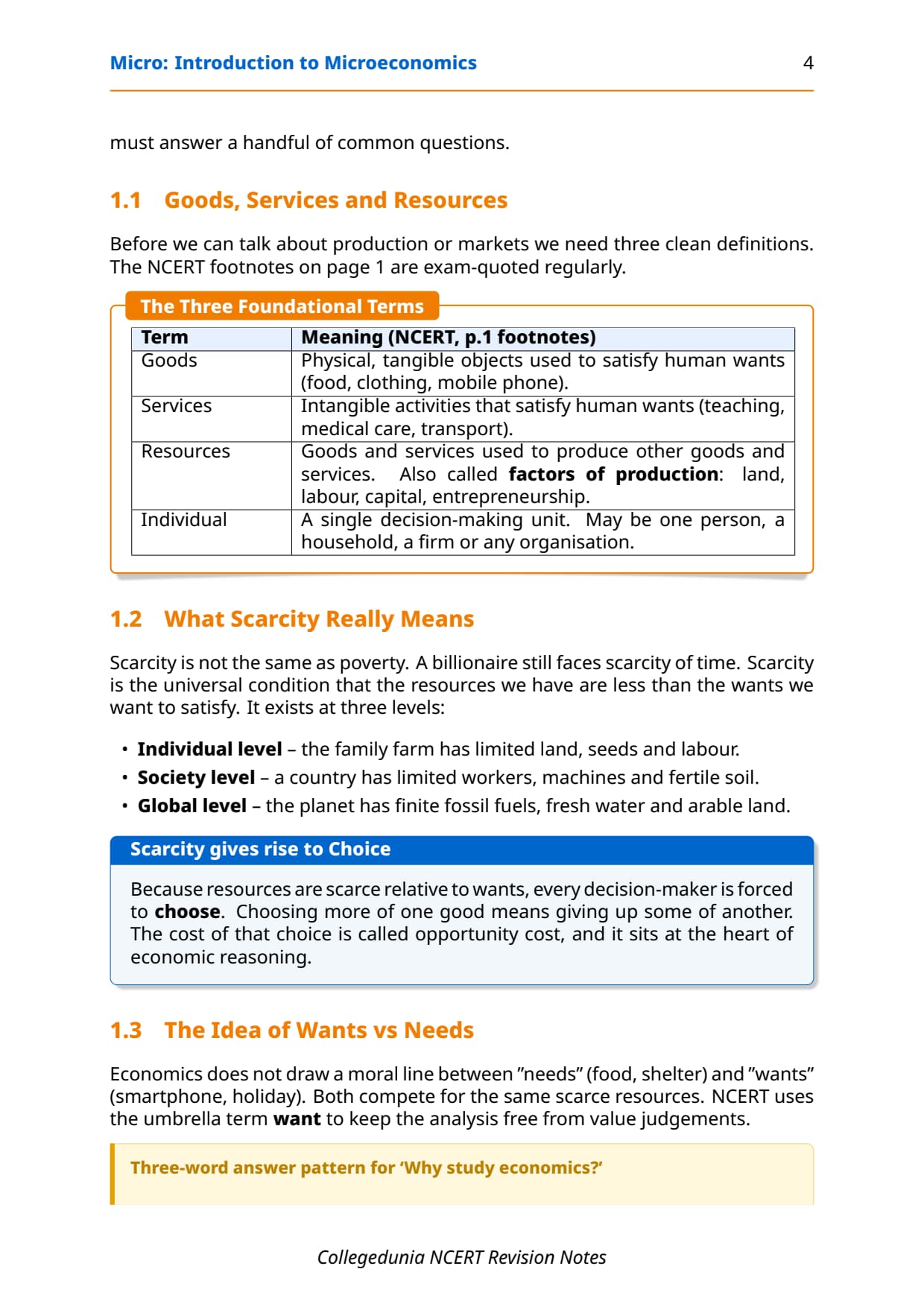
| Term | Meaning |
|---|---|
| Scarcity | Unlimited wants but limited resources that have other uses. |
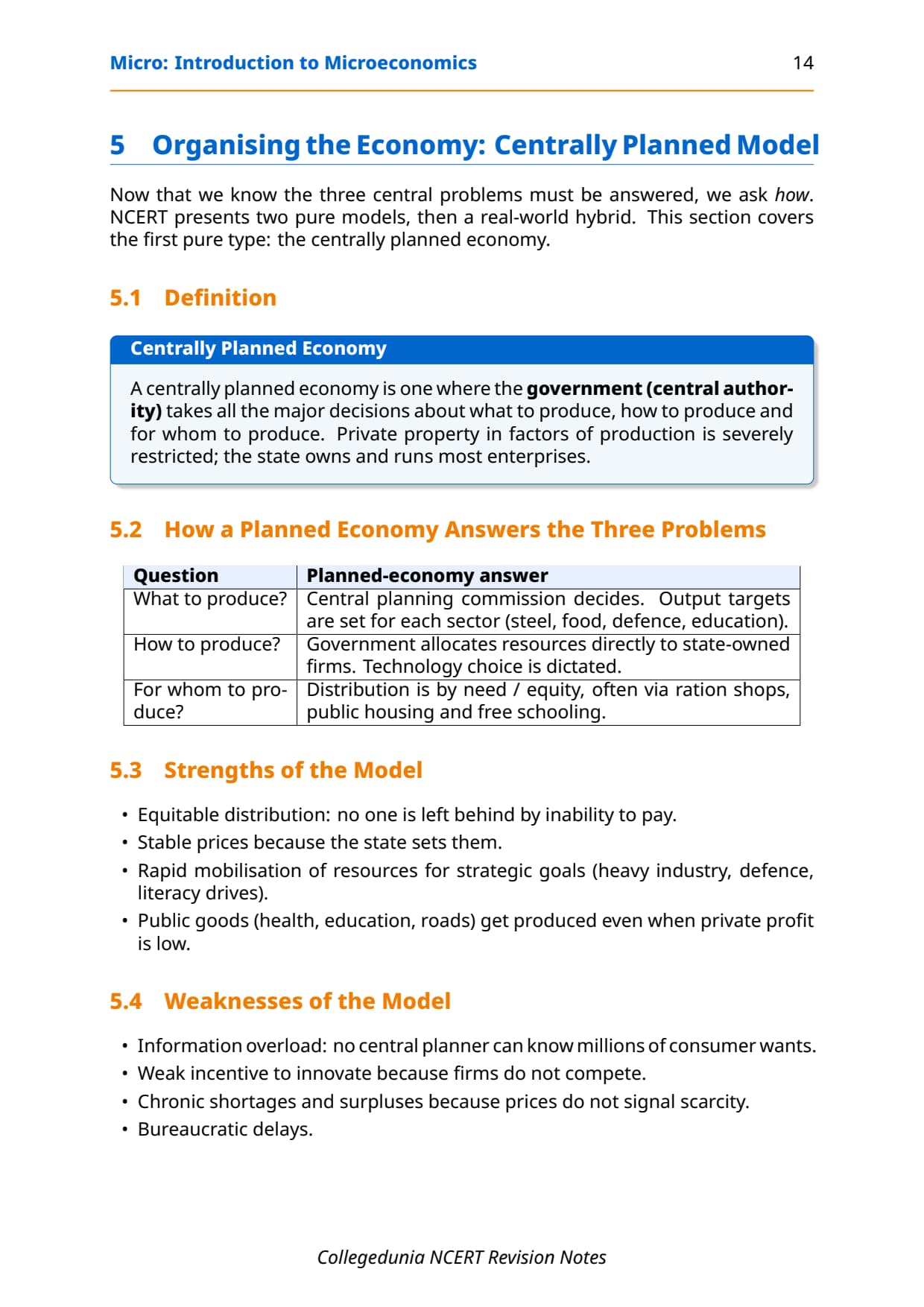
| Central problems | What to produce, how to produce, and for whom to produce. |
| What to produce | Which goods to make and in what amounts. |
| How to produce | The method: more labour or more machines. |
| For whom to produce | How the output is shared among people. |
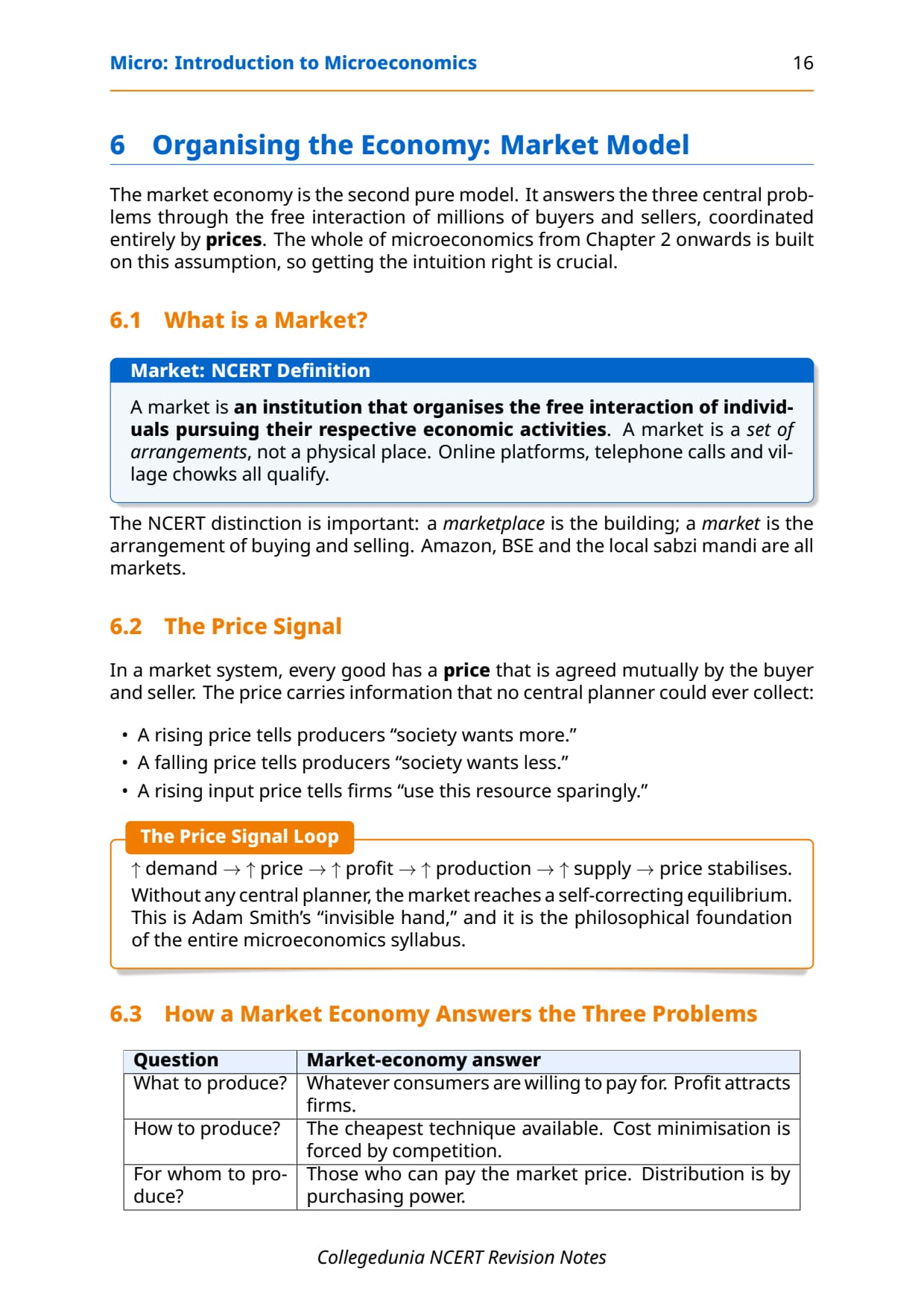
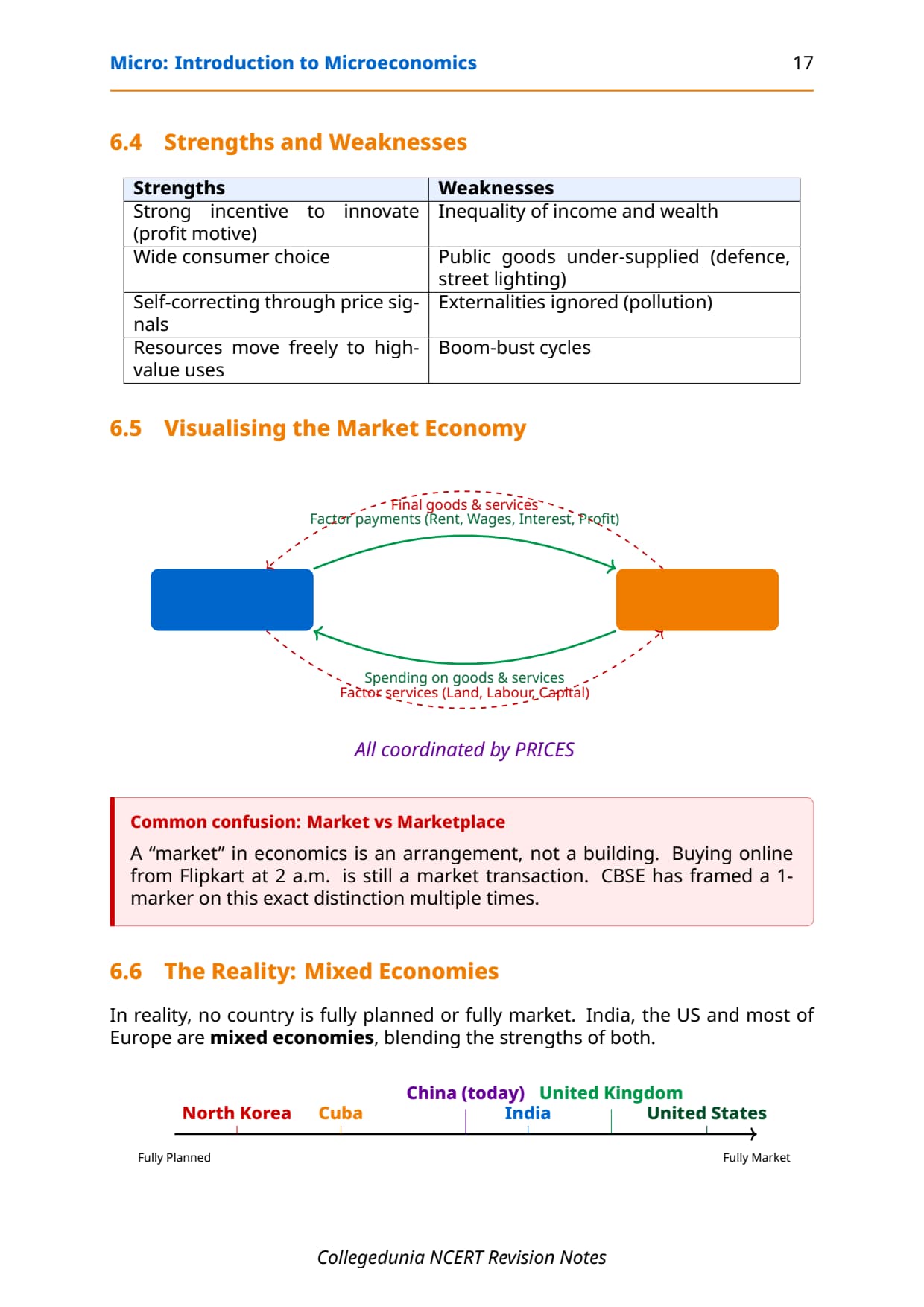
| Market economy | Prices decide what, how and for whom. |
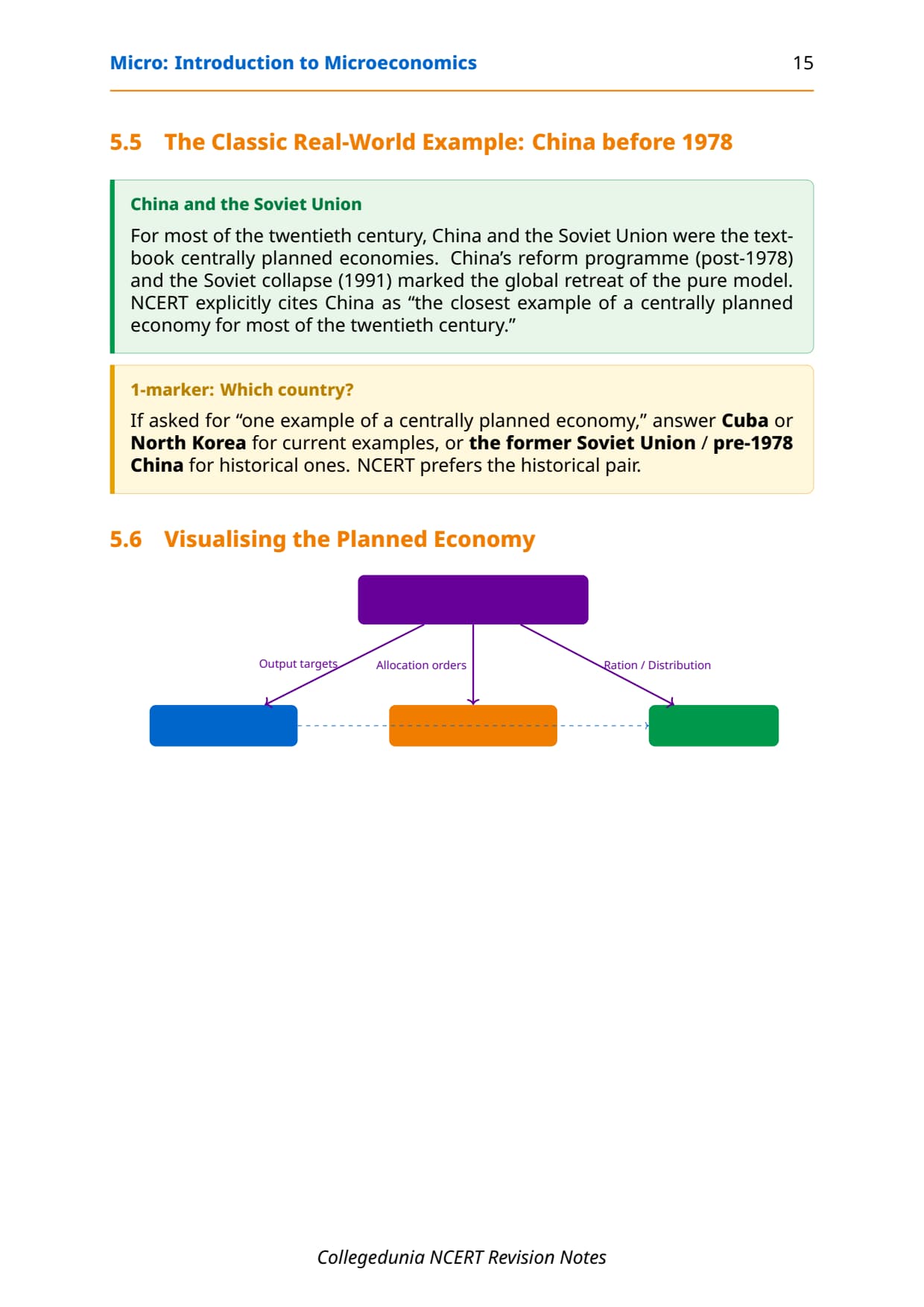
| Mixed economy | Both the government and the market decide. India is one. |
Note that scarcity is not the same as a shortage. A shortage is short-term; scarcity is always there, because resources are limited.

Production Possibility Frontier (PPF) Class 12 Notes
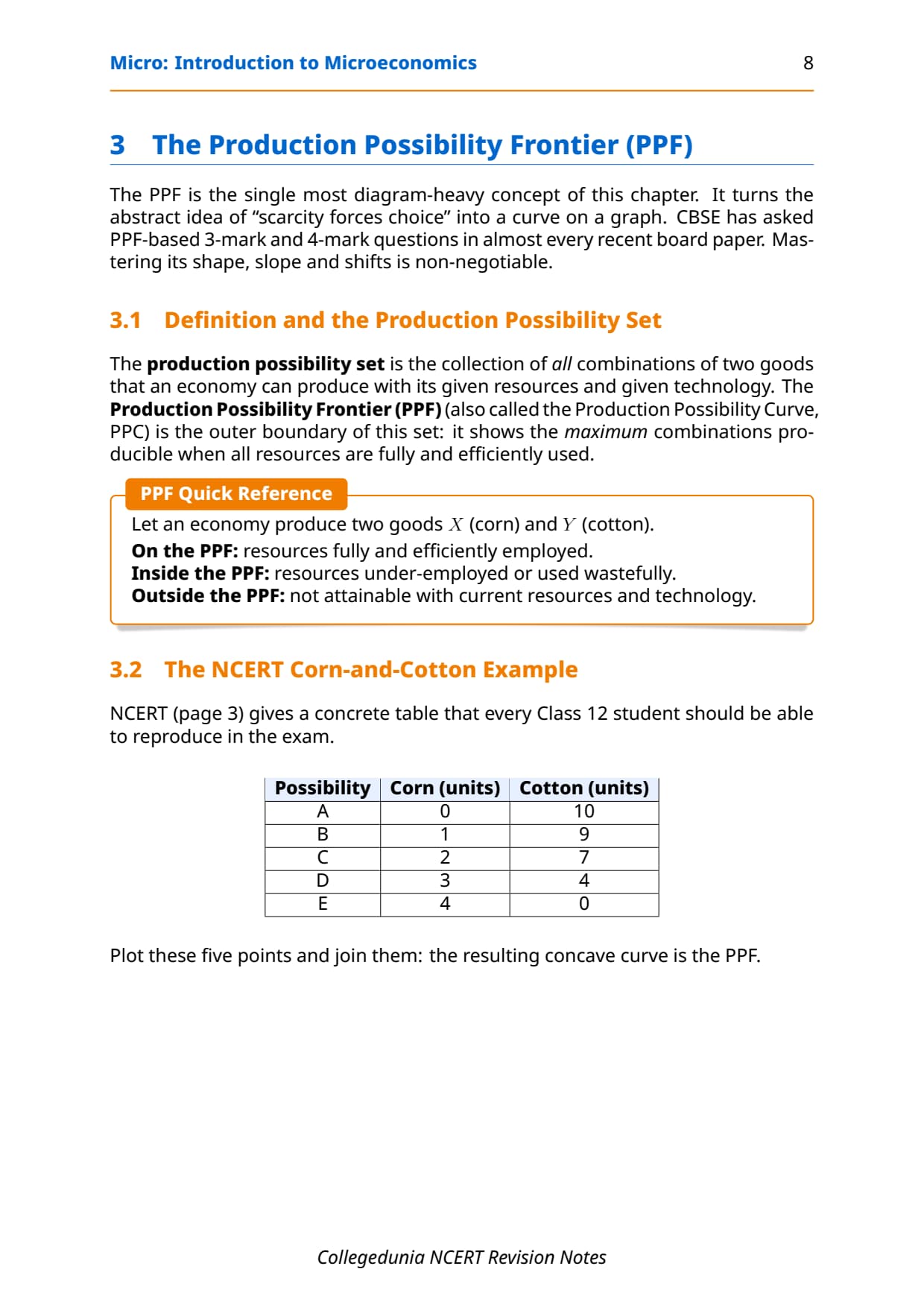
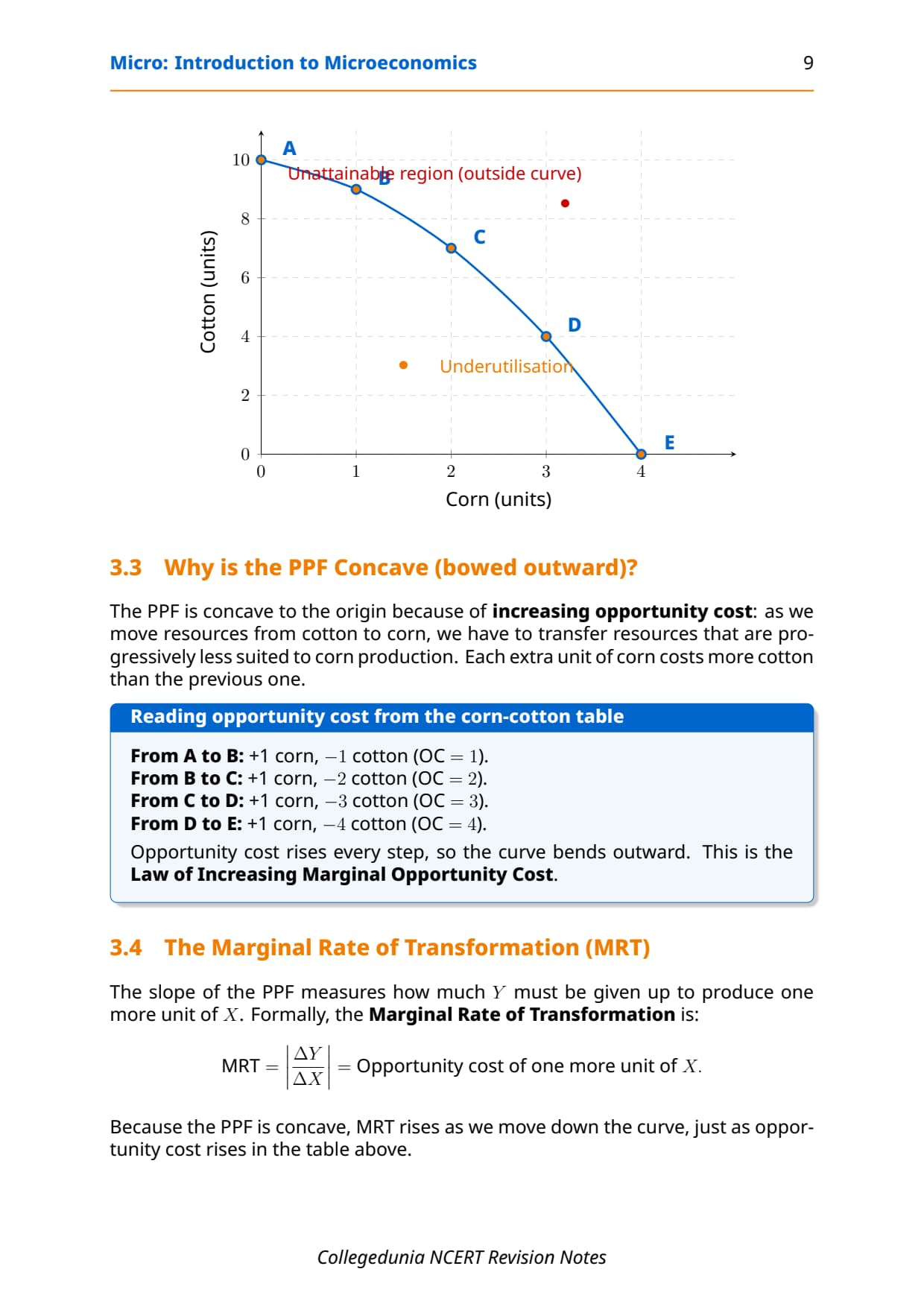
The PPF is the most-drawn diagram in this chapter. It shows the largest amounts of two goods an economy can make when all resources are fully used.
| Feature | What it means |
|---|---|
| Slopes down | More of one good means less of the other. |
| Bowed out (concave) | Each extra unit costs more than the last. |
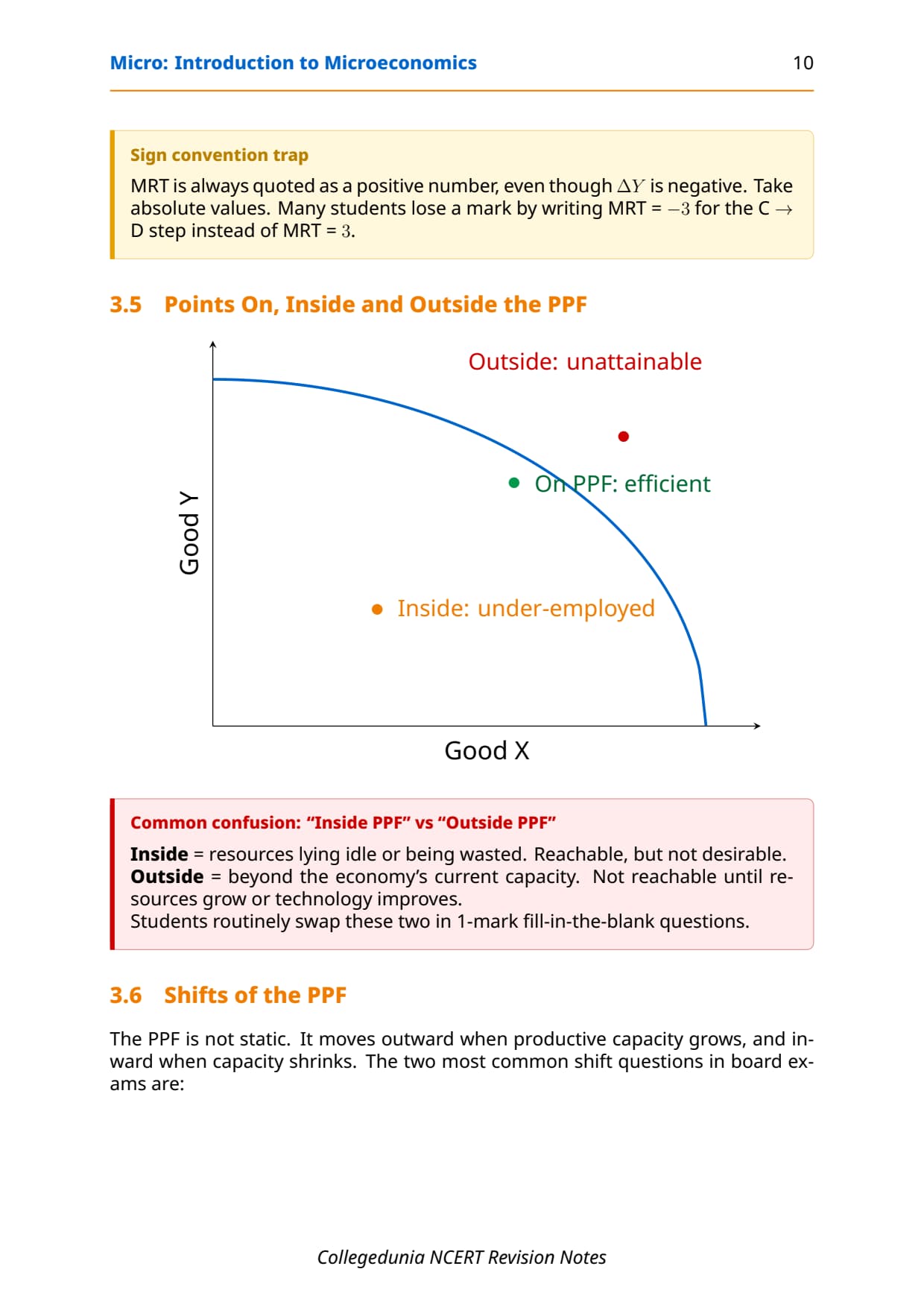
| Point on the curve | All resources are used well. |
| Point inside | Some resources are idle or wasted. |
| Point outside | Not possible right now. |
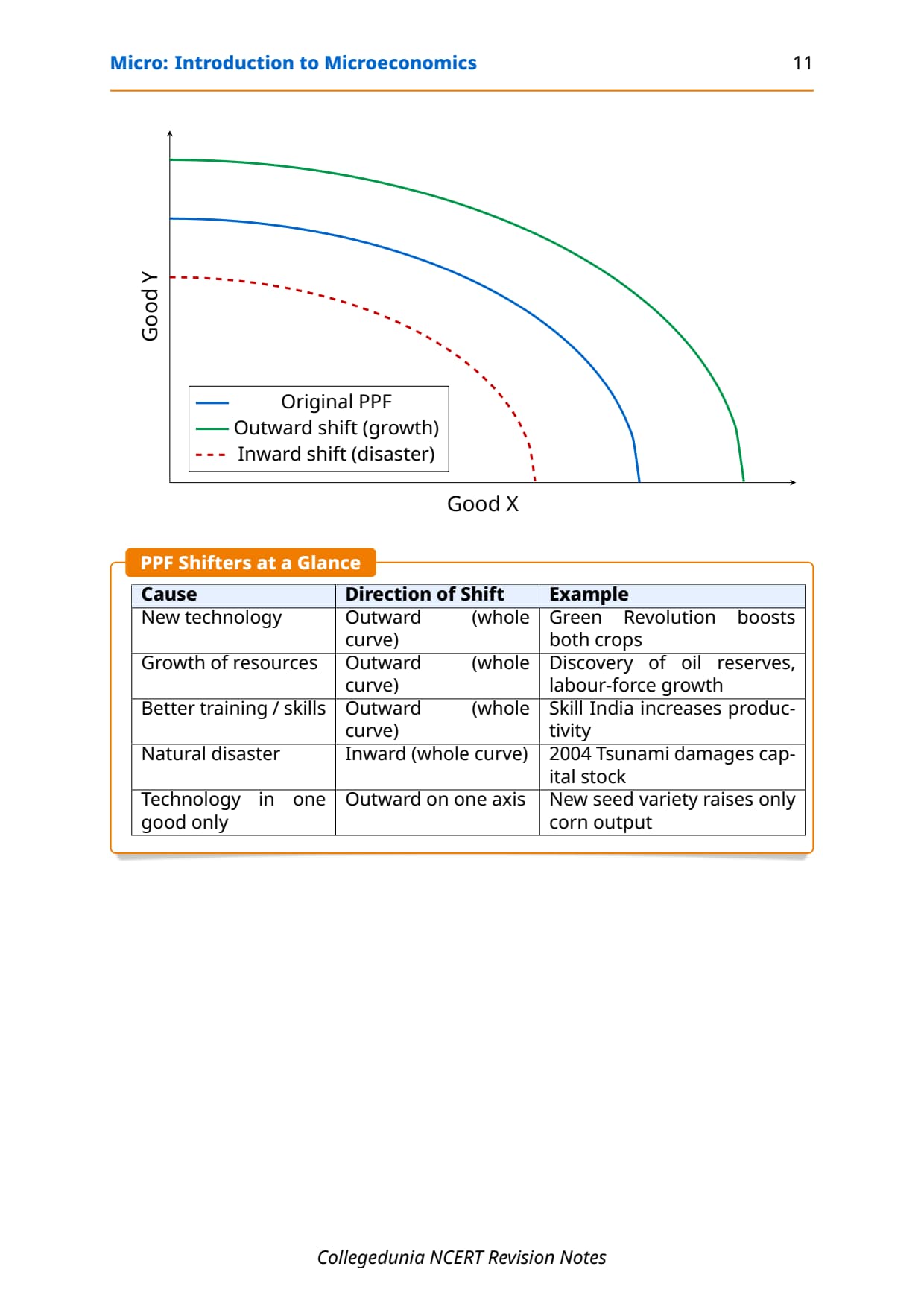
| Shifts out | Growth: more resources or better technology. |
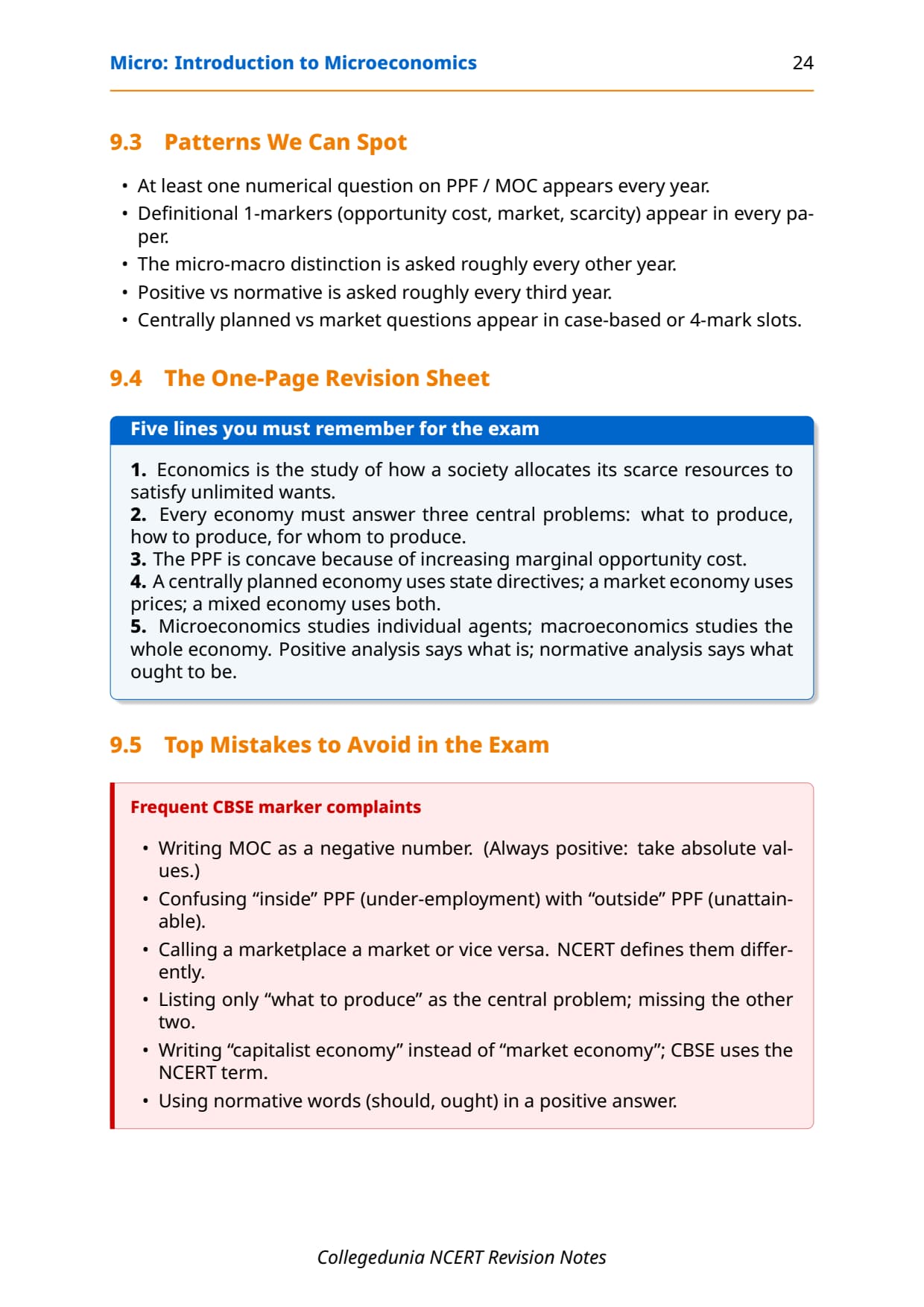
Memory hook: a straight PPF means constant cost; a bowed-out PPF means rising cost. For the "why is the PPF concave" question, say resources are not equally good at both goods, so each extra unit costs more.
Opportunity Cost and Marginal Rate of Transformation
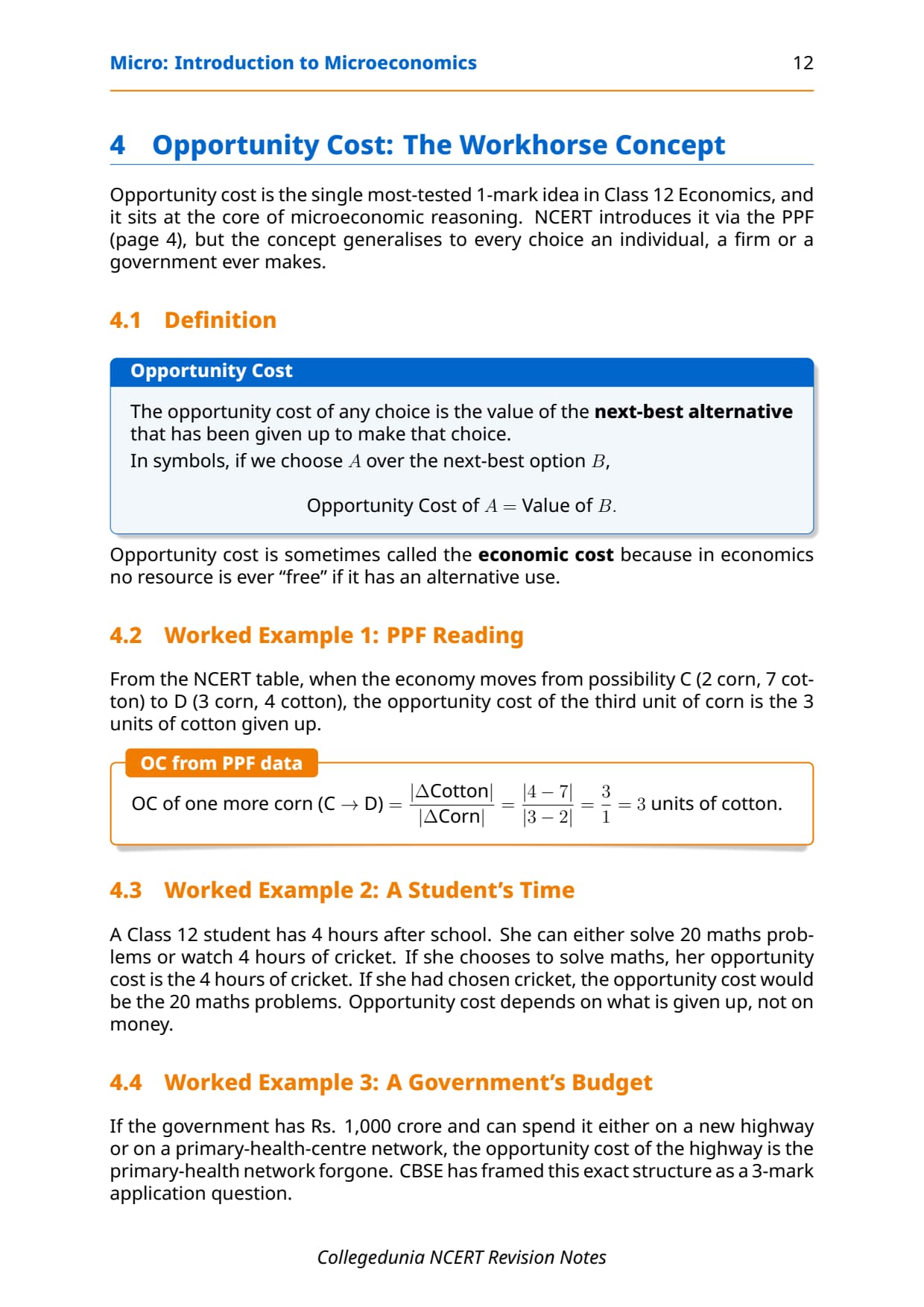
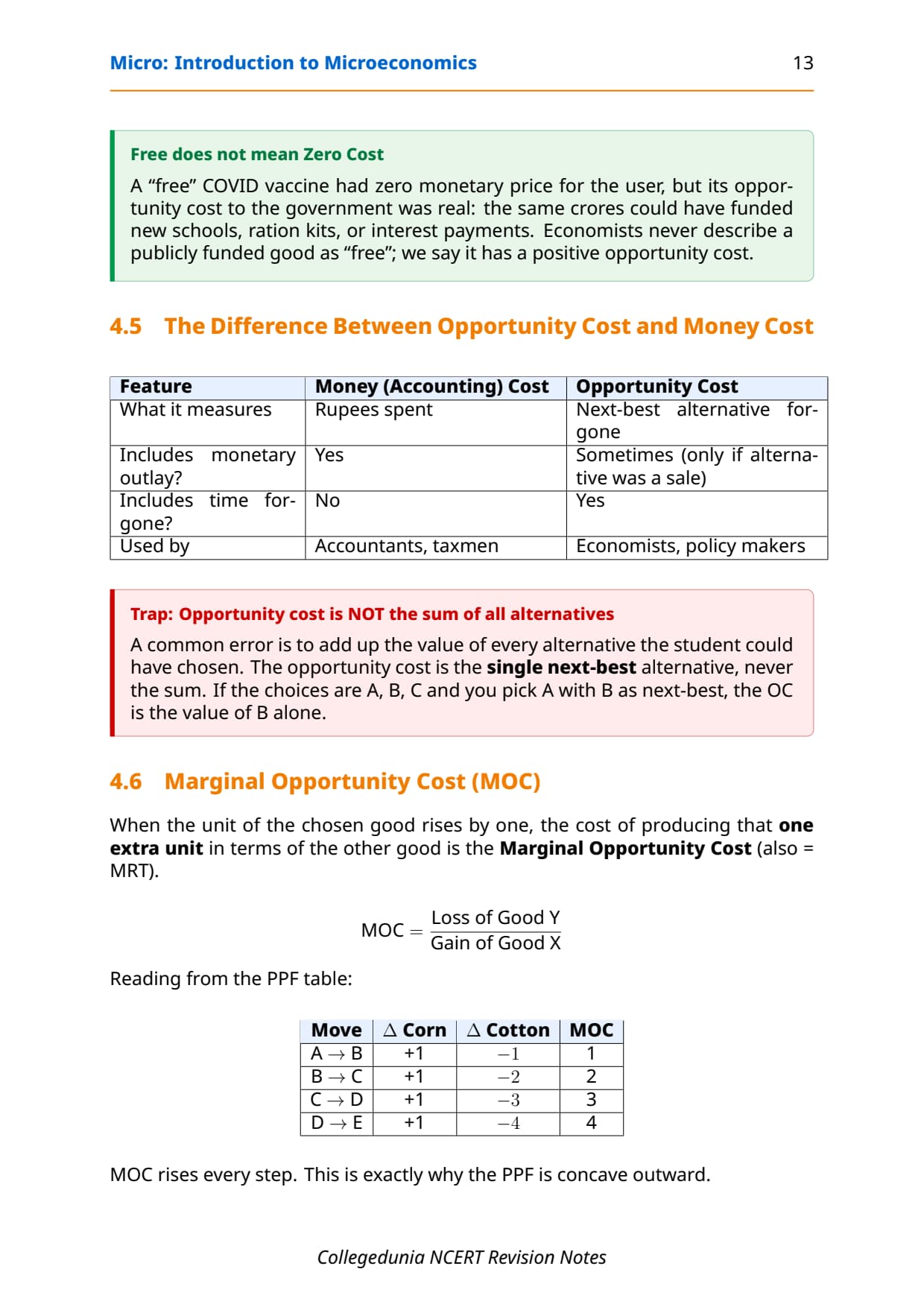
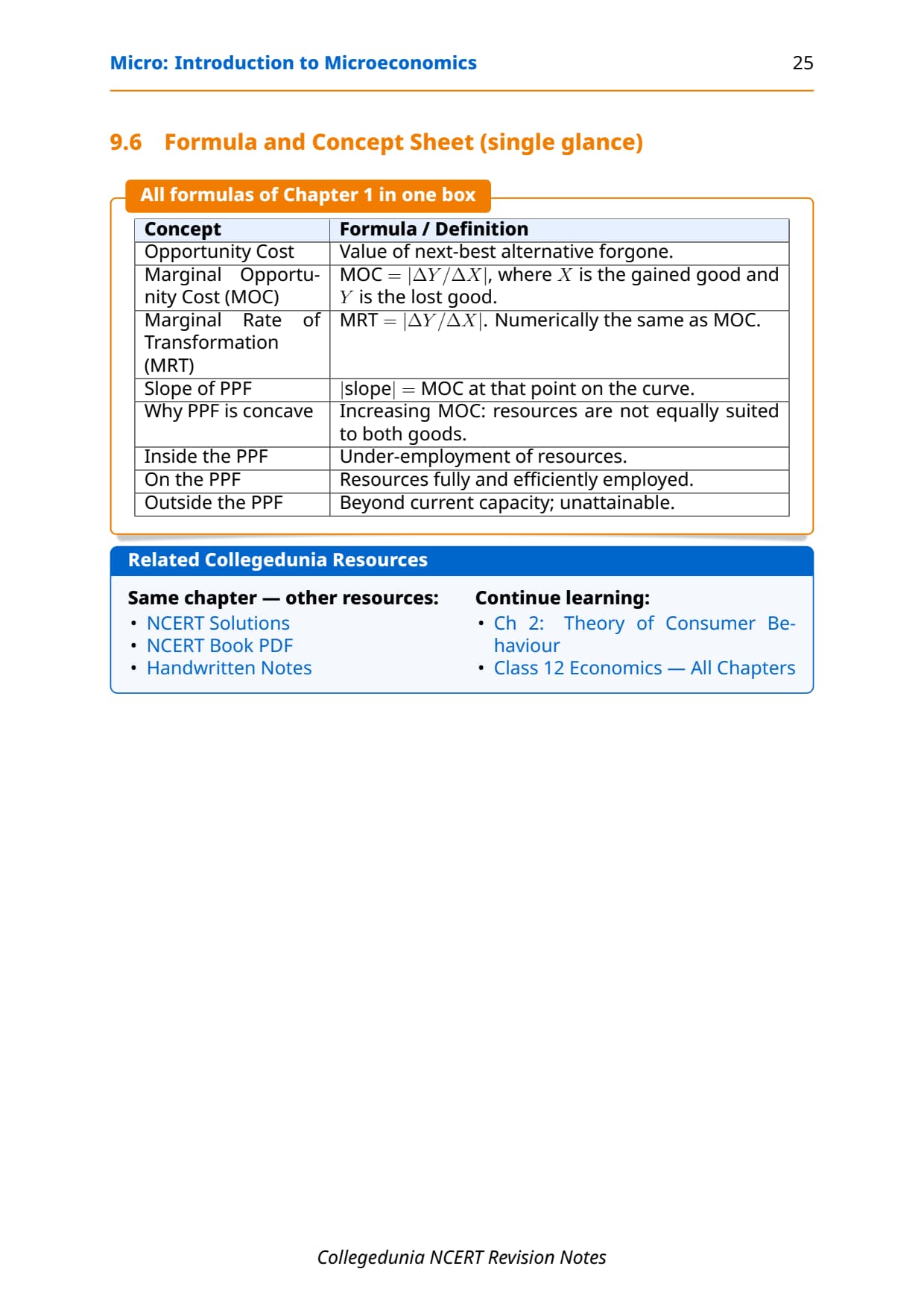
Opportunity cost is the next-best choice you give up. On the PPF, it is the units of one good you drop to make one more of the other. The marginal rate of transformation (MRT) is its formal name:
MRT = units of Y given up / units of X gained = the slope of the PPF.
If one more unit of X costs 2 units of Y, the MRT is 2. It rises as you move down the curve. Worked sums on this sit in the matching NCERT Solutions.
Positive vs Normative and Microeconomics vs Macroeconomics
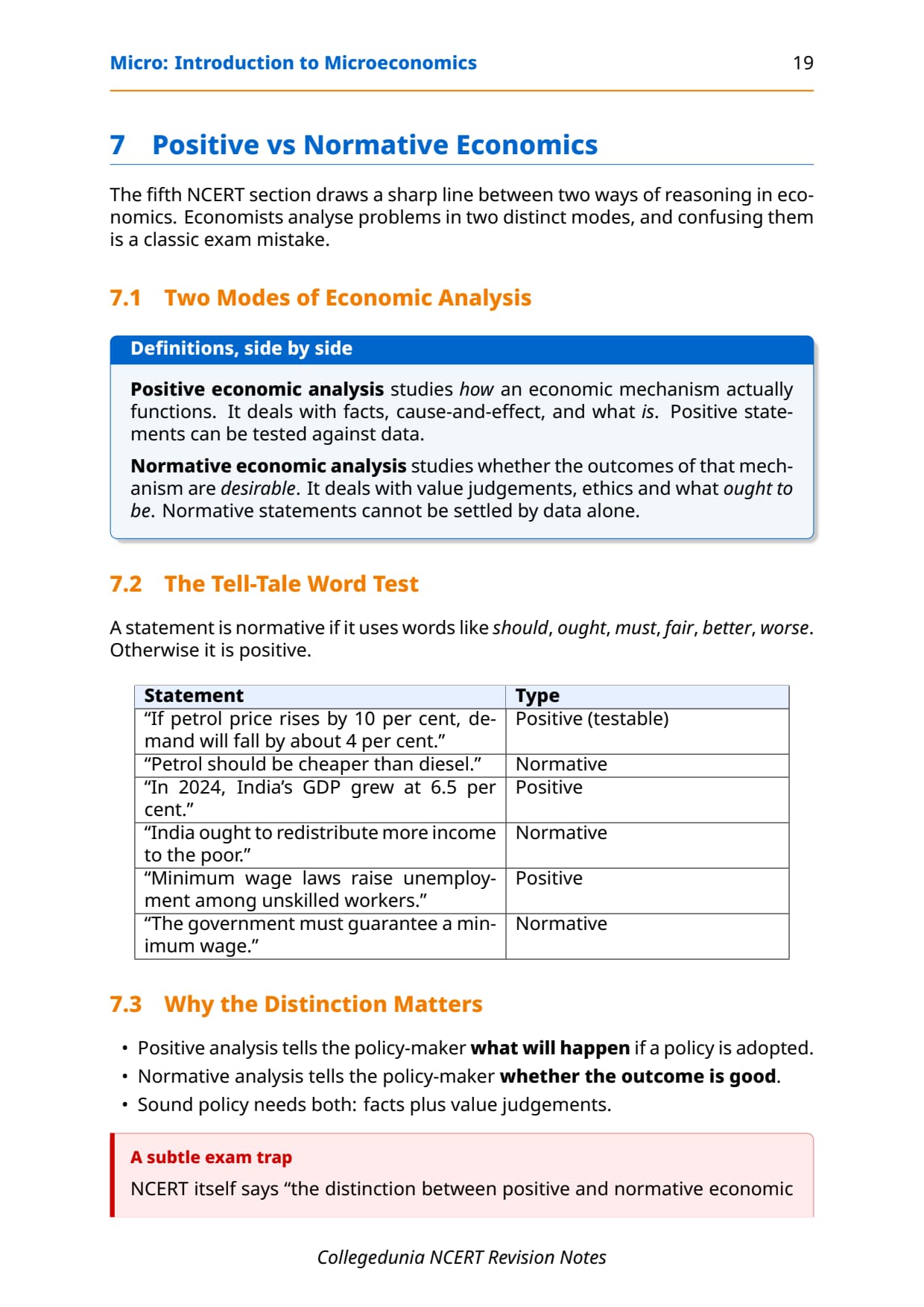
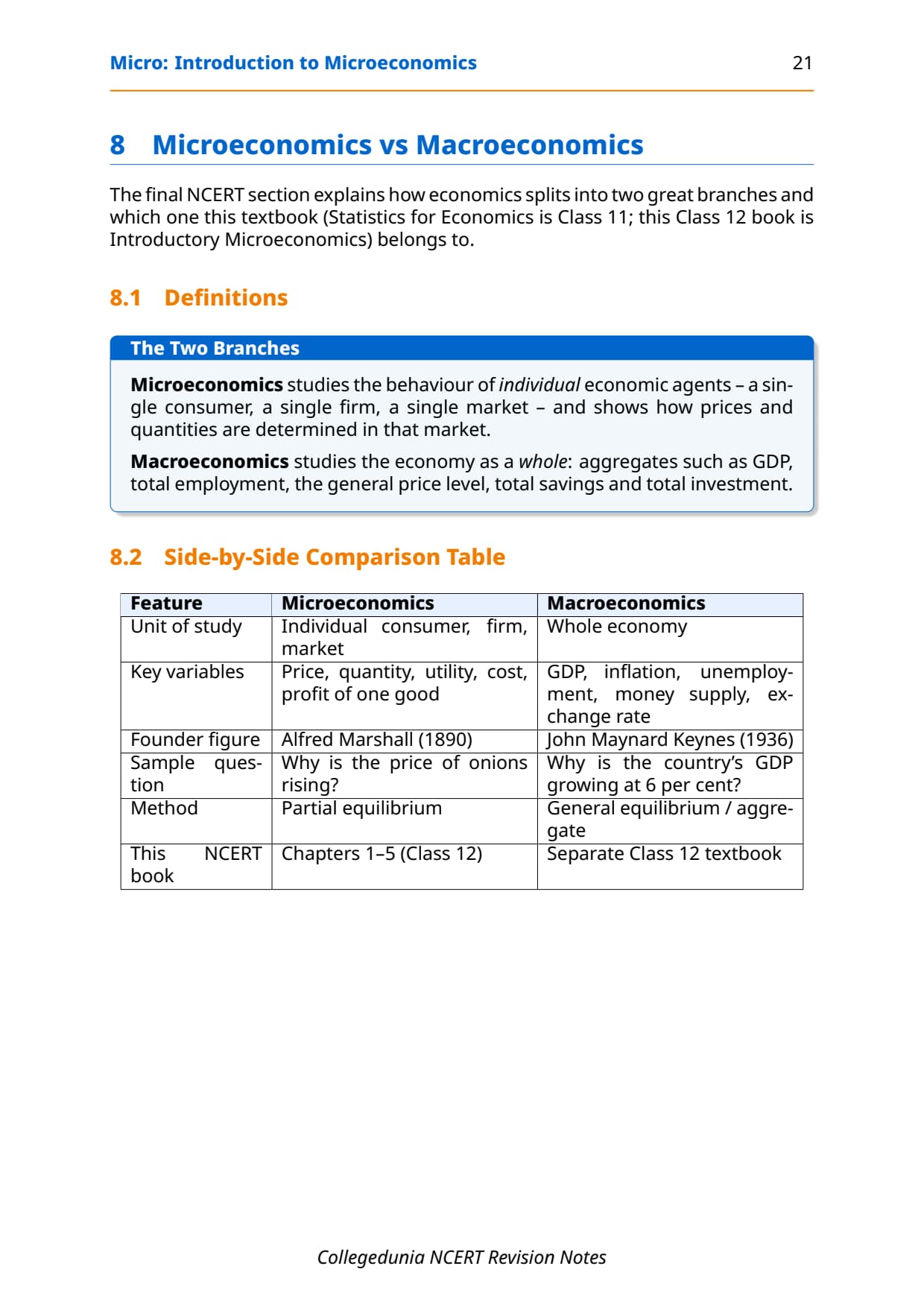
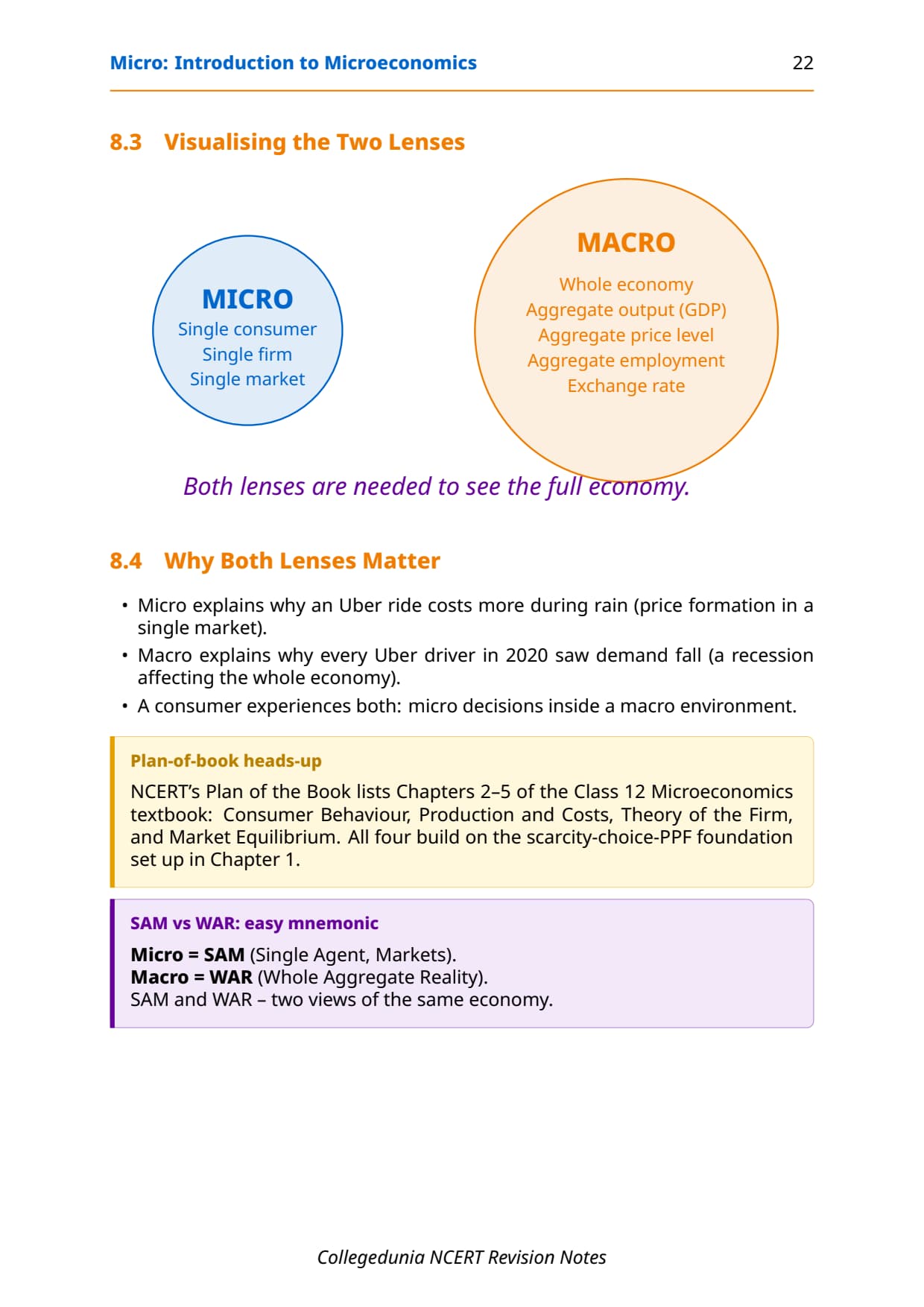
Positive economics is about what is, and can be checked with data. Normative economics is about what should be, and is an opinion. Any "should" or "ought" line is normative. The table below shows micro vs macro.
| Basis | Microeconomics | Macroeconomics |
|---|---|---|
| Studies | One consumer, firm or market. | The whole economy. |
| Main question | How are prices and quantities set? | What sets income, prices and jobs? |
| Topics | Demand, supply, the firm. | National income, money, the budget. |
| Founder | Alfred Marshall. | J. M. Keynes. |
Introduction to Microeconomics Formula and Key Terms Sheet
This is the block to revise in the last 20 minutes before the exam.
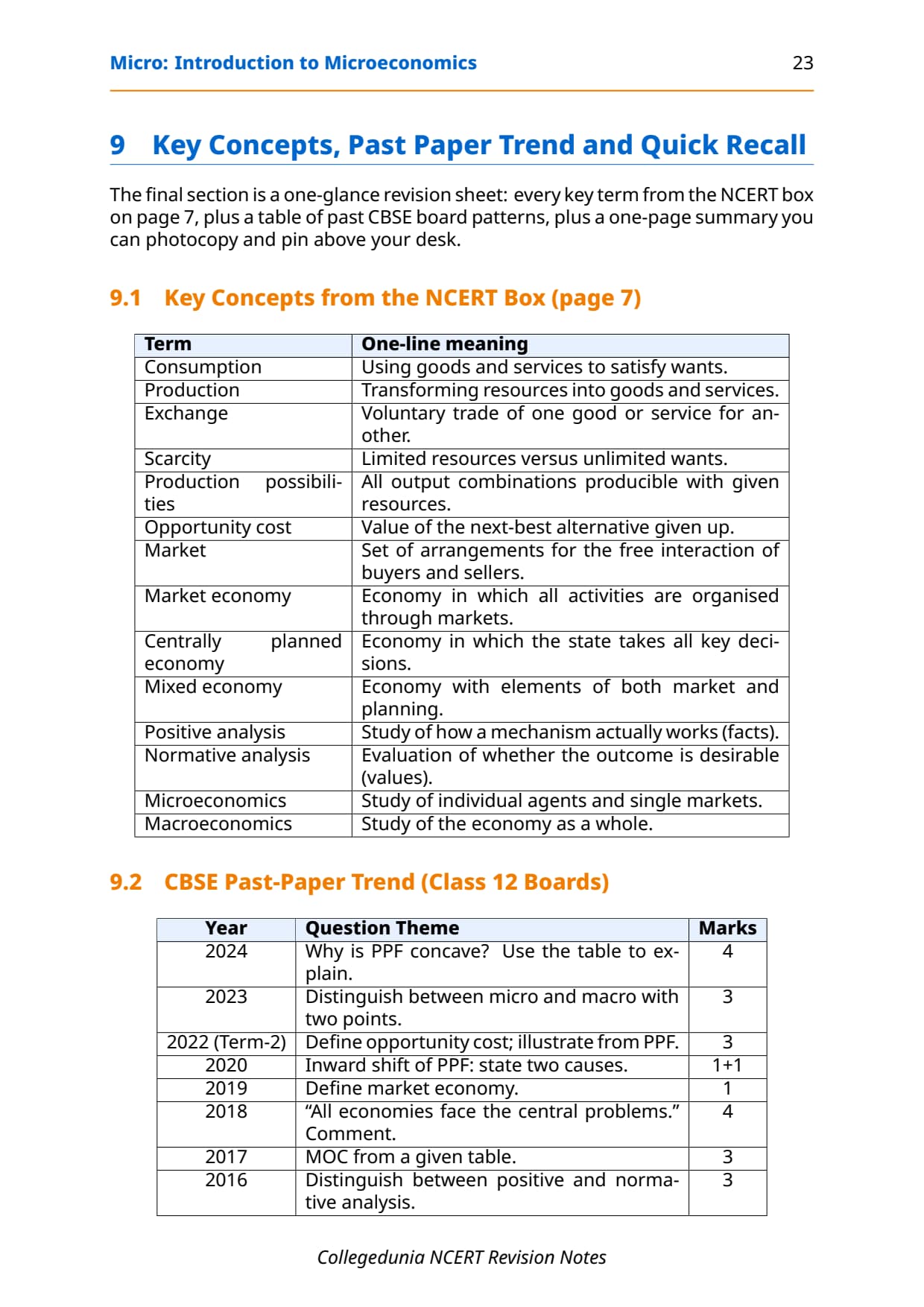
| Term | One-line statement |
|---|---|
| Opportunity cost | The next-best option given up to get something. |
| MRT | Units of Y given up per unit of X; the PPF slope. |
| PPF | The most of two goods an economy can make. |
| Outward shift | Growth from more resources or better technology. |
| Positive vs normative | What is vs what should be. |
Introduction to Microeconomics Class 12 Video Lesson
Source: EB Commerce : Edu Aditya on YouTube
Common Mistakes in Introduction to Microeconomics
- Treating scarcity and shortage as the same thing.
- Drawing a straight PPF when the answer needs a bowed-out one.
- Swapping points inside (possible but wasteful) and outside (not possible) the PPF.
- Reading opportunity cost as money cost instead of the option given up.
- Calling a "should" statement positive instead of normative.
Introduction to Microeconomics Weightage in CBSE and CUET
The chapter has stayed at a steady 6 marks in CBSE. The table maps where its topics show up.
| Year | CBSE question | Marks |
|---|---|---|
| 2025 | Define opportunity cost and read a PPF schedule | 4 |
| 2024 | Micro vs macro, plus positive vs normative | 6 |
| 2023 | State and explain the three central problems | 3 |
| 2022 | Why is the PPF concave | 4 |
Student Feedback
We asked 12,860 Class 12 students about this chapter. 68% found the PPF diagram and opportunity cost the hardest part, and 3 out of 4 said the micro vs macro table was the easiest way to revise it.
Other Resources for Class 12 Economics Chapter 1
Pair these notes with the Solutions, handwritten notes and the official NCERT chapter below.
| Resource | What it covers | Open |
|---|---|---|
| Notes | Concept-first revision of the full chapter. | Chapter 1 Notes |
| NCERT Solutions | Step-by-step answers to every exercise question. | Chapter 1 NCERT Solutions |
| Handwritten Notes | Scanned notebook pages for last-mile revision. | Chapter 1 Handwritten Notes |
| NCERT Book PDF | Official NCERT Microeconomics Chapter 1 textbook. | Chapter 1 NCERT Book PDF |
All Chapters Notes for Class 12 Microeconomics
| Chapter | Notes link |
|---|---|
| Chapter 1 | Introduction to Microeconomics |
| Chapter 2 | Theory of Consumer Behaviour |
| Chapter 3 | Production and Costs |
| Chapter 4 | Theory of the Firm under Perfect Competition |
| Chapter 5 | Market Equilibrium |
Class 12 Economics Chapter 1 Introduction to Microeconomics Notes FAQs
Ques. What are these Class 12 Economics Chapter 1 notes for?
Ans. They are a short revision sheet for NCERT Chapter 1. They cover scarcity, the central problems, the PPF, opportunity cost and the micro vs macro split, with a formula table and common-mistake alerts. Worked answers sit in the matching NCERT Solutions.
Ques. What is the difference between microeconomics and macroeconomics?
Ans. Microeconomics studies one unit, like a consumer, a firm or a single market. Macroeconomics studies the whole economy, like national income, prices and jobs. Both use the same ideas and differ only in scale.
Ques. What is the Production Possibility Frontier?
Ans. The PPF shows the largest amounts of two goods an economy can make when all resources are fully used. It slopes down, is bowed out because costs rise, and shifts out when the economy grows.
Ques. Why is the PPF concave?
Ans. Because resources are not equally good at making both goods. As you make more of one good, you use resources that suit it less, so each extra unit costs more of the other good.
Ques. What is the difference between positive and normative economics?
Ans. Positive economics is about what is and can be checked with data. Normative economics is about what should be and is an opinion. Any line with "should" or "ought" is normative.



Comments