




The Theory of the Firm under Perfect Competition is Chapter 4 of the Class 12 Microeconomics book. It covers the price-taker firm, the TR, AR and MR curves, the MR=MC rule, break-even and shutdown points, and the supply curve. This page has the full revision notes and a free PDF to download.
Here is what this chapter is worth in the exam:
- CBSE Boards: about 9 to 10 marks across theory, one diagram and one numerical.
- CUET: 2 to 3 questions every year on revenue and the MR=MC rule.
- Revision time: about 35 minutes with these notes.
What These Theory of the Firm under Perfect Competition Notes Cover
The chapter is built on one idea: the firm is a price taker. Every result below comes from that. The notes give each topic a short, exam-ready summary:
- Features and price taker (3 marks): why one firm cannot change the market price.
- TR, AR, MR (3 to 4 marks): the P = AR = MR identity.
- MR = MC rule (3 marks): how the firm picks its output.
- Break-even and shutdown (4 marks): when to produce and when to stop.
- Supply curve (6 marks): from the firm's MC to market supply.
Features of Perfect Competition and the Price-Taker Assumption
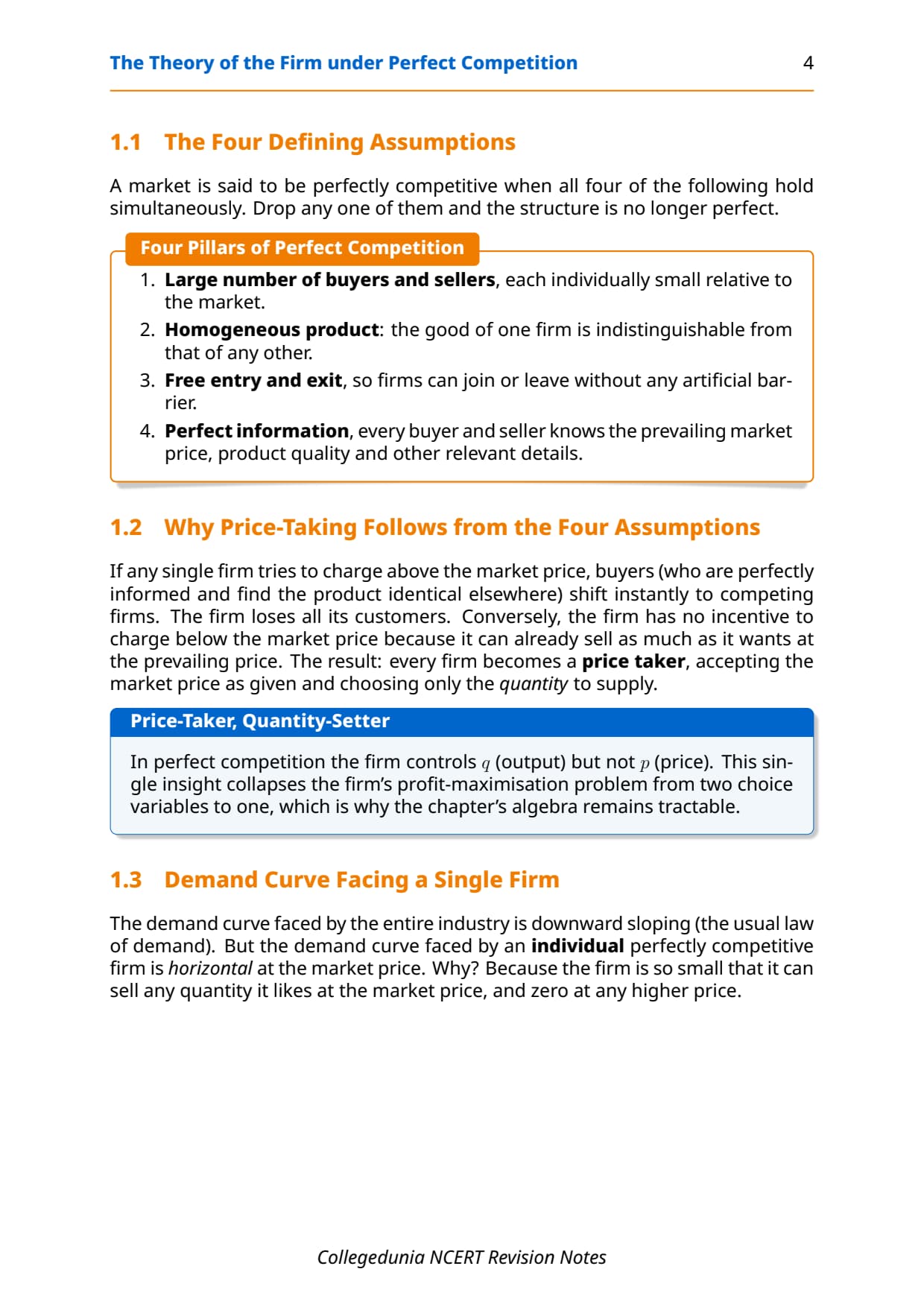
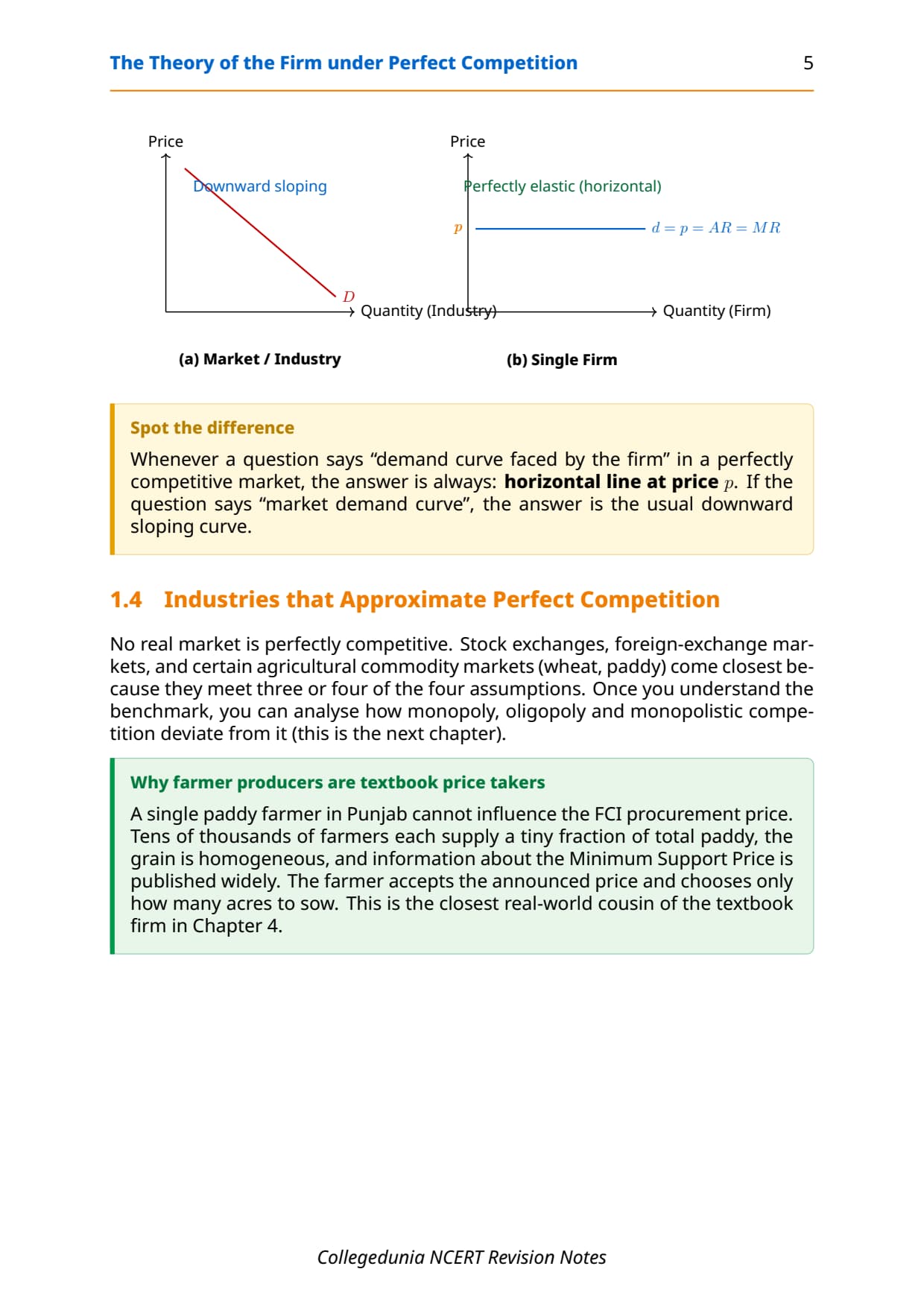
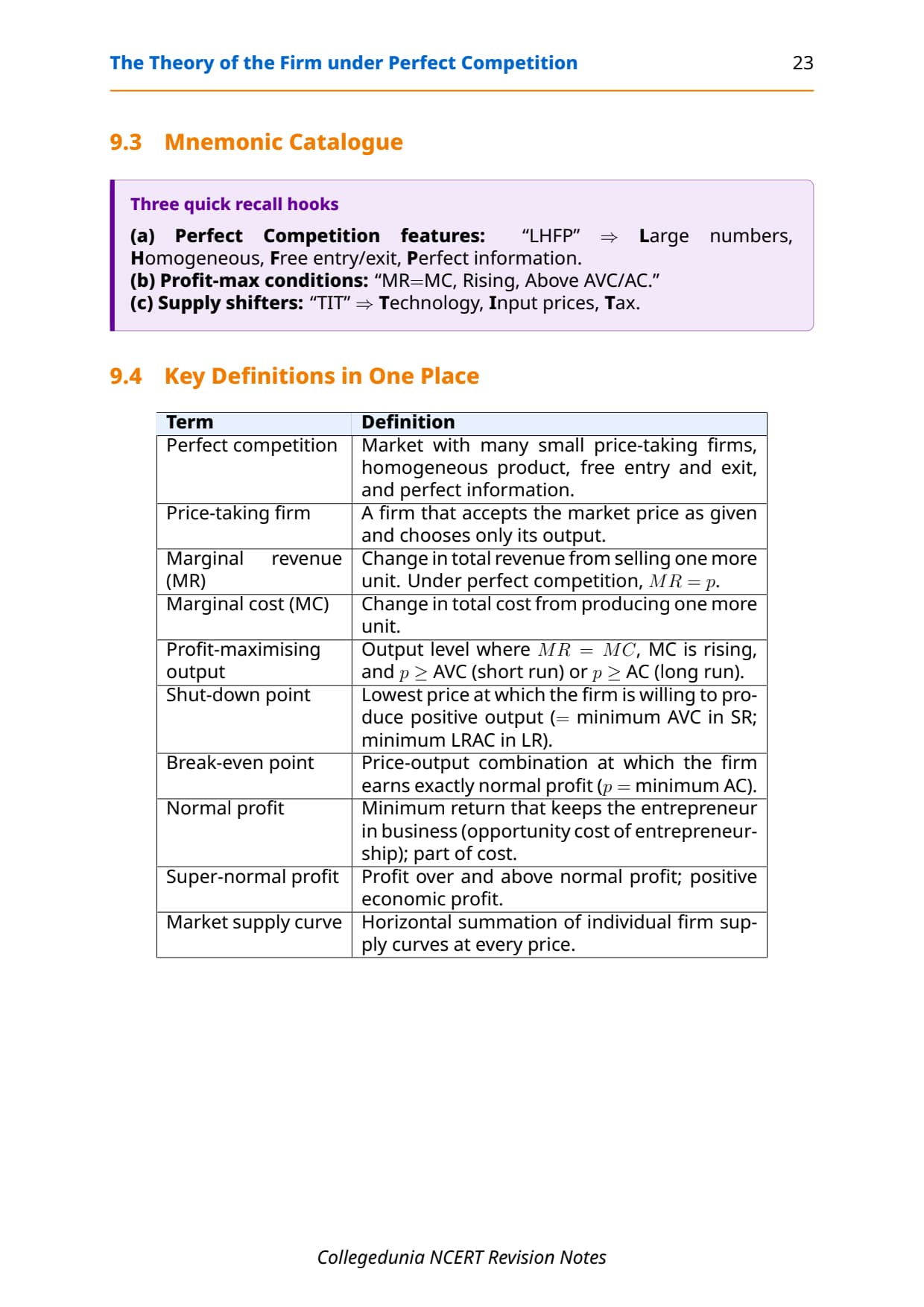
A perfectly competitive market has many small firms selling the same product. No single firm is big enough to move the price. So each firm takes the price as given and only decides how much to produce.
| Feature | What it means |
|---|---|
| Many buyers and sellers | No one has enough share to set the price. |
| Homogeneous product | All firms sell the same good, so buyers do not care who they buy from. |
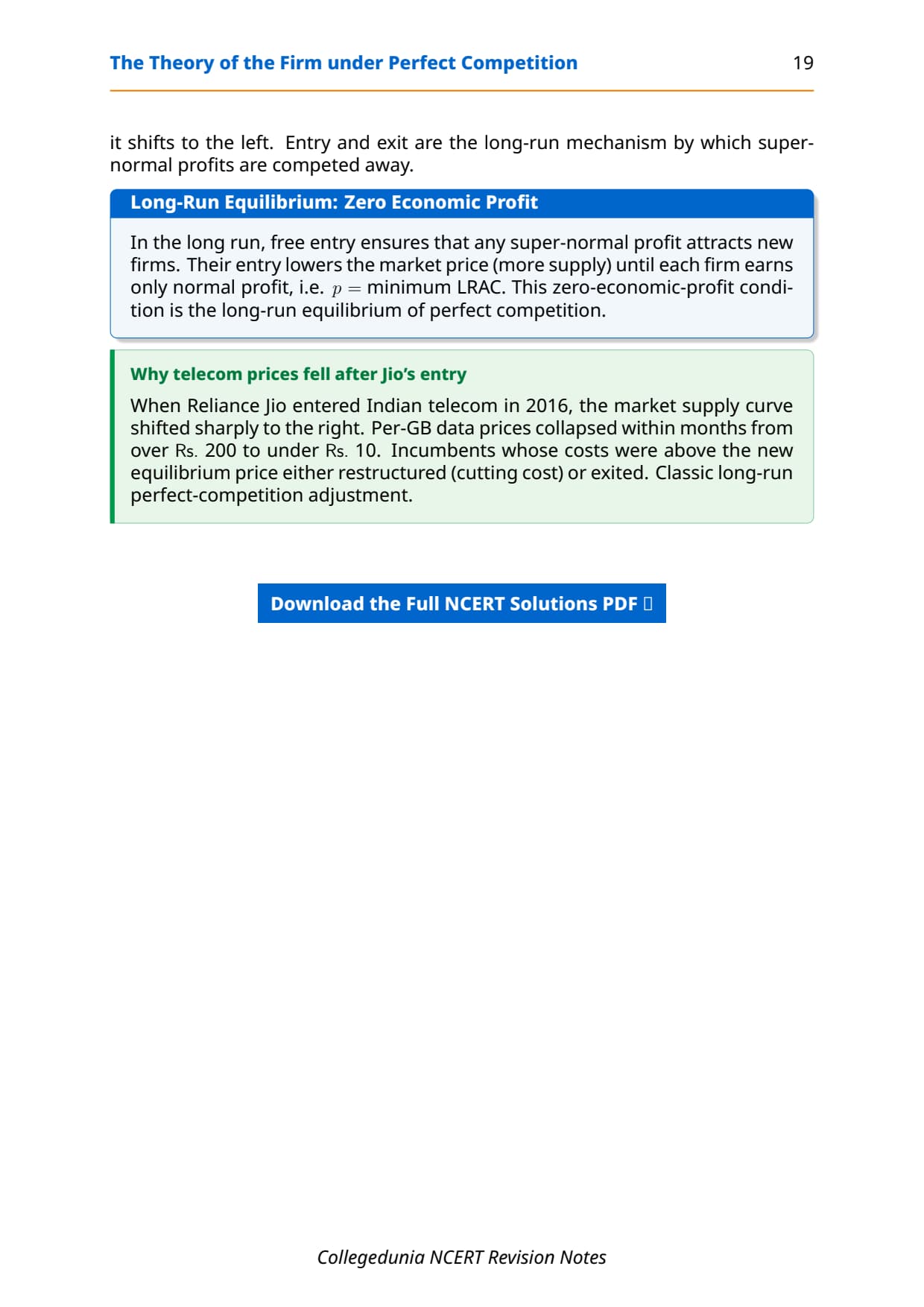
| Free entry and exit | In the long run, profit is competed down to zero. |
| Perfect information | Everyone knows the going market price. |
These features make the firm a price taker. Its demand curve is a flat line at the market price. So d = AR = MR = P for the firm.
Memory hook: the market sets the price, the firm sets the quantity. The firm's demand curve is flat at the market price.
Total, Average and Marginal Revenue under Perfect Competition
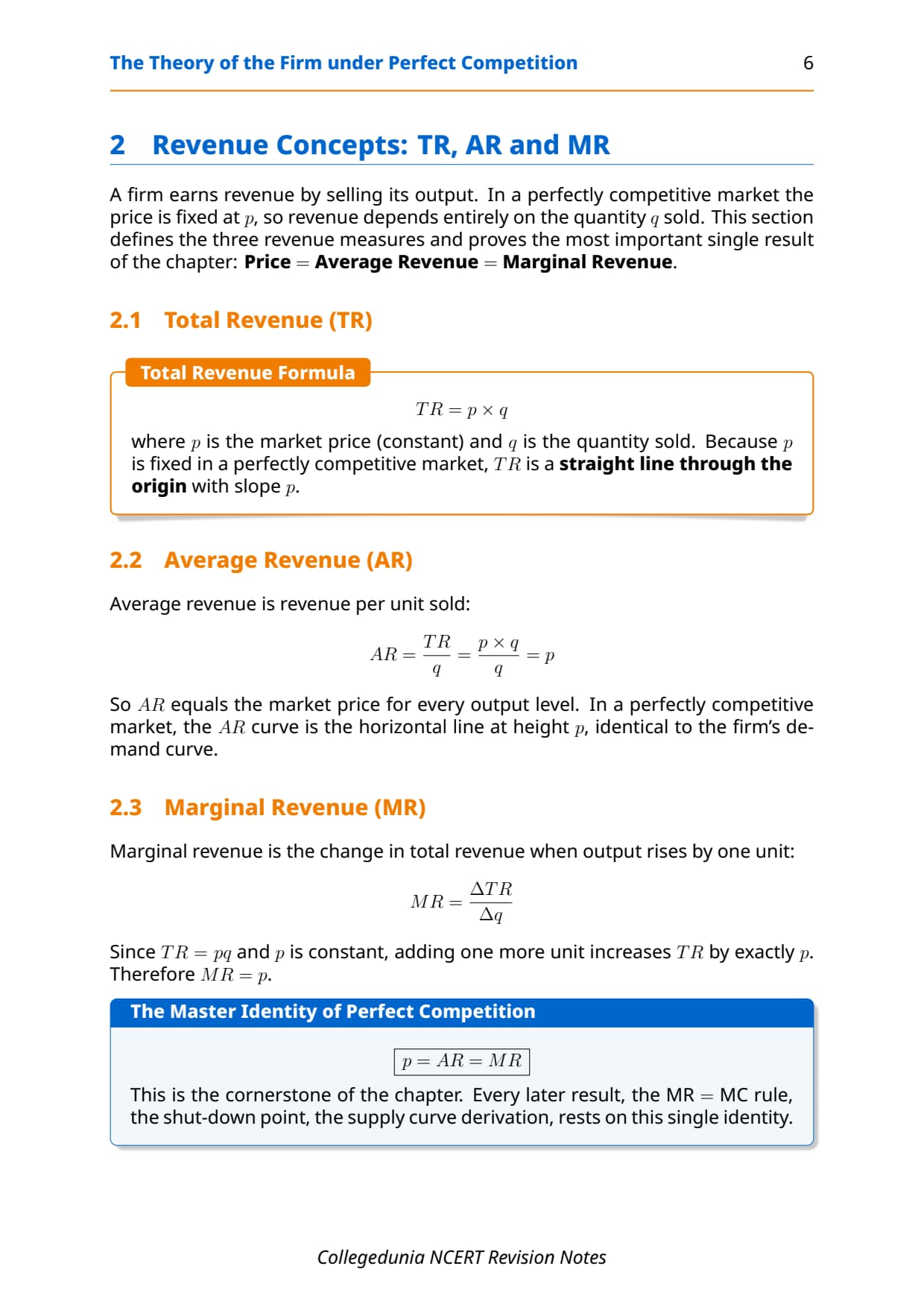
Revenue is simple here because the price never changes for the firm. All three revenue ideas reduce to one number: the price.
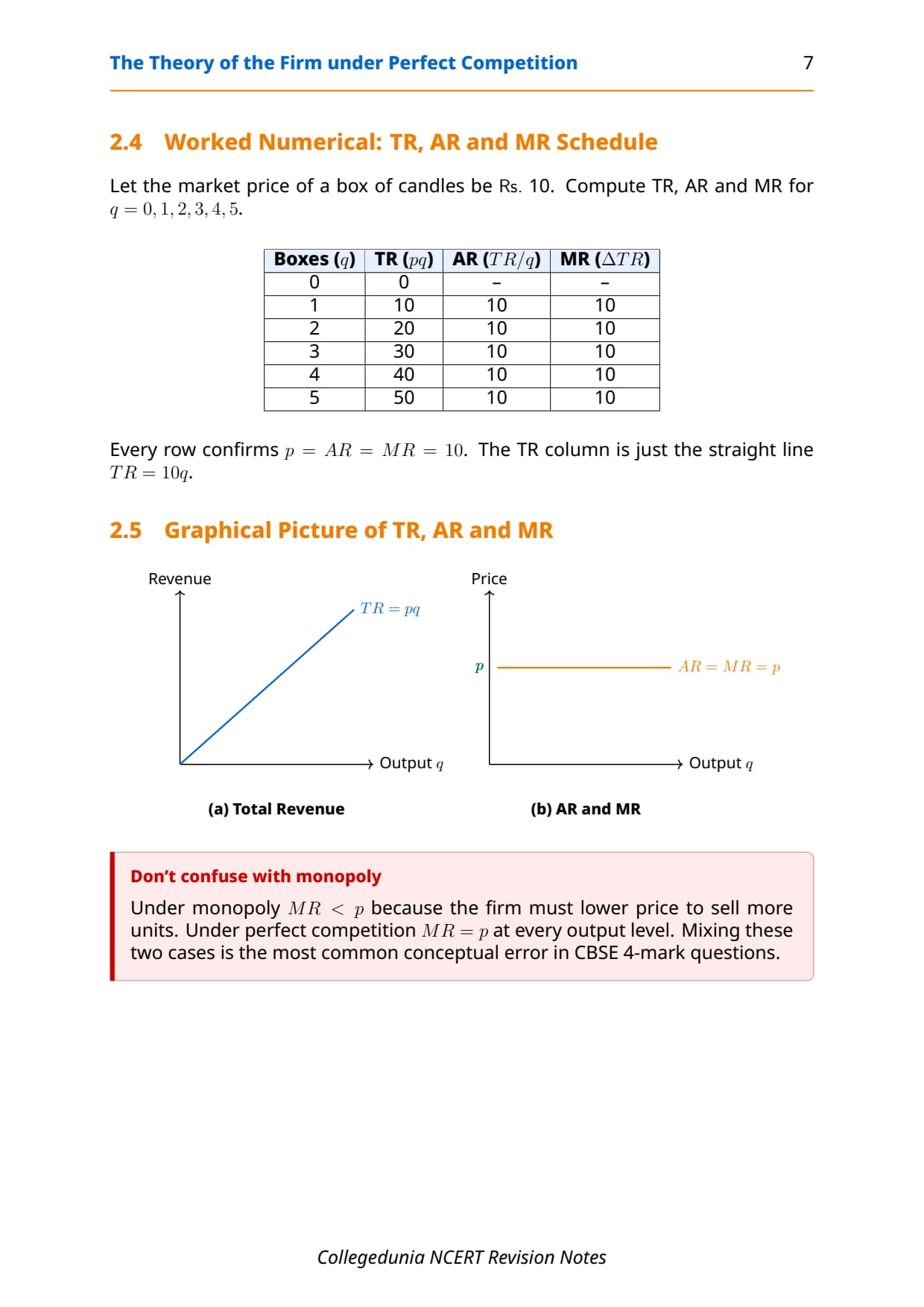
| Concept | Formula | Shape |
|---|---|---|
| Total Revenue (TR) | TR = P times Q | Straight line from the origin, slope P. |
| Average Revenue (AR) | AR = TR / Q = P | Flat line at height P. |
| Marginal Revenue (MR) | MR = change in TR for one more unit = P | Flat line at height P, same as AR. |
So P = AR = MR. This is the most-tested 1-mark idea in the chapter and the base for every numerical.
Profit Maximisation and the MR = MC Rule in Class 12 Economics
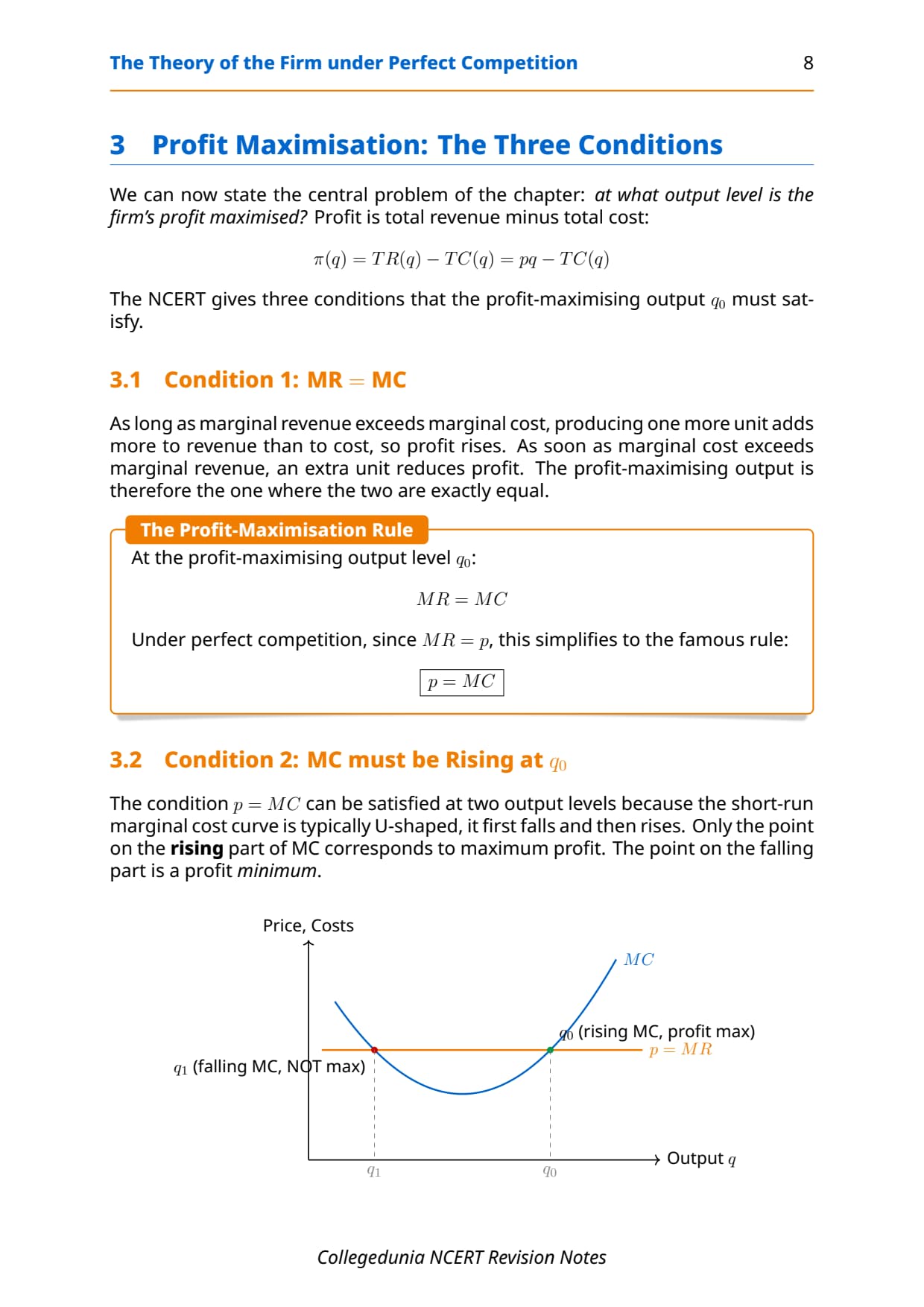
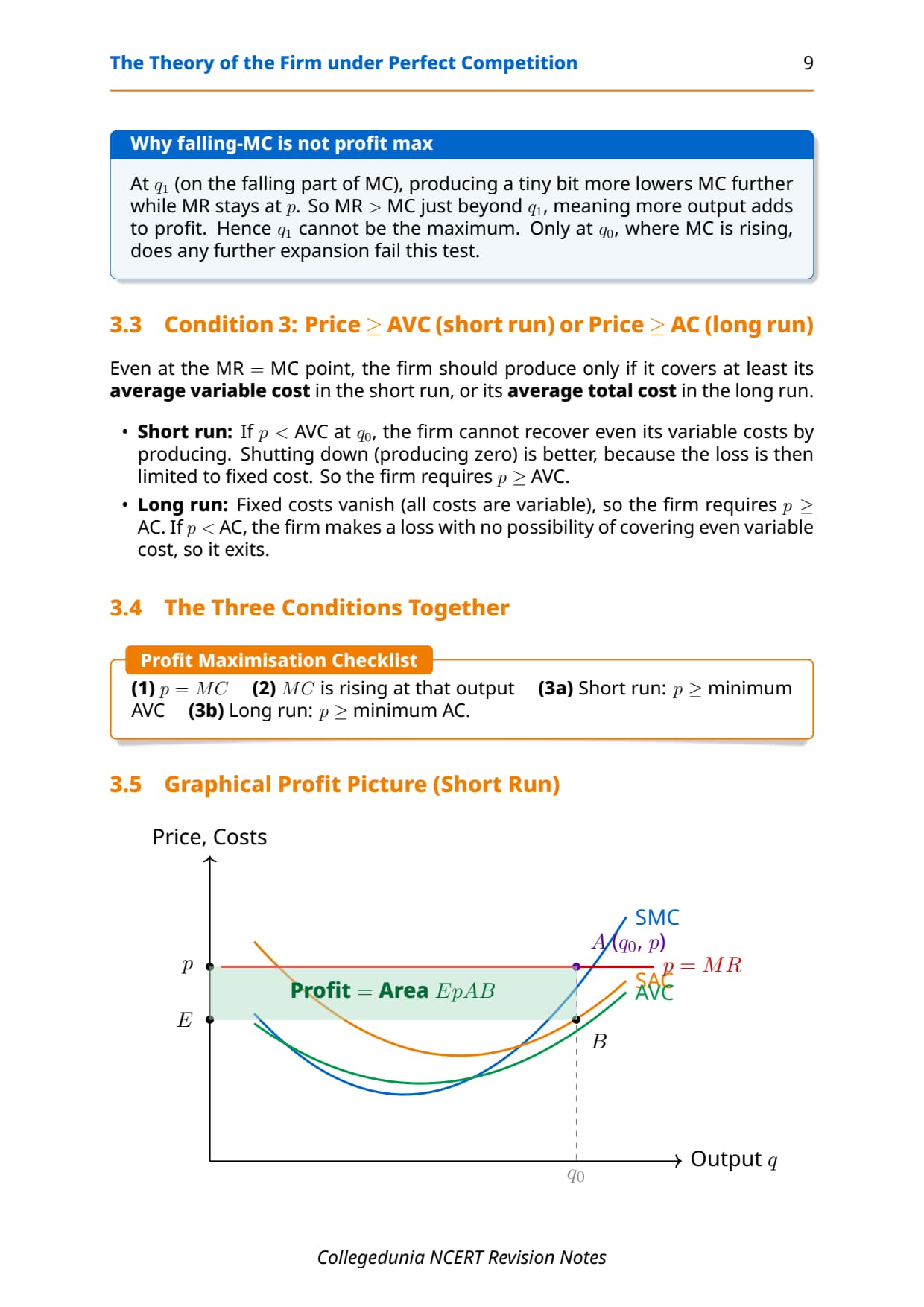
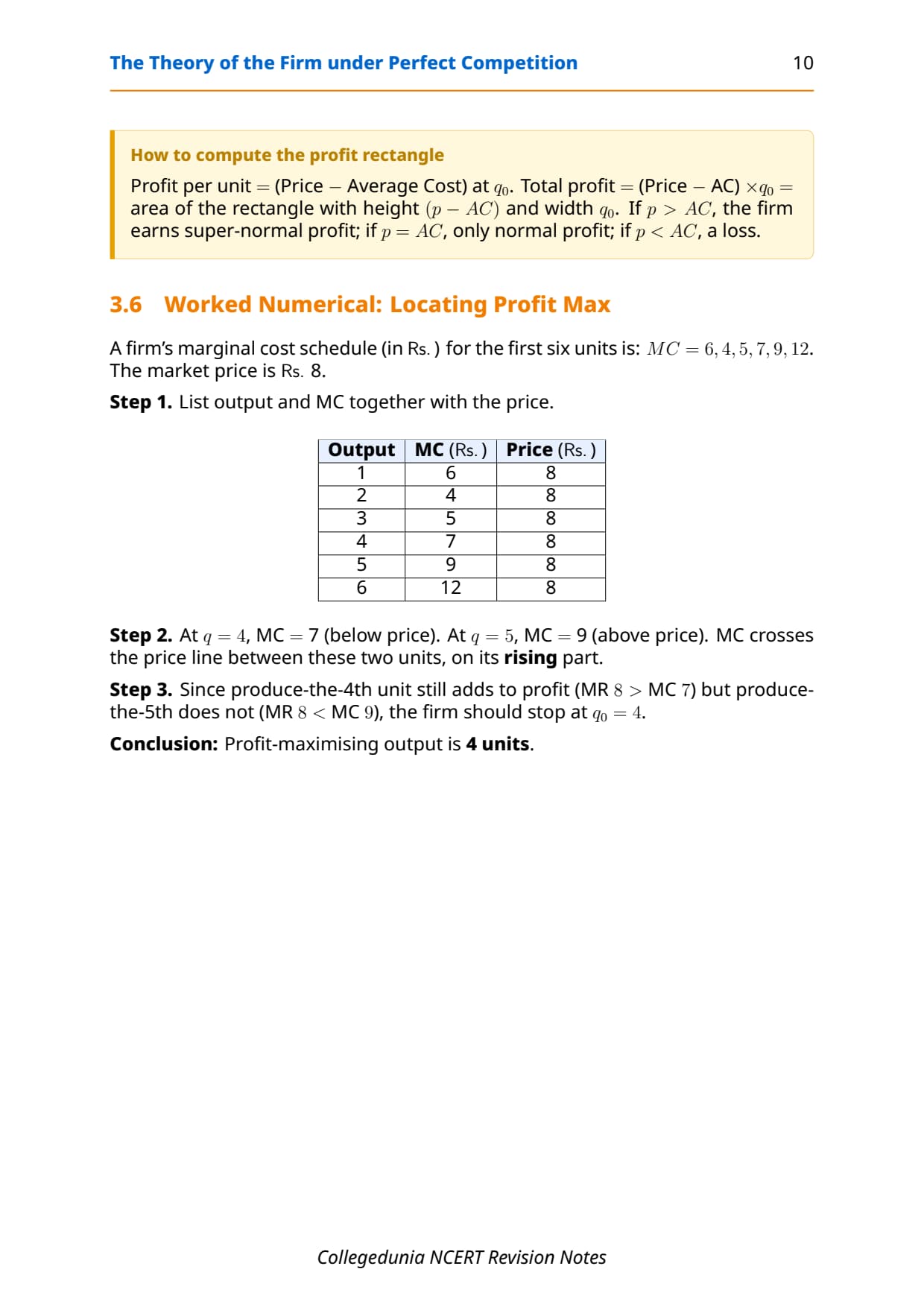
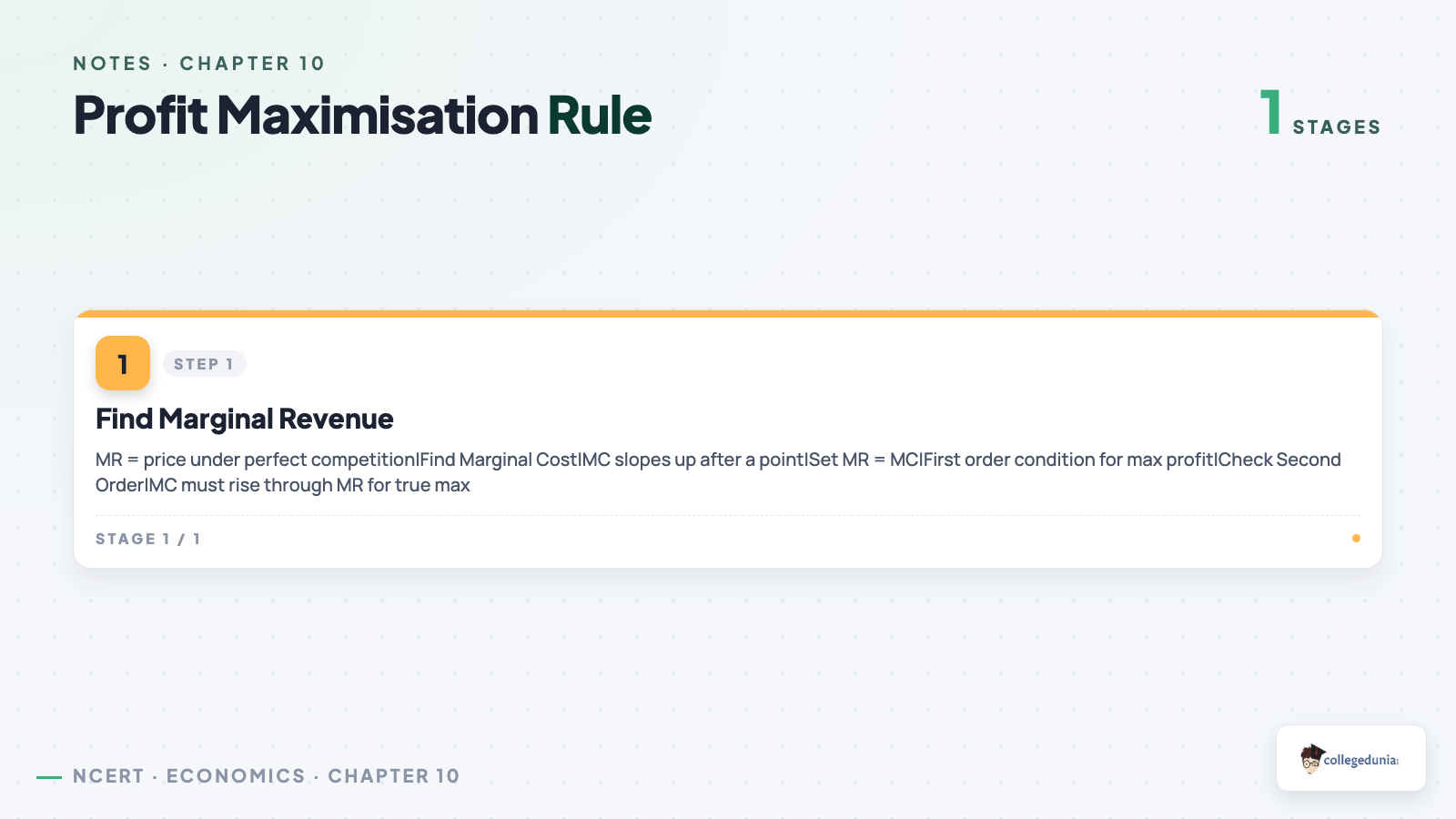
A firm makes the most profit at the output where MR equals MC and MC is rising. For a price taker MR equals P, so the rule becomes P = MC on the rising part of MC.
The logic is short. If MR is more than MC, the next unit adds more money than cost, so make it. If MR is less than MC, the next unit costs more than it earns, so skip it. The best output is where the two are equal. Total profit then equals (P minus AC) times Q.
Worked sums on this sit in the matching NCERT Solutions for Class 12 Economics Chapter 4.
Break-Even Point and Shutdown Point Class 12 Economics
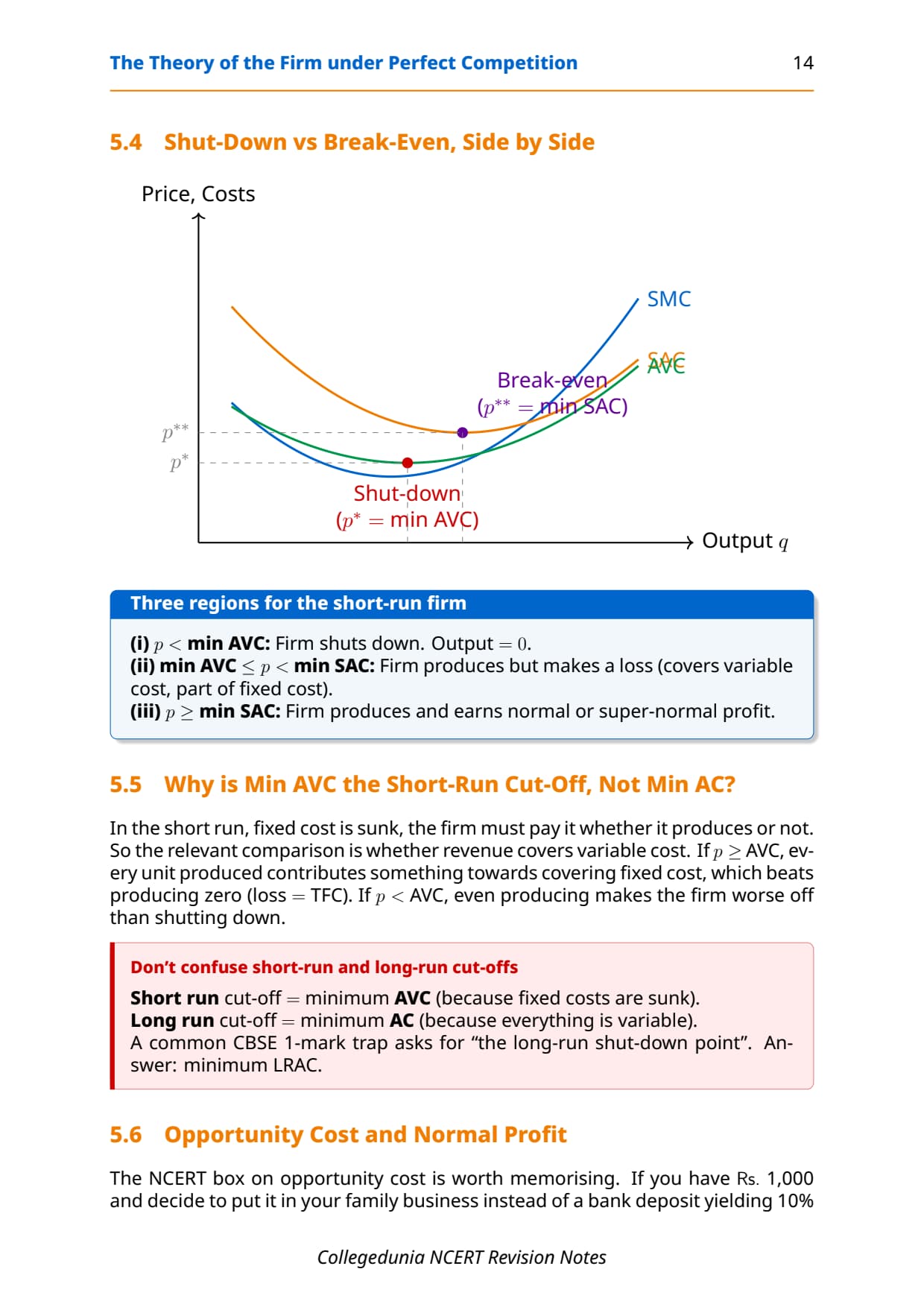
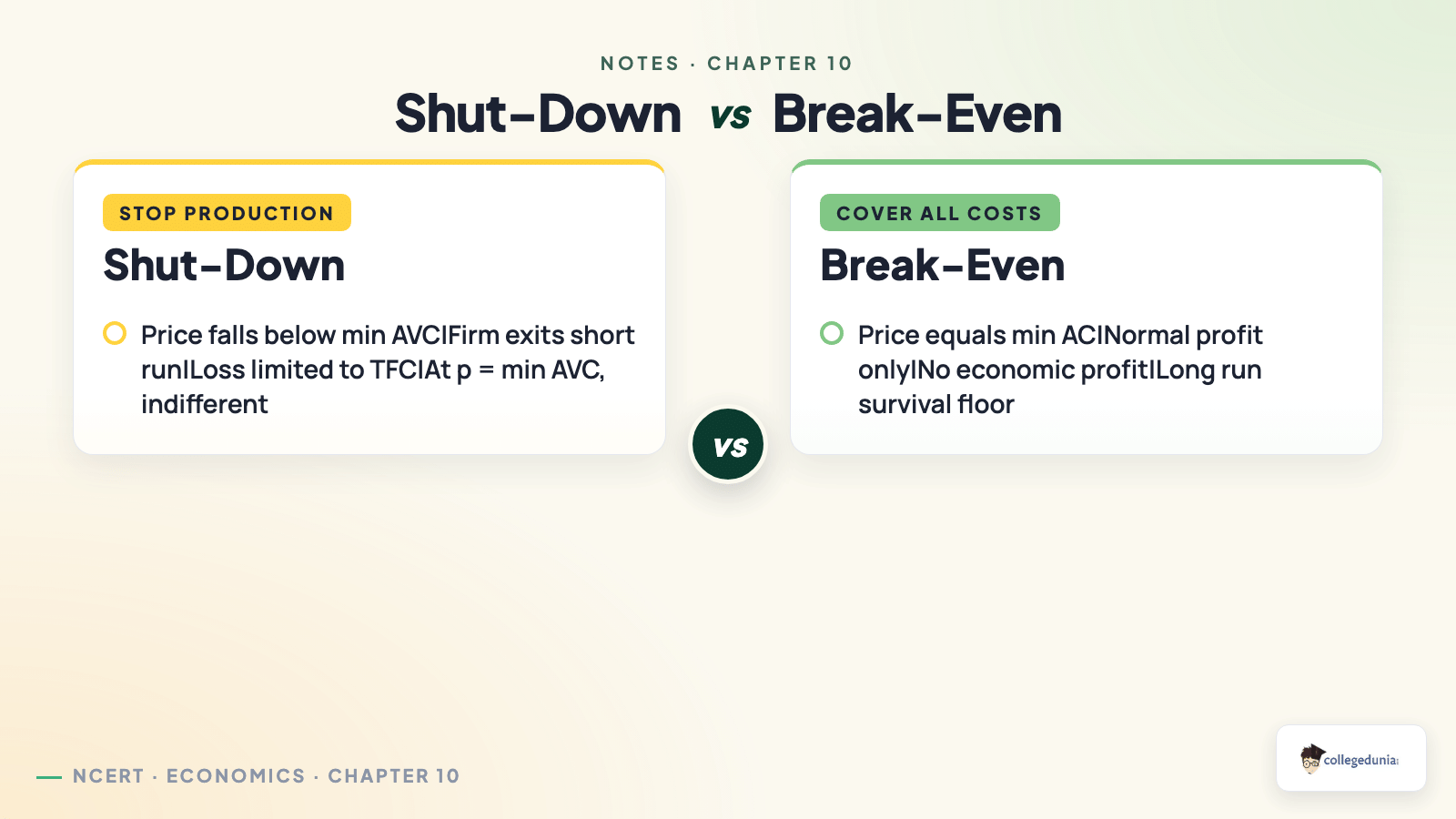
Once P = MC fixes the output, the price tells you whether the firm makes a profit, a loss, or stops. These two points are the most-tested diagram in the board paper.
| Price level | Firm decision | Profit outcome |
|---|---|---|
| P above AC | Produce at P = MC | Profit. |
| P = AC (break-even) | Produce at P = MC | Zero profit. |
| AVC below P below AC | Keep producing | Small loss, less than fixed costs. |
| P = minimum AVC (shutdown) | On the edge of stopping | Loss equal to fixed costs. |
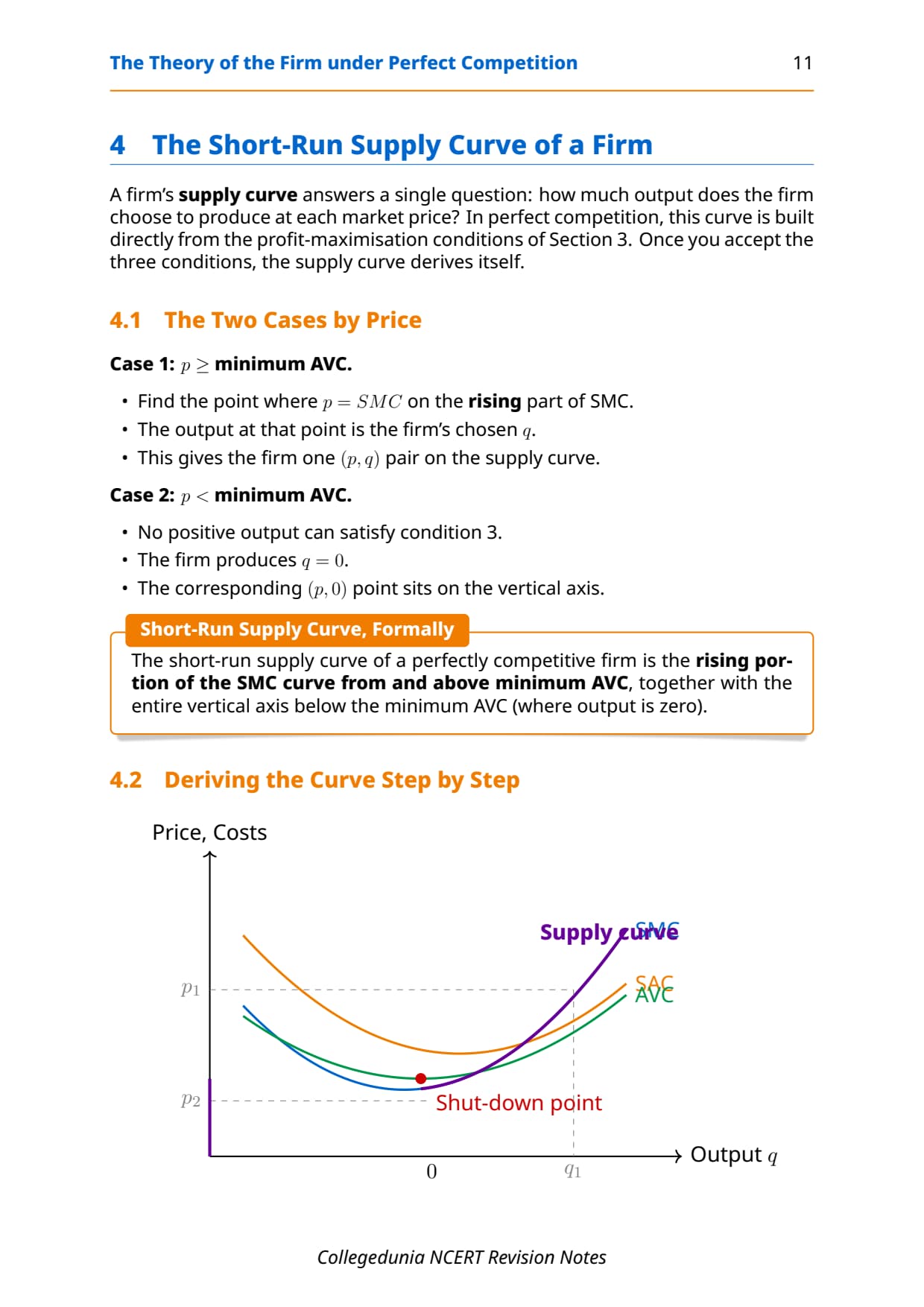
| P below minimum AVC | Shut down, produce zero | Loss equal to fixed costs. |
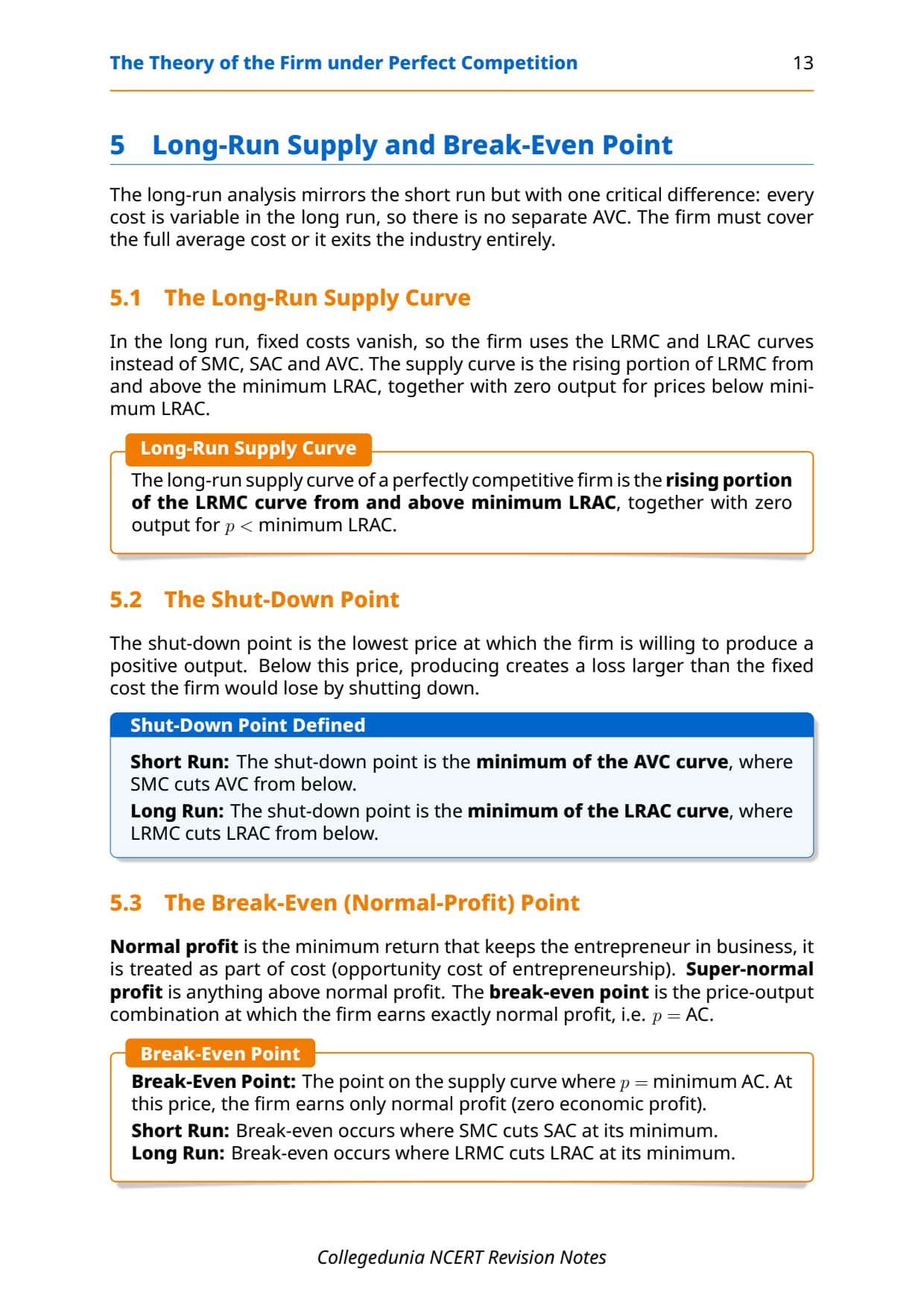
Memory hook: minimum AVC is the short-run shutdown line. Minimum AC is the long-run break-even line. Between them, the firm still produces because stopping is worse.
Firm Supply Curve and Market Supply in Class 12 Economics Chapter 4
Because the firm sets P = MC on the rising part of MC, the rising part of MC is the firm's supply curve. Only the starting point changes between the short run and the long run.
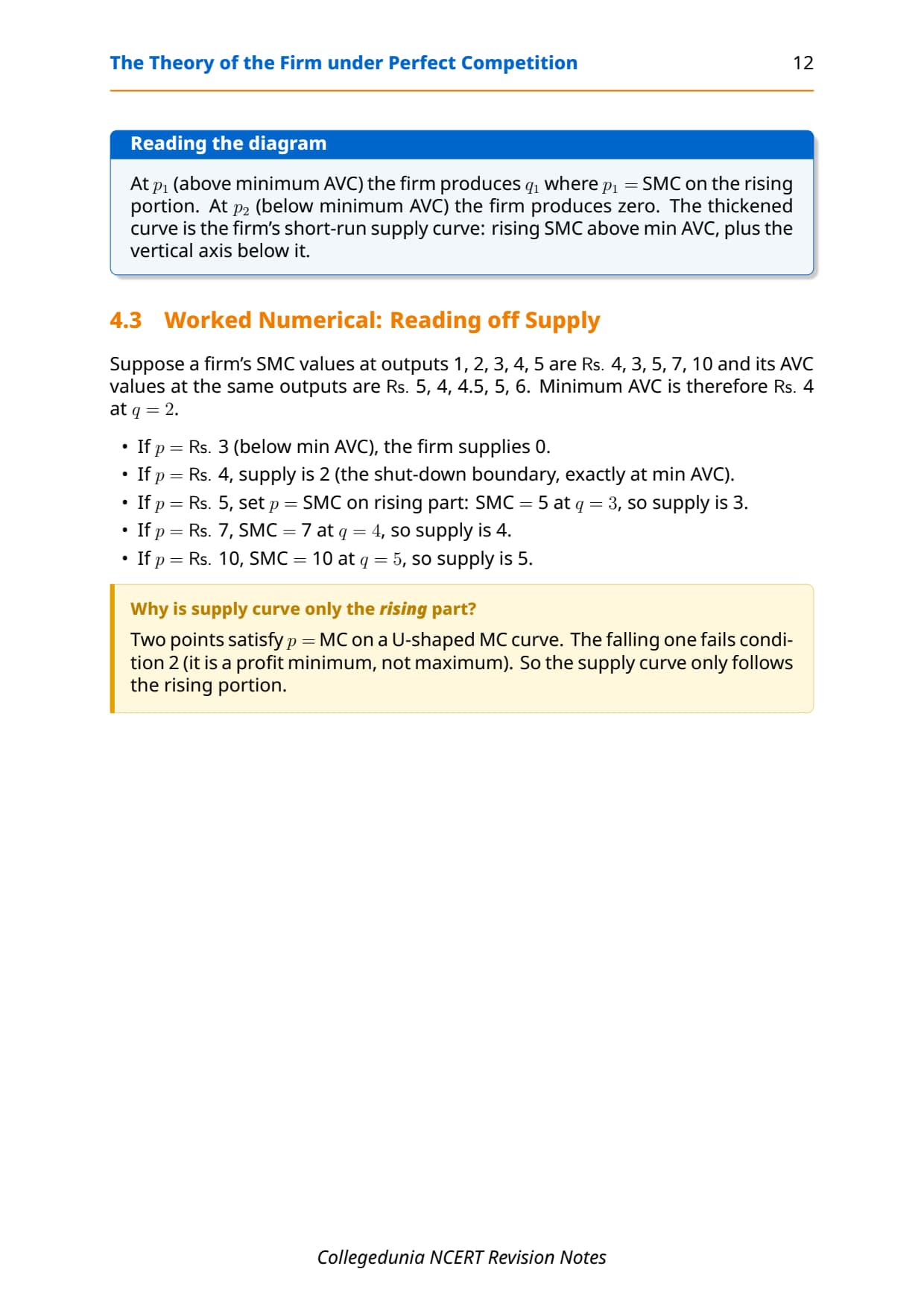
- Short-run firm supply: the MC curve above minimum AVC. Below it, supply is zero.
- Long-run firm supply: the MC curve above minimum AC. Below it, the firm exits.
- Why it slopes up: MC rises due to diminishing returns, so a higher price is needed for more output.
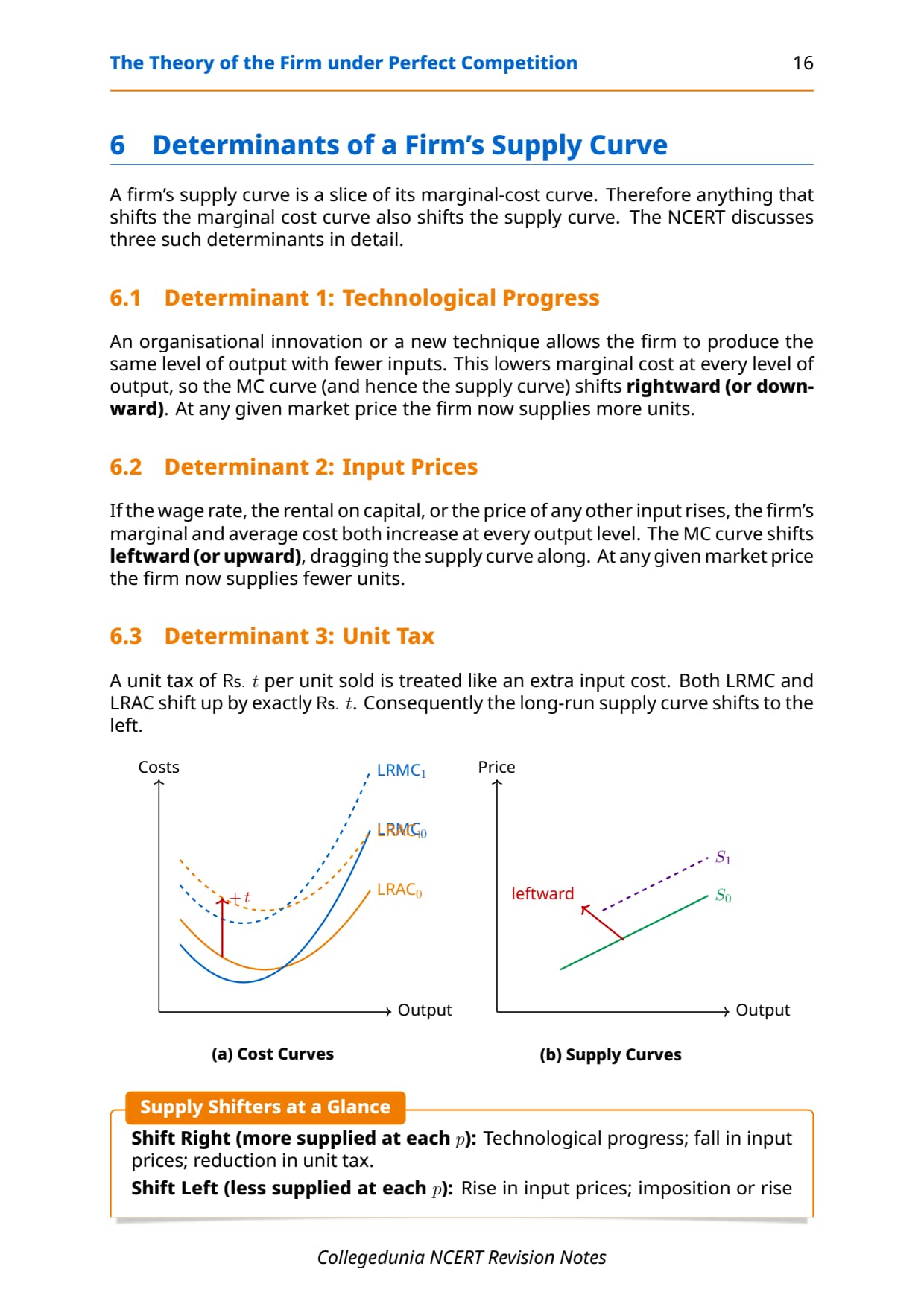
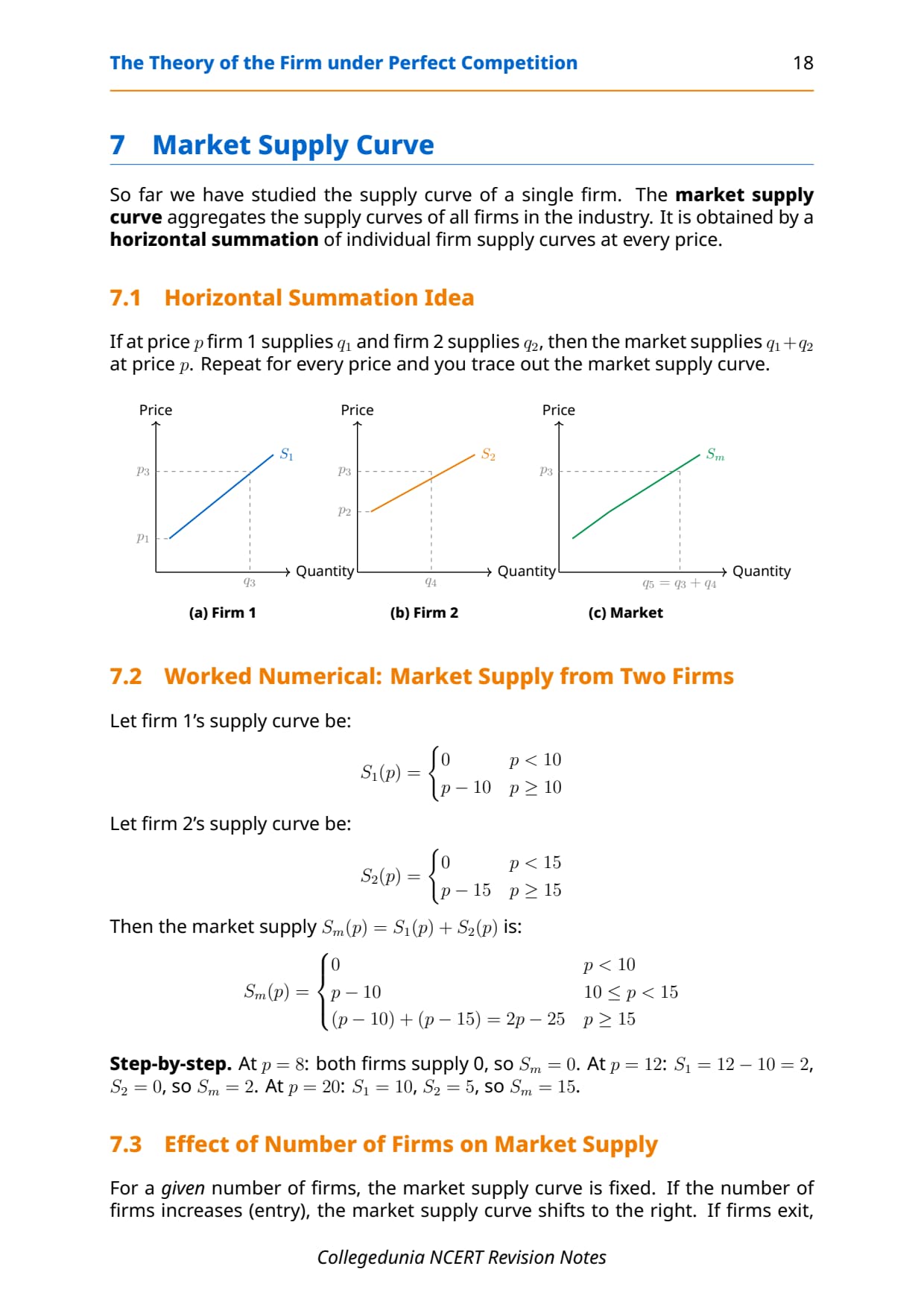
The market supply curve is the horizontal sum of every firm's supply curve. At each price, add up what all firms supply. It shifts right when input prices fall, technology improves, or new firms enter, and left when taxes rise or firms exit.
Price Elasticity of Supply in Class 12 Economics
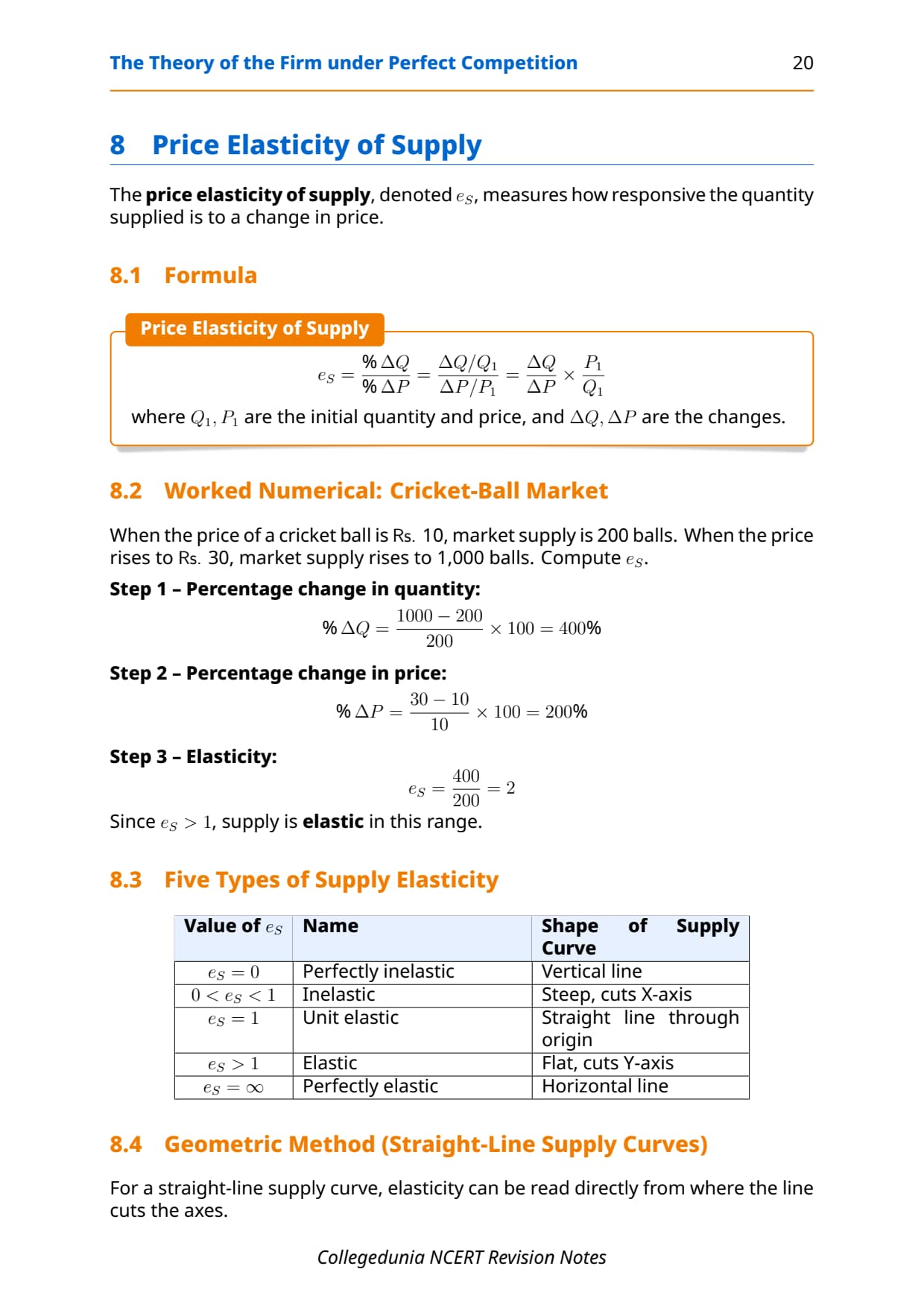
Price elasticity of supply (Es) shows how much quantity supplied reacts to a price change. It is always positive because supply slopes up. CBSE asks a 3 or 4-mark question on it in alternate years.
Es = (percentage change in quantity supplied) / (percentage change in price).
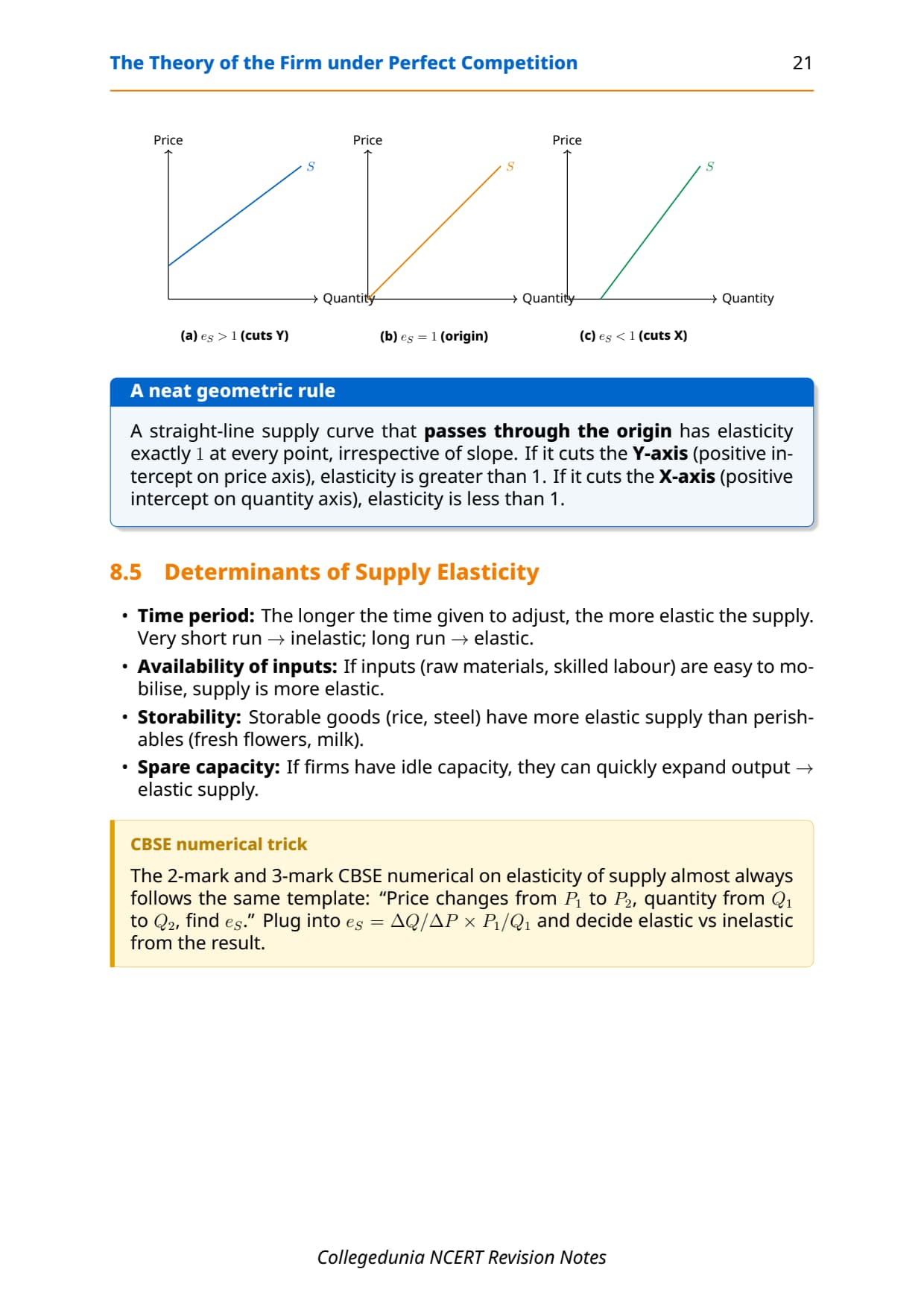
| Supply curve passes through | Elasticity | Type |
|---|---|---|
| Origin (any slope) | Es = 1 | Unit elastic. |
| Price axis (positive intercept) | Es above 1 | Elastic. |
| Quantity axis (positive intercept) | Es below 1 | Inelastic. |
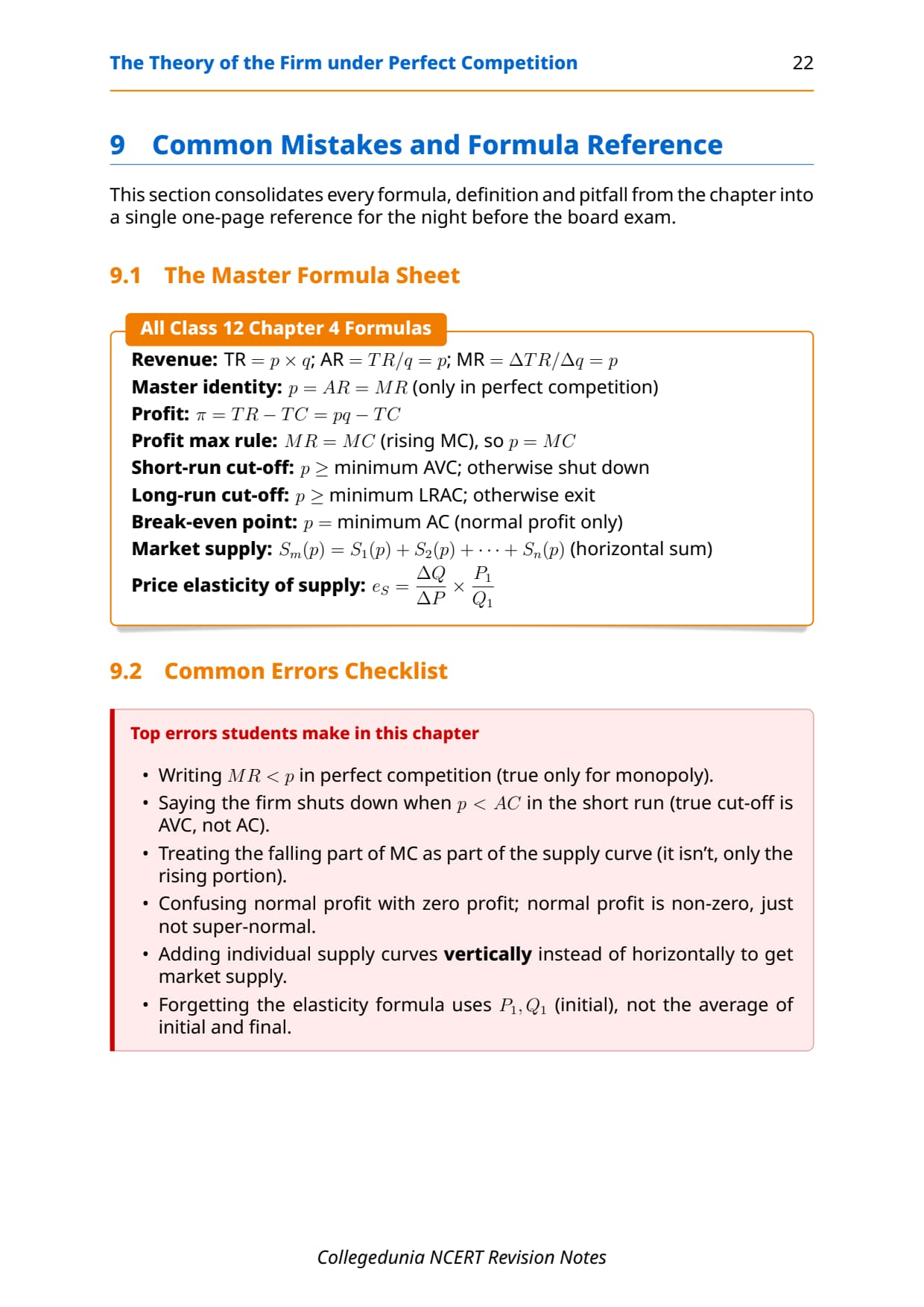
Formula Sheet for Perfect Competition Class 12 Economics Chapter 4
This is the block to revise in the last 20 minutes before the exam.
| Concept | One-line formula |
|---|---|
| Price-taker identity | P = AR = MR |
| Total Revenue | TR = P times Q |
| Profit maximisation | P = MC, with MC rising |
| Total profit | (P minus AC) times Q |
| Break-even | P = AC, zero profit |
| Shutdown (short run) | Produce only if P is at least minimum AVC |
| Firm supply (short run) | MC above minimum AVC |
| Market supply | Horizontal sum of all firm supply curves |
Theory of the Firm Class 12 Video Lesson
Source: Humanities with Poonam on YouTube
Common Mistakes in Theory of the Firm under Perfect Competition
- Drawing AR and MR as two separate curves; under perfect competition they are one flat line.
- Forgetting the "MC rising" part of the MR = MC rule.
- Mixing up break-even (P = AC) with shutdown (P = minimum AVC).
- Saying the whole MC curve is the supply curve, not just the rising part.
- Putting a negative sign on price elasticity of supply.
Perfect Competition Class 12 Weightage in CBSE and CUET
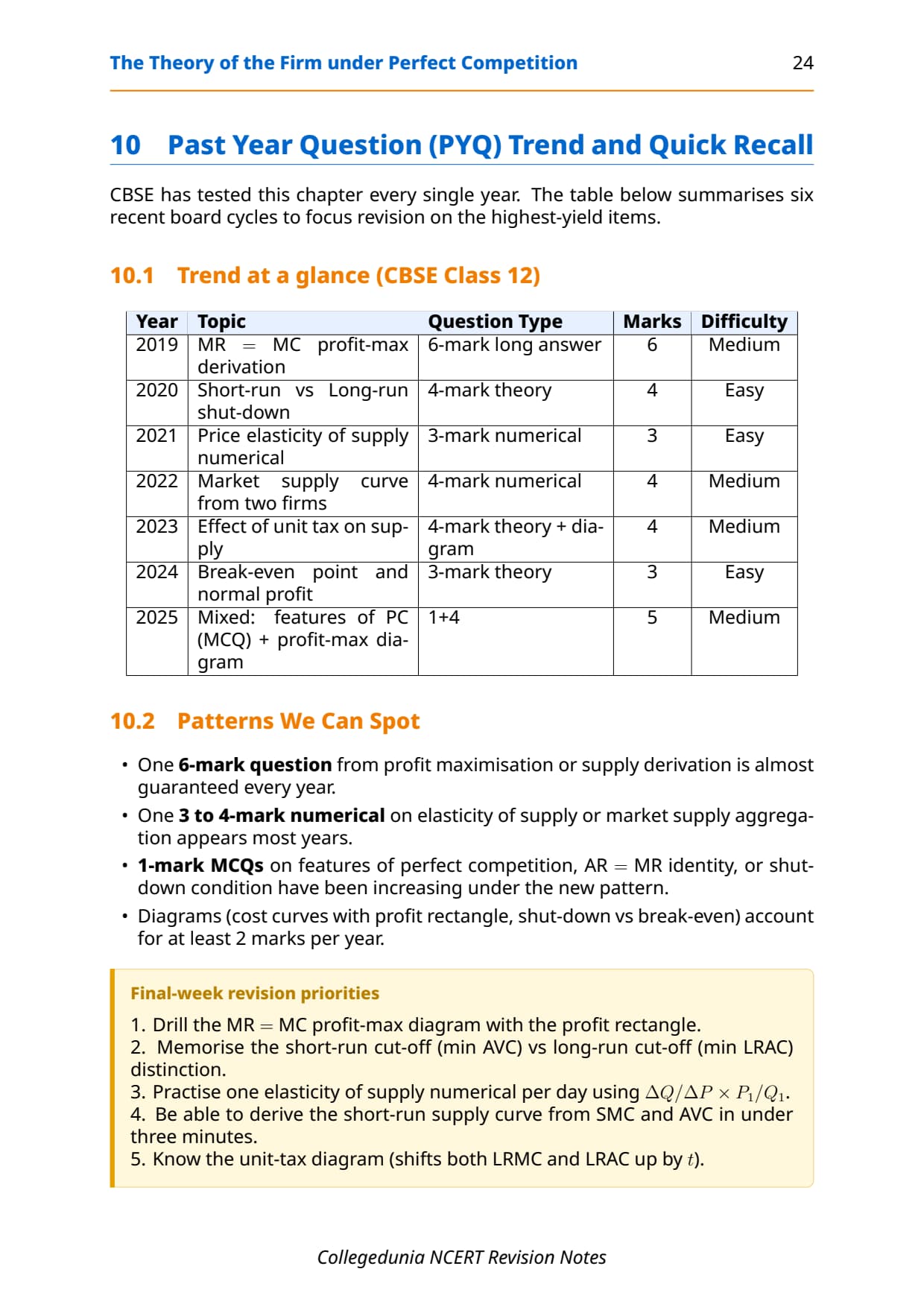
The chapter stays at a steady 9 to 10 marks in CBSE. The table maps recent board questions.
| Year | CBSE question | Marks |
|---|---|---|
| 2025 | Derive the short-run firm supply curve with a diagram | 6 |
| 2024 | Four features of perfect competition, plus a TR-AR-MR sum | 3 + 4 |
| 2023 | Distinguish break-even point from shutdown point | 4 |
| 2022 | MR = MC rule, plus an elasticity-of-supply sum | 3 + 4 |
Student Feedback
We asked 12,180 Class 12 students about this chapter. 74% found the jump from the TR-AR-MR curves to the MR=MC rule the hardest part, and 3 out of 4 said the break-even and shutdown table was the easiest way to revise it. Most finished the full notes in about 34 minutes.
Other Resources for Class 12 Economics Chapter 4
Pair these notes with the Solutions, handwritten notes and the official NCERT chapter below.
| Resource | What it covers | Open |
|---|---|---|
| Notes | Concept-first revision of the full chapter. | Chapter 4 Notes |
| NCERT Solutions | Step-by-step answers to every exercise question. | Chapter 4 NCERT Solutions |
| Handwritten Notes | Scanned notebook pages for last-mile revision. | Chapter 4 Handwritten Notes |
| NCERT Book PDF | Official NCERT Microeconomics Chapter 4 textbook. | Chapter 4 NCERT Book PDF |
All Chapters Notes for Class 12 Microeconomics
| Chapter | Notes link |
|---|---|
| Chapter 1 | Introduction to Microeconomics |
| Chapter 2 | Theory of Consumer Behaviour |
| Chapter 3 | Production and Costs |
| Chapter 4 | The Theory of the Firm under Perfect Competition |
| Chapter 5 | Market Equilibrium |
Class 12 Economics Chapter 4 The Theory of the Firm under Perfect Competition Notes FAQs
Ques. What are these Class 12 Economics Chapter 4 notes for?
Ans. They are a short revision sheet for NCERT Chapter 4. They cover the features of perfect competition, the price-taker firm, the TR-AR-MR identity, the MR=MC rule, break-even and shutdown points, and the supply curve, with a formula table and common-mistake alerts. Worked sums sit in the matching NCERT Solutions.
Ques. Why does a perfectly competitive firm face a horizontal demand curve?
Ans. Because it is a price taker. The market sets the price and one small firm cannot change it. If it charges more, buyers switch to identical rivals. If it charges less, there is no need, since it can sell all it makes at the market price. So demand is flat at P, and d = AR = MR = P.
Ques. What is the MR = MC profit maximisation rule?
Ans. A firm makes the most profit at the output where MR equals MC and MC is rising. Under perfect competition MR equals price, so the rule becomes P = MC. If MR is above MC, the next unit adds profit. If MR is below MC, it cuts profit. The best output is where the two meet.
Ques. What is the difference between the break-even point and the shutdown point?
Ans. The break-even point is where price equals average cost (P = AC), so profit is zero. The shutdown point is the short-run output where price equals minimum average variable cost (P = minimum AVC). Below the shutdown price the firm produces nothing. Between the two, the firm keeps producing at a small loss.
Ques. How is the firm supply curve derived under perfect competition?
Ans. The firm sets P = MC on the rising part of MC, so that rising part is the supply curve. In the short run it is MC above minimum AVC, with zero supply below. In the long run it is MC above minimum AC, and the firm exits below that. The curve slopes up because MC slopes up.



Comments