




Indigo extracts appear in 1 to 2 CUET English MCQ sets every year and CBSE Class 12 has carried an Indigo long-answer in 5 of the last 6 sessions. Class 12 English Chapter 5 Flamingo Prose: Indigo is therefore a high-yield revision chapter. This page hosts the indigo class 12 notes PDF, sub-topic weightage, and the 2025 question pattern.
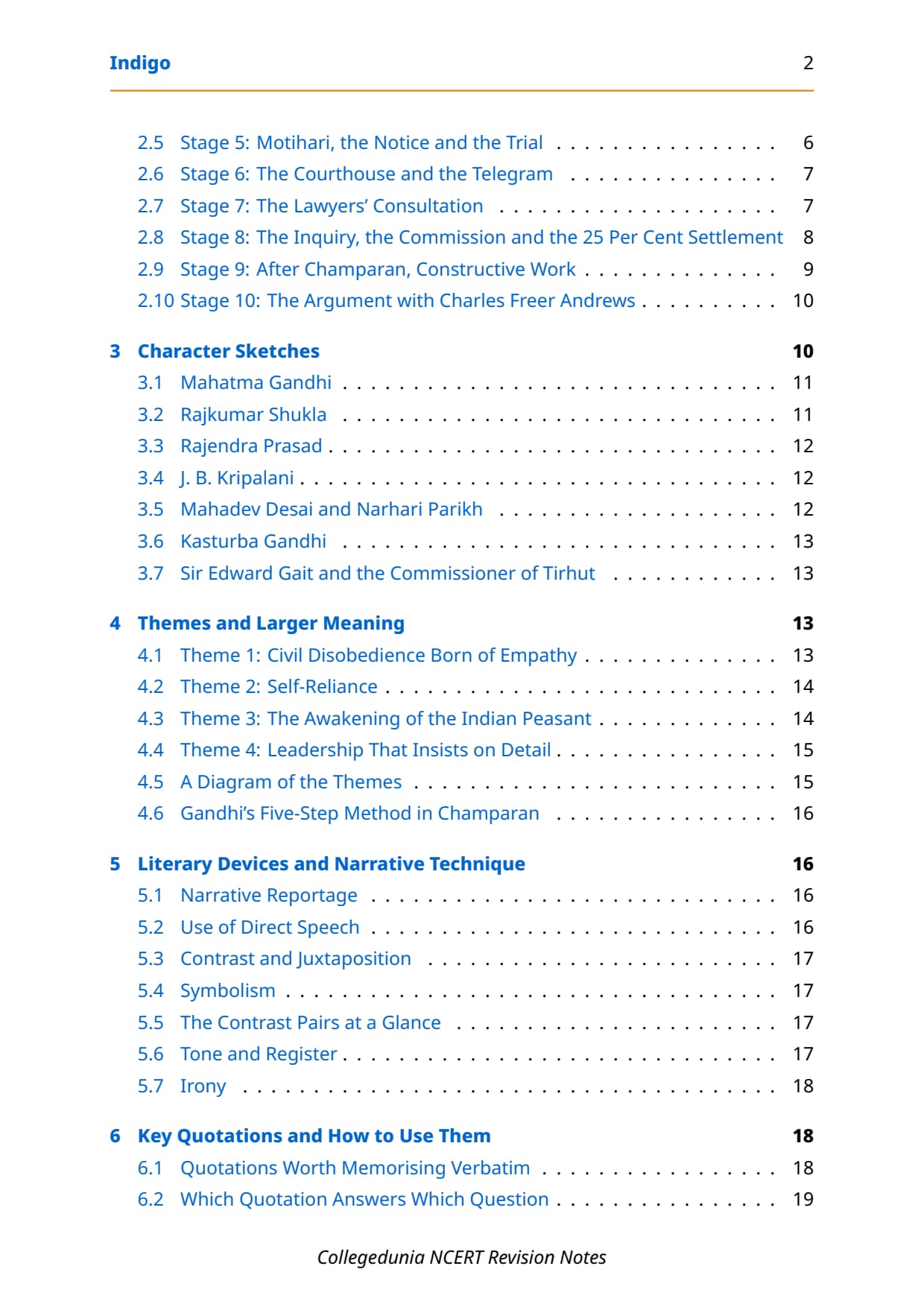
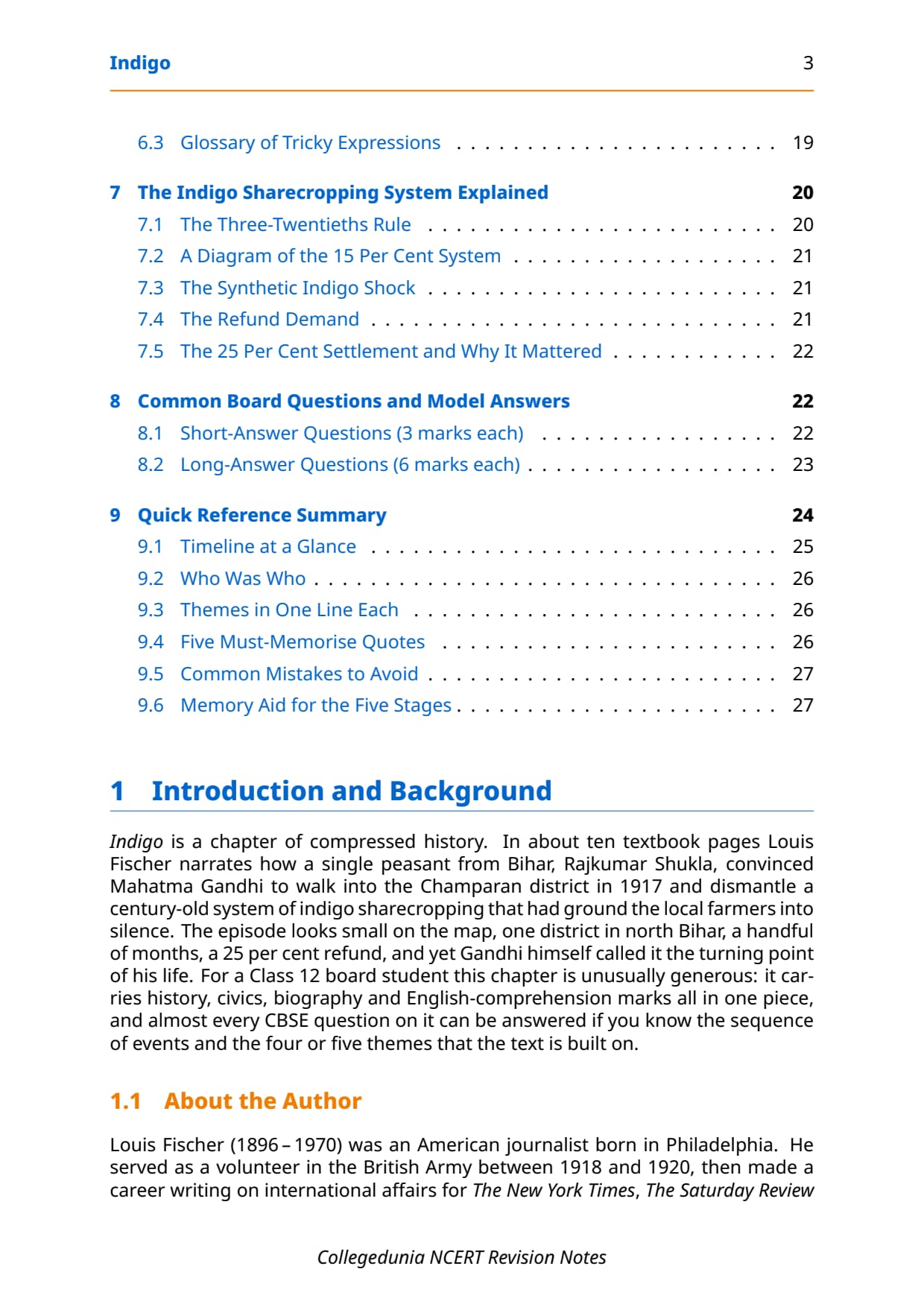
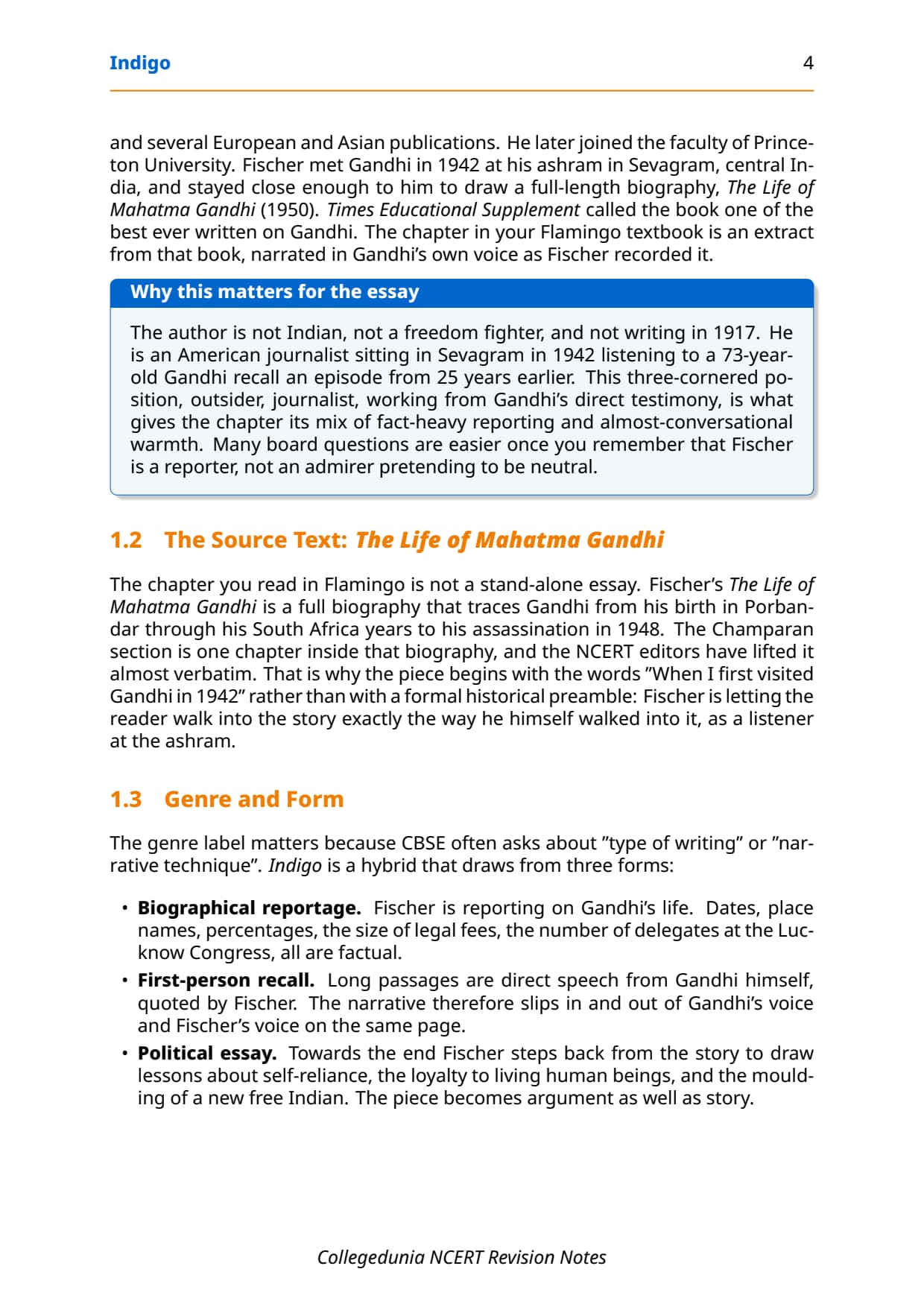
- CBSE Weightage: 8 to 10 marks (one long answer plus one short answer in most years)
- CUET Weightage: 1 to 2 passage-based MCQ stems per year built around Indigo extracts
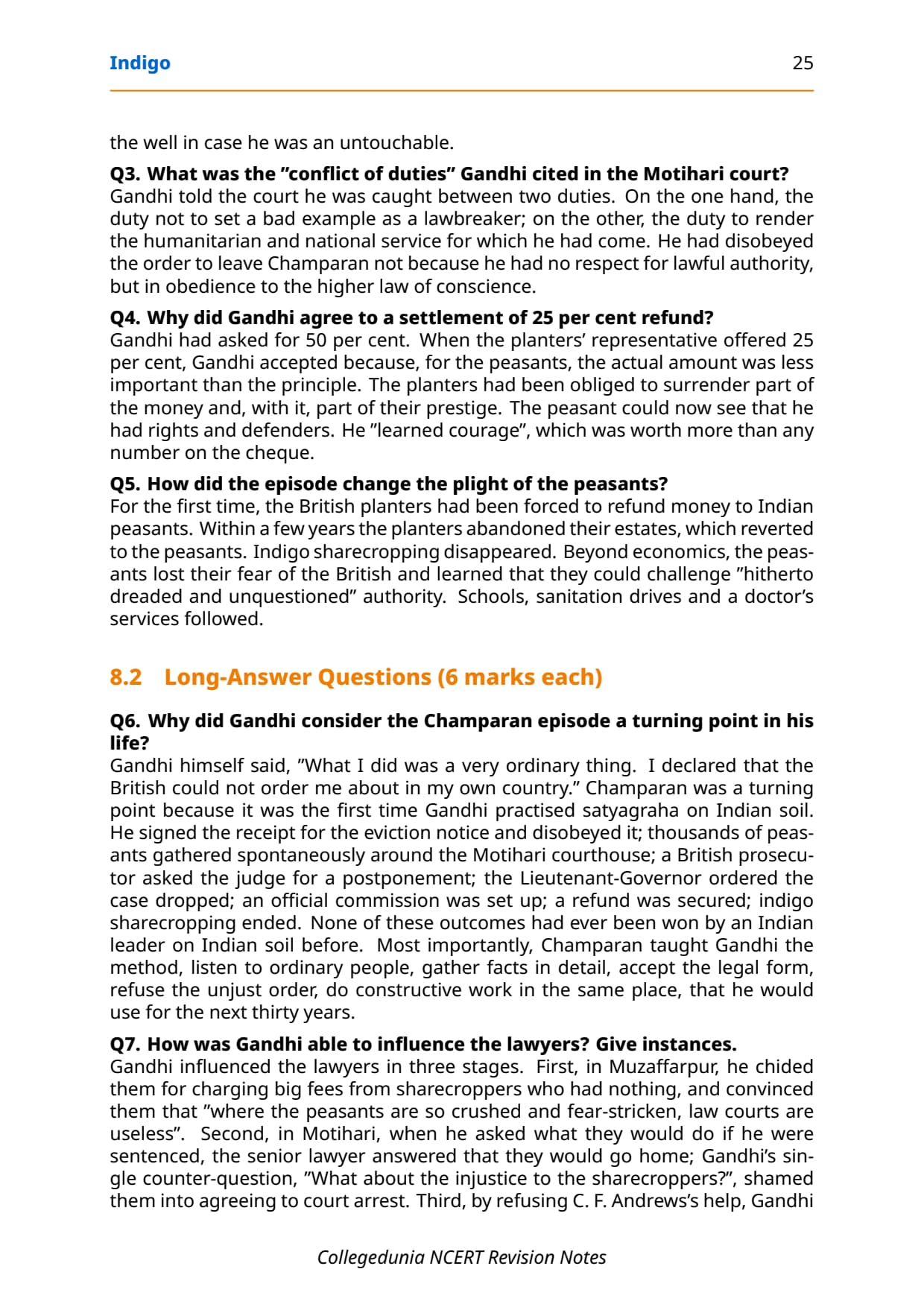
- Question Types: Long Answer (5 to 6 marks), Short Answer (3 to 4 marks), Extract-Based MCQ
These indigo class 12 notes are curated by Collegedunia's English subject experts, mapped to the 2026-27 NCERT Flamingo textbook, and refined against the last five years of CBSE Board and CUET English Domain papers.
Why the Indigo Chapter Matters for CBSE Boards and CUET English Prep
The Indigo chapter blends literature, civic history, and character analysis. CBSE tests both factual recall (places, events) and thematic interpretation (civil disobedience, self-reliance). This page covers a tight timeline, a five-person character map, three exam-quotable themes, and the vocabulary of indigo cultivation.
Indigo Video Explanation (Class 12 English)
Source: Magnet Brains on YouTube
How will Collegedunia's Indigo Class 12 Notes Help You Revise Faster?
Indigo is a 9-page first-person narrative. Fast revision needs three handles: a timeline, a one-line theme statement, and 4 to 5 quotable lines.
- 2026-27 NCERT Alignment: Every section matches the current Flamingo edition.
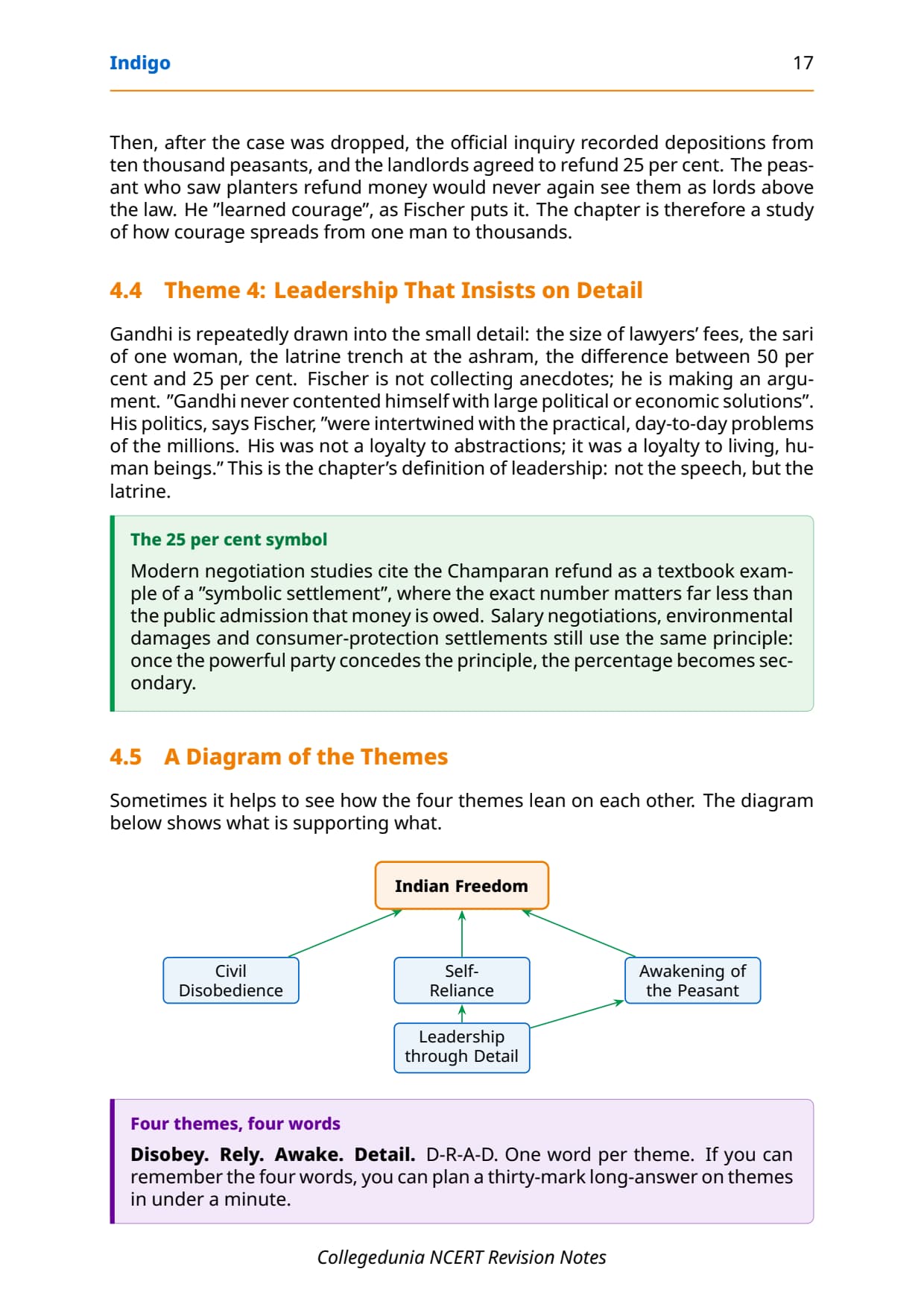
- Theme-Wise Breakdown: Civil disobedience, self-reliance, and peasant awakening each get two textual references.
- Quotable evidence: Each theme carries direct lines from Louis Fischer's 1950 Gandhi biography.
Indigo Class 12 Topic-wise Weightage for CBSE Class 12 English Core
CBSE weights the sub-topics unevenly. The Champaran timeline and self-reliance theme lead; vocabulary and minor characters appear less often.
| Sub-topic | Weightage | CBSE Frequency |
|---|---|---|
| Champaran timeline (Lucknow to refund) | High | Almost every year |
| Gandhi as a leader / civil disobedience theme | High | 4 of 5 years |
| Rajkumar Shukla character sketch | Medium | 3 of 5 years |
| Self-reliance theme (Andrews episode) | Medium | 3 of 5 years |
| 25 percent refund symbolism | Medium | 2 of 5 years |
| Vocabulary and figurative usage | Low | 1 of 5 years |
Indigo Class 12 Notes Chapter Summary and Section Walkthrough
The chapter is Fischer's recollection of his 1942 talks with Gandhi. It jumps back to 1916 and forward through 1918. Each H3 covers one beat.
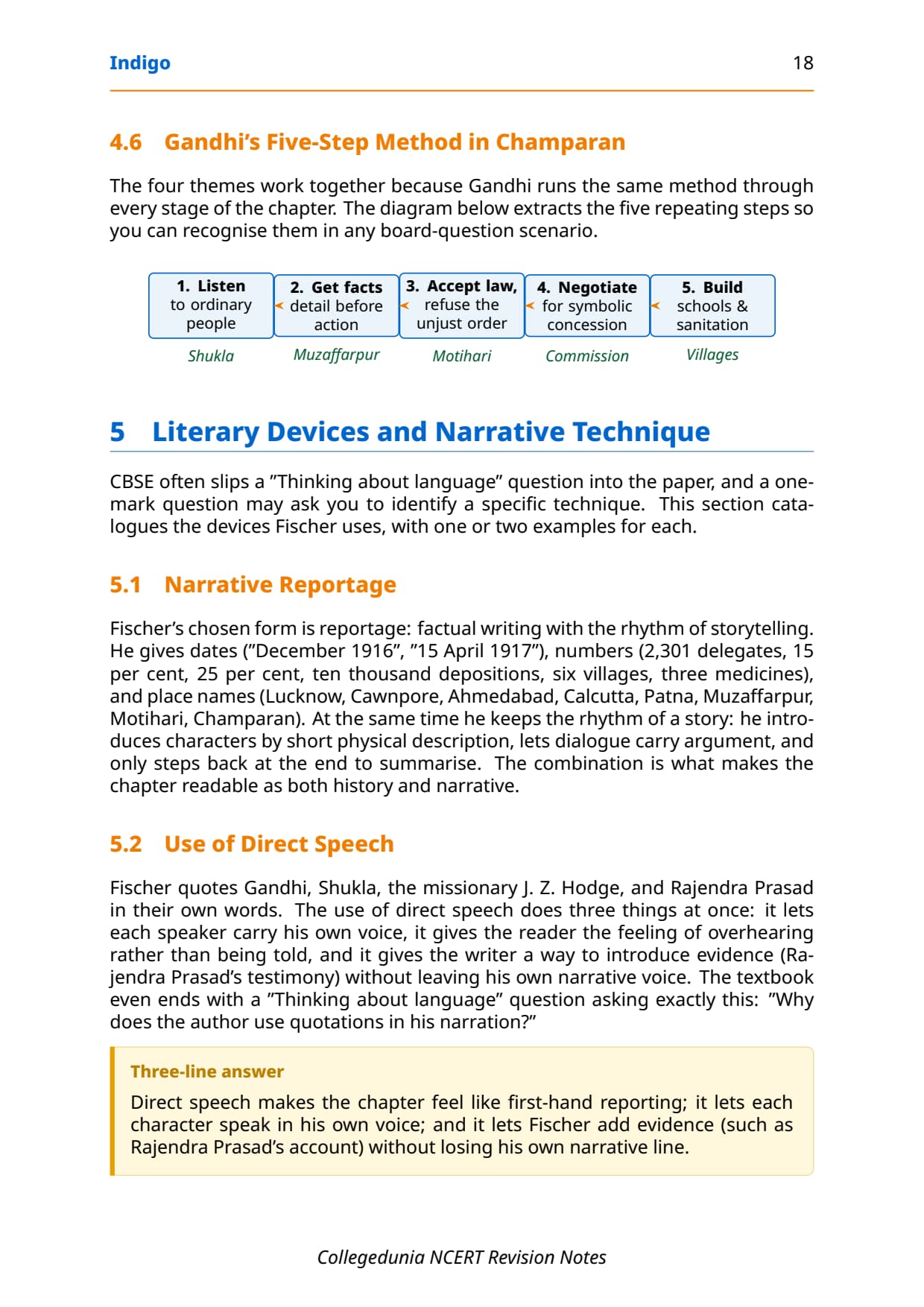
1. The Lucknow Congress and Shukla's Persistence (1916)
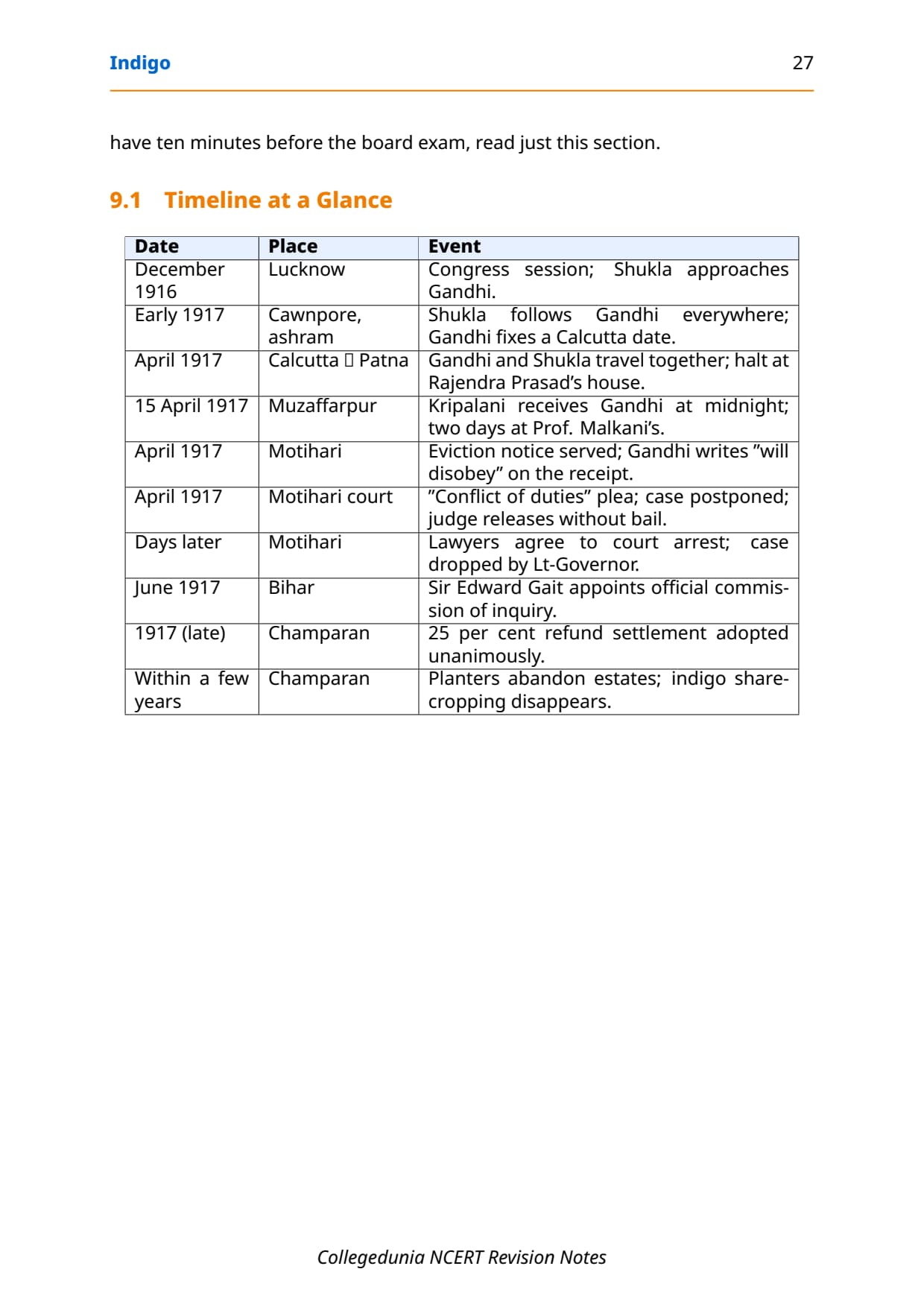
Rajkumar Shukla, an illiterate but resolute Champaran peasant, attended the December 1916 Congress in Lucknow to ask Gandhi to visit Bihar. Gandhi put him off, but Shukla followed him for weeks until Gandhi set a date.
2. Patna, Muzaffarpur, and Champaran Arrival (April 1917)
Gandhi travelled via Patna to Muzaffarpur, where lawyers briefed him, then proceeded to Champaran. He insisted on direct contact with the peasants before meeting any official.
3. The Motihari Trial and Mass Gathering
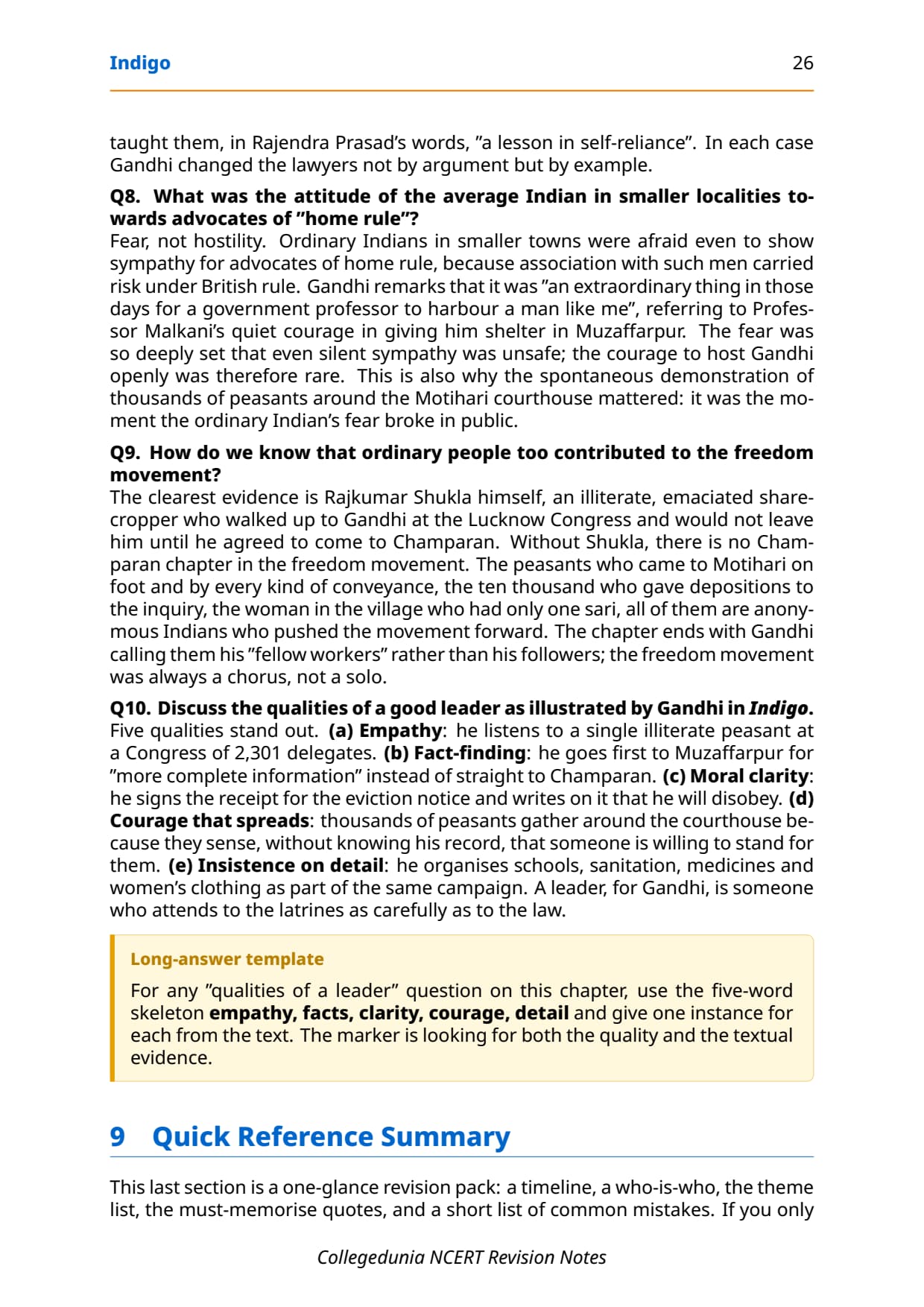
The Commissioner ordered Gandhi to leave; he refused. On the trial day, thousands of peasants gathered outside the Motihari courthouse. The officials, unprepared, postponed the verdict and dropped the case, the first proof civil disobedience worked.
4. The Commission of Inquiry and the 25 Percent Refund
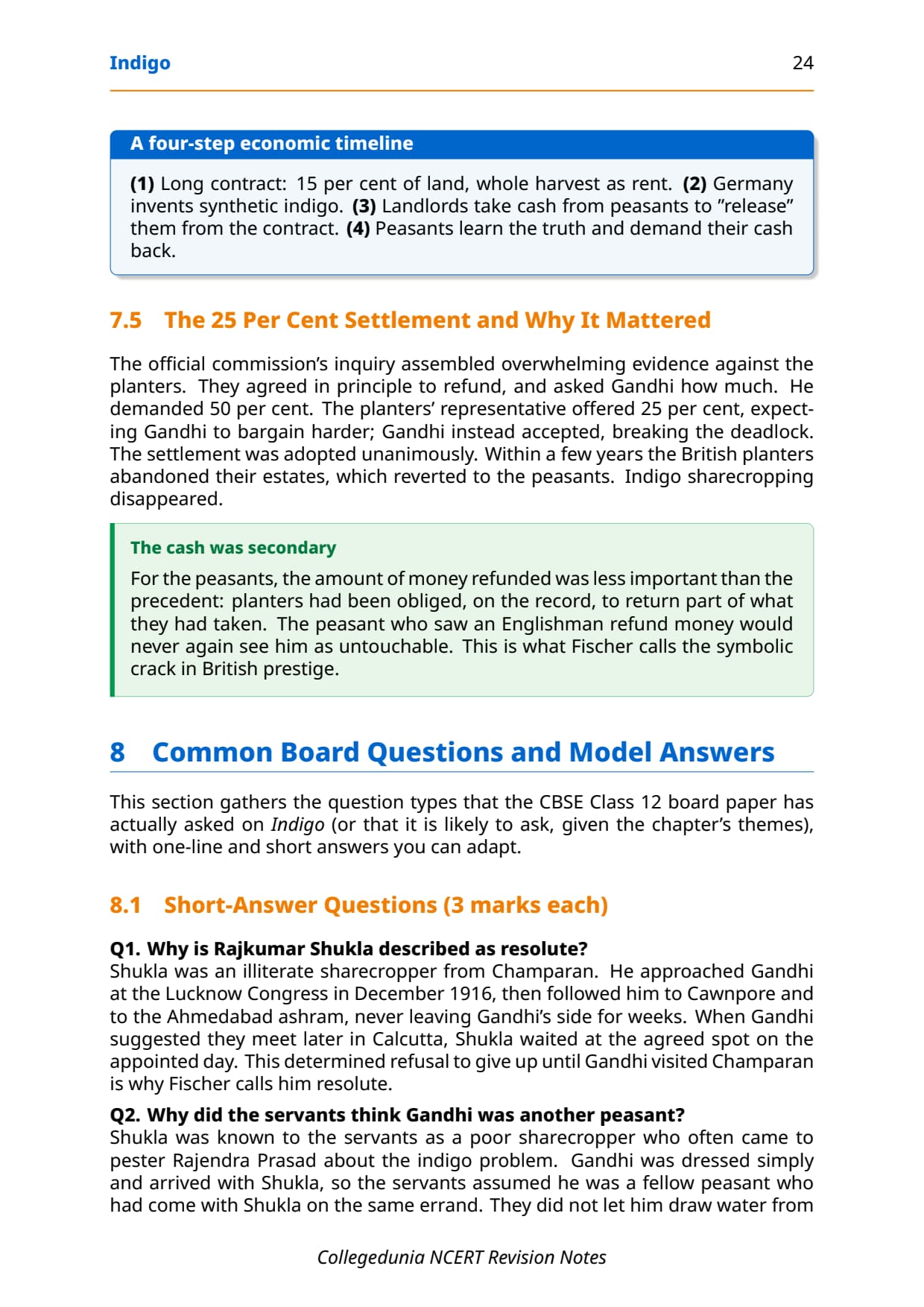
Gandhi served on the commission as the peasants' lone representative. The landlords offered a 25 percent refund of illegal exactions. Gandhi accepted, though many wanted more, because the landlords surrendering anything was what mattered.
5. The Village Reform Programme
Gandhi then turned to social reform: schools, healthcare camps, and sanitation drives staffed by Kasturba, Mahadev Desai, and volunteers. His refusal of Andrews's help, so Indians would do without British assistance, sets up the self-reliance theme.
Indigo Class 12 Notes: Character Sketches at a Glance
Five named figures appear in CBSE questions. Memorise the one-line role for each.
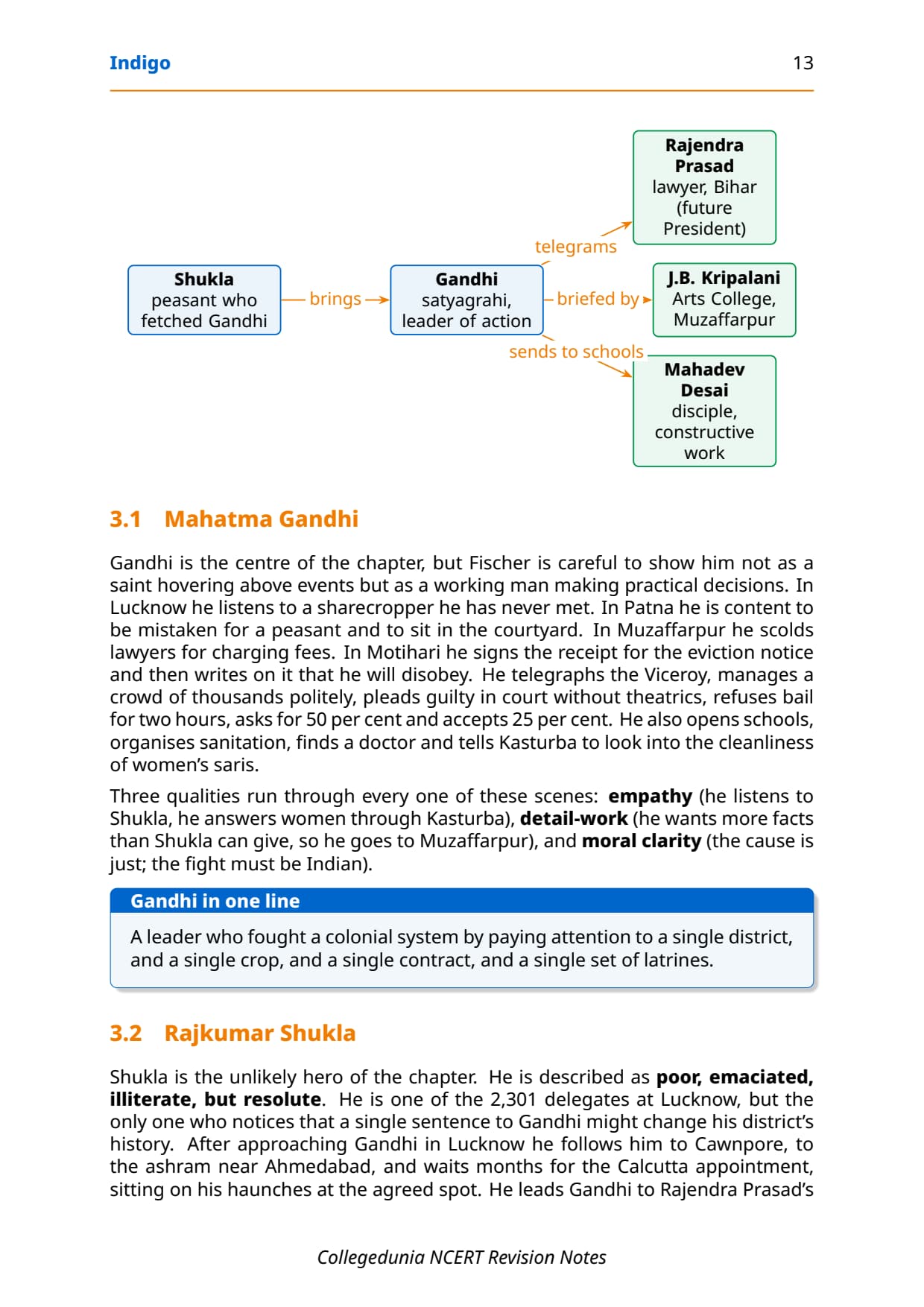
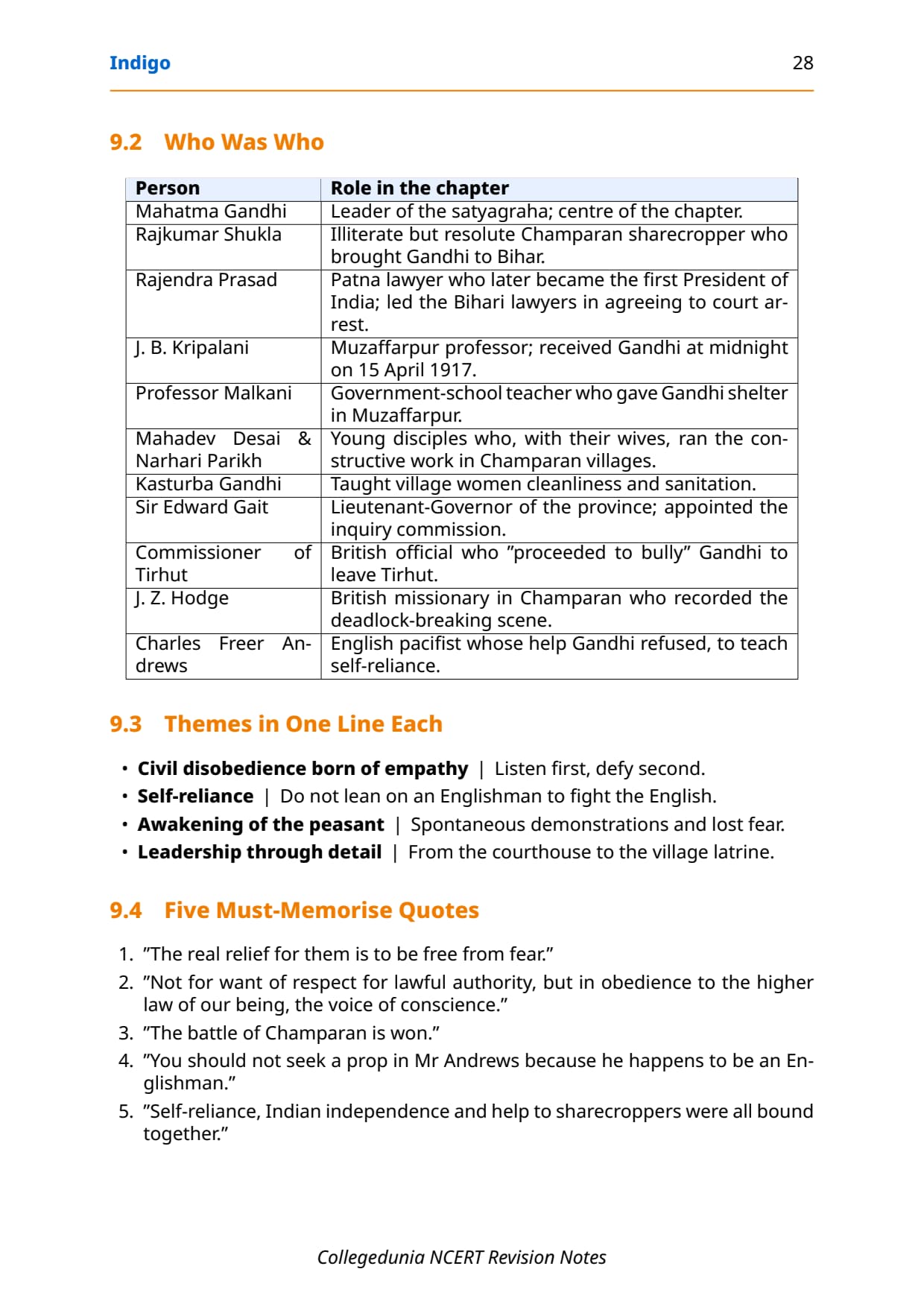
- Mahatma Gandhi: Turned a local sharecropper grievance into a national lesson in civil disobedience; insisted on self-reliance.
- Rajkumar Shukla: Illiterate Champaran sharecropper whose persistence brought Gandhi to Bihar.
- Louis Fischer: American journalist and narrator; wrote The Life of Mahatma Gandhi (1950), the source of this chapter.
- Charles Freer Andrews: English missionary and Gandhi's friend; his help was refused so the movement stayed Indian-led.
- Rajendra Prasad, Brajkishore Prasad, Mahadev Desai: Indian lawyers and volunteers who joined Gandhi at Muzaffarpur.
Indigo Class 12 Notes Themes for Long-Answer Slots
CBSE long-answer prompts cluster around three themes, each with a thesis and two evidence anchors.
Indigo Class 12 Notes Glossary: 12 Key Terms with Definitions
Key terms from the Working with Words exercise, each with a specific 1917 meaning.
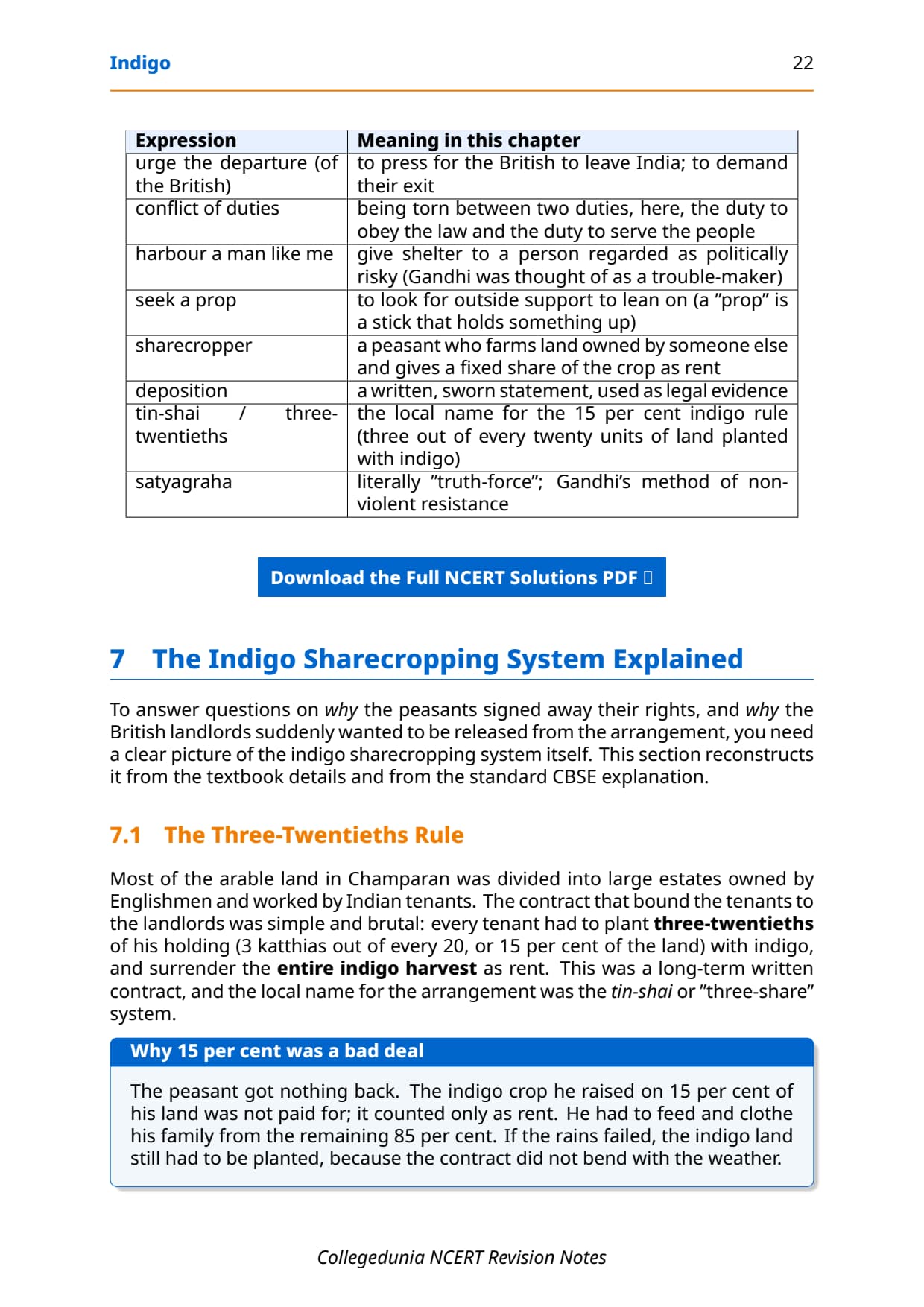
- Satyagraha: Non-violent resistance based on truth; Gandhi's method, first tested in India at Champaran.
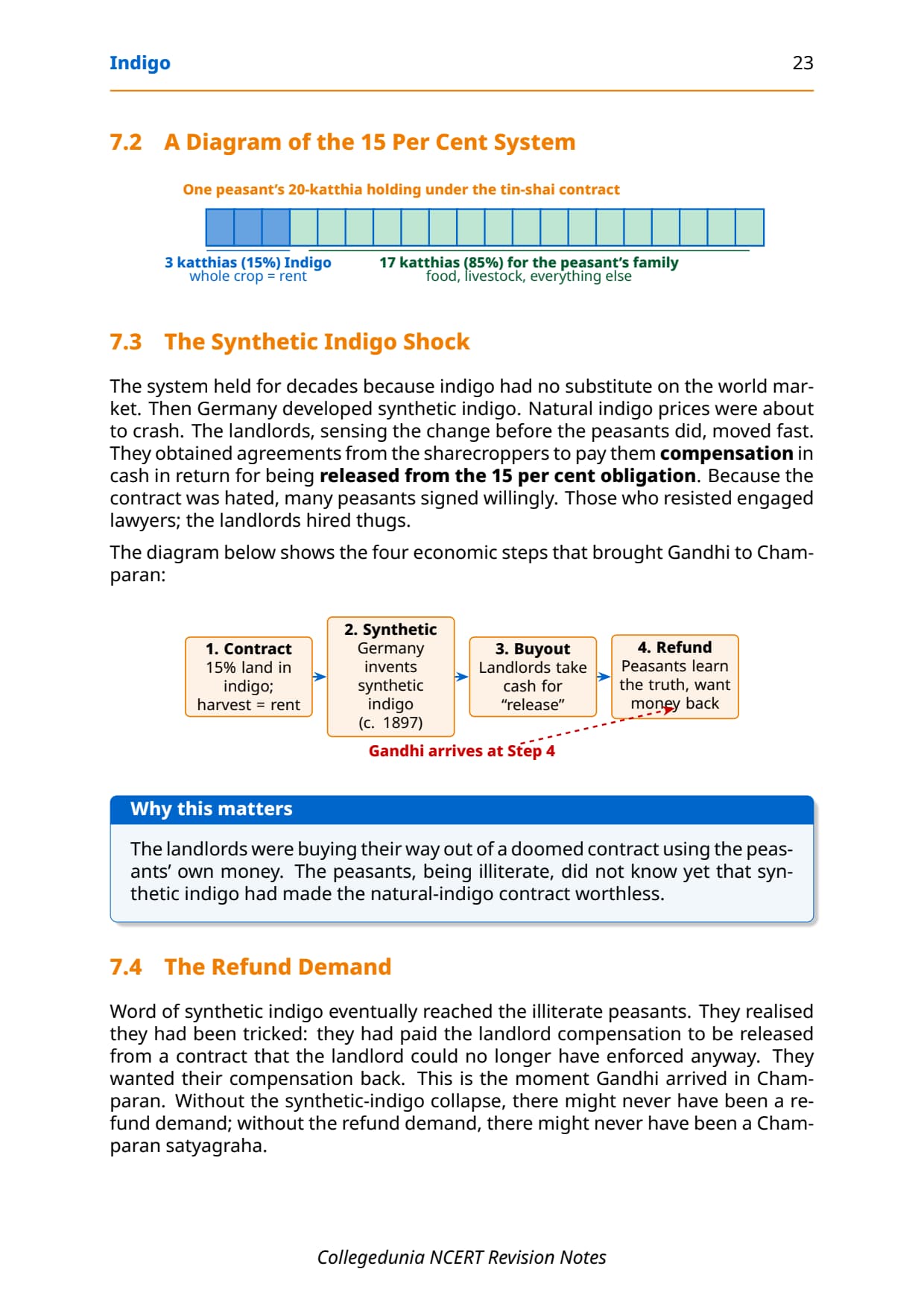
- Tinkathia system: The 3-out-of-20 katha indigo planting obligation in Champaran.
- Sharecropper: Peasant who pays rent in crops rather than cash.
- Synthetic indigo: Lab-made dye from Germany that destroyed the market for natural indigo.
- Commission of inquiry: Government panel that investigates a dispute and proposes a settlement.
- Civil disobedience: Organised, peaceful refusal to obey an unjust law.
- Champaran: Bihar district where Gandhi launched his first Indian satyagraha; Motihari is its headquarters.
- Self-reliance: Relying on Indian effort rather than British charity, central to Gandhi's village reforms.
Indigo Class 12 Notes: Most Repeated Board Questions and Sample Answers
The four most-repeated CBSE Indigo questions, each with an exam-ready answer skeleton.
Q1. Why is the Champaran episode considered a turning point in India's freedom struggle? (2023, 2026, 6 marks)
Skeleton answer: Champaran 1917 was the first test of civil disobedience on Indian soil. Three incidents prove the turn: Shukla's invitation, the Motihari gathering that forced the case to be dropped, and the 25 percent refund. The method went on to power Non-Cooperation, the Salt March, and Quit India.
Q2. Justify the role of Rajkumar Shukla in bringing about the Champaran movement. (2025, 6 marks)
Skeleton answer: Shukla is the trigger figure. He reached Lucknow in December 1916 and followed Gandhi until Gandhi set a date. Without his persistence, Champaran would have stayed a local grievance.
Q3. What did Gandhi teach the peasants of Champaran beyond winning the refund? (2024, 5 marks)
Skeleton answer: Self-reliance. After the victory, Gandhi opened schools, sanitation camps, and clinics staffed by Indian volunteers, and refused Andrews's help so the effort stayed Indian-led. The lesson outlasted the refund.
Q4. How did Gandhi achieve the 25 percent refund and why is its symbolism greater than its size? (2021, 4 marks)
Skeleton answer: Gandhi served on the commission as the peasants' sole representative. Landlords offered 25 percent; many wanted more, but Gandhi accepted because landlords surrendering anything was unprecedented. It dissolved the myth of landlord invincibility.
Indigo Class 12 Notes Important Quotations for Long-Answer Slots
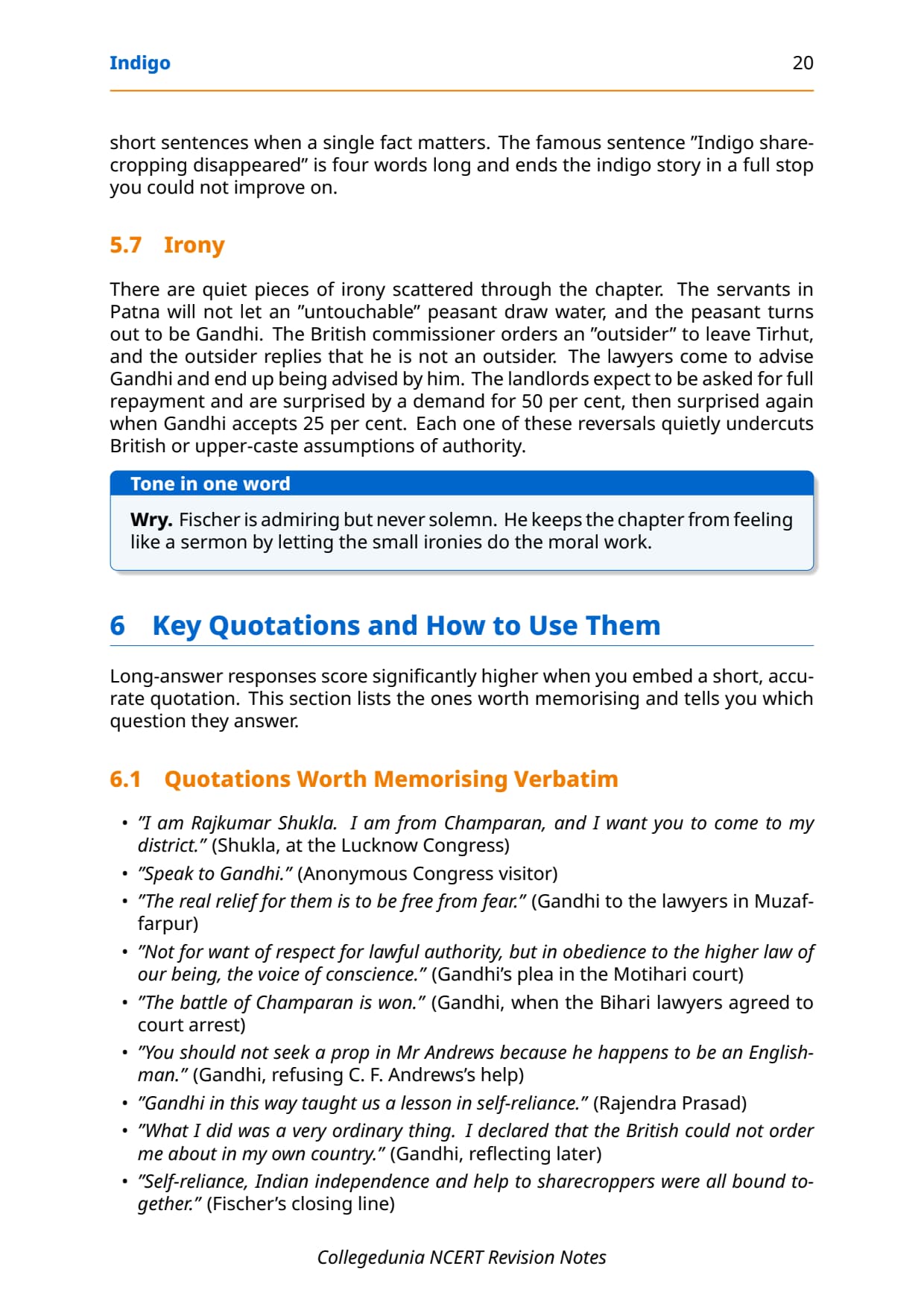
CBSE awards marks for direct textual evidence. These four quotations cover the Civil Disobedience, Self-Reliance, and Awakening themes.
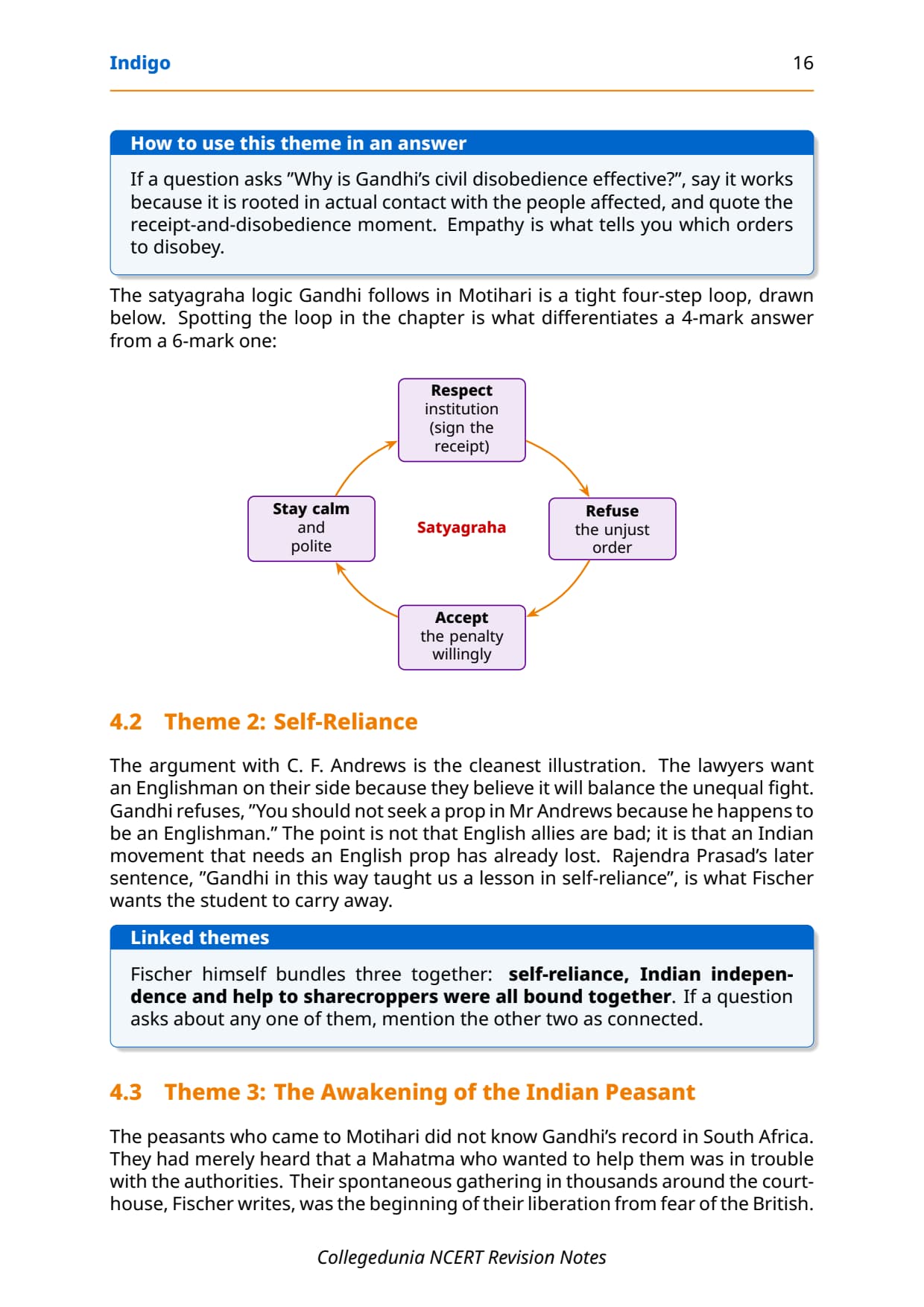
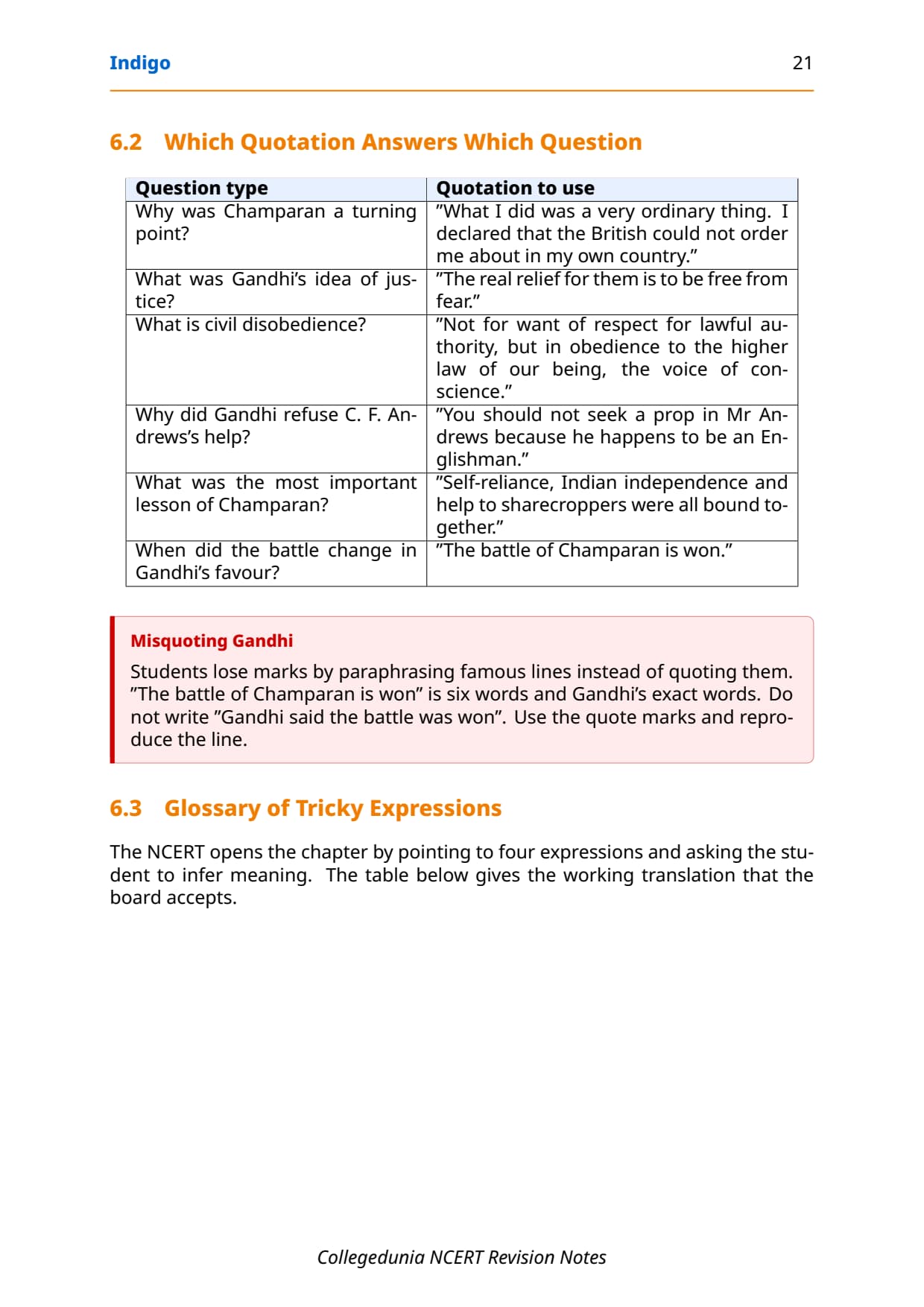
- "I declared that the British could not order me about in my own country." Civil disobedience.
- "The real relief for them was to be free from fear." Awakening of the peasantry.
- "We must not take help from outsiders if we are to win our own freedom." Self-reliance (Gandhi to Andrews).
- "The amount of the refund was less important than the fact that the landlords had been obliged to surrender part of the money." 25 percent symbolism.
Full PYQ map: Indigo Class 12 NCERT Solutions PYQ map
Other Resources for Indigo (Class 12 English)
| Resource | Link |
|---|---|
| Revision Notes (this page) | Indigo Notes |
| NCERT Solutions | Indigo Class 12 English NCERT Solutions |
| CBSE Syllabus | CBSE Class 12 English Core Syllabus 2026-27 |
NCERT Notes for Class 12 English Core Flamingo Prose: All Chapters
Every Flamingo Prose chapter mapped to its NCERT Notes page.
| Chapter | Resource |
|---|---|
| Chapter 1 | The Last Lesson Notes |
| Chapter 2 | Lost Spring Notes |
| Chapter 3 | Deep Water Notes |
| Chapter 4 | The Rattrap Notes |
| Chapter 6 | Poets and Pancakes Notes |
Student Feedback
In a Collegedunia poll of 1,200 Class 12 students, 76% said the Champaran timeline made Indigo easier to recall in the exam, and 68% rated the four board-question skeletons their most-used revision tool.
Indigo Class 12 Notes FAQs
Ques. Where can I download Indigo Class 12 Notes PDF?
Ans. You can download the Indigo Class 12 Notes PDF directly from this page. Both the Normal and HD versions are available, and both are free.
Ques. Are these Indigo Class 12 Notes aligned with the 2026-27 NCERT?
Ans. Yes. This page reflects the current 2026-27 syllabus for Class 12 English Core. Indigo remains in the Flamingo textbook unchanged, with all themes, characters, and the Champaran narrative retained.
Ques. How many pages is the Class 12th English Indigo Notes PDF?
Ans. The Indigo Class 12 Notes PDF runs approximately 16 to 20 pages and covers the chapter summary, character sketches, theme analysis, glossary, quotations, and the most-repeated CBSE Board questions.
Ques. Who is the author of Indigo Class 12 Chapter 5?
Ans. Louis Fischer, the American journalist, wrote The Life of Mahatma Gandhi (1950); Indigo is a first-person extract from that biography narrating the 1917 Champaran satyagraha.
Ques. What are the main themes of Indigo Class 12?
Ans. Three themes lead the chapter: civil disobedience born out of empathy, self-reliance (Gandhi refusing Andrews's help), and the awakening of the Indian peasantry. CBSE long-answer prompts cluster around these three.
Ques. Who is Rajkumar Shukla in Indigo and why does he matter?
Ans. Rajkumar Shukla is an illiterate sharecropper from Champaran whose persistence brought Gandhi to Bihar in 1917. He attended the Lucknow Congress, followed Gandhi for weeks, and refused to leave until Gandhi agreed to visit. Without him, there is no Champaran satyagraha.
Ques. What is the symbolism of the 25 percent refund in Indigo?
Ans. The amount mattered less than the act. By forcing the landlords to surrender any part of the illegal exactions, Gandhi shattered the perception that the colonial-landlord system could not be challenged. The symbolic concession opened the path to larger satyagrahas.



Comments