




The 2026-27 NCERT keeps Class 12 English Chapter 6 Flamingo Prose: Poets and Pancakes intact, with all six episodes of Asokamitran's Gemini Studios memoir. The chapter is worth 6 to 8 marks. This page hosts the Notes PDF, topic-wise weightage and the most-repeated Board questions.
- CBSE Weightage: 6 to 8 marks (one long answer plus a short answer)
- CUET Weightage: 1 to 2 inference items in the English passage section
- Chapter Length: 10 pages of prose plus 1 page of exercises
These Class 12 English Notes for Poets and Pancakes are made by Collegedunia experts, mapped to the 2026-27 NCERT print, and checked against the last five years of CBSE Board papers.
How will Collegedunia's Notes Help You with Class 12 English Chapter 6 Flamingo Prose: Poets and Pancakes?
The Notes condense Asokamitran's memoir into a board-ready map.
- 2026-27 NCERT Alignment: The notes follow the current Flamingo edition.
- Theme-Character-Device Split: Separate cards make it easy to recall what to write for theme, character or technique.
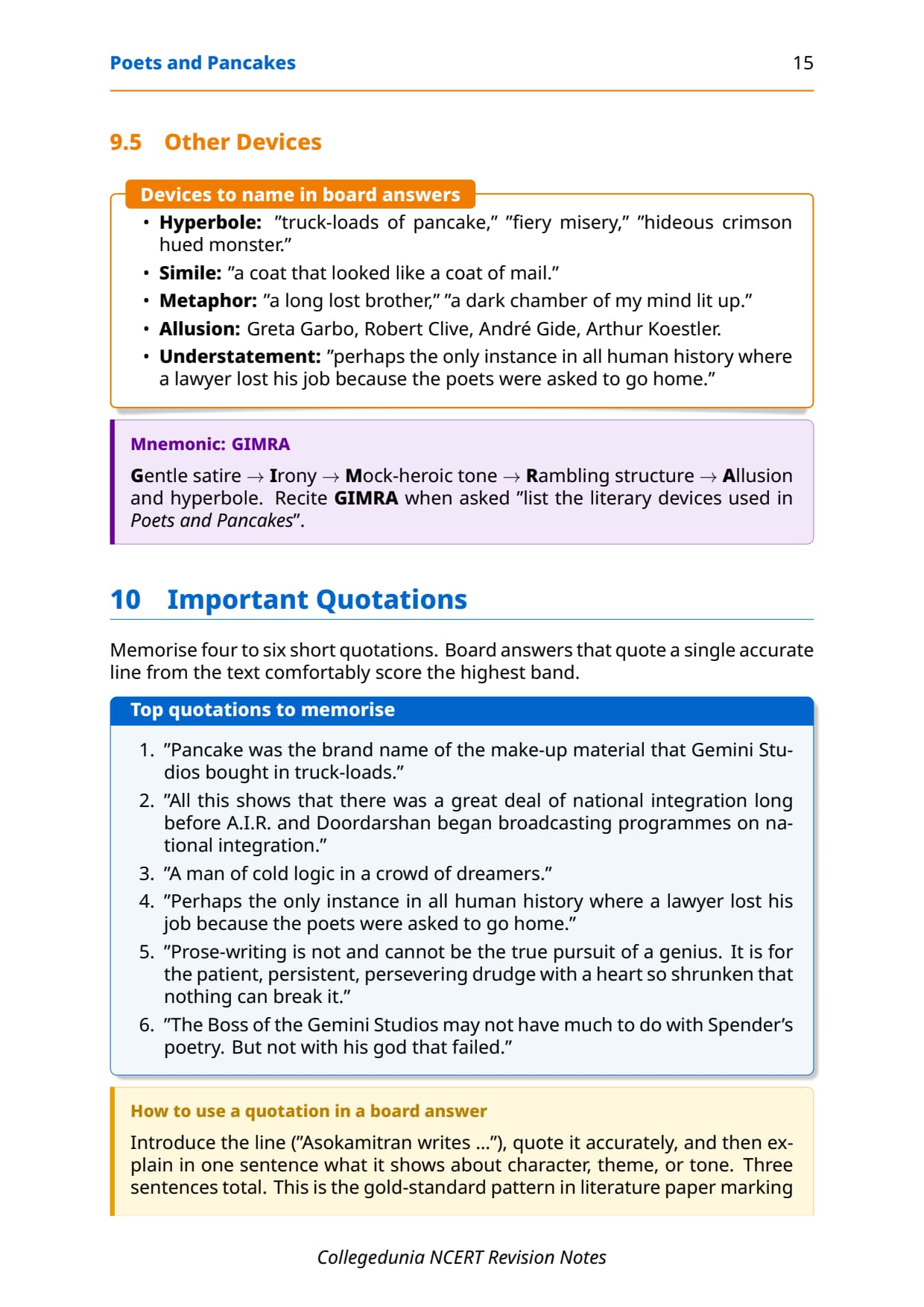
- Quotable Phrases Highlighted: Six verbatim phrases are pulled out for your Board answers.
- Quick Revision Strip: The last page is a 90-second skim card with the chapter's six incidents.
Poets and Pancakes Video Explanation (Class 12 English)
Source: Magnet Brains on YouTube
Class 12 English Notes Chapter 6 Flamingo Prose: Poets and Pancakes Topic-by-Topic Summary
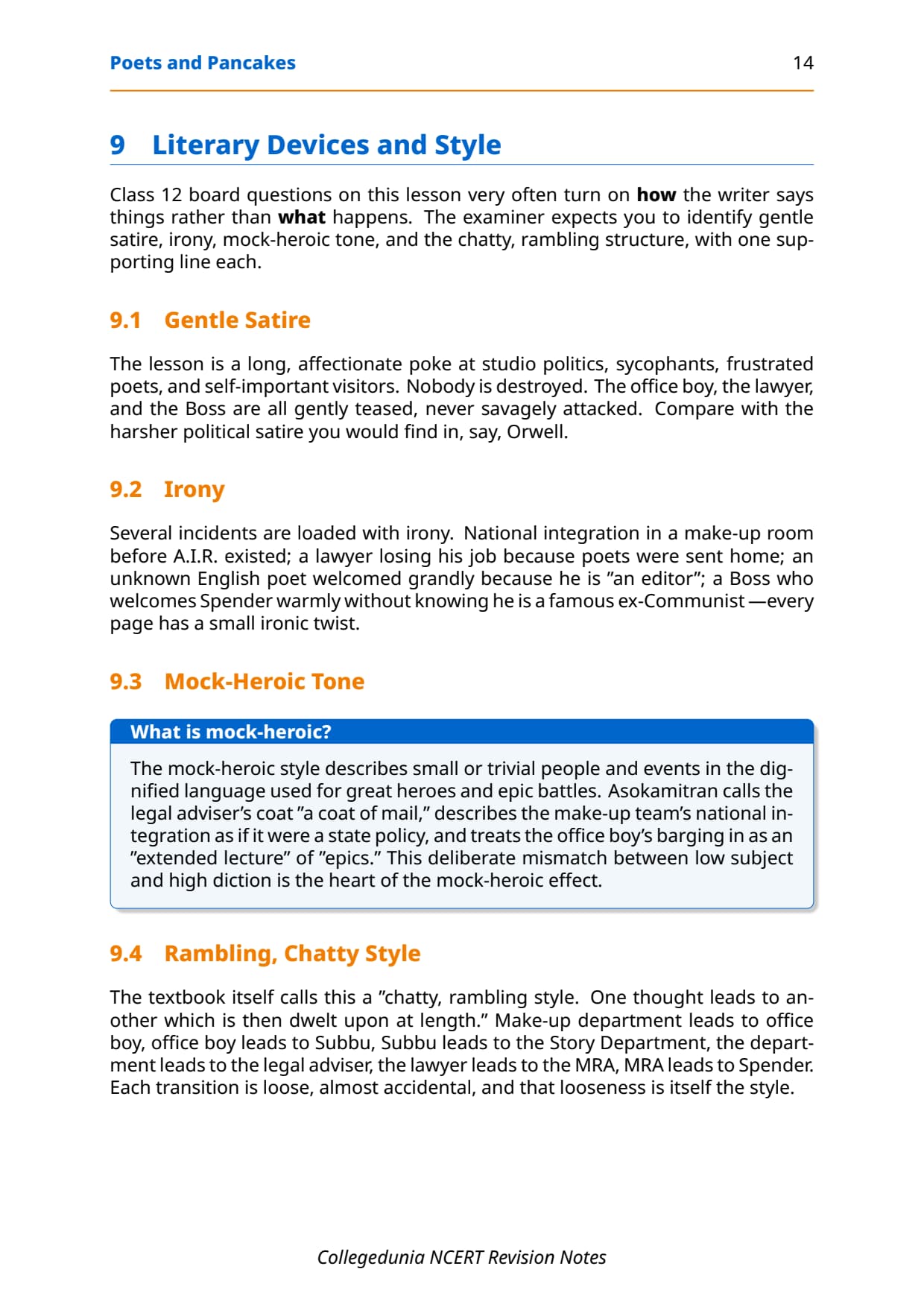
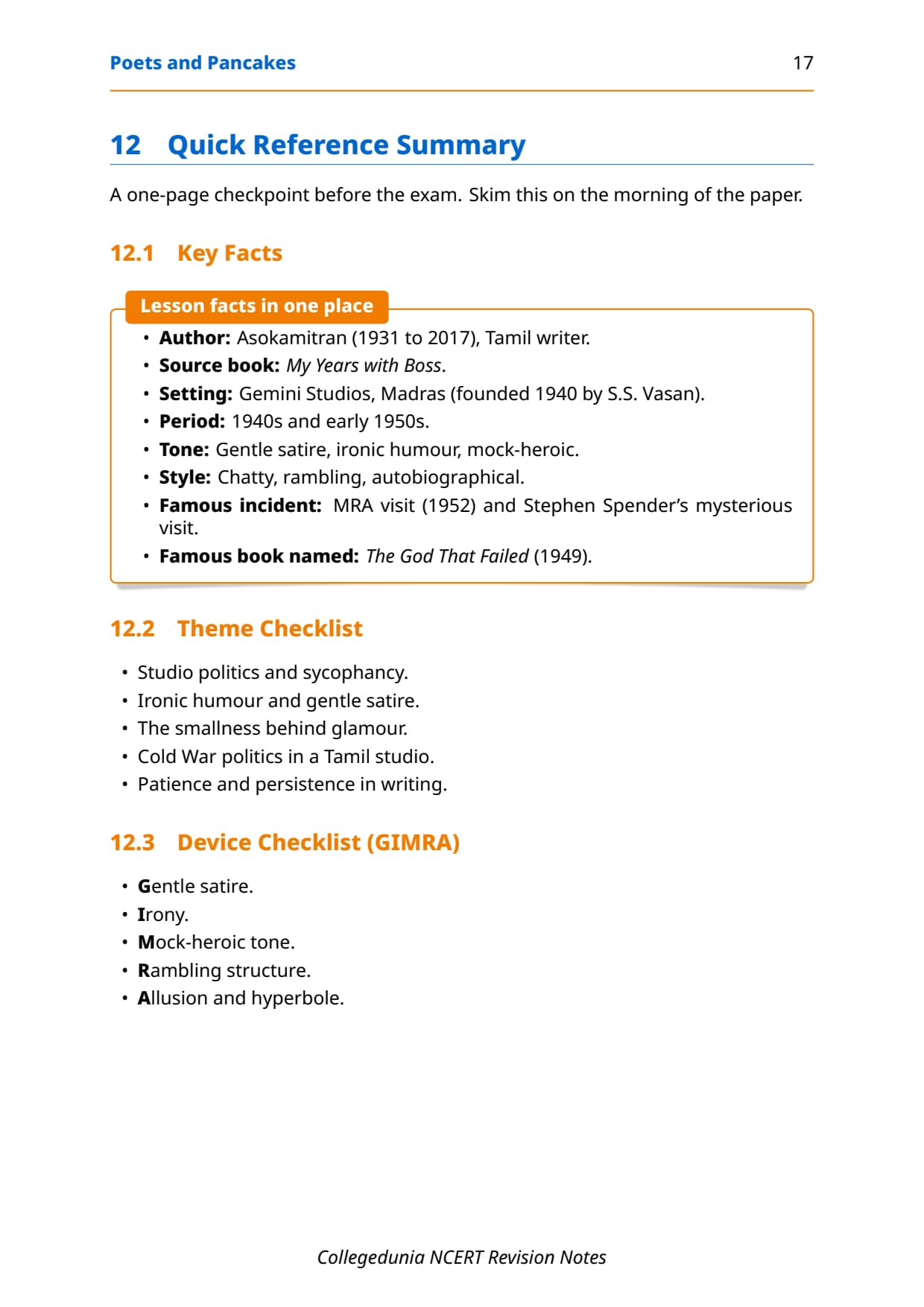
The chapter moves through six loosely connected episodes in Asokamitran's chatty style, painting a portrait of Gemini Studios.
1. Pancake and the Make-up Department
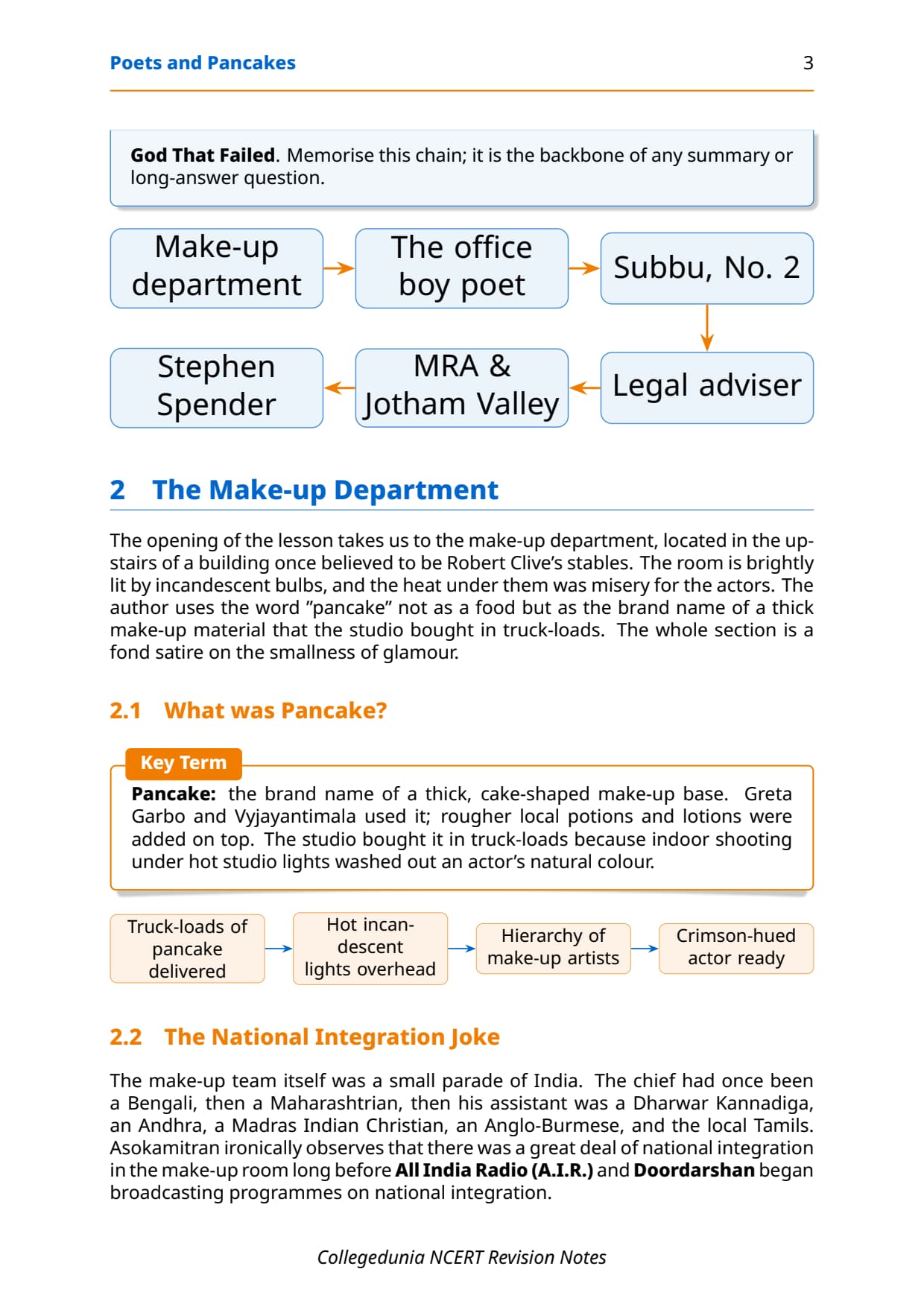
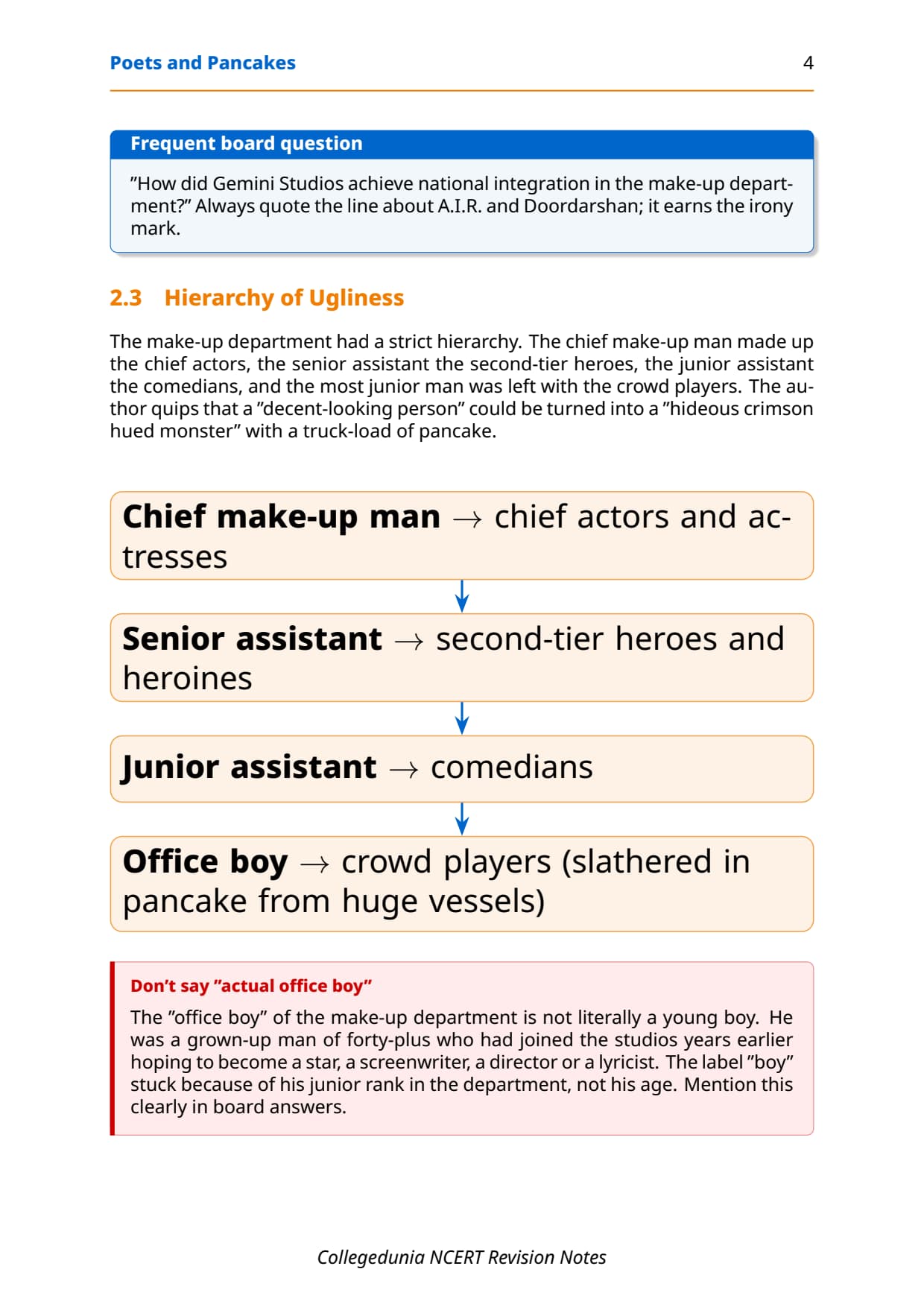
Pancake was the make-up Gemini Studios bought in truck-loads. Its make-up staff came from many regions, which Asokamitran reads as "great national integration long before A.I.R. and Doordarshan." The chief make-up man worked on stars, juniors on second-leads and comedians, and the office boy on the crowd.
2. The Office Boy in His Forties
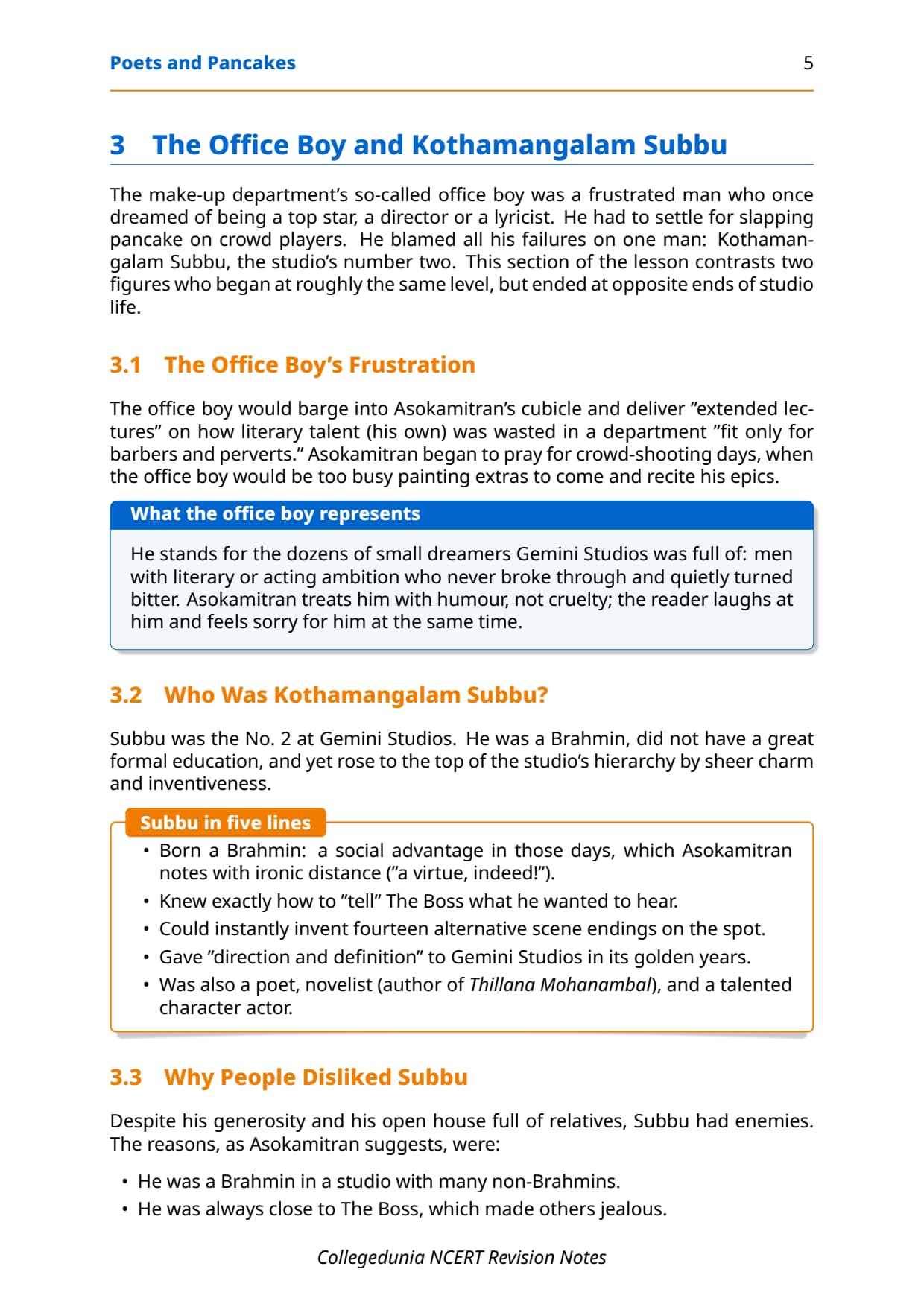
The "boy" was in his early forties. He had joined the studio dreaming of being an actor, writer or director, and ended up smearing pancake on crowd players. His frustration leaked out as long literary lectures to Asokamitran. He blamed Kothamangalam Subbu for his failed career, though Subbu had begun from a similar place.
3. Kothamangalam Subbu, the No. 2
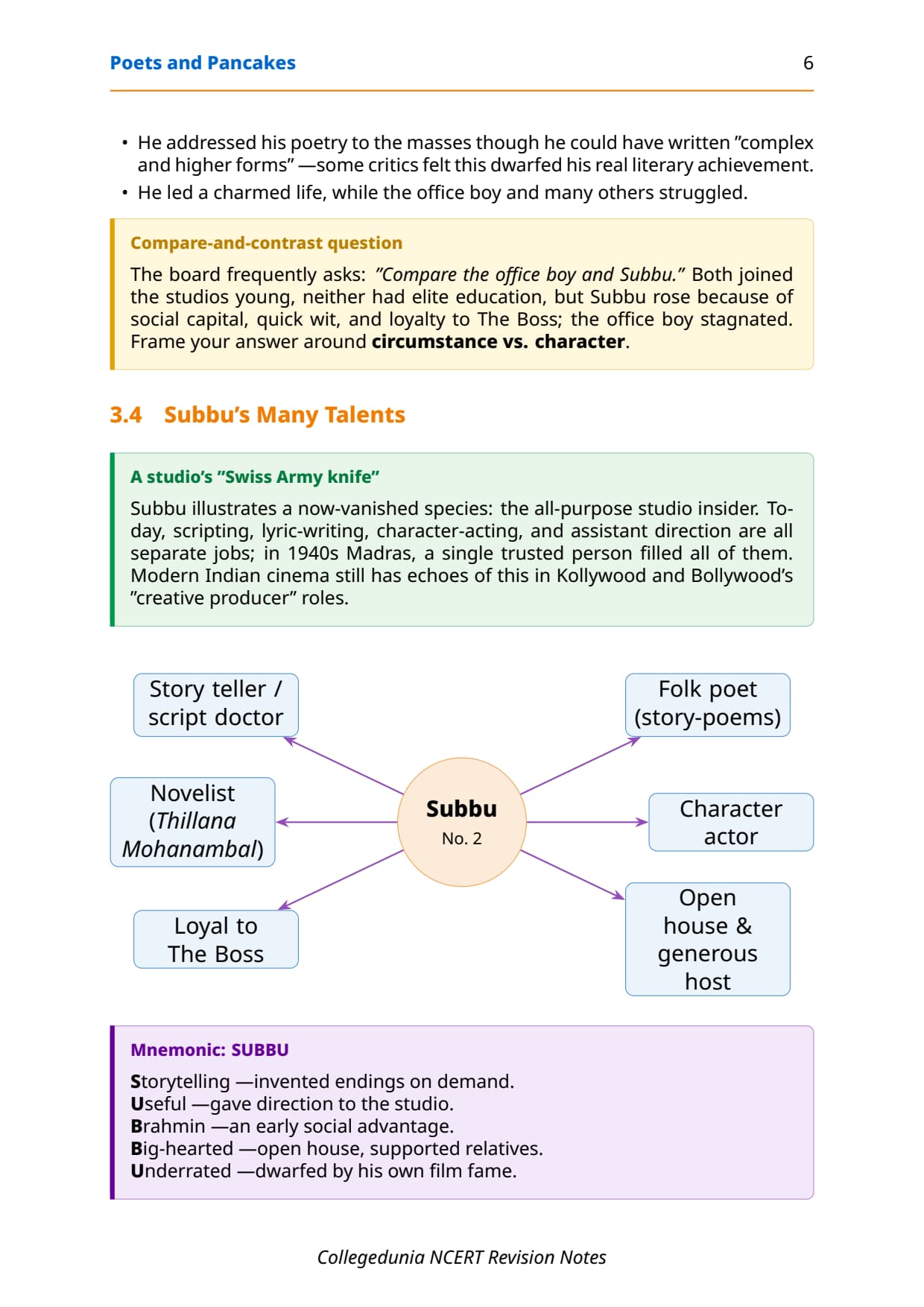
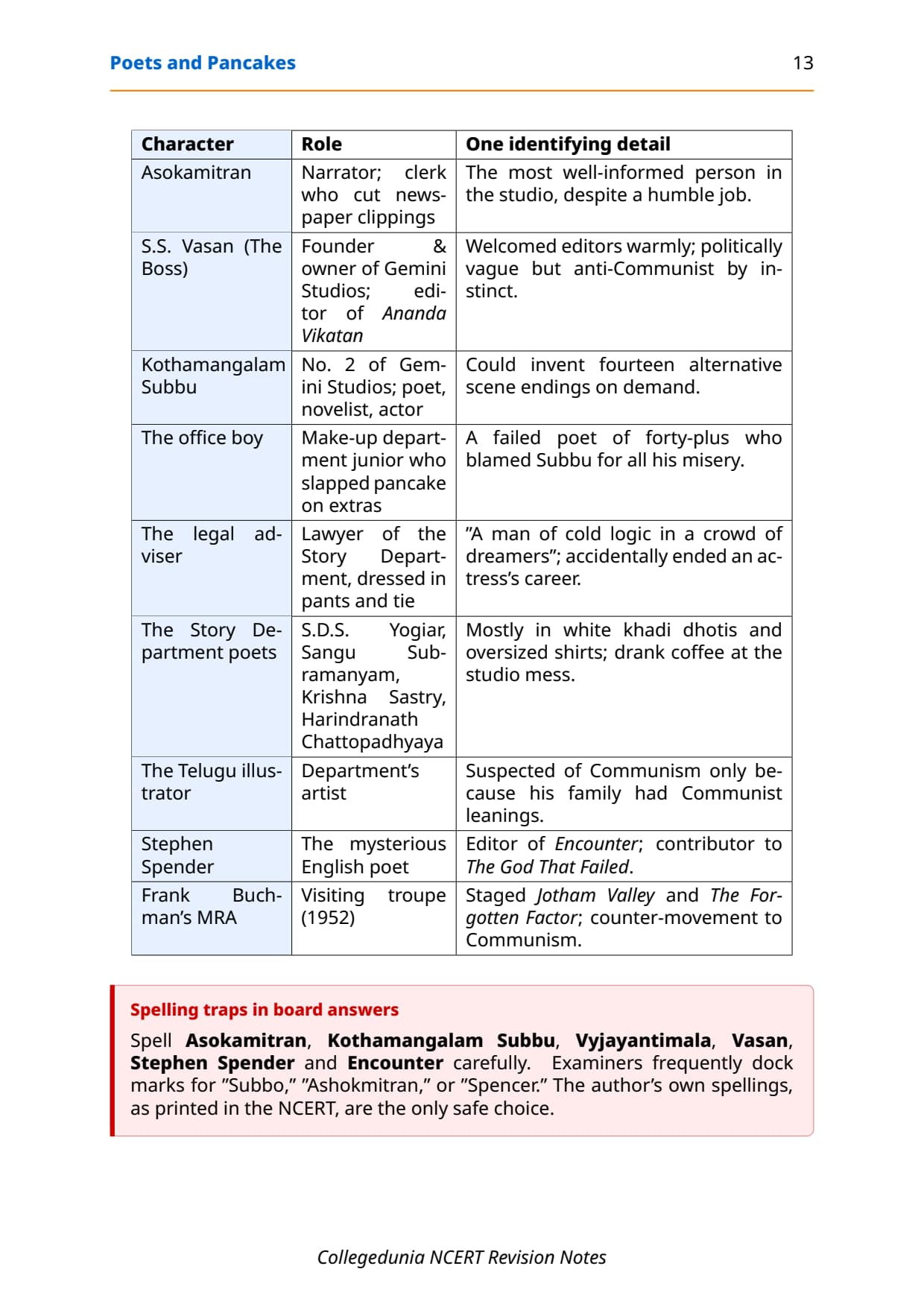
Subbu was officially in the Story Department but was always seen with The Boss, S.S. Vasan. He could improvise four ways of a rat pouring affection on its offspring, and fourteen more if asked. He wrote folk-refrain poems and the novel Thillana Mohanambal, and acted small roles better than the leads. Some called him a sycophant; Asokamitran stays gently uncertain. The label No. 2 captures both his talent and the suspicion around it.
4. The Legal Adviser Who Fired an Actress
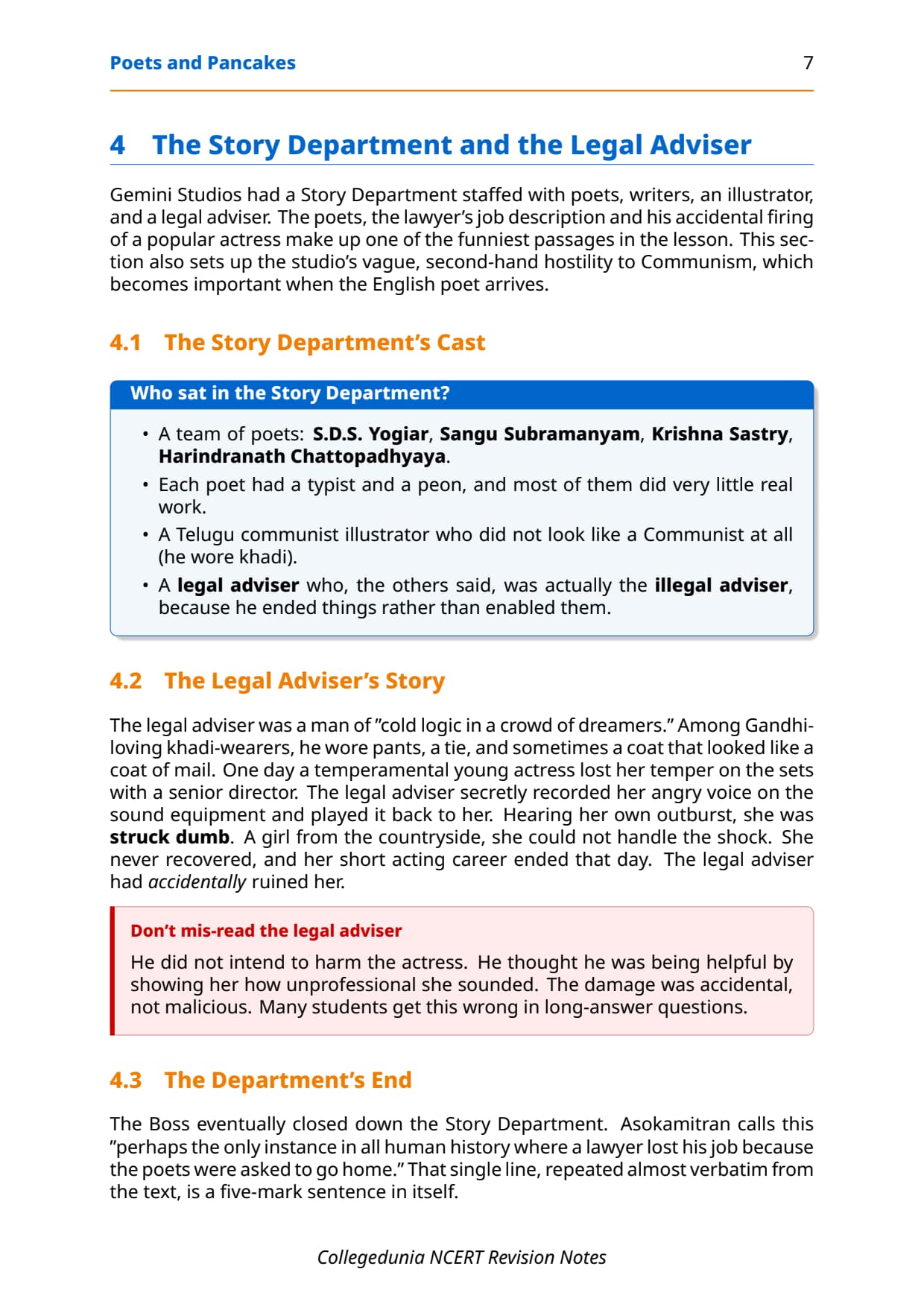
The Story Department also held a lawyer, "officially known as the legal adviser, but everybody referred to him as the opposite." When a temperamental actress blew over on the sets, he recorded her tirade and played it back. She was struck dumb and her career ended that day. Years later The Boss closed the Story Department, and "this was perhaps the only instance in all human history where a lawyer lost his job because the poets were asked to go home."
5. The MRA Visit and the Tamil Drama Influence
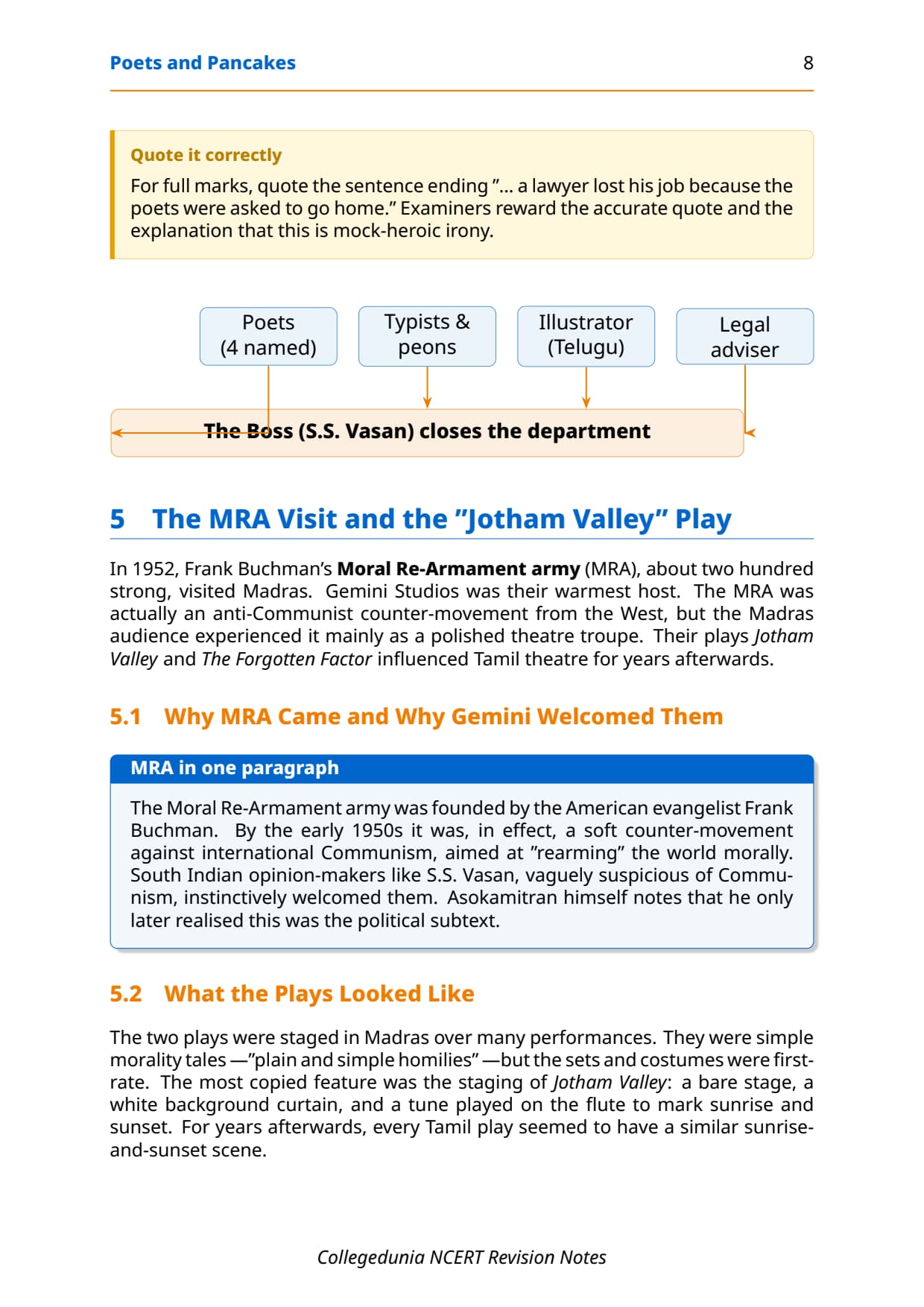
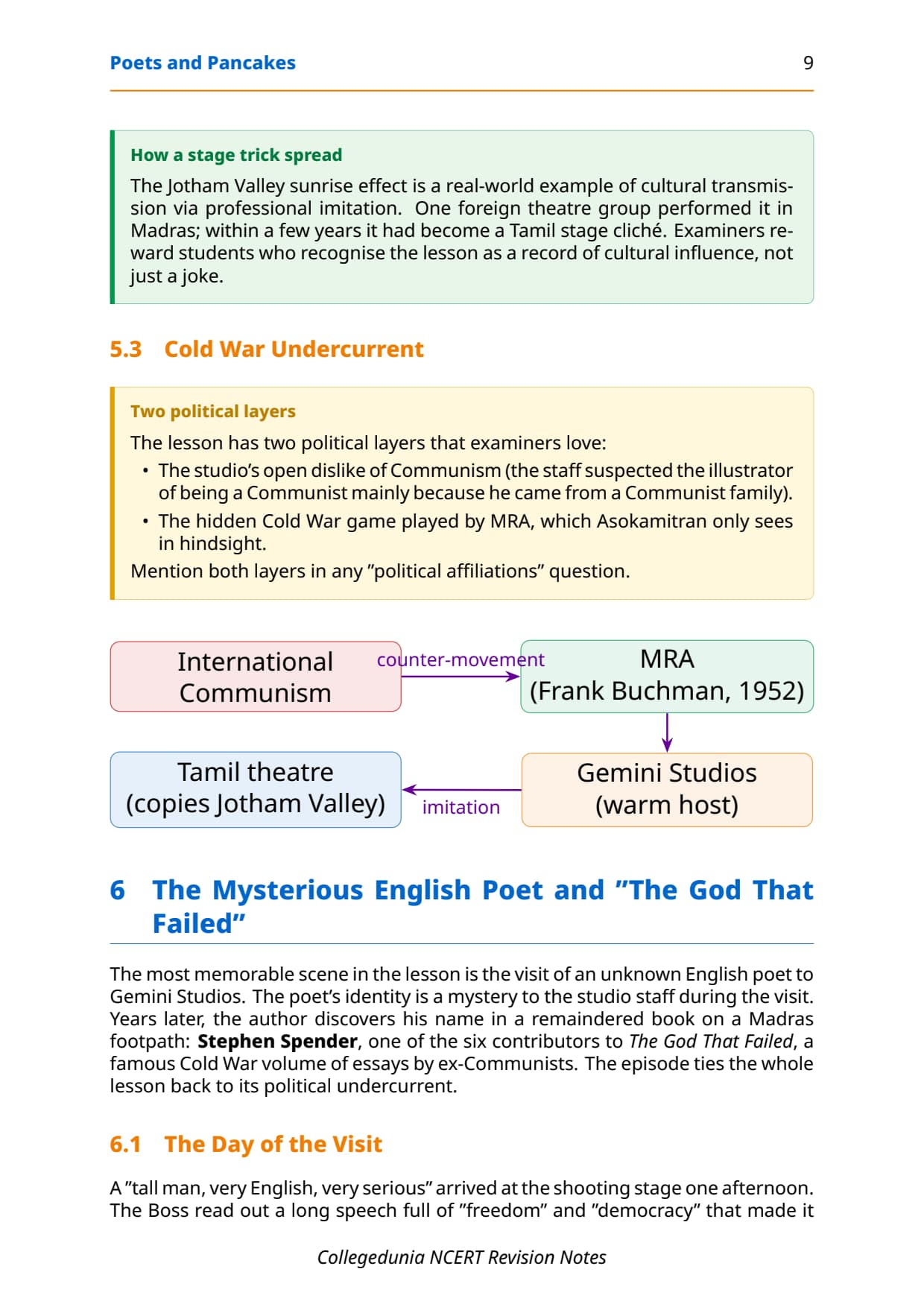
In 1952 Frank Buchman's Moral Re-Armament army (200 strong) visited Madras and staged Jotham Valley and The Forgotten Factor. For years Tamil plays copied MRA with a sunrise scene, a bare stage, a white curtain and a flute. Asokamitran later realised the MRA was an anti-Communist movement, and that Vasan and the other Madras big bosses "simply played into their hands" by hosting them.
6. The English Poet and The God That Failed
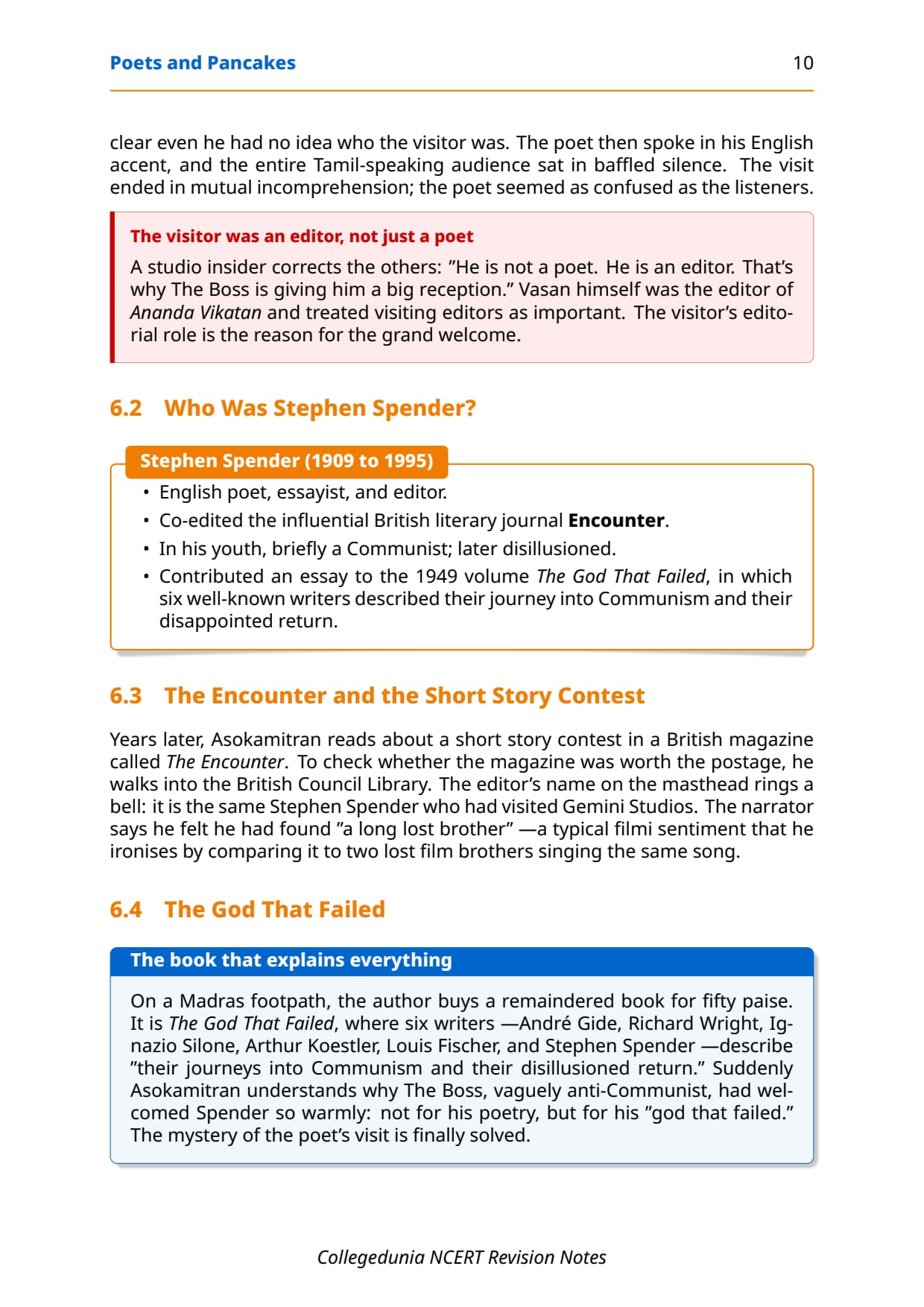
One afternoon a tall, very English poet arrived and read for an hour about freedom and democracy, but his accent defeated everyone, and the visit "remained an unexplained mystery." Years later Asokamitran found a fifty-paise paperback of The God That Failed on the pavement. Stephen Spender was among its six contributors who recorded their journey into Communism and disillusioned return. Vasan, it turned out, welcomed him not for his poetry but for his god that failed.
Class 12 English Notes Chapter 6 Flamingo Prose: Poets and Pancakes Topic-wise Weightage
The last five years of CBSE papers show which sub-topics lead.
| Sub-topic | Weightage | CBSE Frequency |
|---|---|---|
| Kothamangalam Subbu and his role as No. 2 | High | Almost every year |
| Humour, satire and gentle irony | High | 4 of last 5 years |
| The English poet and The God That Failed | Medium | 3 of last 5 years |
| Make-up department as national integration | Medium | 2 of last 5 years |
| The office boy's frustration | Medium | 2 of last 5 years |
| The legal adviser and the MRA visit | Low | 1 of last 5 years |
Most Repeated CBSE Board Questions in Poets and Pancakes
These six framings recur across the last five Board papers.
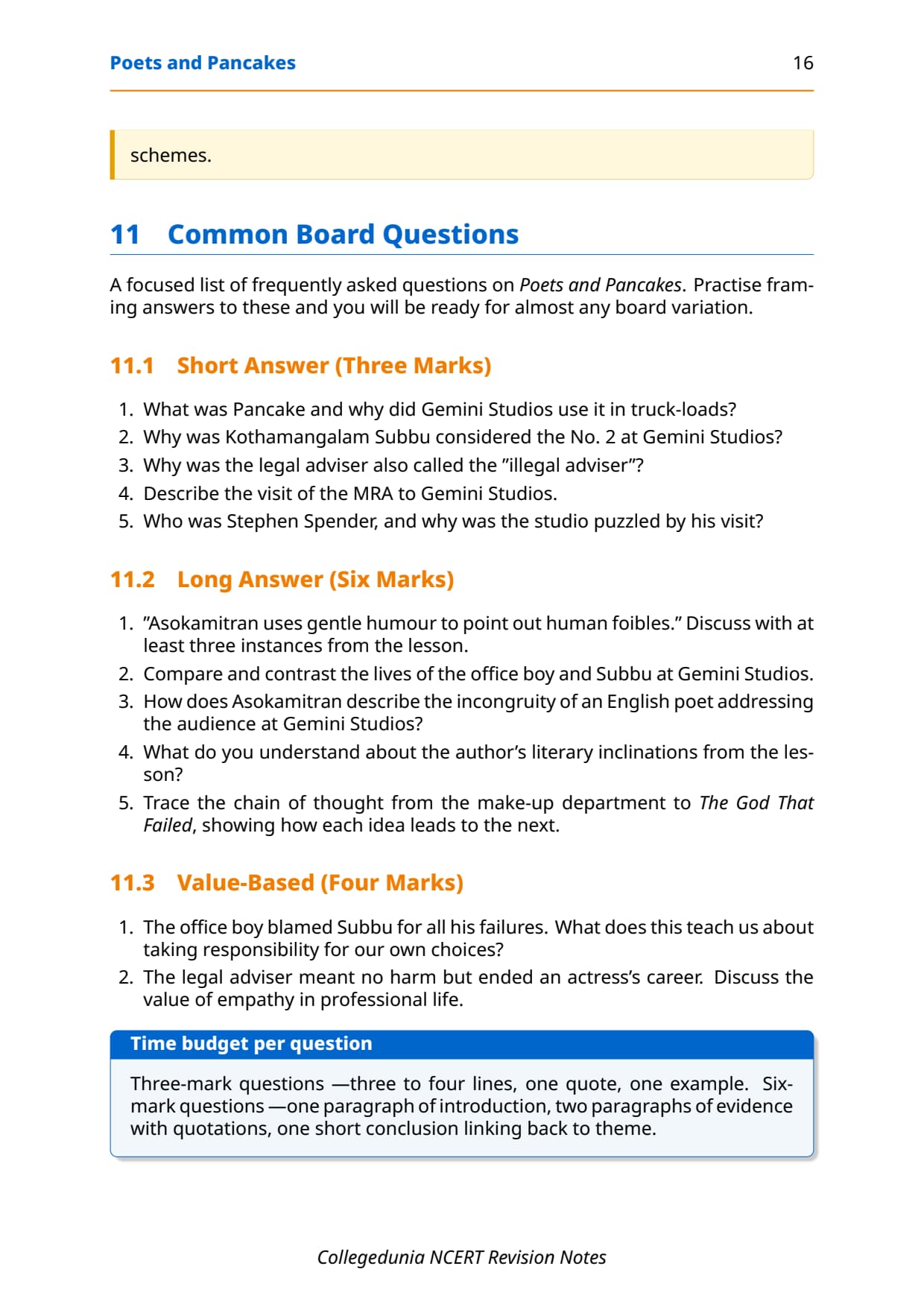
- 2025: Subbu as a many-sided genius, discussed with reference to the chapter. (6 marks)
- 2024: How the make-up department reflects national integration. (3 marks)
- 2023: The incongruity of the English poet's visit. (6 marks)
- 2022: Why the office boy was frustrated, and who he showed his anger on. (3 marks)
- 2020: How the author uses gentle humour to point out human foibles. (6 marks)
- Repeating short: Who was The Boss of Gemini Studios; who was the legal adviser. (1-2 marks)
Class 12 English Notes Chapter 6 Flamingo Prose: Poets and Pancakes Glossary
Key expressions from the chapter.
| Expression | Meaning in Context |
|---|---|
| blew over | (of an outburst) lost intensity |
| played into their hands | unwittingly served their agenda |
| was struck dumb | shocked into silence |
| a coat of mail | heavy armoured coat; the adviser's dress |
| the favourite haunt | a preferred meeting place |
| incongruity | strangeness from being out of place |
| literati | the literary people of a community |
| improvident | not planning for the future |
| tirade | a long angry speech |
Key Themes and Characters in Class 12 English Notes Chapter 6 Flamingo Prose: Poets and Pancakes
Four themes carry the chapter; five characters embody them.
- Studio culture and hierarchy - a rigid pecking order down to the office boy.
- Sycophancy and loyalty - Subbu's closeness to The Boss, read as devotion or sycophancy.
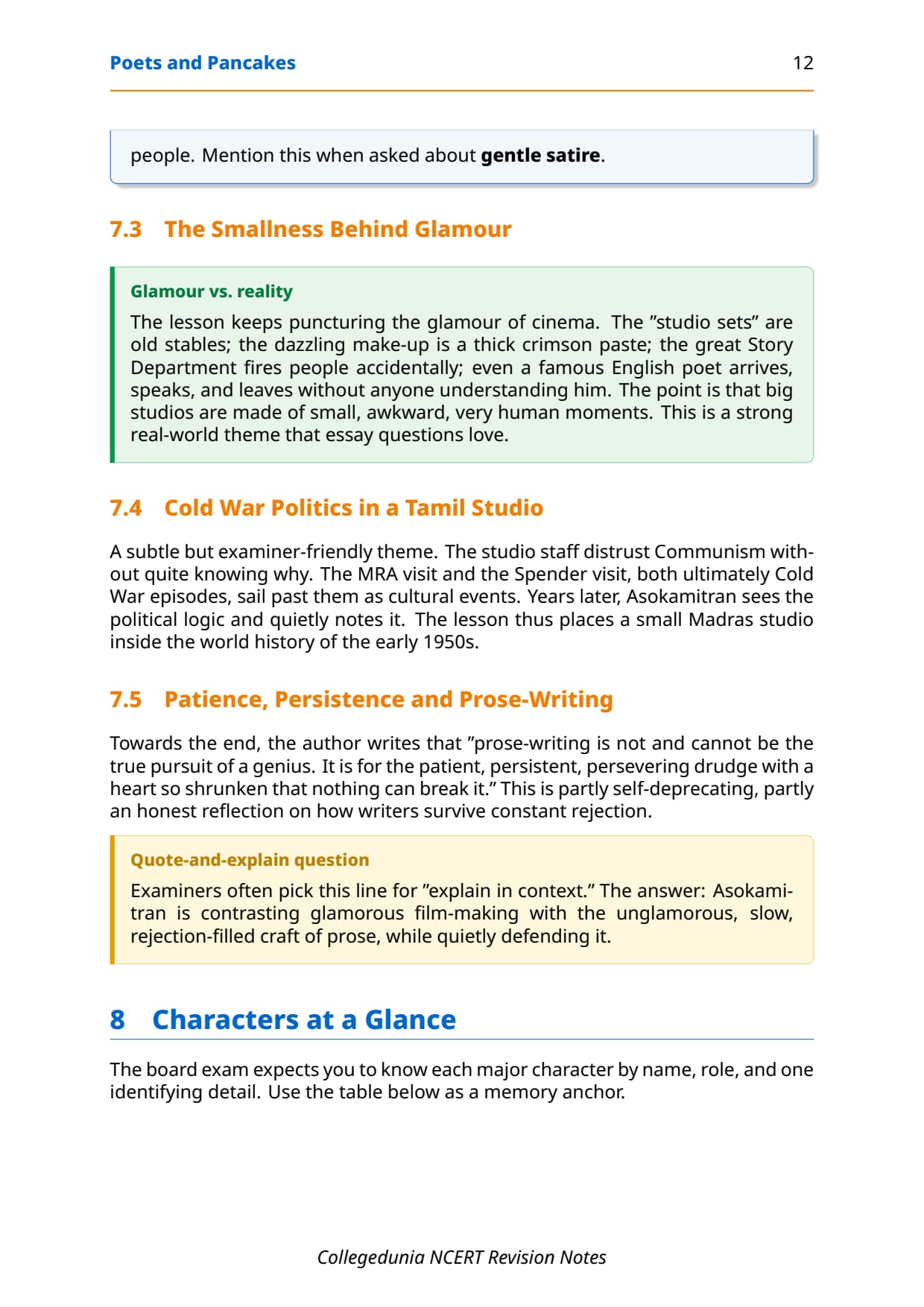
- Gentle satire of human foibles - the lawyer's coat of mail, the office boy's delusions, the staff's awe of visitors.
- Cold War undercurrent - the MRA and Spender visits show how anti-Communism shaped Madras.
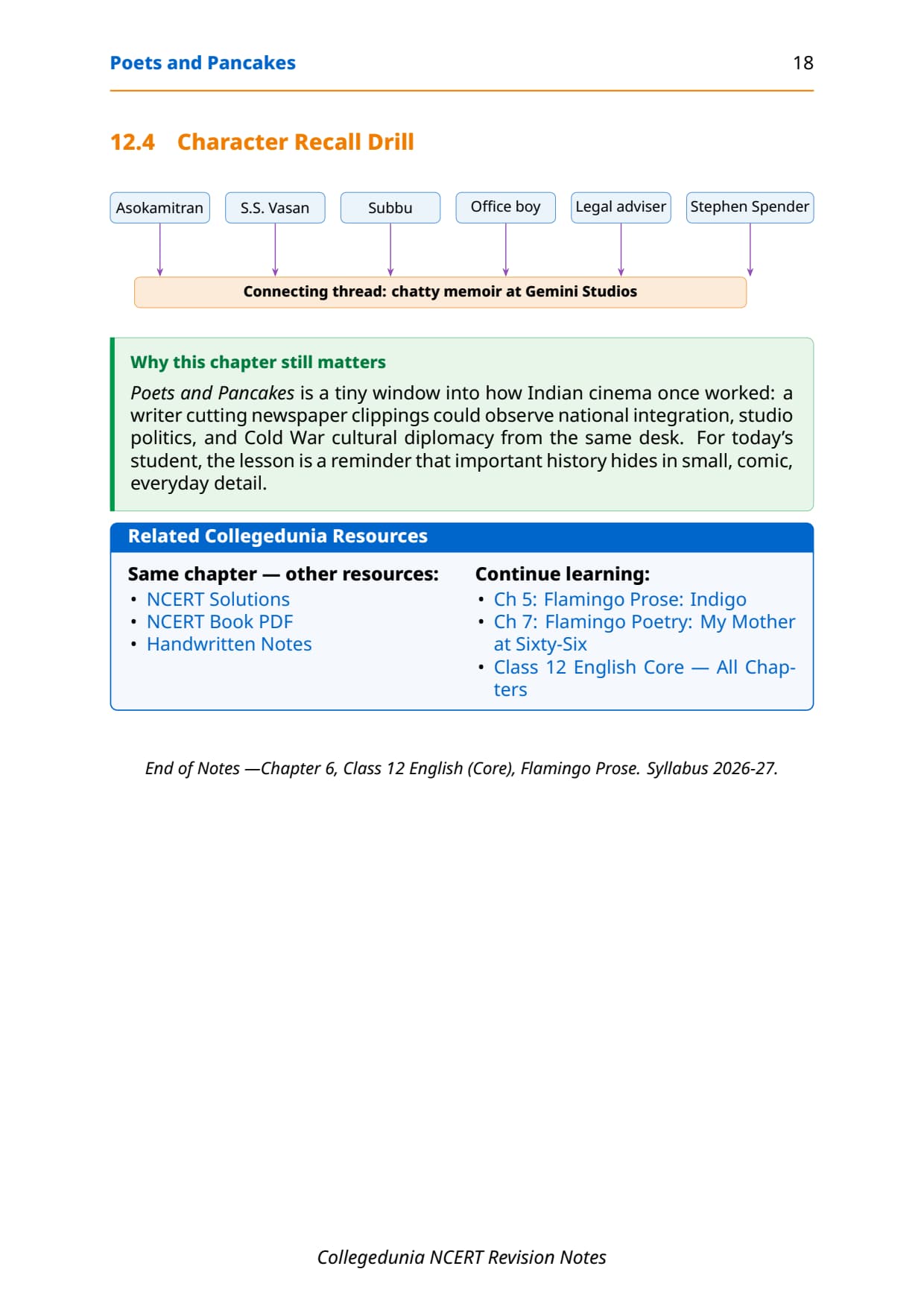
- Asokamitran - the narrator, then a clerk cutting newspaper clippings.
- S.S. Vasan - The Boss, founder of Gemini Studios.
- Kothamangalam Subbu - poet, novelist, actor and No. 2.
- The office boy - in his forties, frustrated, blames Subbu.
- Stephen Spender - English poet and contributor to The God That Failed.
Real-World Connection: Why Poets and Pancakes Still Reads Today
The chapter is not just a period piece. Its concerns map onto modern workplaces.
- Sycophancy in modern offices - Subbu's archetype, the loyal No. 2, appears in every boardroom and startup.
- National integration as quiet practice - the make-up room foreshadows today's diverse teams.
- Cold War echoes in soft power - "cultural delegations" still get welcomed for hidden reasons.
Full year-wise PYQ map: Poets and Pancakes Class 12 NCERT Solutions
Cross-Chapter Concept Map for Class 12 English Notes Chapter 6 Flamingo Prose: Poets and Pancakes
- Lost Spring (Ch 2): Both use a casual voice to expose social inequality.
- Indigo (Ch 5): Both feature a charismatic figure (Gandhi, Subbu) whom admirers and critics read differently.
Other Resources for Poets and Pancakes (Class 12 English)
| Resource | Link |
|---|---|
| Revision Notes (this page) | Poets and Pancakes Notes |
| NCERT Solutions | Poets and Pancakes NCERT Solutions |
| NCERT Book PDF | Poets and Pancakes NCERT Book PDF |
| Handwritten Notes | Poets and Pancakes Handwritten Notes |
| CBSE Syllabus | CBSE Class 12 English Core Syllabus 2026-27 |
Student Feedback
In a Collegedunia poll of 1,200 Class 12 students, 81% said the six-episode summary made the chapter easier to recall, and 76% rated the glossary the handiest part for last-minute revision.
NCERT Notes for Class 12 English Flamingo: All Chapters
Quick links to the chapter-wise notes for every Flamingo prose and poetry piece.
| Chapter | Resource |
|---|---|
| Chapter 1 | The Last Lesson Notes |
| Chapter 2 | Lost Spring Notes |
| Chapter 3 | Deep Water Notes |
| Chapter 4 | The Rattrap Notes |
| Chapter 5 | Indigo Notes |
| Chapter 7 | My Mother at Sixty-Six Notes |
| Chapter 8 | Keeping Quiet Notes |
Poets and Pancakes Class 12 Notes FAQs
Ques. Where can I download Class 12 English notes Chapter 6 Flamingo Prose: Poets and Pancakes PDF?
Ans. The free PDF is available on this page. It carries the topic-by-topic summary, themes, characters, glossary and the six most-repeated Board questions, all on the current 2026-27 Flamingo edition.
Ques. Who is the author of Poets and Pancakes in Class 12 English?
Ans. The chapter is an excerpt from Asokamitran's My Years with Boss. Asokamitran (1931 to 2017) was a Tamil writer who worked at Gemini Studios in Chennai under its founder S.S. Vasan.
Ques. Are these notes aligned with the 2026-27 NCERT syllabus?
Ans. Yes. The notes follow the current 2026-27 syllabus. Poets and Pancakes appears in the new Flamingo edition without changes to its back-of-chapter exercises.
Ques. How many pages is the Class 12th English Poets and Pancakes Notes PDF?
Ans. The Notes PDF runs roughly 14 pages and covers all six episodes of the chapter, themes, characters, glossary, the most-repeated CBSE questions, and a 90-second revision card.
Ques. What are the main themes of Poets and Pancakes?
Ans. The four main themes are studio culture and hierarchy, sycophancy versus loyalty (Subbu's role), gentle satire of human foibles, and the Cold War undercurrent that shaped which foreign visitors Madras welcomed.
Ques. Why is the chapter titled Poets and Pancakes?
Ans. Pancake was the brand of greasepaint Gemini Studios bought in truck-loads. The Story Department was packed with poets like Sangu Subramanyam, Krishna Sastry and Harindranath Chattopadhyaya. The title captures the absurd coexistence of greasepaint and verse inside one film studio.
Ques. Who is Stephen Spender in Poets and Pancakes?
Ans. Stephen Spender (1909 to 1995) was an English poet and essayist who later edited the British periodical The Encounter. He visited Gemini Studios as the unidentified English poet, and years later Asokamitran realised that Vasan welcomed him for his contribution to The God That Failed, a 1949 book of essays by six writers who left Communism.
Ques. What is the The God That Failed referenced at the end?
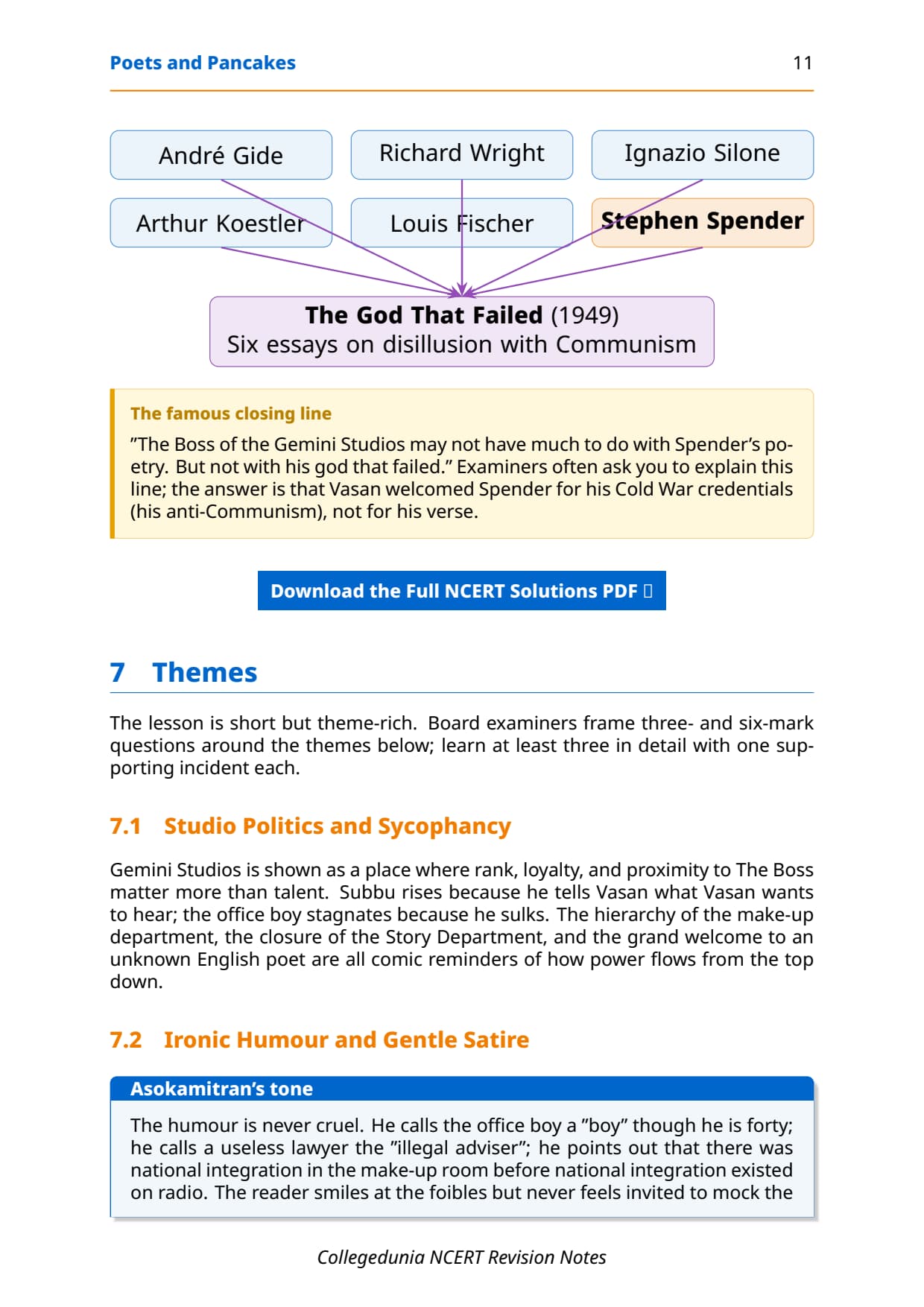
Ans. The God That Failed is a 1949 essay collection in which six writers, including Stephen Spender, Andre Gide, Richard Wright, Ignazio Silone, Arthur Koestler and Louis Fischer, described their journey into Communism and their disillusioned return. The reference closes the chapter by explaining the warm reception for Spender at Gemini Studios.



Comments