




The NCERT Notes for Class 12 Legal Studies Chapter 2 Topics in Law bring together every statute, section number and landmark case that the CBSE board paper actually tests. The chapter is four laws in one, so these notes keep Contract, Tort, Property and Intellectual Property on separate tracks with their own tables.
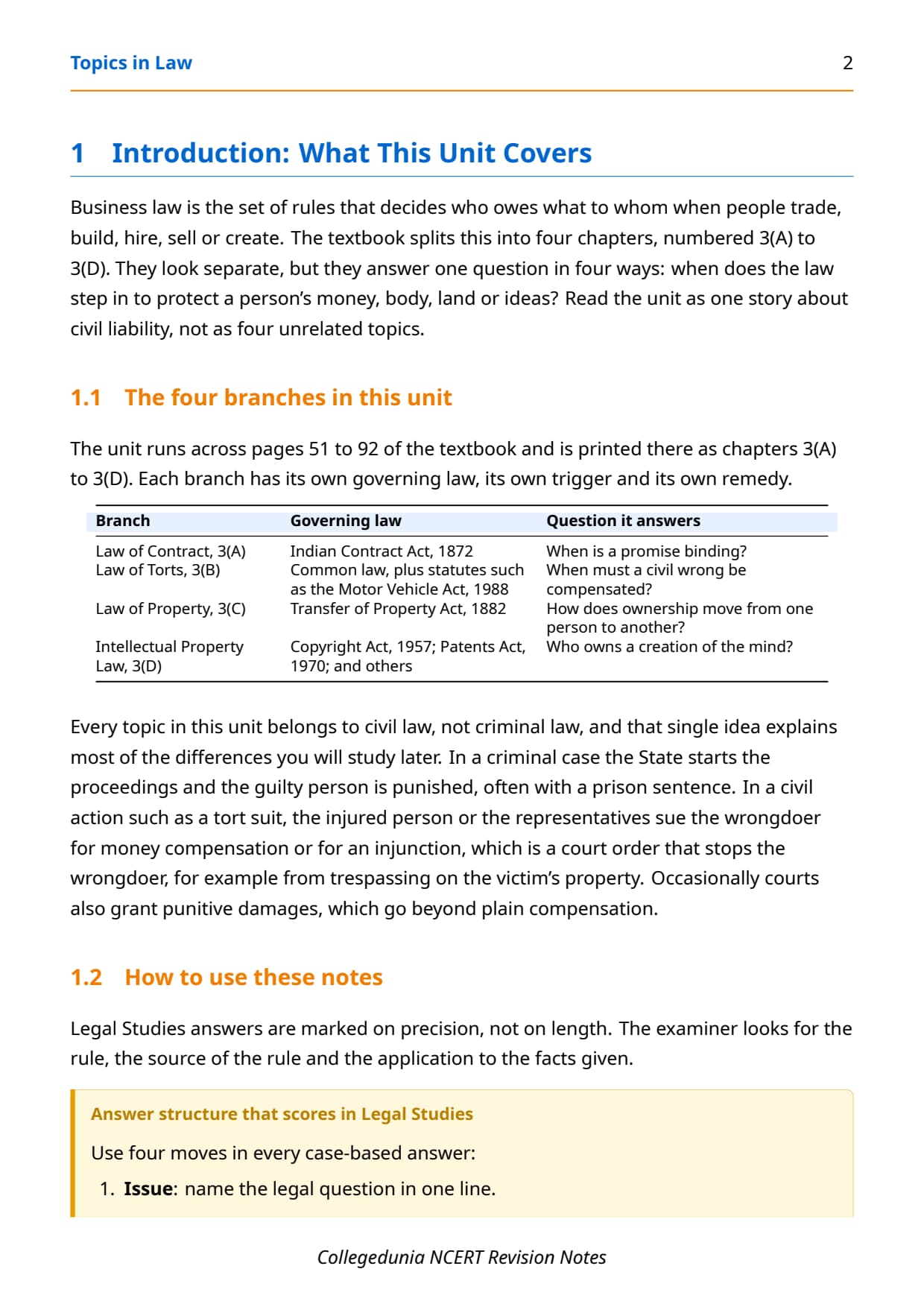
- Four branches, one unit: Law of Contract, Law of Torts, Law of Property and Intellectual Property Law.
- Section drill: every rule is written with its statute and section, the way Legal Studies answers are marked.
- Case bank: nine landmark judgments, from Balfour v. Balfour to Eastern Book Company v. D.B. Modak.
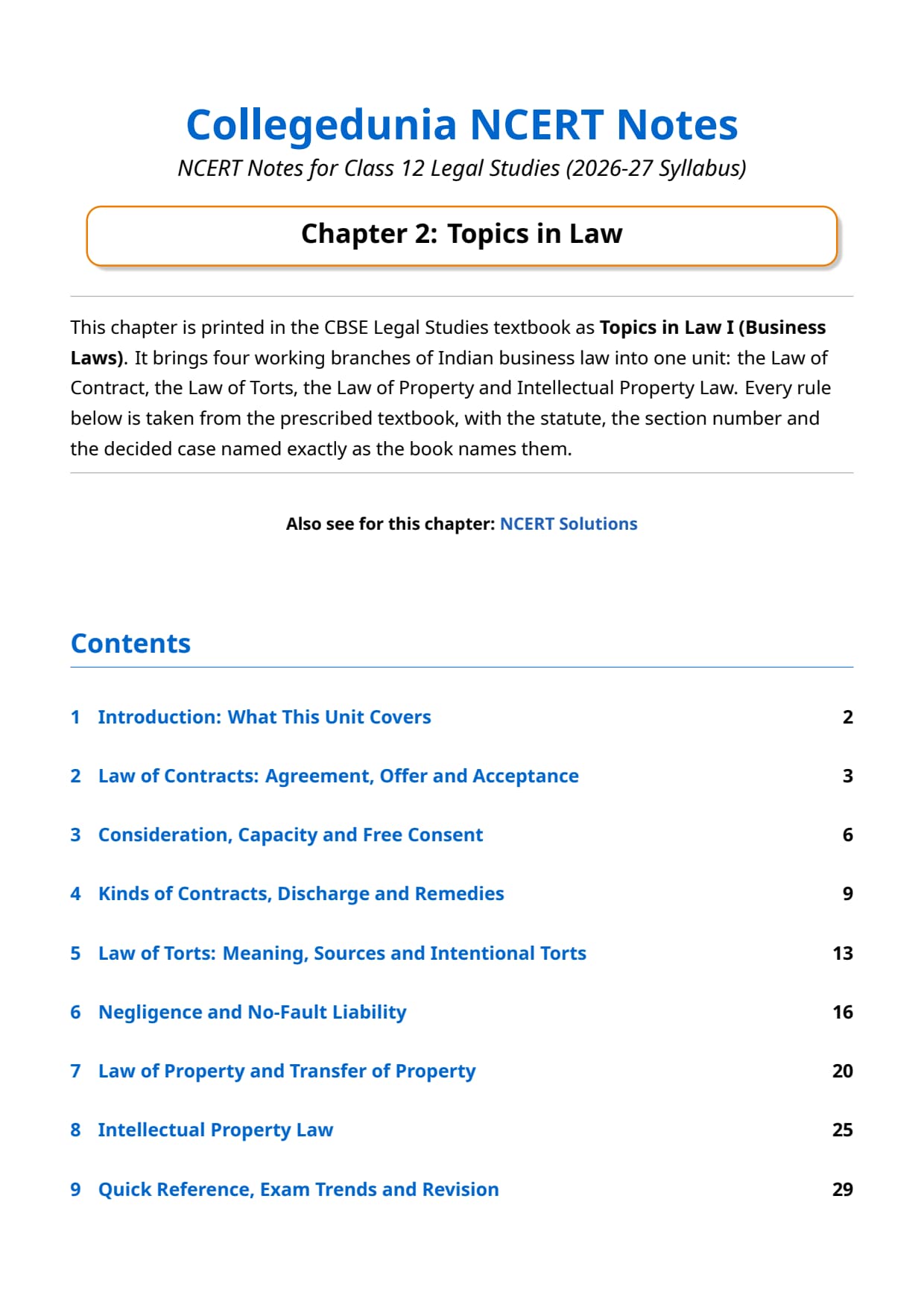
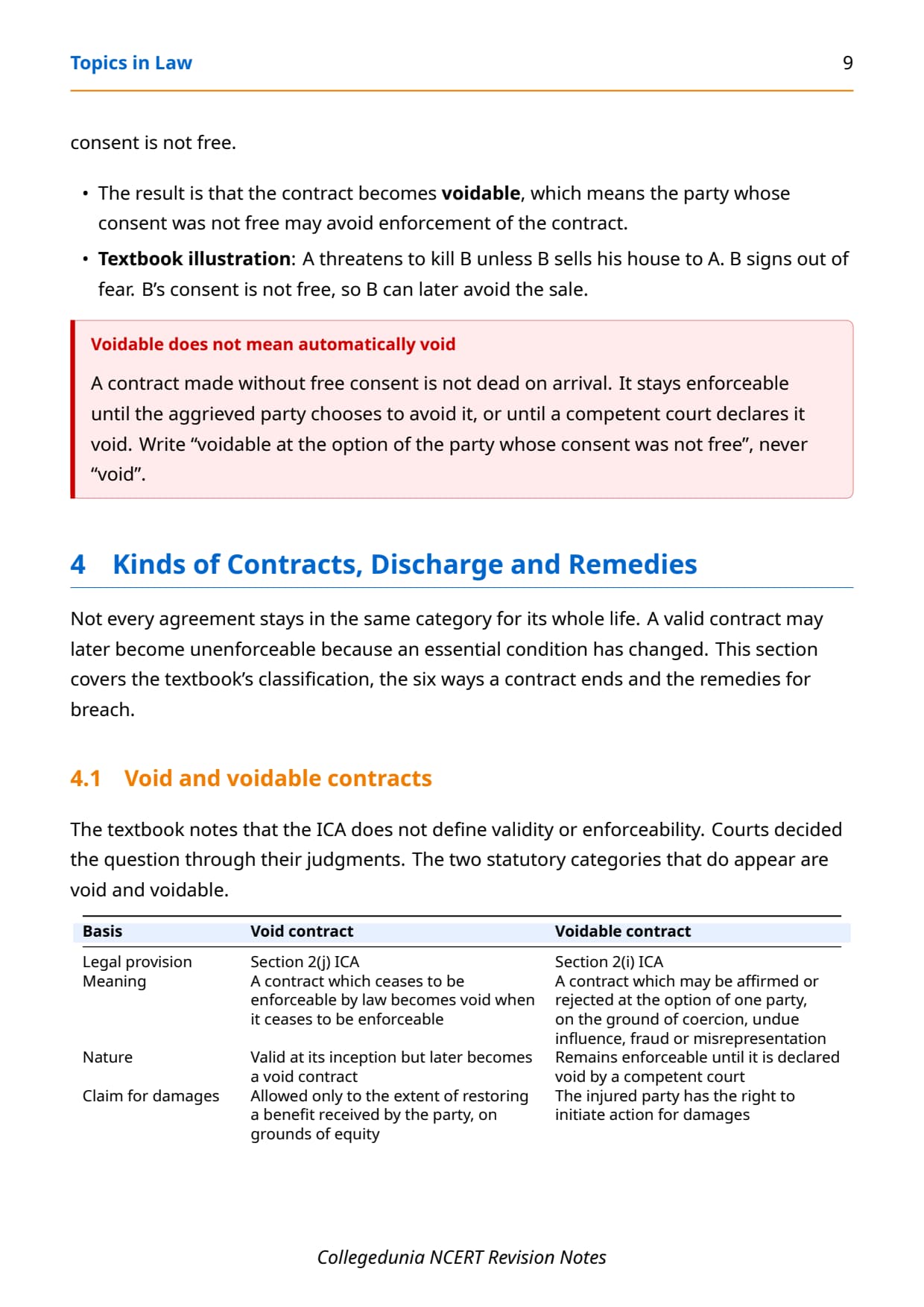
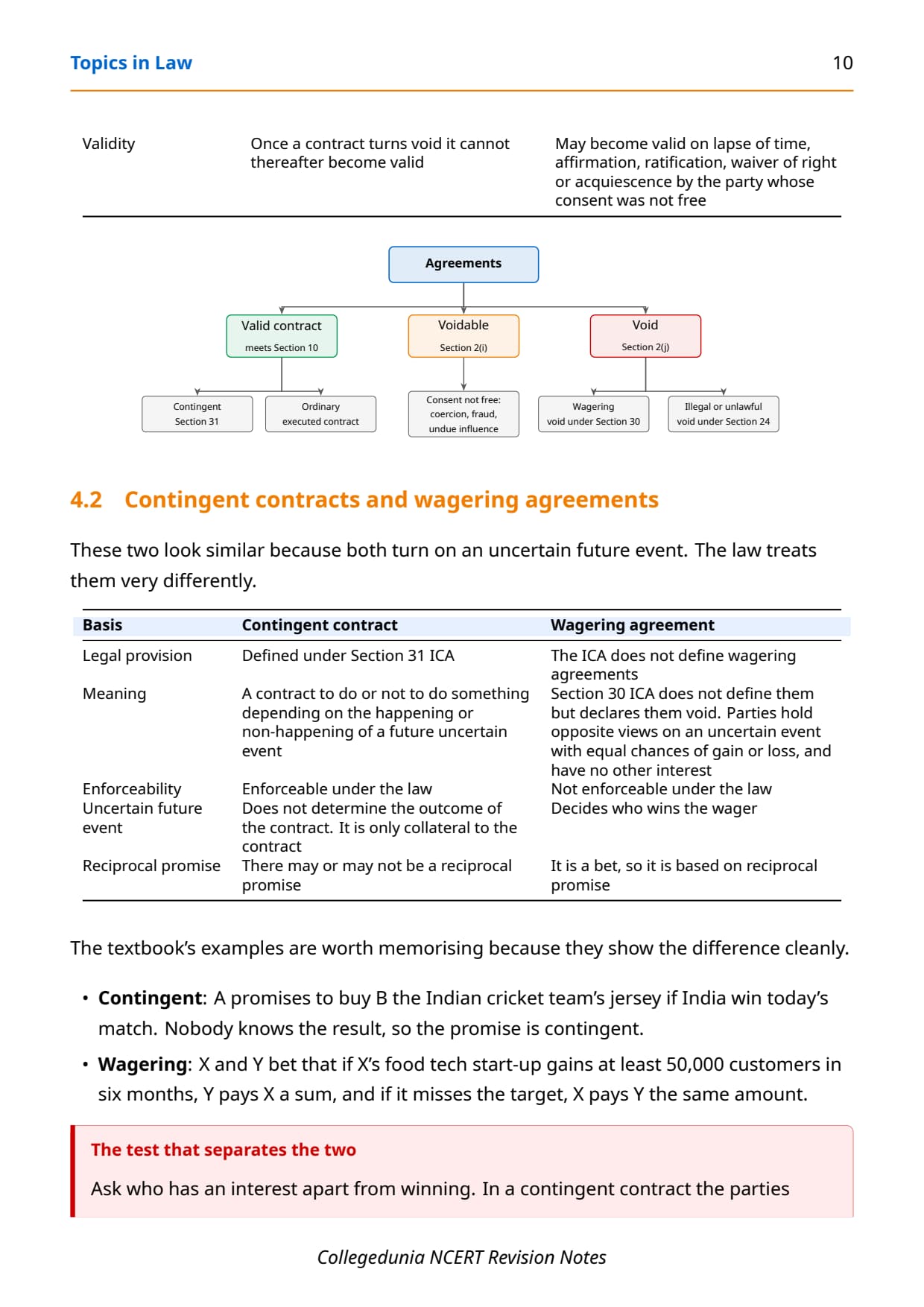
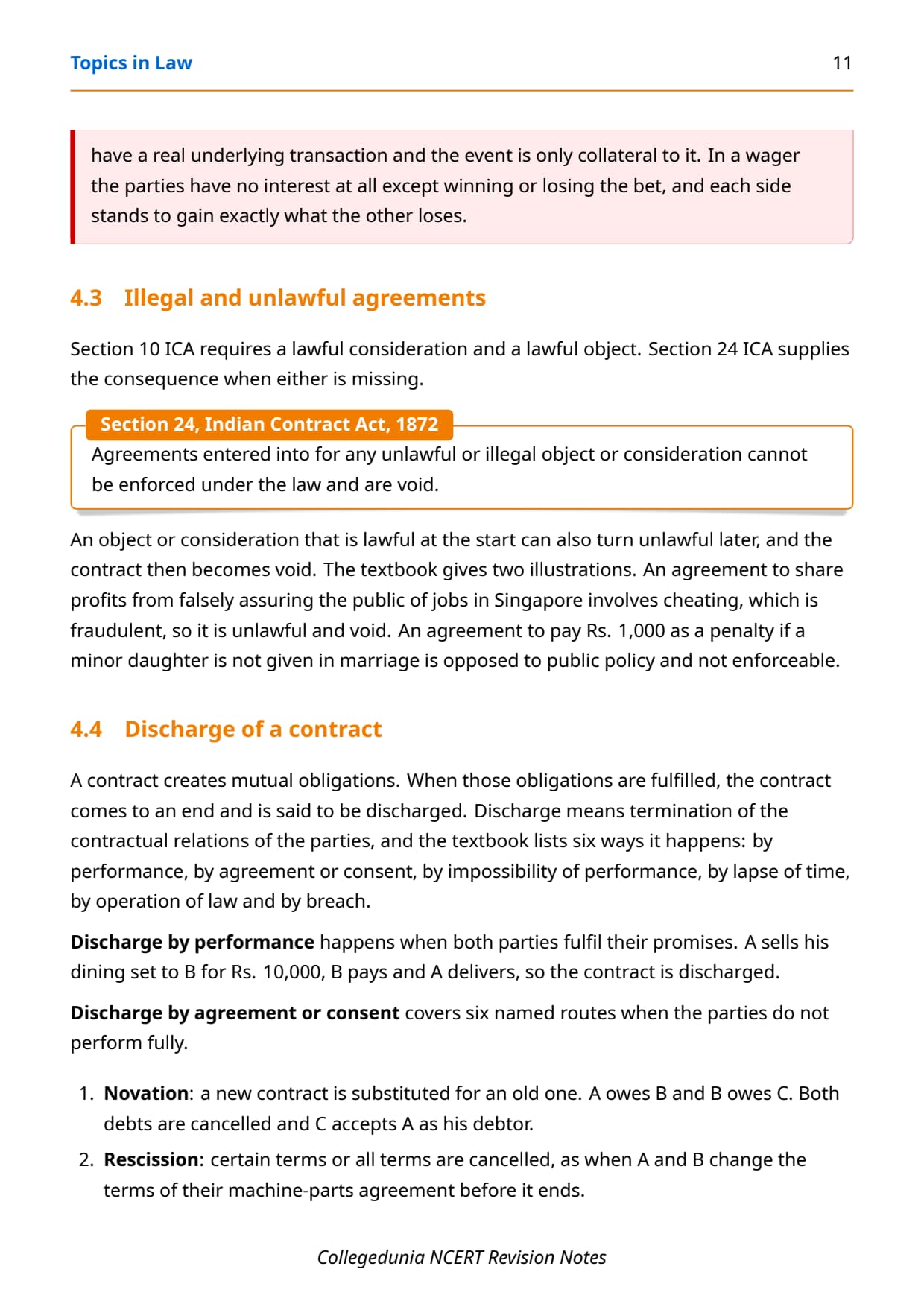
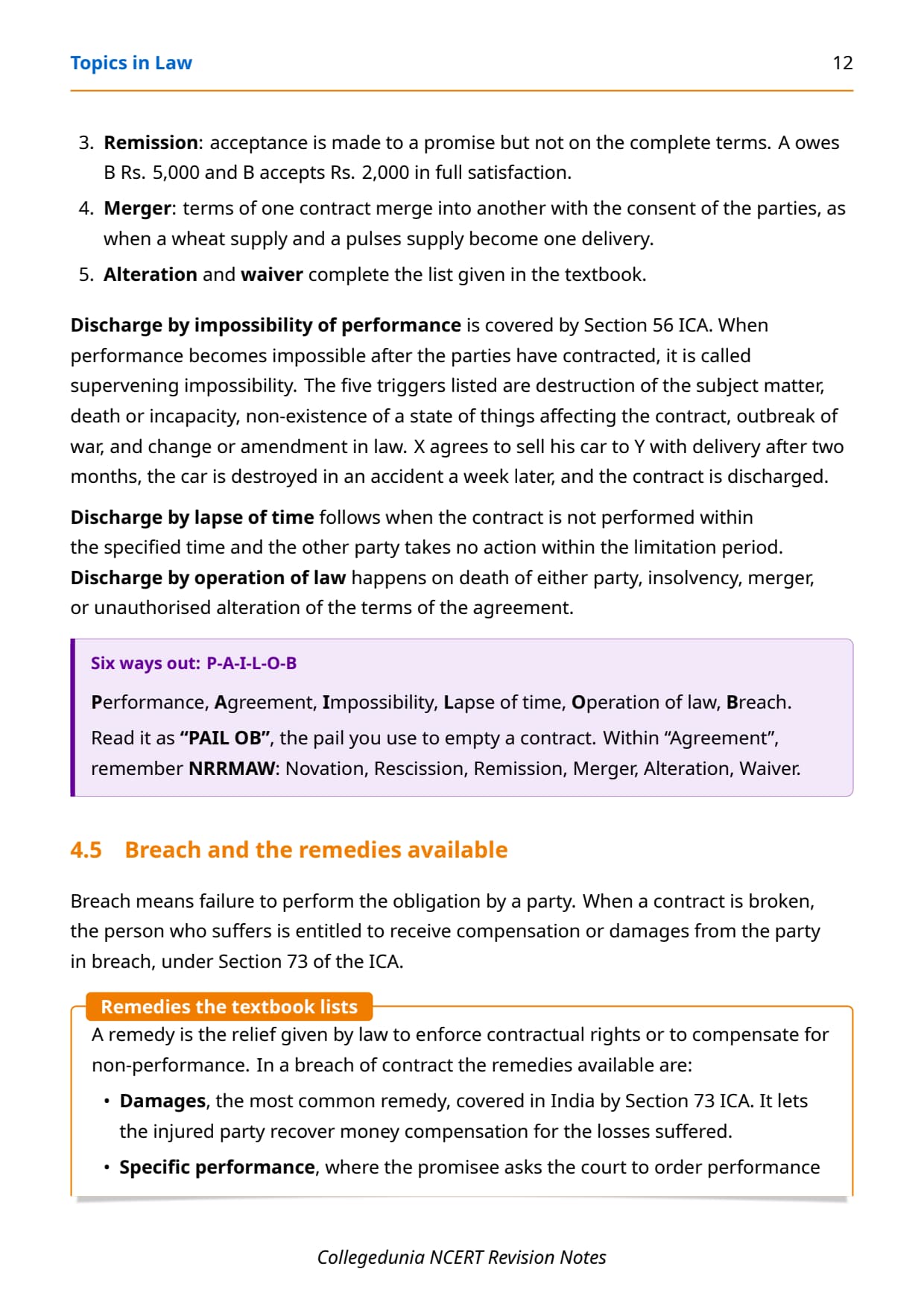
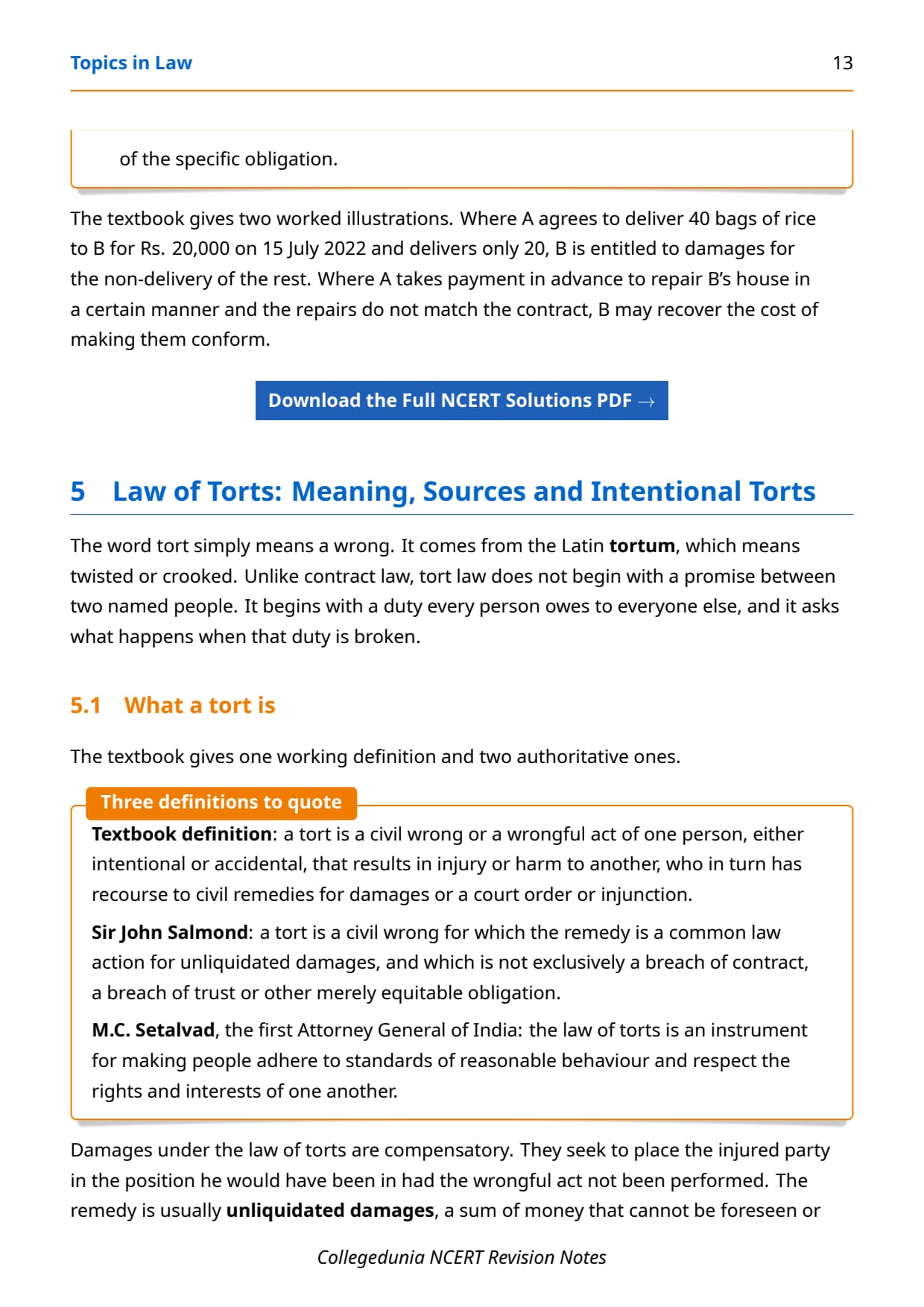
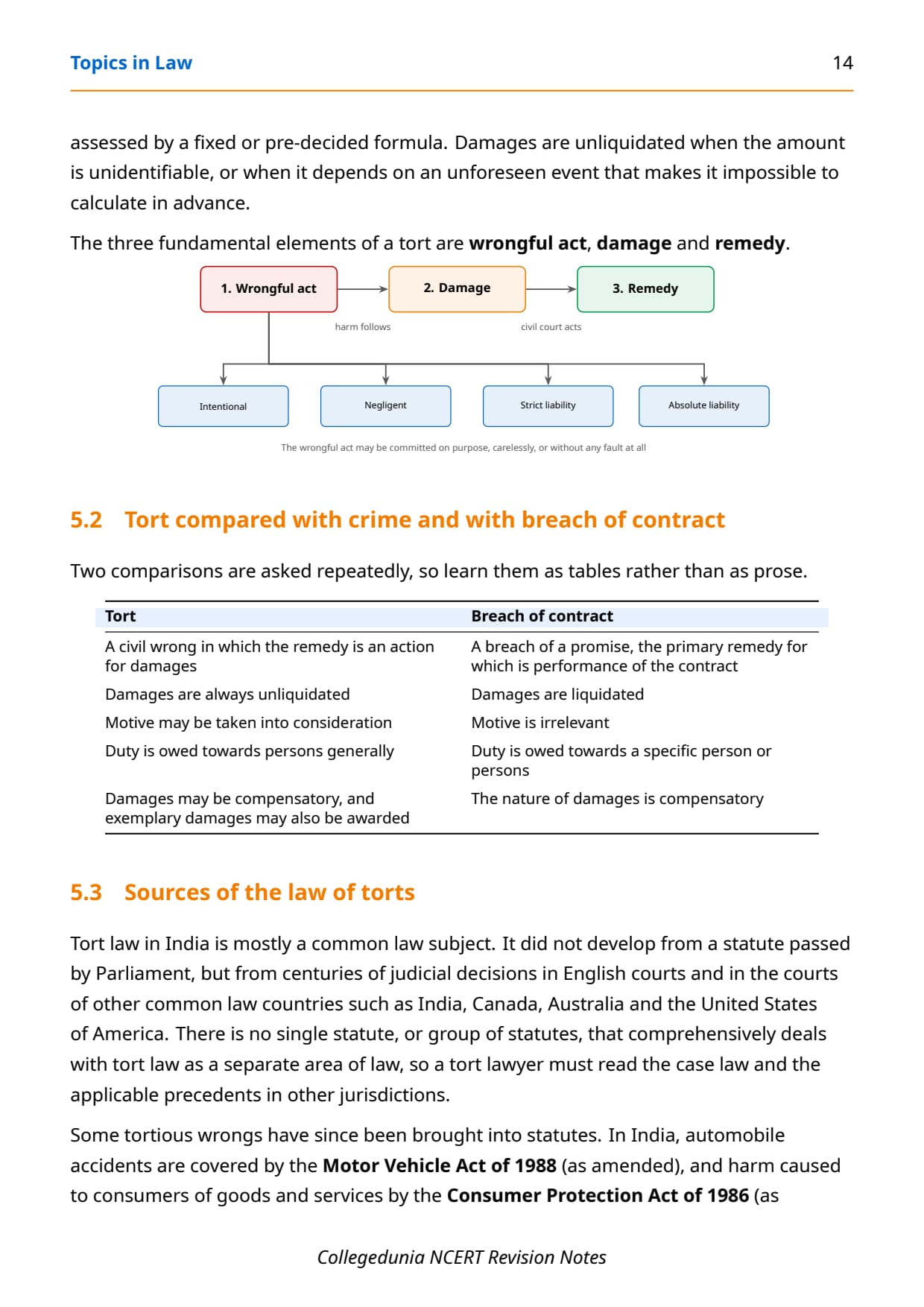
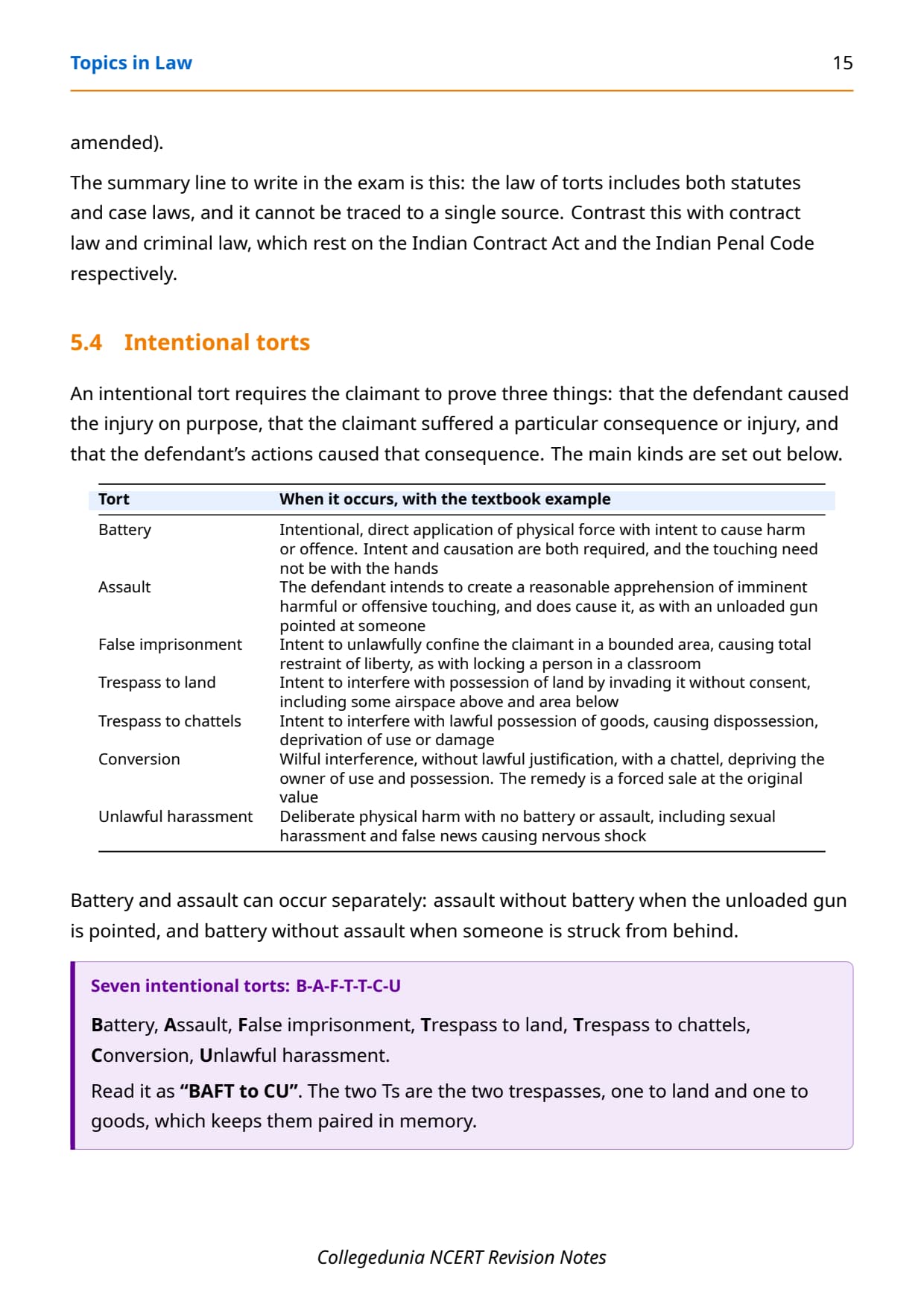
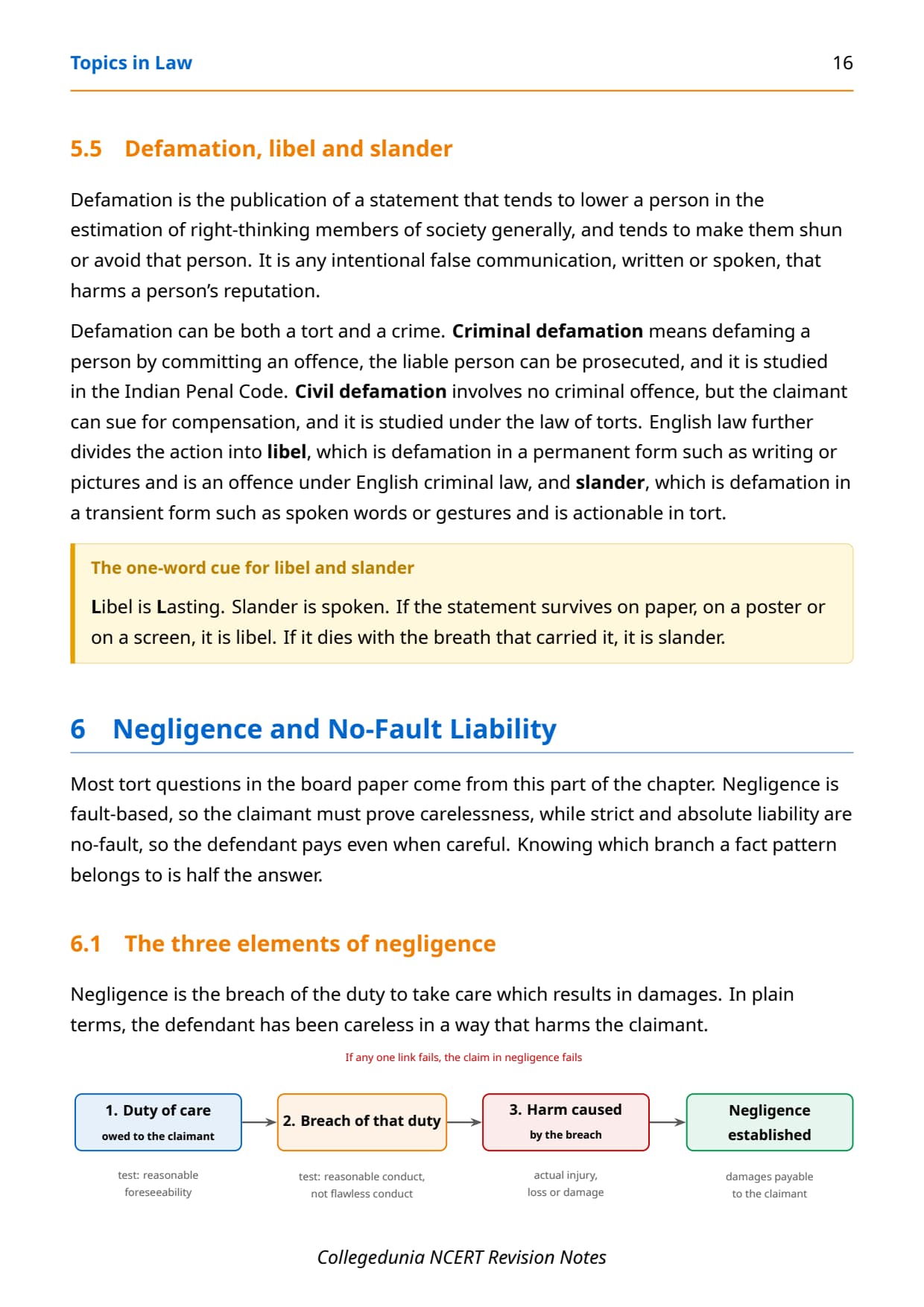
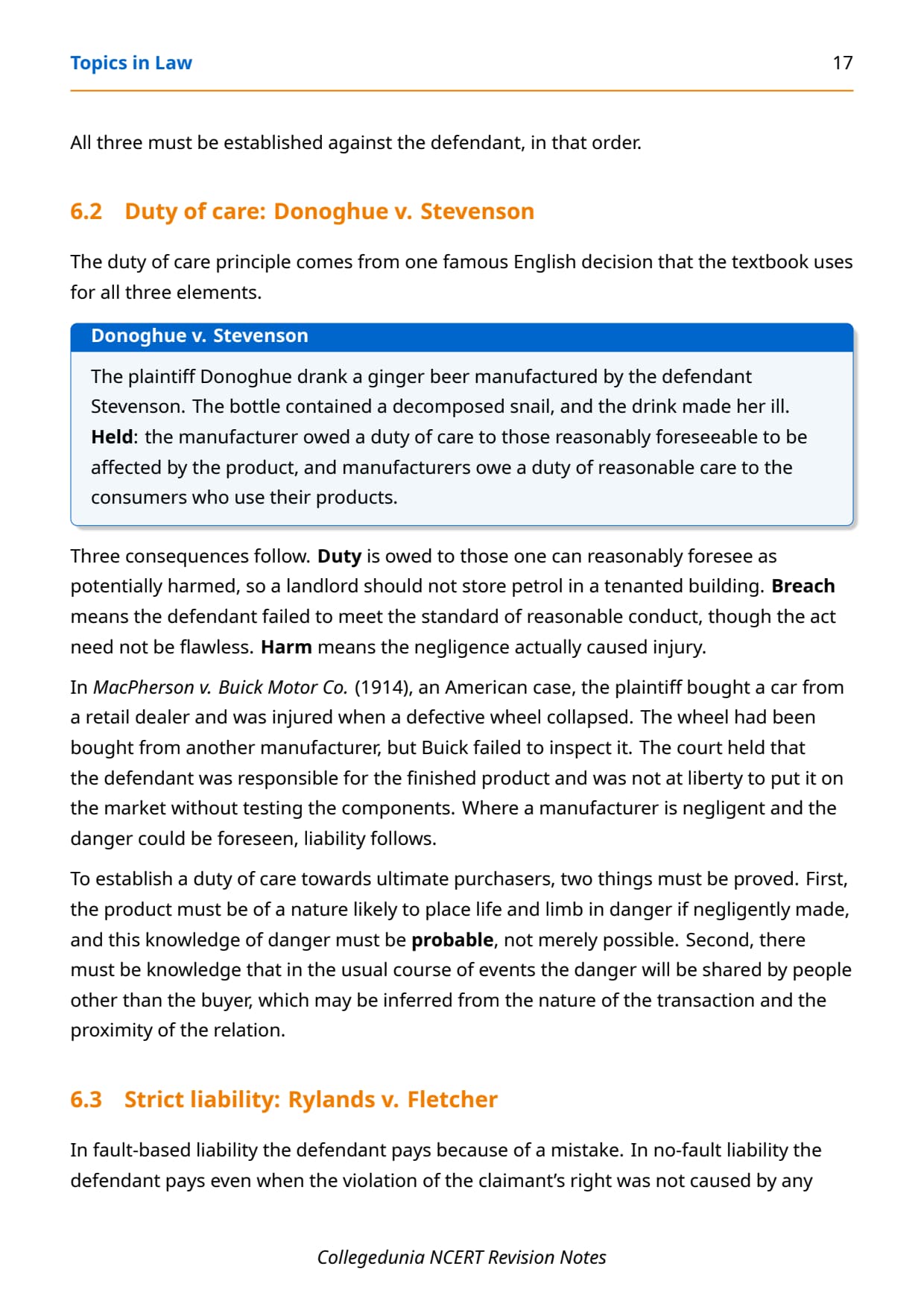
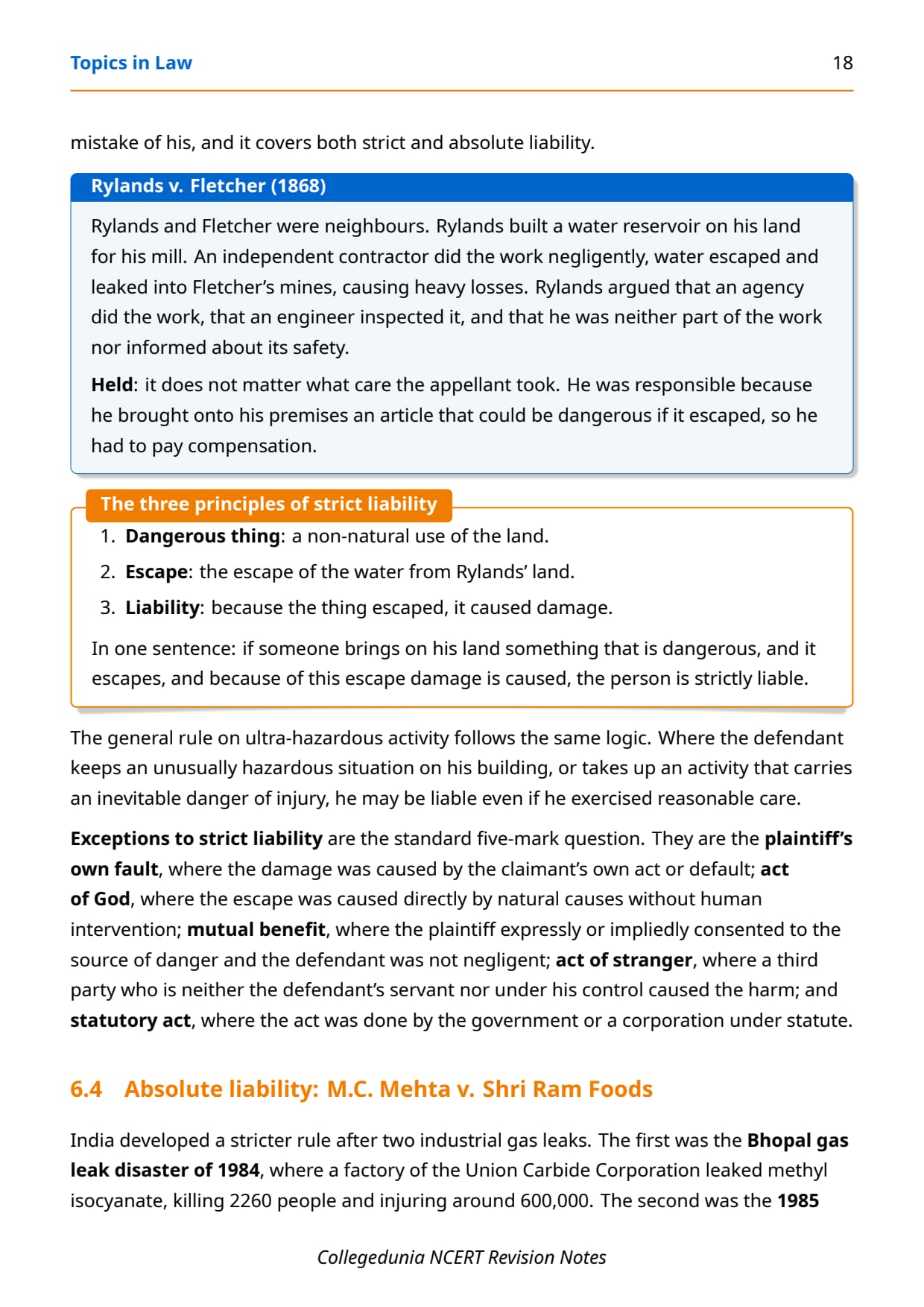
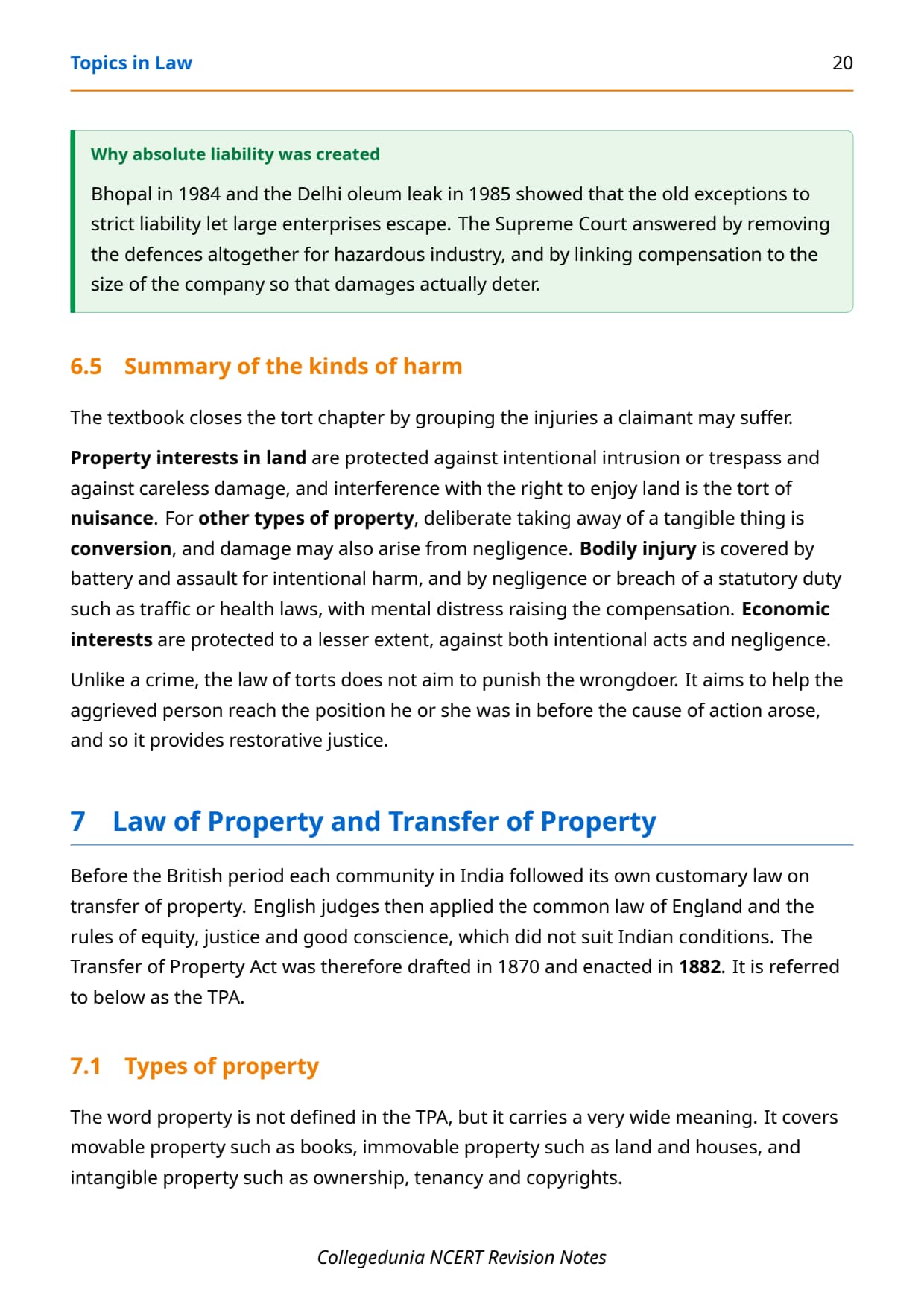
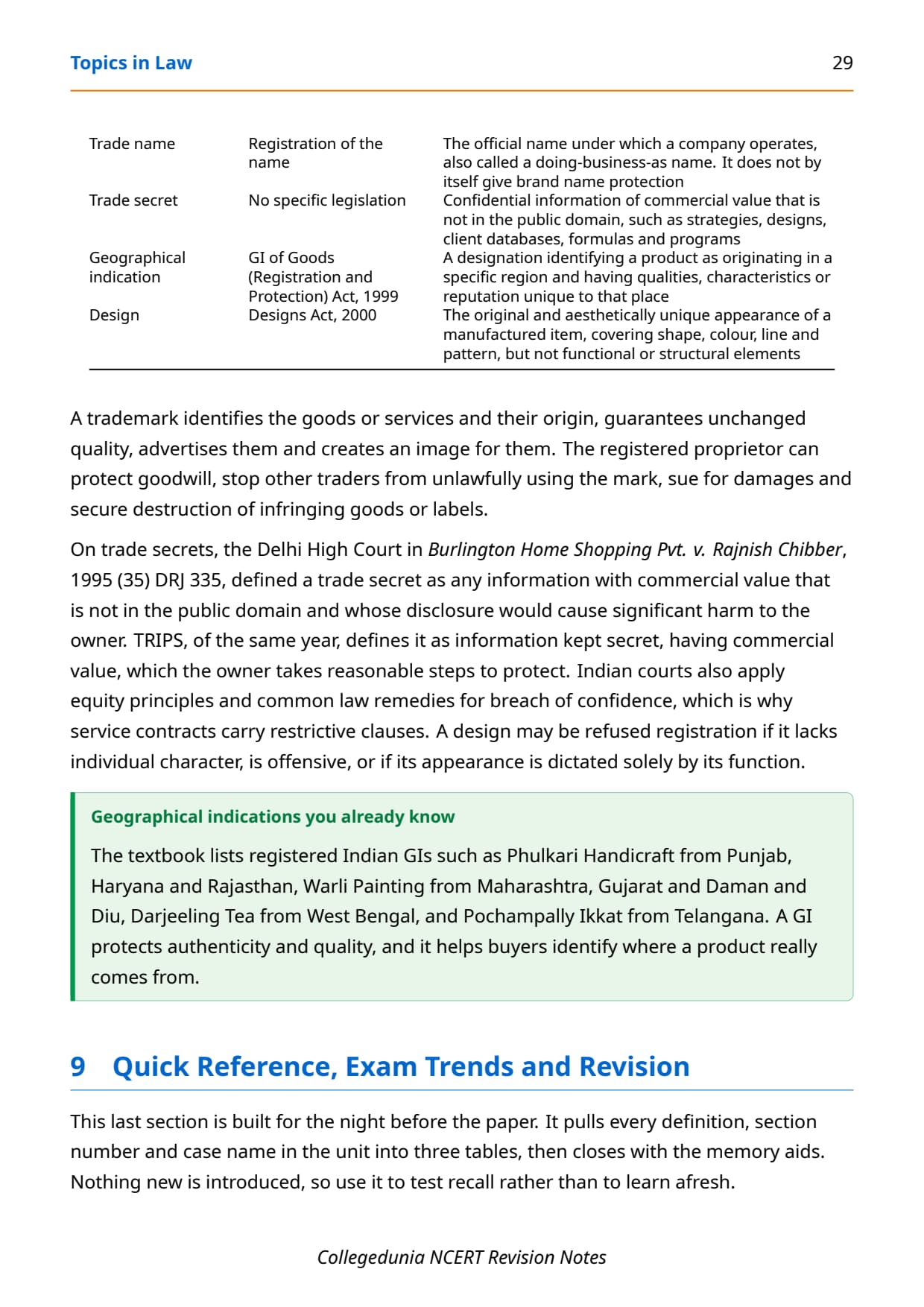
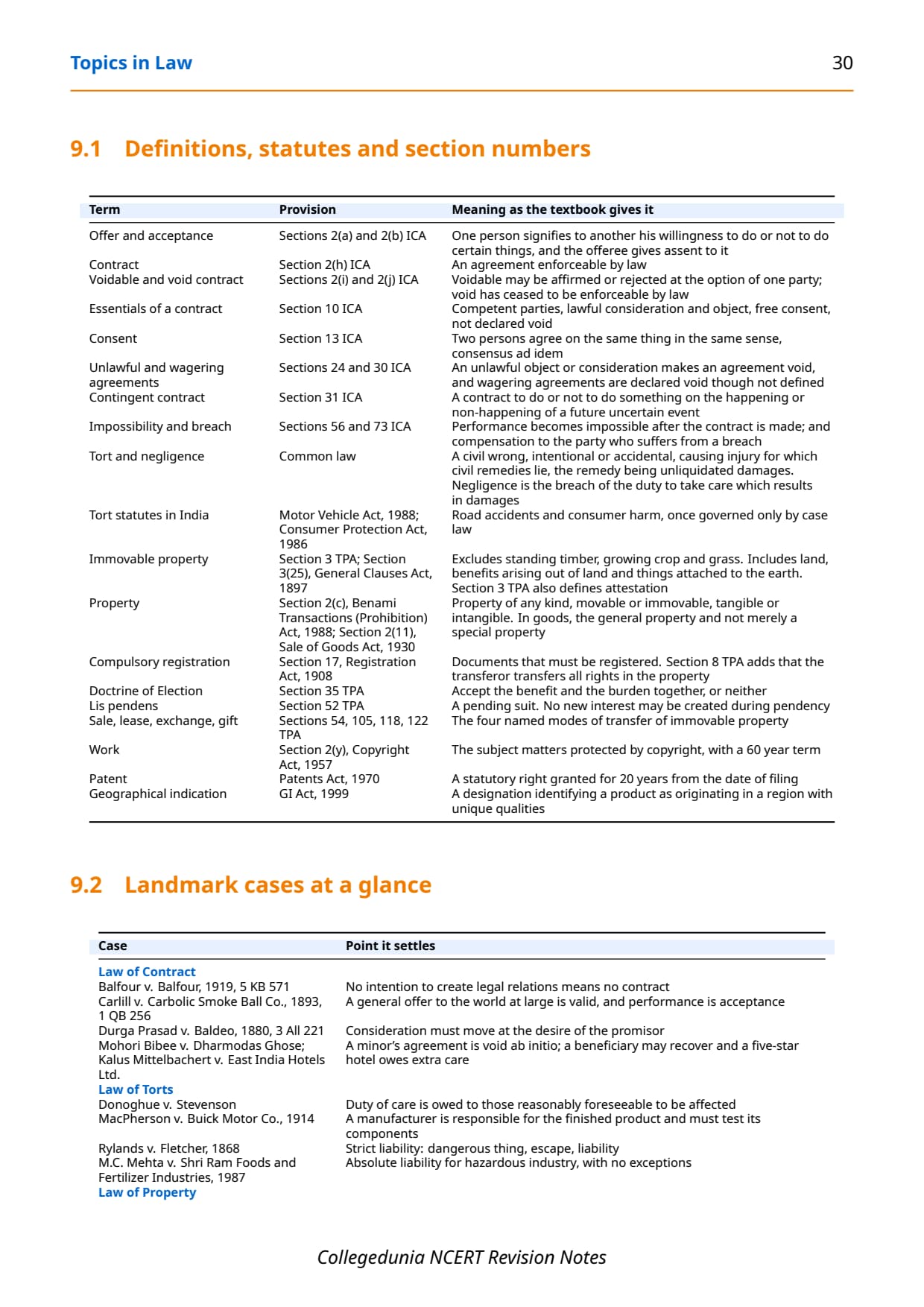
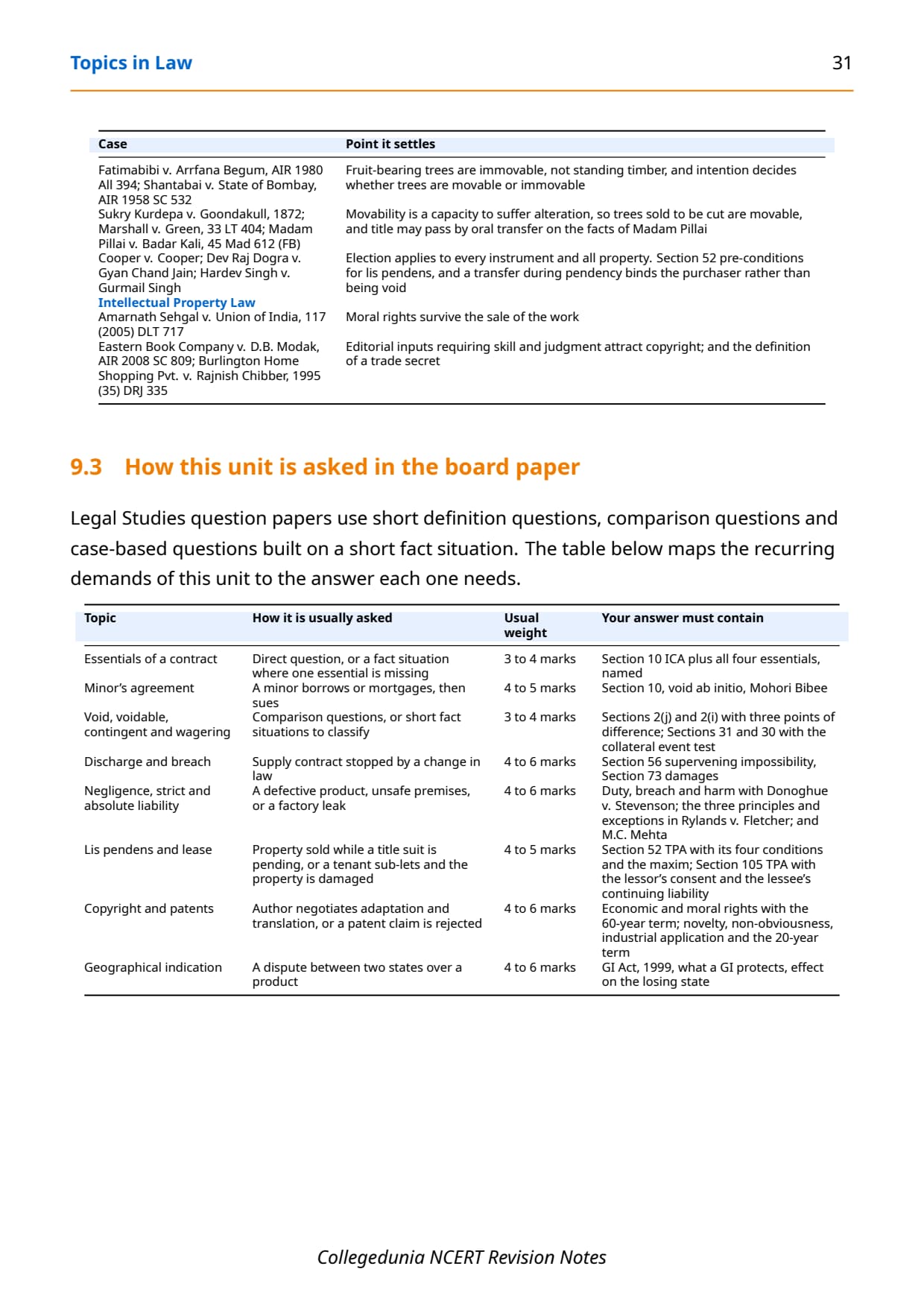
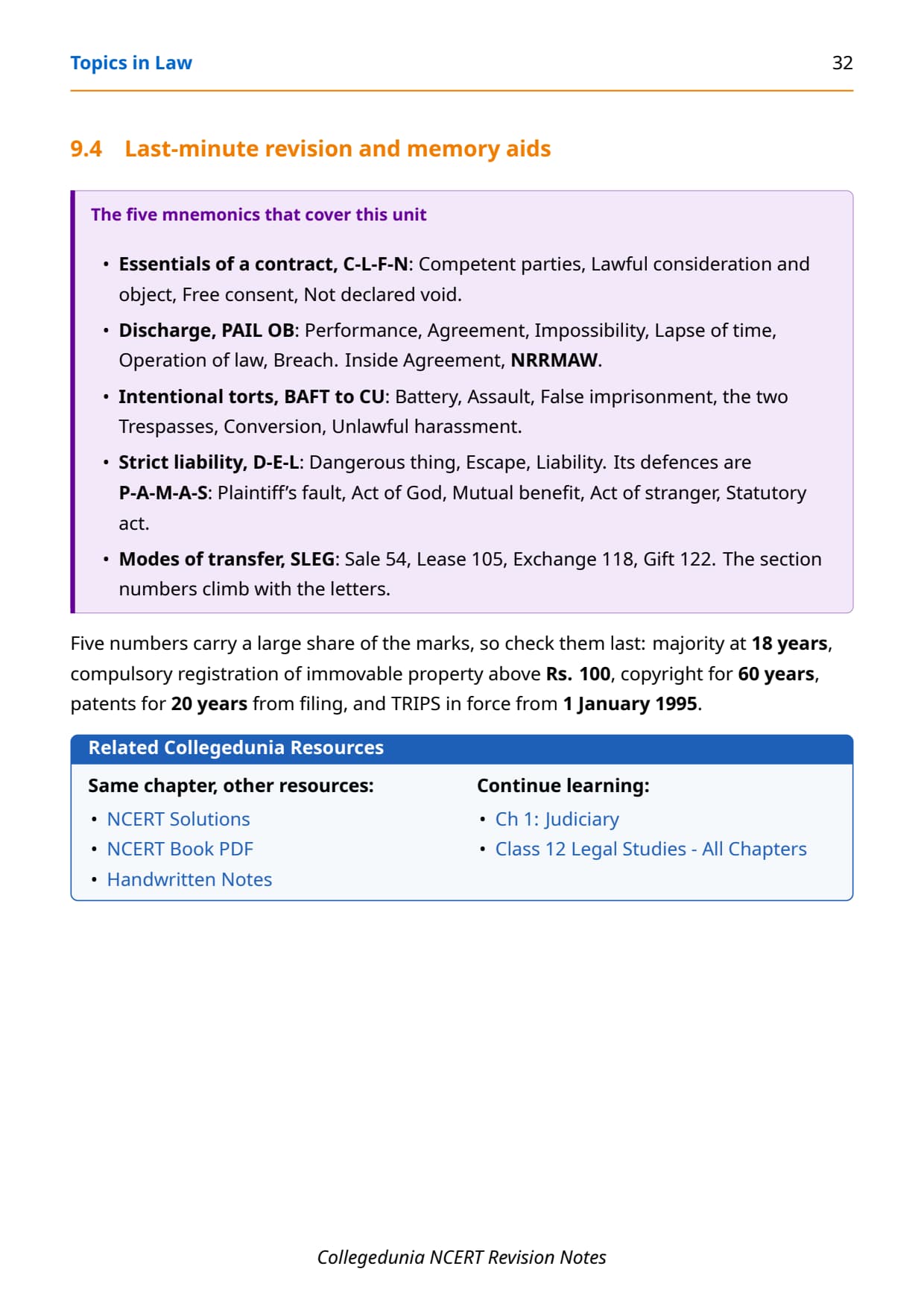
Every rule in these Topics in Law notes is checked line by line against the 2026-27 NCERT Legal Studies print, with statute names, section numbers and case citations quoted exactly as the textbook gives them.
What Topics in Law Covers: Four Business Laws in One Class 12 Unit
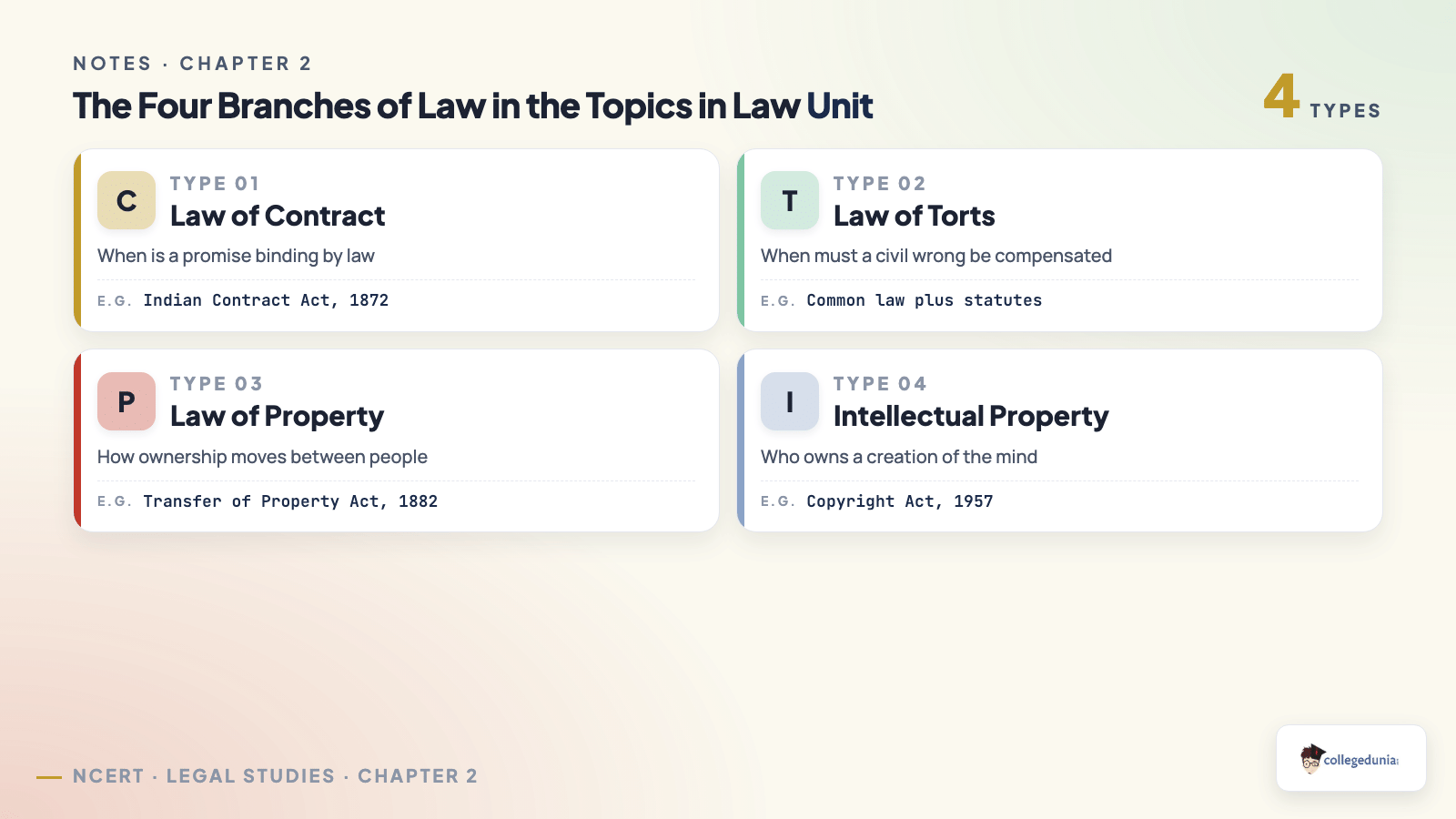
CBSE prints this material under the title Law I (Business Law) and splits it into four parts. They look unrelated, but all four answer the same question in different ways: when does the civil law step in to protect a person's money, body, land or ideas?
| Part | Governing law | Question it answers | Main remedy |
|---|---|---|---|
| Law of Contract | Indian Contract Act, 1872 | When is a promise binding? | Damages, specific performance |
| Law of Torts | Common law, with statutes such as the Motor Vehicle Act, 1988 | When must a civil wrong be compensated? | Unliquidated damages, injunction |
| Law of Property | Transfer of Property Act, 1882 | How does ownership move between people? | Valid or void transfer |
| Intellectual Property Law | Copyright Act, 1957; Patents Act, 1970 and others | Who owns a creation of the mind? | Exclusive statutory rights |
Everything in this unit is civil law, not criminal law, and that single idea explains most of the differences you will study later. In a criminal case the State starts the proceedings and the guilty person is punished. In a civil action the injured person sues for money compensation or for an injunction, which is a court order stopping the wrongdoer.
Legal Studies answers are marked on precision, not on length. Name the issue, quote the rule with its section, apply it to the facts, then state the conclusion. Never write a rule without its section number, and never write a section number without saying what it does.
Topics in Law Full Chapter Video Explanation
Source: Magnet Brains on YouTube
Law of Contract: Agreement, Offer and Acceptance Under the Indian Contract Act, 1872
Commercial law almost always begins with an agreement. Buying groceries, booking a cab and paying for internet are all contracts, even when nobody signs anything. The starting definition is short and must be reproduced exactly.
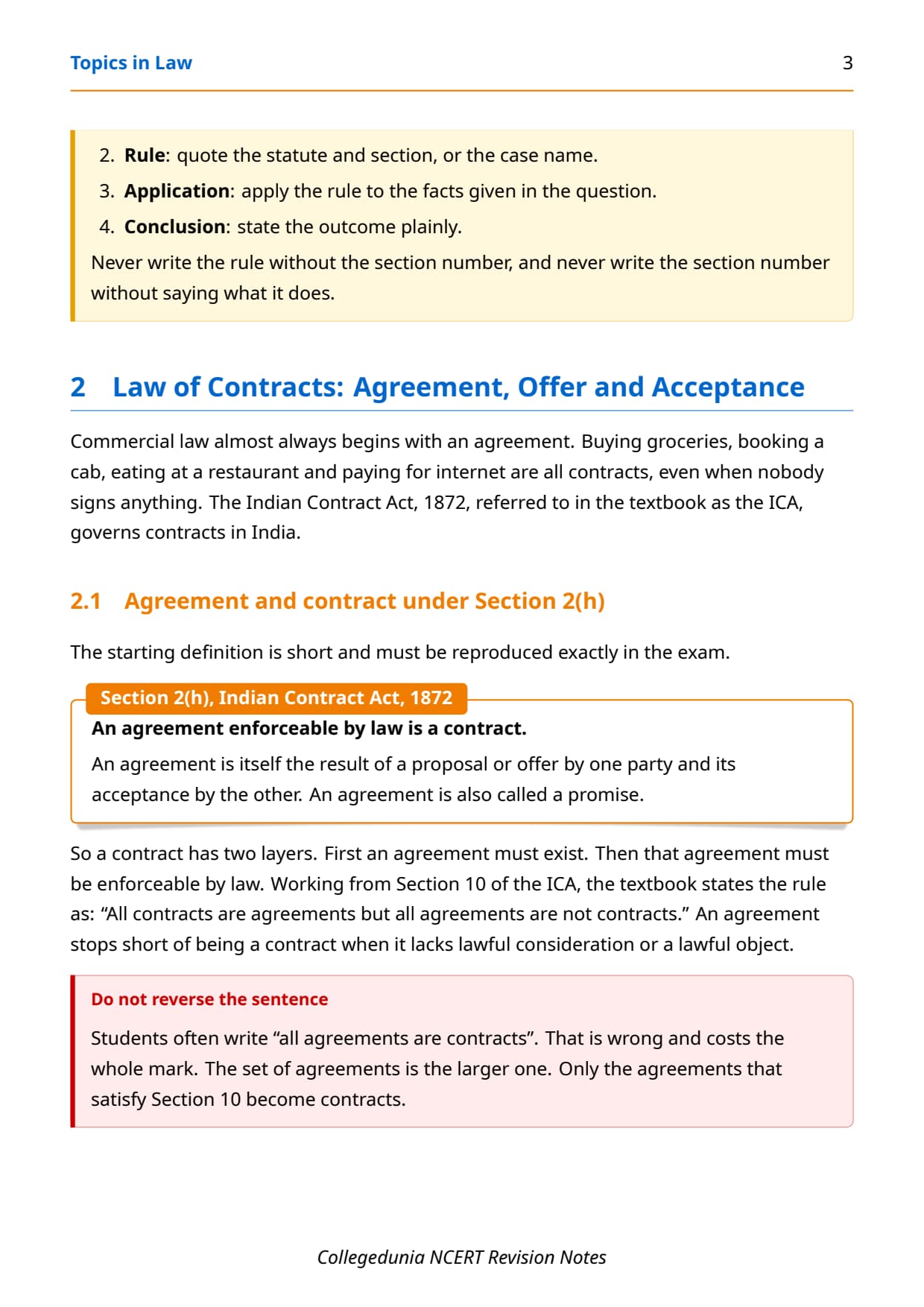
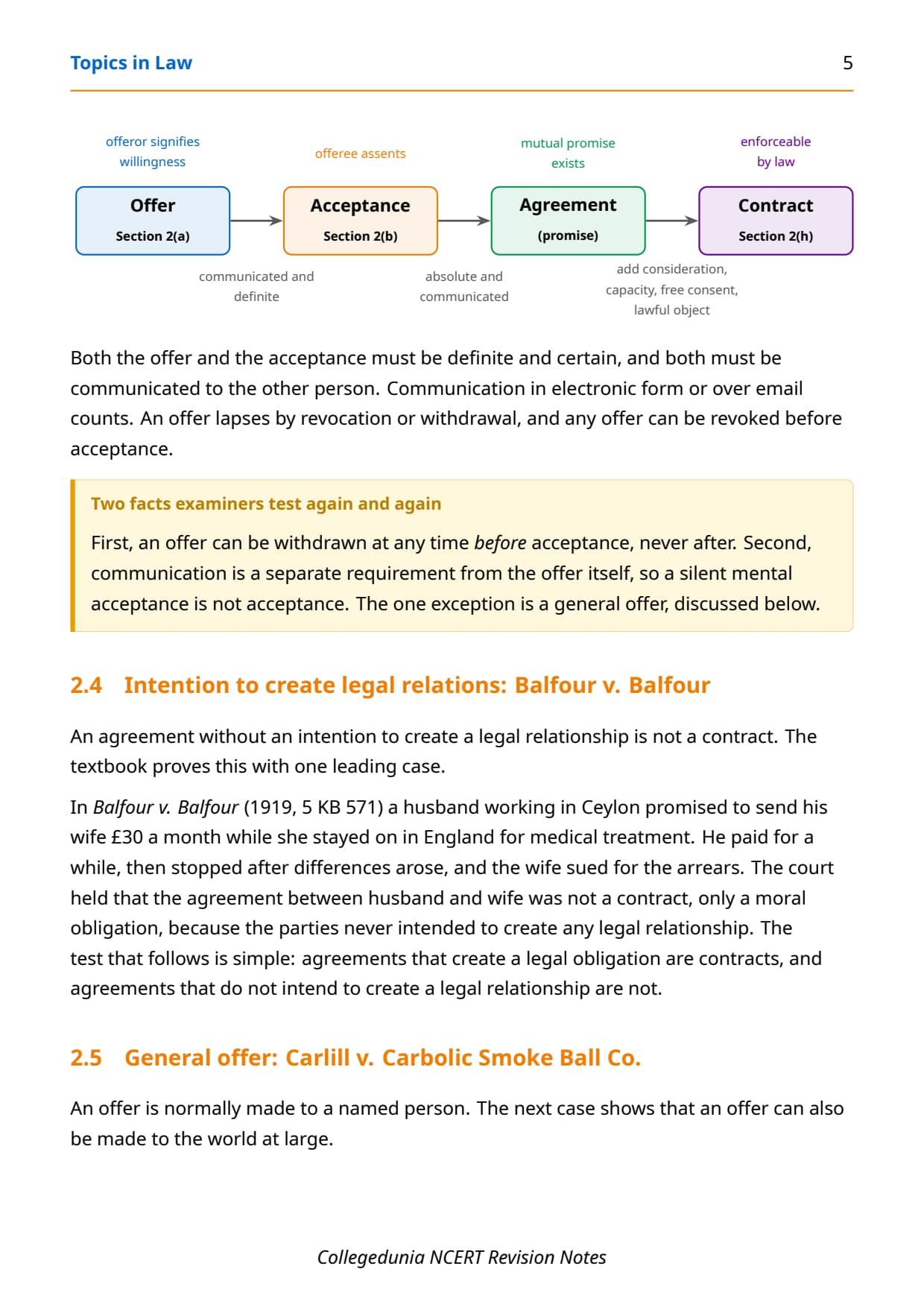
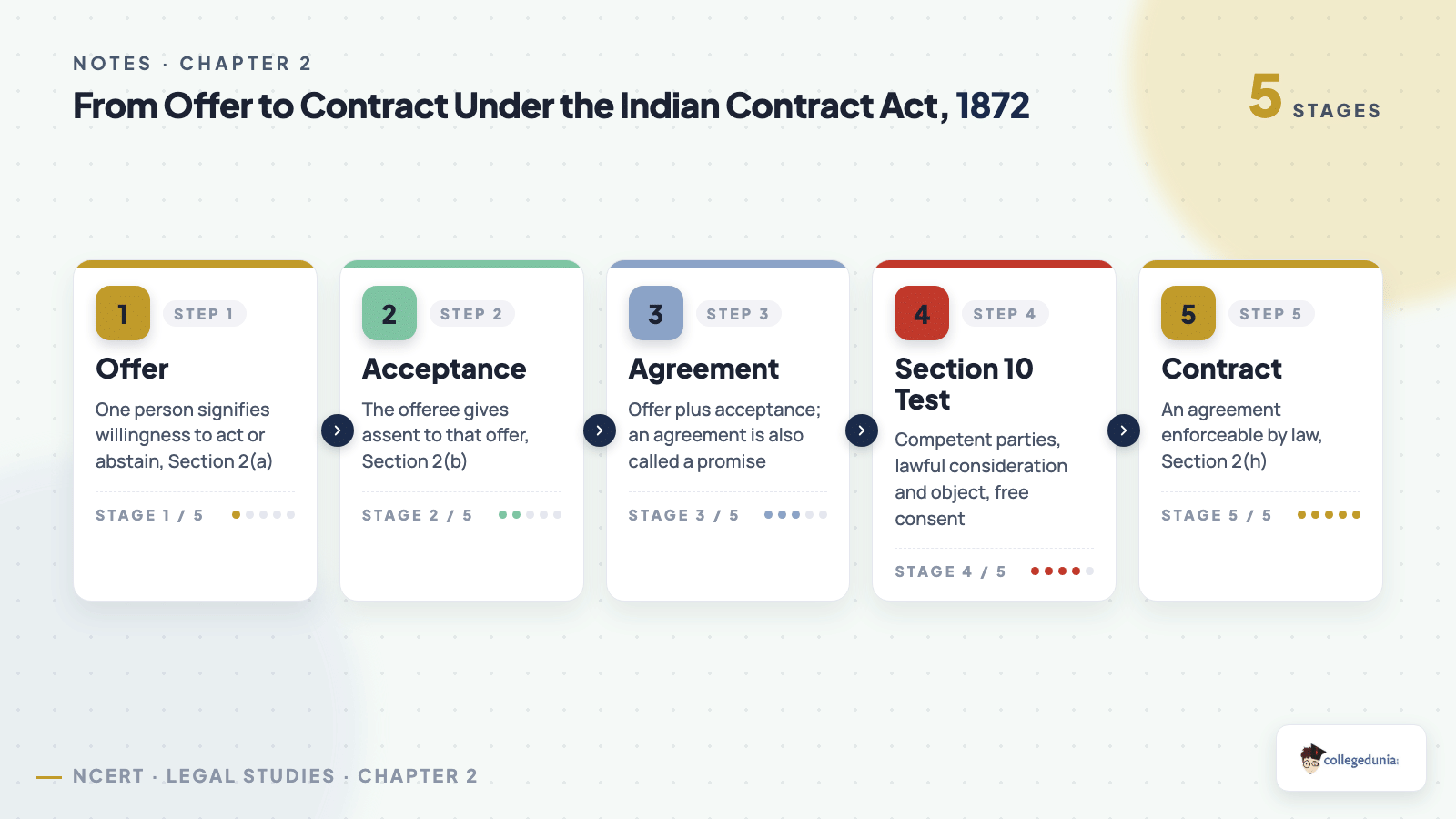
Section 2(h) of the Indian Contract Act, 1872: an agreement enforceable by law is a contract. This means all agreements are not contracts. An agreement is itself the result of a proposal by one party and its acceptance by the other, and an agreement is also called a promise.
- Offer, Section 2(a): one person signifies to another the willingness to do or not do something. The person making it is the offeror.
- Acceptance, Section 2(b): the assent given to an offer by the offeree. Saying yes, or clicking I agree on a website, is acceptance.
- The formula: Offer plus Acceptance equals Agreement.
- Both must be definite: a vague offer or acceptance cannot conclude a contract, and both must be communicated.
- Revocation: any offer can be revoked before it is accepted.
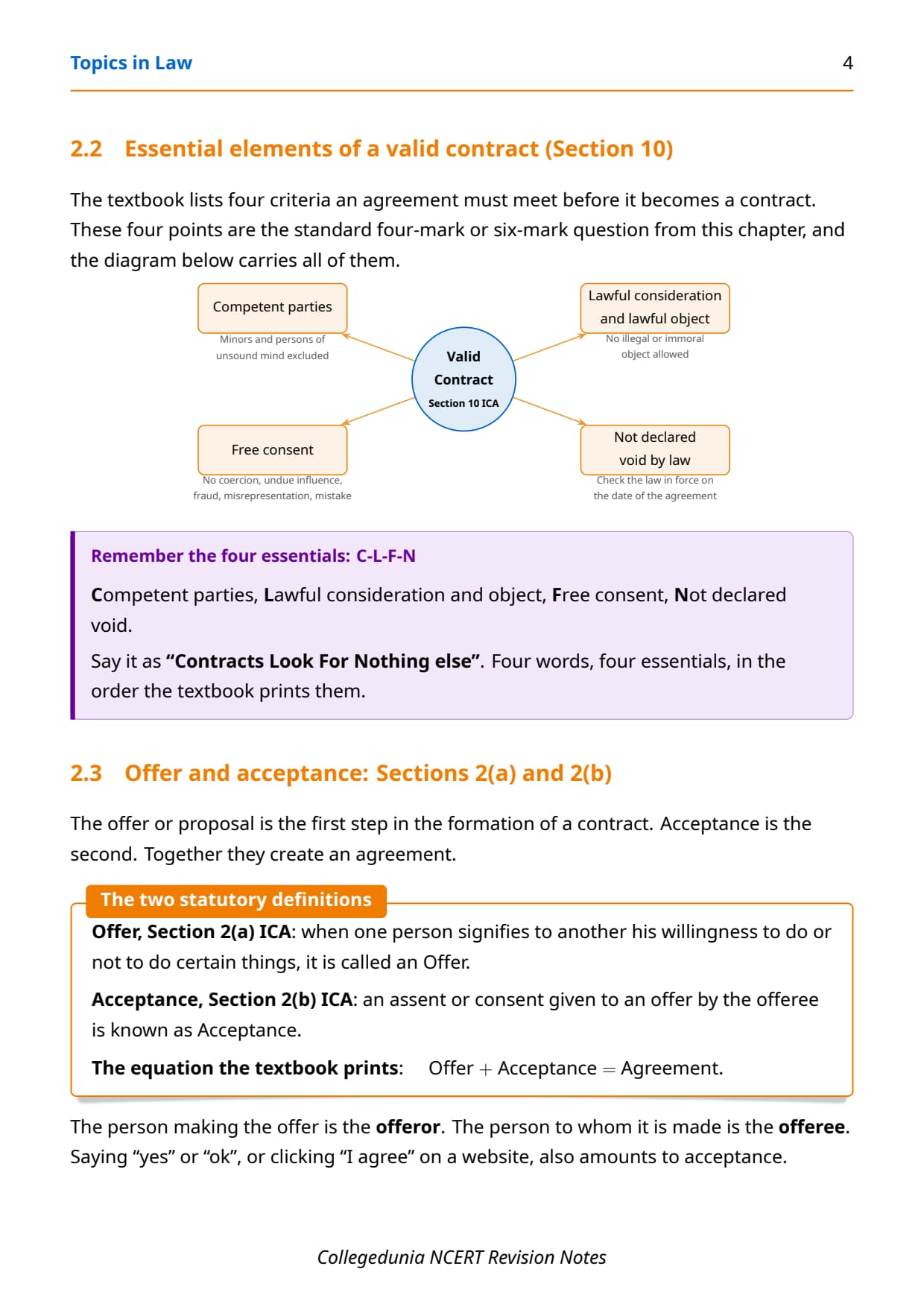
Section 10 of the Act lists what turns that agreement into a contract: competent parties, lawful consideration and lawful object, free consent, and an agreement not expressly declared void by law. The rule the chapter repeats is worth memorising in one line: all contracts are agreements, but all agreements are not contracts.
Two cases carry this section. In Balfour v. Balfour (1919, 5 KB 571), a husband working in Ceylone promised to send his wife 30 pounds a month while she stayed in England for treatment. He stopped paying, and she sued for the arrears. The court held the arrangement was only a moral obligation, so a domestic promise between spouses is not a contract.
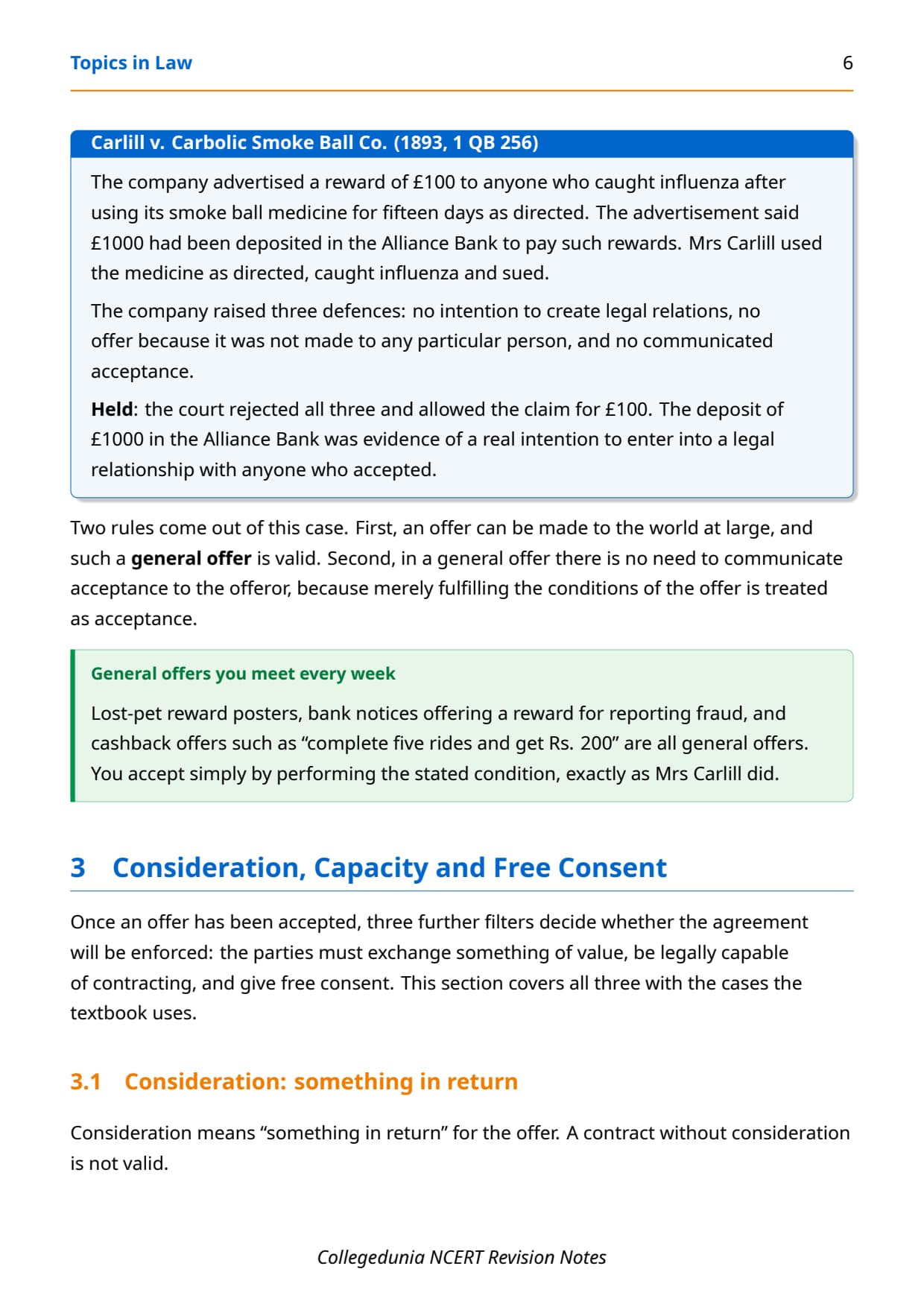
In Carlill v. Carbolic Smoke Ball Co. (1893, 1 QB 256), the company advertised a reward of 100 pounds to anyone who caught influenza after using its smoke ball for fifteen days, and said 1000 pounds had been deposited in the Alliance Bank. Mrs Carlill used it, fell ill, and won.
An offer can be made to the world at large. It is called a general offer, and merely fulfilling its conditions counts as acceptance without any need to communicate it back. The court treated the bank deposit as proof that the company really did intend to create a legal relationship.
Consideration, Capacity and Free Consent: The Three Elements Examiners Test Most
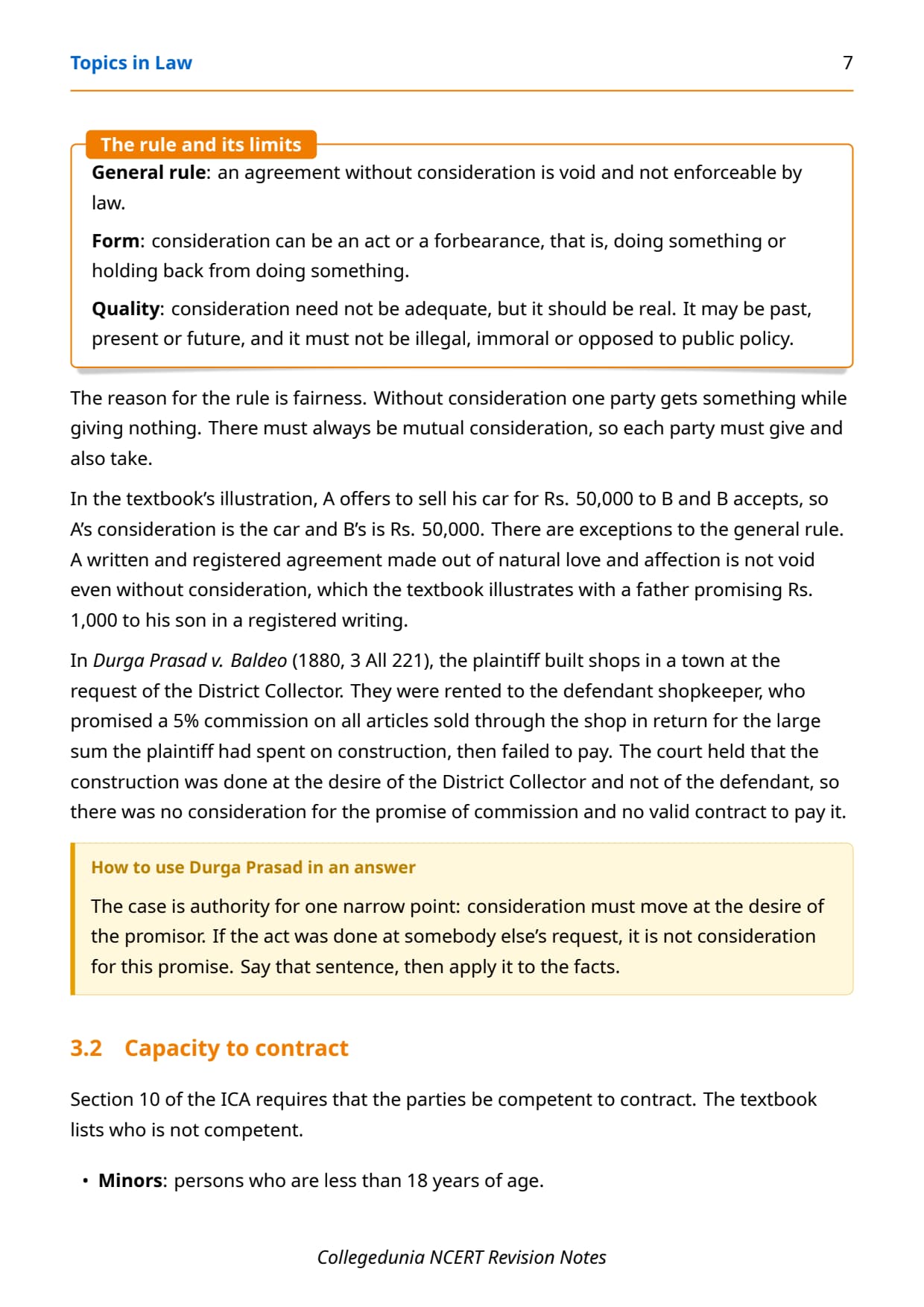
Consideration means something in return for the offer, and it can be an act or a forbearance. The general rule is that an agreement without consideration is void, because one party would be getting something for nothing. Each party must give and also take.
- It need not be adequate, but it must be real. Selling a bike worth Rs 65,000 for Rs 50,000 is still a valid contract.
- It may be past, present or future, but never illegal, immoral or opposed to public policy.
- The natural love exception: a written and registered agreement made out of natural love and affection is not void even without consideration.
In Durga Prasad v. Baldeo (1880, 3 All 221), the plaintiff built shops at the request of the District Collector, and a shopkeeper who rented one later promised a 5 per cent commission on his sales. The court refused the claim. The construction was done at the desire of the Collector, not of the shopkeeper, so there was no consideration and no valid contract.
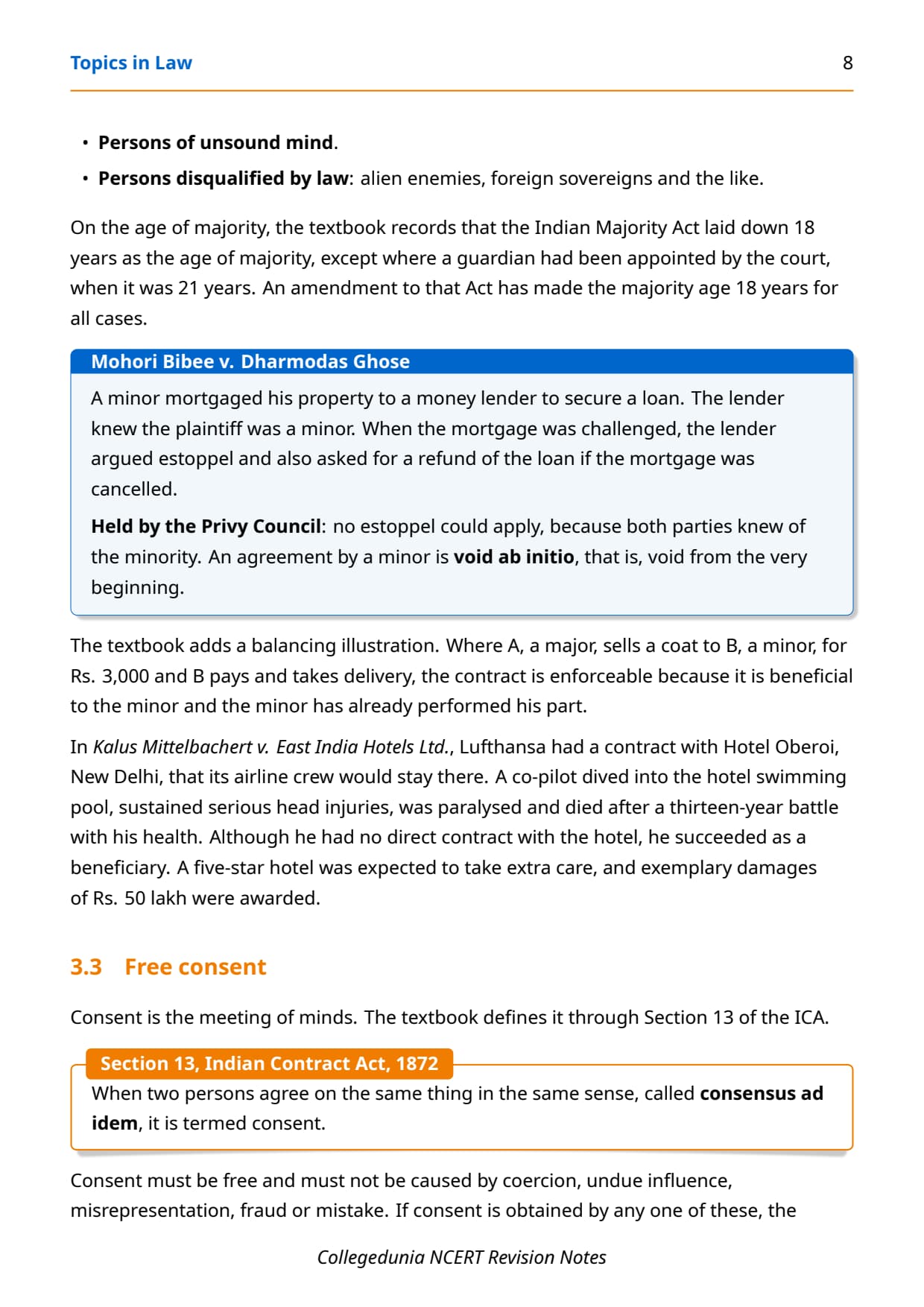
Capacity is the second trap. Section 10 requires competent parties, and the Act rules out three groups: minors below 18 years, persons of unsound mind, and persons disqualified by law such as alien enemies and foreign sovereigns. The Indian Majority Act originally set majority at 21 years where a court had appointed a guardian, and an amendment brought it down to 18 years for all cases.
In Mohori Bibee v. Dharmodas Ghose, a minor mortgaged his property to a money lender who knew he was a minor. The Privy Council held that an agreement by a minor is void ab initio, and that no estoppel could apply because both sides knew of the minority. One narrow exception survives: a contract that benefits the minor and has already been performed by him can still be enforced.
The third element is consent. Section 13 defines consent as two persons agreeing on the same thing in the same sense, or consensus ad idem. Consent is not free when it is caused by coercion, undue influence, misrepresentation, fraud or mistake, and the contract then becomes voidable at the option of the party whose consent was not free.
Void, Voidable, Contingent and Wagering: Sorting the Kinds of Agreements
Not every failed agreement fails the same way, and this is where marks leak fastest. The Act gives each kind its own section, so an answer that names the section scores higher than one that only describes the idea.
| Basis | Void contract | Voidable contract |
|---|---|---|
| Legal provision | Section 2(j), Indian Contract Act | Section 2(i), Indian Contract Act |
| Meaning | Ceases to be enforceable by law | May be affirmed or rejected at the option of one party |
| Ground | Loses enforceability by law or by events | Coercion, undue influence, fraud or misrepresentation |
| Nature | Valid at its inception, later becomes void | Enforceable until a competent court declares it void |
| Claim for damages | Only restoration of a benefit received, on grounds of equity | The injured party may sue for damages |
| Can it become valid | No, once void it cannot become valid | Yes, by lapse of time, affirmation, ratification or waiver |
The second pair looks similar but is tested separately. A contingent contract, defined in Section 31, is a contract to do or not do something depending on a future uncertain event, and it is enforceable. A wagering agreement is a straight bet, and the Act does not define it, but Section 30 declares it void.
- Contingent example: A promises to buy B a jersey if the Indian cricket team wins today's match.
- Wagering example: X and Y each pay the other a fixed sum depending on whether X's start-up gains 50,000 customers.
- The test: in a wager the uncertain event decides who wins; in a contingent contract the event is only collateral to the deal.
- Illegal agreements: if either the object or the consideration is prohibited by law, the agreement is void under Section 24.
Discharge of a Contract and the Remedies Available for Breach
A contract is discharged when the contractual relations of the parties come to an end. The chapter lists six routes, and a board question usually asks for three of them with an illustration each.
- Discharge by performance: both sides fulfil their promises and the deal closes cleanly.
- Discharge by agreement or consent: through novation, rescission, alteration, merger, waiver or remission.
- Discharge by impossibility of performance: supervening impossibility under Section 56, covering destruction of the subject matter, death or incapacity, outbreak of war and a change in law.
- Discharge by lapse of time: the promise is not performed and the other side does not act within the limitation period.
- Discharge by operation of law: death of a party, insolvency, merger, or unauthorised alteration of the terms.
- Discharge by breach: one party fails to perform, which opens the remedies below.
The four sub-routes under discharge by consent are easy one-mark questions. Novation substitutes a new contract for an old one. Rescission cancels some or all terms. Remission accepts part performance in full satisfaction, as when a creditor takes Rs 2,000 against a debt of Rs 5,000. Merger folds the terms of one contract into another with consent.
When a contract is broken, Section 73 of the Indian Contract Act gives the injured party compensation for the loss suffered. The two remedies named in the chapter are damages, the money compensation that is the most common relief, and specific performance, where the court orders the defaulting party to actually carry out the promised obligation.
Law of Torts: What Makes a Civil Wrong Different From a Crime
Tort comes from the Latin word tortum, meaning twisted or crooked. In law it is a civil wrong, intentional or accidental, that injures another person, who can then go to a civil court for damages, a court order or an injunction.
Sir John Salmond defined a tort as a civil wrong for which the remedy is a common law action for unliquidated damages, and which is not exclusively a breach of contract or of trust. M.C. Setalvad, the first Attorney General of India, called the law of torts an instrument for making people respect the rights and interests of one another.
Unliquidated damages are a sum of money that cannot be worked out in advance by any fixed formula. That is why tort damages are decided by the court after the harm is proved, and not written into a document beforehand.
| Point of difference | Tort | Breach of contract |
|---|---|---|
| Primary remedy | An action for damages | Performance of the contract |
| Nature of damages | Always unliquidated | Liquidated |
| Motive | May be taken into consideration | Motive is irrelevant |
| Duty owed to | Persons generally | A specific person or persons |
| Kind of damages | Compensatory, and exemplary damages may also be awarded | Compensatory only |
The three fundamental elements of a tort are a wrongful act, damage, and a remedy. Sources matter too, because tort is mostly a common law subject. It grew from centuries of judicial decisions in England and in other common law countries, and there is no single statute in India that covers tort law as a whole.
India has begun writing parts of it into statute all the same. Automobile accidents are covered by the Motor Vehicle Act of 1988 as amended, and harm to consumers of goods and services by the Consumer Protection Act of 1986 as amended. A tort lawyer still has to read the case law, while a contract lawyer can open the Contract Act or the Sale of Goods Act, 1930.
Intentional Torts, Defamation, Libel and Slander Explained With Examples
A wrongful act in tort law happens in one of three ways: intentionally, negligently, or under strict liability regardless of fault. The intentional group comes first, and each one has a fact pattern the textbook uses.
| Intentional tort | What the defendant does | Textbook example |
|---|---|---|
| Battery | Intentional and direct application of physical force | Throwing hot water at someone |
| Assault | Causes a reasonable fear of imminent harmful touching | Pointing an unloaded gun at a person who thinks it is loaded |
| False imprisonment | Unlawful confinement in a bounded area | Locking a person in a classroom without legal authority |
| Trespass to land | Physically invading land, including the air above and soil below | Littering another person's land |
| Trespass to chattels | Interfering with lawful possession of movable goods | Painting a parked car without the owner's consent |
| Conversion | Wilful interference so serious that the owner loses the chattel | The remedy is a forced sale at the original value |
Battery and assault can happen apart from each other. Hitting a person from behind is battery without assault, because the victim never saw it coming. Throwing an iron ball that misses is assault without battery, because the perception of the claimant is what counts.
Unlawful harassment covers deliberate harm where there is no battery or assault at all. Lying to a parent that their son has been in a road accident, causing nervous shock and illness, is the example the chapter gives. Sexual harassment, unwanted messages and repeated phone calls also amount to the tort of harassment even without any threat of violence.
Defamation is the publication of a statement that lowers a person in the estimation of right-thinking members of society. Defamation can be both a tort and a crime: criminal defamation is prosecuted and studied under the IPC, while civil defamation is sued on under the law of torts.
- Libel: defamation in a permanent form such as writing or pictures. English criminal law recognises it as an offence.
- Slander: defamation in a transient form such as spoken words or gestures. It is actionable under the law of torts in English law.
Negligence and Duty of Care: How Donoghue v. Stevenson Set the Rule
Negligence is the breach of the duty to take care which results in damage. To succeed, the claimant must establish all three elements, and the chapter's central case supplies each one.
| Element | What must be proved | How Donoghue v. Stevenson shows it |
|---|---|---|
| Duty of care | The defendant owed a duty to the victim | A manufacturer owes a duty to everyone reasonably foreseeable as affected by the product |
| Breach of duty | The standard of reasonable conduct was not met | A decomposed snail was left inside a sealed bottle of ginger beer |
| Harm to the claimant | The breach caused actual injury or damage | The plaintiff Donoghue fell ill after drinking it |
The duty is owed to those whom one can reasonably foresee as potentially harmed. The textbook adds a second illustration: a landlord owes a duty of reasonable foresight to tenants and must not store a hazardous substance such as petrol in the basement of the building where they live.
In MacPherson v. Buick Motor Co. (1914), an American case, a buyer was injured when a defective wheel collapsed. The wheel had been bought from another manufacturer, but Buick had failed to inspect it. The court held the maker responsible for the finished product, because it had put that product on the market to be used without inspection by the customer.
Strict Liability and Absolute Liability: Rylands v. Fletcher Against M.C. Mehta
No-fault liability makes a defendant pay even when the claimant's right was not violated by any mistake of the defendant. It covers two rules, and the difference between them is one of the most repeated questions in the chapter.
Strict liability was laid down in Rylands v. Fletcher (1868). Rylands built a water reservoir on his land for his mill, using an independent contractor who worked negligently. The water escaped and flooded Fletcher's mines. The court held Rylands liable no matter how much care he had taken, because he had brought onto his land a thing that was dangerous if it escaped.
- Dangerous thing: a non-natural use of the land.
- Escape: the thing must escape from the defendant's premises.
- Liability: because the thing escaped, it caused damage.
Five defences are available against strict liability: the plaintiff's own fault, an act of God, mutual benefit where the plaintiff consented, the act of a stranger, and a statutory act of the government or a corporation. Learning these five by name is worth more than describing them, because the question is usually phrased as a list.
India then went further. The Bhopal gas leak of 1984, where methyl isocyanate escaped from a Union Carbide Corporation factory, killed 2260 people and injured around 600,000. In 1985 a plant of the Shri Ram Foods and Fertilizer Industries in Delhi leaked oleum gas, killing one person and creating huge panic among residents.
In M.C. Mehta v. Shri Ram Foods and Fertilizer Industries (1987), the then Chief Justice of India P.N. Bhagwati held that an enterprise engaged in a hazardous or inherently dangerous industry owes an absolute and non-delegable duty to the community, and cannot escape by saying it took all reasonable care.
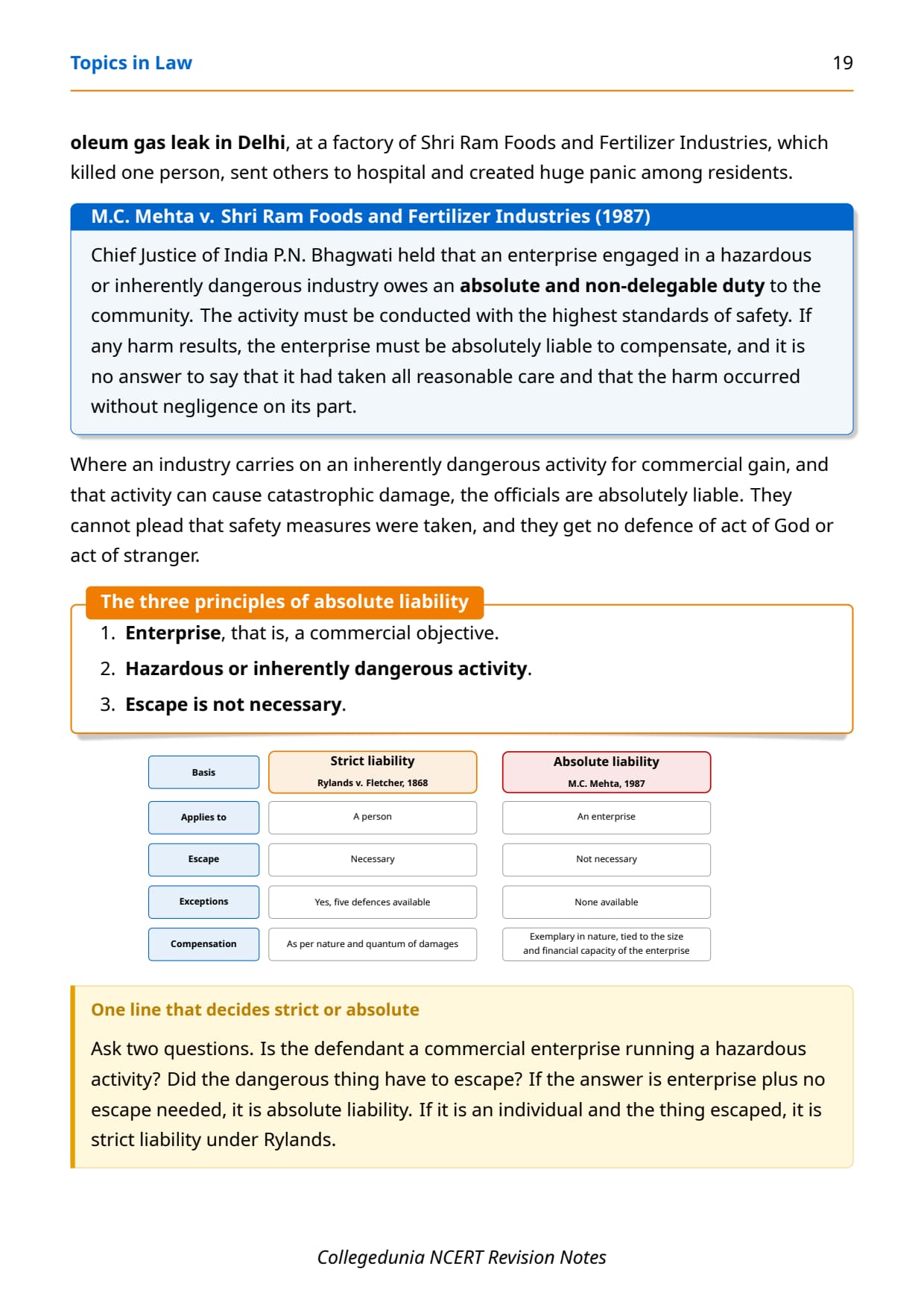
| Basis for comparison | Strict liability | Absolute liability |
|---|---|---|
| Talks about | A person | An enterprise |
| Escape of the dangerous thing | Necessary | Not necessary |
| Exceptions | Yes, five defences are available | No exceptions at all |
| Payment of compensation | Nature and quantum of the damage | Exemplary, based on the size and financial capacity of the enterprise |
The three ingredients of absolute liability are worth writing out: an enterprise with a commercial objective, a hazardous or inherently dangerous activity, and escape is not necessary. Neither an act of God nor an act of a stranger is available as a defence.
Law of Property: Movable and Immovable Property Under the Transfer of Property Act, 1882
Before the British courts, each community in India followed its own customary law on transfer of property. English judges then applied common law and the rules of equity, justice and good conscience, which did not fit Indian conditions. The Transfer of Property Act was drafted in 1870 and finally passed in 1882.
A separate statute, the Sale of Goods Act, 1930, was passed to deal with the transfer of movable property by sale. The Transfer of Property Act, 1882 carries the general principles plus detailed rules for transfer of immovable property by sale, exchange, mortgage, lease and gift.
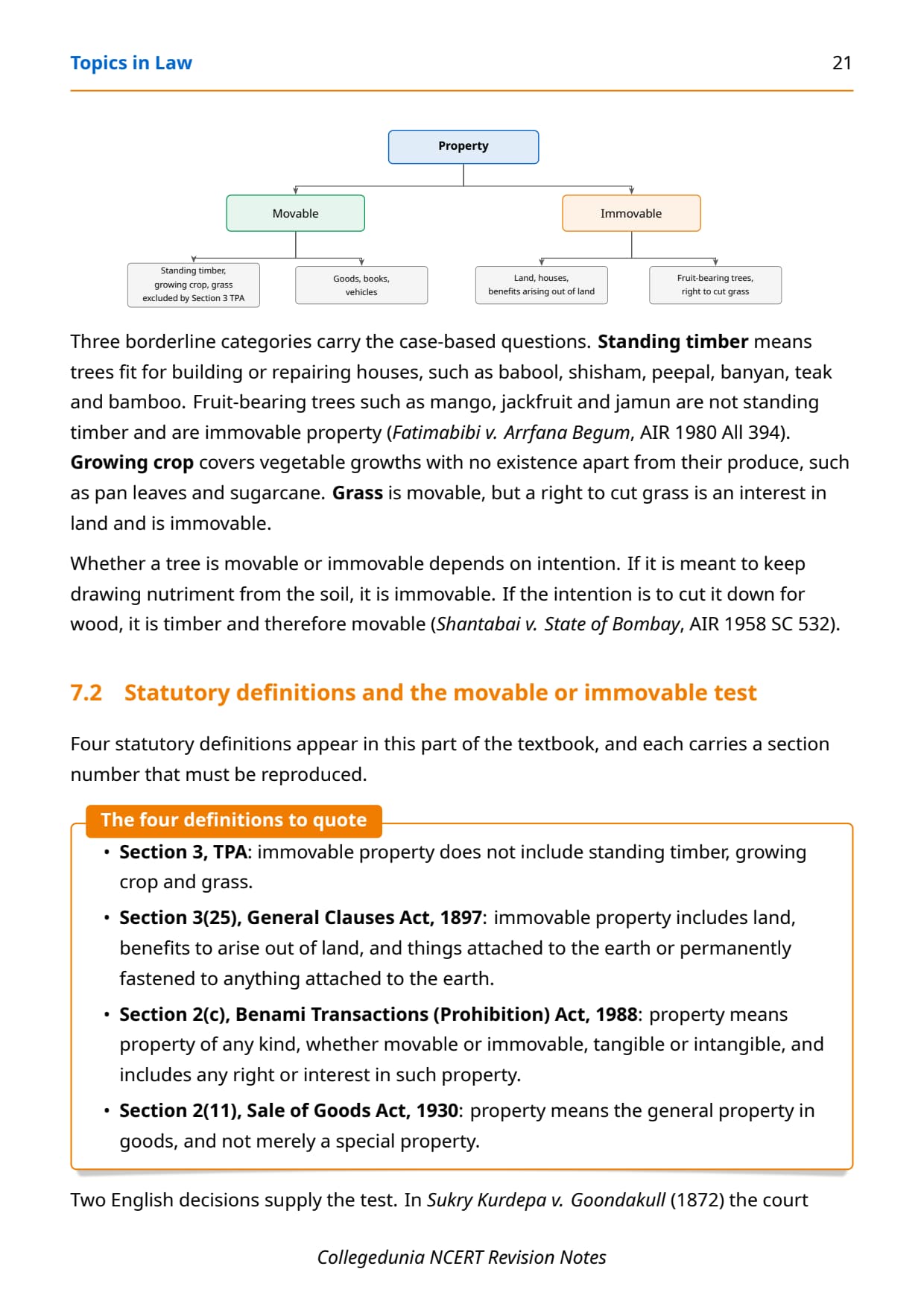
The word property is not defined in the Act, but it covers everything: movables such as books, immovables such as land and houses, and intangibles such as ownership, tenancy and copyright. Section 3 says immovable property does not include standing timber, growing crop and grass.
- Standing timber means trees fit for building or repairing houses, such as Babool, Shisham, Peepal, Banyan, Teak and Bamboo.
- Fruit-bearing trees such as Mango, Jackfruit and Jamun are not standing timber and are immovable property, per Fatimabibi v. Arrfana Begum, AIR 1980 All 394.
- Growing crops such as pan leaves and sugarcane have no existence apart from their produce.
- Grass is movable, but a right to cut grass is an interest in land and is therefore immovable.
The intent test settles the rest. In Shantabai v. State of Bombay, AIR 1958 SC 532, the court held that if trees are meant to keep drawing nutriment from the soil, for example to enjoy their fruit, they are immovable property. If the intention is to cut them for wood, they are timber and therefore movable.
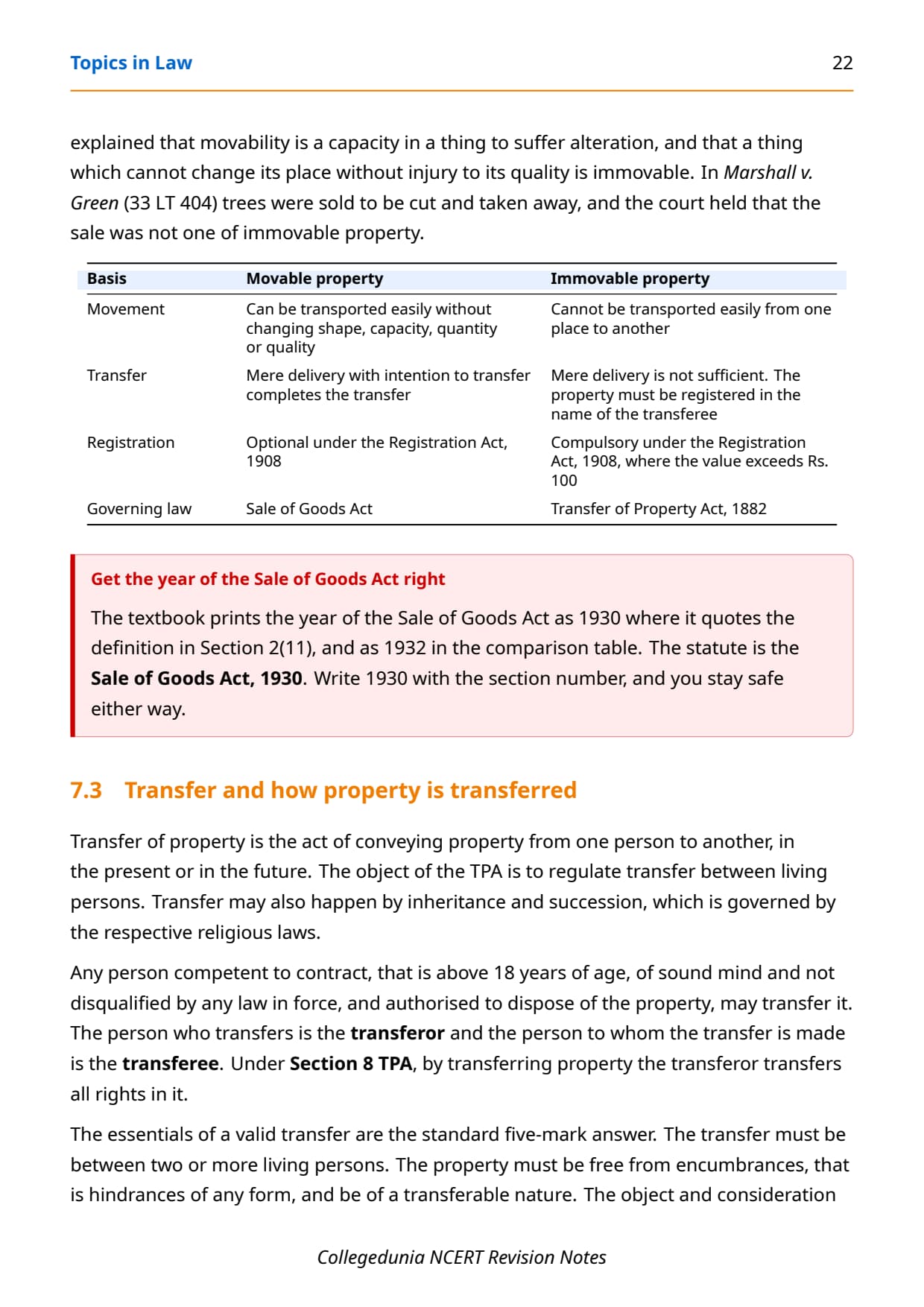
| Basis | Movable property | Immovable property |
|---|---|---|
| Movement | Can be moved without changing its shape, capacity, quantity or quality | Cannot easily be transported from one place to another |
| Transfer | Mere delivery with intention to transfer completes it | Delivery is not enough; it must be registered in the transferee's name |
| Registration | Optional under the Registration Act, 1908 | Compulsory under the Registration Act, 1908 where value exceeds Rs 100 |
| Legal provision | Sale of Goods Act, 1930 | Transfer of Property Act, 1882 |
Two statutory definitions are quoted directly in the chapter and both are quotable in an answer. Section 2(c) of the Benami Transactions (Prohibition) Act, 1988 defines property as property of any kind, movable or immovable, tangible or intangible, including any right or interest in it. Section 2(11) of the Sale of Goods Act, 1930 defines property as the general property in goods, and not merely a special property.
Two more short cases round out this part. In Sukry Kurdepa v. Goondakull (1872), the court explained movability as a thing's capacity to suffer alteration of place, and said a thing that cannot change place without injury to its quality is immovable. In Marshall v. Green (33 LT 404), a sale of trees to be cut and taken away was held not to be a sale of immovable property.
Transfer of Property, Doctrine of Election and Doctrine of Lis Pendens
Transfer means conveying property from one person to another, in the present or the future. Only a person competent to contract, meaning above 18 years, of sound mind and not disqualified by law, and authorised to dispose of the property, can transfer it. The giver is the transferor and the receiver is the transferee.
Under Section 8 of the Transfer of Property Act, 1882, the transferor passes all rights in the property. The essentials of a valid transfer are tested as a five-point list.
- Living persons: the transfer must be between two or more living persons.
- Free of encumbrances: the property must be transferable and free from hindrances.
- Lawful: not for an unlawful object or consideration, and not involving a disqualified party.
- Competent transferor: entitled to the property or authorised to dispose of it.
- Proper mode: registration, attestation and other formalities must be complied with.
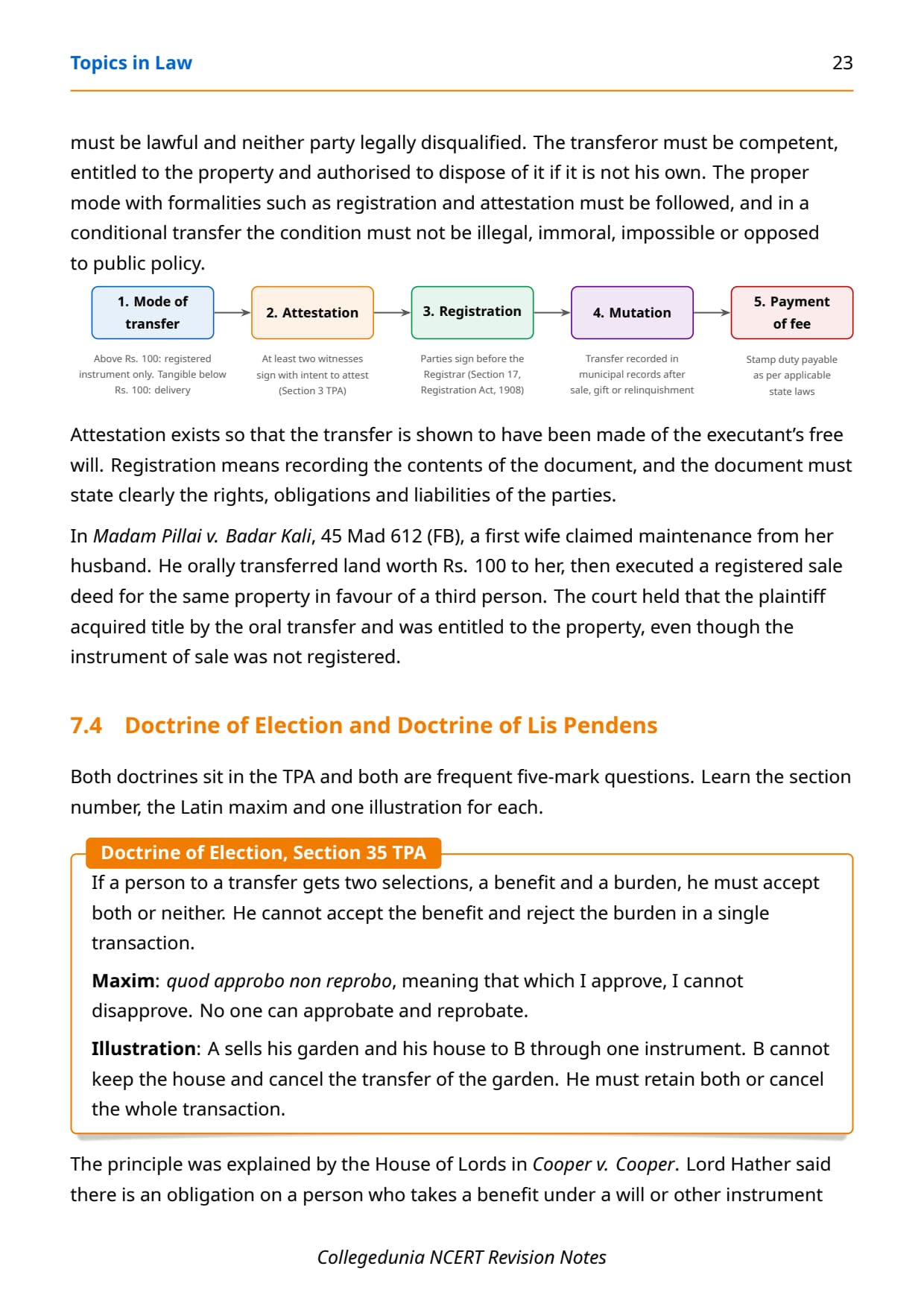
The mode itself depends on value and on whether the property is tangible. Property worth more than Rs 100 can be transferred only by a registered instrument, tangible property worth less than Rs 100 can pass by delivery, and intangible property always needs a registered instrument.
| Step | What it involves |
|---|---|
| Attestation | At least two witnesses sign the instrument with the intention to attest, defined in Section 3 of the Transfer of Property Act, 1882 |
| Registration | Both parties appear and sign; Section 17 of the Registration Act, 1908 lists the documents that must be registered |
| Mutation | The transfer is recorded in the municipal records after a sale, gift or relinquishment |
| Payment of fee | Stamp duty on the transfer is payable as per the applicable state law |
One case cuts against the strict rule. In Madam Pillai v. Badar Kali (45 Mad 612 (FB)), a husband orally transferred land worth Rs 100 to his first wife for maintenance and later sold the same land by a registered instrument to someone else. The court held the wife had acquired title through the oral transfer and was entitled to the property.
The Doctrine of Election, in Section 35 of the Transfer of Property Act, 1882, says that a person given both a benefit and a burden under one instrument must accept both or reject both. It rests on the maxim quod approbo non reprobo, meaning that which I approve, I cannot disapprove.
If A sells his garden and his house to B in one instrument, B cannot keep the house and cancel the garden. The choice is all or nothing, because the burden and the benefit came from the same document.
The principle was explained by the House of Lords in Cooper v. Cooper, where Lord Hather held that a person taking a benefit under a will or other instrument is obliged to give full effect to that instrument. The court also held that the doctrine applies to every instrument and to all types of property.
The Doctrine of Lis Pendens, in Section 52, comes from the maxim ut lite pendent nihil innoveteur, meaning nothing new should be introduced in a pending litigation. Property under a pending suit cannot be transferred in a way that affects the rights of any party to that suit.
In Dev Raj Dogra and others v. Gyan Chand Jain and others, the Supreme Court set three pre-conditions. A suit directly and specifically about a right to immovable property must be pending, the suit must not be collusive, and the property cannot be dealt with so as to affect another party's rights except with the authority of the court.
In Hardev Singh v. Gurmail Singh the Court clarified that such a transfer is not void or illegal, but the buyer is bound by the outcome of the pending case. That distinction is the one most answers miss.
Sale, Lease, Exchange and Gift: Comparing the Four Modes of Transfer
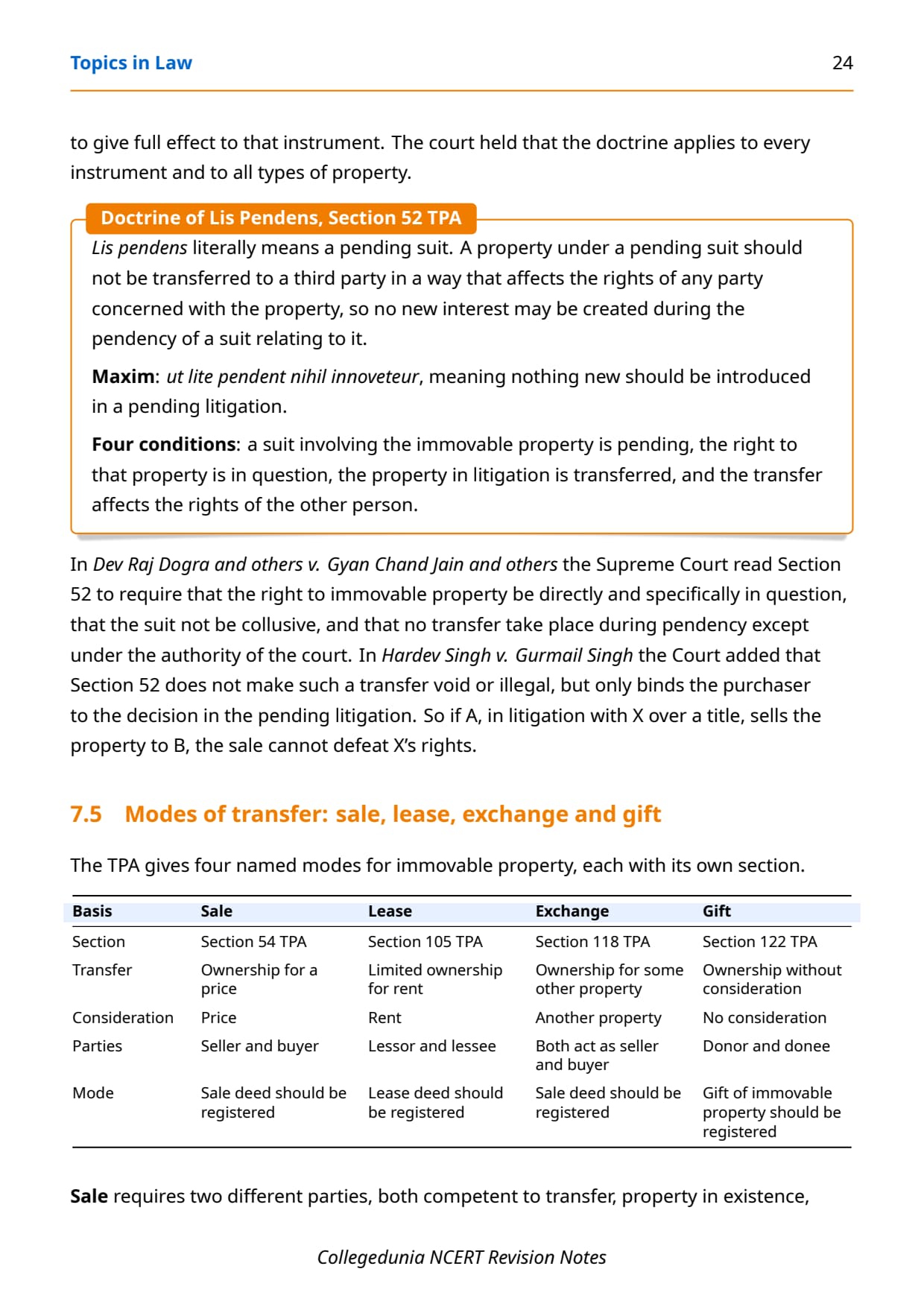
The Act recognises four modes of transfer that carry their own section numbers, and a comparison question on them appears almost every session. Each mode differs in what moves, what is paid, and how it must be recorded.
| Basis | Sale, Section 54 | Lease, Section 105 | Exchange, Section 118 | Gift, Section 122 |
|---|---|---|---|---|
| What transfers | Ownership for a price | Limited ownership for rent | Ownership for some other property | Ownership without consideration |
| Consideration | Price | Rent | Another property | None |
| Parties | Seller and buyer | Lessor and lessee | Both act as seller and buyer | Donor and donee |
| Mode | Sale deed should be registered | Lease deed should be registered | Sale deed should be registered | Gift of immovable property should be registered |
A sale is valid only when there are two different parties, both competent to transfer, the property exists, the consideration is money, and the contract follows the law. A lease can be made only of immovable property, and the lessee may sub-let, in which case the relation between lessee and sub-lessee mirrors that between lessor and lessee.
Subleasing with the consent of the landlord is legal in India, but the original tenant stays liable for the obligations in the lease, including the monthly rent. A gift becomes void if the donee dies before accepting it, which is a favourite one-mark point.
Intellectual Property Law: IPR, the International Conventions and TRIPS
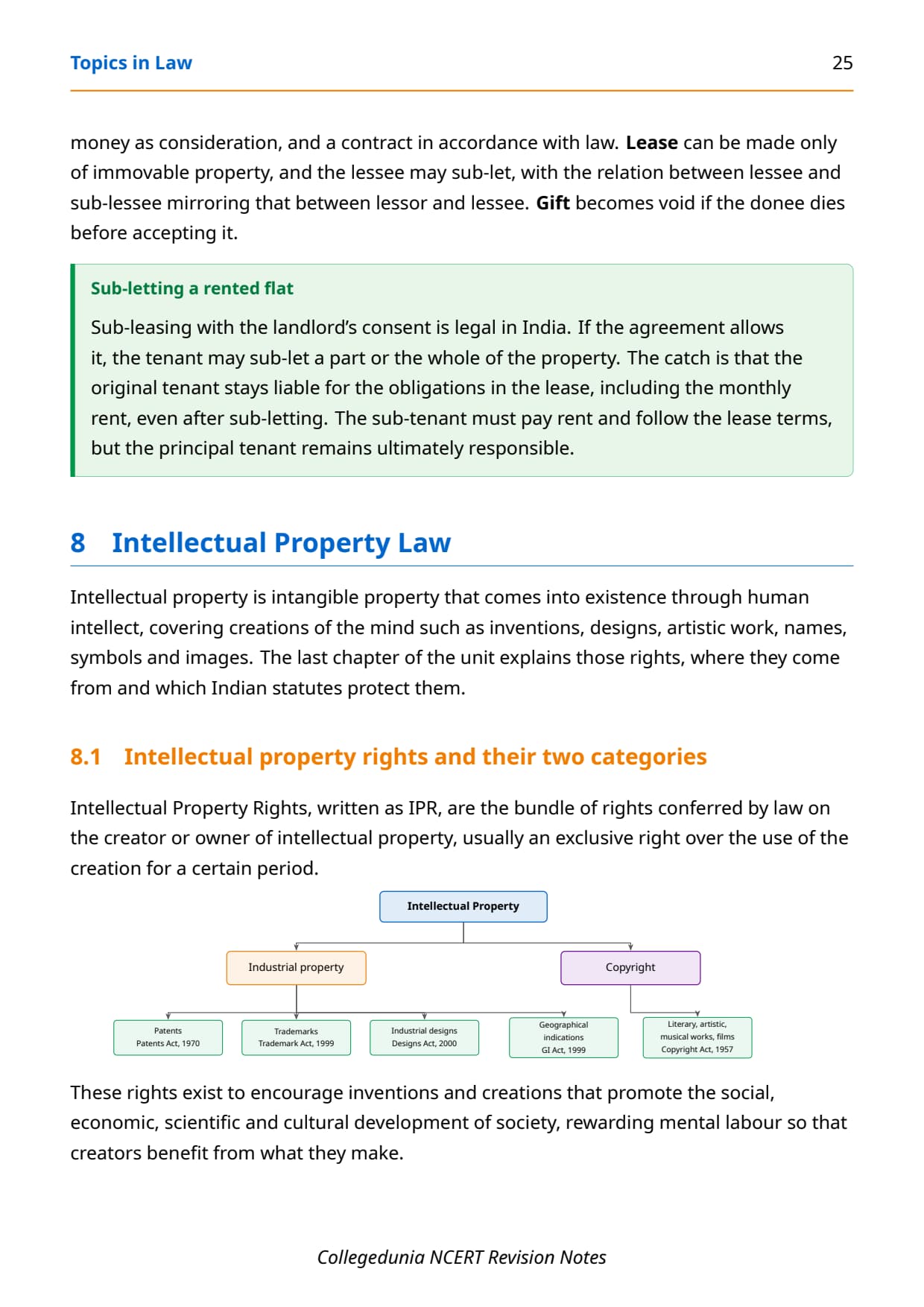
Intellectual property is intangible property that comes into existence through human intellect: inventions, designs, artistic work, names, symbols and images. Intellectual Property Rights are the bundle of rights that the law confers on the creator or owner of that property, usually as an exclusive right for a limited time.
- Industrial property: inventions covered by patents, trademarks, industrial designs and geographical indications of source.
- Copyright: literary and artistic works such as novels, poems, plays, films, musical works, drawings, paintings, photographs, sculptures and architectural designs.
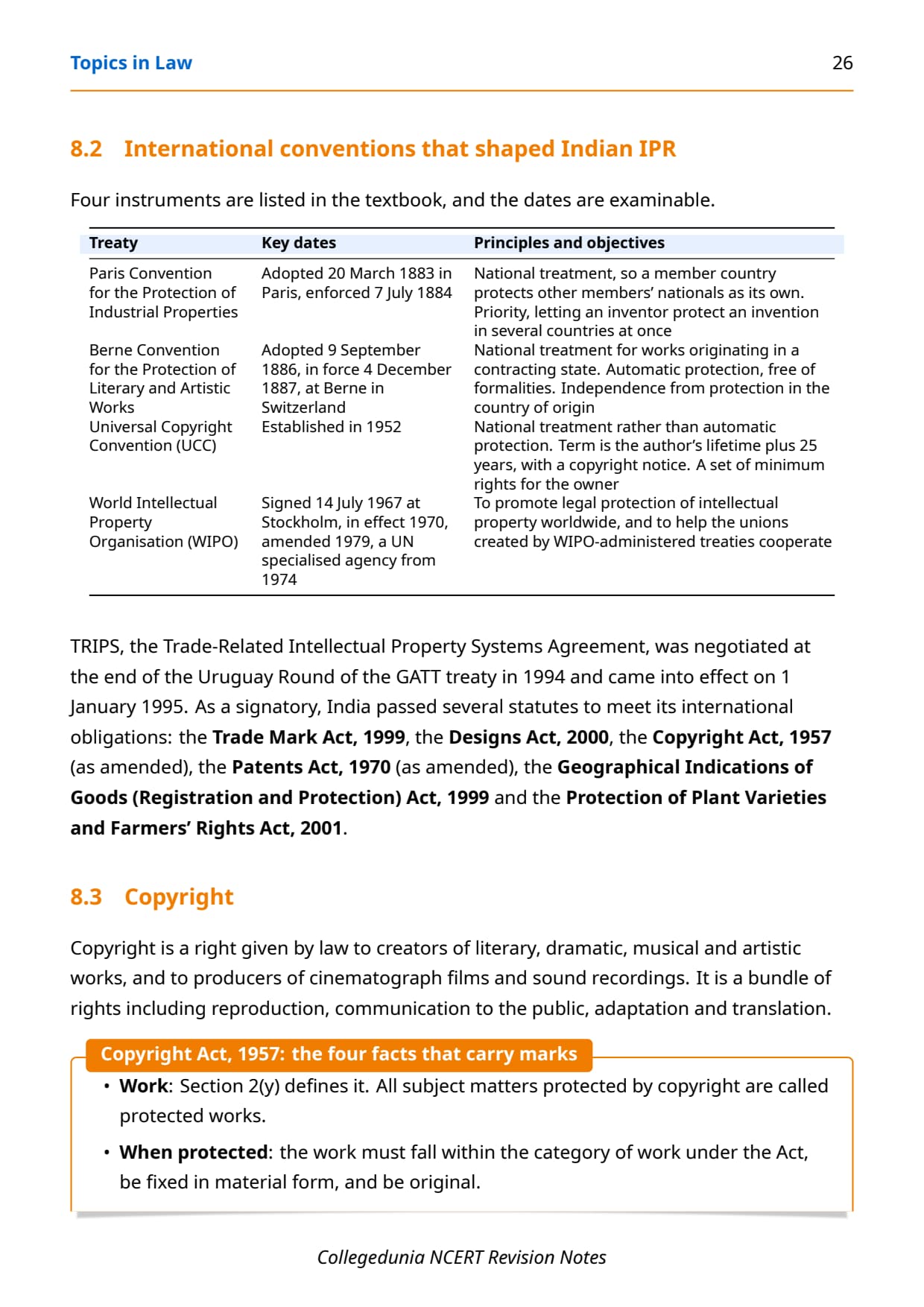
Four international instruments shaped Indian law, and the dates are quoted directly in the chapter, so they must be reproduced exactly.
| Treaty | Year | Principles and objectives |
|---|---|---|
| Paris Convention for the Protection of Industrial Properties | Adopted 20 March 1883, enforced 7 July 1884 | National Treatment, plus the principle of priority, letting an inventor protect an invention in several countries at once |
| Berne Convention for the Protection of Literary and Artistic Works | Adopted 9 September 1886, in force 4 December 1887 | National Treatment, automatic protection without formalities, and independence of protection |
| Universal Copyright Convention | Established 1952 | National Treatment rather than automatic protection, a term of the author's life plus 25 years, and a set of minimum rights |
| WIPO Convention | Signed 14 July 1967 in Stockholm, effective 1970, amended 1979 | Promotes legal protection of intellectual property worldwide and administrative cooperation; WIPO became a UN specialised agency in 1974 |
The TRIPS Agreement was negotiated at the end of the Uruguay Round of the GATT treaty in 1994 and came into effect on 1 January 1995. It covers all forms of intellectual property and aims at harmonising standards of protection and enforcement at national and international levels.
India is a signatory, and passed a set of statutes to meet those obligations: the Trade Mark Act, 1999; Designs Act, 2000; Copyright Act, 1957 as amended; Patents Act, 1970 as amended; Geographical Indications of Goods (Registration and Protection) Act, 1999; and Protection of Plant Varieties and Farmers' Rights Act, 2001.
Patent law in India dates back to the Indian Patents and Designs Act, 1911. The present statute, the Patents Act, 1970, came into force in 1972, and the amendment of 2005 made it TRIPS-compliant as the Patents (Amendments) Act, 2005, extending product patents to all fields of technology including food, drugs, chemicals and micro-organisms.
Copyright, Patents, Trademarks, Trade Secrets and Geographical Indications
Copyright is the right given by law to creators of literary, dramatic, musical and artistic works and to producers of cinematograph films and sound recordings. In India it is governed by the Copyright Act, 1957, and Section 2(y) of that Act defines what counts as a work.
- It must fall within the category of work under the Act.
- It must be recorded or fixed in a material, tangible form.
- It must be original. Mere ideas, knowledge or concepts are not copyrightable, only the original expression of them.
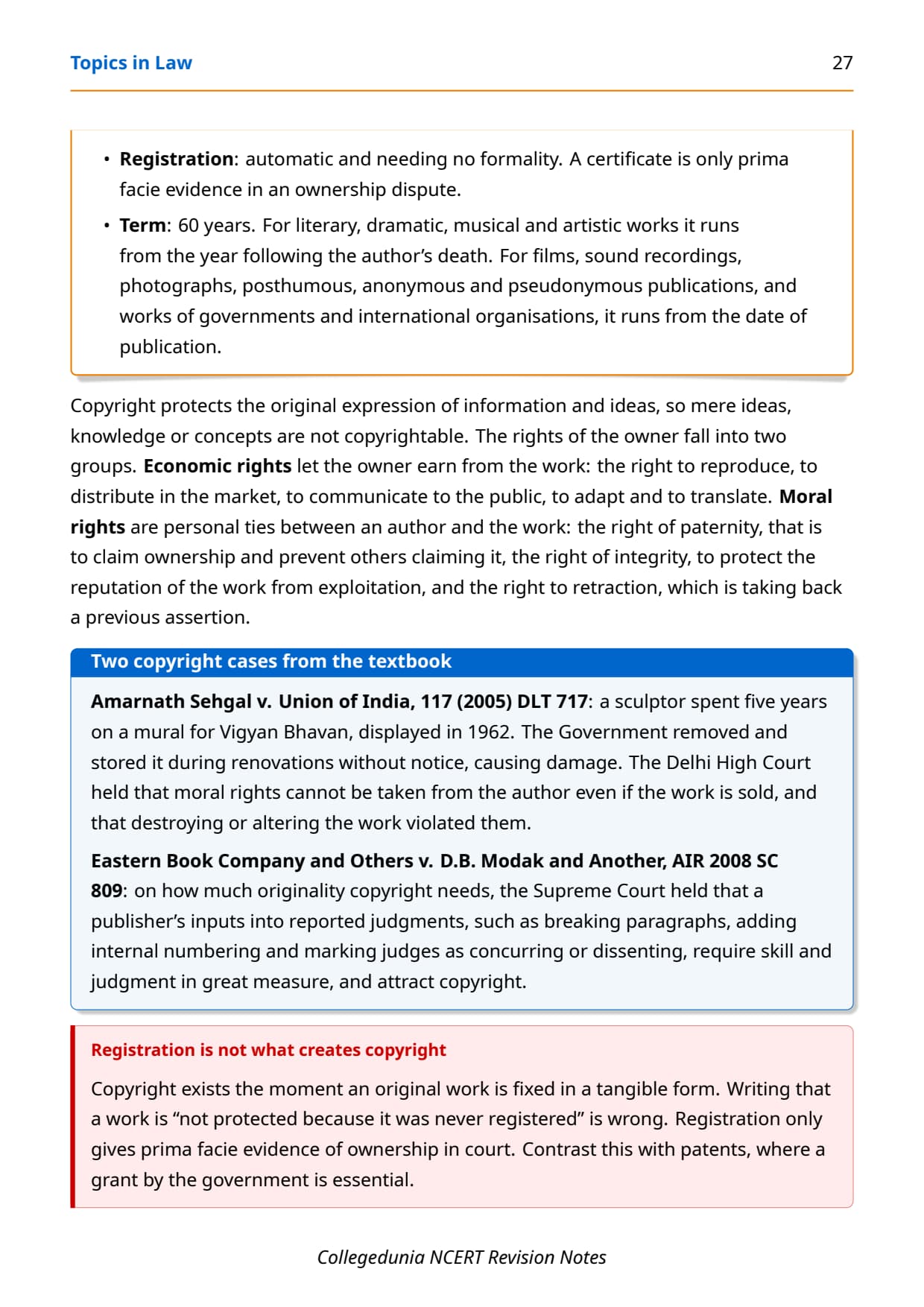
Copyright is automatic on creation and needs no registration, though a certificate of registration serves as prima facie evidence of ownership if a dispute reaches court. The general term of copyright is 60 years, counted from the year following the author's death for literary, dramatic, musical and artistic works, and from the date of publication for films, sound recordings, photographs and government works.
| Economic rights | Moral rights |
|---|---|
| Right to reproduce the work | Right of paternity: to claim ownership and stop others claiming it |
| Right to distribute in the market | Right of integrity: to protect the reputation of the work from exploitation |
| Right of communication to the public | Right to retraction: to take back a previous assertion |
| Right of adaptation and right to translate | Moral rights are personal ties between the author and the work |
Two judgments anchor this part. In Amarnath Sehgal v. Union of India, 117 (2005) DLT 717, a sculptor's mural at Vigyan Bhavan was removed and damaged during renovations. The Delhi High Court held that moral rights cannot be taken away from an author even after the work is sold, and that destroying or altering it violates those rights.
In Eastern Book Company & Others v. D.B. Modak & Another, AIR 2008 SC 809, the question was how much originality copyright needs. The Supreme Court held that the publisher's inputs in the SCC reports, breaking judgments into separate paragraphs, adding internal paragraph numbering, and marking judges as concurring, partly concurring, dissenting or supplementing, required skill and judgment in great measure, so the appellants held copyright in those inputs.
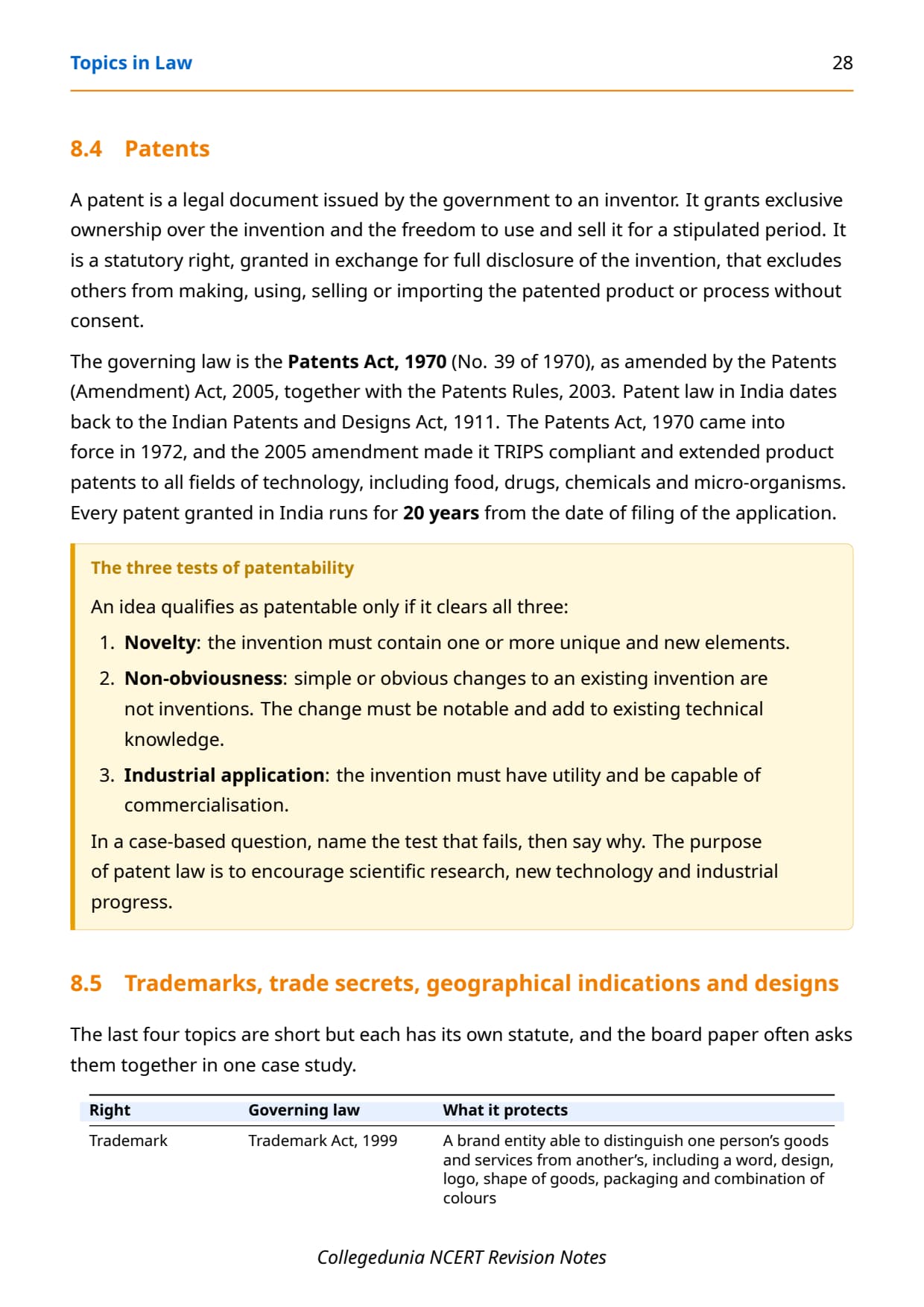
A patent is a legal document issued by the government to an inventor, giving exclusive rights to use and sell the invention for a limited period in exchange for full disclosure. The term of every patent granted in India is 20 years from the date of filing of the application. The system runs under the Patents Act, 1970 (No. 39 of 1970) as amended by the Patents (Amendment) Act, 2005 and the Patents Rules, 2003.
- Novelty: the invention must contain one or more unique and new elements.
- Non-obviousness: simple or obvious changes to an existing invention do not qualify; the change must be notable in the field.
- Industrial application: the invention must have utility and be capable of commercialisation.
A trademark is a brand entity that distinguishes one person's goods and services from another's, and it includes a word, design, logo, shape of goods, packaging and a combination of colours. Trademark rights in India are statutorily protected by the Trademark Act, 1999. A trademark identifies goods and their origin, guarantees unchanged quality, advertises the goods, and creates an image for them.
A trade name is the official name a company operates under, while a trademark is the name, symbol, logo, slogan or sound used to market its products. A trade name gives no brand protection on its own; registering a trademark does. In many cases the trade name becomes the trademark, as with Google.
Trade secrets cover confidential information with commercial value, such as strategies, designs, client databases, formulas and programs. In Burlington Home Shopping Pvt. vs Rajnish Chibber (1995 (35) DRJ 335), the Delhi High Court defined a trade secret as information with commercial value, not in the public domain, whose disclosure would cause significant harm to the owner.
India has no dedicated trade secret statute. Indian courts protect trade secrets through equity principles and common law remedies for breach of confidence and breach of contract, which is why businesses are advised to write restrictive clauses into their service contracts to prevent unauthorised disclosure.
A geographical indication identifies a product as coming from a specific region and carrying qualities or a reputation unique to that place. The Geographical Indications of Goods (Registration and Protection) Act, 1999 provides for their registration and better protection in India.
| Product | Geographical origin |
|---|---|
| Phulkari Handicraft | Punjab, Haryana, Rajasthan |
| Warli Painting | Maharashtra, Gujarat, Daman & Diu |
| Malabar Robusta Coffee | Kerala & Karnataka |
| Darjeeling Tea | West Bengal |
| Pochampally Ikkat | Telangana |
The last form is design. The Designs Act, 2000 protects the original and aesthetically unique appearance of a manufactured item, such as the shape of a cold drink bottle or the wrapper of a chocolate. Protection covers only the ornamental aspects, never the functional or structural elements, and a design is refused if it lacks individual character, is offensive, or is dictated solely by its function.
Statutes and Section Numbers Every Topics in Law Answer Must Quote
This is the sheet to read the night before the paper. Legal Studies marking rewards the exact section, so treat each row as a flashcard rather than as reading material.
| Provision | Statute | What it says |
|---|---|---|
| Section 2(h) | Indian Contract Act, 1872 | An agreement enforceable by law is a contract |
| Section 2(a) and 2(b) | Indian Contract Act, 1872 | Definitions of proposal or offer, and of acceptance |
| Section 10 | Indian Contract Act, 1872 | Essentials of a valid contract |
| Section 13 | Indian Contract Act, 1872 | Consent, or consensus ad idem |
| Section 2(i) and 2(j) | Indian Contract Act, 1872 | Voidable contract and void contract |
| Section 30 and 31 | Indian Contract Act, 1872 | Wagering agreements declared void; contingent contracts defined |
| Section 56 | Indian Contract Act, 1872 | Supervening impossibility of performance |
| Section 73 | Indian Contract Act, 1872 | Compensation for loss caused by breach |
| Section 3 | Transfer of Property Act, 1882 | Immovable property excludes standing timber, growing crop and grass; defines attestation |
| Section 3(25) | General Clauses Act, 1897 | Immovable property includes land, benefits arising out of land and things attached to the earth |
| Section 2(11) | Sale of Goods Act, 1930 | Property means the general property in goods, not merely a special property |
| Section 2(c) | Benami Transactions (Prohibition) Act, 1988 | Property of any kind, movable or immovable, tangible or intangible |
| Section 8, 35 and 52 | Transfer of Property Act, 1882 | Transfer of all rights; Doctrine of Election; Doctrine of Lis Pendens |
| Section 54, 105, 118, 122 | Transfer of Property Act, 1882 | Sale, lease, exchange and gift |
| Section 17 | Registration Act, 1908 | Documents that must be registered |
| Section 2(y) | Copyright Act, 1957 | Definition of a work protected by copyright |
Landmark Cases in Topics in Law and What Each One Decided
Nine judgments carry almost all the case-based marks in this unit. Learn the one-line ratio, not the full facts, and use the case name as the rule in your answer.
| Case | Branch | What it decided |
|---|---|---|
| Balfour v. Balfour (1919, 5 KB 571) | Contract | A domestic promise between husband and wife has no intention to create legal relations |
| Carlill v. Carbolic Smoke Ball Co. (1893, 1 QB 256) | Contract | A general offer to the world is valid; performing its conditions is acceptance |
| Durga Prasad v. Baldeo (1880, 3 All 221) | Contract | Work done at a third party's desire is not consideration |
| Mohori Bibee v. Dharmodas Ghose | Contract | An agreement by a minor is void ab initio |
| Donoghue v. Stevenson | Tort | A manufacturer owes a duty of care to every reasonably foreseeable consumer |
| Rylands v. Fletcher (1868) | Tort | Strict liability for a dangerous thing brought on land that escapes and causes damage |
| M.C. Mehta v. Shri Ram Foods and Fertilizer Industries (1987) | Tort | Absolute and non-delegable duty of a hazardous enterprise, with no exceptions |
| Shantabai v. State of Bombay (AIR 1958 SC 532) | Property | Trees are movable or immovable depending on the intention behind keeping them |
| Eastern Book Company v. D.B. Modak (AIR 2008 SC 809) | Intellectual property | Skill and judgment in editing law reports create copyright in those inputs |
Two more names are worth keeping in reserve for long answers. Amarnath Sehgal v. Union of India settles moral rights, and Dev Raj Dogra and others v. Gyan Chand Jain and others settles the conditions for lis pendens. Both come up whenever the question asks you to support an answer with relevant case law.
Common Mistakes Students Make in the Topics in Law Chapter
Six errors that cost easy marks across the four branches:
- Calling a void contract voidable. A void contract can never become valid again, while a voidable one stays enforceable until the wronged party cancels it.
- Mixing up strict and absolute liability. Strict liability needs escape and allows five defences; absolute liability needs no escape and allows none.
- Treating grass, crops or timber as always immovable. The classification turns on intention, not on the object alone.
- Confusing libel with slander. Libel is permanent, written or pictorial; slander is transient, spoken or gestured.
- Saying copyright must be registered. Protection is automatic on creation; registration only provides evidence.
- Writing the rule without the section. An answer that says the Act allows it, without naming Section 52 or Section 35, loses the rule mark.
One more trap is quieter. Students often write that consideration must be adequate. Consideration need not be adequate, but it must be real, which is exactly why the bike sold below market price in the textbook exercise stays enforceable.
Student Feedback on the Topics in Law Chapter
Student Feedback: In a Collegedunia survey of 11,620 Class 12 Legal Studies students conducted before the 2026 boards, 74% of students rated Topics in Law as the hardest chapter to revise, because four separate laws sit inside one unit.
The same survey found 68% of students lost marks for writing a correct rule without its section number. Students who revised branch by branch, with one table per branch, reported finishing the chapter in about three hours.
Source: 2026-27 Class 12 Legal Studies student poll. Sample of 11,620 students from CBSE schools across 16 states.
That last number is the useful one. Writing the section number takes four seconds and is worth a full mark on most case-based questions. Students preparing for law entrance tests such as CLAT and AILET reported the same habit helped them on the Legal Reasoning section.
What the Topics in Law Class 12 Notes PDF Contains
The file runs to 32 pages and follows the textbook order, so it can sit open beside the printed chapter. Section numbers, case citations and Latin maxims appear exactly where the chapter uses them.
| Pages | What the section covers |
|---|---|
| 1 to 2 | The four branches, the civil law frame, and the four-move answer structure for Legal Studies |
| 3 to 5 | Agreement and contract under Section 2(h), essential elements, offer and acceptance, Balfour v. Balfour and Carlill v. Carbolic Smoke Ball Co. |
| 6 to 8 | Consideration, capacity to contract, the minor's agreement and free consent |
| 9 to 12 | Void, voidable, contingent and illegal agreements, discharge of contract, breach and remedies |
| 13 to 15 | What a tort is, sources of tort law, intentional torts, defamation, libel and slander |
| 16 to 19 | Negligence, Donoghue v. Stevenson, Rylands v. Fletcher, M.C. Mehta and the kinds of harm |
| 20 to 24 | Types of property, the movable or immovable test, transfer, both doctrines and the four modes of transfer |
| 25 to 28 | Intellectual property rights, the international conventions, copyright, patents, trademarks, trade secrets, geographical indications and designs |
| 29 to 32 | Quick reference tables of definitions, statutes and sections, landmark cases at a glance, exam trends and a revision plan |
How to Use the Topics in Law Notes for the CBSE Board Paper
Because this chapter is four laws rather than one, revising it in a single long sitting usually backfires. Split it into four blocks, each with its own table, and keep the quick reference pages for the last pass.
- Block 1, 45 minutes. Law of Contract: Section 2(h), the Section 10 essentials, offer and acceptance, and the three contract cases.
- Block 2, 40 minutes. Kinds of agreements, discharge and remedies, with the void against voidable table written out from memory.
- Block 3, 40 minutes. Law of Torts: tort against crime, tort against breach of contract, intentional torts, negligence and the two liability rules.
- Block 4, 40 minutes. Law of Property and Intellectual Property Law: the movable test, both doctrines, the four modes of transfer, and the five forms of IP.
- Night before, 20 minutes. The statute and section table, the landmark case table and the six common mistakes, nothing else.
For case-based questions, practise the four-move answer every time. Name the issue, quote the rule with its section or case, apply it to the facts given, and state the conclusion in one line. This is the structure the CBSE marking scheme rewards, and it is also how Legal Reasoning questions are set in law entrance papers.
How the Topics in Law Notes Pair with Other Class 12 Legal Studies Resources
Also Check: the handwritten version of this chapter covers the same four branches in a shorter, hand-written form, and works well for a second pass once these notes are done.
| Resource | Best used for | Open it |
|---|---|---|
| Handwritten Notes, same chapter | A shorter hand-written pass over all four branches before the exam | Topics in Law Class 12 Handwritten Notes |
| NCERT Solutions, same chapter | Worked answers to the exercise questions at the end of each branch | Topics in Law Class 12 NCERT Solutions (coming soon) |
| NCERT Book PDF, same chapter | The official chapter text with all original tables and illustrations | Topics in Law Class 12 NCERT Book PDF (coming soon) |
| Handwritten Notes, Judiciary | The chapter on courts and judicial appointments that precedes this one | Judiciary Class 12 Handwritten Notes |
| Handwritten Notes, Legal Profession in India | Advocates, the Bar Council and professional ethics | Legal Profession in India Class 12 Handwritten Notes |
NCERT Notes for Class 12 Legal Studies: All Chapters
Related Links: revision notes for the Class 12 Legal Studies textbook, written to the 2026-27 syllabus.
| Chapter | Class 12 Legal Studies Notes |
|---|---|
| Chapter 1 | Judiciary Class 12 Notes (coming soon) |
| Chapter 2 | Topics in Law Class 12 Notes (this page) |
| Chapter 4 | Human Rights in India Class 12 Notes (coming soon) |
| Chapter 5 | Legal Profession in India Class 12 Notes (coming soon) |
| Chapter 6 | Legal Services Class 12 Notes (coming soon) |
| Chapter 7 | International Context Class 12 Notes (coming soon) |
Topics in Law Class 12 Notes FAQs
Questions Students Ask About the Topics in Law Chapter
Ques. What are the four branches of the Topics in Law chapter?
Ans. The chapter is printed in the Class 12 Legal Studies textbook as Law I (Business Law) and has four branches: the Law of Contract under the Indian Contract Act, 1872, the Law of Torts built mainly on case law, the Law of Property under the Transfer of Property Act, 1882, and Intellectual Property Law under the Copyright Act, 1957, the Patents Act, 1970 and other statutes. Each branch has its own exercise set and is examined separately.
Ques. What is the difference between a void and a voidable contract?
Ans. A void contract is defined in Section 2(j) of the Indian Contract Act and ceases to be enforceable by law, and once void it can never become valid again. A voidable contract, under Section 2(i), may be affirmed or rejected at the option of the party whose consent was obtained by coercion, undue influence, fraud or misrepresentation. A voidable contract can become valid later by lapse of time, affirmation, ratification or waiver.
Ques. What did the court decide in Carlill v. Carbolic Smoke Ball Co.?
Ans. In Carlill v. Carbolic Smoke Ball Co. (1893, 1 QB 256), the company advertised a reward of 100 pounds to anyone who caught influenza after using its smoke ball as directed, and said 1000 pounds had been deposited in the Alliance Bank. The court held that an offer can be made to the world at large, that the bank deposit proved a real intention to create a legal relationship, and that simply fulfilling the conditions of a general offer counts as acceptance.
Ques. Is an agreement made by a minor void or voidable?
Ans. It is void from the beginning. In Mohori Bibee v. Dharmodas Ghose, the Privy Council held that an agreement by a minor is void ab initio, and that no estoppel could be raised against the minor because the money lender knew of the minority. The Indian Majority Act fixes the age of majority at 18 years. A contract that is beneficial to the minor and has already been performed by him is the one narrow exception the textbook allows.
Ques. What is the difference between strict liability and absolute liability?
Ans. Strict liability comes from Rylands v. Fletcher (1868) and applies to a person who brings a dangerous thing onto land that then escapes and causes damage, and five defences are available, including act of God and act of a stranger. Absolute liability comes from M.C. Mehta v. Shri Ram Foods and Fertilizer Industries (1987), applies to an enterprise carrying on a hazardous activity, needs no escape, and allows no exceptions. Compensation under absolute liability is exemplary and depends on the size of the enterprise.
Ques. How do you decide whether a tree is movable or immovable property?
Ans. The test is the intention behind keeping the tree, laid down in Shantabai v. State of Bombay (AIR 1958 SC 532). If the tree is meant to keep drawing nutriment from the soil, for example so that its fruit can be enjoyed, it is immovable property. If the intention is to cut it down for wood, it is timber and therefore movable property. Section 3 of the Transfer of Property Act, 1882 also excludes standing timber, growing crop and grass from immovable property.
Ques. What is the Doctrine of Lis Pendens under the Transfer of Property Act?
Ans. Section 52 of the Transfer of Property Act, 1882 stops a party from transferring property that is already the subject of a pending suit, where the transfer would affect another party's rights. It comes from the maxim ut lite pendent nihil innoveteur. In Dev Raj Dogra and others v. Gyan Chand Jain and others the Supreme Court held that the suit must be pending and not collusive, and in Hardev Singh v. Gurmail Singh it clarified that such a transfer is not void, but the buyer is bound by the outcome of the case.
Ques. Does copyright have to be registered in India?
Ans. No. Under the Copyright Act, 1957, copyright comes into existence as soon as the work is created, and no formality is needed. A certificate of registration is still useful because the entries in the Register of Copyrights serve as prima facie evidence of ownership in court. The general term of copyright is 60 years, counted from the year following the author's death for literary, dramatic, musical and artistic works.
Ques. How are trade secrets protected in India?
Ans. There is no specific legislation for trade secrets in India. Indian courts protect them through equity principles and common law remedies for breach of confidence and breach of contract, which is why businesses are advised to put restrictive clauses into their service contracts. In Burlington Home Shopping Pvt. vs Rajnish Chibber (1995 (35) DRJ 335) the Delhi High Court defined a trade secret as information with commercial value that is not in the public domain and whose disclosure would seriously harm the owner.
Ques. What is the term of a patent in India, and what can be patented?
Ans. The term of every patent granted in India is 20 years from the date of filing of the application, under the Patents Act, 1970 as amended by the Patents (Amendment) Act, 2005 and the Patents Rules, 2003. An invention must satisfy three requirements: novelty, meaning one or more unique and new elements; non-obviousness, meaning a notable change rather than an obvious tweak; and industrial application, meaning it has utility and can be commercialised.
Ques. Where can I download the Class 12 Legal Studies Topics in Law notes PDF?
Ans. Use the download link at the top of this page. The file is free, printable and runs to 32 pages, and it follows the 2026-27 chapter order so it can be kept beside the textbook while revising. It covers all four branches, the statute and section reference table, and the landmark case table used for board answers and for law entrance preparation.



Comments