



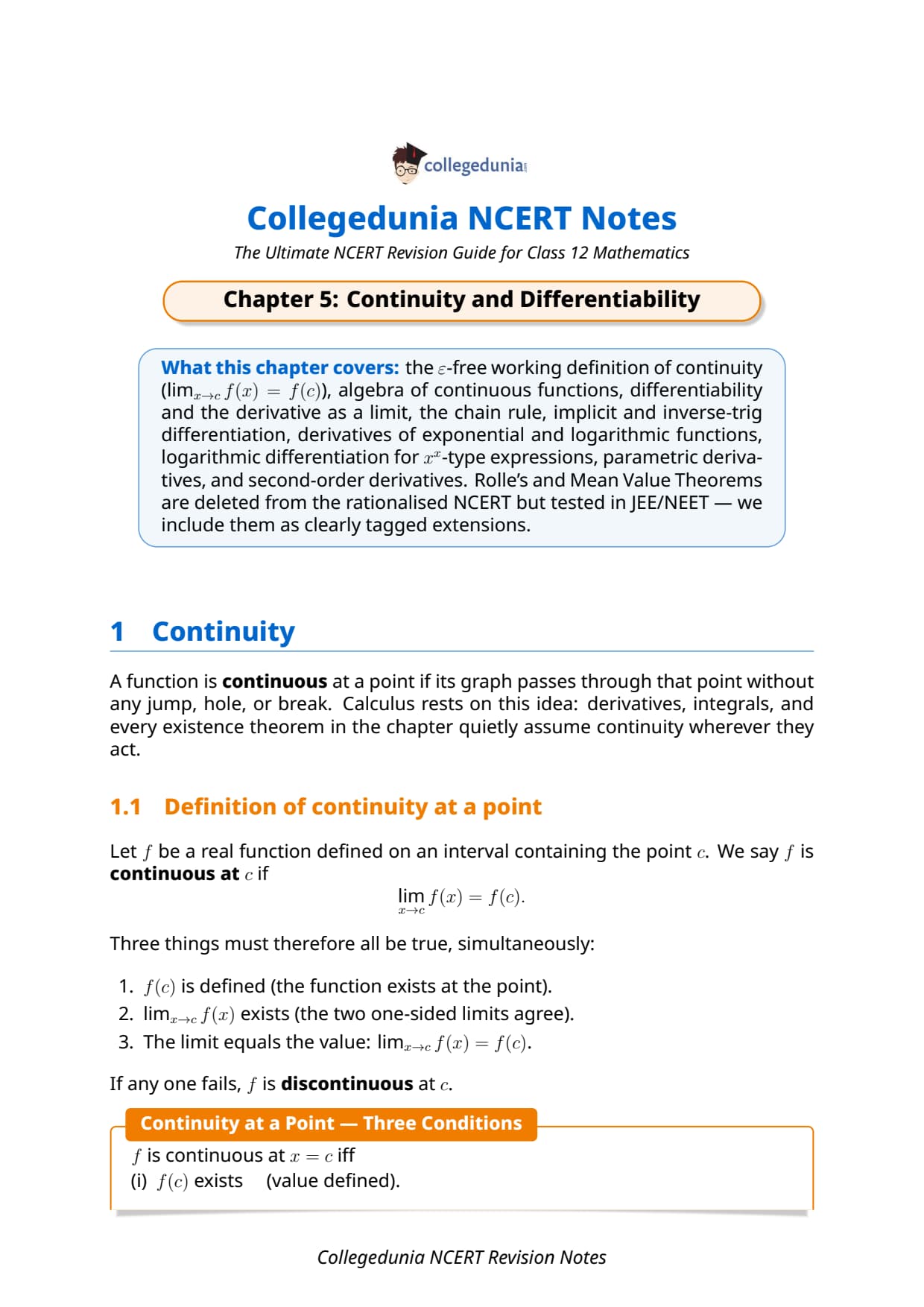
These NCERT Notes for Class 12 Maths Chapter 5 Continuity and Differentiability cover every definition, standard derivative, and theorem in the chapter. They follow the 2026-27 NCERT syllabus for CBSE, JEE Main, and CUET. Download the free notes PDF from this page.

- CBSE Class 12 Boards: 8 to 10 marks, the largest chapter in the Calculus unit.
- JEE Main: 3 to 4 questions per sitting, about 7 to 9% of the Maths section.
- CUET (UG) Maths: 2 to 3 MCQs on continuity, chain rule, and logarithmic differentiation.
These notes are compiled by Class 12 Maths specialists and checked against the 2026-27 NCERT textbook and recent CBSE marking schemes.
|
Table of Contents |
Why Continuity and Differentiability Matters for Class 12
This chapter is the gatekeeper of the Calculus unit, and a weak grip here costs marks across Chapters 6 to 9. CBSE 2024 and 2025 both set a 5-mark logarithmic differentiation question of the form y = [f(x)]g(x) .
Continuity and Differentiability Solved Step by Step (Video)
Source: NCERT Wallah
What to Revise Before Chapter 5
- Limits and one-sided limits (Class 11): the basis of every continuity test.
- The sin x / x limit and the laws of logarithms: used to derive the standard derivatives.
- Inverse trigonometric domains (Ch 2): their derivatives carry limits.
Continuity and Differentiability Topic Breakdown
1. Continuity at a point
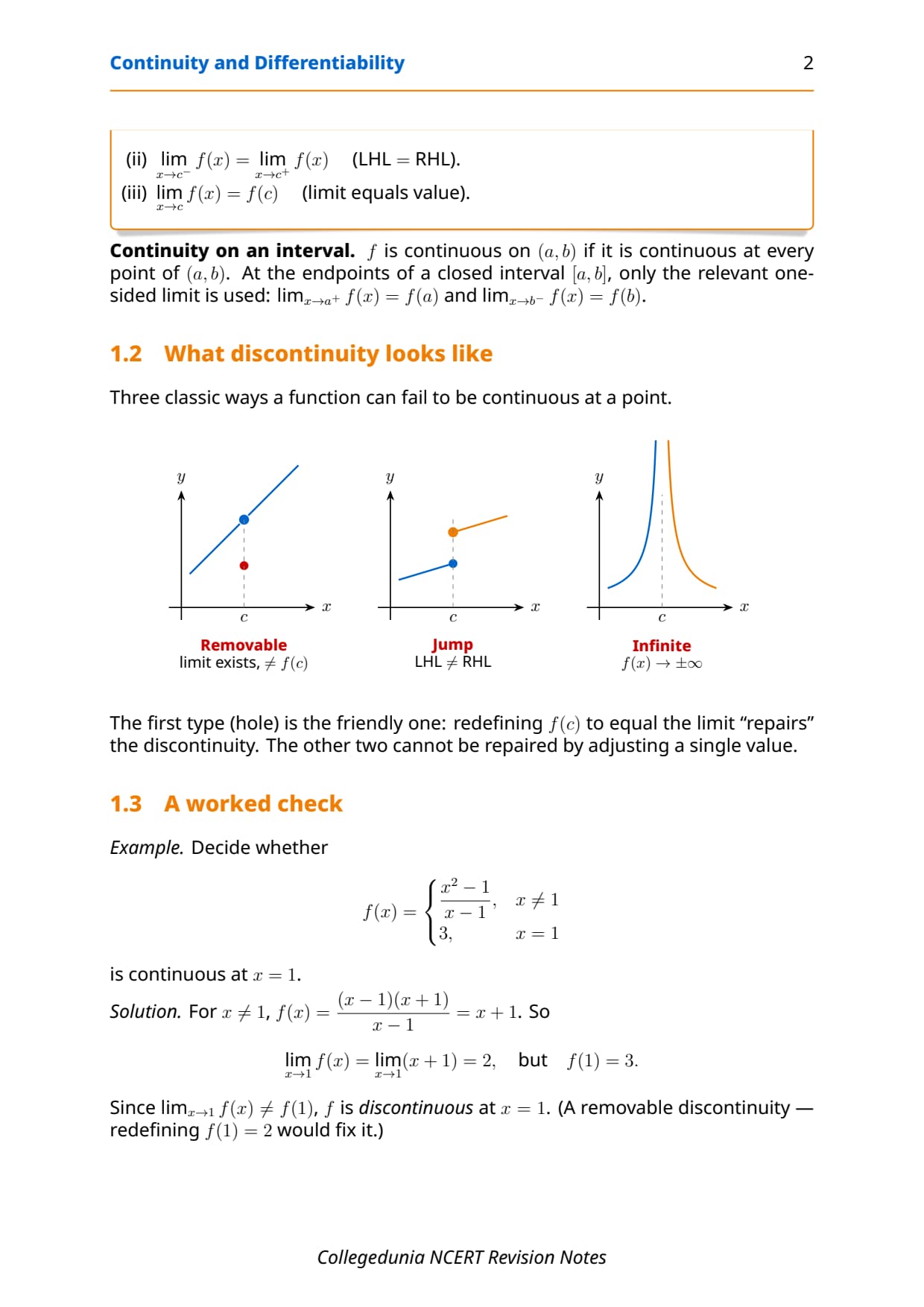
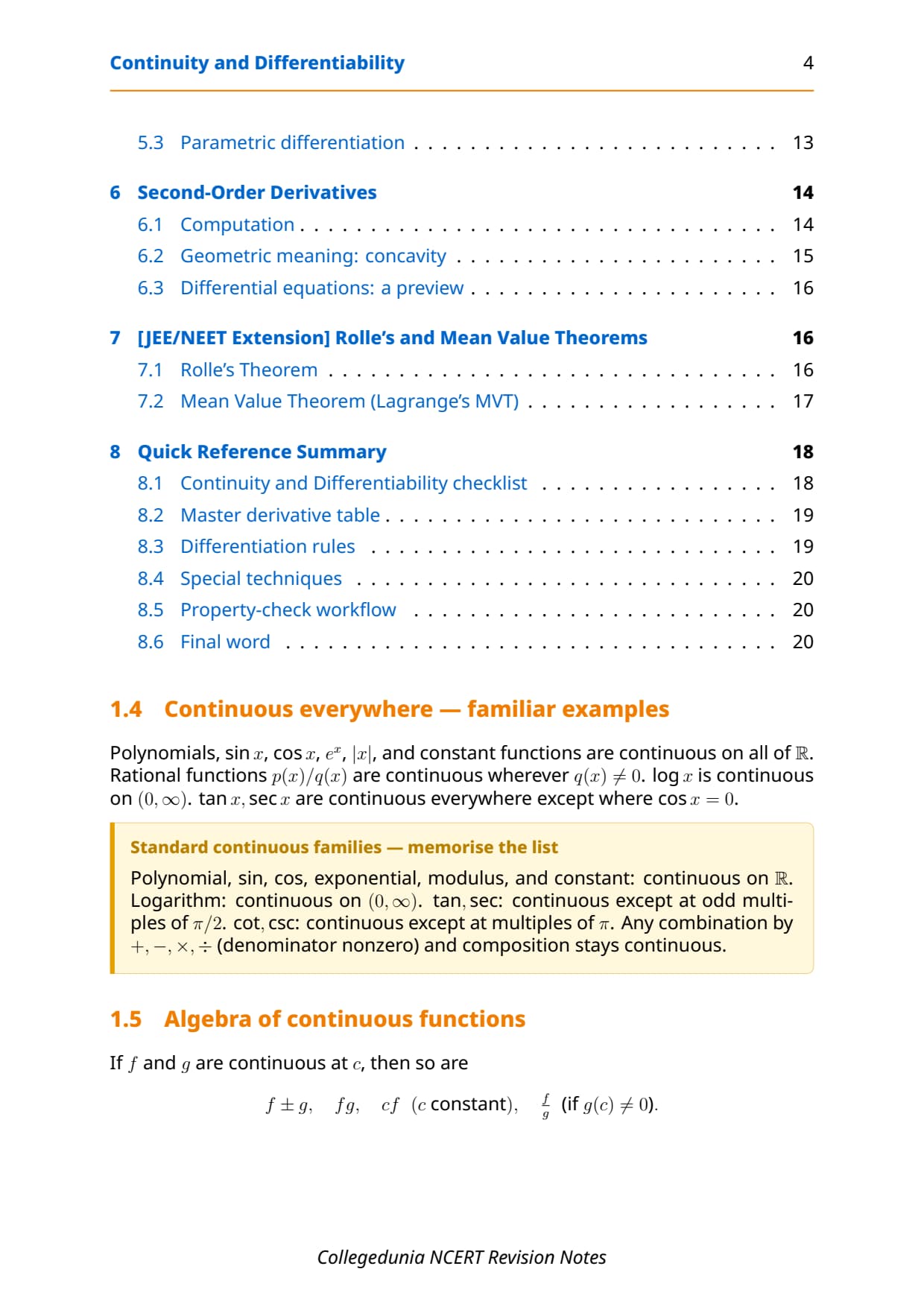
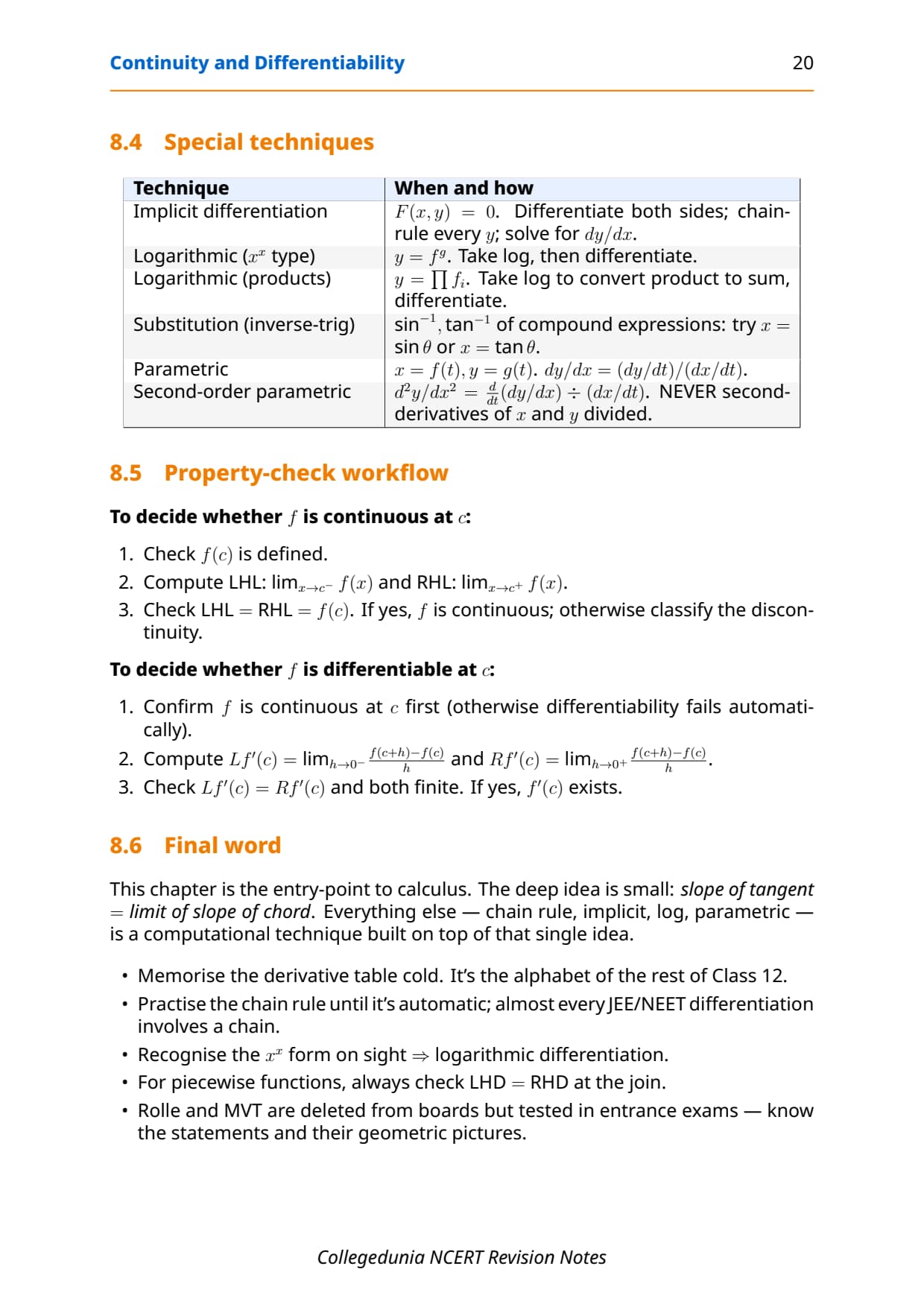
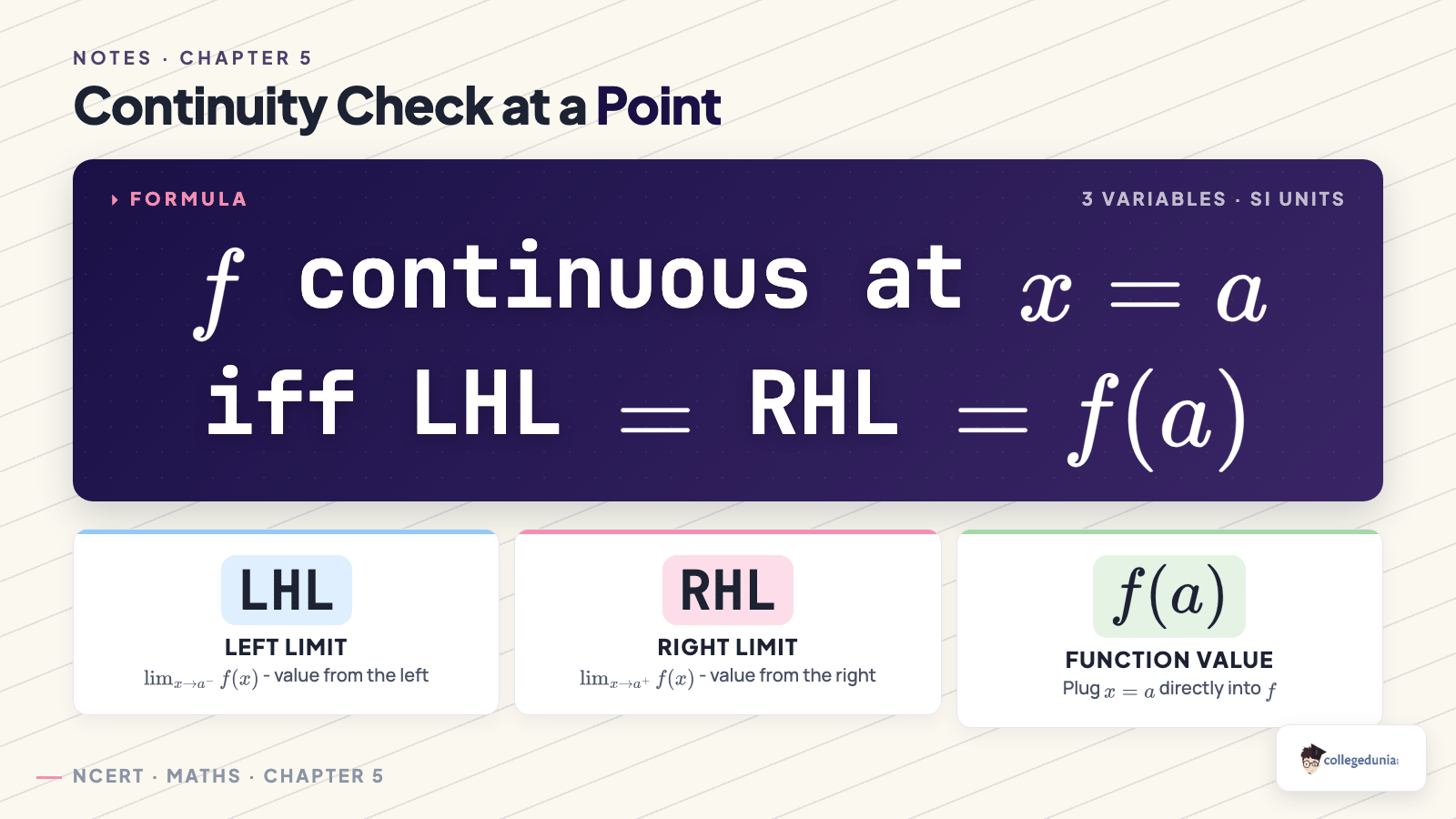
f is continuous at x = a if f(a) is defined, the limit exists, and the two agree: $$ \lim_{x \to a^-} f(x) = \lim_{x \to a^+} f(x) = f(a) $$ Any one failure breaks continuity. Write this three-line test verbatim to earn the method mark.
2. Algebra of continuous functions
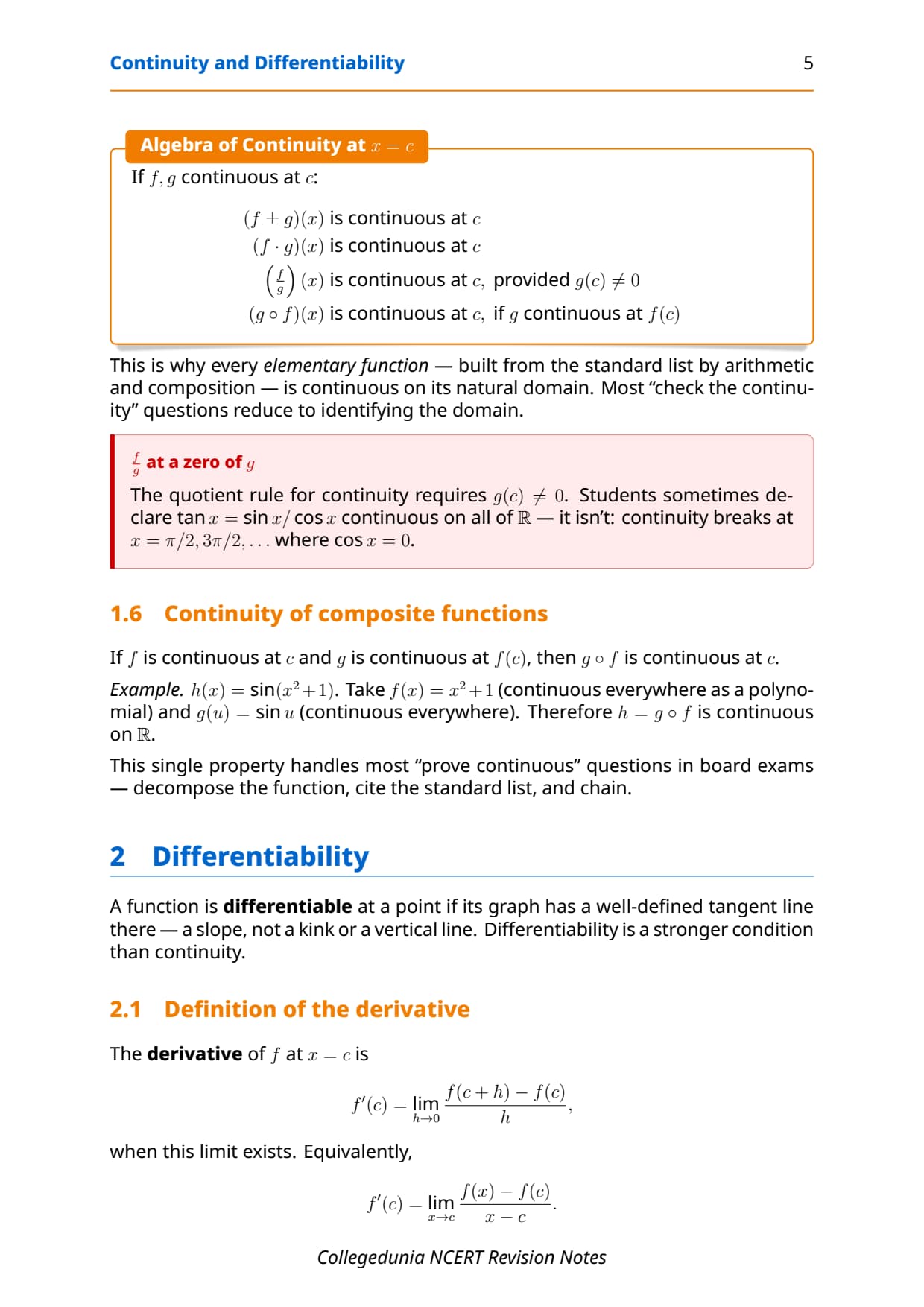
If f, g are continuous at a , so are f ± g , fg , and f/g (with g(a) ≠ 0 ). Composition also preserves it, so polynomials and standard functions are continuous on their domains.
3. Differentiability at a point
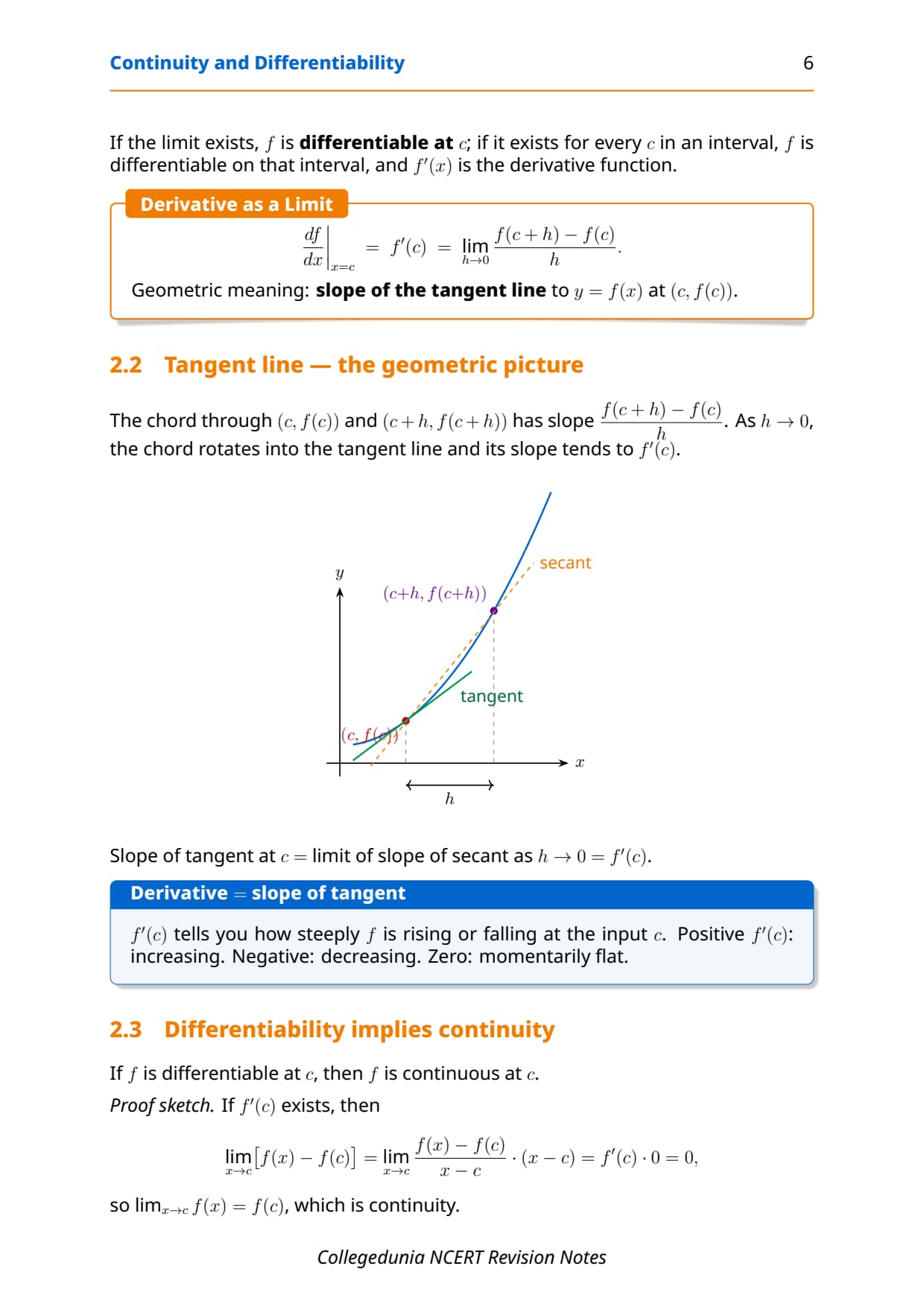
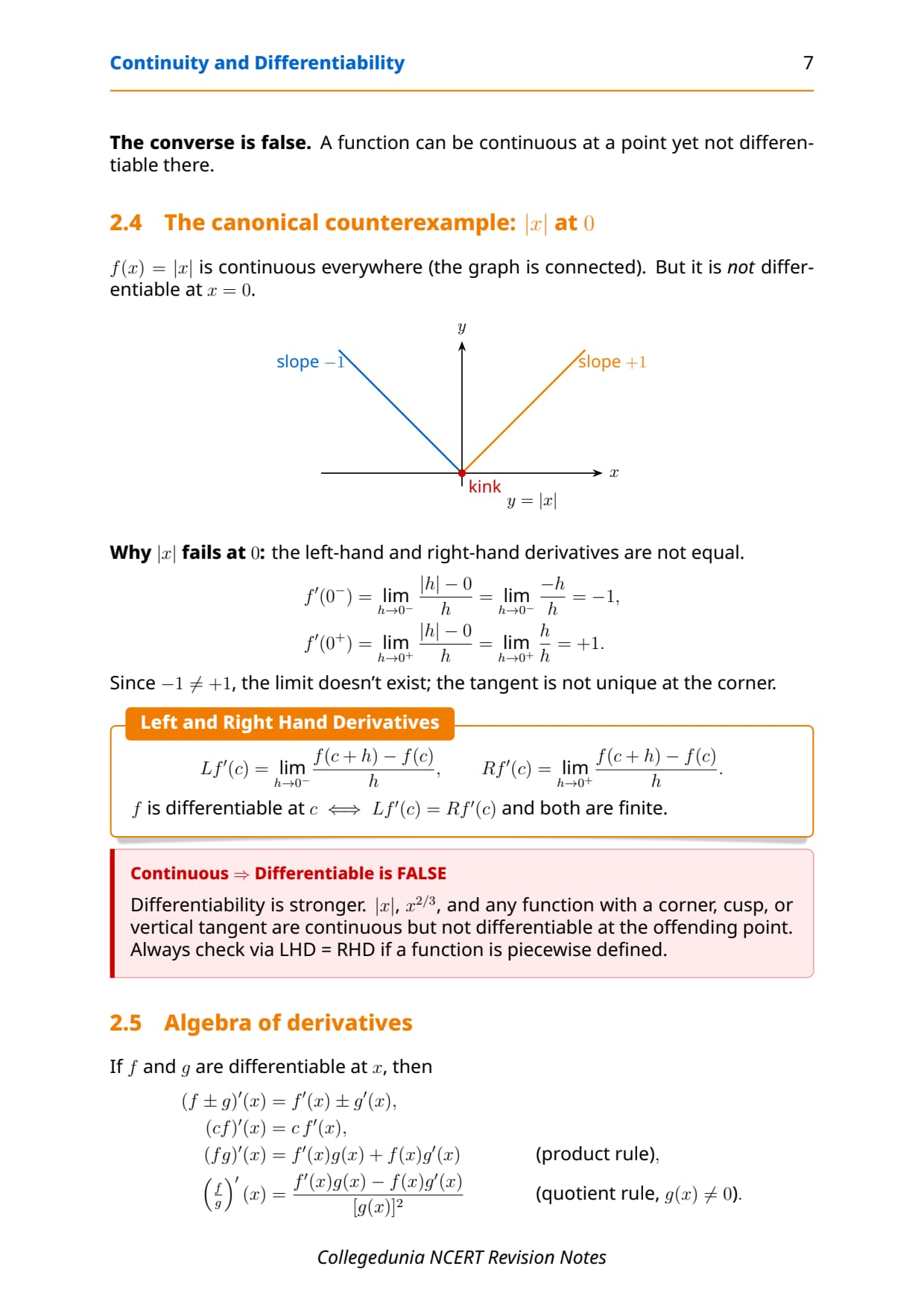
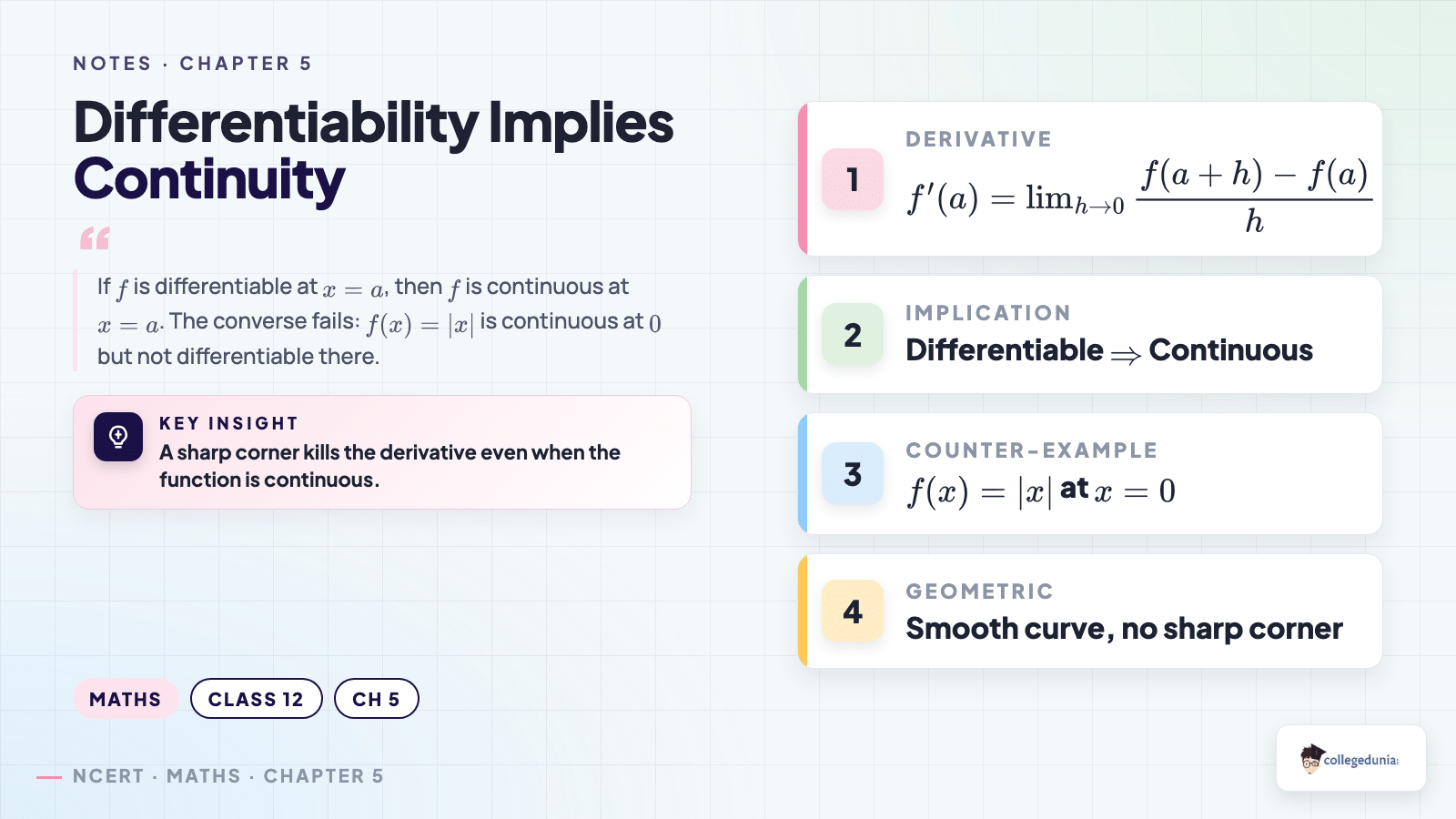
f is differentiable at a if $$ f'(a) = \lim_{h \to 0} \frac{f(a + h) - f(a)}{h} $$ exists. Differentiable implies continuous, but not the reverse: |x| is continuous at 0 yet not differentiable there.
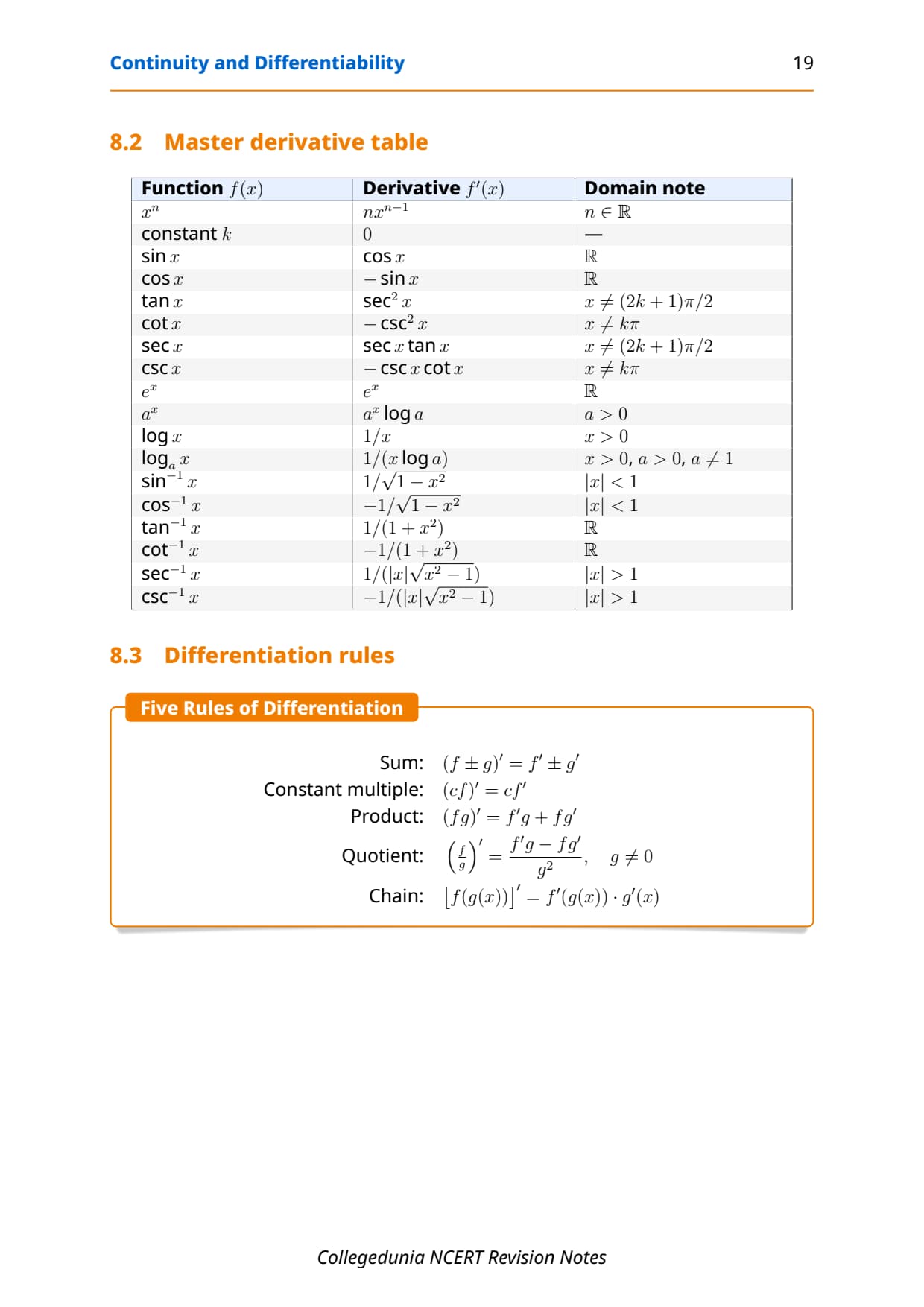
4. Derivatives of standard functions
These 16 standard derivatives drive most of the chapter.
| Function | Derivative |
|---|---|
| xn | n xn-1 |
| sin x , cos x | cos x , -sin x |
| tan x , cot x | sec2 x , -csc2 x |
| sec x , csc x | sec x tan x , -csc x cot x |
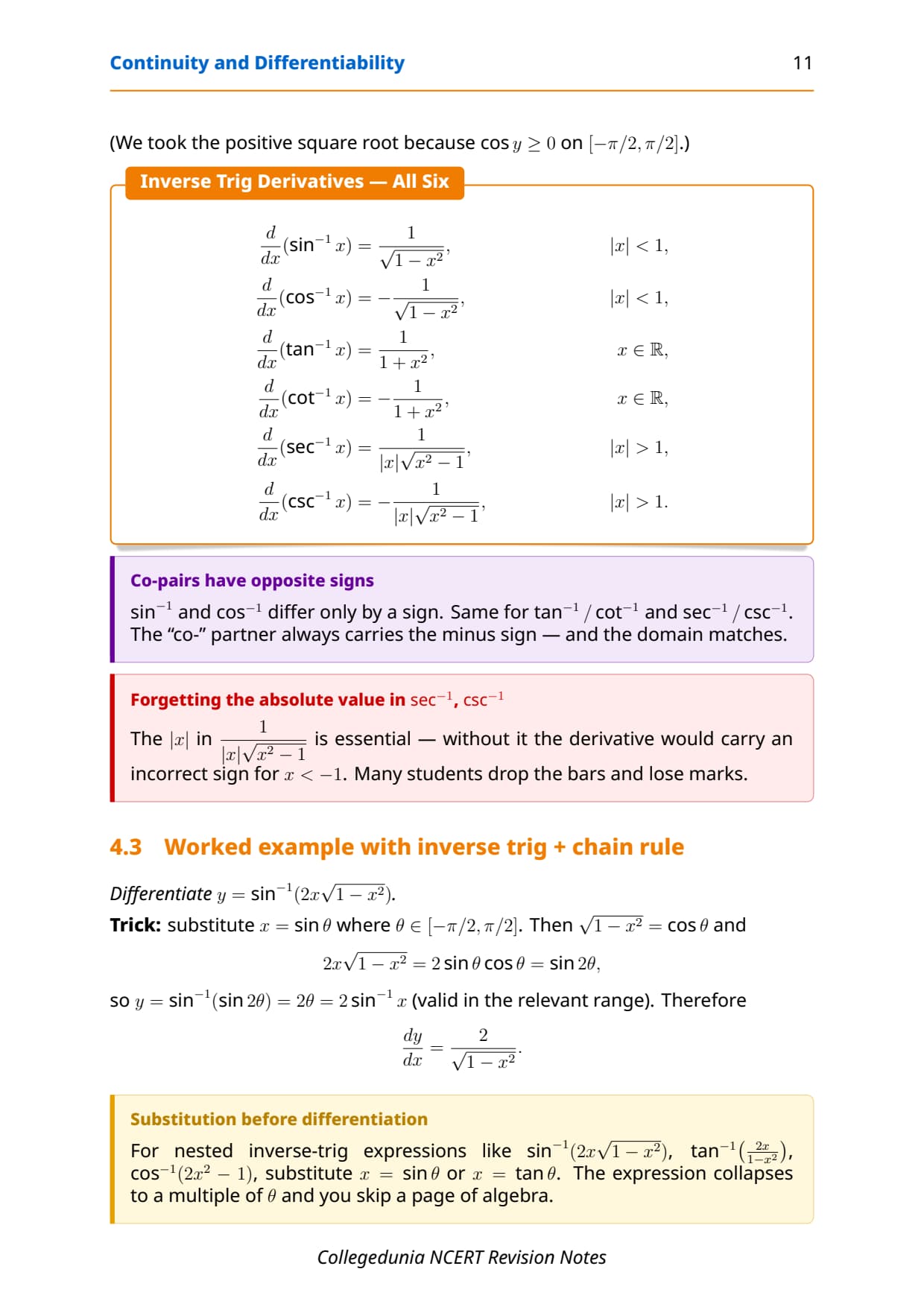
| sin-1 x , cos-1 x | ± 1√1 - x2 , |x| < 1 |
| tan-1 x , cot-1 x | ± 11 + x2 |
| ex , ax | ex , ax log a |
| log x , a x | 1x , 1x log a |
Always state the domain restriction on inverse-trig and log derivatives.
5. Chain rule
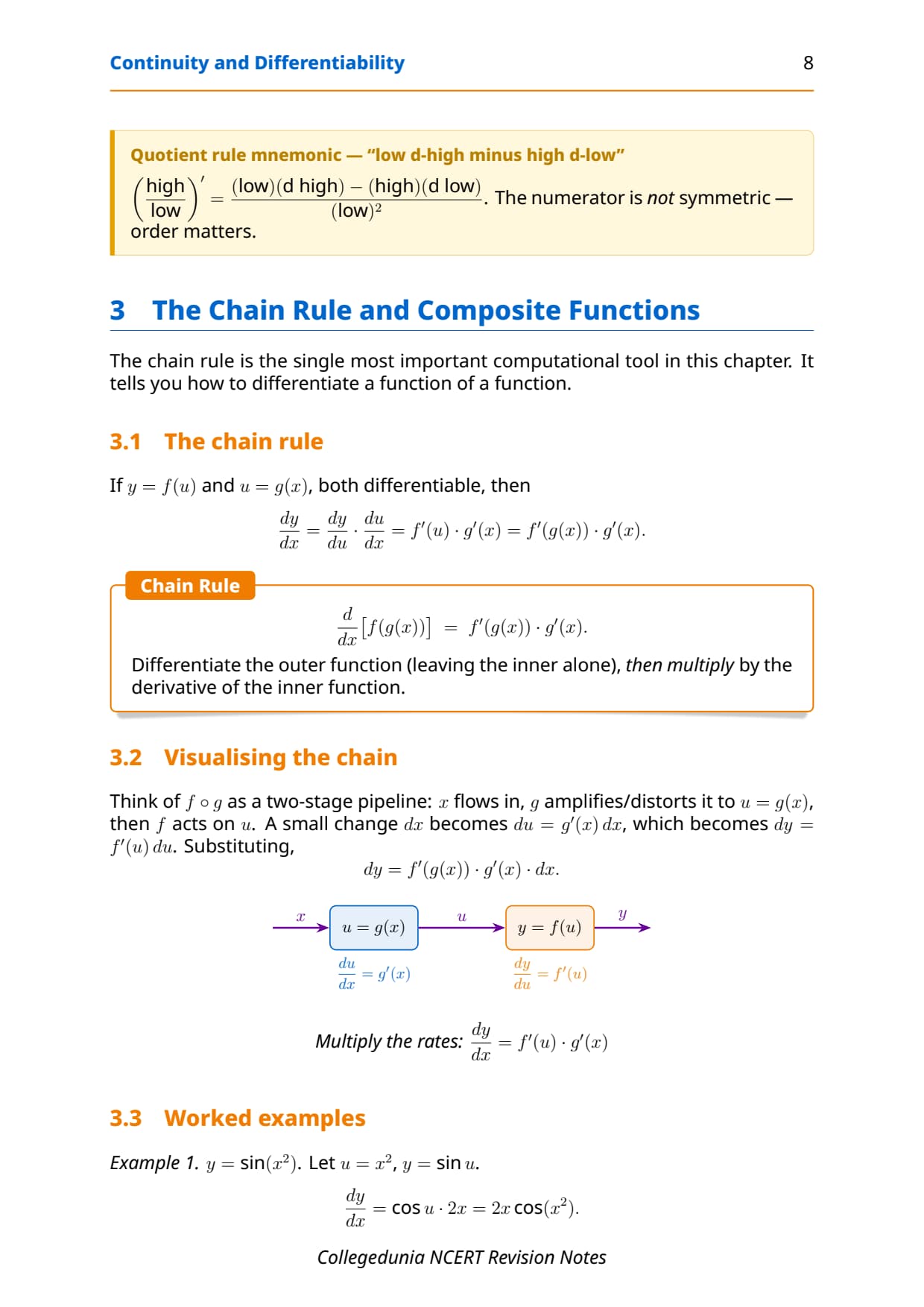
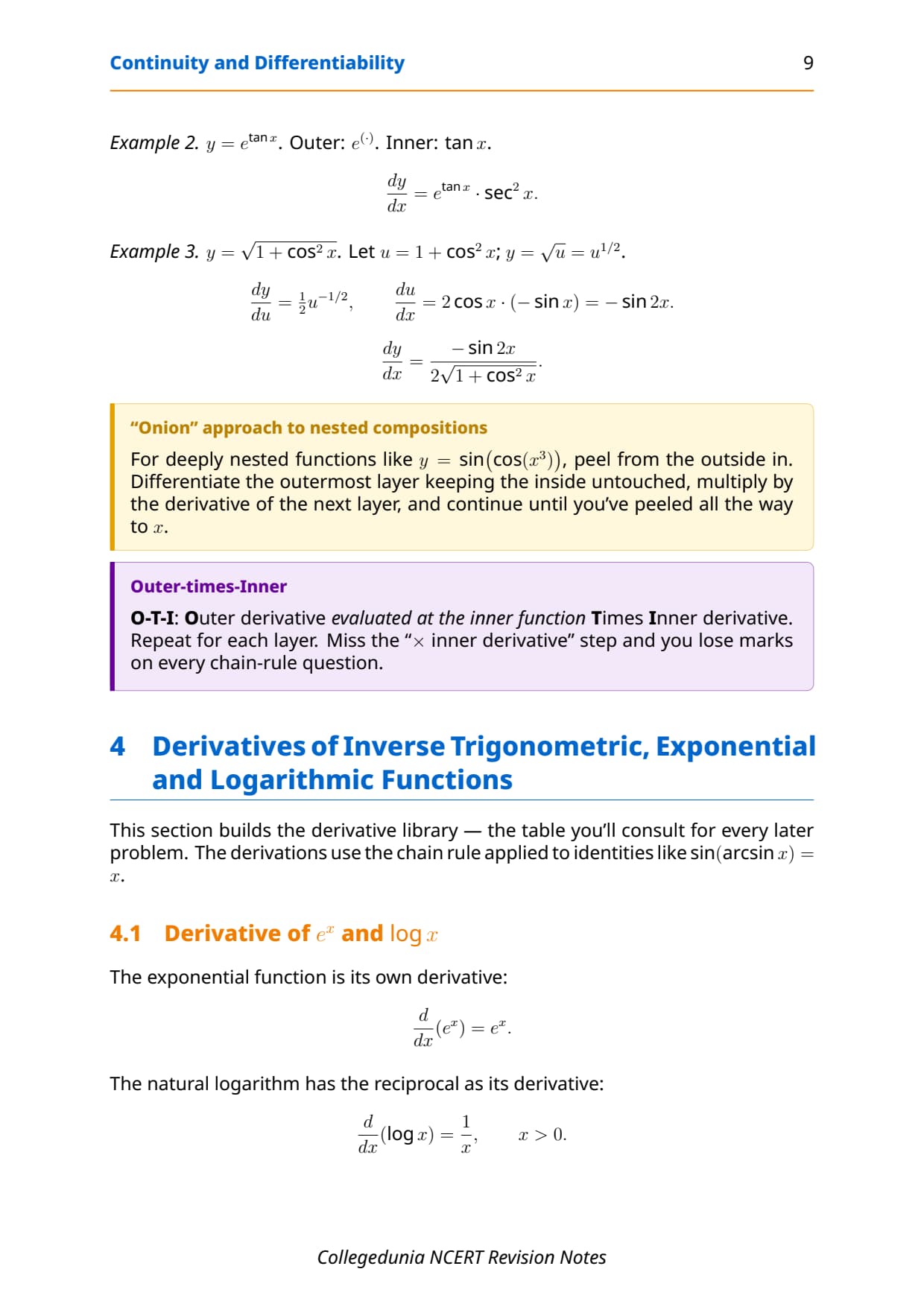
If y = f(u) , u = g(x) , then dydx = f'(g(x)) · g'(x) . Never stop at the outer derivative; always multiply by g'(x) .
6. Implicit differentiation
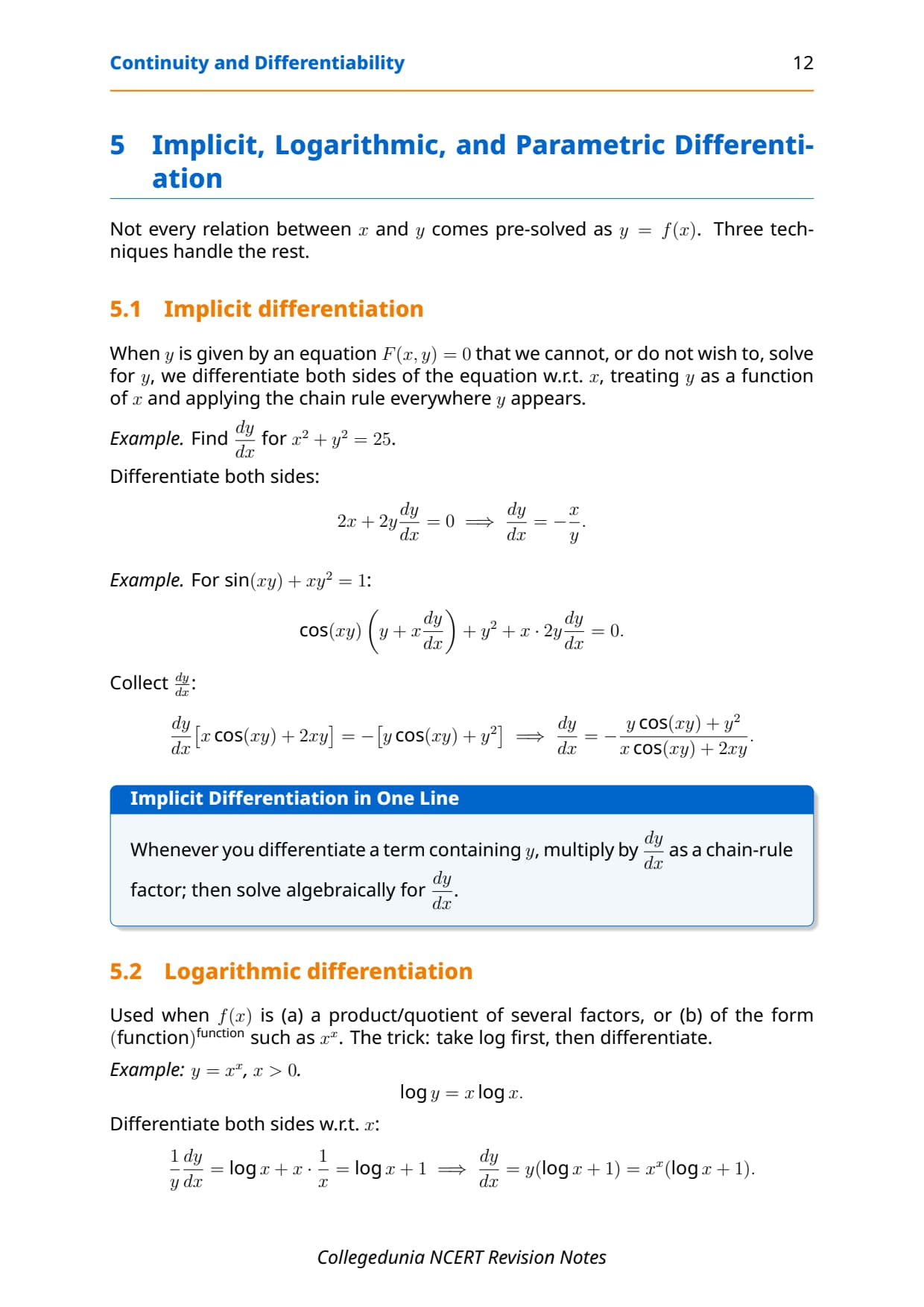
Differentiate every term in F(x, y) = 0 , treating y as a function of x . For x2 + y2 = 25 , this gives dydx = -xy .
7. Logarithmic differentiation
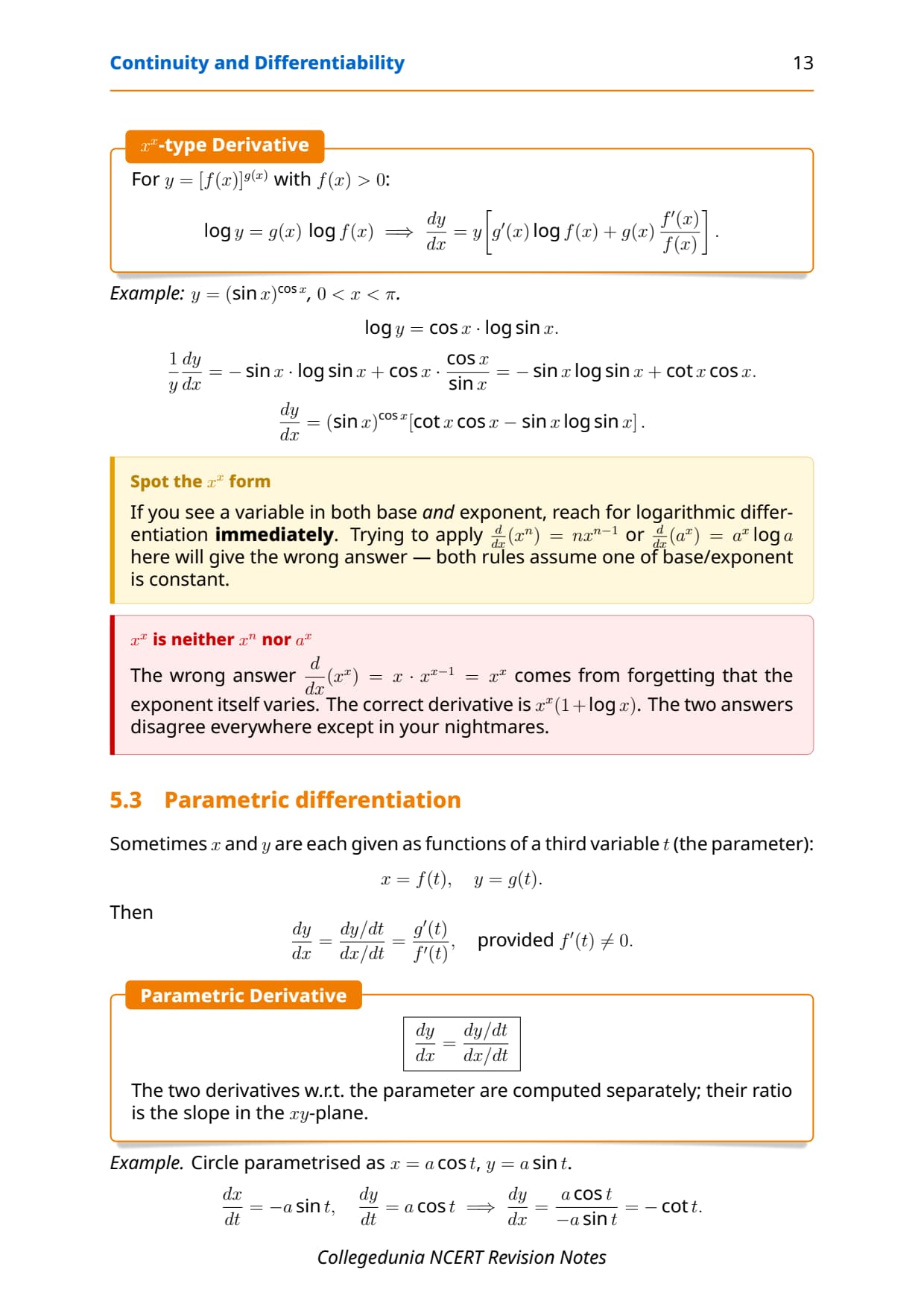
Use it for y = [f(x)]g(x) or long products: take log of both sides, differentiate, then multiply back by y . For y = xx , dydx = xx (log x + 1) .
8. Parametric and second-order derivatives
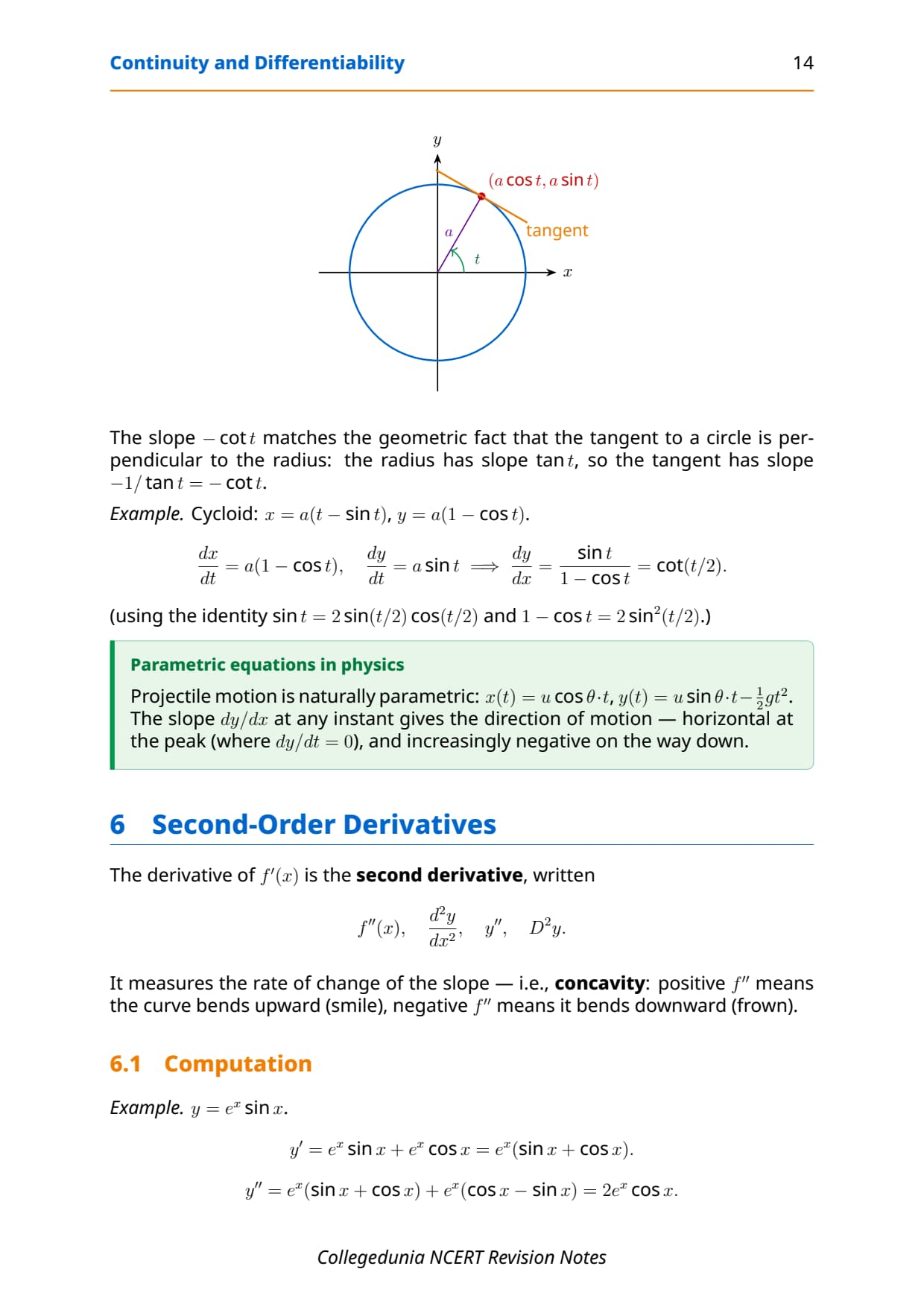
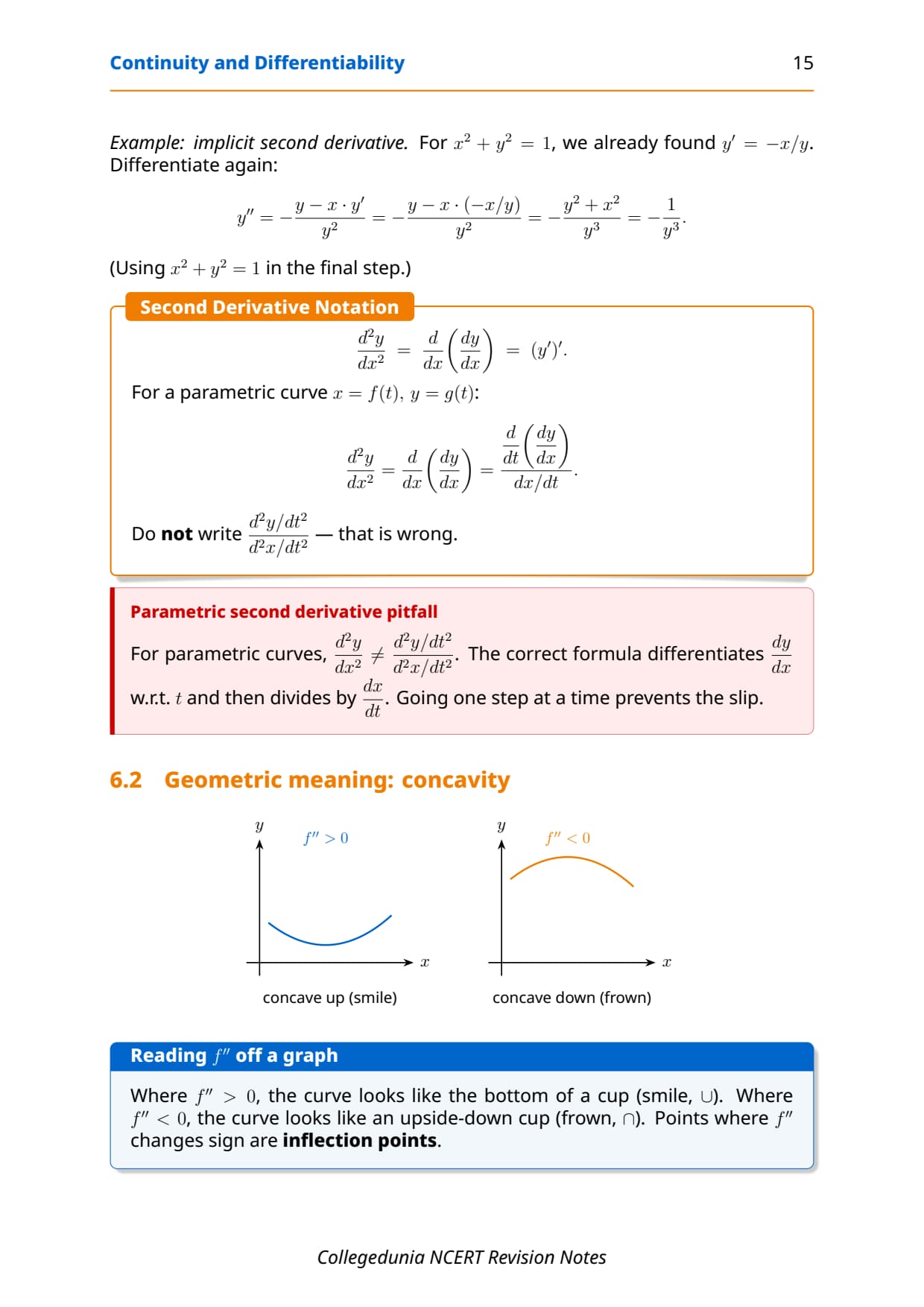
If x = f(t) , y = g(t) , then dydx = g'(t)f'(t) , and the second derivative differentiates this again with respect to x .
9. Rolle's Theorem and the Mean Value Theorem
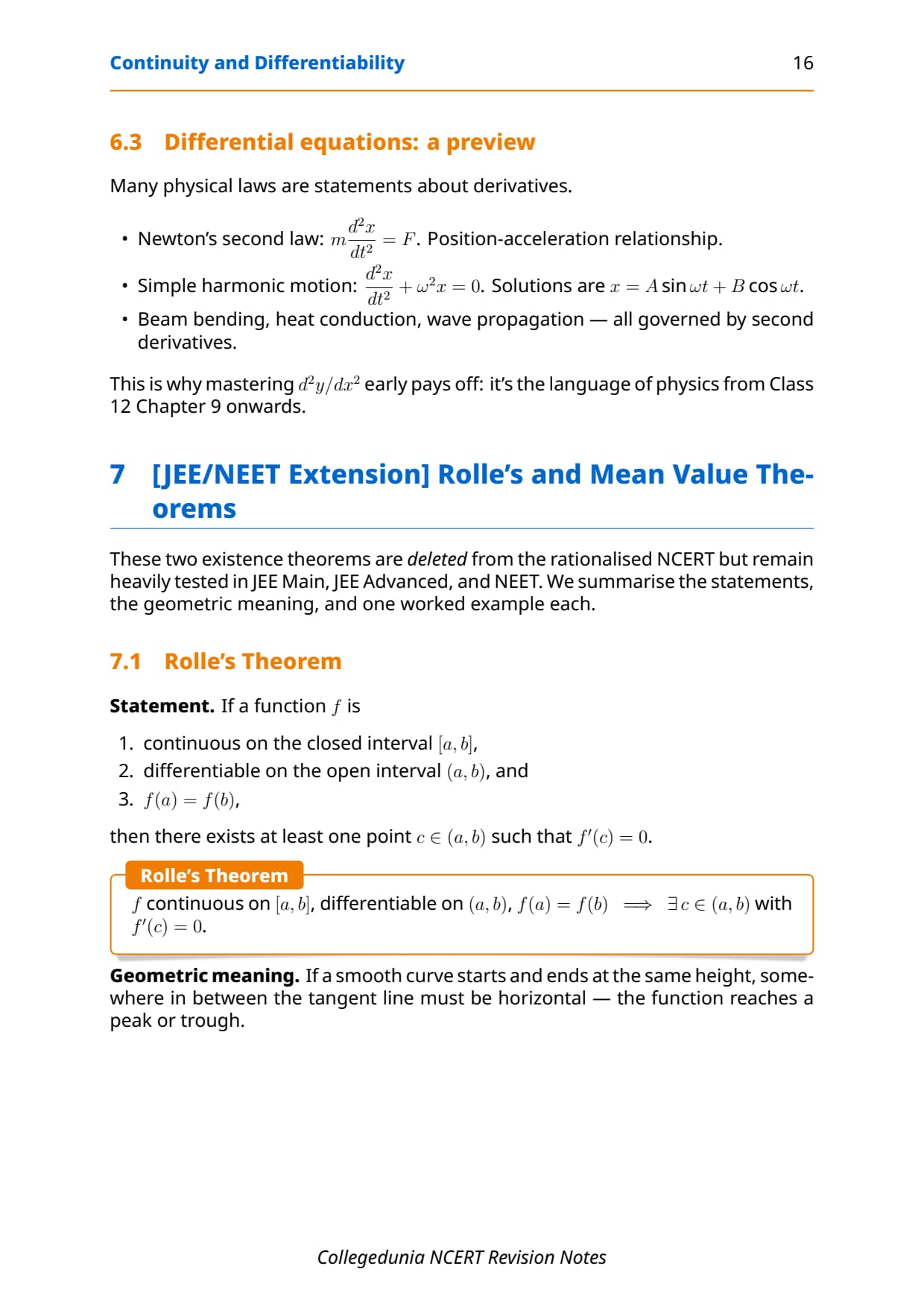
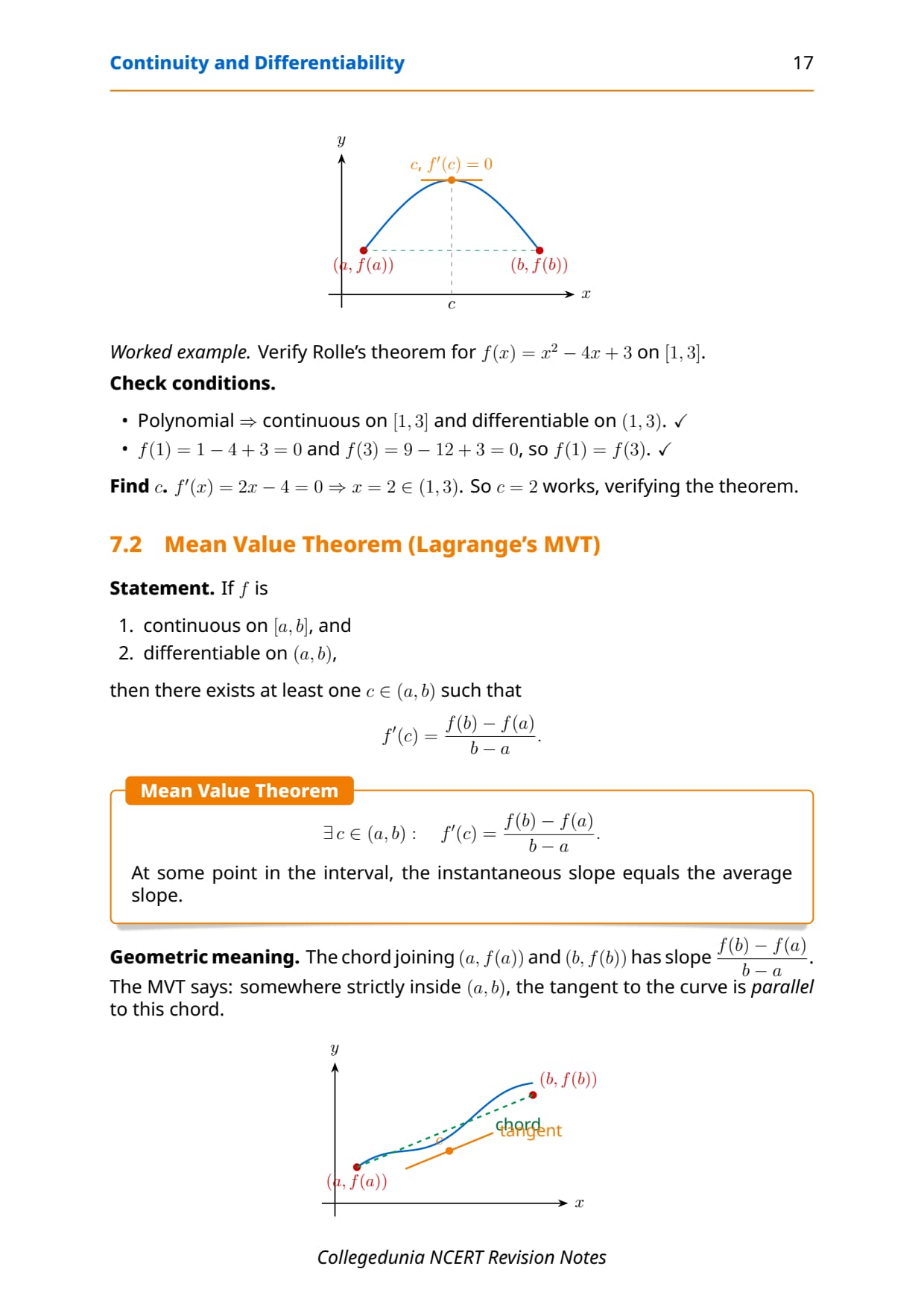
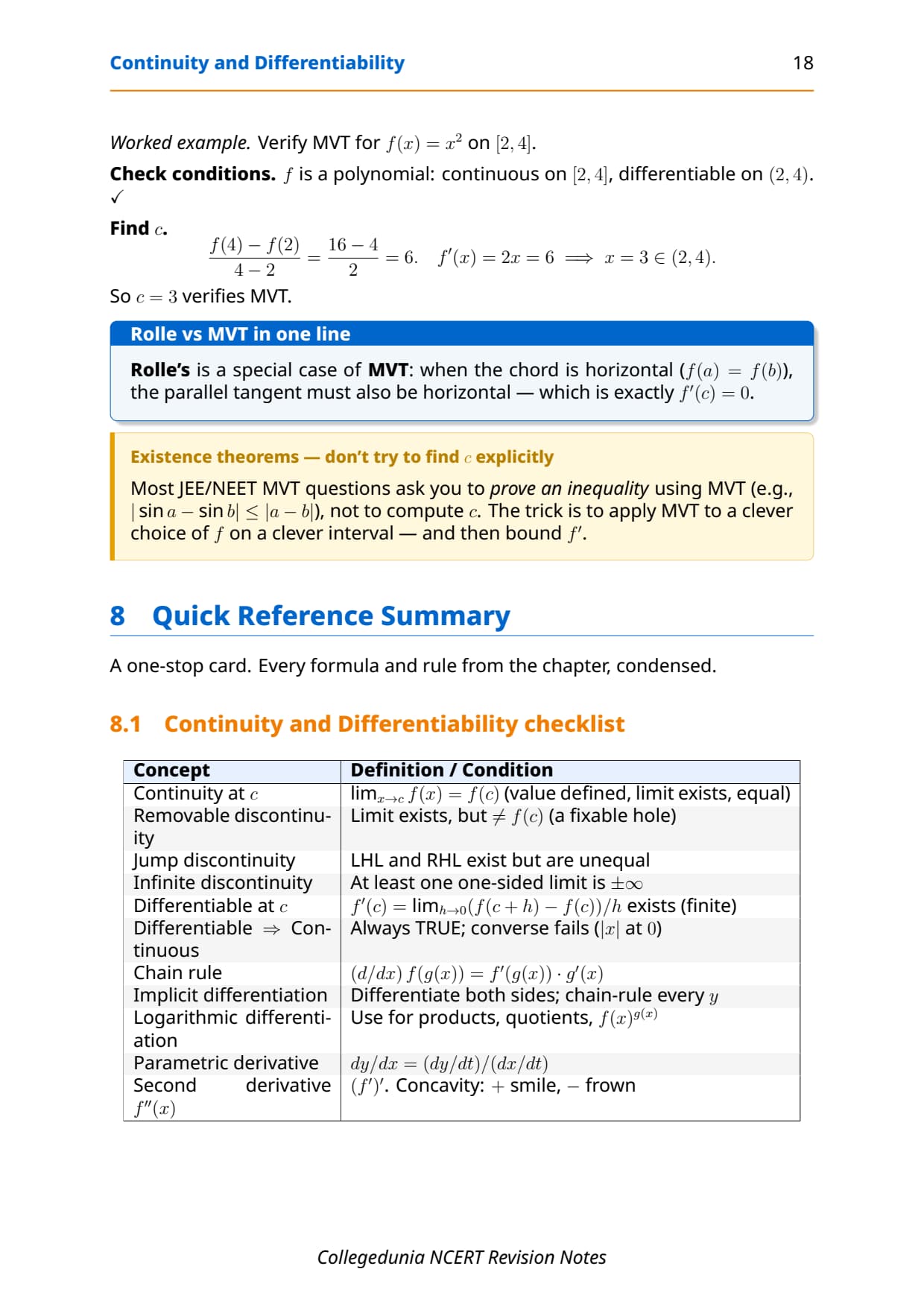
Rolle's: if f is continuous on [a, b] , differentiable on (a, b) , and f(a) = f(b) , then f'(c) = 0 for some c in the interval. The Mean Value Theorem drops the third hypothesis, giving $$ f'(c) = \frac{f(b) - f(a)}{b - a} $$ Always state and verify the hypotheses first for full marks.
Common Misconceptions in Continuity and Differentiability
- "Continuous implies differentiable." The converse is true; |x| is continuous at 0 but has a corner there.
- Wrong power rule for variable exponents: [f(x)]g(x) needs logarithmic differentiation.
- Skipping domain restrictions on inverse-trig derivatives, e.g. |x| < 1 for sin-1 x .
Continuity and Differentiability Most Repeated CBSE Questions
Ques. If f(x) = sin 3xx for x ≠ 0 and f(0) = k is continuous at 0, find k . (2025, 2023, 2020)
[3-Mark] x → 0 sin 3xx = 3 . Hence k = 3 .
Ques. Differentiate xx . (2024, 2022, 2019)
[5-Mark] Use logarithmic differentiation: ddx(xx) = xx(log x + 1) .
Continuity and Differentiability Weightage in CBSE, JEE and CUET
Chapter 5 supplies nearly one in every twelve Maths questions in recent JEE Main sittings.
| Exam | Weightage | Important Topics |
|---|---|---|
| CBSE Boards 2025 | 8 to 10 marks | Continuity test, logarithmic and parametric derivatives |
| JEE Main 2025 | 3 to 4 questions | Chain rule, logarithmic differentiation, MVT proofs |
| CUET (UG) 2025 | 2 to 3 MCQs | Standard derivatives, chain rule, continuity checks |
Class 12 Maths Notes: All Chapters
Jump to any other Class 12 Maths chapter's Notes page.
| Chapter | Chapter Notes |
|---|---|
| Chapter 1 | Relations and Functions Notes |
| Chapter 2 | Inverse Trigonometric Functions Notes |
| Chapter 3 | Matrices Notes |
| Chapter 4 | Determinants Notes |
| Chapter 6 | Application of Derivatives Notes |
| Chapter 7 | Integrals Notes |
| Chapter 8 | Application of Integrals Notes |
| Chapter 9 | Differential Equations Notes |
| Chapter 10 | Vector Algebra Notes |
| Chapter 11 | Three Dimensional Geometry Notes |
| Chapter 12 | Linear Programming Notes |
| Chapter 13 | Probability Notes |
Continuity and Differentiability Exercise-wise Breakdown
The chapter has 7 exercises plus a Miscellaneous Exercise. Each row links straight to the worked solutions.
| Exercise | Topic Tested |
|---|---|
| Exercise 5.1 | Continuity at a point and on an interval |
| Exercise 5.2 | Algebra of continuous functions |
| Exercise 5.3 | Differentiability and chain rule |
| Exercise 5.4 | Derivatives of inverse trigonometric functions |
| Exercise 5.5 | Logarithmic differentiation |
| Exercise 5.6 | Parametric and implicit differentiation |
| Exercise 5.7 | Second-order derivatives; Rolle's and Mean Value Theorem |
| Miscellaneous Exercise | Mixed continuity and differentiability problems |
Continuity and Differentiability Class 12 PDF Download Formats
The Continuity and Differentiability Class 12 PDF comes in three styles: a light file for phone revision, a print-ready HD file, and a handwritten-notes version. All follow the NCERT 2026-27 notation, and a Hindi-medium edition is available.
The separate Formula Sheet and Solutions PDFs are linked in the Other Resources table below. State-board students will find the same definitions; only the exercise numbers differ.
How These Notes Pair with Other Chapter 5 Resources
Use these notes for the first theory pass, the Solutions PDF for practice, and the Formula Sheet for final-week recall. RD Sharma, ML Aggarwal, and the NCERT Exemplar add extra practice. All sister resources are linked below.
How to Use the Continuity and Differentiability Notes
Split your revision across three sittings:
- Theory: read the NCERT chapter, mark every definition and theorem, then review the formulas here.
- Solved examples: re-solve each NCERT example without peeking, then check your steps.
- Exercises: attempt one exercise set per sitting and click the linked pages above to verify.
For both boards and JEE Main, split time roughly 60% on NCERT and 40% on JEE-style sets. For CUET, focus on definitions and one-step applications.
Other Resources for Continuity and Differentiability
| Resource | Link |
|---|---|
| NCERT Notes (this page) | Continuity and Differentiability Notes |
| NCERT Solutions | Continuity and Differentiability Solutions |
| Formula Sheet | Continuity and Differentiability Formula Sheet |
| Handwritten Notes | Continuity and Differentiability Handwritten Notes |
| Exemplar Solutions | Continuity and Differentiability Exemplar Solutions |
Student Feedback - Continuity and Differentiability difficulty (March 2026 survey of 12,840 Class 12 students):
- 73% of students surveyed rated this as one of the higher-weightage units in their CBSE board prep.
- The average student lost 1.2 marks from skipping a single intermediate step.
- 74% of JEE aspirants re-revised this chapter at least twice in the final week.
Continuity and Differentiability Class 12 Notes - Frequently Asked Questions
Ques. What is the weightage of Continuity and Differentiability in CBSE Class 12 Maths Board Exam 2026?
Ans. Continuity and Differentiability typically carries 8 to 10 marks in the CBSE Class 12 Maths paper, the largest single-chapter weightage in the Calculus unit. Expect at least one MCQ on continuity of a piecewise function, a 3-mark short answer on finding a constant for continuity, and a 5-mark long answer that is almost always either logarithmic differentiation or a parametric second-order derivative.
Ques. Is every continuous function differentiable?
Ans. No. Differentiability implies continuity, but the converse is false. The classic counter-example is f(x) = |x| at x = 0 , which is continuous but not differentiable because the left-hand derivative is -1 and the right-hand derivative is +1 . A continuous function with a corner, cusp, or vertical tangent fails differentiability at that point.
Ques. When should I use logarithmic differentiation?
Ans. Use logarithmic differentiation in two situations: (i) when the function has the form y = [f(x)]g(x) , where both base and exponent are functions of x ; and (ii) when the function is a product or quotient of many factors, so taking log converts the product into a sum.
The 4-step procedure (log both sides, differentiate, isolate dydx , substitute back) is standard.
Ques. How do I verify Rolle's Theorem for a given function on an interval?
Ans. State the three hypotheses and check each one explicitly: (i) f is continuous on the closed interval [a, b] , (ii) differentiable on the open interval (a, b) , and (iii) f(a) = f(b) .
If any hypothesis fails, say so and stop. If all three hold, solve f'(c) = 0 for c and confirm c ∈ (a, b) . CBSE awards 2 of the 4 marks just for the verification.
Ques. What is the chain rule and where do I apply it?
Ans. The chain rule is dydx = dydu · dudx for a composed function y = f(g(x)) . Apply it whenever one function is wrapped inside another, for instance y = sin(x2) , y = etan x , or y = log(sin x) . For multiple nesting, apply the rule layer by layer.
Ques. Why are domain restrictions on inverse trigonometric derivatives important?
Ans. The derivatives of sin-1 x and cos-1 x are valid only for |x| < 1 ; at x = ± 1 the tangent line is vertical and the derivative does not exist. Examiners deduct a method mark whenever a student writes the derivative without flagging the restriction.



Comments