




The NCERT Solutions for Class 6 Mathematics Chapter 5 Prime Time explain factors, multiples, prime numbers, and divisibility through the 2026-27 Ganita Prakash activities. Each answer uses small steps, number lists, and clear checks that students can repeat on their own.
- Core ideas: common factors, common multiples, primes, composites, and prime factorisation
- Useful checks: divisibility rules for 2, 3, 4, 5, 6, 8, 9, and 10
- Practice style: games, number grids, factor puzzles, and true-or-false reasoning
Chapter5PrimeTimeSolutions.pdf?page=1&dpi=150)
Chapter5PrimeTimeSolutions.pdf?page=2&dpi=150)
Chapter5PrimeTimeSolutions.pdf?page=3&dpi=150)
Chapter5PrimeTimeSolutions.pdf?page=4&dpi=150)
Chapter5PrimeTimeSolutions.pdf?page=5&dpi=150)
Chapter5PrimeTimeSolutions.pdf?page=6&dpi=150)
Chapter5PrimeTimeSolutions.pdf?page=7&dpi=150)
Chapter5PrimeTimeSolutions.pdf?page=8&dpi=150)
Chapter5PrimeTimeSolutions.pdf?page=9&dpi=150)
Chapter5PrimeTimeSolutions.pdf?page=10&dpi=150)
Chapter5PrimeTimeSolutions.pdf?page=11&dpi=150)
Chapter5PrimeTimeSolutions.pdf?page=12&dpi=150)
Chapter5PrimeTimeSolutions.pdf?page=13&dpi=150)
Chapter5PrimeTimeSolutions.pdf?page=14&dpi=150)
Chapter5PrimeTimeSolutions.pdf?page=15&dpi=150)
Chapter5PrimeTimeSolutions.pdf?page=16&dpi=150)
Chapter5PrimeTimeSolutions.pdf?page=17&dpi=150)
Chapter5PrimeTimeSolutions.pdf?page=18&dpi=150)
Chapter5PrimeTimeSolutions.pdf?page=19&dpi=150)
Chapter5PrimeTimeSolutions.pdf?page=20&dpi=150)
Chapter5PrimeTimeSolutions.pdf?page=21&dpi=150)
Chapter5PrimeTimeSolutions.pdf?page=22&dpi=150)
Chapter5PrimeTimeSolutions.pdf?page=23&dpi=150)
Chapter5PrimeTimeSolutions.pdf?page=24&dpi=150)
Chapter5PrimeTimeSolutions.pdf?page=25&dpi=150)
Chapter5PrimeTimeSolutions.pdf?page=26&dpi=150)
Chapter5PrimeTimeSolutions.pdf?page=27&dpi=150)
Chapter5PrimeTimeSolutions.pdf?page=28&dpi=150)
Chapter5PrimeTimeSolutions.pdf?page=29&dpi=150)
Chapter5PrimeTimeSolutions.pdf?page=30&dpi=150)
Chapter5PrimeTimeSolutions.pdf?page=31&dpi=150)
Chapter5PrimeTimeSolutions.pdf?page=32&dpi=150)
Chapter5PrimeTimeSolutions.pdf?page=33&dpi=150)
Chapter5PrimeTimeSolutions.pdf?page=34&dpi=150)
Chapter5PrimeTimeSolutions.pdf?page=35&dpi=150)
Chapter5PrimeTimeSolutions.pdf?page=36&dpi=150)
Chapter5PrimeTimeSolutions.pdf?page=37&dpi=150)
Chapter5PrimeTimeSolutions.pdf?page=38&dpi=150)
Chapter5PrimeTimeSolutions.pdf?page=39&dpi=150)
Chapter5PrimeTimeSolutions.pdf?page=40&dpi=150)
Chapter5PrimeTimeSolutions.pdf?page=41&dpi=150)
Chapter5PrimeTimeSolutions.pdf?page=42&dpi=150)
Chapter5PrimeTimeSolutions.pdf?page=43&dpi=150)
Chapter5PrimeTimeSolutions.pdf?page=44&dpi=150)
Chapter5PrimeTimeSolutions.pdf?page=45&dpi=150)
Chapter5PrimeTimeSolutions.pdf?page=46&dpi=150)
Chapter5PrimeTimeSolutions.pdf?page=47&dpi=150)
Chapter5PrimeTimeSolutions.pdf?page=48&dpi=150)
Chapter5PrimeTimeSolutions.pdf?page=49&dpi=150)
Chapter5PrimeTimeSolutions.pdf?page=50&dpi=150)
Chapter5PrimeTimeSolutions.pdf?page=51&dpi=150)
Chapter5PrimeTimeSolutions.pdf?page=52&dpi=150)
Chapter5PrimeTimeSolutions.pdf?page=53&dpi=150)
Chapter5PrimeTimeSolutions.pdf?page=54&dpi=150)
Chapter5PrimeTimeSolutions.pdf?page=55&dpi=150)
Chapter5PrimeTimeSolutions.pdf?page=56&dpi=150)
Chapter5PrimeTimeSolutions.pdf?page=57&dpi=150)
Chapter5PrimeTimeSolutions.pdf?page=58&dpi=150)
Chapter5PrimeTimeSolutions_flat_MobileCard.pdf?page=1&dpi=150)
Chapter5PrimeTimeSolutions_flat_MobileCard.pdf?page=2&dpi=150)
Chapter5PrimeTimeSolutions_flat_MobileCard.pdf?page=3&dpi=150)
Chapter5PrimeTimeSolutions_flat_MobileCard.pdf?page=4&dpi=150)
Chapter5PrimeTimeSolutions_flat_MobileCard.pdf?page=5&dpi=150)
Chapter5PrimeTimeSolutions_flat_MobileCard.pdf?page=6&dpi=150)
Chapter5PrimeTimeSolutions_flat_MobileCard.pdf?page=7&dpi=150)
Chapter5PrimeTimeSolutions_flat_MobileCard.pdf?page=8&dpi=150)
Chapter5PrimeTimeSolutions_flat_MobileCard.pdf?page=9&dpi=150)
Chapter5PrimeTimeSolutions_flat_MobileCard.pdf?page=10&dpi=150)
Chapter5PrimeTimeSolutions_flat_MobileCard.pdf?page=11&dpi=150)
Chapter5PrimeTimeSolutions_flat_MobileCard.pdf?page=12&dpi=150)
Chapter5PrimeTimeSolutions_flat_MobileCard.pdf?page=13&dpi=150)
Chapter5PrimeTimeSolutions_flat_MobileCard.pdf?page=14&dpi=150)
Chapter5PrimeTimeSolutions_flat_MobileCard.pdf?page=15&dpi=150)
Chapter5PrimeTimeSolutions_flat_MobileCard.pdf?page=16&dpi=150)
Chapter5PrimeTimeSolutions_flat_MobileCard.pdf?page=17&dpi=150)
Chapter5PrimeTimeSolutions_flat_MobileCard.pdf?page=18&dpi=150)
Chapter5PrimeTimeSolutions_flat_MobileCard.pdf?page=19&dpi=150)
Chapter5PrimeTimeSolutions_flat_MobileCard.pdf?page=20&dpi=150)
Chapter5PrimeTimeSolutions_flat_MobileCard.pdf?page=21&dpi=150)
Chapter5PrimeTimeSolutions_flat_MobileCard.pdf?page=22&dpi=150)
Chapter5PrimeTimeSolutions_flat_MobileCard.pdf?page=23&dpi=150)
Chapter5PrimeTimeSolutions_flat_MobileCard.pdf?page=24&dpi=150)
Chapter5PrimeTimeSolutions_flat_MobileCard.pdf?page=25&dpi=150)
Chapter5PrimeTimeSolutions_flat_MobileCard.pdf?page=26&dpi=150)
Chapter5PrimeTimeSolutions_flat_MobileCard.pdf?page=27&dpi=150)
Chapter5PrimeTimeSolutions_flat_MobileCard.pdf?page=28&dpi=150)
Chapter5PrimeTimeSolutions_flat_MobileCard.pdf?page=29&dpi=150)
Chapter5PrimeTimeSolutions_flat_MobileCard.pdf?page=30&dpi=150)
Chapter5PrimeTimeSolutions_flat_MobileCard.pdf?page=31&dpi=150)
Chapter5PrimeTimeSolutions_flat_MobileCard.pdf?page=32&dpi=150)
Chapter5PrimeTimeSolutions_flat_MobileCard.pdf?page=33&dpi=150)
Chapter5PrimeTimeSolutions_flat_MobileCard.pdf?page=34&dpi=150)
Chapter5PrimeTimeSolutions_flat_MobileCard.pdf?page=35&dpi=150)
Chapter5PrimeTimeSolutions_flat_MobileCard.pdf?page=36&dpi=150)
Chapter5PrimeTimeSolutions_flat_MobileCard.pdf?page=37&dpi=150)
Chapter5PrimeTimeSolutions_flat_MobileCard.pdf?page=38&dpi=150)
Chapter5PrimeTimeSolutions_flat_MobileCard.pdf?page=39&dpi=150)
Chapter5PrimeTimeSolutions_flat_MobileCard.pdf?page=40&dpi=150)
Chapter5PrimeTimeSolutions_flat_MobileCard.pdf?page=41&dpi=150)
Chapter5PrimeTimeSolutions_flat_MobileCard.pdf?page=42&dpi=150)
Chapter5PrimeTimeSolutions_flat_MobileCard.pdf?page=43&dpi=150)
Chapter5PrimeTimeSolutions_flat_MobileCard.pdf?page=44&dpi=150)
Chapter5PrimeTimeSolutions_flat_MobileCard.pdf?page=45&dpi=150)
Chapter5PrimeTimeSolutions_flat_MobileCard.pdf?page=46&dpi=150)
Chapter5PrimeTimeSolutions_flat_MobileCard.pdf?page=47&dpi=150)
Chapter5PrimeTimeSolutions_flat_MobileCard.pdf?page=48&dpi=150)
Chapter5PrimeTimeSolutions_flat_MobileCard.pdf?page=49&dpi=150)
Chapter5PrimeTimeSolutions_flat_MobileCard.pdf?page=50&dpi=150)
Chapter5PrimeTimeSolutions_flat_MobileCard.pdf?page=51&dpi=150)
Chapter5PrimeTimeSolutions_flat_MobileCard.pdf?page=52&dpi=150)
Chapter5PrimeTimeSolutions_flat_MobileCard.pdf?page=53&dpi=150)
Chapter5PrimeTimeSolutions_flat_MobileCard.pdf?page=54&dpi=150)
Chapter5PrimeTimeSolutions_flat_MobileCard.pdf?page=55&dpi=150)
Chapter5PrimeTimeSolutions_flat_MobileCard.pdf?page=56&dpi=150)
Chapter5PrimeTimeSolutions_flat_MobileCard.pdf?page=57&dpi=150)
Chapter5PrimeTimeSolutions_flat_MobileCard.pdf?page=58&dpi=150)
Chapter5PrimeTimeSolutions_flat_MobileCard.pdf?page=59&dpi=150)
Chapter5PrimeTimeSolutions_flat_MobileCard.pdf?page=60&dpi=150)
Chapter5PrimeTimeSolutions_flat_MobileCard.pdf?page=61&dpi=150)
Chapter5PrimeTimeSolutions_flat_MobileCard.pdf?page=62&dpi=150)
Chapter5PrimeTimeSolutions_flat_MobileCard.pdf?page=63&dpi=150)
Chapter5PrimeTimeSolutions_flat_MobileCard.pdf?page=64&dpi=150)
Chapter5PrimeTimeSolutions_flat_MobileCard.pdf?page=65&dpi=150)
Chapter5PrimeTimeSolutions_flat_MobileCard.pdf?page=66&dpi=150)
Chapter5PrimeTimeSolutions_flat_MobileCard.pdf?page=67&dpi=150)
Chapter5PrimeTimeSolutions_flat_MobileCard.pdf?page=68&dpi=150)
Chapter5PrimeTimeSolutions_flat_MobileCard.pdf?page=69&dpi=150)
Chapter5PrimeTimeSolutions_flat_MobileCard.pdf?page=70&dpi=150)
Chapter5PrimeTimeSolutions_flat_MobileCard.pdf?page=71&dpi=150)
Chapter5PrimeTimeSolutions_flat_MobileCard.pdf?page=72&dpi=150)
Chapter5PrimeTimeSolutions_flat_MobileCard.pdf?page=73&dpi=150)
Chapter5PrimeTimeSolutions_flat_MobileCard.pdf?page=74&dpi=150)
Chapter5PrimeTimeSolutions_flat_MobileCard.pdf?page=75&dpi=150)
Chapter5PrimeTimeSolutions_flat_MobileCard.pdf?page=76&dpi=150)
Chapter5PrimeTimeSolutions_flat_MobileCard.pdf?page=77&dpi=150)
Chapter5PrimeTimeSolutions_flat_MobileCard.pdf?page=78&dpi=150)
Chapter5PrimeTimeSolutions_flat_MobileCard.pdf?page=79&dpi=150)
Chapter5PrimeTimeSolutions_flat_MobileCard.pdf?page=80&dpi=150)
Chapter5PrimeTimeSolutions_flat_MobileCard.pdf?page=81&dpi=150)
Chapter5PrimeTimeSolutions_flat_MobileCard.pdf?page=82&dpi=150)
Chapter5PrimeTimeSolutions_flat_MobileCard.pdf?page=83&dpi=150)
Chapter5PrimeTimeSolutions_flat_MobileCard.pdf?page=84&dpi=150)
Chapter5PrimeTimeSolutions_flat_MobileCard.pdf?page=85&dpi=150)
Chapter5PrimeTimeSolutions_flat_MobileCard.pdf?page=86&dpi=150)
Chapter5PrimeTimeSolutions_flat_MobileCard.pdf?page=87&dpi=150)
Chapter5PrimeTimeSolutions_flat_MobileCard.pdf?page=88&dpi=150)
Chapter5PrimeTimeSolutions_flat_MobileCard.pdf?page=89&dpi=150)
Chapter5PrimeTimeSolutions_flat_MobileCard.pdf?page=90&dpi=150)
Chapter5PrimeTimeSolutions_flat_MobileCard.pdf?page=91&dpi=150)
Chapter5PrimeTimeSolutions_flat_MobileCard.pdf?page=92&dpi=150)
Chapter5PrimeTimeSolutions_flat_MobileCard.pdf?page=93&dpi=150)
Chapter5PrimeTimeSolutions_flat_MobileCard.pdf?page=94&dpi=150)
Chapter5PrimeTimeSolutions_flat_MobileCard.pdf?page=95&dpi=150)
Chapter5PrimeTimeSolutions_flat_MobileCard.pdf?page=96&dpi=150)
Chapter5PrimeTimeSolutions_flat_MobileCard.pdf?page=97&dpi=150)
Chapter5PrimeTimeSolutions_flat_MobileCard.pdf?page=98&dpi=150)
Chapter5PrimeTimeSolutions_flat_MobileCard.pdf?page=99&dpi=150)
Chapter5PrimeTimeSolutions_flat_MobileCard.pdf?page=100&dpi=150)
Chapter5PrimeTimeSolutions_flat_MobileCard.pdf?page=101&dpi=150)
Chapter5PrimeTimeSolutions_flat_MobileCard.pdf?page=102&dpi=150)
Chapter5PrimeTimeSolutions_flat_MobileCard.pdf?page=103&dpi=150)
Chapter5PrimeTimeSolutions_flat_MobileCard.pdf?page=104&dpi=150)
Chapter5PrimeTimeSolutions_flat_MobileCard.pdf?page=105&dpi=150)
Chapter5PrimeTimeSolutions_flat_MobileCard.pdf?page=106&dpi=150)
Chapter5PrimeTimeSolutions_flat_MobileCard.pdf?page=107&dpi=150)
Chapter5PrimeTimeSolutions_flat_MobileCard.pdf?page=108&dpi=150)
Chapter5PrimeTimeSolutions_flat_MobileCard.pdf?page=109&dpi=150)
Chapter5PrimeTimeSolutions_flat_MobileCard.pdf?page=110&dpi=150)
Chapter5PrimeTimeSolutions_flat_MobileCard.pdf?page=111&dpi=150)
Each solution follows the 2026-27 NCERT Ganita Prakash book and explains why each factor or multiple works.
|
Table of Contents |
Prime Time Ideas Every Class 6 Student Should Know
A multiple comes from multiplying a number by a whole number. A factor divides a number exactly, without leaving a remainder. Multiples continue forever, but every number has a limited set of factors.
| Idea | Meaning | Example |
|---|---|---|
| Common multiple | A multiple shared by two or more numbers | 15 is common to 3 and 5 |
| Common factor | A factor shared by two or more numbers | 2 is common to 14 and 36 |
| Prime number | A number with exactly two factors | 7 has factors 1 and 7 |
| Composite number | A number with more than two factors | 12 has six factors |
The number 1 is neither prime nor composite. It has only one factor, while a prime number must have exactly two.
How to Find Common Factors and Common Multiples in Prime Time
List the factors when the numbers are small. List multiples until the first shared values appear. This simple method also explains the chapter's Idli-Vada and Jump Jackpot games.
- Write each number's factors or first few multiples.
- Circle the values present in both lists.
- Check every circled value in the original numbers.
- State whether the answer is a factor or multiple.
For 12 and 18, the common factors are 1, 2, 3, and 6. Their common multiples start with 36, 72, and 108. Do not mix a shared divisor with a shared product.
Prime Time Quick Revision
Source: Magnet Brains on YouTube
Prime Numbers, Composite Numbers and Prime Factorisation
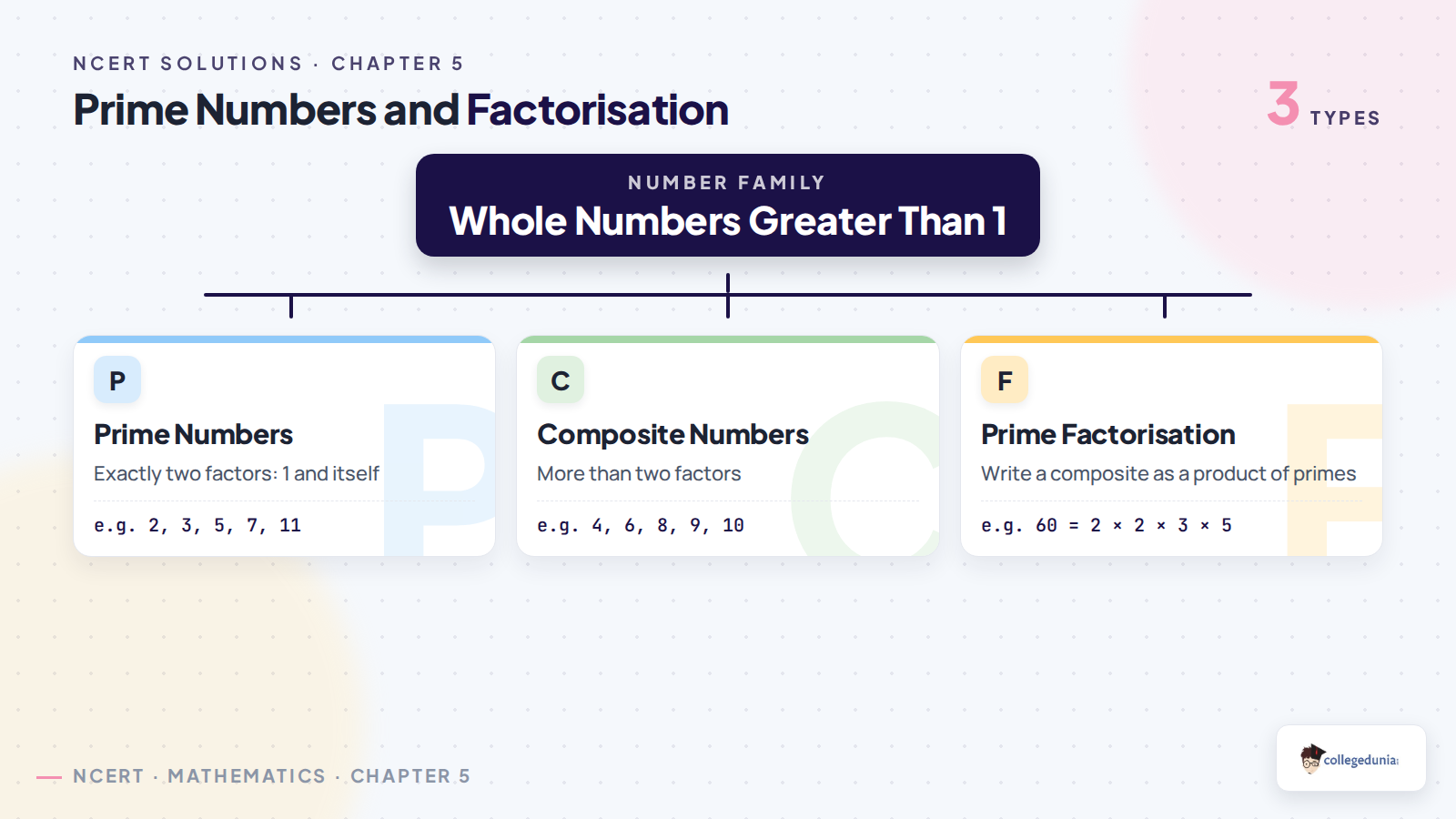
Prime factorisation means breaking a number into prime factors. Keep dividing a composite factor until every factor is prime. The order can change, but the final prime factors stay the same.
- Start with the smallest prime factor that divides the number.
- Divide, then repeat with the quotient.
- Stop only when every written factor is prime.
- Multiply the prime factors to check the original number.
For example, 60 = 2 × 2 × 3 × 5. The product returns 60, so the factorisation is correct. A composite factor left in the final line means the work is incomplete.
Divisibility Rules Used in Prime Time Solutions
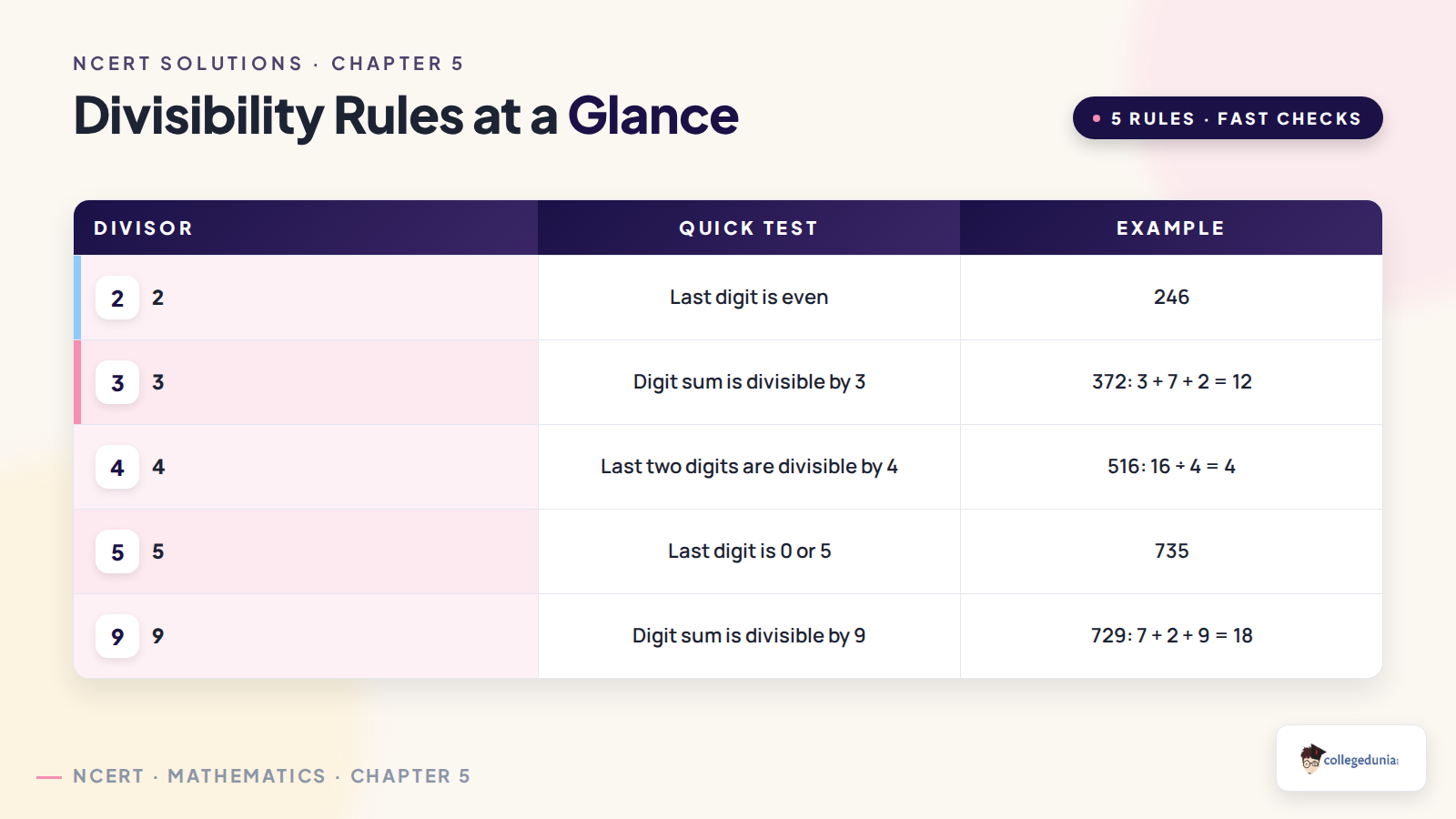
Divisibility rules help students test large numbers without full division. Apply the correct rule, then explain the result in one short sentence.
| Divisor | Quick test |
|---|---|
| 2 | The last digit is even. |
| 3 | The sum of the digits is divisible by 3. |
| 4 | The number formed by the last two digits is divisible by 4. |
| 5 | The last digit is 0 or 5. |
| 6 | The number is divisible by both 2 and 3. |
| 8 | The number formed by the last three digits is divisible by 8. |
| 9 | The sum of the digits is divisible by 9. |
| 10 | The last digit is 0. |
A divisibility test proves exact division; it does not give the quotient. Divide separately when the question also asks for the quotient.
Common Mistakes in Prime Time NCERT Solutions
Most errors come from incomplete lists or from calling 1 a prime number. Another common mistake is stopping prime factorisation too early.
- Do not leave 1 out of a factor list.
- Do not include the number itself in a proper-factor list.
- Do not confuse factors with multiples.
- Do not apply the rule for 3 to test divisibility by 9.
- Do not write a composite number as a final prime factor.
Quick check: multiply all prime factors. The product must equal the number you started with.
How to Practise Prime Time Questions Step by Step
Try the activity before opening the answer. Compare your method with the solution, mark the first wrong step, and solve the question again.
- Play Idli-Vada with a new pair of numbers.
- Use jumps to find every factor of a chosen number.
- Mark primes on a number grid by crossing out multiples.
- Make factor trees for three composite numbers.
A 25-minute practice round is enough for one activity and its checks. Keep the last five minutes for correcting factor lists.
Student Feedback on Prime Time Class 6 Mathematics
In a Collegedunia poll of 10,680 students before the 2026 school exams, most students found factor trees easier after checking each product.
Source: 2026-27 Class 6 Mathematics student poll
Related Resources for Prime Time Class 6
Use these Collegedunia resources to read, revise, and practise the same chapter in different ways.
| Resource | What it offers |
|---|---|
| Prime Time Class 6 Notes | Definitions, rules, and quick examples |
| Prime Time NCERT Book | Official chapter activities and exercises |
| Prime Time Handwritten Notes | Fast revision of factors and divisibility |
NCERT Solutions for Class 6 Mathematics Ganita Prakash: All Chapters
Move between these solution pages while working through the Ganita Prakash textbook.
| Chapter | NCERT Solutions |
|---|---|
| Chapter 1 | Patterns in Mathematics Solutions |
| Chapter 2 | Lines and Angles Solutions |
| Chapter 3 | Number Play Solutions |
| Chapter 4 | Data Handling and Presentation Solutions |
| Chapter 5 | Prime Time Solutions |
| Chapter 6 | Perimeter and Area Solutions |
| Chapter 7 | Fractions Solutions |
| Chapter 8 | Playing with Constructions Solutions |
| Chapter 9 | Symmetry Solutions |
| Chapter 10 | The Other Side of Zero Solutions |
Practice questions: Open the Prime Time step-by-step question cards.
Prime Time Class 6 Mathematics NCERT Solutions FAQs
Ques. What is a prime number?
Ans. A prime number is a whole number greater than 1 with exactly two factors: 1 and the number itself.
Ques. What is a composite number?
Ans. A composite number is a whole number greater than 1 that has more than two factors.
Ques. Is 1 a prime number?
Ans. No. The number 1 has only one factor, so it is neither prime nor composite.
Ques. What is prime factorisation?
Ans. Prime factorisation means writing a composite number as a product containing only prime numbers.
Ques. How can students find common factors?
Ans. List every factor of each number, then select the factors that appear in all the lists.
Ques. How can students find common multiples?
Ans. Write multiples of each number and identify the values shared by every list.
Ques. Are these Prime Time solutions based on the 2026-27 book?
Ans. Yes. The answers follow Class 6 Ganita Prakash Chapter 5 Prime Time for the 2026-27 session.



Comments